

- Industry Size (2026)
- USD 1.50 Bn
- Forecast (2036)
- USD 1.92 Bn
- CAGR (2026 to 2036)
- 2.5%
Acetate Cloth Tape Market Size, Market Forecast and Outlook By FMI
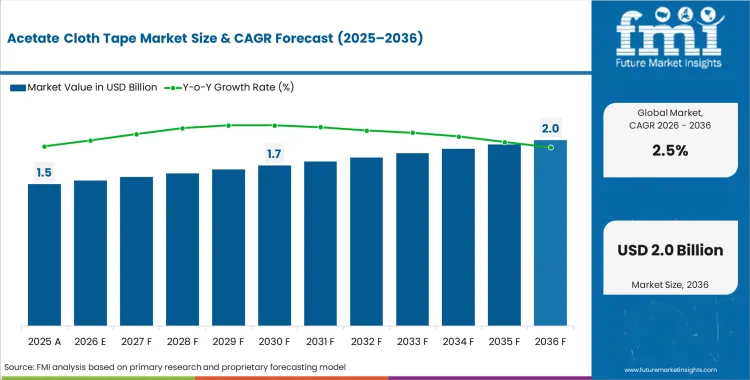
The Acetate Cloth Tape market was valued at USD 1.46 billion in 2025, projected to reach USD 1.50 billion in 2026, and is forecast to expand to USD 1.92 billion by 2036 at a 2.5% CAGR. Acetate cloth tape serves as a specialist electrical insulation and harness bundling material across automotive wiring assemblies, consumer electronics manufacturing, and industrial cable management applications, where its combination of conformable woven acetate backing, controlled adhesive tack, and abrasion resistance provides performance characteristics not replicated by standard plastic film tapes. FMI is of the opinion that the acetate cloth tape market is a mature, application-specific specialty tape category where demand is shaped by automotive production volumes, electronic device manufacturing output, and the performance specifications embedded in OEM wiring harness and cable management standards rather than by broad economic expansion. The market is closely linked to automotive wiring harness market demand cycles and consumer electronics assembly supply chain dynamics in Asia Pacific.
Summary of Acetate Cloth Tape Market
- Market Snapshot
- The Acetate Cloth Tape market is valued at USD 1.46 billion in 2025 and is projected to reach USD 1.92 billion by 2036.
- The industry is expected to grow at a 2.5% CAGR from 2026 to 2036, creating an incremental opportunity of USD 0.431 billion.
- The market is a mature, specification-driven category where adhesive type differentiation, regulatory compliance requirements, and end-use industry expansion define competitive positioning.
- Demand and Growth Drivers
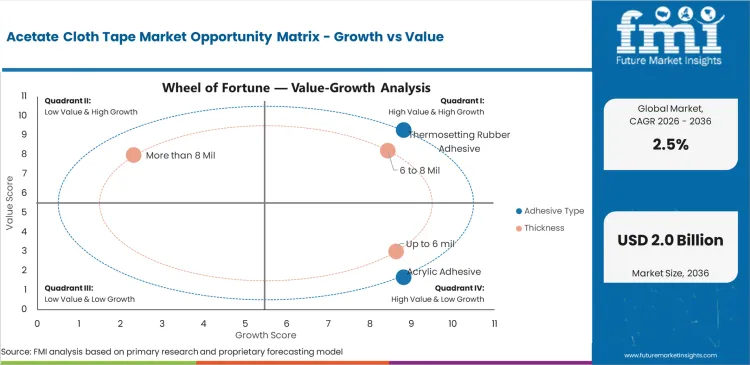
- Demand is driven by 6 to 8 mil procurement growth across liner less application segments in key industrial and consumer end-use markets.
- Product performance specifications mandated by end-use industry standards and regulatory compliance requirements anchor demand for certified acetate cloth tape grades across major markets.
- Asia Pacific manufacturing expansion and downstream industry growth in pharmaceuticals, construction, and consumer goods sectors are generating incremental demand across all product grades.
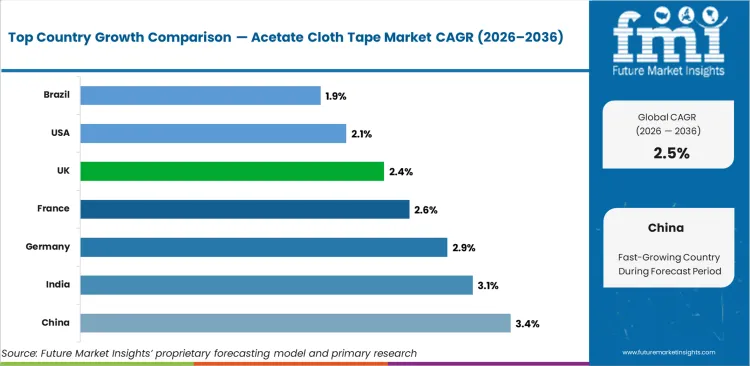
- China leads at 3.4% CAGR, followed by India at 3.1%, Germany at 2.9%, France at 2.6%, UK at 2.4%, USA at 2.1%, and Brazil at 1.9%.
- Product and Segment View
- The market covers acetate cloth tape products across adhesive type categories and application grades serving industrial, commercial, and regulated end-use procurement channels.
- Thermosetting Rubber Adhesive leads Adhesive Type with 57.6% share in 2026, driven by its performance advantages and established specification acceptance across primary end-use applications.
- 6 to 8 Mil accounts for 44.8% by Thickness in 2026, reflecting its dominant positioning in established procurement channels.
- Liner less holds 53.2% by Liner in 2026, anchored by volume consumption in key industrial and commercial end-use segments.
- Scope includes certified acetate cloth tape products for defined end-use applications; excludes precursor chemicals, downstream derivative products, and non-certified materials.
- Geography and Competitive Outlook
- China and India are the fastest-growing markets driven by manufacturing industry expansion and regulatory compliance adoption, while established markets in Germany, UK, and USA sustain steady demand through replacement and compliance upgrade cycles.
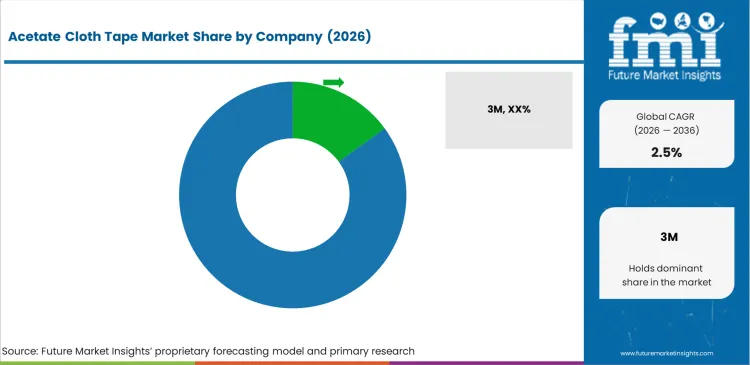
- Competition is served by global integrated chemical and materials manufacturers alongside regional specialists, with key players including 3M, Nitto Denko, Teraoka Seisakusho, Parafix Tapes & Conversions, PPI Adhesive Products, Kruse Adhesive Tape, Symbio, Kingzom.
Acetate Cloth Tape Market Key Takeaways
| Metric | Details |
|---|---|
| Industry Size (2026) | USD 1.50 billion |
| Industry Value (2036) | USD 1.92 billion |
| CAGR (2026 to 2036) | 2.5% |
| Source | Future Market Insights, 2026 |
The absolute dollar increment from 2026 to 2036 stands at USD 0.431 billion, reflecting a steady-growth specialty material category with limited volume upside but stable demand anchored by mandated performance specifications in automotive and electronics applications. FMI analysts observe that automotive electrification programmes are creating a net mixed demand signal for acetate cloth tape, as electric vehicle wiring harness architectures incorporate high-voltage cable assemblies requiring specific insulation tape grades while simultaneously reducing low-voltage ancillary harness content relative to internal combustion engine vehicles. Thermosetting rubber adhesive formulations maintain share leadership due to their superior heat resistance and adhesion retention at elevated operating temperatures encountered in engine bay and under-bonnet wiring applications, supporting a modest price premium over thermoplastic alternatives.
China leads at a 3.4% CAGR through 2036, driven by domestic automotive production and the concentration of consumer electronics manufacturing that generates consistent acetate cloth tape procurement. India follows at 3.1% as automotive manufacturing capacity expansion and electronics assembly growth drive tape demand. Germany advances at 2.9% supported by premium automotive OEM production and precision industrial cable assembly requirements. France progresses at 2.6% anchored by automotive and industrial manufacturing. The United Kingdom tracks at 2.4%, the United States at 2.1% supported by automotive and electronics manufacturing, and Brazil at 1.9% from automotive sector activity.
Acetate Cloth Tape Market Definition
The Acetate Cloth Tape market encompasses pressure-sensitive adhesive tapes constructed with a woven or non-woven acetate fabric backing coated with thermosetting or thermoplastic rubber adhesive systems, designed for electrical insulation, wire and cable bundling, harness wrapping, and surface protection in automotive, electronics, and industrial applications. Products operate under defined temperature resistance, voltage insulation, and abrasion resistance specifications mandated by automotive OEM wiring harness standards and consumer electronics manufacturing quality requirements.
Acetate Cloth Tape Market Inclusions
Market scope includes acetate cloth tape rolls in standard and custom widths for automotive wiring harness assembly, consumer electronics cable management, industrial cable bundling, and electrical insulation applications, across thermosetting rubber adhesive and thermoplastic rubber adhesive formulations in liner less and lined configurations. OEM-specification acetate cloth tapes certified to automotive harness tape standards and electronics manufacturing quality specifications are fully incorporated.
Acetate Cloth Tape Market Exclusions
Standard polyvinyl chloride electrical insulation tape, polyester film adhesive tape, non-woven fabric tape without acetate backing composition, and foam adhesive tape products fall outside market scope. Industrial masking tape, high-temperature polyimide tape, and specialty fibre-reinforced structural adhesive tape are explicitly excluded. Acetate fabric without adhesive coating as a standalone textile material is omitted from market valuation.
Acetate Cloth Tape Market Research Methodology
- Primary Research: FMI analysts engaged with procurement managers, product development engineers, and regulatory compliance specialists across key end-use industries, alongside acetate cloth tape manufacturer product executives, to map demand drivers, specification requirements, and regulatory compliance triggers governing market adoption.
- Desk Research: Data aggregation incorporated end-use industry production statistics from national statistical agencies, regulatory standards documentation, company primary disclosures from annual reports and investor presentations, and official product launch and capacity expansion announcements from manufacturers.
- Market-Sizing and Forecasting: Baseline values were derived from bottom-up aggregation of end-use industry output volumes, acetate cloth tape consumption intensity per unit of end-use production, and regional product grade mix, with forward projections applying regulatory adoption curves and end-use industry growth rates from government and multilateral statistical sources.
- Data Validation and Update Cycle: Projections are cross-validated against publicly reported revenue and volume data from leading manufacturers and calibrated against end-use industry production output statistics from government statistical agencies and regulatory authority programme reports.
Why is the Acetate Cloth Tape Market Growing?
The Acetate Cloth Tape market is experiencing steady growth driven by its extensive use across industrial, commercial, and specialty applications. The market expansion is being influenced by the increasing demand for high-performance bonding solutions that offer durability, flexibility, and resistance to heat, moisture, and abrasion. Industrial sectors are leveraging acetate cloth tapes for assembly, insulation, and packaging applications, where reliable adhesion and mechanical strength are critical.
Growing automation in manufacturing processes has further amplified the need for tapes that can perform consistently under varying operational conditions. In addition, the adoption of linerless tape designs and specialized adhesive formulations has enhanced process efficiency and reduced material waste, making acetate cloth tapes more attractive for end users.
The rising focus on occupational safety and standardized bonding practices has also supported market adoption As industries continue to prioritize productivity, operational safety, and cost-effective solutions, acetate cloth tapes are expected to maintain strong demand, with continued opportunities for product innovation and specialized formulations catering to high-performance applications.
Segmental Analysis
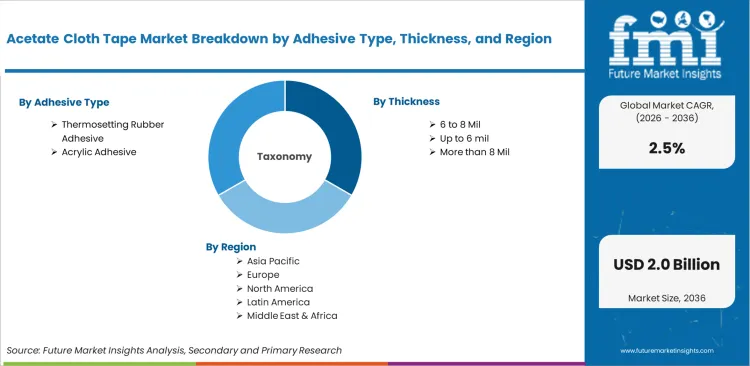
The acetate cloth tape market is segmented by adhesive type, thickness, liner, application, end-use industry, and geographic regions. By adhesive type, acetate cloth tape market is divided into Thermosetting Rubber Adhesive and Acrylic Adhesive. In terms of thickness, acetate cloth tape market is classified into 6 to 8 Mil, Up to 6 mil, and More than 8 Mil. Based on liner, acetate cloth tape market is segmented into Liner less and With Liner. By application, acetate cloth tape market is segmented into Insulation, Sealing, Bundling, and Wrapping. By end-use industry, acetate cloth tape market is segmented into Electrical Industry and Electronics Industry. Regionally, the acetate cloth tape industry is classified into North America, Latin America, Western Europe, Eastern Europe, Balkan & Baltic Countries, Russia & Belarus, Central Asia, East Asia, South Asia & Pacific, and the Middle East & Africa.
Insights into the Thermosetting Rubber Adhesive Segment
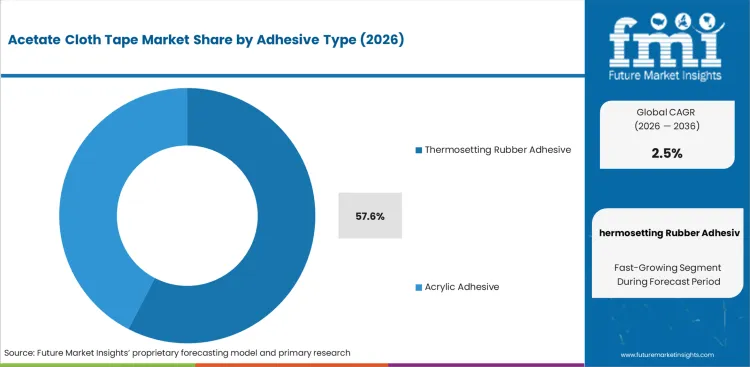
The thermosetting rubber adhesive segment is projected to hold 57.60% of the Acetate Cloth Tape market revenue share in 2026, establishing it as the leading adhesive type. This dominance is being attributed to its superior bonding strength, temperature resistance, and versatility across diverse substrates.
Adoption has been supported by industrial and commercial applications where long-lasting adhesion is required under challenging environmental conditions. The growth of this segment has been further reinforced by the ability to deliver consistent performance in both automated and manual assembly processes.
Additionally, thermosetting rubber adhesives provide a balance of tack, peel strength, and shear resistance, which is crucial for high-performance tape applications As manufacturers seek reliable and durable bonding solutions that can withstand mechanical stress, heat, and moisture, the thermosetting rubber adhesive segment is anticipated to retain its market leadership, with continued innovation enhancing adhesive formulations to meet evolving industrial needs.
Insights into the 6 to 8 Mil Thickness Segment
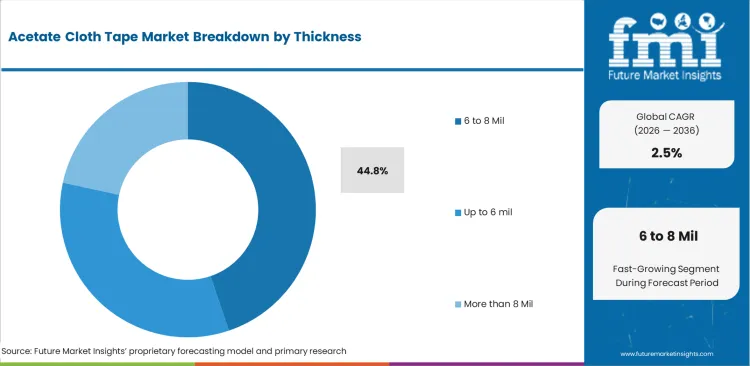
The 6 to 8 Mil thickness segment is expected to capture 44.80% of the Acetate Cloth Tape market revenue share in 2026, making it the most preferred thickness range. This growth is being driven by the optimal balance it provides between flexibility and mechanical strength, which allows effective bonding without compromising substrate conformity.
The thickness range is widely adopted in electrical insulation, packaging reinforcement, and industrial masking applications, where moderate thickness ensures durability while minimizing material usage. Its ease of handling and compatibility with both manual and automated processes has supported widespread industry acceptance.
As manufacturers prioritize efficient, reliable, and cost-effective tape solutions, the 6 to 8 Mil thickness segment is expected to maintain its leading position, supported by its adaptability to a broad range of applications and operational conditions.
Insights into the Linerless Segment
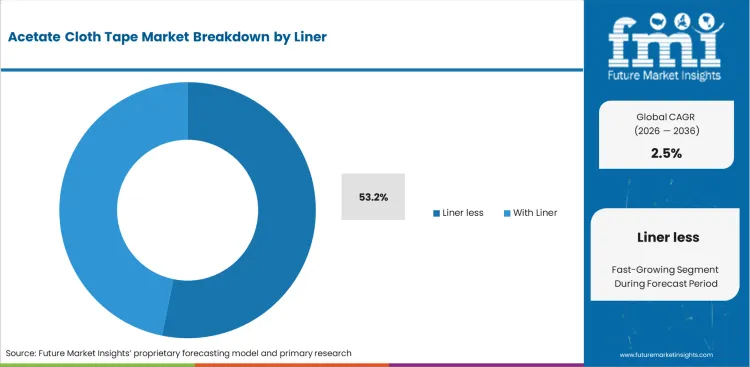
The linerless segment is projected to account for 53.20% of the Acetate Cloth Tape market revenue share in 2026, establishing it as the dominant liner type. This growth is being driven by its ability to reduce material waste and enhance process efficiency, eliminating the need to remove a backing liner during application.
Linerless tapes have become increasingly preferred in automated production lines and high-volume industrial processes, where speed and operational efficiency are critical. The segment’s popularity has also been supported by its adaptability across diverse applications such as insulation, assembly, and packaging reinforcement.
Additionally, linerless designs simplify handling and storage, reducing operational costs while maintaining performance standards As industries continue to focus on productivity, sustainability, and streamlined manufacturing workflows, the linerless segment is expected to retain its leadership in the acetate cloth tape market, with further innovation in adhesive and backing materials enhancing usability and performance.
Market Overview
Global Acetate Cloth Tape Market: An Overview
Due to the continuous drive within the global electronics and electrical industry to reduce component size, comes the ever-growing necessity to protect parts from overheating. Acetate cloth tape is a pressure-sensitive tape used for insulation. The structure of acetate cloth tape consists of acetate fabric coated with a pressure-sensitive adhesive on one side. Acetate cloth tape has stable adhesive properties. These tapes are made of flexible acetate fabric and work well both on even and uneven surfaces. Acetate cloth tape has an aesthetic appeal and offers excellent conformability in coil wrapping applications, is printable, and has temperature resistance up to 120 °C.
The key application for these tapes is the final bandaging and identification of coils and relays with printed acetate cloth tapes. The acetate cloth tape offers printing space on its surface. Manufacturers of acetate cloth tape offer tapes in a variety of widths, color, and thicknesses for end-use industries and these can also be customized as per the client's requirement.
Global Acetate Cloth Tape Market: Drivers & Restraints
The demand for acetate cloth tape is expected to grow during the forecast period against the backdrop of the pressure-sensitive tape market. Acetate cloth tape can absorb varnishes and electrical insulating resins. Acetate cloth tape is hand tearable and doesn’t require an additional tool such as scissors or a knife for cutting or tearing. The key application of acetate cloth tape is in the electrical and electronics industry. Acetate cloth tape is known for its high-quality finishing and durability. These tapes are made with heat-curing adhesive to resist a range of high temperatures.
Acetate cloth tape manufacturers utilize the printing space for branding and promotional purpose. The increasing significance of packaging in industries full supply chain and logistics functions have provided packaging manufacturers to offer packaging products such as acetate cloth tape to cater to clients operating in the electrical and electronics industry. Acetate cloth tape is easy to apply and stays stuck as the strength of thermosetting rubber adhesive increases over time and on exposure to high temperatures. These factors are expected to further drive the global acetate cloth tape market during the forecast period.
Global Acetate Cloth Tape Market: Regional Outlook
Globally, the market for acetate cloth tape is divided into seven key regions - North America, Western Europe, Latin America, Eastern Europe, the Asia Pacific excluding Japan, the Middle East & Africa, and Japan. Among these regions, the Asia Pacific excluding Japan is expected to spearhead the global acetate cloth tape market in terms of growth and consumption. European and American regions are expected to expand at a below-average growth rate during the forecast period.
Acetate Cloth Tape Market: Some of the Key Players
Following are some of the key players operating in the acetate cloth tape market are 3M Company, Nitto Denko Corporation, Teraoka Seisakusho Co., Ltd., Parafix Tapes & Conversions Ltd, PPI Adhesive Products (C.E.) s.r.o., Kruse Adhesive Tape, Symbio, Inc., Kingzom Co., Limited, etc. Many more unorganized and local players are expected to contribute to the global acetate cloth tape market during the forecast period.
The report is a compilation of first-hand information, qualitative and quantitative assessments by industry analysts, and inputs from industry experts and industry participants across the value chain. The report provides an in-depth analysis of parent market trends, macroeconomic indicators and governing factors along with acetate cloth tape market attractiveness as per segments. The report also maps the qualitative impact of various market factors on acetate cloth tape market segments and geographies.
Analysis of Acetate Cloth Tape Market By Key Countries
.webp "Top Country Growth Comparison Acetate Cloth Tape Market Cagr (2026 2036)")
| Country | CAGR |
|---|---|
| China | 3.4% |
| India | 3.1% |
| Germany | 2.9% |
| France | 2.6% |
| UK | 2.4% |
| USA | 2.1% |
| Brazil | 1.9% |
Country-wise Analysis
The Acetate Cloth Tape Market is expected to register a CAGR of 2.5% during the forecast period, exhibiting varied country level momentum. China leads with the highest CAGR of 3.4%, followed by India at 3.1%. Developed markets such as Germany, France, and the UK continue to expand steadily, while the USA is likely to grow at consistent rates. Brazil posts the lowest CAGR at 1.9%, yet still underscores a broadly positive trajectory for the global Acetate Cloth Tape Market. In 2026, Germany held a dominant revenue in the Western Europe market and is expected to grow with a CAGR of 2.9%. The USA Acetate Cloth Tape Market is estimated to be valued at USD 525.8 million in 2026 and is anticipated to reach a valuation of USD 648.9 million by 2036. Sales are projected to rise at a CAGR of 2.1% over the forecast period between 2026 and 2036. While Japan and South Korea markets are estimated to be valued at USD 74.4 million and USD 45.7 million respectively in 2026.
Key Players in the Acetate Cloth Tape Market
- 3M
- Nitto Denko
- Teraoka Seisakusho
- Parafix Tapes & Conversions
- PPI Adhesive Products
- Kruse Adhesive Tape
- Symbio
- Kingzom
Scope of the Report
| Metric | Value |
|---|---|
| Quantitative Units | USD 1.50 billion to USD 1.92 billion, at a CAGR of 2.5% |
| Market Definition | The Acetate Cloth Tape market encompasses pressure-sensitive adhesive tapes constructed with a woven or non-woven acetate fabric backing coated with thermosetting or thermoplastic rubber adhesive systems, designed for electrical insulation, wire and ... |
| Adhesive Type Segmentation | Thermosetting Rubber Adhesive, Thermoplastic Rubber Adhesive) |
| Thickness Segmentation | 6 to 8 Mil, Below 6 Mil, Above 8 Mil) |
| Regions Covered | North America, Latin America, Europe, East Asia, South Asia, Oceania, Middle East & Africa |
| Countries Covered | China, India, Germany, France, UK, USA, Brazil, and 40 plus countries |
| Key Companies Profiled | 3M, Nitto Denko, Teraoka Seisakusho, Parafix Tapes & Conversions, PPI Adhesive Products, Kruse Adhesive Tape, Symbio, Kingzom |
| Forecast Period | 2026 to 2036 |
| Approach | Bottom-up aggregation from end-use industry output volumes and acetate cloth tape consumption intensity rates, with scenario modelling for regulatory compliance adoption timelines and grade mix transitions. |
Acetate Cloth Tape Market by Segments
Adhesive Type:
- Thermosetting Rubber Adhesive
- Acrylic Adhesive
Thickness:
- 6 to 8 Mil
- Up to 6 mil
- More than 8 Mil
Liner:
- Liner less
- With Liner
Application:
- Insulation
- Sealing
- Bundling
- Wrapping
End-use Industry:
- Electrical Industry
- Electronics Industry
Region:
- North America
- USA
- Canada
- Mexico
- Latin America
- Brazil
- Chile
- Rest of Latin America
- Western Europe
- Germany
- UK
- Italy
- Spain
- France
- Nordic
- BENELUX
- Rest of Western Europe
- Eastern Europe
- Russia
- Poland
- Hungary
- Balkan & Baltic
- Rest of Eastern Europe
- East Asia
- China
- Japan
- South Korea
- South Asia and Pacific
- India
- ASEAN
- Australia & New Zealand
- Rest of South Asia and Pacific
- Middle East & Africa
- Kingdom of Saudi Arabia
- Other GCC Countries
- Turkiye
- South Africa
- Other African Union
- Rest of Middle East & Africa
Bibliography
- 1. International Electrotechnical Commission. (2023). IEC 60684: Flexible insulating sleevings and tapes. IEC. https://www.iec.ch
- 2. International Organisation for Standardisation. (2023). ISO 6722: Road vehicles: Single-core cables. ISO. https://www.iso.org
- 3. Society of Automotive Engineers. (2025). SAE J1273: Hose assemblies performance requirements. SAE International. https://www.sae.org
- 4. European Chemicals Agency. (2025). Substance evaluation and restriction progress report. ECHA. https://www.echa.europa.eu
- 5. Japan Automobile Manufacturers Association. (2025). Automobile production statistics. JAMA. https://www.jama.or.jp
- 6. Ministry of Heavy Industries, Government of India. (2025). Automotive Mission Plan progress report. MHI. https://www.siam.in
This bibliography is provided for reader reference. The full Future Market Insights report contains the complete reference list with primary research documentation.
Frequently Asked Questions
How large is the Acetate Cloth Tape market in 2026?
The Acetate Cloth Tape market is estimated at USD 1.50 billion in 2026.
What will the Acetate Cloth Tape market size reach by 2036?
The market is projected to reach USD 1.92 billion by 2036.
What is the CAGR for the Acetate Cloth Tape market from 2026 to 2036?
The market is expected to grow at a CAGR of 2.5% from 2026 to 2036.
Which Adhesive Type segment leads the Acetate Cloth Tape market in 2026?
Thermosetting Rubber Adhesive holds 57.6% share in 2026, driven by its superior heat resistance and adhesion retention in automotive under-bonnet and industrial high-temperature wiring applications.
Which Thickness segment dominates in 2026?
The 6 to 8 Mil thickness range accounts for 44.8% share in 2026, representing the standard specification range for automotive OEM wiring harness wrapping and general industrial cable bundling applications.
Which country is the fastest-growing market for Acetate Cloth Tape?
China leads with a 3.4% CAGR through 2036, driven by domestic automotive production volumes and the concentration of consumer electronics assembly operations generating consistent specialty tape procurement.
What application is driving primary demand for Acetate Cloth Tape?
Automotive wiring harness assembly is the primary demand driver, where acetate cloth tape is specified by OEM wiring standards for its conformability, abrasion resistance, and electrical insulation performance in harness bundling and cable management applications.
Preview the report firsthand - request a free sample
Get SampleGet the brochure for pricing and purchase details.
Get PDFTable of Content
- Executive Summary
- Global Market Outlook
- Demand-side Trends
- Supply-side Trends
- Technology Roadmap Analysis
- Analysis and Recommendations
- Market Overview
- Market Coverage / Taxonomy
- Market Definition / Scope / Limitations
- Research Methodology
- Chapter Orientation
- Analytical Lens and Working Hypotheses
- Market Structure, Signals, and Trend Drivers
- Benchmarking and Cross-market Comparability
- Market Sizing, Forecasting, and Opportunity Mapping
- Research Design and Evidence Framework
- Desk Research Programme (Secondary Evidence)
- Company Annual and Sustainability Reports
- Peer-reviewed Journals and Academic Literature
- Corporate Websites, Product Literature, and Technical Notes
- Earnings Decks and Investor Briefings
- Statutory Filings and Regulatory Disclosures
- Technical White Papers and Standards Notes
- Trade Journals, Industry Magazines, and Analyst Briefs
- Conference Proceedings, Webinars, and Seminar Materials
- Government Statistics Portals and Public Data Releases
- Press Releases and Reputable Media Coverage
- Specialist Newsletters and Curated Briefings
- Sector Databases and Reference Repositories
- FMI Internal Proprietary Databases and Historical Market Datasets
- Subscription Datasets and Paid Sources
- Social Channels, Communities, and Digital Listening Inputs
- Additional Desk Sources
- Expert Input and Fieldwork (Primary Evidence)
- Primary Modes
- Qualitative Interviews and Expert Elicitation
- Quantitative Surveys and Structured Data Capture
- Blended Approach
- Why Primary Evidence is Used
- Field Techniques
- Interviews
- Surveys
- Focus Groups
- Observational and In-context Research
- Social and Community Interactions
- Stakeholder Universe Engaged
- C-suite Leaders
- Board Members
- Presidents and Vice Presidents
- R&D and Innovation Heads
- Technical Specialists
- Domain Subject-matter Experts
- Scientists
- Physicians and Other Healthcare Professionals
- Governance, Ethics, and Data Stewardship
- Research Ethics
- Data Integrity and Handling
- Primary Modes
- Tooling, Models, and Reference Databases
- Desk Research Programme (Secondary Evidence)
- Data Engineering and Model Build
- Data Acquisition and Ingestion
- Cleaning, Normalisation, and Verification
- Synthesis, Triangulation, and Analysis
- Quality Assurance and Audit Trail
- Market Background
- Market Dynamics
- Drivers
- Restraints
- Opportunity
- Trends
- Scenario Forecast
- Demand in Optimistic Scenario
- Demand in Likely Scenario
- Demand in Conservative Scenario
- Opportunity Map Analysis
- Product Life Cycle Analysis
- Supply Chain Analysis
- Investment Feasibility Matrix
- Value Chain Analysis
- PESTLE and Porter’s Analysis
- Regulatory Landscape
- Regional Parent Market Outlook
- Production and Consumption Statistics
- Import and Export Statistics
- Market Dynamics
- Global Market Analysis 2021 to 2025 and Forecast, 2026 to 2036
- Historical Market Size Value (USD Million) Analysis, 2021 to 2025
- Current and Future Market Size Value (USD Million) Projections, 2026 to 2036
- Y-o-Y Growth Trend Analysis
- Absolute $ Opportunity Analysis
- Global Market Pricing Analysis 2021 to 2025 and Forecast 2026 to 2036
- Global Market Analysis 2021 to 2025 and Forecast 2026 to 2036, By Adhesive Type
- Introduction / Key Findings
- Historical Market Size Value (USD Million) Analysis By Adhesive Type , 2021 to 2025
- Current and Future Market Size Value (USD Million) Analysis and Forecast By Adhesive Type , 2026 to 2036
- Thermosetting Rubber Adhesive
- Acrylic Adhesive
- Thermosetting Rubber Adhesive
- Y-o-Y Growth Trend Analysis By Adhesive Type , 2021 to 2025
- Absolute $ Opportunity Analysis By Adhesive Type , 2026 to 2036
- Global Market Analysis 2021 to 2025 and Forecast 2026 to 2036, By Thickness
- Introduction / Key Findings
- Historical Market Size Value (USD Million) Analysis By Thickness, 2021 to 2025
- Current and Future Market Size Value (USD Million) Analysis and Forecast By Thickness, 2026 to 2036
- 6 to 8 Mil
- Up to 6 mil
- More than 8 Mil
- 6 to 8 Mil
- Y-o-Y Growth Trend Analysis By Thickness, 2021 to 2025
- Absolute $ Opportunity Analysis By Thickness, 2026 to 2036
- Global Market Analysis 2021 to 2025 and Forecast 2026 to 2036, By Liner
- Introduction / Key Findings
- Historical Market Size Value (USD Million) Analysis By Liner, 2021 to 2025
- Current and Future Market Size Value (USD Million) Analysis and Forecast By Liner, 2026 to 2036
- Liner less
- With Liner
- Liner less
- Y-o-Y Growth Trend Analysis By Liner, 2021 to 2025
- Absolute $ Opportunity Analysis By Liner, 2026 to 2036
- Global Market Analysis 2021 to 2025 and Forecast 2026 to 2036, By Application
- Introduction / Key Findings
- Historical Market Size Value (USD Million) Analysis By Application, 2021 to 2025
- Current and Future Market Size Value (USD Million) Analysis and Forecast By Application, 2026 to 2036
- Insulation
- Sealing
- Bundling
- Wrapping
- Insulation
- Y-o-Y Growth Trend Analysis By Application, 2021 to 2025
- Absolute $ Opportunity Analysis By Application, 2026 to 2036
- Global Market Analysis 2021 to 2025 and Forecast 2026 to 2036, By End-use Industry
- Introduction / Key Findings
- Historical Market Size Value (USD Million) Analysis By End-use Industry, 2021 to 2025
- Current and Future Market Size Value (USD Million) Analysis and Forecast By End-use Industry, 2026 to 2036
- Electrical Industry
- Electronics Industry
- Electrical Industry
- Y-o-Y Growth Trend Analysis By End-use Industry, 2021 to 2025
- Absolute $ Opportunity Analysis By End-use Industry, 2026 to 2036
- Global Market Analysis 2021 to 2025 and Forecast 2026 to 2036, By Region
- Introduction
- Historical Market Size Value (USD Million) Analysis By Region, 2021 to 2025
- Current Market Size Value (USD Million) Analysis and Forecast By Region, 2026 to 2036
- North America
- Latin America
- Western Europe
- Eastern Europe
- East Asia
- South Asia and Pacific
- Middle East & Africa
- Market Attractiveness Analysis By Region
- North America Market Analysis 2021 to 2025 and Forecast 2026 to 2036, By Country
- Historical Market Size Value (USD Million) Trend Analysis By Market Taxonomy, 2021 to 2025
- Market Size Value (USD Million) Forecast By Market Taxonomy, 2026 to 2036
- By Country
- USA
- Canada
- Mexico
- By Adhesive Type
- By Thickness
- By Liner
- By Application
- By End-use Industry
- By Country
- Market Attractiveness Analysis
- By Country
- By Adhesive Type
- By Thickness
- By Liner
- By Application
- By End-use Industry
- Key Takeaways
- Latin America Market Analysis 2021 to 2025 and Forecast 2026 to 2036, By Country
- Historical Market Size Value (USD Million) Trend Analysis By Market Taxonomy, 2021 to 2025
- Market Size Value (USD Million) Forecast By Market Taxonomy, 2026 to 2036
- By Country
- Brazil
- Chile
- Rest of Latin America
- By Adhesive Type
- By Thickness
- By Liner
- By Application
- By End-use Industry
- By Country
- Market Attractiveness Analysis
- By Country
- By Adhesive Type
- By Thickness
- By Liner
- By Application
- By End-use Industry
- Key Takeaways
- Western Europe Market Analysis 2021 to 2025 and Forecast 2026 to 2036, By Country
- Historical Market Size Value (USD Million) Trend Analysis By Market Taxonomy, 2021 to 2025
- Market Size Value (USD Million) Forecast By Market Taxonomy, 2026 to 2036
- By Country
- Germany
- UK
- Italy
- Spain
- France
- Nordic
- BENELUX
- Rest of Western Europe
- By Adhesive Type
- By Thickness
- By Liner
- By Application
- By End-use Industry
- By Country
- Market Attractiveness Analysis
- By Country
- By Adhesive Type
- By Thickness
- By Liner
- By Application
- By End-use Industry
- Key Takeaways
- Eastern Europe Market Analysis 2021 to 2025 and Forecast 2026 to 2036, By Country
- Historical Market Size Value (USD Million) Trend Analysis By Market Taxonomy, 2021 to 2025
- Market Size Value (USD Million) Forecast By Market Taxonomy, 2026 to 2036
- By Country
- Russia
- Poland
- Hungary
- Balkan & Baltic
- Rest of Eastern Europe
- By Adhesive Type
- By Thickness
- By Liner
- By Application
- By End-use Industry
- By Country
- Market Attractiveness Analysis
- By Country
- By Adhesive Type
- By Thickness
- By Liner
- By Application
- By End-use Industry
- Key Takeaways
- East Asia Market Analysis 2021 to 2025 and Forecast 2026 to 2036, By Country
- Historical Market Size Value (USD Million) Trend Analysis By Market Taxonomy, 2021 to 2025
- Market Size Value (USD Million) Forecast By Market Taxonomy, 2026 to 2036
- By Country
- China
- Japan
- South Korea
- By Adhesive Type
- By Thickness
- By Liner
- By Application
- By End-use Industry
- By Country
- Market Attractiveness Analysis
- By Country
- By Adhesive Type
- By Thickness
- By Liner
- By Application
- By End-use Industry
- Key Takeaways
- South Asia and Pacific Market Analysis 2021 to 2025 and Forecast 2026 to 2036, By Country
- Historical Market Size Value (USD Million) Trend Analysis By Market Taxonomy, 2021 to 2025
- Market Size Value (USD Million) Forecast By Market Taxonomy, 2026 to 2036
- By Country
- India
- ASEAN
- Australia & New Zealand
- Rest of South Asia and Pacific
- By Adhesive Type
- By Thickness
- By Liner
- By Application
- By End-use Industry
- By Country
- Market Attractiveness Analysis
- By Country
- By Adhesive Type
- By Thickness
- By Liner
- By Application
- By End-use Industry
- Key Takeaways
- Middle East & Africa Market Analysis 2021 to 2025 and Forecast 2026 to 2036, By Country
- Historical Market Size Value (USD Million) Trend Analysis By Market Taxonomy, 2021 to 2025
- Market Size Value (USD Million) Forecast By Market Taxonomy, 2026 to 2036
- By Country
- Kingdom of Saudi Arabia
- Other GCC Countries
- Turkiye
- South Africa
- Other African Union
- Rest of Middle East & Africa
- By Adhesive Type
- By Thickness
- By Liner
- By Application
- By End-use Industry
- By Country
- Market Attractiveness Analysis
- By Country
- By Adhesive Type
- By Thickness
- By Liner
- By Application
- By End-use Industry
- Key Takeaways
- Key Countries Market Analysis
- USA
- Pricing Analysis
- Market Share Analysis, 2025
- By Adhesive Type
- By Thickness
- By Liner
- By Application
- By End-use Industry
- Canada
- Pricing Analysis
- Market Share Analysis, 2025
- By Adhesive Type
- By Thickness
- By Liner
- By Application
- By End-use Industry
- Mexico
- Pricing Analysis
- Market Share Analysis, 2025
- By Adhesive Type
- By Thickness
- By Liner
- By Application
- By End-use Industry
- Brazil
- Pricing Analysis
- Market Share Analysis, 2025
- By Adhesive Type
- By Thickness
- By Liner
- By Application
- By End-use Industry
- Chile
- Pricing Analysis
- Market Share Analysis, 2025
- By Adhesive Type
- By Thickness
- By Liner
- By Application
- By End-use Industry
- Germany
- Pricing Analysis
- Market Share Analysis, 2025
- By Adhesive Type
- By Thickness
- By Liner
- By Application
- By End-use Industry
- UK
- Pricing Analysis
- Market Share Analysis, 2025
- By Adhesive Type
- By Thickness
- By Liner
- By Application
- By End-use Industry
- Italy
- Pricing Analysis
- Market Share Analysis, 2025
- By Adhesive Type
- By Thickness
- By Liner
- By Application
- By End-use Industry
- Spain
- Pricing Analysis
- Market Share Analysis, 2025
- By Adhesive Type
- By Thickness
- By Liner
- By Application
- By End-use Industry
- France
- Pricing Analysis
- Market Share Analysis, 2025
- By Adhesive Type
- By Thickness
- By Liner
- By Application
- By End-use Industry
- India
- Pricing Analysis
- Market Share Analysis, 2025
- By Adhesive Type
- By Thickness
- By Liner
- By Application
- By End-use Industry
- ASEAN
- Pricing Analysis
- Market Share Analysis, 2025
- By Adhesive Type
- By Thickness
- By Liner
- By Application
- By End-use Industry
- Australia & New Zealand
- Pricing Analysis
- Market Share Analysis, 2025
- By Adhesive Type
- By Thickness
- By Liner
- By Application
- By End-use Industry
- China
- Pricing Analysis
- Market Share Analysis, 2025
- By Adhesive Type
- By Thickness
- By Liner
- By Application
- By End-use Industry
- Japan
- Pricing Analysis
- Market Share Analysis, 2025
- By Adhesive Type
- By Thickness
- By Liner
- By Application
- By End-use Industry
- South Korea
- Pricing Analysis
- Market Share Analysis, 2025
- By Adhesive Type
- By Thickness
- By Liner
- By Application
- By End-use Industry
- Russia
- Pricing Analysis
- Market Share Analysis, 2025
- By Adhesive Type
- By Thickness
- By Liner
- By Application
- By End-use Industry
- Poland
- Pricing Analysis
- Market Share Analysis, 2025
- By Adhesive Type
- By Thickness
- By Liner
- By Application
- By End-use Industry
- Hungary
- Pricing Analysis
- Market Share Analysis, 2025
- By Adhesive Type
- By Thickness
- By Liner
- By Application
- By End-use Industry
- Kingdom of Saudi Arabia
- Pricing Analysis
- Market Share Analysis, 2025
- By Adhesive Type
- By Thickness
- By Liner
- By Application
- By End-use Industry
- Turkiye
- Pricing Analysis
- Market Share Analysis, 2025
- By Adhesive Type
- By Thickness
- By Liner
- By Application
- By End-use Industry
- South Africa
- Pricing Analysis
- Market Share Analysis, 2025
- By Adhesive Type
- By Thickness
- By Liner
- By Application
- By End-use Industry
- USA
- Market Structure Analysis
- Competition Dashboard
- Competition Benchmarking
- Market Share Analysis of Top Players
- By Region
- By Adhesive Type
- By Thickness
- By Liner
- By Application
- By End-use Industry
- Competition Analysis
- Competition Deep Dive
- 3M
- Overview
- Product Portfolio
- Profitability by Market Segments (Product/Age /Sales Channel/Region)
- Sales Footprint
- Strategy Overview
- Marketing Strategy
- Product Strategy
- Channel Strategy
- Nitto Denko
- Teraoka Seisakusho
- Parafix Tapes & Conversions
- PPI Adhesive Products
- Kruse Adhesive Tape
- Symbio
- Kingzom
- 3M
- Competition Deep Dive
- Assumptions & Acronyms Used


