

- Industry Size (2025)
- USD 469.6 Mn
- Forecast (2035)
- USD 760.6 Mn
- CAGR (2025 to 2035)
- 4.9%
Tape Dispenser Market Size and Share Forecast Outlook in Japan From 2025 to 2035
The Tape Dispenser Industry Analysis in Japan is estimated to be valued at USD 469.6 million in 2025 and is projected to reach USD 760.6 million by 2035, registering a compound annual growth rate (CAGR) of 4.9% over the forecast period.
Quick Stats for Tape Dispenser Industry Analysis in Japan
- Tape Dispenser Industry Analysis in Japan Industry Value (2025): USD 469.6 million
- Tape Dispenser Industry Analysis in Japan Forecast Value (2035): USD 760.6 million
- Tape Dispenser Industry Analysis in Japan Forecast CAGR: 4.9%
- Leading Segment in Tape Dispenser Industry Analysis in Japan in 2025: Table top (54.6%)
- Key Growth Region in Tape Dispenser Industry Analysis in Japan: North America, Asia-Pacific, Europe
- Top Key Players in Tape Dispenser Industry Analysis in Japan: Tesa SE, Intertape Polymer Group Inc., Fellow Brands, Shurtape Technologies LLC, Koziol USA, START International, Yaesu Keikogyo Co., Ltd, TOYO STEEL Co., Ltd., ARHAN KABUSHIKI KAISHA, Excel Factory Inc.
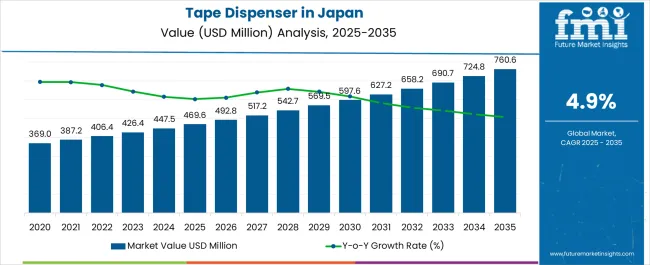
| Metric | Value |
|---|---|
| Tape Dispenser Industry Analysis in Japan Estimated Value in (2025 E) | USD 469.6 million |
| Tape Dispenser Industry Analysis in Japan Forecast Value in (2035 F) | USD 760.6 million |
| Forecast CAGR (2025 to 2035) | 4.9% |
Rationale for Segmental Growth in the Tape Dispenser Industry in Japan
The tape dispenser industry in Japan is demonstrating steady growth as a result of strong demand across office, commercial, and packaging applications. Market development is being influenced by rising operational efficiency needs, user preference for convenience-driven products, and the presence of technologically adaptable solutions. The current scenario reflects stable adoption in both professional and consumer environments, with manufacturers focusing on enhancing design durability, ergonomics, and cost efficiency.
Regulatory emphasis on workplace productivity and safety is also contributing to consistent market expansion. Future outlook is being shaped by automation trends, increased integration of dispensing solutions in organized retail and logistics, and the introduction of sustainable materials that align with environmental standards.
Growth rationale is anchored on Japan’s mature commercial infrastructure, the need for precision in office and industrial applications, and continuous innovation in product designs that improve efficiency, reliability, and long-term usability These factors collectively support sustainable revenue growth and broader market penetration across domestic segments.
Segmental Analysis
Insights into the Product Type Segment
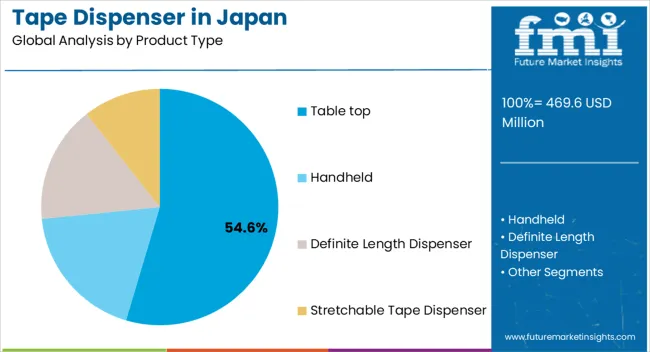
The table top segment, holding 54.60% of the product type category, has maintained its leadership due to its reliability, durability, and widespread application across office and industrial workspaces. Preference for table top models has been reinforced by their stability, ease of use, and suitability for repetitive tasks requiring efficiency.
Manufacturers have been optimizing product designs to improve ergonomics and safety, which has enhanced adoption across diverse professional environments. Consistent demand has been supported by the strong presence of corporate offices and manufacturing facilities in Japan, where workflow optimization is prioritized.
Innovation in multi-roll and heavy-duty variants has also strengthened the value proposition The continued preference for table top dispensers is expected to sustain growth momentum, making the segment a cornerstone of the Japanese tape dispenser industry.
Insights into the Technology Segment
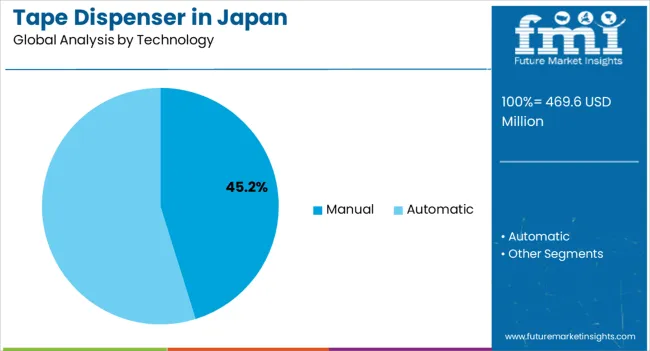
The manual segment, representing 45.20% of the technology category, has retained its dominance due to its cost-effectiveness, ease of operation, and minimal maintenance requirements. Its adoption has been driven by offices, retail stores, and small-scale businesses where affordability and straightforward usage are essential.
Manual dispensers have benefited from design improvements that reduce user fatigue and increase operational efficiency. Strong demand has been observed in environments where automation is not required, reinforcing segment stability.
Manufacturers are focusing on enhancing durability and integrating user-friendly features, ensuring continued relevance in competitive markets As workplace productivity needs expand, the manual dispenser segment is expected to maintain its substantial market presence while serving as a dependable choice for cost-conscious buyers.
Insights into the End-Use Segment
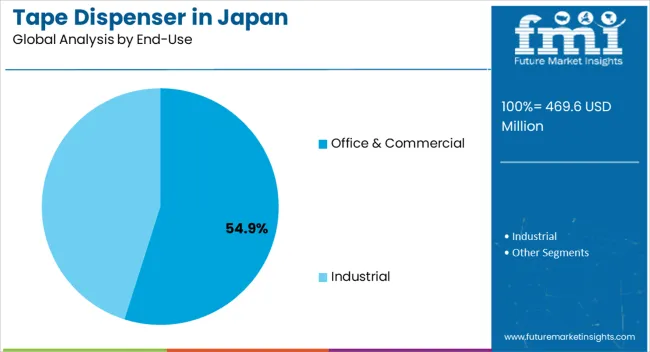
The office and commercial segment, accounting for 54.90% of the end-use category, has been leading the market due to Japan’s well-developed corporate infrastructure and extensive retail and commercial activity. High adoption has been supported by demand for efficient packaging, labeling, and administrative solutions in office settings and retail outlets.
The segment’s strength has been reinforced by large-scale distribution networks and procurement by institutional buyers. Continuous investment in commercial infrastructure and the emphasis on productivity have sustained segment leadership.
Product availability through diversified distribution channels, combined with innovation in ergonomically designed dispensers, has improved accessibility and adoption The office and commercial end-use segment is expected to remain the dominant growth driver, supported by expanding business activities and the ongoing need for efficiency in daily operations.
Top Trends Shaping Demand for Tape Dispensers in Japan
- The rapid growth of e-commerce activities in Japan has significantly increased the demand for reliable packaging solutions. As more consumers turn to online shopping, businesses are compelled to enhance their packaging processes. Tape dispensers play a crucial role in ensuring efficient and secure packaging, meeting the demands of the expanding e-commerce sector.
- Advancements in tape technologies, such as the development of high-performance adhesives and specialized tapes for various applications, influence the demand for compatible tape dispensers. The ability of tape dispensers to accommodate these innovations enhances their relevance in meeting the evolving requirements of businesses across different sectors.
Analysis of Top Regions Utilizing and Manufacturing Tape Dispensers in Japan
Development of Industrial Areas in Kanto Raises the Tape Dispensers
The Kanto region, encompassing Tokyo and its surrounding prefectures, is a bustling economic hub with a robust industrial base. In Kanto, the demand for tape dispensers is fueled by the concentration of manufacturing and logistics activities, particularly in Tokyo and neighboring prefectures.
The region extensive network of businesses, including those engaged in electronics, automotive, and e-commerce, drives the need for efficient packaging solutions. The tape dispenser industry in Kanto is influenced by a quest for innovative and automated dispensing technologies to cater to the diverse packaging demands of this economically vibrant region.
Manufacturing Hub in Chubu Boosts the Tape Dispenser Industry
The Chubu region in central Japan is home to major manufacturing centers and industrial zones, including Nagoya, a pivotal automotive hub. In Chubu, the tape dispenser industry is closely tied to manufacturing processes, with a particular emphasis on precision and efficiency.
As automotive and manufacturing companies seek advanced packaging solutions, there is a growing trend toward adopting automated tape dispensers and smart technologies in the Chubu region. This reflects the region commitment to technological advancements and the integration of Industry 4.0 principles into manufacturing operations, driving the demand for sophisticated tape dispenser solutions.
Tape Dispenser Industry Analysis by Top Investment Segments in Japan
The table below highlights how the table top and office and commercial will lead the product type and end use segments in 2025.
| Category | Industrial Share by 2025 |
|---|---|
| Table top | 54.6% |
| Office and commercial | 54.9% |
Table Top Dispenser Segment to Hold a Major Position
Table-top tape dispensers find widespread utility in office and commercial environments, specifically designed to handle high-volume usage and accommodate large tape rolls efficiently. These dispensers are also extensively employed in the manufacturing industry, playing a crucial role in sealing boxes and packaging materials with precision.
Their prevalence in settings requiring continuous tape dispensing activity, such as manufacturing facilities, underscores their preference over hand-held alternatives. The design and functionality of table-top tape dispensers make them particularly well-suited for tasks that demand durability, efficiency, and a consistent output, making them indispensable tools in various professional settings.
Office and Commercial Segment to Account for High Industrial Share
The tape dispenser industry end-user landscape is predominantly led by the office and commercial segment, reflecting a substantial demand for tape dispensers in these settings. The prevalence of tape dispensers in offices and commercial environments is driven by their versatile applications, from sealing envelopes and attaching documents to facilitating efficient packaging processes.
The widespread use of tape dispensers in these sectors underscores their indispensability in everyday tasks, contributing to the segment dominant position within the industry. The high demand within office and commercial settings highlights tape dispensers crucial role in promoting productivity and organization in various professional contexts.
Key Market Developments Observed in the Japan Tape Dispenser Industry
- Intertape Polymer Group Inc. introducesd its cutting-edge Smart Tape solution, incorporating state-of-the-art security technologies to address the critical challenges of cargo theft, product diversion, and counterfeiting.
Key Shifting Preferences Covered in the Japan Tape Dispenser Market Report
| Attribute | Details |
|---|---|
| Estimated Industry Size in 2025 | USD 469.6 million |
| Projected Industry Size in 2035 | USD 760.6 million |
| Anticipated CAGR between 2025 to 2035 | 4.9% CAGR |
| Demand Forecast for the Tape Dispenser Industry in Japan | 2025 to 2035 |
| Report Coverage | Industry Size, Industry Trends, Analysis of key factors influencing the Tape Dispenser Industry in Japan, Insights on Global Players and their Industry Strategy in Japan, Ecosystem Analysis of Local and Regional Japan Providers |
| Key Countries Analyzed | Kanto, Chubu, Kinki (Kansai), Kyushu and Okinawa, Tohoku, Rest of Japan |
| Key Companies Profiled | Yaesu Keikogyo Co., Ltd; TOYO STEEL Co., Ltd.; ARHAN JAPAN KABUSHIKI KAISHA; Excel Factory Inc.; Tesa SE; Intertape Polymer Group Inc.; Fellow Brands; Shurtape Technologies LLC; Koziol USA; START International |
Top Segments Studied in the Japan Tape Dispenser Market Report
By Product type:
- Handheld
- Table top
- Definite Length Dispenser
- Stretchable Tape Dispenser
By Technology:
- Automatic
- Manual
By End-Use:
- Office & Commercial
- Industrial
By Countries:
- Kanto Region
- Chubu Region
- Kinki (Kansai)
- Kyushu and Okinawa
- Tohoku
- Rest of Japan
Frequently Asked Questions
How big is the tape dispenser industry analysis in Japan in 2025?
The global tape dispenser industry analysis in Japan is estimated to be valued at USD 469.6 million in 2025.
What will be the size of tape dispenser industry analysis in Japan in 2035?
The market size for the tape dispenser industry analysis in Japan is projected to reach USD 762.7 million by 2035.
How much will be the tape dispenser industry analysis in Japan growth between 2025 and 2035?
The tape dispenser industry analysis in Japan is expected to grow at a 5.0% CAGR between 2025 and 2035.
What are the key product types in the tape dispenser industry analysis in japan?
The key product types in tape dispenser industry analysis in Japan are table top, handheld, definite length dispenser and stretchable tape dispenser.
Which technology segment to contribute significant share in the tape dispenser industry analysis in Japan in 2025?
In terms of technology, manual segment to command 45.2% share in the tape dispenser industry analysis in Japan in 2025.
Preview the report firsthand - request a free sample
Get SampleGet the brochure for pricing and purchase details.
Get PDFTable of Content
- Executive Summary
- Global Market Outlook
- Demand-side Trends
- Supply-side Trends
- Technology Roadmap Analysis
- Analysis and Recommendations
- Market Overview
- Market Coverage / Taxonomy
- Market Definition / Scope / Limitations
- Market Background
- Market Dynamics
- Drivers
- Restraints
- Opportunity
- Trends
- Scenario Forecast
- Demand in Optimistic Scenario
- Demand in Likely Scenario
- Demand in Conservative Scenario
- Opportunity Map Analysis
- Product Life Cycle Analysis
- Supply Chain Analysis
- Investment Feasibility Matrix
- Value Chain Analysis
- PESTLE and Porter’s Analysis
- Regulatory Landscape
- Regional Parent Market Outlook
- Production and Consumption Statistics
- Import and Export Statistics
- Market Dynamics
- Global Tape Dispenser Industry Analysis in Japan Analysis 2020-2024 and Forecast, 2025-2035
- Historical Market Size Value (USD Mn) Analysis, 2020-2024
- Current and Future Market Size Value (USD Mn) Projections, 2025-2035
- Y-o-Y Growth Trend Analysis
- Absolute $ Opportunity Analysis
- Global Tape Dispenser Industry Analysis in Japan Pricing Analysis 2020-2024 and Forecast 2025-2035
- Global Tape Dispenser Industry Analysis in Japan Analysis 2020-2024 and Forecast 2025-2035, By Product Type
- Introduction / Key Findings
- Historical Market Size Value (USD Mn) Analysis By Product Type , 2020-2024
- Current and Future Market Size Value (USD Mn) Analysis and Forecast By Product Type , 2025-2035
- Table top
- Handheld
- Definite Length Dispenser
- Stretchable Tape Dispenser
- Y-o-Y Growth Trend Analysis By Product Type , 2020-2024
- Absolute $ Opportunity Analysis By Product Type , 2025-2035
- Global Tape Dispenser Industry Analysis in Japan Analysis 2020-2024 and Forecast 2025-2035, By Technology
- Introduction / Key Findings
- Historical Market Size Value (USD Mn) Analysis By Technology, 2020-2024
- Current and Future Market Size Value (USD Mn) Analysis and Forecast By Technology, 2025-2035
- Manual
- Automatic
- Y-o-Y Growth Trend Analysis By Technology, 2020-2024
- Absolute $ Opportunity Analysis By Technology, 2025-2035
- Global Tape Dispenser Industry Analysis in Japan Analysis 2020-2024 and Forecast 2025-2035, By End-Use
- Introduction / Key Findings
- Historical Market Size Value (USD Mn) Analysis By End-Use, 2020-2024
- Current and Future Market Size Value (USD Mn) Analysis and Forecast By End-Use, 2025-2035
- Office & Commercial
- Industrial
- Y-o-Y Growth Trend Analysis By End-Use, 2020-2024
- Absolute $ Opportunity Analysis By End-Use, 2025-2035
- Global Tape Dispenser Industry Analysis in Japan Analysis 2020-2024 and Forecast 2025-2035, By Region
- Introduction
- Historical Market Size Value (USD Mn) Analysis By Region, 2020-2024
- Current Market Size Value (USD Mn) Analysis and Forecast By Region, 2025-2035
- North America
- Latin America
- Western Europe
- Eastern Europe
- East Asia
- South Asia and Pacific
- Middle East & Africa
- Market Attractiveness Analysis By Region
- North America Tape Dispenser Industry Analysis in Japan Analysis 2020-2024 and Forecast 2025-2035, By Country
- Historical Market Size Value (USD Mn) Trend Analysis By Market Taxonomy, 2020-2024
- Market Size Value (USD Mn) Forecast By Market Taxonomy, 2025-2035
- By Country
- USA
- Canada
- Mexico
- By Product Type
- By Technology
- By End-Use
- By Country
- Market Attractiveness Analysis
- By Country
- By Product Type
- By Technology
- By End-Use
- Key Takeaways
- Latin America Tape Dispenser Industry Analysis in Japan Analysis 2020-2024 and Forecast 2025-2035, By Country
- Historical Market Size Value (USD Mn) Trend Analysis By Market Taxonomy, 2020-2024
- Market Size Value (USD Mn) Forecast By Market Taxonomy, 2025-2035
- By Country
- Brazil
- Chile
- Rest of Latin America
- By Product Type
- By Technology
- By End-Use
- By Country
- Market Attractiveness Analysis
- By Country
- By Product Type
- By Technology
- By End-Use
- Key Takeaways
- Western Europe Tape Dispenser Industry Analysis in Japan Analysis 2020-2024 and Forecast 2025-2035, By Country
- Historical Market Size Value (USD Mn) Trend Analysis By Market Taxonomy, 2020-2024
- Market Size Value (USD Mn) Forecast By Market Taxonomy, 2025-2035
- By Country
- Germany
- UK
- Italy
- Spain
- France
- Nordic
- BENELUX
- Rest of Western Europe
- By Product Type
- By Technology
- By End-Use
- By Country
- Market Attractiveness Analysis
- By Country
- By Product Type
- By Technology
- By End-Use
- Key Takeaways
- Eastern Europe Tape Dispenser Industry Analysis in Japan Analysis 2020-2024 and Forecast 2025-2035, By Country
- Historical Market Size Value (USD Mn) Trend Analysis By Market Taxonomy, 2020-2024
- Market Size Value (USD Mn) Forecast By Market Taxonomy, 2025-2035
- By Country
- Russia
- Poland
- Hungary
- Balkan & Baltic
- Rest of Eastern Europe
- By Product Type
- By Technology
- By End-Use
- By Country
- Market Attractiveness Analysis
- By Country
- By Product Type
- By Technology
- By End-Use
- Key Takeaways
- East Asia Tape Dispenser Industry Analysis in Japan Analysis 2020-2024 and Forecast 2025-2035, By Country
- Historical Market Size Value (USD Mn) Trend Analysis By Market Taxonomy, 2020-2024
- Market Size Value (USD Mn) Forecast By Market Taxonomy, 2025-2035
- By Country
- China
- Japan
- South Korea
- By Product Type
- By Technology
- By End-Use
- By Country
- Market Attractiveness Analysis
- By Country
- By Product Type
- By Technology
- By End-Use
- Key Takeaways
- South Asia and Pacific Tape Dispenser Industry Analysis in Japan Analysis 2020-2024 and Forecast 2025-2035, By Country
- Historical Market Size Value (USD Mn) Trend Analysis By Market Taxonomy, 2020-2024
- Market Size Value (USD Mn) Forecast By Market Taxonomy, 2025-2035
- By Country
- India
- ASEAN
- Australia & New Zealand
- Rest of South Asia and Pacific
- By Product Type
- By Technology
- By End-Use
- By Country
- Market Attractiveness Analysis
- By Country
- By Product Type
- By Technology
- By End-Use
- Key Takeaways
- Middle East & Africa Tape Dispenser Industry Analysis in Japan Analysis 2020-2024 and Forecast 2025-2035, By Country
- Historical Market Size Value (USD Mn) Trend Analysis By Market Taxonomy, 2020-2024
- Market Size Value (USD Mn) Forecast By Market Taxonomy, 2025-2035
- By Country
- Kingdom of Saudi Arabia
- Other GCC Countries
- Turkiye
- South Africa
- Other African Union
- Rest of Middle East & Africa
- By Product Type
- By Technology
- By End-Use
- By Country
- Market Attractiveness Analysis
- By Country
- By Product Type
- By Technology
- By End-Use
- Key Takeaways
- Key Countries Tape Dispenser Industry Analysis in Japan Analysis
- USA
- Pricing Analysis
- Market Share Analysis, 2024
- By Product Type
- By Technology
- By End-Use
- Canada
- Pricing Analysis
- Market Share Analysis, 2024
- By Product Type
- By Technology
- By End-Use
- Mexico
- Pricing Analysis
- Market Share Analysis, 2024
- By Product Type
- By Technology
- By End-Use
- Brazil
- Pricing Analysis
- Market Share Analysis, 2024
- By Product Type
- By Technology
- By End-Use
- Chile
- Pricing Analysis
- Market Share Analysis, 2024
- By Product Type
- By Technology
- By End-Use
- Germany
- Pricing Analysis
- Market Share Analysis, 2024
- By Product Type
- By Technology
- By End-Use
- UK
- Pricing Analysis
- Market Share Analysis, 2024
- By Product Type
- By Technology
- By End-Use
- Italy
- Pricing Analysis
- Market Share Analysis, 2024
- By Product Type
- By Technology
- By End-Use
- Spain
- Pricing Analysis
- Market Share Analysis, 2024
- By Product Type
- By Technology
- By End-Use
- France
- Pricing Analysis
- Market Share Analysis, 2024
- By Product Type
- By Technology
- By End-Use
- India
- Pricing Analysis
- Market Share Analysis, 2024
- By Product Type
- By Technology
- By End-Use
- ASEAN
- Pricing Analysis
- Market Share Analysis, 2024
- By Product Type
- By Technology
- By End-Use
- Australia & New Zealand
- Pricing Analysis
- Market Share Analysis, 2024
- By Product Type
- By Technology
- By End-Use
- China
- Pricing Analysis
- Market Share Analysis, 2024
- By Product Type
- By Technology
- By End-Use
- Japan
- Pricing Analysis
- Market Share Analysis, 2024
- By Product Type
- By Technology
- By End-Use
- South Korea
- Pricing Analysis
- Market Share Analysis, 2024
- By Product Type
- By Technology
- By End-Use
- Russia
- Pricing Analysis
- Market Share Analysis, 2024
- By Product Type
- By Technology
- By End-Use
- Poland
- Pricing Analysis
- Market Share Analysis, 2024
- By Product Type
- By Technology
- By End-Use
- Hungary
- Pricing Analysis
- Market Share Analysis, 2024
- By Product Type
- By Technology
- By End-Use
- Kingdom of Saudi Arabia
- Pricing Analysis
- Market Share Analysis, 2024
- By Product Type
- By Technology
- By End-Use
- Turkiye
- Pricing Analysis
- Market Share Analysis, 2024
- By Product Type
- By Technology
- By End-Use
- South Africa
- Pricing Analysis
- Market Share Analysis, 2024
- By Product Type
- By Technology
- By End-Use
- USA
- Market Structure Analysis
- Competition Dashboard
- Competition Benchmarking
- Market Share Analysis of Top Players
- By Regional
- By Product Type
- By Technology
- By End-Use
- Competition Analysis
- Competition Deep Dive
- Tesa SE
- Overview
- Product Portfolio
- Profitability by Market Segments (Product/Age /Sales Channel/Region)
- Sales Footprint
- Strategy Overview
- Marketing Strategy
- Product Strategy
- Channel Strategy
- Intertape Polymer Group Inc.
- Fellow Brands
- Shurtape Technologies LLC
- Koziol USA
- START International
- Yaesu Keikogyo Co., Ltd
- TOYO STEEL Co., Ltd.
- ARHAN KABUSHIKI KAISHA
- Excel Factory Inc.
- Tesa SE
- Competition Deep Dive
- Assumptions & Acronyms Used
- Research Methodology


