

- Industry Size (2025)
- USD 2738.8 Mn
- Forecast (2035)
- USD 4253.3 Mn
- CAGR (2025 to 2035)
- 4.5%
ESD Tapes and Labels Market Size, Market Forecast and Outlook By FMI
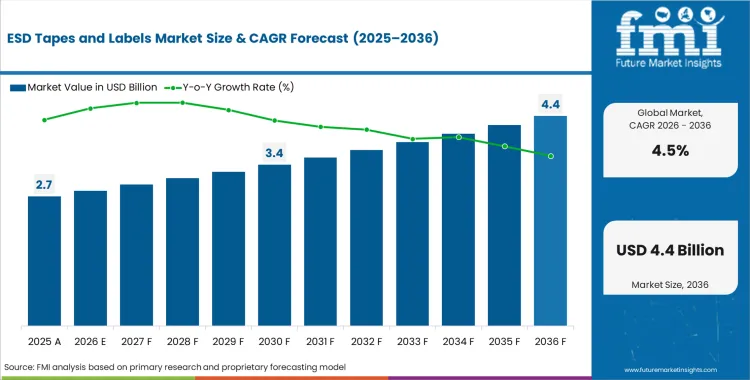
The ESD Tapes and Labels Market was valued at USD Billion 2.644 in 2025, projected to reach USD 2.862 Billion in 2026, and is forecast to expand to USD 4.445 Billion by 2036 at a 4.50% CAGR. The transition toward advanced ESD-safe materials and intelligent inventory management systems is reshaping procurement criteria across supply chain ecosystems. Rising compliance mandates and technology advancement cycles are accelerating adoption across primary end-use verticals.
Summary of ESD Tapes and Labels Market
- Market Snapshot
- The ESD Tapes and Labels Market is valued at USD Billion 2.644 in 2025 and is projected to reach USD Billion 4.445 by 2036.
- The industry is expected to grow at a 4.50% CAGR from 2026 to 2036, creating an incremental opportunity of USD Billion 1.583.
- The market operates as a compliance-driven industrial category where IEC 61340 standards and electronics manufacturing protocols define procurement specifications.
- Demand and Growth Drivers
- Demand is rising as electronics manufacturers face mandatory ESD compliance requirements under IEC 61340 and ANSI/ESD S20.20 certification frameworks.
- Semiconductor fabrication plant expansion across Asia Pacific and North America is creating sustained infrastructure investment in ESD-safe handling and storage systems.
- Automotive electronics content growth and increasing component sensitivity thresholds are accelerating replacement cycles for ESD-compliant packaging across tier supplier networks.
- Among key countries, India leads at 6.3% CAGR, followed by China at 5.7%, the USA at 4.8%, Germany at 4.1%, the UK at 3.9%, and Japan at 3.6%.
- Product and Segment View
- The ESD Tapes and Labels Market encompasses Product Type, Face Material Type, End Use, ESD tapes categories engineered to meet electrostatic discharge protection thresholds across industrial handling environments.
- ESD tapes leads the Product Type category with 60.3% share in 2026, driven by prevalence in electronics assembly and semiconductor component handling workflows.
- PET captures 47.0% of segment revenue, supported by integration into diagnostic and precision manufacturing environments.
- Scope includes certified ESD-compliant systems; excludes non-certified containers and general-purpose packaging without electrostatic control properties.
- Geography and Competitive Outlook
- India and China represent the fastest-growing adoption zones, while North America and Europe anchor high-value demand through semiconductor and automotive electronics verticals.
- Competition is defined by materials engineering capability, IEC certification compliance, and established relationships with electronics OEMs.
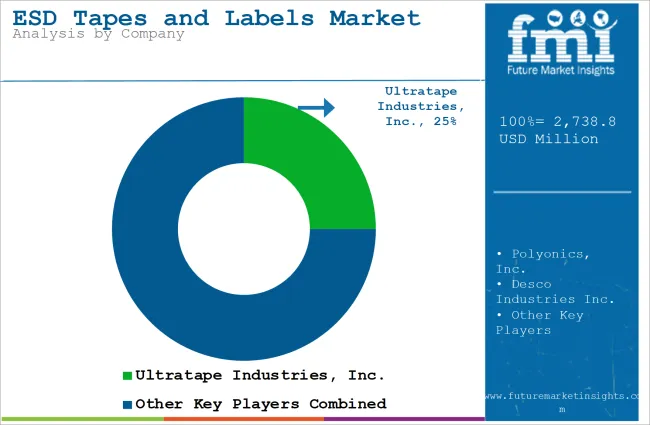
- Key companies active in this market include Ultratape Industries Inc., Polyonics Inc., Desco Industries Inc., 3M Company, JSC IDON, Electrotek Static Controls Pvt. Ltd., Lotus Tapes India Pvt. Ltd., Bertech Inc., Brady Corporation, Advance Tapes International Ltd..
ESD Tapes and Labels Market Key Takeaways
| Metric | Details |
|---|---|
| Industry Size (2026) | USD 2.862 Billion |
| Industry Value (2036) | USD 4.445 Billion |
| CAGR (2026-2036) | 4.50% |
| Source | Future Market Insights, 2026 |
The transition toward advanced ESD-safe materials and intelligent inventory management systems is reshaping procurement criteria across supply chain ecosystems. Electronics assembly facilities and semiconductor fabrication plants operating under IEC 61340 compliance requirements now mandate structured ESD containment protocols at every handling stage. Tier-1 suppliers serving automotive electronics and aerospace defense verticals have elevated ESD packaging specifications within vendor qualification frameworks, creating sustained multi-year procurement cycles.
India sets the pace with a 6.3% CAGR, followed closely by China at 5.7% as both nations leverage greenfield electronics manufacturing expansion to deploy compliant ESD infrastructure. United States operations advance at a 4.8% rate, supported by semiconductor industry reinvestment. Germany registers a 4.1% pace, driven by precision automotive electronics and industrial automation sectors. United Kingdom networks maintain a 3.9% expansion trajectory. Japan expands at a 3.6% trajectory supported by its established electronics manufacturing base.
ESD Tapes and Labels Market Definition
The ESD Tapes and Labels Market encompasses specialized electrostatic discharge-safe containment and identification systems designed to protect electrostatically sensitive components throughout manufacturing and logistics operations. These solutions incorporate conductive or static-dissipative materials calibrated to maintain surface resistivity within thresholds defined by IEC 61340 and ANSI ESD standards.
ESD Tapes and Labels Market Inclusions
Market scope includes Product Type, Face Material Type, End Use, ESD tapes configurations manufactured from certified ESD-compliant materials meeting IEC 61340 and ANSI/ESD performance thresholds. Protocol-compliant accessories and static-dissipative surface treatment components fall within defined boundaries.
ESD Tapes and Labels Market Exclusions
Standard industrial containers lacking certified electrostatic discharge protection properties are excluded. General-purpose storage and labeling systems without conductive or static-dissipative material specifications fall outside analytical parameters. Non-certified packaging solutions without compliance to recognized ESD standards are explicitly omitted.
ESD Tapes and Labels Market Research Methodology
- Primary Research:Analysts engaged with electronics manufacturing procurement leads, ESD compliance engineers, and semiconductor facility operations directors to map qualification criteria and compliance investment cycles.
- Desk Research:Data collection phases aggregated IEC 61340 standard revision schedules, semiconductor industry capital expenditure roadmaps, and electronics manufacturing association procurement guidelines.
- Market-Sizing and Forecasting:Baseline values derive from a bottom-up aggregation of certified ESD product unit volumes, applying region-specific electronics manufacturing growth curves and compliance adoption rates to project future demand velocity.
- Data Validation and Update Cycle:Projections are tested against publicly reported capital expenditure disclosures from semiconductor manufacturers, electronics OEMs, and contract manufacturing organizations.
Key Industry Highlights
Miniaturized Electronics Drive Surge in ESD Tape Demand for Protection
With the coming of consumer goods such as miniaturized electronics in smartphones, tablets, and wearables, there has been an increased demand for ESD protection. Internal components in these devices are becoming increasingly sensitive with miniaturization, like microchips, circuit boards, and connectors, which further leads to a high demand for ESD protection.
ES Importance in Manufacturing Processes: Another concern that leads to damages is protection to these sensitive components during the assembly, packaging, and transport with ESD protection. Companies like Apple and Samsung had established strict procedures on ESD protection to secure their high-value components in its products.
Primarily, these ESD tapes protect the electrostatic buildup and electrostatic discharge causing damages to such sensitive parts as it goes along the manufacturing process and supply chains. As the consumer electronics sector continues innovating through new, more complex designs, its use of ESD tapes and labels will be larger because these protective materials are critical to helping ensure the quality and reliability of products at the manufacturing level.
Aerospace and Defense Innovation Boosts Demand for Advanced ESD Protection
Aerospace and defense products require a lot of accuracy and reliability due to the sensitivity of their electronic parts, often put through conditions that are quite extreme, like changes in temperature, vibrations, and high altitudes. Their applications include radar systems, avionics, communication devices, and missile guidance systems.
All of these are extremely susceptible to ESD, leading to malfunctioning or failure. ESD tapes and labels are a critical component in such industries as the assembly, testing, and transport of delicate electronics so that the potential electrostatic risk is kept away from the equipment.
Some major aerospace companies are Boeing and Lockheed Martin, which also use a huge amount of ESD materials during their manufacturing. These materials are vital for maintaining the operational integrity of military and aviation electronics, in which even a minor malfunction may lead to critical failure. Thus, with innovation in the defense and aerospace industries, the demand for advanced ESD protection solutions will be high.
Semiconductor Industry Prefers Alternatives Over ESD Tapes for Sensitive Components
Alternative ESD protection methods are adopted by companies in lieu of ESD tapes and labels in some applications. These may be especially applicable to value-intensive or highly sensitive components. As an example, the semiconductor industry will often use anti-static bags, conductive foams, or ESD-safe trays to protect delicate wafers and chips being moved and stored.
These provide an added shield against ESD because they give full encapsulation of the components, hence decreasing the electrostatic damage possibility in handling. Further, workbenches for assembling and testing have ESD-safe workbenches, and components are maintained at all stages of production in these.
Although ESD tapes and labels find extensive use across various industries, in the area of semiconductor fabrication and other such precision applications, these alternatives offer greater protection due to their superiority in high stakes. This tendency may lower overall demand for the ESD tape in certain scenarios.
2021 to 2025 Global ESD Tapes and Labels Sales Outlook Compared to Demand Forecast from 2026 to 2036
The global ESD tapes and labels industry recorded a CAGR of 3.0% during the historical period between 2021 and 2025. The growth of the ESD tapes and labels industry was positive as it reached a value of USD 2,659.0 million in 2025 from USD 2,362.5 million in 2021.
Global sales for ESD tapes and labels have shown consistent growth in recent years as more and more industries require protection from electrostatic discharge, including electronics manufacturing, automotive, aerospace, and defense. ESD tapes and labels have gained massive demand with miniature electronic devices having intricate designs and miniaturizations.
Manufacturers ensure the protection of sensitive components including semiconductors, circuit boards, and microchips. The requirement for advanced electronic components has promoted the sales of ESD tapes since they must be used when assembling, packing, and moving high-value items.
Ahead of time, there will be growth in demand for ESD tapes and labels driven by continued development in electronics as well as the emerging applications for the automotive electrification and aerospace industries. Emerging new technologies including electric vehicles, 5G infrastructure, and autonomous systems will place greater demands for effective ESD protection.
In emerging markets, growing manufacturing facilities will further increase the demand, along with increasing ESD protection standards in the industry, which will also drive demand, and a more robust market will be expected for the next decade with higher growth rates.
Market Concentration
Tier 1 company leaders are characterized by high production technology and a wide product portfolio. These market leaders are distinguished by their extensive expertise in manufacturing and reconditioning across multiple packaging formats and a broad geographical reach, underpinned by a robust consumer base.
They provide a wide range of series including reconditioning, recycling, and manufacturing utilizing the latest technology and meeting the regulatory standards providing the highest quality. Prominent companies within Tier 1 include 3M Company, Brady Corporation, Desco Industries Inc., Polyonics, Inc., Antistat, Inc.
Tier 2 companies are characterized by a strong presence overseas and strong market knowledge. These market players have good technology and ensure regulatory compliance but may not have advanced technology and wide global reach. Prominent companies in Tier 2 include Ultratape Industries, Inc., JSC IDON, Electrotek Static Controls Pvt. Ltd., Lotus Tapes (India) Pvt. Ltd., Bertech, Inc., Advance Tapes International Ltd.
Tier 3 includes the majority of small-scale companies operating at the local presence and serving niche markets. These companies are notably oriented towards fulfilling local market demands and are consequently classified within the tier 3 share segment. They are small-scale players and have limited geographical reach. Tier 3, within this context, is recognized as an unorganized market, denoting a sector characterized by a lack of extensive structure and formalization when compared to organized competitors.
Country-wise Insights
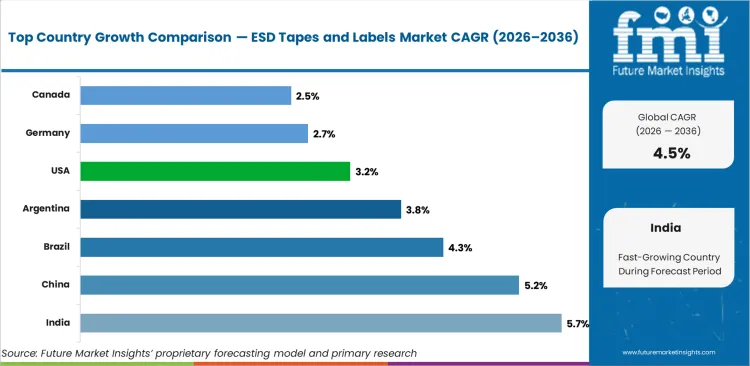
The section below covers the industry analysis for the ESD tapes and labels market for different countries. Market demand analysis on key countries in several regions of the globe, including North America, Asia Pacific, Europe, and others, is provided. USA is anticipated to remain at the forefront in North America, with a CAGR of 3.2% through 2036. In South Asia & Pacific, India is projected to witness a CAGR of 5.7% by 2036.
.webp "Top Country Growth Comparison Esd Tapes And Labels Market Cagr (2026 2036)")
| Countries | Value CAGR (2026 to 2036) |
|---|---|
| USA | 3.2% |
| Canada | 2.5% |
| Brazil | 4.3% |
| Argentina | 3.8% |
| Germany | 2.7% |
| China | 5.2% |
| India | 5.7% |
Silicon Valley Drives ESD Tape Demand for Advanced Semiconductor Manufacturing
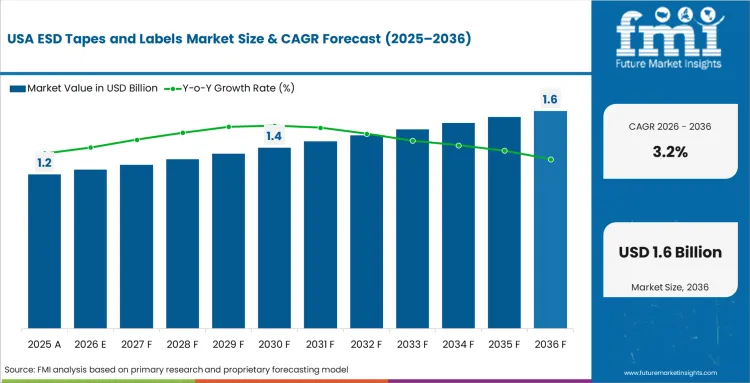
The USA ESD tapes and labels market is gaining popularity as regions like Silicon Valley, home to Intel and Advanced Micro Devices (AMD), are working overtime to produce semiconductors to meet demand for new technologies such as 5G, AI, and electric vehicles. Sensitive chips and wafers are now protected from static discharge by employing ESD tapes and labels as part of its assembly and moving processes.
Critical to the maintaining reliability and good performance of extremely valuable components assembled in high chipset manufacturing facilities similar to Intel Chandler, Arizona facilities is ESD protection. Thus, the business with the development of new, very small, highly powerful chips all the time provides a great challenge for good ESD materials.
This has led to the widespread use of ESD tapes and labels in cleanrooms, packaging areas, and transport processes, which ensures that the delicate electronic parts are shielded from potential electrostatic damage.
Germany's Auto Industry Drives ESD Tape Demand for Advanced Electronics
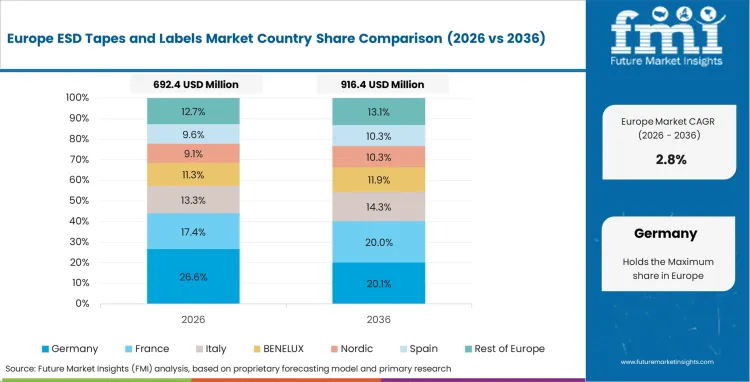
The biggest trigger for the German market of ESD tapes and labels is the automobile industry, and it has especially gained more attention due to an interest in electric vehicles and advanced driver-assistance systems. Giant automobile companies of Germany, like BMW, Audi, and Volkswagen, are considerably investing in bringing sophisticated electronic elements into their automobiles, including sensors, circuit boards, and battery management systems.
These components are sensitive to ESD, so the smallest charge may cause a malfunction, thereby endangering the safety and performance of the vehicle. These risks are therefore reduced by using ESD tapes and labels put to use on the production line by German auto makers to avoid malfunctioning through damaging sensitive electronics while assembling and testing and carrying around.
For instance, the production facilities at Munich and Leipzig house critical components such as battery control units and infotainment systems that are protected with ESD protection materials for BMW. The automobile industry is slowly transforming into more electrified and autonomous vehicles, which means ESD tapes and labels will grow rapidly in Germany to address the complexity of electronics in automobiles.
Category-wise Insights
The section contains information about the leading segments in the industry. By face material type, PET are projected to grow at a CAGR of 4.8% through 2026 to 2036. Additionally, electronic and electrical manufacturing end uses are predicted to grow at a CAGR of 4.9%.
PET by Material Type to Dominate the ESD tapes and labels Market in terms of Value
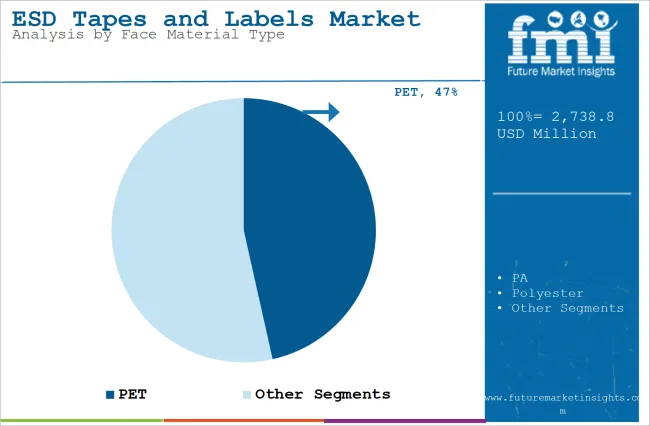
| Face Material Type | Value Share (2036) |
|---|---|
| PET | 46.5% |
PET is likely to remain as the market leader in the ESD tapes and labels market due to its high durability, tensile strength, and also because of its excellent resistance against electrostatic discharge, making it perfect for protecting sensitive electronic components. In semiconductor manufacturing industries, manufacturers like Intel and TSMC require stringent ESD protection for delicate wafers and microchips, where the PET-based tapes and labels find their extensive applications.
This material has self-sustaining inherent resistance to high temperatures, including mechanical stress, and does not lose their protective properties. PET has excellent transparency and is simple to print on, thus making it a prime choice for the labeling applications in the automotive and aerospace markets where traceability and cleanliness are extremely important.
As the need for accuracy and reliability in protecting electronic components is always on the rise, PET will be at the very heart of this requirement. ESD tapes are projected to indicate a market value of USD 1,604.9 million by the end of 2025.
ESD Tapes are the Most Preferred ESD Tapes & Labels by Products
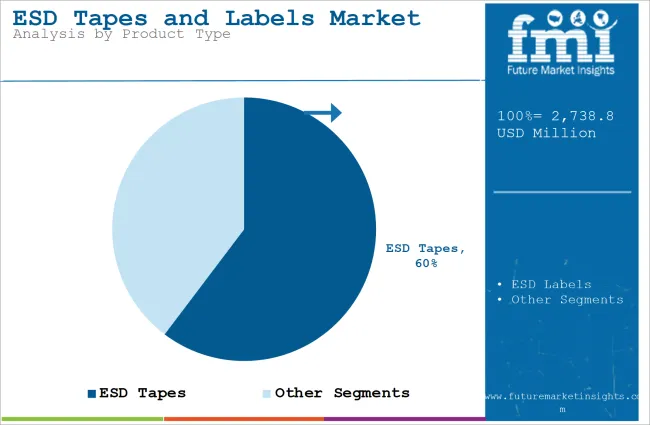
| Product Type | Value Share (2036) |
|---|---|
| ESD Tapes | 60.3% |
The most in-demand product in the ESD tapes and labels market is ESD tapes because it is versatile, efficient, and protects sensitive electronic components from damages in various kinds of industries. For instance, semiconductor manufacturing firms such as Samsung and Micron use ESD tapes in production and transportation activities of microchips and wafers by protecting the delicate material involved.
These tapes are highly valued for conforming to different surfaces, thereby fully protecting the object during assembly and shipment. In car manufacturing, wherein electronic systems continue to be applied to vehicles, ESD tapes are used for the protection of components such as sensors and control units. Their adhesive qualities and the electrostatic discharge prevention ability give them a strategic position in applications in clean rooms and production lines.
This will also rise the demand of ESD tapes as more and more industries focus on the high-value electronic component protection and put ESD tapes at the leadership of the product type in this market. ESD tapes are expected to capture over 40% of the total market share, with projections indicating a market valuation of USD 1,604.9 million by the end of 2025.
Competitive Landscape
Key players operating in the ESD tapes and labels market are investing in the development of innovative sustainable solutions and also entering into partnerships. Key ESD tapes and labels providers have also been acquiring smaller players to grow their presence to further penetrate the ESD tapes and labels market across multiple regions.
Recent Industry Developments in the ESD Tapes and Labels Market
In January 2025, Flexcon Global, a supplier of innovative adhesives, tapes, films, and coating technologies for the healthcare industry, announced its participation in the MD&M West conference in Anaheim, California.
Scope of the Report
| Metric | Value |
|---|---|
| Quantitative Units | USD Billion 2.862 to USD Billion 4.445, at a CAGR of 4.50% |
| Market Definition | The ESD Tapes and Labels Market encompasses specialized electrostatic discharge-safe containment and identification systems designed to protect electrostatically sensitive components throughout manufa... |
| Product Type Segmentation | Product Type, Face Material Type, End Use, ESD tapes |
| ESD tapes Segmentation | PET, Electronic & electrical manufacturing, ESD labels, PA |
| Regions Covered | North America, Latin America, Europe, East Asia, South Asia, Oceania, Middle East & Africa |
| Countries Covered | India, China, USA, Canada, UK, Germany, Japan, and 40 plus countries |
| Key Companies Profiled | Ultratape Industries Inc., Polyonics Inc., Desco Industries Inc., 3M Company, JSC IDON, Electrotek Static Controls Pvt. Ltd., Lotus Tapes India Pvt. Ltd., Bertech Inc., Brady Corporation, Advance Tapes International Ltd. |
| Forecast Period | 2026 to 2036 |
| Approach | Bottom-up methodology with primary research validation and scenario-based demand modeling. |
Key Segments of the ESD Tapes and Labels Industry
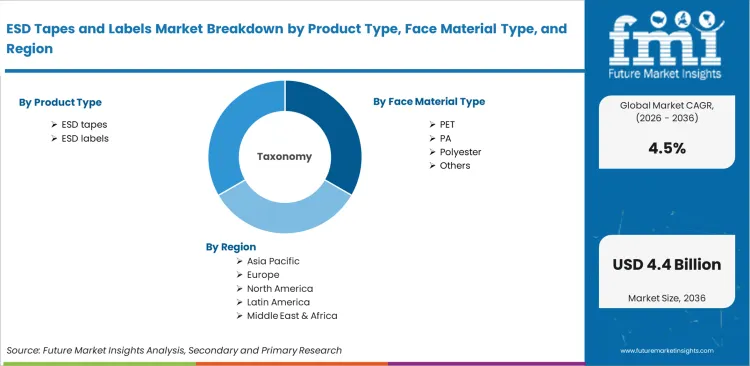
By Product Type:
In terms of product type, the industry is divided into below ESD tapes and ESD labels.
By Face Material Type:
In terms of face material type, the industry is segregated into PET, PA, Polyester, and Others.
By End Use:
The market is classified by end use such as electronic & electrical manufacturing, automotive & mechanical parts, aerospace, defence, and others.
By Region:
Key countries of North America, Latin America, East Asia, South Asia & Pacific, Western Europe, Eastern Europe, and the Middle East & Africa have been covered in the report.
Bibliography
- 1. International Electrotechnical Commission. (2025). IEC 61340-5-1: Protection of electronic devices from electrostatic phenomena. IEC. https://www.iec.ch/
- 2. ANSI/ESD Association. (2023). ANSI/ESD S20.20: Protection of Electrical and Electronic Parts, Assemblies and Equipment. ESD Association. https://www.esda.org/
- 3. Semiconductor Industry Association. (2025). Global Semiconductor Industry Outlook. SIA. https://www.semiconductors.org/
- 4. Organisation for Economic Co-operation and Development. (2025). OECD Digital Economy Outlook 2025. OECD Publishing. https://www.oecd.org/
- 5. European Commission, Directorate-General for Internal Market. (2025). European Electronics Strategy. European Commission. https://ec.europa.eu/
- 6. Ministry of Electronics and Information Technology, Government of India. (2025). India Electronics Policy Progress Report. MEITY. https://www.meity.gov.in/
- 7. United States Department of Defense. (2023). MIL-PRF-81705 Performance Specification. DoD. https://www.dla.mil/
This bibliography is provided for reader reference. The full Future Market Insights report contains the complete reference list with primary research documentation.
Frequently Asked Questions
How large is the demand for ESD Tapes and Labels Market in the global market in 2026?
Demand for ESD Tapes and Labels Market in the global market is estimated to be valued at USD Billion 2.862 in 2026.
What will the market size of ESD Tapes and Labels Market be by 2036?
Market size for ESD Tapes and Labels Market is projected to reach USD Billion 4.445 by 2036.
What is the expected demand growth for ESD Tapes and Labels Market between 2026 and 2036?
Demand for ESD Tapes and Labels Market is expected to grow at a CAGR of 4.50% between 2026 and 2036.
Which Product Type segment is poised to lead global sales by 2026?
ESD tapes accounts for 60.3% in 2026 as electronics assembly facilities require certified ESD containment meeting IEC 61340 thresholds.
What is driving demand in India for ESD Tapes and Labels Market?
Indian greenfield electronics manufacturing facilities deploying integrated ESD compliance infrastructure from initial commissioning, supported by PLI scheme investments, fuel accelerated adoption at 6.3% CAGR.
Which companies are profiled in this ESD Tapes and Labels Market report?
Key companies profiled include Ultratape Industries Inc., Polyonics Inc., Desco Industries Inc., 3M Company, JSC IDON, Electrotek Static Controls Pvt. Ltd., Lotus Tapes India Pvt. Ltd., Bertech Inc., Brady Corporation, Advance Tapes International Ltd..
What compliance standards are referenced in this report?
The report references IEC 61340-5-1, ANSI/ESD S20.20, and MIL-PRF-81705 as the primary standards defining certification requirements across applicable market segments.
Preview the report firsthand - request a free sample
Get SampleGet the brochure for pricing and purchase details.
Get PDFTable of Content
- Executive Summary
- Global Market Outlook
- Demand-side Trends
- Supply-side Trends
- Technology Roadmap Analysis
- Analysis and Recommendations
- Market Overview
- Market Coverage / Taxonomy
- Market Definition / Scope / Limitations
- Research Methodology
- Chapter Orientation
- Analytical Lens and Working Hypotheses
- Market Structure, Signals, and Trend Drivers
- Benchmarking and Cross-market Comparability
- Market Sizing, Forecasting, and Opportunity Mapping
- Research Design and Evidence Framework
- Desk Research Programme (Secondary Evidence)
- Company Annual and Sustainability Reports
- Peer-reviewed Journals and Academic Literature
- Corporate Websites, Product Literature, and Technical Notes
- Earnings Decks and Investor Briefings
- Statutory Filings and Regulatory Disclosures
- Technical White Papers and Standards Notes
- Trade Journals, Industry Magazines, and Analyst Briefs
- Conference Proceedings, Webinars, and Seminar Materials
- Government Statistics Portals and Public Data Releases
- Press Releases and Reputable Media Coverage
- Specialist Newsletters and Curated Briefings
- Sector Databases and Reference Repositories
- FMI Internal Proprietary Databases and Historical Market Datasets
- Subscription Datasets and Paid Sources
- Social Channels, Communities, and Digital Listening Inputs
- Additional Desk Sources
- Expert Input and Fieldwork (Primary Evidence)
- Primary Modes
- Qualitative Interviews and Expert Elicitation
- Quantitative Surveys and Structured Data Capture
- Blended Approach
- Why Primary Evidence is Used
- Field Techniques
- Interviews
- Surveys
- Focus Groups
- Observational and In-context Research
- Social and Community Interactions
- Stakeholder Universe Engaged
- C-suite Leaders
- Board Members
- Presidents and Vice Presidents
- R&D and Innovation Heads
- Technical Specialists
- Domain Subject-matter Experts
- Scientists
- Physicians and Other Healthcare Professionals
- Governance, Ethics, and Data Stewardship
- Research Ethics
- Data Integrity and Handling
- Primary Modes
- Tooling, Models, and Reference Databases
- Desk Research Programme (Secondary Evidence)
- Data Engineering and Model Build
- Data Acquisition and Ingestion
- Cleaning, Normalisation, and Verification
- Synthesis, Triangulation, and Analysis
- Quality Assurance and Audit Trail
- Market Background
- Market Dynamics
- Drivers
- Restraints
- Opportunity
- Trends
- Scenario Forecast
- Demand in Optimistic Scenario
- Demand in Likely Scenario
- Demand in Conservative Scenario
- Opportunity Map Analysis
- Product Life Cycle Analysis
- Supply Chain Analysis
- Investment Feasibility Matrix
- Value Chain Analysis
- PESTLE and Porter’s Analysis
- Regulatory Landscape
- Regional Parent Market Outlook
- Production and Consumption Statistics
- Import and Export Statistics
- Market Dynamics
- Global Market Analysis 2021 to 2025 and Forecast, 2026 to 2036
- Historical Market Size Value (USD Million) Analysis, 2021 to 2025
- Current and Future Market Size Value (USD Million) Projections, 2026 to 2036
- Y-o-Y Growth Trend Analysis
- Absolute $ Opportunity Analysis
- Global Market Pricing Analysis 2021 to 2025 and Forecast 2026 to 2036
- Global Market Analysis 2021 to 2025 and Forecast 2026 to 2036, By Product Type
- Introduction / Key Findings
- Historical Market Size Value (USD Million) Analysis By Product Type , 2021 to 2025
- Current and Future Market Size Value (USD Million) Analysis and Forecast By Product Type , 2026 to 2036
- ESD tapes
- ESD labels
- ESD tapes
- Y-o-Y Growth Trend Analysis By Product Type , 2021 to 2025
- Absolute $ Opportunity Analysis By Product Type , 2026 to 2036
- Global Market Analysis 2021 to 2025 and Forecast 2026 to 2036, By Face Material Type
- Introduction / Key Findings
- Historical Market Size Value (USD Million) Analysis By Face Material Type, 2021 to 2025
- Current and Future Market Size Value (USD Million) Analysis and Forecast By Face Material Type, 2026 to 2036
- PET
- PA
- Polyester
- Others
- PET
- Y-o-Y Growth Trend Analysis By Face Material Type, 2021 to 2025
- Absolute $ Opportunity Analysis By Face Material Type, 2026 to 2036
- Global Market Analysis 2021 to 2025 and Forecast 2026 to 2036, By End Use
- Introduction / Key Findings
- Historical Market Size Value (USD Million) Analysis By End Use, 2021 to 2025
- Current and Future Market Size Value (USD Million) Analysis and Forecast By End Use, 2026 to 2036
- Electronic & electrical manufacturing
- Automotive & mechanical parts
- Aerospace
- Defence
- Others
- Electronic & electrical manufacturing
- Y-o-Y Growth Trend Analysis By End Use, 2021 to 2025
- Absolute $ Opportunity Analysis By End Use, 2026 to 2036
- Global Market Analysis 2021 to 2025 and Forecast 2026 to 2036, By Region
- Introduction
- Historical Market Size Value (USD Million) Analysis By Region, 2021 to 2025
- Current Market Size Value (USD Million) Analysis and Forecast By Region, 2026 to 2036
- North America
- Latin America
- Western Europe
- Eastern Europe
- East Asia
- South Asia and Pacific
- Middle East & Africa
- Market Attractiveness Analysis By Region
- North America Market Analysis 2021 to 2025 and Forecast 2026 to 2036, By Country
- Historical Market Size Value (USD Million) Trend Analysis By Market Taxonomy, 2021 to 2025
- Market Size Value (USD Million) Forecast By Market Taxonomy, 2026 to 2036
- By Country
- USA
- Canada
- Mexico
- By Product Type
- By Face Material Type
- By End Use
- By Country
- Market Attractiveness Analysis
- By Country
- By Product Type
- By Face Material Type
- By End Use
- Key Takeaways
- Latin America Market Analysis 2021 to 2025 and Forecast 2026 to 2036, By Country
- Historical Market Size Value (USD Million) Trend Analysis By Market Taxonomy, 2021 to 2025
- Market Size Value (USD Million) Forecast By Market Taxonomy, 2026 to 2036
- By Country
- Brazil
- Chile
- Rest of Latin America
- By Product Type
- By Face Material Type
- By End Use
- By Country
- Market Attractiveness Analysis
- By Country
- By Product Type
- By Face Material Type
- By End Use
- Key Takeaways
- Western Europe Market Analysis 2021 to 2025 and Forecast 2026 to 2036, By Country
- Historical Market Size Value (USD Million) Trend Analysis By Market Taxonomy, 2021 to 2025
- Market Size Value (USD Million) Forecast By Market Taxonomy, 2026 to 2036
- By Country
- Germany
- UK
- Italy
- Spain
- France
- Nordic
- BENELUX
- Rest of Western Europe
- By Product Type
- By Face Material Type
- By End Use
- By Country
- Market Attractiveness Analysis
- By Country
- By Product Type
- By Face Material Type
- By End Use
- Key Takeaways
- Eastern Europe Market Analysis 2021 to 2025 and Forecast 2026 to 2036, By Country
- Historical Market Size Value (USD Million) Trend Analysis By Market Taxonomy, 2021 to 2025
- Market Size Value (USD Million) Forecast By Market Taxonomy, 2026 to 2036
- By Country
- Russia
- Poland
- Hungary
- Balkan & Baltic
- Rest of Eastern Europe
- By Product Type
- By Face Material Type
- By End Use
- By Country
- Market Attractiveness Analysis
- By Country
- By Product Type
- By Face Material Type
- By End Use
- Key Takeaways
- East Asia Market Analysis 2021 to 2025 and Forecast 2026 to 2036, By Country
- Historical Market Size Value (USD Million) Trend Analysis By Market Taxonomy, 2021 to 2025
- Market Size Value (USD Million) Forecast By Market Taxonomy, 2026 to 2036
- By Country
- China
- Japan
- South Korea
- By Product Type
- By Face Material Type
- By End Use
- By Country
- Market Attractiveness Analysis
- By Country
- By Product Type
- By Face Material Type
- By End Use
- Key Takeaways
- South Asia and Pacific Market Analysis 2021 to 2025 and Forecast 2026 to 2036, By Country
- Historical Market Size Value (USD Million) Trend Analysis By Market Taxonomy, 2021 to 2025
- Market Size Value (USD Million) Forecast By Market Taxonomy, 2026 to 2036
- By Country
- India
- ASEAN
- Australia & New Zealand
- Rest of South Asia and Pacific
- By Product Type
- By Face Material Type
- By End Use
- By Country
- Market Attractiveness Analysis
- By Country
- By Product Type
- By Face Material Type
- By End Use
- Key Takeaways
- Middle East & Africa Market Analysis 2021 to 2025 and Forecast 2026 to 2036, By Country
- Historical Market Size Value (USD Million) Trend Analysis By Market Taxonomy, 2021 to 2025
- Market Size Value (USD Million) Forecast By Market Taxonomy, 2026 to 2036
- By Country
- Kingdom of Saudi Arabia
- Other GCC Countries
- Turkiye
- South Africa
- Other African Union
- Rest of Middle East & Africa
- By Product Type
- By Face Material Type
- By End Use
- By Country
- Market Attractiveness Analysis
- By Country
- By Product Type
- By Face Material Type
- By End Use
- Key Takeaways
- Key Countries Market Analysis
- USA
- Pricing Analysis
- Market Share Analysis, 2025
- By Product Type
- By Face Material Type
- By End Use
- Canada
- Pricing Analysis
- Market Share Analysis, 2025
- By Product Type
- By Face Material Type
- By End Use
- Mexico
- Pricing Analysis
- Market Share Analysis, 2025
- By Product Type
- By Face Material Type
- By End Use
- Brazil
- Pricing Analysis
- Market Share Analysis, 2025
- By Product Type
- By Face Material Type
- By End Use
- Chile
- Pricing Analysis
- Market Share Analysis, 2025
- By Product Type
- By Face Material Type
- By End Use
- Germany
- Pricing Analysis
- Market Share Analysis, 2025
- By Product Type
- By Face Material Type
- By End Use
- UK
- Pricing Analysis
- Market Share Analysis, 2025
- By Product Type
- By Face Material Type
- By End Use
- Italy
- Pricing Analysis
- Market Share Analysis, 2025
- By Product Type
- By Face Material Type
- By End Use
- Spain
- Pricing Analysis
- Market Share Analysis, 2025
- By Product Type
- By Face Material Type
- By End Use
- France
- Pricing Analysis
- Market Share Analysis, 2025
- By Product Type
- By Face Material Type
- By End Use
- India
- Pricing Analysis
- Market Share Analysis, 2025
- By Product Type
- By Face Material Type
- By End Use
- ASEAN
- Pricing Analysis
- Market Share Analysis, 2025
- By Product Type
- By Face Material Type
- By End Use
- Australia & New Zealand
- Pricing Analysis
- Market Share Analysis, 2025
- By Product Type
- By Face Material Type
- By End Use
- China
- Pricing Analysis
- Market Share Analysis, 2025
- By Product Type
- By Face Material Type
- By End Use
- Japan
- Pricing Analysis
- Market Share Analysis, 2025
- By Product Type
- By Face Material Type
- By End Use
- South Korea
- Pricing Analysis
- Market Share Analysis, 2025
- By Product Type
- By Face Material Type
- By End Use
- Russia
- Pricing Analysis
- Market Share Analysis, 2025
- By Product Type
- By Face Material Type
- By End Use
- Poland
- Pricing Analysis
- Market Share Analysis, 2025
- By Product Type
- By Face Material Type
- By End Use
- Hungary
- Pricing Analysis
- Market Share Analysis, 2025
- By Product Type
- By Face Material Type
- By End Use
- Kingdom of Saudi Arabia
- Pricing Analysis
- Market Share Analysis, 2025
- By Product Type
- By Face Material Type
- By End Use
- Turkiye
- Pricing Analysis
- Market Share Analysis, 2025
- By Product Type
- By Face Material Type
- By End Use
- South Africa
- Pricing Analysis
- Market Share Analysis, 2025
- By Product Type
- By Face Material Type
- By End Use
- USA
- Market Structure Analysis
- Competition Dashboard
- Competition Benchmarking
- Market Share Analysis of Top Players
- By Regional
- By Product Type
- By Face Material Type
- By End Use
- Competition Analysis
- Competition Deep Dive
- Ultratape Industries, Inc.
- Overview
- Product Portfolio
- Profitability by Market Segments (Product/Age /Sales Channel/Region)
- Sales Footprint
- Strategy Overview
- Marketing Strategy
- Product Strategy
- Channel Strategy
- Polyonics, Inc.
- Desco Industries Inc.
- 3M Company
- JSC “IDON”
- Electrotek Static Controls Pvt. Ltd.
- Lotus Tapes (India) Pvt. Ltd.
- Bertech, Inc.
- Brady Corporation
- Advance Tapes International Ltd.
- Antistat, Inc.
- Ultratape Industries, Inc.
- Competition Deep Dive
- Assumptions & Acronyms Used


