

- Industry Size (2026)
- USD 330.012 Mn
- Forecast (2036)
- USD 443.509 Mn
- CAGR (2026 to 2036)
- 3.00%
ESD Protective Signage Labels Market Size, Market Forecast and Outlook By FMI
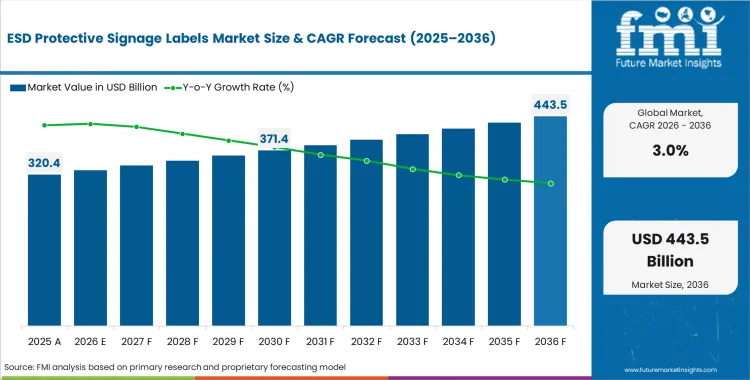
The ESD Protective Signage Labels Market was valued at USD 304.931 Million in 2025, projected to reach USD 330.012 Million in 2026, and is forecast to expand to USD 443.509 Million by 2036 at a 3.00% CAGR. Rising demand across electronics manufacturing, semiconductor handling, and industrial logistics sectors is driving accelerated adoption of ESD-compliant storage and transport solutions. Stringent international electrostatic discharge standards require manufacturers to integrate compliant packaging infrastructure across component fabrication and assembly workflows.
The transition toward advanced ESD-safe materials and intelligent inventory management systems is reshaping procurement criteria across supply chain ecosystems. Electronics assembly facilities and semiconductor fabrication plants operating under IEC 61340 compliance requirements now mandate structured ESD containment protocols at every handling stage. Tier-1 suppliers serving automotive electronics and aerospace defense verticals have elevated ESD packaging specifications within vendor qualification frameworks, creating sustained multi-year procurement cycles that extend well beyond initial equipment investment windows.
Summary of ESD Protective Signage Labels Market
- Market Snapshot
- The ESD Protective Signage Labels Market is valued at USD 304.931 Million in 2025 and is projected to reach USD 443.509 Million by 2036.
- The industry is expected to grow at a 3.00% CAGR from 2026 to 2036, creating an incremental opportunity of USD 113.497 Million.
- The market operates as a compliance-driven industrial category where IEC 61340 standards, semiconductor supply chain requirements, and electronics manufacturing protocols define procurement specifications.
- Demand and Growth Drivers
- Demand is rising as electronics manufacturers face mandatory ESD compliance requirements under IEC 61340 and ANSI/ESD S20.20 certification frameworks.
- Semiconductor fabrication plant expansion across Asia Pacific and North America is creating sustained infrastructure investment in ESD-safe handling and storage systems.
- Automotive electronics content growth and increasing component sensitivity thresholds are accelerating replacement cycles for ESD-compliant packaging across tier supplier networks.
- Among key countries, India leads at 4.8% CAGR, followed by China at 4.2%, the USA at 3.3%, Germany at 2.6%, the UK at 2.4%, and Japan at 2.1%.
- Product and Segment View
- The ESD Protective Signage Labels Market encompasses Material Type, Application, End Use configurations engineered to meet electrostatic discharge protection thresholds across industrial handling environments.
- Plastic leads the Material Type category with 26.9% share in 2026, driven by prevalence in electronics assembly and semiconductor component handling workflows.
- Printed Circuit Board captures 32.9% of segment revenue, supported by integration into diagnostic and precision manufacturing environments.
- Scope includes ESD-compliant storage and transport solutions; excludes non-ESD standard containers and general-purpose industrial packaging without certified electrostatic control properties.
- Geography and Competitive Outlook
- India and China represent the fastest-growing adoption zones driven by electronics manufacturing investment, while North America and Germany anchor high-value demand through semiconductor and automotive electronics verticals.
- Competition is defined by materials engineering capability, IEC certification compliance, and established relationships with electronics OEMs and contract manufacturers.
- Key companies active in this market include 3M Company, Brady Corporation, Desco Industries Inc., Henkel AG & Co. KGaA, Intertronics, KEMET Corporation, LPS Industries LLC, Mouser Electronics Inc., Nitto Denko Corporation, Panduit Corp..
ESD Protective Signage Labels Market Key Takeaways
| Metric | Details |
|---|---|
| Industry Size (2026) | USD 330.012 Million |
| Industry Value (2036) | USD 443.509 Million |
| CAGR (2026-2036) | 3.00% |
| Source | Future Market Insights, 2026 |
Source: FMI analysis based on primary research and proprietary forecasting model
India sets the pace with a 4.8% CAGR, followed closely by China at 4.2% as both nations leverage greenfield electronics manufacturing expansion to deploy compliant ESD infrastructure from initial facility design. United States operations advance at a 3.3% rate, supported by semiconductor industry reinvestment and domestic electronics reshoring mandates. Germany registers a 2.6% pace, driven by precision automotive electronics and industrial automation sectors operating under strict ESD compliance directives. United Kingdom networks maintain a 2.4% expansion trajectory anchored by defense electronics and aerospace supply chain requirements. Japan expands at a 2.1% trajectory supported by its established consumer electronics and semiconductor manufacturing base.
ESD Protective Signage Labels Market Definition
The ESD Protective Signage Labels Market encompasses specialized electrostatic discharge-safe containment systems designed to transport, store, and protect electrostatically sensitive components throughout manufacturing and logistics operations. These solutions incorporate conductive or static-dissipative materials calibrated to maintain surface resistivity within thresholds defined by IEC 61340 and ANSI ESD S6.1 standards. Core applications span semiconductor fabrication facilities, electronics assembly plants, automotive component suppliers, and defense electronics handling environments where uncontrolled electrostatic discharge events can cause latent or catastrophic device failures.
ESD Protective Signage Labels Market Inclusions
Market scope includes Material Type, Application, End Use configurations manufactured from Plastic, Printed Circuit Board, Electrical And Electronic Industries materials meeting certified ESD protection performance thresholds. Protocol-compliant integration accessories, labeling systems, and static-dissipative surface treatment components fall within defined boundaries. ESD packaging solutions certified under IEC 61340, ANSI/ESD, and MIL-SPEC standards are fully incorporated within the analytical framework.
ESD Protective Signage Labels Market Exclusions
Standard industrial containers lacking certified electrostatic discharge protection properties are excluded. General-purpose storage systems without conductive or static-dissipative material specifications fall outside analytical parameters. Non-certified packaging solutions and consumer-grade storage products operating without compliance to recognized ESD standards are explicitly omitted from valuation scope.
ESD Protective Signage Labels Market Research Methodology
- Primary Research: Analysts engaged with electronics manufacturing procurement leads, ESD compliance engineers, and semiconductor facility operations directors to map qualification criteria, sourcing decisions, and compliance investment cycles governing adoption patterns.
- Desk Research: Data collection phases aggregated IEC 61340 standard revision schedules, semiconductor industry capital expenditure roadmaps, electronics manufacturing association procurement guidelines, and national regulatory compliance framework updates.
- Market-Sizing and Forecasting: Baseline values derive from a bottom-up aggregation of certified ESD product unit volumes, applying region-specific electronics manufacturing growth curves and compliance adoption rates to project future demand velocity.
- Data Validation and Update Cycle: Projections are tested against publicly reported capital expenditure disclosures from semiconductor manufacturers, electronics OEMs, and contract manufacturing organizations with confirmed ESD infrastructure investment programs.
Why is the ESD Protective Signage Labels Market Growing?
The ESD Protective Signage Labels market is experiencing steady expansion due to the increasing importance of electrostatic discharge protection in modern electronic manufacturing environments. With the growing complexity of circuits, miniaturization of devices, and higher sensitivity of electronic components, manufacturers are emphasizing the use of ESD warning and identification labels to safeguard equipment and comply with industry standards. These labels serve as a critical visual communication tool, enabling quick identification of sensitive areas and helping reduce risks of damage during handling, assembly, and logistics.
The market is further supported by stringent regulatory frameworks in the electronics sector and rising investments in quality assurance and workplace safety. Continuous improvements in label durability, adhesive performance, and print quality have enhanced their functionality, while customization options support diverse end-use requirements.
With the global electronics and semiconductor industry expanding rapidly, particularly in consumer electronics, automotive electronics, and industrial automation, demand for ESD Protective Signage Labels is expected to maintain a positive trajectory Rising awareness of ESD management practices among enterprises and suppliers is also reinforcing the long-term growth outlook of this market.
Segmental Analysis
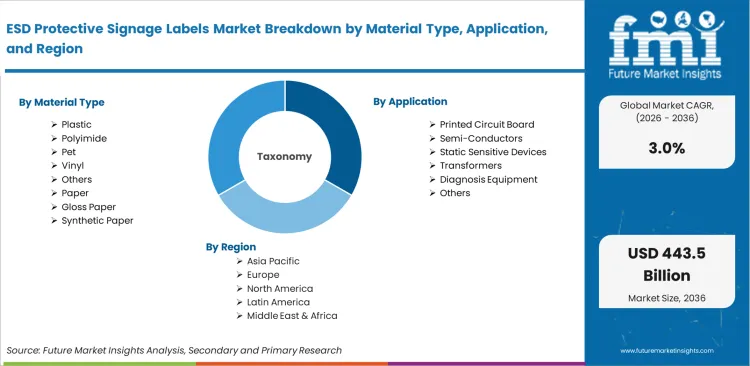
The ESD protective signage labels market is segmented by material type, application, end use, and geographic regions. By material type, esd protective signage labels market is divided into Plastic, Polyimide, Pet, Vinyl, Others, Paper, Gloss Paper, and Synthetic Paper. In terms of application, esd protective signage labels market is classified into Printed Circuit Board (Pcb), Semi-Conductors, Static Sensitive Devices, Transformers, Diagnosis Equipment, and Others. Based on end use, esd protective signage labels market is segmented into Electrical And Electronic Industries, Pharmaceutical, Automobile, Defence & Military, Aerospace, and Others. Regionally, the esd protective signage labels industry is classified into North America, Latin America, Western Europe, Eastern Europe, Balkan & Baltic Countries, Russia & Belarus, Central Asia, East Asia, South Asia & Pacific, and the Middle East & Africa.
Insights into the Plastic Material Type Segment
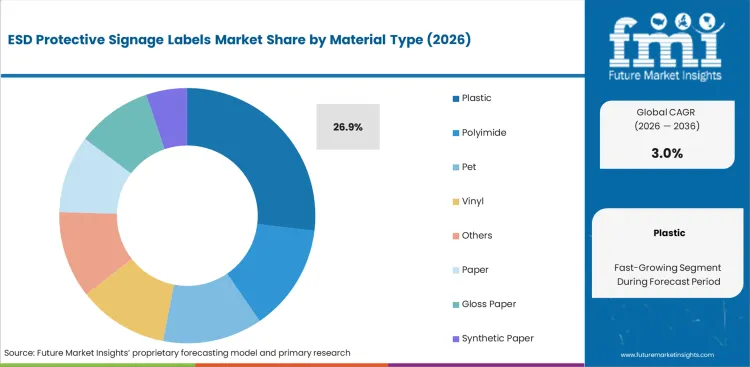
The plastic material type segment is projected to account for 26.9% of the market revenue share in 2026, establishing it as the leading material type. The dominance of this segment is being driven by the lightweight, cost-effective, and durable properties of plastic, making it suitable for large-scale label production. Plastic-based ESD signage labels are widely adopted because they provide strong adhesion, resistance to wear, and flexibility for varied surfaces commonly used in electronics manufacturing environments.
Their adaptability for both indoor and outdoor applications enhances their value proposition. Moreover, advancements in printing technologies have enabled clear visibility, long-lasting color retention, and customizable designs in plastic labels, which further strengthens their market presence.
In addition, the lower production costs associated with plastic labels make them a preferred choice for high-volume manufacturing As industries increasingly seek affordable yet high-performance solutions for ESD management, plastic labels are expected to maintain their leadership position, supported by continuous innovations in material engineering and printing technologies that expand their usability across multiple end-user industries.
Insights into the Printed Circuit Board Application Segment
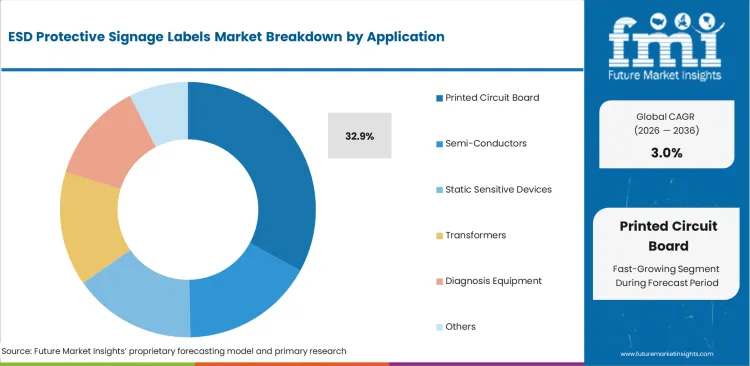
The printed circuit board application segment is expected to hold 32.9% of the market revenue share in 2026, positioning it as the leading application area. This leadership is driven by the growing demand for advanced PCBs in consumer electronics, automotive systems, telecommunications, and industrial devices, where even minimal ESD exposure can cause costly failures. Protective signage labels are being widely implemented during PCB assembly, storage, and transport to prevent electrostatic risks and ensure compliance with quality and safety standards.
These labels provide clear identification of sensitive components, reducing handling errors and improving workflow efficiency in manufacturing facilities. The ability to customize labels according to circuit board requirements enhances their value, ensuring seamless integration into diverse operational environments.
Rising global PCB production volumes, fueled by growth in 5G infrastructure, IoT devices, and electric vehicles, are further accelerating adoption With the industry focusing on high reliability and defect minimization, ESD signage labels for PCB applications are expected to remain central, driving consistent demand in this segment.
Insights into the Electrical and Electronic Industries End Use Segment
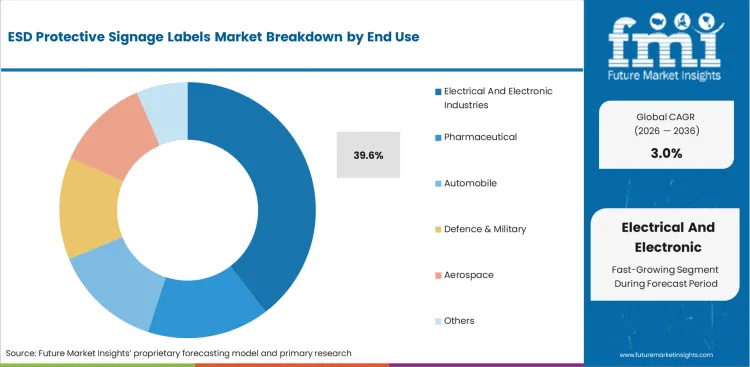
The electrical and electronic industries segment is projected to command 39.6% of the market revenue share in 2026, making it the largest end-use industry. Growth in this segment is being fueled by the rising production of semiconductors, electronic devices, and high-precision components, all of which are highly vulnerable to electrostatic discharge damage. The adoption of ESD protective signage labels in these industries ensures compliance with global quality standards, improves workplace safety, and reduces operational risks associated with equipment damage.
These labels are also used extensively in assembly lines, testing labs, and logistics operations, offering critical visual cues that help personnel manage sensitive components effectively. Rapid expansion of consumer electronics, combined with increasing reliance on automation and connected devices, is driving large-scale use of protective labels.
Furthermore, strong emphasis on regulatory compliance and quality certifications within electrical and electronic manufacturing sectors reinforces demand As industries continue to scale production capacity and embrace digital transformation, the need for effective ESD management through signage labels will remain integral, supporting long-term market leadership of this end-use segment.
Market Overview
ESD Protective Signage Labels Market
Some electrical & electronics manufacturers are making ESD protective signage labels simply usable by producing them in all the prevalent designs and making them generally accessible. Additionally, they give the protective packaging, the ESD emblem and warning words that are required.
These "tamper-evident" destructible type labels allow customers to readily check whether a bag has been opened. In order to provide effective ESD warnings, several manufacturers are focusing on creating versatile ESD protective signage labels that can be used on bags, boxes, and totes. Some manufacturers even make ESD protective signage labels to the specifications and preferences of the clients.
Analysis of ESD Protective Signage Labels Market By Key Countries
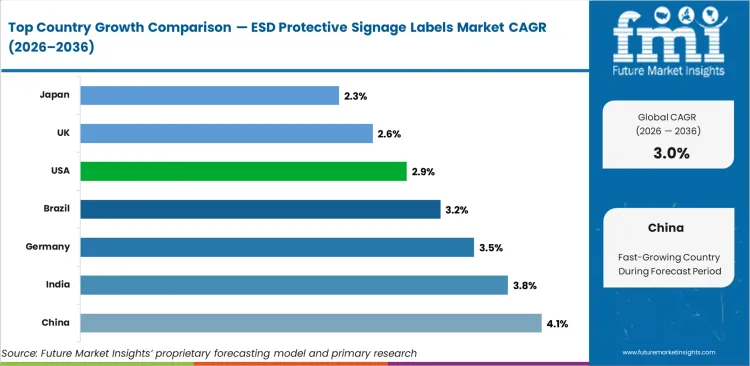
.webp "Top Country Growth Comparison Esd Protective Signage Labels Market Cagr (2026 2036)")
| Country | CAGR |
|---|---|
| China | 4.1% |
| India | 3.8% |
| Germany | 3.5% |
| Brazil | 3.2% |
| USA | 2.9% |
| UK | 2.6% |
| Japan | 2.3% |
Source: FMI analysis based on primary research and proprietary forecasting model
Country-wise Analysis
The ESD Protective Signage Labels Market is expected to register a CAGR of 3.0% during the forecast period, exhibiting varied country level momentum. China leads with the highest CAGR of 4.1%, followed by India at 3.8%. Developed markets such as Germany, France, and the UK continue to expand steadily, while the USA is likely to grow at consistent rates. Japan posts the lowest CAGR at 2.3%, yet still underscores a broadly positive trajectory for the global ESD Protective Signage Labels Market. In 2026, Germany held a dominant revenue in the Western Europe market and is expected to grow with a CAGR of 3.5%. The USA ESD Protective Signage Labels Market is estimated to be valued at USD 120.9 billion in 2026 and is anticipated to reach a valuation of USD 120.9 billion by 2036. Sales are projected to rise at a CAGR of 0.0% over the forecast period between 2026 and 2036. While Japan and South Korea markets are estimated to be valued at USD 15.0 billion and USD 8.4 billion respectively in 2026.
Key Players in the ESD Protective Signage Labels Market
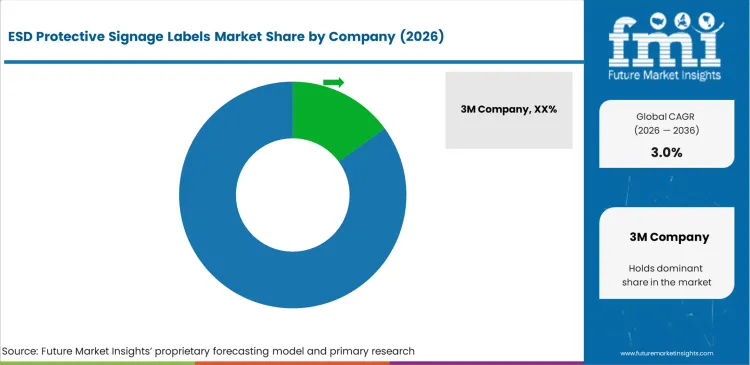
- 3M Company
- Brady Corporation
- Desco Industries Inc.
- Henkel AG & Co. KGaA
- Intertronics
- KEMET Corporation
- LPS Industries, LLC
- Mouser Electronics, Inc.
- Nitto Denko Corporation
- Panduit Corp.
- Protektive Pak
- SCS (Static Control Solutions)
- Static Solutions, Inc.
Scope of the Report
| Metric | Value |
|---|---|
| Quantitative Units | USD Million 330.012 to USD Million 443.509, at a CAGR of 3.00% |
| Market Definition | ESD Protective Signage Labels Market encompasses specialized ESD-compliant containers and storage systems engineered to protect electrostatically sensitive components across electronics manufacturing, semiconductor handling, and industrial logistics environments. |
| Material Type Segmentation | Material Type, Application, End Use |
| Application Segmentation | Plastic, Printed Circuit Board, Electrical And Electronic Industries |
| Regions Covered | North America, Latin America, Europe, East Asia, South Asia, Oceania, Middle East & Africa |
| Countries Covered | India, China, USA, Canada, UK, Germany, Japan, and 40 plus countries |
| Key Companies Profiled | 3M Company, Brady Corporation, Desco Industries Inc., Henkel AG & Co. KGaA, Intertronics, KEMET Corporation, LPS Industries LLC, Mouser Electronics Inc., Nitto Denko Corporation, Panduit Corp. |
| Forecast Period | 2026 to 2036 |
| Approach | Forecasting models apply a bottom-up methodology starting with installed base metrics for ESD-certified handling systems and projecting compliance adoption conversion rates across electronics manufacturing verticals. |
ESD Protective Signage Labels Market by Segments
Material Type:
- Plastic
- Polyimide
- Pet
- Vinyl
- Others
- Paper
- Gloss Paper
- Synthetic Paper
Application:
- Printed Circuit Board (Pcb)
- Semi-Conductors
- Static Sensitive Devices
- Transformers
- Diagnosis Equipment
- Others
End Use:
- Electrical And Electronic Industries
- Pharmaceutical
- Automobile
- Defence & Military
- Aerospace
- Others
Region:
- North America
- USA
- Canada
- Mexico
- Latin America
- Brazil
- Chile
- Rest of Latin America
- Western Europe
- Germany
- UK
- Italy
- Spain
- France
- Nordic
- BENELUX
- Rest of Western Europe
- Eastern Europe
- Russia
- Poland
- Hungary
- Balkan & Baltic
- Rest of Eastern Europe
- East Asia
- China
- Japan
- South Korea
- South Asia and Pacific
- India
- ASEAN
- Australia & New Zealand
- Rest of South Asia and Pacific
- Middle East & Africa
- Kingdom of Saudi Arabia
- Other GCC Countries
- Turkiye
- South Africa
- Other African Union
- Rest of Middle East & Africa
Bibliography
- 1. International Electrotechnical Commission. (2025). IEC 61340-5-1: Protection of electronic devices from electrostatic phenomena. IEC. https://www.iec.ch/
- 2. ANSI/ESD Association. (2023). ANSI/ESD S20.20: Protection of Electrical and Electronic Parts, Assemblies and Equipment. ESD Association. https://www.esda.org/
- 3. Semiconductor Industry Association. (2025). Global Semiconductor Industry Outlook. SIA. https://www.semiconductors.org/
- 4. Organisation for Economic Co-operation and Development. (2025). OECD Digital Economy Outlook 2025. OECD Publishing. https://www.oecd.org/
- 5. European Commission, Directorate-General for Internal Market, Industry, Entrepreneurship and SMEs. (2025). European Electronics Strategy: Key measures and industrial actions. European Commission. https://ec.europa.eu/
- 6. Ministry of Electronics and Information Technology, Government of India. (2025). India Electronics Policy and PLI Scheme Progress Report. MEITY. https://www.meity.gov.in/
- 7. United States Department of Defense. (2023). MIL-PRF-81705 Performance Specification: Barrier Materials, Flexible, Electrostatic-Free, Heat Sealable. DoD. https://www.dla.mil/
This bibliography is provided for reader reference. The full Future Market Insights report contains the complete reference list with primary research documentation.
Frequently Asked Questions
How large is the demand for ESD Protective Signage Labels Market in the global market in 2026?
Demand for ESD Protective Signage Labels Market in the global market is estimated to be valued at USD Million 330.012 in 2026.
What will the market size of ESD Protective Signage Labels Market be by 2036?
Market size for ESD Protective Signage Labels Market is projected to reach USD Million 443.509 by 2036.
What is the expected demand growth for ESD Protective Signage Labels Market between 2026 and 2036?
Demand for ESD Protective Signage Labels Market is expected to grow at a CAGR of 3.00% between 2026 and 2036.
Which Material Type segment is poised to lead global sales by 2026?
Plastic accounts for 26.9% in 2026 as electronics assembly facilities and semiconductor handling operations require certified ESD containment systems meeting IEC 61340 performance thresholds across primary component processing workflows.
What is driving demand in India for ESD Protective Signage Labels Market?
Indian greenfield electronics manufacturing facilities deploying integrated ESD compliance infrastructure from initial facility commissioning, supported by government PLI scheme investments in domestic semiconductor and electronics production capacity, fuel accelerated adoption at 4.8% CAGR.
What compliance standards are referenced in this report?
The report references IEC 61340-5-1, ANSI/ESD S20.20, and MIL-PRF-81705 as the primary governing standards that define certification requirements for ESD-compliant packaging systems across commercial electronics and defense supply chains.
Which companies are profiled in this ESD Protective Signage Labels Market report?
Key companies profiled include 3M Company, Brady Corporation, Desco Industries Inc., Henkel AG & Co. KGaA, Intertronics, KEMET Corporation, LPS Industries LLC, Mouser Electronics Inc., Nitto Denko Corporation, Panduit Corp..
Preview the report firsthand - request a free sample
Get SampleGet the brochure for pricing and purchase details.
Get PDFTable of Content
- Executive Summary
- Global Market Outlook
- Demand-side Trends
- Supply-side Trends
- Technology Roadmap Analysis
- Analysis and Recommendations
- Market Overview
- Market Coverage / Taxonomy
- Market Definition / Scope / Limitations
- Research Methodology
- Chapter Orientation
- Analytical Lens and Working Hypotheses
- Market Structure, Signals, and Trend Drivers
- Benchmarking and Cross-market Comparability
- Market Sizing, Forecasting, and Opportunity Mapping
- Research Design and Evidence Framework
- Desk Research Programme (Secondary Evidence)
- Company Annual and Sustainability Reports
- Peer-reviewed Journals and Academic Literature
- Corporate Websites, Product Literature, and Technical Notes
- Earnings Decks and Investor Briefings
- Statutory Filings and Regulatory Disclosures
- Technical White Papers and Standards Notes
- Trade Journals, Industry Magazines, and Analyst Briefs
- Conference Proceedings, Webinars, and Seminar Materials
- Government Statistics Portals and Public Data Releases
- Press Releases and Reputable Media Coverage
- Specialist Newsletters and Curated Briefings
- Sector Databases and Reference Repositories
- FMI Internal Proprietary Databases and Historical Market Datasets
- Subscription Datasets and Paid Sources
- Social Channels, Communities, and Digital Listening Inputs
- Additional Desk Sources
- Expert Input and Fieldwork (Primary Evidence)
- Primary Modes
- Qualitative Interviews and Expert Elicitation
- Quantitative Surveys and Structured Data Capture
- Blended Approach
- Why Primary Evidence is Used
- Field Techniques
- Interviews
- Surveys
- Focus Groups
- Observational and In-context Research
- Social and Community Interactions
- Stakeholder Universe Engaged
- C-suite Leaders
- Board Members
- Presidents and Vice Presidents
- R&D and Innovation Heads
- Technical Specialists
- Domain Subject-matter Experts
- Scientists
- Physicians and Other Healthcare Professionals
- Governance, Ethics, and Data Stewardship
- Research Ethics
- Data Integrity and Handling
- Primary Modes
- Tooling, Models, and Reference Databases
- Desk Research Programme (Secondary Evidence)
- Data Engineering and Model Build
- Data Acquisition and Ingestion
- Cleaning, Normalisation, and Verification
- Synthesis, Triangulation, and Analysis
- Quality Assurance and Audit Trail
- Market Background
- Market Dynamics
- Drivers
- Restraints
- Opportunity
- Trends
- Scenario Forecast
- Demand in Optimistic Scenario
- Demand in Likely Scenario
- Demand in Conservative Scenario
- Opportunity Map Analysis
- Product Life Cycle Analysis
- Supply Chain Analysis
- Investment Feasibility Matrix
- Value Chain Analysis
- PESTLE and Porter’s Analysis
- Regulatory Landscape
- Regional Parent Market Outlook
- Production and Consumption Statistics
- Import and Export Statistics
- Market Dynamics
- Global Market Analysis 2021 to 2025 and Forecast, 2026 to 2036
- Historical Market Size Value (USD Million) Analysis, 2021 to 2025
- Current and Future Market Size Value (USD Million) Projections, 2026 to 2036
- Y-o-Y Growth Trend Analysis
- Absolute $ Opportunity Analysis
- Global Market Pricing Analysis 2021 to 2025 and Forecast 2026 to 2036
- Global Market Analysis 2021 to 2025 and Forecast 2026 to 2036, By Material Type
- Introduction / Key Findings
- Historical Market Size Value (USD Million) Analysis By Material Type , 2021 to 2025
- Current and Future Market Size Value (USD Million) Analysis and Forecast By Material Type , 2026 to 2036
- Plastic
- Polyimide
- Pet
- Vinyl
- Others
- Paper
- Gloss Paper
- Synthetic Paper
- Plastic
- Y-o-Y Growth Trend Analysis By Material Type , 2021 to 2025
- Absolute $ Opportunity Analysis By Material Type , 2026 to 2036
- Global Market Analysis 2021 to 2025 and Forecast 2026 to 2036, By Application
- Introduction / Key Findings
- Historical Market Size Value (USD Million) Analysis By Application, 2021 to 2025
- Current and Future Market Size Value (USD Million) Analysis and Forecast By Application, 2026 to 2036
- Printed Circuit Board
- Semi-Conductors
- Static Sensitive Devices
- Transformers
- Diagnosis Equipment
- Others
- Printed Circuit Board
- Y-o-Y Growth Trend Analysis By Application, 2021 to 2025
- Absolute $ Opportunity Analysis By Application, 2026 to 2036
- Global Market Analysis 2021 to 2025 and Forecast 2026 to 2036, By End Use
- Introduction / Key Findings
- Historical Market Size Value (USD Million) Analysis By End Use, 2021 to 2025
- Current and Future Market Size Value (USD Million) Analysis and Forecast By End Use, 2026 to 2036
- Electrical And Electronic Industries
- Pharmaceutical
- Automobile
- Defence & Military
- Aerospace
- Others
- Electrical And Electronic Industries
- Y-o-Y Growth Trend Analysis By End Use, 2021 to 2025
- Absolute $ Opportunity Analysis By End Use, 2026 to 2036
- Global Market Analysis 2021 to 2025 and Forecast 2026 to 2036, By Region
- Introduction
- Historical Market Size Value (USD Million) Analysis By Region, 2021 to 2025
- Current Market Size Value (USD Million) Analysis and Forecast By Region, 2026 to 2036
- North America
- Latin America
- Western Europe
- Eastern Europe
- East Asia
- South Asia and Pacific
- Middle East & Africa
- Market Attractiveness Analysis By Region
- North America Market Analysis 2021 to 2025 and Forecast 2026 to 2036, By Country
- Historical Market Size Value (USD Million) Trend Analysis By Market Taxonomy, 2021 to 2025
- Market Size Value (USD Million) Forecast By Market Taxonomy, 2026 to 2036
- By Country
- USA
- Canada
- Mexico
- By Material Type
- By Application
- By End Use
- By Country
- Market Attractiveness Analysis
- By Country
- By Material Type
- By Application
- By End Use
- Key Takeaways
- Latin America Market Analysis 2021 to 2025 and Forecast 2026 to 2036, By Country
- Historical Market Size Value (USD Million) Trend Analysis By Market Taxonomy, 2021 to 2025
- Market Size Value (USD Million) Forecast By Market Taxonomy, 2026 to 2036
- By Country
- Brazil
- Chile
- Rest of Latin America
- By Material Type
- By Application
- By End Use
- By Country
- Market Attractiveness Analysis
- By Country
- By Material Type
- By Application
- By End Use
- Key Takeaways
- Western Europe Market Analysis 2021 to 2025 and Forecast 2026 to 2036, By Country
- Historical Market Size Value (USD Million) Trend Analysis By Market Taxonomy, 2021 to 2025
- Market Size Value (USD Million) Forecast By Market Taxonomy, 2026 to 2036
- By Country
- Germany
- UK
- Italy
- Spain
- France
- Nordic
- BENELUX
- Rest of Western Europe
- By Material Type
- By Application
- By End Use
- By Country
- Market Attractiveness Analysis
- By Country
- By Material Type
- By Application
- By End Use
- Key Takeaways
- Eastern Europe Market Analysis 2021 to 2025 and Forecast 2026 to 2036, By Country
- Historical Market Size Value (USD Million) Trend Analysis By Market Taxonomy, 2021 to 2025
- Market Size Value (USD Million) Forecast By Market Taxonomy, 2026 to 2036
- By Country
- Russia
- Poland
- Hungary
- Balkan & Baltic
- Rest of Eastern Europe
- By Material Type
- By Application
- By End Use
- By Country
- Market Attractiveness Analysis
- By Country
- By Material Type
- By Application
- By End Use
- Key Takeaways
- East Asia Market Analysis 2021 to 2025 and Forecast 2026 to 2036, By Country
- Historical Market Size Value (USD Million) Trend Analysis By Market Taxonomy, 2021 to 2025
- Market Size Value (USD Million) Forecast By Market Taxonomy, 2026 to 2036
- By Country
- China
- Japan
- South Korea
- By Material Type
- By Application
- By End Use
- By Country
- Market Attractiveness Analysis
- By Country
- By Material Type
- By Application
- By End Use
- Key Takeaways
- South Asia and Pacific Market Analysis 2021 to 2025 and Forecast 2026 to 2036, By Country
- Historical Market Size Value (USD Million) Trend Analysis By Market Taxonomy, 2021 to 2025
- Market Size Value (USD Million) Forecast By Market Taxonomy, 2026 to 2036
- By Country
- India
- ASEAN
- Australia & New Zealand
- Rest of South Asia and Pacific
- By Material Type
- By Application
- By End Use
- By Country
- Market Attractiveness Analysis
- By Country
- By Material Type
- By Application
- By End Use
- Key Takeaways
- Middle East & Africa Market Analysis 2021 to 2025 and Forecast 2026 to 2036, By Country
- Historical Market Size Value (USD Million) Trend Analysis By Market Taxonomy, 2021 to 2025
- Market Size Value (USD Million) Forecast By Market Taxonomy, 2026 to 2036
- By Country
- Kingdom of Saudi Arabia
- Other GCC Countries
- Turkiye
- South Africa
- Other African Union
- Rest of Middle East & Africa
- By Material Type
- By Application
- By End Use
- By Country
- Market Attractiveness Analysis
- By Country
- By Material Type
- By Application
- By End Use
- Key Takeaways
- Key Countries Market Analysis
- USA
- Pricing Analysis
- Market Share Analysis, 2025
- By Material Type
- By Application
- By End Use
- Canada
- Pricing Analysis
- Market Share Analysis, 2025
- By Material Type
- By Application
- By End Use
- Mexico
- Pricing Analysis
- Market Share Analysis, 2025
- By Material Type
- By Application
- By End Use
- Brazil
- Pricing Analysis
- Market Share Analysis, 2025
- By Material Type
- By Application
- By End Use
- Chile
- Pricing Analysis
- Market Share Analysis, 2025
- By Material Type
- By Application
- By End Use
- Germany
- Pricing Analysis
- Market Share Analysis, 2025
- By Material Type
- By Application
- By End Use
- UK
- Pricing Analysis
- Market Share Analysis, 2025
- By Material Type
- By Application
- By End Use
- Italy
- Pricing Analysis
- Market Share Analysis, 2025
- By Material Type
- By Application
- By End Use
- Spain
- Pricing Analysis
- Market Share Analysis, 2025
- By Material Type
- By Application
- By End Use
- France
- Pricing Analysis
- Market Share Analysis, 2025
- By Material Type
- By Application
- By End Use
- India
- Pricing Analysis
- Market Share Analysis, 2025
- By Material Type
- By Application
- By End Use
- ASEAN
- Pricing Analysis
- Market Share Analysis, 2025
- By Material Type
- By Application
- By End Use
- Australia & New Zealand
- Pricing Analysis
- Market Share Analysis, 2025
- By Material Type
- By Application
- By End Use
- China
- Pricing Analysis
- Market Share Analysis, 2025
- By Material Type
- By Application
- By End Use
- Japan
- Pricing Analysis
- Market Share Analysis, 2025
- By Material Type
- By Application
- By End Use
- South Korea
- Pricing Analysis
- Market Share Analysis, 2025
- By Material Type
- By Application
- By End Use
- Russia
- Pricing Analysis
- Market Share Analysis, 2025
- By Material Type
- By Application
- By End Use
- Poland
- Pricing Analysis
- Market Share Analysis, 2025
- By Material Type
- By Application
- By End Use
- Hungary
- Pricing Analysis
- Market Share Analysis, 2025
- By Material Type
- By Application
- By End Use
- Kingdom of Saudi Arabia
- Pricing Analysis
- Market Share Analysis, 2025
- By Material Type
- By Application
- By End Use
- Turkiye
- Pricing Analysis
- Market Share Analysis, 2025
- By Material Type
- By Application
- By End Use
- South Africa
- Pricing Analysis
- Market Share Analysis, 2025
- By Material Type
- By Application
- By End Use
- USA
- Market Structure Analysis
- Competition Dashboard
- Competition Benchmarking
- Market Share Analysis of Top Players
- By Regional
- By Material Type
- By Application
- By End Use
- Competition Analysis
- Competition Deep Dive
- 3M Company
- Overview
- Product Portfolio
- Profitability by Market Segments (Product/Age /Sales Channel/Region)
- Sales Footprint
- Strategy Overview
- Marketing Strategy
- Product Strategy
- Channel Strategy
- Brady Corporation
- Desco Industries Inc.
- Henkel AG & Co. KGaA
- Intertronics
- KEMET Corporation
- LPS Industries, LLC
- Mouser Electronics, Inc.
- Nitto Denko Corporation
- Panduit Corp.
- Protektive Pak
- SCS (Static Control Solutions)
- Static Solutions, Inc.
- 3M Company
- Competition Deep Dive
- Assumptions & Acronyms Used


