

- Industry Size (2025)
- USD 1.0 Bn
- Forecast (2035)
- USD 1.5 Bn
- CAGR (2025 to 2035)
- 3.8%
Protective Earth Resistance Meter Market Size and Share Forecast Outlook 2025 to 2035
The Protective Earth Resistance Meter Market is estimated to be valued at USD 1.0 billion in 2025 and is projected to reach USD 1.5 billion by 2035, registering a compound annual growth rate (CAGR) of 3.8% over the forecast period.
Quick Stats for Protective Earth Resistance Meter Market
- Protective Earth Resistance Meter Market Value (2025): USD 1.0 billion
- Protective Earth Resistance Meter Market Forecast Value (2035): USD 1.5 billion
- Protective Earth Resistance Meter Market Forecast CAGR: 3.8%
- Leading Segment in Protective Earth Resistance Meter Market in 2025: Alternating Current (55.0%)
- Key Growth Regions in Protective Earth Resistance Meter Market: North America, Asia-Pacific, Europe
- Top Key Players in Protective Earth Resistance Meter Market: Megger, PCE Instruments, HIOKI, Motwane, SCOPE, Udeyraj Electricals, OMICRON, Ajit Electronic Corporation, Crest Test Systems
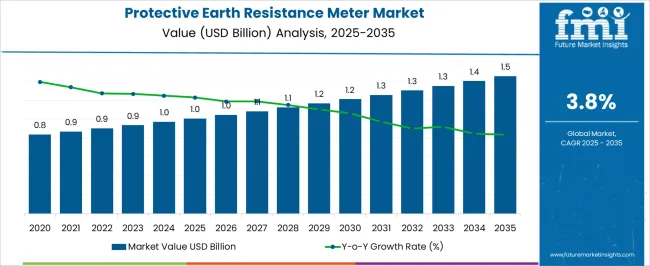
Protective Earth Resistance Meter Market Key Takeaways
| Metric | Value |
|---|---|
| Protective Earth Resistance Meter Market Estimated Value in (2025 E) | USD 1.0 billion |
| Protective Earth Resistance Meter Market Forecast Value in (2035 F) | USD 1.5 billion |
| Forecast CAGR (2025 to 2035) | 3.8% |
Why is the Protective Earth Resistance Meter Market Growing?
The Protective Earth Resistance Meter market is witnessing steady expansion due to the increasing emphasis on electrical safety and compliance across industrial, commercial, and residential sectors. The current scenario is shaped by growing adoption of monitoring systems that ensure grounding reliability, minimize risks of electrical faults, and support regulatory compliance in high-risk environments.
As infrastructure development accelerates and automation becomes more prevalent, accurate measurement of earth resistance has become critical to safeguarding personnel, equipment, and data networks. The growing complexity of electrical systems and rising demand for real-time fault detection are creating opportunities for advanced earth resistance meters.
Enhanced focus on occupational safety and surge protection, alongside investments in renewable energy and smart grids, is further strengthening the market outlook Over the coming years, the market is expected to expand steadily as more end users adopt devices capable of delivering precise readings, improved diagnostics, and integration with larger safety management frameworks.
Segmental Analysis
The protective earth resistance meter market is segmented by current type, measurement method, range, application, and geographic regions. By current type, protective earth resistance meter market is divided into Alternating Current and Direct Current. In terms of measurement method, protective earth resistance meter market is classified into Two-Pole Method and Three-Pole Method. Based on range, protective earth resistance meter market is segmented into 0-20 Ohm, 0-200 Ohm, 0-2000 Ohm, and Other Ranges. By application, protective earth resistance meter market is segmented into Home And Building Solutions, Power Stations, Laboratories, Commercial Buildings, and Other Applications. Regionally, the protective earth resistance meter industry is classified into North America, Latin America, Western Europe, Eastern Europe, Balkan & Baltic Countries, Russia & Belarus, Central Asia, East Asia, South Asia & Pacific, and the Middle East & Africa.
Insights into the Alternating Current Segment
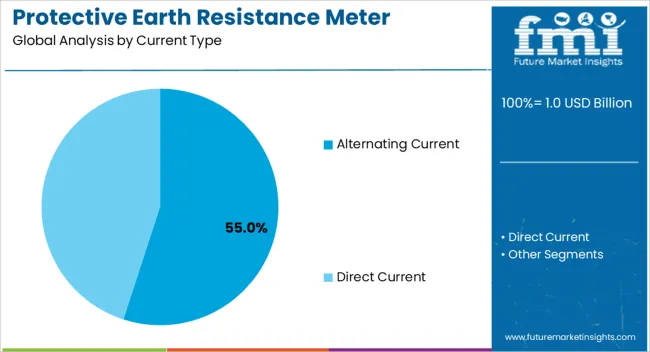
The alternating current segment is expected to hold 55.00% of the Protective Earth Resistance Meter market revenue share in 2025, establishing it as the leading measurement type. This prominence is being attributed to its compatibility with complex electrical networks where continuous current flow is required for proper grounding assessments.
Alternating current-based meters are increasingly preferred in industrial environments where equipment such as transformers, motors, and large electrical panels necessitate precise and stable resistance measurements under dynamic load conditions. The segment’s growth is further supported by the adoption of smart monitoring systems, which rely on alternating current measurements to detect fluctuations and prevent potential hazards.
The ability to perform measurements without shutting down systems has made this technology particularly valuable in sectors requiring uninterrupted operations As safety compliance standards evolve and demand for predictive maintenance rises, alternating current meters are anticipated to maintain their market lead, supported by robust performance and broad applicability across diverse environments.
Insights into the Two Pole Method Segment
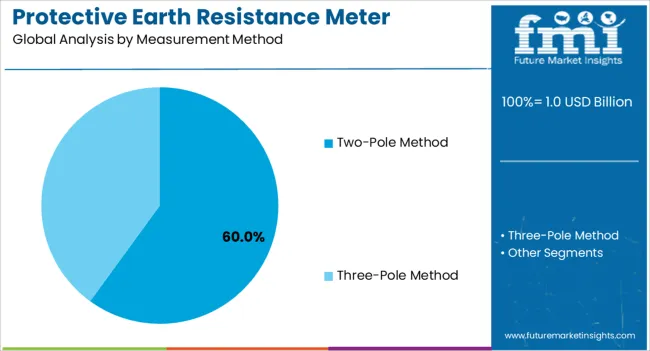
The two pole method segment is expected to account for 60.00% of the Protective Earth Resistance Meter market revenue share in 2025, making it the dominant measurement method. This method’s preference is being driven by its simplicity, cost efficiency, and effectiveness in delivering accurate readings in standard installation scenarios. It is widely adopted in environments where quick verification of earth resistance is required without complex wiring or specialized training.
The ease of setup and the ability to conduct tests in the field without extensive instrumentation have contributed to its broad acceptance among electrical maintenance teams. Furthermore, its compatibility with both alternating and direct current configurations has extended its usability across multiple industries.
With regulatory bodies placing emphasis on grounding checks during routine safety audits, the two pole method has become a reliable solution for ensuring compliance As organizations prioritize operational continuity and risk management, demand for user-friendly and efficient measurement methods like the two pole method is expected to grow consistently in the near future.
Insights into the 0-20 Ohm Range Segment
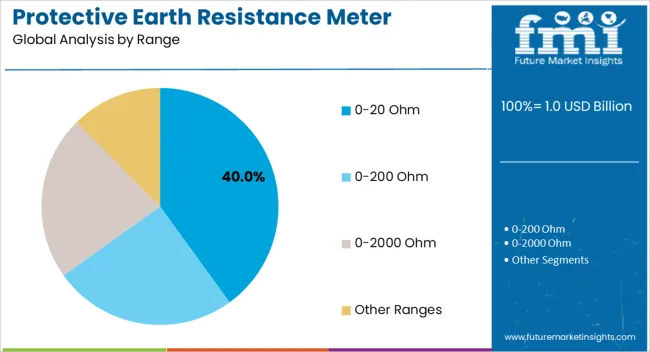
The 0-20 Ohm range segment is projected to hold 40.00% of the Protective Earth Resistance Meter market revenue share in 2025, marking it as a significant category within resistance measurements. This range is being favored because it covers the typical grounding resistance levels required in most industrial and commercial installations.
Accurate detection within this range is essential to ensure that protective grounding systems function effectively to prevent electrical shocks and equipment damage. The segment’s growth has been supported by the increasing need for compliance with electrical safety standards, which often stipulate that resistance values must remain below specified thresholds to guarantee proper grounding.
Additionally, the range aligns well with the requirements of renewable energy installations, manufacturing plants, and data centers, where low resistance levels are critical for operational safety As awareness of grounding failures and their consequences grows, the demand for reliable and precise measurement within the 0-20 Ohm range is expected to remain strong, making it a key contributor to the overall market expansion.
Market Overview
Protective Earth Resistance Meter Market Overview
A protective earth resistance meter is a device that measures earth resistance. Protective earth resistance meter has been extended by several end-users due to its numerous benefits and advantages, creating enormous growth opportunities during the forecast period. The application of protective earth resistance meters in rapidly growing electronics and electrical engineering aims to deliver healthy growth for the protective earth resistance meter market.
Because of the growing use of protective earth resistance meters in home and building solutions around the world, protective earth resistance meter production has increased globally, with APEJ registering high growth for the protective earth resistance meter market during the forecast period. A protective earth resistance meter is a measuring device for earth resistance. Because of its numerous benefits and advantages, the protective earth resistance meter has been extended by several end-users, creating enormous growth opportunities during the forecast period. The use of protective earth resistance meters in rapidly growing electronics and electrical engineering aims to drive healthy growth in the protective earth resistance meter market. Protective earth resistance meter production has increased globally as a result of the increasing use of protective earth resistance meters in home and building solutions around the world, with APEJ registering high growth for the protective earth resistance meter market during the forecast period.
Analysis of Protective Earth Resistance Meter Market By Key Countries
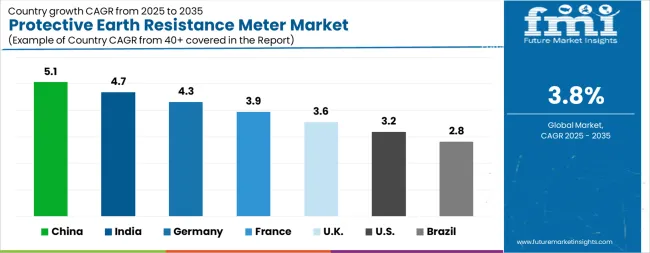
| Country | CAGR |
|---|---|
| China | 5.1% |
| India | 4.7% |
| Germany | 4.3% |
| France | 3.9% |
| UK | 3.6% |
| USA | 3.2% |
| Brazil | 2.8% |
Country-wise Analysis
The Protective Earth Resistance Meter Market is expected to register a CAGR of 3.8% during the forecast period, exhibiting varied country level momentum. China leads with the highest CAGR of 5.1%, followed by India at 4.7%. Developed markets such as Germany, France, and the UK continue to expand steadily, while the USA is likely to grow at consistent rates. Brazil posts the lowest CAGR at 2.8%, yet still underscores a broadly positive trajectory for the global Protective Earth Resistance Meter Market. In 2024, Germany held a dominant revenue in the Western Europe market and is expected to grow with a CAGR of 4.3%. The USA Protective Earth Resistance Meter Market is estimated to be valued at USD 350.3 million in 2025 and is anticipated to reach a valuation of USD 479.4 million by 2035. Sales are projected to rise at a CAGR of 3.2% over the forecast period between 2025 and 2035. While Japan and South Korea markets are estimated to be valued at USD 50.5 million and USD 30.9 million respectively in 2025.
Key Players in the Protective Earth Resistance Meter Market
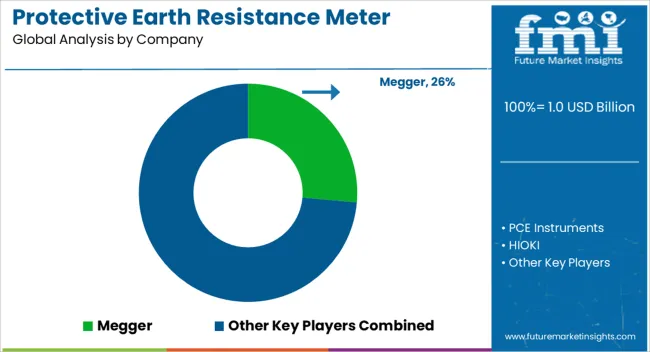
- Megger
- PCE Instruments
- HIOKI
- Motwane
- SCOPE
- Udeyraj Electricals
- OMICRON
- Ajit Electronic Corporation
- Crest Test Systems
Scope of the Report
| Item | Value |
|---|---|
| Quantitative Units | USD 1.0 Billion |
| Current Type | Alternating Current and Direct Current |
| Measurement Method | Two-Pole Method and Three-Pole Method |
| Range | 0-20 Ohm, 0-200 Ohm, 0-2000 Ohm, and Other Ranges |
| Application | Home And Building Solutions, Power Stations, Laboratories, Commercial Buildings, and Other Applications |
| Regions Covered | North America, Europe, Asia-Pacific, Latin America, Middle East & Africa |
| Country Covered | United States, Canada, Germany, France, United Kingdom, China, Japan, India, Brazil, South Africa |
| Key Companies Profiled | Megger, PCE Instruments, HIOKI, Motwane, SCOPE, Udeyraj Electricals, OMICRON, Ajit Electronic Corporation, and Crest Test Systems |
Protective Earth Resistance Meter Market by Segments
Current Type:
- Alternating Current
- Direct Current
Measurement Method:
- Two-Pole Method
- Three-Pole Method
Range:
- 0-20 Ohm
- 0-200 Ohm
- 0-2000 Ohm
- Other Ranges
Application:
- Home And Building Solutions
- Power Stations
- Laboratories
- Commercial Buildings
- Other Applications
Region:
- North America
- USA
- Canada
- Mexico
- Latin America
- Brazil
- Chile
- Rest of Latin America
- Western Europe
- Germany
- UK
- Italy
- Spain
- France
- Nordic
- BENELUX
- Rest of Western Europe
- Eastern Europe
- Russia
- Poland
- Hungary
- Balkan & Baltic
- Rest of Eastern Europe
- East Asia
- China
- Japan
- South Korea
- South Asia and Pacific
- India
- ASEAN
- Australia & New Zealand
- Rest of South Asia and Pacific
- Middle East & Africa
- Kingdom of Saudi Arabia
- Other GCC Countries
- Turkiye
- South Africa
- Other African Union
- Rest of Middle East & Africa
Frequently Asked Questions
How big is the protective earth resistance meter market in 2025?
The global protective earth resistance meter market is estimated to be valued at USD 1.0 billion in 2025.
What will be the size of protective earth resistance meter market in 2035?
The market size for the protective earth resistance meter market is projected to reach USD 1.5 billion by 2035.
How much will be the protective earth resistance meter market growth between 2025 and 2035?
The protective earth resistance meter market is expected to grow at a 3.8% CAGR between 2025 and 2035.
What are the key product types in the protective earth resistance meter market?
The key product types in protective earth resistance meter market are alternating current and direct current.
Which measurement method segment to contribute significant share in the protective earth resistance meter market in 2025?
In terms of measurement method, two-pole method segment to command 60.0% share in the protective earth resistance meter market in 2025.
Preview the report firsthand - request a free sample
Get SampleGet the brochure for pricing and purchase details.
Get PDFTable of Content
- Executive Summary
- Global Market Outlook
- Demand-side Trends
- Supply-side Trends
- Technology Roadmap Analysis
- Analysis and Recommendations
- Market Overview
- Market Coverage / Taxonomy
- Market Definition / Scope / Limitations
- Market Background
- Market Dynamics
- Drivers
- Restraints
- Opportunity
- Trends
- Scenario Forecast
- Demand in Optimistic Scenario
- Demand in Likely Scenario
- Demand in Conservative Scenario
- Opportunity Map Analysis
- Product Life Cycle Analysis
- Supply Chain Analysis
- Investment Feasibility Matrix
- Value Chain Analysis
- PESTLE and Porter’s Analysis
- Regulatory Landscape
- Regional Parent Market Outlook
- Production and Consumption Statistics
- Import and Export Statistics
- Market Dynamics
- Global Market Analysis 2020 to 2024 and Forecast, 2025 to 2035
- Historical Market Size Value (USD Million) Analysis, 2020 to 2024
- Current and Future Market Size Value (USD Million) Projections, 2025 to 2035
- Y-o-Y Growth Trend Analysis
- Absolute $ Opportunity Analysis
- Global Market Pricing Analysis 2020 to 2024 and Forecast 2025 to 2035
- Global Market Analysis 2020 to 2024 and Forecast 2025 to 2035, By Current Type
- Introduction / Key Findings
- Historical Market Size Value (USD Million) Analysis By Current Type , 2020 to 2024
- Current and Future Market Size Value (USD Million) Analysis and Forecast By Current Type , 2025 to 2035
- Alternating Current
- Direct Current
- Y-o-Y Growth Trend Analysis By Current Type , 2020 to 2024
- Absolute $ Opportunity Analysis By Current Type , 2025 to 2035
- Global Market Analysis 2020 to 2024 and Forecast 2025 to 2035, By Measurement Method
- Introduction / Key Findings
- Historical Market Size Value (USD Million) Analysis By Measurement Method, 2020 to 2024
- Current and Future Market Size Value (USD Million) Analysis and Forecast By Measurement Method, 2025 to 2035
- Two-Pole Method
- Three-Pole Method
- Y-o-Y Growth Trend Analysis By Measurement Method, 2020 to 2024
- Absolute $ Opportunity Analysis By Measurement Method, 2025 to 2035
- Global Market Analysis 2020 to 2024 and Forecast 2025 to 2035, By Range
- Introduction / Key Findings
- Historical Market Size Value (USD Million) Analysis By Range, 2020 to 2024
- Current and Future Market Size Value (USD Million) Analysis and Forecast By Range, 2025 to 2035
- 0-20 Ohm
- 0-200 Ohm
- 0-2000 Ohm
- Other Ranges
- Y-o-Y Growth Trend Analysis By Range, 2020 to 2024
- Absolute $ Opportunity Analysis By Range, 2025 to 2035
- Global Market Analysis 2020 to 2024 and Forecast 2025 to 2035, By Application
- Introduction / Key Findings
- Historical Market Size Value (USD Million) Analysis By Application, 2020 to 2024
- Current and Future Market Size Value (USD Million) Analysis and Forecast By Application, 2025 to 2035
- Home And Building Solutions
- Power Stations
- Laboratories
- Commercial Buildings
- Other Applications
- Y-o-Y Growth Trend Analysis By Application, 2020 to 2024
- Absolute $ Opportunity Analysis By Application, 2025 to 2035
- Global Market Analysis 2020 to 2024 and Forecast 2025 to 2035, By Region
- Introduction
- Historical Market Size Value (USD Million) Analysis By Region, 2020 to 2024
- Current Market Size Value (USD Million) Analysis and Forecast By Region, 2025 to 2035
- North America
- Latin America
- Western Europe
- Eastern Europe
- East Asia
- South Asia and Pacific
- Middle East & Africa
- Market Attractiveness Analysis By Region
- North America Market Analysis 2020 to 2024 and Forecast 2025 to 2035, By Country
- Historical Market Size Value (USD Million) Trend Analysis By Market Taxonomy, 2020 to 2024
- Market Size Value (USD Million) Forecast By Market Taxonomy, 2025 to 2035
- By Country
- USA
- Canada
- Mexico
- By Current Type
- By Measurement Method
- By Range
- By Application
- By Country
- Market Attractiveness Analysis
- By Country
- By Current Type
- By Measurement Method
- By Range
- By Application
- Key Takeaways
- Latin America Market Analysis 2020 to 2024 and Forecast 2025 to 2035, By Country
- Historical Market Size Value (USD Million) Trend Analysis By Market Taxonomy, 2020 to 2024
- Market Size Value (USD Million) Forecast By Market Taxonomy, 2025 to 2035
- By Country
- Brazil
- Chile
- Rest of Latin America
- By Current Type
- By Measurement Method
- By Range
- By Application
- By Country
- Market Attractiveness Analysis
- By Country
- By Current Type
- By Measurement Method
- By Range
- By Application
- Key Takeaways
- Western Europe Market Analysis 2020 to 2024 and Forecast 2025 to 2035, By Country
- Historical Market Size Value (USD Million) Trend Analysis By Market Taxonomy, 2020 to 2024
- Market Size Value (USD Million) Forecast By Market Taxonomy, 2025 to 2035
- By Country
- Germany
- UK
- Italy
- Spain
- France
- Nordic
- BENELUX
- Rest of Western Europe
- By Current Type
- By Measurement Method
- By Range
- By Application
- By Country
- Market Attractiveness Analysis
- By Country
- By Current Type
- By Measurement Method
- By Range
- By Application
- Key Takeaways
- Eastern Europe Market Analysis 2020 to 2024 and Forecast 2025 to 2035, By Country
- Historical Market Size Value (USD Million) Trend Analysis By Market Taxonomy, 2020 to 2024
- Market Size Value (USD Million) Forecast By Market Taxonomy, 2025 to 2035
- By Country
- Russia
- Poland
- Hungary
- Balkan & Baltic
- Rest of Eastern Europe
- By Current Type
- By Measurement Method
- By Range
- By Application
- By Country
- Market Attractiveness Analysis
- By Country
- By Current Type
- By Measurement Method
- By Range
- By Application
- Key Takeaways
- East Asia Market Analysis 2020 to 2024 and Forecast 2025 to 2035, By Country
- Historical Market Size Value (USD Million) Trend Analysis By Market Taxonomy, 2020 to 2024
- Market Size Value (USD Million) Forecast By Market Taxonomy, 2025 to 2035
- By Country
- China
- Japan
- South Korea
- By Current Type
- By Measurement Method
- By Range
- By Application
- By Country
- Market Attractiveness Analysis
- By Country
- By Current Type
- By Measurement Method
- By Range
- By Application
- Key Takeaways
- South Asia and Pacific Market Analysis 2020 to 2024 and Forecast 2025 to 2035, By Country
- Historical Market Size Value (USD Million) Trend Analysis By Market Taxonomy, 2020 to 2024
- Market Size Value (USD Million) Forecast By Market Taxonomy, 2025 to 2035
- By Country
- India
- ASEAN
- Australia & New Zealand
- Rest of South Asia and Pacific
- By Current Type
- By Measurement Method
- By Range
- By Application
- By Country
- Market Attractiveness Analysis
- By Country
- By Current Type
- By Measurement Method
- By Range
- By Application
- Key Takeaways
- Middle East & Africa Market Analysis 2020 to 2024 and Forecast 2025 to 2035, By Country
- Historical Market Size Value (USD Million) Trend Analysis By Market Taxonomy, 2020 to 2024
- Market Size Value (USD Million) Forecast By Market Taxonomy, 2025 to 2035
- By Country
- Kingdom of Saudi Arabia
- Other GCC Countries
- Turkiye
- South Africa
- Other African Union
- Rest of Middle East & Africa
- By Current Type
- By Measurement Method
- By Range
- By Application
- By Country
- Market Attractiveness Analysis
- By Country
- By Current Type
- By Measurement Method
- By Range
- By Application
- Key Takeaways
- Key Countries Market Analysis
- USA
- Pricing Analysis
- Market Share Analysis, 2024
- By Current Type
- By Measurement Method
- By Range
- By Application
- Canada
- Pricing Analysis
- Market Share Analysis, 2024
- By Current Type
- By Measurement Method
- By Range
- By Application
- Mexico
- Pricing Analysis
- Market Share Analysis, 2024
- By Current Type
- By Measurement Method
- By Range
- By Application
- Brazil
- Pricing Analysis
- Market Share Analysis, 2024
- By Current Type
- By Measurement Method
- By Range
- By Application
- Chile
- Pricing Analysis
- Market Share Analysis, 2024
- By Current Type
- By Measurement Method
- By Range
- By Application
- Germany
- Pricing Analysis
- Market Share Analysis, 2024
- By Current Type
- By Measurement Method
- By Range
- By Application
- UK
- Pricing Analysis
- Market Share Analysis, 2024
- By Current Type
- By Measurement Method
- By Range
- By Application
- Italy
- Pricing Analysis
- Market Share Analysis, 2024
- By Current Type
- By Measurement Method
- By Range
- By Application
- Spain
- Pricing Analysis
- Market Share Analysis, 2024
- By Current Type
- By Measurement Method
- By Range
- By Application
- France
- Pricing Analysis
- Market Share Analysis, 2024
- By Current Type
- By Measurement Method
- By Range
- By Application
- India
- Pricing Analysis
- Market Share Analysis, 2024
- By Current Type
- By Measurement Method
- By Range
- By Application
- ASEAN
- Pricing Analysis
- Market Share Analysis, 2024
- By Current Type
- By Measurement Method
- By Range
- By Application
- Australia & New Zealand
- Pricing Analysis
- Market Share Analysis, 2024
- By Current Type
- By Measurement Method
- By Range
- By Application
- China
- Pricing Analysis
- Market Share Analysis, 2024
- By Current Type
- By Measurement Method
- By Range
- By Application
- Japan
- Pricing Analysis
- Market Share Analysis, 2024
- By Current Type
- By Measurement Method
- By Range
- By Application
- South Korea
- Pricing Analysis
- Market Share Analysis, 2024
- By Current Type
- By Measurement Method
- By Range
- By Application
- Russia
- Pricing Analysis
- Market Share Analysis, 2024
- By Current Type
- By Measurement Method
- By Range
- By Application
- Poland
- Pricing Analysis
- Market Share Analysis, 2024
- By Current Type
- By Measurement Method
- By Range
- By Application
- Hungary
- Pricing Analysis
- Market Share Analysis, 2024
- By Current Type
- By Measurement Method
- By Range
- By Application
- Kingdom of Saudi Arabia
- Pricing Analysis
- Market Share Analysis, 2024
- By Current Type
- By Measurement Method
- By Range
- By Application
- Turkiye
- Pricing Analysis
- Market Share Analysis, 2024
- By Current Type
- By Measurement Method
- By Range
- By Application
- South Africa
- Pricing Analysis
- Market Share Analysis, 2024
- By Current Type
- By Measurement Method
- By Range
- By Application
- USA
- Market Structure Analysis
- Competition Dashboard
- Competition Benchmarking
- Market Share Analysis of Top Players
- By Regional
- By Current Type
- By Measurement Method
- By Range
- By Application
- Competition Analysis
- Competition Deep Dive
- Megger
- Overview
- Product Portfolio
- Profitability by Market Segments (Product/Age /Sales Channel/Region)
- Sales Footprint
- Strategy Overview
- Marketing Strategy
- Product Strategy
- Channel Strategy
- PCE Instruments
- HIOKI
- Motwane
- SCOPE
- Udeyraj Electricals
- OMICRON
- Ajit Electronic Corporation
- Crest Test Systems
- Megger
- Competition Deep Dive
- Assumptions & Acronyms Used
- Research Methodology


