

- Industry Size (2026)
- USD 1.22 Bn
- Forecast (2036)
- USD 1.72 Bn
- CAGR (2026 to 2036)
- 3.9%
Electrical Insulation Paper Market Size, Market Forecast and Outlook By FMI
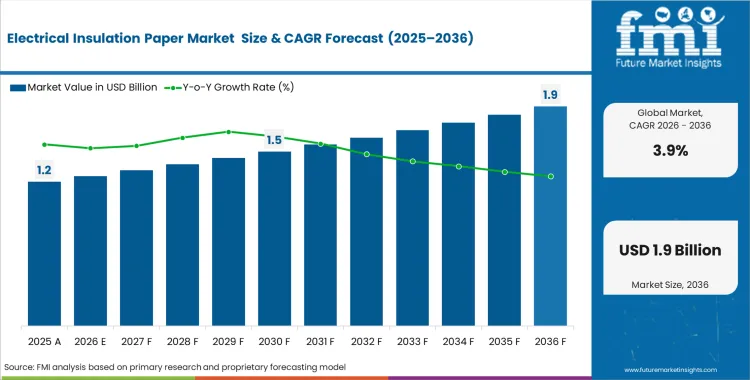
The electrical insulation paper market was valued at USD 1.18 billion in 2025. The market is projected to reach USD 1.22 billion in 2026 and USD 1.72 billion by 2036, expanding at a CAGR of 3.9% during the forecast period. Transformer insulation paper is expected to lead product type demand with a 41.8% share in 2026. Power transformers are projected to remain the leading application with a 36.4% share in 2026.
Summary of Electrical Insulation Paper Market
- Market Snapshot
- The electrical insulation paper market is valued at USD 1.18 billion in 2025 and is projected to reach USD 1.72 billion by 2036.
- The industry is expected to grow at a 3.9% CAGR from 2026 to 2036, creating an incremental opportunity of USD 0.50 billion.
- The market remains a specification-driven electrical materials category, where purity, dielectric performance, and qualification depth shape competitiveness.
- Demand and Growth Drivers
- Demand is rising as utilities invest in grid upgrades and replace aging transformer fleets.
- Electrical insulation paper remains critical because transformer reliability depends on stable dielectric separation and oil compatibility.
- Growth is also being supported by transmission expansion, renewable integration, and industrial electrification across developing markets.
- Product and Segment View
- The market covers cellulose-based insulation papers used in transformers, cables, motors, and related high-voltage equipment.
- Transformer insulation paper is expected to lead product type demand with a 41.8% share in 2026.
- Power transformers are projected to remain the leading application with a 36.4% share in 2026.
- Geography and Competitive Outlook
- East Asia remains a key market due to its transformer manufacturing base and continued grid investment.
- Developing markets are adding demand through electrification and transmission build-out, while mature markets support replacement demand.
- Key companies in the electrical insulation paper market include Ahlstrom, Munksjo, Weidmann Electrical Technology, DuPont, Nippon Paper Industries, Delfort Group, and Krempel GmbH.
- Analyst Opinion
- Ismail Sutaria, Senior Consultant at FMI says, "Electrical insulation paper remains a resilient materials market because transformer reliability leaves little room for compromise. Suppliers that can hold purity, thickness consistency, and long qualification cycles are likely to retain an edge as grid investment continues."
Electrical Insulation Paper Market Definition
Electrical insulation paper is a specialized cellulose-based material used to provide dielectric insulation, mechanical separation, and thermal stability in electrical equipment. It is widely used in transformers, cables, motors, and related high-voltage systems where dependable insulation performance is essential. The material is engineered to maintain purity, strength, and oil absorption characteristics under prolonged electrical and thermal stress.
Electrical Insulation Paper Market Inclusions
- Cellulose-based electrical insulation paper used in transformers, cables, motors, and related electrical equipment.
- Market sizing by product type, application, and region, including demand from utility and industrial power systems.
- Competitive assessment of major manufacturers, product positioning, and strategic developments.
Electrical Insulation Paper Market Exclusions
- Non-paper polymeric insulation materials and unrelated electrical laminates not classified as insulation paper.
- Downstream transformer manufacturing revenues beyond the insulation paper value contribution.
- Country-level trade modeling for minor markets outside the regional framework.
Electrical Insulation Paper Market Research Methodology
This study evaluates the electrical insulation paper market by product type, application, and region with 2025 as the base year and 2026 to 2036 as the forecast period in value terms. All market values are presented in USD billion. The analysis draws on company disclosures, grid-investment references, electrical equipment demand indicators, and technical standards relevant to insulation materials used in transformers and related systems. Market estimates are built through triangulation of supply-side production positioning, application-side consumption patterns, pricing trends, and infrastructure demand signals across major regions.
Key Drivers, Restraints, and Trends in Electrical Insulation Paper Market
Drivers
The market is being driven by steady investment in transmission and distribution infrastructure as utilities upgrade aging grids and expand capacity for rising electricity demand. Transformer installations remain the core demand engine because electrical insulation paper is essential for long operating life. Renewable integration is also increasing the need for transformers across substations and interconnection networks. Industrial electrification adds another layer of demand because dependable insulation remains central to equipment safety and operating stability.
Restraints
Market growth is moderated by volatility in high-purity cellulose inputs and energy-intensive processing costs. The industry also faces competition from synthetic insulation systems in selected applications. Qualification requirements are stringent, which slows the adoption of new grades and extends approval cycles. Large transformer OEMs and utility buyers can also exert pricing pressure, which limits margin expansion for material suppliers.
Trends
A clear trend in the market is the move toward higher-performance insulation paper with stronger thermal endurance and tighter thickness control. Buyers are also placing more weight on process consistency because transformer failures carry high replacement and downtime costs. Supply reliability is becoming more important as OEMs try to reduce procurement risk. Sustainability is gaining visibility as customers show greater interest in responsibly sourced cellulose and lower-impact production practices.
Segmental Analysis
Electrical Insulation Paper Market Analysis by Product Type
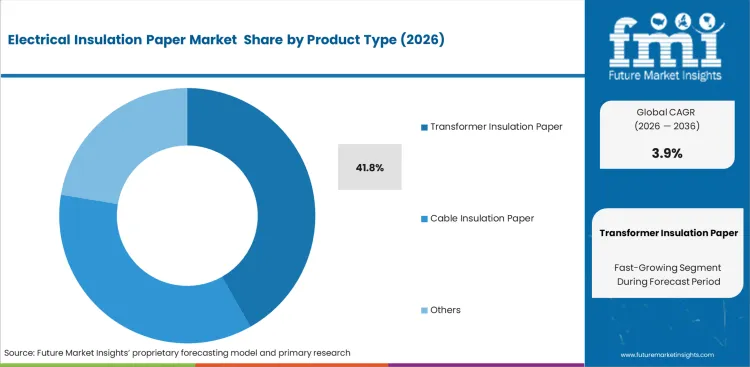
Transformer insulation paper is expected to account for 41.8% of product type demand in 2026, making it the leading category in the electrical insulation paper market. Its position is supported by the large installed base of power and distribution transformers that require dependable dielectric materials in both new production and replacement cycles. Demand remains strongest where buyers prioritize equipment life and oil compatibility. Suppliers compete on purity and consistency across transformer designs.
Electrical Insulation Paper Market Analysis by Application
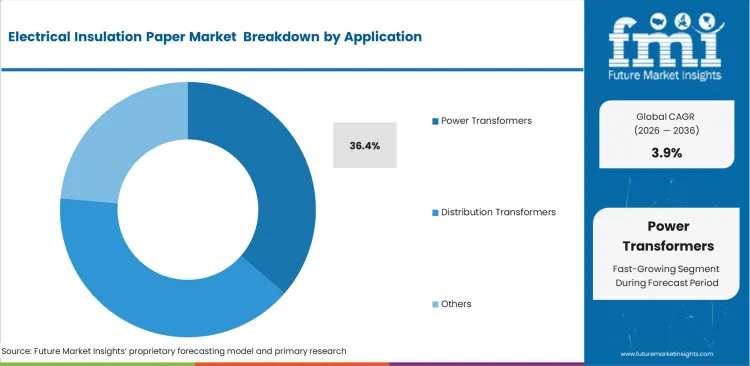
Power transformers are projected to hold the leading application share at 36.4% in 2026, reflecting the importance of high-voltage transmission infrastructure in overall demand. These units require insulation systems that can withstand electrical stress and sustained thermal loading over long operating lives. Growth in this segment is reinforced by grid expansion and renewable integration. Utilities continue to favor premium insulation grades where maintenance risk and outage costs are high.
Electrical Insulation Paper Market Analysis by Region
East Asia represents a highly influential market due to its concentration of transformer manufacturing and continued grid investment. The region benefits from strong domestic demand as well as export-oriented electrical equipment production. China, Japan, and South Korea remain important to regional momentum through utility upgrades and industrial capacity. Competitive intensity in East Asia also pushes suppliers toward higher quality standards and stronger supply reliability.
Competitive Aligners for Market Players
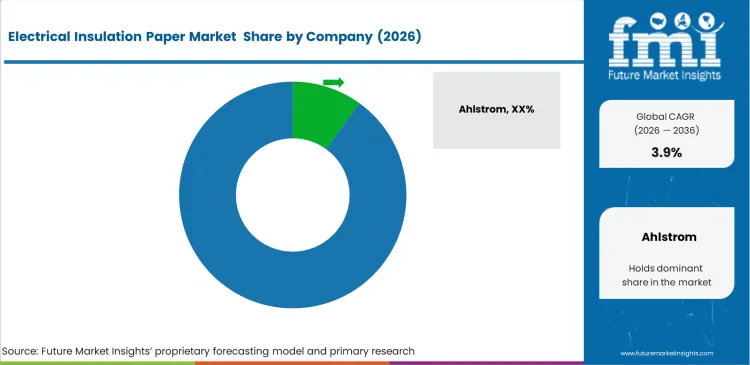
Competition in the electrical insulation paper market is being shaped by qualification depth, material consistency, and supply assurance. Buyers want suppliers that can hold thickness control and support long service life in transformer applications. This gives an advantage to companies with deep process discipline and established relationships with transformer OEMs. In practice, the winning position comes from combining product reliability with dependable delivery.
At the same time, regional manufacturing presence matters because transformer buyers are trying to reduce procurement risk and shorten lead times. Companies such as Weidmann Electrical Technology and Ahlstrom benefit when they can align technical support with application-specific requirements. DuPont and Krempel GmbH also illustrate the value of credibility in electrical materials where qualification cycles are long and switching costs are real. As a result, competition is centering on technical trust and stable supply rather than price alone.
Key Players in Electrical Insulation Paper Market
- Ahlstrom
- Munksjo
- Weidmann Electrical Technology
- DuPont
- Nippon Paper Industries
- Delfort Group
- Krempel GmbH
- Hitachi Energy
- Von Roll Holding AG
- Yantai Metastar Special Paper Co., Ltd.
Strategic Outlook by FMI on Electrical Insulation Paper Market
FMI views the electrical insulation paper market as a stable industry with durable demand tied to long-cycle power infrastructure. The next phase of competition will be shaped by qualification depth, tighter material consistency, and stronger regional supply positions. Companies that align premium insulation properties with cost discipline and dependable delivery are expected to strengthen their long-term standing.
Scope of the Report
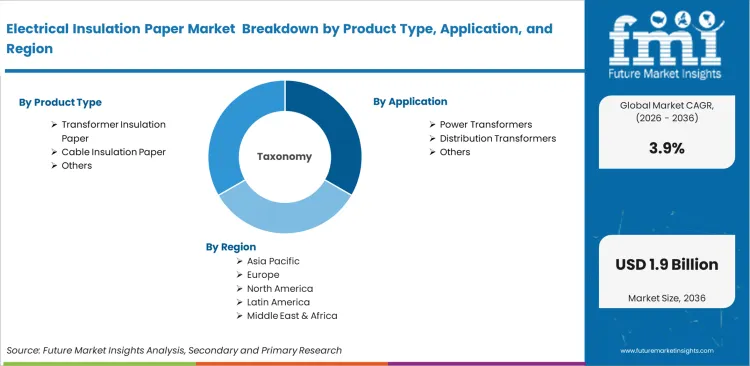
| Metric | Value |
|---|---|
| Market Value | USD 1.18 billion in 2025 to USD 1.72 billion by 2036 |
| CAGR | 3.9% from 2026 to 2036 |
| Base Year | 2025 |
| Forecast Period | 2026 to 2036 |
| Product Type Segmentation | Transformer Insulation Paper, Cable Insulation Paper, Capacitor Tissue Paper, Presspaper and Pressboard |
| Application Segmentation | Power Transformers, Distribution Transformers, Cables and Wires, Capacitors, Motors and Generators |
| Region Segmentation | North America, Latin America, Western Europe, Eastern Europe, East Asia, South Asia and Pacific, Middle East and Africa |
| Regions Covered | North America, Latin America, Western Europe, Eastern Europe, East Asia, South Asia and Pacific, Middle East and Africa |
Bibliography
- International Energy Agency. 2025. Building the Future Transmission Grid.
- International Energy Agency. 2025. World Energy Investment 2025.
- USA Department of Energy. Grid Modernization Initiative. 2024. Grid Modernization Strategy 2024.
- USA Department of Energy. Grid Modernization Initiative. n.d. Grid Modernization Initiative.
- World Bank, International Energy Agency, International Renewable Energy Agency, United Nations Statistics Division, and World Health Organization. 2025. Tracking SDG 7: The Energy Progress Report 2025.
- International Electrotechnical Commission. 2007. IEC 60641-1:2007 Pressboard and presspaper for electrical purposes - Part 1: Definitions and general requirements.
Frequently Asked Questions
How big is the electrical insulation paper market?
The electrical insulation paper market is valued at USD 1.18 billion in 2025 and is projected to reach USD 1.72 billion by 2036.
What is the CAGR of the electrical insulation paper market?
The electrical insulation paper market is expected to expand at a CAGR of 3.9% during the forecast period.
Which product type leads the electrical insulation paper market?
Transformer insulation paper is expected to lead the electrical insulation paper market by product type with a 41.8% share in 2026.
Which application leads the electrical insulation paper market?
Power transformers are projected to lead the electrical insulation paper market by application with a 36.4% share in 2026.
What is driving growth in the electrical insulation paper market?
Growth in the electrical insulation paper market is being driven by grid modernization, transformer replacement demand, and rising investment in transmission and distribution infrastructure.
Who are the key companies in the electrical insulation paper market?
Key companies in the electrical insulation paper market include Ahlstrom, Munksjo, Weidmann Electrical Technology, DuPont, Nippon Paper Industries, Delfort Group, and Krempel GmbH.
Preview the report firsthand - request a free sample
Get SampleGet the brochure for pricing and purchase details.
Get PDFTable of Content
- Executive Summary
- Global Market Outlook
- Demand-side Trends
- Supply-side Trends
- Technology Roadmap Analysis
- Analysis and Recommendations
- Market Overview
- Market Coverage / Taxonomy
- Market Definition / Scope / Limitations
- Research Methodology
- Chapter Orientation
- Analytical Lens and Working Hypotheses
- Market Structure, Signals, and Trend Drivers
- Benchmarking and Cross-market Comparability
- Market Sizing, Forecasting, and Opportunity Mapping
- Research Design and Evidence Framework
- Desk Research Programme (Secondary Evidence)
- Company Annual and Sustainability Reports
- Peer-reviewed Journals and Academic Literature
- Corporate Websites, Product Literature, and Technical Notes
- Earnings Decks and Investor Briefings
- Statutory Filings and Regulatory Disclosures
- Technical White Papers and Standards Notes
- Trade Journals, Industry Magazines, and Analyst Briefs
- Conference Proceedings, Webinars, and Seminar Materials
- Government Statistics Portals and Public Data Releases
- Press Releases and Reputable Media Coverage
- Specialist Newsletters and Curated Briefings
- Sector Databases and Reference Repositories
- FMI Internal Proprietary Databases and Historical Market Datasets
- Subscription Datasets and Paid Sources
- Social Channels, Communities, and Digital Listening Inputs
- Additional Desk Sources
- Expert Input and Fieldwork (Primary Evidence)
- Primary Modes
- Qualitative Interviews and Expert Elicitation
- Quantitative Surveys and Structured Data Capture
- Blended Approach
- Why Primary Evidence is Used
- Field Techniques
- Interviews
- Surveys
- Focus Groups
- Observational and In-context Research
- Social and Community Interactions
- Stakeholder Universe Engaged
- C-suite Leaders
- Board Members
- Presidents and Vice Presidents
- R&D and Innovation Heads
- Technical Specialists
- Domain Subject-matter Experts
- Scientists
- Physicians and Other Healthcare Professionals
- Governance, Ethics, and Data Stewardship
- Research Ethics
- Data Integrity and Handling
- Primary Modes
- Tooling, Models, and Reference Databases
- Desk Research Programme (Secondary Evidence)
- Data Engineering and Model Build
- Data Acquisition and Ingestion
- Cleaning, Normalisation, and Verification
- Synthesis, Triangulation, and Analysis
- Quality Assurance and Audit Trail
- Market Background
- Market Dynamics
- Drivers
- Restraints
- Opportunity
- Trends
- Scenario Forecast
- Demand in Optimistic Scenario
- Demand in Likely Scenario
- Demand in Conservative Scenario
- Opportunity Map Analysis
- Product Life Cycle Analysis
- Supply Chain Analysis
- Investment Feasibility Matrix
- Value Chain Analysis
- PESTLE and Porter’s Analysis
- Regulatory Landscape
- Regional Parent Market Outlook
- Production and Consumption Statistics
- Import and Export Statistics
- Market Dynamics
- Global Market Analysis 2021 to 2025 and Forecast, 2026 to 2036
- Historical Market Size Value (USD Million) Analysis, 2021 to 2025
- Current and Future Market Size Value (USD Million) Projections, 2026 to 2036
- Y-o-Y Growth Trend Analysis
- Absolute $ Opportunity Analysis
- Global Market Pricing Analysis 2021 to 2025 and Forecast 2026 to 2036
- Global Market Analysis 2021 to 2025 and Forecast 2026 to 2036, By Product Type
- Introduction / Key Findings
- Historical Market Size Value (USD Million) Analysis By Product Type , 2021 to 2025
- Current and Future Market Size Value (USD Million) Analysis and Forecast By Product Type , 2026 to 2036
- Transformer Insulation Paper
- Cable Insulation Paper
- Others
- Transformer Insulation Paper
- Y-o-Y Growth Trend Analysis By Product Type , 2021 to 2025
- Absolute $ Opportunity Analysis By Product Type , 2026 to 2036
- Global Market Analysis 2021 to 2025 and Forecast 2026 to 2036, By Application
- Introduction / Key Findings
- Historical Market Size Value (USD Million) Analysis By Application, 2021 to 2025
- Current and Future Market Size Value (USD Million) Analysis and Forecast By Application, 2026 to 2036
- Power Transformers
- Distribution Transformers
- Others
- Power Transformers
- Y-o-Y Growth Trend Analysis By Application, 2021 to 2025
- Absolute $ Opportunity Analysis By Application, 2026 to 2036
- Global Market Analysis 2021 to 2025 and Forecast 2026 to 2036, By Region
- Introduction
- Historical Market Size Value (USD Million) Analysis By Region, 2021 to 2025
- Current Market Size Value (USD Million) Analysis and Forecast By Region, 2026 to 2036
- North America
- Latin America
- Western Europe
- Eastern Europe
- East Asia
- South Asia and Pacific
- Middle East & Africa
- Market Attractiveness Analysis By Region
- North America Market Analysis 2021 to 2025 and Forecast 2026 to 2036, By Country
- Historical Market Size Value (USD Million) Trend Analysis By Market Taxonomy, 2021 to 2025
- Market Size Value (USD Million) Forecast By Market Taxonomy, 2026 to 2036
- By Country
- USA
- Canada
- Mexico
- By Product Type
- By Application
- By Country
- Market Attractiveness Analysis
- By Country
- By Product Type
- By Application
- Key Takeaways
- Latin America Market Analysis 2021 to 2025 and Forecast 2026 to 2036, By Country
- Historical Market Size Value (USD Million) Trend Analysis By Market Taxonomy, 2021 to 2025
- Market Size Value (USD Million) Forecast By Market Taxonomy, 2026 to 2036
- By Country
- Brazil
- Chile
- Rest of Latin America
- By Product Type
- By Application
- By Country
- Market Attractiveness Analysis
- By Country
- By Product Type
- By Application
- Key Takeaways
- Western Europe Market Analysis 2021 to 2025 and Forecast 2026 to 2036, By Country
- Historical Market Size Value (USD Million) Trend Analysis By Market Taxonomy, 2021 to 2025
- Market Size Value (USD Million) Forecast By Market Taxonomy, 2026 to 2036
- By Country
- Germany
- UK
- Italy
- Spain
- France
- Nordic
- BENELUX
- Rest of Western Europe
- By Product Type
- By Application
- By Country
- Market Attractiveness Analysis
- By Country
- By Product Type
- By Application
- Key Takeaways
- Eastern Europe Market Analysis 2021 to 2025 and Forecast 2026 to 2036, By Country
- Historical Market Size Value (USD Million) Trend Analysis By Market Taxonomy, 2021 to 2025
- Market Size Value (USD Million) Forecast By Market Taxonomy, 2026 to 2036
- By Country
- Russia
- Poland
- Hungary
- Balkan & Baltic
- Rest of Eastern Europe
- By Product Type
- By Application
- By Country
- Market Attractiveness Analysis
- By Country
- By Product Type
- By Application
- Key Takeaways
- East Asia Market Analysis 2021 to 2025 and Forecast 2026 to 2036, By Country
- Historical Market Size Value (USD Million) Trend Analysis By Market Taxonomy, 2021 to 2025
- Market Size Value (USD Million) Forecast By Market Taxonomy, 2026 to 2036
- By Country
- China
- Japan
- South Korea
- By Product Type
- By Application
- By Country
- Market Attractiveness Analysis
- By Country
- By Product Type
- By Application
- Key Takeaways
- South Asia and Pacific Market Analysis 2021 to 2025 and Forecast 2026 to 2036, By Country
- Historical Market Size Value (USD Million) Trend Analysis By Market Taxonomy, 2021 to 2025
- Market Size Value (USD Million) Forecast By Market Taxonomy, 2026 to 2036
- By Country
- India
- ASEAN
- Australia & New Zealand
- Rest of South Asia and Pacific
- By Product Type
- By Application
- By Country
- Market Attractiveness Analysis
- By Country
- By Product Type
- By Application
- Key Takeaways
- Middle East & Africa Market Analysis 2021 to 2025 and Forecast 2026 to 2036, By Country
- Historical Market Size Value (USD Million) Trend Analysis By Market Taxonomy, 2021 to 2025
- Market Size Value (USD Million) Forecast By Market Taxonomy, 2026 to 2036
- By Country
- Kingdom of Saudi Arabia
- Other GCC Countries
- Turkiye
- South Africa
- Other African Union
- Rest of Middle East & Africa
- By Product Type
- By Application
- By Country
- Market Attractiveness Analysis
- By Country
- By Product Type
- By Application
- Key Takeaways
- Key Countries Market Analysis
- USA
- Pricing Analysis
- Market Share Analysis, 2025
- By Product Type
- By Application
- Canada
- Pricing Analysis
- Market Share Analysis, 2025
- By Product Type
- By Application
- Mexico
- Pricing Analysis
- Market Share Analysis, 2025
- By Product Type
- By Application
- Brazil
- Pricing Analysis
- Market Share Analysis, 2025
- By Product Type
- By Application
- Chile
- Pricing Analysis
- Market Share Analysis, 2025
- By Product Type
- By Application
- Germany
- Pricing Analysis
- Market Share Analysis, 2025
- By Product Type
- By Application
- UK
- Pricing Analysis
- Market Share Analysis, 2025
- By Product Type
- By Application
- Italy
- Pricing Analysis
- Market Share Analysis, 2025
- By Product Type
- By Application
- Spain
- Pricing Analysis
- Market Share Analysis, 2025
- By Product Type
- By Application
- France
- Pricing Analysis
- Market Share Analysis, 2025
- By Product Type
- By Application
- India
- Pricing Analysis
- Market Share Analysis, 2025
- By Product Type
- By Application
- ASEAN
- Pricing Analysis
- Market Share Analysis, 2025
- By Product Type
- By Application
- Australia & New Zealand
- Pricing Analysis
- Market Share Analysis, 2025
- By Product Type
- By Application
- China
- Pricing Analysis
- Market Share Analysis, 2025
- By Product Type
- By Application
- Japan
- Pricing Analysis
- Market Share Analysis, 2025
- By Product Type
- By Application
- South Korea
- Pricing Analysis
- Market Share Analysis, 2025
- By Product Type
- By Application
- Russia
- Pricing Analysis
- Market Share Analysis, 2025
- By Product Type
- By Application
- Poland
- Pricing Analysis
- Market Share Analysis, 2025
- By Product Type
- By Application
- Hungary
- Pricing Analysis
- Market Share Analysis, 2025
- By Product Type
- By Application
- Kingdom of Saudi Arabia
- Pricing Analysis
- Market Share Analysis, 2025
- By Product Type
- By Application
- Turkiye
- Pricing Analysis
- Market Share Analysis, 2025
- By Product Type
- By Application
- South Africa
- Pricing Analysis
- Market Share Analysis, 2025
- By Product Type
- By Application
- USA
- Market Structure Analysis
- Competition Dashboard
- Competition Benchmarking
- Market Share Analysis of Top Players
- By Regional
- By Product Type
- By Application
- Competition Analysis
- Competition Deep Dive
- Ahlstrom
- Overview
- Product Portfolio
- Profitability by Market Segments (Product/Age /Sales Channel/Region)
- Sales Footprint
- Strategy Overview
- Marketing Strategy
- Product Strategy
- Channel Strategy
- Munksjo
- Weidmann Electrical Technology
- DuPont
- Nippon Paper Industries
- Delfort Group
- Ahlstrom
- Competition Deep Dive
- Assumptions & Acronyms Used


