

- Industry Size (2026)
- USD 520 Mn
- Forecast (2036)
- USD 1860 Mn
- CAGR (2026 to 2036)
- 13.6%
Cloth-based Packaging for Spiritual Products Market Forecast and Outlook By FMI
The cloth-based packaging for spiritual products market is forecasted to total USD 520 million in 2026, and is expected to increase further to USD 1,860 million by 2036. As per FMI’s projections, demand is slated to progress at a CAGR of 13.6% from 2026 to 2036. Systemic transitions toward cloth-based and sustainable fiber packaging within the spiritual products sector are accelerating.
Ministry of Textiles data from December 2025 confirms India remains a leading exporter of handicrafts and textiles, with government investment through the PM-MITRA scheme and the Textile Cluster Development Scheme providing modern infrastructure for technical textiles and sustainable value chains.
A preference for premium, reusable materials like organic cotton and silk increasingly drive growth in this sector over single-use plastics. Corporate actions demonstrate specific adoption of these materials. NGO-led projects like Punah Arpit began upcycling religious cloth offerings into secondary packaging for spiritual kits. Concurrently, luxury brands in the spiritual space introduced high-quality reusable boxes lined with linen or velvet to enhance tactile consumer experiences. Industry disclosures from Shri Sai Printers in early 2025 highlight the integration of customizable textile finishes for incense packaging to serve the premium dhoopbatti market. The 2025 India Spiritual Market analysis notes a rise in artisanal, handcrafted packaging using block printing and weaving techniques to align with the values of millennial and Gen Z consumers.
Summary of Cloth-Based Packaging for Spiritual Products Market
- The cloth-based packaging for spiritual products market comprises textile-based packaging formats used to package, protect, and present spiritual and religious products such as incense, idols, ritual kits, manuscripts, amulets, and cultural gift items across temple institutions, spiritual retail, eco boutiques, and export channels.
- The defined scope is structured under FMI taxonomy with segmentation across end use, packaging format, material, and region, focusing exclusively on reusable and biodegradable textile packaging solutions and excluding paperboard, rigid plastic containers, non-spiritual consumer goods packaging, and downstream retail or logistics services.
- The cloth-based packaging for spiritual products market is projected to grow at a CAGR of 13.6% from 2026 to 2036, expanding from USD 520 million in 2026 to USD 1,860 million by 2036, based on FMI proprietary forecasting integrating regulatory enforcement timelines, institutional procurement mandates, textile cluster capacity expansion, and premiumization trends within the global spiritual economy.
- The sector is undergoing a structural transition from discretionary sustainability adoption to mandatory compliance-driven usage, as temple authorities, government bodies, and export regulations increasingly require the replacement of single-use plastics with durable, reusable cloth-based packaging that aligns ecological standards with cultural authenticity.
- Competition is concentrated among textile and packaging suppliers such as Raymond Limited, UFlex Limited, EcoEnclose, Mondi Group, DS Smith, Toppan Inc., and Klabin, with competitive advantage defined by sustainable fiber access, industrialized textile finishing, digital traceability integration, and the ability to scale artisanal aesthetics into repeatable commercial packaging platforms.
- India is projected to be the fastest-growing country with a CAGR of 16.4% through 2036, supported by government-backed textile infrastructure programs, institutional bans on plastic packaging at pilgrimage sites, and the rapid industrialization of natural-fiber-based packaging supply chains, while South Asia remains the dominant regional market due to the scale of religious consumption and early regulatory enforcement.
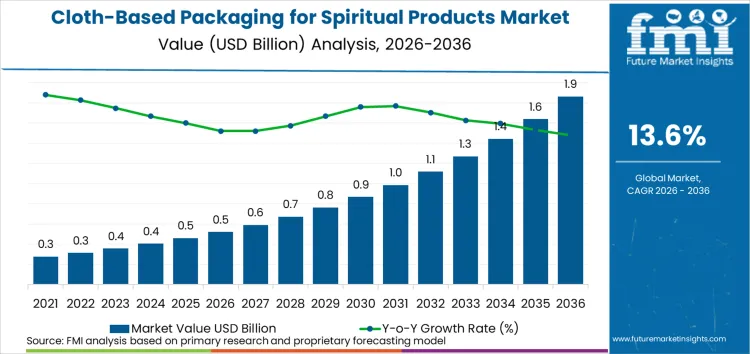
Sustainability mandates are also reshaping supply chain capacities. The H&M Group 2024 Sustainability Report details a move toward 100% recycled or sustainably sourced materials for all branded accessories and packaging by 2030. In 2025, the Ministry of Culture reported extensive use of archival-grade textiles for the preservation and packaging of manuscripts and religious sculptures. These regulatory and strategic developments collectively validate a market pivot where cloth-based solutions are utilized to meet both ecological standards and the premiumization requirements of the global spiritual economy.
Industrial leaders who view sustainable, minimalist design as the primary vehicle for brand authenticity in 2026 summarize this shift toward material integrity and the prioritization of the consumer’s tactile connection to the product. Yoshihisa Suzuki, CEO of DIC India, detailed this strategic transition in an official January 2026 executive commentary:
“Across categories - especially food, beauty, and personal care - consumers are gravitating toward clean, minimalist, truthful packaging. This shift is driven by ingredient consciousness, visual fatigue from cluttered branding, and a preference for authenticity over ornamentation. For us, it means developing coatings and inks that enable clarity, tactile experience, and minimalism - without compromising compliance, safety, or print durability.”
Source: DIC India - From the CEO's Desk: The Future of Packaging in 2026
Cloth-based Packaging for Spiritual Products Market Key Takeaways
| Metrics | Values |
|---|---|
| Expected Value (2026E) | USD 520 million |
| Projected Value (2036F) | USD 1,860 million |
| CAGR (2026 to 2036) | 13.6% |
Source: Future Market Insights (FMI) analysis, based on proprietary forecasting model and primary research
Why is the Cloth-based Packaging for Spiritual Products Market Growing?
Expansion of cloth-based packaging for spiritual products demand is propelled by targeted regulatory enforcement, institutional mandates, and high-performance material subsidies. Institutional mandates from major religious bodies are forcing an immediate shift toward biodegradable alternatives.
The Kashi Vishwanath Temple Trust announced a comprehensive ban on all plastic packaging for puja offerings effective August 10, 2025. This directive prohibits thin plastic films and polythene traditionally used for fruits and flowers, requiring vendors to adopt cloth bags and natural fibers.
The Hindu Religious and Charitable Endowments Department has instructed temple-leased shops to replace plastic wrappers with areca nut leaf plates or bamboo baskets. These mandates transition cloth packaging from a premium choice to a baseline operational requirement for thousands of vendors serving pilgrimage sites.
Government fiscal support for specialized textiles is reducing the cost barrier for sustainable packaging. The Union Budget 2026 to 2027 introduced the National Fibre Scheme to achieve self-reliance in natural fibers like silk, wool, and jute. This is complemented by the Tex-Eco Initiative, which provides financial assistance for the establishment of dye houses using natural and vegetable dyes.
By funding the modernization of traditional textile clusters through the Textile Expansion and Employment Scheme, the government is enabling MSMEs to mass-produce high-quality, eco-friendly cloth pouches and wraps. This localized infrastructure ensures a steady supply of compliant materials for the spiritual products market at competitive prices.
Stringent international and domestic trade regulations are mandating circularity in product housing. The EU Packaging and Packaging Waste Regulation, becoming legally binding on August 12, 2026, requires all packaging to be designed for material recycling and reuse. This affects spiritual products exported to Europe, necessitating a move toward durable cloth-based solutions that meet new harmonized labeling standards.
Domestically, the 1.41 lakh crore rupee government allocation for urban waste management has intensified the enforcement of single-use plastic bans. These converged legal frameworks compel manufacturers to adopt reusable cloth packaging to avoid non-compliance penalties and ensure uninterrupted market access.
How is Cloth-based Packaging for Spiritual Products Market Segmented?
The global spiritual products sector is defined by a high-intensity transition toward circular economy models, where packaging is being re-engineered to meet institutional sustainability mandates. This shift is particularly evident in the convergence of religious heritage with modern environmental law, resulting in a robust demand for reusable, bio-based containers.
Does the Temple and Ashram Sales segment represent the largest end-use category?
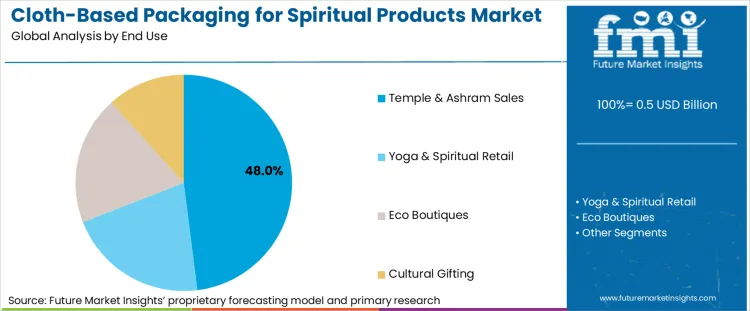
Temple and ashram sales dominate with a 48% share in 2026. The massive volume of daily ritual transactions and the implementation of institutional bans on non-biodegradable materials sustain this leadership.
In UK, the Bhaktivedanta Manor has introduced comprehensive zero-waste initiatives for its festival packaging, replacing plastic-lined containers with traditional textiles to serve thousands of pilgrims. The 2025 Ministry of Tourism reports in India highlight a 1.41 lakh crore-rupee allocation for pilgrimage site redevelopment, which includes the standardization of eco-friendly retail kiosks that exclusively utilize cloth-based packaging for prasadam and devotional artifacts.
In Japan, the Association of Shrines has endorsed the use of high-density cotton and silk pouches for traditional Omamori to reduce the environmental impact of seasonal amulet disposal. In South Korea, the Jogye Order of Korean Buddhism has integrated reusable hemp wraps into its temple stay gift programs, aligning religious practices with the national Zero Waste 2030 roadmap. These institutional directives ensure that cloth-based solutions remain the baseline operational standard for the world’s largest religious and spiritual hubs.
How is Cotton Fabric as the Primary Material driving Market Volume?
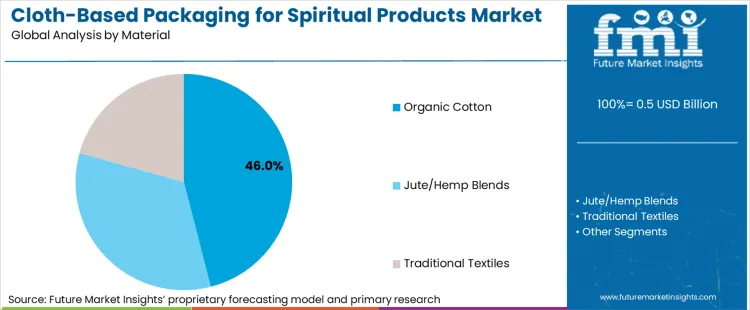
Cotton fabric is the leading material in this sector, commanding a 46% market share as of early 2026. Its dominance is driven by its inherent biodegradability, washability, and the global expansion of organic textile supply chains. In the United States, the 2026 Reusable Bags Market report indicates that nearly 48% of health and organic retail stores now utilize cotton bags as part of their primary green initiatives. This trend is mirrored in Germany, where the updated Packaging Act (VerpackG) mandates that all secondary packaging for high-end spiritual gifts must meet strict recyclability criteria, favoring cotton over synthetic blends.
Technological advancements are also enhancing the functional value of cotton in the spiritual market. In China, manufacturers are deploying digital textile printing to create intricate, religious-themed designs on cotton drawstring pouches without the environmental cost of traditional chemical dyes.
In Canada, the rise of e-commerce for holistic products has led to a surge in the use of reinforced cotton fabric for shipping spiritual kits, as it provides superior protection for fragile items like crystal singing bowls and hand-carved statues. These developments confirm that cotton's versatility and compliance with global environmental standards make it the preferred material for sustainable spiritual retail.
Why do Drawstring Pouches lead the packaging category?
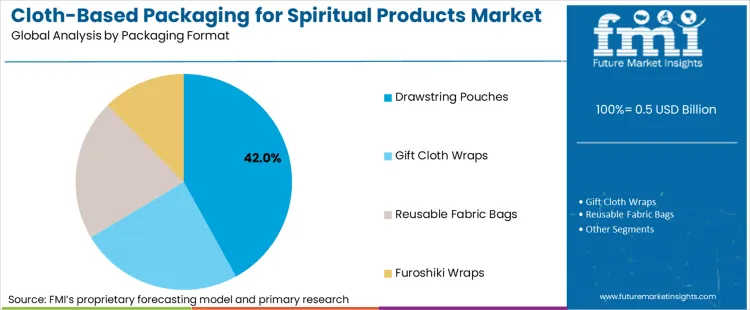
Drawstring pouches represent 42% of total demand in 2026. This format is uniquely suited for spiritual products due to its ability to be repurposed by consumers, extending the lifecycle of the packaging indefinitely. In the EU, new harmonized labeling standards under the Packaging and Packaging Waste Regulation are favoring drawstring designs that utilize natural closures over plastic zippers. This has led luxury spiritual brands in France and Italy to adopt velvet and linen drawstring pouches as the primary housing for high-end tarot decks and meditation tools.
Innovation in this format is particularly visible in the Asian market. In South Korea, the Seoul International Textile Fair 2026 showcased drawstring pouches integrated with NFC tags, allowing consumers to verify the ethical sourcing of the cotton and the authenticity of the spiritual items inside. USA’s 2026 Spring Summer Accessory Packaging Trends report identifies the drawstring format as the key driver for the wild prairie and cottage-core aesthetics, which emphasize hand-woven textures and natural fibers. This global adoption proves that the drawstring pouch is the most effective format for balancing functional protection with the sensory requirements of the modern spiritual consumer.
What Drivers, Restraints, Opportunities, and Trends Prevail in the Cloth-based packaging for spiritual products Market?
Market expansion for cloth-based packaging in the spiritual sector is governed by a fundamental shift from voluntary sustainability to mandatory regulatory compliance. The implementation of the European Union’s Packaging and Packaging Waste Regulation (PPWR) on August 12, 2026, serves as a primary driver, establishing harmonized reusability labels and mandatory QR codes for open data tracking. This regulation essentially prohibits the entry of non-compliant secondary packaging into the EU market, forcing international exporters of spiritual goods to adopt durable textile alternatives that meet specific recyclability performance grades.
UK’s pEPR system has introduced modulated fee structures for 2026. Under this regime, producers using materials rated as Green, such as certain reusable cotton and linen formats, receive a 9% reduction in base fees, while those utilizing hard-to-recycle materials face up to a 20% fee increase.
Industrial growth is further catalyzed by significant public sector investment in textile infrastructure. The India Union Budget 2026-27 introduced the National Fibre Scheme, an umbrella initiative designed to integrate the supply chains of natural fibers including silk, wool, and jute. This scheme aims to double the country's textile value chain to 350 billion dollars by 2030 by modernizing MSME clusters and supporting the export of high-performance technical textiles.
These infrastructure improvements are intended to lower the production costs of artisanal packaging formats like block-printed pouches and woven wraps, which are increasingly demanded by global spiritual retail boutiques seeking to align with millennial and Gen Z values.
The landscape faces structural restraints related to raw material availability and evolving quality standards. Global cotton production for the 2025/26 season is projected to decline to 119.4 million bales, with significant output reductions in India and the United States due to weather-related yield pressures. This tightening supply is exacerbated by a historic structural adjustment in China’s Xinjiang region, where the cotton planting target for 2026/27 has been reduced by over 10% to approximately 36 million mu.
While the Indian government has provided relief by deferring the Cotton Bales QCO and withdrawing the mandatory safety certification for imported textile machinery in January 2026, the underlying requirement to invest in modern, high-speed weaving equipment remains a capital-intensive barrier for smaller ginning and packaging units.
The sector is currently defined by a trend toward high-tech circularity and the industrialization of upcycled materials. The Circle Back campaign and similar tripartite MoUs are now formalizing the transition of discarded religious cloth offerings into commercial-grade secondary packaging through advanced sorting technologies like near-infrared spectroscopy and AI-driven robotics.
These innovations have demonstrated the capacity to increase processing volumes by nearly 90%, enabling the creation of high-quality recycled fibers that satisfy both ecological mandates and the premium tactile requirements of the spiritual economy.
Analysis of Cloth-based packaging for spiritual products Market by Key Countries
The global landscape for cloth-based packaging in the spiritual products market is undergoing a regional metamorphosis. While growth is universally positive, the drivers range from high-tech manufacturing upgrades in the West to deep-seated cultural preservation in the East. As of early 2026, the market is characterized by a move toward hyper-local sourcing and the integration of digital traceability within traditional textile formats.
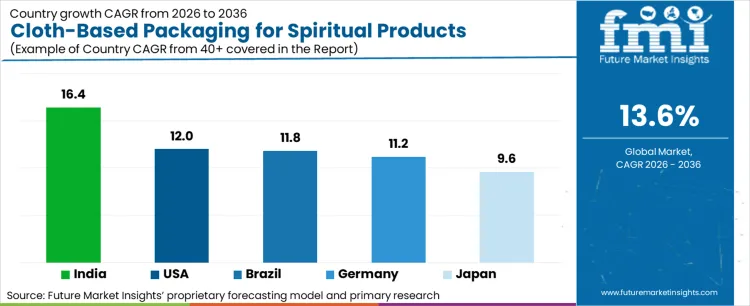
| Country | CAGR (2026 to 2036) |
|---|---|
| India | 16.40% |
| USA | 12.00% |
| Germany | 11.20% |
| Japan | 9.60% |
| Brazil | 11.80% |
Source: Future Market Insights (FMI) analysis, based on proprietary forecasting model and primary research
Will India's Digital Transformation of Textile Clusters sustain its Leading Growth Rate?
India exhibits the highest market acceleration with a CAGR of 16.40% from 2026 to 2036. This growth is anchored by the 2026 expansion of the PM-MITRA parks, which have now operationalized dedicated zones for "piritual Technical Textiles. These zones utilize AI-driven quality control, as seen in Cedro Textil’s recent USD 50 million weaving facility modernization, to produce defect-free cotton and jute fabrics specifically for the export of ritual kits. The government’s National Fibre Scheme, launched in the 2026-27 budget, has further stabilized the supply of natural fibers, ensuring that Indian manufacturers remain the primary global source for cost-effective, high-volume cloth pouches.
The domestic market is also pivoting toward connected packaging. In early 2026, several major pilgrimage trusts began piloting cloth bags embedded with NFC tags to provide pilgrims with digital certificates of authenticity and Prasadam purity. This integration of ancient ritual and modern transparency is expected to drive significant volume in the institutional sales segment, which already commands nearly half of the domestic market share. The convergence of these factors positions India as both the manufacturing hub and a primary consumption engine for the global industry.
Is USA's transition to lightweight luxury driving its Double-Digit Expansion?
USA is projected to progress at a CAGR of 12.00% through 2036. A significant 2026 trend is the emergence of lightweighting as a new symbol of luxury in the spiritual wellness sector. Retailers are moving away from heavy, ornate boxes toward ultra-light, high-strength organic cotton and mushroom-based Mylo™ pouches.
This shift is a response to the 2026 Tariff Mitigation Strategies, where brands are reducing packaging weight to offset increased shipping and import costs. By utilizing bio-based and upcycled materials, emerging brands are successfully capturing the loyalty of Gen Z consumers.
The 2026 U.S. retail landscape is prioritizing inclusive & accessible packaging. This is manifesting in the spiritual market through the redesign of drawstring pouches with ergonomic toggles and Braille-embossed fabric labels. Large-scale wellness retailers like those in the Pacific Northwest have begun conducting accessibility audits on their private-label meditation kits, ensuring that textile packaging is functional for a diverse user base. These empathic design standards are becoming a prerequisite for shelf space in major holistic retail chains across North America.
How is Germany’s 2026 regulatory overhaul reshaping its spiritual packaging sector?
Germany is slated for a CAGR of 11.20% between 2026 and 2036, primarily driven by the full enforcement of the EU PPWR on August 12, 2026. This legislation has effectively banned PFAS coatings on all packaging and requires a mandatory winner seal or similar recyclability certification for any product placed on the market.
German spiritual boutiques are shifting toward mono-material cotton and linen wraps that move cleanly through a single recycling flow. The 49th German Packaging Award in early 2026 highlighted several winners in the "Sustainability" category that utilized localized hemp-cotton blends for ritual gift housing.
Germany is also seeing a surge in refillable ecosystems for spiritual consumables. Brands are now pairing sleek, reusable cloth cases with compostable refills for incense and herbal blends. This refillable-as-an-expectation trend is supported by the 2026 update to the VerpackDG, which requires retailers to provide clear end-of-life disposal instructions via standardized pictograms or QR codes on the fabric. These regulatory mandates have transformed cloth packaging from an aesthetic choice into a vital tool for legal market access in the EU.
Does Japan’s focus on Invisible Perfection and Hybrid Silks define its Trajectory?
Japan’s market is forecasted to grow at a CAGR of 9.60% from 2026 to 2036. The sector is defined by the concept of invisible perfection, where technical know-how is used to create recycled fabrics that mimic the suppleness of conventional silk. Leading mills like Suncorona Oda in Osaka have introduced ultra-light organzas made from post-consumer PET for 2026, which are being adopted for the inner lining of premium Buddhist scroll cases. This hybrid approach allows Japanese manufacturers to maintain the Tokimeki of traditional craftsmanship while meeting 2026 global sustainability benchmarks.
Cultural heritage remains the strongest driver, with a modernized Omamori market leading the way. For the 2026 New Year talismans, many shrines transitioned to brocade pouches featuring classic Japanese motifs woven with local, CO2-free hydroelectric power. These products are increasingly sold through digital shopper portals that provide historical storytelling via the packaging’s connected surfaces. This blend of high-performance yarns and ancient talismanic traditions ensures that Japan remains the global benchmark for high-end, ritualistic textile presentation.
Is Brazil’s Plastic-substitution Mandate accelerating its Textile Packaging Adoption?
Brazil is expected to witness a CAGR of 11.80% from 2026 to 2036. The primary catalyst is the 2026 enforcement of municipal decrees in São Paulo and Rio de Janeiro, which require a 30% reduction in disposable plastic use. This has created an immediate vacuum in the spiritual and religious gift market, rapidly being filled by Brazil’s abundant domestic cotton and jute production. Domestic textile leaders like Cedro Têxtil have recently invested R$ 100 million in innovation, focusing on AI-driven production of sustainable industrial textiles that serve as a domestic alternative to expensive packaging imports.
Brazil’s Product-as-a-Service model is a unique 2026 trend in the Brazilian market. Companies like Tectextil Embalagens Industriais have launched take-back and refurbishment programs for textile packaging, allowing spiritual retailers to lease rather than buy their secondary packaging. This circular model is particularly attractive to Brazil’s growing middle-class and single-person households, who prioritize convenience and environmental responsibility. As cotton prices in Brazil hit a 16-year low in late 2025 due to abundant national supply, the economic feasibility of large-scale cloth packaging adoption has never been higher for the South American spiritual economy.
What is the Competition Outlook for Cloth-based Packaging for Spiritual Products?
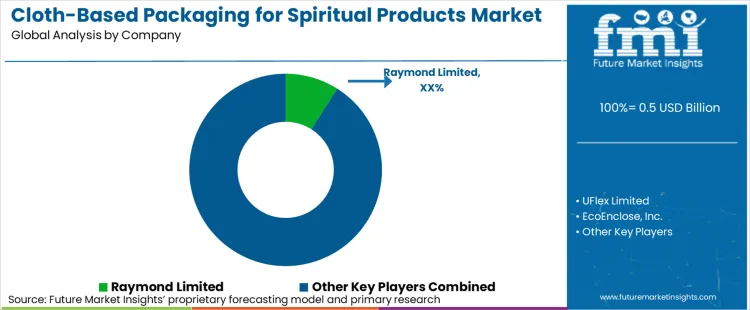
The competitive landscape for cloth-based packaging in the spiritual products market is undergoing a transition from artisanal, low-volume production to high-tech, industrialized supply chains. Competition is intensifying as legacy textile manufacturers integrate advanced barrier coatings and digital traceability to compete with emerging bio-material startups.
To maintain a competitive edge, market leaders are shifting from selling commoditized pouches to providing end-to-end circular services, including the leasing of reusable packaging and the implementation of blockchain-verified ethical sourcing for organic fibers. This professionalization allows larger players to secure long-term contracts with major pilgrimage trusts and global wellness retailers who require rigorous environmental reporting and high-volume consistency that traditional small-scale weavers cannot provide.
Strategic differentiation is increasingly centered on the sensory and functional performance of the fabric rather than price alone. Companies are investing in proprietary enzymatic treatments that allow natural fibers to retain therapeutic fragrances for longer periods, specifically targeting the premium incense and herbal ritual segments. Adoption of AI-driven predictive maintenance and automated cutting systems is enabling manufacturers to reduce production waste by nearly 30% while maintaining the handcrafted aesthetic desired by consumers.
By positioning themselves as technology partners rather than just material suppliers, leading firms are embedding their products deeper into the brand stories of spiritual boutiques, effectively raising the barrier for new entrants who lack integrated digital and material innovation capabilities.
Corporate Strategic Developments (2024 to 2026):
- UFlex Limited in February 2026 launched a suite of advanced manufacturing solutions at PlastIndia 2026, including 100% rPET Bottle-to-Bottle advanced recycling capabilities. The company also debuted high-performance water-based coatings and enzymatic delamination technologies designed to enhance the recyclability of multi-layered flexible materials, directly supporting brand compliance with upcoming 2026 EPR mandates.
- In January 2026, Mondi Group was recognized with nine WorldStar Packaging Awards for 14 innovations, including the Protective Mailer, a paper-based padded solution that replaces plastic bubble mailers. The company also launched the re/cycle HiProtex Paper, a high-barrier, 80% paper-based solution designed to replace traditional aluminum and PVDC composites in personal care and spiritual product packaging.
- In February 2026, EcoEnclose Inc. announced the successful beta launch of seaweed-based die-cut handle bags and 100% PCR flexible stand-up pouches. In November 2024, the firm expanded its material portfolio with the introduction of sugarcane-based poly mailers and pouches made with 55% sustainably produced sugarcane, targeting SMEs in the e-commerce wellness and spiritual sectors.
Key Players Profiled
- Raymond Limited
- UFlex Limited
- EcoEnclose, Inc.
- Packlane, Inc.
- Mondi Group
- DS Smith Plc
- Toppan Inc.
- Klabin S.A.
Market Definition
The cloth-based packaging for spiritual products market comprises revenues generated from textile-based packaging formats used to package, protect, present, and distribute spiritual and religious products across institutional, retail, and export channels. These packaging solutions are designed to replace single-use plastic and disposable materials with reusable, biodegradable, and culturally aligned textile alternatives.
The scope includes cloth-based packaging formats such as drawstring pouches, reusable fabric bags, gift cloth wraps, and traditional wrapping systems including furoshiki-style textiles. Materials within scope include cotton fabric, organic cotton, jute and hemp blends, silk and silk blends, and region-specific traditional textiles used for packaging incense, idols, prayer accessories, ritual kits, amulets, manuscripts, and cultural gift items.
The scope excludes revenues from the manufacture of spiritual or religious products themselves, non-textile packaging formats such as paperboard or rigid plastic containers, and packaging used for non-spiritual consumer goods. It also excludes downstream retail services, logistics-only textile handling, ceremonial cloths not used as packaging, and experimental or artisanal materials not supplied through organized commercial packaging value chains. Plastic-dominant or coated textile formats that do not meet reusability or sustainability criteria fall outside the defined market boundary.
Scope of Report
| Items | Values |
|---|---|
| Quantitative Units (2026) | USD 520 million |
| End Use | Temple & Ashram Sales, Yoga & Spiritual Retail, Eco Boutiques, Cultural Gifting |
| Packaging Format | Drawstring Pouches, Gift Cloth Wraps, Reusable Fabric Bags, Furoshiki Wraps |
| Material | Cotton Fabric, Organic Cotton, Jute/Hemp Blends, Traditional Textiles |
| Regions Covered | South Asia, North America, Europe, Japan, Rest of the World |
| Countries | India, USA, Germany, Japan, Brazil, and 40+ countries |
| Key Companies | Raymond Limited, UFlex Limited , EcoEnclose, Inc., Packlane, Inc., Mondi Group , DS Smith Plc , Toppan Inc., Klabin S.A. |
Source: Future Market Insights (FMI) analysis, based on proprietary forecasting model and primary research
Cloth-based Packaging for Spiritual Products Market Key Segments
By End Use:
- Temple & Ashram Sales
- Yoga & Spiritual Retail
- Eco Boutiques
- Cultural Gifting
By Packaging Format:
- Drawstring Pouches
- Gift Cloth Wraps
- Reusable Fabric Bags
- Furoshiki Wraps
By Material:
- Cotton Fabric
- Organic Cotton
- Jute/Hemp Blends
- Traditional Textiles
By Region:
- South Asia
- North America
- Europe
- Japan
- Rest of the World
Bibliography
- Ministry of Textiles, Government of India. (2025). Annual report 2024 to 2025: Sustainable textiles, handicrafts, and PM-MITRA implementation progress. Government of India.
- Ministry of Culture, Government of India. (2025). Guidelines on preservation, storage, and textile-based packaging of cultural and religious artifacts. Government of India.
- Central Pollution Control Board. (2024). Implementation status of single-use plastic bans and biodegradable alternatives in retail and religious institutions. Government of India.
- Textile Exchange. (2024). Preferred fiber & materials market report 2024: Cotton, cellulosics, and natural fiber packaging applications. Textile Exchange.
- H&M Group. (2024). Sustainability disclosure 2024: Packaging material transition and fiber sourcing strategy. H&M Group.
- Japan Textile Federation. (2025). Technical textiles and traditional fabric applications in cultural and gift packaging. Japan Textile Federation.
- Confederation of Indian Textile Industry. (2026). Natural fiber value chains and MSME-scale textile packaging manufacturing in India. CITI.
Frequently Asked Questions
What is the projected global growth rate for the cloth-based packaging for spiritual products market?
The global market is projected to expand at a 13.6% CAGR from 2026 to 2036, reflecting a structural shift from voluntary sustainability adoption to mandatory compliance.
How large is the global cloth-based packaging for spiritual products market expected to be by 2036?
The market is expected to grow from USD 520 million in 2026 to approximately USD 1,860 million by 2036.
What is driving the growth of cloth-based packaging for spiritual products?
Growth is driven by the enforcement of single-use plastic bans at pilgrimage sites, institutional mandates from temple trusts, and export-oriented sustainability compliance. Cloth-based packaging aligns environmental requirements with cultural authenticity, making it a preferred solution for ritual items, prasadam distribution, and spiritual gifting across global markets.
Which materials and packaging formats dominate market demand?
Cotton fabric is the leading material due to its biodegradability, durability, and regulatory compatibility, while drawstring pouches dominate the packaging format segment. These formats are favored for their reusability, ease of handling, and ability to extend packaging lifecycle beyond initial product use.
Which regions are expected to lead market expansion over the forecast period?
South Asia remains the dominant and fastest-growing region, led by India, supported by government textile programs and institutional plastic bans. Europe and North America follow, driven by packaging waste regulations, EPR frameworks, and demand for premium, sustainable spiritual packaging.
Preview the report firsthand - request a free sample
Get SampleGet the brochure for pricing and purchase details.
Get PDFTable of Content
- Executive Summary
- Global Market Outlook
- Demand-side Trends
- Supply-side Trends
- Technology Roadmap Analysis
- Analysis and Recommendations
- Market Overview
- Market Coverage / Taxonomy
- Market Definition / Scope / Limitations
- Research Methodology
- Chapter Orientation
- Analytical Lens and Working Hypotheses
- Market Structure, Signals, and Trend Drivers
- Benchmarking and Cross-market Comparability
- Market Sizing, Forecasting, and Opportunity Mapping
- Research Design and Evidence Framework
- Desk Research Programme (Secondary Evidence)
- Company Annual and Sustainability Reports
- Peer-reviewed Journals and Academic Literature
- Corporate Websites, Product Literature, and Technical Notes
- Earnings Decks and Investor Briefings
- Statutory Filings and Regulatory Disclosures
- Technical White Papers and Standards Notes
- Trade Journals, Industry Magazines, and Analyst Briefs
- Conference Proceedings, Webinars, and Seminar Materials
- Government Statistics Portals and Public Data Releases
- Press Releases and Reputable Media Coverage
- Specialist Newsletters and Curated Briefings
- Sector Databases and Reference Repositories
- FMI Internal Proprietary Databases and Historical Market Datasets
- Subscription Datasets and Paid Sources
- Social Channels, Communities, and Digital Listening Inputs
- Additional Desk Sources
- Expert Input and Fieldwork (Primary Evidence)
- Primary Modes
- Qualitative Interviews and Expert Elicitation
- Quantitative Surveys and Structured Data Capture
- Blended Approach
- Why Primary Evidence is Used
- Field Techniques
- Interviews
- Surveys
- Focus Groups
- Observational and In-context Research
- Social and Community Interactions
- Stakeholder Universe Engaged
- C-suite Leaders
- Board Members
- Presidents and Vice Presidents
- R&D and Innovation Heads
- Technical Specialists
- Domain Subject-matter Experts
- Scientists
- Physicians and Other Healthcare Professionals
- Governance, Ethics, and Data Stewardship
- Research Ethics
- Data Integrity and Handling
- Primary Modes
- Tooling, Models, and Reference Databases
- Desk Research Programme (Secondary Evidence)
- Data Engineering and Model Build
- Data Acquisition and Ingestion
- Cleaning, Normalisation, and Verification
- Synthesis, Triangulation, and Analysis
- Quality Assurance and Audit Trail
- Market Background
- Market Dynamics
- Drivers
- Restraints
- Opportunity
- Trends
- Scenario Forecast
- Demand in Optimistic Scenario
- Demand in Likely Scenario
- Demand in Conservative Scenario
- Opportunity Map Analysis
- Product Life Cycle Analysis
- Supply Chain Analysis
- Investment Feasibility Matrix
- Value Chain Analysis
- PESTLE and Porter’s Analysis
- Regulatory Landscape
- Regional Parent Market Outlook
- Production and Consumption Statistics
- Import and Export Statistics
- Market Dynamics
- Global Market Analysis 2021 to 2025 and Forecast, 2026 to 2036
- Historical Market Size Value (USD Million) Analysis, 2021 to 2025
- Current and Future Market Size Value (USD Million) Projections, 2026 to 2036
- Y-o-Y Growth Trend Analysis
- Absolute $ Opportunity Analysis
- Global Market Pricing Analysis 2021 to 2025 and Forecast 2026 to 2036
- Global Market Analysis 2021 to 2025 and Forecast 2026 to 2036, By End Use
- Introduction / Key Findings
- Historical Market Size Value (USD Million) Analysis By End Use , 2021 to 2025
- Current and Future Market Size Value (USD Million) Analysis and Forecast By End Use , 2026 to 2036
- Temple & Ashram Sales
- Yoga & Spiritual Retail
- Eco Boutiques
- Cultural Gifting
- Temple & Ashram Sales
- Y-o-Y Growth Trend Analysis By End Use , 2021 to 2025
- Absolute $ Opportunity Analysis By End Use , 2026 to 2036
- Global Market Analysis 2021 to 2025 and Forecast 2026 to 2036, By Material
- Introduction / Key Findings
- Historical Market Size Value (USD Million) Analysis By Material, 2021 to 2025
- Current and Future Market Size Value (USD Million) Analysis and Forecast By Material, 2026 to 2036
- Organic Cotton
- Jute/Hemp Blends
- Traditional Textiles
- Organic Cotton
- Y-o-Y Growth Trend Analysis By Material, 2021 to 2025
- Absolute $ Opportunity Analysis By Material, 2026 to 2036
- Global Market Analysis 2021 to 2025 and Forecast 2026 to 2036, By Packaging Format
- Introduction / Key Findings
- Historical Market Size Value (USD Million) Analysis By Packaging Format, 2021 to 2025
- Current and Future Market Size Value (USD Million) Analysis and Forecast By Packaging Format, 2026 to 2036
- Drawstring Pouches
- Gift Cloth Wraps
- Reusable Fabric Bags
- Furoshiki Wraps
- Drawstring Pouches
- Y-o-Y Growth Trend Analysis By Packaging Format, 2021 to 2025
- Absolute $ Opportunity Analysis By Packaging Format, 2026 to 2036
- Global Market Analysis 2021 to 2025 and Forecast 2026 to 2036, By Region
- Introduction
- Historical Market Size Value (USD Million) Analysis By Region, 2021 to 2025
- Current Market Size Value (USD Million) Analysis and Forecast By Region, 2026 to 2036
- North America
- Latin America
- Western Europe
- Eastern Europe
- East Asia
- South Asia and Pacific
- Middle East & Africa
- Market Attractiveness Analysis By Region
- North America Market Analysis 2021 to 2025 and Forecast 2026 to 2036, By Country
- Historical Market Size Value (USD Million) Trend Analysis By Market Taxonomy, 2021 to 2025
- Market Size Value (USD Million) Forecast By Market Taxonomy, 2026 to 2036
- By Country
- USA
- Canada
- Mexico
- By End Use
- By Material
- By Packaging Format
- By Country
- Market Attractiveness Analysis
- By Country
- By End Use
- By Material
- By Packaging Format
- Key Takeaways
- Latin America Market Analysis 2021 to 2025 and Forecast 2026 to 2036, By Country
- Historical Market Size Value (USD Million) Trend Analysis By Market Taxonomy, 2021 to 2025
- Market Size Value (USD Million) Forecast By Market Taxonomy, 2026 to 2036
- By Country
- Brazil
- Chile
- Rest of Latin America
- By End Use
- By Material
- By Packaging Format
- By Country
- Market Attractiveness Analysis
- By Country
- By End Use
- By Material
- By Packaging Format
- Key Takeaways
- Western Europe Market Analysis 2021 to 2025 and Forecast 2026 to 2036, By Country
- Historical Market Size Value (USD Million) Trend Analysis By Market Taxonomy, 2021 to 2025
- Market Size Value (USD Million) Forecast By Market Taxonomy, 2026 to 2036
- By Country
- Germany
- UK
- Italy
- Spain
- France
- Nordic
- BENELUX
- Rest of Western Europe
- By End Use
- By Material
- By Packaging Format
- By Country
- Market Attractiveness Analysis
- By Country
- By End Use
- By Material
- By Packaging Format
- Key Takeaways
- Eastern Europe Market Analysis 2021 to 2025 and Forecast 2026 to 2036, By Country
- Historical Market Size Value (USD Million) Trend Analysis By Market Taxonomy, 2021 to 2025
- Market Size Value (USD Million) Forecast By Market Taxonomy, 2026 to 2036
- By Country
- Russia
- Poland
- Hungary
- Balkan & Baltic
- Rest of Eastern Europe
- By End Use
- By Material
- By Packaging Format
- By Country
- Market Attractiveness Analysis
- By Country
- By End Use
- By Material
- By Packaging Format
- Key Takeaways
- East Asia Market Analysis 2021 to 2025 and Forecast 2026 to 2036, By Country
- Historical Market Size Value (USD Million) Trend Analysis By Market Taxonomy, 2021 to 2025
- Market Size Value (USD Million) Forecast By Market Taxonomy, 2026 to 2036
- By Country
- China
- Japan
- South Korea
- By End Use
- By Material
- By Packaging Format
- By Country
- Market Attractiveness Analysis
- By Country
- By End Use
- By Material
- By Packaging Format
- Key Takeaways
- South Asia and Pacific Market Analysis 2021 to 2025 and Forecast 2026 to 2036, By Country
- Historical Market Size Value (USD Million) Trend Analysis By Market Taxonomy, 2021 to 2025
- Market Size Value (USD Million) Forecast By Market Taxonomy, 2026 to 2036
- By Country
- India
- ASEAN
- Australia & New Zealand
- Rest of South Asia and Pacific
- By End Use
- By Material
- By Packaging Format
- By Country
- Market Attractiveness Analysis
- By Country
- By End Use
- By Material
- By Packaging Format
- Key Takeaways
- Middle East & Africa Market Analysis 2021 to 2025 and Forecast 2026 to 2036, By Country
- Historical Market Size Value (USD Million) Trend Analysis By Market Taxonomy, 2021 to 2025
- Market Size Value (USD Million) Forecast By Market Taxonomy, 2026 to 2036
- By Country
- Kingdom of Saudi Arabia
- Other GCC Countries
- Turkiye
- South Africa
- Other African Union
- Rest of Middle East & Africa
- By End Use
- By Material
- By Packaging Format
- By Country
- Market Attractiveness Analysis
- By Country
- By End Use
- By Material
- By Packaging Format
- Key Takeaways
- Key Countries Market Analysis
- USA
- Pricing Analysis
- Market Share Analysis, 2025
- By End Use
- By Material
- By Packaging Format
- Canada
- Pricing Analysis
- Market Share Analysis, 2025
- By End Use
- By Material
- By Packaging Format
- Mexico
- Pricing Analysis
- Market Share Analysis, 2025
- By End Use
- By Material
- By Packaging Format
- Brazil
- Pricing Analysis
- Market Share Analysis, 2025
- By End Use
- By Material
- By Packaging Format
- Chile
- Pricing Analysis
- Market Share Analysis, 2025
- By End Use
- By Material
- By Packaging Format
- Germany
- Pricing Analysis
- Market Share Analysis, 2025
- By End Use
- By Material
- By Packaging Format
- UK
- Pricing Analysis
- Market Share Analysis, 2025
- By End Use
- By Material
- By Packaging Format
- Italy
- Pricing Analysis
- Market Share Analysis, 2025
- By End Use
- By Material
- By Packaging Format
- Spain
- Pricing Analysis
- Market Share Analysis, 2025
- By End Use
- By Material
- By Packaging Format
- France
- Pricing Analysis
- Market Share Analysis, 2025
- By End Use
- By Material
- By Packaging Format
- India
- Pricing Analysis
- Market Share Analysis, 2025
- By End Use
- By Material
- By Packaging Format
- ASEAN
- Pricing Analysis
- Market Share Analysis, 2025
- By End Use
- By Material
- By Packaging Format
- Australia & New Zealand
- Pricing Analysis
- Market Share Analysis, 2025
- By End Use
- By Material
- By Packaging Format
- China
- Pricing Analysis
- Market Share Analysis, 2025
- By End Use
- By Material
- By Packaging Format
- Japan
- Pricing Analysis
- Market Share Analysis, 2025
- By End Use
- By Material
- By Packaging Format
- South Korea
- Pricing Analysis
- Market Share Analysis, 2025
- By End Use
- By Material
- By Packaging Format
- Russia
- Pricing Analysis
- Market Share Analysis, 2025
- By End Use
- By Material
- By Packaging Format
- Poland
- Pricing Analysis
- Market Share Analysis, 2025
- By End Use
- By Material
- By Packaging Format
- Hungary
- Pricing Analysis
- Market Share Analysis, 2025
- By End Use
- By Material
- By Packaging Format
- Kingdom of Saudi Arabia
- Pricing Analysis
- Market Share Analysis, 2025
- By End Use
- By Material
- By Packaging Format
- Turkiye
- Pricing Analysis
- Market Share Analysis, 2025
- By End Use
- By Material
- By Packaging Format
- South Africa
- Pricing Analysis
- Market Share Analysis, 2025
- By End Use
- By Material
- By Packaging Format
- USA
- Market Structure Analysis
- Competition Dashboard
- Competition Benchmarking
- Market Share Analysis of Top Players
- By Regional
- By End Use
- By Material
- By Packaging Format
- Competition Analysis
- Competition Deep Dive
- Raymond Limited
- Overview
- Product Portfolio
- Profitability by Market Segments (Product/Age /Sales Channel/Region)
- Sales Footprint
- Strategy Overview
- Marketing Strategy
- Product Strategy
- Channel Strategy
- UFlex Limited
- EcoEnclose, Inc.
- Packlane, Inc.
- Mondi Group
- DS Smith Plc
- Toppan Inc.
- Raymond Limited
- Competition Deep Dive
- Assumptions & Acronyms Used


