

- Industry Size (2026)
- USD 2340 Mn
- Forecast (2036)
- USD 7860 Mn
- CAGR (2026 to 2036)
- 12.9%
Serialized Packaging for Confidential Products Market Forecast and Outlook 2026 to 2036
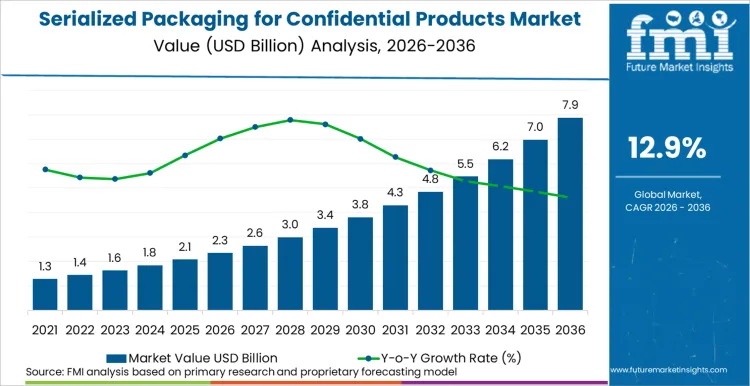
Serialized packaging for confidential products market revenue is projected to total USD 2,340 million in 2026, increasing to USD 7,860 million by 2036, at a CAGR of 12.9%. FMI analysis indicates the market is undergoing a fundamental shift from reactive anti-counterfeiting to proactive supply chain intelligence and direct consumer interaction. The 2026 to 2027 period will be defined by the global maturation of pharmaceutical serialization mandates and the extension of similar traceability requirements to high-value electronics and components, driving the adoption of item-level digital identities.
Growth is anchored in the financial and reputational imperative to protect high-margin, brand-sensitive products. In pharmaceuticals, luxury goods, and regulated electronics, a single counterfeiting or diversion incident can trigger product recalls, regulatory scrutiny, and long-term brand damage. Serialization has therefore become a core risk-mitigation mechanism, enabling product authentication in the field and traceback of breaches within complex supply chains. This shift from optional brand protection to operational necessity continues to drive sustained investment in secure, interoperable serialization platforms.
TOPPAN Group has continued expanding its capabilities in digital printing, variable data, and security features during 2024 to 2025, serving pharmaceutical and luxury packaging applications. TOPPAN’s solutions combine overt elements such as QR codes used for consumer interaction or information access with covert or machine-readable security features embedded during printing. This dual-layer approach supports both brand engagement and supply-chain authentication without relying on externally applied security components.
Technical innovation across the sector is focused on multi-factor authentication through smart labels. Schreiner Group is a documented leader in tamper-evident and smart label technologies for pharmaceuticals, offering solutions that integrate destructible materials, serialization, and optional digital features such as NFC. These labels enable layered verification, visual tamper detection combined with digital checks, helping brand owners address increasingly sophisticated diversion, refilling, and reuse schemes.
In the United States, scale and reliability remain central requirements. Avery Dennison continues to operate and expand its atma.io connected-product cloud platform, which links serialized labels and packaging to persistent digital identities. The platform is positioned to support large-scale identity management, data exchange using open standards, and analytics for traceability, recall readiness, and compliance across industries such as retail, electronics, and regulated manufacturing.
Across Asia, serialization adoption is being driven by export compliance and global customer requirements. Large packaging manufacturers in China and the region are investing in high-speed variable data printing and code application capabilities that allow serialized identifiers to be applied directly to cartons and shippers. These developments enable OEM exporters to meet the traceability expectations of multinational brands and retailers, positioning packaging as an active compliance and logistics asset rather than a passive container.
Summary of Serialized Packaging for Confidential Products Market
- The serialized packaging for confidential products market comprises packaging solutions, including cartons, labels, and substrates, that carry a unique, machine-readable identifier such as a 2D barcode, QR code, or RFID tag applied at the item or batch level. This serialization enables tracking, traceability, authentication, and consumer engagement for pharmaceuticals, luxury goods, high-value electronics, defense items, and precision industrial goods.
- The defined scope follows FMI taxonomy, covering the packaging substrates, printing/inlay application technologies, and associated software/data services required to implement and manage product serialization. It excludes non-serialized packaging and generic tracking solutions like basic barcodes applied at the pallet or case level only.
- The market is projected to grow at a CAGR of 12.9% from 2026 to 2036, expanding from USD 2,340 million in 2026 to USD 7,860 million by 2036, based on FMI proprietary modeling incorporating global regulatory timelines, brand protection spend forecasts, counterfeit incident rates, and primary interviews with brand security and supply chain directors.
- The sector is transitioning from compliance-driven serialization to intelligence-driven digital identities. Solutions are segmenting by industry need: regulatory traceability for pharma, consumer authentication for luxury goods, supply chain visibility for electronics, and secure custody tracking for defense.
- Competition is concentrated among advanced printing and labeling specialists, integrated packaging giants, and dedicated digital identity platform providers, with differentiation driven by data security, integration capabilities with enterprise systems, and the ability to deliver actionable insights from serialization data.
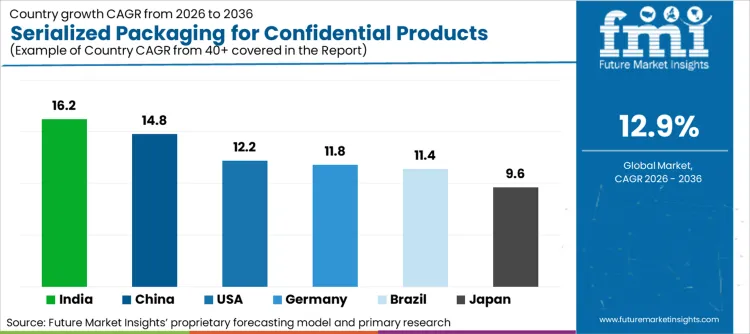
- India records the fastest growth at 16.2% CAGR through 2036, driven by its massive pharmaceutical manufacturing sector’s compliance with global export regulations, while Europe remains the largest value market, shaped by its stringent pharmaceutical track-and-trace laws and dense concentration of luxury brands.
Serialized Packaging for Confidential Products Market Key Takeaways
| Metrics | Values |
|---|---|
| Expected Value (2026E) | USD 2,340 million |
| Projected Value (2036F) | USD 7,860 million |
| CAGR (2026 to 2036) | 12.9% |
Source: Future Market Insights (FMI) analysis, based on proprietary forecasting model and primary research
Why is the Serialized Packaging for Confidential Products Market Growing?
The globalization of pharmaceutical track-and-trace regulations, moving beyond the EU and US to major markets like China, India, and Brazil, is creating a non-negotiable, expanding compliance floor. Serialization is no longer a regional requirement but a global cost of entry for drug manufacturers, ensuring sustained, long-term demand for serialized packaging solutions and their associated data services.
The sophistication of supply chain attacks, including diversion, gray market leaks, and the rise of superfak" counterfeit goods, has outpaced traditional security methods. Serialization provides a digital audit trail that can pinpoint the location and time of a security breach within the logistics network. This forensic capability is essential for luxury brands and electronics manufacturers to protect margins, enforce authorized distribution, and take legal action against bad actors.
The demand for direct-to-consumer engagement and post-purchase experiences is transforming serialization from a security cost into a marketing asset. Brands are using unique QR codes on packaging to offer product authentication, access to digital content, warranty registration, and loyalty rewards. This dual-purpose use case security plus engagement improves the return on investment for serialization programs, particularly in the luxury and premium electronics segments.
How is the Serialized Packaging for Confidential Products Market Segmented?
The market is segmented by the primary industry application, the dominant format for carrying the serialized code, and the substrate material. The pharma & luxury goods segment leads with a 44% share, as both industries face extreme counterfeiting risks and have distinct but equally compelling needs for serialization (compliance vs. brand protection).
Serialized cartons hold the largest format share (36%) due to their prominent surface area for codes, structural role in primary packaging, and suitability for high-speed printing and scanning lines.
How is the Dominance of Folding Boxboard Sustained in Brand-Centric and Regulated Applications?
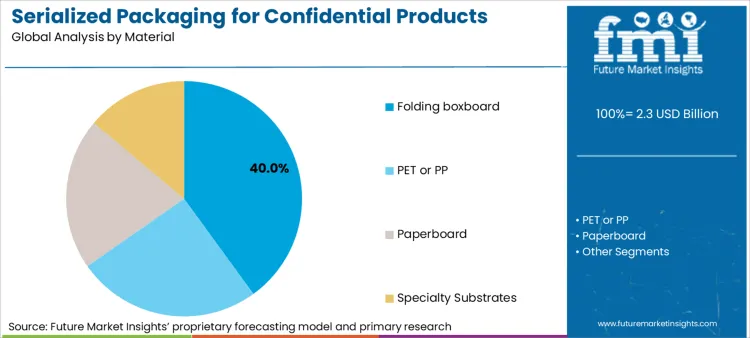
Folding boxboard accounts for a leading 40% material share, favored for its superior printability, rigidity, and brand presentation. In luxury goods, the "unboxing experience" is critical, and folding boxboard provides a premium substrate for high-quality graphics and finishes alongside the serialized code.
In pharmaceuticals, it offers a stable, compliant surface for printing regulatory information and serialized 2D data matrix codes that must remain scannable throughout the supply chain. Its balance of aesthetics, functionality, and cost-effectiveness makes it the default choice for the largest value segments of the market.
Which Regulatory and Margin-Protection Factors are Concentrating Value in the Pharma & Luxury Goods Segment?
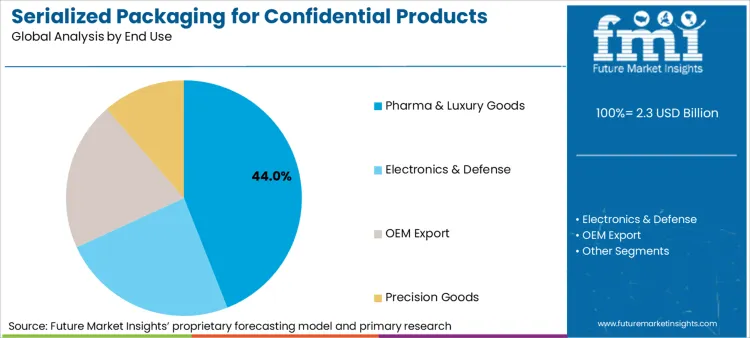
The pharma & luxury goods segment commands a 44% share because it represents the confluence of absolute regulatory mandate and extreme brand vulnerability. In pharma, serialization is a legal requirement for market access, creating a captive, volume-driven market. In luxury, while not legally mandated, it is a critical tool to protect gross margins that can exceed 70%.
Counterfeit luxury goods directly cannibalize sales and damage brand equity. The willingness to invest in sophisticated, often covert, serialization solutions is very high in this segment, driving premium pricing for advanced technologies like digital printing with integrated security features and blockchain-linked verification.
What Role do Harmonized Regulations and Brand Heritage Play in Europe's Market Leadership?
Europe holds a dominant 36% regional share, underpinned by its role as the architect of the world’s most stringent pharmaceutical serialization regulation (the EU Falsified Medicines Directive) and its status as the global heartland of luxury brand manufacturing. The EU’s regulatory framework set a global benchmark, forcing early and deep investment in serialization infrastructure.
European luxury houses, with their long heritage and high vulnerability to counterfeiting, have been pioneers in adopting serialization for authentication. This dual dynamic, regulatory pioneer and brand protection innovator, has created a mature, high-value market where serialization is deeply embedded in both compliance and commercial strategy.
What Drivers, Restraints, Opportunities, and Trends Prevail in the Market?
Market expansion is supported by the rise of connected packaging and IoT. Serialized codes are becoming gateways to digital experiences. Scanning a QR code can now trigger smart reordering, access augmented reality content, or verify a product's sustainability claims. This consumer-facing utility creates a new, marketing-funded revenue stream for serialization, accelerating adoption beyond compliance-only use cases.
While demand is robust, a key restraint is the fragmentation of data standards and system interoperability. Different regions and industries often use different coding standards (e.g., GS1 versus proprietary formats), and serialization data systems may not seamlessly integrate with a company’s existing ERP or supply chain software. This complexity increases implementation cost, time, and risk, acting as a barrier to entry, especially for smaller brands or suppliers.
Technical innovation is defined by the shift from "track and trace" to "predict and prevent" using serialization data analytics. Advanced platforms are now using AI to analyze serialization scan events across the global supply chain. This can identify anomalous patterns indicative of diversion, predict potential counterfeit hotspots based on geographical scan data, and optimize logistics routes, transforming serialization from a passive record-keeping system into an active supply chain intelligence tool.
The emergence of DPPs in the EU, starting with batteries and expanding to electronics and textiles, represents a disruptive opportunity. DPPs will require a unique digital identity, likely a QR code or RFID, containing lifecycle data. This regulatory trend will massively expand the universe of products requiring serialized packaging, moving it from high-value niches into broader consumer goods categories.
Analysis of Serialized Packaging Market by Key Countries
| Country | CAGR (2026–2036) |
|---|---|
| Germany | 11.8% |
| USA | 12.2% |
| China | 14.8% |
| Japan | 9.6% |
| India | 16.2% |
| Brazil | 11.4% |
Source: Future Market Insights analysis, supported by a proprietary forecasting model and primary research
How do Regulatory Leadership and Engineering Precision Shape Germany's Market?
Germany’s market, growing at an 11.8% CAGR, is characterized by its central role in enforcing EU regulations and its engineering-driven approach to precision. As a pharmaceutical manufacturing powerhouse and home to major luxury automotive brands, German industry requires serialization solutions that are not only compliant but also integrable with highly automated, Industry 4.0 production lines.
German suppliers like Schreiner Group excel in developing high-security, mechatronic solutions (e.g., combined label-chip systems) that offer unparalleled tamper evidence and data integrity, catering to the market's demand for flawless, reliable serialization at high speeds.
Which Defense-Industrial and Pharmaceutical Compliance Dynamics Define the US Market?
USA, expanding at a 12.2% CAGR, is driven by two powerful sectors: defense/aerospace and pharmaceuticals. The Department of Defense mandates unique item identification (UID) for a vast range of components, driving demand for durable, serialized labels and tags (often RFID) that can withstand harsh environments.
The final implementation of the Drug Supply Chain Security Act (DSCSA) creates enormous volume demand for serialized pharmaceutical packaging. US suppliers like Zebra Technologies must cater to both: providing ruggedized serialization for defense and high-speed, high-volume printing and scanning solutions for pharma.
How is China's Market Driven by OEM Export Compliance and Domestic Brand Protection?
China’s high growth rate of 14.8% CAGR reflects its dual identity as the "world's factory" and an emerging consumer market. For OEM exporters in electronics, serialized packaging is a requirement from Western clients to ensure supply chain transparency and combat diversion.
As Chinese luxury and premium brands emerge, they are rapidly adopting serialization to combat local counterfeiting and build consumer trust. The market favors scalable, cost-optimized solutions like QR-coded cartons that can be produced in vast volumes while providing the necessary digital link for both export logistics and domestic marketing.
How are Japan's Miniaturization and Quality-Validation Needs Influencing Packaging?
Japan’s market, growing at a 9.6% CAGR, is uniquely shaped by the need to serialize extremely small precision goods including semiconductor components, micro-medical devices and a cultural emphasis on perfect quality validation. Serialization solutions must be miniaturized yet robust, often involving micro-lasers or precision printing on specialty substrates.
The serial code is not just for tracking; it is a key part of the quality record, linked to extensive manufacturing process data. Japanese suppliers like DNP specialize in these high-precision, integrated solutions where the serialized package is a critical component of the product's quality assurance pedigree.
How is India's Pharmaceutical Export Engine Catalyzing High-Volume Serialization Demand?
India exhibits the highest CAGR at 16.2%, almost entirely fueled by its pharmaceutical sector's compliance with global serialization mandates. As the largest provider of generic medicines, Indian pharma companies must serialize products for the EU, US, and other regulated markets.
This has created a surge in demand for affordable, high-volume serialization solutions, printing lines, inspection systems, and cartons, that can operate at the scale of billions of packs per year. Domestic suppliers like Manjushree Technopack are scaling rapidly to meet this demand, focusing on cost-effectiveness and reliability to serve this massive, compliance-driven market.
Which Regional Leadership and Anti-Diversion Needs Shape Brazil's Market?
Brazil’s market expansion at an 11.4% CAGR is influenced by its role as a regional manufacturing leader for pharmaceuticals and consumer goods and its need to combat widespread product diversion. Brazilian manufacturers supplying Mercosur neighbors use serialization to control distribution and prevent parallel trade.
Domestically, high tax differentials between states incentivize diversion, making serialization a key tool for brands to track product movement and enforce territorial sales policies. Suppliers like Metalgráfica Iguaçu develop solutions that are robust enough for regional logistics and provide the data needed for both tax compliance and supply chain control.
What is the Competition Outlook for Serialized Packaging for Confidential Products Market?
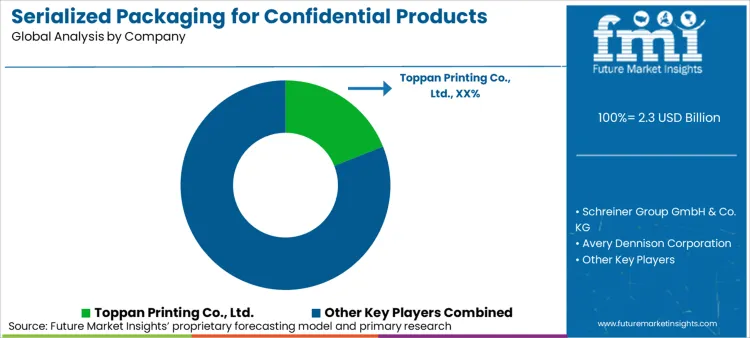
Competitive intensity is increasing as differentiation shifts from the physical act of applying a code to the secure management, interoperability, and analysis of serialization data at scale. As serialized units move into the billions across pharmaceuticals, luxury goods, and regulated consumer products, providers that can ensure data integrity, cybersecurity, and advanced analytics are gaining advantage. Market leaders are positioning themselves not just as code or label suppliers, but as data intelligence partners capable of supporting diversion detection, recall readiness, and regulatory reporting.
The dominant strategic direction is the move toward open, standards-based ecosystems. Adoption of frameworks such as GS1 EPCIS is enabling interoperability across packaging converters, brand owners, logistics providers, and regulators. This reduces dependency on closed systems, allows hardware and software components to be sourced independently, and supports global scalability, an essential requirement for confidential and regulated products distributed across complex supply chains.
Strategic leadership is also pivoting toward serialization as an enabler of sustainability and compliance convergence. Serialized identifiers are used to connect physical products to digital records containing recycled-content data, regulatory attributes, or product passports. This aligns security packaging with ESG and circularity initiatives, expanding the value of serialization beyond anti-counterfeiting into environmental and compliance verification.
Key Developments
- Avery Dennison continued expanding the capabilities of its atma.io connected-product platform during 2024–2025, supporting serialization, interoperability with GS1 standards, and integration with enterprise systems. Public disclosures emphasize scalable data exchange and analytics for traceability, authentication, and supply-chain transparency rather than single-ERP exclusivity.
- TOPPAN Group advanced its use of digital printing and security technologies for luxury and confidential product packaging during 2024–2025, enabling high-resolution graphics combined with variable data printing (e.g., serialized QR codes and covert security features). These capabilities support mass customization while embedding authentication and traceability directly into premium packaging.
- Manjushree Technopack continued strengthening its position in regulated and value-added packaging segments in India, supplying packaging formats compatible with serialization and track-and-trace requirements for pharmaceuticals and other confidential products. The company’s public strategy focuses on supporting India’s expanding serialization and compliance landscape through manufacturing scale and process readiness, rather than through undisclosed joint ventures.
Key Players Profiled
- Toppan Printing Co., Ltd.
- Schreiner Group GmbH & Co. KG
- Avery Dennison Corporation
- Zebra Technologies Corporation
- Zhejiang Zijiang Enterprise Group
- Greatview Aseptic Packaging Co., Ltd.
- Dai Nippon Printing Co., Ltd. (DNP)
- Manjushree Technopack Ltd.
- Metalgráfica Iguaçu S.A.
- Amcor plc
Market Definition
The serialized packaging for confidential products market comprises packaging substrates, labels, tags, and the associated printing, marking, or encoding technologies used to apply a unique, machine-readable identifier to individual products or sales units. This includes the design and production of the packaging itself, the integration of serialization features (QR codes, 2D Data Matrix, RFID/NFC), and the necessary software for code generation, management, and verification. The core function is to create a secure, one-to-one link between a physical item and its digital identity for the purposes of traceability, authentication, and engagement.
The market scope covers solutions where serialization is a primary feature of the packaging for security or compliance. It excludes non-serialized packaging and generic coding used solely for internal inventory management without external verification or traceability requirements.
Scope of Report
| Items | Values |
|---|---|
| Quantitative Units | USD 2,340 million |
| End Use | Pharma & Luxury Goods, Electronics & Defense, OEM Export, Precision Goods, Others |
| Packaging Format | Serialized Cartons, Secure Labels, QR-Coded Cartons, RFID Packs, Others |
| Material | Folding Boxboard, PET / PP, Paperboard, Specialty Substrates, Others |
| Regions Covered | Europe, North America, East Asia, Japan, South Asia, Latin America, Middle East & Africa |
| Countries | Germany, USA, China, Japan, India, Brazil and 40+ countries |
| Key Companies | Toppan, Schreiner Group, Avery Dennison, Zebra Tech, Zijiang, Greatview, Toppan/DNP, Manjushree, Metalgráfica Iguaçu, Amcor |
Source: Future Market Insights (FMI) analysis, based on proprietary forecasting model and primary research
Serialized Packaging for Confidential Products Market Key Segments
By End Use
- Pharma & Luxury Goods
- Electronics & Defense
- OEM Export
- Precision Goods
- Others
By Packaging Format
- Serialized Cartons
- Secure Labels
- QR-Coded Cartons
- RFID Packs
By Material
- Folding Boxboard
- PET or PP
- Paperboard
- Specialty Substrates
By Region
- Europe
- North America
- East Asia
- Japan
- South Asia
- Latin America
- Middle East & Africa
Bibliography
- European Medicines Agency (EMA). (2025). Safety Features for Medicinal Products for Human Use: Practical Guidance on Serialization and Verification. EMA.
- U.S. Food and Drug Administration (FDA). (2025). Drug Supply Chain Security Act (DSCSA): Standards for Interoperable Exchange of Serialized Data. FDA.
- GS1. (2026). Global Traceability Standard and EPCIS 2.0: Implementation for Item-Level Serialization. GS1.
- Organisation for Economic Co-operation and Development (OECD). (2025). Trade in Counterfeit Goods and the Role of Traceability and Authentication Technologies. OECD Publishing.
- National Institute of Standards and Technology (NIST). (2025). Supply Chain Risk Management for Item-Level Product Identification and Traceability. NIST Special Publication.
Frequently Asked Questions
How big is the serialized packaging for confidential products market in 2026?
The global serialized packaging for confidential products market is estimated to be valued at USD 2.3 billion in 2026.
What will be the size of serialized packaging for confidential products market in 2036?
The market size for the serialized packaging for confidential products market is projected to reach USD 7.9 billion by 2036.
How much will be the serialized packaging for confidential products market growth between 2026 and 2036?
The serialized packaging for confidential products market is expected to grow at a 12.9% CAGR between 2026 and 2036.
What are the key product types in the serialized packaging for confidential products market?
The key product types in serialized packaging for confidential products market are folding boxboard , pet or pp, paperboard and specialty substrates.
Which end use segment to contribute significant share in the serialized packaging for confidential products market in 2026?
In terms of end use, pharma & luxury goods segment to command 44.0% share in the serialized packaging for confidential products market in 2026.
Preview the report firsthand - request a free sample
Get SampleGet the brochure for pricing and purchase details.
Get PDFTable of Content
- Executive Summary
- Global Market Outlook
- Demand-side Trends
- Supply-side Trends
- Technology Roadmap Analysis
- Analysis and Recommendations
- Market Overview
- Market Coverage / Taxonomy
- Market Definition / Scope / Limitations
- Research Methodology
- Chapter Orientation
- Analytical Lens and Working Hypotheses
- Market Structure, Signals, and Trend Drivers
- Benchmarking and Cross-market Comparability
- Market Sizing, Forecasting, and Opportunity Mapping
- Research Design and Evidence Framework
- Desk Research Programme (Secondary Evidence)
- Company Annual and Sustainability Reports
- Peer-reviewed Journals and Academic Literature
- Corporate Websites, Product Literature, and Technical Notes
- Earnings Decks and Investor Briefings
- Statutory Filings and Regulatory Disclosures
- Technical White Papers and Standards Notes
- Trade Journals, Industry Magazines, and Analyst Briefs
- Conference Proceedings, Webinars, and Seminar Materials
- Government Statistics Portals and Public Data Releases
- Press Releases and Reputable Media Coverage
- Specialist Newsletters and Curated Briefings
- Sector Databases and Reference Repositories
- FMI Internal Proprietary Databases and Historical Market Datasets
- Subscription Datasets and Paid Sources
- Social Channels, Communities, and Digital Listening Inputs
- Additional Desk Sources
- Expert Input and Fieldwork (Primary Evidence)
- Primary Modes
- Qualitative Interviews and Expert Elicitation
- Quantitative Surveys and Structured Data Capture
- Blended Approach
- Why Primary Evidence is Used
- Field Techniques
- Interviews
- Surveys
- Focus Groups
- Observational and In-context Research
- Social and Community Interactions
- Stakeholder Universe Engaged
- C-suite Leaders
- Board Members
- Presidents and Vice Presidents
- R&D and Innovation Heads
- Technical Specialists
- Domain Subject-matter Experts
- Scientists
- Physicians and Other Healthcare Professionals
- Governance, Ethics, and Data Stewardship
- Research Ethics
- Data Integrity and Handling
- Primary Modes
- Tooling, Models, and Reference Databases
- Desk Research Programme (Secondary Evidence)
- Data Engineering and Model Build
- Data Acquisition and Ingestion
- Cleaning, Normalisation, and Verification
- Synthesis, Triangulation, and Analysis
- Quality Assurance and Audit Trail
- Market Background
- Market Dynamics
- Drivers
- Restraints
- Opportunity
- Trends
- Scenario Forecast
- Demand in Optimistic Scenario
- Demand in Likely Scenario
- Demand in Conservative Scenario
- Opportunity Map Analysis
- Product Life Cycle Analysis
- Supply Chain Analysis
- Investment Feasibility Matrix
- Value Chain Analysis
- PESTLE and Porter’s Analysis
- Regulatory Landscape
- Regional Parent Market Outlook
- Production and Consumption Statistics
- Import and Export Statistics
- Market Dynamics
- Global Market Analysis 2021 to 2025 and Forecast, 2026 to 2036
- Historical Market Size Value (USD Million) Analysis, 2021 to 2025
- Current and Future Market Size Value (USD Million) Projections, 2026 to 2036
- Y-o-Y Growth Trend Analysis
- Absolute $ Opportunity Analysis
- Global Market Pricing Analysis 2021 to 2025 and Forecast 2026 to 2036
- Global Market Analysis 2021 to 2025 and Forecast 2026 to 2036, By Material
- Introduction / Key Findings
- Historical Market Size Value (USD Million) Analysis By Material , 2021 to 2025
- Current and Future Market Size Value (USD Million) Analysis and Forecast By Material , 2026 to 2036
- Folding boxboard
- PET or PP
- Paperboard
- Specialty Substrates
- Folding boxboard
- Y-o-Y Growth Trend Analysis By Material , 2021 to 2025
- Absolute $ Opportunity Analysis By Material , 2026 to 2036
- Global Market Analysis 2021 to 2025 and Forecast 2026 to 2036, By End Use
- Introduction / Key Findings
- Historical Market Size Value (USD Million) Analysis By End Use, 2021 to 2025
- Current and Future Market Size Value (USD Million) Analysis and Forecast By End Use, 2026 to 2036
- Pharma & Luxury Goods
- Electronics & Defense
- OEM Export
- Precision Goods
- Pharma & Luxury Goods
- Y-o-Y Growth Trend Analysis By End Use, 2021 to 2025
- Absolute $ Opportunity Analysis By End Use, 2026 to 2036
- Global Market Analysis 2021 to 2025 and Forecast 2026 to 2036, By Region
- Introduction
- Historical Market Size Value (USD Million) Analysis By Region, 2021 to 2025
- Current Market Size Value (USD Million) Analysis and Forecast By Region, 2026 to 2036
- North America
- Latin America
- Western Europe
- Eastern Europe
- East Asia
- South Asia and Pacific
- Middle East & Africa
- Market Attractiveness Analysis By Region
- North America Market Analysis 2021 to 2025 and Forecast 2026 to 2036, By Country
- Historical Market Size Value (USD Million) Trend Analysis By Market Taxonomy, 2021 to 2025
- Market Size Value (USD Million) Forecast By Market Taxonomy, 2026 to 2036
- By Country
- USA
- Canada
- Mexico
- By Material
- By End Use
- By Country
- Market Attractiveness Analysis
- By Country
- By Material
- By End Use
- Key Takeaways
- Latin America Market Analysis 2021 to 2025 and Forecast 2026 to 2036, By Country
- Historical Market Size Value (USD Million) Trend Analysis By Market Taxonomy, 2021 to 2025
- Market Size Value (USD Million) Forecast By Market Taxonomy, 2026 to 2036
- By Country
- Brazil
- Chile
- Rest of Latin America
- By Material
- By End Use
- By Country
- Market Attractiveness Analysis
- By Country
- By Material
- By End Use
- Key Takeaways
- Western Europe Market Analysis 2021 to 2025 and Forecast 2026 to 2036, By Country
- Historical Market Size Value (USD Million) Trend Analysis By Market Taxonomy, 2021 to 2025
- Market Size Value (USD Million) Forecast By Market Taxonomy, 2026 to 2036
- By Country
- Germany
- UK
- Italy
- Spain
- France
- Nordic
- BENELUX
- Rest of Western Europe
- By Material
- By End Use
- By Country
- Market Attractiveness Analysis
- By Country
- By Material
- By End Use
- Key Takeaways
- Eastern Europe Market Analysis 2021 to 2025 and Forecast 2026 to 2036, By Country
- Historical Market Size Value (USD Million) Trend Analysis By Market Taxonomy, 2021 to 2025
- Market Size Value (USD Million) Forecast By Market Taxonomy, 2026 to 2036
- By Country
- Russia
- Poland
- Hungary
- Balkan & Baltic
- Rest of Eastern Europe
- By Material
- By End Use
- By Country
- Market Attractiveness Analysis
- By Country
- By Material
- By End Use
- Key Takeaways
- East Asia Market Analysis 2021 to 2025 and Forecast 2026 to 2036, By Country
- Historical Market Size Value (USD Million) Trend Analysis By Market Taxonomy, 2021 to 2025
- Market Size Value (USD Million) Forecast By Market Taxonomy, 2026 to 2036
- By Country
- China
- Japan
- South Korea
- By Material
- By End Use
- By Country
- Market Attractiveness Analysis
- By Country
- By Material
- By End Use
- Key Takeaways
- South Asia and Pacific Market Analysis 2021 to 2025 and Forecast 2026 to 2036, By Country
- Historical Market Size Value (USD Million) Trend Analysis By Market Taxonomy, 2021 to 2025
- Market Size Value (USD Million) Forecast By Market Taxonomy, 2026 to 2036
- By Country
- India
- ASEAN
- Australia & New Zealand
- Rest of South Asia and Pacific
- By Material
- By End Use
- By Country
- Market Attractiveness Analysis
- By Country
- By Material
- By End Use
- Key Takeaways
- Middle East & Africa Market Analysis 2021 to 2025 and Forecast 2026 to 2036, By Country
- Historical Market Size Value (USD Million) Trend Analysis By Market Taxonomy, 2021 to 2025
- Market Size Value (USD Million) Forecast By Market Taxonomy, 2026 to 2036
- By Country
- Kingdom of Saudi Arabia
- Other GCC Countries
- Turkiye
- South Africa
- Other African Union
- Rest of Middle East & Africa
- By Material
- By End Use
- By Country
- Market Attractiveness Analysis
- By Country
- By Material
- By End Use
- Key Takeaways
- Key Countries Market Analysis
- USA
- Pricing Analysis
- Market Share Analysis, 2025
- By Material
- By End Use
- Canada
- Pricing Analysis
- Market Share Analysis, 2025
- By Material
- By End Use
- Mexico
- Pricing Analysis
- Market Share Analysis, 2025
- By Material
- By End Use
- Brazil
- Pricing Analysis
- Market Share Analysis, 2025
- By Material
- By End Use
- Chile
- Pricing Analysis
- Market Share Analysis, 2025
- By Material
- By End Use
- Germany
- Pricing Analysis
- Market Share Analysis, 2025
- By Material
- By End Use
- UK
- Pricing Analysis
- Market Share Analysis, 2025
- By Material
- By End Use
- Italy
- Pricing Analysis
- Market Share Analysis, 2025
- By Material
- By End Use
- Spain
- Pricing Analysis
- Market Share Analysis, 2025
- By Material
- By End Use
- France
- Pricing Analysis
- Market Share Analysis, 2025
- By Material
- By End Use
- India
- Pricing Analysis
- Market Share Analysis, 2025
- By Material
- By End Use
- ASEAN
- Pricing Analysis
- Market Share Analysis, 2025
- By Material
- By End Use
- Australia & New Zealand
- Pricing Analysis
- Market Share Analysis, 2025
- By Material
- By End Use
- China
- Pricing Analysis
- Market Share Analysis, 2025
- By Material
- By End Use
- Japan
- Pricing Analysis
- Market Share Analysis, 2025
- By Material
- By End Use
- South Korea
- Pricing Analysis
- Market Share Analysis, 2025
- By Material
- By End Use
- Russia
- Pricing Analysis
- Market Share Analysis, 2025
- By Material
- By End Use
- Poland
- Pricing Analysis
- Market Share Analysis, 2025
- By Material
- By End Use
- Hungary
- Pricing Analysis
- Market Share Analysis, 2025
- By Material
- By End Use
- Kingdom of Saudi Arabia
- Pricing Analysis
- Market Share Analysis, 2025
- By Material
- By End Use
- Turkiye
- Pricing Analysis
- Market Share Analysis, 2025
- By Material
- By End Use
- South Africa
- Pricing Analysis
- Market Share Analysis, 2025
- By Material
- By End Use
- USA
- Market Structure Analysis
- Competition Dashboard
- Competition Benchmarking
- Market Share Analysis of Top Players
- By Regional
- By Material
- By End Use
- Competition Analysis
- Competition Deep Dive
- Toppan Printing Co., Ltd.
- Overview
- Product Portfolio
- Profitability by Market Segments (Product/Age /Sales Channel/Region)
- Sales Footprint
- Strategy Overview
- Marketing Strategy
- Product Strategy
- Channel Strategy
- Schreiner Group GmbH & Co. KG
- Avery Dennison Corporation
- Zebra Technologies Corporation
- Zhejiang Zijiang Enterprise Group
- Greatview Aseptic Packaging Co., Ltd.
- Dai Nippon Printing Co., Ltd. (DNP)
- Toppan Printing Co., Ltd.
- Competition Deep Dive
- Assumptions & Acronyms Used


