

- Industry Size (2026)
- USD 7.4 Bn
- Forecast (2036)
- USD 14.1 Bn
- CAGR (2026 to 2036)
- 6.7%
DCT Mechatronic Control Unit Market Size, Market Forecast and Outlook By FMI
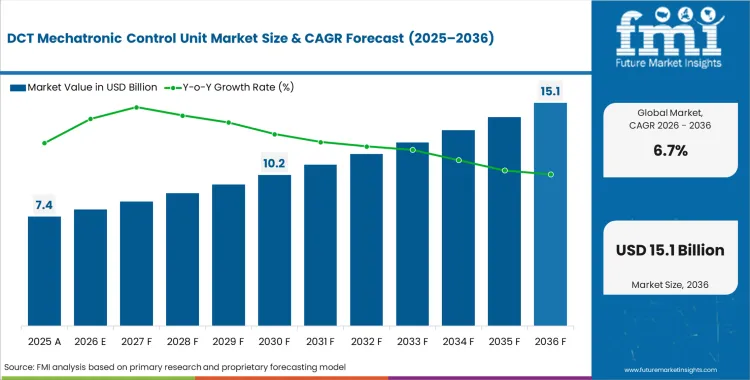
The DCT mechatronic control unit market crossed a valuation of USD 6.9 billion in 2025 while revenue is poised to surpass USD 7.4 billion in 2026 at a 6.7% CAGR during the forecast period. The total industry sales are estimated to hit USD 14.1 billion through the decade, as automotive manufacturers prioritize high-efficiency torque transfer to meet tightening fleet emission standards.
Summary of DCT Mechatronic Control Unit Market
- Market Snapshot
- The industry for these controllers was valued at USD 6.9 billion in 2025 and is projected to reach USD 14.1 billion by 2036.
- The market is expected to expand at a CAGR of 6.7% from 2026 to 2036, lifting valuation from USD 7.4 billion in 2026 to USD 14.1 billion by 2036 and creating an incremental opportunity of USD 6.7 billion.
- Commercial advantage in this category comes down to execution, specifically hydraulic accuracy, calibration depth, and how cleanly the unit can be integrated into an OEM’s platform without adding validation cycles.
- FMI frames this as a market for intelligent control systems that operate dual-clutch gearboxes, segmented by build architecture, transmission type, and engine pairing.
- Demand and Growth Drivers
- OEMs continue specifying dual-clutch systems in gasoline and hybrid programs because the architecture delivers efficiency gains without sacrificing shift response, a combination that helps meet fleet targets without heavy hardware penalties.
- Buyers and engineering teams are increasingly selecting integrated mechatronic packages where control electronics and hydraulic actuation sit together, because it shortens response time, reduces harness complexity, and lowers assembly and tuning variability.
- Hybrid transmission programs are widening the performance requirement for these controllers, since torque blending between the engine and motor demands tighter shift timing and more robust control logic under frequent transient conditions.
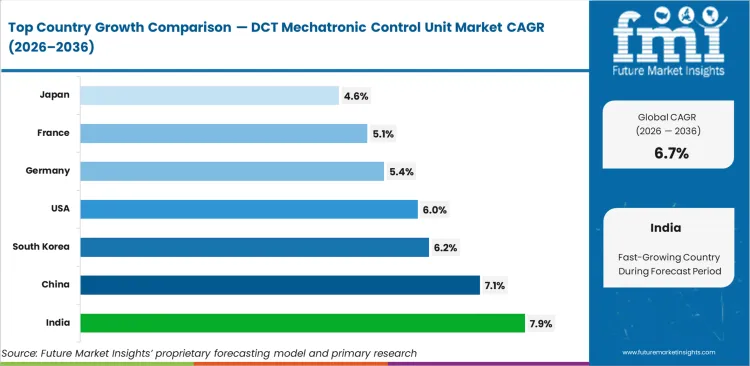
- India is set to record a 7.9% CAGR in the DCT mechatronic control unit market through 2036, supported by faster adoption of automatic drivetrains in high-volume passenger platforms.
- China follows with demand expected to rise at a 7.1% CAGR through 2036 as domestic OEMs scale hybrid lineups with in-house valve and control strategies, while the South Korean market is projected to expand at a 6.2% CAGR over the study period.
- The United States is projected to witness a 6.0% CAGR through 2036 as hybrid mix and performance expectations pull higher-content transmission control into mainstream programs; Germany is likely to grow at 5.4% CAGR, with France at 5.1% and Japan at 4.6% as these markets lean more toward upgrade and refinement cycles than new architecture adoption.
- BEV migration toward single-speed drivetrains limits the ceiling for this market over time, because pure electric platforms do not need multi-gear DCT hardware in most volume configurations.
- Product and Segment View
- These units function as the control center for clutch engagement and hydraulic pressure management, translating software intent into repeatable mechanical execution inside the gearbox.
- Passenger cars carry the bulk of installed demand because shift quality, efficiency compliance, and NVH targets in high-volume platforms leave little tolerance for inconsistent actuation. In 2026, passenger cars are expected to contribute 88% of total market share.
- Most purchasing happens at the factory gate through platform awards rather than spot replacement demand, which keeps the channel structure heavily OEM-led; the First Fit (OEM) route is projected to secure 92% share in 2026.
- Wet DCT configurations remain preferred where torque loads and thermal stability matter, especially in performance-leaning and heavier vehicle applications; wet DCT designs are anticipated to represent 64% of market share in 2026.
- OEM engineers are standardizing integrated layouts that package electronics with hydraulics because it reduces response delay and simplifies end-of-line calibration. The integrated architecture is expected to account for 71% share in 2026.
- The product mix stays weighted toward gasoline and conventional hybrid programs, where duty cycles and cost targets align best with DCT adoption; ICE/HEV applications are projected to hold 79% share in 2026, compared with 14% for plug-in hybrids and 7% for specialized electric use cases.
- The scope here is limited to the integrated controller and its hydraulic actuation hardware, rather than the full transmission assembly or broader vehicle ECUs.
- Geography and Competitive Outlook
- Demand growth concentrates in India, China, and South Korea because these markets are scaling modern automatic and hybrid programs quickly, while the United States and Europe continue to anchor high-value electronics content through stricter validation requirements and more complex platform architectures.
- Procurement decisions favor suppliers that can deliver stable hydraulics, robust software, and platform-specific integration without pushing out SOP timelines, since revalidation cost and warranty exposure rise quickly when shift behavior is inconsistent.
- Bosch, ZF, and BorgWarner remain core incumbents, with Bosch positioned as the lead supplier in many OEM programs.
- The supplier base stays narrow because OEMs prefer a small set of partners capable of global manufacturing, functional safety compliance, and long-cycle calibration support across multiple vehicle platforms.
Transmission engineers are rebalancing where control actually sits inside a dual-clutch drivetrain. Shift speed still sets the baseline, but the real differentiation now comes from shift logic that manages energy use, clutch overlap, thermal behavior, and hybrid coordination in one control stack. The mechatronic unit is where that coordination becomes physical, because the shift forks, hydraulic pressure, and electronic commands have to stay aligned under changing torque and temperature. OEMs are therefore being pushed into a platform decision: integrate electro-hydraulic control tightly into the transmission or keep the control electronics modular. Waiting too long carries a cost, since the next generation of hybrid DCT programs needs mechatronics that can arbitrate between power sources in milliseconds without drivability penalties. Predictive shift control also raises the bar for actuation hardware, which is why stronger solenoid driver IC capability is being specified to cover small software delays and keep valve timing stable.
Suppliers are also standardizing high-voltage electrical interfaces ahead of plug-in hybrid volume expansion toward 2030, because inconsistent architectures create validation burden and slow multi-platform rollouts. The market inflection point for DCT TCUs is likely to show up once these systems clear Level 3 certification requirements, where functional safety, redundancy logic, and determinism become procurement filters rather than engineering preferences. In high-volume SUV applications, software-heavy transmission control will increasingly behave like a supervisory node in the vehicle power network, coordinating torque requests and energy management rather than simply executing shift commands.
India’s outlook is anchored in rising acceptance of automated drivetrains, which expands the fitted base for DCT-equipped models across mid-price platforms. Demand for DCT mechatronic control units in India is anticipated to rise at a CAGR of 7.9% through 2036 as buyers and OEMs shift toward higher-content transmission packages. China remains close behind because local brands are bringing valve design and hybrid control strategies in-house; the market for DCT mechatronic control units in China is expected to grow at a CAGR of 7.1% during the forecast period as those designs scale across domestic hybrid lineups. South Korea benefits from strong electronics integration and transmission calibration capability, and the DCT mechatronic control unit market there is projected to expand at 6.2% CAGR through 2036. The United States follows a similar direction, where OEM programs focused on efficiency and hybrid compatibility are expected to lift the market at a 6.0% CAGR through 2036. Germany remains more engineering-driven than volume-driven, but the market is still likely to advance at 5.4% CAGR as premium manufacturers continue refining wet DCT control for higher torque loads and tighter performance targets.
Segmental Analysis
DCT Mechatronic Control Unit Market Analysis by Sales Channel
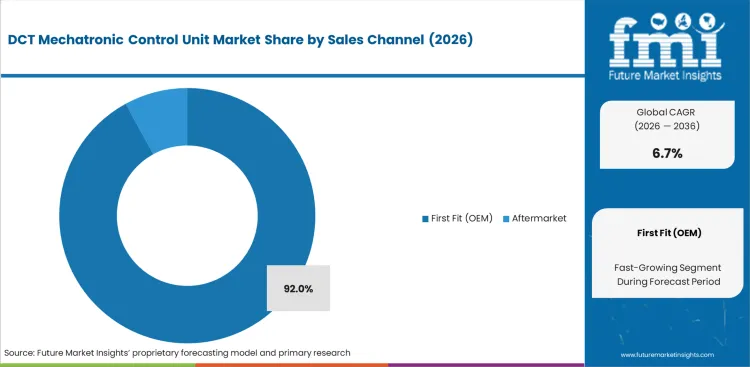
Automakers continue to source these systems through OEM channels because fully calibrated assemblies reduce launch risk and simplify line-side integration. OEM DCT control unit demand is expected to account for 92% share in 2026, reflecting buyer preference for units that arrive validated for the target gearbox architecture. FMI analysts note that the transmission control module for DCT is now treated much like a lifetime-fit component, so replacement demand stays limited unless the failure is severe enough to justify full unit changeout. That buying pattern keeps attention fixed on long-term reliability rather than the opening price of the DCT mechatronic unit.
Supplier choice also narrows quickly once a unit is approved for a specific transmission casing. Software validation, calibration compatibility, and embedded control logic make supplier replacement expensive and slow, especially when a new vendor would require fresh testing across drivability and safety parameters. The aftermarket share for the DCT mechatronic unit remains low for the same reason. Proprietary encryption around shift-logic code leaves buyers dependent on the original equipment manufacturer dual clutch transmission electronics supplier long after the initial sourcing decision has been made.
- Validation-led lock-in: Once a powertrain engineer validates shift-fork timing, the calibration is typically frozen to preserve safety and shift consistency. R&D teams treat that approval stage as a lasting switching barrier that keeps the original supplier embedded in the program.
- Zero-mile fault protection: Assembly plants prefer units with integrated sensing that can identify solenoid sticking before engine mating begins. Pre-tested modules help quality teams reduce rejection risk and avoid disruption at the final assembly stage.
- DCT TCU sourcing for OEMs: Tier-1 suppliers coordinate powertrain-grade chips, precision pistons, and finished subassemblies within tight production windows. Procurement teams rely on that supply discipline because delays in any one input can interrupt vehicle output.
DCT Mechatronic Control Unit Market Analysis by DCT Type
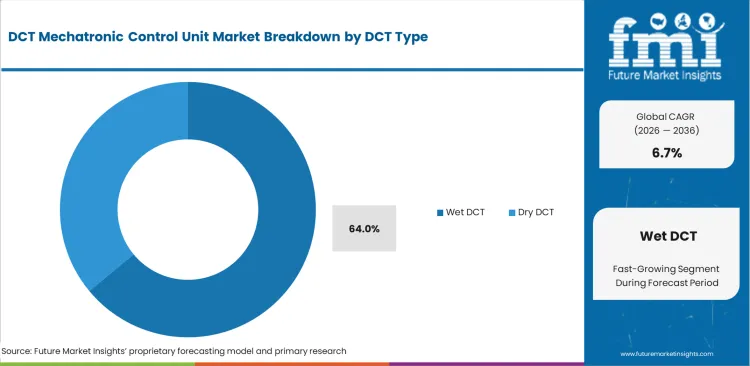
Wet DCT setups remain the preferred configuration in heavier SUVs because sustained torque loads generate more heat than dry systems can comfortably manage. The wet DCT mechatronic control unit is expected to account for 64% share in 2026, supported by an oil-cooled operating environment that allows sharper engagement calibration without compromising thermal stability. FMI’s assessment indicates that these units carry greater design complexity, particularly where transmission filter integration is required to protect control performance inside fluid-based architectures. Dry DCT control units still retain relevance in hybrid commuter vehicles, where lower mass and packaging efficiency matter more than peak thermal endurance. Materials teams are testing new solenoid coatings for non-lubricated housings to reduce wear and maintain actuation consistency. Errors in cooling judgment can surface later as field failures, exposing OEMs to recalls, warranty cost, and avoidable damage to brand credibility.
- Thermal load management: Solenoid arrays operating inside wet systems need electrical insulation that can withstand continuous fluid exposure without losing reliability. Packaging teams improve performance by designing compact manifolds that keep fluid flow consistent around critical control points.
- Contamination resistance: Wet-system solenoid packs face ongoing exposure to metallic debris released by clutch plates during repeated launch events. Procurement teams favor units with integrated magnetic traps because actuator precision weakens quickly once particle control is lost.
- Dry-to-wet transition: Passenger cars moving toward higher torque bands are pushing development toward the DCT hydraulic control module market. That shift forces engineering teams to rewrite shift-logic software around different fluid behavior, response timing, and calibration demands.
DCT Mechatronic Control Unit Market Analysis by Vehicle Type
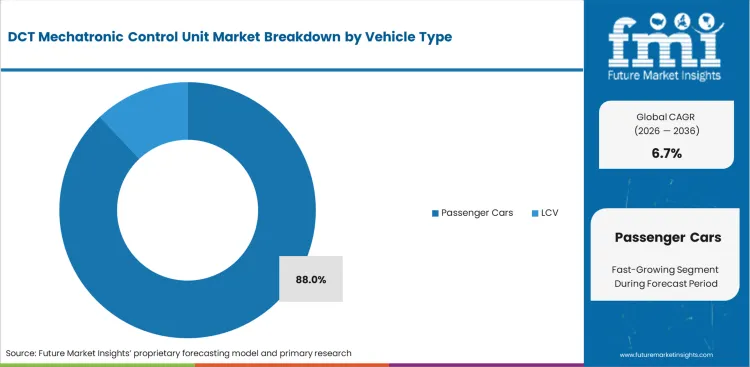
Passenger cars remain the core volume base for this market because buyers expect quicker shift response, better fuel economy, and smoother performance in daily driving conditions. In 2026, this vehicle category is expected to contribute 88% of total market share, reflecting the global concentration of dual-clutch adoption in compact and mid-sized passenger platforms. High production volumes make this segment commercially important for another reason: even small gains in shift calibration can improve fuel consumption across a broad model portfolio. Urban driving places repeated demand on gear transitions, so mechatronic units in passenger cars are tuned for frequent shifting without compromising refinement or service life. Manufacturers continue to focus on this category because incremental improvements in mechatronic shift logic support lower fleet-wide CO2 averages and make compliance targets easier to manage.
- Fleet efficiency drivers: Automakers give passenger cars priority because small gains in shift timing and clutch control can improve fuel economy across large installed volumes. That makes this segment central to emissions compliance planning.
- Mass production scale: Standardizing DCT mechatronics across passenger car platforms helps OEMs spread software validation and development cost over much larger production runs. That scale advantage improves sourcing economics.
- Urban driving optimization: City traffic places repeated stress on shift quality, low-speed responsiveness, and durability. Mechatronic units for passenger cars are therefore calibrated to manage constant gear changes while preserving smooth operation.
DCT Mechatronic Control Unit Market Analysis by Integration
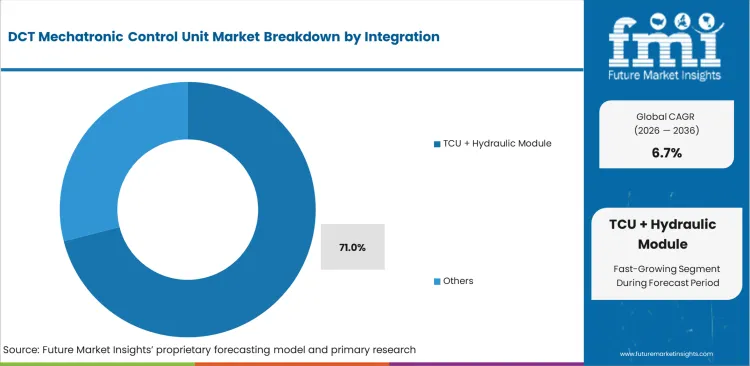
Automakers prefer integrated assemblies when reliability, calibration control, and line efficiency matter more than component-level flexibility. The TCU + Hydraulic Module configuration is expected to represent 71% of market share in 2026 because a single pre-tested unit simplifies installation at the plant and reduces integration risk. Housing the control electronics and hydraulic actuation together also shortens response time between command and execution, which matters in dual-clutch systems where shift quality depends on precise timing. Factory teams favor this format because it arrives calibrated for immediate fitment, lowering rejection rates during end-of-line validation. The compact package adds another advantage by easing installation in increasingly crowded engine bays where transmission packaging space is limited.
- Plug-and-play reliability: Factory managers prefer TCU hydraulic module integration because the unit reaches the assembly line pre-tested and pre-calibrated. That reduces validation burden on site and cuts the risk of end-of-line rejection.
- Latency reduction: Combining electronic control logic and hydraulic actuation within one housing helps reduce signal travel delay. That tighter response window supports faster and more consistent shift execution.
- Space-saving design: Integrating the computer and hydraulics into one package reduces packaging volume. Engineers benefit from that smaller footprint when fitting complex dual-clutch systems into constrained engine compartments.
DCT Mechatronic Control Unit Market Analysis by Powertrain
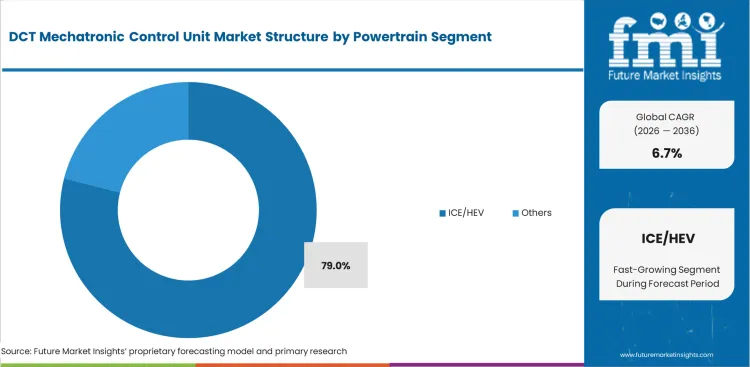
The ICE/HEV category is expected to represent 79% of total market share in 2026, reflecting continued dependence on dual-clutch technology to deliver fuel efficiency, drivability, and tighter emissions performance within familiar powertrain layouts. In hybrid applications, shift quality matters beyond transmission feel alone. The mechatronic unit also helps coordinate torque transfer between the combustion engine and electric motor, which is critical for smooth mode transitions during everyday driving. That coordination role gives these systems added importance as automakers try to improve efficiency without sacrificing response or refinement.
- Hybrid energy management: DCT mechatronics in hybrid vehicles help regulate how torque is shared between the engine and electric motor. That control function supports smoother transitions and better fuel economy under mixed driving conditions.
- Advanced PHEV requirements: Plug-in hybrid architectures often require more complex mechatronic control because an additional clutch may be needed to disconnect the engine during electric-only operation. That raises calibration demands and software burden.
- Electric performance niche: BEV e-DCT applications remain limited but relevant in performance-focused models using two-speed gearboxes. Automakers pursue these setups where high-speed efficiency and stronger top-end power delivery justify the added system complexity.
DCT Mechatronic Control Unit Market Drivers, Restraints, and Opportunities
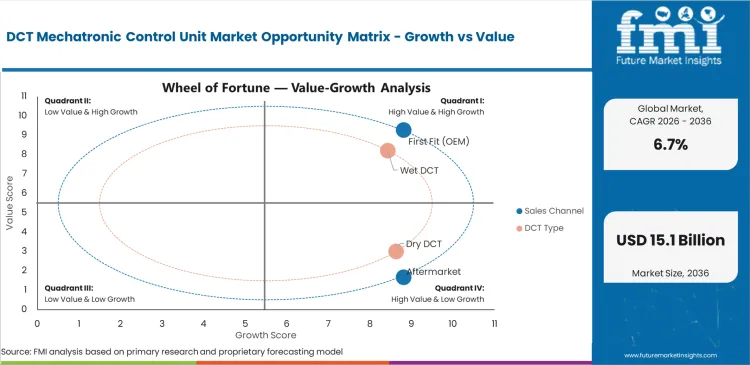
Commercial pressure from global emissions mandates is forcing procurement directors to replace traditional automatics with the dual clutch transmission market. The stakes of delay are significant; brands failing to lower CO2 averages face multi-million dollar penalties. What drives DCT mechatronic unit demand is the ability of these units to enable engines to operate at peak efficiency for a greater percentage of the drive cycle. This shift is not just about fuel economy; it is about meeting the consumer expectation for seamless performance in turbocharged platforms.
The fundamental obstacle slowing adoption is the high capital intensity required to establish precision manifold production lines. This is not a software-only problem; it is a manufacturing constraint where the tolerance requirements for transmission components are tighter than for engine pistons. Many DCT control unit manufacturers want to enter the market but lack specialized clean-room assembly environments. This creates a persistent supply-side barrier that keeps concentration high among a few global Tier-1 leaders. Even when buyers seek to diversify, the 24-month qualification cycle acts as a structural brake on market fragmentation.
- DCT Mechatronic Units Used In EVs: The shift toward two-speed gearboxes in high-performance EVs opens a niche for power transmission gearbox mechatronics.
- Predictive Maintenance Data: Integrated sensors can provide real-time fluid health and solenoid wear data, creating a revenue opportunity for OEMs.
- Localized Assembly Hubs: Establishing assembly plants in India and Southeast Asia allows mechatronic control unit suppliers to bypass import duties and serve rising demand.
Regional Analysis
The global landscape is currently defined by a sharp divide between emerging hubs localizing their supply chains and established engineering centers refining high-performance hybrid architectures. FMI projects these shifting production bases will fundamentally reorder where the next generation of transmission electronics are designed and built through 2036.
.webp "Top Country Growth Comparison Dct Mechatronic Control Unit Market Cagr (2026 2036)")
| Country | CAGR (2026 to 2036) |
|---|---|
| India | 7.9% |
| China | 7.1% |
| South Korea | 6.2% |
| USA | 6.0% |
| Germany | 5.4% |
| Japan | 4.6% |
| France | 5.1% |
Asia Pacific DCT Mechatronic Control Unit Market Analysis
Manufacturers in Asia Pacific are no longer satisfied with simply assembling imported kits; they are now building the entire value chain, from circuit board soldering to hydraulic manifold casting, right on their own soil. This drive for self-sufficiency is forcing global suppliers to form deep partnerships with local tech firms to keep their spots on the factory floor. The rapid rise of dual-clutch systems in mid-sized SUVs is providing the massive volume needed to make these local investments pay off.
- India: Cost discipline remains central to transmission sourcing in India’s mass-market hatchback segment, pushing automakers to qualify a broader base of domestic solenoid suppliers rather than rely too heavily on imported components. Demand for these controllers in India is anticipated to rise at a CAGR of 7.9% through 2036 as local production improves price competitiveness and shortens response time for model-level tuning changes. The shift also gives vehicle brands more room to align transmission behavior with local driving preferences without carrying the duty burden attached to overseas procurement.
- China: Chinese suppliers are strengthening their position by offering open-architecture shifting logic that allows domestic automakers to calibrate drive modes faster and with greater independence than many traditional European programs permit. The market for these controllers in China is expected to grow at a CAGR of 7.1% during the study period, supported by rapid electrification across SUV platforms and the wider push toward software-defined vehicle performance. That flexibility matters in a crowded market where brands compete aggressively on drivability, responsiveness, and model differentiation.
- South Korea: Platform standardization across 8-speed dual-clutch systems is giving South Korean electronics suppliers a stable volume base, especially as domestic OEMs carry common transmission architectures into global vehicle programs. South Korea is expected to post a CAGR of 6.2% in this market through 2036 as engineering teams adapt control systems to meet tighter environmental compliance requirements, including the use of lower-impact fluid and materials strategies. This keeps supplier selection tied not only to performance, but also to reporting readiness and program-level compliance execution.
- Japan: Japan’s transmission market remains divided between the continued use of CVTs in compact passenger vehicles and selective deployment of dual-clutch systems in premium and performance-oriented models. Sales of these controllers in Japan are likely to increase at a CAGR of 4.6% over the forecast period as mechatronic integration becomes more important in high-torque hybrid drivetrains for larger sedans and upscale nameplates. The opportunity stays concentrated in applications where long service life, thermal durability, and calibration precision matter more than scale alone.
Asia Pacific remains the primary engine for volume growth, with localized manufacturing and customized software giving regional players a distinct advantage over those relying on one-size-fits-all global parts.
Europe DCT Mechatronic Control Unit Market Analysis
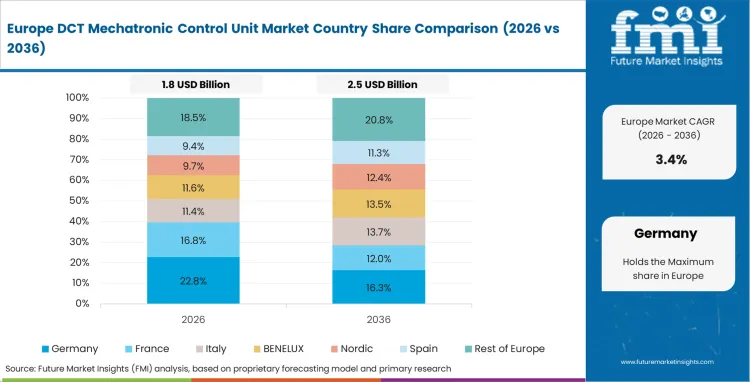
European engineers are treating the mechatronic unit as their most important tool for hitting aggressive fleet-wide emission targets. Even as the region looks toward a fully electric future, the short-term focus has actually made research more complex as teams try to squeeze every last drop of efficiency out of their final hybrid and internal combustion platforms.
- Germany: Premium transmission programs in Germany are placing greater emphasis on liquid-cooled electronics because sustained high-speed driving creates heat loads that air-cooled systems struggle to manage consistently. Demand for these systems in Germany is anticipated to rise at a CAGR of 5.4% through 2036, supported by the country’s concentration of high-performance vehicle production and its deep bench in precision driveline engineering. Suppliers serving this market are therefore being judged on thermal durability, calibration stability, and the ability to meet demanding operating conditions over long duty cycles.
- France: Platform-sharing discipline is shaping transmission sourcing in France, where procurement teams are pushing modular component designs that can move across multiple vehicle lines with limited redevelopment. The market for these systems in France is expected to grow at a CAGR of 5.1% through 2036 as automakers use common architectures to control program costs and extend hybrid technology into compact cars and crossovers. That sourcing logic helps French brands protect margins while still offering upgraded powertrain functionality in price-sensitive segments.
Europe continues to lead in high-end technical innovation, using sophisticated thermal management and modular platforms to bridge the gap between traditional engines and the next wave of electrified travel.
North America DCT Mechatronic Control Unit Market Analysis
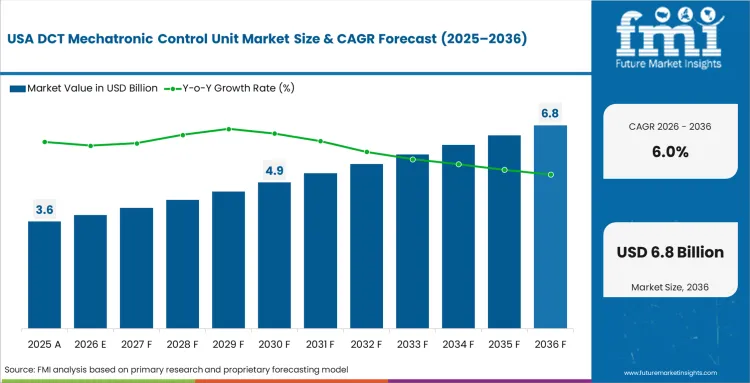
North American buyers are increasingly choosing dual-clutch systems for light trucks and performance cars where they need faster shifts and better towing power than a traditional automatic can provide. This shift is opening up new doors for companies that specialize in heavy-duty valves and electronics designed for high-load work.
- United States: Off-road duty cycles and wide temperature variation are pushing USA vehicle programs toward more rugged transmission electronics, especially in pickups engineered for towing, trail use, and high-load operation. Demand for these systems in the United States is anticipated to rise at a CAGR of 6.0% through 2036, with wet-system configurations drawing particular attention across the country’s large base of turbocharged pickup platforms. That creates a clear opening for suppliers able to demonstrate vibration resistance, thermal stability, and validation standards suited to harsh-use applications.
North America is evolving from a torque-converter-only market into a high-value hub for heavy-duty dual-clutch technology, driven by a consumer demand for more capable and efficient trucks.
Competitive Aligners for Market Players
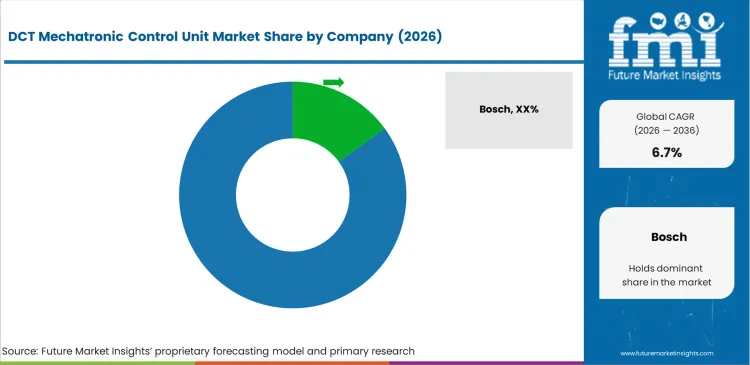
Top suppliers in this field retain their advantage through long-standing integration with vehicle manufacturers, where validation history, safety performance, and software maturity carry more weight than unit price alone. Competition is shaped less by feature lists and more by a supplier’s ability to deliver a transmission control package that has already been proven across demanding test cycles and multiple vehicle programs. Bosch remains strongly placed because it combines mechanical hardware, control electronics, and calibration capability within a single system architecture, which reduces integration risk for OEMs.
That position is difficult to dislodge because changing transmission-control suppliers is costly, time-consuming, and tied to fresh validation, software adaptation, and platform-level engineering work. Established names such as Bosch and ZF benefit from that inertia, while challengers including Hitachi Astemo and Denso are trying to build share through programs linked to newer hybrid and electrified gearbox designs. Their opening lies in applications where incumbent architectures are being reconsidered rather than in mature platforms already locked into existing suppliers.
OEM buying behavior is also shifting. Large automakers are pressing for greater software access so they can tune drivability, thermal response, and shift character more precisely across brands and vehicle classes. By 2036, supplier competition is likely to depend less on mechanical competence alone and more on how effectively control software manages heat, efficiency, and hybrid energy flow under real operating conditions. The strongest commercial position will sit with companies that can improve energy use without adding calibration burden or compromising transmission durability.
Key Players in DCT Mechatronic Control Unit Market
- Bosch
- Continental
- ZF
- BorgWarner
- Schaeffler
- Hitachi Astemo
- Denso
Scope of the Report
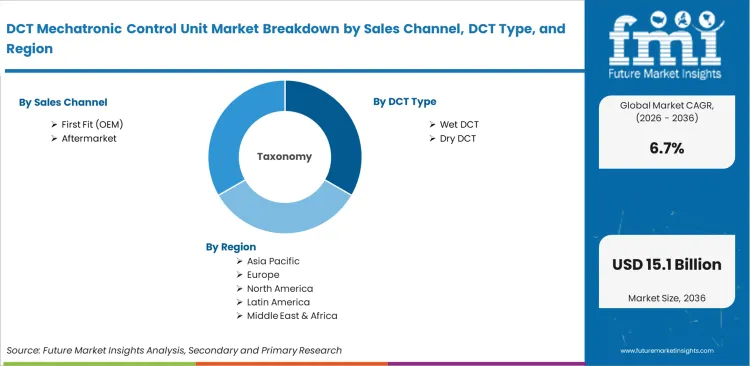
| Metric | Value |
|---|---|
| Quantitative Units | USD 7.4 billion to USD 14.1 billion, at a CAGR of 6.7% |
| Market Definition | Mechatronic control units are integrated electronic-hydraulic hubs that manage gear selection and clutch engagement. |
| Segmentation | Sales Channel, DCT Type, Vehicle Type, Integration, Powertrain, and Region. |
| Regions Covered | North America, Europe, Asia Pacific, Latin America, Middle East & Africa. |
| Countries Covered | USA, China, India, Germany, Japan, South Korea, France, and more. |
| Key Companies Profiled | Bosch, Continental, ZF, BorgWarner, Schaeffler, Hitachi Astemo, Denso, and others. |
| Forecast Period | 2026 to 2036 |
| Approach | Bottom-up production-linked model anchored to DCT installation rates and replacement frequency. |
Source: Future Market Insights (FMI) analysis, based on proprietary forecasting model and primary research
Segments
Sales Channel
- First Fit (OEM)
- Aftermarket
DCT Type
- Wet DCT
- Dry DCT
Vehicle Type
- Passenger Cars
- LCV
Regions:
- Asia Pacific
- India
- China
- Japan
- South Korea
- Indonesia
- Australia & New Zealand
- ASEAN
- Rest of Asia Pacific
- Europe
- Germany
- Italy
- France
- United Kingdom
- Spain
- Benelux
- Nordics
- Central & Eastern Europe
- Rest of Europe
- North America
- United States
- Canada
- Mexico
- Latin America
- Brazil
- Argentina
- Chile
- Rest of Latin America
- Middle East & Africa
- Kingdom of Saudi Arabia
- United Arab Emirates
- South Africa
- Turkey
- Rest of Middle East & Africa
Bibliography
- Kim, S., Lee, H., Kim, J., & Park, G. (2024). Online adaptive identification of clutch torque transmissibility for the drivability consistency of high-performance production vehicles. Control Engineering Practice, 147, 105926.
- Liu, Z., Dave, S., & Rinderknecht, S. (2024). Energy loss and efficiency investigations of a dual clutch transmission based on adaptive experiment and analytical simulation. Forschung im Ingenieurwesen, 88, 22.
- Brancati, R., Gimelli, A., & Tufano, F. (2024). Control-oriented modelling of a HEV with dual-clutch transmission for torque split and gear shifting optimization. Journal of Physics: Conference Series, 2893(1), 012102.
- Liu, Y., Xie, C., Zhang, Y., Zeng, C., Huang, Y., Ai, T., & Yang, L. (2025). Research on multi-objective optimization of clutch engagement strategy based on deep reinforcement learning. Vehicles, 7(4), 147.
- National Highway Traffic Safety Administration. (2024). Part 573 safety recall report 24V-529. USA Department of Transportation.
- Society of Automotive Engineers. (2025). Torque transfer response enhancement on the DCT with estimated hydraulic pressure and clutch piston chamber.
This bibliography is provided for reader reference. The full FMI report contains the complete reference list and detailed citations.
This Report Addresses
- Identification of the structural shift toward TCU hydraulic module integration in the USD 7.4 billion OEM segment.
- Analytical breakdown of the 64% share held by wet DCT systems in torque-intensive SUV platforms.
- Strategic evaluation of India's 7.9% growth trajectory and its impact on localized powertrain electronics.
- Assessment of the energy-partitioning role of mechatronic units in the 14% share PHEV segment.
- Competitive analysis of the top three Tier-1 drivetrain electronics suppliers controlling the global supply chain.
- Operational implications of software-defined shift logic on mechatronic unit lifecycle and vendor lock-in.
- Forward-looking analysis of e-DCT mechatronic unit for PHEV platforms in the two-speed EV market.
- Evaluation of contamination-resistant solenoid designs for high-mileage commercial LCV applications.
Frequently Asked Questions
What is the projected value of the DCT mechatronic control unit market by 2036?
The industry lifts total valuation to USD 14.1 billion by 2036 as automotive manufacturers prioritize high-efficiency torque transfer mechanisms.
Which vehicle segment is expected to lead the market in 2026?
Passenger cars are anticipated to account for 88% share in 2026 due to the mass-market adoption of compact DCTs globally.
What is the primary factor driving the high share of First Fit (OEM) sales?
OEM demand is expected to hold 92% share because procurement teams favor integrated, pre-tested solutions that arrive fully calibrated at the factory.
Why is the wet DCT segment poised to garner 64% share in 2026?
High-torque SUV platforms require oil-cooled configurations where the mechatronic unit manages aggressive engagement profiles and manages thermal load.
What structural condition explains India's leading CAGR of 7.9%?
India's growth is anticipated to see momentum as urban congestion drives car buyers toward automation, prompting manufacturers to qualify domestic solenoid suppliers.
How does the mechatronic unit contribute to energy efficiency in hybrid vehicles?
Mechatronic units enable engines to operate at peak efficiency for a greater percentage of the drive cycle by precisely managing gear transitions.
What is the non-obvious observation regarding mechatronic software?
The real competitive value is shifting from the hydraulic manifold toward the shift-logic software that manages solenoid thermal profiles during frequent gear changes.
Why is TCU hydraulic module integration anticipated to capture 71% share?
OEMs prioritize simplified assembly line workflows and fully validated, 'plug-and-play' integrated modules over standalone electronic or hydraulic components.
What are the commercial stakes of delaying mechatronic development for e-DCTs?
Suppliers lacking high-voltage driver configurations will miss the development window for next-generation Dedicated Hybrid Transmissions, where mechatronics coordinate multi-power paths.
How do mechatronic units handle contamination in wet DCT systems?
Procurement directors require units with integrated magnetic traps to protect solenoid packs from metallic particles shed by clutch friction plates.
What friction is slowing the entry of new mechatronic suppliers?
Precision manifold production requires specialized clean-room assembly environments and high-pressure testing rigs with tolerance requirements tighter than for engine pistons.
What role does the K0 clutch play in PHEV mechatronic units?
In PHEV platforms, the mechatronic unit is tasked with managing the K0 clutch to seamlessly disconnect the engine from the drivetrain.
How is market concentration being maintained by global Tier-1 leaders?
Once a unit is qualified for a specific gearbox casing, the validation-led lock-in makes the original supplier nearly irreplaceable throughout the platform's life.
What is the expected CAGR for the China market through 2036?
The China sector is expected to register a CAGR of 7.1% as regional suppliers offer open-source shift logic to domestic carmakers.
What operational outcome is associated with modular mechatronics in Europe?
French procurement directors focus on sharing modular units across different vehicle platforms to achieve economies of scale and reduce per-unit costs.
Why are dry DCT control unit variants seeing a resurgence in hybrids?
Reduced weight and lower parasitic drag make dry-DCT mechatronics ideal for lightweight commuter hybrids where fuel economy is the primary motivator.
What is the impact of Level 3 autonomous driving on mechatronic design?
Mechatronic units must achieve full functional safety compliance to execute fail-operational gear holds without driver intervention during automated sequences.
How does the mechatronic unit manage shift-fork position in HEVs?
High-fidelity shift-fork position sensors are required to ensure that mechanical and electrical power paths are synchronized within 50 milliseconds during shifts.
What is the commercial opportunity in localized mechatronic assembly hubs?
Establishing plants in India and Southeast Asia allows mechatronic control unit suppliers to bypass import duties and serve rising local drivetrain automation.
How is EMI being addressed in electrified powertrain mechatronics?
Electronics engineers must implement specialized EMI filtering on the mechatronic PCB to prevent corrupted shift commands from high-voltage motors.
What diagnostic challenge do aftermarket service providers face with DCTs?
Proprietary encryption of shift-logic code makes third-party mechatronic swaps technically unfeasible without OEM diagnostic keys, protecting OEM service revenue.
What structural divergence is occurring between the USA and Japan markets?
The USA sector is focused on ruggedized wet-DCT systems for towing, while Japan integrates mechatronics into high-torque hybrid platforms for premium sedans.
How does predictive maintenance data create a revenue stream for OEMs?
Integrated sensors provide real-time fluid health and solenoid wear data, allowing OEMs to manage fleet reliability for commercial LCV operators.
What is the difference between DCT mechatronic and TCU?
A TCU is a standalone electronic control board, whereas a mechatronic unit integrates that board with the hydraulic manifold and solenoids in one housing.
Preview the report firsthand - request a free sample
Get SampleGet the brochure for pricing and purchase details.
Get PDFTable of Content
- Executive Summary
- Global Market Outlook
- Demand-side Trends
- Supply-side Trends
- Technology Roadmap Analysis
- Analysis and Recommendations
- Market Overview
- Market Coverage / Taxonomy
- Market Definition / Scope / Limitations
- Research Methodology
- Chapter Orientation
- Analytical Lens and Working Hypotheses
- Market Structure, Signals, and Trend Drivers
- Benchmarking and Cross-market Comparability
- Market Sizing, Forecasting, and Opportunity Mapping
- Research Design and Evidence Framework
- Desk Research Programme (Secondary Evidence)
- Company Annual and Sustainability Reports
- Peer-reviewed Journals and Academic Literature
- Corporate Websites, Product Literature, and Technical Notes
- Earnings Decks and Investor Briefings
- Statutory Filings and Regulatory Disclosures
- Technical White Papers and Standards Notes
- Trade Journals, Industry Magazines, and Analyst Briefs
- Conference Proceedings, Webinars, and Seminar Materials
- Government Statistics Portals and Public Data Releases
- Press Releases and Reputable Media Coverage
- Specialist Newsletters and Curated Briefings
- Sector Databases and Reference Repositories
- FMI Internal Proprietary Databases and Historical Market Datasets
- Subscription Datasets and Paid Sources
- Social Channels, Communities, and Digital Listening Inputs
- Additional Desk Sources
- Expert Input and Fieldwork (Primary Evidence)
- Primary Modes
- Qualitative Interviews and Expert Elicitation
- Quantitative Surveys and Structured Data Capture
- Blended Approach
- Why Primary Evidence is Used
- Field Techniques
- Interviews
- Surveys
- Focus Groups
- Observational and In-context Research
- Social and Community Interactions
- Stakeholder Universe Engaged
- C-suite Leaders
- Board Members
- Presidents and Vice Presidents
- R&D and Innovation Heads
- Technical Specialists
- Domain Subject-matter Experts
- Scientists
- Physicians and Other Healthcare Professionals
- Governance, Ethics, and Data Stewardship
- Research Ethics
- Data Integrity and Handling
- Primary Modes
- Tooling, Models, and Reference Databases
- Desk Research Programme (Secondary Evidence)
- Data Engineering and Model Build
- Data Acquisition and Ingestion
- Cleaning, Normalisation, and Verification
- Synthesis, Triangulation, and Analysis
- Quality Assurance and Audit Trail
- Market Background
- Market Dynamics
- Drivers
- Restraints
- Opportunity
- Trends
- Scenario Forecast
- Demand in Optimistic Scenario
- Demand in Likely Scenario
- Demand in Conservative Scenario
- Opportunity Map Analysis
- Product Life Cycle Analysis
- Supply Chain Analysis
- Investment Feasibility Matrix
- Value Chain Analysis
- PESTLE and Porter’s Analysis
- Regulatory Landscape
- Regional Parent Market Outlook
- Production and Consumption Statistics
- Import and Export Statistics
- Market Dynamics
- Global Market Analysis 2021 to 2025 and Forecast, 2026 to 2036
- Historical Market Size Value (USD Million) Analysis, 2021 to 2025
- Current and Future Market Size Value (USD Million) Projections, 2026 to 2036
- Y-o-Y Growth Trend Analysis
- Absolute $ Opportunity Analysis
- Global Market Pricing Analysis 2021 to 2025 and Forecast 2026 to 2036
- Global Market Analysis 2021 to 2025 and Forecast 2026 to 2036, By Sales Channel
- Introduction / Key Findings
- Historical Market Size Value (USD Million) Analysis By Sales Channel , 2021 to 2025
- Current and Future Market Size Value (USD Million) Analysis and Forecast By Sales Channel , 2026 to 2036
- First Fit (OEM)
- Aftermarket
- First Fit (OEM)
- Y-o-Y Growth Trend Analysis By Sales Channel , 2021 to 2025
- Absolute $ Opportunity Analysis By Sales Channel , 2026 to 2036
- Global Market Analysis 2021 to 2025 and Forecast 2026 to 2036, By DCT Type
- Introduction / Key Findings
- Historical Market Size Value (USD Million) Analysis By DCT Type, 2021 to 2025
- Current and Future Market Size Value (USD Million) Analysis and Forecast By DCT Type, 2026 to 2036
- Wet DCT
- Dry DCT
- Wet DCT
- Y-o-Y Growth Trend Analysis By DCT Type, 2021 to 2025
- Absolute $ Opportunity Analysis By DCT Type, 2026 to 2036
- Global Market Analysis 2021 to 2025 and Forecast 2026 to 2036, By Vehicle Type
- Introduction / Key Findings
- Historical Market Size Value (USD Million) Analysis By Vehicle Type, 2021 to 2025
- Current and Future Market Size Value (USD Million) Analysis and Forecast By Vehicle Type, 2026 to 2036
- Passenger Cars
- LCV
- Passenger Cars
- Y-o-Y Growth Trend Analysis By Vehicle Type, 2021 to 2025
- Absolute $ Opportunity Analysis By Vehicle Type, 2026 to 2036
- Global Market Analysis 2021 to 2025 and Forecast 2026 to 2036, By Integration
- Introduction / Key Findings
- Historical Market Size Value (USD Million) Analysis By Integration, 2021 to 2025
- Current and Future Market Size Value (USD Million) Analysis and Forecast By Integration, 2026 to 2036
- TCU + Hydraulic Module
- Others
- TCU + Hydraulic Module
- Y-o-Y Growth Trend Analysis By Integration, 2021 to 2025
- Absolute $ Opportunity Analysis By Integration, 2026 to 2036
- Global Market Analysis 2021 to 2025 and Forecast 2026 to 2036, By Powertrain
- Introduction / Key Findings
- Historical Market Size Value (USD Million) Analysis By Powertrain, 2021 to 2025
- Current and Future Market Size Value (USD Million) Analysis and Forecast By Powertrain, 2026 to 2036
- ICE/HEV
- Others
- ICE/HEV
- Y-o-Y Growth Trend Analysis By Powertrain, 2021 to 2025
- Absolute $ Opportunity Analysis By Powertrain, 2026 to 2036
- Global Market Analysis 2021 to 2025 and Forecast 2026 to 2036, By Region
- Introduction
- Historical Market Size Value (USD Million) Analysis By Region, 2021 to 2025
- Current Market Size Value (USD Million) Analysis and Forecast By Region, 2026 to 2036
- North America
- Latin America
- Western Europe
- Eastern Europe
- East Asia
- South Asia and Pacific
- Middle East & Africa
- Market Attractiveness Analysis By Region
- North America Market Analysis 2021 to 2025 and Forecast 2026 to 2036, By Country
- Historical Market Size Value (USD Million) Trend Analysis By Market Taxonomy, 2021 to 2025
- Market Size Value (USD Million) Forecast By Market Taxonomy, 2026 to 2036
- By Country
- USA
- Canada
- Mexico
- By Sales Channel
- By DCT Type
- By Vehicle Type
- By Integration
- By Powertrain
- By Country
- Market Attractiveness Analysis
- By Country
- By Sales Channel
- By DCT Type
- By Vehicle Type
- By Integration
- By Powertrain
- Key Takeaways
- Latin America Market Analysis 2021 to 2025 and Forecast 2026 to 2036, By Country
- Historical Market Size Value (USD Million) Trend Analysis By Market Taxonomy, 2021 to 2025
- Market Size Value (USD Million) Forecast By Market Taxonomy, 2026 to 2036
- By Country
- Brazil
- Chile
- Rest of Latin America
- By Sales Channel
- By DCT Type
- By Vehicle Type
- By Integration
- By Powertrain
- By Country
- Market Attractiveness Analysis
- By Country
- By Sales Channel
- By DCT Type
- By Vehicle Type
- By Integration
- By Powertrain
- Key Takeaways
- Western Europe Market Analysis 2021 to 2025 and Forecast 2026 to 2036, By Country
- Historical Market Size Value (USD Million) Trend Analysis By Market Taxonomy, 2021 to 2025
- Market Size Value (USD Million) Forecast By Market Taxonomy, 2026 to 2036
- By Country
- Germany
- UK
- Italy
- Spain
- France
- Nordic
- BENELUX
- Rest of Western Europe
- By Sales Channel
- By DCT Type
- By Vehicle Type
- By Integration
- By Powertrain
- By Country
- Market Attractiveness Analysis
- By Country
- By Sales Channel
- By DCT Type
- By Vehicle Type
- By Integration
- By Powertrain
- Key Takeaways
- Eastern Europe Market Analysis 2021 to 2025 and Forecast 2026 to 2036, By Country
- Historical Market Size Value (USD Million) Trend Analysis By Market Taxonomy, 2021 to 2025
- Market Size Value (USD Million) Forecast By Market Taxonomy, 2026 to 2036
- By Country
- Russia
- Poland
- Hungary
- Balkan & Baltic
- Rest of Eastern Europe
- By Sales Channel
- By DCT Type
- By Vehicle Type
- By Integration
- By Powertrain
- By Country
- Market Attractiveness Analysis
- By Country
- By Sales Channel
- By DCT Type
- By Vehicle Type
- By Integration
- By Powertrain
- Key Takeaways
- East Asia Market Analysis 2021 to 2025 and Forecast 2026 to 2036, By Country
- Historical Market Size Value (USD Million) Trend Analysis By Market Taxonomy, 2021 to 2025
- Market Size Value (USD Million) Forecast By Market Taxonomy, 2026 to 2036
- By Country
- China
- Japan
- South Korea
- By Sales Channel
- By DCT Type
- By Vehicle Type
- By Integration
- By Powertrain
- By Country
- Market Attractiveness Analysis
- By Country
- By Sales Channel
- By DCT Type
- By Vehicle Type
- By Integration
- By Powertrain
- Key Takeaways
- South Asia and Pacific Market Analysis 2021 to 2025 and Forecast 2026 to 2036, By Country
- Historical Market Size Value (USD Million) Trend Analysis By Market Taxonomy, 2021 to 2025
- Market Size Value (USD Million) Forecast By Market Taxonomy, 2026 to 2036
- By Country
- India
- ASEAN
- Australia & New Zealand
- Rest of South Asia and Pacific
- By Sales Channel
- By DCT Type
- By Vehicle Type
- By Integration
- By Powertrain
- By Country
- Market Attractiveness Analysis
- By Country
- By Sales Channel
- By DCT Type
- By Vehicle Type
- By Integration
- By Powertrain
- Key Takeaways
- Middle East & Africa Market Analysis 2021 to 2025 and Forecast 2026 to 2036, By Country
- Historical Market Size Value (USD Million) Trend Analysis By Market Taxonomy, 2021 to 2025
- Market Size Value (USD Million) Forecast By Market Taxonomy, 2026 to 2036
- By Country
- Kingdom of Saudi Arabia
- Other GCC Countries
- Turkiye
- South Africa
- Other African Union
- Rest of Middle East & Africa
- By Sales Channel
- By DCT Type
- By Vehicle Type
- By Integration
- By Powertrain
- By Country
- Market Attractiveness Analysis
- By Country
- By Sales Channel
- By DCT Type
- By Vehicle Type
- By Integration
- By Powertrain
- Key Takeaways
- Key Countries Market Analysis
- USA
- Pricing Analysis
- Market Share Analysis, 2025
- By Sales Channel
- By DCT Type
- By Vehicle Type
- By Integration
- By Powertrain
- Canada
- Pricing Analysis
- Market Share Analysis, 2025
- By Sales Channel
- By DCT Type
- By Vehicle Type
- By Integration
- By Powertrain
- Mexico
- Pricing Analysis
- Market Share Analysis, 2025
- By Sales Channel
- By DCT Type
- By Vehicle Type
- By Integration
- By Powertrain
- Brazil
- Pricing Analysis
- Market Share Analysis, 2025
- By Sales Channel
- By DCT Type
- By Vehicle Type
- By Integration
- By Powertrain
- Chile
- Pricing Analysis
- Market Share Analysis, 2025
- By Sales Channel
- By DCT Type
- By Vehicle Type
- By Integration
- By Powertrain
- Germany
- Pricing Analysis
- Market Share Analysis, 2025
- By Sales Channel
- By DCT Type
- By Vehicle Type
- By Integration
- By Powertrain
- UK
- Pricing Analysis
- Market Share Analysis, 2025
- By Sales Channel
- By DCT Type
- By Vehicle Type
- By Integration
- By Powertrain
- Italy
- Pricing Analysis
- Market Share Analysis, 2025
- By Sales Channel
- By DCT Type
- By Vehicle Type
- By Integration
- By Powertrain
- Spain
- Pricing Analysis
- Market Share Analysis, 2025
- By Sales Channel
- By DCT Type
- By Vehicle Type
- By Integration
- By Powertrain
- France
- Pricing Analysis
- Market Share Analysis, 2025
- By Sales Channel
- By DCT Type
- By Vehicle Type
- By Integration
- By Powertrain
- India
- Pricing Analysis
- Market Share Analysis, 2025
- By Sales Channel
- By DCT Type
- By Vehicle Type
- By Integration
- By Powertrain
- ASEAN
- Pricing Analysis
- Market Share Analysis, 2025
- By Sales Channel
- By DCT Type
- By Vehicle Type
- By Integration
- By Powertrain
- Australia & New Zealand
- Pricing Analysis
- Market Share Analysis, 2025
- By Sales Channel
- By DCT Type
- By Vehicle Type
- By Integration
- By Powertrain
- China
- Pricing Analysis
- Market Share Analysis, 2025
- By Sales Channel
- By DCT Type
- By Vehicle Type
- By Integration
- By Powertrain
- Japan
- Pricing Analysis
- Market Share Analysis, 2025
- By Sales Channel
- By DCT Type
- By Vehicle Type
- By Integration
- By Powertrain
- South Korea
- Pricing Analysis
- Market Share Analysis, 2025
- By Sales Channel
- By DCT Type
- By Vehicle Type
- By Integration
- By Powertrain
- Russia
- Pricing Analysis
- Market Share Analysis, 2025
- By Sales Channel
- By DCT Type
- By Vehicle Type
- By Integration
- By Powertrain
- Poland
- Pricing Analysis
- Market Share Analysis, 2025
- By Sales Channel
- By DCT Type
- By Vehicle Type
- By Integration
- By Powertrain
- Hungary
- Pricing Analysis
- Market Share Analysis, 2025
- By Sales Channel
- By DCT Type
- By Vehicle Type
- By Integration
- By Powertrain
- Kingdom of Saudi Arabia
- Pricing Analysis
- Market Share Analysis, 2025
- By Sales Channel
- By DCT Type
- By Vehicle Type
- By Integration
- By Powertrain
- Turkiye
- Pricing Analysis
- Market Share Analysis, 2025
- By Sales Channel
- By DCT Type
- By Vehicle Type
- By Integration
- By Powertrain
- South Africa
- Pricing Analysis
- Market Share Analysis, 2025
- By Sales Channel
- By DCT Type
- By Vehicle Type
- By Integration
- By Powertrain
- USA
- Market Structure Analysis
- Competition Dashboard
- Competition Benchmarking
- Market Share Analysis of Top Players
- By Regional
- By Sales Channel
- By DCT Type
- By Vehicle Type
- By Integration
- By Powertrain
- Competition Analysis
- Competition Deep Dive
- Bosch
- Overview
- Product Portfolio
- Profitability by Market Segments (Product/Age /Sales Channel/Region)
- Sales Footprint
- Strategy Overview
- Marketing Strategy
- Product Strategy
- Channel Strategy
- Continental
- ZF
- BorgWarner
- Schaeffler
- Hitachi Astemo
- Denso
- Bosch
- Competition Deep Dive
- Assumptions & Acronyms Used


