

- Market Size (2026)
- USD 2.7 Bn
- Forecast (2036)
- USD 9.7 Bn
- CAGR (2026 to 2036)
- 13.5%
Powertrain Domain Control Unit Platforms Market Size, Market Forecast and Outlook By FMI
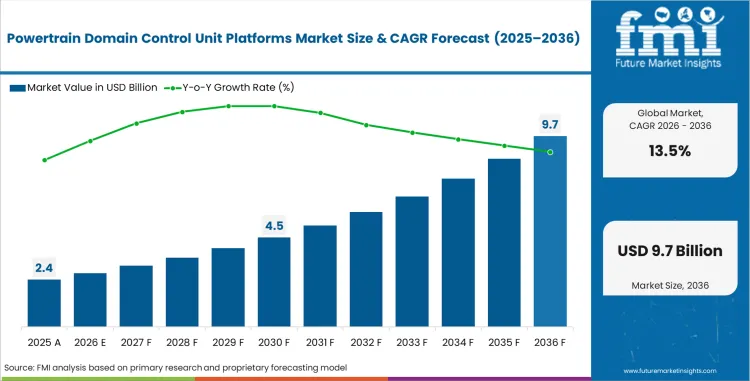
The powertrain domain control unit platforms market crossed a valuation of USD 2.4 billion in 2025. The market is anticipated to reach USD 2.7 billion by 2026-end and grow at a 13.5% CAGR between 2026 and 2036 to reach USD 9.7 billion by 2036. Electric platforms are projected to account for 38.0% share in 2026, while passenger cars are expected to represent 61.0% share.
Summary of the Powertrain Domain Control Unit Platforms Market
- Demand and Growth Drivers
- EV platform growth is increasing demand for powertrain control units that manage torque and thermal behavior in one system.
- Hybrid vehicle programs are creating demand for controllers managing engine operation and electric drive coordination.
- Software-defined vehicle programs are pushing OEMs toward control platforms supporting updates across the vehicle life cycle.
- Product and Segment View
- Films and elastomers lead the product form demand in 2026, as they fit flexible shielding and surface coverage needs.
- Carbon based materials hold a strong position because they offer practical absorption performance with manageable processing cost.
- Ferrite materials support demand in lower-frequency absorption work where magnetic loss performance is important.
- Geography and Competitive Outlook
- China is expected to support strong demand through electronics manufacturing and defense communication systems.
- The USA is projected to stay important through military electronics and radar testing infrastructure.
- Germany and Japan are expected to support stable demand through automotive radar and high-precision electronics work.
- Suppliers are expected to compete through material performance, frequency coverage and reliable supply to defense and electronics users.
- Analyst Opinion
- Nikhil Kaitwade, Principal Consultant at FMI says, “I see this market moving from ECU supply into platform control ownership. Powertrain control is becoming a software and safety problem as much as a hardware problem. OEMs want fewer controllers and more reusable software across electric, hybrid, and combustion variants.”
- Powertrain Domain Control Unit Platforms Market Value Analysis
- The powertrain domain control unit platforms market is moving from ECU supply into integrated propulsion control.
- EV and hybrid programs support adoption because control units coordinate motor and inverter functions.
- Software defined vehicle programs increase demand for control platforms that support updates.
- Demand comes from safe live control and reduced ECU complexity.
Key Takeaways
- The powertrain domain control unit platforms market is valued at USD 2.4 billion in 2025.
- By 2036, the market is expected to reach USD 9.7 billion.
- From 2026 to 2036, the market is projected to expand at a 13.5% CAGR.
- The market is expected to create an incremental opportunity of USD 6 billion between 2026 and 2036.
- Electric platforms are forecast to account for 38.0% of platform type demand in 2026.
- Passenger cars are projected to hold 61.0% of vehicle type demand in 2026.
- China (15.8%) and India (15.1%) are expected to record the fastest growth at through 2036.
Strategic Pointers: Powertrain Domain Control Unit Platforms Market
Powertrain domain control unit platform suppliers are moving from single function ECU delivery toward centralized propulsion computing. Bosch identifies the vehicle control unit as the central E/E architecture component for all powertrain types. Bosch also states that rising software complexity requires greater processing power. NXP’s S32E2 propulsion domain controller proof of concept integrates BMS, motor control, CAN gateway and FOTA in one ECU. Consolidation becomes a clear cost and launch speed lever for EV programs. AUTOSAR positions its standardized software framework as a way for development partners to save time and money.
ISO/SAE 21434:2021 defines cybersecurity risk management across the road vehicle E/E lifecycle. DCU suppliers with reusable middleware and safety evidence can reduce OEM validation burden. Aptiv’s US11380107B2 patent on a power and data center for automotive applications points to the next architecture shift. Zonal E/E architecture connects sensors and controllers through combined data and power distribution. Powertrain DCU platforms will be evaluated on integration depth and certified lifecycle support, with hardware supply becoming only one part of supplier selection.
Powertrain Domain Control Unit Platforms Market Definition
The powertrain domain control unit platforms market includes hardware, software, middleware, and validation tools used to manage vehicle propulsion control. These platforms coordinate engine control, motor control, inverter response, torque delivery, regenerative braking, and powertrain thermal functions.
Powertrain Domain Control Unit Platforms Market Inclusions
Market scope includes powertrain domain controllers, real-time processors, embedded software platforms, powertrain middleware, calibration environments, validation tools, OEM integration support, Tier-1 supplied control systems, and engineering services across global vehicle programs.
Powertrain Domain Control Unit Platforms Market Exclusions
The scope excludes standalone engine sensors, traction motors, battery packs, mechanical transmissions, infotainment ECUs, ADAS-only computers, telematics devices, and general-purpose chips sold without powertrain control integration.
Powertrain Domain Control Unit Platforms Market Research Methodology
- Primary Research: FMI assessed inputs from automotive electronics suppliers, powertrain software engineers, Tier-1 platform integrators, and OEM architecture planners.
- Desk Research: The study reviewed official emissions rules, cybersecurity regulations, supplier platform releases, and public automotive architecture material.
- Market Sizing and Forecasting: The model combined controller content per vehicle, EV and hybrid production mix, regional platform adoption, and software integration value.
- Data Validation: Forecasts were cross-checked against automotive ECU demand, electric drivetrain growth, and supplier product portfolios.
Why is the Powertrain Domain Control Unit Platforms Market Growing?
- EV growth is increasing the need for controllers that coordinate inverter behavior and motor response.
- Hybrid systems need one control base for combustion timing and electric assist.
- Software-defined vehicles need update-ready powertrain control with safe real-time operation.
- Emissions rules increase calibration depth across combustion and hybrid powertrains.
- Zonal architecture reduces scattered ECUs and creates demand for domain control platforms.
Powertrain control is moving closer to software-defined vehicle architecture as OEMs reduce scattered controller layouts. The growth raises controller content because each EV needs tight coordination between power electronics and drive software. A powertrain domain controller helps OEMs reuse software across vehicle lines. Suppliers with safe processors and calibration tools gain a clearer role in launch programs.
Regulation is strengthening the need for cleaner calibration and secure software updates. These rules increase pressure on powertrain control accuracy because hybrid and combustion platforms must manage emissions across wider driving conditions which pushes demand toward secure platforms that can support updates and traceable software changes.
Market Segmentation Analysis
- Electric platforms are projected to account for 38.0% of platform type demand in 2026 as BEV powertrains need central torque control.
- Passenger cars are expected to represent 61.0% of vehicle type demand in 2026 with high-volume EV programs leading adoption.
- Battery electric propulsion is projected to hold 34.0% share in 2026 as inverter control moves into domain platforms.
- Domain centralized architecture is anticipated to account for 43.0% share in 2026 as OEMs reduce scattered ECU layouts.
- Hardware platforms are expected to hold 41.0% share in 2026 as safe compute and real-time control boards anchor the market.
The Powertrain Domain Control Unit Platforms Market is segmented by Platform Type, which includes Hybrid Platforms, Electric Platforms, ICE Platforms, and Multi-energy Platforms, Vehicle Type, which includes Passenger Cars, Light Commercial Vehicles, Heavy Commercial Vehicles, and Off-highway Vehicles, Propulsion Type, which includes Battery Electric, Hybrid Electric, Plug-in Hybrid, and Internal Combustion, Architecture, which includes Domain Centralized, Zonal Connected, Cross-domain Integrated, and Distributed ECU, Integration Level, which includes Hardware Platforms, Software Platforms, Middleware Platforms, and Validation Tools, and Region.
Insights into the Electric Platforms Platform Type Segment
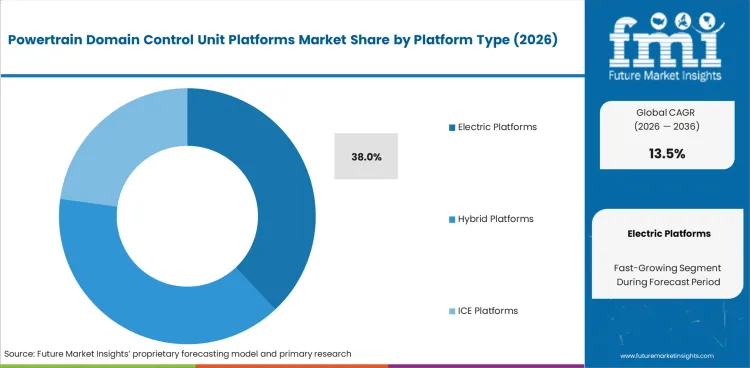
- Electric platforms are projected to account for 38.0% in 2026 as BEV programs need controller coordination across inverter response and torque delivery.
- Hybrid platforms follow closely in Europe and Japan because OEMs need powertrain software that can balance engine operation with electric assist during emissions test cycles.
Insights into the Passenger Cars Vehicle Type Segment
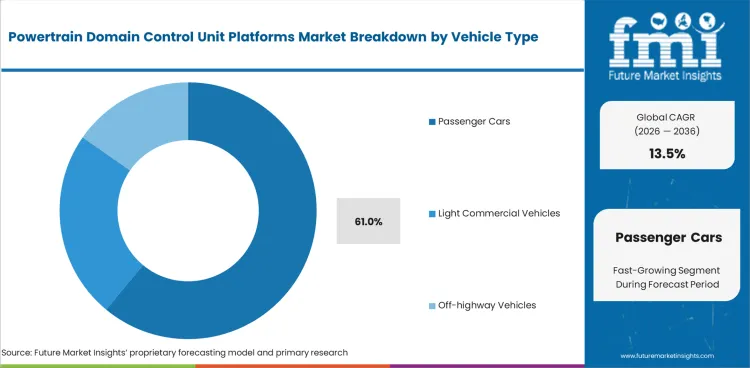
- Passenger cars are expected to represent 61.0% in 2026 Scaled EV and hybrid programs need repeatable control platforms.
- Commercial vehicles need stronger duty-cycle calibration. Passenger cars offer a faster route for controller reuse across trims and global vehicle lines.
Insights into the Battery Electric Propulsion Type Segment
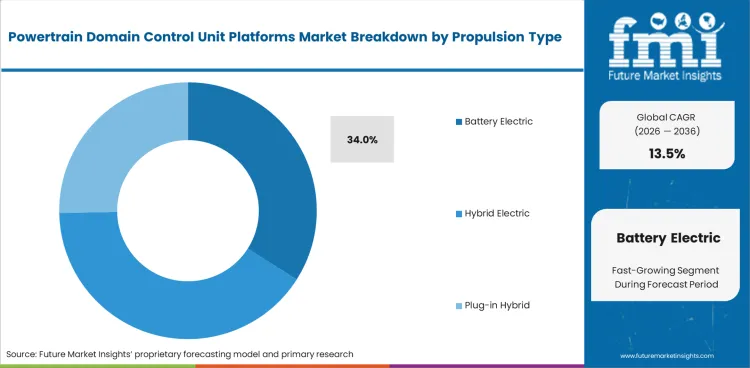
- Battery electric propulsion is projected to hold 34.0% share in 2026 with high demand for motor control and regenerative braking software.
- Plug-in hybrid platforms need deeper energy management because the controller must switch smoothly between electric drive and combustion operation.
Insights into the Domain Centralized Architecture Segment
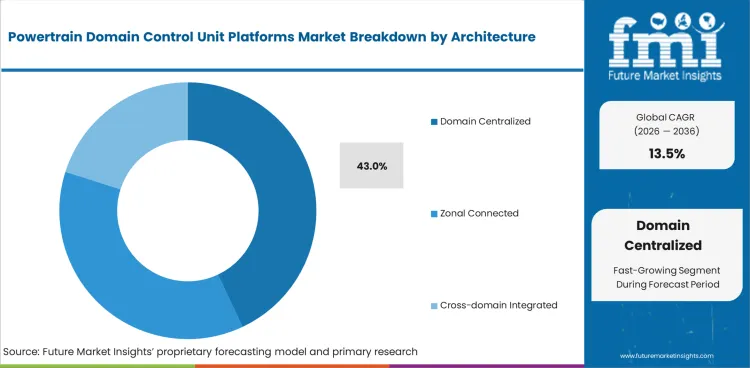
- Domain centralized architecture is anticipated to account for 43.0% share in 2026. OEMs use it to reduce separate powertrain ECUs and wiring complexity.
- Zonal connected layouts are gaining support as automotive zonal gateway ECUs move more data across the vehicle network.
Insights into the Hardware Platforms Integration Level Segment
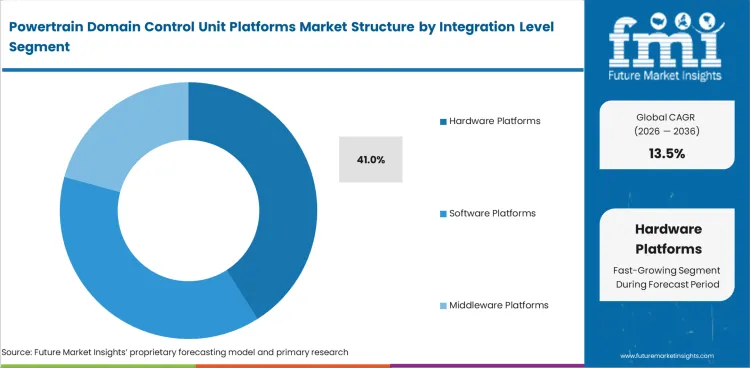
- Hardware platforms are expected to hold 41.0% share in 2026 because real-time control needs safe processors, power stages, and automotive-grade boards.
- Software platforms are gaining demand as OEMs seek reusable control stacks across vehicle control unit programs.
Powertrain Domain Control Unit Platforms Market Drivers, Restraints, and Opportunities
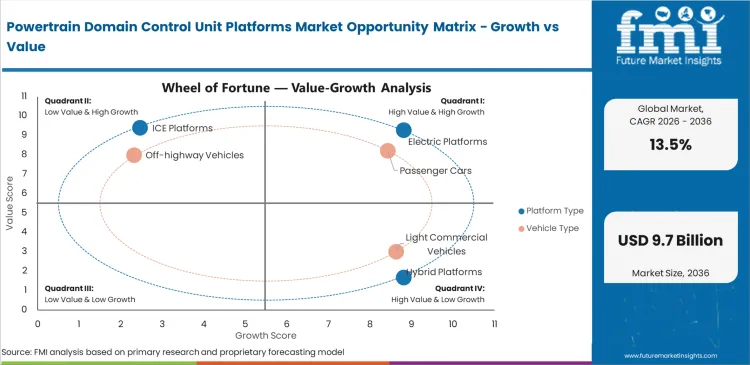
- EV powertrain control depth is increasing as motor and braking functions move into common software platforms.
- Hybrid calibration complexity supports demand for domain controllers that manage combustion and electric drive coordination.
- High validation cost can slow adoption in lower-priced vehicles with limited electronics budgets.
- Software update rules create an opportunity for secure platforms with traceable version control.
- Zonal architecture creates new demand for controllers that connect powertrain functions with vehicle-level software.
EV Torque Control Depth
EV programs are increasing the amount of control work handled inside one powertrain platform. Motor response, inverter switching, and regenerative braking need fast decisions under safe real-time limits. NXP describes its S32N family as processors for central compute applications with safe real-time and application processing. The product direction shows how suppliers are preparing for fewer controllers with more integrated powertrain software. OEMs gain when one platform supports several vehicle trims. Suppliers gain when their chips and software tools reduce rework during calibration.
Hybrid Calibration Load
Hybrid platforms create a different type of controller demand because engine control and electric assist must operate together. The control unit must manage fuel use, emissions limits, battery state, and drive response. EPA’s April 2024 final rule for model year 2027 and later vehicles increases pressure on powertrain efficiency and emissions control. Hybrid models need precise calibration to meet these targets under real driving conditions. It supports demand for domain platforms that combine safe hardware and flexible software. Suppliers with emissions calibration skill gain a clear advantage.
Analysis of Powertrain Domain Control Unit Platforms Market by Key Countries
.webp "Top Country Growth Comparison Powertrain Domain Control Unit Platforms Market Cagr (2026 2036)")
| Country | CAGR |
|---|---|
| UK | 12.4% |
| US | 13.2% |
| Japan | 11.8% |
| China | 15.8% |
| India | 15.1% |
| Germany | 12.9% |
| France | 12.1% |
| Brazil | 10.7% |
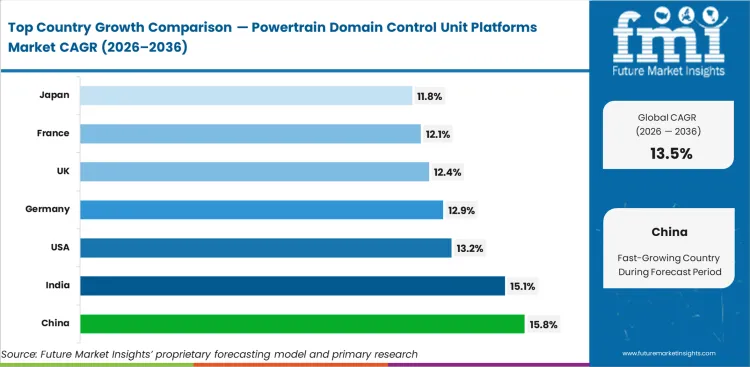
Source: FMI analysis based on primary research and proprietary forecasting model.
Powertrain Domain Control Unit Platforms Market CAGR Analysis by Country
- China and India are expected to lead growth at 15.8% CAGR and 15.1% CAGR, supported by EV production scale and newer electronic architectures.
- The US is forecast to grow at 13.2% CAGR through 2036 with software-defined vehicle programs and emissions rules.
- Germany, the UK, and France are projected to record 12.9% CAGR, 12.4% CAGR, and 12.1% CAGR, supported by EV registrations and validation needs.
- Japan and Brazil are expected to grow at 11.8% CAGR and 10.7% CAGR, driven by hybrid engineering and local powertrain programs.
- The global market is projected to expand at a 13.5% CAGR from 2026 to 2036 as EV and hybrid platforms need deeper powertrain control.
Demand Outlook for Powertrain Domain Control Unit Platforms Market in the UK
The UK is projected to rise at 12.4% CAGR through 2036 as BEV programs increase controller content. The UK market benefits from higher electrified vehicle registrations and policy pressure on zero-emission sales. Supplier opportunities improve for platforms that coordinate propulsion software and power electronics. OEMs and import brands need software-ready control systems for EV compliance. A faster BEV mix would lift demand for vehicle electrification control content across passenger cars.
- The ZEV mandate keeps BEV share targets visible in UK launch planning.
- West Midlands engineering activity supports powertrain software and validation work.
- BEV growth gives suppliers a clearer view of controller demand.
Sales Analysis of Powertrain Domain Control Unit Platforms Market in the USA
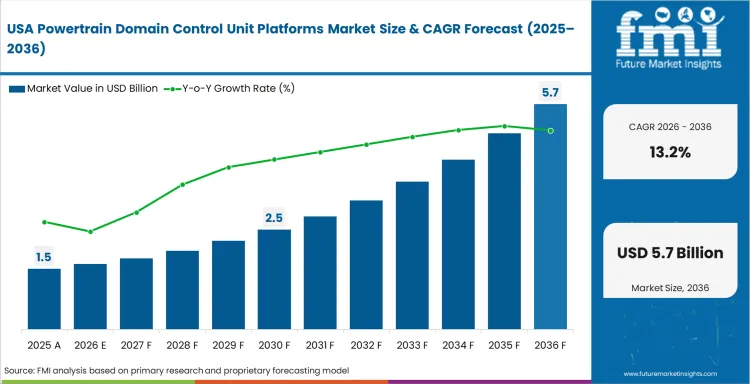
The USA market is shaped by emissions compliance and large software-defined vehicle programs. Automakers need cleaner calibration across combustion, hybrid, and electric platforms. The USA is forecast to grow at 13.2% CAGR through 2036 with software-defined vehicle programs and emissions rules. OEMs and Tier-1 suppliers are focusing on fewer ECUs and stronger software reuse. Demand is strongest in EV platforms and full-size hybrids that need high torque control.
- Michigan and California support control platform work through OEM engineering and EV software programs.
- Emissions standards increase calibration value across hybrid and combustion powertrains.
- Large pickup and SUV programs need controllers with torque management and thermal control depth.
Demand Analysis of Powertrain Domain Control Unit Platforms Market in Japan
Japan’s market is driven by hybrid expertise and high validation discipline. Japanese OEMs use careful control calibration to protect drivability and fuel economy. Software-defined vehicle planning is increasing the need for higher compute and reusable vehicle software. Japan is expected to post 11.8% from 2026 to through 2036 with hybrid engineering and software update discipline. Automotive microcontrollers support this demand as powertrain software becomes more integrated.
- Aichi and Tochigi engineering hubs support hybrid powertrain software validation.
- Japanese OEMs favor long test cycles before wider controller platform rollout.
- Next-generation EV programs point to stronger compute needs across powertrain control.
Opportunity Analysis of Powertrain Domain Control Unit Platforms Market in China
China is the fastest-growing market as EV model cycles are shorter and controller demand scales with local production which creates a large base for electric powertrain controllers and software reuse across vehicle brands. Chinese OEMs need control platforms that support fast launch timing and local supplier integration. China is projected to record a 15.8% CAGR by 2036 as EV production scale raises controller demand. Growth is strongest in BEVs and plug-in hybrids.
- Guangdong and Shanghai support EV programs with dense supplier networks.
- Plug-in hybrid growth raises demand for engine and motor coordination software.
- Local OEMs value platforms that reduce software work across fast model cycles.
Future Outlook for Powertrain Domain Control Unit Platforms Market in India
India is expected to expand at 15.1% CAGR through 2036 as local EV programs build newer electronic architectures. India is moving from basic EV electronics toward more integrated control platforms. Local EV programs and rising software capability are improving demand for domain controllers. Indian OEMs need cost-efficient platforms for two-wheelers and passenger cars. Suppliers with scalable software and local engineering support can gain faster acceptance in India.
- Tamil Nadu and Maharashtra support EV manufacturing clusters with supplier depth.
- FAME and PLI programs improve the case for domestic EV electronics work.
- Light commercial EVs create demand for durable controllers with simple service access.
In-depth Analysis of Powertrain Domain Control Unit Platforms Market in Germany
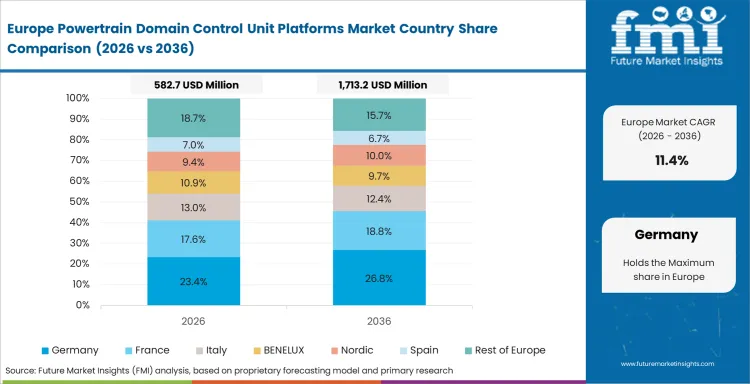
Germany’s market depends on premium EV production and high validation standards. German OEMs need platforms to manage performance and software updates across high-value vehicles. Germany is expected to advance at 12.9% CAGR through 2036 as premium EV production supports deeper validation. Suppliers benefit when they combine processor depth with vehicle-level integration. Demand is strongest in premium BEVs and plug-in hybrids.
- Bavaria and Baden-Württemberg anchor powertrain engineering and supplier testing.
- German EV production supports demand for safe high-performance control hardware.
- Premium vehicle programs raise validation needs for thermal and torque control.
Sales Outlook for Powertrain Domain Control Unit Platforms Market in France
France shows steady growth through electrified vehicle sales and domestic platform planning. French OEMs focus on affordable EVs, which places cost pressure on controller platforms. Suppliers need compact hardware and reusable software to fit lower vehicle price bands. France is forecast at 12.1% CAGR through 2036 as EV registrations and hybrid production support platform demand. Growth is strongest in small cars and light commercial EVs.
- Île-de-France and Hauts-de-France support EV assembly and engineering programs.
- Renault Group’s small EV focus raises demand for cost-efficient control platforms.
- French EV activity increases software work across inverter and torque control.
In-depth Analysis of Powertrain Domain Control Unit Platforms Market in Brazil
Brazil is projected to grow at 10.7% CAGR through 2036 as flex-fuel hybrids and local EV programs widen. Brazil’s market is smaller but important as flex-fuel hybrids add unique powertrain control needs. Local demand depends on emissions rules and ethanol compatibility. The market needs controllers that handle fuel variation and hybrid assist without raising vehicle cost too sharply. Suppliers with cost-efficient hardware and calibration support can build share in local programs.
- São Paulo supports most automotive engineering activity and supplier decisions.
- Flex-fuel hybrid platforms need control software tuned for ethanol and gasoline.
- Local assembly programs favor suppliers that can support calibration inside Brazil.
Competitive Landscape and Strategic Positioning
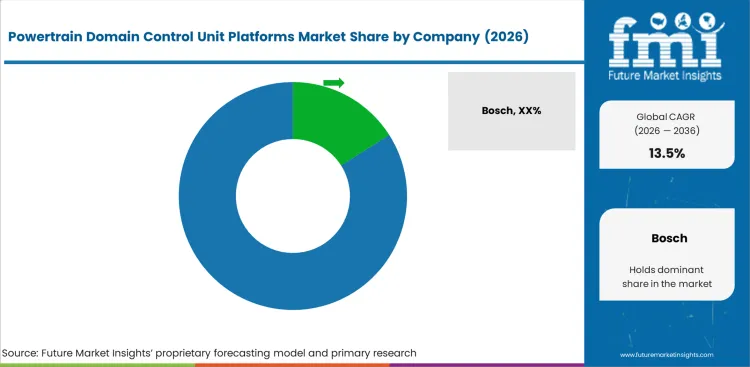
- The market is moderately concentrated across global Tier-1 suppliers and automotive semiconductor companies.
- Leading suppliers differentiate on safe compute, AUTOSAR support and powertrain calibration depth.
- Smaller specialists gain work in validation tools and engineering support.
- Entry barriers are high because safety certification and OEM launch timing are difficult to match.
Competition is shifting from controller supply toward platform ownership. Bosch says its Vehicle Motion Management connects steering, braking, powertrain, recuperation, and stability control through one software layer. Powertrain domain control suppliers need to prove fast response and safe fallback behavior. OEMs favor suppliers that can support both hardware and software during launch.
Semiconductor suppliers are gaining influence as controller performance depends on safe real-time processors. New vehicle super-integration processors and advanced microcontroller families support central compute needs in software-defined vehicles. These products support the shift from isolated control units to scalable platforms. Automakers gain when processor roadmaps support multiple vehicle lines. Suppliers gain when software tools are available before hardware decisions close.
Cross-domain integration is creating another competitive layer. High-performance computers are now being used in real vehicle applications to combine vehicle motion and cockpit functions. New multi-domain silicon platforms are also improving software access for automakers. These moves show how suppliers are linking compute hardware with software access. Powertrain domain platforms will need to connect with automotive connectivity control units as vehicle data flow grows.
Key Companies in the Powertrain Domain Control Unit Platforms Market
Key companies active in this market include suppliers with powertrain electronics, safe processors, embedded software, and vehicle integration capability.
- Global Tier-1 Integrators: Bosch, Continental, Denso, ZF and Marelli support OEM powertrain control programs through controller hardware and vehicle integration.
- Automotive Semiconductor Leaders: NXP, Renesas, Infineon, STMicroelectronics, and Texas Instruments supply safe processors and real-time compute platforms.
- Software and Engineering Specialists: Vector, ETAS, KPIT, Elektrobit, and dSPACE support AUTOSAR stacks, calibration tools and virtual testing.
Competitive Benchmarking: Powertrain Domain Control Unit Platforms Market
| Company | Safe Real-time Compute | Powertrain Software Depth | OEM Integration Reach | Geographic Footprint |
|---|---|---|---|---|
| Bosch | High | High | Strong | Global |
| Continental | High | High | Strong | Global |
| Denso | High | High | Strong | Global |
| ZF | High | Strong | Strong | Global |
| NXP | High | Medium | Strong | Global |
| Renesas | High | Strong | Strong | Global |
| Infineon | High | Medium | Strong | Global |
| STMicroelectronics | Medium | Medium | Strong | Global |
| Texas Instruments | Medium | Medium | Strong | Global |
| Vector | Low | High | Strong | Europe, North America, Asia |
Source: Future Market Insights competitive analysis, 2026.
Key Developments in the Powertrain Domain Control Unit Platforms Market
- In November 2024, Infineon launched the AURIX TC4Dx microcontroller family with sampling and 2025 mass production plans. The product supports safe real-time control in next-generation vehicles.
- In January 2025, Honda and Renesas signed an agreement to develop a high-performance SoC for software-defined vehicles. The work targets Honda 0 Series models planned for the late 2020s.
Key Players in the Powertrain Domain Control Unit Platforms Market
Global Tier-1 Integrators
- Bosch
- Continental
- Denso
- ZF
- Marelli
Automotive Semiconductor Leaders
- NXP
- Renesas
- Infineon
- STMicroelectronics
- Texas Instruments
Software and Engineering Specialists
- Vector
- ETAS
- KPIT
- Elektrobit
- dSPACE
Report Scope and Coverage
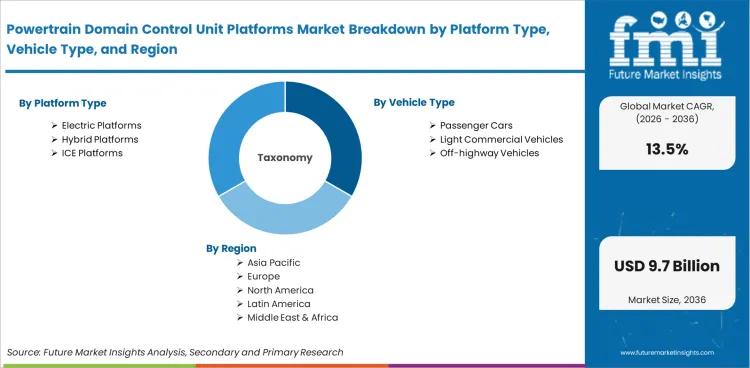
Powertrain Domain Control Unit Platforms Market Breakdown by Platform Type, Vehicle Type, Propulsion Type, Architecture, Integration Level, Sales Channel, and Region
| Parameter | Details |
|---|---|
| Quantitative Units | USD 2.7 billion to USD 9.7 billion, at a 13.5% CAGR |
| Market Definition | Hardware, software, middleware, and validation platforms used for powertrain domain control across electric, hybrid, plug-in hybrid and combustion vehicles. |
| Regions Covered | North America, Latin America, Western Europe, Eastern Europe, East Asia, South Asia and Pacific, Middle East and Africa |
| Countries Covered | UK, US, Japan, China, India, Germany, France, Brazil, and 30+ countries |
| Key Companies Profiled | Bosch, Continental, Denso, ZF, Marelli, NXP, Renesas, Infineon, STMicroelectronics, Texas Instruments |
| Forecast Period | 2026 to 2036 |
| Approach | Hybrid bottom-up and top-down methodology starting with controller content per vehicle and platform adoption across regions. |
Powertrain Domain Control Unit Platforms Market by Segments
Powertrain Domain Control Unit Platforms Market Segmented by Platform Type
- Hybrid Platforms
- Electric Platforms
- ICE Platforms
- Multi-energy Platforms
Powertrain Domain Control Unit Platforms Market Segmented by Vehicle Type
- Passenger Cars
- Light Commercial Vehicles
- Heavy Commercial Vehicles
- Off-highway Vehicles
Powertrain Domain Control Unit Platforms Market Segmented by Propulsion Type
- Battery Electric
- Hybrid Electric
- Plug-in Hybrid
- Internal Combustion
Powertrain Domain Control Unit Platforms Market Segmented by Architecture
- Domain Centralized
- Zonal Connected
- Cross-domain Integrated
- Distributed ECU
Powertrain Domain Control Unit Platforms Market Segmented by Integration Level
- Hardware Platforms
- Software Platforms
- Middleware Platforms
- Validation Tools
Powertrain Domain Control Unit Platforms Market by Region
- North America
- United States
- Canada
- Mexico
- Latin America
- Brazil
- Chile
- Rest of Latin America
- Western Europe
- Germany
- UK
- Italy
- Spain
- France
- Nordic
- BENELUX
- Rest of Western Europe
- Eastern Europe
- Russia
- Poland
- Hungary
- Balkan and Baltic
- Rest of Eastern Europe
- East Asia
- China
- Japan
- South Korea
- South Asia and Pacific
- India
- ASEAN
- Australia and New Zealand
- Rest of South Asia and Pacific
- Middle East and Africa
- Kingdom of Saudi Arabia
- Other GCC Countries
- Turkiye
- South Africa
- Other African Union
- Rest of Middle East and Africa
Research Sources and Bibliography
- Infineon Technologies AG. (2024, November 6). New high-performance microcontroller: Infineon launches AURIX TC4Dx.
- Honda Motor Co., Ltd. (2025, January 8). Honda and Renesas sign agreement to develop high-performance SoC for software-defined vehicles.
- International Energy Agency. (2025, May 14). Executive summary: Global EV Outlook 2025. IEA.
- USA Environmental Protection Agency. (2024). Final rule: Multi-pollutant emissions standards for model years 2027 and later light-duty and medium-duty vehicles.
- Vehicle Certification Agency. (2024, May 14). Cyber security and software updating. UK Government.
- Society of Motor Manufacturers and Traders. (2026, January 6). UK new car market breaches two million as almost one in four buyers go electric.
- European Automobile Manufacturers’ Association. (2026, January 27). New car registrations: +1.8% in 2025, battery-electric 17.4% market share. ACEA.
This Report Answers
- What is the estimated powertrain domain control unit platforms market size in 2026?
- What is the forecast value of powertrain domain control unit platforms by 2036?
- What CAGR is projected for powertrain domain control unit platforms from 2026 to 2036?
- Which platform type is expected to lead demand by 2026?
- Which vehicle type is projected to account for the highest share in 2026?
- How do EV and hybrid programs change powertrain controller demand?
- Why do cybersecurity and software update rules influence platform selection?
- Which countries are expected to record faster growth through 2036?
- Which companies are active across control hardware, software, and safe processors?
- How does FMI estimate and validate the forecast for this market?
Frequently Asked Questions
What is the global market demand for powertrain domain control unit platforms in 2026?
In 2026, the global market is expected to be worth USD 2.7 billion, driven by EV and hybrid control platform demand.
How big will the powertrain domain control unit platforms market be in 2036?
By 2036, the market is expected to reach USD 9.7 billion, with software-defined vehicle programs supporting demand.
Which platform type is likely to lead the market by 2026?
Electric platforms are projected to lead with 38.0% share in 2026 as BEV powertrain software deepens.
Which vehicle type is expected to lead demand by 2026?
Passenger cars are expected to hold 61.0% share in 2026 because high-volume EV programs use more controller platforms.
Which country is expected to grow fastest through 2036?
China is projected to record 15.8% CAGR through 2036 as EV production scale drives controller platform demand.
What does this report include under powertrain domain control unit platforms?
The report includes control hardware, embedded software and validation tools used for electric, hybrid, and combustion powertrains.
How does FMI estimate this market forecast?
FMI uses controller content per vehicle, EV production mix and regional adoption patterns to build the forecast.
Preview the report firsthand - request a free sample
Get SampleGet the brochure for pricing and purchase details.
Get PDFTable of Content
- Executive Summary
- Global Market Outlook
- Demand-side Trends
- Supply-side Trends
- Technology Roadmap Analysis
- Analysis and Recommendations
- Market Overview
- Market Coverage / Taxonomy
- Market Definition / Scope / Limitations
- Research Methodology
- Chapter Orientation
- Analytical Lens and Working Hypotheses
- Market Structure, Signals, and Trend Drivers
- Benchmarking and Cross-market Comparability
- Market Sizing, Forecasting, and Opportunity Mapping
- Research Design and Evidence Framework
- Desk Research Programme (Secondary Evidence)
- Company Annual and Sustainability Reports
- Peer-reviewed Journals and Academic Literature
- Corporate Websites, Product Literature, and Technical Notes
- Earnings Decks and Investor Briefings
- Statutory Filings and Regulatory Disclosures
- Technical White Papers and Standards Notes
- Trade Journals, Industry Magazines, and Analyst Briefs
- Conference Proceedings, Webinars, and Seminar Materials
- Government Statistics Portals and Public Data Releases
- Press Releases and Reputable Media Coverage
- Specialist Newsletters and Curated Briefings
- Sector Databases and Reference Repositories
- FMI Internal Proprietary Databases and Historical Market Datasets
- Subscription Datasets and Paid Sources
- Social Channels, Communities, and Digital Listening Inputs
- Additional Desk Sources
- Expert Input and Fieldwork (Primary Evidence)
- Primary Modes
- Qualitative Interviews and Expert Elicitation
- Quantitative Surveys and Structured Data Capture
- Blended Approach
- Why Primary Evidence is Used
- Field Techniques
- Interviews
- Surveys
- Focus Groups
- Observational and In-context Research
- Social and Community Interactions
- Stakeholder Universe Engaged
- C-suite Leaders
- Board Members
- Presidents and Vice Presidents
- R&D and Innovation Heads
- Technical Specialists
- Domain Subject-matter Experts
- Scientists
- Physicians and Other Healthcare Professionals
- Governance, Ethics, and Data Stewardship
- Research Ethics
- Data Integrity and Handling
- Primary Modes
- Tooling, Models, and Reference Databases
- Desk Research Programme (Secondary Evidence)
- Data Engineering and Model Build
- Data Acquisition and Ingestion
- Cleaning, Normalisation, and Verification
- Synthesis, Triangulation, and Analysis
- Quality Assurance and Audit Trail
- Market Background
- Market Dynamics
- Drivers
- Restraints
- Opportunity
- Trends
- Scenario Forecast
- Demand in Optimistic Scenario
- Demand in Likely Scenario
- Demand in Conservative Scenario
- Opportunity Map Analysis
- Product Life Cycle Analysis
- Supply Chain Analysis
- Investment Feasibility Matrix
- Value Chain Analysis
- PESTLE and Porter’s Analysis
- Regulatory Landscape
- Regional Parent Market Outlook
- Production and Consumption Statistics
- Import and Export Statistics
- Market Dynamics
- Global Market Analysis 2021 to 2025 and Forecast, 2026 to 2036
- Historical Market Size Value (USD Million) Analysis, 2021 to 2025
- Current and Future Market Size Value (USD Million) Projections, 2026 to 2036
- Y-o-Y Growth Trend Analysis
- Absolute $ Opportunity Analysis
- Global Market Pricing Analysis 2021 to 2025 and Forecast 2026 to 2036
- Global Market Analysis 2021 to 2025 and Forecast 2026 to 2036, By Platform Type
- Introduction / Key Findings
- Historical Market Size Value (USD Million) Analysis By Platform Type , 2021 to 2025
- Current and Future Market Size Value (USD Million) Analysis and Forecast By Platform Type , 2026 to 2036
- Electric Platforms
- Hybrid Platforms
- ICE Platforms
- Electric Platforms
- Y-o-Y Growth Trend Analysis By Platform Type , 2021 to 2025
- Absolute $ Opportunity Analysis By Platform Type , 2026 to 2036
- Global Market Analysis 2021 to 2025 and Forecast 2026 to 2036, By Vehicle Type
- Introduction / Key Findings
- Historical Market Size Value (USD Million) Analysis By Vehicle Type, 2021 to 2025
- Current and Future Market Size Value (USD Million) Analysis and Forecast By Vehicle Type, 2026 to 2036
- Passenger Cars
- Light Commercial Vehicles
- Off-highway Vehicles
- Passenger Cars
- Y-o-Y Growth Trend Analysis By Vehicle Type, 2021 to 2025
- Absolute $ Opportunity Analysis By Vehicle Type, 2026 to 2036
- Global Market Analysis 2021 to 2025 and Forecast 2026 to 2036, By Propulsion Type
- Introduction / Key Findings
- Historical Market Size Value (USD Million) Analysis By Propulsion Type, 2021 to 2025
- Current and Future Market Size Value (USD Million) Analysis and Forecast By Propulsion Type, 2026 to 2036
- Battery Electric
- Hybrid Electric
- Plug-in Hybrid
- Battery Electric
- Y-o-Y Growth Trend Analysis By Propulsion Type, 2021 to 2025
- Absolute $ Opportunity Analysis By Propulsion Type, 2026 to 2036
- Global Market Analysis 2021 to 2025 and Forecast 2026 to 2036, By Architecture
- Introduction / Key Findings
- Historical Market Size Value (USD Million) Analysis By Architecture, 2021 to 2025
- Current and Future Market Size Value (USD Million) Analysis and Forecast By Architecture, 2026 to 2036
- Domain Centralized
- Zonal Connected
- Cross-domain Integrated
- Domain Centralized
- Y-o-Y Growth Trend Analysis By Architecture, 2021 to 2025
- Absolute $ Opportunity Analysis By Architecture, 2026 to 2036
- Global Market Analysis 2021 to 2025 and Forecast 2026 to 2036, By Integration Level
- Introduction / Key Findings
- Historical Market Size Value (USD Million) Analysis By Integration Level, 2021 to 2025
- Current and Future Market Size Value (USD Million) Analysis and Forecast By Integration Level, 2026 to 2036
- Hardware Platforms
- Software Platforms
- Middleware Platforms
- Hardware Platforms
- Y-o-Y Growth Trend Analysis By Integration Level, 2021 to 2025
- Absolute $ Opportunity Analysis By Integration Level, 2026 to 2036
- Global Market Analysis 2021 to 2025 and Forecast 2026 to 2036, By Region
- Introduction
- Historical Market Size Value (USD Million) Analysis By Region, 2021 to 2025
- Current Market Size Value (USD Million) Analysis and Forecast By Region, 2026 to 2036
- North America
- Latin America
- Western Europe
- Eastern Europe
- East Asia
- South Asia and Pacific
- Middle East & Africa
- Market Attractiveness Analysis By Region
- North America Market Analysis 2021 to 2025 and Forecast 2026 to 2036, By Country
- Historical Market Size Value (USD Million) Trend Analysis By Market Taxonomy, 2021 to 2025
- Market Size Value (USD Million) Forecast By Market Taxonomy, 2026 to 2036
- By Country
- USA
- Canada
- Mexico
- By Platform Type
- By Vehicle Type
- By Propulsion Type
- By Architecture
- By Integration Level
- By Country
- Market Attractiveness Analysis
- By Country
- By Platform Type
- By Vehicle Type
- By Propulsion Type
- By Architecture
- By Integration Level
- Key Takeaways
- Latin America Market Analysis 2021 to 2025 and Forecast 2026 to 2036, By Country
- Historical Market Size Value (USD Million) Trend Analysis By Market Taxonomy, 2021 to 2025
- Market Size Value (USD Million) Forecast By Market Taxonomy, 2026 to 2036
- By Country
- Brazil
- Chile
- Rest of Latin America
- By Platform Type
- By Vehicle Type
- By Propulsion Type
- By Architecture
- By Integration Level
- By Country
- Market Attractiveness Analysis
- By Country
- By Platform Type
- By Vehicle Type
- By Propulsion Type
- By Architecture
- By Integration Level
- Key Takeaways
- Western Europe Market Analysis 2021 to 2025 and Forecast 2026 to 2036, By Country
- Historical Market Size Value (USD Million) Trend Analysis By Market Taxonomy, 2021 to 2025
- Market Size Value (USD Million) Forecast By Market Taxonomy, 2026 to 2036
- By Country
- Germany
- UK
- Italy
- Spain
- France
- Nordic
- BENELUX
- Rest of Western Europe
- By Platform Type
- By Vehicle Type
- By Propulsion Type
- By Architecture
- By Integration Level
- By Country
- Market Attractiveness Analysis
- By Country
- By Platform Type
- By Vehicle Type
- By Propulsion Type
- By Architecture
- By Integration Level
- Key Takeaways
- Eastern Europe Market Analysis 2021 to 2025 and Forecast 2026 to 2036, By Country
- Historical Market Size Value (USD Million) Trend Analysis By Market Taxonomy, 2021 to 2025
- Market Size Value (USD Million) Forecast By Market Taxonomy, 2026 to 2036
- By Country
- Russia
- Poland
- Hungary
- Balkan & Baltic
- Rest of Eastern Europe
- By Platform Type
- By Vehicle Type
- By Propulsion Type
- By Architecture
- By Integration Level
- By Country
- Market Attractiveness Analysis
- By Country
- By Platform Type
- By Vehicle Type
- By Propulsion Type
- By Architecture
- By Integration Level
- Key Takeaways
- East Asia Market Analysis 2021 to 2025 and Forecast 2026 to 2036, By Country
- Historical Market Size Value (USD Million) Trend Analysis By Market Taxonomy, 2021 to 2025
- Market Size Value (USD Million) Forecast By Market Taxonomy, 2026 to 2036
- By Country
- China
- Japan
- South Korea
- By Platform Type
- By Vehicle Type
- By Propulsion Type
- By Architecture
- By Integration Level
- By Country
- Market Attractiveness Analysis
- By Country
- By Platform Type
- By Vehicle Type
- By Propulsion Type
- By Architecture
- By Integration Level
- Key Takeaways
- South Asia and Pacific Market Analysis 2021 to 2025 and Forecast 2026 to 2036, By Country
- Historical Market Size Value (USD Million) Trend Analysis By Market Taxonomy, 2021 to 2025
- Market Size Value (USD Million) Forecast By Market Taxonomy, 2026 to 2036
- By Country
- India
- ASEAN
- Australia & New Zealand
- Rest of South Asia and Pacific
- By Platform Type
- By Vehicle Type
- By Propulsion Type
- By Architecture
- By Integration Level
- By Country
- Market Attractiveness Analysis
- By Country
- By Platform Type
- By Vehicle Type
- By Propulsion Type
- By Architecture
- By Integration Level
- Key Takeaways
- Middle East & Africa Market Analysis 2021 to 2025 and Forecast 2026 to 2036, By Country
- Historical Market Size Value (USD Million) Trend Analysis By Market Taxonomy, 2021 to 2025
- Market Size Value (USD Million) Forecast By Market Taxonomy, 2026 to 2036
- By Country
- Kingdom of Saudi Arabia
- Other GCC Countries
- Turkiye
- South Africa
- Other African Union
- Rest of Middle East & Africa
- By Platform Type
- By Vehicle Type
- By Propulsion Type
- By Architecture
- By Integration Level
- By Country
- Market Attractiveness Analysis
- By Country
- By Platform Type
- By Vehicle Type
- By Propulsion Type
- By Architecture
- By Integration Level
- Key Takeaways
- Key Countries Market Analysis
- USA
- Pricing Analysis
- Market Share Analysis, 2025
- By Platform Type
- By Vehicle Type
- By Propulsion Type
- By Architecture
- By Integration Level
- Canada
- Pricing Analysis
- Market Share Analysis, 2025
- By Platform Type
- By Vehicle Type
- By Propulsion Type
- By Architecture
- By Integration Level
- Mexico
- Pricing Analysis
- Market Share Analysis, 2025
- By Platform Type
- By Vehicle Type
- By Propulsion Type
- By Architecture
- By Integration Level
- Brazil
- Pricing Analysis
- Market Share Analysis, 2025
- By Platform Type
- By Vehicle Type
- By Propulsion Type
- By Architecture
- By Integration Level
- Chile
- Pricing Analysis
- Market Share Analysis, 2025
- By Platform Type
- By Vehicle Type
- By Propulsion Type
- By Architecture
- By Integration Level
- Germany
- Pricing Analysis
- Market Share Analysis, 2025
- By Platform Type
- By Vehicle Type
- By Propulsion Type
- By Architecture
- By Integration Level
- UK
- Pricing Analysis
- Market Share Analysis, 2025
- By Platform Type
- By Vehicle Type
- By Propulsion Type
- By Architecture
- By Integration Level
- Italy
- Pricing Analysis
- Market Share Analysis, 2025
- By Platform Type
- By Vehicle Type
- By Propulsion Type
- By Architecture
- By Integration Level
- Spain
- Pricing Analysis
- Market Share Analysis, 2025
- By Platform Type
- By Vehicle Type
- By Propulsion Type
- By Architecture
- By Integration Level
- France
- Pricing Analysis
- Market Share Analysis, 2025
- By Platform Type
- By Vehicle Type
- By Propulsion Type
- By Architecture
- By Integration Level
- India
- Pricing Analysis
- Market Share Analysis, 2025
- By Platform Type
- By Vehicle Type
- By Propulsion Type
- By Architecture
- By Integration Level
- ASEAN
- Pricing Analysis
- Market Share Analysis, 2025
- By Platform Type
- By Vehicle Type
- By Propulsion Type
- By Architecture
- By Integration Level
- Australia & New Zealand
- Pricing Analysis
- Market Share Analysis, 2025
- By Platform Type
- By Vehicle Type
- By Propulsion Type
- By Architecture
- By Integration Level
- China
- Pricing Analysis
- Market Share Analysis, 2025
- By Platform Type
- By Vehicle Type
- By Propulsion Type
- By Architecture
- By Integration Level
- Japan
- Pricing Analysis
- Market Share Analysis, 2025
- By Platform Type
- By Vehicle Type
- By Propulsion Type
- By Architecture
- By Integration Level
- South Korea
- Pricing Analysis
- Market Share Analysis, 2025
- By Platform Type
- By Vehicle Type
- By Propulsion Type
- By Architecture
- By Integration Level
- Russia
- Pricing Analysis
- Market Share Analysis, 2025
- By Platform Type
- By Vehicle Type
- By Propulsion Type
- By Architecture
- By Integration Level
- Poland
- Pricing Analysis
- Market Share Analysis, 2025
- By Platform Type
- By Vehicle Type
- By Propulsion Type
- By Architecture
- By Integration Level
- Hungary
- Pricing Analysis
- Market Share Analysis, 2025
- By Platform Type
- By Vehicle Type
- By Propulsion Type
- By Architecture
- By Integration Level
- Kingdom of Saudi Arabia
- Pricing Analysis
- Market Share Analysis, 2025
- By Platform Type
- By Vehicle Type
- By Propulsion Type
- By Architecture
- By Integration Level
- Turkiye
- Pricing Analysis
- Market Share Analysis, 2025
- By Platform Type
- By Vehicle Type
- By Propulsion Type
- By Architecture
- By Integration Level
- South Africa
- Pricing Analysis
- Market Share Analysis, 2025
- By Platform Type
- By Vehicle Type
- By Propulsion Type
- By Architecture
- By Integration Level
- USA
- Market Structure Analysis
- Competition Dashboard
- Competition Benchmarking
- Market Share Analysis of Top Players
- By Regional
- By Platform Type
- By Vehicle Type
- By Propulsion Type
- By Architecture
- By Integration Level
- Competition Analysis
- Competition Deep Dive
- Bosch
- Overview
- Product Portfolio
- Profitability by Market Segments (Product/Age /Sales Channel/Region)
- Sales Footprint
- Strategy Overview
- Marketing Strategy
- Product Strategy
- Channel Strategy
- Continental
- Denso
- ZF
- Marelli
- NXP
- Bosch
- Competition Deep Dive
- Assumptions & Acronyms Used


