

- Industry Size (2026)
- USD 1.1 Bn
- Forecast (2036)
- USD 4.9 Bn
- CAGR (2026 to 2036)
- 16.1%
Automotive Zonal Gateway ECU Market Size, Market Forecast and Outlook By FMI
The automotive zonal gateway ECU market surpassed a value of USD 1.0 billion in 2025. Industry outlook reflects with sales poised to surpass USD 1.1 billion in 2026 at a CAGR of 16.1% during the forecast period. Tracking the steady rise in demand propels revenue expansion expected to carry the total valuation to USD 4.9 billion through 2036, as automakers aggressively consolidate distributed control units into centralized compute hubs to manage exponential software complexity.
Summary of Automotive Zonal Gateway ECU Market
- The market is forecast to reach USD 4.9 billion by 2036.
- The market is expected to grow at a CAGR of 16.1% from 2026 to 2036.
- The market was estimated at USD 1.0 billion in 2025.
- The forecast period represents an incremental opportunity of USD 3.8 billion.
- The market is projected to surpass USD 1.1 billion in 2026.
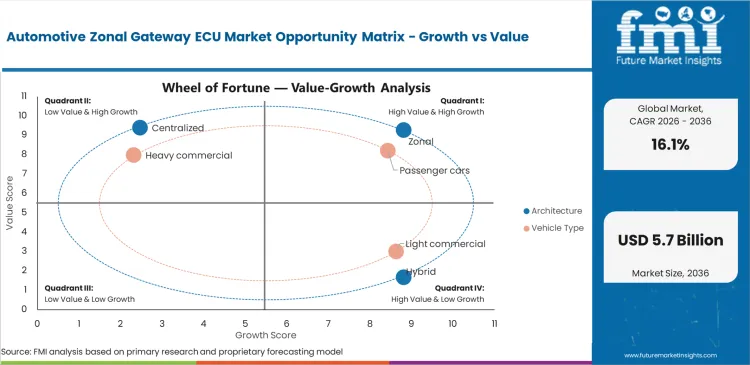
- Zonal architecture leads the segment with a 42.0% share, driven by centralized vehicle computing trends.
- Passenger cars dominate with a 78.0% share, supported by early adoption in premium and software-defined vehicles.
- Ethernet communication leads with a 47.0% share, acting as the core data backbone for high-speed connectivity.
- Gateway-power integration holds a 39.0% share, reflecting the shift toward combining data routing with power distribution.
- OEM sales channel dominates with 88.0% share, as systems are integrated during vehicle production.
- Key companies in the market include Aptiv, Continental, Bosch, Marelli, and Infineon.
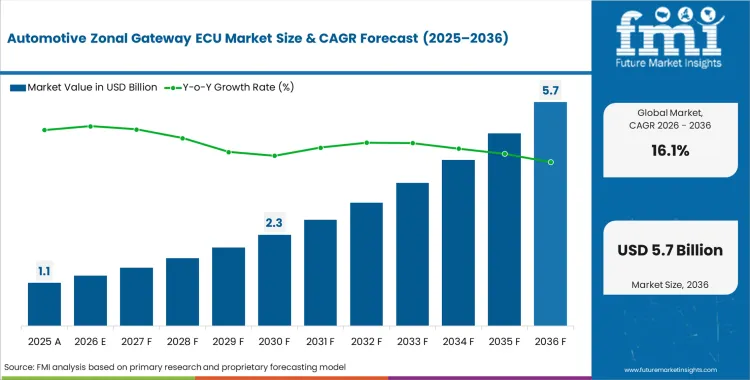
Car designers are under immense pressure to stop using dozens of separate, single-purpose computer chips and move toward powerful, all-in-one computing hubs. Waiting to make this change traps automakers into using miles of heavy, outdated copper wiring. Such an extra weight hurts vehicle performance and makes it nearly impossible to send regular software updates over the air, leading to a major conflict currently unfolding across the supply chain. Older parts suppliers want to keep selling slightly modified versions of their old hardware, with modern vehicle builders refusing to buy the same. Modern builders demand a complete modification to the said modern architecture so their vehicles can run entirely on advanced software.
Older car wiring simply crashes when asked to process the massive video files needed for advanced self-driving features. High-speed ethernet networks must replace these old cables, directly driving software-defined vehicle gateway ECU demand. Automakers are forced to immediately install smart power hubs just to direct this heavy traffic of sensor data without overloading the system. Crossing this technology hurdle requires intense effort right now, but it makes adding powerful central computers much easier for all future car models.
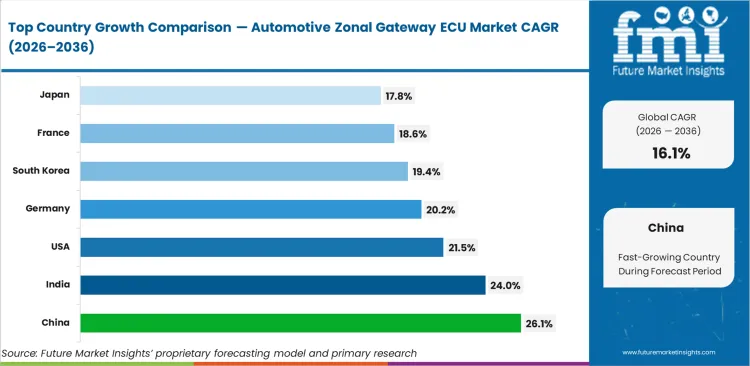
Geographically, the China’s automotive zonal gateway ECU sector is poised to accelerate at a predicted 26.1% as domestic electric vehicle manufacturers bypass legacy architectures entirely. India set to expand at an anticipated 24.0% driven by rapid modernization of domestic automotive platforms. United States is likely to advance at an estimated 21.5% alongside heavy investment in software defined vehicle initiatives. Germany’s industry footprint set to progress at an expected 20.2% while premium automakers restructure supplier ecosystems. South Korea poised to grow at an estimated 19.4% supporting high-volume integration. France is anticipated to post a predicted 18.6% as regional production shifts toward electrification. Japan is likely to register a projected 17.8% relying on cautious incremental hybrid rollouts. Divergence heavily favors regions unburdened by legacy combustion-engine supply chains.
Segmental Analysis
Automotive Zonal Gateway ECU Market Analysis by Architecture
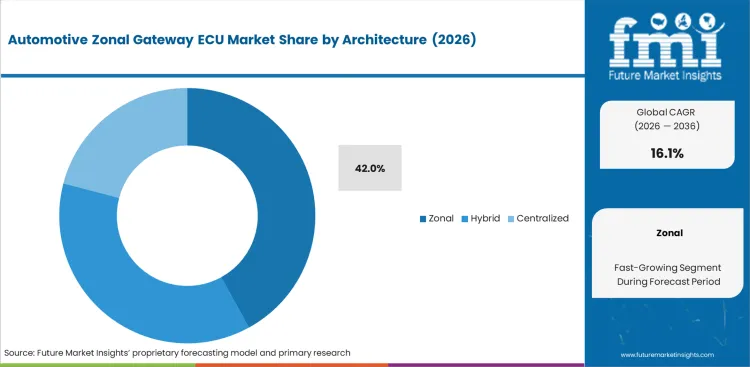
Old wiring designs are no longer well suited to the data load created by modern safety cameras and sensors. Grouping computer parts by their physical location inside the vehicle solves this issue and defines the core logic behind zonal E/E architecture. As this organizational shift is expected to reduce vehicle weight and support electric driving efficiency, the Zonal segment is estimated to account for 42.0% share in 2026. Car manufacturers adopting this structure are also reworking sourcing priorities toward hardware platforms built for higher computing integration.
- Supplier Ecosystem Disruption: Physical localization is forcing suppliers to combine capabilities such as body control and braking into unified hardware modules. Component manufacturers without cross-domain capability are likely to face rising competitive pressure as integration requirements become more demanding.
- Wiring Harness Elimination: Aggregating regional data allows automakers to replace large bundles of copper wiring with a more centralized in-vehicle Ethernet system. This shift is expected to create packaging flexibility while reducing weight across the vehicle architecture.
- Validation Complexity: Centralized logic increases the need to separate safety-critical functions from comfort features within shared processors. Automakers are therefore expected to invest more heavily in hypervisor technologies to support stable system partitioning and reliable vehicle performance.
Automotive Zonal Gateway ECU Market Analysis by Vehicle Type
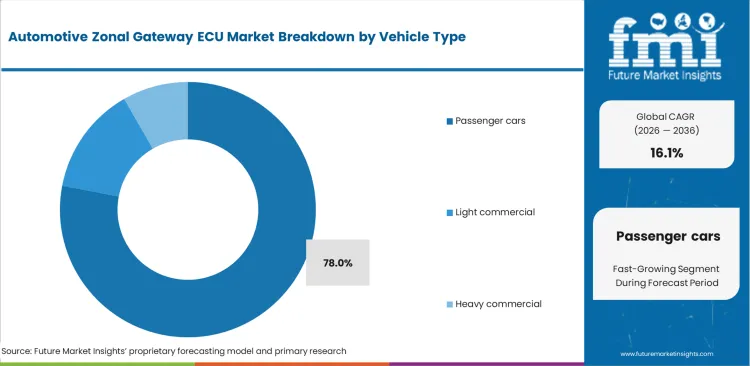
Automakers usually introduce costly new electronic hardware through high-volume passenger vehicle programs, where scale improves cost recovery and supports faster rollout. Consumer demand for larger digital interfaces, connected features, and advanced driver assistance functions continues to raise the electronic content per vehicle. A centralized computer hub helps manufacturers use the same physical architecture across multiple models while differentiating features through software. Supported by this shift toward upgradeable vehicle electronics, the passenger cars category is estimated to account for 78.0% share in 2026 as mass-market vehicles move further toward software-defined operation.
- Consumer Feature Deployment: High-bandwidth data routing supports stable performance for infotainment, connectivity, and active safety functions across passenger vehicles. Manufacturers are also expected to strengthen lifecycle monetization by enabling software-based feature upgrades over the ownership period.
- Platform Standardization: Similar gateway hardware can be deployed across different passenger vehicle classes, which helps reduce hardware redesign across model programs. Product differentiation increasingly shifts toward software configuration, interface tuning, and feature access rather than major physical changes.
- Lifespan Extension: Separating sensing hardware from core processing logic can improve platform relevance over a longer vehicle life. This architecture allows passenger vehicles to receive added functions and system improvements after the initial sale, which supports longer usable value from the same electronic base.
Automotive Zonal Gateway ECU Market Analysis by Network
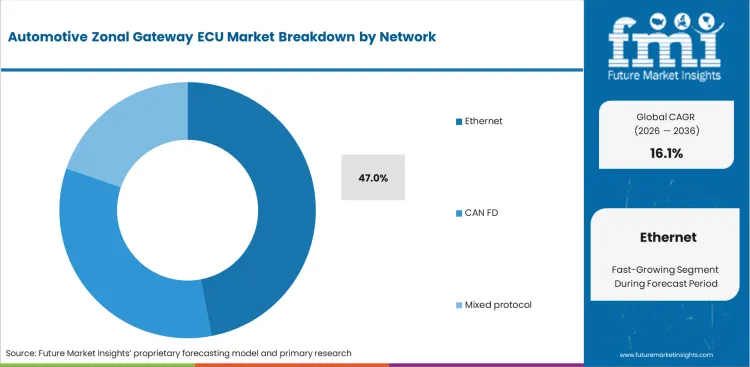
Serving as the mandatory backbone for cross-vehicle data transit, the ethernet segment is estimated to account for a forecasted 47.0% share in 2026 to support heavy multimedia loads. Standard car wiring protocols crash completely when trying to move raw, uncompressed video feeds from multiple safety cameras at once. Upgrading to an in-vehicle ethernet system fundamentally changes how a car operates and forces mechanics to use standard IT tools instead of old-school diagnostic scanners. Relying on older wiring physically prevents a vehicle from reaching higher levels of self-driving capability.
- Backbone Data Transit: Gigabit speeds allow uncompressed high-resolution video streams to travel instantaneously from edge sensors to central compute cores. Safety systems execute collision avoidance maneuvers without dangerous latency.
- Security Protocol Implementation: Standard IT security measures become natively applicable to vehicle networks. Cybersecurity engineers implement robust firewalls within gateways to prevent malicious external commands reaching critical steering functions.
- Diagnostic Overhaul: Service centers must upgrade diagnostic equipment to interface directly with IP-based networks. Technicians face steep learning curves transitioning from voltage-based troubleshooting to packet analysis.
Automotive Zonal Gateway ECU Market Analysis by Integration
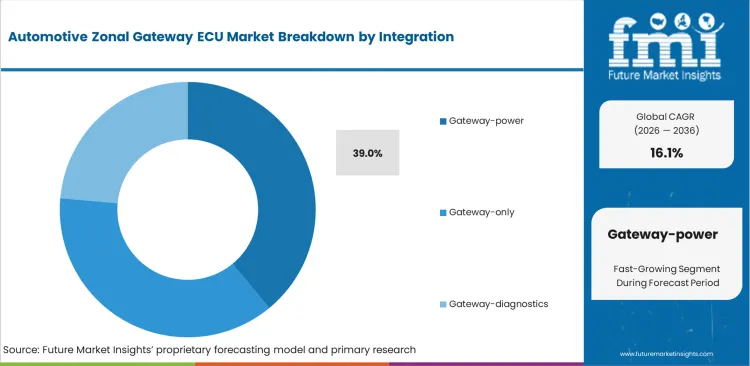
Merging data routing with electrical power distribution solves a major space problem inside the vehicle cabin. Car interior designers desperately want to eliminate bulky, traditional fuse boxes to free up legroom and storage space. Finding room for redundant wiring is incredibly difficult, which is why the Gateway-power segment is forecast to command a projected 39.0% share in 2026 as automakers replace physical fuses with smart digital switches. Pushing high-voltage electricity right next to sensitive computer chips creates intense heat, forcing engineers to invent entirely new cooling strategies just to keep these combined hubs running safely.
- Smart Fuse Replacement: Silicon-based power switching replaces melting physical fuses entirely. Drivers reset minor electrical faults through central infotainment screens without visiting mechanics.
- Space Reclamation: Eliminating traditional relay boxes frees up significant interior volume. Automotive interior designers utilize reclaimed space to improve cabin ergonomics and storage capacity.
- Thermal Management: Proximity of high-current power traces to delicate computing silicon generates localized heat spikes. Hardware engineers must design advanced aluminum enclosures to prevent thermal throttling during heavy electrical loads.
Automotive Zonal Gateway ECU Market Analysis by Sales Channel
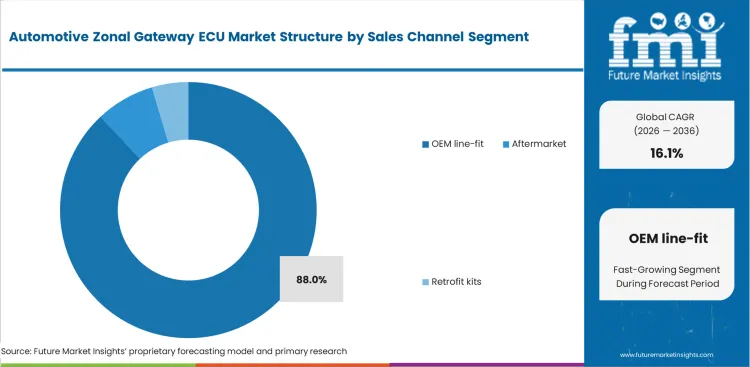
Core wiring networks must be laid down on the bare metal chassis before the rest of the car is actually built. Factories use these simplified wiring hubs to speed up the assembly line and push vehicles out the door faster. Independent mechanic shops cannot easily rip apart an older car to install a centralized car OS system later. As these organizational changes are permanent once the car leaves the factory, OEM line-fit is set to represent an expected 88.0% of market share in 2026 as the undisputed primary sales channel.
- Assembly Line Sequencing: Installing primary communication backbones occurs immediately after chassis welding. Producers rely on simplified zonal wiring to drastically accelerate factory throughput.
- Warranty Security: Core network hardware remains strictly sealed and authenticated by manufacturers. Unauthorized third-party modifications get automatically rejected by central security protocols.
- Lifecycle Software Control: Factory-installed gateways serve as exclusive gatekeepers for all vehicle updates. Automakers maintain absolute control over digital ecosystems, preventing unverified code from executing.
Automotive Zonal Gateway ECU Market Drivers, Restraints, and Opportunities
Modern vehicles depend on software coordination across safety, connectivity, and control functions at a level older electronic layouts were not built to support. Automakers are finding it harder to manage dozens of stand-alone control units across the vehicle, especially as new safety features and camera-based systems keep raising data traffic and validation demands. Legacy wiring structures add weight, increase integration complexity, and make software troubleshooting more difficult once new functions are layered onto old module designs. Zonal gateways offer a more workable structure by separating where sensors sit from where processing takes place. Data from each section of the vehicle can be routed through a local gateway and sent back to a central compute system, which helps simplify network design and improves software coordination across the platform. This approach also gives manufacturers a cleaner path to consolidate processing power without creating the same level of system conflict seen in older distributed layouts. Slower adoption of this model can leave automakers carrying more software integration burden, more update complexity, and a higher risk of post-launch correction work.
Fragmentation across the traditional automotive supply chain continues to slow progress toward zonal architectures. Many established suppliers still specialize in narrow functions such as braking, steering, or climate control, while zonal systems require hardware that can support multiple domains within a shared electronic structure. Meeting this requirement calls for stronger cross-domain engineering, tighter software integration, and broader system-level validation capability. Suppliers built around single-function modules may struggle to adjust quickly to this shift. Automakers are therefore taking a larger role in architecture design and integration control as they push these platforms forward. That shift increases development responsibility inside the vehicle manufacturer and adds execution pressure during the transition period. Adoption is likely to move ahead in stages until the supplier base becomes better equipped to support multi-function hardware and centralized software environments.
- Integrated Silicon Design: Semiconductor designers are embedding secure ethernet connections directly into smart power switches. Automakers use these new chips to shrink the physical size of the module while managing heat much more effectively.
- Diagnostic Software Subscriptions: Technology firms build cloud-based analytics platforms that connect straight into the vehicle gateways. Fleet owners buy these software subscriptions to predict exactly when a specific component will fail before a commercial vehicle breaks down on the road.
- Automated Network Validation: Engineering companies are creating specialized testing tools to verify that these high-speed networks function correctly. Vehicle makers rely heavily on these automotive ethernet and SDV network conformance test solutions to cut down development time and ensure different hardware parts communicate safely.
Regional Analysis
Based on regional analysis, automotive zonal gateway ECU market is segmented into North America, Latin America, Western Europe, Eastern Europe, Asia-Pacific, and Middle East & Africa across 40 plus countries. Automakers across different parts of the world are moving away from old wiring systems at completely different speeds. Regions building electric vehicles from scratch adopt advanced computer hubs much faster than areas tied to traditional gas-engine factories.
.webp "Top Country Growth Comparison Automotive Zonal Gateway Ecu Market Cagr (2026 2036)")
| Country | CAGR (2026 to 2036) |
|---|---|
| China | 26.1% |
| India | 24.0% |
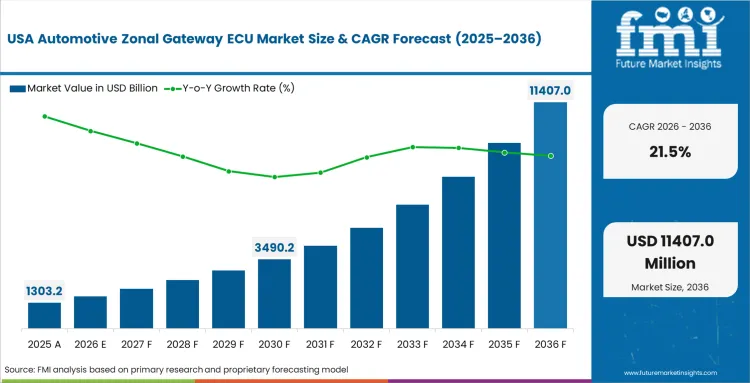
| United States | 21.5% |
| Germany | 20.2% |
| South Korea | 19.4% |
| France | 18.6% |
| Japan | 17.8% |
Source: Future Market Insights (FMI) analysis, based on proprietary forecasting model and primary research
Asia-Pacific Automotive Zonal Gateway ECU Market Analysis
Clean-sheet electric vehicle production allows domestic manufacturers in Asia to bypass old electrical designs entirely and push toward software defined vehicle platforms. Regional automakers operate without the massive sunk costs tied to legacy combustion-engine factories, giving them a huge advantage in deploying centralized computing.
- China: Chinese car brands treat centralized computer setups as a standard feature rather than an expensive upgrade. As they push out new car designs in half the normal time, demand for automotive zonal gateways in the country is anticipated to rise at an expected CAGR of 26.1% through 2036. This massive speed advantage comes directly from not having to adapt older gas-powered blueprints.
- India: Rapid upgrades to local car platforms force automakers in the country to find better ways to handle vehicle data. Suppliers are winning large contracts by offering simple, cost-effective computing hubs to these local factories, which is why India is poised to record steady growth in this sector at a projected CAGR of 24.0% through 2036. The country clearly favors practical, scalable technology over immediate high-end autonomy.
- South Korea: The country is projected to witness an estimated 19.4% CAGR in the zonal gateway market through 2036 as massive local brands shift their entire global lineups to centralized setups. Engineers here standardize the exact same computer box across many different types of cars. This shared approach keeps manufacturing costs low while supporting heavy electronics.
- Japan: Local engineers here prioritize absolute reliability, meaning they prefer to blend new computer hubs carefully with older systems. Such a cautious, step-by-step approach explains why Japan is likely to post a predicted CAGR of 17.8% in the zonal gateway space by 2036. They refuse to rush software changes if it risks breaking proven safety features.
FMI observes, Asia market supply chain rules strongly dictate exactly where these high-value parts get built. Countries that control their own battery and computer chip production are naturally taking the lead in changing how cars are wired.
North America & Latin America Automotive Zonal Gateway ECU Market Analysis
Heavy spending on self-driving technology completely shapes the hardware choices made in North American factories. Vehicle makers in this hemisphere desperately require high-bandwidth data systems to process massive sensor payloads safely. Regulatory pressures regarding vehicle emissions also indirectly push this shift forward, since stripping out heavy copper wiring significantly drops overall vehicle weight and extends electric range. Older car companies use this transition period to completely restructure their supplier relationships, explicitly favoring agile technology firms over traditional metal-bending parts makers.
- United States: Tech companies from California entering the car business are forcing older Detroit brands to rethink how they build electrical systems. As these legacy builders scramble to catch up and offer over-the-air updates, the United States zonal gateway ECU market is poised to expand at a CAGR of 21.5% through 2036. Carmakers desperately need this connected vehicle technology to handle the massive amounts of data coming from cameras and sensors safely.
FMI assesses, cross-border trade rules determine exactly where car brands choose to test and build these advanced electronic parts. As vehicle weight becomes a bigger issue for electric range, North American factories will keep stripping out heavy copper wires in favor of smart data hubs.
Western Europe & Eastern Europe Automotive Zonal Gateway ECU Market Analysis
Premium car brands dominate the push toward centralized vehicle computing across European assembly lines. Engineers in this region historically defined the global standards for automotive networking, and they continue to demand the rigorous safety certifications required for new computer hubs. Clear tension exists between strict regional data privacy laws and the inherent data-harvesting nature of modern vehicle platforms. Manufacturers must invest heavily in secure gateway firewalls to ensure compliance before these connected vehicles ever hit public roads.
- Germany: Big local parts suppliers are trying hard to control this shift by selling closed-off, private computer systems. Automakers are fighting back and demanding open designs so they do not get trapped using just one supplier, a conflict that drives Germany to an expected CAGR of 20.2% during the study period. This battle over standard rules defines the entire German supply chain right now.
- France: The nation is anticipated to see adoption grow at a projected CAGR of 18.6% over the forecast period because local factories focus heavily on making everyday electric cars cheaper to build. Factory planners use centralized computer hubs to cut down on assembly time, which directly improves profits on lower-priced electric models. Simplifying the wiring makes mass production much easier.
FMI reports, finding enough software engineers remains the biggest hurdle for European carmakers trying to change their electrical designs. Strict privacy laws also force these companies to build incredibly strong firewalls into their vehicle networks before they can hit the road.
Competitive Aligners for Market Players
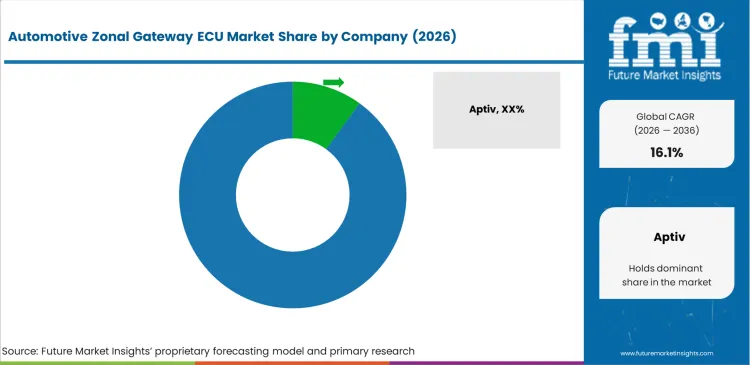
Shift toward centralized vehicle electronics is changing what automakers expect from zonal gateway suppliers. Vendors built around single-function hardware are finding it harder to stay relevant, since new gateway programs require broader integration across communication, routing, and software control. Automakers are placing more value on suppliers that can support multiple vehicle domains within one unit and validate stable data flow across different protocols. Competitive strength in this space now depends heavily on integration capability and dependable validation performance across complex electronic architectures.
Established suppliers still hold an edge where automotive qualification remains difficult and time intensive. Fast data routing alone is not enough, because gateway hardware must continue to perform under vibration, heat, and electromagnetic stress over long production cycles. Proven experience in safety validation, thermal management, and system durability still carries weight when manufacturers assess supplier capability. This keeps technically mature vendors in a stronger position as automakers move toward more centralized architectures.
Automakers are also trying to avoid dependence on closed gateway platforms. Open standards and modular system design give manufacturers more flexibility in how they source hardware, semiconductor content, and software layers across the vehicle architecture. That approach helps reduce lock-in risk and keeps supplier competition centered on compatibility, performance, and cost. Suppliers that support broader interoperability are therefore likely to remain better aligned with how vehicle electronics sourcing is evolving.
Key Players in Automotive Zonal Gateway ECU Market
- Aptiv
- Continental
- Bosch
- Marelli
- Infineon
Scope of the Report
| Metric | Value |
|---|---|
| Quantitative Units | USD 1.1 billion to USD 4.9 billion, at a CAGR of 16.1% |
| Market Definition | Automotive Zonal Gateway ECUs function as central data routers and power distributors within a specific physical zone of a vehicle. These modules aggregate inputs from localized sensors and actuators, converting diverse signals into high-speed payloads for transmission to central computing cores. |
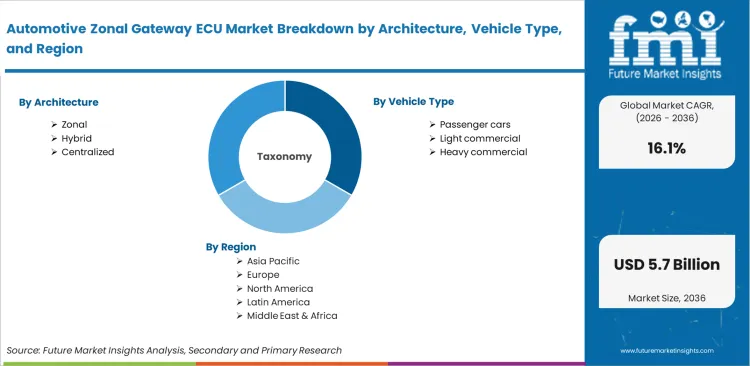
| Segmentation | Architecture, Vehicle Type, Network, Integration, Sales Channel, Region |
| Regions Covered | North America, Latin America, Western Europe, Eastern Europe, Asia-Pacific, Middle East & Africa |
| Countries Covered | China, India, United States, Germany, South Korea, France, Japan |
| Key Companies Profiled | Aptiv, Continental, Bosch, Marelli, Infineon |
| Forecast Period | 2026 to 2036 |
| Approach | OEM production volumes cross-referenced with architectural adoption rates for next-generation vehicle platforms. |
Source: Future Market Insights (FMI) analysis, based on proprietary forecasting model and primary research
Segments
Architecture:
- Zonal
- Hybrid
- Centralized
Vehicle Type:
- Passenger cars
- Light commercial
- Heavy commercial
Network:
- Ethernet
- CAN FD
- Mixed protocol
Integration:
- Gateway-only
- Gateway-power
- Gateway-diagnostics
Sales Channel:
- OEM line-fit
- Aftermarket
- Retrofit kits
Regions:
- Asia Pacific
- India
- China
- Japan
- South Korea
- Indonesia
- Australia
- New Zealand
- ASEAN
- Rest of Asia Pacific
- Europe
- Germany
- Italy
- France
- United Kingdom
- Spain
- Benelux
- Nordics
- Central & Eastern Europe
- Rest of Europe
- North America
- United States
- Canada
- Mexico
- Latin America
- Brazil
- Argentina
- Chile
- Rest of Latin America
- Middle East & Africa
- Kingdom of Saudi Arabia
- United Arab Emirates
- South Africa
- Turkey
- Rest of Middle East & Africa
Bibliography
- Wang, W., Guo, K., Cao, W., et al. (2024). Review of electrical and electronic architectures for autonomous vehicles: Topologies, networking and simulators. Automotive Innovation, 7, 82-101.
- Li, B., Zhu, Y., Liu, Q., & Yao, X. (2024). Development of deterministic communication for in-vehicle networks based on software-defined time-sensitive networking. Machines, 12(11), Article 816.
- Vehicle Certification Agency. (2024). Cyber security and software updating.
- International Organization for Standardization. (2024). ISO 24089:2023/Amd 1:2024 road vehicles, Software update engineering, Amendment 1.
- Anderson, T., Stevens, S., & Schäuffle, J. (2025). Rapidly evolving E/E architectures for ground vehicles: Insights from the commercial and automotive industries (SAE Technical Paper 2025-01-0446). SAE International.
- Guo, Z., Koufos, K., Dianati, M., & Woodman, R. (2025). State-of-the-art virtualisation technologies for the centralised automotive E/E architecture. Frontiers in Future Transportation, 6, Article 1519390.
This bibliography is provided for reader reference. The full FMI report contains the complete reference list with primary source documentation.
This Report Addresses
- Zonal architecture adoption rates impacting traditional distributed control unit manufacturing.
- High-speed ethernet deployment substituting legacy CAN FD protocols across vehicle segments.
- Gateway-power integration metrics eliminating conventional automotive fuse boxes entirely.
- OEM line-fit penetration representing organizational hurdles for aftermarket retrofit suppliers.
- Cross-domain hardware convergence forcing tier-1 suppliers to restructure engineering divisions.
- China's rapid electric vehicle development bypassing legacy electrical topologies completely.
- Silicon integration challenges concerning thermal management near sensitive processing cores.
- Standardized diagnostic protocol shifts requiring service centers to upgrade networking tools.
Frequently Asked Questions
What is a zonal gateway ECU in a car?
These devices serve as localized data aggregators and routers, significantly reducing physical wiring by sending compiled sensor data over high-speed networks to central computers.
How large is the automotive zonal gateway ECU market?
Demand is projected to reach USD 4.9 billion by 2036 as automakers aggressively consolidate distributed networks.
What is the CAGR of the zonal gateway ECU market through 2036?
Sales are expected to register a projected CAGR of 16.1% from 2026 to 2036.
Which architecture segment holds dominant position?
Zonal configurations are anticipated to capture an estimated 42.0% share in 2026.
Why are automakers shifting from distributed ECUs to zonal gateways?
They fundamentally eliminate heavy wiring harnesses by decoupling physical sensor locations from central processing logic.
What drives adoption of ethernet networks?
Gigabit speeds are absolutely mandatory for routing uncompressed video streams from advanced driver assistance systems without dangerous latency.
Why do gateway-power units capture significant share?
Replacing physical fuses with smart silicon switches allows automotive designers to reclaim significant interior cabin space.
What structural friction slows widespread zonal implementation?
Incumbent tier-1 suppliers struggle building cross-domain hardware because engineers remain siloed into legacy functional divisions.
How is a zonal gateway ECU different from a domain controller?
While domain controllers manage specific vehicle functions like infotainment logically, zonal gateways physically aggregate all regional data regardless of function.
Why does China lead regional growth?
Domestic manufacturers utilize clean-sheet electric vehicle designs bypassing legacy combustion-engine wiring constraints entirely.
What structural difference exists between China and Japan's approach?
While Chinese OEMs deploy native zonal designs for rapid software iteration, Japanese engineers rely on optimized hybrid networks ensuring absolute reliability.
How does OEM line-fit dominate sales channels?
Core network routing hardware must be integrated directly into bare chassis during initial factory assembly.
Can zonal gateways be retrofitted into older vehicles?
Physical wiring harnesses dictate network topology, making aftermarket centralized compute retrofits practically impossible.
Which vehicle segment is adopting zonal gateway ECUs first?
Passenger cars lead adoption because intense consumer demand for digital cockpit features justifies the massive initial engineering investment required.
How do zonal gateways alter vehicle diagnostics?
Service technicians must abandon legacy voltage-based troubleshooting and utilize IT-standard packet analysis tools.
What are the main cost and validation challenges in zonal gateway ECU sourcing?
Routing high-current power traces immediately adjacent to delicate computing silicon forces designers to invent advanced aluminum heat sinks and run massive validation matrices.
How do automakers prevent vendor lock-in?
Large OEMs mandate strict adherence to open networking standards, ensuring physical gateway hardware remains interoperable with diverse computing silicon.
Why are traditional fuse boxes disappearing?
Silicon-based power switching allows drivers to reset minor electrical faults digitally through central infotainment interfaces.
What impact do software-defined vehicles have on gateways?
Native software platforms require domain-agnostic computing configurations executing over-the-air updates seamlessly.
Why do commercial vehicles trail passenger cars in adoption?
Differing lifecycle economics and standardized fleet requirements delay immediate need for high-bandwidth multimedia routing.
How does ethernet implementation affect vehicle cybersecurity?
Standard IT security measures and robust firewalls become natively applicable within central gateways blocking malicious external commands.
Who are the top companies in zonal gateway ECU?
Incumbent tier-1 giants like Aptiv, Continental, Bosch, and Marelli lead production due to their massive institutional knowledge regarding automotive-grade safety certifications.
Which countries are adopting zonal gateway architecture the fastest?
China, India, and the United States lead global implementation driven by software-defined vehicle investments and clean-sheet EV platform rollouts.
What forces semiconductor designers to adapt?
Designers face intense pressure integrating secure routing capabilities directly into high-current power switching silicon to reduce module size.
Preview the report firsthand - request a free sample
Get SampleGet the brochure for pricing and purchase details.
Get PDFTable of Content
- Executive Summary
- Global Market Outlook
- Demand-side Trends
- Supply-side Trends
- Technology Roadmap Analysis
- Analysis and Recommendations
- Market Overview
- Market Coverage / Taxonomy
- Market Definition / Scope / Limitations
- Research Methodology
- Chapter Orientation
- Analytical Lens and Working Hypotheses
- Market Structure, Signals, and Trend Drivers
- Benchmarking and Cross-market Comparability
- Market Sizing, Forecasting, and Opportunity Mapping
- Research Design and Evidence Framework
- Desk Research Programme (Secondary Evidence)
- Company Annual and Sustainability Reports
- Peer-reviewed Journals and Academic Literature
- Corporate Websites, Product Literature, and Technical Notes
- Earnings Decks and Investor Briefings
- Statutory Filings and Regulatory Disclosures
- Technical White Papers and Standards Notes
- Trade Journals, Industry Magazines, and Analyst Briefs
- Conference Proceedings, Webinars, and Seminar Materials
- Government Statistics Portals and Public Data Releases
- Press Releases and Reputable Media Coverage
- Specialist Newsletters and Curated Briefings
- Sector Databases and Reference Repositories
- FMI Internal Proprietary Databases and Historical Market Datasets
- Subscription Datasets and Paid Sources
- Social Channels, Communities, and Digital Listening Inputs
- Additional Desk Sources
- Expert Input and Fieldwork (Primary Evidence)
- Primary Modes
- Qualitative Interviews and Expert Elicitation
- Quantitative Surveys and Structured Data Capture
- Blended Approach
- Why Primary Evidence is Used
- Field Techniques
- Interviews
- Surveys
- Focus Groups
- Observational and In-context Research
- Social and Community Interactions
- Stakeholder Universe Engaged
- C-suite Leaders
- Board Members
- Presidents and Vice Presidents
- R&D and Innovation Heads
- Technical Specialists
- Domain Subject-matter Experts
- Scientists
- Physicians and Other Healthcare Professionals
- Governance, Ethics, and Data Stewardship
- Research Ethics
- Data Integrity and Handling
- Primary Modes
- Tooling, Models, and Reference Databases
- Desk Research Programme (Secondary Evidence)
- Data Engineering and Model Build
- Data Acquisition and Ingestion
- Cleaning, Normalisation, and Verification
- Synthesis, Triangulation, and Analysis
- Quality Assurance and Audit Trail
- Market Background
- Market Dynamics
- Drivers
- Restraints
- Opportunity
- Trends
- Scenario Forecast
- Demand in Optimistic Scenario
- Demand in Likely Scenario
- Demand in Conservative Scenario
- Opportunity Map Analysis
- Product Life Cycle Analysis
- Supply Chain Analysis
- Investment Feasibility Matrix
- Value Chain Analysis
- PESTLE and Porter’s Analysis
- Regulatory Landscape
- Regional Parent Market Outlook
- Production and Consumption Statistics
- Import and Export Statistics
- Market Dynamics
- Global Market Analysis 2021 to 2025 and Forecast, 2026 to 2036
- Historical Market Size Value (USD Million) Analysis, 2021 to 2025
- Current and Future Market Size Value (USD Million) Projections, 2026 to 2036
- Y-o-Y Growth Trend Analysis
- Absolute $ Opportunity Analysis
- Global Market Pricing Analysis 2021 to 2025 and Forecast 2026 to 2036
- Global Market Analysis 2021 to 2025 and Forecast 2026 to 2036, By Architecture
- Introduction / Key Findings
- Historical Market Size Value (USD Million) Analysis By Architecture , 2021 to 2025
- Current and Future Market Size Value (USD Million) Analysis and Forecast By Architecture , 2026 to 2036
- Zonal
- Hybrid
- Centralized
- Zonal
- Y-o-Y Growth Trend Analysis By Architecture , 2021 to 2025
- Absolute $ Opportunity Analysis By Architecture , 2026 to 2036
- Global Market Analysis 2021 to 2025 and Forecast 2026 to 2036, By Vehicle Type
- Introduction / Key Findings
- Historical Market Size Value (USD Million) Analysis By Vehicle Type, 2021 to 2025
- Current and Future Market Size Value (USD Million) Analysis and Forecast By Vehicle Type, 2026 to 2036
- Passenger cars
- Light commercial
- Heavy commercial
- Passenger cars
- Y-o-Y Growth Trend Analysis By Vehicle Type, 2021 to 2025
- Absolute $ Opportunity Analysis By Vehicle Type, 2026 to 2036
- Global Market Analysis 2021 to 2025 and Forecast 2026 to 2036, By Network
- Introduction / Key Findings
- Historical Market Size Value (USD Million) Analysis By Network, 2021 to 2025
- Current and Future Market Size Value (USD Million) Analysis and Forecast By Network, 2026 to 2036
- Ethernet
- CAN FD
- Mixed protocol
- Ethernet
- Y-o-Y Growth Trend Analysis By Network, 2021 to 2025
- Absolute $ Opportunity Analysis By Network, 2026 to 2036
- Global Market Analysis 2021 to 2025 and Forecast 2026 to 2036, By Integration
- Introduction / Key Findings
- Historical Market Size Value (USD Million) Analysis By Integration, 2021 to 2025
- Current and Future Market Size Value (USD Million) Analysis and Forecast By Integration, 2026 to 2036
- Gateway-power
- Gateway-only
- Gateway-diagnostics
- Gateway-power
- Y-o-Y Growth Trend Analysis By Integration, 2021 to 2025
- Absolute $ Opportunity Analysis By Integration, 2026 to 2036
- Global Market Analysis 2021 to 2025 and Forecast 2026 to 2036, By Sales Channel
- Introduction / Key Findings
- Historical Market Size Value (USD Million) Analysis By Sales Channel, 2021 to 2025
- Current and Future Market Size Value (USD Million) Analysis and Forecast By Sales Channel, 2026 to 2036
- OEM line-fit
- Aftermarket
- Retrofit kits
- OEM line-fit
- Y-o-Y Growth Trend Analysis By Sales Channel, 2021 to 2025
- Absolute $ Opportunity Analysis By Sales Channel, 2026 to 2036
- Global Market Analysis 2021 to 2025 and Forecast 2026 to 2036, By Region
- Introduction
- Historical Market Size Value (USD Million) Analysis By Region, 2021 to 2025
- Current Market Size Value (USD Million) Analysis and Forecast By Region, 2026 to 2036
- North America
- Latin America
- Western Europe
- Eastern Europe
- East Asia
- South Asia and Pacific
- Middle East & Africa
- Market Attractiveness Analysis By Region
- North America Market Analysis 2021 to 2025 and Forecast 2026 to 2036, By Country
- Historical Market Size Value (USD Million) Trend Analysis By Market Taxonomy, 2021 to 2025
- Market Size Value (USD Million) Forecast By Market Taxonomy, 2026 to 2036
- By Country
- USA
- Canada
- Mexico
- By Architecture
- By Vehicle Type
- By Network
- By Integration
- By Sales Channel
- By Country
- Market Attractiveness Analysis
- By Country
- By Architecture
- By Vehicle Type
- By Network
- By Integration
- By Sales Channel
- Key Takeaways
- Latin America Market Analysis 2021 to 2025 and Forecast 2026 to 2036, By Country
- Historical Market Size Value (USD Million) Trend Analysis By Market Taxonomy, 2021 to 2025
- Market Size Value (USD Million) Forecast By Market Taxonomy, 2026 to 2036
- By Country
- Brazil
- Chile
- Rest of Latin America
- By Architecture
- By Vehicle Type
- By Network
- By Integration
- By Sales Channel
- By Country
- Market Attractiveness Analysis
- By Country
- By Architecture
- By Vehicle Type
- By Network
- By Integration
- By Sales Channel
- Key Takeaways
- Western Europe Market Analysis 2021 to 2025 and Forecast 2026 to 2036, By Country
- Historical Market Size Value (USD Million) Trend Analysis By Market Taxonomy, 2021 to 2025
- Market Size Value (USD Million) Forecast By Market Taxonomy, 2026 to 2036
- By Country
- Germany
- UK
- Italy
- Spain
- France
- Nordic
- BENELUX
- Rest of Western Europe
- By Architecture
- By Vehicle Type
- By Network
- By Integration
- By Sales Channel
- By Country
- Market Attractiveness Analysis
- By Country
- By Architecture
- By Vehicle Type
- By Network
- By Integration
- By Sales Channel
- Key Takeaways
- Eastern Europe Market Analysis 2021 to 2025 and Forecast 2026 to 2036, By Country
- Historical Market Size Value (USD Million) Trend Analysis By Market Taxonomy, 2021 to 2025
- Market Size Value (USD Million) Forecast By Market Taxonomy, 2026 to 2036
- By Country
- Russia
- Poland
- Hungary
- Balkan & Baltic
- Rest of Eastern Europe
- By Architecture
- By Vehicle Type
- By Network
- By Integration
- By Sales Channel
- By Country
- Market Attractiveness Analysis
- By Country
- By Architecture
- By Vehicle Type
- By Network
- By Integration
- By Sales Channel
- Key Takeaways
- East Asia Market Analysis 2021 to 2025 and Forecast 2026 to 2036, By Country
- Historical Market Size Value (USD Million) Trend Analysis By Market Taxonomy, 2021 to 2025
- Market Size Value (USD Million) Forecast By Market Taxonomy, 2026 to 2036
- By Country
- China
- Japan
- South Korea
- By Architecture
- By Vehicle Type
- By Network
- By Integration
- By Sales Channel
- By Country
- Market Attractiveness Analysis
- By Country
- By Architecture
- By Vehicle Type
- By Network
- By Integration
- By Sales Channel
- Key Takeaways
- South Asia and Pacific Market Analysis 2021 to 2025 and Forecast 2026 to 2036, By Country
- Historical Market Size Value (USD Million) Trend Analysis By Market Taxonomy, 2021 to 2025
- Market Size Value (USD Million) Forecast By Market Taxonomy, 2026 to 2036
- By Country
- India
- ASEAN
- Australia & New Zealand
- Rest of South Asia and Pacific
- By Architecture
- By Vehicle Type
- By Network
- By Integration
- By Sales Channel
- By Country
- Market Attractiveness Analysis
- By Country
- By Architecture
- By Vehicle Type
- By Network
- By Integration
- By Sales Channel
- Key Takeaways
- Middle East & Africa Market Analysis 2021 to 2025 and Forecast 2026 to 2036, By Country
- Historical Market Size Value (USD Million) Trend Analysis By Market Taxonomy, 2021 to 2025
- Market Size Value (USD Million) Forecast By Market Taxonomy, 2026 to 2036
- By Country
- Kingdom of Saudi Arabia
- Other GCC Countries
- Turkiye
- South Africa
- Other African Union
- Rest of Middle East & Africa
- By Architecture
- By Vehicle Type
- By Network
- By Integration
- By Sales Channel
- By Country
- Market Attractiveness Analysis
- By Country
- By Architecture
- By Vehicle Type
- By Network
- By Integration
- By Sales Channel
- Key Takeaways
- Key Countries Market Analysis
- USA
- Pricing Analysis
- Market Share Analysis, 2025
- By Architecture
- By Vehicle Type
- By Network
- By Integration
- By Sales Channel
- Canada
- Pricing Analysis
- Market Share Analysis, 2025
- By Architecture
- By Vehicle Type
- By Network
- By Integration
- By Sales Channel
- Mexico
- Pricing Analysis
- Market Share Analysis, 2025
- By Architecture
- By Vehicle Type
- By Network
- By Integration
- By Sales Channel
- Brazil
- Pricing Analysis
- Market Share Analysis, 2025
- By Architecture
- By Vehicle Type
- By Network
- By Integration
- By Sales Channel
- Chile
- Pricing Analysis
- Market Share Analysis, 2025
- By Architecture
- By Vehicle Type
- By Network
- By Integration
- By Sales Channel
- Germany
- Pricing Analysis
- Market Share Analysis, 2025
- By Architecture
- By Vehicle Type
- By Network
- By Integration
- By Sales Channel
- UK
- Pricing Analysis
- Market Share Analysis, 2025
- By Architecture
- By Vehicle Type
- By Network
- By Integration
- By Sales Channel
- Italy
- Pricing Analysis
- Market Share Analysis, 2025
- By Architecture
- By Vehicle Type
- By Network
- By Integration
- By Sales Channel
- Spain
- Pricing Analysis
- Market Share Analysis, 2025
- By Architecture
- By Vehicle Type
- By Network
- By Integration
- By Sales Channel
- France
- Pricing Analysis
- Market Share Analysis, 2025
- By Architecture
- By Vehicle Type
- By Network
- By Integration
- By Sales Channel
- India
- Pricing Analysis
- Market Share Analysis, 2025
- By Architecture
- By Vehicle Type
- By Network
- By Integration
- By Sales Channel
- ASEAN
- Pricing Analysis
- Market Share Analysis, 2025
- By Architecture
- By Vehicle Type
- By Network
- By Integration
- By Sales Channel
- Australia & New Zealand
- Pricing Analysis
- Market Share Analysis, 2025
- By Architecture
- By Vehicle Type
- By Network
- By Integration
- By Sales Channel
- China
- Pricing Analysis
- Market Share Analysis, 2025
- By Architecture
- By Vehicle Type
- By Network
- By Integration
- By Sales Channel
- Japan
- Pricing Analysis
- Market Share Analysis, 2025
- By Architecture
- By Vehicle Type
- By Network
- By Integration
- By Sales Channel
- South Korea
- Pricing Analysis
- Market Share Analysis, 2025
- By Architecture
- By Vehicle Type
- By Network
- By Integration
- By Sales Channel
- Russia
- Pricing Analysis
- Market Share Analysis, 2025
- By Architecture
- By Vehicle Type
- By Network
- By Integration
- By Sales Channel
- Poland
- Pricing Analysis
- Market Share Analysis, 2025
- By Architecture
- By Vehicle Type
- By Network
- By Integration
- By Sales Channel
- Hungary
- Pricing Analysis
- Market Share Analysis, 2025
- By Architecture
- By Vehicle Type
- By Network
- By Integration
- By Sales Channel
- Kingdom of Saudi Arabia
- Pricing Analysis
- Market Share Analysis, 2025
- By Architecture
- By Vehicle Type
- By Network
- By Integration
- By Sales Channel
- Turkiye
- Pricing Analysis
- Market Share Analysis, 2025
- By Architecture
- By Vehicle Type
- By Network
- By Integration
- By Sales Channel
- South Africa
- Pricing Analysis
- Market Share Analysis, 2025
- By Architecture
- By Vehicle Type
- By Network
- By Integration
- By Sales Channel
- USA
- Market Structure Analysis
- Competition Dashboard
- Competition Benchmarking
- Market Share Analysis of Top Players
- By Regional
- By Architecture
- By Vehicle Type
- By Network
- By Integration
- By Sales Channel
- Competition Analysis
- Competition Deep Dive
- Aptiv
- Overview
- Product Portfolio
- Profitability by Market Segments (Product/Age /Sales Channel/Region)
- Sales Footprint
- Strategy Overview
- Marketing Strategy
- Product Strategy
- Channel Strategy
- Continental
- Bosch
- Marelli
- Infineon
- Aptiv
- Competition Deep Dive
- Assumptions & Acronyms Used


