

- Industry Size (2026)
- USD 501.8 Mn
- Forecast (2036)
- USD 1198.9 Mn
- CAGR (2026 to 2036)
- 9.10%
Automotive OTA Cybersecurity Stress Test Equipment Market Forecast and Outlook 2026 to 2036
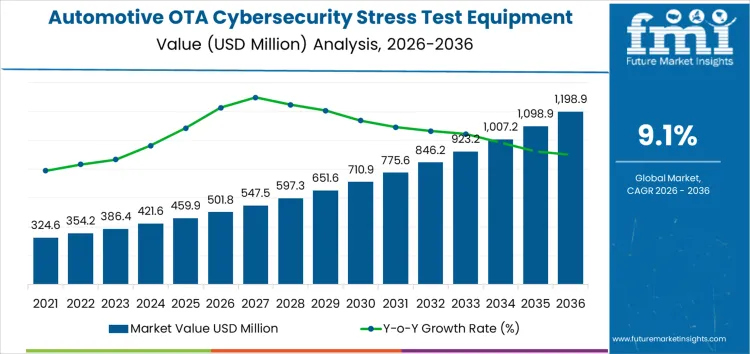
The automotive OTA cybersecurity stress test equipment market is valued at USD 501.8 million in 2026 and is expected to reach USD 1,198.9 Million by 2036, growing at a CAGR of 9.10%. This market has become strategically important within the automotive industry as connected vehicles continue to evolve with over-the-air (OTA) updates, which create significant cybersecurity risks. Stress test equipment ensures that these updates can be delivered safely and securely, preventing unauthorized access and safeguarding sensitive data. As vehicles become more connected through advanced driver-assistance systems (ADAS), infotainment, and V2X communication, the reliance on secure OTA updates increases, thus amplifying the need for rigorous stress testing.
Quick Stats for Automotive OTA Cybersecurity Stress Test Equipment Market
- Automotive OTA Cybersecurity Stress Test Equipment Market Value (2026): USD 501.8 Million
- Automotive OTA Cybersecurity Stress Test Equipment Market Forecast Value (2036): USD 1,198.9 Million
- Automotive OTA Cybersecurity Stress Test Equipment Market Forecast CAGR (2026-2036): 9.10%
- Key Growth Regions in Automotive OTA Cybersecurity Stress Test Equipment Market: Asia Pacific
- Leading Delivery Model in Automotive OTA Cybersecurity Stress Test Equipment Market: Hardware Test Appliances
- Top Key Players in Automotive OTA Cybersecurity Stress Test Equipment Market: Keysight, Rohde & Schwarz, Anritsu, Spirent, VIAVI, Vector Informatik, Tektronix, National Instruments (NI), dSPACE, DEKRA
Control points like the ability to simulate complex cyberattacks, assess multi-layered vulnerabilities, and validate software resilience are crucial in shaping the outcomes of this market. The growing dependency on wireless networks for vehicle updates means that cybersecurity testing is now integral to maintaining vehicle integrity and consumer trust. Key strategic trade-offs are emerging, such as balancing the cost of high-fidelity testing solutions with the need for comprehensive security validation. As OEMs and Tier-1 suppliers face mounting regulatory pressures, the ability to integrate robust cybersecurity measures will dictate competitive success, making this market vital for the future of automotive technology.
Automotive OTA Cybersecurity Stress Test Equipment Market Key Takeaways
| Metric | Value |
|---|---|
| Industry Value (2026) | USD 501.8 Million |
| Forecast Value (2036) | USD 1,198.9 Million |
| Forecast CAGR (2026-2036) | 9.10% |
How is the Global Automotive OTA Cybersecurity Stress Test Equipment Market Advancing?
The global automotive OTA (Over-the-Air) cybersecurity stress test equipment market is growing as the automotive industry embraces connected vehicle technologies and the need for robust cybersecurity measures increases. With the growing reliance on OTA updates for vehicle software and systems, manufacturers are increasingly focused on ensuring that these remote updates do not expose vehicles to cyber threats. Stress test equipment is essential to simulate cyber-attacks and vulnerabilities during OTA update processes, ensuring that they are secure and can withstand potential security breaches. This demand is being driven by the need to protect sensitive data and prevent unauthorized access to vehicle systems.
As the complexity of connected vehicle systems increases, so do the risks associated with cybersecurity. The automotive industry is under heightened scrutiny to meet stringent security standards, particularly as data privacy and system integrity concerns grow. Stress test equipment designed to evaluate OTA updates is crucial in ensuring that vehicles' software is protected from cyber-attacks, hacking, and data leaks. The integration of AI and machine learning in cybersecurity stress testing is further enhancing the market, providing better insights into vulnerabilities and helping manufacturers improve the security and reliability of their vehicles' OTA systems.
What is the Segment-Wise Analysis for the Automotive OTA Cybersecurity Stress Test Equipment Market?
The automotive OTA cybersecurity stress test equipment market is segmented by delivery model and end user. Hardware test appliances lead the market with a 38% share, followed by software platforms, hybrid, and services. These delivery models are crucial for testing the cybersecurity resilience of over-the-air (OTA) systems in vehicles. In terms of end users, OEMs hold the largest share at 40%, driven by the need to ensure the security of OTA updates and connected vehicle systems.
Why Do Hardware Test Appliances Lead the Automotive OTA Cybersecurity Stress Test Equipment Market?
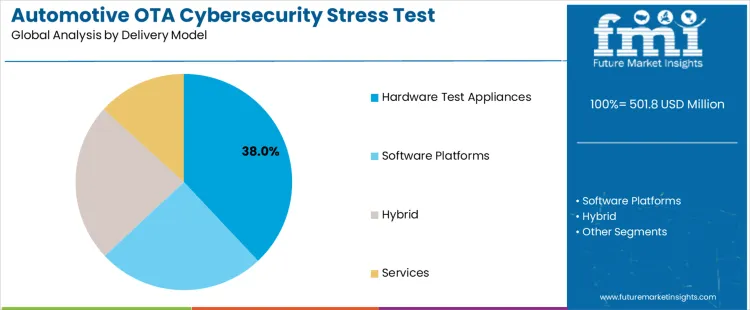
Hardware test appliances account for 38% of the automotive OTA cybersecurity stress test equipment market share, owing to their ability to simulate and assess various cybersecurity threats in a controlled environment. These appliances are essential for testing the resilience of vehicle systems against external and internal security risks, such as unauthorized access, data breaches, and OTA update vulnerabilities. Hardware-based testing provides a tangible approach to stress testing cybersecurity features, ensuring that vehicle systems can withstand real-world attacks. As automotive cybersecurity becomes increasingly vital, hardware test appliances continue to play a leading role in validating the security of connected and autonomous vehicle systems.
How Do OEMs Contribute to the Automotive OTA Cybersecurity Stress Test Equipment Market?
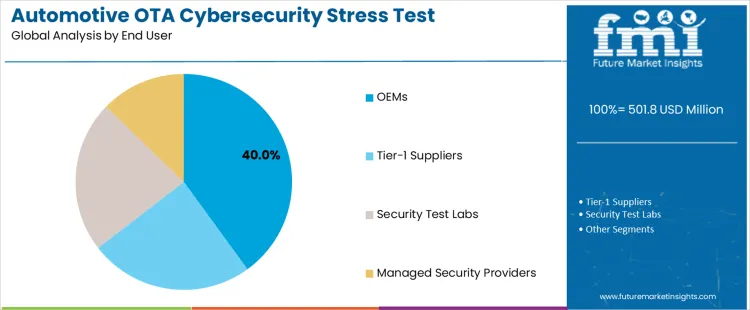
OEMs account for 40% of the automotive OTA cybersecurity stress test equipment market share, reflecting their critical role in the development and deployment of connected vehicle technologies. OEMs are responsible for integrating secure OTA systems in vehicles, and they require robust testing solutions to ensure the security and integrity of their vehicles' communication networks. These test systems help OEMs validate their systems against potential cyber threats and vulnerabilities, ensuring compliance with industry standards and consumer safety expectations. With the growing demand for connected vehicles and over-the-air updates, OEMs continue to drive the adoption of advanced cybersecurity testing solutions in the automotive industry.
What Are the Key Dynamics for the Automotive OTA Cybersecurity Stress Test Equipment Market?
The automotive OTA (Over‑the‑Air) cybersecurity stress test equipment market is shaped by the rapid growth of connected and software‑defined vehicles that rely on OTA updates for software patches, feature upgrades, and security fixes. As vehicles become more networked with telematics, V2X, infotainment, and ADAS modules-exposure to cyber threats increases. Stress test equipment is essential to simulate attack vectors, identify vulnerabilities, and validate that OTA update mechanisms are resilient against intrusion or manipulation.
How Are the Key Drivers Shaping the Automotive OTA Cybersecurity Stress Test Equipment Market?
Growth in this market is largely driven by automakers and suppliers prioritizing cybersecurity as a core aspect of vehicle safety and compliance. With the proliferation of OTA updates across vehicle ECUs and software components, manufacturers require automated stress test platforms that can evaluate update integrity under simulated cyberattack scenarios. Increasing government and industry regulations, such as guidelines for automotive cybersecurity management systems, compel OEMs and Tier‑1s to adopt advanced validation tools. Rising consumer awareness of vehicle security and high‑profile incidents of automotive hacking push stakeholders to invest in equipment that strengthens OTA resilience and protects brand trust.
Why Are There Restraints Impacting the Automotive OTA Cybersecurity Stress Test Equipment Market?
A major challenge is the high complexity and cost of developing sophisticated stress test equipment capable of replicating diverse cyber threat scenarios, multi‑vector attacks, and evolving malware profiles. Building comprehensive test environments that support numerous communications protocols, architectures, and vehicle platforms requires substantial investment. Another constraint is the shortage of cybersecurity specialists with automotive domain expertise to design, configure, and interpret advanced tests. Fragmented global cybersecurity standards and regulatory uncertainty in some regions further complicate test strategy alignment and slow broader adoption by smaller OEMs and suppliers.
What is the Growth Outlook for the Automotive OTA Cybersecurity Stress Test Equipment Market by Country?
| Country | CAGR (%) |
|---|---|
| China | 10.6% |
| Brazil | 9.9% |
| USA | 8.8% |
| Germany | 8.8% |
| UK | 8.7% |
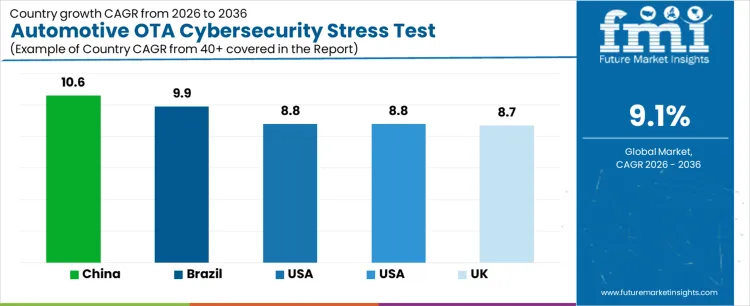
The automotive OTA cybersecurity stress test equipment market is experiencing strong growth, with China leading at a 10.6% CAGR, driven by rapid advancements in electric and autonomous vehicle technologies, and an increasing focus on secure OTA software updates. Brazil follows with 9.9%, fueled by the rise of connected vehicles and government initiatives supporting smart mobility. The USA’s market grows at 8.8%, supported by its strong automotive industry and growing adoption of electric and autonomous vehicles that require secure OTA updates. The UK’s market grows at 8.7%, driven by its emphasis on cybersecurity in connected vehicle technologies. Germany’s market also grows at 8.8%, supported by its automotive leadership and regulatory push for higher cybersecurity standards in vehicles.
What is Driving the Growth of the Automotive OTA Cybersecurity Stress Test Equipment Market in China?
China’s automotive OTA cybersecurity stress test equipment market is growing at 10.6%, driven by the rapid development of the country’s electric vehicle (EV) and autonomous vehicle sectors, coupled with increasing concerns over the cybersecurity of over-the-air (OTA) software updates. As Chinese automakers continue to embrace digitalization, connectivity, and autonomous driving technologies, the need for robust cybersecurity measures to protect OTA updates becomes critical. The country’s strong push toward smart cities and connected vehicles further accelerates the demand for stress test equipment to ensure secure software deployments. With the government’s commitment to innovation in the automotive industry and a focus on improving vehicle cybersecurity standards, the demand for advanced stress testing solutions continues to grow.
What is Contributing to the Growth of the Automotive OTA Cybersecurity Stress Test Equipment Market in Brazil?
Brazil’s automotive OTA cybersecurity stress test equipment market is growing at 9.9%, supported by the increasing adoption of connected vehicles and the government’s push for technological advancements in the automotive sector. As Brazilian automakers explore new technologies in electric and autonomous vehicles, ensuring the security of OTA software updates is becoming a top priority. With the rise of digital mobility solutions and the growing demand for smart vehicle features, the need for cybersecurity stress testing equipment is accelerating. Brazil’s focus on improving vehicle quality, along with its investments in smart city initiatives, further boosts the market for automotive cybersecurity solutions. As the automotive industry in Brazil continues to modernize, the demand for secure OTA testing platforms will continue to grow.
How is the Automotive OTA Cybersecurity Stress Test Equipment Market Expanding in the USA?
The USA’s automotive OTA cybersecurity stress test equipment market is growing at 8.8%, driven by the rapid development of connected vehicles, electric vehicles, and autonomous driving technologies. With increasing concerns over vehicle cybersecurity, especially regarding OTA updates, manufacturers and technology providers are investing heavily in stress test equipment to safeguard vehicles from potential cyber threats. The USA’s strong automotive industry, coupled with the growing adoption of digital technologies in vehicles, is a major driver for this market. The country’s regulatory push for higher cybersecurity standards in vehicles accelerates the need for robust testing solutions to ensure that OTA updates are secure and reliable. The USA’s focus on innovation and safety in the automotive sector continues to support market growth.
Why is the Automotive OTA Cybersecurity Stress Test Equipment Market Growing in the UK?
The UK’s automotive OTA cybersecurity stress test equipment market is growing at 8.7%, driven by the country’s emphasis on vehicle cybersecurity and the rise of connected vehicle technologies. With the increasing use of OTA software updates in vehicles, ensuring their security has become a priority for automakers. The UK government’s initiatives to promote smart mobility and ecological transportation solutions further contribute to the growing need for advanced cybersecurity testing solutions. As the UK transitions to electric and autonomous vehicles, the demand for robust stress test equipment to secure OTA updates becomes even more critical. The country’s strong automotive and tech sectors, coupled with a focus on vehicle security regulations, position the UK as a key market for automotive OTA cybersecurity solutions.
What is Driving the Growth of the Automotive OTA Cybersecurity Stress Test Equipment Market in Germany?
Germany’s automotive OTA cybersecurity stress test equipment market is growing at 8.8%, supported by the country’s leadership in the automotive industry and its focus on electric vehicles and autonomous technologies. As Germany’s automotive manufacturers increasingly integrate OTA capabilities into their vehicles, the need for robust cybersecurity measures to protect against vulnerabilities in these updates becomes crucial. With the rise of connected vehicles and the growing importance of digital mobility solutions, the demand for cybersecurity stress testing equipment is accelerating. Germany’s commitment to high automotive standards, coupled with its investment in future mobility technologies, continues to drive the growth of the automotive OTA cybersecurity test equipment market. Regulatory requirements for vehicle security also support the need for these advanced testing solutions.
How Do Key Players Compete in the Automotive OTA Cybersecurity Stress Test Equipment Market?
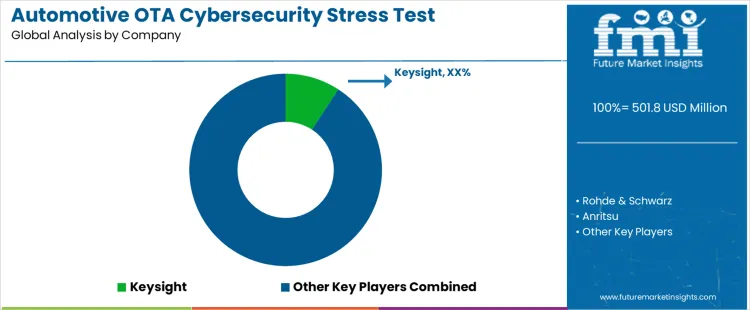
Competition in the automotive OTA (over the air) cybersecurity stress test equipment market centers on robust threat simulation, protocol coverage, integration with vehicle networks, and automated vulnerability assessment. Keysight leads with high performance cybersecurity test suites that simulate sophisticated attack vectors against OTA update channels and in vehicle networks, emphasizing real time analytics and actionable risk insights. Rohde & Schwarz competes with comprehensive RF and protocol stress tools that evaluate wireless update paths and encryption robustness under varied interference and load conditions.
Anritsu positions its equipment around network and wireless stress testing, focusing on cellular, Wi Fi, and V2X connectivity critical to OTA delivery. Its product materials highlight latency and resilience under attack conditions. Spirent and VIAVI differentiate through scalable, automation ready frameworks that emulate complex traffic loads and multi protocol environments, helping engineers assess how OTA systems behave under concurrent threat scenarios. Vector Informatik brings software centric test platforms that validate communication stacks and security logic across CAN, LIN, and Ethernet domains, enhancing integration with automotive ECUs.
Tektronix offers high resolution signal capture and analysis tools that help isolate anomalies introduced by stress tests. National Instruments (NI) and dSPACE add value with modular hardware software ecosystems that support synchronized data capture and custom stress scripting, enabling thorough exploration of edge conditions. DEKRA rounds out the field with independent security evaluation services and certification support, emphasizing compliance with global cybersecurity standards.
Key Players in Automotive OTA Cybersecurity Stress Test Equipment Market
- Keysight
- Rohde & Schwarz
- Anritsu
- Spirent
- VIAVI
- Vector Informatik
- Tektronix
- National Instruments (NI)
- dSPACE
- DEKRA
Scope of Report
| Items | Values |
|---|---|
| Quantitative Unit (2026) | USD million |
| Test Type | Intrusion Simulation (Network/ECU), Penetration or Red-Team Tooling, Fuzzing & Protocol Robustness, Compliance or Certification Testing |
| Delivery Model | Hardware Test Appliances, Software Platforms, Hybrid, Services |
| End User | OEMs, Tier-1 Suppliers, Security Test Labs, Managed Security Providers |
| Regions Covered | Asia Pacific, Europe, North America, Latin America, Middle East & Africa |
| Countries Covered | USA, China, Japan, South Korea, India, Australia & New Zealand, ASEAN, Germany, UK, France, Italy, Spain, Nordic, BENELUX, Brazil, Chile, Mexico, Saudi Arabia, Other GCC Countries, Turkey, South Africa, Other African Union |
| Key Companies Profiled | Keysight, Rohde & Schwarz, Anritsu, Spirent, VIAVI, Vector Informatik, Tektronix, National Instruments (NI), dSPACE, DEKRA |
| Additional Attributes | Dollar sales segmented by test type, delivery model, and end user, with regional CAGR and growth outlook. The report provides detailed market trends and forecasts for each segment and region, offering insights into the expected growth dynamics across the global market. |
Automotive OTA Cybersecurity Stress Test Equipment Market by Key Segments
Test Type
- Intrusion Simulation (Network/ECU)
- Penetration or Red-Team Tooling
- Fuzzing & Protocol Robustness
- Compliance or Certification Testing
Delivery Model
- Hardware Test Appliances
- Software Platforms
- Hybrid
- Services
End User
- OEMs
- Tier-1 Suppliers
- Security Test Labs
- Managed Security Providers
Region
- Asia Pacific
- China
- Japan
- South Korea
- India
- Australia & New Zealand
- ASEAN
- Rest of Asia Pacific
- Europe
- Germany
- United Kingdom
- France
- Italy
- Spain
- Nordic
- BENELUX
- Rest of Europe
- North America
- United States
- Canada
- Mexico
- Latin America
- Brazil
- Chile
- Rest of Latin America
- Middle East & Africa
- Kingdom of Saudi Arabia
- Other GCC Countries
- Turkey
- South Africa
- Other African Union
- Rest of Middle East & Africa
Bibliography
- Keysight. (2023). Advanced cybersecurity test suites for automotive over-the-air (OTA) updates. Keysight.
- Rohde & Schwarz. (2023). Comprehensive RF and protocol stress tools for automotive cybersecurity testing. Rohde & Schwarz.
- Anritsu. (2023). Network and wireless stress testing solutions for automotive OTA security. Anritsu.
Frequently Asked Questions
How big is the automotive OTA cybersecurity stress test equipment market in 2026?
The global automotive OTA cybersecurity stress test equipment market is estimated to be valued at USD 501.8 million in 2026.
What will be the size of automotive OTA cybersecurity stress test equipment market in 2036?
The market size for the automotive OTA cybersecurity stress test equipment market is projected to reach USD 1,198.9 million by 2036.
How much will be the automotive OTA cybersecurity stress test equipment market growth between 2026 and 2036?
The automotive OTA cybersecurity stress test equipment market is expected to grow at a 9.1% CAGR between 2026 and 2036.
What are the key product types in the automotive OTA cybersecurity stress test equipment market?
The key product types in automotive OTA cybersecurity stress test equipment market are intrusion simulation (network/ecu), penetration or red-team tooling, fuzzing & protocol robustness and compliance or certification testing.
Which delivery model segment to contribute significant share in the automotive OTA cybersecurity stress test equipment market in 2026?
In terms of delivery model, hardware test appliances segment to command 38.0% share in the automotive OTA cybersecurity stress test equipment market in 2026.
Preview the report firsthand - request a free sample
Get SampleGet the brochure for pricing and purchase details.
Get PDFTable of Content
- Executive Summary
- Global Market Outlook
- Demand-side Trends
- Supply-side Trends
- Technology Roadmap Analysis
- Analysis and Recommendations
- Market Overview
- Market Coverage / Taxonomy
- Market Definition / Scope / Limitations
- Market Background
- Market Dynamics
- Drivers
- Restraints
- Opportunity
- Trends
- Scenario Forecast
- Demand in Optimistic Scenario
- Demand in Likely Scenario
- Demand in Conservative Scenario
- Opportunity Map Analysis
- Product Life Cycle Analysis
- Supply Chain Analysis
- Investment Feasibility Matrix
- Value Chain Analysis
- PESTLE and Porter’s Analysis
- Regulatory Landscape
- Regional Parent Market Outlook
- Production and Consumption Statistics
- Import and Export Statistics
- Market Dynamics
- Global Market Analysis 2021 to 2025 and Forecast, 2026 to 2036
- Historical Market Size Value (USD Million) Analysis, 2021 to 2025
- Current and Future Market Size Value (USD Million) Projections, 2026 to 2036
- Y-o-Y Growth Trend Analysis
- Absolute $ Opportunity Analysis
- Global Market Pricing Analysis 2021 to 2025 and Forecast 2026 to 2036
- Global Market Analysis 2021 to 2025 and Forecast 2026 to 2036, By Test Type
- Introduction / Key Findings
- Historical Market Size Value (USD Million) Analysis By Test Type , 2021 to 2025
- Current and Future Market Size Value (USD Million) Analysis and Forecast By Test Type , 2026 to 2036
- Intrusion Simulation (Network/ECU)
- Penetration or Red-Team Tooling
- Fuzzing & Protocol Robustness
- Compliance or Certification Testing
- Intrusion Simulation (Network/ECU)
- Y-o-Y Growth Trend Analysis By Test Type , 2021 to 2025
- Absolute $ Opportunity Analysis By Test Type , 2026 to 2036
- Global Market Analysis 2021 to 2025 and Forecast 2026 to 2036, By Delivery Model
- Introduction / Key Findings
- Historical Market Size Value (USD Million) Analysis By Delivery Model, 2021 to 2025
- Current and Future Market Size Value (USD Million) Analysis and Forecast By Delivery Model, 2026 to 2036
- Hardware Test Appliances
- Software Platforms
- Hybrid
- Services
- Hardware Test Appliances
- Y-o-Y Growth Trend Analysis By Delivery Model, 2021 to 2025
- Absolute $ Opportunity Analysis By Delivery Model, 2026 to 2036
- Global Market Analysis 2021 to 2025 and Forecast 2026 to 2036, By End User
- Introduction / Key Findings
- Historical Market Size Value (USD Million) Analysis By End User, 2021 to 2025
- Current and Future Market Size Value (USD Million) Analysis and Forecast By End User, 2026 to 2036
- OEMs
- Tier-1 Suppliers
- Security Test Labs
- Managed Security Providers
- OEMs
- Y-o-Y Growth Trend Analysis By End User, 2021 to 2025
- Absolute $ Opportunity Analysis By End User, 2026 to 2036
- Global Market Analysis 2021 to 2025 and Forecast 2026 to 2036, By Region
- Introduction
- Historical Market Size Value (USD Million) Analysis By Region, 2021 to 2025
- Current Market Size Value (USD Million) Analysis and Forecast By Region, 2026 to 2036
- North America
- Latin America
- Western Europe
- Eastern Europe
- East Asia
- South Asia and Pacific
- Middle East & Africa
- Market Attractiveness Analysis By Region
- North America Market Analysis 2021 to 2025 and Forecast 2026 to 2036, By Country
- Historical Market Size Value (USD Million) Trend Analysis By Market Taxonomy, 2021 to 2025
- Market Size Value (USD Million) Forecast By Market Taxonomy, 2026 to 2036
- By Country
- USA
- Canada
- Mexico
- By Test Type
- By Delivery Model
- By End User
- By Country
- Market Attractiveness Analysis
- By Country
- By Test Type
- By Delivery Model
- By End User
- Key Takeaways
- Latin America Market Analysis 2021 to 2025 and Forecast 2026 to 2036, By Country
- Historical Market Size Value (USD Million) Trend Analysis By Market Taxonomy, 2021 to 2025
- Market Size Value (USD Million) Forecast By Market Taxonomy, 2026 to 2036
- By Country
- Brazil
- Chile
- Rest of Latin America
- By Test Type
- By Delivery Model
- By End User
- By Country
- Market Attractiveness Analysis
- By Country
- By Test Type
- By Delivery Model
- By End User
- Key Takeaways
- Western Europe Market Analysis 2021 to 2025 and Forecast 2026 to 2036, By Country
- Historical Market Size Value (USD Million) Trend Analysis By Market Taxonomy, 2021 to 2025
- Market Size Value (USD Million) Forecast By Market Taxonomy, 2026 to 2036
- By Country
- Germany
- UK
- Italy
- Spain
- France
- Nordic
- BENELUX
- Rest of Western Europe
- By Test Type
- By Delivery Model
- By End User
- By Country
- Market Attractiveness Analysis
- By Country
- By Test Type
- By Delivery Model
- By End User
- Key Takeaways
- Eastern Europe Market Analysis 2021 to 2025 and Forecast 2026 to 2036, By Country
- Historical Market Size Value (USD Million) Trend Analysis By Market Taxonomy, 2021 to 2025
- Market Size Value (USD Million) Forecast By Market Taxonomy, 2026 to 2036
- By Country
- Russia
- Poland
- Hungary
- Balkan & Baltic
- Rest of Eastern Europe
- By Test Type
- By Delivery Model
- By End User
- By Country
- Market Attractiveness Analysis
- By Country
- By Test Type
- By Delivery Model
- By End User
- Key Takeaways
- East Asia Market Analysis 2021 to 2025 and Forecast 2026 to 2036, By Country
- Historical Market Size Value (USD Million) Trend Analysis By Market Taxonomy, 2021 to 2025
- Market Size Value (USD Million) Forecast By Market Taxonomy, 2026 to 2036
- By Country
- China
- Japan
- South Korea
- By Test Type
- By Delivery Model
- By End User
- By Country
- Market Attractiveness Analysis
- By Country
- By Test Type
- By Delivery Model
- By End User
- Key Takeaways
- South Asia and Pacific Market Analysis 2021 to 2025 and Forecast 2026 to 2036, By Country
- Historical Market Size Value (USD Million) Trend Analysis By Market Taxonomy, 2021 to 2025
- Market Size Value (USD Million) Forecast By Market Taxonomy, 2026 to 2036
- By Country
- India
- ASEAN
- Australia & New Zealand
- Rest of South Asia and Pacific
- By Test Type
- By Delivery Model
- By End User
- By Country
- Market Attractiveness Analysis
- By Country
- By Test Type
- By Delivery Model
- By End User
- Key Takeaways
- Middle East & Africa Market Analysis 2021 to 2025 and Forecast 2026 to 2036, By Country
- Historical Market Size Value (USD Million) Trend Analysis By Market Taxonomy, 2021 to 2025
- Market Size Value (USD Million) Forecast By Market Taxonomy, 2026 to 2036
- By Country
- Kingdom of Saudi Arabia
- Other GCC Countries
- Turkiye
- South Africa
- Other African Union
- Rest of Middle East & Africa
- By Test Type
- By Delivery Model
- By End User
- By Country
- Market Attractiveness Analysis
- By Country
- By Test Type
- By Delivery Model
- By End User
- Key Takeaways
- Key Countries Market Analysis
- USA
- Pricing Analysis
- Market Share Analysis, 2025
- By Test Type
- By Delivery Model
- By End User
- Canada
- Pricing Analysis
- Market Share Analysis, 2025
- By Test Type
- By Delivery Model
- By End User
- Mexico
- Pricing Analysis
- Market Share Analysis, 2025
- By Test Type
- By Delivery Model
- By End User
- Brazil
- Pricing Analysis
- Market Share Analysis, 2025
- By Test Type
- By Delivery Model
- By End User
- Chile
- Pricing Analysis
- Market Share Analysis, 2025
- By Test Type
- By Delivery Model
- By End User
- Germany
- Pricing Analysis
- Market Share Analysis, 2025
- By Test Type
- By Delivery Model
- By End User
- UK
- Pricing Analysis
- Market Share Analysis, 2025
- By Test Type
- By Delivery Model
- By End User
- Italy
- Pricing Analysis
- Market Share Analysis, 2025
- By Test Type
- By Delivery Model
- By End User
- Spain
- Pricing Analysis
- Market Share Analysis, 2025
- By Test Type
- By Delivery Model
- By End User
- France
- Pricing Analysis
- Market Share Analysis, 2025
- By Test Type
- By Delivery Model
- By End User
- India
- Pricing Analysis
- Market Share Analysis, 2025
- By Test Type
- By Delivery Model
- By End User
- ASEAN
- Pricing Analysis
- Market Share Analysis, 2025
- By Test Type
- By Delivery Model
- By End User
- Australia & New Zealand
- Pricing Analysis
- Market Share Analysis, 2025
- By Test Type
- By Delivery Model
- By End User
- China
- Pricing Analysis
- Market Share Analysis, 2025
- By Test Type
- By Delivery Model
- By End User
- Japan
- Pricing Analysis
- Market Share Analysis, 2025
- By Test Type
- By Delivery Model
- By End User
- South Korea
- Pricing Analysis
- Market Share Analysis, 2025
- By Test Type
- By Delivery Model
- By End User
- Russia
- Pricing Analysis
- Market Share Analysis, 2025
- By Test Type
- By Delivery Model
- By End User
- Poland
- Pricing Analysis
- Market Share Analysis, 2025
- By Test Type
- By Delivery Model
- By End User
- Hungary
- Pricing Analysis
- Market Share Analysis, 2025
- By Test Type
- By Delivery Model
- By End User
- Kingdom of Saudi Arabia
- Pricing Analysis
- Market Share Analysis, 2025
- By Test Type
- By Delivery Model
- By End User
- Turkiye
- Pricing Analysis
- Market Share Analysis, 2025
- By Test Type
- By Delivery Model
- By End User
- South Africa
- Pricing Analysis
- Market Share Analysis, 2025
- By Test Type
- By Delivery Model
- By End User
- USA
- Market Structure Analysis
- Competition Dashboard
- Competition Benchmarking
- Market Share Analysis of Top Players
- By Regional
- By Test Type
- By Delivery Model
- By End User
- Competition Analysis
- Competition Deep Dive
- Keysight
- Overview
- Product Portfolio
- Profitability by Market Segments (Product/Age /Sales Channel/Region)
- Sales Footprint
- Strategy Overview
- Marketing Strategy
- Product Strategy
- Channel Strategy
- Rohde & Schwarz
- Anritsu
- Spirent
- VIAVI
- Vector Informatik
- Tektronix
- National Instruments (NI)
- dSPACE
- DEKRA
- Keysight
- Competition Deep Dive
- Assumptions & Acronyms Used
- Research Methodology


