

- Industry Size (2026)
- USD 5.41 Bn
- Forecast (2036)
- USD 18 Bn
- CAGR (2026 to 2036)
- 12.75%
Automotive OTA Updates Compliance Market Size, Market Forecast and Outlook By FMI
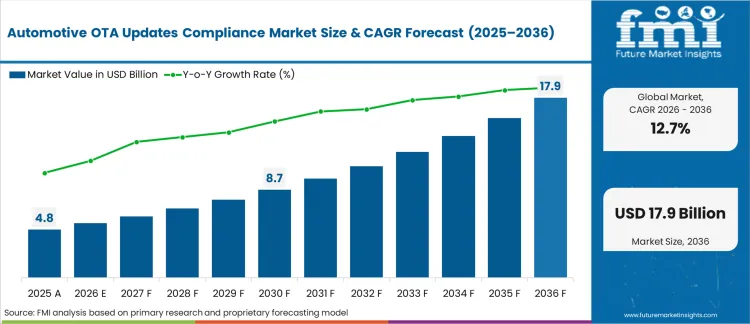
In 2025, the automotive OTA updates compliance market surpassed a value of USD 4.8 billion, is projected at USD 5.41 billion in 2026 and USD 18 billion by 2036, implying a 12.75% CAGR, with momentum tied to stringent regulatory mandates for vehicle cybersecurity and traceability. Global electric car sales exceeded USD 17 million in 2024, expanding the baseline fleet requiring continuous software monitoring [1].
Tier-1 suppliers and automakers are rapidly industrializing compliance infrastructures to manage software-defined vehicle (SDV) lifecycles. Volvo Cars announced a major OTA rollout covering approximately USD 2.5 million cars across 85 countries in 2026 [2], signaling that secure update pipelines have transitioned from premium features to baseline operational requirements. Procurement teams that fail to integrate certified lifecycle management systems face immediate exposure to regulatory audits and costly physical recalls.
Summary of Automotive OTA Updates Compliance Market
- Automotive OTA Updates Compliance Market Definition
- The market comprises software platforms, hardware components, and services designed to securely deliver, track, and authenticate over-the-air vehicle updates in strict accordance with global automotive cybersecurity and safety regulations.
- Demand Drivers in the Market
- Strict enforcement of UNECE WP.29 and ISO/SAE 21434 mandates compels automakers to adopt continuous monitoring and auditable update pipelines.
- The rising frequency of software-related vehicle recalls forces manufacturers to deploy OTA capabilities as the primary mitigation mechanism.
- The shift toward zonal and centralized software-defined vehicle architectures requires robust remote update validation frameworks.
- Key Segments Analyzed in the FMI Report
- Software: 70% share in 2026, driven by the critical need for encrypted payload delivery and cryptographic authentication.
- Passenger Vehicles: 72% share in 2026, reflecting the rapid electrification and digitization of consumer mobility platforms.
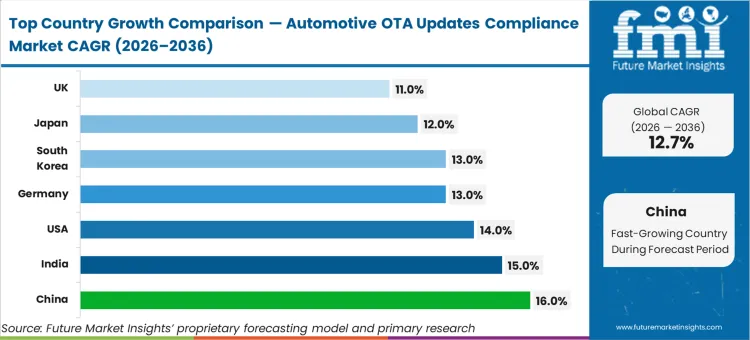
- China: 16% CAGR, outpacing mature markets as domestic fleet electrification aligns with strict state-level supply chain transparency regulations.
- Analyst Opinion at FMI
- Nikhil Kaitwade, Principal Consultant for Automotive at Future Market Insights, opines, “Procurement is no longer a downstream cost‑control function, it has become a strategic gatekeeper for software integrity across the entire vehicle lifecycle. As the automotive sector shifts toward fully software‑defined mobility, leaders are recognizing that the real competitive edge comes not from negotiating component prices, but from ensuring end‑to‑end system compliance.”
- Strategic Implications / Executive Takeaways
- Prioritize hardware-level cryptographic isolation to meet stringent regulatory thresholds for update authentication.
- Integrate compliance reporting natively into OTA delivery pipelines to automate audit trails for transport authorities.
- Secure long-term technology partnerships to manage the escalating complexity of multi-domain software rollouts.
- Methodology
- Validated through direct interviews with automotive software architects, compliance officers, and Tier-1 suppliers.
- Based on verified corporate capacity announcements, government regulatory filings, and primary patent datasets.
- Utilizes a bottom-up adoption model anchored to regional EV production volumes and regulatory enforcement timelines.
Erik Severinson, chief product and strategy officer at Volvo Cars, opined, “The improvements focus on what we believe matters most to our customers. These upgrades ensure a more enjoyable and exclusive experience, with the car set to get better over time thanks to over-the-air updates.”[3] Automakers leveraging automotive over the air (OTA) updates capabilities face an inflection point where user experience and regulatory compliance converge. Suppliers providing validated, isolated update environments will capture premium contracts from OEMs facing strict software purity mandates across 2026 to 2036.
Automotive OTA Updates Compliance Market Definition
The Automotive OTA Updates Compliance market encompasses the specialized software platforms, cryptographic hardware, and integration services required to authenticate, distribute, and verify remote vehicle software updates. These systems ensure that connected vehicles adhere to global safety frameworks, such as UNECE WP.29 and ISO/SAE 21434, throughout their lifecycle. A primary example includes centralized update managers that cryptographically verify firmware payloads before allowing installation on safety-critical electronic control units (ECUs).
Automotive OTA Updates Compliance Market Inclusions
The market scope includes software-over-the-air (SOTA) and firmware-over-the-air (FOTA) delivery platforms, compliance audit trail software, and dedicated hardware security modules (HSMs) designed for secure update verification. It covers solutions deployed across both passenger and commercial vehicles for infotainment, ADAS, and powertrain applications. Systems providing ISO 24089 standard adherence for lifecycle software management are explicitly included.
Automotive OTA Updates Compliance Market Exclusions
The scope strictly excludes general-purpose IT software updates, aftermarket consumer diagnostic dongles without OEM-authorized cryptographic keys, and standalone telecom data plans. Unregulated infotainment applications that do not interact with vehicle control networks or fall under automotive safety compliance mandates are also excluded.
Automotive OTA Updates Compliance Market Research Methodology
- Primary Research: Direct interviews with Tier-1 software engineering directors, automotive compliance officers, and cybersecurity platform vendors.
- Desk Research: Custom extraction of regulatory enforcement timelines from national transport authorities, alongside verified OEM platform announcements and patent filings.
- Market-Sizing and Forecasting: Analysts developed a bottom-up adoption model starting from global connected vehicle production volumes, applying regional compliance enforcement ratios to project platform demand.
- Data Validation and Update Cycle: Findings underwent cross-verification against official government recall databases and peer-reviewed automotive security journals before final forecast integration.
Segmental Analysis
Automotive OTA Updates Compliance Market Analysis by Component
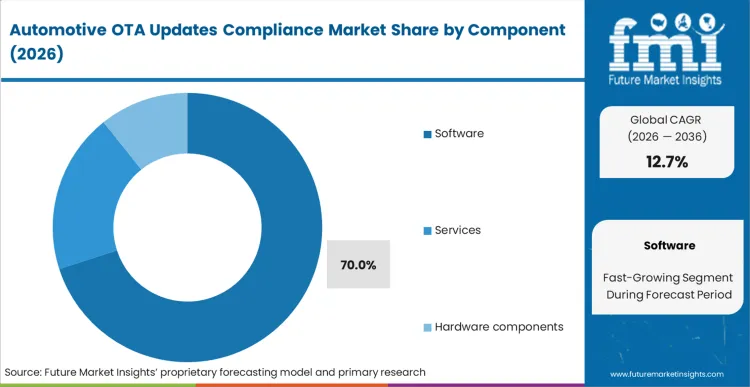
Software commands a 70% share of 2026 volumes, reflecting the industry's structural transition toward unified vehicle operating systems and cloud-based governance. Automakers are actively respecifying over the air software update architectures to eliminate fragmented legacy ECUs that complicate compliance auditing. The necessity for encrypted payload delivery forces OEMs to invest heavily in robust software backbones over standalone hardware fixes. The Eclipse Foundation reports that 79% of developers currently utilize open-source in-vehicle software [4], amplifying the need for stringent software composition analysis and compliance tracking before OTA deployment.
- Technical Validation: Zonal architectures increasingly rely on software abstractions to isolate safety-critical domains from infotainment updates.
- Regulatory Compliance: Mandates require exact version tracking across millions of vehicles, achievable only through centralized software governance.
- Process Compatibility: Software platforms seamlessly integrate with existing OEM cloud infrastructures to automate global deployment schedules.
Automotive OTA Updates Compliance Market Analysis by Update Type
The complexity of modern vehicle architectures makes physical dealership visits for software recalls economically unsustainable. SOTA holds a 60% share in 2026 as automakers prioritize agile feature enhancements and rapid security patching. FMI analysts opine that fleet OTA update test platforms are becoming mandatory procurement items for OEMs aiming to validate SOTA payloads across diverse vehicle configurations. The CVE Program produced 12,009 vulnerability records in Q1 2025 [5], highlighting the escalating cybersecurity threat landscape that necessitates immediate over-the-air remediation.
- Lifecycle Management: Continuous SOTA rollouts allow manufacturers to monetize post-sale features while maintaining strict safety compliance.
- Vulnerability Remediation: Automated patching eliminates the dangerous lag time between vulnerability discovery and vehicle protection.
- Cost Structures: Tightens when physical recall requirements are replaced by efficient remote software distribution.
Automotive OTA Updates Compliance Market Analysis by Vehicle Type
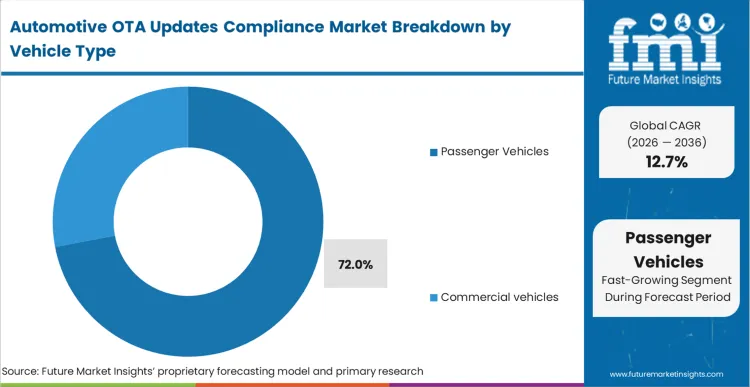
The integration of automotive cybersecurity protocols into passenger platforms is now a non-negotiable prerequisite for market entry in major jurisdictions. Passenger vehicles lead the segment with a 72% share in 2026, driven by high consumer demand for digital experiences and advanced driver-assistance systems (ADAS). The integration of complex infotainment and autonomous capabilities inherently expands the vehicle's attack surface, requiring comprehensive compliance frameworks
- Volume Concentration: Narrows high-tech passenger EVs that utilize software as a primary competitive differentiator.
- Procurement Shifts: Fleet operators demand guaranteed uptime and secure lifecycle management for autonomous passenger models.
- Safety Assurance: Passenger vehicles require fail-safe OTA mechanisms to ensure updates do not disrupt critical driving functions.
Automotive OTA Updates Compliance Market Analysis by Application
Infotainment & UX represents 34% of segment share as brands frequently deploy updates to refresh interfaces and integrate third-party applications. However, regulatory scrutiny is expanding rapidly into safety-critical domains. FMI analysts opine that automotive remote diagnostic capabilities are increasingly tied to powertrain and ADAS updates, ensuring pre-update vehicle health checks. Memory safety issues currently cause approximately 70% of vulnerabilities according to OpenSSF [6], forcing OEMs to meticulously audit code intended for vehicle integration.
- Feature Enhancement: Regular UX updates maintain brand engagement and vehicle residual value over time.
- Security Isolation: Hypervisors are deployed to strictly separate frequently updated infotainment systems from underlying vehicle control networks.
- Adoption Acceleration: Consumers expect smartphone-like update cadences seamlessly applied to their vehicles.
Automotive OTA Updates Compliance Market Drivers, Restraints, and Opportunities
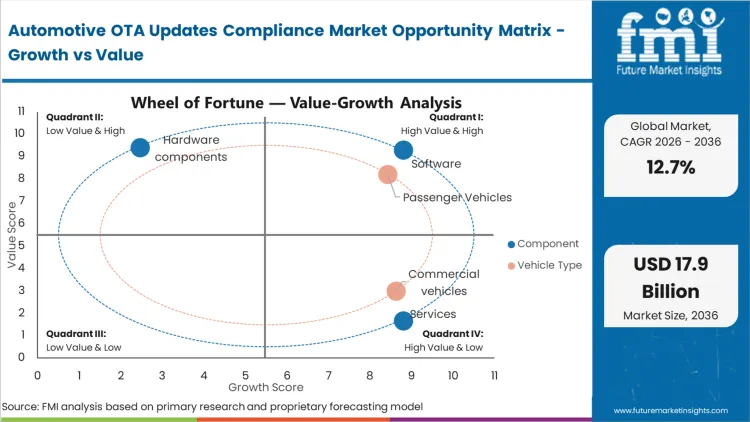
The surge in software-driven vehicle recalls acts as the primary catalyst forcing automakers to operationalize compliant OTA architectures. Procurement teams recognize that certified OTA platforms are the only scalable defense against expanding regulatory scrutiny, shifting investments from legacy diagnostic tools to continuous lifecycle management systems.
The lack of specialized automotive cybersecurity talent restricts the rapid deployment of compliant OTA infrastructures. OpenSSF reports that 40.8% of organizations struggle with a lack of security expertise [8], creating bottlenecks in validating complex software supply chains. Automakers mitigate this by outsourcing compliance tooling and integration to specialized Tier-1 partners capable of delivering pre-certified update environments.
- Zonal Architecture Integration: Suppliers providing pre-integrated OTA hardware and software suites capture market share from OEMs transitioning to centralized compute models. Infineon introduced a zonal controller reference kit supporting A/B swap for OTA updates [9].
- Automated Compliance Auditing: Platforms that automatically generate cryptographic proof of update success for regulatory bodies streamline vehicle homologation processes. NXP announced S32K5 microcontrollers specifically engineered for faster, secure OTA programming [10].
- Cross-Domain Security: Integrating OTA capabilities natively into autonomous driving platforms ensures ADAS features remain compliant with evolving safety regulations.
Regional Analysis
Based on the regional analysis, the Automotive OTA Updates Compliance market is segmented into North America, Latin America, Europe, East Asia, South Asia, Oceania and Middle East & Africa across 40+ countries. The full report also offers market attractiveness analysis based on regional trends.
.webp "Top Country Growth Comparison Automotive Ota Updates Compliance Market Cagr (2026 2036)")
| Country | CAGR (2026 to 2036) |
|---|---|
| China | 16.0% |
| India | 15.0% |
| USA | 14.0% |
| Germany | 13.0% |
| South Korea | 13.0% |
| Japan | 12.0% |
| UK | 11.0% |
Source: Future Market Insights (FMI) analysis, based on proprietary forecasting model and primary research
Asia Pacific Automotive OTA Updates Compliance Market Analysis
Asia Pacific's commercialization pace is increasingly defined by how quickly regional manufacturers scale electric vehicle production alongside strict state-level data governance mandates. Rapid electrification forces domestic automakers to embed secure update pipelines directly into their SDV platforms to maintain competitive parity and regulatory clearance. The necessity for supply-chain transparency transforms compliance from a secondary IT function into a core vehicle engineering discipline. The region's focus on building sovereign automotive software ecosystems directly accelerates the deployment of verifiable OTA infrastructures.
- China: China's automotive OTA updates compliance market is poised to grow at a robust CAGR of 16.0% through 2036. State-mandated data localization and supply-chain transparency rules force automakers to deeply integrate compliance monitoring into fleet operations. Valeo announced a new China facility dedicated to supporting SDV compliance and controlled update architectures [12]. Suppliers that do not offer fully localized, auditable OTA delivery pipelines will face immediate exclusion from domestic OEM vendor lists.
- India: Domestic OEMs are rapidly adopting global-platform architectures to accelerate homologation across emerging fleets. Fueling this transition, demand for OTA compliance in India is projected to expand at a CAGR of 15.0% through the 2036 forecast period. Suppliers provide "compliance-by-design" reference kits to bypass local skills gaps, ensuring procurement directors can secure partnerships with Tier-1 integrators capable of delivering cost-effective, scalable security frameworks.
- Japan: OTA compliance growth follows the transition toward integrated mobility computers that enable secure software partitioning across legacy architectures. DENSO signed an agreement for custom SoCs to establish secure update domains [13]. Automakers that fail to modernize their supply chains to support unified update management cannot meet emerging cybersecurity export standards, highlighting why the Japanese market is expected to record a steady CAGR of 12.0% over the next decade.
- South Korea: Automakers in this mature ecosystem are aggressively packaging strict compliance tooling alongside fast-paced SDV release cycles. The South Korean sector is projected to surge at a CAGR of 13.0% from 2026 to 2036. The rapid cadence of continuous map and content updates requires rigorous pipeline auditability, meaning OEMs must deploy automated verification tools to ensure rapid feature delivery does not compromise baseline vehicle homologation.
FMI's report includes comprehensive tracking of the Asia Pacific processing landscape, connecting electric vehicle output to finished compliance capacity. Across emerging mobility hubs in Southeast Asia, growth concentrates where localization aligns with lead-time reduction, prompting buyers to secure reliable shipments for secure automotive hardware platforms.
North America Automotive OTA Updates Compliance Market Analysis
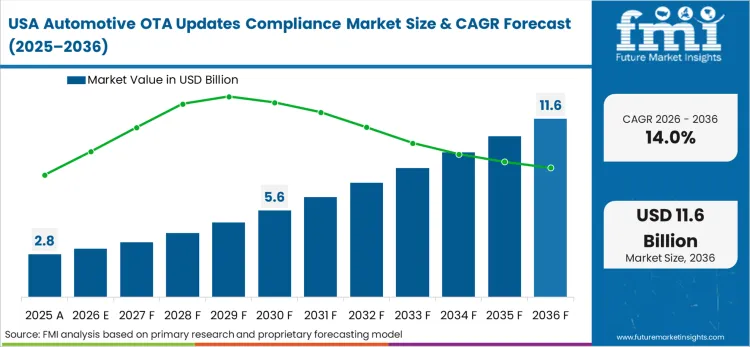
North America's compliance landscape is undergoing recalibration as intense regulatory scrutiny surrounding software defects drives adoption. The escalating cost of physical vehicle recalls forces OEMs to establish OTA updates as the primary mechanism for rapid defect remediation. The NHTSA recorded recalls impacting over 39 million vehicles and equipment [7], explicitly highlighting the financial exposure automakers face without remote patching capabilities. This dynamic firmly establishes continuous software monitoring and secure deployment pipelines as the foundation of modern automotive risk management in the region.
- USA: Over the forecast period, the United States market is anticipated to expand at a CAGR of 14.0%. Compliance in the USA is strictly recall-driven, positioning OTA capabilities as the most cost-effective path to remedy software defects while maintaining rigorous audit trails. Automakers lacking verified, end-to-end traceability for their software payloads face severe financial penalties and mandatory stop-sale orders during regulatory investigations.
FMI's report includes comprehensive tracking of the North American processing landscape, connecting regulatory enforcement actions to finished compliance capacity. Across Canada and Mexico, growth concentrates where localization aligns with cross-border supply chain integration, prompting buyers to secure reliable partnerships for unified vehicle software governance.
Europe Automotive OTA Updates Compliance Market Analysis
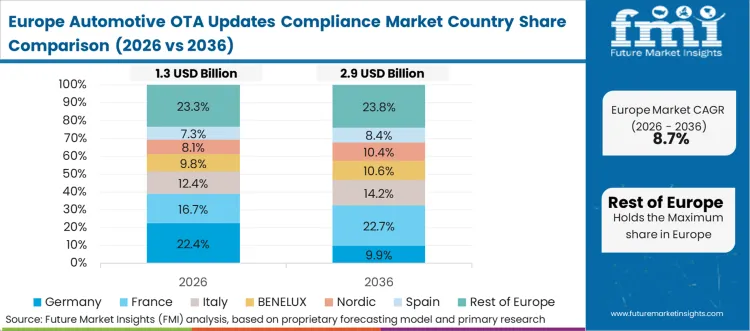
Europe functions as the global technical proving ground for advanced isolation methods under the strict enforcement of UNECE WP.29 regulations. Regulatory scrutiny compels manufacturers to source efficient, secure update mechanisms that guarantee cryptographic traceability across the entire vehicle lifecycle. This environment establishes comprehensive software lifecycle management not as an optional feature, but as a rigid legal prerequisite for vehicle type approval across the continent.
- Germany: High engineering rigor and complex documentation requirements dictate that compliance spending concentrates on securing mixed-criticality software stacks. Backed by these stringent requirements, Germany's OTA updates compliance demand is forecast to climb at a 13.0% CAGR through 2036. The market demands robust Tier-1 toolchains and standardized APIs for secure payload delivery, forcing suppliers to provide transparent, auditable software composition analyses to clear procurement thresholds set by premium automakers.
- UK: The UK specializes in advanced compliance tooling, where growth is strongest in software validation, SBOM governance, and secure cloud operations. The Linux Foundation reports that broad open-source adoption necessitates specialized tracking mechanisms [16]. Software vendors operating without verifiable security pedigree frameworks will be systematically excluded from localized development ecosystems, driving the UK market forward at an estimated CAGR of 11.0% through the forecast duration.
FMI's report includes comprehensive tracking of the European processing landscape, connecting regulatory mandates to finished compliance capacity. Across France and Italy, growth concentrates where modernization aligns with stringent safety certifications, prompting buyers to secure reliable platforms for continuous vehicle security auditing.
Competitive Aligners for Market Players
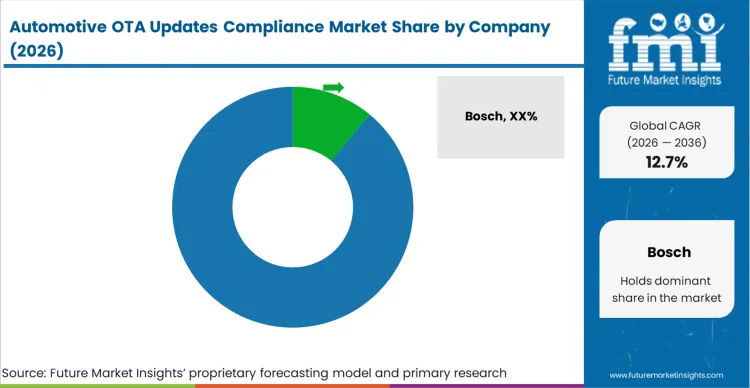
Market dynamics increasingly favor players capable of delivering fully integrated, silicon‑to‑cloud security ecosystems. Organizations with mature cryptographic infrastructure enjoy a decisive competitive edge over those dependent on fragmented, software‑only solutions. The USA Department of Transportation’s USD 11 million investment in Vehicle Electronics and Cybersecurity research underscores the long‑term institutional commitment to advancing compliance‑ready architectures [17]. Procurement teams are locking in multi‑year platform partnerships to ensure operational stability and maintain continuous alignment with evolving regulatory expectations.
Technological capability differentiates premium suppliers from bulk component manufacturers. Companies holding intellectual property for specific isolation techniques and rapid memory-safe execution command higher margins by delivering platforms with superior auditability. The Federal Highway Administration estimates USD 277.3 billion vehicle miles traveled [18], representing a massive operational environment requiring robust, zero-downtime update management. Technical validation remains the primary barrier to entry for new market participants seeking access to high-value OEM SDV portfolios.
Strategic alliances and ecosystem integrations accelerate commercialization timelines for emerging players. Co-investment programs and standardized reference architectures offset the massive capital requirements associated with building proprietary security stacks from the ground up. The industry shift toward operational maturity is evident as automakers deeply integrate Tier-1 security platforms directly into next-generation vehicle architectures to de-risk capacity expansion and guarantee long-term homologation.
Recent Developments
The report includes full coverage of key trends from competitive benchmarking. Some of the recent developments covered in the reports:
- In January 2026, Qualcomm expanded its collaboration with Google aimed at simplifying secure Android OTA updates across automotive platforms. [14]
- In January 2026, ZF launched an integration platform that includes native provisions for OTA software updates and automated compliance traces. [15]
- In September 2025, Bosch integrated NVIDIA DRIVE AGX Thor into future architectures to securely simplify controlled OTA domains. [11]
Key Players in Automotive OTA Updates Compliance Market
- Bosch
- Continental
- Harman (Samsung)
- Aptiv
- Airbiquity
- Redbend (Harman)
- HERE Technologies
Scope of the Report
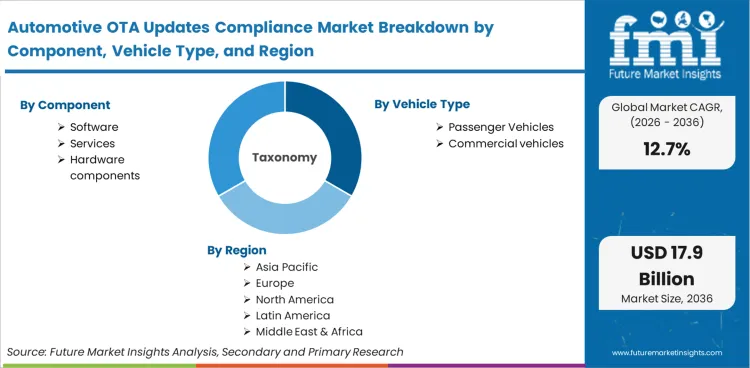
| Metric | Value |
|---|---|
| Quantitative Units | USD 5.41 billion (2026) to USD 18 billion (2036), at a CAGR of 12.75% |
| Market Definition | Software platforms, hardware components, and services designed to securely deliver, track, and authenticate over-the-air vehicle updates in strict accordance with global automotive cybersecurity and safety regulations. |
| Component Segmentation | Software, Services, Hardware components |
| Update type Segmentation | SOTA, FOTA |
| Vehicle type Segmentation | Passenger vehicles, Commercial vehicles |
| Application Segmentation | Infotainment & UX, Safety/security patches, Powertrain & battery, ADAS feature updates |
| Regions Covered | North America, Latin America, Europe, East Asia, South Asia, Oceania, Middle East and Africa |
| Countries Covered | United States, Canada, Mexico, Brazil, Argentina, Germany, France, United Kingdom, Italy, Spain, China, India, Japan, South Korea, Indonesia, Australia and 40 plus countries |
| Key Companies Profiled | Bosch, Continental, Harman (Samsung), Aptiv, Airbiquity, Redbend (Harman), HERE Technologies |
| Forecast Period | 2026 to 2036 |
| Approach | Hybrid top-down and bottom-up market modeling validated through primary interviews with software engineering directors, supported by regulatory data benchmarking. |
Source: Future Market Insights (FMI) analysis, based on proprietary forecasting model and primary research
Segmental Analysis
Component:
- Software
- Services
- Hardware components
Update Type:
- SOTA
- FOTA
Vehicle Type:
- Passenger vehicles
- Commercial vehicles
Application:
- Infotainment & UX
- Safety/security patches
- Powertrain & battery
- ADAS feature updates
Compliance Focus:
- Cybersecurity (ISO/SAE 21434)
- UNECE WP.29 compliance
- Data governance & audit trails
- Recall avoidance/traceability
Region:
- Asia Pacific
- India
- China
- Japan
- South Korea
- Indonesia
- Australia & New Zealand
- ASEAN
- Rest of Asia Pacific
- Europe
- Germany
- Italy
- France
- United Kingdom
- Spain
- Benelux
- Nordics
- Central & Eastern Europe
- Rest of Europe
- North America
- United States
- Canada
- Mexico
- Latin America
- Brazil
- Argentina
- Chile
- Rest of Latin America
- Middle East & Africa
- Kingdom of Saudi Arabia
- United Arab Emirates
- South Africa
- Turkey
- Rest of Middle East & Africa
Bibliography
- [1] International Energy Agency (IEA). (2025). Global EV Outlook 2025.
- [2] Volvo Cars. (2026). Volvo Cars kicks off largest over-the-air car software update in history with comprehensive user experience upgrade (Company news release).
- [3] Volvo Cars. (2025, February 18). Our best-selling XC60 SUV is now better than ever (Press release).
- [4] Eclipse Foundation. (2025, April). 2025 State of Automotive Software Development Survey (Report).
- [5] CVE Program. (2025, May 28). CVE Program Report for Quarter 1 Calendar Year (Q1 CY) 2025 (Report).
- [6] OpenSSF. (2025, April 28). Announcing the release of the Memory Safety Continuum (Report).
- [7] National Highway Traffic Safety Administration (NHTSA). (2025, January 17). Report on Vehicle Safety Recall Completion Rates (Government report).
- [8] OpenSSF. (2025, August 12). Securing AI: The Next Cybersecurity Battleground (Report).
- [9] Infineon. (2026, January 02). Infineon and Flex launch Zone Controller Development Kit for software-defined vehicles at CES 2026 (Market news).
- [10] NXP Semiconductors. (2025, March 11). New S32K5 Microcontroller Family Advances Zonal SDV Architectures (Newsroom).
- [11] Bosch. (2025, September). Bosch To Integrate NVIDIA DRIVE AGX Thor Into Next-Generation ADAS and Software-Defined Vehicle Architectures (Press portal).
- [12] Valeo. (2025, August 29). Valeo opens a new production facility in China to support the software-defined vehicle revolution (Press release).
- [13] DENSO. (2025, December 26). DENSO and MediaTek Collaborate on Automotive SoCs for Advanced Driver-Assistance Systems (Newsroom).
- [14] Qualcomm. (2026, January 05). Qualcomm and Google Expand Collaboration for Secure Android OTA Updates in Automotive Platforms (News releases).
- [15] ZF. (2026, January 06). ZF Launches New Integration Platform with Native OTA Software Updates and Automated Compliance Traces (Press releases).
- [16] The Linux Foundation. (2025, January). The State of Global Open Source 2025 (Report).
- [17] U.S. Department of Transportation. (2025, June). AMRP FY2024-2025 NHTSA Final Report (Government report).
- [18] Federal Highway Administration (FHWA). (2025, May). Traffic Volume Trends (Government report).
This bibliography is provided for reader reference and is not exhaustive. The full report contains the complete reference list and detailed citations.
This Report Addresses
- Market size estimation and revenue forecasts from 2026 to 2036, supported by validated capacity and trade benchmarks across major processing hubs.
- Segment and regional revenue forecasts covering critical applications like infotainment, powertrain, and ADAS feature updates.
- Regulatory impact analysis evaluating strict UNECE WP.29 mandates and ISO/SAE 21434 protocols.
- Competition strategy assessment including integration models, cost survivability positioning, and process capability benchmarking.
- Growth opportunity mapping across SOTA and FOTA formats with emphasis on secure software supply chain transitions.
- Product reformulation tracking covering key metrics such as cryptographic isolation and audit trail compliance.
- Market report delivery in PDF, Excel, PPT, and interactive dashboard formats for executive and operational use.
Frequently Asked Questions
How large is the demand for Automotive OTA Updates Compliance in the global market in 2026?
Demand for Automotive OTA Updates Compliance in the global market is estimated to be valued at USD 5.41 billion in 2026.
What will be the market size of Automotive OTA Updates Compliance in the global market by 2036?
Market size for Automotive OTA Updates Compliance is projected to reach USD 18 billion by 2036.
What is the expected demand growth for Automotive OTA Updates Compliance in the global market between 2026 and 2036?
Demand for Automotive OTA Updates Compliance is expected to grow at a CAGR of 12.75% between 2026 and 2036.
Which Component is poised to lead global sales by 2026?
Software commands 70% in 2026 as automakers invest heavily in robust software backbones over standalone hardware fixes.
How significant is the role of Passenger vehicles in driving Automotive OTA Updates Compliance adoption in 2026?
Passenger vehicles represents 72% of segment share as brands prioritize high consumer demand for digital experiences.
What is driving demand in China?
State-mandated data localization and strict supply-chain transparency rules drive compliance tooling adoption.
What compliance standards or regulations are referenced for China?
Supply-chain transparency rules and state-level data localization mandates govern domestic OEM vendor lists.
What is the China growth outlook in this report?
China is projected to grow at a CAGR of 16.0% during 2026 to 2036.
Why is North America described as a priority region in this report?
Intense regulatory scrutiny surrounding software defects and costly physical recalls force immediate OTA adoption.
What type of demand dominates in North America?
Recall-driven compliance demand dominates as automakers seek cost-effective paths to remedy defects.
What is India's growth outlook in this report?
India is projected to expand at a CAGR of 15.0% during 2026 to 2036.
Does the report cover United States in its regional analysis?
Yes, United States is included within North America under the regional scope of analysis.
What are the sources referred to for analyzing United States?
Official recall completion rates data from the NHTSA and verified OEM platform announcements form the analytical basis.
What is the main demand theme linked to United States in its region coverage?
Strict recall-driven compliance and the necessity for robust audit trails shape continuous procurement demand.
Does the report cover Germany in its regional analysis?
Yes, Germany is included within Europe under the regional coverage framework.
What is the main Germany related demand theme in its region coverage?
High engineering rigor and complex documentation requirements for securing mixed-criticality software stacks dominate.
Which product formats or configurations are strategically important for Asia Pacific supply chains?
Fully localized, auditable OTA delivery pipelines that comply with sovereign data laws hold immense strategic importance.
What is Automotive OTA Updates Compliance and what is it mainly used for?
It comprises software and hardware designed to securely authenticate and distribute remote vehicle updates in accordance with safety regulations.
What does Automotive OTA Updates Compliance mean in this report?
The market refers to the systems required to authenticate, distribute, and verify remote vehicle software updates globally.
What is included in the scope of this Automotive OTA Updates Compliance report?
Scope includes SOTA, FOTA, compliance audit software, and hardware security modules deployed across connected vehicles.
What is excluded from the scope of this report?
General-purpose IT updates, aftermarket diagnostic dongles, and standalone telecom data plans are strictly excluded.
What does market forecast mean on this page?
The market forecast represents a model-based projection built on defined industrial and adoption assumptions for strategic planning purposes.
How does FMI build and validate the Automotive OTA Updates Compliance forecast?
Forecasts combine top-down connected vehicle volumes with bottom-up compliance ratios, validated by primary engineering director interviews.
What does zero reliance on speculative third-party market research mean here?
Primary interviews, verified regulatory filings, and official government datasets are used exclusively instead of unverified syndicated estimates.
Preview the report firsthand - request a free sample
Get SampleGet the brochure for pricing and purchase details.
Get PDFTable of Content
- Executive Summary
- Global Market Outlook
- Demand-side Trends
- Supply-side Trends
- Technology Roadmap Analysis
- Analysis and Recommendations
- Market Overview
- Analytical Lens and Working Hypotheses
- Market Structure, Signals, and Trend Drivers
- Benchmarking and Cross-market Comparability
- Market Sizing, Forecasting, and Opportunity Mapping
- Research Design and Evidence Framework
- Desk Research Programme (Secondary Evidence)
- Company Annual and Sustainability Reports
- Peer-reviewed Journals and Academic Literature
- Corporate Websites, Product Literature, and Technical Notes
- Trade Journals, Industry Magazines, and Analyst Briefs
- Conference Proceedings, Webinars, and Seminar Materials
- Government Statistics Portals and Public Data Releases
- Press Releases and Reputable Media Coverage
- Specialist Newsletters and Curated Briefings
- Sector Databases and Reference Repositories
- FMI Internal Proprietary Databases and Historical Market Datasets
- Subscription Datasets and Paid Sources
- Social Channels, Communities, and Digital Listening Inputs
- Additional Desk Sources
- Expert Input and Fieldwork (Primary Evidence)
- Primary Modes
- Qualitative Interviews and Expert Elicitation
- Quantitative Surveys and Structured Data Capture
- Blended Approach
- Why Primary Evidence is Used
- Field Techniques
- Interviews
- Surveys
- Focus Groups
- Observational and In-context Research
- Social and Community Interactions
- Stakeholder Universe Engaged
- C-suite Leaders
- Board Members
- Presidents and Vice Presidents
- R&D and Innovation Heads
- Technical Specialists
- Domain Subject-matter Experts
- Scientists
- Physicians and Other Healthcare Professionals
- Governance, Ethics, and Data Stewardship
- Research Ethics
- Data Integrity and Handling
- Primary Modes
- Tooling, Models, and Reference Databases
- Desk Research Programme (Secondary Evidence)
- Data Engineering and Model Build
- Data Acquisition and Ingestion
- Cleaning, Normalisation, and Verification
- Synthesis, Triangulation, and Analysis
- Quality Assurance and Audit Trail
- Analytical Lens and Working Hypotheses
- Market Background
- Market Dynamics
- Drivers
- Restraints
- Opportunity
- Trends
- Scenario Forecast
- Demand in Optimistic Scenario
- Demand in Likely Scenario
- Demand in Conservative Scenario
- Opportunity Map Analysis
- Product Life Cycle Analysis
- Supply Chain Analysis
- Investment Feasibility Matrix
- Value Chain Analysis
- PESTLE and Porter’s Analysis
- Regulatory Landscape
- Regional Parent Market Outlook
- Production and Consumption Statistics
- Import and Export Statistics
- Market Dynamics
- Global Market Analysis 2021 to 2025 and Forecast, 2026 to 2036
- Historical Market Size Value (USD Million) Analysis, 2021 to 2025
- Current and Future Market Size Value (USD Million) Projections, 2026 to 2036
- Y-o-Y Growth Trend Analysis
- Absolute $ Opportunity Analysis
- Global Market Pricing Analysis 2021 to 2025 and Forecast 2026 to 2036
- Global Market Analysis 2021 to 2025 and Forecast 2026 to 2036, By Component
- Introduction / Key Findings
- Historical Market Size Value (USD Million) Analysis By Component , 2021 to 2025
- Current and Future Market Size Value (USD Million) Analysis and Forecast By Component , 2026 to 2036
- Software
- Services
- Hardware components
- Software
- Y-o-Y Growth Trend Analysis By Component , 2021 to 2025
- Absolute $ Opportunity Analysis By Component , 2026 to 2036
- Global Market Analysis 2021 to 2025 and Forecast 2026 to 2036, By Vehicle Type
- Introduction / Key Findings
- Historical Market Size Value (USD Million) Analysis By Vehicle Type, 2021 to 2025
- Current and Future Market Size Value (USD Million) Analysis and Forecast By Vehicle Type, 2026 to 2036
- Passenger Vehicles
- Commercial vehicles
- Passenger Vehicles
- Y-o-Y Growth Trend Analysis By Vehicle Type, 2021 to 2025
- Absolute $ Opportunity Analysis By Vehicle Type, 2026 to 2036
- Global Market Analysis 2021 to 2025 and Forecast 2026 to 2036, By Region
- Introduction
- Historical Market Size Value (USD Million) Analysis By Region, 2021 to 2025
- Current Market Size Value (USD Million) Analysis and Forecast By Region, 2026 to 2036
- North America
- Latin America
- Western Europe
- Eastern Europe
- East Asia
- South Asia and Pacific
- Middle East & Africa
- Market Attractiveness Analysis By Region
- North America Market Analysis 2021 to 2025 and Forecast 2026 to 2036, By Country
- Historical Market Size Value (USD Million) Trend Analysis By Market Taxonomy, 2021 to 2025
- Market Size Value (USD Million) Forecast By Market Taxonomy, 2026 to 2036
- By Country
- USA
- Canada
- Mexico
- By Component
- By Vehicle Type
- By Country
- Market Attractiveness Analysis
- By Country
- By Component
- By Vehicle Type
- Key Takeaways
- Latin America Market Analysis 2021 to 2025 and Forecast 2026 to 2036, By Country
- Historical Market Size Value (USD Million) Trend Analysis By Market Taxonomy, 2021 to 2025
- Market Size Value (USD Million) Forecast By Market Taxonomy, 2026 to 2036
- By Country
- Brazil
- Chile
- Rest of Latin America
- By Component
- By Vehicle Type
- By Country
- Market Attractiveness Analysis
- By Country
- By Component
- By Vehicle Type
- Key Takeaways
- Western Europe Market Analysis 2021 to 2025 and Forecast 2026 to 2036, By Country
- Historical Market Size Value (USD Million) Trend Analysis By Market Taxonomy, 2021 to 2025
- Market Size Value (USD Million) Forecast By Market Taxonomy, 2026 to 2036
- By Country
- Germany
- UK
- Italy
- Spain
- France
- Nordic
- BENELUX
- Rest of Western Europe
- By Component
- By Vehicle Type
- By Country
- Market Attractiveness Analysis
- By Country
- By Component
- By Vehicle Type
- Key Takeaways
- Eastern Europe Market Analysis 2021 to 2025 and Forecast 2026 to 2036, By Country
- Historical Market Size Value (USD Million) Trend Analysis By Market Taxonomy, 2021 to 2025
- Market Size Value (USD Million) Forecast By Market Taxonomy, 2026 to 2036
- By Country
- Russia
- Poland
- Hungary
- Balkan & Baltic
- Rest of Eastern Europe
- By Component
- By Vehicle Type
- By Country
- Market Attractiveness Analysis
- By Country
- By Component
- By Vehicle Type
- Key Takeaways
- East Asia Market Analysis 2021 to 2025 and Forecast 2026 to 2036, By Country
- Historical Market Size Value (USD Million) Trend Analysis By Market Taxonomy, 2021 to 2025
- Market Size Value (USD Million) Forecast By Market Taxonomy, 2026 to 2036
- By Country
- China
- Japan
- South Korea
- By Component
- By Vehicle Type
- By Country
- Market Attractiveness Analysis
- By Country
- By Component
- By Vehicle Type
- Key Takeaways
- South Asia and Pacific Market Analysis 2021 to 2025 and Forecast 2026 to 2036, By Country
- Historical Market Size Value (USD Million) Trend Analysis By Market Taxonomy, 2021 to 2025
- Market Size Value (USD Million) Forecast By Market Taxonomy, 2026 to 2036
- By Country
- India
- ASEAN
- Australia & New Zealand
- Rest of South Asia and Pacific
- By Component
- By Vehicle Type
- By Country
- Market Attractiveness Analysis
- By Country
- By Component
- By Vehicle Type
- Key Takeaways
- Middle East & Africa Market Analysis 2021 to 2025 and Forecast 2026 to 2036, By Country
- Historical Market Size Value (USD Million) Trend Analysis By Market Taxonomy, 2021 to 2025
- Market Size Value (USD Million) Forecast By Market Taxonomy, 2026 to 2036
- By Country
- Kingdom of Saudi Arabia
- Other GCC Countries
- Turkiye
- South Africa
- Other African Union
- Rest of Middle East & Africa
- By Component
- By Vehicle Type
- By Country
- Market Attractiveness Analysis
- By Country
- By Component
- By Vehicle Type
- Key Takeaways
- Key Countries Market Analysis
- USA
- Pricing Analysis
- Market Share Analysis, 2025
- By Component
- By Vehicle Type
- Canada
- Pricing Analysis
- Market Share Analysis, 2025
- By Component
- By Vehicle Type
- Mexico
- Pricing Analysis
- Market Share Analysis, 2025
- By Component
- By Vehicle Type
- Brazil
- Pricing Analysis
- Market Share Analysis, 2025
- By Component
- By Vehicle Type
- Chile
- Pricing Analysis
- Market Share Analysis, 2025
- By Component
- By Vehicle Type
- Germany
- Pricing Analysis
- Market Share Analysis, 2025
- By Component
- By Vehicle Type
- UK
- Pricing Analysis
- Market Share Analysis, 2025
- By Component
- By Vehicle Type
- Italy
- Pricing Analysis
- Market Share Analysis, 2025
- By Component
- By Vehicle Type
- Spain
- Pricing Analysis
- Market Share Analysis, 2025
- By Component
- By Vehicle Type
- France
- Pricing Analysis
- Market Share Analysis, 2025
- By Component
- By Vehicle Type
- India
- Pricing Analysis
- Market Share Analysis, 2025
- By Component
- By Vehicle Type
- ASEAN
- Pricing Analysis
- Market Share Analysis, 2025
- By Component
- By Vehicle Type
- Australia & New Zealand
- Pricing Analysis
- Market Share Analysis, 2025
- By Component
- By Vehicle Type
- China
- Pricing Analysis
- Market Share Analysis, 2025
- By Component
- By Vehicle Type
- Japan
- Pricing Analysis
- Market Share Analysis, 2025
- By Component
- By Vehicle Type
- South Korea
- Pricing Analysis
- Market Share Analysis, 2025
- By Component
- By Vehicle Type
- Russia
- Pricing Analysis
- Market Share Analysis, 2025
- By Component
- By Vehicle Type
- Poland
- Pricing Analysis
- Market Share Analysis, 2025
- By Component
- By Vehicle Type
- Hungary
- Pricing Analysis
- Market Share Analysis, 2025
- By Component
- By Vehicle Type
- Kingdom of Saudi Arabia
- Pricing Analysis
- Market Share Analysis, 2025
- By Component
- By Vehicle Type
- Turkiye
- Pricing Analysis
- Market Share Analysis, 2025
- By Component
- By Vehicle Type
- South Africa
- Pricing Analysis
- Market Share Analysis, 2025
- By Component
- By Vehicle Type
- USA
- Market Structure Analysis
- Competition Dashboard
- Competition Benchmarking
- Market Share Analysis of Top Players
- By Regional
- By Component
- By Vehicle Type
- Competition Analysis
- Competition Deep Dive
- Bosch
- Overview
- Product Portfolio
- Profitability by Market Segments (Product/Age /Sales Channel/Region)
- Sales Footprint
- Strategy Overview
- Marketing Strategy
- Product Strategy
- Channel Strategy
- Continental
- Harman (Samsung)
- Aptiv
- Airbiquity
- Redbend (Harman)
- HERE Technologies
- Bosch
- Competition Deep Dive
- Assumptions & Acronyms Used


