

- Industry Size (2026)
- USD 1.0 Bn
- Forecast (2036)
- USD 12.5 Bn
- CAGR (2026 to 2036)
- 28.0%
Automotive Metaverse In-Car Entertainment Market Size, Market Forecast and Outlook By FMI
The automotive metaverse in-car entertainment market growth having progressed from USD 0.8 billion in 2025, it is poised to cross USD 1.0 billion in 2026 at a CAGR of 28.0% during the forecast period significantly propelling the automotive metaverse forecast 2036 valuation to USD 12.5 billion through 2036 as the transition of the vehicle cabin from a transit space to a persistent digital revenue environment drives capital allocation toward spatial computing.
Original equipment manufacturers are currently forced to shift their core monetization strategies from hardware-defined infotainment to software-defined spatial platforms. Automotive executives must decide whether to build proprietary digital ecosystems or yield the post-sale cabin revenue to consumer technology giants. Delaying this architectural pivot permanently limits brands from capturing recurring digital services revenue, relegating their premium vehicles to mere hardware shells. Integrating vehicle software operations to support spatial applications requires a fundamental rewriting of how chassis data interacts with the central compute unit to enable immersive in-car experiences.
Summary of Automotive Metaverse In-Car Entertainment Market
- Automotive Metaverse In-Car Entertainment Market Definition
- The market defines the infrastructure and content ecosystem that transforms the passenger cabin into an immersive digital environment, utilizing spatial computing, motion synchronization, and edge rendering to deliver interactive entertainment distinct from legacy 2D screens.
- Demand Drivers in the Market
- The exhaustion of traditional hardware differentiation forces original equipment manufacturers to cultivate recurring software-based revenue streams within the cabin.
- The shift toward higher levels of driving automation, particularly the L3 autonomy metaverse cabin, pushes interior design teams to repurpose forward-facing passenger configurations for spatial media consumption.
- Rising consumer expectations for continuous digital engagement obligate automotive user experience directors to integrate transit time into the broader spatial internet.
- Key Segments Analyzed in the FMI Report
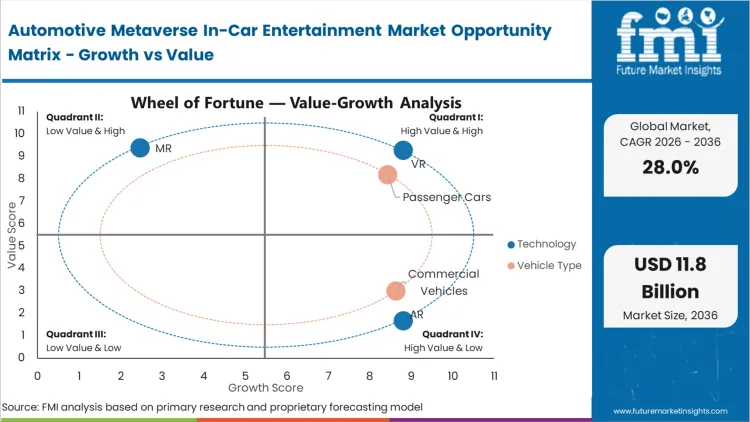
- VR: VR is poised to hold 45.0% share in 2026, shaping long-term metaverse car entertainment trends as it offers total immersion for rear-seat passengers without requiring a total redesign of the vehicle's greenhouse architecture.
- Passenger Cars: Passenger Cars is projected to hold 75.0% share in 2026, driven by the immediate availability of high-compute silicon in premium consumer vehicles.
- Gaming & Interactive Entertainment: Gaming & Interactive Entertainment is estimated to account for 55.0% share in 2026, reflecting the high monetization potential of active user engagement over passive viewing.
- 5G/Edge-Enabled: 5G/Edge-Enabled is expected to dominate with 65.0% share in 2026, providing the necessary bandwidth to offload intensive rendering tasks from the vehicle hardware.
- China: 35.0% CAGR, propelled by a domestic consumer base that evaluates vehicle purchases primarily on the sophistication of the digital cabin ecosystem.
- Analyst Opinion at FMI
- Nikhil Kaitwade, Principal Analyst, Automotive, at FMI, opines, "Standard market metrics capture the volume of headset shipments or display panel upgrades, assuming hardware saturation dictates market maturity. What they miss entirely is the data pipeline integrating chassis telemetry with game engines. The true structural pivot of this market is not when a screen becomes 3D, but when the rendering software learns to predict the vehicle's suspension movement. Without that integration, motion sickness renders the hardware useless."
- Strategic Implications / Executive Takeaways
- Automotive software architects must standardize telemetry application programming interfaces to allow third-party developers to access real-time vehicle motion data.
- Tier-1 hardware suppliers should pivot from designing isolated displays to engineering unified high-compute domain controllers to avoid component commoditization.
- Content aggregators face a brief window to negotiate exclusive distribution rights with major OEMs before proprietary app ecosystems harden.
- Methodology
- Primary Research: Interviews with OEM digital experience heads and spatial software architects.
- Desk Research: Analysis of automotive silicon specifications and SDK documentation.
- Market-Sizing: Anchored to advanced domain controller procurement volumes.
- Data Validation: Triangulated against edge-compute infrastructure deployment schedules.
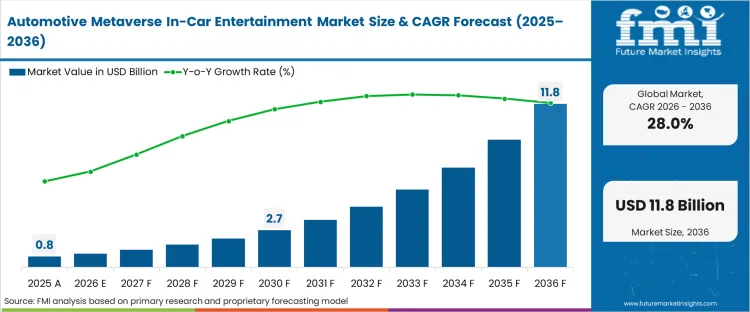
Before immersive cabin experiences become standard, the industry must cross a specific structural threshold: the real-time synchronization of high-frequency vehicle motion telemetry with low-latency edge rendering engines. Silicon developers and game engine creators trigger this gate by embedding predictive motion algorithms directly into the rendering pipeline. Once this vestibular disconnect is eliminated, the primary barrier to extended passenger engagement drops, unlocking the mass deployment of spatial media.
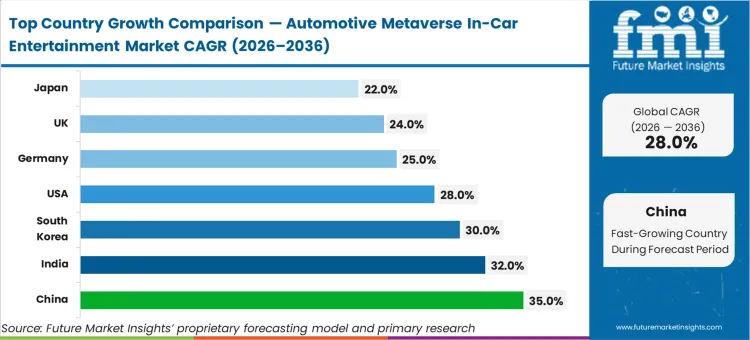
China is expected to register a 35.0% CAGR, followed by India tracking at 32.0% and South Korea advancing at 30.0%. The United States is estimated to grow at 28.0%, while Germany expands at 25.0%, the United Kingdom at 24.0%, and Japan at 22.0%. The global automotive metaverse CAGR reflects fundamental differences in how regional consumer bases prioritize digital continuity between their mobile devices and transit environments, dictating the volume of capital deployment.
Automotive Metaverse In-Car Entertainment Market Definition
The automotive metaverse in-car entertainment market encompasses the hardware, software, and connectivity frameworks required to deliver persistent, spatial, and interactive digital experiences within a vehicle cabin. Functionally, it structurally replaces the legacy in-vehicle infotainment metaverse by relying on real-time rendering, vehicle telemetry integration to prevent motion sickness, and extended reality (XR) interfaces rather than flat-panel touchscreen interactions.
Automotive Metaverse In-Car Entertainment Market Inclusions
This market includes virtual reality headsets designed for transit environments, augmented reality head-up displays that interact with external environments, mixed reality processing units, spatial audio systems, and the underlying rendering software engines. It also covers the integration of car OS architectures necessary to bridge vehicular sensor data with entertainment applications in the software-defined vehicle metaverse, as well as the connectivity modules built specifically to handle the high-bandwidth requirements of edge-rendered platforms.
Automotive Metaverse In-Car Entertainment Market Exclusions
The market explicitly excludes traditional rear-seat entertainment screens, standard 2D navigation panels, basic Bluetooth audio interfaces, and consumer smartphones used independently within the cabin. These categories are excluded because they do not utilize spatial computing, lack integration with vehicle motion telemetry, and operate outside the structural definition of an immersive, rendered environment.
Automotive Metaverse In-Car Entertainment Market Research Methodology
- Primary Research: Chief Technology Officers at tier-1 automotive suppliers, heads of digital cabin experience at global OEMs, and lead software architects at spatial computing developers.
- Desk Research: Aggregation of technical specifications from automotive silicon releases, homologation filings for in-cabin sensors, and software development kit documentation from major gaming engines.
- Market-Sizing and Forecasting: The baseline anchors to the volume of next-generation system-on-chips ordered for high-compute passenger vehicle platforms.
- Data Validation and Update Cycle: Forecasts are triangulated against the capital expenditure cycles of telecommunications providers deploying localized edge-compute nodes along major transit corridors.
Segmental Analysis
Automotive Metaverse In-Car Entertainment Market Analysis by Technology
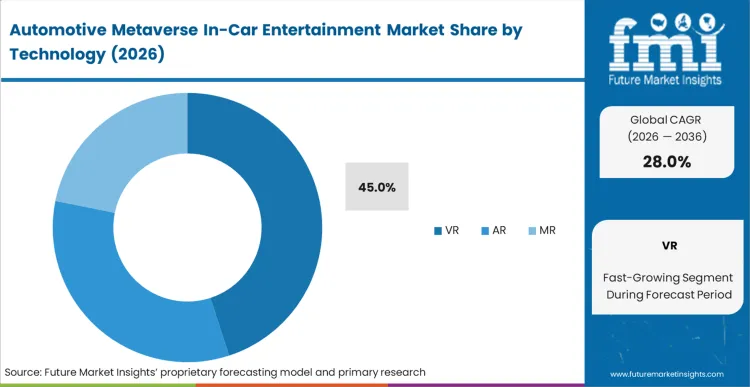
The reason VR holds 45.0% of this market comes down to a single operational reality: original equipment manufacturers can deploy total immersion for rear-seat passengers today without fundamentally altering the structural engineering of the vehicle's glass. Based on FMI's assessment, augmented reality requires complex laminations and projection pathways that disrupt crash safety testing and visibility homologation. By isolating the visual environment entirely, VR allows automotive infotainment SoCs to dictate the experience independent of external physical constraints. Buyers specifying cabin layouts rely on this separation to accelerate their digital roadmaps. If an OEM attempts to force full-windshield AR head-up display automotive projections before the optical physics are solved, they face delayed vehicle launch cycles and massive warranty risks from misaligned rendering.
- Baseline Display Metrics: The initial requirement focuses on refresh rates and pixel density to ensure visual clarity within the constraints of a headset or localized display. Display engineers must maintain absolute frame stability to prevent immediate user rejection.
- Telemetry Synchronization Limits: Even with high resolution, visual rendering that lags behind the physical sensation of a pothole or a sharp turn induces vestibular mismatch. Software developers must close the gap between sensor input and frame output to support safe virtual reality car passenger deployments.
- Acceptability Thresholds: Broad consumer adoption relies entirely on achieving sub-20 millisecond motion-to-photon latency. Original equipment manufacturers that fail to meet this threshold will see their spatial computing investments functionally abandoned by end users.
Automotive Metaverse In-Car Entertainment Market Analysis by Vehicle Type
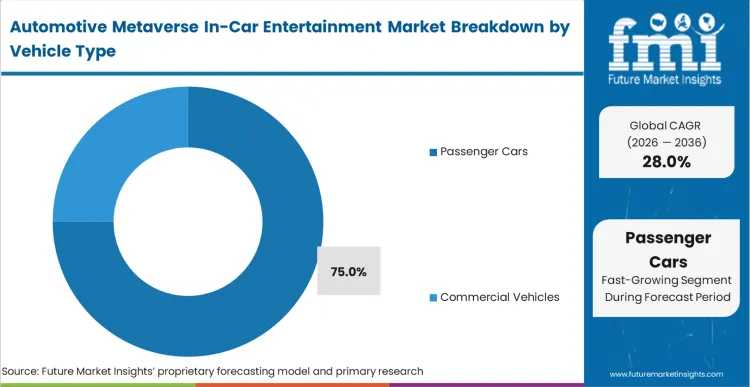
According to FMI's estimates, fleet operators in the commercial sector cannot justify the power draw and weight penalty of these systems. Procurement directors at luxury brands prioritize these localized digital environments to justify price premiums as mechanical performance differentiation evaporates. Legacy infotainment architecture completely fails to handle the simultaneous processing of autonomous driving data and high-fidelity spatial rendering, forcing a complete architectural overhaul. Passenger Cars control 75.0% of this market because premium consumer vehicles are the only platforms currently equipped with the thermal management and power distribution networks required for advanced spatial compute. Companies that fail to deploy these automotive software integration frameworks and passenger metaverse automotive ecosystems cede the premium consumer segment to digitally native entrants, accelerating overall in-car AR VR market growth.
- Purchase Trigger: Brand differentiation in the premium segment has shifted entirely from combustion metrics to digital experience exclusivity. Category managers approve XR hardware to establish immediate visual differentiation on the showroom floor.
- Qualification Validation: Once specified, the system must prove it can operate without drawing critical compute resources away from the advanced driver assistance systems. Safety engineers require strict hypervisor partitioning before approving production.
- Expansion Criteria: Sustained investment occurs when automakers can prove the hardware supports over-the-air content updates that generate subscription revenue. Platforms lacking this monetization pathway are scaled back in subsequent model years.
Automotive Metaverse In-Car Entertainment Market Analysis by Application
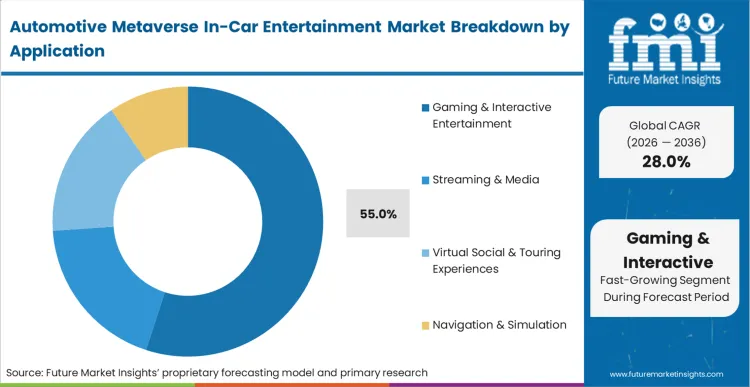
Automotive user experience directors are currently deciding whether to engineer their cabins for passive consumption or interactive engagement. Choosing a passive-only architecture restricts the automaker to a low-margin data conduit rather than a platform owner. FMI analysts opine that passive media like the in-car streaming metaverse requires minimal computational enhancement compared to real-time game engines that react to vehicle telemetry. When engineers implement robust United States automotive display units, they construct environments where external traffic data actively shapes the gameplay narrative. Gaming & Interactive Entertainment captures 55.0% of this segment, dominating metaverse automotive applications, because interactive media commands higher recurring engagement and microtransaction potential than static video streaming.
- Early Adopters: Premium electric vehicle owners utilize these systems during charging cycles. Automakers target this specific dwell time to introduce VR gaming in cars without motion sickness constraints.
- Secondary Integration: As telemetry synchronization improves, usage expands into the rear seats during active transit. Developers optimize their physics engines to incorporate real-world lateral forces into the virtual experience.
- Final Conversion: Mass market adoption occurs when the hardware cost of automotive SoC platforms drops sufficiently to equip mid-tier vehicles. At this stage, interactive entertainment transitions from a luxury option to a standard digital expectation.
Automotive Metaverse In-Car Entertainment Market Analysis by Connectivity
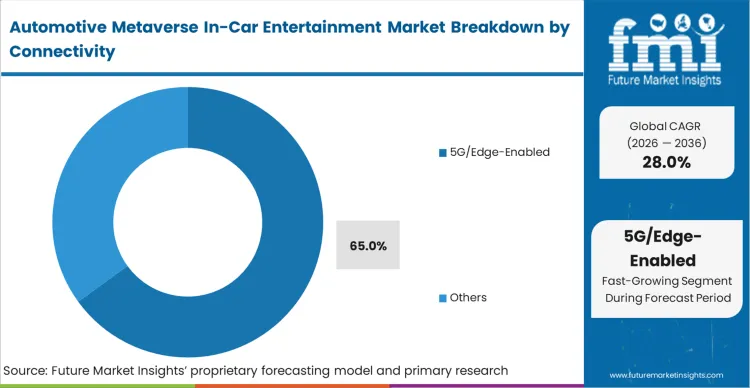
The foundational requirement for any spatial media in a moving environment is the ability to continuously pull heavy computational loads from the cloud to the localized edge without dropping frames. 5G edge metaverse automotive configurations secure 65.0% share because on-board silicon alone cannot store and render infinite metaverse environments without draining the vehicle's battery. In FMI's view, the dependency on edge networks shifts the compute burden, allowing automakers to design sleeker automotive interior layouts free of bulky processing units. Software architects rely on this bandwidth to deliver high-fidelity assets dynamically. If a vehicle's connectivity drops out, the spatial experience immediately collapses into a latent, disorienting freeze.
- Buffering Collapse: When network density falters, edge-rendered environments fail to update dynamically, causing the visual field to stutter. Passengers experience immediate discomfort when the virtual horizon stops tracking.
- Handoff Latency: Moving between cellular towers introduces micro-interruptions that standard video buffering masks but spatial rendering exposes. Network engineers must prioritize ultra-reliable low-latency protocols specifically to sustain automotive XR entertainment adoption.
- Edge Reliance: The system demands constant proximity to localized compute centers. Fleet managers seeking to deploy these systems on rural routes must accept heavy functional limitations until 5G stand-alone infrastructure permeates globally.
Automotive Metaverse In-Car Entertainment Market Drivers, Restraints, and Opportunities
The exhaustion of traditional hardware differentiation drives the XR in-vehicle entertainment CAGR, forcing automotive executives to fundamentally alter how they extract value from their vehicles. Original equipment manufacturers must now engineer their cabins to support continuous, post-sale digital monetization. This structural imperative compels cabin design leads to integrate spatial computing hardware natively into the dashboard and headrests, ensuring the vehicle can run third-party connected infotainment UX frameworks. Brands that successfully manage this transition capture high-margin software revenue; those that delay lose the customer relationship entirely the moment a smartphone is mounted to the dash.
The single biggest friction in this market is the latency bridge between cloud-rendered spatial assets and localized vehicle motion data, causing severe vestibular disconnect. This operational obstacle prevents widespread adoption regardless of how advanced the display hardware becomes. Passengers cannot tolerate a virtual environment that lags behind the physical sensation of acceleration. While localized compute units address part of this friction, the requirement to process heavy automotive OEM telematics concurrently with rendering engines demands silicon capabilities that remain prohibitively expensive for non-luxury tiers.
Opportunities in the Automotive Metaverse In-Car Entertainment Market
- Audio Integration: The spatial mapping of vehicle acoustics allows developers to anchor digital events to specific physical locations within the cabin. Acoustic engineers can capture this by designing directional car audio environments that align perfectly with the rendered visual field.
- Telemetry-As-A-Service: Standardizing the application programming interfaces that expose vehicle suspension data enables third parties to build accurate motion-synchronized apps. Platform directors who open these gateways create an immediate ecosystem advantage over closed-loop competitors.
- Retrofit Computing: The massive installed base of existing vehicles lacks native spatial rendering capabilities. Hardware innovators capture this white space by designing retrofit in-car VR holoride compute hubs that interface with legacy automotive display units while handling the metaverse processing externally.
Regional Analysis
Based on the regional analysis, the Automotive Metaverse In-Car Entertainment Market is segmented into APAC, North America, and Europe across 40 plus countries. Regional adoption of immersive cabin technologies reveals a fractured landscape, driven heavily by local regulatory postures and consumer expectations regarding digital continuity. Asian markets aggressively prioritize spatial compute capabilities to satisfy a digitally native consumer base, whereas Western geographies balance these deployments against strict driver distraction and data privacy frameworks.
.webp "Top Country Growth Comparison Automotive Metaverse In Car Entertainment Market Cagr (2026 2036)")
| Country | CAGR (2026 to 2036) |
|---|---|
| China | 35.0% |
| India | 32.0% |
| South Korea | 30.0% |
| United States | 28.0% |
| Germany | 25.0% |
| United Kingdom | 24.0% |
| Japan | 22.0% |
Source: Future Market Insights (FMI) analysis, based on proprietary forecasting model and primary research
APAC Automotive Metaverse In-Car Entertainment Market Analysis
Consumers across Asian markets demand seamless integration between their transit environments and broader digital ecosystems, treating the vehicle as a connected spatial node rather than isolated hardware. To meet this expectation, domestic automakers are rapidly qualifying automotive control panel architectures capable of handling heavy application loads, prioritizing screen real estate and computing power over legacy mechanical metrics. This aggressive pursuit of digital continuity drives the intensive deployment of spatial capital throughout the region.
- China: Demand for advanced in-car entertainment in China is set to grow at a remarkable 35.0% CAGR through 2036. This explosive trajectory is fueled by domestic product managers who operate under extreme pressure to natively integrate localized metaverse applications directly into vehicle operating systems. Because the Chinese consumer base evaluates purchases primarily on digital ecosystem sophistication, domestic automakers are forced to launch spatial computing features years ahead of Western counterparts, rapidly accelerating the shift toward a software-defined automotive economy.
- India: Software developers in India are leveraging an expanding base of premium electric vehicle early adopters to test spatial applications free from the constraints of legacy internal combustion architectures. The Indian market is forecast to register a CAGR of 32.0%, reflecting a dynamic where digital experience directors bypass traditional infotainment development cycles entirely. By establishing early partnerships with domestic EV manufacturers, suppliers can capture the foundational spatial architecture contracts for the next decade.
- South Korea: South Korea leverages its near-universal 5G density to completely eliminate the network latency barriers that typically hinder spatial rendering in other regions. To capitalize on this, automotive brands and telecommunications providers are co-developing edge nodes specifically optimized for high-speed highway corridors. The South Korea market value is poised to expand at an impressive 30.0% CAGR, with the said distinct structural advantage positions the country as a primary export hub for validated spatial software frameworks.
- Japan: Japan presents a highly cautious deployment environment for immersive displays due to rigorous homologation standards surrounding driver distraction, despite the country's advanced robotics capabilities. FMI estimates the Japanese market to expand at a CAGR of 22.0%, as automotive engineers are compelled to strictly partition rear-seat entertainment networks from the primary vehicle bus for regulatory approval. While the underlying silicon remains highly advanced, the visible user experience is heavily restricted compared to regional neighbors.
FMI's report includes secondary markets across Southeast Asia. The gradual rollout of edge-compute infrastructure in these territories dictates a delayed adoption curve, heavily dependent on the prior standardization of hardware in the primary APAC hubs.
North America Automotive Metaverse In-Car Entertainment Market Analysis
The deployment of spatial computing in the North American cabin is fundamentally shaped by strict safety mandates that demand absolute physical separation between immersive entertainment zones and the driver's operational sightlines. These regulations severely restrict the implementation of full-cabin augmented reality concepts. The procurement directors at major Detroit automakers as a result are prioritizing the integration of high-bandwidth automotive transceivers, investing heavily in localized audio and targeted VR solutions that ensure the rear-seat experience operates entirely independently of critical vehicle functions.
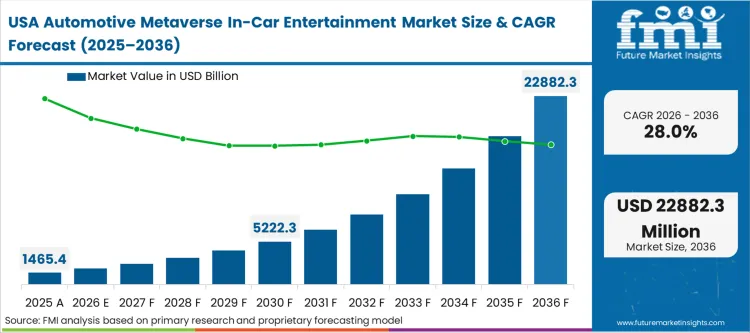
- United States: A CAGR of 28.0% is expected for the United States over the forecast period, driven by the massive distances associated with domestic travel that make long-duration passenger engagement a critical competitive differentiator. To capitalize on this, user experience teams prioritize low-latency motion synchronization over raw graphical fidelity, designing spatial content that remains comfortable over multi-hour journeys. This specific trajectory establishes American OEMs as the primary catalysts for cross-industry partnerships between major gaming console developers and the automotive sector.
FMI's report includes Canadian and Mexican assembly corridors. Capital allocation in these zones focuses predominantly on adapting Tier-1 manufacturing facilities to handle the delicate integration of spatial computing hardware into standard vehicle assembly lines.
Europe Automotive Metaverse In-Car Entertainment Market Analysis
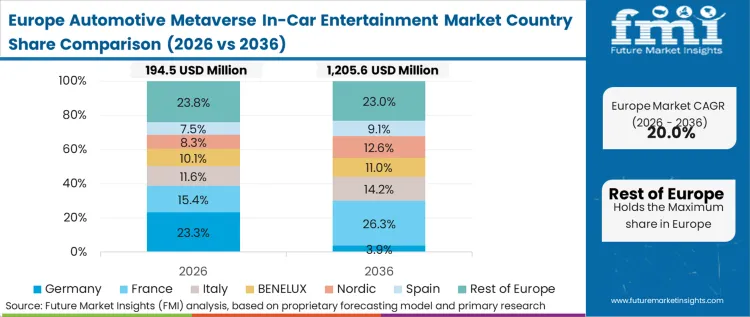
The European approach to the metaverse favors tightly curated, brand-specific digital experiences over open ecosystems, driven by the deep integration of legacy engineering heritage and strict data privacy frameworks. Automakers in this region heavily restrict third-party application access to core telemetry, treating vehicle architecture with extreme protectionism. This infrastructural caution compels software developers to construct heavily partitioned environments that strictly comply with rigorous automotive OTA updates compliance regulations.
- Germany: Hardware integrators in Germany face rigorous thermal and vibration qualification cycles before their spatial compute units receive mass production approval, reflecting an engineering culture that demands digital additions meet the exact same durability standards as mechanical components. Once integrated, these robust architectures empower automakers to push complex, high-fidelity updates without risking field hardware failures. The market growth in Germany is set for a CAGR of 25.0% over the forecast period, driven by this meticulous qualification process.
- United Kingdom: Interior design directors in the UK are leveraging bespoke mixed reality frameworks to completely replace physical controls, utilizing the high concentration of luxury vehicle manufacturing to create unique testing grounds for ultra-premium spatial applications. Sales of spatial products in the UK are on track to record a CAGR of 24.0% as this localized digital luxury implementation clears physical cabin clutter. In the end, this structural shift simplifies the manufacturing complexities associated with right-hand and left-hand drive variants.
FMI's report includes the Nordic region and broader EU member states. These countries are utilizing spatial environments to gamify eco-driving behaviors, aligning the digital entertainment ecosystem with regional decarbonization mandates.
Competitive Aligners for Market Players
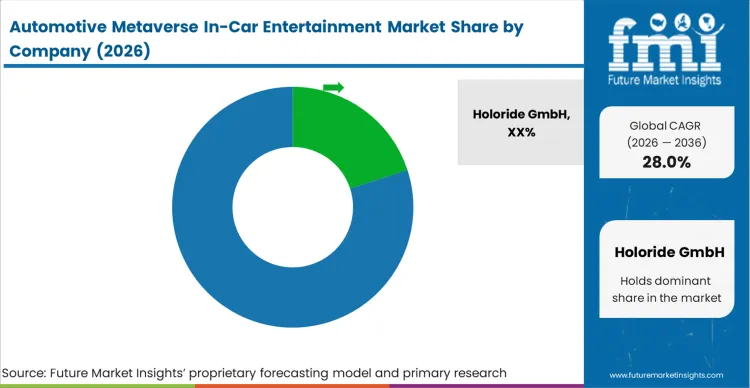
The concentrated nature of the foundational operating system and silicon layer dictates how buyers evaluate vendors in this market. Automakers do not select automotive e-tailing interfaces based on consumer brand recognition; they select them based on the capability of the underlying system-on-chip to handle simultaneous hypervisor partitioning. Leading companies like NVIDIA Corporation and Qualcomm supply the core processing power, while Unity Technologies Inc. provides the rendering logic. The primary variable OEMs use to distinguish qualified partners is the vendor's ability to guarantee sub-20 millisecond latency, a standard pioneered by early integrations like holoride in-car VR and spatial concepts like the WayRay holographic AR car.
Incumbents in the silicon and OS space possess a deep structural advantage through their established relationships with Tier-1 automotive integrators. A challenger attempting to build proprietary in-vehicle apps against the established NVIDIA Unity automotive metaverse ecosystem must overcome the massive switching costs associated with rewriting the vehicle's electrical architecture. To compete, challengers must build standardized middleware that translates raw chassis data into usable game-engine physics without requiring custom integration for every vehicle model. When vendors embed this translation capability directly into their software development kits, they bypass the legacy bottleneck of Tier-1 hardware qualification.
Large automotive buyers actively resist being locked into a single digital ecosystem by forcing smart vehicle architecture that separates the hardware compute layer from the software experience layer. The contrast between a closed Tesla in-car gaming metaverse and an open-platform BMW Mercedes metaverse cockpit highlights the structural tension between consumer tech giants who want to own the cabin interface and automakers who refuse to become mere hardware suppliers. Through 2036, the application and content layer will remain heavily fragmented as automakers curate multiple third-party developers, while the underlying silicon and rendering engine market consolidates around a few dominant architectures capable of meeting automotive safety integrities.
Key Players in Automotive Metaverse In-Car Entertainment Market
- Holoride GmbH
- Tesla Inc.
- BMW AG
- Mercedes-Benz AG
- NVIDIA Corporation
- Unity Technologies Inc.
- WayRay AG
Scope of the Report
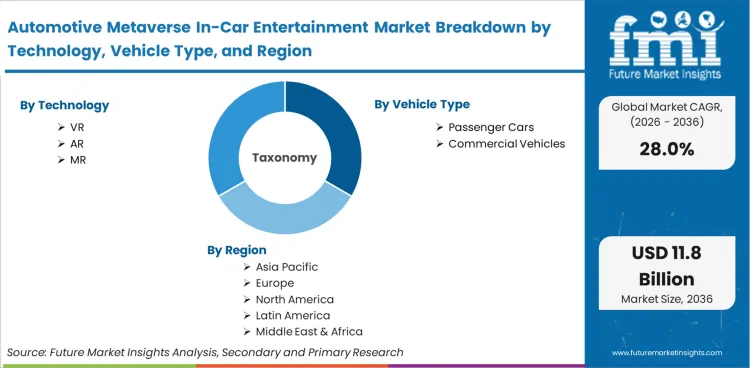
| Metric | Value |
|---|---|
| Quantitative Units | USD 1.0 billion to USD 12.5 billion, at a CAGR of 28.0% |
| Market Definition | The automotive metaverse in-car entertainment market covers the integration of spatial computing, edge rendering, and vehicle telemetry to deliver immersive, motion-synchronized digital experiences inside the passenger cabin. |
| Technology Segmentation | VR, AR, MR |
| Vehicle Type Segmentation | Passenger Cars, Commercial Vehicles |
| Application Segmentation | Gaming & Interactive Entertainment, Streaming & Media, Virtual Social & Touring Experiences, Navigation & Simulation |
| Connectivity Segmentation | 5G/Edge-Enabled |
| Regions Covered | APAC, North America, Europe |
| Countries Covered | China, United States, Germany, Japan, India, South Korea, United Kingdom, and 40 plus countries |
| Key Companies Profiled | Holoride GmbH, Tesla Inc., BMW AG, Mercedes-Benz AG, NVIDIA Corporation, Unity Technologies Inc., WayRay AG |
| Forecast Period | 2026 to 2036 |
| Approach | Primary research aggregated input from OEM digital cabin leads and spatial software architects. Baseline figures anchored to procurement volumes of advanced automotive domain controllers. Forecast models validated against the deployment timelines of localized edge-compute infrastructure across major transit corridors. |
Source: Future Market Insights (FMI) analysis, based on proprietary forecasting model and primary research
Automotive Metaverse In-Car Entertainment Market Segments
Technology:
- VR
- AR
- MR
Vehicle Type:
- Passenger Cars
- Commercial Vehicles
Application:
- Gaming & Interactive Entertainment
- Streaming & Media
- Virtual Social & Touring Experiences
- Navigation & Simulation
Connectivity:
- 5G/Edge-Enabled
Regions:
- North America
- United States
- Canada
- Latin America
- Brazil
- Mexico
- Europe
- Germany
- United Kingdom
- France
- Italy
- Spain
- Asia-Pacific
- China
- Japan
- South Korea
- India
Bibliography
- BMW Group. (2026). BMW Group report 2025. BMW Group.
- Qualcomm Incorporated. (2025, November 5). Fourth quarter and fiscal 2025 earnings presentation. Qualcomm Incorporated.
- Ford Motor Company. (2025). 2025 integrated sustainability and financial report. Ford Motor Company.
- Mercedes-Benz Group AG. (2025). Mercedes-Benz Group annual report 2025. Mercedes-Benz Group AG.
- NVIDIA Corporation. (2025). NVIDIA DRIVE AGX Thor development platform: Technical overview (automotive XR and software-defined vehicle platform). NVIDIA Corporation.
- Zhou, C., et al. (2024). Automotive augmented reality head-up displays: Opportunities and challenges. Micromachines.
- Yang, L., et al. (2025). Xstudio - a collaborative metaverse-based tool for automotive design processes. IEEE Transactions on Visualization and Computer Graphics.
This bibliography is provided for reader reference. The full FMI report contains the complete reference list with primary source documentation.
Frequently Asked Questions
How large is the Automotive Metaverse In-Car Entertainment Market in 2026?
The industry is expected to be valued at USD 1.0 billion in 2026, reflecting the initial capital injection from premium automakers shifting research budgets toward high-compute cabin architectures.
What will it be valued at by 2036?
The market valuation is projected to reach USD 12.5 billion by 2036 as spatial computing transitions from a luxury option to a standardized digital expectation across mid-tier platforms.
What CAGR is projected?
A CAGR of 28.0% is anticipated through 2036, demonstrating how quickly automakers must deploy localized rendering hardware to capture recurring post-sale software revenues.
Which Technology segment leads?
VR holds a 45.0% share because isolating the visual environment entirely allows automakers to deploy spatial media immediately without awaiting the complex optical breakthroughs required for full-windshield augmented reality.
Which Vehicle Type segment leads?
Passenger Cars account for 75.0% of the market because only premium consumer vehicles currently possess the sophisticated electrical architectures and thermal management systems capable of sustaining high-fidelity edge rendering.
Which Application segment leads?
Gaming & Interactive Entertainment commands 55.0% share because interactive media generates significantly higher recurring engagement than passive video, allowing automakers to maximize their digital monetization window.
What drives rapid growth?
The exhaustion of traditional mechanical differentiation compels original equipment manufacturers to build proprietary digital ecosystems to avoid yielding their entire post-sale revenue stream to established consumer technology giants.
What is the primary restraint?
The vestibular disconnect caused by latency between vehicle motion and visual rendering remains the largest structural barrier, as any failure to synchronize chassis telemetry with the game engine results in immediate passenger motion sickness.
Which country grows fastest?
China grows the fastest at a 35.0% CAGR because its consumer base evaluates vehicles primarily on digital ecosystem sophistication, forcing domestic automakers to deploy spatial computing years ahead of Western schedules.
How do European privacy mandates affect deployment?
Strict data protection frameworks in Europe force automakers to build tightly partitioned environments, requiring software developers to design localized, brand-specific digital experiences rather than open metaverse applications.
Why is 5G connectivity essential for this ecosystem?
5G infrastructure is essential because it allows the vehicle to offload heavy computational workloads to edge nodes, maintaining high visual fidelity through dynamic streaming without draining the vehicle's battery reserves.
How do automakers avoid hardware commoditization?
Tier-1 suppliers avoid hardware commoditization by engineering unified domain controllers to control the automotive multimodal interaction, cementing their position as critical architectural partners rather than replaceable component vendors.
What creates the switching cost for OS vendors?
Rewriting a vehicle's electrical architecture to support a new operating system requires years of homologation testing, giving incumbents who already process critical driving data a massive advantage.
How does North America handle driver distraction regulations?
Procurement directors in Detroit navigate strict safety mandates by investing in targeted VR solutions and spatial audio that cannot physically bleed into the driver's sightline, completely separating the rear-seat immersive experience from cabin operations.
Why are commercial vehicles lagging in adoption?
Commercial vehicles lag in adoption because fleet operators evaluate technology strictly on cost-per-mile efficiency, and the massive power draw, weight penalty, and required data subscriptions provide no return on investment.
How do motion synchronization algorithms work?
Developers embed predictive physics engines that tap into the vehicle's suspension application programming interface to anticipate lateral G-forces milliseconds before they occur, shifting the visual frame seamlessly to match the passenger's physical equilibrium.
What role do traditional game engines play?
Traditional game engines provide the essential rendering logic that allows developers to port existing spatial content directly into the cabin, bypassing the need for automakers to build proprietary physics engines from scratch.
Why is India growing at 32.0%?
India is growing rapidly at 32.0% because digital experience directors are utilizing greenfield electric vehicle platforms to bypass traditional 2D infotainment cycles, deploying native spatial architectures without the integration debt of legacy combustion models.
How does spatial audio enhance the metaverse?
Directional acoustics anchor digital events to specific physical coordinates within the vehicle, providing a multi-sensory alignment that validates the visual illusion and reduces the cognitive dissonance that typically induces motion sickness.
What must challengers build to disrupt incumbents?
Disruptors must engineer standardized middleware that translates raw chassis telemetry into usable game-engine data, bypassing the need for custom hardware integration and allowing spatial app developers to scale across multiple vehicle brands simultaneously.
Why do automakers resist consumer tech monopolies in the cabin?
Automakers resist consumer tech monopolies as a survival tactic to maintain ownership of the customer's digital relationship, avoiding being reduced to a low-margin hardware shell if a tech giant controls the spatial automotive human machine interface.
What is the functional consequence of delaying this architecture?
Brands that delay investing in this architecture will find their dashboards permanently occupied by third-party devices, forfeiting the only high-margin software revenue available in the next decade of automotive design.
Preview the report firsthand - request a free sample
Get SampleGet the brochure for pricing and purchase details.
Get PDFTable of Content
- Executive Summary
- Global Market Outlook
- Demand-side Trends
- Supply-side Trends
- Technology Roadmap Analysis
- Analysis and Recommendations
- Market Overview
- Market Coverage / Taxonomy
- Market Definition / Scope / Limitations
- Research Methodology
- Chapter Orientation
- Analytical Lens and Working Hypotheses
- Market Structure, Signals, and Trend Drivers
- Benchmarking and Cross-market Comparability
- Market Sizing, Forecasting, and Opportunity Mapping
- Research Design and Evidence Framework
- Desk Research Programme (Secondary Evidence)
- Company Annual and Sustainability Reports
- Peer-reviewed Journals and Academic Literature
- Corporate Websites, Product Literature, and Technical Notes
- Earnings Decks and Investor Briefings
- Statutory Filings and Regulatory Disclosures
- Technical White Papers and Standards Notes
- Trade Journals, Industry Magazines, and Analyst Briefs
- Conference Proceedings, Webinars, and Seminar Materials
- Government Statistics Portals and Public Data Releases
- Press Releases and Reputable Media Coverage
- Specialist Newsletters and Curated Briefings
- Sector Databases and Reference Repositories
- FMI Internal Proprietary Databases and Historical Market Datasets
- Subscription Datasets and Paid Sources
- Social Channels, Communities, and Digital Listening Inputs
- Additional Desk Sources
- Expert Input and Fieldwork (Primary Evidence)
- Primary Modes
- Qualitative Interviews and Expert Elicitation
- Quantitative Surveys and Structured Data Capture
- Blended Approach
- Why Primary Evidence is Used
- Field Techniques
- Interviews
- Surveys
- Focus Groups
- Observational and In-context Research
- Social and Community Interactions
- Stakeholder Universe Engaged
- C-suite Leaders
- Board Members
- Presidents and Vice Presidents
- R&D and Innovation Heads
- Technical Specialists
- Domain Subject-matter Experts
- Scientists
- Physicians and Other Healthcare Professionals
- Governance, Ethics, and Data Stewardship
- Research Ethics
- Data Integrity and Handling
- Primary Modes
- Tooling, Models, and Reference Databases
- Desk Research Programme (Secondary Evidence)
- Data Engineering and Model Build
- Data Acquisition and Ingestion
- Cleaning, Normalisation, and Verification
- Synthesis, Triangulation, and Analysis
- Quality Assurance and Audit Trail
- Market Background
- Market Dynamics
- Drivers
- Restraints
- Opportunity
- Trends
- Scenario Forecast
- Demand in Optimistic Scenario
- Demand in Likely Scenario
- Demand in Conservative Scenario
- Opportunity Map Analysis
- Product Life Cycle Analysis
- Supply Chain Analysis
- Investment Feasibility Matrix
- Value Chain Analysis
- PESTLE and Porter’s Analysis
- Regulatory Landscape
- Regional Parent Market Outlook
- Production and Consumption Statistics
- Import and Export Statistics
- Market Dynamics
- Global Market Analysis 2021 to 2025 and Forecast, 2026 to 2036
- Historical Market Size Value (USD Million) Analysis, 2021 to 2025
- Current and Future Market Size Value (USD Million) Projections, 2026 to 2036
- Y-o-Y Growth Trend Analysis
- Absolute $ Opportunity Analysis
- Global Market Pricing Analysis 2021 to 2025 and Forecast 2026 to 2036
- Global Market Analysis 2021 to 2025 and Forecast 2026 to 2036, By Technology
- Introduction / Key Findings
- Historical Market Size Value (USD Million) Analysis By Technology , 2021 to 2025
- Current and Future Market Size Value (USD Million) Analysis and Forecast By Technology , 2026 to 2036
- VR
- AR
- MR
- VR
- Y-o-Y Growth Trend Analysis By Technology , 2021 to 2025
- Absolute $ Opportunity Analysis By Technology , 2026 to 2036
- Global Market Analysis 2021 to 2025 and Forecast 2026 to 2036, By Vehicle Type
- Introduction / Key Findings
- Historical Market Size Value (USD Million) Analysis By Vehicle Type, 2021 to 2025
- Current and Future Market Size Value (USD Million) Analysis and Forecast By Vehicle Type, 2026 to 2036
- Passenger Cars
- Commercial Vehicles
- Passenger Cars
- Y-o-Y Growth Trend Analysis By Vehicle Type, 2021 to 2025
- Absolute $ Opportunity Analysis By Vehicle Type, 2026 to 2036
- Global Market Analysis 2021 to 2025 and Forecast 2026 to 2036, By Application
- Introduction / Key Findings
- Historical Market Size Value (USD Million) Analysis By Application, 2021 to 2025
- Current and Future Market Size Value (USD Million) Analysis and Forecast By Application, 2026 to 2036
- Gaming & Interactive Entertainment
- Streaming & Media
- Virtual Social & Touring Experiences
- Navigation & Simulation
- Gaming & Interactive Entertainment
- Y-o-Y Growth Trend Analysis By Application, 2021 to 2025
- Absolute $ Opportunity Analysis By Application, 2026 to 2036
- Global Market Analysis 2021 to 2025 and Forecast 2026 to 2036, By Connectivity
- Introduction / Key Findings
- Historical Market Size Value (USD Million) Analysis By Connectivity, 2021 to 2025
- Current and Future Market Size Value (USD Million) Analysis and Forecast By Connectivity, 2026 to 2036
- 5G/Edge-Enabled
- Others
- 5G/Edge-Enabled
- Y-o-Y Growth Trend Analysis By Connectivity, 2021 to 2025
- Absolute $ Opportunity Analysis By Connectivity, 2026 to 2036
- Global Market Analysis 2021 to 2025 and Forecast 2026 to 2036, By Region
- Introduction
- Historical Market Size Value (USD Million) Analysis By Region, 2021 to 2025
- Current Market Size Value (USD Million) Analysis and Forecast By Region, 2026 to 2036
- North America
- Latin America
- Western Europe
- Eastern Europe
- East Asia
- South Asia and Pacific
- Middle East & Africa
- Market Attractiveness Analysis By Region
- North America Market Analysis 2021 to 2025 and Forecast 2026 to 2036, By Country
- Historical Market Size Value (USD Million) Trend Analysis By Market Taxonomy, 2021 to 2025
- Market Size Value (USD Million) Forecast By Market Taxonomy, 2026 to 2036
- By Country
- USA
- Canada
- Mexico
- By Technology
- By Vehicle Type
- By Application
- By Connectivity
- By Country
- Market Attractiveness Analysis
- By Country
- By Technology
- By Vehicle Type
- By Application
- By Connectivity
- Key Takeaways
- Latin America Market Analysis 2021 to 2025 and Forecast 2026 to 2036, By Country
- Historical Market Size Value (USD Million) Trend Analysis By Market Taxonomy, 2021 to 2025
- Market Size Value (USD Million) Forecast By Market Taxonomy, 2026 to 2036
- By Country
- Brazil
- Chile
- Rest of Latin America
- By Technology
- By Vehicle Type
- By Application
- By Connectivity
- By Country
- Market Attractiveness Analysis
- By Country
- By Technology
- By Vehicle Type
- By Application
- By Connectivity
- Key Takeaways
- Western Europe Market Analysis 2021 to 2025 and Forecast 2026 to 2036, By Country
- Historical Market Size Value (USD Million) Trend Analysis By Market Taxonomy, 2021 to 2025
- Market Size Value (USD Million) Forecast By Market Taxonomy, 2026 to 2036
- By Country
- Germany
- UK
- Italy
- Spain
- France
- Nordic
- BENELUX
- Rest of Western Europe
- By Technology
- By Vehicle Type
- By Application
- By Connectivity
- By Country
- Market Attractiveness Analysis
- By Country
- By Technology
- By Vehicle Type
- By Application
- By Connectivity
- Key Takeaways
- Eastern Europe Market Analysis 2021 to 2025 and Forecast 2026 to 2036, By Country
- Historical Market Size Value (USD Million) Trend Analysis By Market Taxonomy, 2021 to 2025
- Market Size Value (USD Million) Forecast By Market Taxonomy, 2026 to 2036
- By Country
- Russia
- Poland
- Hungary
- Balkan & Baltic
- Rest of Eastern Europe
- By Technology
- By Vehicle Type
- By Application
- By Connectivity
- By Country
- Market Attractiveness Analysis
- By Country
- By Technology
- By Vehicle Type
- By Application
- By Connectivity
- Key Takeaways
- East Asia Market Analysis 2021 to 2025 and Forecast 2026 to 2036, By Country
- Historical Market Size Value (USD Million) Trend Analysis By Market Taxonomy, 2021 to 2025
- Market Size Value (USD Million) Forecast By Market Taxonomy, 2026 to 2036
- By Country
- China
- Japan
- South Korea
- By Technology
- By Vehicle Type
- By Application
- By Connectivity
- By Country
- Market Attractiveness Analysis
- By Country
- By Technology
- By Vehicle Type
- By Application
- By Connectivity
- Key Takeaways
- South Asia and Pacific Market Analysis 2021 to 2025 and Forecast 2026 to 2036, By Country
- Historical Market Size Value (USD Million) Trend Analysis By Market Taxonomy, 2021 to 2025
- Market Size Value (USD Million) Forecast By Market Taxonomy, 2026 to 2036
- By Country
- India
- ASEAN
- Australia & New Zealand
- Rest of South Asia and Pacific
- By Technology
- By Vehicle Type
- By Application
- By Connectivity
- By Country
- Market Attractiveness Analysis
- By Country
- By Technology
- By Vehicle Type
- By Application
- By Connectivity
- Key Takeaways
- Middle East & Africa Market Analysis 2021 to 2025 and Forecast 2026 to 2036, By Country
- Historical Market Size Value (USD Million) Trend Analysis By Market Taxonomy, 2021 to 2025
- Market Size Value (USD Million) Forecast By Market Taxonomy, 2026 to 2036
- By Country
- Kingdom of Saudi Arabia
- Other GCC Countries
- Turkiye
- South Africa
- Other African Union
- Rest of Middle East & Africa
- By Technology
- By Vehicle Type
- By Application
- By Connectivity
- By Country
- Market Attractiveness Analysis
- By Country
- By Technology
- By Vehicle Type
- By Application
- By Connectivity
- Key Takeaways
- Key Countries Market Analysis
- USA
- Pricing Analysis
- Market Share Analysis, 2025
- By Technology
- By Vehicle Type
- By Application
- By Connectivity
- Canada
- Pricing Analysis
- Market Share Analysis, 2025
- By Technology
- By Vehicle Type
- By Application
- By Connectivity
- Mexico
- Pricing Analysis
- Market Share Analysis, 2025
- By Technology
- By Vehicle Type
- By Application
- By Connectivity
- Brazil
- Pricing Analysis
- Market Share Analysis, 2025
- By Technology
- By Vehicle Type
- By Application
- By Connectivity
- Chile
- Pricing Analysis
- Market Share Analysis, 2025
- By Technology
- By Vehicle Type
- By Application
- By Connectivity
- Germany
- Pricing Analysis
- Market Share Analysis, 2025
- By Technology
- By Vehicle Type
- By Application
- By Connectivity
- UK
- Pricing Analysis
- Market Share Analysis, 2025
- By Technology
- By Vehicle Type
- By Application
- By Connectivity
- Italy
- Pricing Analysis
- Market Share Analysis, 2025
- By Technology
- By Vehicle Type
- By Application
- By Connectivity
- Spain
- Pricing Analysis
- Market Share Analysis, 2025
- By Technology
- By Vehicle Type
- By Application
- By Connectivity
- France
- Pricing Analysis
- Market Share Analysis, 2025
- By Technology
- By Vehicle Type
- By Application
- By Connectivity
- India
- Pricing Analysis
- Market Share Analysis, 2025
- By Technology
- By Vehicle Type
- By Application
- By Connectivity
- ASEAN
- Pricing Analysis
- Market Share Analysis, 2025
- By Technology
- By Vehicle Type
- By Application
- By Connectivity
- Australia & New Zealand
- Pricing Analysis
- Market Share Analysis, 2025
- By Technology
- By Vehicle Type
- By Application
- By Connectivity
- China
- Pricing Analysis
- Market Share Analysis, 2025
- By Technology
- By Vehicle Type
- By Application
- By Connectivity
- Japan
- Pricing Analysis
- Market Share Analysis, 2025
- By Technology
- By Vehicle Type
- By Application
- By Connectivity
- South Korea
- Pricing Analysis
- Market Share Analysis, 2025
- By Technology
- By Vehicle Type
- By Application
- By Connectivity
- Russia
- Pricing Analysis
- Market Share Analysis, 2025
- By Technology
- By Vehicle Type
- By Application
- By Connectivity
- Poland
- Pricing Analysis
- Market Share Analysis, 2025
- By Technology
- By Vehicle Type
- By Application
- By Connectivity
- Hungary
- Pricing Analysis
- Market Share Analysis, 2025
- By Technology
- By Vehicle Type
- By Application
- By Connectivity
- Kingdom of Saudi Arabia
- Pricing Analysis
- Market Share Analysis, 2025
- By Technology
- By Vehicle Type
- By Application
- By Connectivity
- Turkiye
- Pricing Analysis
- Market Share Analysis, 2025
- By Technology
- By Vehicle Type
- By Application
- By Connectivity
- South Africa
- Pricing Analysis
- Market Share Analysis, 2025
- By Technology
- By Vehicle Type
- By Application
- By Connectivity
- USA
- Market Structure Analysis
- Competition Dashboard
- Competition Benchmarking
- Market Share Analysis of Top Players
- By Regional
- By Technology
- By Vehicle Type
- By Application
- By Connectivity
- Competition Analysis
- Competition Deep Dive
- Holoride GmbH
- Overview
- Product Portfolio
- Profitability by Market Segments (Product/Age /Sales Channel/Region)
- Sales Footprint
- Strategy Overview
- Marketing Strategy
- Product Strategy
- Channel Strategy
- Tesla Inc.
- BMW AG
- Mercedes-Benz AG
- NVIDIA Corporation
- Value (USD Million)y Technologies Inc.
- WayRay AG
- Holoride GmbH
- Competition Deep Dive
- Assumptions & Acronyms Used


