

- Industry Size (2026)
- USD 230.1 Mn
- Forecast (2036)
- USD 469.7 Mn
- CAGR (2026 to 2036)
- 7.4%
Automotive Rotor Position Sensor for E-Axle Market Size, Market Forecast and Outlook By FMI
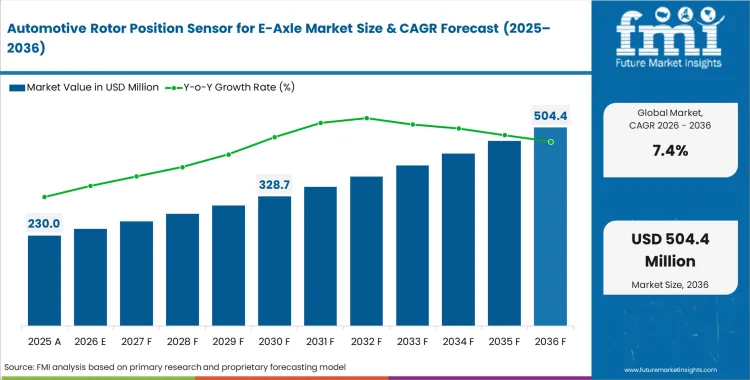
The automotive rotor position sensor for E-axle market was valued at USD 214.2 million in 2025 and is projected to reach USD 230.1 million in 2026. The market is expected to expand at a CAGR of 7.4% during 2026 to 2036, with total valuation projected at USD 469.7 million by 2036. Adoption is driven by increasing integration of E-axle systems, where compact design and higher thermal tolerance influence sensor requirements.
Summary of Automotive Rotor Position Sensor for E-Axle Market
- The market is estimated at USD 214.2 million in 2025.
- The market is projected to reach USD 469.7 million by 2036.
- The market is expected to grow at a CAGR of 7.4% from 2026 to 2036.
- The forecast period represents an incremental opportunity of USD 238.0 million.
- Resolver-based sensors lead the sensor type segment with a 54% share.
- Passenger electric vehicles dominate the vehicle type segment with a 68% share.
- End-shaft mounting leads the design segment with a 49% share.
- Sine-cosine output interfaces lead the interface segment with a 47% share.
- OEM fitment leads the sales channel segment with an 81% share.
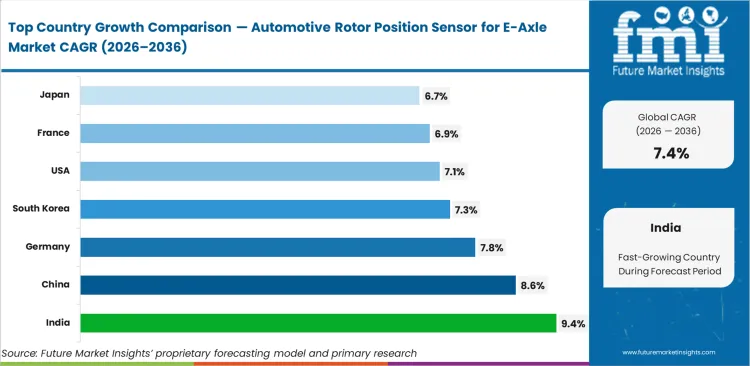
- India (9.4%), China (8.6%), and Germany (7.8%) are among the fastest-growing markets.
Design priorities are shifting toward compact sensing solutions that align with integrated electric drive units. Space constraints within high-voltage powertrains influence sensor placement and configuration. Electromagnetic interference resistance becomes a key performance parameter; as stable signal output is required under high-speed operating conditions. Sensor selection increasingly focuses on reliability and compatibility with high-voltage environments.
System integration is shaping component architecture across electric powertrains. Standardization of digital output protocols reduces dependence on complex analog wiring systems. Digital interfaces support faster data transmission and simplify integration with inverter platforms. This transition improves system efficiency and reduces overall component complexity within electric drive units.
India is estimated to record a CAGR of 9.4% in the automotive rotor position sensor for E-axle market from 2026 to 2036, followed by China at 8.6%, Germany at 7.8%, South Korea at 7.3%, the United States at 7.1%, France at 6.9%, and Japan at 6.7% through 2036. Growth patterns vary by region, with emerging markets focusing on compact mobility solutions and established automotive regions emphasizing high-performance electric platforms.
Segmental Analysis
Automotive Rotor Position Sensor for E-Axle Market Analysis by Sensor Type
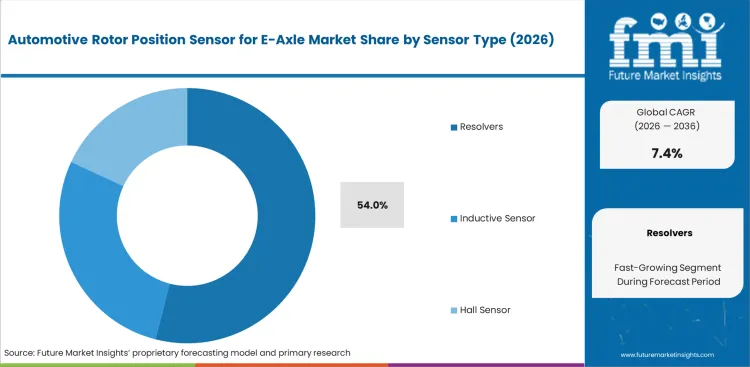
High-voltage inverter environments introduce significant electromagnetic interference, which affects sensor signal stability. Conventional designs struggle under these conditions, especially during rapid switching cycles. Resolvers remain preferred due to their passive construction and resistance to noise and thermal stress. Performance reliability becomes critical in oil-cooled systems where temperature variation is constant. Resolvers account for an estimated 54.0% share of rotor position sensors for e-axles in 2026, supported by their ability to maintain signal integrity under demanding operating conditions.
- Initial topology selection: Powertrain architects mandate inductive principles early in development. ASIC sourcing managers gain immediate axial length reductions when deploying an automotive inductive resolver.
- EMC validation hurdles: Laboratory testing exposes raw signal vulnerabilities during rapid acceleration. Hardware engineering leads must implement costly shielding counter-measures.
- Fleet renewal criteria: Real-world failure data heavily dictates next-generation sourcing. Supplier quality managers abandon low-tier vendors entirely following field thermal degradation incidents.
Automotive Rotor Position Sensor for E-Axle Market Analysis by Vehicle Type
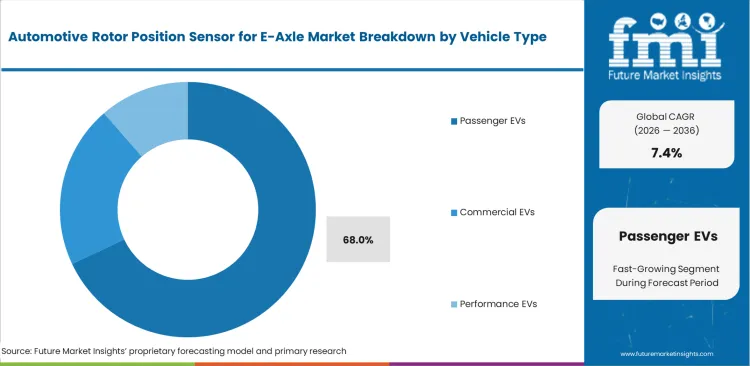
Passenger EVs are anticipated to hold 68.0% share in 2026 as cabin acoustics expose any torque ripple generated by low-fidelity motor control. Based on FMI's assessment, electric traction motor calibration engineers demand sub-degree EV motor angle sensor accuracy to ensure perfectly smooth low-speed maneuvering. A distinct reality practitioner engineers acknowledge is that commercial vehicle platforms actively reject these high-resolution parts, prioritizing sheer mechanical robustness over micro-degree precision. E-axle product managers who deploy passenger-grade sensors in heavy-duty applications experience rapid mechanical fatigue, resulting in unacceptable fleet downtime.
- BOM compression pressure: Component buyers aggressively target feedback devices for cost reduction. Procurement directors face intense supplier pushback on premium ASIL-D certified silicon.
- Hidden calibration expenses: Integration software tuning consumes massive engineering resources. Motor control specialists discover that cheap hardware necessitates expensive algorithmic compensation.
- Lifecycle warranty exposure: Premature degradation triggers complete drive unit replacements. Financial risk officers mandate over-specified components to avoid catastrophic recall scenarios.
Automotive Rotor Position Sensor for E-Axle Market Analysis by Mounting Design
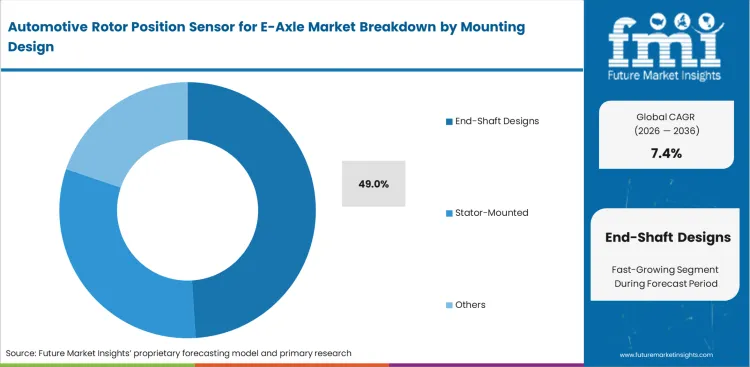
Sensor placement affects both thermal exposure and packaging efficiency within e-axle systems. End-shaft mounting simplifies integration by providing direct access without interfering with magnetic flux paths. This configuration reduces exposure to internal heat sources, improving component longevity. End-shaft designs are estimated to account for 49.0% share of mounting configurations in 2026. Though space constraints emerge as system compactness becomes a priority, limiting further optimization of drivetrain architecture.
- Bearing runout interference: Mechanical wear introduces eccentric shaft motion over time. Quality control supervisors observe unacceptable signal jitter causing erratic torque delivery.
- Thermal saturation risk: Stator-mounted variants absorb massive heat loads during sustained climbing. Thermal engineering heads must deploy active cooling channels to prevent chip failure.
- Integration alignment precision: Module insertion requires microscopic robotic accuracy. Manufacturing operations directors face crippling end-of-line rejection rates if alignment pins drift slightly.
Automotive Rotor Position Sensor for E-Axle Market Analysis by Output Interface
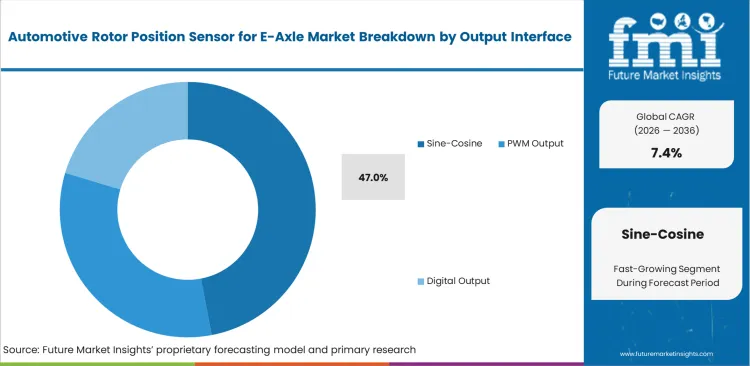
Inverter architecture leads weigh noise immunity of analog signals against harness weight reduction of digital protocols. Sine-cosine interfaces are projected to command 47.0% share, sustained by deeply entrenched legacy software libraries. According to FMI's estimates, firmware development directors actively resist transitioning to modern digital standards to avoid rewriting millions of lines of proven functional safety code. Demanding automotive electronics digitalization discover that control loops are entirely hardcoded for analog processing, making this a software bottleneck rather than hardware limitation. Systems architects who force digital interfaces onto legacy inverters introduce latency issues that destabilize high-speed motor control.
- High-speed latency thresholds: Rapid rotor acceleration challenges basic digital output refresh rates. Control algorithms developers require specialized predictive compensation to maintain stability.
- Interference rejection capability: Differential analog pairs easily reject common-mode noise. Electrical integration leads specify these robust channels for densely packed dual-motor axles.
- Safety diagnostic coverage: PWM outputs inherently broadcast internal chip status. Functional safety managers utilize this continuous heartbeat to achieve stringent ISO 26262 compliance ratings.
Automotive Rotor Position Sensor for E-Axle Market Analysis by Sales Channel
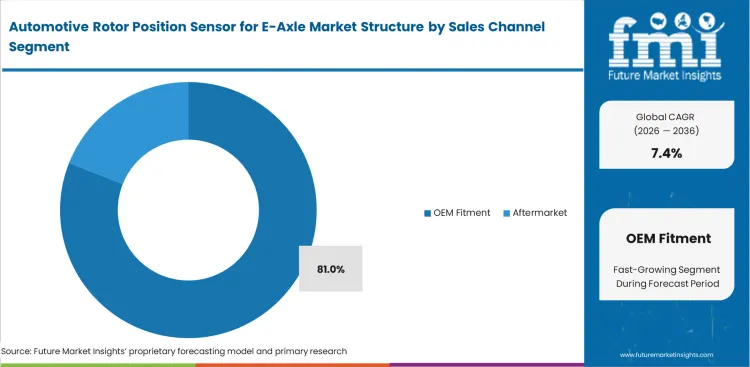
Integration within e-axle assemblies restricts component-level replacement and defines distribution channels. Sensors are embedded during manufacturing, limiting accessibility for aftermarket servicing. OEM fitment is expected to account for 81.0% share of rotor position sensor sales for e-axles in 2026, reflecting closed-system design. Replacement typically involves entire drive unit exchange rather than individual component repair. This structure reduces aftermarket participation and shifts value concentration toward integrated supply chains.
- Tier-1 initial sourcing: Drive unit integrators select components during earliest prototype phases. Supplier qualification leads lock down bill of materials years before vehicle launch.
- OES channel provisioning: Automakers stock complete sub-assemblies for regional distribution centers. Parts logistics directors prioritize sealed modules over individual silicon components.
- Third-party remanufacturing limits: Independent rebuilders struggle with proprietary magnetic calibration protocols. Aftermarket operations heads abandon piecemeal repairs in favor of core exchange programs.
Automotive Rotor Position Sensor for E-Axle Market Drivers, Restraints, and Opportunities
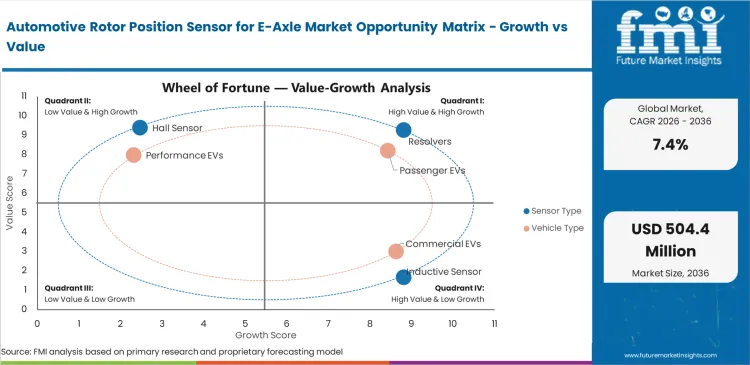
High-voltage silicon carbide inverters operating at 800 volts generate electromagnetic interference that affects signal stability in rotor position sensing systems. Sensor designs require strong noise rejection capability while maintaining sub-degree accuracy at high rotational speeds, including operation near 20,000 RPM. Delays in adopting improved sensing architectures reduce control precision and lead to conservative torque limits, which impact acceleration performance. Electromagnetic tolerance requirements continue to increase as power density rises in integrated e-axle systems.
Electromagnetic compatibility testing adds complexity during electric drive unit integration. Placement of sensing components near high-voltage switching modules increases exposure to interference and extends validation timelines. Sensorless control approaches show limitations in low-speed and high-torque conditions, maintaining reliance on physical sensing hardware. Shielding solutions improve interference protection but add weight and affect overall system efficiency. Design trade-offs between signal stability, weight, and integration complexity remain central to sensor development.
Opportunities in the Automotive Rotor Position Sensor for E-Axle Market
- ASIL-D integrated redundancy: ASIC designers embedding dual independent sensing elements onto single silicon dies. Purchasing directors actively seek these fault-tolerant components to streamline functional safety compliance.
- High-speed inductive commercialization: Material scientists developing printed circuit board coils capable of tracking extreme rotational speeds. E-axle platform managers desperately need these low-profile alternatives to shrink transmission length.
- Magnetic rotor sensing in EVs: Mechanical engineering leads merging position tracking directly into rotor support structures. Drivetrain architects deploying this electric vehicle e-axle technology eliminate standalone mounting brackets entirely.
Regional Analysis
Based on regional analysis, Automotive Rotor Position Sensor for E-Axle is segmented into Asia Pacific, North America, and Europe across 40 plus countries.
.webp "Top Country Growth Comparison Automotive Rotor Position Sensor For E Axle Market Cagr (2026 2036)")
| Country | CAGR (2026 to 2036) |
|---|---|
| India | 9.4% |
| China | 8.6% |
| Germany | 7.8% |
| South Korea | 7.3% |
| United States | 7.1% |
| France | 6.9% |
| Japan | 6.7% |
Source: Future Market Insights (FMI) analysis, based on proprietary forecasting model and primary research
Asia Pacific Automotive Rotor Position Sensor for E-Axle Market Analysis
Electrification mandates reshape drivetrain architectures across Asia Pacific. Compact E-axle systems gain preference under performance-linked regulatory frameworks. Localized semiconductor production supports rapid iteration of sensor designs. Integration of sensing technologies into motor assemblies improves efficiency while reducing component complexity.
- India: Localization policies accelerate development of domestic sensor manufacturing ecosystems across India. The automotive rotor position sensor market for E-axle in India is anticipated to record a CAGR of 9.4% over the forecast period, supported by integration of locally produced components into electric drivetrain systems. Supply chain consolidation improves cost efficiency across vehicle production. Strong alignment with policy-driven manufacturing incentives strengthens adoption across expanding electric vehicle platforms.
- China: Competitive pricing structures drive rapid integration of simplified sensor architectures across China. High-volume production encourages transition toward PCB-based inductive systems within domestic vehicle platforms. The automotive rotor position sensor market for e-axle in China is predicted to grow at 8.6% during the study period, reflecting strong adoption of integrated sensing formats. Manufacturing scale supports consistent output across export-focused electric vehicle supply chains.
- South Korea: High-speed electric motor requirements increase demand for advanced sensing technologies across South Korea. Precision magnetic sensing supports stable signal feedback under extreme rotational speeds. Demand for automotive rotor position sensor for e-axle in South Korea is likely to expand at a CAGR of 7.3% across the assessment timeline, driven by adoption of high-performance sensing solutions. Reliable signal accuracy supports consistent motor control across performance-driven electric vehicle applications.
- Japan: Established hybrid-electric systems sustain reliance on proven sensing technologies across Japan. Emphasis on long-term reliability increases demand for validated resolver-based designs. Japan is estimated to reach 6.7% CAGR throughout the forecast duration, reflecting stable adoption of precision-engineered sensor systems. Consistent performance supports defect minimization across advanced automotive manufacturing environments.
FMI's report includes extensive coverage of surrounding Southeast Asian nations. Regional supply chain officers increasingly rely on localized assembly hubs to bypass volatile trans-Pacific shipping bottlenecks.
North America Automotive Rotor Position Sensor for E-Axle Market Analysis
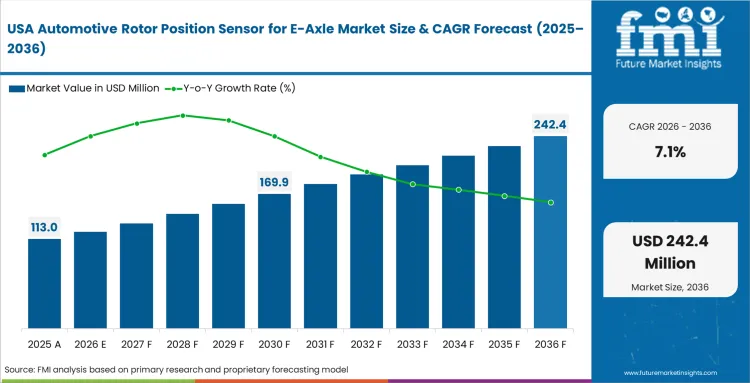
Heavy-duty towing requirements fundamentally shape domestic electric powertrain specifications. Commercial vehicle chief engineers actively reject delicate silicon-based sensing, favoring massive variable-reluctance resolvers capable of surviving extreme thermal saturation during sustained uphill hauling. As per FMI's projection, sheer torque demands force component suppliers to over-engineer magnetic targets, prioritizing ruggedized durability over fractional weight savings.
- United States: Electric pickup truck programs dictate unprecedented thermal shock survivability. Drivetrain packaging directors mandate military-grade potting compounds, sustaining 7.1% growth through 2036 to prevent sensor delamination during heavy-duty fleet operations. This thermal robustness requirement structurally prevents off-the-shelf passenger car components from entering domestic utility sectors.
FMI's report includes detailed assessments of Canadian manufacturing corridors. Cross-border logistics managers tightly synchronize component flow to feed massive consolidated electric drive assembly plants.
Europe Automotive Rotor Position Sensor for E-Axle Market Analysis
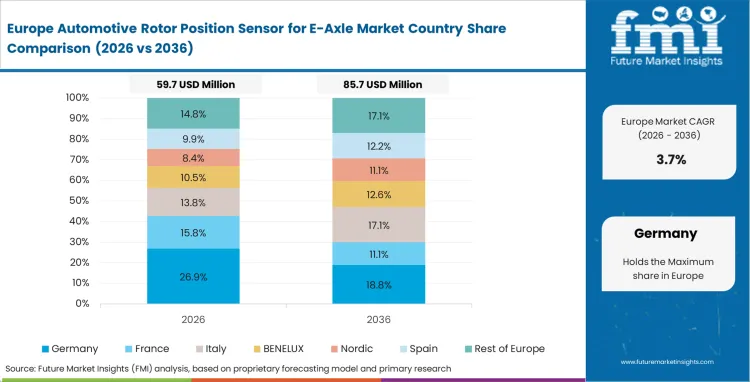
Premium vehicle engineering increases demand for high-resolution sensing systems across Europe. Torque precision and acoustic refinement require advanced feedback mechanisms. Functional safety compliance drives integration of redundant sensing architectures. Sensor accuracy remains essential in maintaining performance consistency across high-end electric drivetrain systems.
- Germany: High-speed autobahn cruising exposes induction motors to sustained peak thermal loads. Thermal engineering heads specify extreme temperature-rated silicon, which is anticipated to rise at a CAGR of 7.8% through 2036 to prevent high-speed demagnetization incidents. Once engineering teams validate these high-temperature profiles, internal qualification standards elevate permanently across all future model years.
- France: Compact vehicle architectures increase demand for space-efficient sensing systems across France. Stator-mounted configurations reduce drivetrain footprint while maintaining functional accuracy. The automotive rotor position sensor market for e-axle in France is anticipated to record a CAGR of 6.9% across the study timeline, driven by adoption of integrated sensor designs. Efficient packaging supports optimization of vehicle layouts across urban mobility platforms.
FMI's report includes analysis of Italian and British specialized component ecosystems. Niche supercar manufacturers operating here drive early adoption of extreme high-frequency inductive technologies.
Competitive Aligners for Market Players
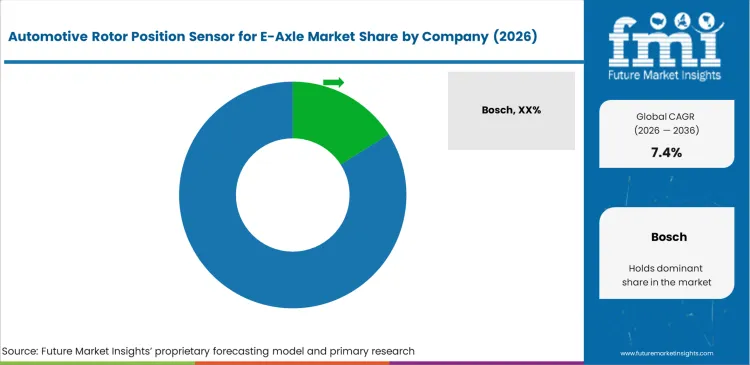
Functional safety requirements create high entry barriers in rotor position sensing for E-axle systems. Supplier selection is driven by ASIL-D compliance and proven field reliability, with qualification history influencing sourcing decisions. Established participants such as Bosch and Continental benefit from validated performance records that support early platform integration. Pricing remains secondary where safety certification and liability considerations are critical.
Established sensor manufacturers maintain advantages through embedded signal processing capabilities within silicon design. Leading sensor manufacturers develop integrated compensation features that address mechanical variation and thermal drift at the hardware level. This reduces processing load on control systems and improves signal accuracy. Competing solutions without integrated correction increase system complexity and integration effort.
Unit manufacturers prioritize supply flexibility by standardizing physical mounting interfaces. Multi-sourcing strategies reduce dependency on single semiconductor suppliers. Major semiconductor suppliers operate within frameworks where dual sourcing supports supply continuity. Integration trends indicate closer alignment between sensing components and mechanical assemblies, including potential integration within motor bearing structures. This shift may redefine supplier roles and require collaboration between semiconductor and mechanical component manufacturers.
Key Players in Automotive Rotor Position Sensor for E-Axle Market
- Bosch
- Continental
- Sensata Technologies
- Melexis
- TDK-Micronas
- Allegro MicroSystems
- MinebeaMitsumi
Scope of the Report
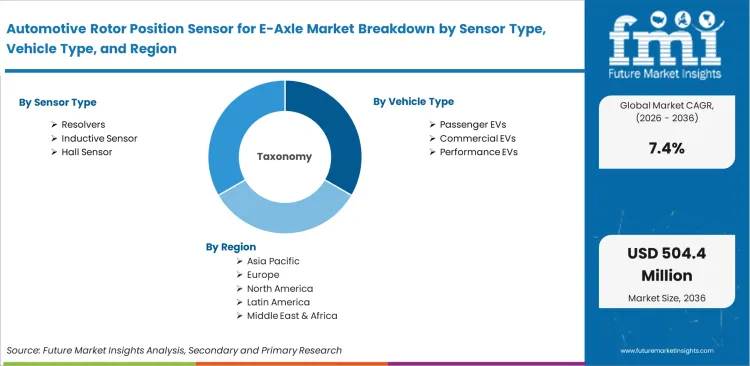
| Metric | Value |
|---|---|
| Quantitative Units | USD 230.1 million to USD 469.7 million, at a CAGR of 7.4% |
| Market Definition | Rotary feedback devices engineered specifically to operate inside highly integrated electric drive units constitute this category. These components continuously report precise angular orientation and speed of traction motor shafts directly to inverter control modules. |
| Segmentation | Sensor Type, Vehicle Type, Mounting Design, Output Interface, and Sales Channel |
| Regions Covered | Asia Pacific, North America, Europe |
| Countries Covered | India, China, Germany, South Korea, United States, France, Japan |
| Key Companies Profiled | Bosch, Continental, Sensata Technologies, Melexis, TDK-Micronas, Allegro MicroSystems, MinebeaMitsumi |
| Forecast Period | 2026 to 2036 |
| Approach | Installed base of 3-in-1 electric drive units cross-referenced with component teardown data. |
Source: Future Market Insights (FMI) analysis, based on proprietary forecasting model and primary research
Automotive Rotor Position Sensor for E-Axle Market Analysis by Segments
Sensor Type
- Resolver
- Inductive sensor
- Hall sensor
- TMR sensor
Vehicle Type
- Passenger EVs
- Commercial EVs
- Performance EVs
- Hybrid EVs
Mounting Design
- End-shaft
- Stator-mounted
- PCB-mounted
- Integrated module
Output Interface
- Sine-cosine
- PWM output
- Digital output
- Differential output
Sales Channel
- OEM fitment
- Aftermarket
Region:
- North America
- United States
- Canada
- Europe
- Germany
- United Kingdom
- France
- Italy
- Spain
- Asia Pacific
- China
- Japan
- South Korea
- Taiwan
- Singapore
- Latin America
- Brazil
- Mexico
- Argentina
- Middle East & Africa
- GCC Countries
- South Africa
- Israel
Bibliography
- Allegro MicroSystems. (2026). EV traction motor requirements and speed sensor solutions.
- Dini, P., et al. (2025). Modeling, control and monitoring of automotive electric drives: A review. Electronics, 14(19), 3950.
- Gobbi, M., et al. (2024). Traction motors for electric vehicles: Maximization of mechanical efficiency. Applied Energy, 357, 122484.
- International Energy Agency. (2025, May 14). Global EV Outlook 2025.
- Li, X., et al. (2025). Rotor position detection method for permanent magnet synchronous motor based on search coil. IET Electric Power Applications.
This bibliography is provided for reader reference. The full FMI report contains the complete reference list with primary source documentation.
This Report Addresses
- 800-volt architecture adoption forces inverter engineering heads to specify feedback components capable of surviving intense electromagnetic interference.
- Axial length constraints compel drivetrain packaging directors to select ultra-thin inductive coil designs.
- Functional safety legislation pushes automotive purchasing leads to mandate fully redundant dual-die sensing ICs.
- Drivetrain integration directors across Asia Pacific rapidly qualify compact mid-drive units to satisfy strict new hill-climbing regulations.
- Commercial vehicle chief engineers actively reject delicate silicon-based sensing, favoring massive variable-reluctance resolvers.
- Thermal engineering heads specify extreme temperature-rated silicon to prevent high-speed demagnetization incidents.
- Hardware engineers face grueling qualification cycles when placing sensitive integrated circuits merely inches away from high-voltage switching modules.
- ASIC designers embedding dual independent sensing elements onto single silicon dies streamline functional safety compliance.
Frequently Asked Questions
What is the automotive rotor position sensor for e-axle market size in 2025, 2026, and 2036?
Revenue reached USD 230.1 million in 2026, up from USD 214.2 million in 2025, and is projected to hit USD 469.7 million by 2036. This metric signals how deeply automakers rely on precision torque management to hit aggressive efficiency targets across mass-market platforms.
What is the CAGR of the e-axle rotor position sensor market from 2026 to 2036?
Operations scale at a 7.4% CAGR through 2036. This growth rate masks an intense technological race to miniaturize sensing envelopes without sacrificing ASIL-D safety compliance.
Why do E-axle traction motors need rotor position sensors?
These components continuously report precise angular orientation and speed of traction motor shafts directly to inverter control modules. This high-speed feedback loop is mandatory for efficient commutation and exact torque delivery.
Which sensor type leads this market, resolver or inductive?
Powertrain purchasing directors actively specify resolver technology because its entirely passive rotor construction easily survives extreme oil-cooled thermal cycling. Resolvers maintain dominance through unparalleled electromagnetic immunity inside noisy 800-volt environments.
Which countries are growing fastest in e-axle rotor position sensing?
India expands at a leading 9.4% CAGR driven by localized supply mandates, followed by China at 8.6% as domestic systems architects aggressively strip out discrete sensor housings to cut costs.
Who are the main companies in automotive rotor position sensors for e-axles?
Prominent entities shaping the supply chain include Bosch, Continental, Sensata Technologies, Melexis, TDK-Micronas, Allegro MicroSystems, and MinebeaMitsumi.
How do resolver and inductive rotor sensors differ in EV traction motors?
Resolvers use heavy wire-wound coils to resist thermal and electromagnetic shock, making them extremely durable but bulky. Inductive sensors use printed circuit boards, saving crucial axial space and weight but requiring advanced shielding against high-voltage switching noise.
Is sensorless control a threat to dedicated rotor position sensors?
While software algorithms attempt to estimate rotor position based on back-EMF, true sensorless control remains too risky for low-speed, high-torque maneuvering. Functional safety mandates will keep physical hardware entrenched in traction drives for the foreseeable future.
Which vehicle segment drives the most demand for e-axle rotor sensors?
Passenger EVs hold the commanding share, as cabin acoustics expose any torque ripple generated by low-fidelity motor control. Electric drive calibration engineers demand sub-degree angular accuracy to ensure perfectly smooth low-speed maneuvering.
What are the main technical challenges in e-axle rotor position sensing?
Hardware engineers place sensitive integrated circuits merely inches away from high-voltage switching modules. Severe switching noise from silicon carbide inverters routinely disrupts standard feedback loops during rapid acceleration.
Preview the report firsthand - request a free sample
Get SampleGet the brochure for pricing and purchase details.
Get PDFTable of Content
- Executive Summary
- Global Market Outlook
- Demand-side Trends
- Supply-side Trends
- Technology Roadmap Analysis
- Analysis and Recommendations
- Market Overview
- Market Coverage / Taxonomy
- Market Definition / Scope / Limitations
- Research Methodology
- Chapter Orientation
- Analytical Lens and Working Hypotheses
- Market Structure, Signals, and Trend Drivers
- Benchmarking and Cross-market Comparability
- Market Sizing, Forecasting, and Opportunity Mapping
- Research Design and Evidence Framework
- Desk Research Programme (Secondary Evidence)
- Company Annual and Sustainability Reports
- Peer-reviewed Journals and Academic Literature
- Corporate Websites, Product Literature, and Technical Notes
- Earnings Decks and Investor Briefings
- Statutory Filings and Regulatory Disclosures
- Technical White Papers and Standards Notes
- Trade Journals, Industry Magazines, and Analyst Briefs
- Conference Proceedings, Webinars, and Seminar Materials
- Government Statistics Portals and Public Data Releases
- Press Releases and Reputable Media Coverage
- Specialist Newsletters and Curated Briefings
- Sector Databases and Reference Repositories
- FMI Internal Proprietary Databases and Historical Market Datasets
- Subscription Datasets and Paid Sources
- Social Channels, Communities, and Digital Listening Inputs
- Additional Desk Sources
- Expert Input and Fieldwork (Primary Evidence)
- Primary Modes
- Qualitative Interviews and Expert Elicitation
- Quantitative Surveys and Structured Data Capture
- Blended Approach
- Why Primary Evidence is Used
- Field Techniques
- Interviews
- Surveys
- Focus Groups
- Observational and In-context Research
- Social and Community Interactions
- Stakeholder Universe Engaged
- C-suite Leaders
- Board Members
- Presidents and Vice Presidents
- R&D and Innovation Heads
- Technical Specialists
- Domain Subject-matter Experts
- Scientists
- Physicians and Other Healthcare Professionals
- Governance, Ethics, and Data Stewardship
- Research Ethics
- Data Integrity and Handling
- Primary Modes
- Tooling, Models, and Reference Databases
- Desk Research Programme (Secondary Evidence)
- Data Engineering and Model Build
- Data Acquisition and Ingestion
- Cleaning, Normalisation, and Verification
- Synthesis, Triangulation, and Analysis
- Quality Assurance and Audit Trail
- Market Background
- Market Dynamics
- Drivers
- Restraints
- Opportunity
- Trends
- Scenario Forecast
- Demand in Optimistic Scenario
- Demand in Likely Scenario
- Demand in Conservative Scenario
- Opportunity Map Analysis
- Product Life Cycle Analysis
- Supply Chain Analysis
- Investment Feasibility Matrix
- Value Chain Analysis
- PESTLE and Porter’s Analysis
- Regulatory Landscape
- Regional Parent Market Outlook
- Production and Consumption Statistics
- Import and Export Statistics
- Market Dynamics
- Global Market Analysis 2021 to 2025 and Forecast, 2026 to 2036
- Historical Market Size Value (USD Million) Analysis, 2021 to 2025
- Current and Future Market Size Value (USD Million) Projections, 2026 to 2036
- Y-o-Y Growth Trend Analysis
- Absolute $ Opportunity Analysis
- Global Market Pricing Analysis 2021 to 2025 and Forecast 2026 to 2036
- Global Market Analysis 2021 to 2025 and Forecast 2026 to 2036, By Sensor Type
- Introduction / Key Findings
- Historical Market Size Value (USD Million) Analysis By Sensor Type , 2021 to 2025
- Current and Future Market Size Value (USD Million) Analysis and Forecast By Sensor Type , 2026 to 2036
- Resolvers
- Inductive Sensor
- Hall Sensor
- Resolvers
- Y-o-Y Growth Trend Analysis By Sensor Type , 2021 to 2025
- Absolute $ Opportunity Analysis By Sensor Type , 2026 to 2036
- Global Market Analysis 2021 to 2025 and Forecast 2026 to 2036, By Vehicle Type
- Introduction / Key Findings
- Historical Market Size Value (USD Million) Analysis By Vehicle Type, 2021 to 2025
- Current and Future Market Size Value (USD Million) Analysis and Forecast By Vehicle Type, 2026 to 2036
- Passenger EVs
- Commercial EVs
- Performance EVs
- Passenger EVs
- Y-o-Y Growth Trend Analysis By Vehicle Type, 2021 to 2025
- Absolute $ Opportunity Analysis By Vehicle Type, 2026 to 2036
- Global Market Analysis 2021 to 2025 and Forecast 2026 to 2036, By Mounting Design
- Introduction / Key Findings
- Historical Market Size Value (USD Million) Analysis By Mounting Design, 2021 to 2025
- Current and Future Market Size Value (USD Million) Analysis and Forecast By Mounting Design, 2026 to 2036
- End-Shaft Designs
- Stator-Mounted
- Others
- End-Shaft Designs
- Y-o-Y Growth Trend Analysis By Mounting Design, 2021 to 2025
- Absolute $ Opportunity Analysis By Mounting Design, 2026 to 2036
- Global Market Analysis 2021 to 2025 and Forecast 2026 to 2036, By Output Interface
- Introduction / Key Findings
- Historical Market Size Value (USD Million) Analysis By Output Interface, 2021 to 2025
- Current and Future Market Size Value (USD Million) Analysis and Forecast By Output Interface, 2026 to 2036
- Sine-Cosine
- PWM Output
- Digital Output
- Sine-Cosine
- Y-o-Y Growth Trend Analysis By Output Interface, 2021 to 2025
- Absolute $ Opportunity Analysis By Output Interface, 2026 to 2036
- Global Market Analysis 2021 to 2025 and Forecast 2026 to 2036, By Sales Channel
- Introduction / Key Findings
- Historical Market Size Value (USD Million) Analysis By Sales Channel, 2021 to 2025
- Current and Future Market Size Value (USD Million) Analysis and Forecast By Sales Channel, 2026 to 2036
- OEM Fitment
- Aftermarket
- OEM Fitment
- Y-o-Y Growth Trend Analysis By Sales Channel, 2021 to 2025
- Absolute $ Opportunity Analysis By Sales Channel, 2026 to 2036
- Global Market Analysis 2021 to 2025 and Forecast 2026 to 2036, By Region
- Introduction
- Historical Market Size Value (USD Million) Analysis By Region, 2021 to 2025
- Current Market Size Value (USD Million) Analysis and Forecast By Region, 2026 to 2036
- North America
- Latin America
- Western Europe
- Eastern Europe
- East Asia
- South Asia and Pacific
- Middle East & Africa
- Market Attractiveness Analysis By Region
- North America Market Analysis 2021 to 2025 and Forecast 2026 to 2036, By Country
- Historical Market Size Value (USD Million) Trend Analysis By Market Taxonomy, 2021 to 2025
- Market Size Value (USD Million) Forecast By Market Taxonomy, 2026 to 2036
- By Country
- USA
- Canada
- Mexico
- By Sensor Type
- By Vehicle Type
- By Mounting Design
- By Output Interface
- By Sales Channel
- By Country
- Market Attractiveness Analysis
- By Country
- By Sensor Type
- By Vehicle Type
- By Mounting Design
- By Output Interface
- By Sales Channel
- Key Takeaways
- Latin America Market Analysis 2021 to 2025 and Forecast 2026 to 2036, By Country
- Historical Market Size Value (USD Million) Trend Analysis By Market Taxonomy, 2021 to 2025
- Market Size Value (USD Million) Forecast By Market Taxonomy, 2026 to 2036
- By Country
- Brazil
- Chile
- Rest of Latin America
- By Sensor Type
- By Vehicle Type
- By Mounting Design
- By Output Interface
- By Sales Channel
- By Country
- Market Attractiveness Analysis
- By Country
- By Sensor Type
- By Vehicle Type
- By Mounting Design
- By Output Interface
- By Sales Channel
- Key Takeaways
- Western Europe Market Analysis 2021 to 2025 and Forecast 2026 to 2036, By Country
- Historical Market Size Value (USD Million) Trend Analysis By Market Taxonomy, 2021 to 2025
- Market Size Value (USD Million) Forecast By Market Taxonomy, 2026 to 2036
- By Country
- Germany
- UK
- Italy
- Spain
- France
- Nordic
- BENELUX
- Rest of Western Europe
- By Sensor Type
- By Vehicle Type
- By Mounting Design
- By Output Interface
- By Sales Channel
- By Country
- Market Attractiveness Analysis
- By Country
- By Sensor Type
- By Vehicle Type
- By Mounting Design
- By Output Interface
- By Sales Channel
- Key Takeaways
- Eastern Europe Market Analysis 2021 to 2025 and Forecast 2026 to 2036, By Country
- Historical Market Size Value (USD Million) Trend Analysis By Market Taxonomy, 2021 to 2025
- Market Size Value (USD Million) Forecast By Market Taxonomy, 2026 to 2036
- By Country
- Russia
- Poland
- Hungary
- Balkan & Baltic
- Rest of Eastern Europe
- By Sensor Type
- By Vehicle Type
- By Mounting Design
- By Output Interface
- By Sales Channel
- By Country
- Market Attractiveness Analysis
- By Country
- By Sensor Type
- By Vehicle Type
- By Mounting Design
- By Output Interface
- By Sales Channel
- Key Takeaways
- East Asia Market Analysis 2021 to 2025 and Forecast 2026 to 2036, By Country
- Historical Market Size Value (USD Million) Trend Analysis By Market Taxonomy, 2021 to 2025
- Market Size Value (USD Million) Forecast By Market Taxonomy, 2026 to 2036
- By Country
- China
- Japan
- South Korea
- By Sensor Type
- By Vehicle Type
- By Mounting Design
- By Output Interface
- By Sales Channel
- By Country
- Market Attractiveness Analysis
- By Country
- By Sensor Type
- By Vehicle Type
- By Mounting Design
- By Output Interface
- By Sales Channel
- Key Takeaways
- South Asia and Pacific Market Analysis 2021 to 2025 and Forecast 2026 to 2036, By Country
- Historical Market Size Value (USD Million) Trend Analysis By Market Taxonomy, 2021 to 2025
- Market Size Value (USD Million) Forecast By Market Taxonomy, 2026 to 2036
- By Country
- India
- ASEAN
- Australia & New Zealand
- Rest of South Asia and Pacific
- By Sensor Type
- By Vehicle Type
- By Mounting Design
- By Output Interface
- By Sales Channel
- By Country
- Market Attractiveness Analysis
- By Country
- By Sensor Type
- By Vehicle Type
- By Mounting Design
- By Output Interface
- By Sales Channel
- Key Takeaways
- Middle East & Africa Market Analysis 2021 to 2025 and Forecast 2026 to 2036, By Country
- Historical Market Size Value (USD Million) Trend Analysis By Market Taxonomy, 2021 to 2025
- Market Size Value (USD Million) Forecast By Market Taxonomy, 2026 to 2036
- By Country
- Kingdom of Saudi Arabia
- Other GCC Countries
- Turkiye
- South Africa
- Other African Union
- Rest of Middle East & Africa
- By Sensor Type
- By Vehicle Type
- By Mounting Design
- By Output Interface
- By Sales Channel
- By Country
- Market Attractiveness Analysis
- By Country
- By Sensor Type
- By Vehicle Type
- By Mounting Design
- By Output Interface
- By Sales Channel
- Key Takeaways
- Key Countries Market Analysis
- USA
- Pricing Analysis
- Market Share Analysis, 2025
- By Sensor Type
- By Vehicle Type
- By Mounting Design
- By Output Interface
- By Sales Channel
- Canada
- Pricing Analysis
- Market Share Analysis, 2025
- By Sensor Type
- By Vehicle Type
- By Mounting Design
- By Output Interface
- By Sales Channel
- Mexico
- Pricing Analysis
- Market Share Analysis, 2025
- By Sensor Type
- By Vehicle Type
- By Mounting Design
- By Output Interface
- By Sales Channel
- Brazil
- Pricing Analysis
- Market Share Analysis, 2025
- By Sensor Type
- By Vehicle Type
- By Mounting Design
- By Output Interface
- By Sales Channel
- Chile
- Pricing Analysis
- Market Share Analysis, 2025
- By Sensor Type
- By Vehicle Type
- By Mounting Design
- By Output Interface
- By Sales Channel
- Germany
- Pricing Analysis
- Market Share Analysis, 2025
- By Sensor Type
- By Vehicle Type
- By Mounting Design
- By Output Interface
- By Sales Channel
- UK
- Pricing Analysis
- Market Share Analysis, 2025
- By Sensor Type
- By Vehicle Type
- By Mounting Design
- By Output Interface
- By Sales Channel
- Italy
- Pricing Analysis
- Market Share Analysis, 2025
- By Sensor Type
- By Vehicle Type
- By Mounting Design
- By Output Interface
- By Sales Channel
- Spain
- Pricing Analysis
- Market Share Analysis, 2025
- By Sensor Type
- By Vehicle Type
- By Mounting Design
- By Output Interface
- By Sales Channel
- France
- Pricing Analysis
- Market Share Analysis, 2025
- By Sensor Type
- By Vehicle Type
- By Mounting Design
- By Output Interface
- By Sales Channel
- India
- Pricing Analysis
- Market Share Analysis, 2025
- By Sensor Type
- By Vehicle Type
- By Mounting Design
- By Output Interface
- By Sales Channel
- ASEAN
- Pricing Analysis
- Market Share Analysis, 2025
- By Sensor Type
- By Vehicle Type
- By Mounting Design
- By Output Interface
- By Sales Channel
- Australia & New Zealand
- Pricing Analysis
- Market Share Analysis, 2025
- By Sensor Type
- By Vehicle Type
- By Mounting Design
- By Output Interface
- By Sales Channel
- China
- Pricing Analysis
- Market Share Analysis, 2025
- By Sensor Type
- By Vehicle Type
- By Mounting Design
- By Output Interface
- By Sales Channel
- Japan
- Pricing Analysis
- Market Share Analysis, 2025
- By Sensor Type
- By Vehicle Type
- By Mounting Design
- By Output Interface
- By Sales Channel
- South Korea
- Pricing Analysis
- Market Share Analysis, 2025
- By Sensor Type
- By Vehicle Type
- By Mounting Design
- By Output Interface
- By Sales Channel
- Russia
- Pricing Analysis
- Market Share Analysis, 2025
- By Sensor Type
- By Vehicle Type
- By Mounting Design
- By Output Interface
- By Sales Channel
- Poland
- Pricing Analysis
- Market Share Analysis, 2025
- By Sensor Type
- By Vehicle Type
- By Mounting Design
- By Output Interface
- By Sales Channel
- Hungary
- Pricing Analysis
- Market Share Analysis, 2025
- By Sensor Type
- By Vehicle Type
- By Mounting Design
- By Output Interface
- By Sales Channel
- Kingdom of Saudi Arabia
- Pricing Analysis
- Market Share Analysis, 2025
- By Sensor Type
- By Vehicle Type
- By Mounting Design
- By Output Interface
- By Sales Channel
- Turkiye
- Pricing Analysis
- Market Share Analysis, 2025
- By Sensor Type
- By Vehicle Type
- By Mounting Design
- By Output Interface
- By Sales Channel
- South Africa
- Pricing Analysis
- Market Share Analysis, 2025
- By Sensor Type
- By Vehicle Type
- By Mounting Design
- By Output Interface
- By Sales Channel
- USA
- Market Structure Analysis
- Competition Dashboard
- Competition Benchmarking
- Market Share Analysis of Top Players
- By Region
- By Sensor Type
- By Vehicle Type
- By Mounting Design
- By Output Interface
- By Sales Channel
- Competition Analysis
- Competition Deep Dive
- Bosch
- Overview
- Product Portfolio
- Profitability by Market Segments (Product/Age /Sales Channel/Region)
- Sales Footprint
- Strategy Overview
- Marketing Strategy
- Product Strategy
- Channel Strategy
- Continental
- Sensata Technologies
- Melexis
- TDK-Micronas
- Allegro MicroSystems
- MinebeaMitsumi
- Bosch
- Competition Deep Dive
- Assumptions & Acronyms Used


