

- Industry Size (2026)
- USD 173.7 Mn
- Forecast (2036)
- USD 753.2 Mn
- CAGR (2026 to 2036)
- 15.8%
Next-Generation PFAS Destruction Reagents Market Forecast and Outlook 2026 to 2036
The next-generation PFAS destruction reagents market is valued at USD 173.7 million in 2026 and is forecast to reach USD 753.2 million by 2036, expanding at a CAGR of 15.8%. Growth reflects rising regulatory pressure to eliminate PFAS liabilities rather than contain them, alongside escalating remediation costs linked to long-term environmental persistence. Utilities, industrial operators, and waste managers increasingly adopt destructive treatment approaches as adsorption and sequestration methods shift contamination burdens downstream.
Electrochemical oxidation reagents and catalysts represent leading destruction chemistry demand due to ability to cleave strong carbon-fluorine bonds under controlled conditions. These systems generate reactive species in situ, enabling mineralization of PFAS into inert end products without secondary waste streams. Concentrated industrial wastewater and landfill leachate represent leading treated media, reflecting higher PFAS loadings and favorable economics for advanced treatment deployment. Segment structure indicates prioritization of point-source destruction where contaminant concentration and regulatory risk are highest.
Quick Stats for Next-Generation PFAS Destruction Reagents Market
- Next-Generation PFAS Destruction Reagents Market Value (2026): USD 173.7 million
- Next-Generation PFAS Destruction Reagents Market Forecast Value (2036): USD 753.2 million
- Next-Generation PFAS Destruction Reagents Market Forecast CAGR (2026 to 2036): 15.8%
- Leading Destruction Chemistry in Global Demand: Electrochemical Oxidation Reagents and Catalysts
- Fastest-Growing Countries: China, USA, Germany, Australia, Canada
- Top Players in Global Demand: Aclarity, Revive Environmental, AECOM, Ovivo Inc., General Atomics Electromagnetic Systems
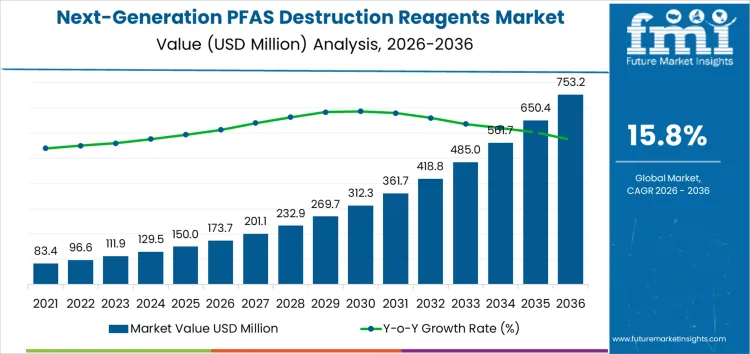
China, USA, Germany, Australia, and Canada emerge as fastest-growing countries, supported by enforcement actions, public funding, and industrial remediation mandates. Competitive landscape includes Aclarity, Revive Environmental, AECOM, Ovivo Inc., and General Atomics Electromagnetic Systems. These players focus on scalable reactor design, catalyst durability, and integration with existing treatment infrastructure to enable full PFAS destruction.
Next-Generation PFAS Destruction Reagents Market Key Takeaways
| Metric | Value |
|---|---|
| Market Value (2026) | USD 173.7 million |
| Market Forecast Value (2036) | USD 753.2 million |
| Forecast CAGR (2026 to 2036) | 15.8% |
Why is the Demand for Next-Generation PFAS Destruction Reagents Market Growing?
Demand for next-generation PFAS destruction reagents is growing globally due to rising regulatory pressure and environmental concerns related to per- and polyfluoroalkyl substances persistence and toxicity. PFAS compounds resist conventional treatment, accumulate in water, soil, and biota, and are subject to emerging limits on environmental and drinking water concentrations. Governments and industrial users adopt advanced reagents designed to break carbon-fluorine bonds and render compounds less harmful or transform them into benign end products. Utilities, treatment facilities, and remediation contractors invest in destruction technologies that complement adsorption and separation processes to achieve comprehensive PFAS management.
Growth in potable reuse, wastewater recycling, and environmental cleanup programs increases need for reagents capable of degrading PFAS at scale. Regulatory frameworks in multiple regions require demonstrable reduction of PFAS mass rather than simple phase transfer, which strengthens adoption of destruction solutions. Research institutions and technology developers expand reagent portfolios that leverage catalytic, electrochemical, and thermal mechanisms to improve efficiency under variable conditions. Corporate sustainability commitments and litigation risk management reinforce transition to advanced destruction chemistries. Supply chain partners integrate destruction reagents into broader treatment trains to meet compliance and public health objectives internationally.
How Are the Segments Classified in the Next-Generation PFAS Destruction Reagents Market?
Demand for next-generation PFAS destruction reagents globally is shaped by regulatory pressure to eliminate persistent fluorinated compounds and limits of containment-based treatment. Operators assess destruction efficiency, defluorination completeness, operational safety, and compatibility with liquid and solid waste streams. Adoption patterns reflect movement beyond capture toward irreversible PFAS breakdown across industrial, municipal, and remediation-focused treatment environments.
Which Destruction Chemistry Represents the Largest Share of Global Demand?
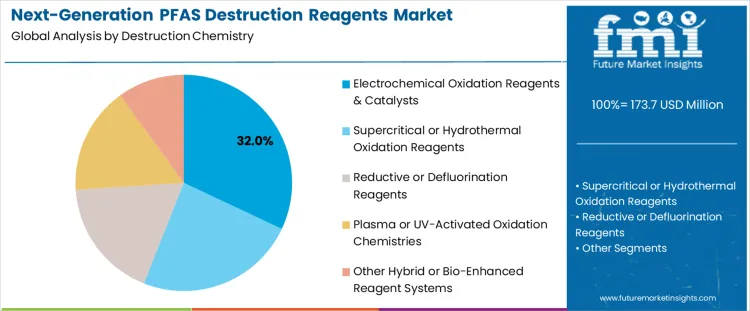
Electrochemical oxidation reagents and catalysts hold 32.0%, representing the largest share of global demand. These chemistries enable direct electron-driven breakdown of carbon-fluorine bonds under controlled conditions. Supercritical or hydrothermal oxidation reagents hold 24.0%, supporting high-temperature and high-pressure mineralization of PFAS compounds. Reductive or defluorination reagents account for 18.0%, enabling targeted fluorine removal through chemical reduction pathways. Plasma or UV-activated oxidation chemistries hold 16.0%, supporting radical-based degradation. Other hybrid or bio-enhanced systems hold 10.0%. Chemistry distribution reflects emphasis on scalable and controllable destruction mechanisms.
Key Points
- Electrochemical systems lead due to controllable defluorination capability.
- Hydrothermal oxidation supports complete mineralization.
- Plasma and reductive methods address targeted destruction needs.
Which Treated Medium Drives the Highest Share of Global Adoption?
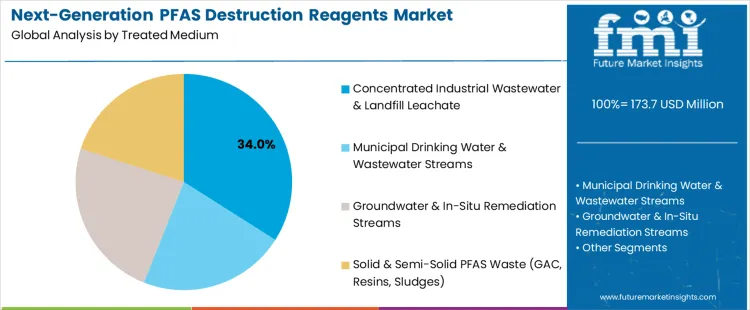
Concentrated industrial wastewater and landfill leachate hold 34.0%, driving the highest share of global adoption. These streams contain elevated PFAS concentrations requiring destructive treatment rather than dilution. Groundwater and in-situ remediation streams account for 24.0%, addressing legacy contamination plumes. Municipal drinking water and wastewater streams hold 22.0%, reflecting growing interest in post-capture destruction. Solid and semi-solid PFAS waste hold 20.0%, supporting treatment of spent adsorbents and sludges. Medium distribution reflects prioritization of high-concentration and legacy contamination sources.
Key Points
- Industrial wastewater leads due to high PFAS loading.
- Groundwater remediation addresses legacy contamination.
- Solid waste treatment supports adsorbent disposal management.
Which End-Use Sector Accounts for the Largest Share of Global Demand?
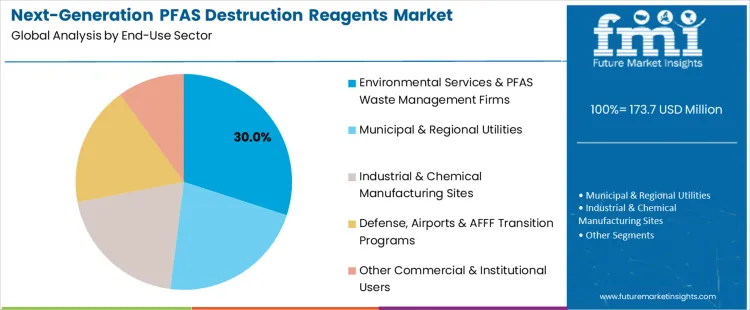
Environmental services and PFAS waste management firms hold 30.0%, accounting for the largest share of global demand. These firms deploy destruction technologies within centralized treatment and disposal workflows. Municipal and regional utilities hold 22.0%, integrating destruction reagents into advanced treatment strategies. Industrial and chemical manufacturing sites account for 20.0%, addressing on-site PFAS liabilities. Defense, airports, and AFFF transition programs hold 18.0%, supporting remediation of firefighting foam residues. Other commercial and institutional users hold 10.0%. End-use distribution reflects outsourcing of destruction capability to specialized operators.
Key Points
- Environmental service firms lead due to centralized PFAS treatment roles.
- Utilities adopt destruction to complement capture technologies.
- Defense and aviation address AFFF-related contamination.
What are the Key Dynamics in the Next-Generation PFAS Destruction Reagents Market?
Global demand rises as governments, environmental remediation firms, and industrial operators adopt reagents capable of breaking down per- and polyfluoroalkyl substances (PFAS) into benign byproducts rather than merely capturing them. Next-generation destruction reagents support in-situ and ex-situ remediation of contaminated soil, groundwater, and industrial waste streams. Adoption aligns with escalating regulatory frameworks targeting PFAS remediation requirements, increasing contamination site inventories, and investment in sustainable chemical management across regions. Usage spans municipal authorities, energy and manufacturing sectors, and environmental service providers.
How do regulatory mandates and environmental cleanup imperatives shape global demand?
Regulatory agencies in North America, Europe, Asia-Pacific, and other jurisdictions establish or tighten limits on PFAS compounds in drinking water, soil, and industrial discharges, accelerating the need for effective destruction solutions. Traditional containment and adsorption approaches shift toward technologies that chemically degrade PFAS chains to avoid long-term disposal liabilities. Public and private stakeholders seek reagents capable of defluorination under controlled conditions while meeting environmental safety criteria. Remediation programmes for legacy contamination sites, military bases, manufacturing facilities, and landfill leachate areas, drive adoption as part of compliance action plans. International collaboration on PFAS management frameworks underlines the importance of scalable destruction chemistries that support long-term environmental health objectives.
How does technical complexity, cost, and site-specific constraints influence market scalability?
Next-generation PFAS destruction reagents involve significant technical development to overcome the strength of the carbon-fluorine bond, requiring advanced oxidation, reductive, or catalytic chemistries tailored to diverse PFAS species. Performance varies with contaminant concentration, matrix characteristics, temperature, and reagent delivery method, necessitating site-specific optimization and testing. High reagent and processing costs can limit adoption for large-volume remediation projects, particularly in resource-constrained regions. Integration with existing treatment infrastructure and safety protocols adds operational complexity. Variability in regulatory acceptance of destruction endpoints and byproduct characterization creates uncertainty for technology selection. Global growth depends on continued innovation that enhances efficacy, reduces cost, and harmonizes performance criteria across jurisdictions, enabling wider deployment in industrial, municipal, and contaminated-site contexts.
How Is Demand for Next-Generation PFAS Destruction Reagents Evolving?
Demand for next-generation PFAS destruction reagents is increasing globally due to remediation mandates, litigation exposure, and limits of containment-only approaches. China leads with a 17.0% CAGR, supported by industrial site remediation and policy-backed treatment deployment. USA follows at 16.0%, driven by federal cleanup programs and liability management at contaminated sites. Germany records 14.0%, reflecting precautionary regulation and advanced treatment optimization. Australia posts 13.5%, shaped by legacy contamination management and water security priorities. Canada records 13.0%, supported by drinking water remediation and federal-provincial coordination. Growth reflects shift toward destructive chemistries enabling permanent PFAS mineralization worldwide.
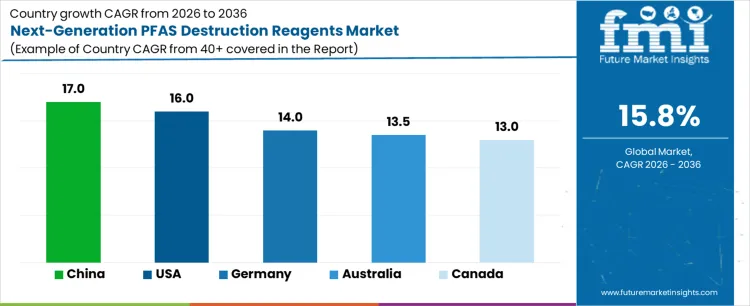
| Country | CAGR (%) |
|---|---|
| China | 17.0% |
| USA | 16.0% |
| Germany | 14.0% |
| Australia | 13.5% |
| Canada | 13.0% |
What factors are accelerating adoption of PFAS destruction reagents in China?
China demand is driven by remediation of industrial parks, firefighting foam sites, and manufacturing effluents containing PFAS. CAGR of 17.0% reflects deployment of oxidative, reductive, and catalytic reagents designed for irreversible PFAS breakdown. Policy directives prioritize permanent destruction over long-term containment. Centralized project execution enables rapid scale-up across regions. Domestic suppliers expand production of advanced reagents compatible with soil, sludge, and water matrices. Performance focus includes reaction completeness, byproduct control, and throughput. Growth remains policy-led and infrastructure-driven, aligned with environmental risk reduction objectives.
- Industrial and legacy site remediation programs
- Policy preference for permanent PFAS destruction
- Centralized execution enabling rapid scale-up
- Expansion of domestic advanced reagent supply
How are regulatory and liability pressures shaping demand growth in the USA?
USA demand is shaped by federal cleanup mandates, state enforcement actions, and litigation related to PFAS contamination. CAGR of 16.0% reflects adoption of destruction reagents for groundwater, soil, and waste concentrates. Agencies prioritize technologies that eliminate long-term liability associated with sequestration. Reagents integrate with thermal, electrochemical, and advanced oxidation systems. Pilot-to-full-scale transitions accelerate procurement. Growth remains regulation-driven and risk-focused, aligned with remediation timelines and public health protection.
- Federal and state remediation mandates
- Liability reduction through permanent destruction
- Integration with advanced treatment systems
- Accelerated pilot-to-scale deployment
Why does Germany show strong adoption of next-generation PFAS destruction chemistries?
Germany demand reflects precautionary environmental policy and preference for definitive contaminant removal. CAGR of 14.0% is supported by use of destruction reagents within controlled treatment trains for water and waste. Regulators favor solutions minimizing residuals and secondary pollution. Utilities and remediation firms emphasize process validation and documentation. Research institutions support optimization of reagent efficiency and byproduct control. Growth remains compliance-focused and efficiency-led, aligned with strict environmental standards and lifecycle accountability.
- Precautionary regulation favoring destruction approaches
- Emphasis on residual and byproduct control
- Strong validation and documentation requirements
- Research-supported process optimization
What is driving demand growth for PFAS destruction reagents in Australia?
Australia demand is driven by management of legacy contamination from firefighting foams and industrial activities. CAGR of 13.5% reflects need for permanent treatment solutions under water scarcity constraints. Reagents enable on-site destruction, reducing transport and disposal costs. Government programs fund remediation of defense and airport sites. Adoption emphasizes robustness across variable matrices. Growth remains program-led and resource-focused, aligned with long-term water protection goals.
- Legacy firefighting foam contamination management
- Preference for on-site destruction solutions
- Government-funded remediation programs
- Adaptability to variable site conditions
How is Canada positioned within the global PFAS destruction reagent landscape?
Canada demand reflects drinking water protection priorities and coordinated federal-provincial remediation efforts. CAGR of 13.0% is supported by adoption of destruction reagents for water treatment residuals and contaminated soils. Utilities seek solutions compatible with cold climates and remote locations. Regulatory frameworks emphasize permanent risk reduction. Collaboration with research institutions supports validation and deployment. Growth remains compliance-driven and infrastructure-aligned, focused on safeguarding water resources and reducing long-term environmental liabilities.
- Drinking water and soil remediation needs
- Federal-provincial coordination on cleanup
- Suitability for remote and cold environments
- Emphasis on permanent risk reduction
What is the competitive landscape of demand for next-generation PFAS destruction reagents?
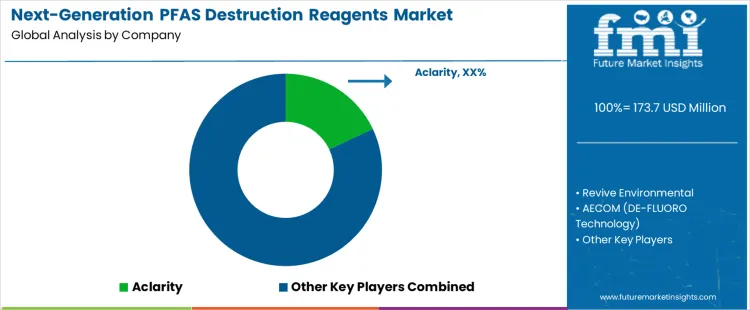
Demand for next-generation PFAS destruction reagents is driven by tightening discharge limits, remediation liabilities, and regulatory pressure to eliminate persistent fluorinated compounds rather than transfer them between media. Treatment approaches target irreversible PFAS mineralization through chemical oxidation, reduction, or supercritical and electrochemical pathways applied to water, concentrates, and residual wastes. Buyers evaluate destruction efficiency across short- and long-chain PFAS, reaction completeness, energy intensity, secondary byproduct formation, and scalability from pilot to full-scale remediation. Procurement teams prioritize technologies demonstrating verified destruction performance, regulatory acceptance, compatibility with existing treatment trains, and manageable operating complexity. Trend in the global market reflects transition away from adsorption-only solutions toward destructive processes supporting long-term compliance and liability reduction.
Aclarity maintains strong positioning through electrochemical oxidation reagents and systems designed for on-site PFAS destruction in contaminated water streams. Revive Environmental focuses on chemical reagent-based destruction approaches applied to PFAS-laden wastes generated from treatment and remediation activities. AECOM deploys its DE-FLUORO technology combining reagents and process engineering to enable PFAS destruction within integrated remediation projects. Ovivo Inc. supports PFAS destruction through advanced treatment platforms incorporating oxidative and electrochemical processes aligned with municipal and industrial applications. General Atomics Electromagnetic Systems advances supercritical water oxidation under its PERSES iSCWO platform targeting complete PFAS destruction in high-strength waste streams. Competitive differentiation depends on destruction completeness, scalability, regulatory validation, and integration capability within broader PFAS remediation programs.
Key Players in the Next-Generation PFAS Destruction Reagents Market
- Aclarity
- Revive Environmental
- AECOM (DE-FLUORO Technology)
- Ovivo Inc.
- General Atomics Electromagnetic Systems (PERSES iSCWO)
Scope of the Report
| Items | Values |
|---|---|
| Quantitative Units | USD million |
| Destruction Chemistry | Electrochemical Oxidation Reagents & Catalysts; Supercritical or Hydrothermal Oxidation Reagents; Reductive or Defluorination Reagents; Plasma or UV-Activated Oxidation Chemistries; Other Hybrid or Bio-Enhanced Reagent Systems |
| Treated Medium | Concentrated Industrial Wastewater & Landfill Leachate; Municipal Drinking Water & Wastewater Streams; Groundwater & In-Situ Remediation Streams; Solid & Semi-Solid PFAS Waste (GAC, Resins, Sludges) |
| End-Use Sector | Environmental Services & PFAS Waste Management Firms; Municipal & Regional Utilities; Industrial & Chemical Manufacturing Sites; Defense, Airports & AFFF Transition Programs; Other Commercial & Institutional Users |
| Regions Covered | Asia Pacific, Europe, North America, Latin America, Middle East & Africa |
| Countries Covered | China, USA, Germany, Australia, Canada, and 40+ countries |
| Key Companies Profiled | Aclarity; Revive Environmental; AECOM (DE-FLUORO Technology); Ovivo Inc.; General Atomics Electromagnetic Systems (PERSES iSCWO) |
| Additional Attributes | Dollar sales by destruction chemistry and treated medium; adoption trends for electrochemical, hydrothermal, and reductive PFAS destruction pathways; reagent effectiveness by PFAS chain length and fluorine bond cleavage efficiency; integration with existing water and waste treatment infrastructure; operational energy intensity and lifecycle cost considerations; regulatory acceptance and validation metrics for permanent PFAS destruction outcomes. |
Next-Generation PFAS Destruction Reagents Market by Segment
Destruction Chemistry:
- Electrochemical Oxidation Reagents & Catalysts
- Supercritical or Hydrothermal Oxidation Reagents
- Reductive or Defluorination Reagents
- Plasma or UV-Activated Oxidation Chemistries
- Other Hybrid or Bio-Enhanced Reagent Systems
Treated Medium:
- Concentrated Industrial Wastewater & Landfill Leachate
- Municipal Drinking Water & Wastewater Streams
- Groundwater & In-Situ Remediation Streams
- Solid & Semi-Solid PFAS Waste (GAC, Resins, Sludges)
End-Use Sector:
- Environmental Services & PFAS Waste Management Firms
- Municipal & Regional Utilities
- Industrial & Chemical Manufacturing Sites
- Defense, Airports & AFFF Transition Programs
- Other Commercial & Institutional Users
Region:
- Asia Pacific
- China
- Japan
- South Korea
- India
- Australia & New Zealand
- ASEAN
- Rest of Asia Pacific
- Europe
- Germany
- United Kingdom
- France
- Italy
- Spain
- Nordic
- BENELUX
- Rest of Europe
- North America
- United States
- Canada
- Mexico
- Latin America
- Brazil
- Chile
- Rest of Latin America
- Middle East & Africa
- Kingdom of Saudi Arabia
- Other GCC Countries
- Turkey
- South Africa
- Other African Union
- Rest of Middle East & Africa
Frequently Asked Questions
How big is the next-generation PFAS destruction reagents market in 2026?
The global next-generation PFAS destruction reagents market is estimated to be valued at USD 173.7 million in 2026.
What will be the size of next-generation PFAS destruction reagents market in 2036?
The market size for the next-generation PFAS destruction reagents market is projected to reach USD 753.2 million by 2036.
How much will be the next-generation PFAS destruction reagents market growth between 2026 and 2036?
The next-generation PFAS destruction reagents market is expected to grow at a 15.8% CAGR between 2026 and 2036.
What are the key product types in the next-generation PFAS destruction reagents market?
The key product types in next-generation PFAS destruction reagents market are electrochemical oxidation reagents & catalysts, supercritical or hydrothermal oxidation reagents, reductive or defluorination reagents, plasma or uv-activated oxidation chemistries and other hybrid or bio-enhanced reagent systems.
Which treated medium segment to contribute significant share in the next-generation PFAS destruction reagents market in 2026?
In terms of treated medium, concentrated industrial wastewater & landfill leachate segment to command 34.0% share in the next-generation PFAS destruction reagents market in 2026.
Preview the report firsthand - request a free sample
Get SampleGet the brochure for pricing and purchase details.
Get PDFTable of Content
- Executive Summary
- Global Market Outlook
- Demand-side Trends
- Supply-side Trends
- Technology Roadmap Analysis
- Analysis and Recommendations
- Market Overview
- Market Coverage / Taxonomy
- Market Definition / Scope / Limitations
- Market Background
- Market Dynamics
- Drivers
- Restraints
- Opportunity
- Trends
- Scenario Forecast
- Demand in Optimistic Scenario
- Demand in Likely Scenario
- Demand in Conservative Scenario
- Opportunity Map Analysis
- Product Life Cycle Analysis
- Supply Chain Analysis
- Investment Feasibility Matrix
- Value Chain Analysis
- PESTLE and Porter’s Analysis
- Regulatory Landscape
- Regional Parent Market Outlook
- Production and Consumption Statistics
- Import and Export Statistics
- Market Dynamics
- Global Market Analysis 2021 to 2025 and Forecast, 2026 to 2036
- Historical Market Size Value (USD Million) Analysis, 2021 to 2025
- Current and Future Market Size Value (USD Million) Projections, 2026 to 2036
- Y-o-Y Growth Trend Analysis
- Absolute $ Opportunity Analysis
- Global Market Pricing Analysis 2021 to 2025 and Forecast 2026 to 2036
- Global Market Analysis 2021 to 2025 and Forecast 2026 to 2036, By Destruction Chemistry
- Introduction / Key Findings
- Historical Market Size Value (USD Million) Analysis By Destruction Chemistry , 2021 to 2025
- Current and Future Market Size Value (USD Million) Analysis and Forecast By Destruction Chemistry , 2026 to 2036
- Electrochemical Oxidation Reagents & Catalysts
- Supercritical or Hydrothermal Oxidation Reagents
- Reductive or Defluorination Reagents
- Plasma or UV-Activated Oxidation Chemistries
- Other Hybrid or Bio-Enhanced Reagent Systems
- Electrochemical Oxidation Reagents & Catalysts
- Y-o-Y Growth Trend Analysis By Destruction Chemistry , 2021 to 2025
- Absolute $ Opportunity Analysis By Destruction Chemistry , 2026 to 2036
- Global Market Analysis 2021 to 2025 and Forecast 2026 to 2036, By Treated Medium
- Introduction / Key Findings
- Historical Market Size Value (USD Million) Analysis By Treated Medium, 2021 to 2025
- Current and Future Market Size Value (USD Million) Analysis and Forecast By Treated Medium, 2026 to 2036
- Concentrated Industrial Wastewater & Landfill Leachate
- Municipal Drinking Water & Wastewater Streams
- Groundwater & In-Situ Remediation Streams
- Solid & Semi-Solid PFAS Waste (GAC, Resins, Sludges)
- Concentrated Industrial Wastewater & Landfill Leachate
- Y-o-Y Growth Trend Analysis By Treated Medium, 2021 to 2025
- Absolute $ Opportunity Analysis By Treated Medium, 2026 to 2036
- Global Market Analysis 2021 to 2025 and Forecast 2026 to 2036, By End-Use Sector
- Introduction / Key Findings
- Historical Market Size Value (USD Million) Analysis By End-Use Sector, 2021 to 2025
- Current and Future Market Size Value (USD Million) Analysis and Forecast By End-Use Sector, 2026 to 2036
- Environmental Services & PFAS Waste Management Firms
- Municipal & Regional Utilities
- Industrial & Chemical Manufacturing Sites
- Defense, Airports & AFFF Transition Programs
- Other Commercial & Institutional Users
- Environmental Services & PFAS Waste Management Firms
- Y-o-Y Growth Trend Analysis By End-Use Sector, 2021 to 2025
- Absolute $ Opportunity Analysis By End-Use Sector, 2026 to 2036
- Global Market Analysis 2021 to 2025 and Forecast 2026 to 2036, By Region
- Introduction
- Historical Market Size Value (USD Million) Analysis By Region, 2021 to 2025
- Current Market Size Value (USD Million) Analysis and Forecast By Region, 2026 to 2036
- North America
- Latin America
- Western Europe
- Eastern Europe
- East Asia
- South Asia and Pacific
- Middle East & Africa
- Market Attractiveness Analysis By Region
- North America Market Analysis 2021 to 2025 and Forecast 2026 to 2036, By Country
- Historical Market Size Value (USD Million) Trend Analysis By Market Taxonomy, 2021 to 2025
- Market Size Value (USD Million) Forecast By Market Taxonomy, 2026 to 2036
- By Country
- USA
- Canada
- Mexico
- By Destruction Chemistry
- By Treated Medium
- By End-Use Sector
- By Country
- Market Attractiveness Analysis
- By Country
- By Destruction Chemistry
- By Treated Medium
- By End-Use Sector
- Key Takeaways
- Latin America Market Analysis 2021 to 2025 and Forecast 2026 to 2036, By Country
- Historical Market Size Value (USD Million) Trend Analysis By Market Taxonomy, 2021 to 2025
- Market Size Value (USD Million) Forecast By Market Taxonomy, 2026 to 2036
- By Country
- Brazil
- Chile
- Rest of Latin America
- By Destruction Chemistry
- By Treated Medium
- By End-Use Sector
- By Country
- Market Attractiveness Analysis
- By Country
- By Destruction Chemistry
- By Treated Medium
- By End-Use Sector
- Key Takeaways
- Western Europe Market Analysis 2021 to 2025 and Forecast 2026 to 2036, By Country
- Historical Market Size Value (USD Million) Trend Analysis By Market Taxonomy, 2021 to 2025
- Market Size Value (USD Million) Forecast By Market Taxonomy, 2026 to 2036
- By Country
- Germany
- UK
- Italy
- Spain
- France
- Nordic
- BENELUX
- Rest of Western Europe
- By Destruction Chemistry
- By Treated Medium
- By End-Use Sector
- By Country
- Market Attractiveness Analysis
- By Country
- By Destruction Chemistry
- By Treated Medium
- By End-Use Sector
- Key Takeaways
- Eastern Europe Market Analysis 2021 to 2025 and Forecast 2026 to 2036, By Country
- Historical Market Size Value (USD Million) Trend Analysis By Market Taxonomy, 2021 to 2025
- Market Size Value (USD Million) Forecast By Market Taxonomy, 2026 to 2036
- By Country
- Russia
- Poland
- Hungary
- Balkan & Baltic
- Rest of Eastern Europe
- By Destruction Chemistry
- By Treated Medium
- By End-Use Sector
- By Country
- Market Attractiveness Analysis
- By Country
- By Destruction Chemistry
- By Treated Medium
- By End-Use Sector
- Key Takeaways
- East Asia Market Analysis 2021 to 2025 and Forecast 2026 to 2036, By Country
- Historical Market Size Value (USD Million) Trend Analysis By Market Taxonomy, 2021 to 2025
- Market Size Value (USD Million) Forecast By Market Taxonomy, 2026 to 2036
- By Country
- China
- Japan
- South Korea
- By Destruction Chemistry
- By Treated Medium
- By End-Use Sector
- By Country
- Market Attractiveness Analysis
- By Country
- By Destruction Chemistry
- By Treated Medium
- By End-Use Sector
- Key Takeaways
- South Asia and Pacific Market Analysis 2021 to 2025 and Forecast 2026 to 2036, By Country
- Historical Market Size Value (USD Million) Trend Analysis By Market Taxonomy, 2021 to 2025
- Market Size Value (USD Million) Forecast By Market Taxonomy, 2026 to 2036
- By Country
- India
- ASEAN
- Australia & New Zealand
- Rest of South Asia and Pacific
- By Destruction Chemistry
- By Treated Medium
- By End-Use Sector
- By Country
- Market Attractiveness Analysis
- By Country
- By Destruction Chemistry
- By Treated Medium
- By End-Use Sector
- Key Takeaways
- Middle East & Africa Market Analysis 2021 to 2025 and Forecast 2026 to 2036, By Country
- Historical Market Size Value (USD Million) Trend Analysis By Market Taxonomy, 2021 to 2025
- Market Size Value (USD Million) Forecast By Market Taxonomy, 2026 to 2036
- By Country
- Kingdom of Saudi Arabia
- Other GCC Countries
- Turkiye
- South Africa
- Other African Union
- Rest of Middle East & Africa
- By Destruction Chemistry
- By Treated Medium
- By End-Use Sector
- By Country
- Market Attractiveness Analysis
- By Country
- By Destruction Chemistry
- By Treated Medium
- By End-Use Sector
- Key Takeaways
- Key Countries Market Analysis
- USA
- Pricing Analysis
- Market Share Analysis, 2025
- By Destruction Chemistry
- By Treated Medium
- By End-Use Sector
- Canada
- Pricing Analysis
- Market Share Analysis, 2025
- By Destruction Chemistry
- By Treated Medium
- By End-Use Sector
- Mexico
- Pricing Analysis
- Market Share Analysis, 2025
- By Destruction Chemistry
- By Treated Medium
- By End-Use Sector
- Brazil
- Pricing Analysis
- Market Share Analysis, 2025
- By Destruction Chemistry
- By Treated Medium
- By End-Use Sector
- Chile
- Pricing Analysis
- Market Share Analysis, 2025
- By Destruction Chemistry
- By Treated Medium
- By End-Use Sector
- Germany
- Pricing Analysis
- Market Share Analysis, 2025
- By Destruction Chemistry
- By Treated Medium
- By End-Use Sector
- UK
- Pricing Analysis
- Market Share Analysis, 2025
- By Destruction Chemistry
- By Treated Medium
- By End-Use Sector
- Italy
- Pricing Analysis
- Market Share Analysis, 2025
- By Destruction Chemistry
- By Treated Medium
- By End-Use Sector
- Spain
- Pricing Analysis
- Market Share Analysis, 2025
- By Destruction Chemistry
- By Treated Medium
- By End-Use Sector
- France
- Pricing Analysis
- Market Share Analysis, 2025
- By Destruction Chemistry
- By Treated Medium
- By End-Use Sector
- India
- Pricing Analysis
- Market Share Analysis, 2025
- By Destruction Chemistry
- By Treated Medium
- By End-Use Sector
- ASEAN
- Pricing Analysis
- Market Share Analysis, 2025
- By Destruction Chemistry
- By Treated Medium
- By End-Use Sector
- Australia & New Zealand
- Pricing Analysis
- Market Share Analysis, 2025
- By Destruction Chemistry
- By Treated Medium
- By End-Use Sector
- China
- Pricing Analysis
- Market Share Analysis, 2025
- By Destruction Chemistry
- By Treated Medium
- By End-Use Sector
- Japan
- Pricing Analysis
- Market Share Analysis, 2025
- By Destruction Chemistry
- By Treated Medium
- By End-Use Sector
- South Korea
- Pricing Analysis
- Market Share Analysis, 2025
- By Destruction Chemistry
- By Treated Medium
- By End-Use Sector
- Russia
- Pricing Analysis
- Market Share Analysis, 2025
- By Destruction Chemistry
- By Treated Medium
- By End-Use Sector
- Poland
- Pricing Analysis
- Market Share Analysis, 2025
- By Destruction Chemistry
- By Treated Medium
- By End-Use Sector
- Hungary
- Pricing Analysis
- Market Share Analysis, 2025
- By Destruction Chemistry
- By Treated Medium
- By End-Use Sector
- Kingdom of Saudi Arabia
- Pricing Analysis
- Market Share Analysis, 2025
- By Destruction Chemistry
- By Treated Medium
- By End-Use Sector
- Turkiye
- Pricing Analysis
- Market Share Analysis, 2025
- By Destruction Chemistry
- By Treated Medium
- By End-Use Sector
- South Africa
- Pricing Analysis
- Market Share Analysis, 2025
- By Destruction Chemistry
- By Treated Medium
- By End-Use Sector
- USA
- Market Structure Analysis
- Competition Dashboard
- Competition Benchmarking
- Market Share Analysis of Top Players
- By Regional
- By Destruction Chemistry
- By Treated Medium
- By End-Use Sector
- Competition Analysis
- Competition Deep Dive
- Aclarity
- Overview
- Product Portfolio
- Profitability by Market Segments (Product/Age /Sales Channel/Region)
- Sales Footprint
- Strategy Overview
- Marketing Strategy
- Product Strategy
- Channel Strategy
- Revive Environmental
- AECOM (DE-FLUORO Technology)
- Ovivo
- General Atomics Electromagnetic Systems (PERSES iSCWO)
- Aclarity
- Competition Deep Dive
- Assumptions & Acronyms Used
- Research Methodology


