

- Industry Size (2026)
- USD 346.3 Mn
- Forecast (2036)
- USD 1047.0 Mn
- CAGR (2026 to 2036)
- 11.7%
PFAS-Free Firefighting Foams Market Forecast and Outlook 2026 to 2036
The PFAS-free firefighting foams market is valued at USD 346.3 million in 2026 and is projected to reach USD 1,047.0 million by 2036, expanding at a CAGR of 11.7%. Growth is driven by regulatory bans on fluorinated firefighting foams, environmental liability linked to PFAS contamination, and replacement programs across high-risk fire protection assets. Industrial operators and public authorities accelerate transition toward fluorine-free alternatives to meet environmental compliance, reduce remediation costs, and align with evolving safety standards.
Fluorine-free synthetic detergent foams represent leading foam-type demand due to effective knockdown performance against hydrocarbon fires and compatibility with existing firefighting infrastructure. These foams rely on optimized surfactant systems to achieve rapid flame suppression, cooling, and vapor sealing without persistent fluorinated compounds. Adoption is reinforced by improved formulation performance, compliance with international fire testing standards, and suitability for large-scale storage, transport, and emergency response applications. Segment structure reflects prioritization of environmental safety without compromising operational fire suppression requirements.
Oil and gas, petrochemical, refining, and storage terminals represent leading end-use demand due to high fire load and regulatory oversight. China, USA, India, and Germany emerge as fastest-growing countries, supported by infrastructure scale and regulatory enforcement. Competitive landscape includes Perimeter Solutions, Angus Fire Ltd., Dafo Fomtec AB, National Foam, and SFFECO Global, focusing on fluorine-free formulations, large-scale deployment readiness, and performance validation.
Quick Stats for PFAS-Free Firefighting Foams Market
- PFAS-Free Firefighting Foams Market Value (2026): USD 346.3 million
- PFAS-Free Firefighting Foams Market Forecast Value (2036): USD 1,047.0 million
- PFAS-Free Firefighting Foams Market Forecast CAGR (2026 to 2036): 11.7%
- Leading Foam Type in Global Demand: Fluorine-Free Synthetic Detergent Foams
- Fastest-Growing Countries: China, USA, India, Germany
- Top Players in Global Demand: Perimeter Solutions, Angus Fire Ltd., Dafo Fomtec AB, National Foam, SFFECO Global
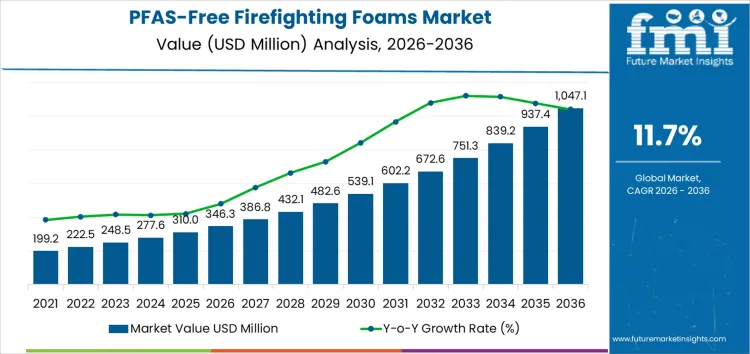
PFAS-Free Firefighting Foams Market Key Takeaways
| Metric | Value |
|---|---|
| Market Value (2026) | USD 346.3 million |
| Market Forecast Value (2036) | USD 1,047.0 million |
| Forecast CAGR (2026 to 2036) | 11.7% |
Why is the Demand for PFAS-Free Firefighting Foams Market Growing?
Demand for PFAS-free firefighting foams is growing globally due to regulatory restrictions on per and polyfluoroalkyl substances and rising environmental health priorities. Traditional aqueous film forming foams containing PFAS have been linked to persistence in soil and water, which prompts governments and industry users to phase out legacy formulations. Fire safety programs adopt foam alternatives that provide effective flammable liquid fire suppression without long-lasting fluorinated compounds. Aviation, petrochemical, military, and industrial facilities integrate PFAS-free foams into emergency response plans to meet evolving standards and reduce environmental liability.
Regulatory frameworks in multiple regions restrict manufacture, use, and discharge of PFAS based products, which motivates procurement of compliant substitutes. Manufacturers develop hydrocarbon-based, silicone-enhanced, and other fluorine-free agents that balance extinguishing performance and environmental acceptability. Training facilities and fire departments update equipment and drills to include PFAS-free foams, ensuring readiness across operational scenarios. Environmental remediation and sustainability initiatives reinforce transition efforts as water quality protection becomes a priority. Supply chain partners align procurement strategies with restricted substance lists and corporate sustainability goals. Continuous research improves efficacy and stability of fluorine-free alternatives, sustaining demand across firefighting sectors worldwide.
How Are the Segments Classified in the PFAS-Free Firefighting Foams Market?
Demand for PFAS-free firefighting foams globally is shaped by regulatory bans on fluorinated surfactants, environmental liability concerns, and performance validation under hydrocarbon fire scenarios. End users assess knockdown speed, burn-back resistance, compatibility with existing systems, and cleanup implications. Adoption patterns reflect accelerated replacement across high-risk industrial sites and aviation environments requiring compliant fire suppression without persistent fluorinated residues.
Which Foam Type Represents the Largest Share of Global Demand?
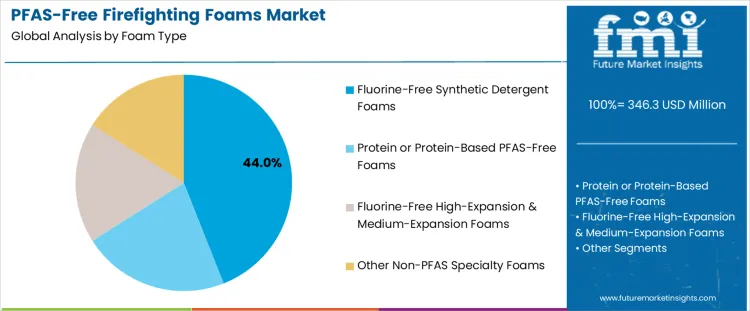
Fluorine-free synthetic detergent foams hold 44.0%, representing the largest share of global demand. These foams deliver rapid fire knockdown and acceptable burn-back control without PFAS content. Protein or protein-based PFAS-free foams hold 22.0%, supporting stability and heat resistance for prolonged suppression scenarios. Fluorine-free high-expansion and medium-expansion foams account for 18.0%, addressing confined-space and vapor suppression applications. Other non-PFAS specialty foams hold 16.0%, covering niche formulations and tailored performance needs. Foam-type distribution reflects preference for synthetic detergent systems meeting performance and compliance requirements.
Key Points:
- Synthetic detergent foams lead due to balanced performance and compliance.
- Protein-based foams support stability under prolonged exposure.
- Expansion foams address confined and vapor suppression uses.
Which End-Use Industry Drives the Highest Share of Global Adoption?
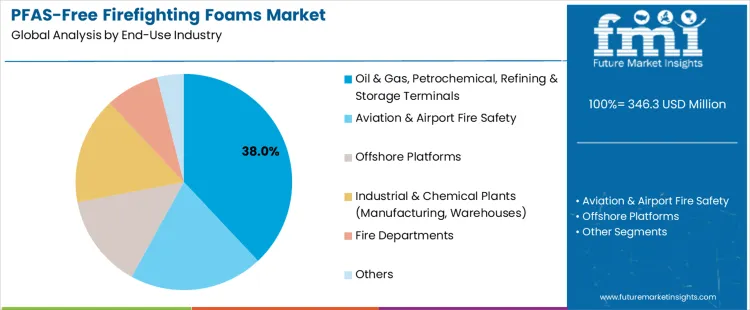
Oil and gas, petrochemical, refining, and storage terminals hold 38.0%, driving the highest share of global adoption. These sites face elevated hydrocarbon fire risk and stringent environmental oversight. Aviation and airport fire safety holds 20.0%, requiring rapid response capability and regulatory compliance. Industrial and chemical plants account for 16.0%, addressing manufacturing and warehouse fire hazards. Offshore platforms hold 14.0%, requiring performance under harsh conditions. Fire departments account for 8.0%, supporting municipal response readiness. Other uses hold 4.0%. End-use distribution reflects concentration of high-risk fire scenarios in energy and aviation sectors.
Key Points:
- Energy and petrochemical sites dominate due to high fire risk.
- Aviation requires rapid, compliant suppression performance.
- Industrial and offshore uses demand robust operational reliability.
What are the Key Dynamics in the PFAS-Free Firefighting Foams Market?
Global demand rises as fire protection authorities, industrial end users, and aviation operators transition from PFAS-based aqueous film-forming foams (AFFFs) to PFAS-free formulations that reduce environmental persistence and human health concerns. Adoption aligns with regulatory restrictions on per- and polyfluoroalkyl substances, sustainable procurement policies, and increased scrutiny of legacy contamination. Usage spans airports, petrochemical facilities, municipal fire departments, and marine fire response units across multiple regions pursuing environmentally responsible emergency response capability.
How do regulatory restrictions and environmental health priorities shape global demand?
Governments in Europe, North America, and Asia-Pacific introduce phased bans, phaseouts, or stringent use conditions for PFAS-based firefighting foams due to persistence, bioaccumulation, and toxicity risks. Environmental agencies and aviation regulators require adoption of alternative foams that meet equivalent fire suppression performance while minimizing long-term ecological impact. Industrial users, including oil and gas, chemical plants, and storage terminals, update fire protection specifications to align with best-available sustainable technologies. Procurement policies by governments and large enterprises emphasize PFAS-free certification and lifecycle environmental impact assessments. Fire service training and response organizations integrate PFAS-free foams into standard operating procedures to reduce firefighting runoff contamination and remediation liabilities.
How does performance equivalence, cost considerations, and operational integration influence market scalability?
PFAS-free foam formulations must demonstrate comparable extinguishment speed, burnback resistance, and training safety to legacy AFFFs, requiring extensive testing, certification, and validation. Cost differentials relative to established fluorinated products affect procurement decisions, particularly for smaller fire departments and developing market users. Integration into existing foam delivery systems may require compatibility testing with hardware and proportioning equipment to ensure effective distribution. End users balance investment in PFAS-free solutions against potential future remediation and regulatory compliance costs. Availability of standardized global performance criteria improves confidence in alternative technologies but variable regional standards create complexity for multinational specifications. Long-term growth depends on continued innovation that delivers reliable fire suppression while maintaining environmental and human health profiles, operational readiness, and alignment with evolving global regulatory expectations.
How Is Demand for PFAS-Free Firefighting Foams Evolving?
Demand for PFAS-free firefighting foams is increasing globally due to regulatory bans, liability risks, and environmental remediation costs associated with fluorinated foams. China leads with a 14.2% CAGR, supported by industrial fire safety upgrades and policy-driven substitution. USA follows at 13.5%, driven by federal and state-level PFAS restrictions and military base remediation programs. India records a 12.8% CAGR, reflecting industrial expansion, airport safety upgrades, and alignment with global fire safety standards. Germany posts a 12.0% CAGR, shaped by precautionary chemical regulation and mandatory phase-out of fluorinated firefighting agents. Growth reflects rapid transition toward fluorine-free Class B fire suppression solutions worldwide.
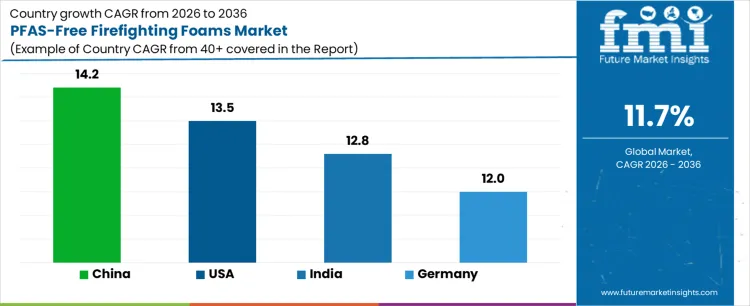
| Country | CAGR (%) |
|---|---|
| China | 14.2% |
| USA | 13.5% |
| India | 12.8% |
| Germany | 12.0% |
What factors are driving rapid adoption of PFAS-free firefighting foams in China?
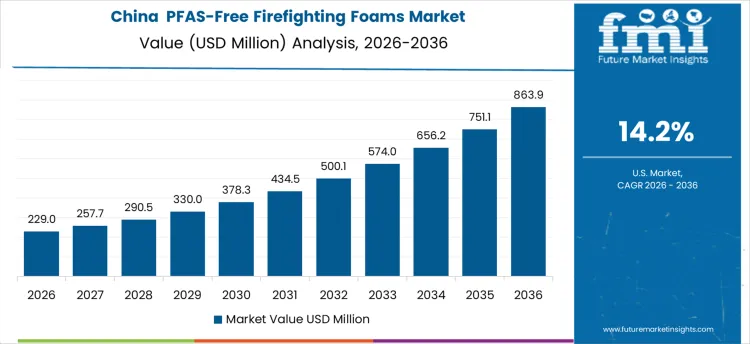
China demand is driven by large-scale industrialization, expansion of petrochemical facilities, and strengthened fire safety regulation. CAGR of 14.2% reflects accelerated replacement of fluorinated aqueous film-forming foams across airports, refineries, and storage terminals. Environmental compliance requirements limit discharge of persistent chemicals. Centralized policy directives enable rapid nationwide substitution. Domestic manufacturers scale production of fluorine-free formulations optimized for hydrocarbon fire suppression. Training and certification updates support operational transition. Growth remains policy-led and infrastructure-driven, aligned with environmental risk reduction and industrial safety objectives.
- Industrial and petrochemical fire safety upgrades
- Regulatory restrictions on persistent fluorinated foams
- Centralized substitution mandates
- Scaling of domestic PFAS-free foam production
How are regulatory actions shaping PFAS-free foam demand growth in the USA?
USA demand is shaped by state-level PFAS bans, federal regulations, and litigation exposure related to contaminated sites. CAGR of 13.5% reflects mandated transition at military bases, airports, and municipal fire departments. Fire agencies replace legacy AFFF stocks and invest in compatible foam proportioning systems. Environmental remediation costs accelerate proactive substitution. Certification under updated firefighting standards guides procurement. Growth remains regulation-driven and liability-focused, aligned with environmental protection and public health priorities.
- State and federal PFAS bans
- Replacement of legacy AFFF inventories
- Military and airport transition programs
- Compliance with updated firefighting standards
What is supporting strong growth of PFAS-free firefighting foams in India?
India demand is driven by expansion of industrial infrastructure, aviation capacity growth, and modernization of emergency response systems. CAGR of 12.8% reflects adoption of PFAS-free foams at airports, oil terminals, and chemical plants. Export-oriented facilities align fire safety materials with international environmental standards. Regulatory guidance increasingly discourages fluorinated foam usage. Training programs support operational readiness with new formulations. Growth remains infrastructure-led and compliance-aligned, supported by industrial growth and safety modernization initiatives.
- Airport and industrial fire safety modernization
- Alignment with international environmental standards
- Adoption across oil and chemical facilities
- Training for fluorine-free foam deployment
Why does Germany show steady but high growth in PFAS-free foam adoption?
Germany demand reflects strict chemical regulation, environmental protection mandates, and precautionary risk management. CAGR of 12.0% is supported by mandated phase-out of fluorinated firefighting foams across municipal and industrial users. Fire brigades adopt certified fluorine-free alternatives compatible with European fire performance standards. Environmental liability considerations influence procurement decisions. Documentation and traceability requirements guide product selection. Growth remains regulation-driven and compliance-focused, aligned with EU-wide chemical safety frameworks.
- Mandatory phase-out of fluorinated firefighting foams
- Adoption aligned with European fire performance standards
- Environmental liability risk management
- Strong regulatory documentation requirements
What is the competitive landscape of demand for PFAS-free firefighting foams?
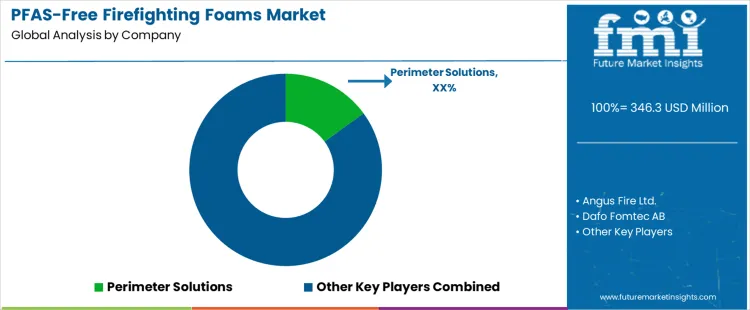
Demand for PFAS-free firefighting foams is driven by regulatory bans on fluorinated surfactants, environmental liability concerns, and transition mandates from aviation, petrochemical, and municipal fire authorities. Applications include Class B firefighting for flammable liquid fires, industrial risk protection, airport rescue and firefighting, and marine operations.
Buyers evaluate fire knockdown speed, burnback resistance, compatibility with existing proportioning systems, and performance under international standards such as EN, ICAO, and UL. Procurement teams prioritize demonstrated performance equivalence to AFFF alternatives, supply continuity, training support, and environmental compliance documentation. Trend in the global market reflects accelerated phase-out timelines, retrofit programs for legacy systems, and increased scrutiny of lifecycle environmental impact.
Perimeter Solutions maintains strong positioning through fluorine-free foam portfolios deployed across aviation, industrial, and municipal firefighting sectors. Angus Fire Ltd. supplies PFAS-free foams certified to international performance standards and adopted widely by airport and industrial operators. Dafo Fomtec AB focuses on fluorine-free formulations used in fixed systems and mobile firefighting applications.
National Foam supports global transition programs with fluorine-free foam solutions integrated into fire suppression system retrofits. SFFECO Global participates through regionally deployed PFAS-free foams serving industrial and municipal customers. Competitive differentiation depends on certification coverage, real-world fire performance, system compatibility, and ability to support large-scale conversion programs.
Key Players in the PFAS-Free Firefighting Foams Market
- Perimeter Solutions
- Angus Fire Ltd.
- Dafo Fomtec AB
- National Foam
- SFFECO Global
Scope of the Report
| Items | Values |
|---|---|
| Quantitative Units | USD million |
| Foam Type | Fluorine-Free Synthetic Detergent Foams; Protein or Protein-Based PFAS-Free Foams; Fluorine-Free High-Expansion & Medium-Expansion Foams; Other Non-PFAS Specialty Foams |
| End-Use Industry | Oil & Gas, Petrochemical, Refining & Storage Terminals; Aviation & Airport Fire Safety; Offshore Platforms; Industrial & Chemical Plants (Manufacturing, Warehouses); Fire Departments; Others |
| Regions Covered | Asia Pacific, Europe, North America, Latin America, Middle East & Africa |
| Countries Covered | China, USA, India, Germany, and 40+ countries |
| Key Companies Profiled | Perimeter Solutions; Angus Fire Ltd.; Dafo Fomtec AB; National Foam; SFFECO Global |
| Additional Attributes | Dollar sales by foam type and end-use industry; adoption trends for fluorine-free firefighting formulations; performance benchmarks for fire knockdown, burnback resistance, and environmental persistence; compatibility with legacy firefighting systems; compliance with PFAS regulatory restrictions and certification standards; advances in protein-based and synthetic PFAS-free foam chemistries. |
PFAS-Free Firefighting Foams Market by Segment
By Foam Type:
- Fluorine-Free Synthetic Detergent Foams
- Protein or Protein-Based PFAS-Free Foams
- Fluorine-Free High-Expansion & Medium-Expansion Foams
- Other Non-PFAS Specialty Foams
By End-Use Industry:
- Oil & Gas, Petrochemical, Refining & Storage Terminals
- Aviation & Airport Fire Safety
- Offshore Platforms
- Industrial & Chemical Plants (Manufacturing, Warehouses)
- Fire Departments
- Others
By Region:
- Asia Pacific
- China
- Japan
- South Korea
- India
- Australia & New Zealand
- ASEAN
- Rest of Asia Pacific
- Europe
- Germany
- United Kingdom
- France
- Italy
- Spain
- Nordic
- BENELUX
- Rest of Europe
- North America
- United States
- Canada
- Mexico
- Latin America
- Brazil
- Chile
- Rest of Latin America
- Middle East & Africa
- Kingdom of Saudi Arabia
- Other GCC Countries
- Turkey
- South Africa
- Other African Union
- Rest of Middle East & Africa
Frequently Asked Questions
How big is the PFAS-free firefighting foams market in 2026?
The global PFAS-free firefighting foams market is estimated to be valued at USD 346.3 million in 2026.
What will be the size of PFAS-free firefighting foams market in 2036?
The market size for the PFAS-free firefighting foams market is projected to reach USD 1,047.1 million by 2036.
How much will be the PFAS-free firefighting foams market growth between 2026 and 2036?
The PFAS-free firefighting foams market is expected to grow at a 11.7% CAGR between 2026 and 2036.
What are the key product types in the PFAS-free firefighting foams market?
The key product types in PFAS-free firefighting foams market are fluorine-free synthetic detergent foams, protein or protein-based PFAS-free foams, fluorine-free high-expansion & medium-expansion foams and other non-PFAS specialty foams.
Which end-use industry segment to contribute significant share in the PFAS-free firefighting foams market in 2026?
In terms of end-use industry, oil & gas, Petrochemical, refining & storage terminals segment to command 38.0% share in the PFAS-free firefighting foams market in 2026.
Preview the report firsthand - request a free sample
Get SampleGet the brochure for pricing and purchase details.
Get PDFTable of Content
- Executive Summary
- Global Market Outlook
- Demand-side Trends
- Supply-side Trends
- Technology Roadmap Analysis
- Analysis and Recommendations
- Market Overview
- Market Coverage / Taxonomy
- Market Definition / Scope / Limitations
- Market Background
- Market Dynamics
- Drivers
- Restraints
- Opportunity
- Trends
- Scenario Forecast
- Demand in Optimistic Scenario
- Demand in Likely Scenario
- Demand in Conservative Scenario
- Opportunity Map Analysis
- Product Life Cycle Analysis
- Supply Chain Analysis
- Investment Feasibility Matrix
- Value Chain Analysis
- PESTLE and Porter’s Analysis
- Regulatory Landscape
- Regional Parent Market Outlook
- Production and Consumption Statistics
- Import and Export Statistics
- Market Dynamics
- Global Market Analysis 2021 to 2025 and Forecast, 2026 to 2036
- Historical Market Size Value (USD Million) Analysis, 2021 to 2025
- Current and Future Market Size Value (USD Million) Projections, 2026 to 2036
- Y-o-Y Growth Trend Analysis
- Absolute $ Opportunity Analysis
- Global Market Pricing Analysis 2021 to 2025 and Forecast 2026 to 2036
- Global Market Analysis 2021 to 2025 and Forecast 2026 to 2036, By Foam Type
- Introduction / Key Findings
- Historical Market Size Value (USD Million) Analysis By Foam Type , 2021 to 2025
- Current and Future Market Size Value (USD Million) Analysis and Forecast By Foam Type , 2026 to 2036
- Fluorine-Free Synthetic Detergent Foams
- Protein or Protein-Based PFAS-Free Foams
- Fluorine-Free High-Expansion & Medium-Expansion Foams
- Other Non-PFAS Specialty Foams
- Fluorine-Free Synthetic Detergent Foams
- Y-o-Y Growth Trend Analysis By Foam Type , 2021 to 2025
- Absolute $ Opportunity Analysis By Foam Type , 2026 to 2036
- Global Market Analysis 2021 to 2025 and Forecast 2026 to 2036, By End-Use Industry
- Introduction / Key Findings
- Historical Market Size Value (USD Million) Analysis By End-Use Industry, 2021 to 2025
- Current and Future Market Size Value (USD Million) Analysis and Forecast By End-Use Industry, 2026 to 2036
- Oil & Gas, Petrochemical, Refining & Storage Terminals
- Aviation & Airport Fire Safety
- Offshore Platforms
- Industrial & Chemical Plants (Manufacturing, Warehouses)
- Fire Departments
- Others
- Oil & Gas, Petrochemical, Refining & Storage Terminals
- Y-o-Y Growth Trend Analysis By End-Use Industry, 2021 to 2025
- Absolute $ Opportunity Analysis By End-Use Industry, 2026 to 2036
- Global Market Analysis 2021 to 2025 and Forecast 2026 to 2036, By Region
- Introduction
- Historical Market Size Value (USD Million) Analysis By Region, 2021 to 2025
- Current Market Size Value (USD Million) Analysis and Forecast By Region, 2026 to 2036
- North America
- Latin America
- Western Europe
- Eastern Europe
- East Asia
- South Asia and Pacific
- Middle East & Africa
- Market Attractiveness Analysis By Region
- North America Market Analysis 2021 to 2025 and Forecast 2026 to 2036, By Country
- Historical Market Size Value (USD Million) Trend Analysis By Market Taxonomy, 2021 to 2025
- Market Size Value (USD Million) Forecast By Market Taxonomy, 2026 to 2036
- By Country
- USA
- Canada
- Mexico
- By Foam Type
- By End-Use Industry
- By Country
- Market Attractiveness Analysis
- By Country
- By Foam Type
- By End-Use Industry
- Key Takeaways
- Latin America Market Analysis 2021 to 2025 and Forecast 2026 to 2036, By Country
- Historical Market Size Value (USD Million) Trend Analysis By Market Taxonomy, 2021 to 2025
- Market Size Value (USD Million) Forecast By Market Taxonomy, 2026 to 2036
- By Country
- Brazil
- Chile
- Rest of Latin America
- By Foam Type
- By End-Use Industry
- By Country
- Market Attractiveness Analysis
- By Country
- By Foam Type
- By End-Use Industry
- Key Takeaways
- Western Europe Market Analysis 2021 to 2025 and Forecast 2026 to 2036, By Country
- Historical Market Size Value (USD Million) Trend Analysis By Market Taxonomy, 2021 to 2025
- Market Size Value (USD Million) Forecast By Market Taxonomy, 2026 to 2036
- By Country
- Germany
- UK
- Italy
- Spain
- France
- Nordic
- BENELUX
- Rest of Western Europe
- By Foam Type
- By End-Use Industry
- By Country
- Market Attractiveness Analysis
- By Country
- By Foam Type
- By End-Use Industry
- Key Takeaways
- Eastern Europe Market Analysis 2021 to 2025 and Forecast 2026 to 2036, By Country
- Historical Market Size Value (USD Million) Trend Analysis By Market Taxonomy, 2021 to 2025
- Market Size Value (USD Million) Forecast By Market Taxonomy, 2026 to 2036
- By Country
- Russia
- Poland
- Hungary
- Balkan & Baltic
- Rest of Eastern Europe
- By Foam Type
- By End-Use Industry
- By Country
- Market Attractiveness Analysis
- By Country
- By Foam Type
- By End-Use Industry
- Key Takeaways
- East Asia Market Analysis 2021 to 2025 and Forecast 2026 to 2036, By Country
- Historical Market Size Value (USD Million) Trend Analysis By Market Taxonomy, 2021 to 2025
- Market Size Value (USD Million) Forecast By Market Taxonomy, 2026 to 2036
- By Country
- China
- Japan
- South Korea
- By Foam Type
- By End-Use Industry
- By Country
- Market Attractiveness Analysis
- By Country
- By Foam Type
- By End-Use Industry
- Key Takeaways
- South Asia and Pacific Market Analysis 2021 to 2025 and Forecast 2026 to 2036, By Country
- Historical Market Size Value (USD Million) Trend Analysis By Market Taxonomy, 2021 to 2025
- Market Size Value (USD Million) Forecast By Market Taxonomy, 2026 to 2036
- By Country
- India
- ASEAN
- Australia & New Zealand
- Rest of South Asia and Pacific
- By Foam Type
- By End-Use Industry
- By Country
- Market Attractiveness Analysis
- By Country
- By Foam Type
- By End-Use Industry
- Key Takeaways
- Middle East & Africa Market Analysis 2021 to 2025 and Forecast 2026 to 2036, By Country
- Historical Market Size Value (USD Million) Trend Analysis By Market Taxonomy, 2021 to 2025
- Market Size Value (USD Million) Forecast By Market Taxonomy, 2026 to 2036
- By Country
- Kingdom of Saudi Arabia
- Other GCC Countries
- Turkiye
- South Africa
- Other African Union
- Rest of Middle East & Africa
- By Foam Type
- By End-Use Industry
- By Country
- Market Attractiveness Analysis
- By Country
- By Foam Type
- By End-Use Industry
- Key Takeaways
- Key Countries Market Analysis
- USA
- Pricing Analysis
- Market Share Analysis, 2025
- By Foam Type
- By End-Use Industry
- Canada
- Pricing Analysis
- Market Share Analysis, 2025
- By Foam Type
- By End-Use Industry
- Mexico
- Pricing Analysis
- Market Share Analysis, 2025
- By Foam Type
- By End-Use Industry
- Brazil
- Pricing Analysis
- Market Share Analysis, 2025
- By Foam Type
- By End-Use Industry
- Chile
- Pricing Analysis
- Market Share Analysis, 2025
- By Foam Type
- By End-Use Industry
- Germany
- Pricing Analysis
- Market Share Analysis, 2025
- By Foam Type
- By End-Use Industry
- UK
- Pricing Analysis
- Market Share Analysis, 2025
- By Foam Type
- By End-Use Industry
- Italy
- Pricing Analysis
- Market Share Analysis, 2025
- By Foam Type
- By End-Use Industry
- Spain
- Pricing Analysis
- Market Share Analysis, 2025
- By Foam Type
- By End-Use Industry
- France
- Pricing Analysis
- Market Share Analysis, 2025
- By Foam Type
- By End-Use Industry
- India
- Pricing Analysis
- Market Share Analysis, 2025
- By Foam Type
- By End-Use Industry
- ASEAN
- Pricing Analysis
- Market Share Analysis, 2025
- By Foam Type
- By End-Use Industry
- Australia & New Zealand
- Pricing Analysis
- Market Share Analysis, 2025
- By Foam Type
- By End-Use Industry
- China
- Pricing Analysis
- Market Share Analysis, 2025
- By Foam Type
- By End-Use Industry
- Japan
- Pricing Analysis
- Market Share Analysis, 2025
- By Foam Type
- By End-Use Industry
- South Korea
- Pricing Analysis
- Market Share Analysis, 2025
- By Foam Type
- By End-Use Industry
- Russia
- Pricing Analysis
- Market Share Analysis, 2025
- By Foam Type
- By End-Use Industry
- Poland
- Pricing Analysis
- Market Share Analysis, 2025
- By Foam Type
- By End-Use Industry
- Hungary
- Pricing Analysis
- Market Share Analysis, 2025
- By Foam Type
- By End-Use Industry
- Kingdom of Saudi Arabia
- Pricing Analysis
- Market Share Analysis, 2025
- By Foam Type
- By End-Use Industry
- Turkiye
- Pricing Analysis
- Market Share Analysis, 2025
- By Foam Type
- By End-Use Industry
- South Africa
- Pricing Analysis
- Market Share Analysis, 2025
- By Foam Type
- By End-Use Industry
- USA
- Market Structure Analysis
- Competition Dashboard
- Competition Benchmarking
- Market Share Analysis of Top Players
- By Regional
- By Foam Type
- By End-Use Industry
- Competition Analysis
- Competition Deep Dive
- Perimeter Solutions
- Overview
- Product Portfolio
- Profitability by Market Segments (Product/Age /Sales Channel/Region)
- Sales Footprint
- Strategy Overview
- Marketing Strategy
- Product Strategy
- Channel Strategy
- Angus Fire Ltd.
- Dafo Fomtec AB
- National Foam
- SFFECO Global
- Perimeter Solutions
- Competition Deep Dive
- Assumptions & Acronyms Used
- Research Methodology


