

- Industry Size (2026)
- USD 1.5 Bn
- Forecast (2036)
- USD 2.3 Bn
- CAGR (2026 to 2036)
- 5.0%
Aerial Firefighting Market Forecast and Outlook By FMI
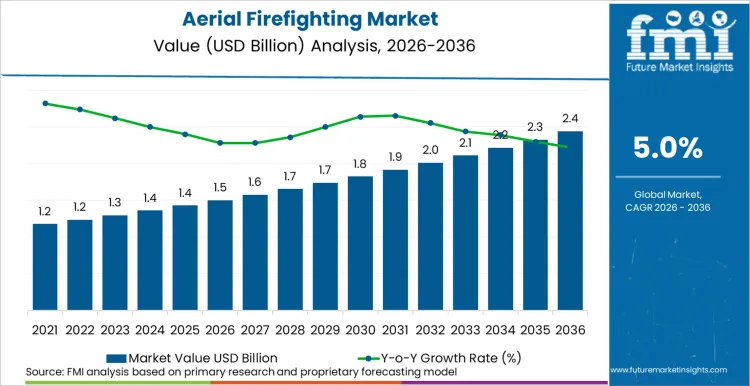
In 2025, the global aerial firefighting market was valued at approximately USD 1.4 billion. Based on Future Market Insights' analysis, demand for aerial firefighting solutions is estimated to grow to USD 1.5 billion in 2026 and is projected to reach approximately USD 2.3 billion by 2036. FMI projects a CAGR of approximately 5.0% during the forecast period.
Absolute dollar growth of USD 0.9 billion over the decade signals steady expansion driven by increasing frequency and severity of wildfires, government investments in firefighting modernization, and growing adoption of specialized aerial platforms. Despite high operational costs and fleet capacity limitations, major aerial firefighting providers sustain momentum through aircraft modernization, private sector partnerships, and integration of UAV technologies.
Summary of Aerial Firefighting Market
- Aerial Firefighting Market Definition: The industry covers aerial assets and services for wildfire and structural fire suppression, including aircraft, helicopters, UAVs, and associated operations and support.
- Demand Drivers in the Market:
- Climate change increases wildfire frequency, severity, and duration.
- Government disaster preparedness budgets expand for aerial capabilities.
- Urban-wildland interface growth requires rapid response assets.
- Key Segments Analyzed in the FMI Report:
- Type: Aircraft leads with 48.6% share.
- Service: Firefighting operations dominate at 53.2% share.
- End User: Government commands 46.7% share.
- Analyst Opinion at FMI: Nikhil Kaitwade, Principal Consultant for Aerospace and Defense at Future Market Insights, opines, "In the updated version of the Aerial Firefighting Market Report for 2026 to 2036, emergency response planners and procurement officials will find insights into how UAV integration is reducing operational costs and enabling sustained overnight operations. Besides this, my findings point at fleet aging challenges requiring modernization investments and the emergence of hybrid-electric platforms for reduced environmental impact and operating costs."
- Strategic Implications/Executive Takeaways:
- Shift focus from single-mission platforms to multi-role aerial assets.
- Treat UAV integration as force multiplier for surveillance and targeted suppression.
- Prioritize public-private partnerships for fleet capacity and surge capability.
- Methodology:
- Validated through wildfire incidence data and government procurement records.
- Zero reliance on speculative third-party market research reports.
- Based on verifiable disaster management budgets and aircraft fleet statistics.
As Sam Davis, Chief Executive Officer of Bridger Aerospace, stated regarding federal wildfire response coordination, “Consolidating federal capabilities and bringing together wildland fire programs that have long operated across multiple agencies will help us respond more quickly and effectively at the early stages of a wildfire to save lives, protect property, and reduce the hazards faced by firefighters.” [1]
China (6.8% projected) and India (6.3% projected) drive new opportunities through rapid urbanization and increasing wildfire threats. Germany (5.8% projected) and France (5.3% projected) contribute via technological advancements and government funding.
Aerial Firefighting Market Definition
Aerial firefighting encompasses the use of aircraft and supporting aerial assets to combat wildfires and structural fires from the air. This includes fixed-wing airtankers, helicopters equipped with water buckets or tanks, and increasingly unmanned aerial vehicles (UAVs) for surveillance and targeted suppression. Services include direct firefighting operations (water and retardant drops), aerial surveillance and monitoring for fire detection and mapping, and aerial logistics and support for ground crews. End users span government agencies (forestry services, civil protection), private firefighting contractors, and industrial companies protecting critical infrastructure .
Aerial Firefighting Market Inclusions
The report includes a comprehensive analysis of market dynamics, featuring Global and Regional Market Sizes (Volume and Value) and a 10-year Forecast (2026-2036). It covers segmental breakdowns by type (Aircraft, Helicopter, Fixed-wing Aircraft, UAVs), service (Firefighting Operations, Aerial Surveillance and Monitoring, Aerial Logistics and Support), end user (Government, Private Firefighting Contractors, Industrial Companies), and geographic regions.
Aerial Firefighting Market Exclusions
The scope excludes ground-based firefighting equipment and personnel, non-aerial fire detection systems (satellite-based detection without aircraft integration), and military aircraft not specifically configured for firefighting missions.
Aerial Firefighting Market Research Methodology
- Primary Research: Interviews were conducted with aerial firefighting operators, aircraft manufacturers, government disaster management agencies, and private firefighting contractors across major regions. Aviation specialists clarified aircraft modification and certification requirements.
- Desk Research: Wildfire statistics, government budget allocations, and corporate financial filings supported volume benchmarking.
- Market-Sizing and Forecasting: A hybrid top-down and bottom-up model was developed. Demand was reconstructed from wildfire incidence data, aircraft fleet counts, and service contract values, then validated against operator revenue reports and procurement records.
- Data Validation and Update Cycle: Outputs undergo anomaly screening, variance checks across production and trade datasets, and structured peer review prior to release.
Segmental Analysis
Aerial Firefighting Market Analysis by Type
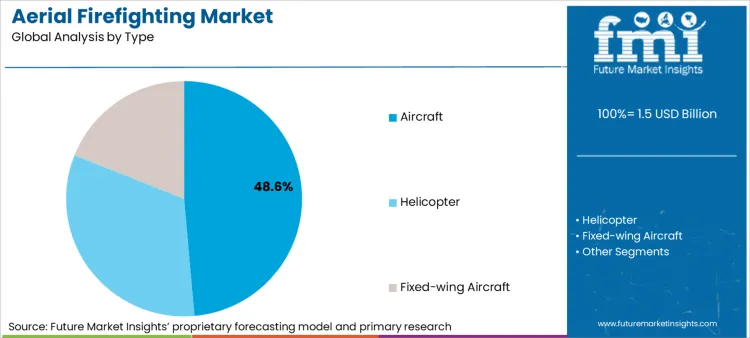
Based on FMI’s aerial firefighting market report, fixed-wing aircraft are estimated to hold 48.6% share in 2026. Growth in fixed-wing platforms comes from their high payload capacity, extended operational range, and speed advantages in suppressing large-scale wildfires, enabling coverage of expansive terrain within compressed response windows while deploying advanced retardant dispersal systems with improved drop precision.
- Fleet Modernization Strategy: Conair Group Inc. is expanding next-generation tanker capacity through aircraft conversion programs, stating, “Conair Group Inc. (Conair), operating the largest fixed-wing fleet of firefighting aircraft in the world, is pleased to announce the purchase of seven Dash 8-400 aircraft for conversion to airtankers, engineered specifically for aerial firefighting.” [2] Such conversions enhance payload efficiency and modernize national wildfire response fleets.
- Amphibious Rapid Turnaround: Canadair CL-415 aircraft provide tactical flexibility in water-abundant regions. As documented, “The CL-415 can scoop up to 6,140 L (1,350 imp gal; 1,620 US gal) of water from a nearby water source, mix it with a chemical foam if desired, and drop it on a fire without having to return to base to refill its tanks.” [3] This capability reduces ground refueling dependency and improves sortie frequency.
- Wide-Area Coverage Capability: Fixed-wing platforms enable long-distance deployment across remote wildfire zones, supporting national-scale fire suppression strategies where helicopter endurance and payload are comparatively constrained.
Aerial Firefighting Market Analysis by Service
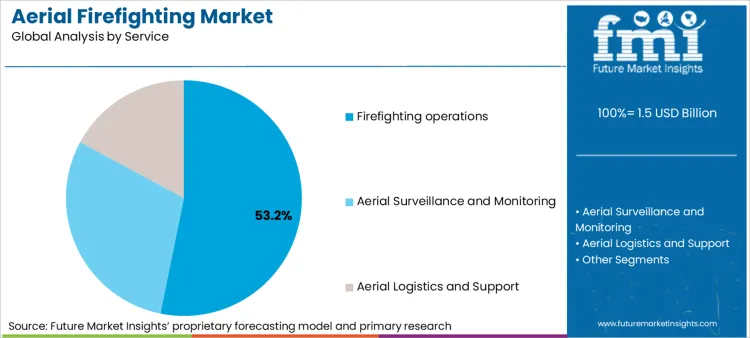
Firefighting operations are estimated to account for 53.2% share in 2026, reflecting growing reliance on aerial suppression as a primary frontline response to increasingly destructive wildfire seasons. Strategic deployment of aerial assets enhances early containment, protects infrastructure corridors, and limits fire spread in terrain inaccessible to ground crews.
- High-Capacity Retardant Deployment: Large airtankers such as the DC-10 enhance suppression efficiency. As noted in operational testimony, “The DC-10's superior power-to-weight ratio permits operations at all altitudes and in all terrain... its capacity requires fewer flights, further enhancing safety.” [4] High-capacity aircraft reduce mission cycles while improving operational safety margins.
- Night Operations Expansion: Coulson Aviation Canada has advanced night-response capability, stating, “Coulson Aviation Canada is proud to announce it has been awarded and started a 70-day contract by the BC Wildfire Service (BCWS) to provide one of its state-of-the-art Sikorsky S-61 Type 1 helitankers equipped for Night Vision Goggle (NVG) operations.” [5] Enhanced avionics and NVG systems extend operational windows beyond daylight hours.
- Retardant Technology Advancement: Ongoing improvements in fire retardant chemistry and precision application systems increase suppression effectiveness while reducing environmental footprint, supporting regulatory alignment and ecosystem protection objectives.
Aerial Firefighting Market Drivers, Restraints, and Opportunities
Future Market Insights analysis that historical patterns point at a critical emergency response sector facing increasing demand from climate-driven wildfire trends, now requiring modernization of aging fleets and integration of new technologies. Estimated valuation in 2026 represents the "capacity expansion phase" as governments and private operators invest in additional assets and advanced capabilities.
While operational costs remain significant, the escalating cost of wildfire damage (often exceeding suppression costs by 10-20x) drives investment, resulting in steady growth as climate change continues to impact fire seasons globally.
- Wildfire Severity: Climate change has increased wildfire frequency, intensity, and duration, with record-breaking fire seasons becoming common in North America, Australia, and Southern Europe, driving sustained demand for aerial suppression assets .
- Urban-Wildland Interface: Expanding residential development into wildfire-prone areas creates greater asset exposure, requiring rapid-response aerial capabilities to protect communities and infrastructure .
- UAV Integration: Unmanned aerial vehicles are increasingly deployed for surveillance, fire mapping, and even targeted suppression, offering cost-effective sustained operations without crew fatigue limitations .
Regional Analysis
Based on the regional analysis, the aerial firefighting market is segmented into North America, Latin America, Europe, Asia Pacific, and Middle East & Africa across 40+ countries. The full report also offers market attractiveness analysis based on regional wildfire risk, climate adaptation funding, and aviation fleet modernization trends.
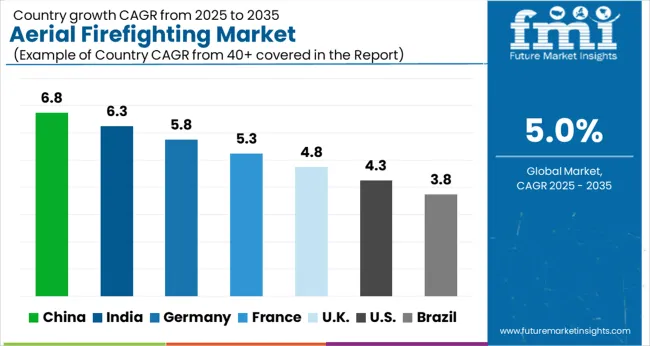
| Country | CAGR (2026 to 2036) |
|---|---|
| China | 6.8% |
| India | 6.3% |
| Germany | 5.8% |
| United Kingdom | 4.8% |
| United States | 4.3% |
Source: Future Market Insights (FMI) analysis, based on proprietary forecasting model and primary research
North America Aerial Firefighting Market Analysis
North America remains the largest and most technologically advanced aerial firefighting market, characterized by structural reform and federal consolidation. The region is transitioning from fragmented inter-agency coordination to unified wildfire command frameworks supported by modern aircraft fleets and advanced retardant systems.
- United States: Demand for aerial firefighting services in the United States is projected to rise at 4.3% CAGR through 2036. Growth is anchored by the launch of the USA Wildland Fire Service (USWFS) in January 2026 to modernize and unify federal wildfire response. Bridger Aerospace stated, “With Bridger's significant Air Attack fleet and the world's largest private Super Scooper fleet, we believe we are uniquely positioned as the nation refocuses efforts on preparedness and aggressive Wildfire Suppression.” This reflects structural federal modernization and fleet expansion. [6]
FMI’s report includes a detailed assessment of federal restructuring, fleet procurement cycles, and wildfire intensity trends across the United States and Canada. Readers can also find insights on retardant contracts, aircraft leasing models, and interagency response coordination.
Asia Pacific Aerial Firefighting Market Analysis
Asia Pacific is the fastest-growing region, driven by national strategies to develop low-altitude aviation economies and formalize aerial emergency response systems. Governments are integrating firefighting aviation into broader disaster management frameworks, civil protection policies, and climate resilience programs.
- China: Leading with a 6.8% CAGR, China’s market expansion is linked to its national “low-altitude economy” strategy. According to USA trade guidance, “By 2030, China's low-altitude economy is expected to reach $274 billion (2 trillion yuan). Key growth areas include aerial emergency rescue, air medical services, firefighting, agriculture, tourism, and pilot training.” This policy-backed aviation expansion directly supports firefighting aircraft procurement and emergency fleet scaling. [7]
- India: India’s aerial firefighting market is projected to grow at 6.3% CAGR through 2036. The Ministry of Environment supports wildfire prevention through financial allocation under the Centrally Sponsored Scheme on Forest Fire Prevention and Management. Official documentation states that funds are released for “creation and maintenance of fire lines, engagement of fire watchers, construction of water storage structures,” reinforcing institutional support for coordinated fire response infrastructure. [8]
The full report analyzes aerial firefighting developments across China, India, Australia, Indonesia, Japan, and ASEAN markets, covering procurement policies, fleet modernization, and satellite monitoring integration.
Europe Aerial Firefighting Market Analysis
Europe is evolving toward a collaborative continental wildfire defense model, where climate adaptation strategies are integrated with civil protection frameworks. Increasing heatwaves and cross-border fire risks are prompting modernization of national fleets and shared response mechanisms.
- Germany: Demand for aerial firefighting in Germany is projected to rise at 5.8% CAGR through 2036. The Federal Government is integrating wildfire response into civil protection and climate adaptation strategies. Policy documentation notes that starting in 2026, the government will collect financial loss data from extreme weather events while expanding federal civil protection reach, strengthening coordinated disaster response systems. [9]
- United Kingdom: The UK market is projected to expand at 4.8% CAGR, supported by aviation modernization funding and strengthened fire service budgets. The London Fire Commissioner’s budget submission highlights funding of £557.3 million and emphasizes that “firefighting today is a very complex and multi-faceted role and therefore continued investment is required to manage these risks.” This reflects modernization of response capabilities in both urban and rural interfaces. [10]
FMI’s analysis of the European aerial firefighting market includes country-level assessments for Germany, France, the United Kingdom, Spain, Italy, and Mediterranean states, evaluating climate policy alignment, fleet investments, and cross-border emergency cooperation mechanisms.
Competitive Landscape of the Aerial Firefighting Market
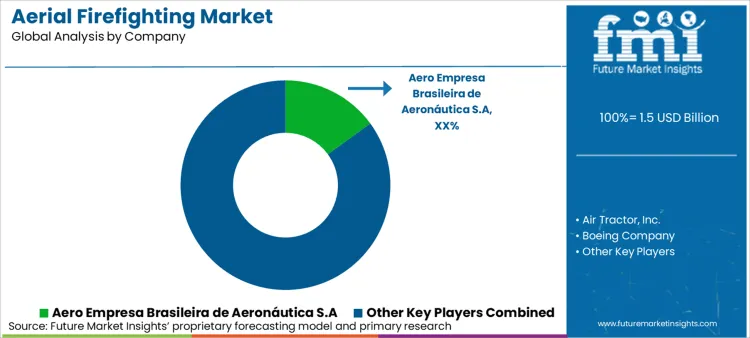
The aerial firefighting market features a mix of aircraft manufacturers, specialized firefighting operators, and government agencies. Aero Empresa Brasileira de Aeronáutica S.A. (Embraer) leads with specialized firefighting aircraft solutions designed to combat wildfires effectively and efficiently, supported by innovative aircraft designs and global presence.
Competitive dynamics are shaped by aircraft capabilities, operational reliability, and service integration. Key players including Air Tractor, Inc., Bombardier Inc., and Boeing Company maintain significant market shares by offering versatile, reliable aircraft tailored for fire suppression. These companies focus on enhancing aircraft capabilities, improving water or retardant delivery systems, and integrating advanced technologies.
Emerging players like Coulson Aviation, Dauntless Air, Inc., and Bridger Aerospace Group Holdings, LLC are expanding market presence by offering specialized aerial firefighting services and equipment, focusing on innovation, reliability, and cost-effectiveness. Their strategies include providing customizable solutions, leveraging modern firefighting aircraft, and enhancing speed and accuracy of fire suppression operations.
Market growth is driven by increasing frequency of wildfires, government support for firefighting solutions, and growing need for advanced technologies in emergency response. Innovations in drone-assisted firefighting, autonomous aircraft systems, and multi-role aerial platforms continue to shape competitive dynamics.
Recent Developments:
- In January 2026 - Bridger Aerospace acquired two Canadair CL-215T scoopers for $50 million and added four air attack aircraft, expanding its fleet ahead of the 2026 wildfire season to boost mission capacity and revenue [11].
- In January 2026 - Coulson Aviation launched its Boeing 767 Very Large Airtanker program to replace aging VLATs, offering greater payload, improved fuel efficiency, and long-term sustainability to strengthen global aerial firefighting capability [12].
Key Players in Aerial Firefighting Market
- Aero Empresa Brasileira de Aeronáutica S.A. (Embraer)
- Air Tractor, Inc.
- Boeing Company
- Bombardier Inc.
- Airbus Defence and Space
- Canadair Regional Jet (Mitsubishi Heavy Industries)
- Conair Group Inc.
- Coulson Aviation (Coulson Group)
- Bridger Aerospace Group Holdings, LLC
- Dauntless Air, Inc.
- Erickson Incorporated
- Aerovironment, Inc. (UAVs)
- 10 Tanker Air Carrier, LLC
- Aero-Flite, Inc.
- Aero Union Corporation
- Neptune Aviation Services
- Minden Air Corporation
- K-MAX Helicopters (Kaman Corporation)
- Lockheed Martin Corporation
- Northrop Grumman Corporation
Scope of the Report
| Metric | Value |
|---|---|
| Quantitative Units | USD 1.5 billion (2026) to USD 2.3 billion (2036), at a CAGR of 5.0% |
| Market Definition | The aerial firefighting market comprises the global provision of aircraft, helicopters, unmanned aerial vehicles (UAVs), and associated services deployed for wildfire and structural fire suppression, including water and retardant drops, aerial surveillance, fire mapping, logistics support, and emergency response operations for government, private, and industrial end users. |
| Type Segmentation | Aircraft (Fixed-wing), Helicopter, Specialized Fixed-wing Aircraft, Unmanned Aerial Vehicles (UAVs) |
| Service Segmentation | Firefighting Operations, Aerial Surveillance and Monitoring, Aerial Logistics and Support |
| End User Segmentation | Government (Federal/National, State/Provincial, Local/Municipal), Private Firefighting Contractors, Industrial Companies (Oil & Gas, Mining, Timber) |
| Application Coverage | Water Drops, Retardant Drops, Foam Applications, Fire Detection, Fire Mapping, Hotspot Identification, Personnel Transport, Equipment Delivery, Communication Relay |
| Regions Covered | North America, Latin America, Europe, Asia Pacific, Middle East & Africa |
| Countries Covered | United States, Canada, Brazil, Chile, Mexico, Germany, France, United Kingdom, Italy, Spain, China, India, Japan, Australia, New Zealand, South Africa, Israel and 40+ countries |
| Key Companies Profiled | Embraer, Air Tractor Inc., Boeing Company, Bombardier Inc., Airbus Defence and Space, Conair Group Inc., Coulson Aviation, Bridger Aerospace Group Holdings LLC, Dauntless Air Inc., Erickson Incorporated |
| Forecast Period | 2026 to 2036 |
| Approach | Hybrid top-down and bottom-up market modeling validated through primary interviews with aerial firefighting operators, aircraft manufacturers, and government disaster management agencies, supported by wildfire incidence data, fleet statistics, procurement records, and operator revenue benchmarking. |
Aerial Firefighting Market Analysis by Segments
Type:
- Aircraft (Fixed-wing)
- Large Airtankers (Type 1)
- Medium Airtankers (Type 2)
- Small Airtankers (Type 3)
- Amphibious Aircraft
- Helicopter
- Light Helicopters (Type 3)
- Medium Helicopters (Type 2)
- Heavy Helicopters (Type 1)
- Fixed-wing Aircraft (Specialized)
- Unmanned Aerial Vehicles (UAVs)
- Surveillance Drones
- Suppression Drones
Service:
- Firefighting Operations
- Water Drops
- Retardant Drops
- Foam Applications
- Aerial Surveillance and Monitoring
- Fire Detection
- Fire Mapping
- Hotspot Identification
- Aerial Logistics and Support
- Personnel Transport
- Equipment Delivery
- Communication Relay
End User:
- Government
- Federal/National Agencies
- State/Provincial Agencies
- Local/Municipal Agencies
- Private Firefighting Contractors
- Wildfire Suppression Services
- Industrial Protection
- Industrial Companies
- Oil and Gas Facilities
- Mining Operations
- Timber Companies
Region:
- North America
- United States
- Canada
- Latin America
- Brazil
- Chile
- Mexico
- Rest of Latin America
- Europe
- Germany
- France
- United Kingdom
- Italy
- Spain
- Rest of Europe
- Asia Pacific
- China
- India
- Japan
- Australia
- New Zealand
- Rest of Asia Pacific
- Middle East & Africa
- South Africa
- Israel
- Rest of Middle East & Africa
Bibliography
- Bridger Aerospace Group Holdings, Inc. (2025). Bridger Aerospace applauds Wildland Fire Service Plan and Fire Ready Nation Act.
- Conair Group Inc. (2024). Conair purchases 7 Dash 8-400 aircraft for conversion to airtankers.
- Wikipedia contributors. (2025). Canadair CL-415. In Wikipedia, The Free Encyclopedia.
- USA House Committee on Agriculture. (n.d.). Priddy testimony on aerial firefighting (DC-10 operations) [Testimony].
- Coulson Aviation Canada. (2024). Coulson Aviation Canada to conduct first night vision aerial firefighting operations with BC Wildfire Service.
- Bridger Aerospace Group Holdings, Inc. (2025). Bridger Aerospace applauds Wildland Fire Service Plan and Fire Ready Nation Act.
- International Trade Administration. (2025). China aviation: Country commercial guide. USA Department of Commerce.
- Lok Sabha Secretariat. (2025). Unstarred question no. 2139 [Parliamentary document].
- Federal Ministry for the Environment, Nature Conservation, Nuclear Safety and Consumer Protection (BMUV). (2025). National adaptation plan (NAP) Germany 2025.
- London Fire Commissioner. (2025). Budget submission 2026-27.
- AirMed & Rescue. (2025). Bridger Aerospace acquires new aircraft.
- Skies Magazine. (2024). Coulson Aviation announces launch of Boeing 767 VLAT program.
This bibliography is provided for reader reference and is not exhaustive. The full report contains the complete reference list and detailed citations.
This Report Addresses
- Market intelligence to enable structured strategic decision-making across mature and emerging aerial firefighting markets
- Market size estimation and 10-year revenue forecasts from 2026 to 2036, supported by validated wildfire incidence data and government procurement records
- Growth opportunity mapping across types, services, and end users with emphasis on aircraft and firefighting operations
- Segment and regional revenue forecasts covering all major aircraft types and geographic regions
- Competition strategy assessment including aircraft capabilities, operational reliability, and service integration benchmarking
- Technology roadmap tracking including UAV integration, retardant delivery systems, and night operations capabilities
- Regulatory impact analysis covering aviation safety standards, environmental regulations for retardants, and certification requirements
- Market report delivery in PDF, Excel, PPT, and interactive dashboard formats for executive and operational use
Frequently Asked Questions
How large is the demand for Aerial Firefighting solutions in the global market in 2026?
Demand for aerial firefighting solutions in the global market is estimated to be valued at USD 1.5 billion in 2026.
What will be the market size of Aerial Firefighting globally by 2036?
The aerial firefighting market is projected to reach USD 2.3 billion by 2036.
What is the expected demand growth for the Aerial Firefighting market between 2026 and 2036?
The aerial firefighting market is expected to grow at a CAGR of 5.0% between 2026 and 2036.
Which Type is poised to lead global sales by 2026?
Fixed-wing aircraft are expected to be the dominant type, capturing approximately 48.6% of global market share in 2026 due to high payload capacity, extended range, and rapid wildfire suppression capability.
How significant is the role of Firefighting Operations service in driving market demand in 2026?
Firefighting operations represent a critical service segment, projected to hold approximately 53.2% of the total market in 2026 as governments prioritize direct aerial suppression to manage increasingly severe wildfire seasons.
Which End User segment leads adoption in 2026?
Government agencies are projected to command approximately 46.7% share of the market in 2026, driven by federal, state, and provincial wildfire preparedness budgets and modernization initiatives.
What is driving aerial firefighting demand in the United States?
Structural consolidation of federal wildfire response through the USA Wildland Fire Service (USWFS), rising wildfire intensity, and modernization of fixed-wing and amphibious aircraft fleets are driving growth.
What is the United States growth outlook in this report?
The United States is projected to grow at a CAGR of 4.3% during 2026 to 2036.
Why is Asia Pacific considered a high-growth region in this report?
Asia Pacific growth is driven by national low-altitude aviation strategies, wildfire risk expansion due to climate change, and government-backed disaster management modernization programs.
What is China’s growth outlook in this report?
China is projected to expand at a CAGR of 6.8% during 2026 to 2036, supported by development of its “low-altitude economy” and aerial emergency response capabilities.
What is India’s growth outlook in this report?
India is projected to grow at a CAGR of 6.3% during 2026 to 2036, supported by institutional funding under national forest fire prevention and management schemes.
What is Germany’s growth outlook in this report?
Germany is projected to expand at a CAGR of 5.8% during 2026 to 2036, driven by integration of wildfire response into national climate adaptation and civil protection frameworks.
What is the United Kingdom’s growth outlook in this report?
The United Kingdom is projected to grow at a CAGR of 4.8% during 2026 to 2036, supported by modernization of fire service budgets and aviation capability enhancements.
What technologies are reshaping the Aerial Firefighting market?
Integration of unmanned aerial vehicles (UAVs), night vision operations, advanced retardant dispersal systems, and hybrid-electric aircraft platforms are reshaping operational models.
What is included in the scope of this Aerial Firefighting Market report?
The report covers aircraft, helicopters, UAVs, firefighting operations, aerial surveillance, logistics support, end users including government and private contractors, and regional demand across North America, Europe, Asia Pacific, Latin America, and Middle East & Africa.
What is excluded from the scope of this report?
Ground-based firefighting equipment, non-aerial satellite-only detection systems, and military aircraft not configured for firefighting missions are excluded.
What does market forecast mean in this report?
Market forecast represents a model-based projection built on defined assumptions regarding wildfire incidence, fleet modernization cycles, procurement budgets, and technological adoption trends.
How does FMI build and validate the Aerial Firefighting market forecast?
The forecast is developed using hybrid top-down and bottom-up modeling validated through wildfire statistics, fleet counts, operator revenue benchmarking, government procurement records, and structured industry interviews.
What does zero reliance on speculative third-party market research mean here?
Primary interviews and verifiable public datasets such as disaster management budgets and aircraft fleet statistics are used instead of unverified syndicated market estimates.
Preview the report firsthand - request a free sample
Get SampleGet the brochure for pricing and purchase details.
Get PDFTable of Content
- Executive Summary
- Global Market Outlook
- Demand-side Trends
- Supply-side Trends
- Technology Roadmap Analysis
- Analysis and Recommendations
- Market Overview
- Market Coverage / Taxonomy
- Market Definition / Scope / Limitations
- Research Methodology
- Chapter Orientation
- Analytical Lens and Working Hypotheses
- Market Structure, Signals, and Trend Drivers
- Benchmarking and Cross-market Comparability
- Market Sizing, Forecasting, and Opportunity Mapping
- Research Design and Evidence Framework
- Desk Research Programme (Secondary Evidence)
- Company Annual and Sustainability Reports
- Peer-reviewed Journals and Academic Literature
- Corporate Websites, Product Literature, and Technical Notes
- Earnings Decks and Investor Briefings
- Statutory Filings and Regulatory Disclosures
- Technical White Papers and Standards Notes
- Trade Journals, Industry Magazines, and Analyst Briefs
- Conference Proceedings, Webinars, and Seminar Materials
- Government Statistics Portals and Public Data Releases
- Sector Databases and Reference Repositories
- FMI Internal Proprietary Databases and Historical Market Datasets
- Subscription Datasets and Paid Sources
- Social Channels, Communities, and Digital Listening Inputs
- Additional Desk Sources
- Expert Input and Fieldwork (Primary Evidence)
- Primary Modes
- Qualitative Interviews and Expert Elicitation
- Quantitative Surveys and Structured Data Capture
- Blended Approach
- Why Primary Evidence is Used
- Field Techniques
- Interviews
- Surveys
- Focus Groups
- Observational and In-context Research
- Social and Community Interactions
- Stakeholder Universe Engaged
- C-suite Leaders
- Board Members
- Presidents and Vice Presidents
- R&D and Innovation Heads
- Technical Specialists
- Domain Subject-matter Experts
- Scientists
- Physicians and Other Healthcare Professionals
- Governance, Ethics, and Data Stewardship
- Research Ethics
- Data Integrity and Handling
- Primary Modes
- Tooling, Models, and Reference Databases
- Desk Research Programme (Secondary Evidence)
- Data Engineering and Model Build
- Data Acquisition and Ingestion
- Cleaning, Normalisation, and Verification
- Synthesis, Triangulation, and Analysis
- Quality Assurance and Audit Trail
- Market Background
- Market Dynamics
- Drivers
- Restraints
- Opportunity
- Trends
- Scenario Forecast
- Demand in Optimistic Scenario
- Demand in Likely Scenario
- Demand in Conservative Scenario
- Opportunity Map Analysis
- Product Life Cycle Analysis
- Supply Chain Analysis
- Investment Feasibility Matrix
- Value Chain Analysis
- PESTLE and Porter’s Analysis
- Regulatory Landscape
- Regional Parent Market Outlook
- Production and Consumption Statistics
- Import and Export Statistics
- Market Dynamics
- Global Market Analysis 2021 to 2025 and Forecast, 2026 to 2036
- Historical Market Size Value (USD Million) Analysis, 2021 to 2025
- Current and Future Market Size Value (USD Million) Projections, 2026 to 2036
- Y-o-Y Growth Trend Analysis
- Absolute $ Opportunity Analysis
- Global Market Pricing Analysis 2021 to 2025 and Forecast 2026 to 2036
- Global Market Analysis 2021 to 2025 and Forecast 2026 to 2036, By Type
- Introduction / Key Findings
- Historical Market Size Value (USD Million) Analysis By Type , 2021 to 2025
- Current and Future Market Size Value (USD Million) Analysis and Forecast By Type , 2026 to 2036
- Aircraft
- Helicopter
- Fixed-wing Aircraft
- Aircraft
- Y-o-Y Growth Trend Analysis By Type , 2021 to 2025
- Absolute $ Opportunity Analysis By Type , 2026 to 2036
- Global Market Analysis 2021 to 2025 and Forecast 2026 to 2036, By Service
- Introduction / Key Findings
- Historical Market Size Value (USD Million) Analysis By Service, 2021 to 2025
- Current and Future Market Size Value (USD Million) Analysis and Forecast By Service, 2026 to 2036
- Firefighting operations
- Aerial Surveillance and Monitoring
- Aerial Logistics and Support
- Firefighting operations
- Y-o-Y Growth Trend Analysis By Service, 2021 to 2025
- Absolute $ Opportunity Analysis By Service, 2026 to 2036
- Global Market Analysis 2021 to 2025 and Forecast 2026 to 2036, By End User
- Introduction / Key Findings
- Historical Market Size Value (USD Million) Analysis By End User, 2021 to 2025
- Current and Future Market Size Value (USD Million) Analysis and Forecast By End User, 2026 to 2036
- Government
- Private Firefighting Contractors
- Industrial Companies
- Government
- Y-o-Y Growth Trend Analysis By End User, 2021 to 2025
- Absolute $ Opportunity Analysis By End User, 2026 to 2036
- Global Market Analysis 2021 to 2025 and Forecast 2026 to 2036, By Region
- Introduction
- Historical Market Size Value (USD Million) Analysis By Region, 2021 to 2025
- Current Market Size Value (USD Million) Analysis and Forecast By Region, 2026 to 2036
- North America
- Latin America
- Western Europe
- Eastern Europe
- East Asia
- South Asia and Pacific
- Middle East & Africa
- Market Attractiveness Analysis By Region
- North America Market Analysis 2021 to 2025 and Forecast 2026 to 2036, By Country
- Historical Market Size Value (USD Million) Trend Analysis By Market Taxonomy, 2021 to 2025
- Market Size Value (USD Million) Forecast By Market Taxonomy, 2026 to 2036
- By Country
- USA
- Canada
- Mexico
- By Type
- By Service
- By End User
- By Country
- Market Attractiveness Analysis
- By Country
- By Type
- By Service
- By End User
- Key Takeaways
- Latin America Market Analysis 2021 to 2025 and Forecast 2026 to 2036, By Country
- Historical Market Size Value (USD Million) Trend Analysis By Market Taxonomy, 2021 to 2025
- Market Size Value (USD Million) Forecast By Market Taxonomy, 2026 to 2036
- By Country
- Brazil
- Chile
- Rest of Latin America
- By Type
- By Service
- By End User
- By Country
- Market Attractiveness Analysis
- By Country
- By Type
- By Service
- By End User
- Key Takeaways
- Western Europe Market Analysis 2021 to 2025 and Forecast 2026 to 2036, By Country
- Historical Market Size Value (USD Million) Trend Analysis By Market Taxonomy, 2021 to 2025
- Market Size Value (USD Million) Forecast By Market Taxonomy, 2026 to 2036
- By Country
- Germany
- UK
- Italy
- Spain
- France
- Nordic
- BENELUX
- Rest of Western Europe
- By Type
- By Service
- By End User
- By Country
- Market Attractiveness Analysis
- By Country
- By Type
- By Service
- By End User
- Key Takeaways
- Eastern Europe Market Analysis 2021 to 2025 and Forecast 2026 to 2036, By Country
- Historical Market Size Value (USD Million) Trend Analysis By Market Taxonomy, 2021 to 2025
- Market Size Value (USD Million) Forecast By Market Taxonomy, 2026 to 2036
- By Country
- Russia
- Poland
- Hungary
- Balkan & Baltic
- Rest of Eastern Europe
- By Type
- By Service
- By End User
- By Country
- Market Attractiveness Analysis
- By Country
- By Type
- By Service
- By End User
- Key Takeaways
- East Asia Market Analysis 2021 to 2025 and Forecast 2026 to 2036, By Country
- Historical Market Size Value (USD Million) Trend Analysis By Market Taxonomy, 2021 to 2025
- Market Size Value (USD Million) Forecast By Market Taxonomy, 2026 to 2036
- By Country
- China
- Japan
- South Korea
- By Type
- By Service
- By End User
- By Country
- Market Attractiveness Analysis
- By Country
- By Type
- By Service
- By End User
- Key Takeaways
- South Asia and Pacific Market Analysis 2021 to 2025 and Forecast 2026 to 2036, By Country
- Historical Market Size Value (USD Million) Trend Analysis By Market Taxonomy, 2021 to 2025
- Market Size Value (USD Million) Forecast By Market Taxonomy, 2026 to 2036
- By Country
- India
- ASEAN
- Australia & New Zealand
- Rest of South Asia and Pacific
- By Type
- By Service
- By End User
- By Country
- Market Attractiveness Analysis
- By Country
- By Type
- By Service
- By End User
- Key Takeaways
- Middle East & Africa Market Analysis 2021 to 2025 and Forecast 2026 to 2036, By Country
- Historical Market Size Value (USD Million) Trend Analysis By Market Taxonomy, 2021 to 2025
- Market Size Value (USD Million) Forecast By Market Taxonomy, 2026 to 2036
- By Country
- Kingdom of Saudi Arabia
- Other GCC Countries
- Turkiye
- South Africa
- Other African Union
- Rest of Middle East & Africa
- By Type
- By Service
- By End User
- By Country
- Market Attractiveness Analysis
- By Country
- By Type
- By Service
- By End User
- Key Takeaways
- Key Countries Market Analysis
- USA
- Pricing Analysis
- Market Share Analysis, 2025
- By Type
- By Service
- By End User
- Canada
- Pricing Analysis
- Market Share Analysis, 2025
- By Type
- By Service
- By End User
- Mexico
- Pricing Analysis
- Market Share Analysis, 2025
- By Type
- By Service
- By End User
- Brazil
- Pricing Analysis
- Market Share Analysis, 2025
- By Type
- By Service
- By End User
- Chile
- Pricing Analysis
- Market Share Analysis, 2025
- By Type
- By Service
- By End User
- Germany
- Pricing Analysis
- Market Share Analysis, 2025
- By Type
- By Service
- By End User
- UK
- Pricing Analysis
- Market Share Analysis, 2025
- By Type
- By Service
- By End User
- Italy
- Pricing Analysis
- Market Share Analysis, 2025
- By Type
- By Service
- By End User
- Spain
- Pricing Analysis
- Market Share Analysis, 2025
- By Type
- By Service
- By End User
- France
- Pricing Analysis
- Market Share Analysis, 2025
- By Type
- By Service
- By End User
- India
- Pricing Analysis
- Market Share Analysis, 2025
- By Type
- By Service
- By End User
- ASEAN
- Pricing Analysis
- Market Share Analysis, 2025
- By Type
- By Service
- By End User
- Australia & New Zealand
- Pricing Analysis
- Market Share Analysis, 2025
- By Type
- By Service
- By End User
- China
- Pricing Analysis
- Market Share Analysis, 2025
- By Type
- By Service
- By End User
- Japan
- Pricing Analysis
- Market Share Analysis, 2025
- By Type
- By Service
- By End User
- South Korea
- Pricing Analysis
- Market Share Analysis, 2025
- By Type
- By Service
- By End User
- Russia
- Pricing Analysis
- Market Share Analysis, 2025
- By Type
- By Service
- By End User
- Poland
- Pricing Analysis
- Market Share Analysis, 2025
- By Type
- By Service
- By End User
- Hungary
- Pricing Analysis
- Market Share Analysis, 2025
- By Type
- By Service
- By End User
- Kingdom of Saudi Arabia
- Pricing Analysis
- Market Share Analysis, 2025
- By Type
- By Service
- By End User
- Turkiye
- Pricing Analysis
- Market Share Analysis, 2025
- By Type
- By Service
- By End User
- South Africa
- Pricing Analysis
- Market Share Analysis, 2025
- By Type
- By Service
- By End User
- USA
- Market Structure Analysis
- Competition Dashboard
- Competition Benchmarking
- Market Share Analysis of Top Players
- By Regional
- By Type
- By Service
- By End User
- Competition Analysis
- Competition Deep Dive
- Aero Empresa Brasileira de Aeronáutica S.A
- Overview
- Product Portfolio
- Profitability by Market Segments (Product/Age /Sales Channel/Region)
- Sales Footprint
- Strategy Overview
- Marketing Strategy
- Product Strategy
- Channel Strategy
- Air Tractor, Inc.
- Boeing Company
- Bombardier Inc.
- Airbus Defence and Space
- Canadair Regional Jet (Mitsubishi Heavy Industries)
- Conair Group Inc.
- Aero Empresa Brasileira de Aeronáutica S.A
- Competition Deep Dive
- Assumptions & Acronyms Used


