

- Industry Size (2026)
- USD 15.0 Bn
- Forecast (2036)
- USD 26.8 Bn
- CAGR (2026 to 2036)
- 6.0%
BRICS Aerial Work Platforms Market Forecast and Outlook 2026 to 2036
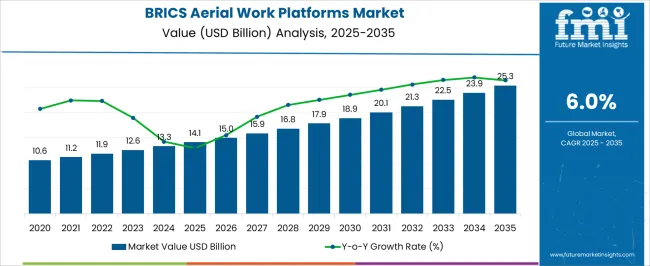
The BRICS aerial work platforms market is valued at USD 15.0 Billion in 2026 and is projected to reach USD 26.8 Billion by 2036, expanding at a 6.0% CAGR. The category is being shaped by a tightening safety baseline for mobile elevating work platforms. ISO 16368:2024 defines safety requirements and risk-reduction measures for MEWPs, raising the minimum spec and verification burden for platforms sold into regulated worksites. ANSI/SAIA A92.20 similarly specifies design, stability criteria, and tests before a MEWP is first put into service, reinforcing procurement preference for compliant, documented fleets rather than informal access methods.
OEM capital allocation is also signalling an electrification pivot as rental fleets and large contractors standardise on lower-emission machines for mixed indoor and outdoor work. Terex’s CEO framed the cycle effect as portfolio resilience and execution, stating, ‘We continued to make progress executing our strategy in 2024, making Terex a more resilient, less-cyclical company.’ In parallel, Haulotte’s chairman linked growth to rental-network density, stating, ‘The only way to create a market and develop it is to have between the manufacturers a large and developed network of rental companies.’ Consolidation is widening portfolios and distribution reach. Tadano’s acquisition moves explicitly expand its aerial work platform footprint through brands that include aerial work platforms, strengthening its access equipment coverage alongside cranes.
Summary of BRICS Aerial Work Platforms Market
- The market comprises boom lifts, scissor lifts, vertical mast lifts, and portable personal lifts used for regulated work-at-height tasks across construction, mining, logistics, and industrial maintenance in BRICS countries.
- The defined scope follows FMI taxonomy across product type, height band, engine type, and end use in Brazil, Russia, India, China, and South Africa, excluding cranes, telehandlers, forklifts, and non-MEWP access systems.
- The market is projected to grow at a 6.0% CAGR from 2026 to 2036, expanding from USD 15.0 billion in 2026 to USD 26.8 billion by 2036, based on standards-led fleet replacement, rental penetration, and infrastructure execution intensity.
- The sector is shifting toward electric, compliance-ready, and mid-height platforms aligned with tightening MEWP safety standards and fleet professionalisation.
- Competition includes Oshkosh (JLG), Terex (Genie), Haulotte, Tadano, Zoomlion, Zhejiang Dingli, and Sinoboom, with portfolio breadth and rental-channel strength shaping leadership.
- China grows fastest at 6.8% CAGR, followed by India at 6.4%, while Brazil, South Africa, and Russia expand at steady, infrastructure-linked rates.
BRICS Aerial Work Platforms Market Key Takeaways
| Metric | Value (USD Billion) |
|---|---|
| Market Size 2026 | USD 15.0 Billion |
| Forecast Value 2036 | USD 26.8 Billion |
| CAGR (2026 to 2036) | 6.0% |
What are the key driving factors rising the demand for the Aerial Work Platforms Market in BRICS?
Infrastructure execution and safety compliance are forcing BRICS contractors to formalise access methods. Brazil’s Novo PAC targets BRL 1.7 trillion of investment, expanding the addressable base of public works where audited safety practices and planned maintenance increase demand for professional access equipment.
India’s roads pipeline and PPP push strengthens multi-year construction throughput, supporting rental fleet utilisation and replacement demand. Standards also harden procurement filters: ISO 16368:2024 specifies safety and risk-reduction measures for MEWPs, and compliance expectations shift buyers toward OEM platforms with documented verification and training support.
How is the BRICS Aerial Work Platforms Market Segmented?
The BRICS aerial work platforms market is segmented by product type, platform height, engine type, end use, and country to reflect the diverse execution pathways of construction, mining, logistics, and industrial maintenance activity. By product type, the market includes boom lifts, scissor lifts, vertical mast lifts, and portable personal lifts, which serve as the primary engineered access interface for regulated worksites. By platform height, demand spans below 10 metres, 10 to 20 metres, 20 to 25 metres, and above 25 metres, reflecting the varying task envelopes across mid-rise construction, façade access, warehousing, and plant maintenance. By engine type, adoption is led by electric platforms followed by engine-powered units, aligned with indoor-outdoor duty cycles and emissions expectations. By end use, construction and industrial maintenance anchor volume, while mining and logistics expand as secondary growth channels across BRICS countries.
FMI analysis suggests that while electrification and standards convergence are accelerating fleet upgrades, the market structure remains heavily reliant on rental penetration and compliance-driven procurement frameworks. This segmentation highlights a dual-structure market where mid-height electric platforms deliver utilisation depth while boom lifts provide reach flexibility and task breadth across complex jobsites.
Why do boom lifts hold the lead at 38.0% share in 2026?
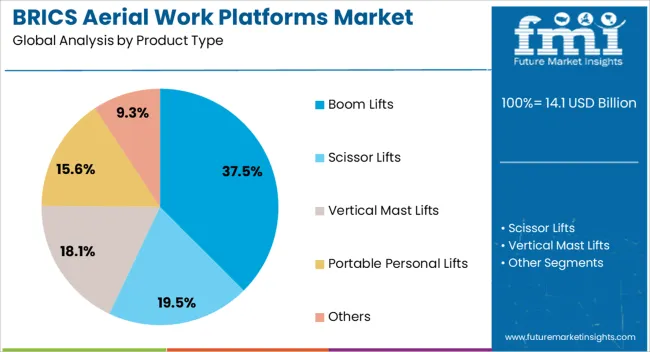
Boom lifts lead at 38.0% because BRICS jobsite productivity is increasingly governed by reach and repositioning efficiency, not only lift height. Urban construction, industrial retrofits, and logistics facilities require outreach over obstacles, frequent slewing, and rapid redeployment across mixed trades. This behaviour aligns with rental fleets optimising utilisation hours by prioritising platforms that can cover more task types per shift, reducing idle time and transport churn. Standards pressure reinforces the shift toward engineered access solutions with defined verification and safe operating envelopes, raising the penalty for improvised access in higher-risk tasks.
Why does 10 to 20 metres lead with a 32.0% share in 2026?
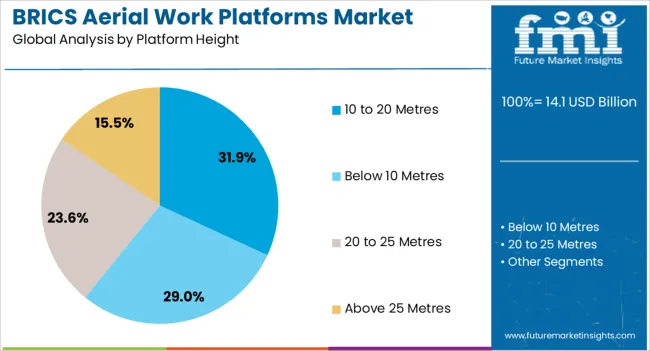
The 10 to 20 metres band leads with a 32.0% share because it sits at the intersection of highest task frequency and lowest deployment friction. In BRICS, a large share of work-at-height activity is concentrated in mid-rise construction, façade access, warehousing, MEP installation, and industrial maintenance where access is repeated across many work fronts. This band also supports standardised fleet planning for rental companies, enabling dense branch coverage with fewer specialised units and faster turnaround. Safety rules raise the requirement for fit-for-purpose platforms and documented checks. ANSI/SAIA A92.20 specifies safety requirements, stability criteria, and pre-service examinations and tests, pushing buyers toward standardised equipment classes that can be verified and trained at scale. That compliance load favours the most commonly deployed height class.
Why do electric platforms command a 59.0% share in 2026?
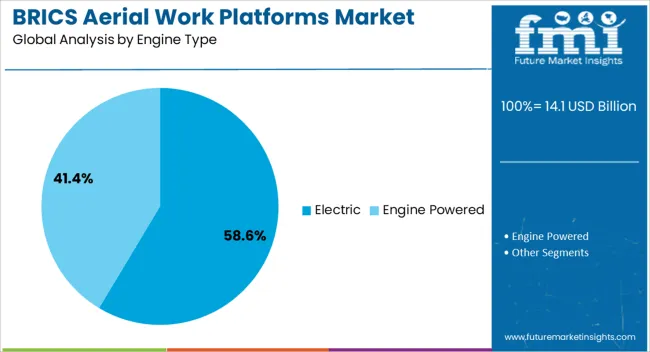
Electric leads at 59.0% because indoor-capable, low-local-emission platforms increasingly match the operating reality of warehouses, terminals, malls, airports, and industrial plants that run maintenance windows and continuous operations. Electric fleets also simplify site acceptance where noise, ventilation limits, and indoor air rules are stricter, and they reduce friction in mixed indoor-outdoor duty cycles. OEM portfolios and rental strategies reinforce this direction by prioritising electrified product lines that can be deployed across more applications without fuel logistics. The compliance baseline further supports electric adoption because modern MEWP standards focus buyers on verified safe operation and risk controls rather than informal workarounds.
Why Is Electrification Reshaping Fleet Standardisation in BRICS?
Electrification is reshaping fleet procurement in BRICS by aligning equipment choices with evolving safety expectations, operational discipline, and multi-site deployment flexibility. Contractors and rental fleets are increasingly prioritising standardised electric platforms that can operate across indoor and outdoor environments with lower noise, simplified logistics, and broader site acceptance. This transition reduces dependency on fragmented equipment mixes and enables higher utilisation across varied jobsite conditions. Electrified platforms also support professional fleet positioning, where documented operating envelopes, training alignment, and predictable performance improve contractor confidence. As infrastructure and industrial maintenance projects expand, electric fleets become easier to redeploy across sectors, strengthening rental penetration and long-term utilisation economics in emerging markets.
How Does Compliance-Driven Procurement Influence Adoption Constraints?
Compliance and operating discipline introduce structural friction that can limit adoption in cost-sensitive segments despite long-term efficiency gains. Formal safety expectations increase documentation, inspection, and training requirements before platforms enter service, raising upfront administrative and operational overhead for fleet owners. On large public works, project sequencing gaps and uneven contractor readiness can delay mobilisation, suppressing equipment utilisation even when demand pipelines appear strong. In infrastructure-heavy markets, the conversion of planned corridors into active, equipment-ready work fronts determines how quickly fleets can absorb capacity. As a result, adoption depends not only on capital availability but also on execution maturity, workforce capability, and the ability of projects to sustain consistent, compliant deployment cycles.
What is BRICS Aerial Work Platforms Market Regional Outlook?
Sales across BRICS are expanding steadily, driven by infrastructure execution intensity, tightening safety expectations, and the professionalisation of rental fleets that favour engineered work-at-height solutions over informal access methods. While the overall BRICS aerial work platforms market grows at a 6.0% CAGR, growth dispersion reflects differences in infrastructure pipelines and industrial maintenance intensity across member nations. China leads at a 6.8% CAGR, supported by sustained transport, logistics, and industrial site expansion that increases repetitive mid-height access demand, followed by India at 6.4%, where corridor development and construction throughput strengthen rental penetration and fleet utilisation. Brazil expands at 5.8%, reflecting public works acceleration and compliance-driven site formalisation, while South Africa advances at 5.7% as bulk infrastructure in energy and logistics supports steady maintenance-led demand. Russia grows at a more measured 5.3%, anchored in ongoing transport and public asset upgrades rather than rapid construction surges. FMI analysis indicates that future growth will be governed by infrastructure continuity, rental-network density, and electrification-driven fleet standardisation rather than cyclical construction spikes alone.
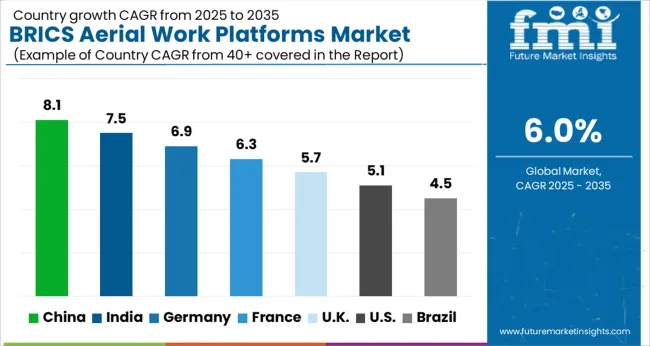
| Country | CAGR (2026 to 2036) |
|---|---|
| Brazil | 5.8% |
| Russia | 5.3% |
| India | 6.4% |
| China | 6.8% |
| South Africa | 5.7% |
Source: Future Market Insights (FMI) analysis, based on proprietary forecasting model and primary research.
Why is China growing at a 6.8% CAGR in aerial work platforms through 2036?
China’s 6.8% CAGR is supported by sustained infrastructure build-out and industrial upgrading that expands repetitive work-at-height across transport, logistics, and advanced manufacturing sites. The national policy direction under the 14th Five-Year Plan emphasises building a modern infrastructure system that is complete, efficient, and safe and reliable, supporting continuous project pipelines that favour mechanised access over labour-intensive methods. As site safety and productivity expectations tighten, contractors and plant operators standardise equipment classes to reduce incident exposure and improve cycle time in maintenance and fit-out tasks. The result is stronger utilisation for mid-height electric platforms and boom lifts that can cover dense task envelopes without heavy permitting or complex mobilisation.
What makes India a 6.4% CAGR market for aerial work platforms across 2026 to 2036?
India’s 6.4% CAGR is tied to sustained road and logistics corridor execution that increases the volume of structured construction work where mechanised access is easier to audit and deploy at scale. The Ministry of Road Transport and Highways identified a PPP project pipeline of 13,400 km with an estimated cost of ₹8.3 lakh crore over the next three years, supporting multi-year contractor backlogs and higher equipment utilisation opportunities. As work fronts expand, rental penetration typically rises because contractors prefer variable-cost access fleets for project-based demand. Standards-led risk management further shifts large contractors toward formal MEWP use for installation, finishing, and maintenance tasks that repeat across highways, terminals, and associated facilities.
Why does Brazil expand at a 5.8% CAGR in aerial work platforms to 2036?
Brazil’s 5.8% CAGR is reinforced by federal infrastructure acceleration and stronger safety expectations in construction. Novo PAC targets BRL 1.7 trillion in investment across states, widening the number of public and mixed-funded projects that demand documented safety practices and predictable execution windows. On the risk side, Brazil’s NR-18 safety framework sets requirements for construction workplaces, increasing the value of engineered access platforms versus informal solutions for work at height. This combination of expanded project volume and compliance pressure supports rental fleet growth and replacement demand, especially for electric units that fit indoor-capable maintenance and fit-out work in commercial and public buildings.
How does Russia sustain a 5.3% CAGR in aerial work platforms through 2036?
Russia’s 5.3% CAGR is linked to ongoing road and transport infrastructure programmes that keep construction activity active across regions and sustain demand for mechanised access on bridges, interchanges, depots, and public assets. The government has highlighted the Bharatmala Pariyojana and Setu Bharatam as high-recognition public initiatives, supporting continued emphasis on road network upgrades. Industry experts note that these projects increase recurring work-at-height tasks, such as inspection, lighting, and structural maintenance, where MEWPs are increasingly replacing scaffolding to improve productivity and safety
Why does South Africa reach a 5.7% CAGR in aerial work platforms over 2026 to 2036?
South Africa’s 5.7% CAGR is driven by the prioritisation of bulk infrastructure in energy, water, freight transport, and telecommunications, which expands maintenance and project work requiring safe access at height. The sectors create steady demand for mid-height access in plants, terminals, and network infrastructure where downtime costs are high and planned maintenance windows reward faster execution. As contractors professionalise safety management, demand concentrates in electric and mid-height platforms that can operate in enclosed environments and tight industrial footprints.
How is competition structured in the BRICS aerial work platforms market, and who leads globally?
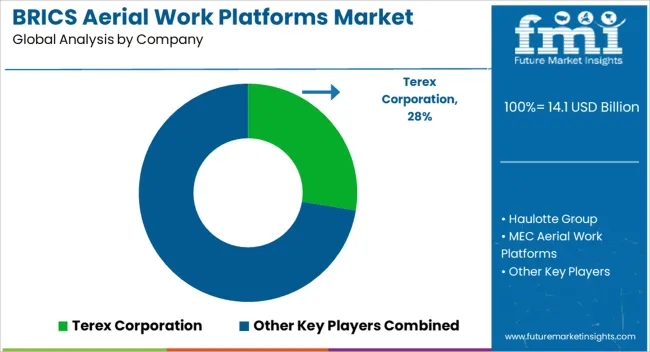
Competition is anchored in global OEM platforms and regional distribution, with leadership shaped by breadth of product coverage, rental-channel penetration, and the ability to support compliance, parts, and training at scale. Scope includes boom lifts, scissor lifts, vertical mast lifts, and portable personal lifts. Scope excludes cranes, telehandlers, forklifts, scaffolding systems, and vehicle-mounted access outside MEWP classes. Globally, Oshkosh’s JLG positions itself as the world’s leading designer and manufacturer of access equipment, which signals scale advantages in product range and support infrastructure. In BRICS, competitive strength varies by country based on distribution density, service footprint, and fleet standardisation by large contractors and rental firms. China’s growth intensity rewards OEMs that can supply high volumes and support electrified fleets; India and Brazil reward aftermarket responsiveness and rental partnerships; Russia and South Africa reward ruggedisation, parts availability, and service continuity. Global leadership does not automatically translate into country leadership because local channel control and service reach often determine fleet selection and repeat procurement.
Recent developments
- In March 2025, Niftylift showcased its Hydrogen-Electric HR17 H2E and award-winning HR22SE at Bauma 2025 in Munich, marking their global debut and highlighting the company’s focus on zero-emission technology and innovative, sustainable powered access solutions.
- In November 2024, Genie introduced six next-generation GS™ slab scissor lifts featuring a redesigned, low-maintenance build, improved serviceability, electrification-ready systems, and a curved linkage design to enhance performance while reducing total cost of ownership.
Key Players in BRICS Aerial Work Platforms Market
- Oshkosh Corporation (JLG)
- Terex Corporation (Genie)
- Haulotte Group
- Tadano Ltd.
- Aichi Corporation
- Zoomlion
- Zhejiang Dingli
- Sinoboom
- Skyjack
- Niftylift
Market Definition
The BRICS aerial work platforms market covers mobile elevating work platforms used to position personnel, tools, and materials at height across construction, mining, industrial maintenance, logistics, and public infrastructure work. The scope includes self-propelled boom lifts, scissor lifts, vertical mast lifts, and portable personal lifts deployed through direct sales and rental channels. Demand formation is driven by infrastructure execution, maintenance cycles, and work-at-height compliance, with product selection shaped by reach needs, height envelopes, and indoor-outdoor duty cycles.
Market Inclusion
Included are electric and engine-powered MEWPs across boom, scissor, vertical mast, and portable personal lift categories, across platform height bands from below 10 metres to above 25 metres. Included activities cover OEM equipment sales, fleet and rental procurement, parts and service commitments tied to MEWP operation, and country-level deployment in Brazil, Russia, India, China, and South Africa. Included decision factors cover standards alignment, inspection and training readiness, and service-network support needed to operate compliant fleets on regulated worksites.
Market Exclusion
Excluded are cranes, telehandlers, forklifts, scaffolding and formwork systems, suspended access equipment, and vehicle-mounted access platforms not classified within MEWP standards used for self-propelled platforms. Also excluded are general construction equipment categories where height access is incidental rather than the primary function. Revenue from unrelated industrial segments of listed companies is excluded unless directly attributable to aerial work platforms. Where standalone revenue is not disclosed, competitive positioning is assessed through disclosed portfolio scope, distribution footprint, and repeated executive emphasis on access equipment scale.
Scope of Report
| Items | Values |
|---|---|
| Quantitative Units (2026) | USD 15.0 Billion |
| Product Type Segments | Boom Lifts; Scissor Lifts; Vertical Mast Lifts; Portable Personal Lifts; Others |
| Platform Height | Below 10 Metres; 10 to 20 Metres; 20 to 25 Metres; Above 25 Metres |
| Engine Type | Electric; Engine Powered |
| End Use | Construction; Mining; Transportation and Logistics; Manufacturing; Others |
| Regions Covered | BRICS |
| Countries Covered | Brazil; Russia; India; China; South Africa |
| Key Companies Profiled | Terex Corporation; Haulotte Group; MEC Aerial Work Platforms; Tadano Ltd.; Aichi Corporation |
| Additional Attributes | Revenue assessment by product type, height band, and engine type; evaluation of standards and safety compliance influence on fleet replacement; tracking of electrification-driven portfolio shifts and rental-fleet standardisation; country-level linkage to infrastructure programmes and industrial maintenance intensity across BRICS. |
BRICS Aerial Work Platforms Market by Key Segments
-
By Product Type
- Boom Lifts
- Scissor Lifts
- Vertical Mast Lifts
- Portable Personal Lifts
- Others
-
By Platform Height
- 10 to 20 Metres
- Below 10 Metres
- 20 to 25 Metres
- Above 25 Metres
-
By Engine Type
- Electric
- Engine Powered
-
By End Use
- Construction
- Mining
- Transportation and Logistics
- Manufacturing
- Others
Bibliography
- Bureau of Indian Standards. (2023). IS 17757:2023 Mobile elevating work platforms - Design, calculations, safety requirements and test methods. Government of India.
- State Council of the People’s Republic of China. (2024). Report on the work of the government 2024. The State Council.
- International Powered Access Federation (IPAF). (2024). IPAF Global safety report 2024. IPAF.
- Terex Corporation. (2025). Terex announces fourth quarter and full year 2024 results. Terex Investor Relations.
Frequently Asked Questions
How big is the BRICS aerial work platforms market in 2026?
The market is valued at USD 15.0 billion in 2026 and is projected to reach USD 26.8 billion by 2036.
What is the growth outlook for the BRICS aerial work platforms market over 2026 to 2036?
The market is forecast to expand at a 6.0% CAGR, supported by infrastructure execution and standards-led fleet replacement.
Which segments drive demand in this market?
Demand is led by boom lifts with 38.0% share, electric platforms with 59.0% share, and 10 to 20 metre platforms with 32.0% share.
Which BRICS country grows fastest in aerial work platforms through 2036?
China leads at a 6.8% CAGR, followed by India at 6.4%, reflecting higher infrastructure and industrial maintenance intensity.
What are the main risks and constraints affecting this market?
Key constraints include compliance overhead from MEWP safety requirements, inspection and training burden, and uneven project readiness that can suppress fleet utilisation.
Preview the report firsthand - request a free sample
Get SampleGet the brochure for pricing and purchase details.
Get PDFTable of Content
- Executive Summary
- Global Market Outlook
- Demand-side Trends
- Supply-side Trends
- Technology Roadmap Analysis
- Analysis and Recommendations
- Market Overview
- Market Coverage / Taxonomy
- Market Definition / Scope / Limitations
- Market Background
- Market Dynamics
- Drivers
- Restraints
- Opportunity
- Trends
- Scenario Forecast
- Demand in Optimistic Scenario
- Demand in Likely Scenario
- Demand in Conservative Scenario
- Opportunity Map Analysis
- Product Life Cycle Analysis
- Supply Chain Analysis
- Investment Feasibility Matrix
- Value Chain Analysis
- PESTLE and Porter’s Analysis
- Regulatory Landscape
- Regional Parent Market Outlook
- Production and Consumption Statistics
- Import and Export Statistics
- Market Dynamics
- Global Market Analysis 2021 to 2025 and Forecast, 2026 to 2036
- Historical Market Size Value (USD Million) Analysis, 2021 to 2025
- Current and Future Market Size Value (USD Million) Projections, 2026 to 2036
- Y-o-Y Growth Trend Analysis
- Absolute $ Opportunity Analysis
- Global Market Pricing Analysis 2021 to 2025 and Forecast 2026 to 2036
- Global Market Analysis 2021 to 2025 and Forecast 2026 to 2036, By Product Type
- Introduction / Key Findings
- Historical Market Size Value (USD Million) Analysis By Product Type , 2021 to 2025
- Current and Future Market Size Value (USD Million) Analysis and Forecast By Product Type , 2026 to 2036
- Boom Lifts
- Scissor Lifts
- Vertical Mast Lifts
- Portable Personal Lifts
- Others
- Boom Lifts
- Y-o-Y Growth Trend Analysis By Product Type , 2021 to 2025
- Absolute $ Opportunity Analysis By Product Type , 2026 to 2036
- Global Market Analysis 2021 to 2025 and Forecast 2026 to 2036, By Platform Height
- Introduction / Key Findings
- Historical Market Size Value (USD Million) Analysis By Platform Height, 2021 to 2025
- Current and Future Market Size Value (USD Million) Analysis and Forecast By Platform Height, 2026 to 2036
- 10 to 20 Metres
- Below 10 Metres
- 20 to 25 Metres
- Above 25 Metres
- 10 to 20 Metres
- Y-o-Y Growth Trend Analysis By Platform Height, 2021 to 2025
- Absolute $ Opportunity Analysis By Platform Height, 2026 to 2036
- Global Market Analysis 2021 to 2025 and Forecast 2026 to 2036, By Engine Type
- Introduction / Key Findings
- Historical Market Size Value (USD Million) Analysis By Engine Type, 2021 to 2025
- Current and Future Market Size Value (USD Million) Analysis and Forecast By Engine Type, 2026 to 2036
- Electric
- Engine Powered
- Electric
- Y-o-Y Growth Trend Analysis By Engine Type, 2021 to 2025
- Absolute $ Opportunity Analysis By Engine Type, 2026 to 2036
- Global Market Analysis 2021 to 2025 and Forecast 2026 to 2036, By End Use
- Introduction / Key Findings
- Historical Market Size Value (USD Million) Analysis By End Use, 2021 to 2025
- Current and Future Market Size Value (USD Million) Analysis and Forecast By End Use, 2026 to 2036
- Construction
- Mining
- Transportation and Logistics
- Manufacturing
- Others
- Construction
- Y-o-Y Growth Trend Analysis By End Use, 2021 to 2025
- Absolute $ Opportunity Analysis By End Use, 2026 to 2036
- Global Market Analysis 2021 to 2025 and Forecast 2026 to 2036, By Region
- Introduction
- Historical Market Size Value (USD Million) Analysis By Region, 2021 to 2025
- Current Market Size Value (USD Million) Analysis and Forecast By Region, 2026 to 2036
- North America
- Latin America
- Western Europe
- Eastern Europe
- East Asia
- South Asia and Pacific
- Middle East & Africa
- Market Attractiveness Analysis By Region
- North America Market Analysis 2021 to 2025 and Forecast 2026 to 2036, By Country
- Historical Market Size Value (USD Million) Trend Analysis By Market Taxonomy, 2021 to 2025
- Market Size Value (USD Million) Forecast By Market Taxonomy, 2026 to 2036
- By Country
- USA
- Canada
- Mexico
- By Product Type
- By Platform Height
- By Engine Type
- By End Use
- By Country
- Market Attractiveness Analysis
- By Country
- By Product Type
- By Platform Height
- By Engine Type
- By End Use
- Key Takeaways
- Latin America Market Analysis 2021 to 2025 and Forecast 2026 to 2036, By Country
- Historical Market Size Value (USD Million) Trend Analysis By Market Taxonomy, 2021 to 2025
- Market Size Value (USD Million) Forecast By Market Taxonomy, 2026 to 2036
- By Country
- Brazil
- Chile
- Rest of Latin America
- By Product Type
- By Platform Height
- By Engine Type
- By End Use
- By Country
- Market Attractiveness Analysis
- By Country
- By Product Type
- By Platform Height
- By Engine Type
- By End Use
- Key Takeaways
- Western Europe Market Analysis 2021 to 2025 and Forecast 2026 to 2036, By Country
- Historical Market Size Value (USD Million) Trend Analysis By Market Taxonomy, 2021 to 2025
- Market Size Value (USD Million) Forecast By Market Taxonomy, 2026 to 2036
- By Country
- Germany
- UK
- Italy
- Spain
- France
- Nordic
- BENELUX
- Rest of Western Europe
- By Product Type
- By Platform Height
- By Engine Type
- By End Use
- By Country
- Market Attractiveness Analysis
- By Country
- By Product Type
- By Platform Height
- By Engine Type
- By End Use
- Key Takeaways
- Eastern Europe Market Analysis 2021 to 2025 and Forecast 2026 to 2036, By Country
- Historical Market Size Value (USD Million) Trend Analysis By Market Taxonomy, 2021 to 2025
- Market Size Value (USD Million) Forecast By Market Taxonomy, 2026 to 2036
- By Country
- Russia
- Poland
- Hungary
- Balkan & Baltic
- Rest of Eastern Europe
- By Product Type
- By Platform Height
- By Engine Type
- By End Use
- By Country
- Market Attractiveness Analysis
- By Country
- By Product Type
- By Platform Height
- By Engine Type
- By End Use
- Key Takeaways
- East Asia Market Analysis 2021 to 2025 and Forecast 2026 to 2036, By Country
- Historical Market Size Value (USD Million) Trend Analysis By Market Taxonomy, 2021 to 2025
- Market Size Value (USD Million) Forecast By Market Taxonomy, 2026 to 2036
- By Country
- China
- Japan
- South Korea
- By Product Type
- By Platform Height
- By Engine Type
- By End Use
- By Country
- Market Attractiveness Analysis
- By Country
- By Product Type
- By Platform Height
- By Engine Type
- By End Use
- Key Takeaways
- South Asia and Pacific Market Analysis 2021 to 2025 and Forecast 2026 to 2036, By Country
- Historical Market Size Value (USD Million) Trend Analysis By Market Taxonomy, 2021 to 2025
- Market Size Value (USD Million) Forecast By Market Taxonomy, 2026 to 2036
- By Country
- India
- ASEAN
- Australia & New Zealand
- Rest of South Asia and Pacific
- By Product Type
- By Platform Height
- By Engine Type
- By End Use
- By Country
- Market Attractiveness Analysis
- By Country
- By Product Type
- By Platform Height
- By Engine Type
- By End Use
- Key Takeaways
- Middle East & Africa Market Analysis 2021 to 2025 and Forecast 2026 to 2036, By Country
- Historical Market Size Value (USD Million) Trend Analysis By Market Taxonomy, 2021 to 2025
- Market Size Value (USD Million) Forecast By Market Taxonomy, 2026 to 2036
- By Country
- Kingdom of Saudi Arabia
- Other GCC Countries
- Turkiye
- South Africa
- Other African Union
- Rest of Middle East & Africa
- By Product Type
- By Platform Height
- By Engine Type
- By End Use
- By Country
- Market Attractiveness Analysis
- By Country
- By Product Type
- By Platform Height
- By Engine Type
- By End Use
- Key Takeaways
- Key Countries Market Analysis
- USA
- Pricing Analysis
- Market Share Analysis, 2025
- By Product Type
- By Platform Height
- By Engine Type
- By End Use
- Canada
- Pricing Analysis
- Market Share Analysis, 2025
- By Product Type
- By Platform Height
- By Engine Type
- By End Use
- Mexico
- Pricing Analysis
- Market Share Analysis, 2025
- By Product Type
- By Platform Height
- By Engine Type
- By End Use
- Brazil
- Pricing Analysis
- Market Share Analysis, 2025
- By Product Type
- By Platform Height
- By Engine Type
- By End Use
- Chile
- Pricing Analysis
- Market Share Analysis, 2025
- By Product Type
- By Platform Height
- By Engine Type
- By End Use
- Germany
- Pricing Analysis
- Market Share Analysis, 2025
- By Product Type
- By Platform Height
- By Engine Type
- By End Use
- UK
- Pricing Analysis
- Market Share Analysis, 2025
- By Product Type
- By Platform Height
- By Engine Type
- By End Use
- Italy
- Pricing Analysis
- Market Share Analysis, 2025
- By Product Type
- By Platform Height
- By Engine Type
- By End Use
- Spain
- Pricing Analysis
- Market Share Analysis, 2025
- By Product Type
- By Platform Height
- By Engine Type
- By End Use
- France
- Pricing Analysis
- Market Share Analysis, 2025
- By Product Type
- By Platform Height
- By Engine Type
- By End Use
- India
- Pricing Analysis
- Market Share Analysis, 2025
- By Product Type
- By Platform Height
- By Engine Type
- By End Use
- ASEAN
- Pricing Analysis
- Market Share Analysis, 2025
- By Product Type
- By Platform Height
- By Engine Type
- By End Use
- Australia & New Zealand
- Pricing Analysis
- Market Share Analysis, 2025
- By Product Type
- By Platform Height
- By Engine Type
- By End Use
- China
- Pricing Analysis
- Market Share Analysis, 2025
- By Product Type
- By Platform Height
- By Engine Type
- By End Use
- Japan
- Pricing Analysis
- Market Share Analysis, 2025
- By Product Type
- By Platform Height
- By Engine Type
- By End Use
- South Korea
- Pricing Analysis
- Market Share Analysis, 2025
- By Product Type
- By Platform Height
- By Engine Type
- By End Use
- Russia
- Pricing Analysis
- Market Share Analysis, 2025
- By Product Type
- By Platform Height
- By Engine Type
- By End Use
- Poland
- Pricing Analysis
- Market Share Analysis, 2025
- By Product Type
- By Platform Height
- By Engine Type
- By End Use
- Hungary
- Pricing Analysis
- Market Share Analysis, 2025
- By Product Type
- By Platform Height
- By Engine Type
- By End Use
- Kingdom of Saudi Arabia
- Pricing Analysis
- Market Share Analysis, 2025
- By Product Type
- By Platform Height
- By Engine Type
- By End Use
- Turkiye
- Pricing Analysis
- Market Share Analysis, 2025
- By Product Type
- By Platform Height
- By Engine Type
- By End Use
- South Africa
- Pricing Analysis
- Market Share Analysis, 2025
- By Product Type
- By Platform Height
- By Engine Type
- By End Use
- USA
- Market Structure Analysis
- Competition Dashboard
- Competition Benchmarking
- Market Share Analysis of Top Players
- By Regional
- By Product Type
- By Platform Height
- By Engine Type
- By End Use
- Competition Analysis
- Competition Deep Dive
- Oshkosh Corporation (JLG)
- Overview
- Product Portfolio
- Profitability by Market Segments (Product/Age /Sales Channel/Region)
- Sales Footprint
- Strategy Overview
- Marketing Strategy
- Product Strategy
- Channel Strategy
- Terex Corporation (Genie)
- Haulotte Group
- Tadano Ltd.
- Aichi Corporation
- Zoomlion
- Zhejiang Dingli
- Sinoboom
- Skyjack
- Niftylift
- Oshkosh Corporation (JLG)
- Competition Deep Dive
- Assumptions & Acronyms Used
- Research Methodology


