

- Industry Size (2026)
- USD 2.0 Bn
- Forecast (2036)
- USD 4.2 Bn
- CAGR (2026 to 2036)
- 7.7%
Bridge and Tunnel Condition Assessment Sensor Networks Market Size, Market Forecast and Outlook By FMI
The bridge and tunnel condition assessment sensor networks market was valued at USD 1.2 billion in 2025. Market value is projected to reach USD 2.0 billion in 2026 and expand at a 7.7% CAGR through 2036, taking total valuation to USD 4.2 billion. The growth path reflects a clear shift in infrastructure management as bridge and tunnel owners move from periodic visual inspection toward continuous telemetry-based monitoring.
Aging viaducts are putting highway authorities under closer operating and budget pressure. Many older structures are being asked to carry heavier freight loads without timely, asset-level evidence on how they are performing. Biennial manual inspections leave long visibility gaps, especially when micro-cracking, fatigue, or localized deterioration starts to build between survey cycles. That is increasing demand for highway bridge monitoring systems that can support operating decisions with continuous field data. The commercial case is clear. Better telemetry helps agencies avoid unnecessary traffic restrictions, delay rehabilitation until it is technically justified, and keep critical corridors open with greater confidence. FMI analysts note that accurate strain and load data often confirm that structures still retain usable capacity, reducing avoidable reconstruction spending across the bridge condition monitoring sensor market. Bridge structural health monitoring systems are therefore being used to extend service life and improve maintenance timing.
Summary of Bridge and Tunnel Condition Assessment Sensor Networks and Test Platforms Market
- Market Snapshot
- The bridge and tunnel condition assessment sensor networks and test platforms market is valued at USD 1.8 billion in 2025 and is projected to reach USD 4.2 billion by 2036.
- The industry is expected to grow at a 7.7% CAGR from 2026 to 2036, creating an incremental opportunity of USD 2.4 billion.
- The market operates as a compliance‑driven civil‑infrastructure monitoring segment covering structural assessment, early‑warning indicators, inspection support, and maintenance prioritization across bridge and tunnel assets.
- Competitive differentiation is shaped by sensor reliability, environmental durability, software integration, and the capability to support both permanent monitoring and field‑testing programs.
- Demand and Growth Drivers
- Bridge owners are managing large, aging inventories and require higher‑quality condition intelligence than periodic visual inspections can provide.
- Tunnel operators are expanding sensorized monitoring because structural‑response data, environmental conditions, and load‑effect measurement are now integrated into modern SHM practice.
- Public rail and transport authorities are increasing adoption as they update bridge manuals, revise NDT protocols, and modernize asset files.
- India leads major‑market growth at 10.2% CAGR, followed by China (9.4%), Saudi Arabia (9.0%), the United Kingdom (7.3%), the United States (7.1%), Germany (6.6%), and Japan (6.1%).
- Growth is moderated by public‑budget timing, installation complexity, and the need for agencies to validate ROI before expanding deployments beyond critical structures.
- Product and Segment View
- The market spans fixed sensor networks, data‑acquisition systems, distributed‑fiber sensing, vibration and strain instrumentation, and portable platforms for load, deformation, and condition testing.
- These platforms are used across highway bridges, railway bridges, metro tunnels, road tunnels, immersed tunnels, and rehabilitation projects requiring continuous or campaign‑based condition evidence.
- Bridges lead the Structure Type segment with 62% share, reflecting large inventories and consistent inspection requirements.
- Sensor Networks lead the Platform Type segment with 58% share, supported by the shift toward persistent telemetry and remote alerts.
- Fiber Optic solutions lead the Sensor Type segment with 31% share, driven by distributed‑sensing suitability for long, harsh linear assets.
- Permanent systems lead the Deployment Mode segment with 64% share, reflecting demand for consistent, comparable condition data.
- Transport Agencies lead the End User segment with 54% share, given their ownership of most bridge and tunnel assets.
- The scope includes structural‑response sensing, environmental‑condition sensing, data logging, and portable verification platforms, but excludes building SHM, unrelated industrial CMS, and civil works without assessment instrumentation.
- Geography and Competitive Outlook
- India, China, and Saudi Arabia represent the fastest‑growing demand centers, while the United States remains the largest installed‑base opportunity.
- Competition is fragmented and shaped by instrumentation breadth, software capabilities, long‑term reliability, and the ability to serve both permanent monitoring and project‑based testing.
- Key active suppliers include HBK, MISTRAS Group, Campbell Scientific, GEOKON, Sisgeo, Kinemetrics, and Geocomp.
- No single vendor holds global dominance, indicating a market where specification strength and solution completeness matter more than scale.
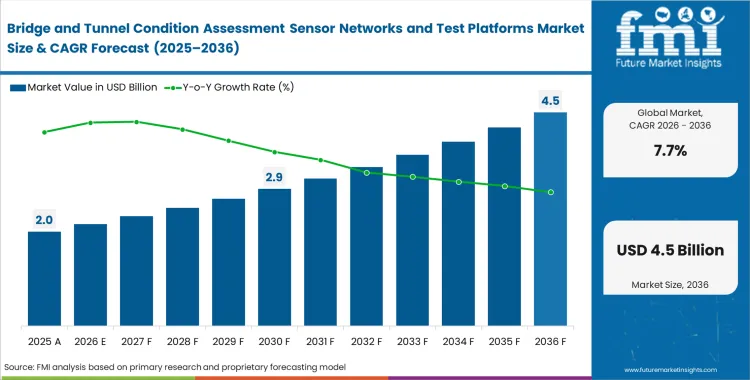
Public funding rules are also changing procurement behavior in this market. Once grant programs or approval frameworks begin requiring telemetry in new infrastructure or rehabilitation projects, sensor purchasing shifts from an isolated technical buy to a portfolio-level planning decision. Agencies start specifying network standards, data protocols, and integration requirements across multiple assets. That gives an advantage to suppliers offering interoperable platforms rather than standalone devices, and it widens the revenue base from hardware supply into longer-duration monitoring programs.
New transport corridors are encouraging early deployment of sensor-based maintenance in India, and demand in the country is expected to rise at a CAGR of 10.2% through 2036. China is forecast to register 9.4% CAGR as high-speed rail expansion lifts requirements for tunnel monitoring system architectures. Large logistics and mobility developments are supporting adoption in Saudi Arabia, where the market is likely to expand at a CAGR of 9.0% during the assessment period. In the United Kingdom, bridge and infrastructure owners are working within mature asset networks, and the market is set to grow at 7.3% CAGR through 2036. The United States is projected to post 7.1% CAGR as operators retrofit a broad installed base of aging assets. Germany is expected to record 6.6% CAGR over the study period, while Japan is likely to see market growth of 6.1% through 2036. The regional split remains clear: Asian demand is tied more closely to greenfield deployment, while Western markets are being shaped by retrofit economics, compliance requirements, and tighter management of aging infrastructure.
Segmental Analysis
Bridge and Tunnel Condition Assessment Sensor Networks Market Analysis by Structure Type
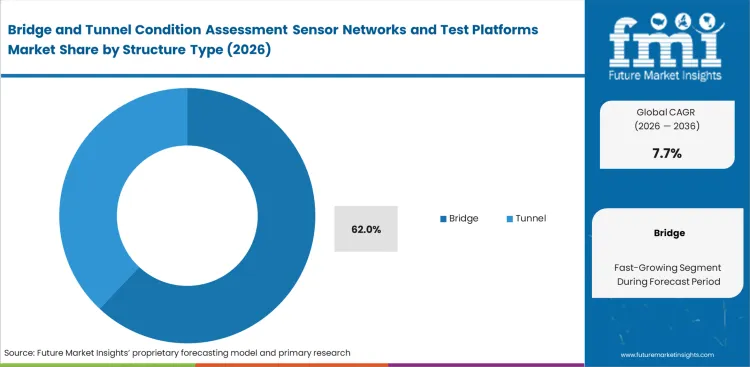
Federal inspection mandates continue to shape monitoring demand across large above-ground transport networks. In 2026, bridges are estimated to account for 62.0% of market share, and FMI observes that this lead comes from the sheer scale of installed assets rather than higher monitoring complexity at each site. Municipal asset teams manage thousands of aging spans that require recurring validation, which keeps procurement centered on bridge monitoring across highway and railway networks. Tunnels represent a smaller site base, though spending per monitored location is usually higher because environmental and structural systems must be instrumented together. That distinction matters commercially. Bridge programs absorb higher hardware volumes, while tunnel projects often generate longer-duration software integration and analytics contracts. A poorly instrumented bridge can force precautionary load restrictions. Unaddressed tunnel deformation can lead to full closures and broader traffic disruption. Early deployment of baseline geotechnical instrumentation and monitoring helps operators meet compliance obligations and assess bridge monitoring sensors against periodic inspection models with greater confidence.
- Inventory Scale Reality: Surface-level viaducts outnumber underground bores by wide margins across most transport networks. Procurement budgets are usually allocated in line with that asset mix.
- Micro-fracture Liability: Visual surveys rarely identify internal rebar corrosion before surface spalling appears. Structural engineers rely on embedded strain data to detect deterioration earlier and assess failure risk more accurately.
- Load Restriction Economics: Without telemetry to verify reserve strength, DOT officials are often left with little choice but to reduce allowable weight limits. That decision can disrupt freight movement and add avoidable pressure across regional supply chains.
Bridge and Tunnel Condition Assessment Sensor Networks Market Analysis by Platform Type
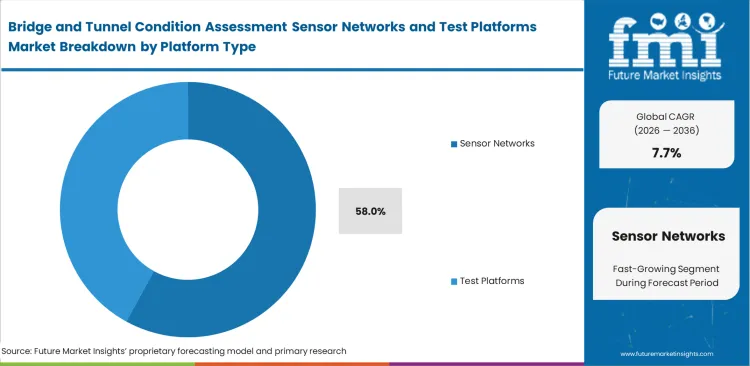
Infrastructure owners increasingly depend on uninterrupted data streams to model long‑term material fatigue with accuracy. Modern transportation authorities have already begun phasing out intermittent testing approaches, and the Sensor Networks segment is expected to hold 58.0% share in 2026 as agencies prioritize systems capable of providing continuous anomaly alerts. Portable test platforms remain valuable for validating acute repair work, but they cannot substitute for the persistent oversight now required in insurance‑linked monitoring mandates. FMI’s analysis indicates that the volume of data produced by continuous non‑destructive testing and inspection networks frequently exceeds the processing and storage capacity of many municipal IT departments. Agencies deferring networked telemetry adoption often face higher operational spending due to emergency manual inspections initiated by unexpected field conditions.
- Persistent Telemetry Demand: Intermittent data leaves blind spots regarding behavior under peak traffic loads. Data scientists require continuous feeds for predictive modeling.
- Labor Cost Avoidance: Sending technicians to attach temporary sensors disrupts traffic and risks personnel safety. Maintenance directors eliminate recurring costs with permanent arrays.
- Insurance Premium Leverage: Underwriters demand unbroken performance logs before adjusting liability rates. Financial controllers use network data to negotiate favorable coverage terms.
Bridge and Tunnel Condition Assessment Sensor Networks Market Analysis by Sensor Type
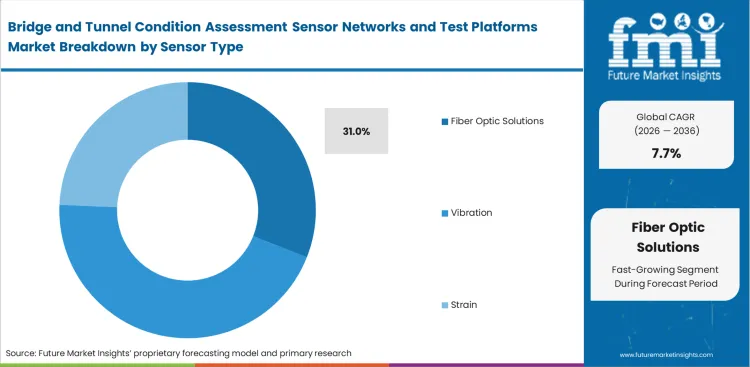
Fiber Optic solutions: Long-span assets create operating conditions where conventional electrical sensors lose reliability over distance and under sustained environmental exposure. That is why many engineers are shifting toward fiber-optic monitoring in bridges, suspension systems, and other extended structures. A single optical strand can support hundreds of measurement points across several kilometers without requiring powered nodes at deck level. In 2026, Fiber Optic solutions are projected to account for 31.0% of market share, reflecting their fit in applications where conventional gauges add wiring burden and ongoing maintenance work. FMI’s assessment indicates that procurement teams do not always model interrogator unit costs accurately, even though these units remain the most capital-intensive element in an optical architecture. When that cost ratio is understated, EPC contractors may switch back to electrical gauges during the tender stage. The immediate saving often proves misleading, as it raises lifecycle wiring requirements and winter-season maintenance costs. Distributed optical sensing remains attractive because it simplifies monitoring across long linear alignments and improves signal stability over distance.
- Distributed Measurement Geometry: A single optical line can replace thousands of copper connections across long structures. Installation teams cut field complexity and reduce deployment time on extended viaducts.
- Electromagnetic Immunity: Heavy rail corridors generate electrical noise that can distort conventional strain readings. Optical arrays give signal engineers cleaner data in these operating conditions.
- Interrogator Cost Friction: Optical networks depend on advanced laser-based reading equipment to interpret field data. Budget planning has to account for interrogator units early, since that cost sits at the front end of system economics.
Bridge and Tunnel Condition Assessment Sensor Networks Market Analysis by Deployment Mode
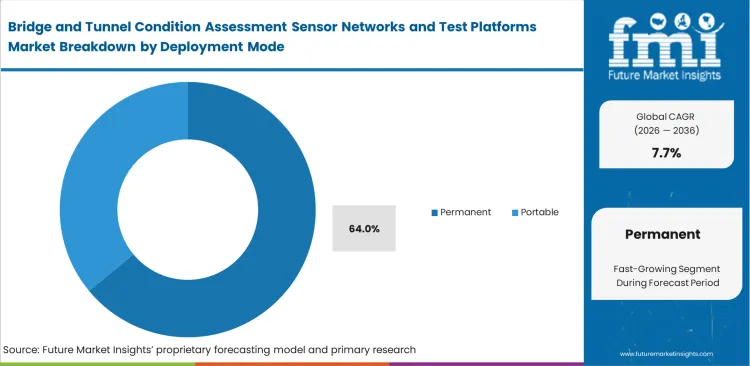
Remote interrogation removes much of the operating burden associated with repeated lane closures, traffic management, and labor coordination for manual sensor work. Asset owners are increasingly specifying monitoring systems intended to remain in place across the full service life of the structure, since that approach preserves baseline data from construction through peak-load years. Permanent installations are forecast to account for 64.0% of market share in 2026, reflecting wider acceptance that temporary diagnostics are better suited to narrower use cases such as post-event checks or load-rating exercises. Contractors also point out that adding permanent hardware later into existing prestressed concrete raises both cost and execution risk. Once embedded conduits are omitted during the design stage, project teams often lose a practical route to long-term remote telemetry without disruptive reconstruction. Integrating monitoring capability at build-time gives owners a more dependable and cost-efficient path to continuous structural assessment.
- Embedded Lifecycle Telemetry: Integrating hardware during construction ensures pristine baseline data before traffic starts. EPC firms use data to prove structural delivery standards.
- Retrofit Cost Penalties: Drilling into existing prestressed concrete to mount permanent housings risks striking internal tendons. Engineers strictly limit aggressive post-construction installations.
- Emergency Triage Utility: Portable systems remain vital for rapid deployment following sudden vehicular impacts. Safety inspectors rely on portable kits when permanent nodes fail.
Bridge and Tunnel Condition Assessment Sensor Networks Market Analysis by End User
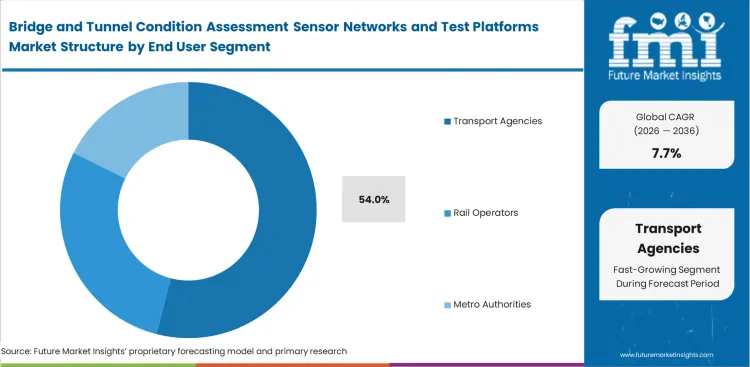
National infrastructure governance frameworks continue to direct procurement volumes toward public authorities responsible for large bridge and tunnel portfolios. These agencies operate under statutory reporting requirements that reinforce the need for consistent monitoring and digital condition scoring. Commercial rail and metro‑system operators manage smaller but tightly regulated networks with different investment cycles. In 2026, Transport Agencies are anticipated to capture 54.0% of total market share, reflecting the scale and compliance demands of their asset bases. Despite this purchasing power, deployment timelines often extend due to public tendering rules emphasizing low‑cost bids and lengthy evaluation periods. Municipal IT teams also encounter delays when attempting to internally develop telemetry platforms, pushing operational rollout beyond hardware warranty windows. Private EPC firms, by contrast, move more quickly to protect concession revenues.
- Federal Mandate Compliance: National registries require updated condition scores to release highway funding. Bureau chiefs use telemetry to automate this tedious reporting requirement.
- Procurement Cycle Friction: Public tenders require extensive bidding periods and low-cost prioritization. Technical directors struggle acquiring premium diagnostic hardware under these rules.
- Private Sector Agility: EPC firms managing toll roads deploy sensors rapidly protecting concession revenue. Concession operators bypass bureaucratic delays guaranteeing uninterrupted toll income.
Bridge and Tunnel Condition Assessment Sensor Networks Market Drivers, Restraints, and Opportunities
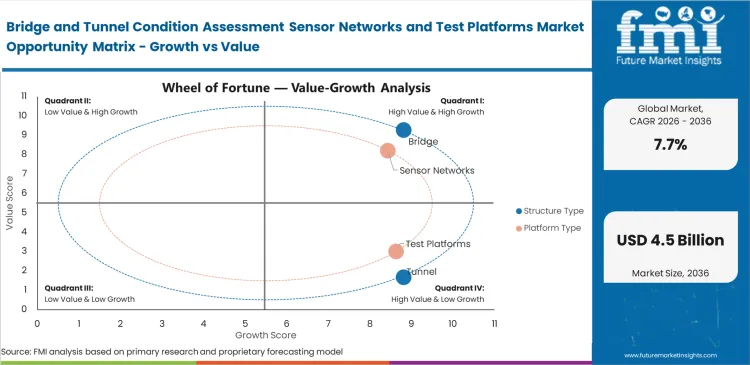
Imminent load-rating downgrades force civil engineering directors to adopt continuous monitoring strictly to keep critical logistics arteries legally open. When a visual inspection flags potential severe fatigue, standard protocol dictates restricting heavy freight traffic immediately. This action devastates regional supply chain economics. Deploying predictive maintenance arrays provides empirical proof that structures can still safely handle current loads despite superficial aging. Threats of total closure override all initial capital expenditure hesitations.
Fragmented software ecosystems isolate sensor outputs completely from enterprise asset management databases. Procurement departments purchase sophisticated interrogators, only to discover proprietary data formats refuse to integrate with existing municipal maintenance scheduling software. This disconnect forces data scientists to manually export and interpret strain charts. Open-API AI-driven predictive maintenance platforms slowly emerge, but legacy hardware manufacturers actively resist abandoning closed ecosystems.
Opportunities in the Bridge and Tunnel Condition Assessment Sensor Networks Market
- Energy-harvesting hardware integration: Eliminating battery replacement logistics enables maintenance directors to install nodes in entirely inaccessible substructure locations.
- Acoustic emission monitoring fusion: Combining crack-propagation sound data with strain metrics gives engineers unprecedented early-warning capabilities for steel fatigue.
- Digital twin visualization synchronization: Linking live IoT-based asset tracking and monitoring feeds into 3D models allows bridge monitoring sensor suppliers to visualize exactly where rehabilitation budgets must deploy next.
Regional Analysis
Based on regional analysis, Bridge and Tunnel Condition Assessment Sensor Networks Market is segmented into North America, Latin America, Western Europe, Eastern Europe, Middle East and Africa, East Asia, South Asia and Pacific across 40 plus countries.
.webp "Top Country Growth Comparison Bridge And Tunnel Condition Assessment Sensor Networks And Test Platforms Market Cagr (2026 2036)")
| Country | CAGR (2026 to 2036) |
|---|---|
| India | 10.2% |
| China | 9.4% |
| Saudi Arabia | 9.0% |
| United Kingdom | 7.3% |
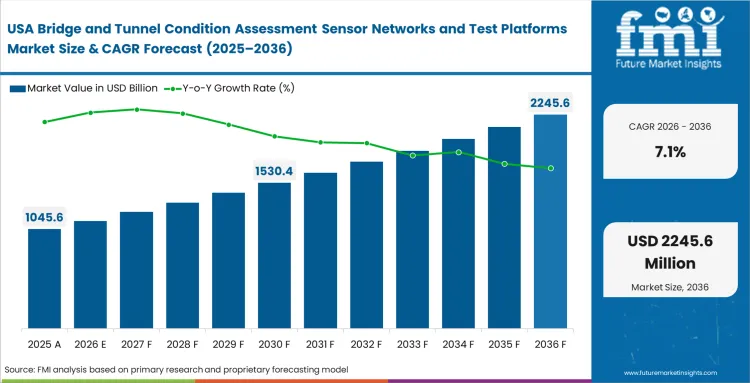
| United States | 7.1% |
| Germany | 6.6% |
| Japan | 6.1% |
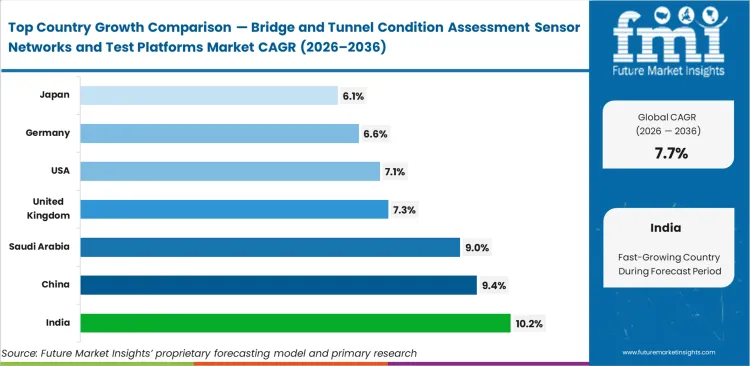
Source: Future Market Insights (FMI) analysis, based on proprietary forecasting model and primary research
South Asia and Pacific Bridge and Tunnel Condition Assessment Sensor Networks Market Analysis
Extreme capital injection into Greenfield transportation corridors defines behavioral reality across this geography. Governments do not just replace old bridges; they construct entirely new freight architectures connecting previously isolated economic zones. FMI analysts note that engineering firms bid on these mega-projects fully expecting mandated telemetry inclusions. Local DOT equivalents completely bypass the manual inspection era, stepping directly into optical sensor networked management. This leapfrogging forces hardware suppliers to build large local support infrastructure handling sheer volumes of simultaneous project deployments.
- India: Significant new transport corridors integrate sensorized maintenance natively into initial concrete designs. Rail network directors demand embedded strain gauges monitoring increased high-speed axle loads. Demand within the bridge monitoring market in India is anticipated to rise at a CAGR of 10.2% through 2036. Winning early instrumentation contracts on flagship freight corridors locks suppliers into decades of guaranteed maintenance revenue.
FMI's report includes extensive data on Australia and ASEAN members. These territories exhibit severe demand spikes specifically aligned with coastal infrastructure bracing for extreme weather events.
East Asia Bridge and Tunnel Condition Assessment Sensor Networks Market Analysis
Hyper-dense urban expansion requires tunneling directly beneath existing fragile infrastructure. Civil authorities mandate strict geotechnical monitoring ensuring excavation machines do not collapse adjacent building foundations. In FMI's view, this liability dynamic makes ground displacement sensors non-negotiable for metro authorities. The region dominates global consumption regarding high-precision tiltmeters and automated total stations. Suppliers competing here face brutal price compression from local manufacturing giants who quickly reverse-engineer imported distributed fiber optic sensors arrays.
- China: High-speed rail and metro expansions demand deep architectural integration from the outset. Infrastructure planners deploy continuous telemetry to manage subsidence risks across highly varied geological zones. Driven by these projects, the tunnel monitoring systems in China is poised to expand at a CAGR of 9.4% through 2036. Domestic suppliers utilize these internal deployments to build economies of scale for global export.
- Japan: Mature installed bases dictate highly selective sensor upgrades rather than foundational deployments. The Japan tunnel monitoring technology segment is expected to grow at a CAGR of 6.1% during the study period. Disaster management agencies focus strictly on advanced seismic response telemetry. The early adoption of basic strain gauges during the 1990s now forces modern IT directors to navigate complex legacy system integrations.
FMI's report includes deep analysis of South Korea. Strict government mandates regarding smart-city infrastructure integration lead to steady procurement of advanced vibration diagnostic tools.
North America Bridge and Tunnel Condition Assessment Sensor Networks Market Analysis
Deferring the collapse of century-old steel structures dominates absolute every procurement discussion in this territory. Federal infrastructure packages finally allocate capital required to instrument bridges operating decades past intended design lives. FMI observes that municipalities do not buy telemetry here optimizing maintenance; they buy it surviving until reconstruction budgets arrive. This distinct desperation creates substantial opportunities for condition monitoring system contractors deploying portable diagnostic testing rapidly before critical ratings drop below legal limits.
- United States: Aging bridge inventories dictate immediate retrofit actions across the nation. As a result, the bridge condition monitoring in the United States is projected to witness a 7.1% CAGR through 2036. Highway administrators urgently secure federal grants to instrument viaducts categorized as deficient. Providing certified data that prevents forced highway closures elevates sensor vendors from mere hardware suppliers to critical municipal partners.
FMI's report includes Canadian market metrics. Extreme freeze-thaw cycles dictate highly specialized requirements for ruggedized interrogators deployed across remote provincial transport routes.
Competitive Aligners for Market Players
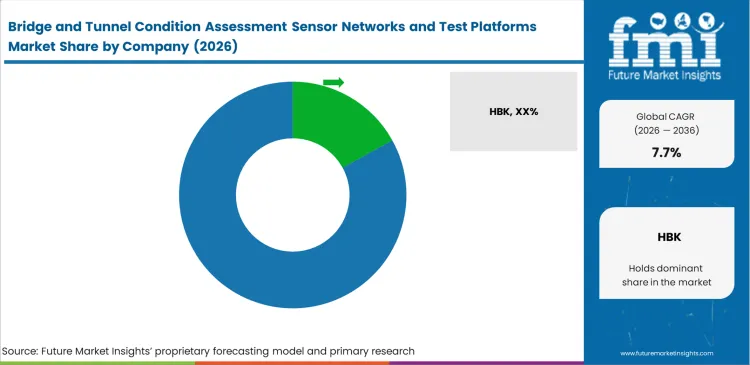
Competition remains highly concentrated among a tight cluster of specialized geotechnical instrumentation firms and established aerospace telemetry manufacturers crossing over into civil engineering. Evaluating who are the key companies in bridge and tunnel condition assessment systems reveals dominant access by HBK, MISTRAS Group, and Campbell Scientific through decades of validated public tender performance. Procurement directors at national transport agencies fundamentally distrust new market entrants; they demand field-proven calibration histories spanning at least ten years before trusting a sensor safeguarding public infrastructure. This extreme risk aversion heavily marginalizes startup hardware firms, forcing them to partner with established EPC conglomerates gaining site access.
Incumbents dominate not through superior individual sensors, but through proprietary data acquisition mainframes. Once an agency installs a specific brand's datalogger cabinet on a bridge deck, adding new sensors inevitably means buying from that exact same manufacturer ensuring software compatibility. This closed-loop architecture constitutes a moat against cheaper imported hardware. Established tunnel monitoring system vendors compound this advantage by maintaining libraries of specific harsh environments fiber optic installation protocols, allowing them to accurately quote complex deployments that inexperienced competitors drastically underprice and subsequently abandon.
Municipal buyers fiercely resist this datalogger lock-in by demanding open-source API architectures in new tender specifications. Transport authorities refuse paying recurring licensing fees just to access their own bridge vibration data. This tension fractures traditional business models, forcing hardware manufacturers to pivot. Hardware margins inevitably compress as sensors commoditize; competitive survival now demands offering AI-driven data interpretation services translating raw strain metrics into explicit remaining-useful-life calculations for non-technical finance directors.
Key Players in Bridge and Tunnel Condition Assessment Sensor Networks Market
- HBK
- MISTRAS Group
- Campbell Scientific
- GEOKON
- Sisgeo
- Kinemetrics
- Geocomp
Scope of the Report
| Metric | Value |
|---|---|
| Quantitative Units | USD 2.0 Billion to USD 4.2 Billion, at a CAGR of 7.7% |
| Market Definition | Hardware arrays and analytical platforms engineered to continuously measure integrity metrics within civil infrastructure. |
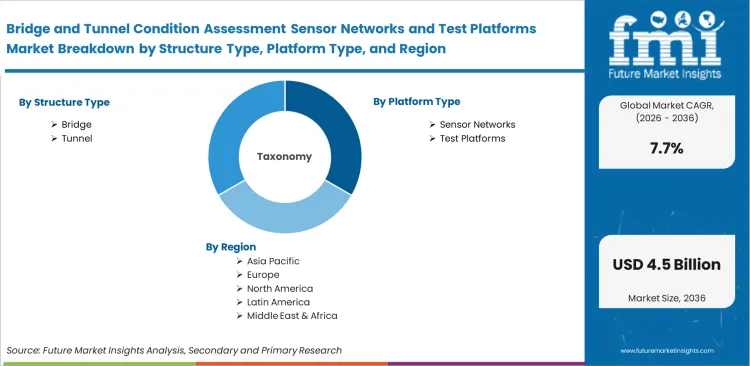
| Segmentation | By Structure Type, Platform Type, Sensor Type, Deployment Mode, End User, and Region |
| Regions Covered | North America, Latin America, Western Europe, Eastern Europe, Middle East and Africa, East Asia, South Asia and Pacific |
| Countries Covered | India, China, Saudi Arabia, United Kingdom, United States, Germany, Japan |
| Key Companies Profiled | HBK, MISTRAS Group, Campbell Scientific, GEOKON, Sisgeo, Kinemetrics, Geocomp |
| Forecast Period | 2026 to 2036 |
| Approach | Aggregation of federal bridge inventory upgrade budgets and project capex |
Source: Future Market Insights (FMI) analysis, based on proprietary forecasting model and primary research
Bridge and Tunnel Condition Assessment Sensor Networks Market Analysis by Segments
By Structure Type
- Bridges
- Tunnels
By Platform Type
- Sensor Networks
- Test Platforms
By Sensor Type
- Fiber Optic
- Vibration
- Strain
- Displacement
- Environmental
By Deployment Mode
- Permanent
- Portable
By End User
- Transport Agencies
- Rail Operators
- Metro Authorities
- EPC Firms
Region:
- North America
- United States
- Canada
- Europe
- Germany
- United Kingdom
- France
- Italy
- Spain
- Asia Pacific
- China
- Japan
- South Korea
- Taiwan
- Singapore
- Latin America
- Brazil
- Mexico
- Argentina
- Middle East & Africa
- GCC Countries
- South Africa
Bibliography
- Aktan, E., Bartoli, I., Glišić, B., & Rainieri, C. (2024). Lessons from Bridge Structural Health Monitoring (SHM) and Their Implications for the Development of Cyber-Physical Systems. Infrastructures, 9(2), 30.
- Gkoumas, K., Stepniak, M., Cheimariotis, I., & Marques dos Santos, F. (2024). New technologies for bridge inspection and monitoring: A perspective from European Union research and innovation projects. Structure and Infrastructure Engineering, 20(7-8), 1120-1132.
- Salehi, H. (2024). Smart Bridge Monitoring Employing Deep Learning and Unmanned Aerial Vehicles (LTRC Project No. 24-2TIRE). Louisiana Transportation Research Center.
- U.S. Geological Survey. (2024). Real-time pier scour monitoring and observations at three scour-critical sites in Idaho, water years 2020-22.
- Yang, Y., Chen, T., Lin, W., Jing, M., & Xu, W. (2024). Research progress on calibration of bridge structural health monitoring sensing system. Advances in Bridge Engineering, 5, Article 32.
This bibliography is provided for reader reference. The full FMI report contains the complete reference list with primary source documentation.
This Report Addresses
- Permanent sensor network integration limits across legacy transport agency asset bases
- Fiber optic structural deployment challenges within harsh tunneling environments
- Bridge condition monitoring hardware procurement shifts toward software analytics
- Regional adoption discrepancies between mature retrofits and new Asian mega-projects
- Predictive maintenance dashboard requirements for municipal public works directors
- Non-destructive test platform utilization balancing continuous tracking telemetry
- Proprietary protocol friction complicating open-architecture civil engineering designs
- Vibration analyzer constraints addressing high-speed rail dynamic load requirements
Frequently Asked Questions
What is driving demand for bridge and tunnel monitoring sensors?
Imminent load-rating downgrades compel municipal asset directors to install strain gauges proving structural viability. Delaying this telemetry upgrade forces preemptive lane closures and significant economic bottlenecks across regional supply chains.
How are bridge condition assessment sensor networks used?
Operators deploy these networks capturing dynamic load responses, concrete strain limits, and multi-axis vibration patterns. They transition structural maintenance from reactive calendar schedules toward targeted condition-based realities.
What sensors are used in tunnel monitoring systems?
Underground architectures rely heavily on high-precision tiltmeters, automated total stations, and ground displacement sensors. These instruments monitor severe environmental degradation variables alongside structural subsidence risks during urban excavation.
Which sensor type leads bridge condition monitoring?
Fiber optic technology represents the leading choice for long-span environments. Engineers specify optical lines because single glass strands multiplex hundreds of measurement points across kilometers without active power nodes.
Why are fiber optic sensors used in bridge monitoring?
Heavy rail corridors generate electrical noise corrupting traditional copper strain signals. Signal engineers rely strictly on optical arrays securing uncorrupted data immune to electromagnetic interference.
What is the difference between SHM and condition assessment?
Structural Health Monitoring (SHM) involves continuous data telemetry permanently bolted to viaducts. Condition assessment encompasses broader practices, including episodic manual reviews using portable testing equipment.
Compare bridge sensor networks and portable test platforms?
Sensor networks deliver persistent telemetry necessary for predictive fatigue modeling and continuous anomaly alerts. Portable test platforms validate acute repairs but leave significant blind spots regarding structural behavior under peak traffic loads.
Who are the key companies in bridge and tunnel condition assessment systems?
Competition remains concentrated among specialized geotechnical firms including HBK, MISTRAS Group, Campbell Scientific, GEOKON, Sisgeo, Kinemetrics, and Geocomp. Transport agencies demand field-proven calibration histories spanning decades from these vendors.
Preview the report firsthand - request a free sample
Get SampleGet the brochure for pricing and purchase details.
Get PDFTable of Content
- Executive Summary
- Global Market Outlook
- Demand-side Trends
- Supply-side Trends
- Technology Roadmap Analysis
- Analysis and Recommendations
- Market Overview
- Market Coverage / Taxonomy
- Market Definition / Scope / Limitations
- Research Methodology
- Chapter Orientation
- Analytical Lens and Working Hypotheses
- Market Structure, Signals, and Trend Drivers
- Benchmarking and Cross-market Comparability
- Market Sizing, Forecasting, and Opportunity Mapping
- Research Design and Evidence Framework
- Desk Research Programme (Secondary Evidence)
- Company Annual and Sustainability Reports
- Peer-reviewed Journals and Academic Literature
- Corporate Websites, Product Literature, and Technical Notes
- Earnings Decks and Investor Briefings
- Statutory Filings and Regulatory Disclosures
- Technical White Papers and Standards Notes
- Trade Journals, Industry Magazines, and Analyst Briefs
- Conference Proceedings, Webinars, and Seminar Materials
- Government Statistics Portals and Public Data Releases
- Press Releases and Reputable Media Coverage
- Specialist Newsletters and Curated Briefings
- Sector Databases and Reference Repositories
- FMI Internal Proprietary Databases and Historical Market Datasets
- Subscription Datasets and Paid Sources
- Social Channels, Communities, and Digital Listening Inputs
- Additional Desk Sources
- Expert Input and Fieldwork (Primary Evidence)
- Primary Modes
- Qualitative Interviews and Expert Elicitation
- Quantitative Surveys and Structured Data Capture
- Blended Approach
- Why Primary Evidence is Used
- Field Techniques
- Interviews
- Surveys
- Focus Groups
- Observational and In-context Research
- Social and Community Interactions
- Stakeholder Universe Engaged
- C-suite Leaders
- Board Members
- Presidents and Vice Presidents
- R&D and Innovation Heads
- Technical Specialists
- Domain Subject-matter Experts
- Scientists
- Physicians and Other Healthcare Professionals
- Governance, Ethics, and Data Stewardship
- Research Ethics
- Data Integrity and Handling
- Primary Modes
- Tooling, Models, and Reference Databases
- Desk Research Programme (Secondary Evidence)
- Data Engineering and Model Build
- Data Acquisition and Ingestion
- Cleaning, Normalisation, and Verification
- Synthesis, Triangulation, and Analysis
- Quality Assurance and Audit Trail
- Market Background
- Market Dynamics
- Drivers
- Restraints
- Opportunity
- Trends
- Scenario Forecast
- Demand in Optimistic Scenario
- Demand in Likely Scenario
- Demand in Conservative Scenario
- Opportunity Map Analysis
- Product Life Cycle Analysis
- Supply Chain Analysis
- Investment Feasibility Matrix
- Value Chain Analysis
- PESTLE and Porter’s Analysis
- Regulatory Landscape
- Regional Parent Market Outlook
- Production and Consumption Statistics
- Import and Export Statistics
- Market Dynamics
- Global Market Analysis 2021 to 2025 and Forecast, 2026 to 2036
- Historical Market Size Value (USD Million) Analysis, 2021 to 2025
- Current and Future Market Size Value (USD Million) Projections, 2026 to 2036
- Y-o-Y Growth Trend Analysis
- Absolute $ Opportunity Analysis
- Global Market Pricing Analysis 2021 to 2025 and Forecast 2026 to 2036
- Global Market Analysis 2021 to 2025 and Forecast 2026 to 2036, By Structure Type
- Introduction / Key Findings
- Historical Market Size Value (USD Million) Analysis By Structure Type , 2021 to 2025
- Current and Future Market Size Value (USD Million) Analysis and Forecast By Structure Type , 2026 to 2036
- Bridge
- Tunnel
- Bridge
- Y-o-Y Growth Trend Analysis By Structure Type , 2021 to 2025
- Absolute $ Opportunity Analysis By Structure Type , 2026 to 2036
- Global Market Analysis 2021 to 2025 and Forecast 2026 to 2036, By Platform Type
- Introduction / Key Findings
- Historical Market Size Value (USD Million) Analysis By Platform Type, 2021 to 2025
- Current and Future Market Size Value (USD Million) Analysis and Forecast By Platform Type, 2026 to 2036
- Sensor Networks
- Test Platforms
- Sensor Networks
- Y-o-Y Growth Trend Analysis By Platform Type, 2021 to 2025
- Absolute $ Opportunity Analysis By Platform Type, 2026 to 2036
- Global Market Analysis 2021 to 2025 and Forecast 2026 to 2036, By Sensor Type
- Introduction / Key Findings
- Historical Market Size Value (USD Million) Analysis By Sensor Type, 2021 to 2025
- Current and Future Market Size Value (USD Million) Analysis and Forecast By Sensor Type, 2026 to 2036
- Fiber Optic Solutions
- Vibration
- Strain
- Fiber Optic Solutions
- Y-o-Y Growth Trend Analysis By Sensor Type, 2021 to 2025
- Absolute $ Opportunity Analysis By Sensor Type, 2026 to 2036
- Global Market Analysis 2021 to 2025 and Forecast 2026 to 2036, By Deployment Mode
- Introduction / Key Findings
- Historical Market Size Value (USD Million) Analysis By Deployment Mode, 2021 to 2025
- Current and Future Market Size Value (USD Million) Analysis and Forecast By Deployment Mode, 2026 to 2036
- Permanent
- Portable
- Permanent
- Y-o-Y Growth Trend Analysis By Deployment Mode, 2021 to 2025
- Absolute $ Opportunity Analysis By Deployment Mode, 2026 to 2036
- Global Market Analysis 2021 to 2025 and Forecast 2026 to 2036, By End User
- Introduction / Key Findings
- Historical Market Size Value (USD Million) Analysis By End User, 2021 to 2025
- Current and Future Market Size Value (USD Million) Analysis and Forecast By End User, 2026 to 2036
- Transport Agencies
- Rail Operators
- Metro Authorities
- Transport Agencies
- Y-o-Y Growth Trend Analysis By End User, 2021 to 2025
- Absolute $ Opportunity Analysis By End User, 2026 to 2036
- Global Market Analysis 2021 to 2025 and Forecast 2026 to 2036, By Region
- Introduction
- Historical Market Size Value (USD Million) Analysis By Region, 2021 to 2025
- Current Market Size Value (USD Million) Analysis and Forecast By Region, 2026 to 2036
- North America
- Latin America
- Western Europe
- Eastern Europe
- East Asia
- South Asia and Pacific
- Middle East & Africa
- Market Attractiveness Analysis By Region
- North America Market Analysis 2021 to 2025 and Forecast 2026 to 2036, By Country
- Historical Market Size Value (USD Million) Trend Analysis By Market Taxonomy, 2021 to 2025
- Market Size Value (USD Million) Forecast By Market Taxonomy, 2026 to 2036
- By Country
- USA
- Canada
- Mexico
- By Structure Type
- By Platform Type
- By Sensor Type
- By Deployment Mode
- By End User
- By Country
- Market Attractiveness Analysis
- By Country
- By Structure Type
- By Platform Type
- By Sensor Type
- By Deployment Mode
- By End User
- Key Takeaways
- Latin America Market Analysis 2021 to 2025 and Forecast 2026 to 2036, By Country
- Historical Market Size Value (USD Million) Trend Analysis By Market Taxonomy, 2021 to 2025
- Market Size Value (USD Million) Forecast By Market Taxonomy, 2026 to 2036
- By Country
- Brazil
- Chile
- Rest of Latin America
- By Structure Type
- By Platform Type
- By Sensor Type
- By Deployment Mode
- By End User
- By Country
- Market Attractiveness Analysis
- By Country
- By Structure Type
- By Platform Type
- By Sensor Type
- By Deployment Mode
- By End User
- Key Takeaways
- Western Europe Market Analysis 2021 to 2025 and Forecast 2026 to 2036, By Country
- Historical Market Size Value (USD Million) Trend Analysis By Market Taxonomy, 2021 to 2025
- Market Size Value (USD Million) Forecast By Market Taxonomy, 2026 to 2036
- By Country
- Germany
- UK
- Italy
- Spain
- France
- Nordic
- BENELUX
- Rest of Western Europe
- By Structure Type
- By Platform Type
- By Sensor Type
- By Deployment Mode
- By End User
- By Country
- Market Attractiveness Analysis
- By Country
- By Structure Type
- By Platform Type
- By Sensor Type
- By Deployment Mode
- By End User
- Key Takeaways
- Eastern Europe Market Analysis 2021 to 2025 and Forecast 2026 to 2036, By Country
- Historical Market Size Value (USD Million) Trend Analysis By Market Taxonomy, 2021 to 2025
- Market Size Value (USD Million) Forecast By Market Taxonomy, 2026 to 2036
- By Country
- Russia
- Poland
- Hungary
- Balkan & Baltic
- Rest of Eastern Europe
- By Structure Type
- By Platform Type
- By Sensor Type
- By Deployment Mode
- By End User
- By Country
- Market Attractiveness Analysis
- By Country
- By Structure Type
- By Platform Type
- By Sensor Type
- By Deployment Mode
- By End User
- Key Takeaways
- East Asia Market Analysis 2021 to 2025 and Forecast 2026 to 2036, By Country
- Historical Market Size Value (USD Million) Trend Analysis By Market Taxonomy, 2021 to 2025
- Market Size Value (USD Million) Forecast By Market Taxonomy, 2026 to 2036
- By Country
- China
- Japan
- South Korea
- By Structure Type
- By Platform Type
- By Sensor Type
- By Deployment Mode
- By End User
- By Country
- Market Attractiveness Analysis
- By Country
- By Structure Type
- By Platform Type
- By Sensor Type
- By Deployment Mode
- By End User
- Key Takeaways
- South Asia and Pacific Market Analysis 2021 to 2025 and Forecast 2026 to 2036, By Country
- Historical Market Size Value (USD Million) Trend Analysis By Market Taxonomy, 2021 to 2025
- Market Size Value (USD Million) Forecast By Market Taxonomy, 2026 to 2036
- By Country
- India
- ASEAN
- Australia & New Zealand
- Rest of South Asia and Pacific
- By Structure Type
- By Platform Type
- By Sensor Type
- By Deployment Mode
- By End User
- By Country
- Market Attractiveness Analysis
- By Country
- By Structure Type
- By Platform Type
- By Sensor Type
- By Deployment Mode
- By End User
- Key Takeaways
- Middle East & Africa Market Analysis 2021 to 2025 and Forecast 2026 to 2036, By Country
- Historical Market Size Value (USD Million) Trend Analysis By Market Taxonomy, 2021 to 2025
- Market Size Value (USD Million) Forecast By Market Taxonomy, 2026 to 2036
- By Country
- Kingdom of Saudi Arabia
- Other GCC Countries
- Turkiye
- South Africa
- Other African Union
- Rest of Middle East & Africa
- By Structure Type
- By Platform Type
- By Sensor Type
- By Deployment Mode
- By End User
- By Country
- Market Attractiveness Analysis
- By Country
- By Structure Type
- By Platform Type
- By Sensor Type
- By Deployment Mode
- By End User
- Key Takeaways
- Key Countries Market Analysis
- USA
- Pricing Analysis
- Market Share Analysis, 2025
- By Structure Type
- By Platform Type
- By Sensor Type
- By Deployment Mode
- By End User
- Canada
- Pricing Analysis
- Market Share Analysis, 2025
- By Structure Type
- By Platform Type
- By Sensor Type
- By Deployment Mode
- By End User
- Mexico
- Pricing Analysis
- Market Share Analysis, 2025
- By Structure Type
- By Platform Type
- By Sensor Type
- By Deployment Mode
- By End User
- Brazil
- Pricing Analysis
- Market Share Analysis, 2025
- By Structure Type
- By Platform Type
- By Sensor Type
- By Deployment Mode
- By End User
- Chile
- Pricing Analysis
- Market Share Analysis, 2025
- By Structure Type
- By Platform Type
- By Sensor Type
- By Deployment Mode
- By End User
- Germany
- Pricing Analysis
- Market Share Analysis, 2025
- By Structure Type
- By Platform Type
- By Sensor Type
- By Deployment Mode
- By End User
- UK
- Pricing Analysis
- Market Share Analysis, 2025
- By Structure Type
- By Platform Type
- By Sensor Type
- By Deployment Mode
- By End User
- Italy
- Pricing Analysis
- Market Share Analysis, 2025
- By Structure Type
- By Platform Type
- By Sensor Type
- By Deployment Mode
- By End User
- Spain
- Pricing Analysis
- Market Share Analysis, 2025
- By Structure Type
- By Platform Type
- By Sensor Type
- By Deployment Mode
- By End User
- France
- Pricing Analysis
- Market Share Analysis, 2025
- By Structure Type
- By Platform Type
- By Sensor Type
- By Deployment Mode
- By End User
- India
- Pricing Analysis
- Market Share Analysis, 2025
- By Structure Type
- By Platform Type
- By Sensor Type
- By Deployment Mode
- By End User
- ASEAN
- Pricing Analysis
- Market Share Analysis, 2025
- By Structure Type
- By Platform Type
- By Sensor Type
- By Deployment Mode
- By End User
- Australia & New Zealand
- Pricing Analysis
- Market Share Analysis, 2025
- By Structure Type
- By Platform Type
- By Sensor Type
- By Deployment Mode
- By End User
- China
- Pricing Analysis
- Market Share Analysis, 2025
- By Structure Type
- By Platform Type
- By Sensor Type
- By Deployment Mode
- By End User
- Japan
- Pricing Analysis
- Market Share Analysis, 2025
- By Structure Type
- By Platform Type
- By Sensor Type
- By Deployment Mode
- By End User
- South Korea
- Pricing Analysis
- Market Share Analysis, 2025
- By Structure Type
- By Platform Type
- By Sensor Type
- By Deployment Mode
- By End User
- Russia
- Pricing Analysis
- Market Share Analysis, 2025
- By Structure Type
- By Platform Type
- By Sensor Type
- By Deployment Mode
- By End User
- Poland
- Pricing Analysis
- Market Share Analysis, 2025
- By Structure Type
- By Platform Type
- By Sensor Type
- By Deployment Mode
- By End User
- Hungary
- Pricing Analysis
- Market Share Analysis, 2025
- By Structure Type
- By Platform Type
- By Sensor Type
- By Deployment Mode
- By End User
- Kingdom of Saudi Arabia
- Pricing Analysis
- Market Share Analysis, 2025
- By Structure Type
- By Platform Type
- By Sensor Type
- By Deployment Mode
- By End User
- Turkiye
- Pricing Analysis
- Market Share Analysis, 2025
- By Structure Type
- By Platform Type
- By Sensor Type
- By Deployment Mode
- By End User
- South Africa
- Pricing Analysis
- Market Share Analysis, 2025
- By Structure Type
- By Platform Type
- By Sensor Type
- By Deployment Mode
- By End User
- USA
- Market Structure Analysis
- Competition Dashboard
- Competition Benchmarking
- Market Share Analysis of Top Players
- By Regional
- By Structure Type
- By Platform Type
- By Sensor Type
- By Deployment Mode
- By End User
- Competition Analysis
- Competition Deep Dive
- HBK
- Overview
- Product Portfolio
- Profitability by Market Segments (Product/Age /Sales Channel/Region)
- Sales Footprint
- Strategy Overview
- Marketing Strategy
- Product Strategy
- Channel Strategy
- MISTRAS Group
- Campbell Scientific
- GEOKON
- Sisgeo
- Kinemetrics
- Geocomp
- HBK
- Competition Deep Dive
- Assumptions & Acronyms Used


