

- Industry Size (2026)
- USD 833.0 Mn
- Forecast (2036)
- USD 1608.3 Mn
- CAGR (2026 to 2036)
- 6.8%
Telecom Power Reliability Test Platforms Market Forecast and Outlook 2026 to 2036
The telecom power reliability test platforms market is valued at USD 833.0 million in 2026 and is forecast to reach USD 1,608.3 million by 2036, expanding at a CAGR of 6.8%. Growth is driven by densification of telecom networks, accelerated 5G rollout, and increasing dependence on uninterrupted power delivery across base stations, edge nodes, and core infrastructure. Reliability validation focuses on continuous operation under fluctuating loads, fault conditions, and grid instability, reflecting critical uptime requirements across telecom deployments.
Programmable DC power supplies represent leading platform type globally due to precision voltage control, fast transient response, and flexibility across diverse test scenarios. These systems support validation of rectifiers, converters, and backup subsystems under dynamic load profiles. The 48V DC telecom rail accounts for leading voltage class, reflecting its widespread adoption in telecom architectures for efficiency, safety, and compatibility with battery-backed systems. Segment structure highlights emphasis on standardized yet highly controllable power environments.
China, Brazil, South Korea, USA, and Germany rank among fastest-growing countries, supported by large-scale network expansion and modernization programs. Competitive landscape includes Chroma ATE, AMETEK Programmable Power, Keysight Technologies, EA Elektro-Automatik, and Tektronix (Keithley). Industry structure reflects sustained demand for high-accuracy, scalable power reliability validation aligned with telecom network criticality.
Quick Stats for Telecom Power Reliability Test Platforms Market
- Telecom Power Reliability Test Platforms Market Value (2026): USD 833.0 million
- Telecom Power Reliability Test Platforms Market Forecast Value (2036): USD 1,608.3 million
- Telecom Power Reliability Test Platforms Market Forecast CAGR (2026–2036): 6.8%
- Leading Platform Type in Global Demand: Programmable DC Power Supplies
- Leading Voltage Class in Global Demand: 48V DC Telecom Rails
- Fastest-Growing Countries: China, Brazil, South Korea, USA, Germany
- Top Players in Global Demand: Chroma ATE, AMETEK Programmable Power, Keysight Technologies, EA Elektro-Automatik, Kikusui, NH Research, Pacific Power Source, ITECH, Hioki, Tektronix (Keithley)
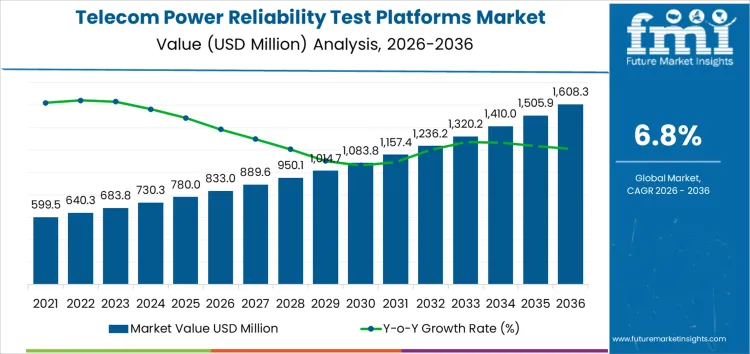
Telecom Power Reliability Test Platforms Market Key Takeaways
| Metric | Value |
|---|---|
| Market Value (2026) | USD 833.0 million |
| Market Forecast Value (2036) | USD 1,608.3 million |
| Forecast CAGR (2026-2036) | 6.8% |
Why is the Demand for Telecom Power Reliability Test Platforms Market Growing?
Demand for telecom power reliability test platforms is growing globally due to expansion of telecommunications networks and increased expectations for uninterrupted service delivery. Telecom operators require rigorous validation of power systems, including backup batteries, rectifiers, inverters, and power distribution units, to ensure continuous operation during grid disturbances, storms, and unplanned outages. Growth in 5G deployments increases energy requirements at cell sites and distributed network nodes, which strengthens need for reliability evaluation under varied load conditions. Data centers and edge computing facilities associated with telecom infrastructure adopt test platforms to verify redundancy, peak load handling, and fault tolerance.
Equipment manufacturers integrate standardized reliability testing early in product development to reduce field failures and improve mean time between failures metrics. Regulatory and service level expectations drive structured test protocols that assess performance under temperature extremes, transient events, and sustained power cycling. Renewable energy integration at remote sites increases complexity of power systems, which requires comprehensive test environments to simulate hybrid configurations. Research and certification labs invest in test systems that support compliance with international standards and interoperability criteria. Global emphasis on network resilience, quality of service, and customer experience reinforces continued demand across telecom power reliability test platforms worldwide.
How Are the Segments Classified in the Telecom Power Reliability Test Platforms Market?
Demand for telecom power reliability test platforms globally is shaped by network densification, power efficiency mandates, and uptime assurance across legacy and next-generation infrastructure. Stakeholders assess voltage stability, load response accuracy, thermal stress behavior, and compliance measurement capability. Adoption patterns reflect sustained testing needs across centralized facilities and distributed edge deployments supporting continuous network availability.
Which Platform Type Accounts for the Largest Share of Global Demand?
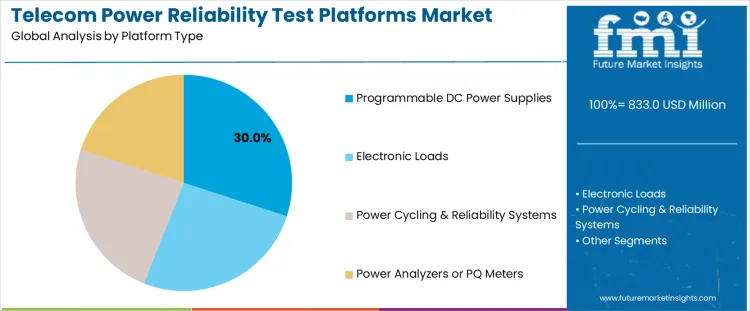
Programmable DC power supplies hold 30.0%, accounting for the largest share of global demand. These platforms enable precise voltage and current control required for telecom equipment validation under variable load conditions. Electronic loads hold 26.0%, supporting dynamic load simulation and discharge profiling during reliability testing. Power cycling and reliability systems account for 24.0%, enabling long-duration stress validation and lifecycle assessment. Power analyzers or power quality meters hold 20.0%, supporting efficiency measurement and compliance verification. Platform-type distribution reflects priority for controllable power sourcing during qualification and validation workflows.
Key Points
- Programmable DC supplies lead due to precise power control needs.
- Electronic loads enable realistic load simulation.
- Reliability systems support lifecycle and stress validation.
Which Voltage Class Drives the Highest Share of Global Testing Demand?
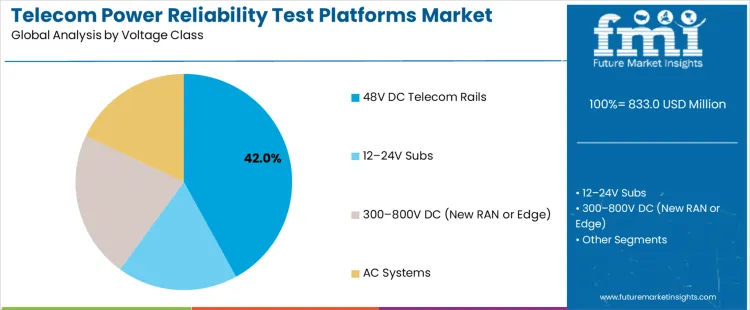
48V DC telecom rails hold 42.0%, driving the highest share of global testing demand. This voltage class remains standard for telecom power distribution due to efficiency and safety balance. The 300–800V DC range holds 22.0%, supporting new radio access networks and edge power architectures. Both 12–24V subs and AC systems each hold 18.0%, addressing auxiliary subsystems and legacy infrastructure. Voltage-class distribution reflects continued reliance on 48V systems alongside gradual adoption of higher-voltage DC architectures.
Key Points
- 48V DC dominates due to widespread telecom adoption.
- Higher-voltage DC supports new RAN and edge systems.
- Lower-voltage and AC systems serve auxiliary needs.
Which Use Case Represents the Largest Share of Global Demand?
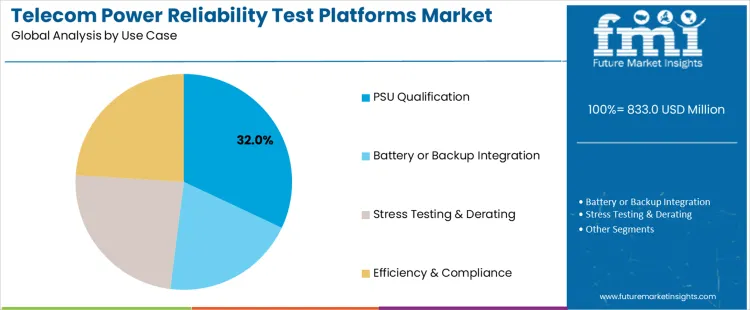
PSU qualification holds 32.0%, representing the largest use-case share globally. This testing validates power supply performance, protection behavior, and reliability under defined operating limits. Stress testing and derating account for 24.0%, ensuring stable operation under elevated thermal and load conditions. Efficiency and compliance testing also hold 24.0%, supporting regulatory and energy-performance requirements. Battery or backup integration holds 20.0%, validating interaction between power systems and energy storage. Use-case distribution reflects emphasis on power supply robustness and compliance assurance.
Key Points
- PSU qualification leads due to reliability verification needs.
- Stress testing supports durability under extreme conditions.
- Efficiency testing ensures compliance and energy performance.
What are the Key Dynamics in the Telecom Power Reliability Test Platforms Market?
Global demand rises as telecommunications operators, equipment manufacturers, and infrastructure integrators adopt reliability test platforms to evaluate power systems supporting critical network assets. Test solutions simulate grid disturbances, backup power performance, load variation, and environmental stressors to ensure continuity in mobile, fixed-line, and data network operations. Adoption aligns with expanded deployment of 5G, fiber networks, and edge computing nodes in diverse geographic and climatic conditions. Usage spans carrier labs, system integrators, and independent test facilities requiring rigorous power validation.
How do network expansion and service continuity requirements shape global demand?
Telecom operators invest in reliability testing as part of network rollout and modernization programmes to minimize downtime and ensure service level targets. Power reliability test platforms assess rectifiers, battery storage, uninterruptible power supplies (UPS), and backup generators under simulated load scenarios. Growing 5G infrastructure increases power density and sensitivity to supply fluctuations, prompting comprehensive evaluation of thermal behaviour, transient response, and backup readiness. Edge sites and distributed infrastructure demand localized testing to guarantee resilience under grid instability and extreme weather events. Equipment manufacturers integrate reliability test cycles into product qualification to meet operator procurement specifications and minimize field failures.
How do capital intensity, test complexity, and regulatory environments influence market scalability?
Telecom power reliability test platforms involve substantial capital investment in automated load banks, environmental chambers, and data acquisition systems necessary for high-fidelity simulation. Integration of diverse power architectures AC, DC, hybrid systems, and renewable sources adds complexity to test configuration and interpretation. Skilled test engineers are required to manage dynamic power scenarios and interpret failure modes across hardware and software interfaces. Regional regulatory frameworks governing grid interconnection, safety standards, and emissions influence test requirements and reporting. Variation in test protocols across carriers and countries leads to customized platform configurations, limiting standardization. Global growth depends on development of modular, scalable test systems and harmonized best practices that support consistent power reliability assessment across expanding telecommunications infrastructure worldwide.
How Is Demand for Telecom Power Reliability Test Platforms Evolving?
Demand for telecom power reliability test platforms is increasing globally due to network densification, 5G rollout, and higher uptime expectations for critical infrastructure. China leads with an 8.4% CAGR, supported by large-scale telecom expansion and in-house power validation. Brazil follows at 8.0%, driven by network modernization and climate-related reliability testing. South Korea records a 6.8% CAGR, shaped by dense urban networks and electronics reliability standards. USA posts 6.7%, reflecting lifecycle testing for deployed infrastructure and upgrade programs. Germany records 6.5%, supported by compliance-driven qualification and industrial telecom use. Growth reflects need for power continuity, fault tolerance testing, and standards-aligned validation worldwide.
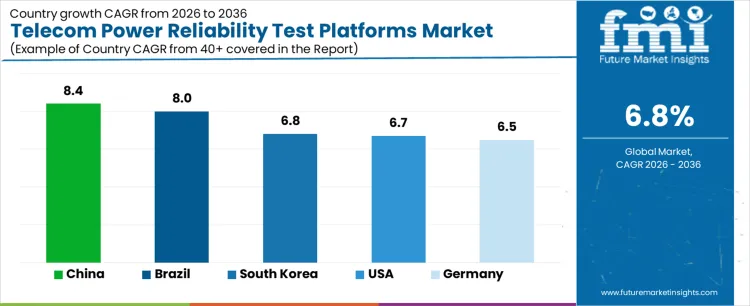
| Country | CAGR (%) |
|---|---|
| China | 8.4% |
| Brazil | 8.0% |
| South Korea | 6.8% |
| USA | 6.7% |
| Germany | 6.5% |
What factors are accelerating adoption of telecom power reliability testing in China?
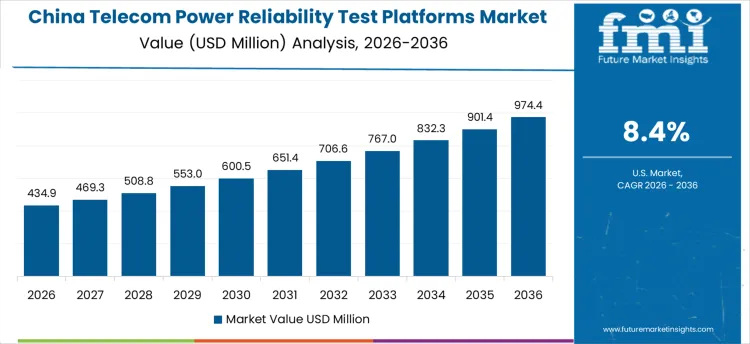
China drives demand through rapid expansion of 5G base stations, data centers, and edge telecom infrastructure. Country’s CAGR of 8.4% reflects extensive testing of rectifiers, DC power systems, batteries, and backup configurations. Operators validate performance under load variation, thermal stress, and grid instability scenarios. In-house testing reduces deployment risk and supports fast rollout schedules. Test platforms emphasize automation, parallel testing, and long-duration endurance capability. Government-backed digital infrastructure programs expand testing volumes. Growth remains scale-driven and rollout-aligned, supported by nationwide network densification and strict uptime targets.
- Large-scale 5G and telecom infrastructure rollout
- Validation of rectifiers, batteries, and backup systems
- In-house automated endurance testing
- Government-supported digital infrastructure investment
Why is Brazil showing strong growth in telecom power reliability testing demand?
Brazil demand is shaped by network modernization, rural connectivity expansion, and challenging environmental conditions. Country’s CAGR of 8.0% reflects need to validate telecom power systems against heat, humidity, and grid variability. Operators test backup duration, battery degradation, and power conversion efficiency. Shared laboratories enable cost-efficient access for operators and integrators. Collaboration with global vendors supports adoption of international reliability standards. Demand favors modular and scalable test platforms. Growth remains capability-building focused, aligned with gradual expansion of resilient telecom infrastructure.
- Network modernization and rural expansion
- Climate and grid variability testing needs
- Shared testing facilities for cost efficiency
- Modular and scalable test platforms
How does South Korea’s dense network environment influence testing demand?
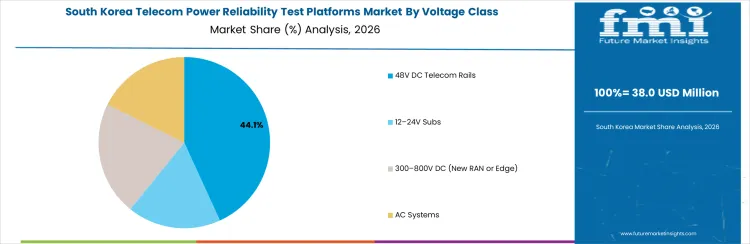
South Korea demand reflects dense urban deployments, advanced electronics integration, and strict service continuity expectations. Country’s CAGR of 6.8% is supported by reliability testing of compact power systems used in small cells and base stations. Operators emphasize fast transient response, thermal management, and fault recovery. Government-backed initiatives promote standardized qualification. Facilities prioritize precision control and repeatability. Growth remains technology-driven, aligned with dense network topologies and high availability requirements.
- Dense urban and small-cell deployments
- Fast transient and fault recovery testing
- Standardized reliability qualification
- Precision-controlled test environments
What dynamics sustain steady growth of telecom power testing in the USA?
USA demand is driven by a large installed base requiring lifecycle testing, upgrades, and resilience validation. Country’s CAGR of 6.7% reflects testing of power systems during network upgrades and edge expansion. Operators validate backup performance, efficiency, and compliance with safety standards. Test platforms integrate data logging and correlation with field telemetry. Procurement emphasizes throughput and standards alignment. Growth remains lifecycle-driven, aligned with phased upgrades and reliability assurance for critical telecom infrastructure.
- Installed base lifecycle and upgrade testing
- Backup power and efficiency validation
- Telemetry-integrated test workflows
- Standards-compliant qualification
How is Germany positioned within the global telecom power test ecosystem?
Germany demand reflects industrial telecom applications, regulatory rigor, and strong compliance culture. Country’s CAGR of 6.5% is supported by testing power systems for reliability, efficiency, and safety across telecom and private networks. Shared research institutes expand access to test facilities. Procurement favors documentation, traceability, and repeatability. Demand aligns with IEC and regional telecom standards. Growth remains engineering-led, aligned with durability, compliance, and long-term operational reliability expectations.
- Industrial and private network power testing
- Strong regulatory and compliance focus
- Documentation and traceability requirements
- Shared research and industry laboratories
What is the competitive landscape of demand for telecom power reliability test platforms?
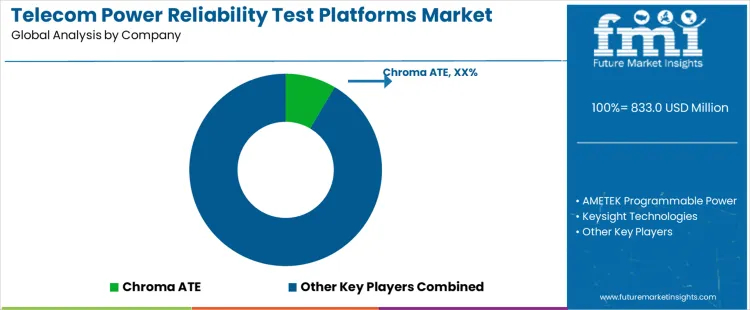
Demand for telecom power reliability test platforms is driven by expansion of 5G networks, edge data centers, and mission-critical telecom infrastructure requiring continuous uptime. Test programs validate DC power systems, rectifiers, power shelves, battery backup integration, and load behavior under fault and stress conditions. Buyers prioritize high-precision power cycling, long-duration burn-in capability, transient response accuracy, and compliance with telecom reliability standards. Procurement teams assess scalability for multi-kilowatt testing, automation support for unattended operation, and measurement repeatability across extended test windows. Trend in the global market reflects higher power density architectures, tighter efficiency targets, and increased focus on predictive reliability validation.
Chroma ATE maintains strong positioning through integrated power test systems widely used for telecom PSU and system-level reliability validation. AMETEK Programmable Power and Keysight Technologies supply high-stability power sources, electronic loads, and measurement platforms supporting complex reliability workflows. EA Elektro-Automatik, Kikusui, and NH Research contribute programmable DC solutions optimized for dynamic load and cycling profiles. Pacific Power Source and ITECH support AC and DC reliability testing aligned with global telecom specifications. Hioki and Tektronix, through Keithley, provide precision electrical measurement and data acquisition supporting long-term reliability analysis. Competitive differentiation depends on power accuracy, automation depth, thermal stability, and ability to support continuous high-stress testing environments.
Key Players in the Telecom Power Reliability Test Platforms Market
- Chroma ATE
- AMETEK Programmable Power
- Keysight Technologies
- EA Elektro-Automatik
- Kikusui
- NH Research
- Pacific Power Source
- ITECH
- Hioki
- Tektronix (Keithley)
Scope of the Report
| Items | Values |
|---|---|
| Quantitative Units | USD million |
| Platform Type | Programmable DC Power Supplies; Electronic Loads; Power Cycling & Reliability Systems; Power Analyzers or Power Quality (PQ) Meters |
| Voltage Class | 48V DC Telecom Rails; 12–24V Subsystems; 300–800V DC Systems for New RAN or Edge; AC Power Systems |
| Use Case | PSU Qualification; Battery or Backup Integration Testing; Stress Testing and Derating Analysis; Efficiency Measurement and Compliance Validation |
| Buyer | Telecom Equipment OEMs; Contract Manufacturers; Network Operator Laboratories; Test Houses or System Integrators |
| Regions Covered | Asia Pacific; Europe; North America; Latin America; Middle East & Africa |
| Countries Covered | China; USA; Germany; Brazil; South Korea; and 40+ countries |
| Key Companies Profiled | Chroma ATE; AMETEK Programmable Power; Keysight Technologies; EA Elektro-Automatik; Kikusui; NH Research; Pacific Power Source; ITECH; Hioki; Tektronix (Keithley) |
| Additional Attributes | Dollar sales by platform type and voltage class; regional adoption trends across 5G RAN, edge, and core networks; qualification demand for high-efficiency power systems; reliability validation for backup and battery integration; compliance-driven testing aligned with telecom power and safety standards. |
Telecom Power Reliability Test Platforms Market by Segment
Platform Type:
- Programmable DC Power Supplies
- Electronic Loads
- Power Cycling & Reliability Systems
- Power Analyzers or PQ Meters
Voltage Class:
- 48V DC Telecom Rails
- 12–24V Subs
- 300–800V DC (New RAN or Edge)
- AC Systems
Use Case:
- PSU Qualification
- Battery or Backup Integration
- Stress Testing & Derating
- Efficiency & Compliance
Buyer:
- Telecom Equipment OEMs
- Contract Manufacturers
- Network Operator Labs
- Test Houses or Integrators
Region:
- Asia Pacific
- China
- Japan
- South Korea
- India
- Australia & New Zealand
- ASEAN
- Rest of Asia Pacific
- Europe
- Germany
- United Kingdom
- France
- Italy
- Spain
- Nordic
- BENELUX
- Rest of Europe
- North America
- United States
- Canada
- Mexico
- Latin America
- Brazil
- Chile
- Rest of Latin America
- Middle East & Africa
- Kingdom of Saudi Arabia
- Other GCC Countries
- Turkey
- South Africa
- Other African Union
- Rest of Middle East & Africa
Frequently Asked Questions
How big is the telecom power reliability test platforms market in 2026?
The global telecom power reliability test platforms market is estimated to be valued at USD 833.0 million in 2026.
What will be the size of telecom power reliability test platforms market in 2036?
The market size for the telecom power reliability test platforms market is projected to reach USD 1,608.3 million by 2036.
How much will be the telecom power reliability test platforms market growth between 2026 and 2036?
The telecom power reliability test platforms market is expected to grow at a 6.8% CAGR between 2026 and 2036.
What are the key product types in the telecom power reliability test platforms market?
The key product types in telecom power reliability test platforms market are programmable dc power supplies, electronic loads, power cycling & reliability systems and power analyzers or pq meters.
Which voltage class segment is expected to contribute a significant share in the telecom power reliability test platforms market in 2026?
In terms of voltage class, 48v dc telecom rails segment to command 42.0% share in the telecom power reliability test platforms market in 2026.
Preview the report firsthand - request a free sample
Get SampleGet the brochure for pricing and purchase details.
Get PDFTable of Content
- Executive Summary
- Global Market Outlook
- Demand-side Trends
- Supply-side Trends
- Technology Roadmap Analysis
- Analysis and Recommendations
- Market Overview
- Market Coverage / Taxonomy
- Market Definition / Scope / Limitations
- Market Background
- Market Dynamics
- Drivers
- Restraints
- Opportunity
- Trends
- Scenario Forecast
- Demand in Optimistic Scenario
- Demand in Likely Scenario
- Demand in Conservative Scenario
- Opportunity Map Analysis
- Product Life Cycle Analysis
- Supply Chain Analysis
- Investment Feasibility Matrix
- Value Chain Analysis
- PESTLE and Porter’s Analysis
- Regulatory Landscape
- Regional Parent Market Outlook
- Production and Consumption Statistics
- Import and Export Statistics
- Market Dynamics
- Global Market Analysis 2021 to 2025 and Forecast, 2026 to 2036
- Historical Market Size Value (USD Million) Analysis, 2021 to 2025
- Current and Future Market Size Value (USD Million) Projections, 2026 to 2036
- Y-o-Y Growth Trend Analysis
- Absolute $ Opportunity Analysis
- Global Market Pricing Analysis 2021 to 2025 and Forecast 2026 to 2036
- Global Market Analysis 2021 to 2025 and Forecast 2026 to 2036, By Platform Type
- Introduction / Key Findings
- Historical Market Size Value (USD Million) Analysis By Platform Type , 2021 to 2025
- Current and Future Market Size Value (USD Million) Analysis and Forecast By Platform Type , 2026 to 2036
- Programmable DC Power Supplies
- Electronic Loads
- Power Cycling & Reliability Systems
- Power Analyzers or PQ Meters
- Programmable DC Power Supplies
- Y-o-Y Growth Trend Analysis By Platform Type , 2021 to 2025
- Absolute $ Opportunity Analysis By Platform Type , 2026 to 2036
- Global Market Analysis 2021 to 2025 and Forecast 2026 to 2036, By Voltage Class
- Introduction / Key Findings
- Historical Market Size Value (USD Million) Analysis By Voltage Class, 2021 to 2025
- Current and Future Market Size Value (USD Million) Analysis and Forecast By Voltage Class, 2026 to 2036
- 48V DC Telecom Rails
- 12–24V Subs
- 300–800V DC (New RAN or Edge)
- AC Systems
- 48V DC Telecom Rails
- Y-o-Y Growth Trend Analysis By Voltage Class, 2021 to 2025
- Absolute $ Opportunity Analysis By Voltage Class, 2026 to 2036
- Global Market Analysis 2021 to 2025 and Forecast 2026 to 2036, By Use Case
- Introduction / Key Findings
- Historical Market Size Value (USD Million) Analysis By Use Case, 2021 to 2025
- Current and Future Market Size Value (USD Million) Analysis and Forecast By Use Case, 2026 to 2036
- PSU Qualification
- Battery or Backup Integration
- Stress Testing & Derating
- Efficiency & Compliance
- PSU Qualification
- Y-o-Y Growth Trend Analysis By Use Case, 2021 to 2025
- Absolute $ Opportunity Analysis By Use Case, 2026 to 2036
- Global Market Analysis 2021 to 2025 and Forecast 2026 to 2036, By Buyer
- Introduction / Key Findings
- Historical Market Size Value (USD Million) Analysis By Buyer, 2021 to 2025
- Current and Future Market Size Value (USD Million) Analysis and Forecast By Buyer, 2026 to 2036
- Telecom Equipment OEMs
- Contract Manufacturers
- Network Operator Labs
- Test Houses or Integrators
- Telecom Equipment OEMs
- Y-o-Y Growth Trend Analysis By Buyer, 2021 to 2025
- Absolute $ Opportunity Analysis By Buyer, 2026 to 2036
- Global Market Analysis 2021 to 2025 and Forecast 2026 to 2036, By Region
- Introduction
- Historical Market Size Value (USD Million) Analysis By Region, 2021 to 2025
- Current Market Size Value (USD Million) Analysis and Forecast By Region, 2026 to 2036
- North America
- Latin America
- Western Europe
- Eastern Europe
- East Asia
- South Asia and Pacific
- Middle East & Africa
- Market Attractiveness Analysis By Region
- North America Market Analysis 2021 to 2025 and Forecast 2026 to 2036, By Country
- Historical Market Size Value (USD Million) Trend Analysis By Market Taxonomy, 2021 to 2025
- Market Size Value (USD Million) Forecast By Market Taxonomy, 2026 to 2036
- By Country
- USA
- Canada
- Mexico
- By Platform Type
- By Voltage Class
- By Use Case
- By Buyer
- By Country
- Market Attractiveness Analysis
- By Country
- By Platform Type
- By Voltage Class
- By Use Case
- By Buyer
- Key Takeaways
- Latin America Market Analysis 2021 to 2025 and Forecast 2026 to 2036, By Country
- Historical Market Size Value (USD Million) Trend Analysis By Market Taxonomy, 2021 to 2025
- Market Size Value (USD Million) Forecast By Market Taxonomy, 2026 to 2036
- By Country
- Brazil
- Chile
- Rest of Latin America
- By Platform Type
- By Voltage Class
- By Use Case
- By Buyer
- By Country
- Market Attractiveness Analysis
- By Country
- By Platform Type
- By Voltage Class
- By Use Case
- By Buyer
- Key Takeaways
- Western Europe Market Analysis 2021 to 2025 and Forecast 2026 to 2036, By Country
- Historical Market Size Value (USD Million) Trend Analysis By Market Taxonomy, 2021 to 2025
- Market Size Value (USD Million) Forecast By Market Taxonomy, 2026 to 2036
- By Country
- Germany
- UK
- Italy
- Spain
- France
- Nordic
- BENELUX
- Rest of Western Europe
- By Platform Type
- By Voltage Class
- By Use Case
- By Buyer
- By Country
- Market Attractiveness Analysis
- By Country
- By Platform Type
- By Voltage Class
- By Use Case
- By Buyer
- Key Takeaways
- Eastern Europe Market Analysis 2021 to 2025 and Forecast 2026 to 2036, By Country
- Historical Market Size Value (USD Million) Trend Analysis By Market Taxonomy, 2021 to 2025
- Market Size Value (USD Million) Forecast By Market Taxonomy, 2026 to 2036
- By Country
- Russia
- Poland
- Hungary
- Balkan & Baltic
- Rest of Eastern Europe
- By Platform Type
- By Voltage Class
- By Use Case
- By Buyer
- By Country
- Market Attractiveness Analysis
- By Country
- By Platform Type
- By Voltage Class
- By Use Case
- By Buyer
- Key Takeaways
- East Asia Market Analysis 2021 to 2025 and Forecast 2026 to 2036, By Country
- Historical Market Size Value (USD Million) Trend Analysis By Market Taxonomy, 2021 to 2025
- Market Size Value (USD Million) Forecast By Market Taxonomy, 2026 to 2036
- By Country
- China
- Japan
- South Korea
- By Platform Type
- By Voltage Class
- By Use Case
- By Buyer
- By Country
- Market Attractiveness Analysis
- By Country
- By Platform Type
- By Voltage Class
- By Use Case
- By Buyer
- Key Takeaways
- South Asia and Pacific Market Analysis 2021 to 2025 and Forecast 2026 to 2036, By Country
- Historical Market Size Value (USD Million) Trend Analysis By Market Taxonomy, 2021 to 2025
- Market Size Value (USD Million) Forecast By Market Taxonomy, 2026 to 2036
- By Country
- India
- ASEAN
- Australia & New Zealand
- Rest of South Asia and Pacific
- By Platform Type
- By Voltage Class
- By Use Case
- By Buyer
- By Country
- Market Attractiveness Analysis
- By Country
- By Platform Type
- By Voltage Class
- By Use Case
- By Buyer
- Key Takeaways
- Middle East & Africa Market Analysis 2021 to 2025 and Forecast 2026 to 2036, By Country
- Historical Market Size Value (USD Million) Trend Analysis By Market Taxonomy, 2021 to 2025
- Market Size Value (USD Million) Forecast By Market Taxonomy, 2026 to 2036
- By Country
- Kingdom of Saudi Arabia
- Other GCC Countries
- Turkiye
- South Africa
- Other African Union
- Rest of Middle East & Africa
- By Platform Type
- By Voltage Class
- By Use Case
- By Buyer
- By Country
- Market Attractiveness Analysis
- By Country
- By Platform Type
- By Voltage Class
- By Use Case
- By Buyer
- Key Takeaways
- Key Countries Market Analysis
- USA
- Pricing Analysis
- Market Share Analysis, 2025
- By Platform Type
- By Voltage Class
- By Use Case
- By Buyer
- Canada
- Pricing Analysis
- Market Share Analysis, 2025
- By Platform Type
- By Voltage Class
- By Use Case
- By Buyer
- Mexico
- Pricing Analysis
- Market Share Analysis, 2025
- By Platform Type
- By Voltage Class
- By Use Case
- By Buyer
- Brazil
- Pricing Analysis
- Market Share Analysis, 2025
- By Platform Type
- By Voltage Class
- By Use Case
- By Buyer
- Chile
- Pricing Analysis
- Market Share Analysis, 2025
- By Platform Type
- By Voltage Class
- By Use Case
- By Buyer
- Germany
- Pricing Analysis
- Market Share Analysis, 2025
- By Platform Type
- By Voltage Class
- By Use Case
- By Buyer
- UK
- Pricing Analysis
- Market Share Analysis, 2025
- By Platform Type
- By Voltage Class
- By Use Case
- By Buyer
- Italy
- Pricing Analysis
- Market Share Analysis, 2025
- By Platform Type
- By Voltage Class
- By Use Case
- By Buyer
- Spain
- Pricing Analysis
- Market Share Analysis, 2025
- By Platform Type
- By Voltage Class
- By Use Case
- By Buyer
- France
- Pricing Analysis
- Market Share Analysis, 2025
- By Platform Type
- By Voltage Class
- By Use Case
- By Buyer
- India
- Pricing Analysis
- Market Share Analysis, 2025
- By Platform Type
- By Voltage Class
- By Use Case
- By Buyer
- ASEAN
- Pricing Analysis
- Market Share Analysis, 2025
- By Platform Type
- By Voltage Class
- By Use Case
- By Buyer
- Australia & New Zealand
- Pricing Analysis
- Market Share Analysis, 2025
- By Platform Type
- By Voltage Class
- By Use Case
- By Buyer
- China
- Pricing Analysis
- Market Share Analysis, 2025
- By Platform Type
- By Voltage Class
- By Use Case
- By Buyer
- Japan
- Pricing Analysis
- Market Share Analysis, 2025
- By Platform Type
- By Voltage Class
- By Use Case
- By Buyer
- South Korea
- Pricing Analysis
- Market Share Analysis, 2025
- By Platform Type
- By Voltage Class
- By Use Case
- By Buyer
- Russia
- Pricing Analysis
- Market Share Analysis, 2025
- By Platform Type
- By Voltage Class
- By Use Case
- By Buyer
- Poland
- Pricing Analysis
- Market Share Analysis, 2025
- By Platform Type
- By Voltage Class
- By Use Case
- By Buyer
- Hungary
- Pricing Analysis
- Market Share Analysis, 2025
- By Platform Type
- By Voltage Class
- By Use Case
- By Buyer
- Kingdom of Saudi Arabia
- Pricing Analysis
- Market Share Analysis, 2025
- By Platform Type
- By Voltage Class
- By Use Case
- By Buyer
- Turkiye
- Pricing Analysis
- Market Share Analysis, 2025
- By Platform Type
- By Voltage Class
- By Use Case
- By Buyer
- South Africa
- Pricing Analysis
- Market Share Analysis, 2025
- By Platform Type
- By Voltage Class
- By Use Case
- By Buyer
- USA
- Market Structure Analysis
- Competition Dashboard
- Competition Benchmarking
- Market Share Analysis of Top Players
- By Regional
- By Platform Type
- By Voltage Class
- By Use Case
- By Buyer
- Competition Analysis
- Competition Deep Dive
- Chroma ATE
- Overview
- Product Portfolio
- Profitability by Market Segments (Product/Age /Sales Channel/Region)
- Sales Footprint
- Strategy Overview
- Marketing Strategy
- Product Strategy
- Channel Strategy
- AMETEK Programmable Power
- Keysight Technologies
- EA Elektro-Automatik
- Kikusui
- NH Research
- Pacific Power Source
- ITECH
- Hioki
- Tektronix (Keithley)
- Chroma ATE
- Competition Deep Dive
- Assumptions & Acronyms Used
- Research Methodology


