

- Industry Size (2026)
- USD 580 Mn
- Forecast (2036)
- USD 1184.3 Mn
- CAGR (2026 to 2036)
- 7.4%
Power Board Tester Market Forecast and Outlook 2026 to 2036
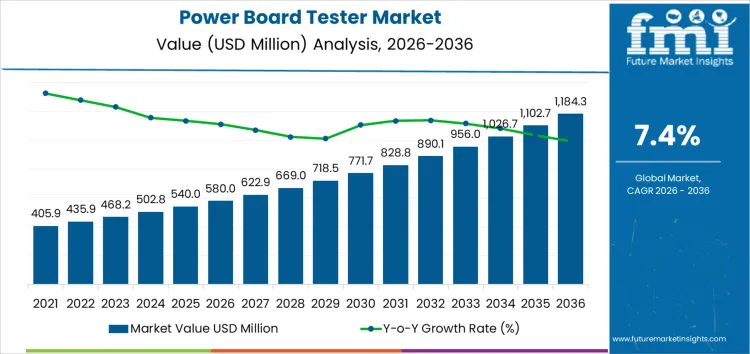
The power board tester market is projected to grow at a CAGR of 7.4%, expanding from USD 580 million in 2026 to USD 1,184.3 million by 2036. Key segments driving this growth include functional tests, which hold a 34% market share due to their essential role in verifying the overall functionality of power boards across various applications. Other significant test types such as in-circuit tests, power cycling or stress tests, and burn-in tests are also crucial for evaluating the reliability and performance of power boards in diverse environments. These tests are critical across industries like electronics, automotive, telecommunications, and industrial automation, where strict performance and safety standards must be met.
Quick Stats for Power Board Tester Market
- Power Board Tester Market Value (2026): USD 580 million
- Power Board Tester Market Forecast Value (2036): USD 1,184.3 million
- Power Board Tester Market Forecast CAGR: 7.4%
- Leading Test Type in Power Board Tester Market: Functional Test (34% share)
- Key Growth Region in Power Board Tester Market: Asia Pacific
- Key Players in Power Board Tester Market: Teradyne, Keysight, National Instruments (NI) (Emerson), Chroma ATE, Advantest
The end-user segments contribute significantly to market growth, with electronics OEMs holding the largest share at 30%, driven by the increasing need for precise testing solutions in electronics manufacturing. Other important end users include EMS providers, automotive tier-1 suppliers, and test houses, all requiring advanced power board testers to ensure the quality, safety, and performance of electronic components. As the demand for high-performance, reliable, and efficient electronic products rises, these key segments will continue to fuel the power board tester market's expansion.
Power Board Tester Market Key Takeaways
| Metric | Value |
|---|---|
| Industry Value (2026) | USD 580 million |
| Forecast Value (2036) | USD 1,184.3 million |
| Forecast CAGR (2026–2036) | 7.4% |
How is the Global Power Board Tester Sector Progressing?
The global power board tester market is advancing as demand grows for reliable and accurate testing solutions in the electronics manufacturing and quality assurance landscape. Power board testers are specialized systems designed to verify electrical performance, structural integrity, and component functionality on printed circuit boards (PCBs) that power electronic devices. These systems are particularly important in industries such as consumer electronics, automotive, industrial automation, and telecommunications, where power boards must meet strict safety and performance standards before deployment. As electronic assemblies become more complex and power densities increase, effective testing solutions are essential to identify defects early and reduce costly rework.
Adoption is being driven by the increasing complexity of power electronics and the trend toward higher performance and reliability expectations across end uses. Manufacturers are investing in automated and high-throughput power board testers that can handle diverse board configurations and deliver rapid, repeatable results. Advances in test software, data analytics, and integration with production line systems have enhanced test accuracy while reducing manual intervention. This improves operational efficiency and supports quality control programs that help manufacturers reduce failure rates and maintain brand reputation.
Challenges such as the need for skilled operators, balancing investment in advanced test infrastructure with production costs, and adapting to varied board designs may influence adoption. Despite these factors, the focus on product reliability, lifecycle performance, and cost-effective quality assurance will sustain demand for power board testers worldwide.
What is the Segment-Wise Analysis for the Global Power Board Tester Market?
The global power board tester market is segmented by test type and end user. Functional test leads the market with a 34% share due to its ability to verify the overall functionality of power boards in various applications. In-circuit test, power cycling or stress, and burn-in tests follow, each playing a critical role in testing power boards for performance and reliability. In terms of end users, electronics OEMs dominate the market with a 30% share, driven by the need for precise and reliable power board testing solutions in electronic device manufacturing.
How Does Functional Test Lead the Global Power Board Tester Market?
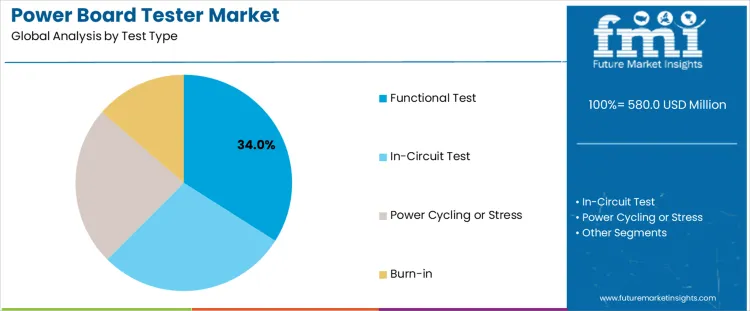
Functional test holds a 34% share in the global power board tester market due to its critical role in evaluating the overall performance and functionality of power boards. This test ensures that the power board functions correctly within its intended system, meeting safety and performance standards. As demand for reliable power boards grows in sectors like electronics and automotive, the need for efficient testing solutions also increases. Functional tests offer manufacturers a reliable method for verifying the full functionality of power boards, which is crucial for ensuring quality and minimizing defects. As industries continue to focus on enhancing product reliability, the importance of functional tests in maintaining performance standards helps reinforce their dominant position in the power board tester market.
How Do Electronics OEMs Contribute to the Global Power Board Tester Market?
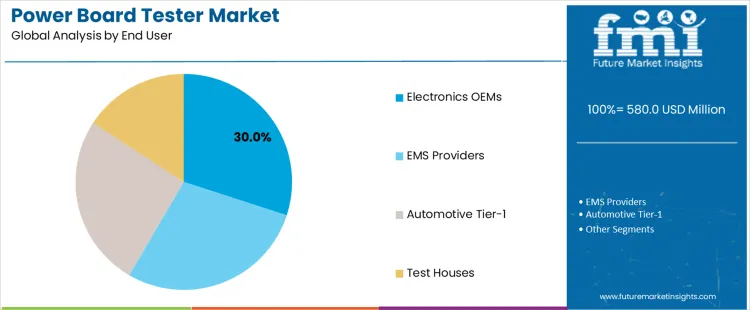
Electronics OEMs account for 30% of the global power board tester market share, driven by their critical role in producing electronic devices that rely on efficient and reliable power boards. These manufacturers depend on power board testers to ensure that power boards meet performance, safety, and reliability standards. As demand for advanced electronic products continues to rise, OEMs require precise testing solutions to maintain high production quality and meet regulatory requirements. The increasing complexity of electronic devices amplifies the need for accurate testing during the manufacturing process. This growing reliance on power board testers in the electronics sector further strengthens the position of electronics OEMs as a key end user in the global market.
What are the Key Dynamics of the Power Board Tester Market?
Power board testers are critical for validating the integrity of power distribution boards, PCBs, and power modules, ensuring safety, performance, and reliability. Rising demand for quality assurance, reduction in field failures, and adherence to stringent regulatory standards drive adoption. Growth in electric vehicles, renewable energy systems, and smart appliances further fuels the need for efficient, accurate, and automated testing solutions.
What Are the Key Drivers for the Power Board Tester Market?
The power board tester market is primarily driven by the increasing complexity of power electronics and the need for robust quality control in production lines. As circuit boards integrate higher voltages, multiple power rails, and advanced power management ICs, thorough testing becomes essential to prevent failures that can lead to safety issues or costly recalls. Adoption is further supported by the growth of sectors such as EVs, industrial automation, and aerospace, where reliability standards are stringent. Industry 4.0 initiatives favor automated test solutions that improve yield, traceability, and throughput.
What Are the Main Restraints Impacting the Power Board Tester Market?
Market growth is constrained by the high cost of advanced testing equipment and integration complexity. High-precision power board testers with automated fixtures, high speed measurement capabilities, and advanced software often require significant capital investment, which can deter small and medium enterprises. The diversity of board designs and rapid product cycles also demand frequent reconfiguration of test programs, necessitating skilled engineers, which increases operational costs. Legacy manufacturing environments may lack the infrastructure to support advanced automated testing, slowing adoption in cost sensitive regions.
What is the Growth Outlook for the Power Board Tester Market by Country?
| Country | CAGR (%) |
|---|---|
| USA | 7.2% |
| South Korea | 7% |
| Germany | 6.9% |
| China | 8.9% |
| Brazil | 8.3% |
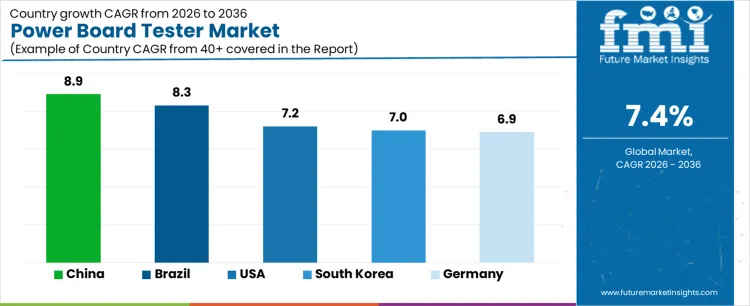
The power board tester market is experiencing steady growth, with China leading at an 8.9% CAGR, driven by its rapid expansion in the electronics and manufacturing sectors. Brazil follows with 8.3%, supported by increasing demand for testing equipment in its growing electronics and automotive industries. The USA’s market grows at 7.2%, fueled by the rising need for efficient testing solutions in industries like consumer electronics, automotive, and power electronics. South Korea’s market grows at 7%, driven by its strong semiconductor and electronics manufacturing industries. Germany’s market grows at 6.9%, backed by its focus on high-quality manufacturing and increasing demand for testing solutions in automotive and industrial sectors.
Why is China Leading in the Power Board Tester Market?
China’s power board tester market is growing at 8.9%, driven by the country’s dominance in global electronics and manufacturing. As China continues to lead in electronics production, particularly in consumer electronics, automotive, and power systems, the demand for power board testers is increasing. These testing devices are critical for ensuring the functionality and reliability of power boards used in various electronic devices and equipment. China’s massive industrial sector requires high-precision testing solutions to ensure quality control and efficient production processes. The country’s focus on technological innovation and expanding automation in manufacturing is fueling the growth of the power board tester market. As China continues to modernize its manufacturing infrastructure and increase demand for electronics, the market for power board testers is expected to continue its rapid growth.
What is Driving the Growth of the Power Board Tester Market in Brazil?
Brazil’s power board tester market is growing at 8.3%, fueled by the country’s expanding electronics, automotive, and power sectors. As Brazil continues to grow its industrial base, particularly in the automotive and consumer electronics industries, the demand for precise and efficient power board testing solutions is rising. Power board testers are essential for ensuring the quality and performance of electronic components used in automotive systems, home appliances, and telecommunications. Brazil’s increasing focus on modernizing its manufacturing processes and improving quality control standards is contributing to the market’s growth. The country’s growing investments in the energy sector and demand for renewable energy solutions are further driving the need for testing solutions in power systems. As Brazil continues to develop its industrial infrastructure, the market for power board testers is expected to grow steadily.
How is the Power Board Tester Market Expanding in the USA?
The USA’s power board tester market is growing at 7.2%, driven by increasing demand for reliable testing solutions in sectors such as consumer electronics, automotive, and industrial electronics. Power board testers are essential tools used to ensure the quality, functionality, and durability of power boards in a wide range of applications, from mobile devices to automotive electronics. As the USA continues to invest in advanced manufacturing technologies and automation, the need for efficient and precise testing equipment is rising. The growing demand for electronic devices and systems with enhanced functionality and energy efficiency is contributing to the market’s expansion. With the USA’s focus on innovation in electronics manufacturing and the rise of the electric vehicle sector, the market for power board testers is expected to continue growing steadily.
What is Contributing to the Growth of the Power Board Tester Market in South Korea?
South Korea’s power board tester market is growing at 7%, driven by the country’s strong semiconductor, electronics, and automotive industries. South Korea is home to some of the world’s largest electronics manufacturers, and the demand for high-quality power board testing solutions is growing as the country continues to lead in the production of advanced consumer electronics, semiconductors, and automotive components. Power board testers are critical for ensuring the performance and reliability of power boards in these industries. The country’s focus on innovation, automation, and improving manufacturing efficiency is further contributing to the demand for testing equipment. As South Korea continues to advance in technology and expand its industrial capabilities, the power board tester market is expected to grow steadily, driven by the increasing demand for precision testing in high-tech sectors.
What is Driving the Growth of the Power Board Tester Market in Germany?
Germany’s power board tester market is growing at 6.9%, driven by the country’s strong industrial base, particularly in automotive, manufacturing, and industrial electronics. Germany’s focus on high-quality production standards and precision manufacturing is fueling the demand for efficient power board testing solutions. Power board testers are essential in ensuring the functionality and reliability of electronic components used in automotive systems, industrial machinery, and home appliances. As Germany continues to emphasize innovation, quality control, and efficiency in manufacturing, the demand for power board testers is expected to rise. Germany’s push toward Industry 4.0 and automation in manufacturing processes further supports the adoption of advanced testing equipment. With the country’s emphasis on maintaining high standards in production, the market for power board testers is set to grow steadily in the coming years.
How Are Firms Competing in the Power Board Tester Market?
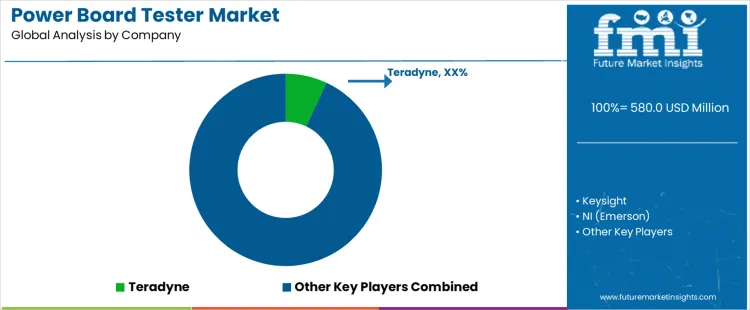
In the power board tester market Teradyne, Keysight, National Instruments (NI) (Emerson), Chroma ATE, Advantest, SPEA, Rohde & Schwarz, ATEC, and Seica are positioned with product brochures that emphasize accuracy, throughput, and seamless integration into modern production lines. Teradyne materials present high performance test platforms described with modular test cores and clear throughput metrics. Test coverage, ease of programming, and fault localization are shown in concise tables and visuals that help engineers compare options. Keysight brochures focus on precision instrumentation and flexible measurement channels that support power integrity and functional checks. Performance curves and use case snapshots are included to aid specification. National Instruments (NI) (Emerson) product briefs showcase configurable test systems where software driven workflows are emphasized. Simple charts and platform overviews help lab and line teams plan test strategies.
Chroma ATE collateral highlights scalable power board testers with concise guidance on load simulation and safety compliance. Advantest literature presents test cells with broad interface support, with diagrams and technical notes that simplify adoption. SPEA brochures describe compact, high accuracy testers suited to mixed technology boards, with clear operation notes. Rohde & Schwarz materials emphasize RF integration and high resolution measurement options. ATEC and Seica both position their solutions with visuals showing automated handling and diagnostic reporting. Technical summaries stress deterministic test execution and system uptime.
Key Players in Power Board Tester Market
- Teradyne
- Keysight
- National Instruments (NI) (Emerson)
- Chroma ATE
- Advantest
- SPEA
- Rohde & Schwarz
- ATEC
- Seica
- National Instruments (NI)
Scope of Report
| Items | Values |
|---|---|
| Quantitative Unit (2026) | USD million |
| Test Type | Functional Test, In-Circuit Test, Power Cycling or Stress, Burn-in |
| Deployment | Inline Production Test, Automated Rack Systems, Bench or Lab Test, Services |
| End User | Electronics OEMs, EMS Providers, Automotive Tier-1, Test Houses |
| Regions Covered | Asia Pacific, Europe, North America, Latin America, Middle East & Africa |
| Countries Covered | USA, China, Japan, South Korea, India, Australia & New Zealand, ASEAN, Germany, UK, France, Italy, Spain, Nordic, BENELUX, Brazil, Chile, Mexico, Saudi Arabia, Other GCC Countries, Turkey, South Africa, Other African Union |
| Key Companies Profiled | Teradyne, Keysight, National Instruments (NI) (Emerson), Chroma ATE, Advantest, SPEA, Rohde & Schwarz, ATEC, Seica |
| Additional Attributes | Dollar sales by test type, deployment, end user, and region; regional CAGR and growth outlook. |
Power Board Tester Market by Segments
Test Type
- Functional Test
- In-Circuit Test
- Power Cycling or Stress
- Burn-in
Deployment
- Inline Production Test
- Automated Rack Systems
- Bench or Lab Test
- Services
End User
- Electronics OEMs
- EMS Providers
- Automotive Tier-1
- Test Houses
Region
- Asia Pacific
- China
- Japan
- South Korea
- India
- Australia & New Zealand
- ASEAN
- Rest of Asia Pacific
- Europe
- Germany
- United Kingdom
- France
- Italy
- Spain
- Nordic
- BENELUX
- Rest of Europe
- North America
- United States
- Canada
- Mexico
- Latin America
- Brazil
- Chile
- Rest of Latin America
- Middle East & Africa
- Kingdom of Saudi Arabia
- Other GCC Countries
- Turkey
- South Africa
- Other African Union
- Rest of Middle East & Africa
Frequently Asked Questions
How big is the power board tester market in 2026?
The global power board tester market is estimated to be valued at USD 580.0 million in 2026.
What will be the size of power board tester market in 2036?
The market size for the power board tester market is projected to reach USD 1,184.3 million by 2036.
How much will be the power board tester market growth between 2026 and 2036?
The power board tester market is expected to grow at a 7.4% CAGR between 2026 and 2036.
What are the key test types in the power board tester market?
The key test types in power board tester market are functional test, in-circuit test, power cycling or stress and burn-in.
Which test type segment to contribute significant share in the power board tester market in 2026?
In terms of test type, functional test segment to command 34.0% share in the power board tester market in 2026.
Preview the report firsthand - request a free sample
Get SampleGet the brochure for pricing and purchase details.
Get PDFTable of Content
- Executive Summary
- Global Market Outlook
- Demand-side Trends
- Supply-side Trends
- Technology Roadmap Analysis
- Analysis and Recommendations
- Market Overview
- Market Coverage / Taxonomy
- Market Definition / Scope / Limitations
- Market Background
- Market Dynamics
- Drivers
- Restraints
- Opportunity
- Trends
- Scenario Forecast
- Demand in Optimistic Scenario
- Demand in Likely Scenario
- Demand in Conservative Scenario
- Opportunity Map Analysis
- Product Life Cycle Analysis
- Supply Chain Analysis
- Investment Feasibility Matrix
- Value Chain Analysis
- PESTLE and Porter’s Analysis
- Regulatory Landscape
- Regional Parent Market Outlook
- Production and Consumption Statistics
- Import and Export Statistics
- Market Dynamics
- Global Market Analysis 2021 to 2025 and Forecast, 2026 to 2036
- Historical Market Size Value (USD Million) Analysis, 2021 to 2025
- Current and Future Market Size Value (USD Million) Projections, 2026 to 2036
- Y-o-Y Growth Trend Analysis
- Absolute $ Opportunity Analysis
- Global Market Pricing Analysis 2021 to 2025 and Forecast 2026 to 2036
- Global Market Analysis 2021 to 2025 and Forecast 2026 to 2036, By Test Type
- Introduction / Key Findings
- Historical Market Size Value (USD Million) Analysis By Test Type , 2021 to 2025
- Current and Future Market Size Value (USD Million) Analysis and Forecast By Test Type , 2026 to 2036
- Functional Test
- In-Circuit Test
- Power Cycling or Stress
- Burn-in
- Functional Test
- Y-o-Y Growth Trend Analysis By Test Type , 2021 to 2025
- Absolute $ Opportunity Analysis By Test Type , 2026 to 2036
- Global Market Analysis 2021 to 2025 and Forecast 2026 to 2036, By Deployment
- Introduction / Key Findings
- Historical Market Size Value (USD Million) Analysis By Deployment, 2021 to 2025
- Current and Future Market Size Value (USD Million) Analysis and Forecast By Deployment, 2026 to 2036
- Inline Production Test
- Automated Rack Systems
- Bench or Lab Test
- Services
- Inline Production Test
- Y-o-Y Growth Trend Analysis By Deployment, 2021 to 2025
- Absolute $ Opportunity Analysis By Deployment, 2026 to 2036
- Global Market Analysis 2021 to 2025 and Forecast 2026 to 2036, By End User
- Introduction / Key Findings
- Historical Market Size Value (USD Million) Analysis By End User, 2021 to 2025
- Current and Future Market Size Value (USD Million) Analysis and Forecast By End User, 2026 to 2036
- Electronics OEMs
- EMS Providers
- Automotive Tier-1
- Test Houses
- Electronics OEMs
- Y-o-Y Growth Trend Analysis By End User, 2021 to 2025
- Absolute $ Opportunity Analysis By End User, 2026 to 2036
- Global Market Analysis 2021 to 2025 and Forecast 2026 to 2036, By Region
- Introduction
- Historical Market Size Value (USD Million) Analysis By Region, 2021 to 2025
- Current Market Size Value (USD Million) Analysis and Forecast By Region, 2026 to 2036
- North America
- Latin America
- Western Europe
- Eastern Europe
- East Asia
- South Asia and Pacific
- Middle East & Africa
- Market Attractiveness Analysis By Region
- North America Market Analysis 2021 to 2025 and Forecast 2026 to 2036, By Country
- Historical Market Size Value (USD Million) Trend Analysis By Market Taxonomy, 2021 to 2025
- Market Size Value (USD Million) Forecast By Market Taxonomy, 2026 to 2036
- By Country
- USA
- Canada
- Mexico
- By Test Type
- By Deployment
- By End User
- By Country
- Market Attractiveness Analysis
- By Country
- By Test Type
- By Deployment
- By End User
- Key Takeaways
- Latin America Market Analysis 2021 to 2025 and Forecast 2026 to 2036, By Country
- Historical Market Size Value (USD Million) Trend Analysis By Market Taxonomy, 2021 to 2025
- Market Size Value (USD Million) Forecast By Market Taxonomy, 2026 to 2036
- By Country
- Brazil
- Chile
- Rest of Latin America
- By Test Type
- By Deployment
- By End User
- By Country
- Market Attractiveness Analysis
- By Country
- By Test Type
- By Deployment
- By End User
- Key Takeaways
- Western Europe Market Analysis 2021 to 2025 and Forecast 2026 to 2036, By Country
- Historical Market Size Value (USD Million) Trend Analysis By Market Taxonomy, 2021 to 2025
- Market Size Value (USD Million) Forecast By Market Taxonomy, 2026 to 2036
- By Country
- Germany
- UK
- Italy
- Spain
- France
- Nordic
- BENELUX
- Rest of Western Europe
- By Test Type
- By Deployment
- By End User
- By Country
- Market Attractiveness Analysis
- By Country
- By Test Type
- By Deployment
- By End User
- Key Takeaways
- Eastern Europe Market Analysis 2021 to 2025 and Forecast 2026 to 2036, By Country
- Historical Market Size Value (USD Million) Trend Analysis By Market Taxonomy, 2021 to 2025
- Market Size Value (USD Million) Forecast By Market Taxonomy, 2026 to 2036
- By Country
- Russia
- Poland
- Hungary
- Balkan & Baltic
- Rest of Eastern Europe
- By Test Type
- By Deployment
- By End User
- By Country
- Market Attractiveness Analysis
- By Country
- By Test Type
- By Deployment
- By End User
- Key Takeaways
- East Asia Market Analysis 2021 to 2025 and Forecast 2026 to 2036, By Country
- Historical Market Size Value (USD Million) Trend Analysis By Market Taxonomy, 2021 to 2025
- Market Size Value (USD Million) Forecast By Market Taxonomy, 2026 to 2036
- By Country
- China
- Japan
- South Korea
- By Test Type
- By Deployment
- By End User
- By Country
- Market Attractiveness Analysis
- By Country
- By Test Type
- By Deployment
- By End User
- Key Takeaways
- South Asia and Pacific Market Analysis 2021 to 2025 and Forecast 2026 to 2036, By Country
- Historical Market Size Value (USD Million) Trend Analysis By Market Taxonomy, 2021 to 2025
- Market Size Value (USD Million) Forecast By Market Taxonomy, 2026 to 2036
- By Country
- India
- ASEAN
- Australia & New Zealand
- Rest of South Asia and Pacific
- By Test Type
- By Deployment
- By End User
- By Country
- Market Attractiveness Analysis
- By Country
- By Test Type
- By Deployment
- By End User
- Key Takeaways
- Middle East & Africa Market Analysis 2021 to 2025 and Forecast 2026 to 2036, By Country
- Historical Market Size Value (USD Million) Trend Analysis By Market Taxonomy, 2021 to 2025
- Market Size Value (USD Million) Forecast By Market Taxonomy, 2026 to 2036
- By Country
- Kingdom of Saudi Arabia
- Other GCC Countries
- Turkiye
- South Africa
- Other African Union
- Rest of Middle East & Africa
- By Test Type
- By Deployment
- By End User
- By Country
- Market Attractiveness Analysis
- By Country
- By Test Type
- By Deployment
- By End User
- Key Takeaways
- Key Countries Market Analysis
- USA
- Pricing Analysis
- Market Share Analysis, 2025
- By Test Type
- By Deployment
- By End User
- Canada
- Pricing Analysis
- Market Share Analysis, 2025
- By Test Type
- By Deployment
- By End User
- Mexico
- Pricing Analysis
- Market Share Analysis, 2025
- By Test Type
- By Deployment
- By End User
- Brazil
- Pricing Analysis
- Market Share Analysis, 2025
- By Test Type
- By Deployment
- By End User
- Chile
- Pricing Analysis
- Market Share Analysis, 2025
- By Test Type
- By Deployment
- By End User
- Germany
- Pricing Analysis
- Market Share Analysis, 2025
- By Test Type
- By Deployment
- By End User
- UK
- Pricing Analysis
- Market Share Analysis, 2025
- By Test Type
- By Deployment
- By End User
- Italy
- Pricing Analysis
- Market Share Analysis, 2025
- By Test Type
- By Deployment
- By End User
- Spain
- Pricing Analysis
- Market Share Analysis, 2025
- By Test Type
- By Deployment
- By End User
- France
- Pricing Analysis
- Market Share Analysis, 2025
- By Test Type
- By Deployment
- By End User
- India
- Pricing Analysis
- Market Share Analysis, 2025
- By Test Type
- By Deployment
- By End User
- ASEAN
- Pricing Analysis
- Market Share Analysis, 2025
- By Test Type
- By Deployment
- By End User
- Australia & New Zealand
- Pricing Analysis
- Market Share Analysis, 2025
- By Test Type
- By Deployment
- By End User
- China
- Pricing Analysis
- Market Share Analysis, 2025
- By Test Type
- By Deployment
- By End User
- Japan
- Pricing Analysis
- Market Share Analysis, 2025
- By Test Type
- By Deployment
- By End User
- South Korea
- Pricing Analysis
- Market Share Analysis, 2025
- By Test Type
- By Deployment
- By End User
- Russia
- Pricing Analysis
- Market Share Analysis, 2025
- By Test Type
- By Deployment
- By End User
- Poland
- Pricing Analysis
- Market Share Analysis, 2025
- By Test Type
- By Deployment
- By End User
- Hungary
- Pricing Analysis
- Market Share Analysis, 2025
- By Test Type
- By Deployment
- By End User
- Kingdom of Saudi Arabia
- Pricing Analysis
- Market Share Analysis, 2025
- By Test Type
- By Deployment
- By End User
- Turkiye
- Pricing Analysis
- Market Share Analysis, 2025
- By Test Type
- By Deployment
- By End User
- South Africa
- Pricing Analysis
- Market Share Analysis, 2025
- By Test Type
- By Deployment
- By End User
- USA
- Market Structure Analysis
- Competition Dashboard
- Competition Benchmarking
- Market Share Analysis of Top Players
- By Regional
- By Test Type
- By Deployment
- By End User
- Competition Analysis
- Competition Deep Dive
- Teradyne
- Overview
- Product Portfolio
- Profitability by Market Segments (Product/Age /Sales Channel/Region)
- Sales Footprint
- Strategy Overview
- Marketing Strategy
- Product Strategy
- Channel Strategy
- Keysight
- National Instruments (NI) (Emerson)
- Chroma ATE
- Advantest
- SPEA
- Rohde & Schwarz
- ATEC
- Seica
- National Instruments (NI)
- Teradyne
- Competition Deep Dive
- Assumptions & Acronyms Used
- Research Methodology


