

- Market Size (2026)
- USD 128.4 Mn
- Forecast (2036)
- USD 290.3 Mn
- CAGR (2026 to 2036)
- 8.5%
Space Power System Hardware-in-the-Loop Test Platforms Market Size, Market Forecast and Outlook By FMI
Summary of Space Power System Hardware-in-the-Loop Test Platforms Market
- Demand and Growth Drivers
- Wider spacecraft development activity is raising the need for power subsystem validation before flight integration.
- Demand is supported by more advanced electrical architectures across satellite and small spacecraft programs.
- Battery safety and fault handling are increasing the need for repeatable validation before qualification.
- Product and Segment View
- Power HIL leads the platform type segment because engineers need direct interaction with real voltage and current behavior during converter and battery testing.
- Battery Systems hold the largest share in subsystem demand because battery behavior affects eclipse operation and safe-state handling.
- Satellite Buses account for the largest mission application share because recurring platform development creates broader repeat demand than specialized deep-space programs.
- Rack-Mounted Systems lead deployment because larger labs prefer stable channel count, stronger integration, and easier instrumentation access.
- Scope covers HIL and PHIL benches used for spacecraft power subsystem validation. Scope excludes environmental chambers, propulsion-only benches, and pure software-in-the-loop tools without physical hardware interaction.
- Geography and Competitive Outlook
- India and China are expected to record the fastest growth, supported by active mission pipelines and rising domestic engineering capability.
- The United States is the largest revenue center because of its broad contractor base and mature subsystem validation environment.
- Competition includes dSPACE, OPAL-RT, and Speedgoat among major suppliers. Supplier positions depend on simulation depth and power interface capability.
- Analyst Opinion
- Nikhil Kaitwade, Principal Analyst at FMI says, “Suppliers that can improve simulation depth, power-interface capability, and lab integration quality while delivering repeatable validation across battery, converter, and distribution workflows are likely to strengthen their position over the forecast period.”
- Space Power System Hardware-in-the-Loop Test Platforms Market Value Analysis
- The market is moving from limited subsystem bench work into a clearer validation category as more spacecraft programs adopt denser electrical architectures.
- Adoption is rising with broader spacecraft development activity because each new program adds validation work across batteries, converters, and distribution controls.
- Spending is supported by greater attention to battery charge handling, electrical safety, and controlled end-of-life behavior.
- Demand is helped by wider use of real-time simulation in power electronics testing, where PHIL tools reduce risk during converter and battery validation.
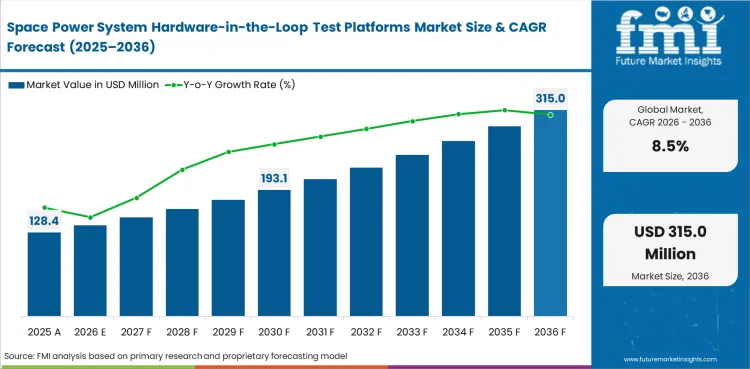
Key Takeaways, Market Size, and Forecast
- The space power system hardware-in-the-loop test platforms market was valued at USD 118.3 million in 2025.
- The space power system hardware-in-the-loop test platforms market is projected to reach USD 290.3 million by 2036.
- From 2026 to 2036, revenue is expected to rise at a CAGR of 8.5%.
- The market is expected to create an incremental opportunity of USD 161.9 million between 2026 and 2036.
- In 2026, Satellite OEMs are set to account for 38.0% of end-user demand, while Power HIL leads the platform type segment with a 34.0% share.
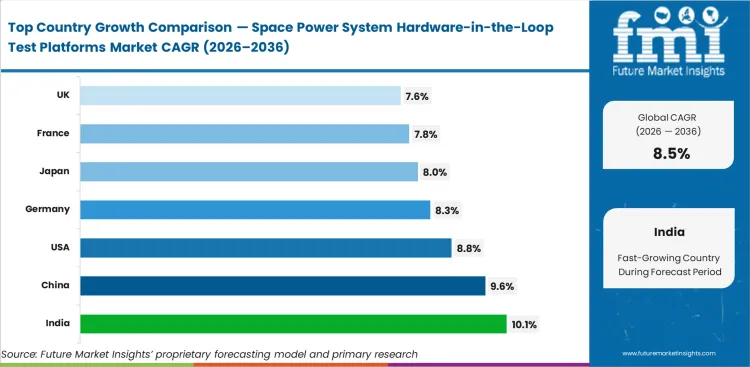
- India (10.1%) and China (9.6%) are projected to be the fastest-growing countries over the forecast period.
Space Power System Hardware-in-the-Loop Test Platforms Market Definition
This market includes equipment and software used to test, validate, and harden spacecraft electrical power subsystems through hardware-in-the-loop and power-hardware-in-the-loop workflows before qualification, integration, and flight readiness. It covers real-time simulation benches, interface hardware, power amplifiers where needed, target computers, I/O modules, and test environments built for batteries, solar arrays, PMAD units, PCDU units, converters, and distribution hardware.
Space Power System Hardware-in-the-Loop Test Platforms Market Inclusions
Scope includes controller-HIL systems, PHIL benches, hybrid benches, battery emulation setups, solar array emulation interfaces, converter validation rigs, distribution testing platforms, telemetry capture tools, real-time processors, and fault injection capability built for spacecraft electrical power programs. The market includes platforms sold into satellite bus development, subsystem verification, integration support, and qualification-linked test work.
Space Power System Hardware-in-the-Loop Test Platforms Market Exclusions
Scope excludes generic industrial HIL systems sold only into automotive, rail, grid, or factory automation work without a spacecraft power use case. It excludes thermal vacuum equipment, vibration systems, EMI chambers, propulsion-only benches, and pure software-in-the-loop environments where no physical hardware participates in the test loop.
Space Power System Hardware-in-the-Loop Test Platforms Market Research Methodology
- Primary Research: Analyst estimates were structured around official space activity patterns, spacecraft power subsystem guidance, and live supplier verification of HIL and PHIL offerings used in power electronics validation.
- Desk Research: The model used non-commercial anchors from space agencies, industry bodies, and official national sources released during 2024 and 2025.
- Market Sizing and Forecasting: A hybrid top-down model linked the addressable share of spacecraft subsystem validation budgets to mission growth, power architecture density, and rising electrical safety requirements.
- Data Validation and Update Cycle: Values were checked against CAGR math, industrial equipment plausibility bands, and the relative scale of broader space test and validation spending.
Why is the Space Power System Hardware-in-the-Loop Test Platforms Market Growing?
Wider spacecraft development activity is creating structured demand for hardware-in-the-loop and power-hardware-in-the-loop platforms that can validate batteries, converters, and distribution controls before flight integration.
Power HIL leads with 34.0% share because spacecraft electrical architectures now require direct interaction with real voltage and current behavior during converter and battery testing.
India leads growth with 10.1%, which is because active mission expansion and rising domestic engineering capability are increasing demand for reusable spacecraft power validation assets.
The market for space power system hardware in the loop test platforms is growing because mission activity is rising and electrical architectures are becoming denser. Electrical safety and subsystem readiness now carry more weight in validation work. HIL and PHIL platforms help engineers validate battery behavior, converter response, distribution control, and safe state handling in ways that software tools alone cannot fully cover.
Battery systems are the biggest part of subsystem demand. Spacecraft battery behavior affects eclipse operation and discharge stability, so engineers need controlled validation before full vehicle integration. Satellite buses are the biggest mission application segment because recurring platform development creates more repeat demand. Launch vehicles and deep space missions create less repeat demand.
Safety and passivation work are structural growth drivers. Residual battery charge and fault handling now carry more weight during spacecraft development. Electrical power chains include denser conversion and storage behavior. Validation programs are moving toward repeatable closed loop benches that can capture dynamic operating states with more discipline before qualification.
Market Segmentation Analysis
Power HIL accounts for 34.0% of demand in 2026, as spacecraft power programs need closed-loop testing with real electrical behavior during converter, battery, and bus validation.
Battery Systems hold the leading share at 22.0%, because stored energy behavior affects eclipse operation, charge control, fault response, and safe-state handling.
Satellite OEMs account for the largest share at 38.0%, as subsystem integration, validation flow, and final signoff stay closest to spacecraft manufacturers.
Rack-Mounted Systems lead deployment with 57.0% share, which reflects the need for stable setup, broader channel support, and easier instrumentation access in larger validation labs.
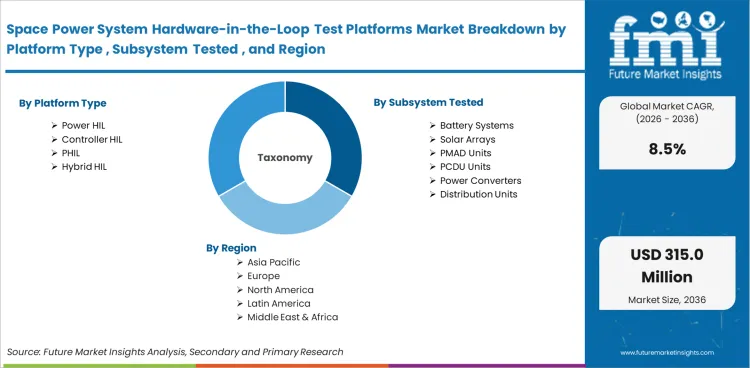
The market for space power system hardware-in-the-loop test platforms is divided into groups based on platform type, subsystem tested, voltage class, mission application, end user, test objective, deployment format, and region. There are Controller HIL, Power HIL, PHIL, and Hybrid HIL under platform type. By subsystem tested, the market includes Battery Systems, Solar Arrays, PMAD Units, PCDU Units, Power Converters, and Distribution Units.
By voltage class, the market covers Low Voltage, Medium Voltage, and High Voltage. By mission application, the market includes Satellite Buses, Launch Vehicles, Lunar Systems, Deep Space Missions, and Orbital Platforms. By end user, it includes Satellite OEMs, Space Agencies, Defense Laboratories, Research Institutes, and Power Subsystem Vendors. By test objective, the market covers Functional Validation, Fault Injection, Qualification Support, Regression Testing, and Performance Mapping. By deployment format, the market includes Rack-Mounted Systems, Benchtop Systems, Modular Systems, and Portable Systems.
Insights into the Platform Type Segment
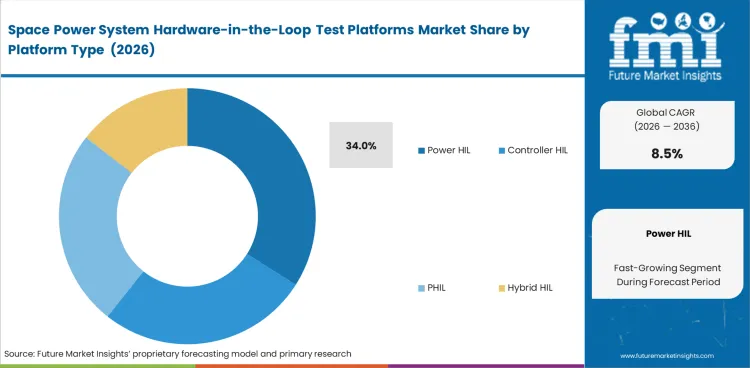
In 2026, Power HIL is expected to account for 34.0% of the market. Converter and battery behavior need to be tested under realistic electrical interaction. This keeps this format ahead of simpler controller setups.
Controller HIL is important in early stage work. PHIL and Hybrid HIL gain use where programs need stronger electrical realism and more direct hardware response during subsystem validation.
Insights into the Subsystem Tested Segment
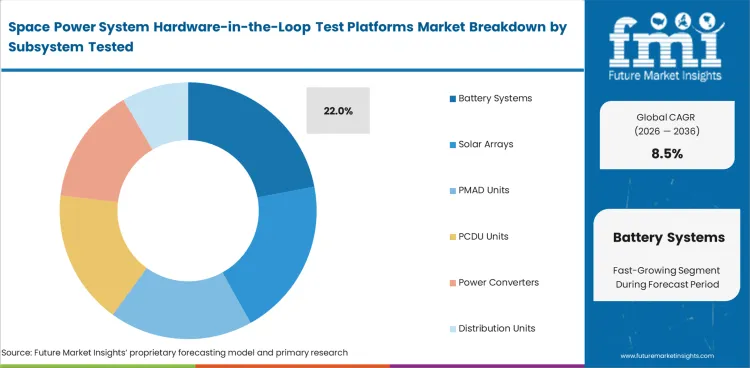
Battery Systems are projected to hold 22.0% of the market in 2026. Battery validation leads because stored energy behavior affects eclipse survival and controlled discharge with direct impact on safe state handling.
Solar Arrays and Power Converters support demand in this segment. Battery behavior usually receives closer attention during subsystem test planning and risk review.
Insights into the Voltage Class Segment
Medium Voltage is likely to hold the leading share in this segment because many spacecraft power architectures need a balance between efficient power distribution and manageable validation setup.
Low Voltage systems are important in smaller platforms and early subsystem work. High Voltage setups gain demand in more advanced applications where power density and conversion efficiency are more important.
Insights into the Mission Application Segment
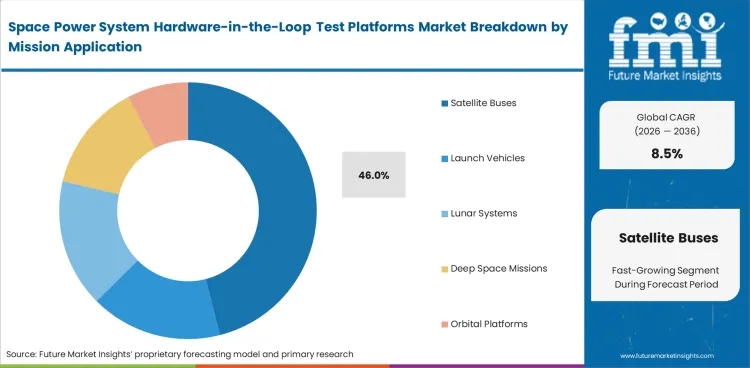
Satellite Buses are anticipated to represent 46.0% of the market in 2026. This segment leads because recurring satellite development creates more repeat demand. Mission classes with lower program count contribute less.
Launch Vehicles and Deep Space Missions require high value testing. Their total program count is lower than satellite bus development and upgrade cycles.
Insights into the End User Segment
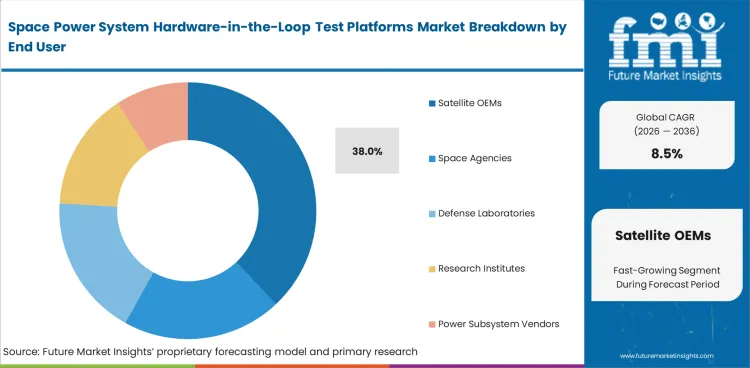
Satellite OEMs are set to make up 38.0% of the market in 2026. Their lead comes from direct responsibility for subsystem integration and final signoff during spacecraft development.
Space Agencies and Defense Laboratories continue to support demand. This is most visible in specialized programs where electrical validation depth and mission assurance needs are higher.
Insights into the Test Objective Segment
Functional Validation is expected to lead this segment because every program needs to confirm that the power chain performs correctly across normal operating conditions before deeper stress testing begins.
Fault Injection and Regression Testing add further demand. This is stronger in programs where abnormal state response and repeat checks are important before integration closes.
Insights into the Deployment Format Segment
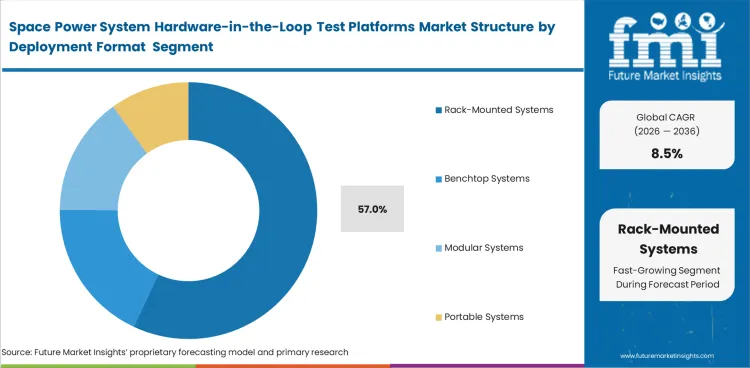
Rack Mounted Systems are projected to contribute 57.0% of total market share in 2026. Demand is strongest here because larger labs prefer fixed setups with better expansion and stronger measurement stability.
Benchtop Systems and Modular Systems support smaller labs and early development work. Portable Systems hold a smaller share. This market depends on controlled lab conditions. Field mobility carries less importance.
Analysis of Space Power System Hardware-in-the-Loop Test Platforms Market by Key Countries
.webp "Top Country Growth Comparison Space Power System Hardware In The Loop Test Platforms Market Cagr (2026 2036)")
| Country | CAGR |
|---|---|
| India | 10.1% |
| China | 9.6% |
| United States | 8.8% |
| Germany | 8.3% |
| Japan | 8.0% |
| France | 7.8% |
| United Kingdom | 7.6% |
Source: FMI-style analysis based on primary research and forecasting model.
Space Power System Hardware-in-the-Loop Test Platforms Market Cagr Analysis By Country
- India is in first place with a 10.1% CAGR. This is because active mission expansion and rising domestic engineering capability are increasing demand for reusable spacecraft power validation assets.
- China at 9.6% shows strong demand because larger mission ambition, deeper power-electronics testing needs, and stronger local tool adoption are supporting higher-value validation programs.
- The United States at 8.8% and Germany at 8.3% keep growing thanks to mature subsystem testing infrastructure, broad contractor depth, and steady technical demand across established space engineering environments.
- Japan at 8.0%, France at 7.8%, and the United Kingdom at 7.6% show that stable institutional space activity and narrower but important lab bases continue to support validation spending.
The global market for space power system hardware-in-the-loop test platforms is expected to grow at a rate of 8.5% per year from 2026 to 2036. The study covers the main space engineering centers, and the key markets are listed below.
Demand Outlook for Space Power System Hardware-in-the-Loop Test Platforms Market in the United States
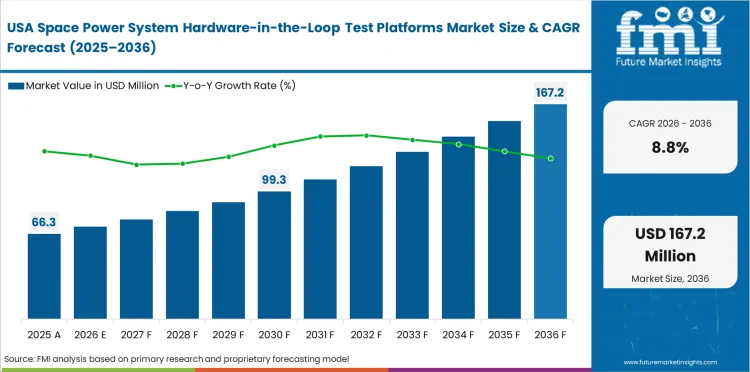
The United States space power system hardware in the loop test platforms market is projected to grow at an 8.8% CAGR through 2036. Demand is supported by high spacecraft development activity and mature subsystem testing infrastructure. The country has a large share of global demand because many programs need repeatable validation across multiple spacecraft families. Higher value installations are most common where larger labs need rack mounted systems with stable automation and stronger measurement control.
- Large mission pipelines support recurring bench refresh cycles.
- Contractor depth helps scale validation across multiple spacecraft families.
- Mature lab infrastructure supports demand for higher value configurations.
Future Outlook for Space Power System Hardware-in-the-Loop Test Platforms Market in India
India is expected to expand at a 10.1% CAGR through 2036. Growth is likely to come from new mission activity and more local engineering capability. Indian labs are likely to favor scalable systems that can support several spacecraft programs without requiring the largest high cost setup at the start. That keeps modular expansion and repeat use important in local buying decisions.
- Active program expansion supports more local validation investment.
- Scalable benches fit controlled budgets and repeat project use.
- Domestic capability growth increases the need for reusable test assets.
Opportunity Analysis of Space Power System Hardware-in-the-Loop Test Platforms Market in China
China is projected to grow at a 9.6% CAGR through 2036. Demand is likely to stay strongest in higher specification benches tied to power electronics and battery behavior. Larger mission ambition raises the need for repeatable closed loop testing under realistic electrical conditions. This creates stronger revenue opportunity in platforms that combine power interaction and fault testing inside one lab environment.
- Deep space and lunar work support higher value validation demand.
- Mission complexity increases the need for more realistic bench testing.
- Local capability growth supports stronger domestic tool adoption.
In-depth Analysis of Space Power System Hardware-in-the-Loop Test Platforms Market in Japan
Japan is forecast to rise at an 8.0% CAGR through 2036. Growth is more measured than in India and China because the installed engineering base is already established. Demand is healthy in applications where reliability and validation discipline carry high weight. Japanese laboratories are likely to value repeatability and system stability over rapid low cost expansion. That supports demand for higher quality HIL platforms integrated into structured development environments.
- Quality discipline supports demand for repeatable validation tools.
- Established technical capability keeps growth steady. Sharper expansion is less likely in this market.
- Stable program activity supports continued subsystem testing demand.
Market Perspective for Space Power System Hardware-in-the-Loop Test Platforms Market in the United Kingdom
The United Kingdom is expected to grow at a 7.6% CAGR through 2036. Demand is supported by institutional programs and smaller satellite work. The country is important for specialized subsystem and small spacecraft engineering. Its total installed base is lower than the United States and leading Asian markets. Tool demand is strongest where validation records need to be clear across shared development and agency linked work.
- Industrial support helps maintain demand for specialized lab systems.
- Small spacecraft work supports focused subsystem validation activity.
- Shared program environments increase the value of clear test records.
Competitive Landscape and Strategic Positioning
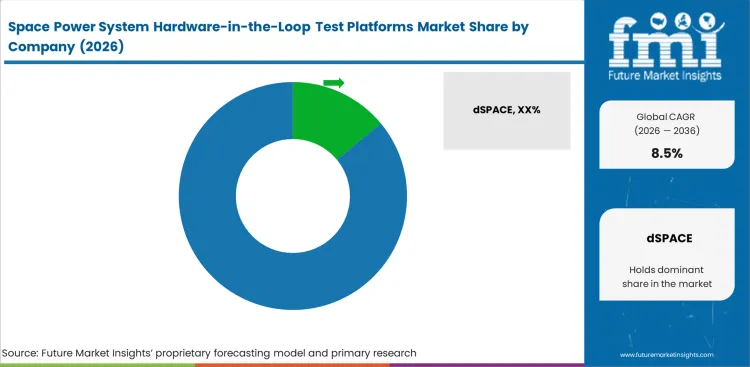
- Competition is moderately fragmented because real-time simulation vendors and power-oriented HIL specialists overlap in the same programs.
- Leading companies compete on simulation depth, power interface capability, automation, and lab integration quality.
- Smaller specialists hold room where spacecraft labs want focused power electronics validation without a broader test stack.
dSPACE, OPAL-RT, and Speedgoat hold strong positions because each offers HIL or PHIL capability relevant to power electronics validation. Their position improves when spacecraft laboratories want a deeper tool chain that can move from controller validation into fuller electrical interaction. RTDS Technologies and Typhoon HIL remain well placed in programs where converter behavior, switching detail, and real-time electrical response carry more weight than broader enterprise deployment.
NI and Concurrent Real-Time keep relevance in setups where engineers need flexible configuration, deterministic processing, or a wider instrumentation environment linked to other test tasks. Competition in this niche depends less on headline size and more on how well a supplier can reduce setup burden, support repeatable electrical scenarios, and deliver usable output inside an established lab routine. Stronger positions usually go to vendors that already serve demanding real-time validation work and can adapt that capability to spacecraft electrical power programs.
Major Industry Players
The supplier base combines real-time simulation companies, power-oriented HIL specialists, and broader test system vendors active in demanding embedded validation work.
- Global Players: dSPACE, OPAL-RT, NI, and Speedgoat fit this group because they offer established HIL capability, broad engineering support, and stronger ability to serve multi-region labs working on complex power electronics validation.
- Regional Players: RTDS Technologies, Concurrent Real-Time, and selected specialist integrators fit this group because they serve focused validation assignments with strong technical capability, though their reach is narrower across global spacecraft programs.
- Emerging Players: Typhoon HIL and smaller subsystem-focused simulation firms fit this layer because they bring strong value in converter modeling, switching behavior, and compact power-electronics validation environments.
Competitive Benchmarking: Space Power System Hardware-in-the-Loop Test Platforms Market
| Company | Real-Time Simulation Depth | Power Interface Capability | Integration Support | Geographic Footprint |
|---|---|---|---|---|
| dSPACE | High | High | Strong | Global |
| OPAL-RT Technologies | High | High | Strong | Global |
| Speedgoat | High | Medium | Strong | Global |
| NI | High | Medium | Strong | Global |
| RTDS Technologies | High | High | Moderate | Multi-region |
| Typhoon HIL | Medium | High | Moderate | Multi-region |
| Concurrent Real-Time | Medium | Medium | Moderate | Regional |
| Pickering Interfaces | Medium | Low | Moderate | Global |
| Bloomy | Low | Medium | Low | Regional |
| Tyto Robotics | Low | Low | Low | Regional |
Source: Future Market Insights competitive analysis, 2026.
Key Developments in Space Power System Hardware-in-the-Loop Test Platforms Market
- In February 2025: OPAL-RT Technologies unveiled the PHIL Prime test bench, a fully integrated and flexible power hardware-in-the-loop test bench.
- In May 2025: dSPACE expanded its SCALEXIO real-time platform with the new SCALEXIO FSX product line, enabling modular and scalable HIL test solutions.
Key Players in the Space Power System Hardware-in-the-Loop Test Platforms Market
Major global players
- dSPACE
- OPAL-RT Technologies
- Speedgoat
- NI
- RTDS Technologies
- Typhoon HIL
Key emerging players/startups
- Concurrent Real-Time
- Pickering Interfaces
- Bloomy
- Tyto Robotics
Scope of the Report
| Parameter | Details |
|---|---|
| Quantitative Units | USD 128.4 million in 2026 to USD 290.3 million by 2036, expanding at a CAGR of 8.5% |
| Market Definition | Covers equipment and software used to test and validate spacecraft electrical power subsystems through HIL and PHIL workflows before integration and qualification |
| Regions Covered | North America, Europe, East Asia, South Asia |
| Countries Covered | United States, India, China, Germany, Japan, France, United Kingdom |
| Key Companies Profiled | dSPACE, OPAL-RT Technologies, Speedgoat, NI, RTDS Technologies, Typhoon HIL, Concurrent Real-Time |
| Forecast Period | 2026 to 2036 |
| Approach | Hybrid top-down sizing built on official activity patterns, spacecraft power subsystem guidance, safety requirements, and live supplier verification |
Space Power System Hardware-in-the-Loop Test Platforms Market by Segments
Space Power System Hardware-in-the-Loop Test Platforms Market segmented as Platform Type
- Controller HIL
- Power HIL
- PHIL
- Hybrid HIL
Space Power System Hardware-in-the-Loop Test Platforms Market classified by Subsystem Tested
- Battery Systems
- Solar Arrays
- PMAD Units
- PCDU Units
- Power Converters
- Distribution Units
Space Power System Hardware-in-the-Loop Test Platforms Market analysed by Voltage Class
- Low Voltage
- Medium Voltage
- High Voltage
Space Power System Hardware-in-the-Loop Test Platforms Market classified by Mission Application
- Satellite Buses
- Launch Vehicles
- Lunar Systems
- Deep Space Missions
- Orbital Platforms
Space Power System Hardware-in-the-Loop Test Platforms Market classified by End User
- Satellite OEMs
- Space Agencies
- Defense Laboratories
- Research Institutes
- Power Subsystem Vendors
Space Power System Hardware-in-the-Loop Test Platforms Market classified by Test Objective
- Functional Validation
- Fault Injection
- Qualification Support
- Regression Testing
- Performance Mapping
Space Power System Hardware-in-the-Loop Test Platforms Market classified by Deployment Format
- Rack-Mounted Systems
- Benchtop Systems
- Modular Systems
- Portable Systems
Space Power System Hardware-in-the-Loop Test Platforms Market by Region and Country
- North America
- United States
- Canada
- Mexico
- Latin America
- Brazil
- Rest of Latin America
- Western Europe
- Germany
- United Kingdom
- France
- Rest of Western Europe
- Eastern Europe
- Rest of Eastern Europe
- East Asia
- China
- Japan
- South Korea
- South Asia and Pacific
- India
- ASEAN
- Australia & New Zealand
- Rest of South Asia and Pacific
- Middle East & Africa
- GCC
- South Africa
- Rest of Middle East & Africa
Bibliography
- OPAL-RT TECHNOLOGIES, Inc. (2025, February 19). OPAL-RT TECHNOLOGIES unveils the PHIL Prime test bench: A fully integrated, flexible power hardware-in-the-loop (PHIL) test bench.
- dSPACE. (2025, May 20). SCALEXIO FSX – modulare und skalierbare Erweiterung der dSPACE SCALEXIO-Echtzeitplattform.
- European Space Agency. (2025). Mitigating space debris generation.
- Indian Space Research Organisation. (2025). Annual Report 2024–25
The bibliography is provided for reader reference and reflects the non-commercial evidence base used in this assessment.
This Report Addresses
- Market sizing and forecast for space power HIL and PHIL platforms through 2036.
- Segment structure across platform type, subsystem tested, mission use, and deployment format.
- Country-by-country growth outlook for seven important space engineering centers.
- Competitive assessment of real-time simulation vendors and power validation specialists.
- Impact of subsystem complexity and safety discipline on tool demand.
- Scope boundaries between spacecraft power validation tools and adjacent aerospace test systems.
- Revenue opportunities linked to higher subsystem validation depth and repeatable lab automation.
- Supplier positioning across real-time simulation depth, power interface capability, and integration support.
Frequently Asked Questions
What is the estimated size of the market in 2026?
The market is estimated at USD 128.4 million in 2026, based on analyst-built modeling tied to subsystem validation demand and supplier capability.
What value is projected for 2036?
The market is projected to reach USD 290.3 million by 2036 as spacecraft power validation becomes more structured across satellite and mission programs.
What is the forecast CAGR from 2026 to 2036?
The market is projected to expand at a CAGR of 8.5% during the 2026 to 2036 assessment period.
Which segment leads the market by platform type?
Power HIL leads the platform type structure with an estimated 34.0% share in 2026 because real electrical interaction matters in converter and battery validation.
Which end user accounts for the largest share?
Satellite OEMs lead end-user demand with an estimated 38.0% share in 2026 because subsystem integration and signoff usually sit inside spacecraft manufacturing programs.
Which countries are growing the fastest?
India and China show the fastest growth among the profiled countries due to active national space programs and rising domestic validation capability.
What does this report mean by market definition?
The market covers tools and software used to validate spacecraft electrical power subsystems through HIL and PHIL workflows before qualification and integration.
How is the forecast built and checked?
How is the forecast built and checked?
Preview the report firsthand - request a free sample
Get SampleGet the brochure for pricing and purchase details.
Get PDFTable of Content
- Executive Summary
- Global Market Outlook
- Demand-side Trends
- Supply-side Trends
- Technology Roadmap Analysis
- Analysis and Recommendations
- Market Overview
- Market Coverage / Taxonomy
- Market Definition / Scope / Limitations
- Research Methodology
- Chapter Orientation
- Analytical Lens and Working Hypotheses
- Market Structure, Signals, and Trend Drivers
- Benchmarking and Cross-market Comparability
- Market Sizing, Forecasting, and Opportunity Mapping
- Research Design and Evidence Framework
- Desk Research Programme (Secondary Evidence)
- Company Annual and Sustainability Reports
- Peer-reviewed Journals and Academic Literature
- Corporate Websites, Product Literature, and Technical Notes
- Earnings Decks and Investor Briefings
- Statutory Filings and Regulatory Disclosures
- Technical White Papers and Standards Notes
- Trade Journals, Industry Magazines, and Analyst Briefs
- Conference Proceedings, Webinars, and Seminar Materials
- Government Statistics Portals and Public Data Releases
- Press Releases and Reputable Media Coverage
- Specialist Newsletters and Curated Briefings
- Sector Databases and Reference Repositories
- FMI Internal Proprietary Databases and Historical Market Datasets
- Subscription Datasets and Paid Sources
- Social Channels, Communities, and Digital Listening Inputs
- Additional Desk Sources
- Expert Input and Fieldwork (Primary Evidence)
- Primary Modes
- Qualitative Interviews and Expert Elicitation
- Quantitative Surveys and Structured Data Capture
- Blended Approach
- Why Primary Evidence is Used
- Field Techniques
- Interviews
- Surveys
- Focus Groups
- Observational and In-context Research
- Social and Community Interactions
- Stakeholder Universe Engaged
- C-suite Leaders
- Board Members
- Presidents and Vice Presidents
- R&D and Innovation Heads
- Technical Specialists
- Domain Subject-matter Experts
- Scientists
- Physicians and Other Healthcare Professionals
- Governance, Ethics, and Data Stewardship
- Research Ethics
- Data Integrity and Handling
- Primary Modes
- Tooling, Models, and Reference Databases
- Desk Research Programme (Secondary Evidence)
- Data Engineering and Model Build
- Data Acquisition and Ingestion
- Cleaning, Normalisation, and Verification
- Synthesis, Triangulation, and Analysis
- Quality Assurance and Audit Trail
- Market Background
- Market Dynamics
- Drivers
- Restraints
- Opportunity
- Trends
- Scenario Forecast
- Demand in Optimistic Scenario
- Demand in Likely Scenario
- Demand in Conservative Scenario
- Opportunity Map Analysis
- Product Life Cycle Analysis
- Supply Chain Analysis
- Investment Feasibility Matrix
- Value Chain Analysis
- PESTLE and Porter’s Analysis
- Regulatory Landscape
- Regional Parent Market Outlook
- Production and Consumption Statistics
- Import and Export Statistics
- Market Dynamics
- Global Market Analysis 2021 to 2025 and Forecast, 2026 to 2036
- Historical Market Size Value (USD Million) Analysis, 2021 to 2025
- Current and Future Market Size Value (USD Million) Projections, 2026 to 2036
- Y-o-Y Growth Trend Analysis
- Absolute $ Opportunity Analysis
- Global Market Pricing Analysis 2021 to 2025 and Forecast 2026 to 2036
- Global Market Analysis 2021 to 2025 and Forecast 2026 to 2036, By Platform Type
- Introduction / Key Findings
- Historical Market Size Value (USD Million) Analysis By Platform Type , 2021 to 2025
- Current and Future Market Size Value (USD Million) Analysis and Forecast By Platform Type , 2026 to 2036
- Power HIL
- Controller HIL
- PHIL
- Hybrid HIL
- Power HIL
- Y-o-Y Growth Trend Analysis By Platform Type , 2021 to 2025
- Absolute $ Opportunity Analysis By Platform Type , 2026 to 2036
- Global Market Analysis 2021 to 2025 and Forecast 2026 to 2036, By Subsystem Tested
- Introduction / Key Findings
- Historical Market Size Value (USD Million) Analysis By Subsystem Tested, 2021 to 2025
- Current and Future Market Size Value (USD Million) Analysis and Forecast By Subsystem Tested, 2026 to 2036
- Battery Systems
- Solar Arrays
- PMAD Value (USD Million)s
- PCDU Value (USD Million)s
- Power Converters
- Distribution Value (USD Million)s
- Battery Systems
- Y-o-Y Growth Trend Analysis By Subsystem Tested, 2021 to 2025
- Absolute $ Opportunity Analysis By Subsystem Tested, 2026 to 2036
- Global Market Analysis 2021 to 2025 and Forecast 2026 to 2036, By Mission Application
- Introduction / Key Findings
- Historical Market Size Value (USD Million) Analysis By Mission Application, 2021 to 2025
- Current and Future Market Size Value (USD Million) Analysis and Forecast By Mission Application, 2026 to 2036
- Satellite Buses
- Launch Vehicles
- Lunar Systems
- Deep Space Missions
- Orbital Platforms
- Satellite Buses
- Y-o-Y Growth Trend Analysis By Mission Application, 2021 to 2025
- Absolute $ Opportunity Analysis By Mission Application, 2026 to 2036
- Global Market Analysis 2021 to 2025 and Forecast 2026 to 2036, By End User
- Introduction / Key Findings
- Historical Market Size Value (USD Million) Analysis By End User, 2021 to 2025
- Current and Future Market Size Value (USD Million) Analysis and Forecast By End User, 2026 to 2036
- Satellite OEMs
- Space Agencies
- Defense Laboratories
- Research Institutes
- Power Subsystem Vendors
- Satellite OEMs
- Y-o-Y Growth Trend Analysis By End User, 2021 to 2025
- Absolute $ Opportunity Analysis By End User, 2026 to 2036
- Global Market Analysis 2021 to 2025 and Forecast 2026 to 2036, By Deployment Format
- Introduction / Key Findings
- Historical Market Size Value (USD Million) Analysis By Deployment Format, 2021 to 2025
- Current and Future Market Size Value (USD Million) Analysis and Forecast By Deployment Format, 2026 to 2036
- Rack-Mounted Systems
- Benchtop Systems
- Modular Systems
- Portable Systems
- Rack-Mounted Systems
- Y-o-Y Growth Trend Analysis By Deployment Format, 2021 to 2025
- Absolute $ Opportunity Analysis By Deployment Format, 2026 to 2036
- Global Market Analysis 2021 to 2025 and Forecast 2026 to 2036, By Region
- Introduction
- Historical Market Size Value (USD Million) Analysis By Region, 2021 to 2025
- Current Market Size Value (USD Million) Analysis and Forecast By Region, 2026 to 2036
- North America
- Latin America
- Western Europe
- Eastern Europe
- East Asia
- South Asia and Pacific
- Middle East & Africa
- Market Attractiveness Analysis By Region
- North America Market Analysis 2021 to 2025 and Forecast 2026 to 2036, By Country
- Historical Market Size Value (USD Million) Trend Analysis By Market Taxonomy, 2021 to 2025
- Market Size Value (USD Million) Forecast By Market Taxonomy, 2026 to 2036
- By Country
- USA
- Canada
- Mexico
- By Platform Type
- By Subsystem Tested
- By Mission Application
- By End User
- By Deployment Format
- By Country
- Market Attractiveness Analysis
- By Country
- By Platform Type
- By Subsystem Tested
- By Mission Application
- By End User
- By Deployment Format
- Key Takeaways
- Latin America Market Analysis 2021 to 2025 and Forecast 2026 to 2036, By Country
- Historical Market Size Value (USD Million) Trend Analysis By Market Taxonomy, 2021 to 2025
- Market Size Value (USD Million) Forecast By Market Taxonomy, 2026 to 2036
- By Country
- Brazil
- Chile
- Rest of Latin America
- By Platform Type
- By Subsystem Tested
- By Mission Application
- By End User
- By Deployment Format
- By Country
- Market Attractiveness Analysis
- By Country
- By Platform Type
- By Subsystem Tested
- By Mission Application
- By End User
- By Deployment Format
- Key Takeaways
- Western Europe Market Analysis 2021 to 2025 and Forecast 2026 to 2036, By Country
- Historical Market Size Value (USD Million) Trend Analysis By Market Taxonomy, 2021 to 2025
- Market Size Value (USD Million) Forecast By Market Taxonomy, 2026 to 2036
- By Country
- Germany
- UK
- Italy
- Spain
- France
- Nordic
- BENELUX
- Rest of Western Europe
- By Platform Type
- By Subsystem Tested
- By Mission Application
- By End User
- By Deployment Format
- By Country
- Market Attractiveness Analysis
- By Country
- By Platform Type
- By Subsystem Tested
- By Mission Application
- By End User
- By Deployment Format
- Key Takeaways
- Eastern Europe Market Analysis 2021 to 2025 and Forecast 2026 to 2036, By Country
- Historical Market Size Value (USD Million) Trend Analysis By Market Taxonomy, 2021 to 2025
- Market Size Value (USD Million) Forecast By Market Taxonomy, 2026 to 2036
- By Country
- Russia
- Poland
- Hungary
- Balkan & Baltic
- Rest of Eastern Europe
- By Platform Type
- By Subsystem Tested
- By Mission Application
- By End User
- By Deployment Format
- By Country
- Market Attractiveness Analysis
- By Country
- By Platform Type
- By Subsystem Tested
- By Mission Application
- By End User
- By Deployment Format
- Key Takeaways
- East Asia Market Analysis 2021 to 2025 and Forecast 2026 to 2036, By Country
- Historical Market Size Value (USD Million) Trend Analysis By Market Taxonomy, 2021 to 2025
- Market Size Value (USD Million) Forecast By Market Taxonomy, 2026 to 2036
- By Country
- China
- Japan
- South Korea
- By Platform Type
- By Subsystem Tested
- By Mission Application
- By End User
- By Deployment Format
- By Country
- Market Attractiveness Analysis
- By Country
- By Platform Type
- By Subsystem Tested
- By Mission Application
- By End User
- By Deployment Format
- Key Takeaways
- South Asia and Pacific Market Analysis 2021 to 2025 and Forecast 2026 to 2036, By Country
- Historical Market Size Value (USD Million) Trend Analysis By Market Taxonomy, 2021 to 2025
- Market Size Value (USD Million) Forecast By Market Taxonomy, 2026 to 2036
- By Country
- India
- ASEAN
- Australia & New Zealand
- Rest of South Asia and Pacific
- By Platform Type
- By Subsystem Tested
- By Mission Application
- By End User
- By Deployment Format
- By Country
- Market Attractiveness Analysis
- By Country
- By Platform Type
- By Subsystem Tested
- By Mission Application
- By End User
- By Deployment Format
- Key Takeaways
- Middle East & Africa Market Analysis 2021 to 2025 and Forecast 2026 to 2036, By Country
- Historical Market Size Value (USD Million) Trend Analysis By Market Taxonomy, 2021 to 2025
- Market Size Value (USD Million) Forecast By Market Taxonomy, 2026 to 2036
- By Country
- Kingdom of Saudi Arabia
- Other GCC Countries
- Turkiye
- South Africa
- Other African Union
- Rest of Middle East & Africa
- By Platform Type
- By Subsystem Tested
- By Mission Application
- By End User
- By Deployment Format
- By Country
- Market Attractiveness Analysis
- By Country
- By Platform Type
- By Subsystem Tested
- By Mission Application
- By End User
- By Deployment Format
- Key Takeaways
- Key Countries Market Analysis
- USA
- Pricing Analysis
- Market Share Analysis, 2025
- By Platform Type
- By Subsystem Tested
- By Mission Application
- By End User
- By Deployment Format
- Canada
- Pricing Analysis
- Market Share Analysis, 2025
- By Platform Type
- By Subsystem Tested
- By Mission Application
- By End User
- By Deployment Format
- Mexico
- Pricing Analysis
- Market Share Analysis, 2025
- By Platform Type
- By Subsystem Tested
- By Mission Application
- By End User
- By Deployment Format
- Brazil
- Pricing Analysis
- Market Share Analysis, 2025
- By Platform Type
- By Subsystem Tested
- By Mission Application
- By End User
- By Deployment Format
- Chile
- Pricing Analysis
- Market Share Analysis, 2025
- By Platform Type
- By Subsystem Tested
- By Mission Application
- By End User
- By Deployment Format
- Germany
- Pricing Analysis
- Market Share Analysis, 2025
- By Platform Type
- By Subsystem Tested
- By Mission Application
- By End User
- By Deployment Format
- UK
- Pricing Analysis
- Market Share Analysis, 2025
- By Platform Type
- By Subsystem Tested
- By Mission Application
- By End User
- By Deployment Format
- Italy
- Pricing Analysis
- Market Share Analysis, 2025
- By Platform Type
- By Subsystem Tested
- By Mission Application
- By End User
- By Deployment Format
- Spain
- Pricing Analysis
- Market Share Analysis, 2025
- By Platform Type
- By Subsystem Tested
- By Mission Application
- By End User
- By Deployment Format
- France
- Pricing Analysis
- Market Share Analysis, 2025
- By Platform Type
- By Subsystem Tested
- By Mission Application
- By End User
- By Deployment Format
- India
- Pricing Analysis
- Market Share Analysis, 2025
- By Platform Type
- By Subsystem Tested
- By Mission Application
- By End User
- By Deployment Format
- ASEAN
- Pricing Analysis
- Market Share Analysis, 2025
- By Platform Type
- By Subsystem Tested
- By Mission Application
- By End User
- By Deployment Format
- Australia & New Zealand
- Pricing Analysis
- Market Share Analysis, 2025
- By Platform Type
- By Subsystem Tested
- By Mission Application
- By End User
- By Deployment Format
- China
- Pricing Analysis
- Market Share Analysis, 2025
- By Platform Type
- By Subsystem Tested
- By Mission Application
- By End User
- By Deployment Format
- Japan
- Pricing Analysis
- Market Share Analysis, 2025
- By Platform Type
- By Subsystem Tested
- By Mission Application
- By End User
- By Deployment Format
- South Korea
- Pricing Analysis
- Market Share Analysis, 2025
- By Platform Type
- By Subsystem Tested
- By Mission Application
- By End User
- By Deployment Format
- Russia
- Pricing Analysis
- Market Share Analysis, 2025
- By Platform Type
- By Subsystem Tested
- By Mission Application
- By End User
- By Deployment Format
- Poland
- Pricing Analysis
- Market Share Analysis, 2025
- By Platform Type
- By Subsystem Tested
- By Mission Application
- By End User
- By Deployment Format
- Hungary
- Pricing Analysis
- Market Share Analysis, 2025
- By Platform Type
- By Subsystem Tested
- By Mission Application
- By End User
- By Deployment Format
- Kingdom of Saudi Arabia
- Pricing Analysis
- Market Share Analysis, 2025
- By Platform Type
- By Subsystem Tested
- By Mission Application
- By End User
- By Deployment Format
- Turkiye
- Pricing Analysis
- Market Share Analysis, 2025
- By Platform Type
- By Subsystem Tested
- By Mission Application
- By End User
- By Deployment Format
- South Africa
- Pricing Analysis
- Market Share Analysis, 2025
- By Platform Type
- By Subsystem Tested
- By Mission Application
- By End User
- By Deployment Format
- USA
- Market Structure Analysis
- Competition Dashboard
- Competition Benchmarking
- Market Share Analysis of Top Players
- By Regional
- By Platform Type
- By Subsystem Tested
- By Mission Application
- By End User
- By Deployment Format
- Competition Analysis
- Competition Deep Dive
- dSPACE
- Overview
- Product Portfolio
- Profitability by Market Segments (Product/Age /Sales Channel/Region)
- Sales Footprint
- Strategy Overview
- Marketing Strategy
- Product Strategy
- Channel Strategy
- OPAL-RT Technologies
- Speedgoat
- NI
- RTDS Technologies
- Typhoon HIL
- Concurrent Real-Time
- Pickering Interfaces
- Bloomy
- Tyto Robotics
- dSPACE
- Competition Deep Dive
- Assumptions & Acronyms Used


