

- Market Size (2026)
- USD 0.54 Bn
- Forecast (2036)
- USD 1.25 Bn
- CAGR (2026 to 2036)
- 8.8%
Infotainment System UX and Latency Test Platforms for Connected Vehicles Market Size, Market Forecast and Outlook By FMI
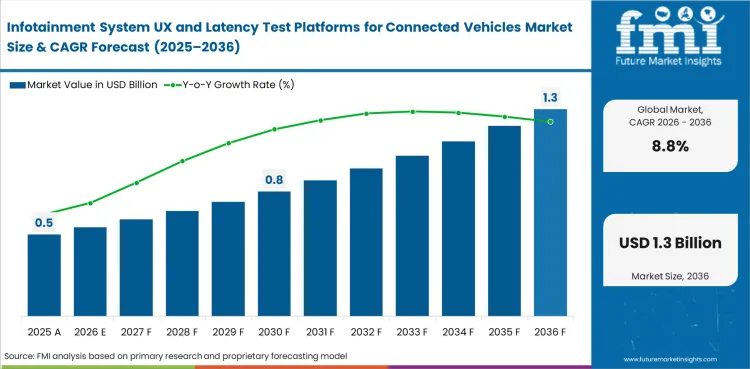
The infotainment system UX and latency test platforms for connected vehicles market was valued at USD 0.5 billion in 2025. The industry is expected to reach USD 0.5 billion by the end of 2026 and advance at a CAGR of 8.8% from 2026 to 2036 to reach USD 1.3 billion by 2036. Hardware-in-the-loop platforms are projected to lead with a 34.0% share, while OEM engineering centers are expected to account for a 41.0% share.
Summary of the Infotainment System UX and Latency Test Platforms for Connected Vehicles Market
- Demand and Growth Drivers
- Growing software content in connected vehicles is pushing OEMs and suppliers to test screen response and network behavior more carefully before launch.
- Faster release cycles for cockpit software and over-the-air updates are further increasing the need for repeatable validation across development and regression stages.
- Product and Segment View
- Hardware-in-the-loop platforms are expected to stay a leading segment because they help groups to evaluate infotainment performance under more realistic operating conditions.
- Validation work is also expanding across automotive simulation environments, where virtual and hardware-linked workflows are used together to reduce late-stage correction costs.
- Geography and Competitive Outlook
- China is likely to stay a key growth market due to high vehicle production, rising digital cockpit content, and broader connected mobility programs.
- India is also expected to record healthy expansion, while the United States continues to hold an important position through strong engineering budgets and heavy validation activity tied to software defined vehicle development.
- Companies with deeper test integration capability, protocol coverage, and support for both virtual and physical validation workflows are expected to strengthen their presence over the forecast period.
- Analyst Opinion
- Nikhil Kaitwade, Principal Consultant at FMI says, “Companies that can connect latency testing, UX validation, and simulation-led workflows across software-defined vehicle programs are likely to strengthen their position over the forecast period, as vehicle makers push more cockpit testing upstream and place greater value on faster debugging, stable response performance, and smoother release cycles.”
- Infotainment System UX and Latency Test Platforms for Connected Vehicles Market Value Analysis
- The market is moving from a narrow validation category into a more established part of vehicle development spending.
- Demand is rising as digital cockpit systems carry more screens and connected services while connected vehicle technology continues to widen the testing load tied to response time and user interaction quality.
- Adoption is being supported by the need to measure latency and voice performance before launch across more software-heavy vehicle programs.
- Spending is further backed by the push for validation tools that help engineering teams improve system stability and keep user experience quality at a consistent level.
Key Takeaways
- The infotainment system UX and latency test platforms for connected vehicles market was valued at USD 0.5 billion in 2025.
- By 2036, the infotainment system UX and latency test platforms for connected vehicles market is projected to reach USD 1.3 billion.
- From 2026 to 2036, the market is expected to expand at a CAGR of 8.8%.
- The market is likely to generate an incremental opportunity of USD 0.7 billion between 2026 and 2036.
- In 2026, hardware-in-the-loop platforms are expected to account for 34.0% of the platform type segment.
- China (10.2%) and India (9.8%) are projected to rank among the faster-growing markets.
Infotainment System UX and Latency Test Platforms for Connected Vehicles Market Definition
The infotainment system UX and latency test platforms for connected vehicles market includes hardware and software tools used to validate how in-vehicle infotainment systems perform under real and simulated operating conditions.
Infotainment System UX and Latency Test Platforms for Connected Vehicles Market Inclusions
Included within scope are hardware-in-the-loop systems, software-in-the-loop environments, network emulation tools, RF and communications validation setups, cloud-connected regression benches, and workflow software designed for infotainment UX and latency testing.
Infotainment System UX and Latency Test Platforms for Connected Vehicles Market Exclusions
Excluded from scope are full ADAS validation platforms, powertrain test systems, battery test rigs, generic electronics test equipment not built around infotainment UX or latency measurement, and consumer aftermarket diagnostic tools.
Market Research Methodology
- Primary Research: FMI assesses supplier positioning, platform scope, deployment fit, and end-user demand through structured analysis of active market participants and official product or partnership disclosures.
- Desk Research: The study uses non-commercial sources including OICA, NHTSA, GSMA, ACEA, SIAM, SMMT, and official company announcements tied directly to connected vehicle testing.
- Market Sizing and Forecasting: The market is sized through a bottom-up allocation of specialist automotive validation demand across connected cockpit, infotainment, and latency-oriented workflows.
- Data Validation and Update Cycle: Forecast assumptions are cross-checked against vehicle production trends, connected-car adoption indicators, country demand patterns, and recent supplier activity across 2024 to 2026.
Why Is the Infotainment System UX and Latency Test Platforms for Connected Vehicles Market Growing?
- Connected vehicles carry more screens, services, and software releases, which raises validation workload before launch.
- Pressure on response timing and driver distraction control is increasing the value of UX and latency test coverage.
- Software-defined vehicle programs are expanding early-stage simulation and continuous regression testing requirements.
Vehicle cockpit architecture is carrying much more software and interface complexity than it did in earlier infotainment generations. Connected cars now rely on touch displays, voice functions and cloud-linked services that must operate smoothly under variable signal conditions.
Safety pressure is supporting demand for deeper cockpit validation. Infotainment UX test platforms help engineering groups study how quickly screens respond and controls behave consistently under changing conditions without adding unnecessary driver workload.
Market Segmentation Analysis
- Hardware-in-the-loop leads platform demand with 34.0% share, supported by realistic system-level infotainment response testing.
- Latency Testing leads test focus with 29.0% share while Central Labs lead deployment with 62.0% share in 2026.
- OEM engineering centers hold 41.0% share, reflecting direct control over validation, release timing, and system acceptance.
- Direct sales lead with 57.0% share, matching the need for tailored deployment and integration support.
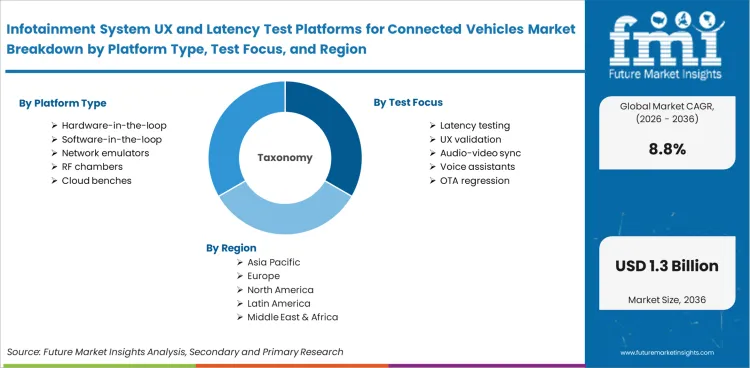
The infotainment system UX and latency test platforms for connected vehicles market is segmented by platform type, test focus, deployment, end user, sales channel, and region. Platform type includes Hardware-in-the-Loop, Software-in-the-Loop, Network Emulators, RF Chambers, and Cloud Benches. Test focus covers Latency Testing, UX Validation, Audio-Video Sync, Voice Assistant Testing, and OTA Regression. Deployment includes Central Labs, Proving Grounds, In-Vehicle Rigs, Cloud Labs, and Bench Stations. End users include OEM Engineering Centers, Tier 1 Labs, Engineering Service Firms, Telecom Labs, and Certification Labs. Sales channels cover Direct Sales, System Integrators, Value-Added Resellers, Service Contracts, and Software Subscriptions.
Insights into the Hardware-in-the-Loop Segment
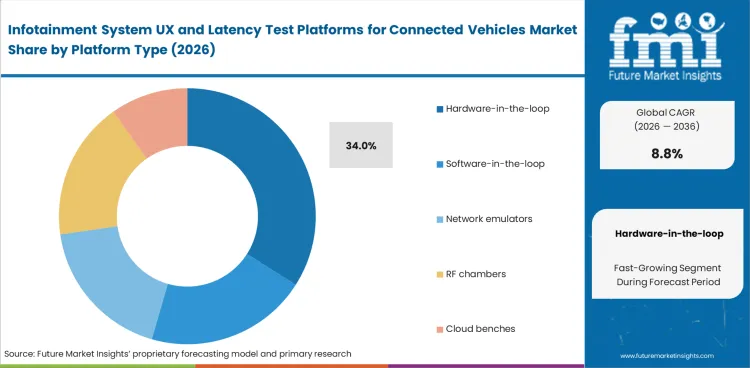
- Hardware-in-the-loop is expected to account for 34% share in 2026. This segment leads because infotainment performance problems often surface only when software and actual control hardware interact in a more realistic environment.
- HIL setups help engineering teams capture latency spikes and unstable responses before full vehicle integration absorbs more time and cost.
Insights into the Latency Testing Segment
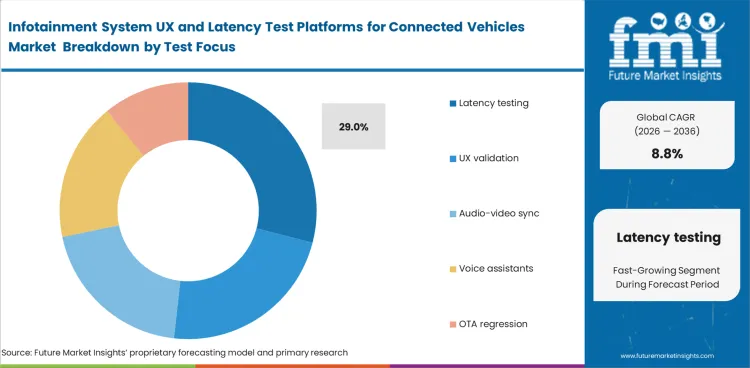
- Latency testing is anticipated to represent 29% of the market in 2026. Timing quality has a direct effect on how drivers and passengers judge infotainment performance, which keeps latency validation close to the center of platform demand.
- This segment is likely to stay large because latency is measurable, easy to benchmark across builds, and relevant across almost every cockpit feature rather than a narrow application subset.
Insights into the OEM Engineering Centers Segment
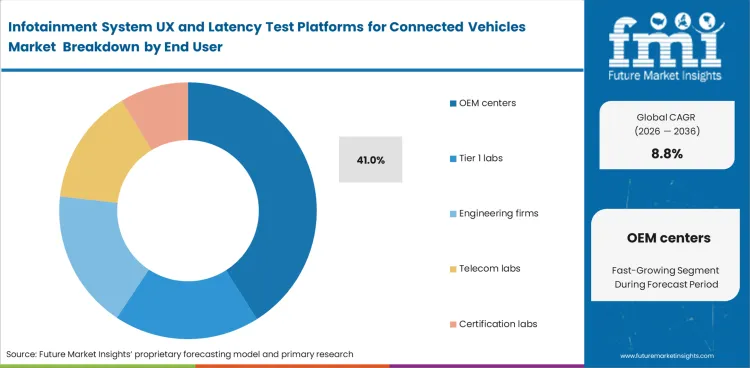
- OEM engineering centers are likely to secure 41% share in 2026. Vehicle manufacturers are the largest end users because they control release timing and platform architecture across infotainment and digital cockpit programs.
- Demand from this segment is supported by software-defined vehicle programs that pull more testing upstream into virtual development and repeated regression cycles across the life of the vehicle platform.
Insights into the Direct Sales Segment
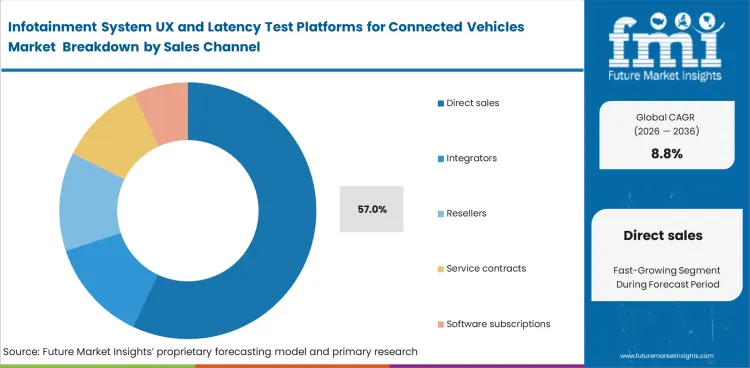
- Direct sales are set to make up 57% of the market in 2026. This channel leads because infotainment UX and latency platforms are usually configured around specific engineering requirements, protocol mixes, and deployment environments rather than sold as standard catalog products.
- OEMs and Tier 1 suppliers often need close vendor support during setup, integration, training, and workflow alignment, which favors direct commercial relationships.
Insights into the Central Labs Segment
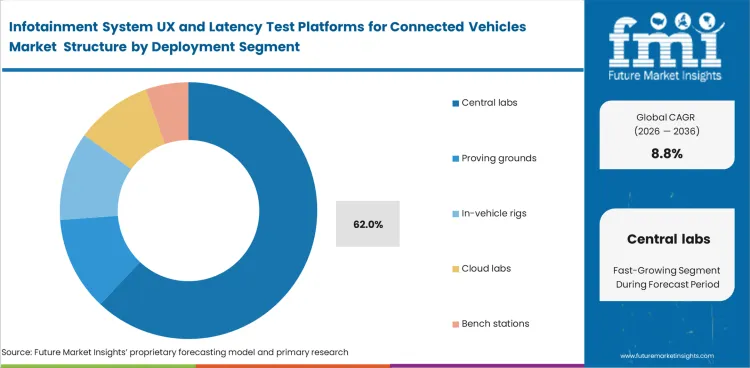
- Central labs are expected to account for 62% share in 2026. This segment leads because most infotainment UX and latency validation is carried out in controlled engineering environments.
- Central lab setups also help OEMs and Tier 1 suppliers manage validation more efficiently by keeping tools and technical teams in one place during development and regression testing.
Infotainment System UX and Latency Test Platforms for Connected Vehicles Market Drivers, Restraints, and Opportunities
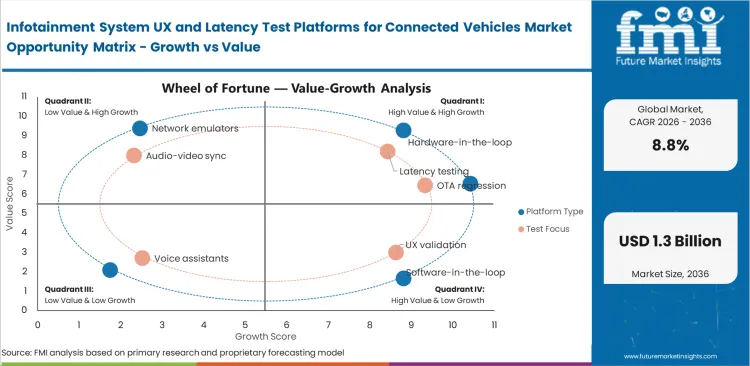
- Connected and software-defined vehicles are increasing the volume and depth of infotainment validation work.
- Complex test environments can raise setup costs, integration time, and specialist staffing needs.
- Virtual development and combined SIL-HIL workflows are taking a larger role in cockpit validation.
Infotainment systems are no longer isolated head units with limited functions. They now carry app ecosystems, voice flows, connected services, OTA interactions, and multi-display behavior, which increases the number of possible failure points during development. This supports stronger demand for platforms that can test response time and user flow repeatedly across simulated and hardware-linked conditions.
Testing and Validation Needs
Automotive development teams are under pressure to validate infotainment behavior earlier and more often as software release cycles shorten. Vector Informatik and Synopsys announced a strategic collaboration in March 2025 to advance software-defined vehicle development, supporting broader use of virtual prototyping, software testing, and integrated validation workflows before physical hardware is available. This matters for infotainment latency and UX because early detection of timing and flow defects can reduce costly rework later in the program.
Input Cost and Integration Pressure
This market carries a restraint in the form of setup cost and workflow complexity. Test platforms often need custom configurations, integration with vehicle electronics workflows, and support for multiple communications layers across infotainment and connected features. Smaller suppliers and regional engineering centers may delay purchases if they cannot justify large upfront spending or if internal teams lack the skills to run advanced validation environments at scale.
Infotainment System UX and Latency Test Platforms for Connected Vehicles Market CAGR Analysis by Country
.webp "Top Country Growth Comparison Infotainment System Ux And Latency Test Platforms For Connected Vehicles Market Cagr (2026 2036)")
| Country | CAGR |
|---|---|
| China | 10.2% |
| India | 9.8% |
| United States | 8.9% |
| Germany | 8.3% |
| United Kingdom | 7.8% |
Source: FMI analysis based on primary research and proprietary forecasting model
Infotainment System UX and Latency Test Platforms for Connected Vehicles Market Analysis By Country
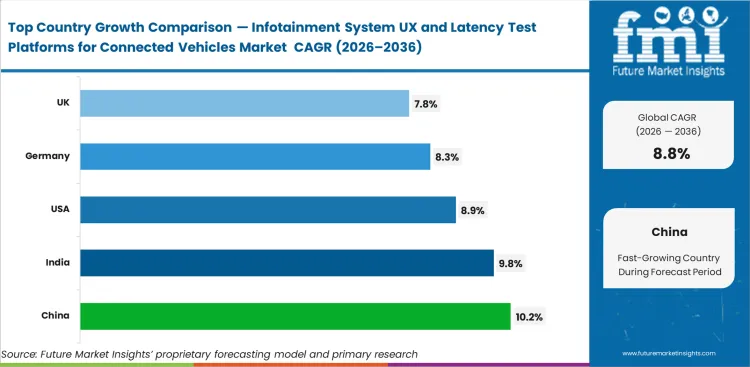
- China is expected to lead major country growth with a 10.2% CAGR through 2036.
- India is projected to expand at a 9.8% CAGR, while the United States is likely to record 8.9% CAGR during the same period.
- Germany is forecast to post 8.3% CAGR, Europe is estimated at 8.1%, and the United Kingdom is likely to grow at 7.8% through 2036.
- Japan is expected to grow at 7.4% CAGR from 2026 to 2036, reflecting steady demand from established automotive engineering programs and continued focus on system reliability.
- The global market is projected to rise at a CAGR of 8.8% over the forecast period.
Demand Outlook for Infotainment System UX and Latency Test Platforms for Connected Vehicles Market in the United States
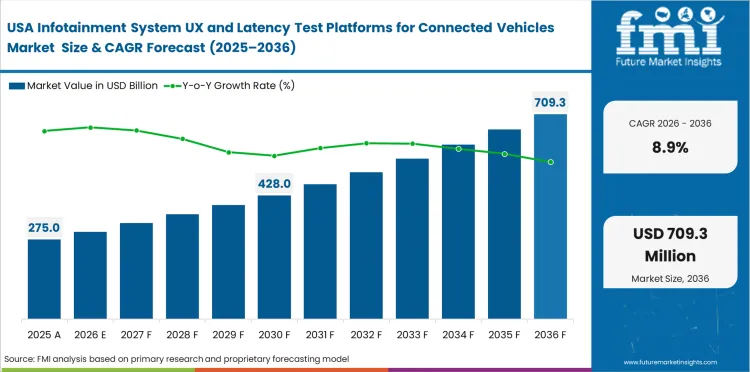
The U.S. infotainment system UX and latency test platforms for connected vehicles market is projected to grow at a CAGR of 8.9% by 2036. Demand is supported by large software validation budgets, stronger connected service development, and steady work on driver-facing digital systems. Growth in software defined vehicle programs is increasing the amount of timing, interface, and regression testing needed across vehicle platforms.
- Connected vehicle development is increasing the need for timing and UX validation.
- Larger engineering budgets support broader use of advanced test platforms.
- Regression testing demand is rising as software updates become more frequent.
Future Outlook for Infotainment System UX and Latency Test Platforms for Connected Vehicles Market in the United Kingdom
The U.K. infotainment system UX and latency test platforms for connected vehicles market is projected to grow at a CAGR of 7.8% from 2026 to 2036. Demand is being supported by EV-linked cockpit development, specialist automotive engineering activity, and the need for reliable interface validation across connected features. Use of automotive simulation tools is helping engineering groups shift more infotainment testing into structured development cycles before final integration.
- EV programs are raising the share of software-heavy cockpit development.
- Specialist engineering work supports demand for focused validation platforms.
- Structured testing cycles are improving the use of simulation-led workflows.
Opportunity Analysis of Infotainment System UX and Latency Test Platforms for Connected Vehicles Market in Germany
Infotainment system UX and latency test platforms for connected vehicles market in Germany is projected to grow at a CAGR of 8.3% through 2036. Demand remains strong because premium vehicle programs, deep automotive engineering capability, and high system refinement standards keep validation intensity elevated. Broader use of connected vehicle technology is adding more software and interface complexity, which increases the need for careful testing of screen flow and connected service behavior.
- Premium vehicle development supports higher validation intensity per program.
- Interface quality standards keep latency testing close to the center of demand.
- Suppliers with strong integration capability remain well placed in Germany.
In-depth Analysis of Infotainment System UX and Latency Test Platforms for Connected Vehicles Market in Japan
The Japan infotainment system UX and latency test platforms for connected vehicles market is projected to grow at a CAGR of 7.4% by 2036. Growth is supported by a mature automotive engineering base, continued attention to system reliability, and careful testing of user-facing digital features before production release. Wider activity in automotive connectivity is also strengthening the case for platforms that can measure network-linked infotainment behavior under controlled conditions.
- Reliability-focused development supports repeatable infotainment testing demand.
- Connected feature growth is widening the validation scope across programs.
- Japan remains important for suppliers with strong timing and stability tools.
Sales Analysis of Infotainment System UX and Latency Test Platforms for Connected Vehicles Market in China
Infotainment system UX and latency test platforms for connected vehicles market in China is projected to grow at a CAGR of 10.2% from 2026 to 2036. This market leads major country growth because vehicle production remains high, digital cockpit rollout is moving quickly, and local brands are adding more connected functions across product lines. Demand is also being strengthened by development activity linked to automotive HIL testing, since realistic system-level validation is increasingly important in software-rich vehicle programs. China is expected to remain the fastest-growing major market in this category.
- Large vehicle output supports a wider engineering and validation base.
- Digital cockpit adoption is increasing the need for latency testing.
- Local brands are expanding connected feature content across more models.
In-depth Analysis of Infotainment System UX and Latency Test Platforms for Connected Vehicles Market in India
Infotainment system UX and latency test platforms for connected vehicles market in India is projected to grow at a CAGR of 9.8% through 2036. Demand is rising as passenger vehicle scale improves, infotainment features spread into more price bands, and local engineering work becomes more structured. Growing use of vehicle intelligence systems is also supporting a broader need for validation of screen response, voice features, and connected system timing. India is expected to remain one of the faster-growing markets as software content increases across locally developed and adapted vehicle programs.
- Passenger vehicle growth is expanding the local base for validation demand.
- Wider infotainment penetration is increasing the need for UX testing.
- Local engineering teams are adopting more structured validation workflows.
Regional Outlook for Infotainment System UX and Latency Test Platforms for Connected Vehicles Market in Europe
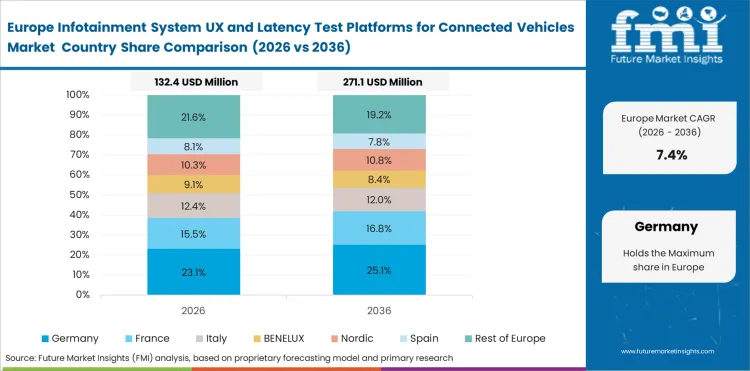
The Europe infotainment system UX and latency test platforms for connected vehicles market is projected to grow at a CAGR of 8.1% through 2036. Regional demand is supported by strong vehicle engineering capability, broad supplier networks, and continued investment in digital cockpit refinement across major automotive countries. Development work tied to automotive electronics is increasing the amount of interface and timing validation needed before production programs move forward. Europe remains a stable and high-value region because validation quality and process discipline stay important across both premium and volume vehicle segments.
- Strong engineering networks support sustained demand across the region.
- Digital cockpit refinement is increasing the amount of validation work.
- Europe remains a high-value region for advanced infotainment test platforms.
Competitive Landscape
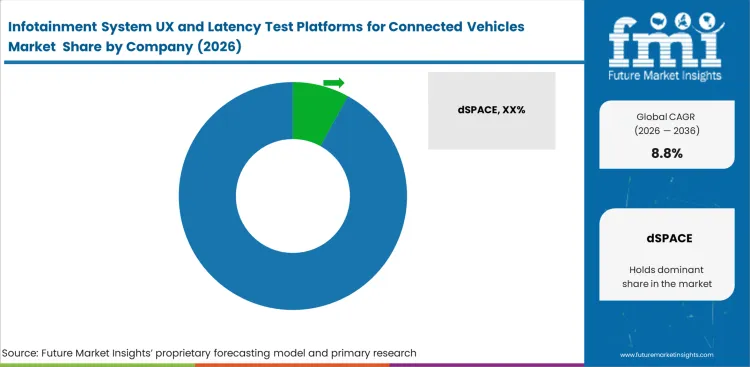
- The market remains moderately fragmented with a mix of specialist validation firms and broad test equipment suppliers.
- Leading companies compete on HIL depth, protocol handling, automation support, and integration with vehicle software workflows.
- Specialist providers can still win where customers need targeted cockpit validation or flexible deployment support.
Competition in this market is shaped less by headline scale and more by technical fit inside automotive development workflows. Suppliers need to support timing analysis, interface behavior testing, communications emulation, and repeatable validation across both virtual and hardware-linked environments. dSPACE, Keysight Technologies, Rohde & Schwarz, Vector Informatik, Emerson, ETAS, and IPG Automotive remain visible because they each offer pieces of this capability stack, though with different strengths across system realism, automation, network handling, or engineering workflow fit.
Recent supplier actions also show a market moving toward integration and broader validation scope. dSPACE highlighted end-to-end SIL and HIL automotive software validation at CES 2025, while Vector Informatik and Synopsys announced a strategic collaboration to advance software-defined vehicle development. Emerson’s July 2025 partnership with Tata Technologies adds another signal that customers want combined test capability and engineering support rather than disconnected tools.
Major Industry Players
- dSPACE, Keysight Technologies, Rohde & Schwarz, Emerson, and ETAS fit this group because they bring wider test portfolios, automotive validation depth, and stronger capacity to support complex engineering environments across multiple regions.
- Vector Informatik, IPG Automotive, AVL, and selected specialist engineering tool vendors fit here because they carry strong automotive development credibility and good technical depth in specific validation layers, even if their reach is narrower than the broadest test conglomerates.
- AUTOCRYPT-linked testing collaborations, software validation specialists, and niche cockpit engineering firms remain relevant where buyers need targeted timing, security, or communications validation without committing to a full validation stack from one supplier.
Competitive Benchmarking: Infotainment System UX and Latency Test Platforms for Connected Vehicles Market
| Company | HIL and Simulation Depth | UX and HMI Testing | OEM and Tier 1 Access | Geographic Footprint |
|---|---|---|---|---|
| dSPACE | High | Medium | Strong | Global |
| Keysight Technologies | Medium | High | Strong | Global |
| Rohde & Schwarz | Medium | High | Strong | Global |
| Vector Informatik | High | High | Strong | Global |
| Emerson | High | Medium | Strong | Global |
| ETAS | High | Medium | Strong | Global |
| IPG Automotive | High | Medium | Moderate | Europe, Global |
| AVL | High | Medium | Strong | Global |
| Anritsu | Low | Medium | Moderate | Asia, Global |
| AUTOCRYPT | Low | Medium | Moderate | Asia |
Source: Future Market Insights competitive analysis, 2026.
Key Developments
- In December 2024, dSPACE said it would demonstrate end-to-end SIL and HIL validation for electric, autonomous, and software-defined vehicles at CES 2025.
- In March 2025, Vector Informatik and Synopsys announced a strategic collaboration to advance software-defined vehicle development.
Key Players in the Infotainment System UX and Latency Test Platforms for Connected Vehicles Market
Infotainment System UX and Latency Test Platforms for Connected Vehicles Market Major global players
- dSPACE
- Keysight Technologies
- Rohde & Schwarz
- Emerson
- ETAS
Infotainment System UX and Latency Test Platforms for Connected Vehicles Market Key emerging players / specialists
- Vector Informatik
- IPG Automotive
- AVL
- AUTOCRYPT
Scope of the Report
| Metric | Value |
|---|---|
| Quantitative Units | USD Billion |
| Market Definition | Platforms used to test infotainment UX, latency, and connected-cabin performance in vehicle development |
| Regions Covered | North America, Europe, East Asia, South Asia Pacific, Latin America, Middle East and Africa |
| Countries Covered | United States, China, India, Germany, United Kingdom, Japan and others |
| Key Companies Profiled | dSPACE, Keysight Technologies, Rohde & Schwarz, Vector Informatik, Emerson, ETAS, IPG Automotive |
| Forecast Period | 2026 to 2036 |
| Approach | Bottom-up specialist validation equipment sizing cross-checked against connected vehicle scale, official production data, and supplier activity |
Infotainment System UX and Latency Test Platforms for Connected Vehicles Market by Segments
Infotainment System UX and Latency Test Platforms for Connected Vehicles Market By Platform Type
- Hardware-in-the-loop
- Software-in-the-loop
- Network emulators
- RF chambers
- Cloud benches
Infotainment System UX and Latency Test Platforms for Connected Vehicles Market By Test Focus
- Latency testing
- UX validation
- Audio-video sync
- Voice assistants
- OTA regression
Infotainment System UX and Latency Test Platforms for Connected Vehicles Market By Deployment
- Central labs
- Proving grounds
- In-vehicle rigs
- Cloud labs
- Bench stations
Infotainment System UX and Latency Test Platforms for Connected Vehicles Market By End User
- OEM centers
- Tier 1 labs
- Engineering firms
- Telecom labs
- Certification labs
Infotainment System UX and Latency Test Platforms for Connected Vehicles Market By Sales Channel
- Direct sales
- Integrators
- Resellers
- Service contracts
- Software subscriptions
Infotainment System UX and Latency Test Platforms for Connected Vehicles Market By Region
- North America
- USA
- Canada
- Mexico
- Latin America
- Brazil
- Chile
- Rest of Latin America
- Western Europe
- Germany
- UK
- Italy
- Spain
- France
- Nordic
- BENELUX
- Rest of Western Europe
- Eastern Europe
- Russia
- Poland
- Hungary
- Balkan & Baltic
- Rest of Eastern Europe
- East Asia
- China
- Japan
- South Korea
- South Asia and Pacific
- India
- ASEAN
- Australia & New Zealand
- Rest of South Asia and Pacific
- Middle East & Africa
- Kingdom of Saudi Arabia
- Other GCC Countries
- Turkiye
- South Africa
- Other African Union
- Rest of Middle East & Africa
Bibliography
- dSPACE. (2024, December 12). dSPACE at CES 2025: How seamless SIL/HIL validation accelerates automotive software development. dSPACE.
- Vector Informatik GmbH. (2025, March 10). Vector Informatik and Synopsys announce strategic collaboration to advance software-defined vehicle development. Vector Informatik.
- Emerson. (2025, July 9). Emerson and Tata Technologies partner to innovate advanced testing solutions for next-gen mobility. Emerson.
- Anritsu. (2025, January 9). Anritsu and AUTOCRYPT sign MOU at CES 2025 to advance automotive security testing through simulated 5G networks. Anritsu.
- Society of Indian Automobile Manufacturers. (2025, April 15). Key highlights from FY 2024-25.
This bibliography is provided for reader reference.
This Report Addresses
- Market size estimates for 2025, 2026, and 2036 with forecast growth through 2036.
- Segment demand across platform type, test focus, deployment model, end user, and sales channel.
- Country growth patterns across major connected vehicle engineering and production centers.
- Competitive positioning of major suppliers active in infotainment UX and latency validation.
- Demand support from connected-car scale, safety pressure, and software-defined vehicle development.
- Commercial impact of recent supplier partnerships and validation workflow expansion.
- Scope boundaries between infotainment validation and adjacent automotive test categories.
- Forecast methodology based on specialist validation demand allocation and official-source cross-checks.
Frequently Asked Questions
What is the market size in 2026?
The market is estimated at USD 0.54 billion in 2026.
What is the forecast market value for 2036?
The market is projected to reach USD 1.25 billion by 2036.
What is the CAGR from 2026 to 2036?
The market is forecast to expand at a CAGR of 8.8% through 2036.
Which platform type leads the market?
Hardware-in-the-loop platforms are expected to lead with about 34% share in 2026.
Which test focus leads demand?
Latency testing is projected to remain the leading test focus with about 29% share in 2026.
Which end-user group leads demand?
OEM engineering centers are expected to account for about 41% of total demand in 2026.
Preview the report firsthand - request a free sample
Get SampleGet the brochure for pricing and purchase details.
Get PDFTable of Content
- Key Takeaways
- Market Size and CAGR
- Top Growth Driver
- Fastest Growing Segment
- Leading Region
- Key Companies
- Emerging Opportunities
- Executive Summary
- Global Market Outlook
- Demand-side Trends
- Supply-side Trends
- Technology Roadmap Analysis
- Analysis and Recommendations
- Analyst Perspective (What is happening? Why now? What should investors know?)
- Key Questions Answered
- How large is the market?
- What is the CAGR?
- What are key trends?
- Which region dominates?
- Who are the leaders?
- Market Overview
- Market Coverage / Taxonomy
- Market Definition / Scope / Limitations
- Research Methodology
- Chapter Orientation
- Analytical Lens and Working Hypotheses
- Market Structure, Signals, and Trend Drivers
- Benchmarking and Cross-market Comparability
- Market Sizing, Forecasting, and Opportunity Mapping
- Research Design and Evidence Framework
- Desk Research Programme (Secondary Evidence)
- Expert Input and Fieldwork (Primary Evidence)
- Tooling, Models, and Reference Databases
- Data Engineering and Model Build
- Quality Assurance and Audit Trail
- Market Background
- Market Dynamics (Drivers, Restraints, Opportunity, Trends)
- Scenario Forecast (Optimistic, Likely, Conservative)
- Impact Analysis
- AI Impact
- Sustainability Impact
- Regulatory Impact
- Technology Impact
- Consumer / Buyer Analysis
- Purchase Drivers
- Adoption Barriers
- Buyer Journey
- Opportunity Map Analysis
- Product Life Cycle Analysis
- Supply Chain Analysis
- Investment Feasibility Matrix
- Value Chain Analysis
- PESTLE and Porter's Analysis
- Regulatory Landscape
- Regional Parent Market Outlook
- Production and Consumption Statistics
- Import and Export Statistics
- Global Market Analysis and Forecast, 2021 to 2036
- Historical Market Size Value (USD Billion) & Volume (Unit) Analysis, 2021 to 2025
- Current and Future Market Size Value (USD Billion) & Volume (Unit) Projections, 2026 to 2036
- Y-o-Y Growth Trend Analysis
- Absolute $ Opportunity Analysis
- Global Market Pricing Analysis, 2021 to 2036
- Global Market Analysis and Forecast, By Platform Type, 2021 to 2036
- Introduction / Key Findings
- Historical Market Size Value (USD Billion) & Volume (Unit) Analysis By Platform Type, 2021 to 2025
- Current and Future Market Size Value (USD Billion) & Volume (Unit) Analysis and Forecast By Platform Type, 2026 to 2036
- Hardware-in-the-loop
- Software-in-the-loop
- Network emulators
- RF chambers
- Cloud benches
- Hardware-in-the-loop
- Y-o-Y Growth Trend Analysis By Platform Type, 2021 to 2025
- Absolute $ Opportunity Analysis By Platform Type, 2026 to 2036
- Global Market Analysis and Forecast, By Test Focus, 2021 to 2036
- Introduction / Key Findings
- Historical Market Size Value (USD Billion) & Volume (Unit) Analysis By Test Focus, 2021 to 2025
- Current and Future Market Size Value (USD Billion) & Volume (Unit) Analysis and Forecast By Test Focus, 2026 to 2036
- Latency testing
- UX validation
- Audio-video sync
- Voice assistants
- OTA regression
- Latency testing
- Y-o-Y Growth Trend Analysis By Test Focus, 2021 to 2025
- Absolute $ Opportunity Analysis By Test Focus, 2026 to 2036
- Global Market Analysis and Forecast, By Deployment, 2021 to 2036
- Introduction / Key Findings
- Historical Market Size Value (USD Billion) & Volume (Unit) Analysis By Deployment, 2021 to 2025
- Current and Future Market Size Value (USD Billion) & Volume (Unit) Analysis and Forecast By Deployment, 2026 to 2036
- Central labs
- Proving grounds
- In-vehicle rigs
- Cloud labs
- Bench stations
- Central labs
- Y-o-Y Growth Trend Analysis By Deployment, 2021 to 2025
- Absolute $ Opportunity Analysis By Deployment, 2026 to 2036
- Global Market Analysis and Forecast, By End User, 2021 to 2036
- Introduction / Key Findings
- Historical Market Size Value (USD Billion) & Volume (Unit) Analysis By End User, 2021 to 2025
- Current and Future Market Size Value (USD Billion) & Volume (Unit) Analysis and Forecast By End User, 2026 to 2036
- OEM centers
- Tier 1 labs
- Engineering firms
- Telecom labs
- Certification labs
- OEM centers
- Y-o-Y Growth Trend Analysis By End User, 2021 to 2025
- Absolute $ Opportunity Analysis By End User, 2026 to 2036
- Global Market Analysis and Forecast, By Sales Channel, 2021 to 2036
- Introduction / Key Findings
- Historical Market Size Value (USD Billion) & Volume (Unit) Analysis By Sales Channel, 2021 to 2025
- Current and Future Market Size Value (USD Billion) & Volume (Unit) Analysis and Forecast By Sales Channel, 2026 to 2036
- Direct sales
- Integrators
- Resellers
- Service contracts
- Software subscriptions
- Direct sales
- Y-o-Y Growth Trend Analysis By Sales Channel, 2021 to 2025
- Absolute $ Opportunity Analysis By Sales Channel, 2026 to 2036
- Global Market Analysis and Forecast, By Region, 2021 to 2036
- Introduction
- Historical Market Size Value (USD Billion) & Volume (Unit) Analysis By Region, 2021 to 2025
- Current Market Size Value (USD Billion) & Volume (Unit) Analysis and Forecast By Region, 2026 to 2036
- North America
- Latin America
- Western Europe
- Eastern Europe
- East Asia
- South Asia and Pacific
- Middle East & Africa
- Market Attractiveness Analysis By Region
- North America Market Analysis and Forecast, By Country, 2021 to 2036
- Historical Market Size Value (USD Billion) & Volume (Unit) Trend Analysis By Market Taxonomy, 2021 to 2025
- Market Size Value (USD Billion) & Volume (Unit) Forecast By Market Taxonomy, 2026 to 2036
- By Country
- USA
- Canada
- Mexico
- By Platform Type
- By Test Focus
- By Deployment
- By End User
- By Sales Channel
- By Country
- Market Attractiveness Analysis
- By Country
- By Platform Type
- By Test Focus
- By Deployment
- By End User
- By Sales Channel
- Key Takeaways
- Latin America Market Analysis and Forecast, By Country
- Historical Market Size Value (USD Billion) & Volume (Unit) Trend Analysis By Market Taxonomy, 2021 to 2025
- Market Size Value (USD Billion) & Volume (Unit) Forecast By Market Taxonomy, 2026 to 2036
- By Country
- Brazil
- Chile
- Rest of Latin America
- By Platform Type
- By Test Focus
- By Deployment
- By End User
- By Sales Channel
- By Country
- Market Attractiveness Analysis
- By Country
- By Platform Type
- By Test Focus
- By Deployment
- By End User
- By Sales Channel
- Key Takeaways
- Western Europe Market Analysis and Forecast, By Country
- Historical Market Size Value (USD Billion) & Volume (Unit) Trend Analysis By Market Taxonomy, 2021 to 2025
- Market Size Value (USD Billion) & Volume (Unit) Forecast By Market Taxonomy, 2026 to 2036
- By Country
- Germany
- UK
- Italy
- Spain
- France
- Nordic
- BENELUX
- Rest of Western Europe
- By Platform Type
- By Test Focus
- By Deployment
- By End User
- By Sales Channel
- By Country
- Market Attractiveness Analysis
- By Country
- By Platform Type
- By Test Focus
- By Deployment
- By End User
- By Sales Channel
- Key Takeaways
- Eastern Europe Market Analysis and Forecast, By Country
- Historical Market Size Value (USD Billion) & Volume (Unit) Trend Analysis By Market Taxonomy, 2021 to 2025
- Market Size Value (USD Billion) & Volume (Unit) Forecast By Market Taxonomy, 2026 to 2036
- By Country
- Russia
- Poland
- Hungary
- Balkan & Baltic
- Rest of Eastern Europe
- By Platform Type
- By Test Focus
- By Deployment
- By End User
- By Sales Channel
- By Country
- Market Attractiveness Analysis
- By Country
- By Platform Type
- By Test Focus
- By Deployment
- By End User
- By Sales Channel
- Key Takeaways
- East Asia Market Analysis and Forecast, By Country
- Historical Market Size Value (USD Billion) & Volume (Unit) Trend Analysis By Market Taxonomy, 2021 to 2025
- Market Size Value (USD Billion) & Volume (Unit) Forecast By Market Taxonomy, 2026 to 2036
- By Country
- China
- Japan
- South Korea
- By Platform Type
- By Test Focus
- By Deployment
- By End User
- By Sales Channel
- By Country
- Market Attractiveness Analysis
- By Country
- By Platform Type
- By Test Focus
- By Deployment
- By End User
- By Sales Channel
- Key Takeaways
- South Asia and Pacific Market Analysis and Forecast, By Country
- Historical Market Size Value (USD Billion) & Volume (Unit) Trend Analysis By Market Taxonomy, 2021 to 2025
- Market Size Value (USD Billion) & Volume (Unit) Forecast By Market Taxonomy, 2026 to 2036
- By Country
- India
- ASEAN
- Australia & New Zealand
- Rest of South Asia and Pacific
- By Platform Type
- By Test Focus
- By Deployment
- By End User
- By Sales Channel
- By Country
- Market Attractiveness Analysis
- By Country
- By Platform Type
- By Test Focus
- By Deployment
- By End User
- By Sales Channel
- Key Takeaways
- Middle East & Africa Market Analysis and Forecast, By Country
- Historical Market Size Value (USD Billion) & Volume (Unit) Trend Analysis By Market Taxonomy, 2021 to 2025
- Market Size Value (USD Billion) & Volume (Unit) Forecast By Market Taxonomy, 2026 to 2036
- By Country
- Kingdom of Saudi Arabia
- Other GCC Countries
- Türkiye
- South Africa
- Other African Union
- Rest of Middle East & Africa
- By Platform Type
- By Test Focus
- By Deployment
- By End User
- By Sales Channel
- By Country
- Market Attractiveness Analysis
- By Country
- By Platform Type
- By Test Focus
- By Deployment
- By End User
- By Sales Channel
- Key Takeaways
- Key Countries Market Analysis
- USA
- Pricing Analysis
- Market Share Analysis, 2025
- By Platform Type
- By Test Focus
- By Deployment
- By End User
- By Sales Channel
- Canada
- Pricing Analysis
- Market Share Analysis, 2025
- By Platform Type
- By Test Focus
- By Deployment
- By End User
- By Sales Channel
- Mexico
- Pricing Analysis
- Market Share Analysis, 2025
- By Platform Type
- By Test Focus
- By Deployment
- By End User
- By Sales Channel
- Brazil
- Pricing Analysis
- Market Share Analysis, 2025
- By Platform Type
- By Test Focus
- By Deployment
- By End User
- By Sales Channel
- Chile
- Pricing Analysis
- Market Share Analysis, 2025
- By Platform Type
- By Test Focus
- By Deployment
- By End User
- By Sales Channel
- Germany
- Pricing Analysis
- Market Share Analysis, 2025
- By Platform Type
- By Test Focus
- By Deployment
- By End User
- By Sales Channel
- UK
- Pricing Analysis
- Market Share Analysis, 2025
- By Platform Type
- By Test Focus
- By Deployment
- By End User
- By Sales Channel
- Italy
- Pricing Analysis
- Market Share Analysis, 2025
- By Platform Type
- By Test Focus
- By Deployment
- By End User
- By Sales Channel
- Spain
- Pricing Analysis
- Market Share Analysis, 2025
- By Platform Type
- By Test Focus
- By Deployment
- By End User
- By Sales Channel
- France
- Pricing Analysis
- Market Share Analysis, 2025
- By Platform Type
- By Test Focus
- By Deployment
- By End User
- By Sales Channel
- India
- Pricing Analysis
- Market Share Analysis, 2025
- By Platform Type
- By Test Focus
- By Deployment
- By End User
- By Sales Channel
- ASEAN
- Pricing Analysis
- Market Share Analysis, 2025
- By Platform Type
- By Test Focus
- By Deployment
- By End User
- By Sales Channel
- Australia & New Zealand
- Pricing Analysis
- Market Share Analysis, 2025
- By Platform Type
- By Test Focus
- By Deployment
- By End User
- By Sales Channel
- China
- Pricing Analysis
- Market Share Analysis, 2025
- By Platform Type
- By Test Focus
- By Deployment
- By End User
- By Sales Channel
- Japan
- Pricing Analysis
- Market Share Analysis, 2025
- By Platform Type
- By Test Focus
- By Deployment
- By End User
- By Sales Channel
- South Korea
- Pricing Analysis
- Market Share Analysis, 2025
- By Platform Type
- By Test Focus
- By Deployment
- By End User
- By Sales Channel
- Russia
- Pricing Analysis
- Market Share Analysis, 2025
- By Platform Type
- By Test Focus
- By Deployment
- By End User
- By Sales Channel
- Poland
- Pricing Analysis
- Market Share Analysis, 2025
- By Platform Type
- By Test Focus
- By Deployment
- By End User
- By Sales Channel
- Hungary
- Pricing Analysis
- Market Share Analysis, 2025
- By Platform Type
- By Test Focus
- By Deployment
- By End User
- By Sales Channel
- Kingdom of Saudi Arabia
- Pricing Analysis
- Market Share Analysis, 2025
- By Platform Type
- By Test Focus
- By Deployment
- By End User
- By Sales Channel
- Türkiye
- Pricing Analysis
- Market Share Analysis, 2025
- By Platform Type
- By Test Focus
- By Deployment
- By End User
- By Sales Channel
- South Africa
- Pricing Analysis
- Market Share Analysis, 2025
- By Platform Type
- By Test Focus
- By Deployment
- By End User
- By Sales Channel
- USA
- Market Structure Analysis
- Competition Dashboard
- Competition Benchmarking
- Market Share Analysis of Top Players
- By Regional
- By Platform Type
- By Test Focus
- By Deployment
- By End User
- By Sales Channel
- Emerging Startups
- Innovation Benchmarking
- Competition Analysis
- Competition Deep Dive
- dSPACE
- Overview
- Product Portfolio
- Profitability by Market Segments (Product/Region/Sales Channel)
- Sales Footprint
- Strategy Overview
- Marketing Strategy
- Product Strategy
- Channel Strategy
- Keysight Technologies
- Rohde & Schwarz
- Emerson
- ETAS
- Vector Informatik
- IPG Automotive
- AVL
- AUTOCRYPT
- dSPACE
- Case Studies
- Success Stories
- Recent Developments
- Competition Deep Dive
- Assumptions & Acronyms Used


