

- Market Size (2026)
- USD 0.30 Bn
- Forecast (2036)
- USD 1.93 Bn
- CAGR (2026 to 2036)
- 20.5%
EV Charging System Test and Certification Equipment Market Size, Forecast and Outlook by FMI
Revenue from EV Charging System Test and Certification Equipment reached USD 0.25 billion in 2025. Demand is projected to reach USD 0.30 billion in 2026. Global valuation is forecast to reach USD 1.93 billion by 2036 at a 20.5% CAGR. FMI estimates USD 1.63 billion in absolute dollar opportunity will be observed between 2026 and 2036.
Summary of EV Charging System Test and Certification Equipment Market
- The EV Charging System Test and Certification Equipment market is forecast to reach USD 1.93 billion by 2036.
- Industry is expected to grow at a CAGR of 20.5% from 2026 to 2036.
- Market valuation was estimated at USD 0.25 billion in 2025.
- Incremental opportunity across the forecast period totals USD 1.63 billion.
- Hardware is projected to emerge with 60% market share in 2026.
- Manufacturing applications account for 45% of testing demand in 2026.
- DC fast chargers hold 65% of compliance protocol volume.
- Testing labs represent 40% of procurement share among end users.
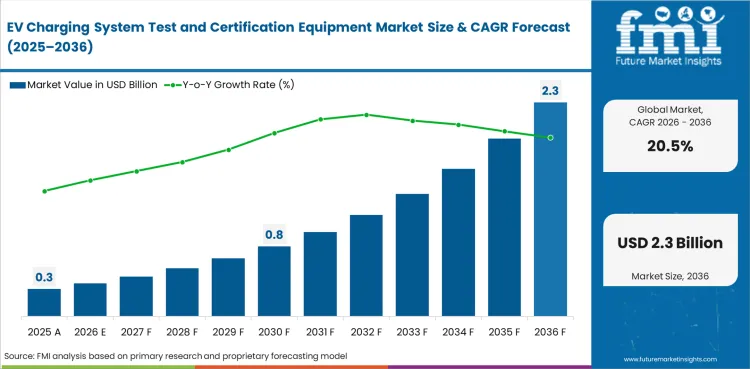
Key Takeaways, Market Size, and Forecast - EV Charging System Test and Certification Equipment Market
- The EV Charging System Test and Certification Equipment market was valued at USD 0.25 billion in 2025.
- The market is set to reach USD 0.30 billion by 2026-end and grow at a CAGR of 20.5% between 2026–2036 to reach USD 1.93 billion by 2036.
- DC fast charging will dominate with a 65% share, while hardware equipment will lead with a 60% share.
- The EV Charging System Test and Certification Equipment market was valued at USD 0.25 billion in 2025.
- By 2036, the market is expected to be worth USD 1.93 billion.
- From 2026 to 2036, the market is projected to expand at a CAGR of 20.5%.
- The market is projected to create an incremental opportunity of USD 1.63 billion between 2026 and 2036.
- In 2026, hardware is expected to account for 60% of the equipment type segment, driven by rising demand for high-voltage simulators and physical load testing in EV charging validation.
- China and the United States are among the fastest growing markets globally.
EV Charging System Test and Certification Equipment Market Key Takeaways
| Parameter | Details |
|---|---|
| Market Value (2026) | USD 0.30 billion |
| Forecast Value (2036) | USD 1.93 billion |
| CAGR (2026 to 2036) | 20.5% |
| Estimated Market Value (2025) | USD 0.25 billion |
| Incremental Opportunity | USD 1.63 billion |
| Leading Equipment Type | Hardware (60% of equipment type segment) |
| Leading Application | Manufacturing (45% of application segment) |
| Leading Charging Category | DC fast (65% of charging category segment) |
| Leading End User | Testing labs (40% of distribution) |
| Key Players | Keysight Technologies, Chroma ATE, Rohde & Schwarz, UL Solutions, Intertek |
Source: Future Market Insights, 2026
High-voltage thermal management testing mandates and ISO 15118 protocol updates are changing equipment requirements through 2036. Global interoperability standard enforcement is increasing spending on compliance testing across public networks.
High-power direct current system deployment adds testing requirements beyond baseline alternating current chargers. Emulators see rising demand as automakers standardize around megawatt charging specifications across global commercial fleets. Interoperability standard updates from CharIN add new product requirements for automated test benches. China and the United States represent the most active country markets. Germany remains one of the largest European charging-infrastructure markets.
EV Charging System Test and Certification Equipment Market Definition
The EV Charging System Test and Certification Equipment market covers electronic loads and grid simulators. Manufacturers use these instruments to validate protocol conformance under ISO 15118 standards in laboratory settings. FMI defines this sector as precision measurement tools deployed for end-of-line production quality assurance.
EV Charging System Test and Certification Equipment Market Inclusions
Market scope includes all commercially traded validation tools segmented by equipment type and application. Charging category and end user form additional segments. Segment coverage spans standard compliance testing across the full 2026 to 2036 forecast.
EV Charging System Test and Certification Equipment Market Exclusions
Scope excludes general-purpose multimeters and standard oscilloscopes not tailored for EV applications. Unspecialized voltage meters and basic electrical safety testers fall outside the scope.
EV Charging System Test and Certification Equipment Market Research Methodology
- Primary Research: FMI analysts interviewed certification lab directors and grid simulator engineers across North America and Europe.
- Desk Research: Data from the International Energy Agency and regional transportation ministries set the baseline parameters.
- Market Sizing and Forecasting: Baseline values come from a bottom-up count of programmable power supply shipments. Hardware expansion rates and protocol adoption curves help project demand through 2036.
- Data Validation and Update Cycle: A quarterly data refresh compares projections to official test bench commercialization evidence.
Growth Drivers for EV Charging System Test and Certification Equipment
- High-voltage thermal management mandates and ISO 15118 protocol compliance are increasing equipment demand.
- Testing requirements across CHAdeMO CCS and emerging high-power protocols are increasing investment in new simulation platforms.
- Expansion of ultra-fast public charging networks is increasing recurring demand for conformance and interoperability testing.
China accounts for about two-third of global public charging stock. More than two-thirds of growth in public chargers since 2020 has occurred there. This growth is raising demand for hardware emulators in certification and validation work. Network operators standardize around megawatt charging specifications across commercial transport networks.
Certification of electric vehicle communication controllers faces stricter compliance requirements in European markets under interoperability rules. U.S. interoperability requirements are increasing demand for bidirectional power flow validation tools. Approval cycles under CharIN standards slow how fast new power analyzers move into regular procurement cycles.
Charging point operators expanding European EV charging infrastructure networks increase routine protocol validation work. High-power depot rollout in Germany is increasing demand for electronic loads and grid-simulation equipment. The United Kingdom had 59,670 public EV charging devices installed as of 1 April 2024. This installed base is increasing demand for recurring power-quality and compliance testing services.
Segmental Analysis
- Hardware accounts for 60% of test bench investment with regenerative DC emulators pulling bulk demand.
- Manufacturing holds 45% of deployment volume driven by end-of-line quality assurance requirements.
- DC fast testing secures 65% of protocol simulation share as commercial fleet operators upgrade regional depots.
Coverage runs across four dimensions including equipment type and application alongside charging category and end user. Hardware dominates the EV test equipment category while manufacturing leads the application dimension. DC fast systems and third-party testing labs secure the largest positions in their respective categories. High capital requirements limit entry for smaller instrument providers. High-power direct current simulators set the main cost and capability limits in this sector.
Insights into the Hardware Segment
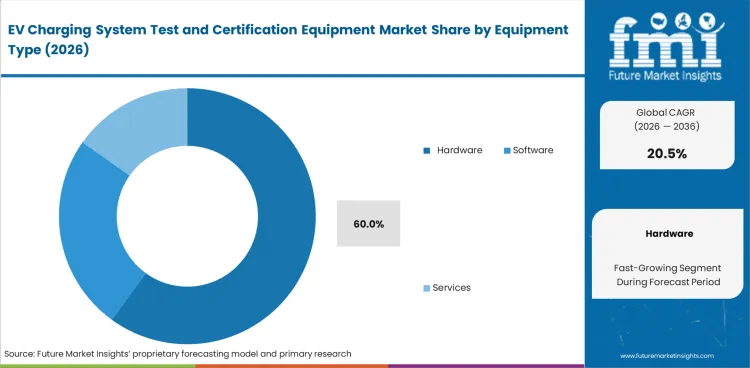
Hardware is projected to emerge with 60% market share in 2026. This lead comes from high thermal and electrical loads that software simulation has not matched at scale. Physical load banks and grid emulators process actual high-voltage currents necessary for safety certification.
Within the equipment segment regenerative DC emulators are expanding fastest as facility directors respond to rising grid energy costs. Hardware upgrades become mandatory as charging voltages push past 800 volts.
Insights into the Manufacturing Segment
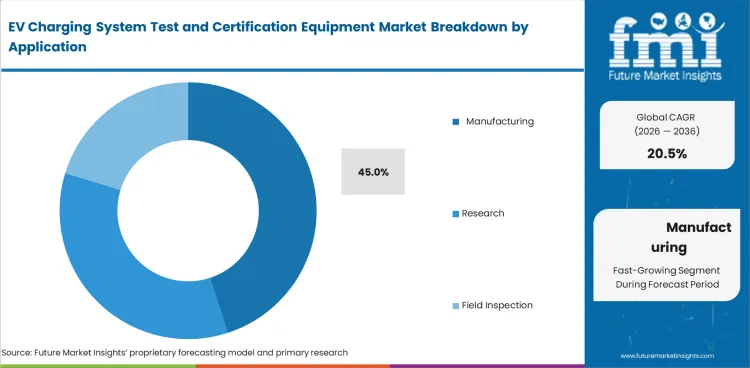
In 2026 manufacturing applications are expected to account for 45% of the application segment. End-of-line verification and burn-in testing represent the two largest sub-applications by volume. Volume manufacturing of electric vehicle on board chargers forces automakers to install automated validation rigs directly adjacent to assembly lines.
Chain standardization across regional vehicle assembly plants is narrowing instrument buying to three primary global vendors. Automated test sequencers replace manual compliance checks on the factory floor.
Insights into the DC Fast Segment
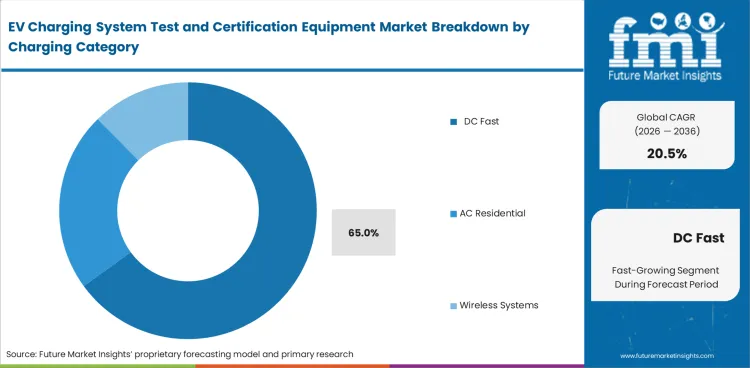
A 65% share of the charging category segment is expected for DC fast in 2026. High voltage direct current systems require extensive harmonic testing to protect local utility grids from frequency distortion. Testing laboratories use specialized grid simulators to mimic grid fluctuations during peak vehicle charging sessions.
Procurement volume compounds as regional standards differ across CCS CHAdeMO and emerging megawatt protocols. Automakers demand unified testing benches capable of simulating all global fast-charging standards simultaneously.
Market Drivers and Commercial Restraints
- Government-funded infrastructure buildouts push testing labs to upgrade from standard AC analyzers to bi-directional high-voltage simulators.
- Energy recovery can lower operating energy costs compared with conventional heat-dissipating test setups.
- Software-in-the-loop methods can reduce the amount of physical prototype validation required during charging-system development.
Public network expansion and bidirectional power flow integration drive EV smart charging software validation requirements through 2036. Hardware innovation and regulatory mandates are raising cost pressure for independent certification bodies. Grid integration standards mandate rigorous cybersecurity testing across public communication networks. Regional fragmentation in connector types adds heavy capital expenditure burdens for testing laboratories.
Commercial Fleet Electrification Multiplies Heavy Duty Testing
Rising deployment of electric commercial vehicles is increasing demand for high-current charging validation. Each megawatt-class charging station requires prolonged thermal stability verification under continuous peak loads. Fleet operators serving million-mile duty cycles have switched from standard 150-kilowatt validation to megawatt hardware stress tests. Heavy duty compliance requirements make it harder for smaller certification labs to compete for top-tier automaker contracts.
Megawatt Emulation Requirements Pressure Mid-Tier Laboratories
Validating commercial truck infrastructure runs into physical grid limits at many existing independent testing facilities. Upgrading local utility connections to handle dual-megawatt power draws pushes certification labs to spend heavily on facility improvements. Specialized cybersecurity validation hubs require distinct software testing infrastructures separate from power emulation hardware. The capability gap is increasing between regional testing providers and global testing conglomerates holding superior capital access.
Bidirectional Protocol Updates Generate Recurrent Software Testing
Vehicle-to-grid integration mandates in European markets add recurring protocol compliance testing with each new firmware release. Automaker integration of wireless electric vehicle charging systems is pushing interoperability demand above regional average rates. Firmware update cycles across installed networks create ongoing validation contracts. Software conformance cycles can slow deployment of field security patches.
Regenerative Load Simulators Cut Facility Energy Costs
Power electronics advances in silicon carbide components are closing the efficiency gap with traditional resistive load banks. Keysight states that regenerative DC emulators can feed absorbed power back to the grid. This capability reduces operating energy demand compared with resistive-load approaches. Energy efficient testing hardware shifts electric vehicle battery testing equipment investment toward a lower-operating-cost equipment category. Higher upfront equipment costs can slow adoption among lower-volume testing facilities.
Regional and Country Market Performance
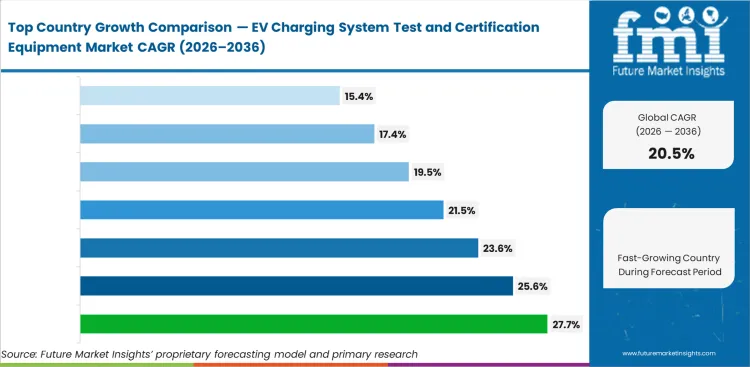
- Mandated expansion of ultra-fast public networks forces equipment upgrades across China and the United States.
- Japan and South Korea rely on dense urban fast-charging networks to generate continuous grid simulation demand.
- The United Kingdom adds a stronger compliance case through public-chargepoint reliability requirements that took effect on 24 November 2024.
Global EV Charging System Test and Certification Equipment demand differs by country based on charging-network scale, policy timing, and compliance requirements. China remains the leading public-charging market and continues to add charging infrastructure at a scale that exceeds other national markets. Automotive diagnostic scan tools integrate alongside dedicated infrastructure simulators in mature North American markets. Strict European Union interoperability directives define the testing parameters for German and French laboratories.
Demand Outlook for EV Charging System Test and Certification Equipment Market in China
State-mandated expansion of ultra-fast public charging networks pushes testing labs to switch from low-power AC testers to high-voltage DC emulators. China remains the largest public-charging market, which supports stronger demand for charging-system validation equipment. High deployment density forces regional network operators to procure portable field inspection analyzers. Local standardisation requirements under the GB/T protocol split the China EV test equipment market into domestic and export-focused testing tiers.
Future Outlook for EV Charging System Test and Certification Equipment Market in the United States
Public DC fast charging ports in the United States grew 7.4% in Q2 2024, adding 3,047 ports. This expansion is raising demand for charging-system validation and interoperability testing. Federal funding and performance requirements continue to support investment in bidirectional power-flow validation tools. Automakers and laboratories continue to invest in megawatt simulation platforms for commercial charging applications.
Opportunity Analysis of EV Charging System Test and Certification Equipment Market in Germany
At the end of 2024 Germany had 160,000 public charging points and France had 155,000. Germany remains one of the largest European charging-infrastructure markets, which supports demand for validation equipment. Cross-border interoperability testing directives expose charging point operators to stringent European grid integration rules. Bi-directional power flows demand sophisticated electronic load emulators capable of ISO 15118-20 validation. Leading German certification bodies work with grid operators on dedicated compliance testing modules.
In-depth Analysis of EV Charging System Test and Certification Equipment Market in the United Kingdom
Public-chargepoint reliability requirements in the United Kingdom took effect on 24 November 2024, adding a stronger compliance case for testing secure communications and uptime performance. The United Kingdom had 59,670 public EV charging devices installed as of 1 April 2024. Testing laboratories face intense pressure to validate secure communication protocols between vehicles and backend management systems. Regional certification bodies update simulation hardware to match these requirements.
Sales Analysis of EV Charging System Test and Certification Equipment Market in France
At the end of 2024 France had 155,000 public charging points, making it one of the larger public-charging networks in Europe. French infrastructure expansion is increasing third-party certification activity across the country. Utilities demand proof of thermal safety before granting high-power grid connection permits. Independent testing labs procure high-voltage simulators to verify liquid cooling system performance under maximum load. Regional grid operators restrict deployment of uncertified stations to protect local distribution networks.
In-depth Analysis of EV Charging System Test and Certification Equipment Market in Japan
Japan continues to expand charging infrastructure and related policy support, which sustains demand for end-of-line verification and charging-system validation. Government and industry programs keep focus on charging availability and system reliability. High capital expenditure flows directly into automated manufacturing test rigs at major automotive supply plants. Protocol consolidation narrows hardware buying to a small number of approved global instrument suppliers.
Competitive Landscape of EV Charging System Test and Certification Equipment Market
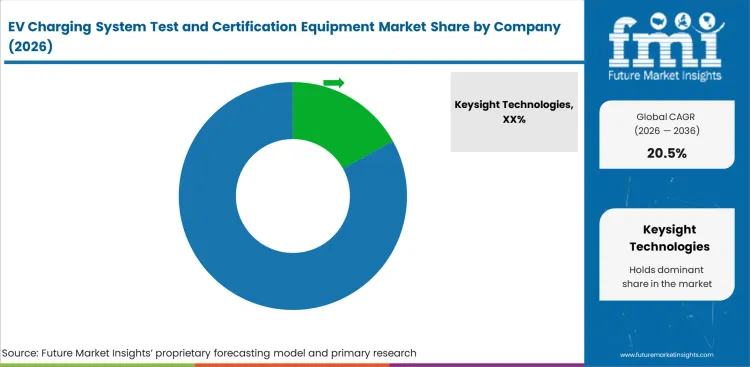
- Keysight is one of the established suppliers in high-power EV and EVSE test systems.
- Chroma ATE offers EV and EVSE-related automatic test capabilities across charging and power-electronics applications.
- Vector Informatik provides software tools used in EV charging development and testing.
EV charging testing supply is concentrated among established test instrument manufacturers. Supply divides between integrated hardware providers with global scale and software specialists in cybersecurity and protocol validation. Keysight leverages its high-power regenerative DC emulator platforms to support top-tier certification and development programs.
Chroma ATE and Rohde & Schwarz compete through different strengths across charging and communication test workflows. Chroma provides automatic test capabilities for EVSE and power-electronics applications. Rohde & Schwarz participates in automotive conformance and communication-related testing through its broader automotive test portfolio. These vendors support global automakers developing connected and interoperable charging systems.
UL Solutions and DEKRA operate as independent laboratories that influence equipment purchasing specifications in the charging ecosystem. Intertek provides transportation and automotive testing services that can support certification programs for vehicle and charging applications. TÜV SÜD provides EV charging infrastructure testing and certification services covering safety, reliability, and interoperability.
New entrants face three main barriers. Getting in requires ISO 17025 accreditation and a spot in automaker approved vendor programs. Strict cryptographic validation requirements and long procurement cycles protect incumbent suppliers.
Major Industry Players
- Keysight Technologies Chroma ATE Rohde & Schwarz and Vector Informatik hold visible positions in the market based on engineering capability and exposure to automotive charging programs.
- UL Solutions Intertek and DEKRA serve global markets through independent testing and certification operations.
- TUV SUD Hioki and Horiba supply specialized testing and compliance support for regional utility and automotive applications.
Key Developments in EV Charging System Test and Certification Equipment Market
- In October 2025, Keysight expanded its end-of-line test portfolio with the EV2020B and EV2020BE manufacturing functional test platforms, including a version designed for EVSE testing.
- In October 2025, Chroma highlighted IEC 61851-23 compliant test solutions for DC EV supply equipment, supporting tighter charging-safety and compliance requirements.
Key Players in the EV Charging System Test and Certification Equipment Market
Major Global Players
- Keysight Technologies
- Chroma ATE
- Rohde & Schwarz
- UL Solutions
- Intertek
- DEKRA
- TUV SUD
Emerging Players
- Vector Informatik
- Hioki
- Horiba
Scope of the Report
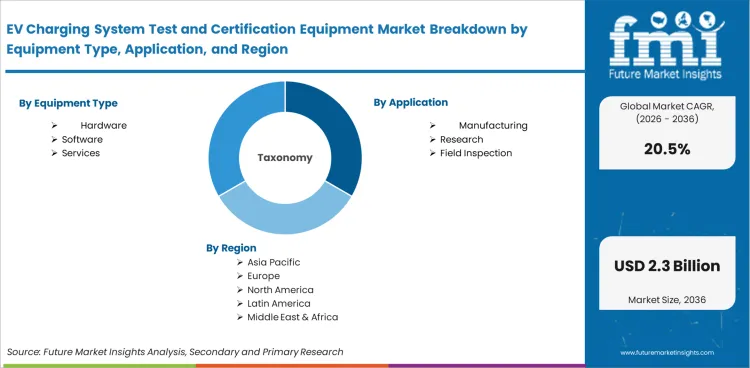
| Metric | Value |
|---|---|
| Quantitative Units | USD 0.30 billion to USD 1.93 billion at a CAGR of 20.5% |
| Market Definition | The EV Charging System Test and Certification Equipment market covers electronic loads and grid simulators. Manufacturers use these instruments to validate protocol conformance under ISO 15118 standards in laboratory settings. |
| Segmentation |
|
| Regions Covered | North America East Asia Western Europe |
| Countries Covered | China United States Germany United Kingdom France Japan South Korea |
| Key Companies Profiled | Keysight Technologies Chroma ATE Rohde & Schwarz UL Solutions Intertek DEKRA TUV SUD |
| Forecast Period | 2026 to 2036 |
| Approach | Baseline values come from a bottom-up count of programmable power supply shipments adjusted using hardware expansion rates. |
EV Charging System Test and Certification Equipment Market by Segments
EV Charging System Test and Certification Equipment Market Segmented by Equipment Type:
- Hardware
- Software
- Services
EV Charging System Test and Certification Equipment Market Classified by Application:
- Research
- Manufacturing
- Field inspection
EV Charging System Test and Certification Equipment Market Analyzed by Charging Category:
- DC fast
- AC residential
- Wireless systems
EV Charging System Test and Certification Equipment Market Classified by End User:
- Automakers
- Testing labs
- Grid operators
EV Charging System Test and Certification Equipment Market by Region and Country:
- North America
- USA
- Canada
- Mexico
- Latin America
- Brazil
- Chile
- Rest of Latin America
- Western Europe
- Germany
- UK
- Italy
- Spain
- France
- Nordic
- BENELUX
- Rest of Western Europe
- Eastern Europe
- Russia
- Poland
- Hungary
- Balkan & Baltic
- Rest of Eastern Europe
- East Asia
- China
- Japan
- South Korea
- South Asia and Pacific
- India
- ASEAN
- Australia & New Zealand
- Rest of South Asia and Pacific
- Middle East & Africa
- Kingdom of Saudi Arabia
- Other GCC Countries
- Turkiye
- South Africa
- Other African Union
- Rest of Middle East & Africa
Bibliography
- International Energy Agency. (2025, May 14). Global EV Outlook 2025. IEA.
- International Energy Agency. (2025, May 14). Electric vehicle charging. In Global EV Outlook 2025. IEA.
- Brown, A., Cappellucci, J., Gaus, M., & Buleje, H. (2024). Electric Vehicle Charging Infrastructure Trends from the Alternative Fueling Station Locator: Second Quarter 2024. National Renewable Energy Laboratory.
- UK Department for Transport. (2024, April 30). Electric vehicle public charging infrastructure statistics: April 2024. GOV.UK.
- UK Department for Transport. (2024, October 21). Public Charge Point Regulations 2023 guidance. GOV.UK.
- Keysight Technologies. (2025, October 2). Keysight expands end-of-line test portfolio to power the future of electric mobility. Keysight Technologies.
- Chroma ATE. (2025, October 20). Ensuring EV charging safety: Chroma delivers IEC 61851-23 compliant test solutions for DC EV supply equipment. Chroma ATE.
Frequently Asked Questions
How large is the EV Charging System Test and Certification Equipment market in 2026?
Demand for EV Charging System Test and Certification Equipment in the global market is estimated at USD 0.30 billion in 2026.
What is the forecast for the EV Charging System Test and Certification Equipment market?
Global EV Charging System Test and Certification Equipment market revenue is projected at USD 1.93 billion by 2036.
At what rate is the EV Charging System Test and Certification Equipment market expected to grow through 2036?
FMI estimates place the expected growth at a 20.5% CAGR from 2026 to 2036.
Which charging category is set to lead global sales by 2026?
DC fast holds the largest share in 2026 at 65% due to strict thermal management testing requirements for public networks.
What application leads the EV Charging System Test and Certification Equipment market in 2026?
Manufacturing leads the application segment with a 45% share driven by end-of-line quality assurance requirements.
What is driving demand in China?
China remains the largest public-charging market, and continued network expansion supports higher demand for charging-system validation equipment.
What products fall under the EV Charging System Test and Certification Equipment market as defined by FMI?
Coverage includes precision measurement tools and programmable load simulators designed to validate protocol conformance and electrical safety.
How does FMI build and check the EV Charging System Test and Certification Equipment forecast?
Baseline values come from a bottom-up count of programmable power supply shipments verified against official test bench commercialization evidence.
Preview the report firsthand - request a free sample
Get SampleGet the brochure for pricing and purchase details.
Get PDFTable of Content
- Executive Summary
- Global Market Outlook
- Demand-side Trends
- Supply-side Trends
- Technology Roadmap Analysis
- Analysis and Recommendations
- Market Overview
- Market Coverage / Taxonomy
- Market Definition / Scope / Limitations
- Research Methodology
- Chapter Orientation
- Analytical Lens and Working Hypotheses
- Market Structure, Signals, and Trend Drivers
- Benchmarking and Cross-market Comparability
- Market Sizing, Forecasting, and Opportunity Mapping
- Research Design and Evidence Framework
- Desk Research Programme (Secondary Evidence)
- Company Annual and Sustainability Reports
- Peer-reviewed Journals and Academic Literature
- Corporate Websites, Product Literature, and Technical Notes
- Earnings Decks and Investor Briefings
- Statutory Filings and Regulatory Disclosures
- Technical White Papers and Standards Notes
- Trade Journals, Industry Magazines, and Analyst Briefs
- Conference Proceedings, Webinars, and Seminar Materials
- Government Statistics Portals and Public Data Releases
- Press Releases and Reputable Media Coverage
- Specialist Newsletters and Curated Briefings
- Sector Databases and Reference Repositories
- FMI Internal Proprietary Databases and Historical Market Datasets
- Subscription Datasets and Paid Sources
- Social Channels, Communities, and Digital Listening Inputs
- Additional Desk Sources
- Expert Input and Fieldwork (Primary Evidence)
- Primary Modes
- Qualitative Interviews and Expert Elicitation
- Quantitative Surveys and Structured Data Capture
- Blended Approach
- Why Primary Evidence is Used
- Field Techniques
- Interviews
- Surveys
- Focus Groups
- Observational and In-context Research
- Social and Community Interactions
- Stakeholder Universe Engaged
- C-suite Leaders
- Board Members
- Opportunity
- Trends
- Scenario Forecast
- Demand in Optimistic Scenario
- Demand in Likely Scenario
- Demand in Conservative Scenario
- Opportunity Map Analysis
- Product Life Cycle Analysis
- Supply Chain Analysis
- Investment Feasibility Matrix
- Value Chain Analysis
- PESTLE and Porter’s Analysis
- Regulatory Landscape
- Regional Parent Market Outlook
- Production and Consumption Statistics
- Import and Export Statistics
- Primary Modes
- Global Market Analysis 2021 to 2025 and Forecast, 2026 to 2036
- Historical Market Size Value (USD Million) Analysis, 2021 to 2025
- Current and Future Market Size Value (USD Million) Projections, 2026 to 2036
- Y-o-Y Growth Trend Analysis
- Absolute $ Opportunity Analysis
- Global Market Pricing Analysis 2021 to 2025 and Forecast 2026 to 2036
- Global Market Analysis 2021 to 2025 and Forecast 2026 to 2036, By Equipment Type
- Introduction / Key Findings
- Historical Market Size Value (USD Million) Analysis By Equipment Type , 2021 to 2025
- Current and Future Market Size Value (USD Million) Analysis and Forecast By Equipment Type , 2026 to 2036
- Hardware
- Software
- Services
- Hardware
- Y-o-Y Growth Trend Analysis By Equipment Type , 2021 to 2025
- Absolute $ Opportunity Analysis By Equipment Type , 2026 to 2036
- Global Market Analysis 2021 to 2025 and Forecast 2026 to 2036, By Application
- Introduction / Key Findings
- Historical Market Size Value (USD Million) Analysis By Application, 2021 to 2025
- Current and Future Market Size Value (USD Million) Analysis and Forecast By Application, 2026 to 2036
- Manufacturing
- Research
- Field Inspection
- Manufacturing
- Y-o-Y Growth Trend Analysis By Application, 2021 to 2025
- Absolute $ Opportunity Analysis By Application, 2026 to 2036
- Global Market Analysis 2021 to 2025 and Forecast 2026 to 2036, By Charging Category
- Introduction / Key Findings
- Historical Market Size Value (USD Million) Analysis By Charging Category, 2021 to 2025
- Current and Future Market Size Value (USD Million) Analysis and Forecast By Charging Category, 2026 to 2036
- DC Fast
- AC Residential
- Wireless Systems
- DC Fast
- Y-o-Y Growth Trend Analysis By Charging Category, 2021 to 2025
- Absolute $ Opportunity Analysis By Charging Category, 2026 to 2036
- Global Market Analysis 2021 to 2025 and Forecast 2026 to 2036, By End User
- Introduction / Key Findings
- Historical Market Size Value (USD Million) Analysis By End User, 2021 to 2025
- Current and Future Market Size Value (USD Million) Analysis and Forecast By End User, 2026 to 2036
- Testing Labs
- Automakers
- Testing Labs
- Y-o-Y Growth Trend Analysis By End User, 2021 to 2025
- Absolute $ Opportunity Analysis By End User, 2026 to 2036
- Global Market Analysis 2021 to 2025 and Forecast 2026 to 2036, By Region
- Introduction
- Historical Market Size Value (USD Million) Analysis By Region, 2021 to 2025
- Current Market Size Value (USD Million) Analysis and Forecast By Region, 2026 to 2036
- North America
- Latin America
- Western Europe
- Eastern Europe
- East Asia
- South Asia and Pacific
- Middle East & Africa
- Market Attractiveness Analysis By Region
- North America Market Analysis 2021 to 2025 and Forecast 2026 to 2036, By Country
- Historical Market Size Value (USD Million) Trend Analysis By Market Taxonomy, 2021 to 2025
- Market Size Value (USD Million) Forecast By Market Taxonomy, 2026 to 2036
- By Country
- USA
- Canada
- Mexico
- By Equipment Type
- By Application
- By Charging Category
- By End User
- By Country
- Market Attractiveness Analysis
- By Country
- By Equipment Type
- By Application
- By Charging Category
- By End User
- Key Takeaways
- Latin America Market Analysis 2021 to 2025 and Forecast 2026 to 2036, By Country
- Historical Market Size Value (USD Million) Trend Analysis By Market Taxonomy, 2021 to 2025
- Market Size Value (USD Million) Forecast By Market Taxonomy, 2026 to 2036
- By Country
- Brazil
- Chile
- Rest of Latin America
- By Equipment Type
- By Application
- By Charging Category
- By End User
- By Country
- Market Attractiveness Analysis
- By Country
- By Equipment Type
- By Application
- By Charging Category
- By End User
- Key Takeaways
- Western Europe Market Analysis 2021 to 2025 and Forecast 2026 to 2036, By Country
- Historical Market Size Value (USD Million) Trend Analysis By Market Taxonomy, 2021 to 2025
- Market Size Value (USD Million) Forecast By Market Taxonomy, 2026 to 2036
- By Country
- Germany
- UK
- Italy
- Spain
- France
- Nordic
- BENELUX
- Rest of Western Europe
- By Equipment Type
- By Application
- By Charging Category
- By End User
- By Country
- Market Attractiveness Analysis
- By Country
- By Equipment Type
- By Application
- By Charging Category
- By End User
- Key Takeaways
- Eastern Europe Market Analysis 2021 to 2025 and Forecast 2026 to 2036, By Country
- Historical Market Size Value (USD Million) Trend Analysis By Market Taxonomy, 2021 to 2025
- Market Size Value (USD Million) Forecast By Market Taxonomy, 2026 to 2036
- By Country
- Russia
- Poland
- Hungary
- Balkan & Baltic
- Rest of Eastern Europe
- By Equipment Type
- By Application
- By Charging Category
- By End User
- By Country
- Market Attractiveness Analysis
- By Country
- By Equipment Type
- By Application
- By Charging Category
- By End User
- Key Takeaways
- East Asia Market Analysis 2021 to 2025 and Forecast 2026 to 2036, By Country
- Historical Market Size Value (USD Million) Trend Analysis By Market Taxonomy, 2021 to 2025
- Market Size Value (USD Million) Forecast By Market Taxonomy, 2026 to 2036
- By Country
- China
- Japan
- South Korea
- By Equipment Type
- By Application
- By Charging Category
- By End User
- By Country
- Market Attractiveness Analysis
- By Country
- By Equipment Type
- By Application
- By Charging Category
- By End User
- Key Takeaways
- South Asia and Pacific Market Analysis 2021 to 2025 and Forecast 2026 to 2036, By Country
- Historical Market Size Value (USD Million) Trend Analysis By Market Taxonomy, 2021 to 2025
- Market Size Value (USD Million) Forecast By Market Taxonomy, 2026 to 2036
- By Country
- India
- ASEAN
- Australia & New Zealand
- Rest of South Asia and Pacific
- By Equipment Type
- By Application
- By Charging Category
- By End User
- By Country
- Market Attractiveness Analysis
- By Country
- By Equipment Type
- By Application
- By Charging Category
- By End User
- Key Takeaways
- Middle East & Africa Market Analysis 2021 to 2025 and Forecast 2026 to 2036, By Country
- Historical Market Size Value (USD Million) Trend Analysis By Market Taxonomy, 2021 to 2025
- Market Size Value (USD Million) Forecast By Market Taxonomy, 2026 to 2036
- By Country
- Kingdom of Saudi Arabia
- Other GCC Countries
- Turkiye
- South Africa
- Other African Union
- Rest of Middle East & Africa
- By Equipment Type
- By Application
- By Charging Category
- By End User
- By Country
- Market Attractiveness Analysis
- By Country
- By Equipment Type
- By Application
- By Charging Category
- By End User
- Key Takeaways
- Key Countries Market Analysis
- USA
- Pricing Analysis
- Market Share Analysis, 2025
- By Equipment Type
- By Application
- By Charging Category
- By End User
- Canada
- Pricing Analysis
- Market Share Analysis, 2025
- By Equipment Type
- By Application
- By Charging Category
- By End User
- Mexico
- Pricing Analysis
- Market Share Analysis, 2025
- By Equipment Type
- By Application
- By Charging Category
- By End User
- Brazil
- Pricing Analysis
- Market Share Analysis, 2025
- By Equipment Type
- By Application
- By Charging Category
- By End User
- Chile
- Pricing Analysis
- Market Share Analysis, 2025
- By Equipment Type
- By Application
- By Charging Category
- By End User
- Germany
- Pricing Analysis
- Market Share Analysis, 2025
- By Equipment Type
- By Application
- By Charging Category
- By End User
- UK
- Pricing Analysis
- Market Share Analysis, 2025
- By Equipment Type
- By Application
- By Charging Category
- By End User
- Italy
- Pricing Analysis
- Market Share Analysis, 2025
- By Equipment Type
- By Application
- By Charging Category
- By End User
- Spain
- Pricing Analysis
- Market Share Analysis, 2025
- By Equipment Type
- By Application
- By Charging Category
- By End User
- France
- Pricing Analysis
- Market Share Analysis, 2025
- By Equipment Type
- By Application
- By Charging Category
- By End User
- India
- Pricing Analysis
- Market Share Analysis, 2025
- By Equipment Type
- By Application
- By Charging Category
- By End User
- ASEAN
- Pricing Analysis
- Market Share Analysis, 2025
- By Equipment Type
- By Application
- By Charging Category
- By End User
- Australia & New Zealand
- Pricing Analysis
- Market Share Analysis, 2025
- By Equipment Type
- By Application
- By Charging Category
- By End User
- China
- Pricing Analysis
- Market Share Analysis, 2025
- By Equipment Type
- By Application
- By Charging Category
- By End User
- Japan
- Pricing Analysis
- Market Share Analysis, 2025
- By Equipment Type
- By Application
- By Charging Category
- By End User
- South Korea
- Pricing Analysis
- Market Share Analysis, 2025
- By Equipment Type
- By Application
- By Charging Category
- By End User
- Russia
- Pricing Analysis
- Market Share Analysis, 2025
- By Equipment Type
- By Application
- By Charging Category
- By End User
- Poland
- Pricing Analysis
- Market Share Analysis, 2025
- By Equipment Type
- By Application
- By Charging Category
- By End User
- Hungary
- Pricing Analysis
- Market Share Analysis, 2025
- By Equipment Type
- By Application
- By Charging Category
- By End User
- Kingdom of Saudi Arabia
- Pricing Analysis
- Market Share Analysis, 2025
- By Equipment Type
- By Application
- By Charging Category
- By End User
- Turkiye
- Pricing Analysis
- Market Share Analysis, 2025
- By Equipment Type
- By Application
- By Charging Category
- By End User
- South Africa
- Pricing Analysis
- Market Share Analysis, 2025
- By Equipment Type
- By Application
- By Charging Category
- By End User
- USA
- Market Structure Analysis
- Competition Dashboard
- Competition Benchmarking
- Market Share Analysis of Top Players
- By Regional
- By Equipment Type
- By Application
- By Charging Category
- By End User
- Competition Analysis
- Competition Deep Dive
- Keysight Technologies
- Overview
- Product Portfolio
- Profitability by Market Segments (Product/Age /Sales Channel/Region)
- Sales Footprint
- Strategy Overview
- Marketing Strategy
- Product Strategy
- Channel Strategy
- Chroma ATE
- Rohde & Schwarz
- UL Solutions
- Intertek
- DEKRA
- TUV SUD
- Keysight Technologies
- Competition Deep Dive
- Desk Research Programme (Secondary Evidence)
- Assumptions & Acronyms Used


