

- Industry Size (2026)
- USD 203.0 Mn
- Forecast (2036)
- USD 680.0 Mn
- CAGR (2026 to 2036)
- 12.8%
Bidirectional EV Charger and V2X Grid Integration Test Systems Market Size, Market Forecast and Outlook By FMI
The bidirectional EV charger and V2X grid integration test systems market surpassed a value of USD 182.4 million in 2025. It is forecast to rise to USD 203.0 million in 2026 and reach USD 680.0 million by 2036, reflecting a CAGR of 12.8% across the assessment period. Growth is being supported by sustained investment as grid operators tighten phase-matching compliance requirements for vehicle-to-grid power reversal.
Automotive engineering directors face an unprecedented liability shift regarding localized grid stability. Releasing a bidirectional onboard charger that injects harmonic distortion into neighborhood transformers guarantees immediate deployment bans from major utilities. Procurement teams evaluating electric vehicle test equipment must secure bidirectional EV charger test systems capable of emulating utility-scale faults instantly. Relying on basic unidirectional dynamometers leaves critical power reversal testing for EV chargers completely unaddressed. Evaluating EVSE validation equipment requires understanding that physical electron transfer rarely causes V2X failures, cryptographic handshakes collapsing under microsecond timing constraints destroy commercial launch schedules.
Advanced cryptographic standard ratification is driving large-scale upgrades across older testing laboratories. Automakers increasingly depend on automated smart grid integration test equipment that can verify complex digital certificates in milliseconds before physical contactors close. Any laboratory without integrated EV charging tester suites risks immediate failure under current certification requirements. The market is moving toward more secure and highly automated validation environments where certificate processing speed, communication integrity, and precise control timing are critical to successful grid-interactive charging system qualification.
Summary of Bidirectional EV Charger and V2X Grid Integration Test Systems Market
- Bidirectional EV Charger and V2X Grid Integration Test Systems Market Definition
- Bidirectional EV charger and V2X grid integration test systems combine physical power amplifiers with real-time grid models to validate safe vehicle-to-grid energy transfer under controlled operating conditions. These platforms help engineers assess synchronization, phase matching, reverse power flow behavior, and control response before field deployment. By simulating grid interaction in a secure environment, they reduce development risk, improve validation accuracy, and support reliable integration of bidirectional charging systems with evolving power networks.
- Demand Drivers in the Market
- Utility interconnection mandates force automakers simulating localized transformer loads before releasing commercial bidirectional functionality.
- Emerging ISO 15118-20 encryption requirements push validation managers deploying automated bidirectional EVSE grid integration testing suites globally.
- Commercial fleet operators compel infrastructure providers proving flawless bidirectional EV charging compatibility across disjointed municipal utility networks.
- Key Segments Analyzed in the FMI Report
- Equipment Type: Communication testers are projected to capture 31.0% share in 2026, reflecting intense focus on digital handshake timing.
- Standard Coverage: ISO 15118 is anticipated to secure 34.0% share, functioning as mandatory baseline protocol across Western deployments.
- End Use: OEM labs are poised to account for 28.0% share, maintaining strict internal control over proprietary discharge algorithms.
- V2X Mode: V2G systems are estimated to lead V2X mode segments with 39.0% share.
- China: 13.5% compound growth, propelled by aggressive integration coupling transit fleets with regional grid stabilization models.
- Analyst Opinion at FMI
- Nikhil Kaitwade, Principal Analyst, Automotive, at FMI, points out, "Test facility directors often evaluate hardware based on maximum continuous current ratings. Traditional dynamometers measure power delivery successfully; V2X benches must quantify harmonic distortion injected back into fragile local grids. Failing to measure phase-matching errors precisely during laboratory emulation guarantees catastrophic equipment damage when vehicles finally connect to physical distribution networks."
- Strategic Implications / Executive Takeaways
- Procurement managers must secure platforms offering instantaneous protocol updates tracking fragmented global grid code revisions.
- Utility interconnection specialists require access to hardware-in-the-loop environments validating OEM claims independently.
- Certification laboratories deploying fully automated ISO 15118-20 V2G conformance testing libraries outcompete rivals relying on manual script execution.
- Methodology
- Target insights gathered directly from charging interoperability engineers, grid integration test managers, and EVSE certification directors.
- Technical parameters verified against published bidirectional charging, communication, and grid interconnection standards.
- Value benchmarks aligned with confirmed capital expenditure budgets for power amplifiers, HIL benches, protocol analyzers, and grid simulators.
- Demand curves cross-referenced with public utility pilot programs, V2G deployment roadmaps, and bidirectional charger validation timelines.
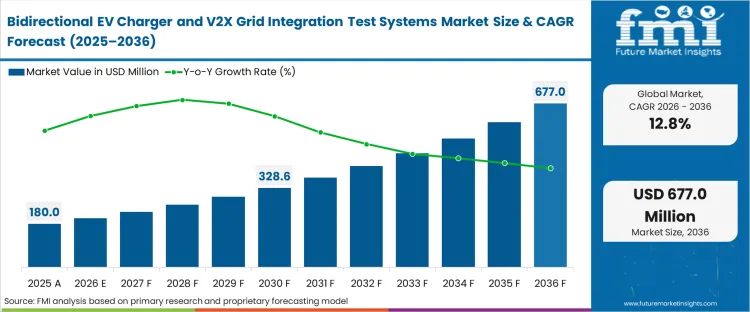
Bidirectional EV Charger and V2X Grid Integration Test Systems Market Key Takeaways
| Metric | Details |
|---|---|
| Industry Size (2026) | USD 203.0 million |
| Industry Value (2036) | USD 680.0 million |
| CAGR (2026 to 2036) | 12.80% |
Source: Future Market Insights (FMI) analysis, based on proprietary forecasting model and primary research
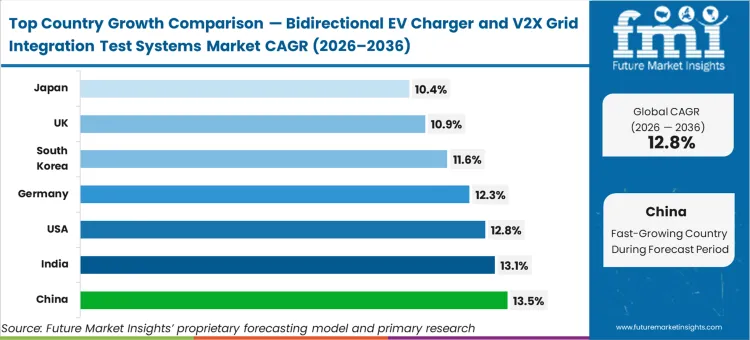
China leads at 13.5% CAGR, leveraging centralized mandates integrating high-voltage fleets directly into national dispatch networks. India tracks at 13.1% driven by indigenous efforts stabilizing fragile regional microgrids using commercial bus platforms. United States advances at 12.8% following federal funding tying infrastructure grants to strict interoperability proof. Germany reaches 12.3% as premium automakers engineer proprietary vehicle grid discharge protocols. South Korea expands at 11.6% alongside dense battery manufacturing clusters demanding rapid qualification. United Kingdom hits 10.9% testing smart-charging models for municipal fleets. Japan grows at 10.4% transitioning established hybrid islanding architectures toward pure battery platforms. Regional divergence centers precisely on whether utilities or automakers dictate interconnection codes.
Bidirectional EV Charger and V2X Grid Integration Test Systems Market Definition
Bidirectional EV charger and V2X grid integration test systems consist of hardware simulators and software protocol analyzers designed to validate power export capabilities from electric vehicles. These platforms simulate grid anomalies, verify cryptographic communication, and ensure onboard inverters synchronize perfectly with utility infrastructure before initiating energy discharge.
Bidirectional EV Charger and V2X Grid Integration Test Systems Market Inclusions
The defined scope covers four-quadrant power amplifiers, automated TTCN-3 conformance suites, hardware-in-the-loop benches, and battery emulators supporting continuous current reversal. It also includes platforms designed for conformance testing against bidirectional electric vehicle charger standards. Systems purpose-built for V2G communication test bench applications are fully aligned with this analytical framework.
Bidirectional EV Charger and V2X Grid Integration Test Systems Market Exclusions
Standard unidirectional DC fast-charging testers lacking power-reversal capabilities sit outside scope. Basic mechanical dynamometers lacking utility interconnection testing for EV chargers remain excluded. End-of-line manufacturing inspection equipment focusing purely on continuity rather than complex protocol timing fails to meet inclusion criteria. Generic multimeters provide zero grid synchronization data.
Bidirectional EV Charger and V2X Grid Integration Test Systems Market Research Methodology
- Primary Research: Chief electrical engineers, utility interconnection managers, and standard certification laboratory directors
- Desk Research: CharIN compliance registries, IEEE 1547 interconnection filings, and OEM validation specification documents
- Market-Sizing and Forecasting: Capital expenditure budgets for grid-emulation test facilities and automated test software licensing
- Data Validation and Update Cycle: Four-quadrant amplifier shipment volumes cross-referenced against regional V2X pilot project funding
Segmental Analysis
Bidirectional EV Charger and V2X Grid Integration Test Systems Market Analysis by Equipment Type
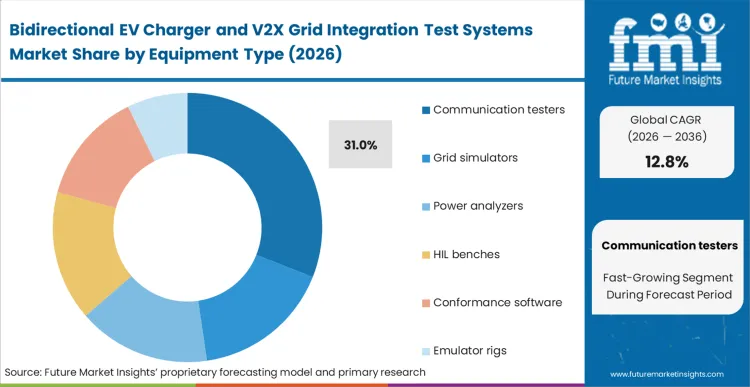
Communication testers are projected to capture 31.0% share in 2026. According to FMI's estimates, these platforms allow validation engineers decoding encrypted data packets flowing between vehicles and utility backend servers. Test facility directors operating massive grid simulators frequently fail certification because their conformance software cannot process ISO 15118 20 charging certificates within strict microsecond deadlines. Hardware capacity means absolutely nothing if logical authorization fails. Implementing advanced charger cybersecurity validation tools ensures vehicles survive sophisticated penetration attacks. Relying on outdated protocol sniffers guarantees vehicles fail official CharIN interoperability events.
- Validation sequence: Network engineers verify precise logical state machines before engaging physical contactors. Blind high-voltage testing destroys costly prototypes instantly.
- Cost mechanics: Procurement leads avoid writing custom scripts costing thousands of engineering hours. Purchasing off-the-shelf bidirectional charging TLS testing suites ensures rapid project progression.
- Performance boundary: Software architects demand systems handling complex cryptographic keys flawlessly. Dropping a single security packet terminates simulated discharge sessions permanently.
Bidirectional EV Charger and V2X Grid Integration Test Systems Market Analysis by Test Scope
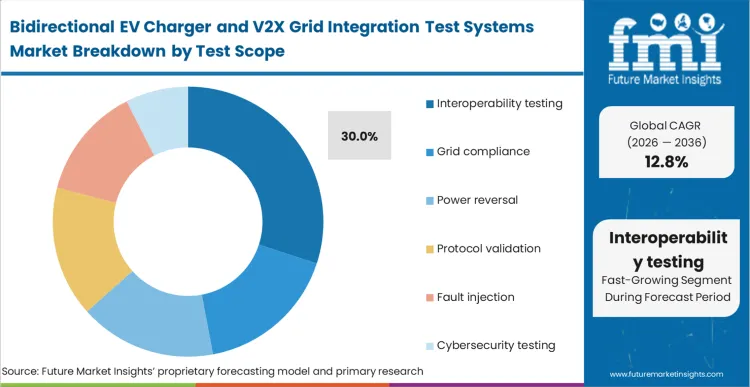
Resolving timing discrepancies between proprietary vehicle software and fragmented utility networks requires specialized diagnostics. Interoperability testing is expected to lead with 30.0% share. FMI's analysis indicates electric vehicle on board charger development relies entirely on proving compatibility across thousands of unique dispenser variations. What generalists miss regarding power reversal is that interoperability goes beyond connector fit; it demands perfect synchronization with dynamic grid voltage profiles that change continuously. Understanding V2G conformance testing vs interoperability testing dictates proper laboratory procurement strategies. Executing rigorous V2G charger interoperability testing prevents catastrophic software translation errors between proprietary vehicle protocols and fragmented utility networks. Attempting commercial deployment without simulating these messy real-world electrical environments exposes automakers to immense liability.
- Fault prevention: Systems integrators simulate severe voltage sags testing how inverters react. Graceful degradation prevents neighborhood brownouts.
- Hidden operational cost: Validation managers maintain massive test matrices matching every over-the-air vehicle update. Broken backward compatibility generates immediate driver complaints.
- Lifecycle reality: Diagnostic teams utilize captured field data recreating failure scenarios inside controlled laboratory environments. Guessing at root causes wastes engineering resources.
Bidirectional EV Charger and V2X Grid Integration Test Systems Market Analysis by Standard Coverage
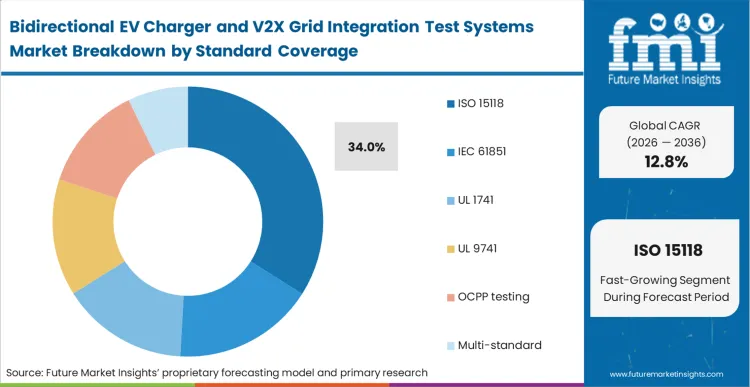
Global harmonization efforts coalesce around unified cryptographic frameworks enabling secure bidirectional energy transfer. ISO 15118 is anticipated to secure 34.0% share. Based on FMI's assessment, European and North American regulators increasingly mandate this specific protocol governing public BEV on board charger deployments. Procurement directors frequently ask what standards are driving V2X charger test equipment demand before finalizing laboratory capital expenditures. Complying with this standard requires emulating highly complex public key infrastructure locally. Many startups incorrectly assume they can pass compliance using manual fault injection. Knowing exactly how is ISO 15118-20 validated for V2G dictates successful product launches. ISO 15118 mandates executing thousands of automated edge-case scenarios exactly as specified by standard definitions.
- Supply landscape: Certification authorities deploy fully integrated hardware verifying digital signatures autonomously. Manual verification proves mathematically impossible.
- Constraint factor: Software leads require modular test systems adapting immediately whenever CharIN publishes updated test cases. Static platforms become obsolete within months.
- Trajectory shift: Emerging utility contracts require documented ISO 15118 conformance securing grid interconnection approval. Non-compliant hardware faces severe deployment restrictions.
Bidirectional EV Charger and V2X Grid Integration Test Systems Market Analysis by End Use
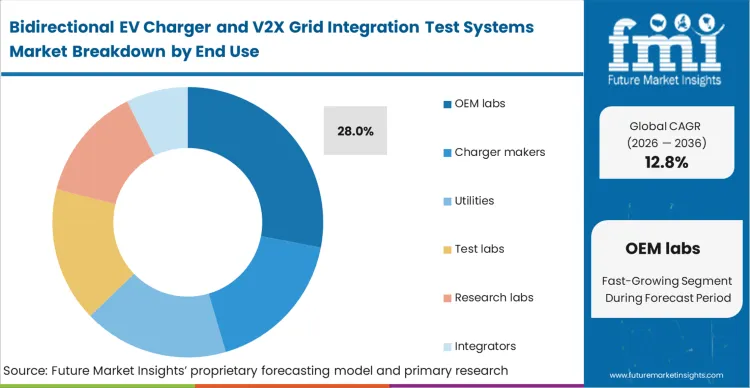
Automakers maintain absolute control over discharge algorithms protecting expensive vehicle battery packs from rapid degradation. OEM labs are poised to account for 28.0% share. In FMI's view, chief engineers construct dedicated AC BEV on board charger testing hubs ensuring proprietary power electronics execute grid commands perfectly. Utilizing power electronics HIL for chargers prevents tier-1 suppliers blaming utility networks when power reversal fails during early customer trials. Executing definitive root-cause analysis requires identical equipment duplicating third-party certification laboratory setups perfectly. Deploying bidirectional OBC HIL testing platforms guarantees rigorous verification across extreme temperature gradients. Centralizing this validation accelerates internal sign-off procedures drastically.
- Decision criteria: Engineering directors refuse delegating crucial grid-compliance verification to external suppliers. Protecting brand reputation demands exhaustive internal testing capacity.
- Operational burden: Global automakers must test Asian, European, and American grid codes simultaneously. Replicating diverse utility profiles requires massive programmable grid simulators.
- Expansion friction: Test lab managers face multi-million-dollar infrastructure costs supporting megawatt-level regenerative testing capabilities. Basic commercial power drops cannot handle continuous bidirectional cycling.
Bidirectional EV Charger and V2X Grid Integration Test Systems Market Analysis by V2X Mode
V2G systems are estimated to lead with 39.0% share. FMI analysts note grid operators demand flawless phase matching before allowing any electric vehicle charging station to push current back onto public distribution networks. What distinguishes V2G emulation is sheer scale; simulating a single vehicle interacting with a localized home panel ignores complex aggregator logic coordinating thousands of vehicles across regional utility topologies. Perfecting charger export-mode testing ensures inverters match dynamic frequency shifts instantaneously. Validating massive distributed energy resource interconnection testing protocols separates advanced V2G deployments from simple backup power applications.
- Economic trigger: Fleet operators require certified equipment bidding vehicle batteries into ancillary service markets. Failing qualification blocks major revenue streams.
- Adoption sequence: Bus operators deploy dedicated V2G infrastructure maximizing asset utilization during idle overnight hours. Consumer retail applications follow later.
- Qualification threshold: Power electronics engineers must prove their inverters generate perfectly clean sine waves. Injecting dirty power triggers utility protection relays instantly.
Bidirectional EV Charger and V2X Grid Integration Test Systems Market Drivers, Restraints, and Opportunities
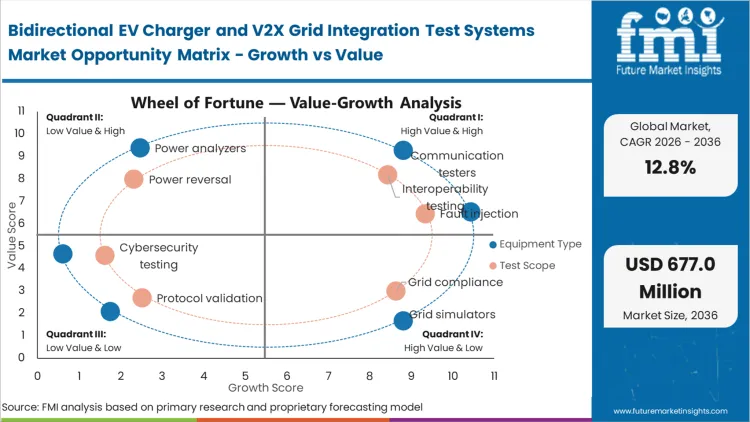
Liability risks surrounding local transformer damage force automakers into exhaustive grid emulation testing. Releasing a bidirectional vehicle that accidentally trips neighborhood protection relays guarantees massive utility backlash and immediate commercial bans. Systems integration managers require platforms capable of simulating severe grid anomalies, proving onboard inverters disconnect safely during external blackouts. Validating these anti-islanding protocols accurately makes advanced EV charger simulation capacity a hard constraint on overall brand deployment schedules. Regulatory bodies defining exactly what standards apply to bidirectional EV charging tests dictate minimum hardware requirements globally.
Absence of finalized, universally accepted grid codes cripples testing throughput globally. Different municipal utility networks enforce highly specific, disjointed interconnection requirements demanding customized testing scripts. Validation engineers struggle maintaining dozens of regional compliance variations simultaneously on single laboratory benches. Evaluating bidirectional charging validation systems reveals severe interoperability gaps across competing hardware ecosystems. Attempting to harmonize local utility demands with global automotive software releases creates massive engineering bottlenecks that basic hardware cannot resolve.
Opportunities in the Bidirectional EV Charger and V2X Grid Integration Test Systems Market
- Automated TTCN-3 compliance generation: Certification laboratories waste countless hours executing scripts manually. Software generating official CharIN reports autonomously captures massive operational efficiencies.
- Cybersecurity penetration modules: Procurement teams initiating a request quote V2G charger test bench evaluation must verify native threat modeling integration immediately. Benches injecting sophisticated cyberattacks into communication layers secure premium pricing.
- Cloud-connected digital twins: Test facility managers require systems continuously validating over-the-air vehicle updates against real-time utility profiles. Connecting laboratory hardware with live automotive test equipment telemetry unlocks highly lucrative continuous-validation contracts.
Regional Analysis
.webp "Top Country Growth Comparison Bidirectional Ev Charger And V2x Grid Integration Test Systems Market Cagr (2026 2036)")
Based on regional analysis, bidirectional EV charger and V2X grid integration test systems market is segmented into North America, Latin America, Western Europe, Eastern Europe, Asia Pacific, and Middle East & Africa across 40 plus countries.
| Country | CAGR (2026 to 2036) |
|---|---|
| China | 13.5% |
| India | 13.1% |
| United States | 12.8% |
| Germany | 12.3% |
| South Korea | 11.6% |
| United Kingdom | 10.9% |
| Japan | 10.4% |
Source: Future Market Insights (FMI) analysis, based on proprietary forecasting model and primary research
Asia Pacific Bidirectional EV Charger and V2X Grid Integration Test Systems Market Analysis
State-directed energy policies mandate aggressive integration bridging transportation fleets with strained regional power grids. Regional engineering directors construct massive centralized simulation facilities replicating complex utility dynamics locally. FMI observes rapid proliferation of ultra-high-power infrastructure pushing vendors delivering extreme precision. Failing to emulate grid behavior accurately at elevated power levels destroys costly prototype inverters during late-stage trials.
- China: Domestic transit operators integrate high-voltage bus fleets directly into national dispatch networks. R&D directors build centralized simulation mega-hubs handling complex V2G validation, driving 13.5% compound growth. Procurement executives evaluating China bidirectional EV charger test systems prioritize seamless cloud backend compatibility. Surpassing basic EV charge cable and connector durability test equipment checks, local manufacturers master grid synchronization securing lucrative state contracts.
- India: Fragile regional microgrids require ruggedized islanding protocols tolerating severe voltage fluctuations. Test facility managers focus on thermal-communication interaction under extreme stress, expanding at 13.1%. Validating cost-effective bidirectional systems creates specialized localized engineering capabilities bridging critical infrastructure gaps.
- South Korea: Dense battery supply chains dictate tight integration between cell safety controllers and external grid logic. Validation leads deploy sophisticated multi-domain platforms tracking at 11.6%. Securing rapid qualification for advanced ultra fast charging EV battery systems capable of power reversal dictates global competitive readiness.
- Japan: Established CHAdeMO bidirectional architectures transition toward global standard compatibility as export requirements evolve. Chief engineers shift procurement toward comprehensive multi-protocol benches, growing at 10.4%. Bridging this technical transition requires immense capital deploying automated software suites.
North America Bidirectional EV Charger and V2X Grid Integration Test Systems Market Analysis
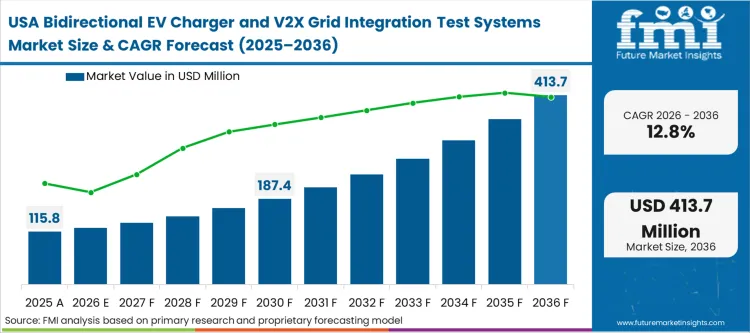
Lucrative federal infrastructure grants are increasingly contingent on documented interoperability performance. Procurement specialists must work within strict deadlines to prove that hardware operates seamlessly with fragmented utility networks across different regions. To reduce this risk, systems integration managers rely on advanced software platforms that uncover digital handshake faults before any vehicle initiates physical power reversal, improving validation confidence and supporting grant-linked deployment eligibility.
- United States: Evolving IEEE 1547 interconnection mandates require unprecedented grid compliance verification. Facilities directors deploy sophisticated cryptographic testing suites securing 12.8% growth in laboratory procurement. Purchasing advanced United States V2G charger test equipment ensures rapid certification across fragmented municipal utilities. Mastering automated secure authentication prevents commercial EV charging cables from causing localized transformer damage during unauthorized discharge events.
Western Europe Bidirectional EV Charger and V2X Grid Integration Test Systems Market Analysis
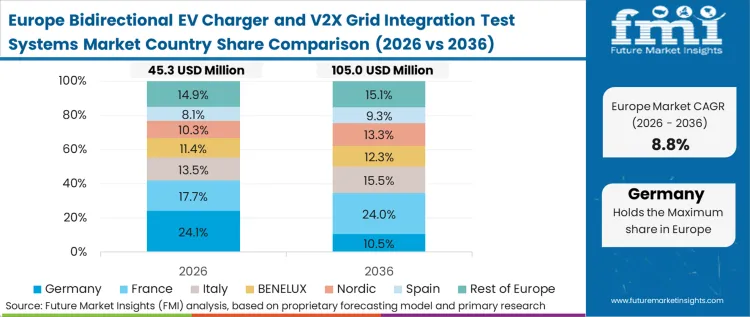
Stringent cybersecurity mandates force European test laboratories deploying ultra-high-fidelity fault injection tools. Calibration engineers demand microsecond-level precision validating ISO 15118-20 encryption sequences perfectly. Standard unidirectional testing ignores complex backend negotiations required sending power back into public grids safely.
- Germany: Premium automakers mandate strict ISO 15118 compliance across all supplier tiers maintaining brand prestige. Test facility managers expand cryptographic validation capacity at 12.3%. Implementing precise ISO 15118-20 bidirectional charging test systems solidifies regional automotive engineering dominance globally. This dense testing infrastructure prevents embarrassing field failures across sophisticated European grid interconnections.
- United Kingdom: Municipal councils launch specialized smart-charging trials demanding unique fleet validation metrics. Systems integration managers leverage rapid prototyping communication platforms, driving 10.9% growth. Proving grid-friendly algorithms unlocks specialized commercial transit contracts instantly.
Competitive Aligners for Market Players
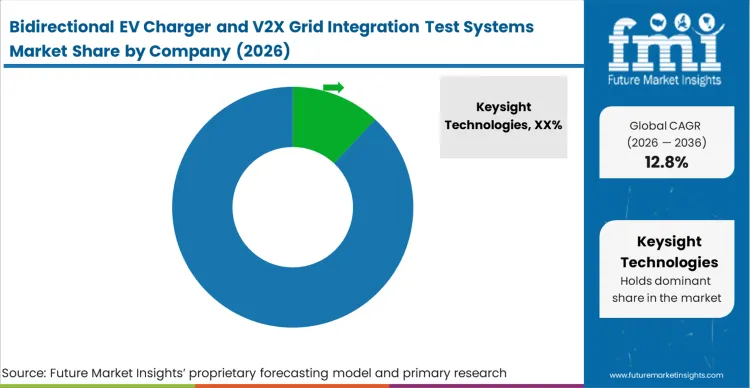
A strong software base has become essential for survival in this testing market. Systems engineers usually favor platforms that can run complex ISO 15118-20 test cases immediately, because very few development teams have the time to build TTCN-3 compliance scripts from scratch. Manual script development can consume too much engineering time for today’s electric vehicle programs. That is why facility teams looking at V2G charger test systems usually place much more weight on pre-validated protocol libraries than on hardware specifications alone.
Another important factor is alignment with certification labs. When independent testing and certification centers begin using a particular protocol emulator or compliance setup, automotive OEMs often move in the same direction. Engineering teams know that working with hardware configurations already familiar to certifiers can reduce friction during final approval. This gives suppliers with strong laboratory relationships a clear advantage, especially when those relationships influence wider equipment purchasing decisions across the industry.
The market is also being shaped by how quickly vendors can update software. Grid codes, communication protocols, and cybersecurity requirements keep evolving, so buyers expect testing platforms to stay current without long delays. Validation teams are more comfortable with systems that receive regular updates and keep pace with changing standards. Vendors that are slow to update can leave customers struggling to validate the latest controller logic. That is why software maintenance and compliance library updates are becoming just as important as the hardware itself.
Key Players in Bidirectional EV Charger and V2X Grid Integration Test Systems Market
- Keysight Technologies
- dSPACE
- Vector Informatik
- Typhoon HIL
- OPAL-RT Technologies
Scope of the Report
| Metric | Value |
|---|---|
| Quantitative Units | USD 203.0 million to USD 680.0 million, at a CAGR of 12.80% |
| Market Definition | Bidirectional EV charger and V2X grid integration test systems consist of hardware simulators and software protocol analyzers designed to validate power export capabilities from electric vehicles. |
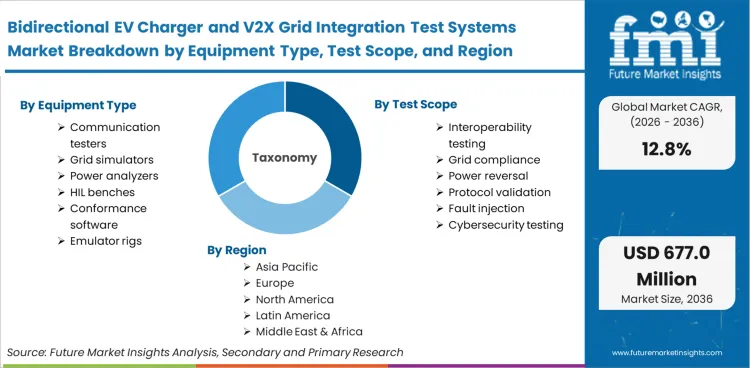
| Segmentation | By Equipment Type, Test Scope, Standard Coverage, End Use, V2X Mode, and Region |
| Regions Covered | North America, Latin America, Western Europe, Eastern Europe, Asia Pacific, Middle East & Africa |
| Countries Covered | China, India, United States, Germany, South Korea, United Kingdom, Japan |
| Key Companies Profiled | Keysight Technologies, dSPACE, Vector Informatik, Typhoon HIL, OPAL-RT Technologies |
| Forecast Period | 2026 to 2036 |
| Approach | FMI connects amplifier shipment tracking with software subscription data modeling true validation capacity accurately. |
Source: Future Market Insights (FMI) analysis, based on proprietary forecasting model and primary research
Bidirectional EV Charger and V2X Grid Integration Test Systems Market Analysis by Segments
By Equipment Type
- Communication testers
- Grid simulators
- Power analyzers
- HIL benches
- Conformance software
- Emulator rigs
By Test Scope
- Interoperability testing
- Grid compliance
- Power reversal
- Protocol validation
- Fault injection
- Cybersecurity testing
By Standard Coverage
- ISO 15118
- IEC 61851
- UL 1741
- UL 9741
- OCPP testing
- Multi-standard
By End Use
- OEM labs
- Charger makers
- Utilities
- Test labs
- Research labs
- Integrators
By V2X Mode
- V2G systems
- V2H systems
- V2B systems
- V2L systems
- Fleet V2X
By Region
- North America
- United States
- Canada
- Latin America
- Brazil
- Mexico
- Western Europe
- Germany
- United Kingdom
- France
- Italy
- Spain
- Eastern Europe
- Poland
- Russia
- Czech Republic
- Asia Pacific
- China
- Japan
- India
- South Korea
- Australia
- Middle East & Africa
- GCC Countries
- South Africa
Bibliography
- Charging Interface Initiative e.V. (2024, September 4). CharIN Interoperability Guide 2.0: Minimum scope for implementation of ISO 15118-20 DC bidirectional power transfer in dynamic control mode for development and testing purposes only (Version 1.0).
- Kisacikoglu, M. J., Harper, J. D., Kandula, R. P., Thurlbeck, A. P., Ali, A. S., Ucer, E., Watt, E., Khan, M. S. U., & Mahmud, R. (2024, April). High-power electric vehicle charging hub integration platform (eCHIP): Design guidelines and specifications for DC distribution-based charging hub. National Renewable Energy Laboratory.
- USA Department of Energy, Office of Electricity. (2024, June). Impact of electric vehicles on the grid: Report to Congress.
- Salcido, V. R., Tillou, M., Franconi, E., Cheslak, K., & Young, M. (2024, December). Electric vehicle charging for residential and commercial energy codes: Technical brief. Pacific Northwest National Laboratory.
- SAE International. (2024, January 22). J3068/2_202401 control of bidirectional power for AC conductive charging.
This bibliography is provided for reader reference. The full FMI report contains the complete reference list with primary source documentation.
This Report Addresses
- Liability shifts forcing automotive engineering directors to solve utility-scale power quality problems during power reversal emulation
- Cryptographic processing bottlenecks causing test laboratories to fail ISO 15118-20 certification audits
- Substation harmonic distortion risks driving demand for advanced programmable grid simulators
- Firmware regression testing requirements expanding cloud-connected hardware-in-the-loop laboratory infrastructure
- Fragmented regional utility grid codes creating massive testing matrices for global OEM platforms
- Anti-islanding protocol verification ensuring onboard inverters disconnect safely during neighborhood blackout simulations
- Fleet capacity market qualifications compelling transit operators to demand documented V2G interoperability proofs
- Cybersecurity penetration tools preventing malicious actors from weaponizing decentralized electric vehicle batteries
Frequently Asked Questions
What is bidirectional EV charger testing?
Evaluating power export capabilities involves testing digital handshakes between vehicles and utility infrastructure. Engineering teams verify communication packets ensuring onboard inverters synchronize perfectly with grid voltage before allowing energy reversal.
How are V2G chargers tested?
Executing rigorous V2G charger validation requires pairing hardware-in-the-loop platforms with automated TTCN-3 software suites. Procurement leads avoid manual testing, utilizing platforms decoding encrypted ISO 15118-20 certificates instantaneously across simulated utility networks.
Why does V2X grid integration need test systems?
Liability risks surrounding local transformer damage force automakers into exhaustive grid emulation testing. Injecting harmonic distortion into neighborhood transformers guarantees immediate deployment bans; validating anti-islanding protocols accurately prevents neighborhood blackouts.
What standards apply to bidirectional EV charging tests?
Global harmonization efforts coalesce around unified cryptographic frameworks enabling secure energy transfer. European and North American regulators increasingly mandate ISO 15118, alongside localized variants like UL 9741 and IEEE 1547.
How is ISO 15118-20 validated for V2G?
Complying with this standard requires emulating highly complex public key infrastructure locally. Certification authorities deploy fully integrated hardware verifying digital signatures autonomously, checking microsecond timing errors.
What is the difference between V2G and V2H testing?
Simulating a single vehicle interacting with a localized home panel ignores complex aggregator logic coordinating thousands of vehicles across regional utility topologies. V2G demands massive backend communication validation mimicking entire dispatch networks.
Can one system test V2G V2H and V2B chargers?
Evaluating modular test environments reveals sophisticated platforms successfully replicate diverse utility profiles spanning commercial and residential boundaries. Validating multiple bidirectional modes relies heavily on dynamic software updates accommodating rapid grid code revisions.
Explain the bidirectional EV charger test systems market trajectory?
Utility interconnection mandates force automakers simulating localized transformer loads before releasing commercial bidirectional functionality. Centralizing this validation accelerates internal sign-off procedures drastically while securing compliance.
What does ISO 15118-20 change for charger testing?
Ratification of advanced cryptographic standards forces mass upgrades across legacy testing laboratories. Automakers require automated platforms validating complex digital certificates in milliseconds before physical contactors close.
Which companies are active in this landscape?
Keysight Technologies, dSPACE, Vector Informatik, Typhoon HIL, OPAL-RT Technologies, and Intertek represent leading vendors providing robust TTCN-3 compliance integration.
Why do fleet operators demand certified V2G hardware?
Commercial fleet operators compel infrastructure providers proving flawless compatibility across disjointed municipal utility networks. Bidding vehicle batteries into ancillary service markets requires certified equipment verifying power quality output.
How does India approach bidirectional grid integration?
Fragile regional microgrids require ruggedized islanding protocols tolerating severe voltage fluctuations. Test facility managers focus on thermal-communication interaction under extreme stress, creating specialized localized engineering capabilities.
What competitive advantage do automated conformance suites offer?
Certification laboratories waste countless hours executing scripts manually. Software generating official CharIN reports autonomously captures massive operational efficiencies, allowing facilities to outcompete rivals relying on outdated manual script execution.
Preview the report firsthand - request a free sample
Get SampleGet the brochure for pricing and purchase details.
Get PDFTable of Content
- Executive Summary
- Global Market Outlook
- Demand-side Trends
- Supply-side Trends
- Technology Roadmap Analysis
- Analysis and Recommendations
- Market Overview
- Market Coverage / Taxonomy
- Market Definition / Scope / Limitations
- Research Methodology
- Chapter Orientation
- Analytical Lens and Working Hypotheses
- Market Structure, Signals, and Trend Drivers
- Benchmarking and Cross-market Comparability
- Market Sizing, Forecasting, and Opportunity Mapping
- Research Design and Evidence Framework
- Desk Research Programme (Secondary Evidence)
- Company Annual and Sustainability Reports
- Peer-reviewed Journals and Academic Literature
- Corporate Websites, Product Literature, and Technical Notes
- Earnings Decks and Investor Briefings
- Statutory Filings and Regulatory Disclosures
- Technical White Papers and Standards Notes
- Trade Journals, Industry Magazines, and Analyst Briefs
- Conference Proceedings, Webinars, and Seminar Materials
- Government Statistics Portals and Public Data Releases
- Press Releases and Reputable Media Coverage
- Specialist Newsletters and Curated Briefings
- Sector Databases and Reference Repositories
- FMI Internal Proprietary Databases and Historical Market Datasets
- Subscription Datasets and Paid Sources
- Social Channels, Communities, and Digital Listening Inputs
- Additional Desk Sources
- Expert Input and Fieldwork (Primary Evidence)
- Primary Modes
- Qualitative Interviews and Expert Elicitation
- Quantitative Surveys and Structured Data Capture
- Blended Approach
- Why Primary Evidence is Used
- Field Techniques
- Interviews
- Surveys
- Focus Groups
- Observational and In-context Research
- Social and Community Interactions
- Stakeholder Universe Engaged
- C-suite Leaders
- Board Members
- Presidents and Vice Presidents
- R&D and Innovation Heads
- Technical Specialists
- Domain Subject-matter Experts
- Scientists
- Physicians and Other Healthcare Professionals
- Governance, Ethics, and Data Stewardship
- Research Ethics
- Data Integrity and Handling
- Primary Modes
- Tooling, Models, and Reference Databases
- Desk Research Programme (Secondary Evidence)
- Data Engineering and Model Build
- Data Acquisition and Ingestion
- Cleaning, Normalisation, and Verification
- Synthesis, Triangulation, and Analysis
- Quality Assurance and Audit Trail
- Market Background
- Market Dynamics
- Drivers
- Restraints
- Opportunity
- Trends
- Scenario Forecast
- Demand in Optimistic Scenario
- Demand in Likely Scenario
- Demand in Conservative Scenario
- Opportunity Map Analysis
- Product Life Cycle Analysis
- Supply Chain Analysis
- Investment Feasibility Matrix
- Value Chain Analysis
- PESTLE and Porter’s Analysis
- Regulatory Landscape
- Regional Parent Market Outlook
- Production and Consumption Statistics
- Import and Export Statistics
- Market Dynamics
- Global Market Analysis 2021 to 2025 and Forecast, 2026 to 2036
- Historical Market Size Value (USD Million) Analysis, 2021 to 2025
- Current and Future Market Size Value (USD Million) Projections, 2026 to 2036
- Y-o-Y Growth Trend Analysis
- Absolute $ Opportunity Analysis
- Global Market Pricing Analysis 2021 to 2025 and Forecast 2026 to 2036
- Global Market Analysis 2021 to 2025 and Forecast 2026 to 2036, By Equipment Type
- Introduction / Key Findings
- Historical Market Size Value (USD Million) Analysis By Equipment Type , 2021 to 2025
- Current and Future Market Size Value (USD Million) Analysis and Forecast By Equipment Type , 2026 to 2036
- Communication testers
- Grid simulators
- Power analyzers
- HIL benches
- Conformance software
- Emulator rigs
- Communication testers
- Y-o-Y Growth Trend Analysis By Equipment Type , 2021 to 2025
- Absolute $ Opportunity Analysis By Equipment Type , 2026 to 2036
- Global Market Analysis 2021 to 2025 and Forecast 2026 to 2036, By Test Scope
- Introduction / Key Findings
- Historical Market Size Value (USD Million) Analysis By Test Scope, 2021 to 2025
- Current and Future Market Size Value (USD Million) Analysis and Forecast By Test Scope, 2026 to 2036
- Interoperability testing
- Grid compliance
- Power reversal
- Protocol validation
- Fault injection
- Cybersecurity testing
- Interoperability testing
- Y-o-Y Growth Trend Analysis By Test Scope, 2021 to 2025
- Absolute $ Opportunity Analysis By Test Scope, 2026 to 2036
- Global Market Analysis 2021 to 2025 and Forecast 2026 to 2036, By Standard Coverage
- Introduction / Key Findings
- Historical Market Size Value (USD Million) Analysis By Standard Coverage, 2021 to 2025
- Current and Future Market Size Value (USD Million) Analysis and Forecast By Standard Coverage, 2026 to 2036
- ISO 15118
- IEC 61851
- UL 1741
- UL 9741
- OCPP testing
- Multi-standard
- ISO 15118
- Y-o-Y Growth Trend Analysis By Standard Coverage, 2021 to 2025
- Absolute $ Opportunity Analysis By Standard Coverage, 2026 to 2036
- Global Market Analysis 2021 to 2025 and Forecast 2026 to 2036, By End Use
- Introduction / Key Findings
- Historical Market Size Value (USD Million) Analysis By End Use, 2021 to 2025
- Current and Future Market Size Value (USD Million) Analysis and Forecast By End Use, 2026 to 2036
- OEM labs
- Charger makers
- Utilities
- Test labs
- Research labs
- Integrators
- OEM labs
- Y-o-Y Growth Trend Analysis By End Use, 2021 to 2025
- Absolute $ Opportunity Analysis By End Use, 2026 to 2036
- Global Market Analysis 2021 to 2025 and Forecast 2026 to 2036, By V2X Mode
- Introduction / Key Findings
- Historical Market Size Value (USD Million) Analysis By V2X Mode, 2021 to 2025
- Current and Future Market Size Value (USD Million) Analysis and Forecast By V2X Mode, 2026 to 2036
- V2G systems
- V2H systems
- V2B systems
- V2L systems
- Fleet V2X
- V2G systems
- Y-o-Y Growth Trend Analysis By V2X Mode, 2021 to 2025
- Absolute $ Opportunity Analysis By V2X Mode, 2026 to 2036
- Global Market Analysis 2021 to 2025 and Forecast 2026 to 2036, By Region
- Introduction
- Historical Market Size Value (USD Million) Analysis By Region, 2021 to 2025
- Current Market Size Value (USD Million) Analysis and Forecast By Region, 2026 to 2036
- North America
- Latin America
- Western Europe
- Eastern Europe
- East Asia
- South Asia and Pacific
- Middle East & Africa
- Market Attractiveness Analysis By Region
- North America Market Analysis 2021 to 2025 and Forecast 2026 to 2036, By Country
- Historical Market Size Value (USD Million) Trend Analysis By Market Taxonomy, 2021 to 2025
- Market Size Value (USD Million) Forecast By Market Taxonomy, 2026 to 2036
- By Country
- USA
- Canada
- Mexico
- By Equipment Type
- By Test Scope
- By Standard Coverage
- By End Use
- By V2X Mode
- By Country
- Market Attractiveness Analysis
- By Country
- By Equipment Type
- By Test Scope
- By Standard Coverage
- By End Use
- By V2X Mode
- Key Takeaways
- Latin America Market Analysis 2021 to 2025 and Forecast 2026 to 2036, By Country
- Historical Market Size Value (USD Million) Trend Analysis By Market Taxonomy, 2021 to 2025
- Market Size Value (USD Million) Forecast By Market Taxonomy, 2026 to 2036
- By Country
- Brazil
- Chile
- Rest of Latin America
- By Equipment Type
- By Test Scope
- By Standard Coverage
- By End Use
- By V2X Mode
- By Country
- Market Attractiveness Analysis
- By Country
- By Equipment Type
- By Test Scope
- By Standard Coverage
- By End Use
- By V2X Mode
- Key Takeaways
- Western Europe Market Analysis 2021 to 2025 and Forecast 2026 to 2036, By Country
- Historical Market Size Value (USD Million) Trend Analysis By Market Taxonomy, 2021 to 2025
- Market Size Value (USD Million) Forecast By Market Taxonomy, 2026 to 2036
- By Country
- Germany
- UK
- Italy
- Spain
- France
- Nordic
- BENELUX
- Rest of Western Europe
- By Equipment Type
- By Test Scope
- By Standard Coverage
- By End Use
- By V2X Mode
- By Country
- Market Attractiveness Analysis
- By Country
- By Equipment Type
- By Test Scope
- By Standard Coverage
- By End Use
- By V2X Mode
- Key Takeaways
- Eastern Europe Market Analysis 2021 to 2025 and Forecast 2026 to 2036, By Country
- Historical Market Size Value (USD Million) Trend Analysis By Market Taxonomy, 2021 to 2025
- Market Size Value (USD Million) Forecast By Market Taxonomy, 2026 to 2036
- By Country
- Russia
- Poland
- Hungary
- Balkan & Baltic
- Rest of Eastern Europe
- By Equipment Type
- By Test Scope
- By Standard Coverage
- By End Use
- By V2X Mode
- By Country
- Market Attractiveness Analysis
- By Country
- By Equipment Type
- By Test Scope
- By Standard Coverage
- By End Use
- By V2X Mode
- Key Takeaways
- East Asia Market Analysis 2021 to 2025 and Forecast 2026 to 2036, By Country
- Historical Market Size Value (USD Million) Trend Analysis By Market Taxonomy, 2021 to 2025
- Market Size Value (USD Million) Forecast By Market Taxonomy, 2026 to 2036
- By Country
- China
- Japan
- South Korea
- By Equipment Type
- By Test Scope
- By Standard Coverage
- By End Use
- By V2X Mode
- By Country
- Market Attractiveness Analysis
- By Country
- By Equipment Type
- By Test Scope
- By Standard Coverage
- By End Use
- By V2X Mode
- Key Takeaways
- South Asia and Pacific Market Analysis 2021 to 2025 and Forecast 2026 to 2036, By Country
- Historical Market Size Value (USD Million) Trend Analysis By Market Taxonomy, 2021 to 2025
- Market Size Value (USD Million) Forecast By Market Taxonomy, 2026 to 2036
- By Country
- India
- ASEAN
- Australia & New Zealand
- Rest of South Asia and Pacific
- By Equipment Type
- By Test Scope
- By Standard Coverage
- By End Use
- By V2X Mode
- By Country
- Market Attractiveness Analysis
- By Country
- By Equipment Type
- By Test Scope
- By Standard Coverage
- By End Use
- By V2X Mode
- Key Takeaways
- Middle East & Africa Market Analysis 2021 to 2025 and Forecast 2026 to 2036, By Country
- Historical Market Size Value (USD Million) Trend Analysis By Market Taxonomy, 2021 to 2025
- Market Size Value (USD Million) Forecast By Market Taxonomy, 2026 to 2036
- By Country
- Kingdom of Saudi Arabia
- Other GCC Countries
- Turkiye
- South Africa
- Other African Union
- Rest of Middle East & Africa
- By Equipment Type
- By Test Scope
- By Standard Coverage
- By End Use
- By V2X Mode
- By Country
- Market Attractiveness Analysis
- By Country
- By Equipment Type
- By Test Scope
- By Standard Coverage
- By End Use
- By V2X Mode
- Key Takeaways
- Key Countries Market Analysis
- USA
- Pricing Analysis
- Market Share Analysis, 2025
- By Equipment Type
- By Test Scope
- By Standard Coverage
- By End Use
- By V2X Mode
- Canada
- Pricing Analysis
- Market Share Analysis, 2025
- By Equipment Type
- By Test Scope
- By Standard Coverage
- By End Use
- By V2X Mode
- Mexico
- Pricing Analysis
- Market Share Analysis, 2025
- By Equipment Type
- By Test Scope
- By Standard Coverage
- By End Use
- By V2X Mode
- Brazil
- Pricing Analysis
- Market Share Analysis, 2025
- By Equipment Type
- By Test Scope
- By Standard Coverage
- By End Use
- By V2X Mode
- Chile
- Pricing Analysis
- Market Share Analysis, 2025
- By Equipment Type
- By Test Scope
- By Standard Coverage
- By End Use
- By V2X Mode
- Germany
- Pricing Analysis
- Market Share Analysis, 2025
- By Equipment Type
- By Test Scope
- By Standard Coverage
- By End Use
- By V2X Mode
- UK
- Pricing Analysis
- Market Share Analysis, 2025
- By Equipment Type
- By Test Scope
- By Standard Coverage
- By End Use
- By V2X Mode
- Italy
- Pricing Analysis
- Market Share Analysis, 2025
- By Equipment Type
- By Test Scope
- By Standard Coverage
- By End Use
- By V2X Mode
- Spain
- Pricing Analysis
- Market Share Analysis, 2025
- By Equipment Type
- By Test Scope
- By Standard Coverage
- By End Use
- By V2X Mode
- France
- Pricing Analysis
- Market Share Analysis, 2025
- By Equipment Type
- By Test Scope
- By Standard Coverage
- By End Use
- By V2X Mode
- India
- Pricing Analysis
- Market Share Analysis, 2025
- By Equipment Type
- By Test Scope
- By Standard Coverage
- By End Use
- By V2X Mode
- ASEAN
- Pricing Analysis
- Market Share Analysis, 2025
- By Equipment Type
- By Test Scope
- By Standard Coverage
- By End Use
- By V2X Mode
- Australia & New Zealand
- Pricing Analysis
- Market Share Analysis, 2025
- By Equipment Type
- By Test Scope
- By Standard Coverage
- By End Use
- By V2X Mode
- China
- Pricing Analysis
- Market Share Analysis, 2025
- By Equipment Type
- By Test Scope
- By Standard Coverage
- By End Use
- By V2X Mode
- Japan
- Pricing Analysis
- Market Share Analysis, 2025
- By Equipment Type
- By Test Scope
- By Standard Coverage
- By End Use
- By V2X Mode
- South Korea
- Pricing Analysis
- Market Share Analysis, 2025
- By Equipment Type
- By Test Scope
- By Standard Coverage
- By End Use
- By V2X Mode
- Russia
- Pricing Analysis
- Market Share Analysis, 2025
- By Equipment Type
- By Test Scope
- By Standard Coverage
- By End Use
- By V2X Mode
- Poland
- Pricing Analysis
- Market Share Analysis, 2025
- By Equipment Type
- By Test Scope
- By Standard Coverage
- By End Use
- By V2X Mode
- Hungary
- Pricing Analysis
- Market Share Analysis, 2025
- By Equipment Type
- By Test Scope
- By Standard Coverage
- By End Use
- By V2X Mode
- Kingdom of Saudi Arabia
- Pricing Analysis
- Market Share Analysis, 2025
- By Equipment Type
- By Test Scope
- By Standard Coverage
- By End Use
- By V2X Mode
- Turkiye
- Pricing Analysis
- Market Share Analysis, 2025
- By Equipment Type
- By Test Scope
- By Standard Coverage
- By End Use
- By V2X Mode
- South Africa
- Pricing Analysis
- Market Share Analysis, 2025
- By Equipment Type
- By Test Scope
- By Standard Coverage
- By End Use
- By V2X Mode
- USA
- Market Structure Analysis
- Competition Dashboard
- Competition Benchmarking
- Market Share Analysis of Top Players
- By Regional
- By Equipment Type
- By Test Scope
- By Standard Coverage
- By End Use
- By V2X Mode
- Competition Analysis
- Competition Deep Dive
- Keysight Technologies
- Overview
- Product Portfolio
- Profitability by Market Segments (Product/Age /Sales Channel/Region)
- Sales Footprint
- Strategy Overview
- Marketing Strategy
- Product Strategy
- Channel Strategy
- dSPACE
- Vector Informatik
- Typhoon HIL
- OPAL-RT Technologies
- Keysight Technologies
- Competition Deep Dive
- Assumptions & Acronyms Used


