

- Industry Size (2026)
- USD 15.85 Bn
- Forecast (2036)
- USD 98.98 Bn
- CAGR (2026 to 2036)
- 20.1%
AC BEV On-Board Charger Market Size, Market Forecast and Outlook By FMI
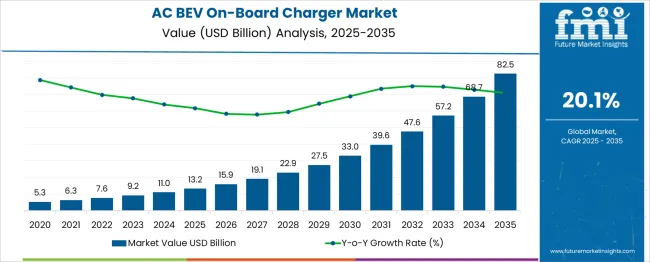
The AC BEV on-board charger market was valued at USD 13.20 billion in 2025, projected to reach USD 15.85 billion in 2026, and is forecast to expand to USD 98.98 billion by 2036 at a 20.1% CAGR. FMI analysts observe that the expansion is driven by accelerating battery electric vehicle production volumes, automaker migration from 7.4 kW baseline chargers toward 11 kW and 22 kW on-board charging architectures, and the integration of bidirectional (V2G/V2H) power electronics into next-generation charger modules. The on-board charger is transitioning from a passive AC-DC conversion component to an active energy management module within the vehicle's power electronics platform.
Summary of AC BEV On-Board Charger Market
- Market Snapshot
- The AC BEV on-board charger market is valued at USD 13.20 billion in 2025 and is projected to reach USD 98.98 billion by 2036.
- The industry is expected to grow at a 20.1% CAGR from 2026 to 2036, creating an incremental opportunity of USD 83.13 billion.
- The market is a production-volume-driven, power-electronics-intensive automotive component category where charging power rating, silicon carbide content, and bidirectional capability define competitive positioning.
- Demand and Growth Drivers
- Demand is rising as global BEV production volumes accelerate and automakers migrate from 7.4 kW baseline chargers to 11 kW and 22 kW on-board charging architectures.
- Bidirectional (V2G/V2H) power electronics integration is transforming the on-board charger from a passive converter to an active energy management module.
- Growth is further supported by silicon carbide power semiconductor adoption that enables higher power density and efficiency in compact on-board charger packages.
- Among key countries, India leads at 25.1% CAGR, followed by Germany at 23.1%, France at 21.1%, the UK at 19.1%, the USA at 17.1%, and Brazil at 15.1%.
- Product and Segment View
- The market includes AC-to-DC on-board charger modules installed in battery electric vehicles across 11 kW, greater than 11 kW to 22 kW, and greater than 22 kW power rating tiers.
- The greater than 11 kW to 22 kW rating segment leads with 47.3% share in 2026 as automakers standardize on three-phase AC charging capability.
- The scope includes on-board charger modules integrated into BEV power electronics platforms, while excluding external wallbox chargers, DC fast charging equipment, and plug-in hybrid (PHEV) on-board chargers.
- Integrated on-board charger and DC-DC converter modules are increasingly specified as a single procurement unit by automotive OEMs.
- Geography and Competitive Outlook
- India and Germany are the fastest-growing markets due to EV production incentives and OEM electrification mandates, while China represents the largest production volume base.
- Competition is shaped by power semiconductor sourcing, thermal management engineering, and OEM platform contract access, with key players including BorgWarner Inc., Valeo, Delta Energy Systems, Eaton Corporation, and Toyota Industries Corporation.
- FMI analysts note that the market is consolidating around suppliers offering integrated on-board charger and DC-DC converter modules with bidirectional capability.
- Analyst Opinion at FMI
- Nikhil Kaitwade, Principal Consultant for oil & Gas, opines,: 'In my analysis, I have observed that the primary competitive differentiator in AC BEV on-board chargers is shifting from raw power conversion efficiency to thermal management density and bidirectional power flow capability. OEM platform engineers who specify on-board chargers purely on charging power rating and cost per kilowatt are missing the value creation opportunity that V2G-ready architectures deliver through grid services revenue sharing. Tier-1 suppliers that cannot demonstrate certified bidirectional power flow compliance by 2028 model year nomination cycles will face exclusion from premium BEV platform contracts.'
- Strategic Implications / Executive Takeaways
- Power electronics suppliers must accelerate silicon carbide module qualification and secure long-term SiC wafer supply agreements to meet rising on-board charger power density specifications.
- Automotive OEM procurement teams should evaluate integrated on-board charger and DC-DC converter modules to reduce packaging volume and wiring harness complexity in next-generation BEV platforms.
- Fleet operators must assess V2G-ready on-board charger specifications in BEV procurement to enable future grid services revenue participation.
AC BEV On-Board Charger Market Key Takeaways
| Metric | Details |
|---|---|
| Industry Size (2026) | USD 15.85 billion |
| Industry Value (2036) | USD 98.98 billion |
| CAGR (2026-2036) | 20.1% |
Source: Future Market Insights, 2026
The market is adding an incremental opportunity of approximately USD 83.13 billion between 2026 and 2036. This growth reflects the structural increase in BEV production penetration across all major automotive markets combined with the per-vehicle content value increase as charging power ratings migrate upward. As per FMI, the shift from 11 kW to 22 kW on-board chargers doubles the silicon carbide power semiconductor content per unit, increasing component cost but enabling three-phase AC charging that halves charging time at compatible wallbox installations. Integrated on-board charger and DC-DC converter modules are reducing packaging volume while increasing power density, creating new procurement specifications that favor vertically integrated power electronics suppliers.
Regional growth trajectories mirror the geographic distribution of BEV production and adoption mandates. India sets the pace with a 25.1% CAGR, driven by EV production incentives under the FAME-III scheme and mandatory on-board charger standards for new BEV homologation. Germany follows at 23.1%, supported by its OEM concentration and EU CO2 fleet emission targets forcing accelerated BEV production ramp-ups. France registers a 21.1% pace, anchored by its automotive industry electrification strategy and fiscal incentives for BEV purchases. The United Kingdom advances at 19.1%, driven by the 2035 ICE sales ban timeline. The United States grows at 17.1%, supported by IRA tax credit qualification requirements for domestically produced BEV components. Brazil registers a 15.1% trajectory.
AC BEV On-Board Charger Market Definition
AC BEV on-board chargers are power electronics modules permanently installed within battery electric vehicles that convert alternating current from external AC charging infrastructure into direct current for battery charging. These modules operate across single-phase and three-phase AC input configurations at power ratings from 3.3 kW to over 22 kW, with emerging bidirectional variants enabling vehicle-to-grid and vehicle-to-home power flow.
AC BEV On-Board Charger Market Inclusions
Market scope includes all AC-to-DC on-board charger modules designed for permanent installation in battery electric vehicles. Single-phase and three-phase configurations across all power rating tiers are fully incorporated. Integrated on-board charger and DC-DC converter modules are included. Global and regional market sizes and segment-level analysis are covered.
AC BEV On-Board Charger Market Exclusions
External AC wallbox chargers, DC fast charging equipment (DCFC), portable EVSE cables, plug-in hybrid vehicle (PHEV) on-board chargers, and standalone DC-DC converters sold separately from on-board charger modules are excluded.
AC BEV On-Board Charger Market Research Methodology
- Primary Research: Analysts engaged with automotive OEM power electronics engineers, Tier-1 charger module suppliers, silicon carbide semiconductor manufacturers, and EV charging infrastructure planners to map specification trends and production volume forecasts.
- Desk Research: Data collection phases aggregated BEV production forecasts from automotive regulatory filings, OEM electrification investment announcements, and power semiconductor capacity expansion roadmaps.
- Market-Sizing and Forecasting: Baseline values derive from a bottom-up aggregation of BEV production volumes by region and platform, applying power-rating-specific on-board charger content values to project future revenue.
- Data Validation and Update Cycle: Projections are tested against publicly reported automotive electronics revenue from leading Tier-1 suppliers and cross-referenced with BEV production volume data from national vehicle registration databases.
Why is the AC BEV On-Board Charger Market Growing?
The AC BEV On-Board Charger market is witnessing significant momentum driven by increasing adoption of battery electric vehicles and the parallel development of charging infrastructure. Demand is being reinforced by supportive regulatory frameworks promoting zero-emission transportation and technological advancements improving charger efficiency and safety. Automotive OEMs, as seen in corporate announcements and investor presentations, are integrating higher capacity on-board chargers to meet consumer expectations for faster charging times without compromising battery longevity.
Energy and automotive industry journals have highlighted the growing focus on grid compatibility and bidirectional charging capabilities as further enhancing market attractiveness. Future outlook remains robust as governments expand incentives for electric mobility and manufacturers invest in scalable, software-driven charging technologies.
Sustainability goals and the rising awareness among consumers about total cost of ownership are also paving the way for continued market expansion. These combined factors are positioning the AC BEV On-Board Charger market for sustained growth in both mature and emerging economies.
Segmental Analysis
The AC BEV on-board charger market is segmented by rating and geographic regions. The AC BEV on-board charger market is rated into two categories >11 kW to 22 kW and 11 kW to 22 kW. Regionally, the AC BEV on-board charger industry is classified into North America, Latin America, Western Europe, Eastern Europe, Balkan & Baltic Countries, Russia & Belarus, Central Asia, East Asia, South Asia & Pacific, and the Middle East & Africa.
Insights into the > 11 kW to 22 kW Rating Segment
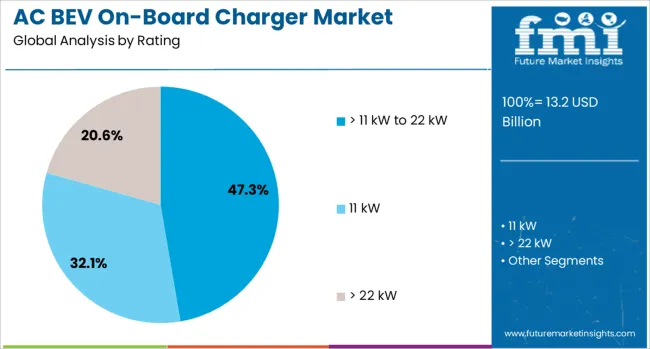
The > 11 kW to 22 kW rating segment is anticipated to command approximately 47.3% of the AC BEV On-Board Charger market revenue share in 2026, establishing it as the leading segment. This prominence is being driven by the increasing deployment of mid-to-high capacity chargers that offer a balance between faster charging speeds and compatibility with existing grid infrastructure, as observed in OEM technical documentation and industry updates.
Automotive manufacturers are integrating these chargers to ensure efficient energy transfer while maintaining battery health, aligning with consumer expectations for reduced charging times. Furthermore, industry publications have reported that the > 11 kW to 22 kW range offers optimal adaptability for both residential and commercial charging scenarios, making it widely suitable across diverse geographies.
Investor presentations have highlighted that supportive policies and expanding three-phase grid access in many regions are enabling higher adoption of this segment. These advantages, along with proven reliability and operational efficiency, have secured its dominant position in the market.
What are the Drivers, Restraints, and Key Trends of the AC BEV On-Board Charger Market?
The AC BEV on-board charger market is experiencing growth due to the increasing demand for electric vehicles (EVs) and the need for efficient charging solutions. AC on-board chargers play a crucial role in converting alternating current (AC) from charging stations into direct current (DC) to recharge the EV battery. As the adoption of battery electric vehicles (BEVs) rises, there is growing demand for on-board chargers that can handle higher power levels and offer faster charging times. With advancements in charging technology and growing consumer interest in EVs, the market for AC BEV on-board chargers is expected to expand significantly. Challenges related to cost, compatibility, and regulatory standards persist but present opportunities for innovation.
Increasing Demand for Electric Vehicles and Charging Infrastructure
The AC BEV on-board charger market is driven by the growing demand for electric vehicles (EVs), especially as governments and consumers shift towards more sustainable transportation options. With the rise in electric vehicle adoption, the need for efficient, reliable, and high-performance charging solutions is increasing. On-board chargers are essential in ensuring that BEVs can recharge efficiently, whether at home or public charging stations. As governments worldwide incentivize EV purchases and expand charging infrastructure, demand for AC on-board chargers is further boosted.The rising environmental concerns over carbon emissions and the growing shift to green technologies are pushing the automotive industry to adopt electric vehicles, creating further growth for the AC BEV on-board charger market.
Cost and Compatibility Issues
One of the main challenges in the AC BEV on-board charger market is the cost and compatibility of the technology. While the demand for electric vehicles is rising, the upfront costs associated with on-board chargers remain relatively high, particularly in advanced models capable of faster charging or higher power outputs. Moreover, the wide variety of EV models and charging standards can create compatibility issues, making it difficult for consumers to use public charging stations seamlessly. These discrepancies in charging protocols and the need for specialized equipment can slow the adoption of on-board chargers. Additionally, the pace of technological advancements in battery and charging systems may lead to obsolescence concerns, making consumers hesitant to invest in certain systems.
Growth in EV Adoption and Technological Innovations
The AC BEV on-board charger market presents significant opportunities, particularly as electric vehicle adoption continues to increase worldwide. With the growing interest in battery electric vehicles (BEVs) and government incentives promoting clean energy vehicles, the demand for reliable charging solutions is accelerating. Additionally, innovations in charging technology, such as the development of high-efficiency, fast-charging, and compact on-board chargers, present opportunities for manufacturers to capture market share. Advancements in battery technologies and smart charging infrastructure also offer opportunities for further integration with home energy systems. As the electric vehicle market expands, there is growing potential for integrating more advanced and cost-effective charging systems, making them more accessible to a broader consumer base.
Integration with Smart Charging Infrastructure and Fast Charging Solutions
A key trend in the AC BEV on-board charger market is the integration with smart charging infrastructure. With the development of smart grids and digitalized charging networks, on-board chargers are being equipped with advanced features such as remote monitoring, dynamic load balancing, and real-time data analysis. These systems help optimize charging times and energy usage, providing consumers with a more seamless charging experience. Furthermore, the push for faster charging solutions is driving innovation in on-board chargers, with manufacturers focusing on increasing charging speeds without compromising battery health or safety. As electric vehicles become more mainstream, these trends are expected to shape the future of on-board chargers, driving advancements in technology and increasing the overall efficiency of the charging process.
Analysis of AC BEV On-Board Charger Market By Key Countries
.webp "Top Country Growth Comparison Ac Bev On Board Charger Market Cagr (2026 2036)")
| Country | CAGR |
|---|---|
| China | 27.1% |
| India | 25.1% |
| Germany | 23.1% |
| France | 21.1% |
| UK | 19.1% |
| USA | 17.1% |
| Brazil | 15.1% |
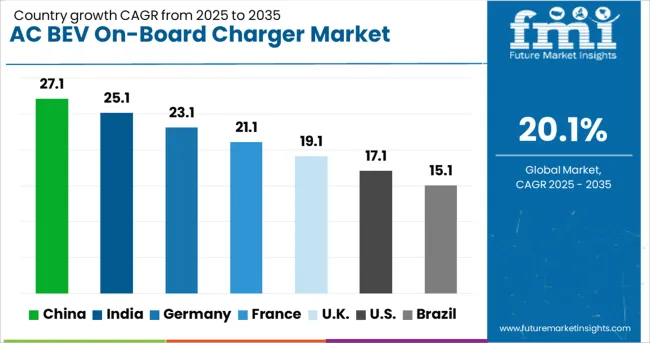
The AC BEV On-Board Charger market is projected to grow at a global CAGR of 20.1% from 2026 to 2036. China leads the market with a growth rate of 27.1%, followed by India at 25.1%. France is expected to experience 21.1% growth, while the United Kingdom is forecasted to grow at 19.1%. The United States records a growth of 17.1%. The rapid adoption of electric vehicles (EVs) in emerging markets, especially in China and India, is driven by government initiatives and a rising demand for clean mobility solutions. OECD countries such as France, the UK, and the USA show steady growth, supported by technological advancements in EV charging infrastructure and increasing consumer adoption of electric vehicles. The analysis covers 40+ countries, with the leading markets shown below.
Market Expansion for AC BEV On-Board Charger Market in China
China is projected to grow at a CAGR of 27.1% through 2036, driven by the rapid expansion of the electric vehicle market and government policies promoting clean mobility. The Chinese government’s strong incentives for electric vehicle adoption, coupled with its manufacturing capabilities in EVs, position the country as a leader in the AC BEV On-Board Charger market. The demand for on-board chargers is expected to rise significantly as electric vehicles continue to gain traction, supported by the expanding charging infrastructure in urban and rural areas.
- Government incentives and manufacturing capabilities drive the growth of the EV market in China.
- China’s rapid urbanization and infrastructure development fuel demand for efficient charging solutions.
- The growing adoption of electric vehicles boosts the demand for on-board chargers in China.
Sales Analysis of AC BEV On-Board Charger Market in India
India is projected to grow at a CAGR of 25.1% through 2036, driven by increasing government support for electric vehicle adoption and the expansion of charging infrastructure. India’s rapidly growing automotive sector is shifting towards electric mobility, and the demand for AC BEV On-Board Chargers is expected to rise in line with this transition. With incentives for electric vehicle manufacturers and buyers, coupled with government targets for EV adoption, India is poised for strong growth in the electric vehicle market. The increasing number of EVs in urban areas will further accelerate the demand for efficient on-board chargers.
- Government policies and incentives for electric vehicles drive the adoption of on-board chargers in India.
- Urbanization and the growing demand for eco-friendly mobility solutions fuel market growth.
- Expansion of charging infrastructure supports the adoption of AC BEV On-Board Chargers in India.
Innovation in AC BEV On-Board Charger Market in France
France is projected to grow at a CAGR of 21.1% through 2036, driven by strong government policies supporting electric vehicle adoption and technological advancements in EV charging infrastructure. The French government’s commitment to reducing carbon emissions and promoting sustainable transportation solutions accelerates the demand for AC BEV On-Board Chargers. As more consumers embrace electric vehicles, the need for efficient and fast-charging solutions will continue to rise. France’s strategic focus on expanding its electric vehicle fleet and charging network supports the growth of the AC BEV On-Board Charger market.
- Government policies supporting electric vehicles accelerate demand for on-board chargers in France.
- France’s commitment to reducing emissions and promoting clean mobility solutions drives market growth.
- The growth of EV adoption and charging infrastructure supports the demand for on-board chargers.
Growth of AC BEV On-Board Charger Market in the United Kingdom
The United Kingdom is projected to grow at a CAGR of 19.1% through 2036, with the demand for AC BEV On-Board Chargers increasing due to the expanding electric vehicle market. The UK’s commitment to net-zero emissions and its strong regulatory framework encouraging the adoption of electric vehicles contribute significantly to the growth of the market. The increasing installation of charging points, coupled with the demand for advanced and efficient charging technologies, will drive the demand for on-board chargers. As the UK pushes towards an all-electric vehicle future, the demand for reliable and fast-charging solutions will continue to grow.
- Government regulations and net-zero emissions targets support the growth of electric vehicles and charging infrastructure in the UK
- The rise of electric vehicles and charging networks drives the demand for on-board chargers.
- Increasing consumer demand for efficient charging technologies boosts market growth in the UK
Technological Progress in AC BEV On-Board Charger Market in the United States
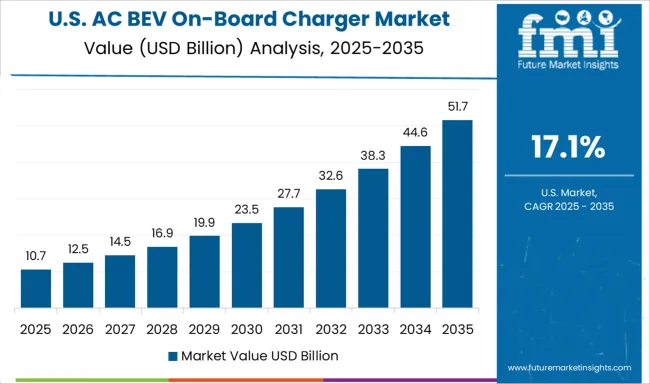
The United States is projected to grow at a CAGR of 17.1% through 2036, driven by the increasing adoption of electric vehicles and advancements in EV charging infrastructure. The USA market is supported by federal and state-level incentives promoting electric vehicle adoption, as well as the growing installation of EV charging stations. As the transition to electric vehicles accelerates, the demand for efficient on-board charging solutions is expected to increase. In addition, the growing focus on reducing greenhouse gas emissions and promoting sustainable transportation will further drive the demand for AC BEV On-Board Chargers in the USA
- Government policies and incentives for electric vehicles drive market demand in the USA
- The growth of EV adoption and charging infrastructure supports the demand for on-board chargers.
- Rising consumer interest in eco-friendly mobility solutions boosts the demand for on-board chargers in the USA
Competitive Landscape of AC BEV On-Board Charger Market
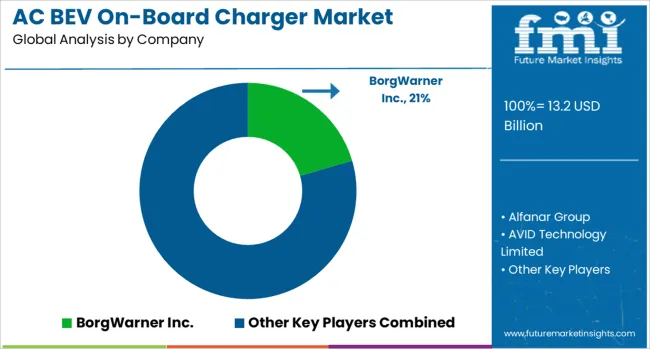
The AC BEV (Battery Electric Vehicle) on-board charger market is driven by key players specializing in charging systems for electric vehicles (EVs), focusing on efficiency, reliability, and compactness. BorgWarner Inc. is a leading player, providing advanced on-board chargers for electric vehicles, with a strong focus on optimizing charging efficiency and integrating smart technologies for energy management.
Alfanar Group and AVID Technology Limited also contribute to the market, offering scalable and cost-effective charging solutions designed for mass-market electric vehicles. Bell Power Solution and BRUSA Elektronik AG specialize in high-performance on-board chargers, focusing on enhancing the charging speed, reducing energy loss, and improving the overall reliability of electric vehicle charging systems. Current Ways Inc. and Delphi Technologies offer cutting-edge charging solutions that enable faster charging times while ensuring safety and compliance with international standards.
Delta Energy Systems and Eaton Corporation provide comprehensive EV charging solutions, including on-board chargers for both consumer and commercial EVs, with an emphasis on reducing carbon footprints and supporting energy-efficient charging systems. Ficosa International SA and innolectric AG focus on the development of compact, lightweight, and high-efficiency charging modules designed for a wide range of electric vehicle models.
Kirloskar Electric Company, Powell Industries, and Stercom Power Solutions GmbH offer high-quality charging systems for industrial applications, supporting the growing demand for electric vehicle infrastructure. STMicroelectronics, Toyota Industries Corporation, and Valeo leverage their expertise in electronics and automotive systems to produce advanced on-board chargers with integrated power management features.
Competitive differentiation in this market is driven by charger efficiency, integration with vehicle control systems, compactness, cost-efficiency, and the ability to support fast-charging technologies. Barriers to entry include high development costs, technological complexity, and compliance with regulatory standards. Strategic priorities include expanding global distribution networks, improving energy efficiency, and developing charging systems compatible with next-generation EVs.
Key Developments in AC BEV On-Board Charger Market
- Paccar Parts has expanded its EV charger offerings by adding Eaton DC fast chargers to its product lineup in June 2025. These chargers are available in 50-150 kW charge output levels, equipped with comprehensive management software for optimizing output and facilitating easy monitoring. The integration of Eaton's DC fast chargers will enhance the flexibility of charging station infrastructure design and layout.
- In January 2025, Eaton unveiled its vehicle-to-home (V2H) charging capabilities, which enable electric vehicle (EV) batteries to power homes. The system aims to reduce energy costs and increase energy resilience. Eaton's technology, presented at CES 2025, ensures industry-leading interoperability and cybersecurity, advancing vehicle-to-home and vehicle-to-grid (V2G) technologies. Eaton's collaboration with Treehouse facilitates high-quality, cost-effective electrification programs for automotive OEMs, utilities, and hardware manufacturers.
Scope of the Report
| Metric | Value |
|---|---|
| Quantitative Units | USD 15.85 billion to USD 98.98 billion, at a CAGR of 20.1% |
| Market Definition | AC-to-DC power electronics modules permanently installed in BEVs for converting AC charging input to DC battery charging current across multiple power ratings. |
| Rating Segmentation | greater than 11 kW to 22 kW, 11 kW, greater than 22 kW |
| Regions Covered | North America, Latin America, Europe, East Asia, South Asia, Oceania, Middle East & Africa |
| Countries Covered | India, Germany, France, UK, USA, Brazil, and 40 plus countries |
| Key Companies Profiled | BorgWarner Inc., Alfanar Group, AVID Technology Limited, BRUSA Elektronik AG, Delphi Technologies, Delta Energy Systems, Eaton Corporation, Ficosa International SA, innolectric AG, STMicroelectronics, Toyota Industries Corporation, Valeo |
| Forecast Period | 2026 to 2036 |
| Approach | Bottom-up methodology starting with BEV production volumes by region, applying power-rating-specific on-board charger content values. |
AC BEV On-Board Charger Market by Segments
Rating:
- > 11 kW to 22 kW
- 11 kW
- > 22 kW
Region:
- North America
- USA
- Canada
- Mexico
- Latin America
- Brazil
- Chile
- Rest of Latin America
- Western Europe
- Germany
- UK
- Italy
- Spain
- France
- Nordic
- BENELUX
- Rest of Western Europe
- Eastern Europe
- Russia
- Poland
- Hungary
- Balkan & Baltic
- Rest of Eastern Europe
- East Asia
- China
- Japan
- South Korea
- South Asia and Pacific
- India
- ASEAN
- Australia & New Zealand
- Rest of South Asia and Pacific
- Middle East & Africa
- Kingdom of Saudi Arabia
- Other GCC Countries
- Turkiye
- South Africa
- Other African Union
- Rest of Middle East & Africa
Bibliography
- European Commission. (2024). CO2 emission performance standards for new passenger cars and light commercial vehicles. EC.
- USA Department of Energy. (2024). Electric vehicle charging infrastructure deployment: Technical requirements and standards. DOE.
- Ministry of Heavy Industries, Government of India. (2024). FAME-III scheme: Faster adoption and manufacturing of electric vehicles. MHI.
- International Electrotechnical Commission. (2024). IEC 61851-1: Electric vehicle conductive charging system requirements. IEC.
- International Energy Agency. (2024). Global EV outlook: Trends in electric mobility. IEA.
- Organisation for Economic Co-operation and Development. (2024). Transport outlook: Decarbonization pathways for road transport. OECD.
This bibliography is provided for reader reference. The full Future Market Insights report contains the complete reference list with primary research documentation.
Frequently Asked Questions
How large is the demand for AC BEV on-board chargers in the global market in 2026?
Demand for AC BEV on-board chargers in the global market is estimated to be valued at USD 15.85 billion in 2026.
What will be the market size of AC BEV on-board chargers by 2036?
Market size for AC BEV on-board chargers is projected to reach USD 98.98 billion by 2036.
What is the expected demand growth between 2026 and 2036?
Demand is expected to grow at a CAGR of 20.1% between 2026 and 2036.
Which Rating segment is poised to lead global sales by 2026?
The greater than 11 kW to 22 kW rating segment accounts for 47.3% share in 2026 as automakers standardize on three-phase AC charging to reduce home and workplace charging dwell times.
What is driving demand in India?
EV production incentives under the FAME-III scheme and mandatory on-board charger standards for new BEV homologation are driving demand at a 25.1% CAGR.
What is Germany's growth outlook in this report?
Germany is projected to expand at a CAGR of 23.1% during 2026 to 2036, supported by OEM concentration and EU CO2 fleet emission targets.
What is the USA's growth outlook in this report?
The United States is projected to grow at 17.1% CAGR, supported by IRA tax credit qualification requirements for domestically produced BEV components.
What is included in the scope of this report?
The market covers AC-to-DC on-board charger modules installed in battery electric vehicles across all power rating tiers, including integrated charger and DC-DC converter modules.
Preview the report firsthand - request a free sample
Get SampleGet the brochure for pricing and purchase details.
Get PDFTable of Content
- Executive Summary
- Global Market Outlook
- Demand-side Trends
- Supply-side Trends
- Technology Roadmap Analysis
- Analysis and Recommendations
- Market Overview
- Market Coverage / Taxonomy
- Market Definition / Scope / Limitations
- Research Methodology
- Chapter Orientation
- Analytical Lens and Working Hypotheses
- Market Structure, Signals, and Trend Drivers
- Benchmarking and Cross-market Comparability
- Market Sizing, Forecasting, and Opportunity Mapping
- Research Design and Evidence Framework
- Desk Research Programme (Secondary Evidence)
- Company Annual and Sustainability Reports
- Peer-reviewed Journals and Academic Literature
- Sector Databases and Reference Repositories
- FMI Internal Proprietary Databases and Historical Market Datasets
- Subscription Datasets and Paid Sources
- Social Channels, Communities, and Digital Listening Inputs
- Additional Desk Sources
- Expert Input and Fieldwork (Primary Evidence)
- Primary Modes
- Qualitative Interviews and Expert Elicitation
- Quantitative Surveys and Structured Data Capture
- Blended Approach
- Why Primary Evidence is Used
- Field Techniques
- Interviews
- Surveys
- Focus Groups
- Observational and In-context Research
- Social and Community Interactions
- Stakeholder Universe Engaged
- C-suite Leaders
- Board Members
- Presidents and Vice Presidents
- R&D and Innovation Heads
- Technical Specialists
- Domain Subject-matter Experts
- Scientists
- Physicians and Other Healthcare Professionals
- Governance, Ethics, and Data Stewardship
- Research Ethics
- Data Integrity and Handling
- Primary Modes
- Tooling, Models, and Reference Databases
- Desk Research Programme (Secondary Evidence)
- Data Engineering and Model Build
- Data Acquisition and Ingestion
- Cleaning, Normalisation, and Verification
- Synthesis, Triangulation, and Analysis
- Quality Assurance and Audit Trail
- Market Background
- Market Dynamics
- Drivers
- Restraints
- Opportunity
- Trends
- Scenario Forecast
- Demand in Optimistic Scenario
- Demand in Likely Scenario
- Demand in Conservative Scenario
- Opportunity Map Analysis
- Product Life Cycle Analysis
- Supply Chain Analysis
- Investment Feasibility Matrix
- Value Chain Analysis
- PESTLE and Porter’s Analysis
- Regulatory Landscape
- Regional Parent Market Outlook
- Production and Consumption Statistics
- Import and Export Statistics
- Market Dynamics
- Global Market Analysis 2021 to 2025 and Forecast, 2026 to 2036
- Historical Market Size Value (USD Million) Analysis, 2021 to 2025
- Current and Future Market Size Value (USD Million) Projections, 2026 to 2036
- Y-o-Y Growth Trend Analysis
- Absolute $ Opportunity Analysis
- Global Market Pricing Analysis 2021 to 2025 and Forecast 2026 to 2036
- Global Market Analysis 2021 to 2025 and Forecast 2026 to 2036, By Rating
- Introduction / Key Findings
- Historical Market Size Value (USD Million) Analysis By Rating , 2021 to 2025
- Current and Future Market Size Value (USD Million) Analysis and Forecast By Rating , 2026 to 2036
- > 11 kW to 22 kW
- 11 kW
- > 22 kW
- > 11 kW to 22 kW
- Y-o-Y Growth Trend Analysis By Rating , 2021 to 2025
- Absolute $ Opportunity Analysis By Rating , 2026 to 2036
- Global Market Analysis 2021 to 2025 and Forecast 2026 to 2036, By Region
- Introduction
- Historical Market Size Value (USD Million) Analysis By Region, 2021 to 2025
- Current Market Size Value (USD Million) Analysis and Forecast By Region, 2026 to 2036
- North America
- Latin America
- Western Europe
- Eastern Europe
- East Asia
- South Asia and Pacific
- Middle East & Africa
- Market Attractiveness Analysis By Region
- North America Market Analysis 2021 to 2025 and Forecast 2026 to 2036, By Country
- Historical Market Size Value (USD Million) Trend Analysis By Market Taxonomy, 2021 to 2025
- Market Size Value (USD Million) Forecast By Market Taxonomy, 2026 to 2036
- By Country
- USA
- Canada
- Mexico
- By Rating
- By Country
- Market Attractiveness Analysis
- By Country
- By Rating
- Key Takeaways
- Latin America Market Analysis 2021 to 2025 and Forecast 2026 to 2036, By Country
- Historical Market Size Value (USD Million) Trend Analysis By Market Taxonomy, 2021 to 2025
- Market Size Value (USD Million) Forecast By Market Taxonomy, 2026 to 2036
- By Country
- Brazil
- Chile
- Rest of Latin America
- By Rating
- By Country
- Market Attractiveness Analysis
- By Country
- By Rating
- Key Takeaways
- Western Europe Market Analysis 2021 to 2025 and Forecast 2026 to 2036, By Country
- Historical Market Size Value (USD Million) Trend Analysis By Market Taxonomy, 2021 to 2025
- Market Size Value (USD Million) Forecast By Market Taxonomy, 2026 to 2036
- By Country
- Germany
- UK
- Italy
- Spain
- France
- Nordic
- BENELUX
- Rest of Western Europe
- By Rating
- By Country
- Market Attractiveness Analysis
- By Country
- By Rating
- Key Takeaways
- Eastern Europe Market Analysis 2021 to 2025 and Forecast 2026 to 2036, By Country
- Historical Market Size Value (USD Million) Trend Analysis By Market Taxonomy, 2021 to 2025
- Market Size Value (USD Million) Forecast By Market Taxonomy, 2026 to 2036
- By Country
- Russia
- Poland
- Hungary
- Balkan & Baltic
- Rest of Eastern Europe
- By Rating
- By Country
- Market Attractiveness Analysis
- By Country
- By Rating
- Key Takeaways
- East Asia Market Analysis 2021 to 2025 and Forecast 2026 to 2036, By Country
- Historical Market Size Value (USD Million) Trend Analysis By Market Taxonomy, 2021 to 2025
- Market Size Value (USD Million) Forecast By Market Taxonomy, 2026 to 2036
- By Country
- China
- Japan
- South Korea
- By Rating
- By Country
- Market Attractiveness Analysis
- By Country
- By Rating
- Key Takeaways
- South Asia and Pacific Market Analysis 2021 to 2025 and Forecast 2026 to 2036, By Country
- Historical Market Size Value (USD Million) Trend Analysis By Market Taxonomy, 2021 to 2025
- Market Size Value (USD Million) Forecast By Market Taxonomy, 2026 to 2036
- By Country
- India
- ASEAN
- Australia & New Zealand
- Rest of South Asia and Pacific
- By Rating
- By Country
- Market Attractiveness Analysis
- By Country
- By Rating
- Key Takeaways
- Middle East & Africa Market Analysis 2021 to 2025 and Forecast 2026 to 2036, By Country
- Historical Market Size Value (USD Million) Trend Analysis By Market Taxonomy, 2021 to 2025
- Market Size Value (USD Million) Forecast By Market Taxonomy, 2026 to 2036
- By Country
- Kingdom of Saudi Arabia
- Other GCC Countries
- Turkiye
- South Africa
- Other African Union
- Rest of Middle East & Africa
- By Rating
- By Country
- Market Attractiveness Analysis
- By Country
- By Rating
- Key Takeaways
- Key Countries Market Analysis
- USA
- Pricing Analysis
- Market Share Analysis, 2025
- By Rating
- Canada
- Pricing Analysis
- Market Share Analysis, 2025
- By Rating
- Mexico
- Pricing Analysis
- Market Share Analysis, 2025
- By Rating
- Brazil
- Pricing Analysis
- Market Share Analysis, 2025
- By Rating
- Chile
- Pricing Analysis
- Market Share Analysis, 2025
- By Rating
- Germany
- Pricing Analysis
- Market Share Analysis, 2025
- By Rating
- UK
- Pricing Analysis
- Market Share Analysis, 2025
- By Rating
- Italy
- Pricing Analysis
- Market Share Analysis, 2025
- By Rating
- Spain
- Pricing Analysis
- Market Share Analysis, 2025
- By Rating
- France
- Pricing Analysis
- Market Share Analysis, 2025
- By Rating
- India
- Pricing Analysis
- Market Share Analysis, 2025
- By Rating
- ASEAN
- Pricing Analysis
- Market Share Analysis, 2025
- By Rating
- Australia & New Zealand
- Pricing Analysis
- Market Share Analysis, 2025
- By Rating
- China
- Pricing Analysis
- Market Share Analysis, 2025
- By Rating
- Japan
- Pricing Analysis
- Market Share Analysis, 2025
- By Rating
- South Korea
- Pricing Analysis
- Market Share Analysis, 2025
- By Rating
- Russia
- Pricing Analysis
- Market Share Analysis, 2025
- By Rating
- Poland
- Pricing Analysis
- Market Share Analysis, 2025
- By Rating
- Hungary
- Pricing Analysis
- Market Share Analysis, 2025
- By Rating
- Kingdom of Saudi Arabia
- Pricing Analysis
- Market Share Analysis, 2025
- By Rating
- Turkiye
- Pricing Analysis
- Market Share Analysis, 2025
- By Rating
- South Africa
- Pricing Analysis
- Market Share Analysis, 2025
- By Rating
- USA
- Market Structure Analysis
- Competition Dashboard
- Competition Benchmarking
- Market Share Analysis of Top Players
- By Regional
- By Rating
- Competition Analysis
- Competition Deep Dive
- BorgWarner Inc.
- Overview
- Product Portfolio
- Profitability by Market Segments (Product/Age /Sales Channel/Region)
- Sales Footprint
- Strategy Overview
- Marketing Strategy
- Product Strategy
- Channel Strategy
- Alfanar Group
- AVID Technology Limited
- Bell Power Solution
- BRUSA Elektronik AG
- Current Ways Inc.
- Delphi Technologies
- Delta Energy Systems
- Eaton Corporation
- Ficosa International SA
- innolectric AG
- Kirloskar Electric Company
- Powell Industries
- Stercom Power Solutions GmbH
- STMicroelectronics
- Toyota Industries Corporation
- Valeo
- Xepics Italia SRL
- BorgWarner Inc.
- Competition Deep Dive
- Assumptions & Acronyms Used


