

- Industry Size (2026)
- USD 5.46 Bn
- Forecast (2036)
- USD 8.9 Bn
- CAGR (2026 to 2036)
- 5.0%
Acetoacetanilide Market Size, Market Forecast and Outlook By FMI
In 2025, the acetoacetanilide market was valued at USD 5.2 billion. Based on Future Market Insights' analysis, demand for acetoacetanilide is estimated to grow to USD 5.46 billion in 2026 and USD 8.9 billion by 2036. FMI projects a CAGR of 5.0% during the forecast period.
An absolute dollar growth of USD 3.44 billion between 2026 and 2036 reflects structural shifts in downstream chemical manufacturing rather than volume-only expansion of commodity intermediates. Growth depends on increased specification of acetoacetanilide in high-purity grades for pharmaceutical intermediates, its essential role in synthesizing modern herbicides for broad-acre farming, and rising consumption in organic pigment production for automotive coatings and high-performance plastics. As per FMI, chemical manufacturers are capturing value not from incremental tonnage alone, but from purity consistency, particle size optimization, and application-specific formulation support that reduce downstream processing costs for agrochemical and dye producers.
Summary of the Acetoacetanilide Market
- Market Definition
- The market comprises an organic chemical intermediate used primarily in the synthesis of herbicides, pigments, dyes, and pharmaceutical compounds across global chemical manufacturing value chains.
- Demand Drivers
- Expanding global agricultural production requiring herbicide inputs for weed control in staple crops.
- Rising demand for high-performance organic pigments in automotive coatings, plastics, and printing inks.
- Growing pharmaceutical intermediate requirements for active ingredient synthesis.
- Increasing preference for consistent high-purity grades enabling downstream process efficiency.
- Key Segments Analyzed
- Form: Dry Powder leads, accounting for 52.6% share in 2025 due to handling ease, stability, and compatibility with automated chemical processes.
- Application: Co-Promoter dominates with 38.4% share, reflecting its essential role in enhancing agrochemical and dye formulation performance.
- End Use: Agriculture represents the largest end-use sector at 31.7% share, driven by herbicide production volumes.
- Geography: Asia Pacific leads global consumption, while North America and Europe drive value through specialty applications.
- Analyst Opinion at FMI
- Nikhil Kaitwade, Principal Consultant for Chemicals and Materials at Future Market Insights, opines, 'In this updated edition of the Acetoacetanilide Market report, chemical industry stakeholders will observe that value creation is migrating from commoditized intermediate supply toward application-engineered grades that deliver measurable downstream benefits. Suppliers that master impurity profiling, particle engineering, and formulation compatibility will secure strategic positions in agrochemical and speciality chemical value chains through 2036. The molecule's versatility, long considered a given, is now being monetized through precision rather than volume.'
- Strategic Implications / Executive Takeaways
- Invest in high-purity production capabilities serving pharmaceutical and high-performance pigment applications.
- Develop application-specific particle size distributions and physical forms optimized for customer formulation processes.
- Strengthen technical support capabilities enabling co-development with agrochemical and dye manufacturers.
- Build supply chain resilience through raw material sourcing diversification and strategic inventory management.
- Methodology
- Built on primary interviews with acetoacetanilide manufacturers and downstream chemical buyers.
- Benchmarked against agrochemical production statistics and pigment consumption data.
- Validated using trade data and internal peer review as per FMI modeling standards.
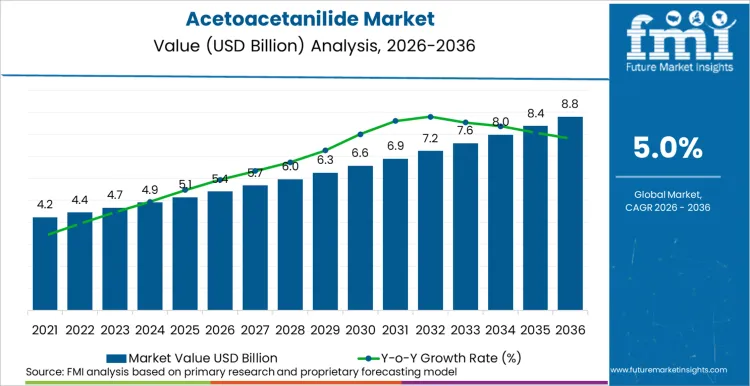
China (6.8% CAGR) leads global expansion, supported by its position as the world's largest agrochemical manufacturing base and concentrated production capacity for dye intermediates. India (6.3% CAGR) follows, driven by expanding domestic agrochemical production, government support for domestic manufacturing under the Atmanirbhar Bharat initiative, and growing pharmaceutical intermediate demand. Germany (5.8% CAGR) grows on the back of its specialty chemical industry serving high-performance pigments and coatings for automotive and industrial applications. Brazil (5.3% CAGR) benefits from its large agricultural economy requiring herbicides for soy, corn, and sugarcane production.
Mature markets such as the United States (4.8% CAGR), the United Kingdom (4.3% CAGR), and Japan (3.8% CAGR) generate comparatively slower expansion, where demand is shaped more by replacement cycles in agrochemical formulations and specialty applications than by new agricultural frontier expansion, with generic competition from Asian producers acting as a structural constraint on value growth.
Acetoacetanilide Market Definition
The acetoacetanilide market covers the global production and supply of an organic compound widely used as a chemical intermediate in the synthesis of agrochemicals, pigments, dyes, and pharmaceutical products. Manufactured through the reaction of diketene with aniline, this acetoacetic acid derivative serves as a key building block for producing herbicides such as acetochlor and butachlor, azo pigments, and various active pharmaceutical ingredients. Its chemical stability, reactivity profile, and cost-effectiveness make it essential across multiple industrial value chains.
Market Inclusions
The report includes global and regional market size estimates in value terms, with a forecast period from 2026 to 2036. It provides segmentation by Form, Application, End Use, and Region. The analysis incorporates manufacturing technology trends, purity grade developments, application-specific formulation advances, and regulatory impacts on agrochemical and pigment sectors. Regional demand dynamics, country-level growth rates, and competitive positioning are also evaluated as per FMI methodology.
Market Exclusions
The scope excludes downstream formulated products such as finished herbicides, paints, and pharmaceutical drugs that contain acetoacetanilide as an intermediate. It also excludes revenue from captive consumption where manufacturers produce acetoacetanilide solely for internal use in integrated operations. Laboratory-scale and research-grade quantities are not considered due to negligible market contribution.
Research Methodology
- Primary Research: Interviews were conducted with acetoacetanilide manufacturers, agrochemical formulators, pigment producers, pharmaceutical intermediate buyers, and chemical distribution specialists.
- Desk Research: Public company filings, chemical industry statistics, trade data under relevant HS codes, agrochemical registration databases, and regulatory documentation were reviewed.
- Market-Sizing and Forecasting: A hybrid top-down and bottom-up model was constructed, reconstructing demand from agrochemical production volumes, pigment consumption patterns, and intermediate-per-unit ratios across end-use applications.
- Data Validation and Update Cycle: Outputs were subjected to variance testing against production capacity data, trade flow benchmarking, and structured internal review prior to publication.
Acetoacetanilide Market Drivers, Restraints, and Opportunities
Future Market Insights analysis indicates the market has historically existed as a volume-driven intermediate chemical category tied to agrochemical and dye production cycles. Its baseline scale is anchored in the essential nature of herbicides for global food production and pigments for industrial and consumer goods. As per FMI, the market's valuation is increasingly linked to application-specific performance requirements, where purity consistency and physical form characteristics command premium pricing beyond commodity benchmarks.
FMI analysts observe a clear distinction between standard-grade acetoacetanilide optimized for cost and high-purity grades that raise unit value through tighter specifications and application-specific performance benefits. Standard grades face pressure where agrochemical producers consolidate procurement and push for cost reductions, while growth is concentrated in applications that justify premium pricing through improved herbicide efficacy, reduced downstream processing costs, and superior pigment performance. This shift nets out as steady value growth because quality differentiation and application engineering support margin expansion even as overall tonnage growth moderates.
- Global food security imperative: Rising global population and increasing food demand drive agricultural intensification, requiring herbicide inputs for weed control in staple crops. The Food and Agriculture Organization projects agricultural production must increase by 50% by 2050 to feed the global population, sustaining demand for crop protection chemicals including acetoacetanilide-based herbicides.
- Herbicide-tolerant crop adoption: Widespread adoption of herbicide-tolerant crop varieties, particularly in soy, corn, and canola, has expanded the addressable market for herbicides including acetochlor and butachlor. This agronomic trend creates sustained demand for acetoacetanilide as a key intermediate in these formulations.
- Organic pigment market expansion: Rising environmental concerns regarding heavy metal-based pigments have accelerated substitution toward organic alternatives. Acetoacetanilide-derived azo pigments offer heat stability and color brilliance essential for automotive coatings, packaging inks, and engineering plastics, supporting premium-grade demand.
- Raw material cost volatility: Aniline and diketene, the primary raw materials for acetoacetanilide production, are subject to price fluctuations influenced by benzene and acetic acid markets. This volatility creates margin pressure for manufacturers without backward integration or long-term supply agreements.
- Generic competition intensity: The expiration of key agrochemical patents has enabled generic manufacturers, particularly in China and India, to enter herbicide production. While this expands acetoacetanilide consumption, it also intensifies price competition among intermediate suppliers serving these producers.
Segmental Analysis
Acetoacetanilide Market Analysis by Form
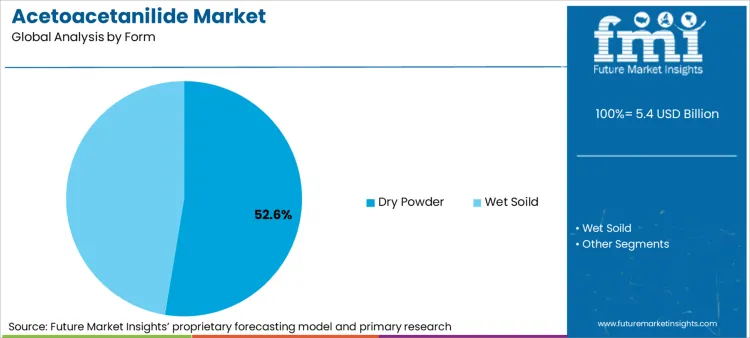
Based on FMI's acetoacetanilide market report, dry powder represents the leading form segment, projected to hold 52.6% of the market revenue share in 2025. This dominance is driven by ease of handling, storage stability, and compatibility with automated chemical processing equipment.
Dry powder forms enable precise dosing, reduced contamination risks during transfer, and extended shelf life compared to wet alternatives, making them preferred for large-scale agrochemical and pigment manufacturing operations.
The physical characteristics of dry powder acetoacetanilide, including consistent particle size distribution and flowability, support uniform dispersion in downstream formulation processes. Manufacturers benefit from reduced caking during storage and simplified material handling logistics. These operational advantages translate to lower processing costs for customers, reinforcing preference for dry forms despite potentially higher manufacturing energy requirements.
Wet solid forms serve specific applications where downstream processing benefits from pre-dissolved or slurry-form inputs. These applications typically involve continuous processes where dissolution time impacts production throughput. However, wet forms face transportation cost disadvantages due to water content and require specialized storage conditions, limiting their share relative to dry powder.
- Particle engineering advances: Manufacturers increasingly offer customized particle size distributions optimized for specific customer applications. Fine powders for rapid dissolution in agrochemical formulations versus granular forms for dust-free handling in pigment production demonstrate this trend.
- Packaging innovation: Improved packaging technologies including moisture-barrier bags and bulk container liners preserve dry powder quality during transport and storage, particularly important for high-humidity regions in Asia Pacific.
- Quality consistency focus: Leading producers invest in process analytical technology ensuring batch-to-batch consistency in physical properties, reducing customer qualification requirements and enabling just-in-time inventory management.
Acetoacetanilide Market Analysis by Application
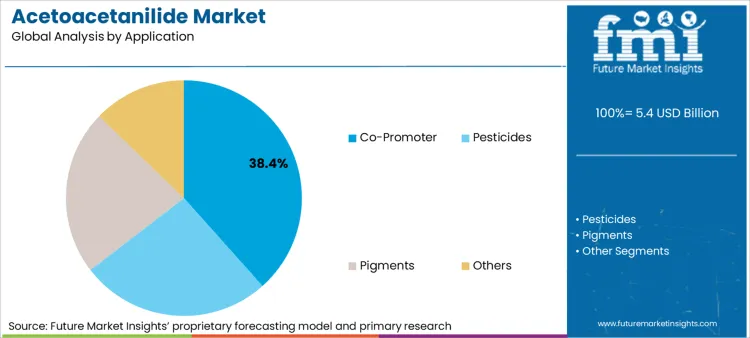
The co-promoter application segment is expected to account for 38.4% of the market revenue share in 2025, establishing it as the leading application area. Acetoacetanilide functions as a co-promoter in herbicide formulations, enhancing the efficacy of primary active ingredients through improved solubility, penetration, and stability. This synergistic role has become increasingly important as herbicide formulations evolve toward combination products addressing resistant weed species.
In pigment applications, acetoacetanilide serves as a critical intermediate for azo pigment synthesis, where its coupling chemistry enables production of yellow, orange, and red pigments with excellent heat stability and migration resistance. These pigments find extensive use in automotive coatings, industrial paints, and plastic masterbatches requiring high-performance colorants.
Pesticide applications encompass both herbicides where acetoacetanilide derivatives serve as active ingredients and insecticides where it functions as an intermediate. The compound's versatility across multiple pesticide classes supports diversified demand across crop protection portfolios.
- Herbicide combination products: The trend toward pre-mixed herbicide combinations addressing multiple weed species and resistance mechanisms has increased formulation complexity, elevating the importance of co-promoters that ensure compatibility and efficacy.
- High-performance pigment demand: Automotive industry requirements for coatings with extended durability and color retention have driven specification of high-quality azo pigments, supporting premium-grade acetoacetanilide demand.
- Regulatory-driven reformulation: Evolving agrochemical registration requirements have prompted reformulation efforts where co-promoters play essential roles in maintaining efficacy while meeting environmental and toxicological standards.
Acetoacetanilide Market Analysis by End Use
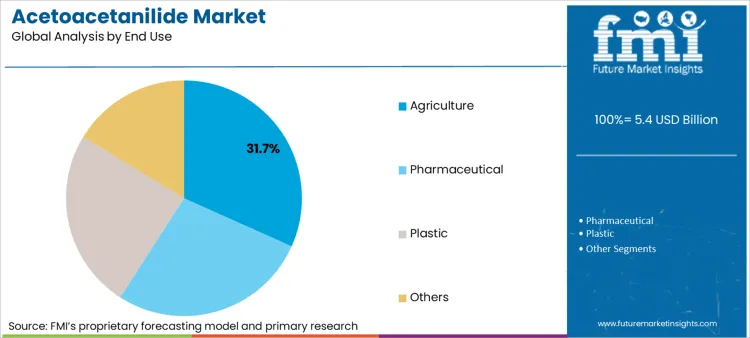
The agriculture end-use segment is projected to hold 31.7% of the acetoacetanilide market revenue share in 2025, establishing it as the leading end-use sector. This leadership reflects the compound's essential role in producing herbicides for global food production. Major herbicides including acetochlor, butachlor, and alachlor rely on acetoacetanilide as a key synthetic intermediate, with these products protecting millions of hectares of corn, soy, rice, and other staple crops annually.
The pigment and dye sector represents the second-largest end use, consuming acetoacetanilide for azo pigment production serving coatings, plastics, and printing applications. This segment demands higher purity grades and benefits from the compound's consistent coupling chemistry essential for reproducible color development.
Pharmaceutical applications, while smaller in volume, command premium pricing for high-purity grades used in active pharmaceutical ingredient synthesis. Acetoacetanilide derivatives appear in analgesic and anti-inflammatory compounds, with stringent pharmacopoeial requirements creating barriers to entry for lower-quality producers.
- Agrochemical seasonality: Agricultural chemical production follows planting seasons, creating inventory build cycles and working capital requirements for acetoacetanilide manufacturers. Southern Hemisphere and Northern Hemisphere demand patterns provide some production smoothing for global suppliers.
- Specialty chemical diversification: Leading producers increasingly serve multiple end-use sectors to balance demand fluctuations and capture margin opportunities across agriculture, pigments, and pharmaceuticals.
- Regional specialization: Chinese producers dominate agrochemical intermediate supply, while Indian manufacturers have strengthened positions in both agrochemical and pharmaceutical intermediates through government manufacturing incentives.
Regional Analysis
The acetoacetanilide market is segmented geographically across North America, Europe, Asia-Pacific, Latin America, and Middle East & Africa. Growth dynamics differ based on agrochemical production capacity, pigment manufacturing concentration, and regulatory frameworks governing chemical intermediates.
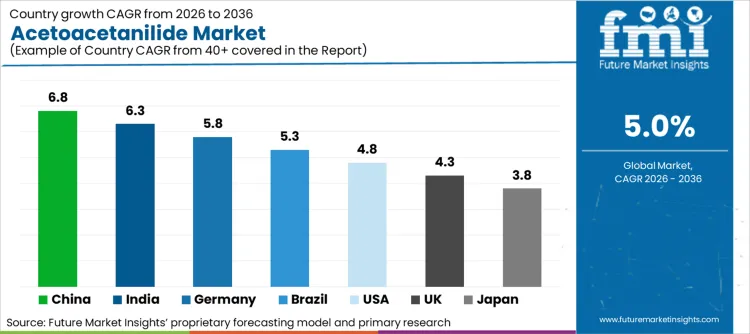
| Country | CAGR |
|---|---|
| China | 6.8% |
| India | 6.3% |
| Germany | 5.8% |
| Brazil | 5.3% |
| USA | 4.8% |
| UK | 4.3% |
| Japan | 3.8% |
Source: Future Market Insights (FMI) analysis, based on proprietary forecasting model and primary research
Asia Pacific Market Analysis
Asia Pacific stands as the dominant production and consumption region for acetoacetanilide, accounting for the majority of global capacity and demand. The region's leadership is built on concentrated agrochemical manufacturing in China and India, extensive pigment production serving global markets, and growing pharmaceutical intermediate capabilities. China serves as both the largest producer and consumer, with integrated chemical complexes supplying domestic and export markets.
- China: Acetoacetanilide demand in China is projected to rise at 6.8% CAGR through 2036, the highest among major markets. Growth is supported by China's position as the world's largest agrochemical manufacturer, with extensive production capacity for herbicides serving domestic agriculture and global export markets. The country's pigment industry, concentrated in Zhejiang and Jiangsu provinces, consumes substantial volumes for azo pigment production serving coatings, plastics, and printing applications worldwide.
China's chemical manufacturing infrastructure enables cost-competitive acetoacetanilide production through integrated raw material access to aniline and diketene. Government support for domestic agrochemical self-sufficiency and export competitiveness reinforces production expansion. Environmental enforcement has consolidated production among larger, compliant manufacturers, improving quality consistency and reducing supply volatility.
The Chinese market also benefits from growing pharmaceutical intermediate production, with acetoacetanilide serving active ingredient synthesis for both domestic consumption and export. Contract manufacturing organizations serving global pharmaceutical companies specify high-purity grades, supporting value growth beyond commodity volumes.
FMI's analysis of acetoacetanilide market in Asia-Pacific consists of country-wise assessment that includes China, India, Japan, South Korea, and ASEAN nations. Readers can find agrochemical production tracking, environmental compliance analysis, and export competitiveness assessment.
- India: Acetoacetanilide demand in India is projected to rise at 6.3% CAGR through 2036. Growth is supported by India's expanding agrochemical manufacturing base, government initiatives promoting domestic production under the Atmanirbhar Bharat (Self-Reliant India) program, and growing pharmaceutical intermediate capabilities. Indian manufacturers including Laxmi Organic Industries have established integrated production serving both domestic consumption and export markets.
The Indian agrochemical sector benefits from a favorable policy environment including production-linked incentive schemes for chemical manufacturing. Herbicide consumption within India's large agricultural economy drives domestic demand, while export-oriented producers serve generic agrochemical markets in Latin America, Africa, and Southeast Asia.
India's pigment industry, while smaller than China's, has grown steadily serving regional demand for high-quality organic pigments. Pharmaceutical applications represent a particular strength, with India's generic pharmaceutical industry requiring acetoacetanilide for active ingredient synthesis under stringent quality standards.
FMI's analysis of acetoacetanilide market in Asia-Pacific consists of country-wise assessment that includes China, India, Japan, and South Korea. Readers can find policy support analysis, manufacturing competitiveness tracking, and export market assessment.
- Japan: Japan represents a mature, technology-intensive market where acetoacetanilide demand is projected to rise at 3.8% CAGR through 2036. Japanese consumption focuses on high-purity grades for specialty pigment production serving automotive coatings and electronic materials, and pharmaceutical intermediates for innovative drug manufacturing. Japanese chemical companies emphasize quality consistency and application development rather than volume production.
The country's sophisticated pigment industry requires acetoacetanilide with tight specification ranges ensuring reproducible color development in demanding applications. Japanese pharmaceutical companies specify pharmacopoeial-grade material for active ingredient synthesis, with supplier qualification processes creating high entry barriers but rewarding established relationships.
FMI's analysis of acetoacetanilide market in Asia-Pacific consists of country-wise assessment that includes China, India, Japan, and South Korea. Readers can find quality specification analysis, application development tracking, and import dependency assessment.
North America Market Analysis
North America functions as a significant consumption region driven by its large agricultural economy and specialty chemical industry. The United States serves as the primary market, with acetoacetanilide consumed in herbicide formulation for corn, soy, and other row crops, and in specialty pigment production for industrial applications.
- United States: Demand for acetoacetanilide in the United States is projected to advance at 4.8% CAGR through 2036. The USA market combines agricultural demand from the world's largest corn and soybean production areas with specialty chemical applications in pigments and pharmaceuticals. The United States market was estimated at significant value in 2025.
USA herbicide consumption follows planting patterns, with acetochlor and other acetoacetanilide-derived products widely used for pre-emergence and early post-emergence weed control. The adoption of herbicide-tolerant crop varieties has sustained herbicide volumes despite integrated weed management practices.
Specialty applications in pigments serve automotive coatings, industrial maintenance paints, and high-performance plastics. USA pigment manufacturers specify high-quality intermediates ensuring compliance with environmental and performance standards. Pharmaceutical applications, while modest in volume, demand premium-grade material for active ingredient synthesis.
FMI's analysis of acetoacetanilide market in North America consists of country-wise assessment that includes the United States and Canada. Readers can find crop protection analysis, specialty chemical tracking, and import competition assessment.
Europe Market Analysis
Europe represents a quality-driven market where regulatory compliance and environmental standards shape acetoacetanilide specifications. The region's strong agrochemical and specialty chemical industries require intermediates meeting REACH and other regulatory requirements, favoring established suppliers with documentation capabilities.
- Germany: Demand for acetoacetanilide in Germany is projected to rise at 5.8% CAGR through 2036. Growth is influenced by Germany's position as Europe's largest chemical producer and its strong specialty chemical sector serving automotive coatings, industrial applications, and pharmaceutical manufacturing. In 2024, Germany held dominant revenue share in the Western Europe market.
German pigment manufacturers serve the global automotive industry, requiring high-performance colorants with exceptional durability and color consistency. Acetoacetanilide for these applications must meet stringent purity specifications ensuring reproducible coupling chemistry and heat stability during processing.
Pharmaceutical applications in Germany demand pharmacopoeial-grade material for active ingredient synthesis, with documentation requirements exceeding those for industrial applications. Agrochemical applications focus on high-value herbicides for European agriculture, where regulatory compliance and environmental performance drive formulation choices.
FMI's analysis of acetoacetanilide market in Europe consists of country-wise assessment that includes Germany, United Kingdom, France, Italy, and Spain. Readers can find regulatory compliance analysis, specialty chemical tracking, and import sourcing patterns.
Competitive Aligners for Market Players
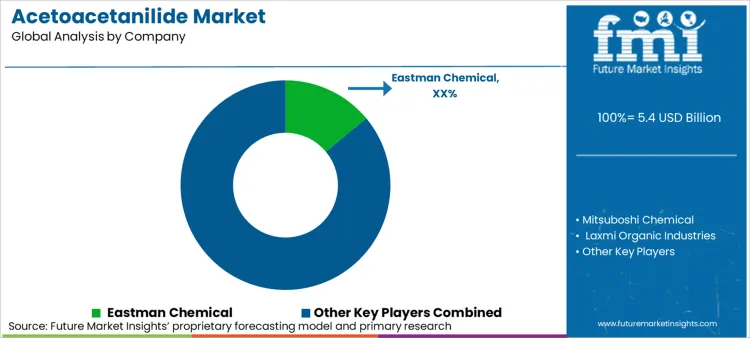
The acetoacetanilide market features a mix of global chemical companies and regional specialists, with Asian manufacturers dominating volume production while Western companies focus on specialty applications. Major players include Eastman Chemical, Mitsuboshi Chemical, Laxmi Organic Industries, and multiple Chinese producers including Cangzhou Goldlion Chemicals, Nantong Acetic Acid Chemical, and Jiangsu Changyu Chemical.
Chinese producers benefit from integrated raw material access, large-scale production economics, and government support for chemical manufacturing. These advantages enable cost-competitive supply to global agrochemical and pigment markets. Consolidation among compliant producers following environmental enforcement has improved industry structure and quality consistency.
Indian manufacturers including Laxmi Organic Industries have built integrated positions serving domestic and export markets. Government support for domestic manufacturing and quality improvement initiatives have strengthened their competitiveness in pharmaceutical and specialty applications.
Western players including Eastman Chemical focus on higher-value applications requiring technical service, application development, and regulatory support. These manufacturers compete on quality consistency, supply reliability, and formulation expertise rather than price alone.
Recent Developments
- Eastman Chemical - Portfolio Management (2025): Eastman continued optimizing its chemical intermediate portfolio, emphasizing specialty applications where technical differentiation supports margin objectives.
- Laxmi Organic Industries - Capacity Expansion (2025): Laxmi Organic Industries advanced its manufacturing capabilities for chemical intermediates including acetoacetanilide, supporting domestic and export market growth.
- Chinese Producer Consolidation (2025): Environmental enforcement in China's chemical industry continued driving consolidation among acetoacetanilide producers, with compliant manufacturers gaining market share from non-compliant operators.
Key Players in the Acetoacetanilide Market
- Eastman Chemical
- Mitsuboshi Chemical
- Laxmi Organic Industries
- Cangzhou Goldlion Chemicals
- Nantong Acetic Acid Chemical
- Jiangsu Changyu Chemical
- Hangzhou Dayangchem
- Jiangsu Tiancheng biochemical products
- Shanghai Qidian Chemical
- Jiaozhou Fine Chemical
Scope of Report
| Metric | Value |
|---|---|
| Quantitative Units | USD 5.46 billion (2026) to USD 8.9 billion (2036), at a CAGR of 5.0% |
| Market Definition | The acetoacetanilide market comprises the global production and supply of an organic chemical intermediate used in the synthesis of agrochemicals, pigments, dyes, and pharmaceutical products across agricultural, industrial, and healthcare value chains. |
| Form Segmentation | Dry Powder, Wet Solid |
| Application Segmentation | Co-Promoter, Pesticides, Pigments, Others |
| End Use Segmentation | Agriculture, Pharmaceutical, Plastic, Paint and Coatings, Others |
| Region Segmentation | North America, Europe, Asia-Pacific, Latin America, Middle East & Africa |
| Countries Covered | United States, Canada, Germany, United Kingdom, France, Italy, Spain, China, India, Japan, South Korea, Brazil and 40+ countries |
| Key Companies Profiled | Eastman Chemical, Mitsuboshi Chemical, Laxmi Organic Industries, Cangzhou Goldlion Chemicals, Nantong Acetic Acid Chemical, Jiangsu Changyu Chemical, Hangzhou Dayangchem, Jiangsu Tiancheng biochemical products, Shanghai Qidian Chemical, Jiaozhou Fine Chemical |
| Forecast Period | 2026 to 2036 |
| Approach | Hybrid top-down and bottom-up market modeling validated through primary interviews with acetoacetanilide manufacturers, downstream chemical buyers, and industry specialists, supported by agrochemical production statistics and trade flow analysis |
Acetoacetanilide Market Analysis by Segments
Form
- Dry Powder
- Wet Solid
Application
- Co-Promoter
- Pesticides
- Pigments
- Others
End Use
- Agriculture
- Pharmaceutical
- Plastic
- Paint and Coatings
- Others
Region
- North America (United States, Canada, Mexico)
- Latin America (Brazil, Chile, Rest of Latin America)
- Western Europe (Germany, United Kingdom, Italy, Spain, France, Nordic, BENELUX, Rest of Western Europe)
- Eastern Europe (Russia, Poland, Hungary, Balkan & Baltic, Rest of Eastern Europe)
- East Asia (China, Japan, South Korea)
- South Asia and Pacific (India, ASEAN, Australia & New Zealand, Rest of South Asia and Pacific)
- Middle East & Africa (Kingdom of Saudi Arabia, Other GCC Countries, Turkiye, South Africa, Other African Union, Rest of Middle East & Africa)
Bibliography
- Eastman Chemical Company. (2025). Annual Report 2025.
- Laxmi Organic Industries Ltd. (2025). Annual Report 2024-2025.
- Mitsuboshi Chemical Co., Ltd. (2025). Corporate Sustainability Report 2025.
- Food and Agriculture Organization of the United Nations. (2025). World Food and Agriculture - Statistical Yearbook 2025.
- United States Department of Agriculture. (2025). Agricultural Chemical Usage Report.
- European Chemicals Agency. (2025). REACH Registration Statistics.
- Ministry of Chemicals and Fertilizers, Government of India. (2025). Annual Report 2024-2025.
- China National Chemical Information Center. (2025). Chemical Industry Statistical Bulletin.
- Cangzhou Goldlion Chemicals Co., Ltd. (2025). Company Profile and Product Catalog.
- Jiangsu Changyu Chemical Co., Ltd. (2025). Corporate Overview.
- International Trade Centre. (2025). Trade Map - Chemical Intermediates Trade Statistics.
- United Nations Environment Programme. (2025). Global Chemicals Outlook II.
Frequently Asked Questions
How large is the acetoacetanilide market in 2026?
Demand for acetoacetanilide is estimated to be valued at USD 5.46 billion in 2026.
What will be the market size of acetoacetanilide by 2036?
Market size for acetoacetanilide is projected to reach USD 8.9 billion by 2036.
What is the expected demand growth for acetoacetanilide between 2026 and 2036?
Demand for acetoacetanilide is expected to grow at a 5.0% CAGR between 2026 and 2036.
Which form segment is poised to lead global sales?
Dry powder leads with 52.6% share in 2025, driven by handling ease, stability, and compatibility with automated chemical processes.
Which application segment contributes the largest share?
Co-promoter commands 38.4% share, reflecting its essential role in enhancing agrochemical and dye formulation performance.
Which end-use segment is the largest consumer?
Agriculture represents the largest end-use sector at 31.7% share, driven by herbicide production volumes.
How significant is the agriculture sector in driving demand?
Agriculture is the primary demand driver, with acetoacetanilide serving as a key intermediate for herbicides protecting staple crops globally.
What is driving demand in China?
China's position as the world's largest agrochemical manufacturer, extensive pigment production capacity, and integrated raw material access drive market leadership.
What is the China growth outlook?
China is projected to expand at a 6.8% CAGR during 2026 to 2036.
What drives India's market growth?
Expanding agrochemical manufacturing, government manufacturing initiatives, and growing pharmaceutical intermediate capabilities support India's growth.
What is the India growth outlook?
India is projected to expand at a 6.3% CAGR during 2026 to 2036.
What characterizes the German market?
Germany's strong specialty chemical sector serving automotive coatings and pharmaceutical applications drives demand for high-purity grades.
What is the Germany growth outlook?
Germany is projected to expand at a 5.8% CAGR during 2026 to 2036.
What drives the United States market?
Large agricultural economy requiring herbicides for corn and soy, plus specialty pigment applications, shape U.S. demand.
What is the United States growth outlook?
The United States is projected to expand at a 4.8% CAGR during 2026 to 2036.
What is the United Kingdom growth outlook?
The United Kingdom is projected to expand at a 4.3% CAGR during 2026 to 2036.
What is the Japan growth outlook?
Japan is projected to expand at a 3.8% CAGR during 2026 to 2036.
What is the Brazil growth outlook?
Brazil is projected to expand at a 5.3% CAGR during 2026 to 2036.
What is acetoacetanilide and what is it mainly used for?
Acetoacetanilide is an organic chemical intermediate primarily used in the synthesis of herbicides, pigments, dyes, and pharmaceutical compounds.
What does the acetoacetanilide market mean in this report?
It refers to the global manufacturing and supply of acetoacetanilide by form, application, end use, and region, measured in value terms.
What is included in the scope of this report?
Scope includes market sizing and forecasting for 2026 to 2036, segmentation by form, application, end use, and region, along with competitive assessment and country-wise outlook.
What is excluded from the scope of this report?
The scope excludes downstream formulated products such as finished herbicides and paints, captive consumption for internal use, and laboratory-scale quantities.
Preview the report firsthand - request a free sample
Get SampleGet the brochure for pricing and purchase details.
Get PDFTable of Content
- Executive Summary
- Global Market Outlook
- Demand-side Trends
- Supply-side Trends
- Technology Roadmap Analysis
- Analysis and Recommendations
- Market Overview
- Market Coverage / Taxonomy
- Market Definition / Scope / Limitations
- Research Methodology
- Chapter Orientation
- Analytical Lens and Working Hypotheses
- Market Structure, Signals, and Trend Drivers
- Benchmarking and Cross-market Comparability
- Market Sizing, Forecasting, and Opportunity Mapping
- Research Design and Evidence Framework
- Desk Research Programme (Secondary Evidence)
- Company Annual and Sustainability Reports
- Peer-reviewed Journals and Academic Literature
- Corporate Websites, Product Literature, and Technical Notes
- Earnings Decks and Investor Briefings
- Statutory Filings and Regulatory Disclosures
- Technical White Papers and Standards Notes
- Trade Journals, Industry Magazines, and Analyst Briefs
- Conference Proceedings, Webinars, and Seminar Materials
- Government Statistics Portals and Public Data Releases
- Press Releases and Reputable Media Coverage
- Specialist Newsletters and Curated Briefings
- Sector Databases and Reference Repositories
- FMI Internal Proprietary Databases and Historical Market Datasets
- Subscription Datasets and Paid Sources
- Social Channels, Communities, and Digital Listening Inputs
- Additional Desk Sources
- Expert Input and Fieldwork (Primary Evidence)
- Primary Modes
- Qualitative Interviews and Expert Elicitation
- Quantitative Surveys and Structured Data Capture
- Blended Approach
- Why Primary Evidence is Used
- Field Techniques
- Interviews
- Surveys
- Focus Groups
- Observational and In-context Research
- Social and Community Interactions
- Stakeholder Universe Engaged
- C-suite Leaders
- Board Members
- Presidents and Vice Presidents
- R&D and Innovation Heads
- Technical Specialists
- Domain Subject-matter Experts
- Scientists
- Physicians and Other Healthcare Professionals
- Governance, Ethics, and Data Stewardship
- Research Ethics
- Data Integrity and Handling
- Primary Modes
- Tooling, Models, and Reference Databases
- Desk Research Programme (Secondary Evidence)
- Data Engineering and Model Build
- Data Acquisition and Ingestion
- Cleaning, Normalisation, and Verification
- Synthesis, Triangulation, and Analysis
- Quality Assurance and Audit Trail
- Market Background
- Market Dynamics
- Drivers
- Restraints
- Opportunity
- Trends
- Scenario Forecast
- Demand in Optimistic Scenario
- Demand in Likely Scenario
- Demand in Conservative Scenario
- Opportunity Map Analysis
- Product Life Cycle Analysis
- Supply Chain Analysis
- Investment Feasibility Matrix
- Value Chain Analysis
- PESTLE and Porter’s Analysis
- Regulatory Landscape
- Regional Parent Market Outlook
- Production and Consumption Statistics
- Import and Export Statistics
- Market Dynamics
- Global Market Analysis 2021 to 2025 and Forecast, 2026 to 2036
- Historical Market Size Value (USD Million) Analysis, 2021 to 2025
- Current and Future Market Size Value (USD Million) Projections, 2026 to 2036
- Y-o-Y Growth Trend Analysis
- Absolute $ Opportunity Analysis
- Global Market Pricing Analysis 2021 to 2025 and Forecast 2026 to 2036
- Global Market Analysis 2021 to 2025 and Forecast 2026 to 2036, By Form
- Introduction / Key Findings
- Historical Market Size Value (USD Million) Analysis By Form , 2021 to 2025
- Current and Future Market Size Value (USD Million) Analysis and Forecast By Form , 2026 to 2036
- Dry Powder
- Wet Soild
- Dry Powder
- Y-o-Y Growth Trend Analysis By Form , 2021 to 2025
- Absolute $ Opportunity Analysis By Form , 2026 to 2036
- Global Market Analysis 2021 to 2025 and Forecast 2026 to 2036, By Application
- Introduction / Key Findings
- Historical Market Size Value (USD Million) Analysis By Application, 2021 to 2025
- Current and Future Market Size Value (USD Million) Analysis and Forecast By Application, 2026 to 2036
- Co-Promoter
- Pesticides
- Pigments
- Others
- Co-Promoter
- Y-o-Y Growth Trend Analysis By Application, 2021 to 2025
- Absolute $ Opportunity Analysis By Application, 2026 to 2036
- Global Market Analysis 2021 to 2025 and Forecast 2026 to 2036, By End Use
- Introduction / Key Findings
- Historical Market Size Value (USD Million) Analysis By End Use, 2021 to 2025
- Current and Future Market Size Value (USD Million) Analysis and Forecast By End Use, 2026 to 2036
- Agriculture
- Pharmaceutical
- Plastic
- Others
- Agriculture
- Y-o-Y Growth Trend Analysis By End Use, 2021 to 2025
- Absolute $ Opportunity Analysis By End Use, 2026 to 2036
- Global Market Analysis 2021 to 2025 and Forecast 2026 to 2036, By Region
- Introduction
- Historical Market Size Value (USD Million) Analysis By Region, 2021 to 2025
- Current Market Size Value (USD Million) Analysis and Forecast By Region, 2026 to 2036
- North America
- Latin America
- Western Europe
- Eastern Europe
- East Asia
- South Asia and Pacific
- Middle East & Africa
- Market Attractiveness Analysis By Region
- North America Market Analysis 2021 to 2025 and Forecast 2026 to 2036, By Country
- Historical Market Size Value (USD Million) Trend Analysis By Market Taxonomy, 2021 to 2025
- Market Size Value (USD Million) Forecast By Market Taxonomy, 2026 to 2036
- By Country
- USA
- Canada
- Mexico
- By Form
- By Application
- By End Use
- By Country
- Market Attractiveness Analysis
- By Country
- By Form
- By Application
- By End Use
- Key Takeaways
- Latin America Market Analysis 2021 to 2025 and Forecast 2026 to 2036, By Country
- Historical Market Size Value (USD Million) Trend Analysis By Market Taxonomy, 2021 to 2025
- Market Size Value (USD Million) Forecast By Market Taxonomy, 2026 to 2036
- By Country
- Brazil
- Chile
- Rest of Latin America
- By Form
- By Application
- By End Use
- By Country
- Market Attractiveness Analysis
- By Country
- By Form
- By Application
- By End Use
- Key Takeaways
- Western Europe Market Analysis 2021 to 2025 and Forecast 2026 to 2036, By Country
- Historical Market Size Value (USD Million) Trend Analysis By Market Taxonomy, 2021 to 2025
- Market Size Value (USD Million) Forecast By Market Taxonomy, 2026 to 2036
- By Country
- Germany
- UK
- Italy
- Spain
- France
- Nordic
- BENELUX
- Rest of Western Europe
- By Form
- By Application
- By End Use
- By Country
- Market Attractiveness Analysis
- By Country
- By Form
- By Application
- By End Use
- Key Takeaways
- Eastern Europe Market Analysis 2021 to 2025 and Forecast 2026 to 2036, By Country
- Historical Market Size Value (USD Million) Trend Analysis By Market Taxonomy, 2021 to 2025
- Market Size Value (USD Million) Forecast By Market Taxonomy, 2026 to 2036
- By Country
- Russia
- Poland
- Hungary
- Balkan & Baltic
- Rest of Eastern Europe
- By Form
- By Application
- By End Use
- By Country
- Market Attractiveness Analysis
- By Country
- By Form
- By Application
- By End Use
- Key Takeaways
- East Asia Market Analysis 2021 to 2025 and Forecast 2026 to 2036, By Country
- Historical Market Size Value (USD Million) Trend Analysis By Market Taxonomy, 2021 to 2025
- Market Size Value (USD Million) Forecast By Market Taxonomy, 2026 to 2036
- By Country
- China
- Japan
- South Korea
- By Form
- By Application
- By End Use
- By Country
- Market Attractiveness Analysis
- By Country
- By Form
- By Application
- By End Use
- Key Takeaways
- South Asia and Pacific Market Analysis 2021 to 2025 and Forecast 2026 to 2036, By Country
- Historical Market Size Value (USD Million) Trend Analysis By Market Taxonomy, 2021 to 2025
- Market Size Value (USD Million) Forecast By Market Taxonomy, 2026 to 2036
- By Country
- India
- ASEAN
- Australia & New Zealand
- Rest of South Asia and Pacific
- By Form
- By Application
- By End Use
- By Country
- Market Attractiveness Analysis
- By Country
- By Form
- By Application
- By End Use
- Key Takeaways
- Middle East & Africa Market Analysis 2021 to 2025 and Forecast 2026 to 2036, By Country
- Historical Market Size Value (USD Million) Trend Analysis By Market Taxonomy, 2021 to 2025
- Market Size Value (USD Million) Forecast By Market Taxonomy, 2026 to 2036
- By Country
- Kingdom of Saudi Arabia
- Other GCC Countries
- Turkiye
- South Africa
- Other African Union
- Rest of Middle East & Africa
- By Form
- By Application
- By End Use
- By Country
- Market Attractiveness Analysis
- By Country
- By Form
- By Application
- By End Use
- Key Takeaways
- Key Countries Market Analysis
- USA
- Pricing Analysis
- Market Share Analysis, 2025
- By Form
- By Application
- By End Use
- Canada
- Pricing Analysis
- Market Share Analysis, 2025
- By Form
- By Application
- By End Use
- Mexico
- Pricing Analysis
- Market Share Analysis, 2025
- By Form
- By Application
- By End Use
- Brazil
- Pricing Analysis
- Market Share Analysis, 2025
- By Form
- By Application
- By End Use
- Chile
- Pricing Analysis
- Market Share Analysis, 2025
- By Form
- By Application
- By End Use
- Germany
- Pricing Analysis
- Market Share Analysis, 2025
- By Form
- By Application
- By End Use
- UK
- Pricing Analysis
- Market Share Analysis, 2025
- By Form
- By Application
- By End Use
- Italy
- Pricing Analysis
- Market Share Analysis, 2025
- By Form
- By Application
- By End Use
- Spain
- Pricing Analysis
- Market Share Analysis, 2025
- By Form
- By Application
- By End Use
- France
- Pricing Analysis
- Market Share Analysis, 2025
- By Form
- By Application
- By End Use
- India
- Pricing Analysis
- Market Share Analysis, 2025
- By Form
- By Application
- By End Use
- ASEAN
- Pricing Analysis
- Market Share Analysis, 2025
- By Form
- By Application
- By End Use
- Australia & New Zealand
- Pricing Analysis
- Market Share Analysis, 2025
- By Form
- By Application
- By End Use
- China
- Pricing Analysis
- Market Share Analysis, 2025
- By Form
- By Application
- By End Use
- Japan
- Pricing Analysis
- Market Share Analysis, 2025
- By Form
- By Application
- By End Use
- South Korea
- Pricing Analysis
- Market Share Analysis, 2025
- By Form
- By Application
- By End Use
- Russia
- Pricing Analysis
- Market Share Analysis, 2025
- By Form
- By Application
- By End Use
- Poland
- Pricing Analysis
- Market Share Analysis, 2025
- By Form
- By Application
- By End Use
- Hungary
- Pricing Analysis
- Market Share Analysis, 2025
- By Form
- By Application
- By End Use
- Kingdom of Saudi Arabia
- Pricing Analysis
- Market Share Analysis, 2025
- By Form
- By Application
- By End Use
- Turkiye
- Pricing Analysis
- Market Share Analysis, 2025
- By Form
- By Application
- By End Use
- South Africa
- Pricing Analysis
- Market Share Analysis, 2025
- By Form
- By Application
- By End Use
- USA
- Market Structure Analysis
- Competition Dashboard
- Competition Benchmarking
- Market Share Analysis of Top Players
- By Regional
- By Form
- By Application
- By End Use
- Competition Analysis
- Competition Deep Dive
- Eastman Chemical
- Overview
- Product Portfolio
- Profitability by Market Segments (Product/Age /Sales Channel/Region)
- Sales Footprint
- Strategy Overview
- Marketing Strategy
- Product Strategy
- Channel Strategy
- Mitsuboshi Chemical
- Laxmi Organic Industries
- Cangzhou Goldlion Chemicals
- Nantong Acetic Acid Chemical
- Jiangsu Changyu Chemical
- Hangzhou Dayangchem
- Eastman Chemical
- Competition Deep Dive
- Assumptions & Acronyms Used


