

- Industry Size (2026)
- USD 0.4 Bn
- Forecast (2036)
- USD 1.6 Bn
- CAGR (2026 to 2036)
- 14.7%
Heat-Resilient Flower Retention Agrochemical Market Forecast and Outlook 2026 to 2036
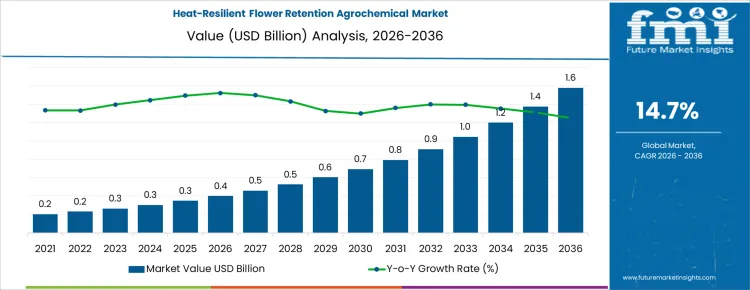
The heat-resilient flower retention agrochemical market is projected to grow significantly, expanding from USD 0.4 billion in 2026 to USD 1.6 billion by 2036, at a CAGR of 14.7%. This growth is driven by rising temperatures and the increasing demand for solutions to combat heat stress that affects flowering and reproductive success in crops. Among active chemistry types, anti-abscission plant growth regulators lead the market with a 37% share, as they prevent premature flower drop under heat stress. Other notable active chemistries include hormone-balancing biostimulant blends, heat-stress protective metabolite sprays, and micronutrient-hormone synergistic systems. In terms of crop types, fruits & vegetables hold the largest share at 41%, driven by their high susceptibility to heat stress, which affects flower retention and yield.
Quick Stats for Heat-Resilient Flower Retention Agrochemical Market
- Heat-Resilient Flower Retention Agrochemical Market Value (2026): USD 0.4 billion
- Heat-Resilient Flower Retention Agrochemical Market Forecast Value (2036): USD 1.6 billion
- Heat-Resilient Flower Retention Agrochemical Market Forecast CAGR: 14.7%
- Leading Chemistry in Heat-Resilient Flower Retention Agrochemical Market: Anti-Abscission Plant Growth Regulators (37%)
- Key Growth Regions in Heat-Resilient Flower Retention Agrochemical Market: India, Brazil, USA, China, Spain
- Key Players in Heat-Resilient Flower Retention Agrochemical Market: Fine Americas, De Sangosse, ICL Growing Solutions, Lallemand Plant Care, Bioiberica
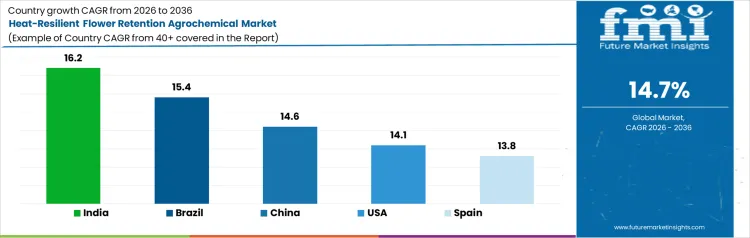
India leads the market with a 16.2% CAGR, driven by the country’s agricultural landscape and increasing heat stress. Brazil follows closely with 15.4%, supported by its flower production industry. China grows at 14.6%, fueled by the expanding floriculture sector. The USA grows at 14.1%, driven by demand for heat-resilient solutions in major flower-growing regions like California and Florida. Spain sees a 13.8% CAGR, focusing on improving flower retention in warmer climates. The market’s growth is underpinned by innovations in formulation technologies and growing adoption of eco-friendly farming practices to mitigate the effects of rising temperatures.
Heat‑Resilient Flower Retention Agrochemical Market Key Takeaways
| Metric | Value |
|---|---|
| Industry Value (2026) | USD 0.4 billion |
| Forecast Value (2036) | USD 1.6 billion |
| Forecast CAGR (2026–2036) | 14.7% |
How is the Global Heat‑Resilient Flower Retention Agrochemical Sector Advancing?
The global heat‑resilient flower retention agrochemical market is growing rapidly as growers face increasing temperature extremes and heat stress that can disrupt flowering and reduce crop yields. Heat stress during key reproductive stages can cause flower drop, poor pollination, and reduced fruit set, impacting productivity in crops such as fruits, vegetables, and ornamentals. Heat‑resilient flower retention agrochemicals are specialized formulations designed to help plants maintain floral structures and reproductive development under high temperatures. These products support physiological processes that stabilize flower retention, enabling more consistent yields even in challenging climatic conditions.
Demand for these agrochemicals is rising as climate change intensifies and growers seek adaptive crop management tools that maintain performance under stress. Traditional crop protection approaches have focused mainly on pests and diseases, but emerging abiotic stressors like heat require new solutions that enhance plant resilience. Innovations in formulation technologies have improved the effectiveness of heat‑resilient products by enhancing uptake, improving stress signaling modulation, and ensuring compatibility with standard crop spray programs.
Demand is expected to expand strongly as awareness of heat stress impacts grows and adoption of climate‑adaptive agriculture practices increases. These agrochemicals are being integrated into broader strategies that include precision irrigation, canopy management, and nutrient balancing to support optimal plant health. Challenges such as variability in field responses across crop types and environmental conditions, cost considerations, and the need for tailored application guidance may influence adoption rates. The drive toward resilient agricultural systems capable of maintaining productivity under rising temperatures will continue to fuel demand for heat‑resilient flower retention agrochemicals worldwide.
What Is the Segment-Wise Analysis for the Global Heat-Resilient Flower Retention Agrochemical Market?
The global heat-resilient flower retention agrochemical market is segmented by active chemistry type and crop type. Anti-abscission plant growth regulators lead the market with a 37% share, as they effectively prevent premature flower drop under heat stress conditions. Other significant active chemistries include hormone-balancing biostimulant blends, heat-stress protective metabolite sprays, and micronutrient-hormone synergistic systems. In terms of crop types, fruits & vegetables hold the largest share at 41%, followed by oilseeds & pulses, plantation & export crops, and horticulture & floriculture.
How Do Anti-Abscission Plant Growth Regulators Lead the Global Heat-Resilient Flower Retention Agrochemical Market?
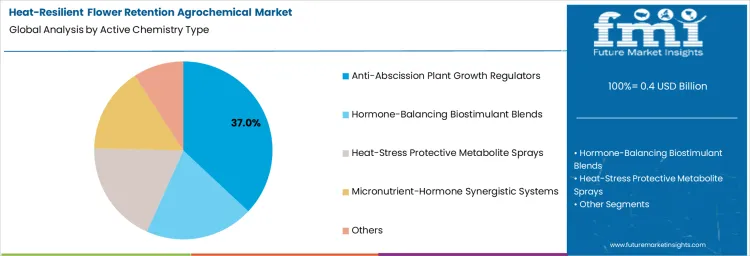
Anti-abscission plant growth regulators hold a 37% share in the global heat-resilient flower retention agrochemical market due to their effectiveness in preventing flower drop during periods of heat stress. These regulators inhibit the natural process of abscission, which causes flowers to prematurely fall off the plant under stress conditions. By maintaining flower retention, they help improve crop yields, particularly in heat-sensitive crops like fruits and vegetables. As climate change results in more frequent and intense heat events, the demand for anti-abscission agrochemicals continues to grow, driving their dominance in the market.
Why Do Fruits & Vegetables Hold the Largest Market Share in the Global Heat-Resilient Flower Retention Agrochemical Market?
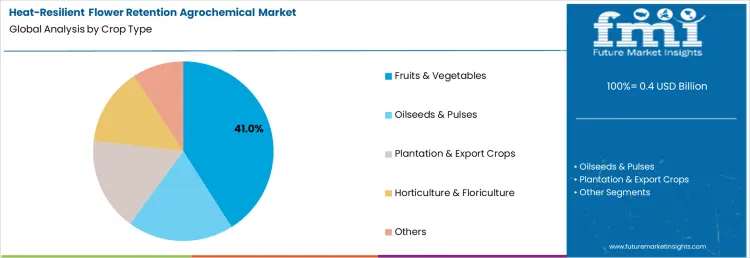
Fruits & vegetables hold the largest share of 41% in the global heat-resilient flower retention agrochemical market due to their susceptibility to heat stress, which can lead to flower drop and reduced yield. These crops, such as tomatoes, peppers, and cucumbers, are particularly sensitive to heat, making flower retention crucial for maximizing yield potential. By using agrochemicals like anti-abscission plant growth regulators and heat-stress protective metabolite sprays, growers can protect flowers from premature loss, improving overall crop quality and yield. The increasing demand for high-quality fruits and vegetables, coupled with climate challenges, continues to drive the adoption of heat-resilient solutions in this sector.
What is Shaping the Heat-Resilient Flower Retention Agrochemical Market?
The heat-resilient flower retention agrochemical market is shaped by rising global temperatures and more frequent heat stress events that threaten reproductive success in many crop species. High heat during flowering can cause flower drop, reduced pollination, and poor fruit set, leading to yield losses in fruits, vegetables, and ornamentals. Agrochemicals designed to enhance flower retention under thermal stress help plants maintain bloom integrity, improve fruit set, and sustain productivity. Advances in plant physiology research, formulation technology, and climate-smart agriculture practices are influencing market growth.
What Challenges Are Limiting Adoption of Heat-Resilient Flower Retention Agrochemicals?
Adoption can be limited by variable field performance and cost concerns. Effectiveness may differ by crop type, heat intensity, timing of application, and local environmental conditions, making growers cautious about consistency. Some heat-resilience products carry higher upfront prices compared with standard crop protectants, affecting adoption in budget-sensitive operations. Integration into existing spray programs requires agronomic knowledge to optimize timing relative to crop phenology and forecasted heat events. Limited localized performance data can also slow broader acceptance.
What Key Trends Are Shaping the Heat-Resilient Flower Retention Agrochemical Market?
Key trends include development of multi-functional formulations that combine flower retention with nutrient delivery and other stress-mitigating benefits such as antioxidant support or improved water use efficiency. There is growing interest in bio-based and low-toxicity solutions that align with durability and regulatory preferences. Precision agriculture tools such as predictive weather analytics and sensor-based crop stress monitoring are improving application timing and effectiveness. Partnerships between agritech firms, plant physiologists, and crop protectant companies are accelerating tailored solutions for specific crops and climates.
What is the Growth Outlook for the Heat-Resilient Flower Retention Agrochemical Market by Country?
| Country | CAGR (%) |
|---|---|
| India | 16.2% |
| Brazil | 15.4% |
| USA | 14.1% |
| China | 14.6% |
| Spain | 13.8% |
The heat-resilient flower retention agrochemical market is growing at a rapid pace, with India leading at a 16.2% CAGR, driven by the country’s diverse agricultural landscape and the need to combat heat stress on flowers, particularly in high-temperature regions. Brazil follows closely with 15.4%, supported by its large-scale flower and crop production, as well as increasing temperatures in key growing areas. China’s market grows at 14.6%, fueled by the rising demand for heat-resilient agrochemicals to support its vast flower and horticulture industry. The USA’s market grows at 14.1%, as farmers seek to improve flower retention in the face of rising temperatures. Spain’s market grows at 13.8%, driven by its focus on improving flower yield and quality in warmer climates.
Why is India Leading in the Heat-Resilient Flower Retention Agrochemical Market?
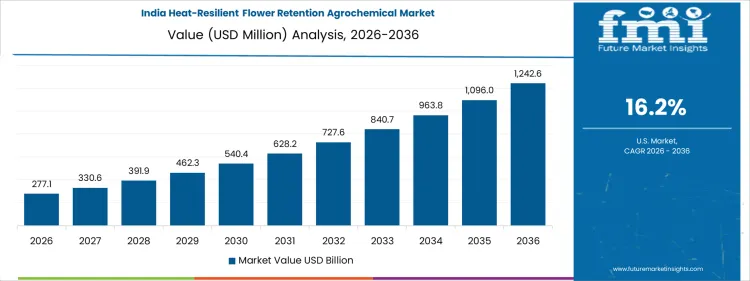
India’s heat-resilient flower retention agrochemical market is growing at 16.2%, driven by the country’s agricultural sector, which faces significant heat stress challenges, especially in regions with high temperatures during the flowering season. As India is one of the largest producers of flowers, particularly for the domestic and export markets, there is an increasing need for agrochemicals that can help flowers withstand extreme heat conditions, ensuring better flower retention and higher quality yields. With changing climate patterns and temperature fluctuations, Indian farmers are adopting heat-resilient solutions to mitigate the impact of heat on flower production. Government initiatives supporting eco-friendly farming practices and the growing demand for high-quality flowers further contribute to the market’s growth. As India continues to prioritize agricultural productivity and durability, the demand for heat-resilient flower retention agrochemicals is expected to continue rising.
What is Driving the Growth of the Heat-Resilient Flower Retention Agrochemical Market in Brazil?
Brazil’s heat-resilient flower retention agrochemical market is growing at 15.4%, fueled by the country’s strong flower production industry, particularly in regions like São Paulo. With rising temperatures and increasing challenges related to heat stress, Brazilian farmers are turning to agrochemicals that help flowers retain their blooms and maintain high quality despite the heat. Brazil’s agricultural sector has been increasingly adopting eco-friendly farming practices and looking for ways to improve the resilience of flowers in extreme conditions. As demand for both domestic consumption and export of flowers grows, the need for heat-resilient flower retention agrochemicals is expected to rise. Additionally, government policies and environmental regulations supporting eco-friendly agricultural solutions are contributing to the market’s growth, ensuring a steady demand for heat-resilient agrochemicals in Brazil.
How is the Heat-Resilient Flower Retention Agrochemical Market Expanding in China?
China’s heat-resilient flower retention agrochemical market is growing at 14.6%, supported by the country’s expanding flower production industry and the need to address the impact of rising temperatures on flower quality and yield. As China continues to be a major player in global flower production, particularly in floriculture, there is increasing demand for agrochemicals that help flowers withstand extreme heat and improve retention rates. The Chinese government’s emphasis on improving agricultural productivity while maintaining environmental standards is further driving the adoption of heat-resilient agrochemicals. With China’s growing interest in producing high-quality flowers for both domestic consumption and export, the market for these agrochemicals is expected to expand steadily, helping farmers protect crops and maintain flower quality even during hotter months.
What is Contributing to the Growth of the Heat-Resilient Flower Retention Agrochemical Market in the USA?
The USA’s heat-resilient flower retention agrochemical market is growing at 14.1%, driven by the increasing need for solutions that protect flowers from the stress caused by rising temperatures, particularly in regions like California and Florida, which are major flower-growing areas. As heat stress negatively impacts flower retention and quality, farmers in the USA are increasingly adopting heat-resilient agrochemicals to ensure optimal flowering, improve yield, and maintain high standards for domestic and export markets. The growing focus on climate-smart agriculture and eco-friendly farming practices is also contributing to the adoption of these agrochemicals. With the demand for high-quality flowers in the USA and abroad continuing to rise, the market for heat-resilient flower retention agrochemicals is expected to grow steadily in the coming years.
What is Driving the Growth of the Heat-Resilient Flower Retention Agrochemical Market in Spain?
Spain’s heat-resilient flower retention agrochemical market is growing at 13.8%, supported by the country’s emphasis on improving agricultural resilience to heat stress, particularly in regions where flowers and horticultural crops are heavily cultivated. Spain’s climate, which often experiences high temperatures during the growing season, poses a significant challenge to flower retention and overall crop productivity. Heat-resilient agrochemicals are increasingly used to enhance flower retention, ensuring better yields and higher quality blooms. As the demand for flowers grows, both for domestic markets and exports, Spanish farmers are adopting solutions to combat the negative effects of heat stress on their crops. With Spain’s agricultural policies focusing on eco-friendly farming and improving productivity in adverse conditions, the demand for these agrochemicals is expected to increase, driving steady growth in the market.
How Are Companies Competing in the Heat‑Resilient Flower Retention Agrochemical Market?
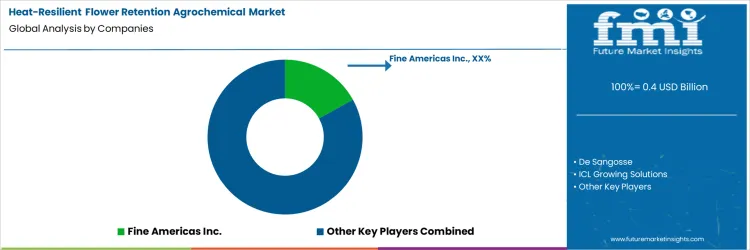
In the heat‑resilient flower retention agrochemical market Fine Americas Inc., De Sangosse, ICL Growing Solutions, Lallemand Plant Care, Bioiberica S.A.U., and others are positioned with product brochures that highlight formulation performance in supporting floral structures under high temperature stress. At Fine Americas Inc. products are described with data on enhanced flower integrity and stress tolerance. Technical summaries and application guidance are included to help growers plan treatments at critical phenological stages. De Sangosse materials present heat‑adaptive agrochemicals with clear dosing charts and crop‑specific recommendations. Visuals are used to illustrate improved flower retention rates when products are applied ahead of peak heat periods.
ICL Growing Solutions brochures showcase specialty solutions designed to enhance cell membrane stability and maintain bloom viability in hot conditions. Field results are highlighted alongside suggested usage windows to aid agronomists and advisors. Lallemand Plant Care collateral is focused on microbial‑enhanced formulations that interact with plant systems to support reproductive resilience. Mode‑of‑action explanations and performance comparisons are included to simplify selection among advisors. Bioiberica S.A.U. product briefs emphasize bio‑based actives with documented flower set benefits under thermal stress. Others in the segment are described with niche heat‑resilient technologies or crop‑specific enhancements that address unique climatic pressures.
Key Players in Heat-Resilient Flower Retention Agrochemical Market
- Fine Americas Inc.
- De Sangosse
- ICL Growing Solutions
- Lallemand Plant Care
- Bioiberica S.A.U.
- Others
Scope of Report
| Items | Values |
|---|---|
| Quantitative Units (2026) | USD billion |
| Active Chemistry Type | Anti-Abscission Plant Growth Regulators, Hormone-Balancing Biostimulant Blends, Heat-Stress Protective Metabolite Sprays, Micronutrient-Hormone Synergistic Systems, Others |
| Crop Type | Fruits & Vegetables, Oilseeds & Pulses, Plantation & Export Crops, Horticulture & Floriculture, Others |
| Regions Covered | Asia Pacific, Europe, North America, Latin America, Middle East & Africa |
| Countries Covered | USA, China, Japan, South Korea, India, Australia & New Zealand, ASEAN, Germany, UK, France, Italy, Spain, Nordic, BENELUX, Brazil, Chile, Mexico, Saudi Arabia, Other GCC Countries, Turkey, South Africa, Other African Union |
| Key Companies Profiled | BASF, Corteva Agriscience, Syngenta Group, UPL, Valent BioSciences, Others |
| Additional Attributes | Dollar sales by active chemistry type, crop type, and region; regional CAGR and growth outlook; distribution channels including biostimulant suppliers, agricultural product distributors, and horticulture & floriculture experts; innovation trends in heat-resilient flower retention agrochemicals; competitive positioning of global vs regional suppliers. |
Heat-Resilient Flower Retention Agrochemical Market by Segments
Active Chemistry Type
- Anti-Abscission Plant Growth Regulators
- Hormone-Balancing Biostimulant Blends
- Heat-Stress Protective Metabolite Sprays
- Micronutrient-Hormone Synergistic Systems
- Others
Crop Type
- Fruits & Vegetables
- Oilseeds & Pulses
- Plantation & Export Crops
- Horticulture & Floriculture
- Others
Region
- Asia Pacific
- China
- Japan
- South Korea
- India
- Australia & New Zealand
- ASEAN
- Rest of Asia Pacific
- Europe
- Germany
- United Kingdom
- France
- Italy
- Spain
- Nordic
- BENELUX
- Rest of Europe
- North America
- United States
- Canada
- Mexico
- Latin America
- Brazil
- Chile
- Rest of Latin America
- Middle East & Africa
- Kingdom of Saudi Arabia
- Other GCC Countries
- Turkey
- South Africa
- Other African Union
- Rest of Middle East & Africa
Frequently Asked Questions
How big is the heat-resilient flower retention agrochemical market in 2026?
The global heat-resilient flower retention agrochemical market is estimated to be valued at USD 0.4 billion in 2026.
What will be the size of heat-resilient flower retention agrochemical market in 2036?
The market size for the heat-resilient flower retention agrochemical market is projected to reach USD 1.6 billion by 2036.
How much will be the heat-resilient flower retention agrochemical market growth between 2026 and 2036?
The heat-resilient flower retention agrochemical market is expected to grow at a 14.7% CAGR between 2026 and 2036.
What are the key product types in the heat-resilient flower retention agrochemical market?
The key product types in heat-resilient flower retention agrochemical market are anti-abscission plant growth regulators, hormone-balancing biostimulant blends, heat-stress protective metabolite sprays, micronutrient-hormone synergistic systems and others.
Which crop type segment to contribute significant share in the heat-resilient flower retention agrochemical market in 2026?
In terms of crop type, fruits & vegetables segment to command 41.0% share in the heat-resilient flower retention agrochemical market in 2026.
Preview the report firsthand - request a free sample
Get SampleGet the brochure for pricing and purchase details.
Get PDFTable of Content
- Executive Summary
- Global Market Outlook
- Demand-side Trends
- Supply-side Trends
- Technology Roadmap Analysis
- Analysis and Recommendations
- Market Overview
- Market Coverage / Taxonomy
- Market Definition / Scope / Limitations
- Market Background
- Market Dynamics
- Drivers
- Restraints
- Opportunity
- Trends
- Scenario Forecast
- Demand in Optimistic Scenario
- Demand in Likely Scenario
- Demand in Conservative Scenario
- Opportunity Map Analysis
- Product Life Cycle Analysis
- Supply Chain Analysis
- Investment Feasibility Matrix
- Value Chain Analysis
- PESTLE and Porter’s Analysis
- Regulatory Landscape
- Regional Parent Market Outlook
- Production and Consumption Statistics
- Import and Export Statistics
- Market Dynamics
- Global Market Analysis 2021 to 2025 and Forecast, 2026 to 2036
- Historical Market Size Value (USD Million) Analysis, 2021 to 2025
- Current and Future Market Size Value (USD Million) Projections, 2026 to 2036
- Y-o-Y Growth Trend Analysis
- Absolute $ Opportunity Analysis
- Global Market Pricing Analysis 2021 to 2025 and Forecast 2026 to 2036
- Global Market Analysis 2021 to 2025 and Forecast 2026 to 2036, By Active Chemistry Type
- Introduction / Key Findings
- Historical Market Size Value (USD Million) Analysis By Active Chemistry Type , 2021 to 2025
- Current and Future Market Size Value (USD Million) Analysis and Forecast By Active Chemistry Type , 2026 to 2036
- Anti-Abscission Plant Growth Regulators
- Hormone-Balancing Biostimulant Blends
- Heat-Stress Protective Metabolite Sprays
- Micronutrient-Hormone Synergistic Systems
- Others
- Y-o-Y Growth Trend Analysis By Active Chemistry Type , 2021 to 2025
- Absolute $ Opportunity Analysis By Active Chemistry Type , 2026 to 2036
- Global Market Analysis 2021 to 2025 and Forecast 2026 to 2036, By Crop Type
- Introduction / Key Findings
- Historical Market Size Value (USD Million) Analysis By Crop Type, 2021 to 2025
- Current and Future Market Size Value (USD Million) Analysis and Forecast By Crop Type, 2026 to 2036
- Fruits & Vegetables
- Oilseeds & Pulses
- Plantation & Export Crops
- Horticulture & Floriculture
- Others
- Y-o-Y Growth Trend Analysis By Crop Type, 2021 to 2025
- Absolute $ Opportunity Analysis By Crop Type, 2026 to 2036
- Global Market Analysis 2021 to 2025 and Forecast 2026 to 2036, By Region
- Introduction
- Historical Market Size Value (USD Million) Analysis By Region, 2021 to 2025
- Current Market Size Value (USD Million) Analysis and Forecast By Region, 2026 to 2036
- North America
- Latin America
- Western Europe
- Eastern Europe
- East Asia
- South Asia and Pacific
- Middle East & Africa
- Market Attractiveness Analysis By Region
- North America Market Analysis 2021 to 2025 and Forecast 2026 to 2036, By Country
- Historical Market Size Value (USD Million) Trend Analysis By Market Taxonomy, 2021 to 2025
- Market Size Value (USD Million) Forecast By Market Taxonomy, 2026 to 2036
- By Country
- USA
- Canada
- Mexico
- By Active Chemistry Type
- By Crop Type
- By Country
- Market Attractiveness Analysis
- By Country
- By Active Chemistry Type
- By Crop Type
- Key Takeaways
- Latin America Market Analysis 2021 to 2025 and Forecast 2026 to 2036, By Country
- Historical Market Size Value (USD Million) Trend Analysis By Market Taxonomy, 2021 to 2025
- Market Size Value (USD Million) Forecast By Market Taxonomy, 2026 to 2036
- By Country
- Brazil
- Chile
- Rest of Latin America
- By Active Chemistry Type
- By Crop Type
- By Country
- Market Attractiveness Analysis
- By Country
- By Active Chemistry Type
- By Crop Type
- Key Takeaways
- Western Europe Market Analysis 2021 to 2025 and Forecast 2026 to 2036, By Country
- Historical Market Size Value (USD Million) Trend Analysis By Market Taxonomy, 2021 to 2025
- Market Size Value (USD Million) Forecast By Market Taxonomy, 2026 to 2036
- By Country
- Germany
- UK
- Italy
- Spain
- France
- Nordic
- BENELUX
- Rest of Western Europe
- By Active Chemistry Type
- By Crop Type
- By Country
- Market Attractiveness Analysis
- By Country
- By Active Chemistry Type
- By Crop Type
- Key Takeaways
- Eastern Europe Market Analysis 2021 to 2025 and Forecast 2026 to 2036, By Country
- Historical Market Size Value (USD Million) Trend Analysis By Market Taxonomy, 2021 to 2025
- Market Size Value (USD Million) Forecast By Market Taxonomy, 2026 to 2036
- By Country
- Russia
- Poland
- Hungary
- Balkan & Baltic
- Rest of Eastern Europe
- By Active Chemistry Type
- By Crop Type
- By Country
- Market Attractiveness Analysis
- By Country
- By Active Chemistry Type
- By Crop Type
- Key Takeaways
- East Asia Market Analysis 2021 to 2025 and Forecast 2026 to 2036, By Country
- Historical Market Size Value (USD Million) Trend Analysis By Market Taxonomy, 2021 to 2025
- Market Size Value (USD Million) Forecast By Market Taxonomy, 2026 to 2036
- By Country
- China
- Japan
- South Korea
- By Active Chemistry Type
- By Crop Type
- By Country
- Market Attractiveness Analysis
- By Country
- By Active Chemistry Type
- By Crop Type
- Key Takeaways
- South Asia and Pacific Market Analysis 2021 to 2025 and Forecast 2026 to 2036, By Country
- Historical Market Size Value (USD Million) Trend Analysis By Market Taxonomy, 2021 to 2025
- Market Size Value (USD Million) Forecast By Market Taxonomy, 2026 to 2036
- By Country
- India
- ASEAN
- Australia & New Zealand
- Rest of South Asia and Pacific
- By Active Chemistry Type
- By Crop Type
- By Country
- Market Attractiveness Analysis
- By Country
- By Active Chemistry Type
- By Crop Type
- Key Takeaways
- Middle East & Africa Market Analysis 2021 to 2025 and Forecast 2026 to 2036, By Country
- Historical Market Size Value (USD Million) Trend Analysis By Market Taxonomy, 2021 to 2025
- Market Size Value (USD Million) Forecast By Market Taxonomy, 2026 to 2036
- By Country
- Kingdom of Saudi Arabia
- Other GCC Countries
- Turkiye
- South Africa
- Other African Union
- Rest of Middle East & Africa
- By Active Chemistry Type
- By Crop Type
- By Country
- Market Attractiveness Analysis
- By Country
- By Active Chemistry Type
- By Crop Type
- Key Takeaways
- Key Countries Market Analysis
- USA
- Pricing Analysis
- Market Share Analysis, 2025
- By Active Chemistry Type
- By Crop Type
- Canada
- Pricing Analysis
- Market Share Analysis, 2025
- By Active Chemistry Type
- By Crop Type
- Mexico
- Pricing Analysis
- Market Share Analysis, 2025
- By Active Chemistry Type
- By Crop Type
- Brazil
- Pricing Analysis
- Market Share Analysis, 2025
- By Active Chemistry Type
- By Crop Type
- Chile
- Pricing Analysis
- Market Share Analysis, 2025
- By Active Chemistry Type
- By Crop Type
- Germany
- Pricing Analysis
- Market Share Analysis, 2025
- By Active Chemistry Type
- By Crop Type
- UK
- Pricing Analysis
- Market Share Analysis, 2025
- By Active Chemistry Type
- By Crop Type
- Italy
- Pricing Analysis
- Market Share Analysis, 2025
- By Active Chemistry Type
- By Crop Type
- Spain
- Pricing Analysis
- Market Share Analysis, 2025
- By Active Chemistry Type
- By Crop Type
- France
- Pricing Analysis
- Market Share Analysis, 2025
- By Active Chemistry Type
- By Crop Type
- India
- Pricing Analysis
- Market Share Analysis, 2025
- By Active Chemistry Type
- By Crop Type
- ASEAN
- Pricing Analysis
- Market Share Analysis, 2025
- By Active Chemistry Type
- By Crop Type
- Australia & New Zealand
- Pricing Analysis
- Market Share Analysis, 2025
- By Active Chemistry Type
- By Crop Type
- China
- Pricing Analysis
- Market Share Analysis, 2025
- By Active Chemistry Type
- By Crop Type
- Japan
- Pricing Analysis
- Market Share Analysis, 2025
- By Active Chemistry Type
- By Crop Type
- South Korea
- Pricing Analysis
- Market Share Analysis, 2025
- By Active Chemistry Type
- By Crop Type
- Russia
- Pricing Analysis
- Market Share Analysis, 2025
- By Active Chemistry Type
- By Crop Type
- Poland
- Pricing Analysis
- Market Share Analysis, 2025
- By Active Chemistry Type
- By Crop Type
- Hungary
- Pricing Analysis
- Market Share Analysis, 2025
- By Active Chemistry Type
- By Crop Type
- Kingdom of Saudi Arabia
- Pricing Analysis
- Market Share Analysis, 2025
- By Active Chemistry Type
- By Crop Type
- Turkiye
- Pricing Analysis
- Market Share Analysis, 2025
- By Active Chemistry Type
- By Crop Type
- South Africa
- Pricing Analysis
- Market Share Analysis, 2025
- By Active Chemistry Type
- By Crop Type
- USA
- Market Structure Analysis
- Competition Dashboard
- Competition Benchmarking
- Market Share Analysis of Top Players
- By Regional
- By Active Chemistry Type
- By Crop Type
- Competition Analysis
- Competition Deep Dive
- Fine Americas Inc.
- Overview
- Product Portfolio
- Profitability by Market Segments (Product/Age /Sales Channel/Region)
- Sales Footprint
- Strategy Overview
- Marketing Strategy
- Product Strategy
- Channel Strategy
- De Sangosse
- ICL Growing Solutions
- Lallemand Plant Care
- Bioiberica S.A.U.
- Others
- Fine Americas Inc.
- Competition Deep Dive
- Assumptions & Acronyms Used
- Research Methodology


