

- Market Size (2026)
- USD 169.3 Mn
- Forecast (2036)
- USD 397.8 Mn
- CAGR (2026 to 2036)
- 8.9%
How big is Acetylacetone Market in 2026?
USD 169.3 million in 2026 and USD 397.8 million by 2036 at an 8.9% CAGR.
Demand for Acetylacetone is projected to expand at 8.9% CAGR between 2026 and 2036 with valuation anticipated to increase from USD 169.3 million in 2026 to USD 397.8 million by 2036. Growth is supported by its role as a specialty intermediate in pharmaceutical, agrochemical, and fine-chemical manufacturing. Wacker Chemie AG reported in March 2026 that acetylacetone forms part of its Biosolutions fine-chemicals portfolio serving pharmaceutical active ingredients and crop-protection applications. The inclusion of acetylacetone in these value chains highlights its importance in synthesis and formulation processes. Once qualified within a production route, manufacturers often retain the material across recurring campaigns because process consistency and regulatory documentation make switching costs comparatively higher.
Country economics change how specialty-synthesis demand converts into repeat orders between major operating regions. Destatis recorded a 2.1% monthly increase in German chemical production during April 2026 while plant operators remained exposed to energy-sensitive production costs. That combination favors continuity at mature European sites while Asian restructuring programs direct more capacity toward higher-value fine chemicals.
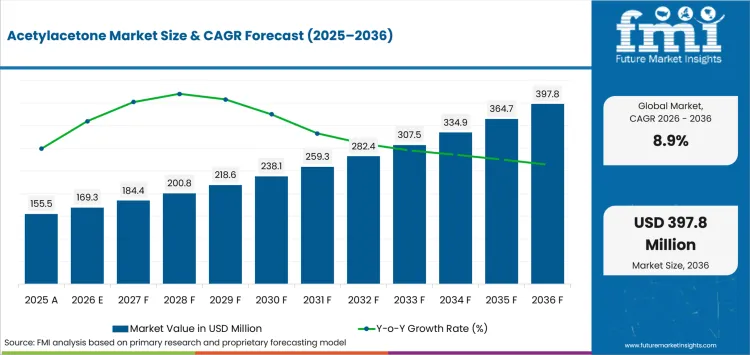
Key Takeaways of Acetylacetone Market
- Demand rises with repeat synthesis programs that require a qualified beta-diketone intermediate for pharmaceutical, agrochemical, coating, and chelation chemistry.
- By application, heterocyclic compounds synthesis is estimated to hold 29.0% in 2026 owing to its direct role in repeat ring-forming reaction sequences.
- In 2026, the keto form is expected to lead form demand with 94.0% share because commercial specifications qualify acetylacetone as one chemical product.
- China carries the highest approved country growth focus at 10.4% CAGR through 2036 as its chemical manufacturing base supports frequent intermediate qualification.
- Flammable-liquid handling and raw-material interruptions increase inventory costs and extend approval cycles for companies that need a verified second source.
- Some of the key players in this market include Wacker Chemie AG, Daicel Corporation, Thermo Fisher Scientific Inc., Merck KGaA, Avantor, Inc., Tokyo Chemical Industry Co., Ltd., FUJIFILM Wako Pure Chemical Corporation, and Nouryon.
Analyst Perspective
“Acetylacetone contracts deserve more scrutiny on assay drift and backup supply than on small unit-price differences between approved sources. The best commercial offer protects reaction reproducibility during raw-material disruptions without forcing a plant to repeat qualification work.”
- Nikhil Kaitwade, Principal Consultant, Future Market Insights
How is the Acetylacetone Market segmented?
The acetylacetone market is segmented by application and form, with region used for geographic analysis.
Application covers heterocyclic compounds synthesis, biomolecules, peroxide compounds polymerization, anti-corrosion paints & coatings, and dyes & pigments. Form separates keto and enol categories, while region analysis in full report covers 20+ countries.
What makes Heterocyclic Compounds Synthesis central to the Application category?
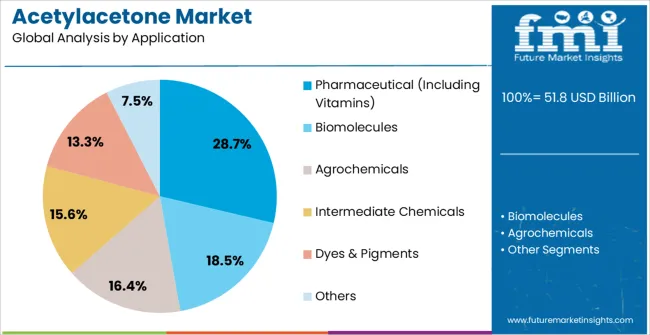
Heterocycle producers use acetylacetone in condensation reactions that form ring systems for precision chemicals and pharmaceutical intermediate programs. WACKER’s May 2026 investor presentation places acetylacetone among advanced intermediates serving life-science chemistry and confirms its active role in controlled synthesis programs. Organic synthesis intermediates are qualified by repeat reaction behavior and impurity limits instead of broad solvent performance claims.
- By application, heterocyclic compounds synthesis is estimated to hold 29.0% in 2026 owing to acetylacetone’s direct use in repeat condensation routes.
- Process chemists favor grades with stable assay and impurity profiles since unexpected variation increases purification work and can force revalidation ahead of commercial batch resumption.
Why does Keto lead the Form category?
Commercial procurement treats acetylacetone and 2,4-pentanedione as one specified chemical even though keto and enol forms interconvert. OSHA’s July 2025 chemical database lists one CAS number for both names and records a 93°F flash point for the regulated liquid. That shared identity keeps chelating agents and synthesis orders tied to one qualified material specification instead of separate tautomer streams.
- In 2026, keto is expected to lead the form category with 94.0% share because routine purchasing is organized around standardized acetylacetone specifications.
- Laboratories qualify acetylacetone against assay and safety documentation as enol content reflects equilibrium behavior instead of a separate bulk sourcing route.
What are the drivers, restraints and opportunities in the Acetylacetone Market?
Specialty synthesis raises repeat demand while hazardous-liquid handling increases switching cost and qualification support improves commercial access.
- Driver: Additional chemical manufacturing sites increase the number of specialty synthesis programs that can qualify acetylacetone for repeated production.
- Restraint: Raw-material interruptions and flammable-liquid controls increase safety-stock requirements and lengthen approval work for alternative sources.
- Opportunity: Documented quality systems and responsive distribution reduce qualification risk for high-value chemistry that cannot tolerate unplanned material changes.
Specialty Synthesis Capacity Expands Qualification Points
Additional chemical manufacturing sites introduce new qualification points whenever pharmaceutical or specialty-synthesis programs move into full commercial production. The USA Census Bureau documented a 10.2% increase in chemical manufacturing establishments between 2017 and 2022 in its March 2026 review. Those additional sites expand the addressable pool for surface treatment chemicals and acetylacetone after process owners approve reaction-specific assay limits.
Handling and Feedstock Disruptions Raise Switching Cost
A short upstream stoppage can leave downstream plants without an approved substitute for a qualified intermediate. Daicel Corporation reported a roughly two-week Himeji acetic acid shutdown in January 2026 following a carbon-monoxide plant malfunction. Alternative acetylacetone lots must reproduce approved process behavior to restore normal purchasing, so disruption increases contingency inventory cost and extends source-change timelines during unplanned supply outages.
Qualification Infrastructure Improves Commercial Access
Life-science chemistry values qualification infrastructure since documented release controls precede routine material approval. In July 2026 Merck KGaA opened a 2,000-square-meter BioReliance testing facility in Darmstadt for GMP-compliant release and stability studies. Acetylacetone distributors can apply the same discipline to water treatment chemicals and regulated synthesis programs by pairing assay records with traceable storage and release procedures for distributors.
Which country CAGRs are profiled in the Acetylacetone Market?
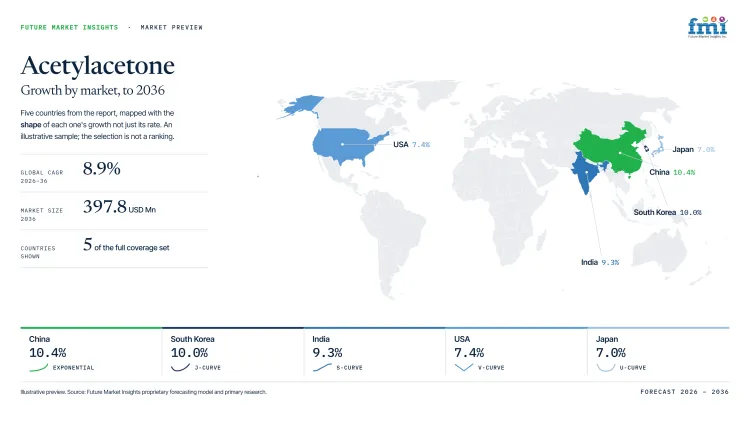
| Country | CAGR |
|---|---|
| China | 10.4% |
| South Korea | 10% |
| India | 9.3% |
| United States | 7.4% |
| Japan | 7.0% |
How do country-level CAGRs compare in the Acetylacetone Market?
The five profiled CAGRs span 3.4 percentage points, from China at 10.4% to Japan at 7.0%. China and South Korea form the upper growth group, followed by India, while the United States and Japan form the lower-growth pair. The variation reflects differences in specialty-chemical expansion, domestic manufacturing activity, and the pace of new qualified supply development.
- China is positioned at the top, supported by expanding chemical manufacturing capacity and increasing demand for qualified intermediates across specialty applications.
- South Korea follows, with its integrated chemical industry and growing specialty-materials focus supporting acetylacetone demand.
- India is supported by expanding pharmaceutical, coatings, and specialty-chemical production, along with increasing domestic sourcing of chemical intermediates.
- The United States benefits from its broad chemical manufacturing base and established demand across industrial and specialty synthesis applications.
- Japan reflects a mature specialty-chemical market with established consumption patterns and stringent quality requirements.
Qualification costs and supply risks vary despite similar forecast rates. The full report provides country-level CAGR analysis across North America, Latin America, Europe, East Asia, South Asia, Oceania and the Middle East and Africa.
Country-wise Analysis
- China is expected to record a 10.4% CAGR through 2036, supported by the country's expanding chemical manufacturing base and continued development of specialty-chemical production. Acetylacetone demand benefits from its use as a synthesis intermediate across pharmaceuticals, coatings, agrochemicals, and other chemical applications. Growing domestic production capabilities and investments in higher-value chemical products are strengthening the requirement for consistent-quality intermediates. Regional supply networks and domestic manufacturing capacity also support shorter replenishment cycles for producers operating across major chemical clusters.
- South Korea is forecast to advance at a 10.0% CAGR through 2036, supported by its integrated petrochemical infrastructure and increasing focus on specialty and high-value chemical products. The country's established chemical clusters provide strong technical and distribution networks for qualified intermediates. Acetylacetone consumption is supported by applications requiring controlled specifications and reliable feedstock availability. Local inventory and established technical support can also reduce qualification and replenishment challenges for manufacturers operating within tightly integrated production chains.
- India is projected to grow at a 9.3% CAGR through 2036, driven by expanding pharmaceutical, coatings, agrochemical, and specialty-chemical manufacturing. Increasing domestic production and the development of higher-value chemical intermediates are creating additional demand for acetylacetone. India's growing chemical manufacturing ecosystem also encourages suppliers to strengthen local distribution, inventory availability, and technical support. These factors can improve supply continuity for manufacturers that require consistent specifications across repeated production batches.
- The United States is expected to register a 7.4% CAGR through 2036, supported by its broad chemical manufacturing base and established demand across pharmaceutical, coatings, and specialty-synthesis applications. Mature distribution infrastructure provides manufacturers with access to multiple supply channels and regional inventory points. However, stringent handling, storage, documentation, and qualification requirements can influence supplier selection, particularly for applications where consistent product specifications are critical. Established domestic distribution therefore remains an important factor in maintaining reliable acetylacetone availability.
- Japan is forecast to expand at a 7.0% CAGR through 2036, reflecting mature specialty-chemical consumption and established demand from pharmaceutical, coatings, and other precision-oriented applications. Japanese manufacturers typically place strong emphasis on product consistency, impurity control, and reliable supplier performance. These requirements can make qualified-source relationships commercially important even as overall market growth remains comparatively moderate. Domestic technical support and dependable distribution can therefore help manufacturers manage replenishment requirements and maintain continuity across established production operations.
Who are the notable companies in the Acetylacetone Market?
Wacker Chemie AG, Daicel Corporation, Thermo Fisher Scientific Inc., Merck KGaA, Avantor, Inc., Tokyo Chemical Industry Co., Ltd., FUJIFILM Wako Pure Chemical Corporation, and Nouryon are the notable companies profiled in this market.
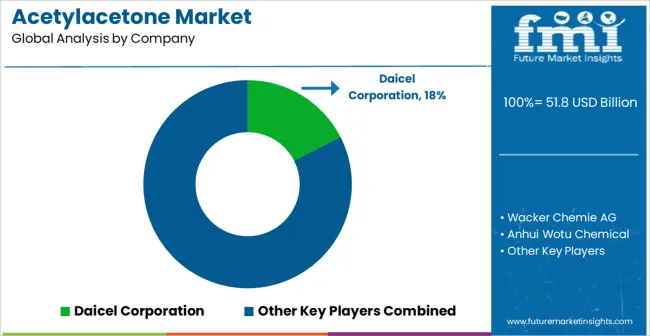
Wacker Chemie AG and Daicel Corporation provide the clearest industrial-scale evidence as both document acetylacetone inside active chemical operations. Thermo Fisher Scientific Inc., Merck KGaA, Avantor, Inc., Tokyo Chemical Industry Co., Ltd., and FUJIFILM Wako Pure Chemical Corporation support synthesis laboratories and cosmetic chemicals formulators through reagent-scale channels. Nouryon supplies acetylacetone as Promotor C for thermoset cure systems used with ketone peroxides and cobalt accelerators. Entry depends on exact-product documentation and reliable distribution more than broad corporate scale or portfolio size.
- Wacker Chemie AG and Daicel Corporation operate industrial intermediate businesses with current first-party evidence linking acetylacetone to production and shipment activity.
- Thermo Fisher Scientific Inc., Merck KGaA, and Avantor, Inc. operate multinational laboratory-chemical platforms with documented acetylacetone grades and formal quality systems.
- Tokyo Chemical Industry Co., Ltd. and FUJIFILM Wako Pure Chemical Corporation serve specialist synthesis laboratories. Nouryon supplies acetylacetone for thermoset cure systems used in construction chemicals formulations.
Competitive Benchmarking: Acetylacetone Market
| Company | Exact-Market Route Breadth | Quality Documentation Depth | Supply & Logistics Evidence | Geographic Reach |
|---|---|---|---|---|
| Wacker Chemie AG | High | High | High | Global chemical network |
| Daicel Corporation | High | Medium | Medium | Japan and international materials markets |
| Thermo Fisher Scientific Inc. | Medium | High | High | Global laboratory and industrial network |
| Merck KGaA | Medium | High | High | Global life-science network |
| Avantor, Inc. | Medium | High | Medium | North America and Europe |
| Tokyo Chemical Industry Co., Ltd. | Medium | High | Medium | Asia, Americas and Europe |
| FUJIFILM Wako Pure Chemical Corporation | Low | High | Medium | Japan with international laboratory distribution |
| Nouryon | Medium | High | High | Africa, Asia, Europe and Middle East |
Scoring basis: High route breadth requires industrial supply or several exact-product grades serving distinct use cases. Medium route breadth requires one broad supply route with multiple pack or application options. Low route breadth identifies one narrow route supported by current exact-product evidence. High documentation requires exact-product safety records plus independent quality or application evidence. Medium documentation requires two verified evidence types covering separate qualification needs. Low documentation identifies one verified source with narrow qualification coverage. High logistics evidence requires multinational distribution or documented bulk supply routes. Medium logistics evidence shows regional distribution with more than one documented service route. Low logistics evidence identifies one narrow delivery route with limited geographic coverage.
Key Developments in the Acetylacetone Market
- In March 2026, Daicel Corporation adjusted acetylacetone shipment volumes following raw-material procurement uncertainty and revised supply planning for customers using approved material.
- In April 2026, Avantor, Inc. expanded its St. Louis site with microbial and stability testing that improves release support for high-value chemicals distributed through its network.
- In October 2025, Nouryon announced an organic peroxides innovation center in Tianjin that supports cure-system development using its Promotor C acetylacetone.
Key Players in the Acetylacetone Market
Industrial Intermediate Producers
- Wacker Chemie AG
- Daicel Corporation
Global Laboratory and Life-Science Chemical Platforms
- Thermo Fisher Scientific Inc.
- Merck KGaA
- Avantor, Inc.
- Tokyo Chemical Industry Co., Ltd.
- FUJIFILM Wako Pure Chemical Corporation
Specialty Reagent and Research-Chemical Platforms
- Nouryon
Acetylacetone Market - Report Scope
| Coverage field | Report scope |
|---|---|
| Market breakdown | By application, form and region. |
| Quantitative Units | USD million. |
| Market Definition | Commercial acetylacetone and 2,4-pentanedione supplied for qualified synthesis, formulation, chelation and laboratory uses. |
| Regions Covered | North America, Latin America, Europe, East Asia, South Asia and Pacific, and Middle East and Africa. |
| Countries Covered | South Korea, China, India, United States, Japan, and 20+ countries included in the full report. |
| Key Companies Profiled | Wacker Chemie AG, Daicel Corporation, Thermo Fisher Scientific Inc., Merck KGaA, Avantor, Inc., Tokyo Chemical Industry Co., Ltd., FUJIFILM Wako Pure Chemical Corporation, and Nouryon. |
| Forecast Period | 2026 to 2036. |
| Approach | Primary and secondary research with market triangulation. |
Acetylacetone Market - Research Methodology
| Method | Approach |
|---|---|
| Primary Research | FMI analysts gathered input from manufacturers, service providers, technology developers, distributors, end users, procurement teams, and subject-matter experts. Interviews examined purchasing decisions, product or service evaluation, adoption barriers, approval requirements, pricing considerations, and expectations for technical or commercial support. Respondents were also asked what evidence is required before a trial, pilot, or initial order develops into regular purchasing. |
| Desk Research | Desk research covered government statistics, regulatory publications, trade data, industry associations, technical literature, standards, company filings, product information, and official corporate announcements. Sources were reviewed for relevance, publication date, geographic coverage, and consistency with the defined market scope. Claims relating to performance, applications, approvals, capacity, investment, and commercial activity were retained only when supported by credible public evidence. |
| Market Sizing and Forecasting | The market model combined the baseline value with historical performance, segment structure, pricing and volume indicators, adoption levels, company participation, and country-level demand conditions. Forecast assumptions considered economic activity, investment trends, regulatory developments, technology adoption, purchasing cycles, supply availability, and barriers to wider market use. Segment and regional estimates were reconciled before the final market total was calculated. |
| Data Validation | Estimates were checked against multiple independent indicators, including public data, company activity, trade patterns, industry developments, and findings from primary interviews. Validation also tested whether products, services, applications, and company revenues fell within the defined market boundaries. Adjacent categories, unsupported claims, overlapping revenues, and activities without direct market relevance were excluded to reduce double counting and maintain consistency across segments and countries. |
Acetylacetone Market by Segments
Acetylacetone Market segmented by Application:
- Heterocyclic Compounds Synthesis
- Biomolecules
- Peroxide Compounds Polymerization
- Anti-Corrosion Paints & Coatings
- Dyes & Pigments
Acetylacetone Market segmented by Form:
- Keto
- Enol
Acetylacetone Market by Region:
- North America
- United States
- Canada
- Latin America
- Brazil
- Mexico
- Chile
- Rest of Latin America
- Western Europe
- Germany
- United Kingdom
- Italy
- Spain
- France
- Nordics
- Benelux
- Rest of Western Europe
- Eastern Europe
- Russia
- Poland
- Hungary
- Balkan and Baltic States
- Rest of Eastern Europe
- East Asia
- China
- Japan
- South Korea
- South Asia and Pacific
- India
- ASEAN
- Australia and New Zealand
- Rest of South Asia and Pacific
- Middle East and Africa
- Kingdom of Saudi Arabia
- Other GCC Countries
- Türkiye
- South Africa
- Other African Union Countries
- Rest of Middle East and Africa
Research Sources and Bibliography
- Wacker Chemie AG. (2026, March 11). Products & Services - WACKER Annual Report 2025.
- Federal Statistical Office of Germany. (2026, June 9). Production in April 2026: +0.4% on the previous month.
- Wacker Chemie AG. (2026, May 6). Roadshow Presentation May 2026
- USA Census Bureau. (2026, March 5). Chemical Manufacturers Produce Everything from Medicine to Fertilizer.
- Daicel Corporation. (2026, March 27). Notice Regarding Adjustment of Shipment Quantity of Products.
- USA Bureau of Labor Statistics. (2026, August 7). Chemical Manufacturing: NAICS 325.
- Ministry of Trade, Industry and Resources, Republic of Korea. (2026, February 25). MOTIR Approves First Petrochemical Restructuring Project.
- Federal Statistical Office of Germany. (2026, August 7). Production in June 2026: +0.2% on the previous month.
- Government of the Russian Federation. (2025, October 13). Денис Мантуров провёл совещание по нацпроекту «Новые материалы и химия».
- Occupational Safety and Health Administration. (2025, July 15). Acetylacetone (2,4-Pentanedione)
- Ministry of Economy, Trade and Industry, Japan. (2026, February 27). Indices of Industrial Production: Preliminary Report for January 2026.
- Fisher Scientific. (2025, December 18). Safety Data Sheet: 2,4-Pentanedione.
- Sigma-Aldrich Inc. (2025, August 12). Safety Data Sheet: Acetylacetone.
- FUJIFILM Wako Pure Chemical Corporation. (2025, November 12). Safety Data Sheet: Acetylacetone.
- Tokyo Chemical Industry Co., Ltd. (2025, November 19). Safety Data Sheet: Acetylacetone.
- Nouryon. (2026). Our curing systems for thermoset resins.
- Merck KGaA. (2026, July 16). MilliporeSigma Announces Opening of BioReliance Testing Facility in Darmstadt, Germany.
- Avantor, Inc. (2026, April 13). Avantor Enhances USA Biomanufacturing Infrastructure with Expanded Stability and Microbial Testing Facility.
- Thermo Fisher Scientific Inc. (2025, December 2). Thermo Fisher Scientific Deepens Investment in Asia’s Biopharma Ecosystem with Expansion of Bioprocess Design Centers.
- Wacker Chemie AG. (2026, March 11). Highlights from 2025.
- Daicel Corporation. (2025, November 6). First Half of Fiscal Year Ending March 2026.
- Thermo Fisher Scientific Inc. (2025, August 21). New Thermo Fisher manufacturing facility boosts USA supply chain resilience and creates jobs.
- Merck KGaA. (2026, April 21). MilliporeSigma Launches First Bio-Based Solvent Portfolio for High-Performance Liquid Chromatography.
- Avantor, Inc. (2025, March 17). Avantor Provides First Look at Recently Completed Hydration Expansion at DCAT Week 2025.
- Tokyo Chemical Industry Co., Ltd. (2025, July). Discover Our New Products of July 2025.
- FUJIFILM Corporation. (2025, June 2). Fujifilm Rebrands Life Sciences Companies to Strengthen Position as Strategic Partners for Life, Offering End-to-End Solutions.
- Nouryon. (2025, October 16). Nouryon expands polymer specialties leadership with metal alkyls capacity increase, new MMAO production capability and organic peroxides innovation center in China.
- Daicel Corporation. (2026, January 15). Regarding Trouble at the CO (Carbon Monoxide) Plant.
- Daicel Corporation. (2026, January 16). Announcement of ISCC PLUS Certification.
- Nouryon. (2026, May 6). Nouryon launches first commercially available solution to restore recycled polypropylene performance in packaging, automotive and consumer goods.
- Avantor, Inc. (2025, January 8).Safety Data Sheet: Acetylacetone AnalaR NORMAPUR®
- Nouryon. (2025, November 10).Nouryon opens new innovation center in Shanghai to accelerate localized innovation and customer collaboration in China.
This bibliography is provided for reader reference and is not exhaustive. The full report contains the complete reference list and detailed citations
This Report Answers
- How large is the acetylacetone market in 2026 and what valuation is projected for 2036?
- Which synthesis routes generate the most direct recurring demand for acetylacetone?
- Why does heterocyclic compounds synthesis hold the largest application share in 2026?
- Why does the keto category account for most form demand in commercial procurement?
- Which operating risks raise qualification and switching costs for acetylacetone purchasers?
- How do South Korea, Germany, Russia, the United States, and Japan differ in growth conditions?
- Which companies have the strongest documented acetylacetone supply and quality positions?
- How should chemical manufacturers compare technical documentation, supply continuity, and logistics during source approval?
- Which recent company actions are changing quality support and distribution capacity around specialty chemicals?
Frequently Asked Questions
How big is the acetylacetone market in 2026?
The acetylacetone market is valued at USD 169.3 million in 2026 and is projected to reach USD 397.8 million by 2036. Repeat synthesis programs support growth as pharmaceutical and agrochemical producers consume the intermediate once qualified.
What is the CAGR of the acetylacetone market from 2026 to 2036?
The acetylacetone market is projected to grow at a CAGR of 8.9% between 2026 and 2036. Expansion follows repeat intermediate demand from pharmaceutical and agrochemical synthesis plus coating and chelation chemistry.
Which application leads the acetylacetone market?
The heterocyclic compounds synthesis segment is expected to hold 29.0% of the acetylacetone market application category in 2026. Its leading position comes from direct use of the beta-diketone in repeat ring-forming reaction sequences.
Which form leads the acetylacetone market?
The keto segment is expected to hold 94.0% of the acetylacetone market form category in 2026. Commercial procurement treats acetylacetone as one specified chemical instead of sourcing separate tautomer streams.
Which companies are active in the acetylacetone market?
Key companies operating in the acetylacetone market include Wacker Chemie AG, Daicel Corporation, Thermo Fisher Scientific Inc., Merck KGaA, Avantor, Inc., Tokyo Chemical Industry Co., Ltd., FUJIFILM Wako Pure Chemical Corporation, and Nouryon. They compete on industrial scale, reagent documentation, quality systems, and distribution reach.
Preview the report firsthand - request a free sample
Get SampleGet the brochure for pricing and purchase details.
Get PDFTable of Content
- Key Takeaways
- Market Size and CAGR
- Top Growth Driver
- Fastest Growing Segment
- Leading Region
- Key Companies
- Emerging Opportunities
- Executive Summary
- Global Market Outlook
- Demand-side Trends
- Supply-side Trends
- Technology Roadmap Analysis
- Analysis and Recommendations
- Analyst Perspective (What is happening? Why now? What should investors know?)
- Key Questions Answered
- How large is the market?
- What is the CAGR?
- What are key trends?
- Which region dominates?
- Who are the leaders?
- Market Overview
- Market Coverage / Taxonomy
- Market Definition / Scope / Limitations
- Research Methodology
- Chapter Orientation
- Analytical Lens and Working Hypotheses
- Market Structure, Signals, and Trend Drivers
- Benchmarking and Cross-market Comparability
- Market Sizing, Forecasting, and Opportunity Mapping
- Research Design and Evidence Framework
- Desk Research Programme (Secondary Evidence)
- Expert Input and Fieldwork (Primary Evidence)
- Tooling, Models, and Reference Databases
- Data Engineering and Model Build
- Quality Assurance and Audit Trail
- Market Background
- Market Dynamics (Drivers, Restraints, Opportunity, Trends)
- Scenario Forecast (Optimistic, Likely, Conservative)
- Impact Analysis
- AI Impact
- Sustainability Impact
- Regulatory Impact
- Technology Impact
- Consumer / Buyer Analysis
- Purchase Drivers
- Adoption Barriers
- Buyer Journey
- Opportunity Map Analysis
- Product Life Cycle Analysis
- Supply Chain Analysis
- Investment Feasibility Matrix
- Value Chain Analysis
- PESTLE and Porter's Analysis
- Regulatory Landscape
- Regional Parent Market Outlook
- Production and Consumption Statistics
- Import and Export Statistics
- Global Market Analysis and Forecast, 2021 to 2036
- Historical Market Size Value (USD Million) Analysis, 2021 to 2025
- Current and Future Market Size Value (USD Million) Projections, 2026 to 2036
- Y-o-Y Growth Trend Analysis
- Absolute $ Opportunity Analysis
- Global Market Pricing Analysis, 2021 to 2036
- Global Market Analysis and Forecast, By Application, 2021 to 2036
- Introduction / Key Findings
- Historical Market Size Value (USD Million) Analysis By Application, 2021 to 2025
- Current and Future Market Size Value (USD Million) Analysis and Forecast By Application, 2026 to 2036
- Heterocyclic Compounds Synthesis
- Biomolecules
- Peroxide Compounds Polymerization
- Anti-Corrosion Paints & Coatings
- Dyes & Pigments
- Heterocyclic Compounds Synthesis
- Y-o-Y Growth Trend Analysis By Application, 2021 to 2025
- Absolute $ Opportunity Analysis By Application, 2026 to 2036
- Global Market Analysis and Forecast, By Form, 2021 to 2036
- Introduction / Key Findings
- Historical Market Size Value (USD Million) Analysis By Form, 2021 to 2025
- Current and Future Market Size Value (USD Million) Analysis and Forecast By Form, 2026 to 2036
- Keto
- Enol
- Keto
- Y-o-Y Growth Trend Analysis By Form, 2021 to 2025
- Absolute $ Opportunity Analysis By Form, 2026 to 2036
- Global Market Analysis and Forecast, By Region, 2021 to 2036
- Introduction
- Historical Market Size Value (USD Million) Analysis By Region, 2021 to 2025
- Current Market Size Value (USD Million) Analysis and Forecast By Region, 2026 to 2036
- North America
- Latin America
- Western Europe
- Eastern Europe
- East Asia
- South Asia and Pacific
- Middle East & Africa
- Market Attractiveness Analysis By Region
- North America Market Analysis and Forecast, By Country, 2021 to 2036
- Historical Market Size Value (USD Million) Trend Analysis By Market Taxonomy, 2021 to 2025
- Market Size Value (USD Million) Forecast By Market Taxonomy, 2026 to 2036
- By Country
- USA
- Canada
- By Application
- By Form
- By Country
- Market Attractiveness Analysis
- By Country
- By Application
- By Form
- Key Takeaways
- Latin America Market Analysis and Forecast, By Country
- Historical Market Size Value (USD Million) Trend Analysis By Market Taxonomy, 2021 to 2025
- Market Size Value (USD Million) Forecast By Market Taxonomy, 2026 to 2036
- By Country
- Brazil
- Mexico
- Chile
- Rest of Latin America
- By Application
- By Form
- By Country
- Market Attractiveness Analysis
- By Country
- By Application
- By Form
- Key Takeaways
- Western Europe Market Analysis and Forecast, By Country
- Historical Market Size Value (USD Million) Trend Analysis By Market Taxonomy, 2021 to 2025
- Market Size Value (USD Million) Forecast By Market Taxonomy, 2026 to 2036
- By Country
- Germany
- UK
- Italy
- Spain
- France
- Nordic
- BENELUX
- Rest of Western Europe
- By Application
- By Form
- By Country
- Market Attractiveness Analysis
- By Country
- By Application
- By Form
- Key Takeaways
- Eastern Europe Market Analysis and Forecast, By Country
- Historical Market Size Value (USD Million) Trend Analysis By Market Taxonomy, 2021 to 2025
- Market Size Value (USD Million) Forecast By Market Taxonomy, 2026 to 2036
- By Country
- Russia
- Poland
- Hungary
- Balkan & Baltic
- Rest of Eastern Europe
- By Application
- By Form
- By Country
- Market Attractiveness Analysis
- By Country
- By Application
- By Form
- Key Takeaways
- East Asia Market Analysis and Forecast, By Country
- Historical Market Size Value (USD Million) Trend Analysis By Market Taxonomy, 2021 to 2025
- Market Size Value (USD Million) Forecast By Market Taxonomy, 2026 to 2036
- By Country
- China
- Japan
- South Korea
- By Application
- By Form
- By Country
- Market Attractiveness Analysis
- By Country
- By Application
- By Form
- Key Takeaways
- South Asia and Pacific Market Analysis and Forecast, By Country
- Historical Market Size Value (USD Million) Trend Analysis By Market Taxonomy, 2021 to 2025
- Market Size Value (USD Million) Forecast By Market Taxonomy, 2026 to 2036
- By Country
- India
- ASEAN
- Australia & New Zealand
- Rest of South Asia and Pacific
- By Application
- By Form
- By Country
- Market Attractiveness Analysis
- By Country
- By Application
- By Form
- Key Takeaways
- Middle East & Africa Market Analysis and Forecast, By Country
- Historical Market Size Value (USD Million) Trend Analysis By Market Taxonomy, 2021 to 2025
- Market Size Value (USD Million) Forecast By Market Taxonomy, 2026 to 2036
- By Country
- Kingdom of Saudi Arabia
- Other GCC Countries
- Türkiye
- South Africa
- Other African Union
- Rest of Middle East & Africa
- By Application
- By Form
- By Country
- Market Attractiveness Analysis
- By Country
- By Application
- By Form
- Key Takeaways
- Key Countries Market Analysis
- USA
- Pricing Analysis
- Market Share Analysis, 2025
- By Application
- By Form
- Canada
- Pricing Analysis
- Market Share Analysis, 2025
- By Application
- By Form
- Mexico
- Pricing Analysis
- Market Share Analysis, 2025
- By Application
- By Form
- Brazil
- Pricing Analysis
- Market Share Analysis, 2025
- By Application
- By Form
- Chile
- Pricing Analysis
- Market Share Analysis, 2025
- By Application
- By Form
- Germany
- Pricing Analysis
- Market Share Analysis, 2025
- By Application
- By Form
- UK
- Pricing Analysis
- Market Share Analysis, 2025
- By Application
- By Form
- Italy
- Pricing Analysis
- Market Share Analysis, 2025
- By Application
- By Form
- Spain
- Pricing Analysis
- Market Share Analysis, 2025
- By Application
- By Form
- France
- Pricing Analysis
- Market Share Analysis, 2025
- By Application
- By Form
- India
- Pricing Analysis
- Market Share Analysis, 2025
- By Application
- By Form
- ASEAN
- Pricing Analysis
- Market Share Analysis, 2025
- By Application
- By Form
- Australia & New Zealand
- Pricing Analysis
- Market Share Analysis, 2025
- By Application
- By Form
- China
- Pricing Analysis
- Market Share Analysis, 2025
- By Application
- By Form
- Japan
- Pricing Analysis
- Market Share Analysis, 2025
- By Application
- By Form
- South Korea
- Pricing Analysis
- Market Share Analysis, 2025
- By Application
- By Form
- Russia
- Pricing Analysis
- Market Share Analysis, 2025
- By Application
- By Form
- Poland
- Pricing Analysis
- Market Share Analysis, 2025
- By Application
- By Form
- Hungary
- Pricing Analysis
- Market Share Analysis, 2025
- By Application
- By Form
- Kingdom of Saudi Arabia
- Pricing Analysis
- Market Share Analysis, 2025
- By Application
- By Form
- Türkiye
- Pricing Analysis
- Market Share Analysis, 2025
- By Application
- By Form
- South Africa
- Pricing Analysis
- Market Share Analysis, 2025
- By Application
- By Form
- USA
- Market Structure Analysis
- Competition Dashboard
- Competition Benchmarking
- Market Share Analysis of Top Players
- By Regional
- By Application
- By Form
- Emerging Startups
- Innovation Benchmarking
- Competition Analysis
- Competition Deep Dive
- BASF SE
- Overview
- Product Portfolio
- Profitability by Market Segments
- Sales Footprint
- Strategy Overview
- Marketing Strategy
- Product Strategy
- Channel Strategy
- Wacker Chemie AG
- Daicel Corporation
- Anhui Wotu Chemical
- Chiping Huahao Chemical
- Yuanji Chemical
- XINAOTE
- Fubore Industrial
- BASF SE
- Case Studies
- Success Stories
- Recent Developments
- Competition Deep Dive
- Assumptions & Acronyms Used


