

- Industry Size (2026)
- USD 2.3 Bn
- Forecast (2036)
- USD 5.8 Bn
- CAGR (2026 to 2036)
- 9.7%
Bidirectional EV Charging Market Size, Market Forecast and Outlook By FMI
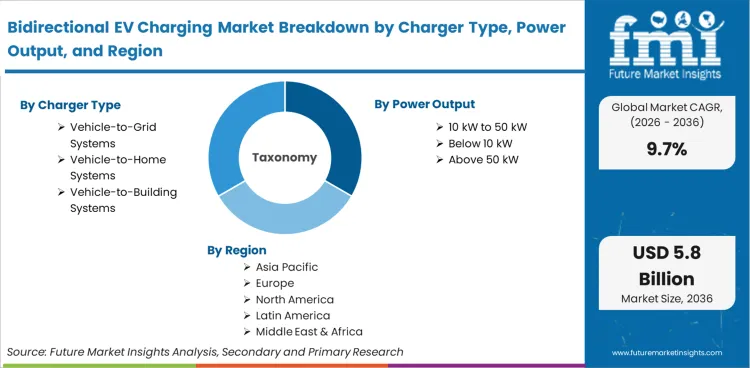
The bidirectional EV charging market stood at USD 2.1 billion in 2025. Market value is projected at USD 2.3 billion in 2026 and is forecast to reach USD 5.8 billion by 2036. The industry is set to register a CAGR of 9.7% across the forecast period. Bidirectional EV charging adoption boost is closely linked with the rapid increase in electric vehicle deployment and grid modernization initiatives across major economies. Utilities and power system operators view bidirectional charging as a practical solution for balancing electricity demand during peak consumption periods. Electric vehicles equipped with vehicle to grid capability can discharge stored power back into the grid, supporting grid stability while creating new revenue streams for EV owners.
Governments and energy regulators are encouraging such systems through incentive programs and pilot deployments. As electricity demand rises with electrification of transport and buildings, power operators are actively exploring distributed energy resources such as EV batteries to support grid resilience. Growing investment in renewable energy infrastructure is another factor supporting market development. Solar and wind generation create intermittent power supply patterns that require flexible storage solutions. Bidirectional charging technology allows EV batteries to function as decentralized storage units capable of storing excess renewable energy during periods of high generation and releasing electricity when production declines.
Summary of Bidirectional EV Charging Market
- Bidirectional EV Charging Market Definition
- The industry covers two-way power flow charging systems utilized for grid services and energy management including residential backup power, commercial load balancing, and utility demand response programs.
- Demand Drivers in the Market
- Grid modernization initiatives drive equipment deployment for distributed energy resource integration.
- Renewable energy intermittency management expands demand for vehicle battery storage capacity utilization.
- Product innovation in inverter efficiency reduces conversion losses while maintaining power quality standards.
- Key Segments Analyzed in the Report
- Charger Type: Vehicle-to-Grid Systems (47%) versus residential backup and building integration applications.
- Power Output: 10 kW to 50 kW (52%) versus lower capacity residential units and high-power commercial installations.
- Geography: High-growth Asia Pacific versus established North American and European grid infrastructure markets.
- Analyst Opinion at FMI
- Nikhil Kaitwade, Senior Consultant for Automotive at Future Market Insights, notes, "In the updated version of the Bidirectional EV Charging Market Report for 2026 to 2036, industry stakeholders will find insights into utility interconnection requirements and grid service participation models that are shaping charger deployment strategies across residential, commercial, and fleet applications. My findings indicate that vehicle-to-grid program readiness directly influences adoption potential, while power electronics compatibility and evolving regulatory frameworks could restrict market expansion for providers targeting price-sensitive end users."
- Strategic Implications/Executive Takeaways
- Shift focus from standalone charging hardware to integrated energy management systems.
- Treat utility demand response programs as primary revenue model rather than supplementary application.
- Prioritize vehicle manufacturer partnerships to address battery warranty concerns and certification requirements.
- Methodology
- Validated through utility pilot program data and charging equipment installation records.
- Zero reliance on speculative energy storage trend forecasting.
- Based on verifiable grid interconnection approvals and demonstrated demand response participation.
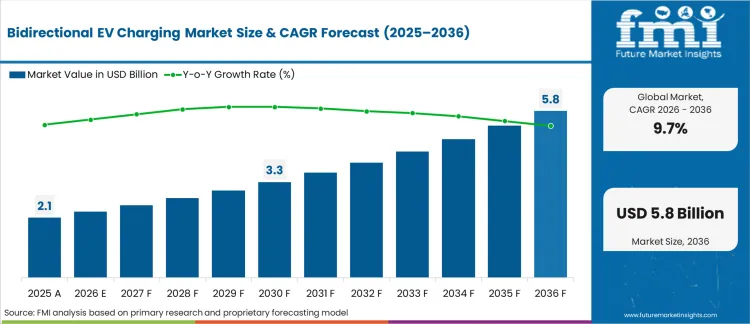
Bidirectional EV Charging Market Key Takeaways
| Metric | Value |
|---|---|
| Market Value (2026) | USD 2.3 billion |
| Market Forecast Value (2036) | USD 5.8 billion |
| Forecast CAGR (2026-2036) | 9.7% |
Source: Analysis based on proprietary forecasting model and primary research
Automotive manufacturers and charging equipment suppliers are accelerating development of bidirectional compatible vehicles and chargers, strengthening the technology ecosystem. New EV models are being designed with vehicle to grid communication capability and higher capacity battery systems capable of supporting power export. Charging infrastructure companies are deploying smart charging platforms capable of controlling power flow between vehicles, buildings, and electricity networks. These developments are supported by emerging standards that enable secure communication between vehicles and charging infrastructure. As energy management becomes a strategic priority for governments, utilities, and fleet operators, bidirectional EV charging is positioned as a key component of future energy and mobility systems.
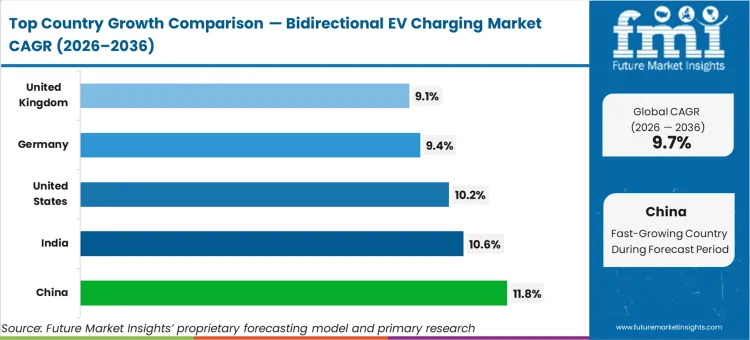
The bidirectional EV charging market is set for steady global expansion, reflected in country‑specific growth rates that highlight both mature and emerging regions, with the United States projected to grow at 10.2% CAGR, Germany at 9.4%, China at 11.8%, India at 10.6%, and the United Kingdom at 9.1%, collectively illustrating how varying levels of EV adoption, grid modernization, and renewable integration are shaping the pace of deployment across key international markets.
Bidirectional EV Charging Market Definition
Bidirectional EV charging systems serve as the primary interface technology for two-way power flow between electric vehicles and electrical infrastructure, encompassing equipment designed for grid services across residential, commercial, and utility applications. The bidirectional EV charging market comprises the global development, production, and distribution of power electronics hardware and control software enabling electric vehicles to discharge stored energy for building power, grid stabilization, or energy arbitrage purposes.
Bidirectional EV Charging Market Inclusions
The report includes a comprehensive analysis of market dynamics, featuring Global and Regional Market Sizes (Volume and Value) and a 10-year Forecast (2026-2036). It covers segmental breakdowns by charger type (Vehicle-to-Grid Systems, Vehicle-to-Home Systems, Vehicle-to-Building Systems, Vehicle-to-Load Systems), power output categories (Below 10 kW, 10 kW to 50 kW, Above 50 kW), and vehicle types (Battery Electric Vehicles, Plug-in Hybrid Electric Vehicles, Commercial Electric Vehicles).
Bidirectional EV Charging Market Exclusions
The scope excludes unidirectional charging infrastructure, battery swap stations, wireless charging systems, and hydrogen refueling equipment. It also does not include charging network software platforms, energy management system providers, and battery manufacturing operations, focusing strictly on finished bidirectional power conversion hardware and their immediate grid integration applications. Report does not account for aftermarket modifications or non-certified charging equipment with limited utility approval.
Bidirectional EV Charging Market Research Methodology
- Primary Research: Interviews were conducted with charging equipment manufacturers, utility grid operators, automotive OEM representatives, energy storage developers, and fleet management companies across major markets. Power systems engineers clarified grid interconnection standards and inverter requirements.
- Desk Research: Utility demand response program data from grid operator reports, electric vehicle adoption rates from automotive industry databases, and power electronics component pricing from semiconductor trade publications supported market benchmarking.
- Market-Sizing and Forecasting: A hybrid top-down and bottom-up model was developed. Demand was reconstructed from charging equipment installation figures, utility pilot program participation volumes, and commercial fleet electrification schedules, then validated against inverter manufacturing capacity and grid interconnection application data.
- Data Validation and Update Cycle: Outputs undergo variance checks across utility procurement datasets, cross-verification with automotive industry associations, and structured expert review prior to release.
Segmental Analysis
Bidirectional EV Charging Market Analysis by Charger Type
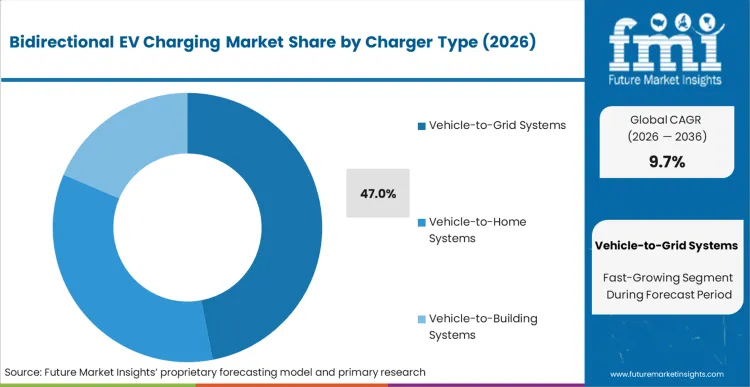
The vehicle-to-grid systems segment is slated to occupy a 47% share in 2026. Vehicle to grid system chargers are widely in demand as power utilities and grid operators are seeking distributed energy resources that support grid stability during peak electricity consumption. Electric vehicles equipped with vehicle to grid charging capability can discharge stored electricity back into the grid when demand rises, creating a flexible energy reserve that utilities can access without building new power plants. As electric vehicle ownership expands rapidly, millions of connected batteries can collectively operate as a large mobile energy storage network. This capability is attracting strong interest from power companies aiming to improve load balancing and reduce pressure on transmission infrastructure.
- Grid Stability Support: Vehicle to grid chargers enable electric vehicles to discharge stored electricity back into power networks during peak consumption periods. Utilities are adopting this capability to manage demand fluctuations and reduce dependence on costly backup generation infrastructure.
- Distributed Energy Resource Integration: These chargers allow large EV fleets to function as mobile energy storage units connected to the grid. Power operators are increasingly evaluating this network of vehicle batteries as a flexible resource for improving electricity load management across urban and regional grids.
Bidirectional EV Charging Market Analysis by Power Output
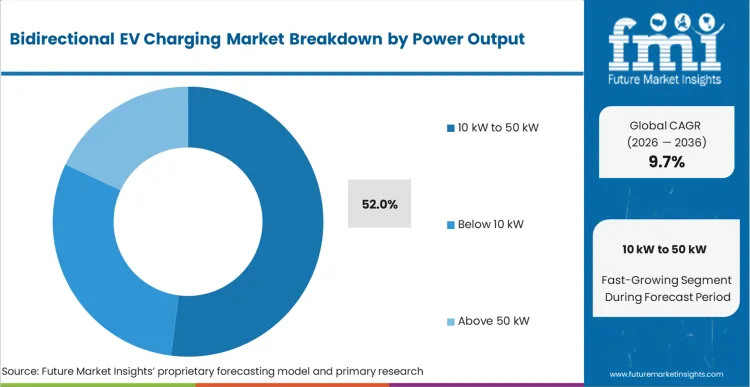
The 10 kW to 50 kW segment is poised to register a 52% market share in 2026. 10 kW to 50 kW bidirectional EV charging systems are gaining strong demand due to their practical balance between charging speed, infrastructure cost, and grid compatibility. These systems deliver faster energy transfer compared with low power residential chargers while avoiding the heavy grid upgrades often required for ultra high power chargers. Commercial facilities, fleet depots, and workplace charging stations prefer this power range because it supports efficient vehicle charging during parking hours while enabling controlled energy discharge back to the grid.
- Optimal Power Balance: Chargers rated between 10 kW and 50 kW deliver efficient energy transfer while avoiding heavy electrical infrastructure upgrades. Charging network operators prefer this range as it supports faster bidirectional energy flow without creating distribution grid overload risks.
- Commercial Charging Compatibility: The power range aligns well with workplace parking zones, fleet depots, and commercial buildings where vehicles remain parked for extended hours. Infrastructure planners deploy these systems to enable controlled vehicle charging and energy export within existing facility power capacity.
Bidirectional EV Charging Market Drivers, Restraints, and Opportunities
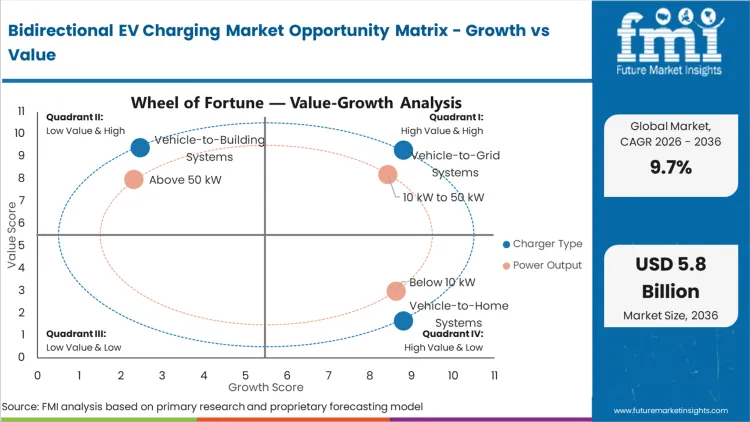
Rising electric vehicle deployment across passenger cars, fleets, and commercial vehicles is creating strong demand for bidirectional charging infrastructure. Governments are promoting vehicle electrification through subsidies, emissions regulations, and infrastructure investment programs. As EV ownership increases, the total battery capacity connected to electricity networks continues to expand. Utilities are recognizing this growing battery base as a distributed energy resource capable of supporting grid balancing during peak electricity demand. Power operators are exploring vehicle to grid systems to stabilize electricity supply while reducing reliance on expensive peaking power plants. Growth of renewable electricity generation is strengthening this driver since bidirectional charging allows electric vehicles to store excess renewable energy and release it back to the grid when needed.
High system installation costs and technical complexity remain major barriers for widespread adoption of bidirectional charging systems. These systems require advanced power electronics, communication protocols, and grid integration technologies that increase infrastructure costs compared with conventional EV chargers. Compatibility challenges between vehicles, charging stations, and grid management platforms can slow deployment in certain regions. Regulatory uncertainty in some electricity markets creates additional hesitation among utilities and charging infrastructure providers. Energy trading rules, grid interconnection requirements, and electricity pricing structures are still evolving in many countries. These regulatory limitations restrict the ability of EV owners to participate in grid service programs and monetize vehicle battery capacity.
- Smart Grid Integration: Smart grid development and digital energy management platforms are creating new opportunities for bidirectional EV charging, enabling vehicles to support grid stability as electricity consumption increases.
- Fleet & Utility Participation: Utilities are expanding demand response programs, while large fleet operators, such as logistics and public transport agencies, are adopting bidirectional charging to manage energy costs and participate in energy markets.
- Residential Energy Ecosystems: Homeowners are increasingly integrating bidirectional EV chargers with rooftop solar and home energy management systems, opening the door for vehicle‑to‑home energy exchange solutions.
Regional Analysis
Based on regional analysis, the bidirectional EV charging market is segmented into North America, Latin America, Europe, East Asia, South Asia, Oceania and Middle East & Africa across 40 countries. The full report also offers market attractiveness analysis based on regional trends.
.webp "Top Country Growth Comparison Bidirectional Ev Charging Market Cagr (2026 2036)")
| Country | CAGR (2026 to 2036) |
|---|---|
| United States | 10.2% |
| Germany | 9.4% |
| China | 11.8% |
| India | 10.6% |
| United Kingdom | 9.1% |
Source: Market analysis based on proprietary forecasting model and primary research
North America Bidirectional EV Charging Market Analysis
Rapid development of renewable energy infrastructure across North America is strengthening demand for bidirectional charging solutions. Solar and wind generation capacity has expanded significantly across several states and provinces, creating intermittent electricity supply patterns that require flexible storage solutions. Electric vehicle batteries connected through bidirectional chargers can store surplus renewable electricity during high generation periods and deliver power back to the grid when renewable output declines.
- United States: Sales of bidirectional EV charging equipment in the United States are projected to grow at 10.2% CAGR from 2026 to 2036. Electric fleet adoption across logistics companies, school bus operators, and municipal vehicle programs is strengthening demand for bidirectional charging systems in the United States. Fleet operators are investing in depot charging infrastructure that enables vehicles to recharge efficiently while parked and export energy during idle periods.
The report presents detailed assessment of growth across the North American region, including country-level evaluation covering the United States and Canada. Readers can access insights on utility demand response participation trends, regulatory framework development, and market expansion across different charger types and power output categories.
Asia Pacific Bidirectional EV Charging Market Analysis
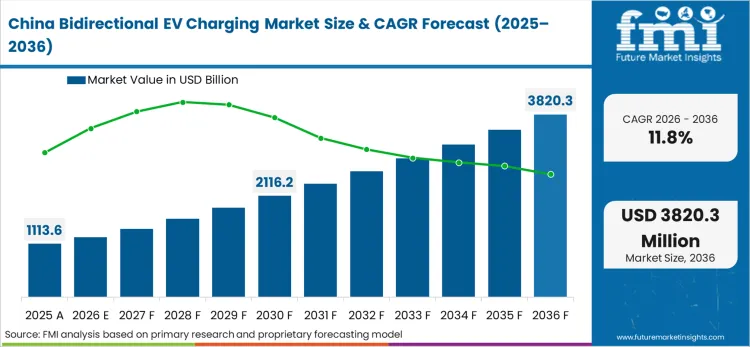
Urban transportation electrification and large scale electric fleet deployment are supporting market expansion. Public transportation agencies, logistics providers, and municipal authorities across Asia Pacific are investing in electric buses, delivery vehicles, and service fleets. Charging depots equipped with bidirectional chargers allow these vehicles to recharge efficiently while contributing stored electricity to local energy networks during idle periods.
- China: The Chinese bidirectional EV charging market is poised to grow at 11.8% CAGR during the study period. China leads global EV manufacturing and sales, creating a massive installed base of electric vehicle batteries connected to electricity networks. Power utilities are increasingly evaluating bidirectional charging systems as a distributed energy resource that can support grid stability during peak electricity demand. Vehicle to grid capable chargers allow electric vehicles to store electricity during off peak hours and supply power back to the grid when consumption rises. This capability is gaining importance as urban electricity demand continues to grow.
- India: The Indian bidirectional EV charging market is estimated to expand at 10.6% CAGR during the forecast period. Electric fleet deployment across public transportation, delivery services, and municipal vehicle programs is supporting market expansion in India. State transport agencies and logistics operators are gradually integrating electric buses, delivery vans, and service vehicles into their fleets. Charging depots serving these vehicles create opportunities for installing bidirectional charging infrastructure that supports both vehicle charging and facility level energy management.
The report provides an in-depth evaluation of the bidirectional EV charging market across East and South Asia from 2021 to 2036. It reviews electric vehicle adoption trends, grid integration framework development, and advancements in power electronics technologies across China, Japan, South Korea, India, Singapore, and Australia. The study outlines utility collaboration strategies that strengthen regional market expansion.
Europe Bidirectional EV Charging Market Analysis
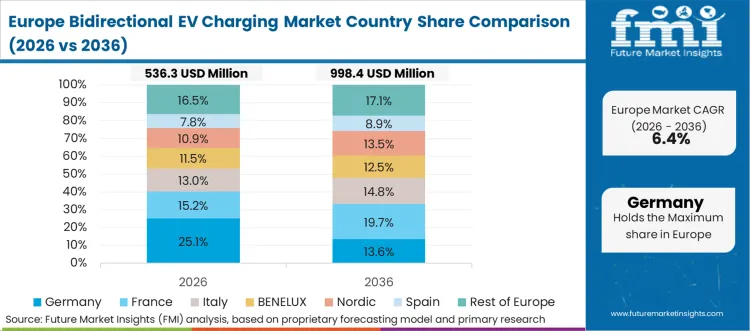
Strong growth in renewable energy generation across Europe is strengthening the role of bidirectional EV charging systems. Many European countries are rapidly expanding solar and wind power capacity to reduce reliance on fossil fuel based electricity generation. Renewable power sources create fluctuating electricity supply patterns that require flexible storage solutions. Electric vehicle batteries connected through bidirectional chargers can store excess renewable energy during periods of high generation and release electricity back to the grid when production declines.
- Germany: Demand for bidirectional EV charging in Germany is expected to grow at 9.4% CAGR during the forecast period. Government programs supporting EV purchases and charging infrastructure deployment are increasing the number of electric vehicles connected to electricity networks. As EV ownership grows, utilities and energy operators are exploring bidirectional charging systems to improve grid flexibility and manage electricity demand during peak periods. Electric vehicles equipped with vehicle to grid capability can return stored electricity to power networks when consumption rises.
- United Kingdom: The UK bidirectional EV charging market is estimated to expand at 9.1% CAGR during the study period. Government backed pilot projects and technology demonstrations are strengthening the market environment for bidirectional charging in the country. Several energy companies and automotive manufacturers are collaborating on vehicle to grid trials that evaluate how electric vehicles can support electricity networks during peak demand events. These programs focus on integrating EV charging infrastructure with grid control platforms to enable automated energy exchange between vehicles and electricity networks.
Evaluation of the European bidirectional EV charging market features country-level coverage across the United Kingdom, Germany, France, Italy, Spain, the Netherlands, and Scandinavia. Readers can review regulatory framework developments and renewable energy integration trends shaping adoption across the European region.
Competitive Landscape for Bidirectional EV Charging Market Players
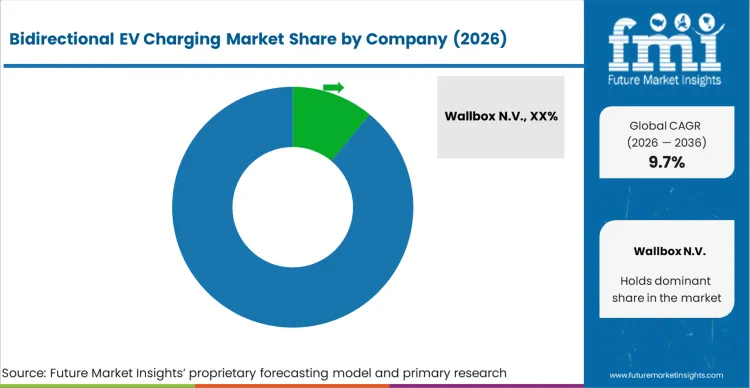
Competition in the bidirectional EV charging market is intensifying as charging equipment manufacturers, energy technology companies, and automotive OEMs expand their capabilities in vehicle to grid infrastructure. Companies are investing in advanced power electronics, grid communication software, and smart charging platforms that enable controlled energy exchange between electric vehicles and electricity networks. Product development is focused on improving charger efficiency, compatibility with multiple EV models, and integration with energy management systems used by utilities and commercial facilities. Many manufacturers are prioritizing development of chargers that support mid power ranges suitable for residential installations, fleet depots, and workplace charging environments.
Strategic partnerships between charging infrastructure providers, power utilities, and automotive companies are shaping the competitive environment. Charging network operators are collaborating with grid operators to deploy bidirectional charging systems that support demand response programs and distributed energy resource participation. Automotive manufacturers are designing new EV models with vehicle to grid communication capability to ensure compatibility with bidirectional charging infrastructure. At the same time, software developers are introducing digital energy management platforms that coordinate energy flow between vehicles, buildings, and electricity networks. As the EV ecosystem expands and smart grid initiatives gain momentum, companies competing in the bidirectional EV charging market are focusing on technology integration, infrastructure scalability, and energy management capabilities to strengthen their market position.
Key Players in Bidirectional EV Charging Market
- Wallbox N.V.
- Fermata Energy LLC
- Nuvve Corporation
- dcbel Inc.
- Kaluza Ltd.
- Enel X Way
- Delta Electronics, Inc.
- Mobility House GmbH
- EVTEC AG
Scope of the Report
| Metric | Value |
|---|---|
| Quantitative Units | USD 2.3 billion (2026) to USD 5.8 billion (2036), at a CAGR of 9.7% |
| Market Definition | The bidirectional EV charging market comprises the global development, production, and distribution of two-way power conversion equipment enabling electric vehicles to discharge stored energy for grid services, building power supply, and energy management applications across residential and commercial installations. |
| Charger Type Segmentation | Vehicle-to-Grid Systems, Vehicle-to-Home Systems, Vehicle-to-Building Systems, Vehicle-to-Load Systems |
| Power Output Coverage | Below 10 kW, 10 kW to 50 kW, Above 50 kW |
| Vehicle Type Segmentation | Battery Electric Vehicles, Plug-in Hybrid Electric Vehicles, Commercial Electric Vehicles |
| Regions Covered | North America, Latin America, Europe, East Asia, South Asia, Oceania, Middle East and Africa |
| Countries Covered | United States, Canada, United Kingdom, Germany, France, China, Japan, India, Brazil, UAE and 40 countries |
| Key Companies Profiled | Wallbox N.V., Fermata Energy LLC, Nuvve Corporation, dcbel Inc., Kaluza Ltd., Enel X Way, Delta Electronics Inc., Mobility House GmbH, EVTEC AG |
| Forecast Period | 2026 to 2036 |
| Approach | Hybrid top down and bottom up market modeling validated through utility procurement records and vehicle-to-grid pilot program data, supported by grid interconnection application tracking and power electronics component analysis |
Bidirectional EV Charging Market Analysis by Segments
Charger Type:
- Vehicle-to-Grid Systems
- Vehicle-to-Home Systems
- Vehicle-to-Building Systems
- Vehicle-to-Load Systems
Power Output:
- Below 10 kW
- 10 kW to 50 kW
- Above 50 kW
Vehicle Type:
- Battery Electric Vehicles
- Plug-in Hybrid Electric Vehicles
- Commercial Electric Vehicles
Region:
- Asia Pacific
- China
- Japan
- South Korea
- India
- Australia
- Singapore
- Thailand
- Rest of Asia Pacific
- Europe
- United Kingdom
- Germany
- France
- Italy
- Spain
- Netherlands
- Scandinavia
- Switzerland
- Rest of Europe
- North America
- United States
- Canada
- Latin America
- Brazil
- Mexico
- Argentina
- Rest of Latin America
- Middle East & Africa
- United Arab Emirates
- Saudi Arabia
- South Africa
- Israel
- Rest of Middle East & Africa
Bibliography
- California Energy Commission. (2025). Vehicle-grid integration program.
- Commonwealth Scientific and Industrial Research Organisation. (2025). Development of a vehicle-to-grid testing and demonstration capability in Australia: Phase 1 project report.
- Ministry of Power. (2024). Guidelines and standards for electric vehicle charging infrastructure.
- CharIN. (2025, August 21). Vehicle-to-grid (V2G) with CharIN: Driving interoperability, standards, and grid integration.
- European Network of Transmission System Operators for Electricity. (2024). ENTSO-E RDI roadmap 2024-2034.
- IEA Technology Collaboration Programme on Hybrid and Electric Vehicles. (2025). Task 43 final report: Vehicle/grid integration.
- Australian Renewable Energy Agency. (2025). National roadmap for bidirectional EV charging.
- USA Department of Energy. (2025). Vehicles-to-grid integration assessment report.
This bibliography is provided for reader reference and is not exhaustive. The full report contains the complete reference list and detailed citations.
This Report Addresses
- Market intelligence to enable strategic decision making across established and emerging electric vehicle markets
- Market size estimation and 10-year revenue forecasts from 2026 to 2036, supported by validated utility program data and charging equipment deployment records
- Growth opportunity mapping across charger types and power output segments with emphasis on grid integration optimization
- Segment and regional revenue forecasts covering vehicle-to-grid systems, residential backup applications, commercial fleet installations, and utility procurement networks
- Competition strategy assessment including vehicle manufacturer partnerships, utility service agreements, and grid code compliance positioning
- Product development tracking including inverter efficiency innovations, battery health monitoring trends, and communication protocol capabilities
- Market access analysis covering utility pilot programs, automotive OEM certification requirements, and regulatory framework developments
- Market report delivery in PDF, Excel, PPT, and interactive dashboard formats for executive and operational use
Frequently Asked Questions
How large is the demand for Bidirectional EV Charging in the global market in 2026?
Demand for Bidirectional EV Charging in the global market is estimated to be valued at USD 2.3 billion in 2026.
What will be the market size of Bidirectional EV Charging in the global market by 2036?
Market size for Bidirectional EV Charging is projected to reach USD 5.8 billion by 2036.
What is the expected demand growth for Bidirectional EV Charging in the global market between 2026 and 2036?
Demand for Bidirectional EV Charging in the global market is expected to grow at a CAGR of 9.7% between 2026 and 2036.
Which Charger Type is poised to lead global sales by 2026?
Vehicle-to-Grid Systems is expected to be the dominant charger type, capturing approximately 47.0% of global market share in 2026 due to frequency regulation capabilities and ancillary services participation opportunities.
How significant is the role of 10 kW to 50 kW power output in driving Bidirectional EV Charging adoption in 2026?
The 10 kW to 50 kW segment represents a primary power output category, projected to hold approximately 52% share of the total market in 2026 as residential service compatibility and commercial fleet scalability maintain segment relevance.
What is Driving Bidirectional EV Charging Demand in the United States?
Utility grid stability programs and regulatory frameworks establishing vehicle-grid integration standards are driving growth.
What Consumer Trends are Referenced for the United States?
Electric vehicle adoption acceleration and utility demand response program participation are referenced as key market development factors.
What is the United States Growth Outlook in this Report?
The United States is projected to grow at a CAGR of 10.2% during 2026 to 2036.
Why is Europe described as Important for Grid Integration Development in this Report?
Growth is driven by renewable energy targets and grid stability requirements that establish regulatory frameworks for vehicle-to-grid services.
What Type of Product Development Dominates in Europe?
Utility-certified bidirectional charging systems with renewable energy integration and demand response capabilities dominate regional market segments.
What is Germany Growth Outlook in this Report?
Germany is projected to expand at a CAGR of 9.4% during 2026 to 2036.
Does the Report Cover China in its Regional Analysis?
China is included within East Asia under the regional scope of analysis.
What are the Sources referred to for analyzing the Market in China?
Electric vehicle production data, renewable energy capacity statistics, and power electronics manufacturing tracking covering installation patterns, grid integration policies, and technology development trends are cited as primary reference sources.
What is the Main Development Theme Linked to China in Asia Coverage?
Asia Pacific development is associated with electric vehicle manufacturing scale enabling charging infrastructure standardization across urban centers.
Does the Report Cover India in its Regional Analysis?
India is included within South Asia under the regional coverage framework.
What is the Main India Related Development Theme in Asia Coverage?
Energy security priorities creating foundation for distributed generation adoption and local manufacturing using cost-effective power electronics production methods is emphasized.
Which Distribution Strategies are Strategically Important for Asia Pacific Market Entry?
Utility partnerships and automotive manufacturer collaboration programs are prioritized for cost-effective market penetration across regional territories.
What is Bidirectional EV Charging and What is It Mainly Used For?
Bidirectional EV charging involves two-way power conversion systems primarily used for grid services and energy management including residential backup power, commercial load balancing, and utility demand response programs.
What does Bidirectional EV Charging Market Mean in this Report?
Bidirectional EV charging market refers to global development, manufacturing, and deployment of power electronics equipment enabling electric vehicles to discharge stored energy across various grid service applications and user segments.
What is Included in the Scope of this Bidirectional EV Charging Market Report?
Scope covers charging equipment by charger type, key power output categories such as 10 kW to 50 kW residential systems and commercial installations, and vehicle type segments including battery electric vehicles, plug-in hybrids, and commercial fleets.
What is Excluded from the Scope of this Report?
Unidirectional charging infrastructure, battery swap stations, wireless charging systems, and hydrogen refueling equipment are excluded unless part of bidirectional charging product offerings.
What does Market Forecast Mean on this Page?
Market forecast represents model-based projections built on utility deployment trends and electric vehicle adoption assumptions for strategic planning purposes.
How is the Bidirectional EV Charging Market Forecast Built and Validated?
Forecast is developed using hybrid modeling validated through utility pilot program records, charging equipment installation data, and grid interconnection application verification.
What does Zero Reliance on Speculative Third Party Market Research Mean Here?
Market analysis is based on verifiable utility contracts, charging infrastructure deployment figures, and grid service participation data rather than speculative technology adoption predictions.
Preview the report firsthand - request a free sample
Get SampleGet the brochure for pricing and purchase details.
Get PDFTable of Content
- Key Takeaways
- Market Size and CAGR
- Top Growth Driver
- Fastest Growing Segment
- Leading Region
- Key Companies
- Emerging Opportunities
- Executive Summary
- Global Market Outlook
- Demand-side Trends
- Supply-side Trends
- Technology Roadmap Analysis
- Analysis and Recommendations
- Analyst Perspective (What is happening? Why now? What should investors know?)
- Key Questions Answered
- How large is the market?
- What is the CAGR?
- What are key trends?
- Which region dominates?
- Who are the leaders?
- Market Overview
- Market Coverage / Taxonomy
- Market Definition / Scope / Limitations
- Research Methodology
- Chapter Orientation
- Analytical Lens and Working Hypotheses
- Market Structure, Signals, and Trend Drivers
- Benchmarking and Cross-market Comparability
- Market Sizing, Forecasting, and Opportunity Mapping
- Research Design and Evidence Framework
- Desk Research Programme (Secondary Evidence)
- Expert Input and Fieldwork (Primary Evidence)
- Tooling, Models, and Reference Databases
- Data Engineering and Model Build
- Quality Assurance and Audit Trail
- Market Background
- Market Dynamics (Drivers, Restraints, Opportunity, Trends)
- Scenario Forecast (Optimistic, Likely, Conservative)
- Impact Analysis
- AI Impact
- Sustainability Impact
- Regulatory Impact
- Technology Impact
- Consumer / Buyer Analysis
- Purchase Drivers
- Adoption Barriers
- Buyer Journey
- Opportunity Map Analysis
- Product Life Cycle Analysis
- Supply Chain Analysis
- Investment Feasibility Matrix
- Value Chain Analysis
- PESTLE and Porter's Analysis
- Regulatory Landscape
- Regional Parent Market Outlook
- Production and Consumption Statistics
- Import and Export Statistics
- Global Market Analysis and Forecast, 2021 to 2036
- Historical Market Size Value (USD Billion) & Volume (Unit) Analysis, 2021 to 2025
- Current and Future Market Size Value (USD Billion) & Volume (Unit) Projections, 2026 to 2036
- Y-o-Y Growth Trend Analysis
- Absolute $ Opportunity Analysis
- Global Market Pricing Analysis, 2021 to 2036
- Global Market Analysis and Forecast, By Charger Type, 2021 to 2036
- Introduction / Key Findings
- Historical Market Size Value (USD Billion) & Volume (Unit) Analysis By Charger Type, 2021 to 2025
- Current and Future Market Size Value (USD Billion) & Volume (Unit) Analysis and Forecast By Charger Type, 2026 to 2036
- Vehicle-to-Grid Systems
- Vehicle-to-Home Systems
- Vehicle-to-Building Systems
- Vehicle-to-Load Systems
- Vehicle-to-Grid Systems
- Y-o-Y Growth Trend Analysis By Charger Type, 2021 to 2025
- Absolute $ Opportunity Analysis By Charger Type, 2026 to 2036
- Global Market Analysis and Forecast, By Power Output, 2021 to 2036
- Introduction / Key Findings
- Historical Market Size Value (USD Billion) & Volume (Unit) Analysis By Power Output, 2021 to 2025
- Current and Future Market Size Value (USD Billion) & Volume (Unit) Analysis and Forecast By Power Output, 2026 to 2036
- 10 kW to 50 kW
- Below 10 kW
- Above 50 kW
- 10 kW to 50 kW
- Y-o-Y Growth Trend Analysis By Power Output, 2021 to 2025
- Absolute $ Opportunity Analysis By Power Output, 2026 to 2036
- Global Market Analysis and Forecast, By Vehicle Type, 2021 to 2036
- Introduction / Key Findings
- Historical Market Size Value (USD Billion) & Volume (Unit) Analysis By Vehicle Type, 2021 to 2025
- Current and Future Market Size Value (USD Billion) & Volume (Unit) Analysis and Forecast By Vehicle Type, 2026 to 2036
- Battery Electric Vehicles
- Plug-in Hybrid Electric Vehicles
- Commercial Electric Vehicles
- Battery Electric Vehicles
- Y-o-Y Growth Trend Analysis By Vehicle Type, 2021 to 2025
- Absolute $ Opportunity Analysis By Vehicle Type, 2026 to 2036
- Global Market Analysis and Forecast, By Region, 2021 to 2036
- Introduction
- Historical Market Size Value (USD Billion) & Volume (Unit) Analysis By Region, 2021 to 2025
- Current Market Size Value (USD Billion) & Volume (Unit) Analysis and Forecast By Region, 2026 to 2036
- North America
- Latin America
- Western Europe
- Eastern Europe
- East Asia
- South Asia and Pacific
- Middle East & Africa
- Market Attractiveness Analysis By Region
- North America Market Analysis and Forecast, By Country, 2021 to 2036
- Historical Market Size Value (USD Billion) & Volume (Unit) Trend Analysis By Market Taxonomy, 2021 to 2025
- Market Size Value (USD Billion) & Volume (Unit) Forecast By Market Taxonomy, 2026 to 2036
- By Country
- USA
- Canada
- Mexico
- By Charger Type
- By Power Output
- By Vehicle Type
- By Country
- Market Attractiveness Analysis
- By Country
- By Charger Type
- By Power Output
- By Vehicle Type
- Key Takeaways
- Latin America Market Analysis and Forecast, By Country
- Historical Market Size Value (USD Billion) & Volume (Unit) Trend Analysis By Market Taxonomy, 2021 to 2025
- Market Size Value (USD Billion) & Volume (Unit) Forecast By Market Taxonomy, 2026 to 2036
- By Country
- Brazil
- Chile
- Rest of Latin America
- By Charger Type
- By Power Output
- By Vehicle Type
- By Country
- Market Attractiveness Analysis
- By Country
- By Charger Type
- By Power Output
- By Vehicle Type
- Key Takeaways
- Western Europe Market Analysis and Forecast, By Country
- Historical Market Size Value (USD Billion) & Volume (Unit) Trend Analysis By Market Taxonomy, 2021 to 2025
- Market Size Value (USD Billion) & Volume (Unit) Forecast By Market Taxonomy, 2026 to 2036
- By Country
- Germany
- UK
- Italy
- Spain
- France
- Nordic
- BENELUX
- Rest of Western Europe
- By Charger Type
- By Power Output
- By Vehicle Type
- By Country
- Market Attractiveness Analysis
- By Country
- By Charger Type
- By Power Output
- By Vehicle Type
- Key Takeaways
- Eastern Europe Market Analysis and Forecast, By Country
- Historical Market Size Value (USD Billion) & Volume (Unit) Trend Analysis By Market Taxonomy, 2021 to 2025
- Market Size Value (USD Billion) & Volume (Unit) Forecast By Market Taxonomy, 2026 to 2036
- By Country
- Russia
- Poland
- Hungary
- Balkan & Baltic
- Rest of Eastern Europe
- By Charger Type
- By Power Output
- By Vehicle Type
- By Country
- Market Attractiveness Analysis
- By Country
- By Charger Type
- By Power Output
- By Vehicle Type
- Key Takeaways
- East Asia Market Analysis and Forecast, By Country
- Historical Market Size Value (USD Billion) & Volume (Unit) Trend Analysis By Market Taxonomy, 2021 to 2025
- Market Size Value (USD Billion) & Volume (Unit) Forecast By Market Taxonomy, 2026 to 2036
- By Country
- China
- Japan
- South Korea
- By Charger Type
- By Power Output
- By Vehicle Type
- By Country
- Market Attractiveness Analysis
- By Country
- By Charger Type
- By Power Output
- By Vehicle Type
- Key Takeaways
- South Asia and Pacific Market Analysis and Forecast, By Country
- Historical Market Size Value (USD Billion) & Volume (Unit) Trend Analysis By Market Taxonomy, 2021 to 2025
- Market Size Value (USD Billion) & Volume (Unit) Forecast By Market Taxonomy, 2026 to 2036
- By Country
- India
- ASEAN
- Australia & New Zealand
- Rest of South Asia and Pacific
- By Charger Type
- By Power Output
- By Vehicle Type
- By Country
- Market Attractiveness Analysis
- By Country
- By Charger Type
- By Power Output
- By Vehicle Type
- Key Takeaways
- Middle East & Africa Market Analysis and Forecast, By Country
- Historical Market Size Value (USD Billion) & Volume (Unit) Trend Analysis By Market Taxonomy, 2021 to 2025
- Market Size Value (USD Billion) & Volume (Unit) Forecast By Market Taxonomy, 2026 to 2036
- By Country
- Kingdom of Saudi Arabia
- Other GCC Countries
- Türkiye
- South Africa
- Other African Union
- Rest of Middle East & Africa
- By Charger Type
- By Power Output
- By Vehicle Type
- By Country
- Market Attractiveness Analysis
- By Country
- By Charger Type
- By Power Output
- By Vehicle Type
- Key Takeaways
- Key Countries Market Analysis
- USA
- Pricing Analysis
- Market Share Analysis, 2025
- By Charger Type
- By Power Output
- By Vehicle Type
- Canada
- Pricing Analysis
- Market Share Analysis, 2025
- By Charger Type
- By Power Output
- By Vehicle Type
- Mexico
- Pricing Analysis
- Market Share Analysis, 2025
- By Charger Type
- By Power Output
- By Vehicle Type
- Brazil
- Pricing Analysis
- Market Share Analysis, 2025
- By Charger Type
- By Power Output
- By Vehicle Type
- Chile
- Pricing Analysis
- Market Share Analysis, 2025
- By Charger Type
- By Power Output
- By Vehicle Type
- Germany
- Pricing Analysis
- Market Share Analysis, 2025
- By Charger Type
- By Power Output
- By Vehicle Type
- UK
- Pricing Analysis
- Market Share Analysis, 2025
- By Charger Type
- By Power Output
- By Vehicle Type
- Italy
- Pricing Analysis
- Market Share Analysis, 2025
- By Charger Type
- By Power Output
- By Vehicle Type
- Spain
- Pricing Analysis
- Market Share Analysis, 2025
- By Charger Type
- By Power Output
- By Vehicle Type
- France
- Pricing Analysis
- Market Share Analysis, 2025
- By Charger Type
- By Power Output
- By Vehicle Type
- India
- Pricing Analysis
- Market Share Analysis, 2025
- By Charger Type
- By Power Output
- By Vehicle Type
- ASEAN
- Pricing Analysis
- Market Share Analysis, 2025
- By Charger Type
- By Power Output
- By Vehicle Type
- Australia & New Zealand
- Pricing Analysis
- Market Share Analysis, 2025
- By Charger Type
- By Power Output
- By Vehicle Type
- China
- Pricing Analysis
- Market Share Analysis, 2025
- By Charger Type
- By Power Output
- By Vehicle Type
- Japan
- Pricing Analysis
- Market Share Analysis, 2025
- By Charger Type
- By Power Output
- By Vehicle Type
- South Korea
- Pricing Analysis
- Market Share Analysis, 2025
- By Charger Type
- By Power Output
- By Vehicle Type
- Russia
- Pricing Analysis
- Market Share Analysis, 2025
- By Charger Type
- By Power Output
- By Vehicle Type
- Poland
- Pricing Analysis
- Market Share Analysis, 2025
- By Charger Type
- By Power Output
- By Vehicle Type
- Hungary
- Pricing Analysis
- Market Share Analysis, 2025
- By Charger Type
- By Power Output
- By Vehicle Type
- Kingdom of Saudi Arabia
- Pricing Analysis
- Market Share Analysis, 2025
- By Charger Type
- By Power Output
- By Vehicle Type
- Türkiye
- Pricing Analysis
- Market Share Analysis, 2025
- By Charger Type
- By Power Output
- By Vehicle Type
- South Africa
- Pricing Analysis
- Market Share Analysis, 2025
- By Charger Type
- By Power Output
- By Vehicle Type
- USA
- Market Structure Analysis
- Competition Dashboard
- Competition Benchmarking
- Market Share Analysis of Top Players
- By Regional
- By Charger Type
- By Power Output
- By Vehicle Type
- Emerging Startups
- Innovation Benchmarking
- Competition Analysis
- Competition Deep Dive
- Wallbox N.V.
- Overview
- Product Portfolio
- Profitability by Market Segments (Product/Region/Sales Channel)
- Sales Footprint
- Strategy Overview
- Marketing Strategy
- Product Strategy
- Channel Strategy
- Fermata Energy LLC
- Nuvve Corporation
- dcbel Inc.
- Kaluza Ltd.
- Enel X Way
- Delta Electronics, Inc.
- Mobility House GmbH
- EVTEC AG
- Wallbox N.V.
- Case Studies
- Success Stories
- Recent Developments
- Competition Deep Dive
- Assumptions & Acronyms Used


