

- Industry Size (2026)
- USD 1.4 Bn
- Forecast (2036)
- USD 1.7 Bn
- CAGR (2026 to 2036)
- 18.3%
Electric Vehicle Battery Conditioners Market Size, Market Forecast and Outlook By FMI
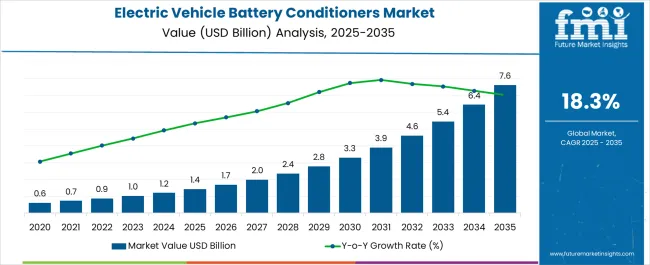
In 2025, the electric vehicle battery conditioners surpassed a valuation of USD 1.4 billion. It is expected to reach USD 1.7 billion in 2026 and USD 8.9 billion by 2036, recording a CAGR of 18.3%. As per FMI estimates, expansion tracks the exponential rise in high-voltage architecture adoption where precise thermal control dictates battery lifespan and charging speed.
The trajectory for 2026 to 2036 is shaped by the total cost of ownership (TCO) physics, where thermal efficiency directly correlates with vehicle range and residual value. Fleet operators and private buyers are increasingly scrutinizing "charging curve" performance, forcing OEMs to specify advanced conditioners that prevent throttling during rapid energy transfer. As battery packs scale to accommodate 300kW+ charging, the parasitic energy tax of cooling systems becomes a critical engineering constraint, pushing demand toward intelligent, variable-capacity thermal management modules rather than static cooling plates.
Neil D. Brinker, President and CEO of Modine, noted the strategic convergence of cooling technologies in July 2025, stating, "Our investment in USA manufacturing for data center cooling advances our strategy to capitalize on our best opportunities in high-growth markets. The USA market is driving a significant portion of global data center activity. With the increasing demand for our solutions and this investment in additional manufacturing and testing capacity, we believe that our total data centers revenue can approach USD 2 billion in our Fiscal 2028." [2] This signals a pivotal shift where suppliers leverage thermal expertise from adjacent high-heat sectors like data centers to solve the thermal density challenges of next-generation EV batteries.
Summary of Electric Vehicle Battery Conditioners Market
- Electric Vehicle Battery Conditioners Market Definition
- Industry covers thermal regulation systems critical for battery safety and performance in electrified transport.
- Demand Drivers in the Market
- Surge in ultra-fast charging infrastructure necessitating active cooling.
- Government mandates like ZEV targets pushing fleet electrification.
- Consumer demand for longer range and faster charging times.
- Key Segments Analyzed in the FMI Report
- Technology: Active Thermal Conditioning dominance (64% share).
- Voltage: 12 to 24 Volts systems holding 40% volume share.
- Geography: Asia Pacific leading with China and India driving volume.
- Analyst Opinion at FMI
- Nikhil Kaitwade, Principal Consultant for Automotive & Process Automation, opines, "In 2026, the market will face a 'thermal wall' where passive systems fail to meet 800V architecture needs. Suppliers who can deliver integrated modules that reduce parasitic power draw by 15-20% will capture the high-margin premium segment."
- Strategic Implications/Executive Takeaways
- Prioritize active liquid cooling investments over air-cooled legacy lines.
- Localize manufacturing in India and US to meet "local-for-local" sourcing rules.
- Explore cross-industry synergies with data center cooling technologies.
- Methodology
- Validated through first-hand corporate production and capacity data.
- Zero reliance on speculative third-party market research reports.
- Based on verifiable industrial benchmarks and verified sources.
Geographically, growth is distributed across manufacturing hubs, with China (20.0% CAGR) and India (18.5% CAGR) leading volume expansion through massive electrification mandates. Mature markets like Germany (16.0% CAGR), the USA (15.2% CAGR), South Korea (15.8% CAGR), Japan (14.0% CAGR), and the UK (13.5% CAGR) are pivoting toward high-performance active systems to support premium platform releases and stringent emission targets.
Electric Vehicle Battery Conditioners Market Definition
The electric vehicle battery conditioners market comprises the global engineering, production, and trade of thermal management systems designed to regulate the temperature of battery packs in electric vehicles. These systems, utilizing liquid coolants, refrigerants, or phase-change materials, ensure cells operate within their optimal thermal window (typically 15°C to 35°C) during charging and discharging cycles.
Electric Vehicle Battery Conditioners Market Inclusions
The report includes a comprehensive analysis of hardware components such as chillers, cold plates, coolant distribution units (CDUs), and intelligent thermal management modules (ITMS). It covers systems for Battery Electric Vehicles (BEVs), Plug-in Hybrid Electric Vehicles (PHEVs), and Hybrid Electric Vehicles (HEVs) across passenger and commercial segments. Revenue estimation accounts for OEM factory-installed systems and specialized aftermarket replacements for commercial fleets.
Electric Vehicle Battery Conditioners Market Exclusions
The scope excludes general automotive HVAC components (cabin air conditioning) unless they are integrated into a unified battery thermal loop. Simple air-cooling fans used in low-speed electric 2-wheelers or non-automotive applications like consumer electronics batteries are also omitted. The analysis does not account for raw material mining (lithium, aluminum) or the standalone sale of chemical coolants, focusing strictly on the thermal management assemblies and control units.
Electric Vehicle Battery Conditioners Market Research Methodology
- Primary Research: Interviews with thermal system engineers, procurement heads at automotive OEMs, and CTOs of Tier-1 suppliers like MAHLE and Modine.
- Desk Research: Analysis of production data from the International Energy Agency (IEA), verified corporate filings, and government infrastructure reports from China’s NEA and India’s Ministry of Heavy Industries.
- Market-Sizing and Forecasting: A hybrid bottom-up model based on EV production volumes multiplied by thermal module attachment rates, validated against supplier order books and capacity announcements.
- Data Validation and Update Cycle: Cross-referencing trade flow data with battery demand statistics to ensure consistency in regional growth projections.
Segmental Analysis
Electric Vehicle Battery Conditioners Market Analysis by Technology
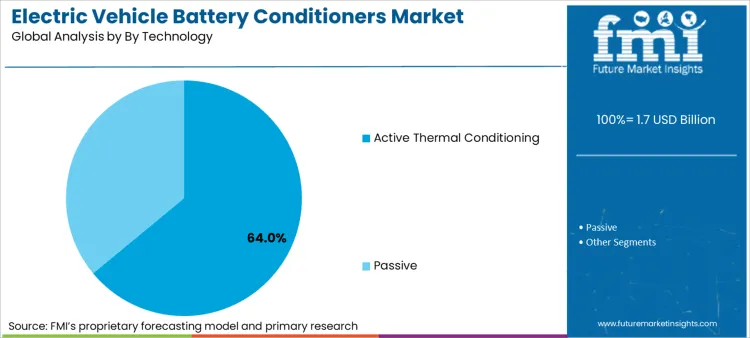
Active thermal conditioning commands the market, accounting for 64% of value in 2025, as passive air cooling becomes obsolete for modern long-range vehicles. This dominance is cemented by the thermodynamic requirements of fast charging, where internal resistance generates heat loads that passive methods cannot dissipate quickly enough to prevent degradation. MAHLE, for instance, secured nearly €1.5 billion in orders for integrated thermal management modules in 2024, validating the industry-wide standardization on active liquid-based architectures. [3]
- Performance imperative: Demand is reinforced by the need to maintain battery health during 350kW+ charging sessions, where active liquid circuits reduce peak cell temperatures to safe limits within minutes. [3]
- Efficiency gain: Adoption accelerates where integrated thermal modules utilize heat pump principles to harvest waste heat, increasing vehicle cruising range by up to 20% in cold climates. [3]
- Safety compliance: Procurement shifts because active systems provide the precise temperature control required to meet stringent thermal runaway standards, ensuring passenger safety during high-stress operation. [3]
Electric Vehicle Battery Conditioners Market Analysis by Vehicle Type
Battery Electric Vehicles (BEVs) represent the primary revenue engine, holding 45.0% of the market share, driven by their larger pack sizes and higher thermal sensitivity compared to hybrids. As global electric car sales topped 17 million in 2024, the sheer volume of chemically sensitive Li-ion cells entering the road network forces a proportional expansion in thermal management hardware. [1]
- Volume correlation: Growth is anchored in the direct link between rising BEV production and thermal unit demand, as every new pure electric vehicle requires a dedicated battery conditioning loop. [1]
- Pack density: Procurement triggers occur as automakers increase energy density to boost range, necessitating more sophisticated cooling plates and chillers to manage the intensified heat flux. [10]
- Lifecycle economics: Uptake accelerates as fleet operators recognize that superior conditioning extends battery warranty viability, protecting the asset's residual value over 8-10 years of service. [1]
Electric Vehicle Battery Conditioners Market Analysis by Voltage
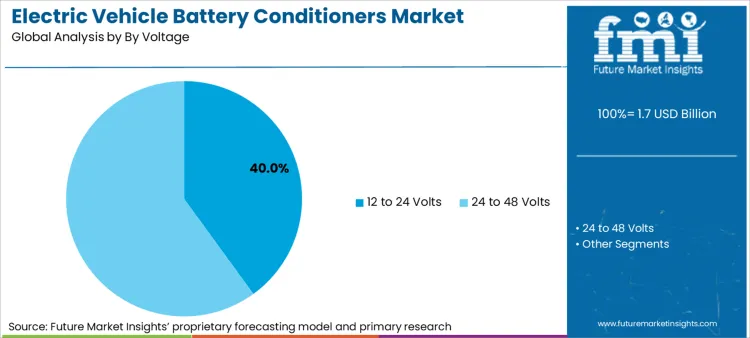
The 12 to 24 Volts segment currently retains a 40.0% volume share, primarily due to the massive installed base of mild hybrids and smaller urban electric runabouts. However, the value shift is moving aggressively toward 24-48V and high-voltage 800V architectures which require robust conditioning to handle faster energy transfer rates. Manufacturers are retooling production lines to support these higher voltage domains which dictate the future of premium EV performance. [9]
- Architecture transition: Demand shifts as OEMs migrate platforms to higher voltages for faster charging, requiring conditioners that can interface with high-power electrical systems without failure. [9]
- Component integration: Adoption tracks the integration of DC-DC converters and pumps into compact units, reducing weight and complexity for 48V auxiliary networks. [9]
- Mass market scale: Growth is supported by the continued proliferation of cost-effective low-voltage EVs in price-sensitive developing markets, sustaining volume for standard conditioning units. [5]
Electric Vehicle Battery Conditioners Market Drivers, Restraints, and Opportunities
The primary driver accelerating market adoption is the critical need to manage heat during ultra-fast charging events, which are becoming the standard for consumer acceptance. As charging speeds push toward 350 kW and beyond, the internal resistance of Li-ion cells generates rapid heat spikes that, if uncontrolled, trigger safety shut-offs or permanent degradation.
This physical reality forces automakers to procure advanced active ev thermal system hardware capable of aggressive heat rejection. For instance, MAHLE recently secured a series order for a cooling module specifically designed to handle waste heat of up to 8 kW from megawatt charging stations, demonstrating how infrastructure upgrades directly pull demand for high-capacity vehicle-side conditioning. [11]
A significant restraint facing the industry is the thermal runaway risk inherent in high-energy-density packs, which necessitates complex and costly safety protocols in conditioning design. The DOE’s Operating Experience Summary (OES) in 2025 highlighted stringent protocols regarding lithium-ion hazards, forcing suppliers to over-engineer systems to contain propagation. To mitigate this, manufacturers like Saint-Gobain are leveraging federal funding to develop advanced thermal management materials that increase battery lifespans by over 100%, directly addressing the durability concerns that otherwise limit aggressive conditioning strategies. [12, 13]
- Solid-State Compatibility: Suppliers can capture value by developing specialized conditioning systems for emerging solid-state batteries, as demonstrated by startups like Ampcera scaling production of thermally stable solid electrolytes. [14]
- Data Center Technology Crossover: Opportunities exist for players to adapt liquid cooling tech from hyperscale computing to automotive applications, allowing for shared R&D costs across high-heat sectors. [2]
- Emerging Market Fleets: Suppliers who design ruggedized, low-cost conditioning systems for high-ambient-temperature regions like India and the Middle East will secure contracts for massive commercial electric 2-wheeler and 3-wheeler fleets. [5]
Regional Analysis
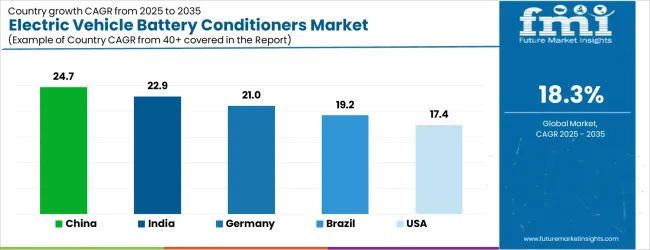
Based on the regional analysis, the electric vehicle battery conditioners market is segmented into North America, Latin America, Europe, East Asia, South Asia, Oceania and Middle East & Africa across 40+ countries. The full report also offers market attractiveness analysis based on regional trends.
| Country | CAGR (2026 to 2036) |
|---|---|
| China | 20.0% |
| India | 18.5% |
| Germany | 16.0% |
| South Korea | 15.8% |
| United States | 15.2% |
| Japan | 14.0% |
| United Kingdom | 13.5% |
Source: Future Market Insights (FMI) analysis, based on proprietary forecasting model and primary research
Asia Pacific Electric Vehicle Battery Conditioners Market Analysis
Asia Pacific leads global demand, leveraging its role as the world's battery manufacturing floor and the largest EV consumer base. The region's growth is fueled by aggressive national policies in China and India that mandate rapid electrification of transport, necessitating a parallel scale-up in thermal component supply chains. China's charging infrastructure explosion, reaching over 20 million facilities by 2025, sets a high bar for vehicle thermal performance, forcing local OEMs to adopt liquid cooling as a standard even in mass-market models. [4]
- China: Demand for battery conditioners in China is set to grow at 20.0% CAGR through 2036, supported by the installation of 20 million charging points that necessitate robust thermal management for frequent plug-in events. This trajectory is supported by the National Energy Administration's confirmation of 20.092 million charging facilities by late 2025, creating a massive ecosystem for thermally managed EVs. [4]
- India: In India, the battery conditioners market is forecast to advance at 18.5% CAGR through 2036, with growth anchored in the PM E-DRIVE scheme that subsidizes electric adoption and incentivizes local component manufacturing. This demand shift is reflected in the rapid surge of EV sales to 2.08 million units in 2024, creating a substantial volume baseline for thermal system suppliers. [5]
- South Korea: South Korea is expected to record 15.8% CAGR in battery conditioners demand over 2026 to 2036 as export-oriented OEMs integrate high-fidelity cooling to meet Western quality standards. This is underpinned by rapid infrastructure growth, with fast charger stock rising to 47,000 units in 2024, driving the need for vehicles capable of handling high-power energy transfer. [1]
- Japan: The outlook for battery conditioners in Japan indicates a 14.0% CAGR from 2026 to 2036 as hybrid and electric powertrains continue to dominate the domestic automotive landscape. This growth is linked to the broader trend of advanced economies maintaining strong demand shares, with Japan projected to remain a key technology adopter through 2030. [10]
FMI’s report includes a detailed growth analysis for Asia Pacific. Sectors like Thailand, Indonesia, Vietnam, and Australia present significant opportunities as automotive production hubs shift. In these emerging territories, the focus for buyers is on sourcing cost-effective thermal management solutions that can withstand tropical climates without compromising vehicle affordability. [5]
North America Electric Vehicle Battery Conditioners Market Analysis
North America is characterized by a "capability arms race," where range and charging speed are the primary competitive differentiators, driving heavy investment in advanced thermal conditioning. The market is pivoting toward localized manufacturing to satisfy Inflation Reduction Act (IRA) requirements, prompting suppliers to build capacity within the USMCA zone. Startups like HighT-Tech are receiving federal support to improve battery materials, further emphasizing the region's focus on high-tech thermal resilience. [15]
- United States: The United States battery conditioners sector is poised to expand at 15.2% CAGR during 2026 to 2036 because stringent battery durability requirements are pushing automakers toward sophisticated active cooling architectures. This expansion is evidenced by the Department of Energy's (DOE) award of $3.67 million to Saint-Gobain in 2025 to develop advanced thermal management materials that extend battery life. [12]
FMI’s report includes a comprehensive country-wise assessment for North America. Canada and Mexico are also covered as critical supply chain partners. In these markets, the integration of cross-border automotive manufacturing clusters allows for efficient distribution of thermal components, with Mexico serving as a cost-efficient production base for high-labor sub-assemblies. [10]
Europe Electric Vehicle Battery Conditioners Market Analysis
Europe remains the global center for high-performance automotive engineering, focusing on efficiency and sustainability in thermal systems. The region is driven by strict CO2 mandates and the Zero Emission Vehicle (ZEV) framework, which compels manufacturers to squeeze every kilometer of range from battery packs via superior conditioning. The market is seeing a high attach rate of heat pump-integrated systems, which are essential for maintaining EV performance during European winters. [7]
- Germany: Growth in battery conditioners across Germany is estimated at 16.0% CAGR through 2036, driven by the presence of premium OEMs who demand cutting-edge thermal efficiency to maintain brand reputation. This demand is reinforced by MAHLE's local innovation hubs, which delivered cooling modules capable of boosting range by 20% in 2024. [3]
- United Kingdom: The UK battery conditioners landscape is forecast to expand at 13.5% CAGR through 2036, as government mandates accelerate the phase-out of internal combustion engines. This demand momentum is supported by the deployment of over 86,000 public charging devices by October 2025, necessitating vehicles equipped with active thermal protection. [7]
FMI’s report includes an in-depth analysis of the European market. Countries like France, Italy, Spain, and Norway are also key markets. A major theme in these regions is the retrofit and serviceability of thermal interface pads and materials in aging EV fleets, ensuring long-term battery health beyond the initial warranty period. [3]
Competitive Aligners for Market Players
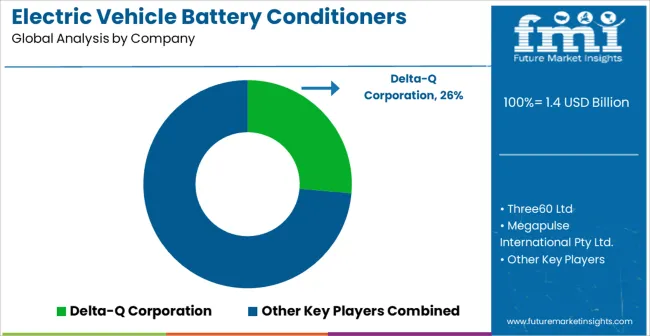
The competitive landscape is defined by a race for "system integration" rather than component sales. Players like Gentherm are moving beyond selling standalone pumps or chillers to offering complete Intelligent Thermal Management Systems (ITMS). This strategy locks OEMs into proprietary architectures, increasing switching costs and ensuring long-term revenue visibility. Evidence of this shift is found in the $1.0 billion transaction between Gentherm and Modine, which valued the combined entity at approximately 6.8x LTM EBITDA, underscoring the market's premium on scaled, pure-play thermal platforms. [8]
Consolidation is reshaping the supplier tier, as companies merge to achieve the scale necessary for global R&D and production. New entrants are also disrupting the status quo; Ola Cell Technologies established a Giga-Scale ACC manufacturing plant in India with 1 GWh installed capacity under the PLI scheme, signaling that battery makers are increasingly insourcing thermal integration to control the full pack value chain. [16]
Innovation in efficiency is the new battleground, with suppliers striving to minimize the "parasitic load" of cooling systems. Winners in this space are those who can deliver thermal safety with the lowest energy footprint. Startup Empower Battery Technology, for example, is developing a "Glass Anode" that facilitates extreme fast charging with inherently superior thermal management, challenging traditional component suppliers to innovate or risk obsolescence. [17]
Recent Developments
The report includes full coverage of key trends from competitive benchmarking. Some of the recent developments covered in the reports:
- In January 2026, Gentherm and Modine announced a $1.0 billion transaction to combine Modine's Performance Technologies business with Gentherm.[8]
- In March 2024, Ola Cell Technologies established a Giga-Scale ACC manufacturing plant with 1 GWh installed capacity, entering pilot production in India.[16]
Key Players in Electric Vehicle Battery Conditioners Market
- MAHLE
- Hanon Systems
- Valeo
- Denso
- Bosch
- Modine Manufacturing
- LG Electronics
Scope of the Report
| Metric | Value |
|---|---|
| Quantitative Units | USD 1.7 billion (2026) to USD 8.9 billion (2036), at a CAGR of 18.3% |
| Market Definition | The electric vehicle battery conditioners market comprises the global engineering, production, and trade of thermal management systems designed to regulate the temperature of battery packs in electric vehicles. |
| Voltage Segmentation | 12 to 24 Volts, 24 to 48 Volts, Others |
| Vehicle Type Segmentation | BEV, HEV/PHEV |
| Application Coverage | Passenger Cars, Commercial Vehicles, Off-highway |
| Regions Covered | North America, Latin America, Europe, East Asia, South Asia, Oceania, Middle East and Africa |
| Countries Covered | United States, Canada, Mexico, Brazil, Argentina, Germany, France, United Kingdom, Italy, Spain, China, India, Japan, South Korea, Indonesia, Australia and 40 plus countries |
| Key Companies Profiled | MAHLE, Hanon Systems, Valeo, Denso, Bosch, Modine Manufacturing, LG Electronics |
| Forecast Period | 2026 to 2036 |
| Approach | Hybrid top down and bottom up market modeling validated through primary interviews with thermal system engineers and procurement heads, supported by trade data benchmarking and plant level capacity verification |
Electric Vehicle Battery Conditioners Market by Segments
Voltage
- 12 to 24 Volts
- 24 to 48 Volts
- Others
Vehicle Type
- BEV
- HEV/PHEV
Technology
- Active Thermal Conditioning
- Passive
Region
- Asia Pacific
- India
- China
- Japan
- South Korea
- Indonesia
- Australia & New Zealand
- ASEAN
- Rest of Asia Pacific
- Europe
- Germany
- Italy
- France
- United Kingdom
- Spain
- Benelux
- Nordics
- Central & Eastern Europe
- Rest of Europe
- North America
- United States
- Canada
- Mexico
- Latin America
- Brazil
- Argentina
- Chile
- Rest of Latin America
- Middle East & Africa
- Kingdom of Saudi Arabia
- United Arab Emirates
- South Africa
- Turkey
- Rest of Middle East & Africa
Bibliography
- 1] IEA. (2024). Global EV Outlook 2025: Trends in electric car markets and charging. International Energy Agency.
- [2] Modine. (2025). Modine Announces New $100 Million Investment to Expand Capacity for North American Data Centers Business. Corporate Press Release.
- [3] MAHLE. (2024). MAHLE successful with major orders for thermal management modules. Corporate Press Release.
- [4] NEA. (2026). The total number of EV charging facilities in China reached 20.092 million by the end of 2025. National Energy Administration.
- [5] Invest India. (2024). Inside India's EV Manufacturing Ecosystem: Key Investment Trends & Government Policies. Govt of India.
- [6] MAHLE. (2025). MAHLE India receives award for intelligent thermal management system. Corporate Press Release.
- [7] DfT. (2025). Electric vehicle public charging infrastructure statistics: October 2025. UK Department for Transport.
- [8] Gentherm. (2026). Gentherm and Modine's Performance Technologies Business Combine. Corporate Investor Relations.
- [9] IEA. (2025). Trends in electric vehicle batteries. International Energy Agency.
- [10] IEA. (2025). Global EV Outlook 2025. International Energy Agency.
- [11] MAHLE. (2025). Series order for cooling module. Corporate Press Release.
- [12] ARPA-E. (2025). CIRCULAR Project Descriptions: Saint-Gobain. DOE ARPA-E.
- [13] DOE. (2025). Operating Experience Summary 2025-01: Lithium Ion. Department of Energy.
- [14] ARPA-E. (2025). EVs4All Ampcera Project Summary. DOE ARPA-E.
- [15] ARPA-E. (2025). CIRCULAR Project Descriptions: HighT-Tech. DOE ARPA-E.
- [16] Govt of India. (2024). PLI ACC Battery Storage Scheme Update. Press Information Bureau.
- [17] ARPA-E. (2025). T2M Empower-Ohio State U Project Summary. DOE ARPA-E.
This Report Addresses
- Market sizing and 10-year forecast for EV battery conditioners across voltage and technology segments
- Evaluation of the shift from passive to active thermal conditioning driven by fast-charging mandates
- Regional analysis covering high-growth markets like China and India versus mature hubs like Germany and USA
- Competitive landscape assessment focusing on consolidation, M&A, and system integration strategies
- Impact of regulatory frameworks like the PM E-DRIVE scheme and European ZEV mandates on component demand
- Technology trends including heat pump integration, bionic fans, and 800V architecture support
- Investment opportunities in localized manufacturing and emerging market fleet electrification
Frequently Asked Questions
How large is the demand for electric vehicle battery conditioners in the global market in 2026?
Demand for electric vehicle battery conditioners is estimated to be valued at USD 1.7 billion in 2026.
What will be the market size of electric vehicle battery conditioners in the global market by 2036?
The market size for electric vehicle battery conditioners is projected to reach USD 8.9 billion by 2036.
What is the expected demand growth for electric vehicle battery conditioners in the global market between 2026 and 2036?
Demand for electric vehicle battery conditioners is expected to grow at a CAGR of 18.3% between 2026 and 2036.
Which technology is poised to lead global sales by 2026?
Active Thermal Conditioning is expected to lead with 64% market share, driven by the necessity to manage high heat loads from fast charging.
How significant is the role of BEVs in driving electric vehicle battery conditioners adoption in 2026?
BEVs represent a dominant 45.0% share, as their large battery packs require sophisticated thermal management to ensure range and longevity.
What is driving demand in China?
Demand in China is driven by the massive deployment of over 20 million charging facilities which necessitates active cooling on vehicles.
What compliance standards or regulations are referenced for China?
The National Energy Administration's charging infrastructure targets and standard GB38031-2025 for battery safety are key benchmarks.
What is the China growth outlook in this report?
China is projected to grow at a CAGR of 20.0% during 2026 to 2036.
Why is Europe described as a priority region in this report?
Europe is a priority due to stringent ZEV mandates and high consumer demand for performance efficiency in diverse weather conditions.
What type of demand dominates in Europe?
Demand for high-performance, integrated thermal modules that include heat pump functionality dominates the European market.
What is the Germany growth outlook in this report?
Germany is projected to expand at a CAGR of 16.0% during 2026 to 2036.
Does the report cover South Korea in its regional analysis?
Yes, South Korea is included within the Asia Pacific regional analysis.
What are the sources referred to for analyzing South Korea?
IEA data on fast charger stock and battery demand trends are the primary sources used for South Korea analysis.
What is the main demand theme linked to South Korea in its region coverage?
Export-oriented product upgrading to meet Western quality and safety standards is the main theme.
Does the report cover Japan in its regional analysis?
Yes, Japan is included within the Asia Pacific regional analysis.
What is the main Japan related demand theme in its region coverage?
Continued dominance of hybrid technologies alongside a steady transition to pure electric platforms shapes Japan's demand.
Which product formats or configurations are strategically important for Asia Pacific supply chains?
Cost-effective yet robust liquid cooling modules suitable for high-ambient temperatures are critical for APAC supply chains.
What is electric vehicle battery conditioners and what is it mainly used for?
It is a thermal management system used to regulate EV battery temperature for optimal safety, range, and lifespan.
What does electric vehicle battery conditioners mean in this report?
It refers to the hardware and engineering systems dedicated to active or passive cooling of the vehicle's traction battery.
What is included in the scope of this electric vehicle battery conditioners report?
The scope includes chillers, cold plates, CDUs, and integrated thermal modules for BEVs, PHEVs, and HEVs.
What is excluded from the scope of this report?
General cabin HVAC components, raw material mining, and non-automotive battery cooling applications are excluded.
What does market forecast mean on this page?
Market forecast represents a model-based projection built on defined assumptions for strategic planning purposes.
How does FMI build and validate the electric vehicle battery conditioners forecast?
The forecast is built using a bottom-up model based on vehicle production volumes and validated through primary industry interviews.
What does zero reliance on speculative third party market research mean here?
It means the report relies on primary manufacturer data and verified government statistics rather than syndicated aggregator estimates.
Preview the report firsthand - request a free sample
Get SampleGet the brochure for pricing and purchase details.
Get PDFTable of Content
- Executive Summary
- Global Market Outlook
- Demand-side Trends
- Supply-side Trends
- Technology Roadmap Analysis
- Analysis and Recommendations
- Market Overview
- Market Coverage / Taxonomy
- Market Definition / Scope / Limitations
- Research Methodology
- Chapter Orientation
- Analytical Lens and Working Hypotheses
- Market Structure, Signals, and Trend Drivers
- Benchmarking and Cross-market Comparability
- Market Sizing, Forecasting, and Opportunity Mapping
- Research Design and Evidence Framework
- Desk Research Programme (Secondary Evidence)
- Company Annual and Sustainability Reports
- Peer-reviewed Journals and Academic Literature
- Corporate Websites, Product Literature, and Technical Notes
- Earnings Decks and Investor Briefings
- Statutory Filings and Regulatory Disclosures
- Technical White Papers and Standards Notes
- Trade Journals, Industry Magazines, and Analyst Briefs
- Conference Proceedings, Webinars, and Seminar Materials
- Government Statistics Portals and Public Data Releases
- Press Releases and Reputable Media Coverage
- Specialist Newsletters and Curated Briefings
- Sector Databases and Reference Repositories
- FMI Internal Proprietary Databases and Historical Market Datasets
- Subscription Datasets and Paid Sources
- Social Channels, Communities, and Digital Listening Inputs
- Additional Desk Sources
- Expert Input and Fieldwork (Primary Evidence)
- Primary Modes
- Qualitative Interviews and Expert Elicitation
- Quantitative Surveys and Structured Data Capture
- Blended Approach
- Why Primary Evidence is Used
- Field Techniques
- Interviews
- Surveys
- Focus Groups
- Observational and In-context Research
- Social and Community Interactions
- Stakeholder Universe Engaged
- C-suite Leaders
- Board Members
- Presidents and Vice Presidents
- R&D and Innovation Heads
- Technical Specialists
- Domain Subject-matter Experts
- Scientists
- Physicians and Other Healthcare Professionals
- Governance, Ethics, and Data Stewardship
- Research Ethics
- Data Integrity and Handling
- Primary Modes
- Tooling, Models, and Reference Databases
- Desk Research Programme (Secondary Evidence)
- Data Engineering and Model Build
- Data Acquisition and Ingestion
- Cleaning, Normalisation, and Verification
- Synthesis, Triangulation, and Analysis
- Quality Assurance and Audit Trail
- Market Background
- Market Dynamics
- Drivers
- Restraints
- Opportunity
- Trends
- Scenario Forecast
- Demand in Optimistic Scenario
- Demand in Likely Scenario
- Demand in Conservative Scenario
- Opportunity Map Analysis
- Product Life Cycle Analysis
- Supply Chain Analysis
- Investment Feasibility Matrix
- Value Chain Analysis
- PESTLE and Porter’s Analysis
- Regulatory Landscape
- Regional Parent Market Outlook
- Production and Consumption Statistics
- Import and Export Statistics
- Market Dynamics
- Global Market Analysis 2021 to 2025 and Forecast, 2026 to 2036
- Historical Market Size Value (USD Million) Analysis, 2021 to 2025
- Current and Future Market Size Value (USD Million) Projections, 2026 to 2036
- Y-o-Y Growth Trend Analysis
- Absolute $ Opportunity Analysis
- Global Market Pricing Analysis 2021 to 2025 and Forecast 2026 to 2036
- Global Market Analysis 2021 to 2025 and Forecast 2026 to 2036, By By Voltage
- Introduction / Key Findings
- Historical Market Size Value (USD Million) Analysis By By Voltage , 2021 to 2025
- Current and Future Market Size Value (USD Million) Analysis and Forecast By By Voltage , 2026 to 2036
- 12 to 24 Volts
- 24 to 48 Volts
- 12 to 24 Volts
- Y-o-Y Growth Trend Analysis By By Voltage , 2021 to 2025
- Absolute $ Opportunity Analysis By By Voltage , 2026 to 2036
- Global Market Analysis 2021 to 2025 and Forecast 2026 to 2036, By By Vehicle Type
- Introduction / Key Findings
- Historical Market Size Value (USD Million) Analysis By By Vehicle Type, 2021 to 2025
- Current and Future Market Size Value (USD Million) Analysis and Forecast By By Vehicle Type, 2026 to 2036
- BEV
- HEV/PHEV
- BEV
- Y-o-Y Growth Trend Analysis By By Vehicle Type, 2021 to 2025
- Absolute $ Opportunity Analysis By By Vehicle Type, 2026 to 2036
- Global Market Analysis 2021 to 2025 and Forecast 2026 to 2036, By By Technology
- Introduction / Key Findings
- Historical Market Size Value (USD Million) Analysis By By Technology, 2021 to 2025
- Current and Future Market Size Value (USD Million) Analysis and Forecast By By Technology, 2026 to 2036
- Active Thermal Conditioning
- Passive
- Active Thermal Conditioning
- Y-o-Y Growth Trend Analysis By By Technology, 2021 to 2025
- Absolute $ Opportunity Analysis By By Technology, 2026 to 2036
- Global Market Analysis 2021 to 2025 and Forecast 2026 to 2036, By Region
- Introduction
- Historical Market Size Value (USD Million) Analysis By Region, 2021 to 2025
- Current Market Size Value (USD Million) Analysis and Forecast By Region, 2026 to 2036
- North America
- Latin America
- Western Europe
- Eastern Europe
- East Asia
- South Asia and Pacific
- Middle East & Africa
- Market Attractiveness Analysis By Region
- North America Market Analysis 2021 to 2025 and Forecast 2026 to 2036, By Country
- Historical Market Size Value (USD Million) Trend Analysis By Market Taxonomy, 2021 to 2025
- Market Size Value (USD Million) Forecast By Market Taxonomy, 2026 to 2036
- By Country
- USA
- Canada
- Mexico
- By By Voltage
- By By Vehicle Type
- By By Technology
- By Country
- Market Attractiveness Analysis
- By Country
- By By Voltage
- By By Vehicle Type
- By By Technology
- Key Takeaways
- Latin America Market Analysis 2021 to 2025 and Forecast 2026 to 2036, By Country
- Historical Market Size Value (USD Million) Trend Analysis By Market Taxonomy, 2021 to 2025
- Market Size Value (USD Million) Forecast By Market Taxonomy, 2026 to 2036
- By Country
- Brazil
- Chile
- Rest of Latin America
- By By Voltage
- By By Vehicle Type
- By By Technology
- By Country
- Market Attractiveness Analysis
- By Country
- By By Voltage
- By By Vehicle Type
- By By Technology
- Key Takeaways
- Western Europe Market Analysis 2021 to 2025 and Forecast 2026 to 2036, By Country
- Historical Market Size Value (USD Million) Trend Analysis By Market Taxonomy, 2021 to 2025
- Market Size Value (USD Million) Forecast By Market Taxonomy, 2026 to 2036
- By Country
- Germany
- UK
- Italy
- Spain
- France
- Nordic
- BENELUX
- Rest of Western Europe
- By By Voltage
- By By Vehicle Type
- By By Technology
- By Country
- Market Attractiveness Analysis
- By Country
- By By Voltage
- By By Vehicle Type
- By By Technology
- Key Takeaways
- Eastern Europe Market Analysis 2021 to 2025 and Forecast 2026 to 2036, By Country
- Historical Market Size Value (USD Million) Trend Analysis By Market Taxonomy, 2021 to 2025
- Market Size Value (USD Million) Forecast By Market Taxonomy, 2026 to 2036
- By Country
- Russia
- Poland
- Hungary
- Balkan & Baltic
- Rest of Eastern Europe
- By By Voltage
- By By Vehicle Type
- By By Technology
- By Country
- Market Attractiveness Analysis
- By Country
- By By Voltage
- By By Vehicle Type
- By By Technology
- Key Takeaways
- East Asia Market Analysis 2021 to 2025 and Forecast 2026 to 2036, By Country
- Historical Market Size Value (USD Million) Trend Analysis By Market Taxonomy, 2021 to 2025
- Market Size Value (USD Million) Forecast By Market Taxonomy, 2026 to 2036
- By Country
- China
- Japan
- South Korea
- By By Voltage
- By By Vehicle Type
- By By Technology
- By Country
- Market Attractiveness Analysis
- By Country
- By By Voltage
- By By Vehicle Type
- By By Technology
- Key Takeaways
- South Asia and Pacific Market Analysis 2021 to 2025 and Forecast 2026 to 2036, By Country
- Historical Market Size Value (USD Million) Trend Analysis By Market Taxonomy, 2021 to 2025
- Market Size Value (USD Million) Forecast By Market Taxonomy, 2026 to 2036
- By Country
- India
- ASEAN
- Australia & New Zealand
- Rest of South Asia and Pacific
- By By Voltage
- By By Vehicle Type
- By By Technology
- By Country
- Market Attractiveness Analysis
- By Country
- By By Voltage
- By By Vehicle Type
- By By Technology
- Key Takeaways
- Middle East & Africa Market Analysis 2021 to 2025 and Forecast 2026 to 2036, By Country
- Historical Market Size Value (USD Million) Trend Analysis By Market Taxonomy, 2021 to 2025
- Market Size Value (USD Million) Forecast By Market Taxonomy, 2026 to 2036
- By Country
- Kingdom of Saudi Arabia
- Other GCC Countries
- Turkiye
- South Africa
- Other African Union
- Rest of Middle East & Africa
- By By Voltage
- By By Vehicle Type
- By By Technology
- By Country
- Market Attractiveness Analysis
- By Country
- By By Voltage
- By By Vehicle Type
- By By Technology
- Key Takeaways
- Key Countries Market Analysis
- USA
- Pricing Analysis
- Market Share Analysis, 2025
- By By Voltage
- By By Vehicle Type
- By By Technology
- Canada
- Pricing Analysis
- Market Share Analysis, 2025
- By By Voltage
- By By Vehicle Type
- By By Technology
- Mexico
- Pricing Analysis
- Market Share Analysis, 2025
- By By Voltage
- By By Vehicle Type
- By By Technology
- Brazil
- Pricing Analysis
- Market Share Analysis, 2025
- By By Voltage
- By By Vehicle Type
- By By Technology
- Chile
- Pricing Analysis
- Market Share Analysis, 2025
- By By Voltage
- By By Vehicle Type
- By By Technology
- Germany
- Pricing Analysis
- Market Share Analysis, 2025
- By By Voltage
- By By Vehicle Type
- By By Technology
- UK
- Pricing Analysis
- Market Share Analysis, 2025
- By By Voltage
- By By Vehicle Type
- By By Technology
- Italy
- Pricing Analysis
- Market Share Analysis, 2025
- By By Voltage
- By By Vehicle Type
- By By Technology
- Spain
- Pricing Analysis
- Market Share Analysis, 2025
- By By Voltage
- By By Vehicle Type
- By By Technology
- France
- Pricing Analysis
- Market Share Analysis, 2025
- By By Voltage
- By By Vehicle Type
- By By Technology
- India
- Pricing Analysis
- Market Share Analysis, 2025
- By By Voltage
- By By Vehicle Type
- By By Technology
- ASEAN
- Pricing Analysis
- Market Share Analysis, 2025
- By By Voltage
- By By Vehicle Type
- By By Technology
- Australia & New Zealand
- Pricing Analysis
- Market Share Analysis, 2025
- By By Voltage
- By By Vehicle Type
- By By Technology
- China
- Pricing Analysis
- Market Share Analysis, 2025
- By By Voltage
- By By Vehicle Type
- By By Technology
- Japan
- Pricing Analysis
- Market Share Analysis, 2025
- By By Voltage
- By By Vehicle Type
- By By Technology
- South Korea
- Pricing Analysis
- Market Share Analysis, 2025
- By By Voltage
- By By Vehicle Type
- By By Technology
- Russia
- Pricing Analysis
- Market Share Analysis, 2025
- By By Voltage
- By By Vehicle Type
- By By Technology
- Poland
- Pricing Analysis
- Market Share Analysis, 2025
- By By Voltage
- By By Vehicle Type
- By By Technology
- Hungary
- Pricing Analysis
- Market Share Analysis, 2025
- By By Voltage
- By By Vehicle Type
- By By Technology
- Kingdom of Saudi Arabia
- Pricing Analysis
- Market Share Analysis, 2025
- By By Voltage
- By By Vehicle Type
- By By Technology
- Turkiye
- Pricing Analysis
- Market Share Analysis, 2025
- By By Voltage
- By By Vehicle Type
- By By Technology
- South Africa
- Pricing Analysis
- Market Share Analysis, 2025
- By By Voltage
- By By Vehicle Type
- By By Technology
- USA
- Market Structure Analysis
- Competition Dashboard
- Competition Benchmarking
- Market Share Analysis of Top Players
- By Regional
- By By Voltage
- By By Vehicle Type
- By By Technology
- Competition Analysis
- Competition Deep Dive
- MAHLE
- Overview
- Product Portfolio
- Profitability by Market Segments (Product/Age /Sales Channel/Region)
- Sales Footprint
- Strategy Overview
- Marketing Strategy
- Product Strategy
- Channel Strategy
- Hanon Systems
- Valeo
- Denso
- Bosch
- Modine Manufacturing
- LG Electronics
- MAHLE
- Competition Deep Dive
- Assumptions & Acronyms Used


