

- Industry Size (2026)
- USD 2.8 Bn
- Forecast (2036)
- USD 3.9 Bn
- CAGR (2026 to 2036)
- 3.4%
Electric Fireplace Market Size, Market Forecast and Outlook By FMI
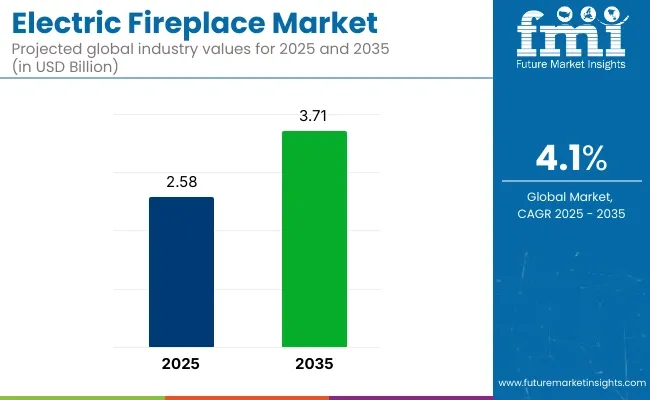
The electric fireplace market is expected to expand from USD 2.8 billion in 2026 to USD 3.9 billion by 2036. The market is anticipated to register a 3.4% CAGR during the forecast period as design-led heating adoption broadens across residential spaces. Wall-mounted electric fireplaces are likely to lead with a 38.1% share in 2026 as compact installation needs shape product choice. Residential applications are projected to account for 78.2% share in 2026 as homeowners prefer simple heating and interior design upgrades.
Summary of the Electric Fireplace Market
- Demand and Growth Drivers
- Smart home integration is expected to increase electric fireplace use through voice control and mobile scheduling features.
- Energy management functions are likely to improve household appeal by adjusting heat output across occupancy and temperature patterns.
- Safety features such as automatic shutoff and overheat alerts are anticipated to strengthen buyer confidence in family homes.
- Product and Segment View
- Wall-mounted electric fireplaces are expected to lead product demand as compact apartments need simple installation and visual appeal.
- Residential applications are likely to dominate use since homeowners combine supplemental heating with decoration and comfort upgrades.
- Freestanding units are anticipated to attract renters and small households through portable placement and lower installation effort.
- Geography and Competitive Outlook
- China is expected to lead country expansion with 4.9% CAGR through 2036 as apartment construction raises demand.
- United States demand is likely to expand at 4.8% CAGR through 2036, helped by renovation activity and residential construction.
- Glen Dimplex Group and Twin Star Home are anticipated to compete through design range and smart home compatibility.
- Analyst Opinion
- Nikhil Kaitwade of FMI offers the following analyst view for Process Automation and adjacent heating equipment markets. “Electric fireplace demand is expected to improve as smart controls and compact wall-mounted designs gain household acceptance. Brands with safer heating systems and stronger residential styling are likely to capture buyers during renovation cycles.”
- Electric Fireplace Market Value Analysis
- The electric fireplace market is moving from seasonal heating purchases toward year-round home comfort and interior design spending.
- Demand is likely to rise as smart controls make heat settings easier to manage across daily household routines.
- Adoption is expected to gain lift from wall-mounted formats with easier installation and limited space requirements.
- Spending is anticipated to increase through renovation projects as consumers seek safer flame effects and lower maintenance needs.
Key Takeaways, Market Size, and Forecast
| Metric | Value |
|---|---|
| Market Size (2026) | USD 2.8 Billion |
| Market Size (2036) | USD 3.9 Billion |
| CAGR (2026–2036) | 3.4% |
| Leading Product Type (2026) | Wall-Mounted Electric Fireplaces |
| Wall-Mounted Electric Fireplaces Share (2026) | 38.1% |
| Leading Application (2026) | Residential Applications |
| Residential Applications Share (2026) | 78.2% |
| Fastest-Growing Country | China |
| China CAGR | 4.9% |
Integration with home automation also enhances safety through remote monitoring, automatic shutoff, and alerts if temperatures exceed set thresholds. As smart lighting, thermostats, and entertainment systems become standard in modern homes, electric fireplaces that sync with these systems gain traction. The combined appeal of aesthetics, ease of integration, and enhanced user experience drives higher adoption of electric fireplaces within smart home ecosystems.
Electric Fireplace Market Key Takeaways
| Metric | Value |
|---|---|
| Market Value (2026) | USD 2.8 billion |
| Market Forecast Value (2036) | USD 3.9 billion |
| Forecast CAGR (2026-2036) | 3.4% |
Source: FMI analysis based on primary research and proprietary forecasting model
What are the Major Advancements in Electric Fireplace Space?
Advancements in electric fireplace technology are making them more appealing to modern consumers and boosting demand. Smart connectivity features now allow electric fireplaces to integrate with home automation systems, enabling control via mobile apps, voice assistants, and programmable schedules. Improved flame realism uses full spectrum LEDs and three-dimensional effects to mimic real fire visuals without fuel. Many models now include zoned heating with precise temperature control, adaptive heat output, and energy-saving modes that adjust performance based on room conditions.
Enhanced safety features such as automatic shutoff, tip-over protection, and overheat sensors increase household confidence. Advances in materials and design deliver slimmer, wall-mounted and built-in options that fit diverse interior styles. Multi-color lighting and customizable ambience allow users to change mood settings independently from heat output. Better integration with smart thermostats and occupancy sensors helps optimize energy use. These technological improvements expand use cases beyond seasonal warmth to year-round ambience and smart-enabled comfort solutions.
What are the Various Segments of the Electric Fireplace Market?
Electric fireplaces play a critical role in delivering supplemental heating, aesthetic enhancement, and energy efficiency across residential heating, commercial applications, and hospitality installations. Adoption is influenced by heating requirements, cost considerations, installation flexibility, and design performance criteria. Segmentation by product type, application, and installation method highlights how manufacturers select specific fireplace solutions to meet heating standards, aesthetic targets, and consumer preferences across diverse property categories.
Which Product Type Holds the Largest Share in Electric Fireplaces?
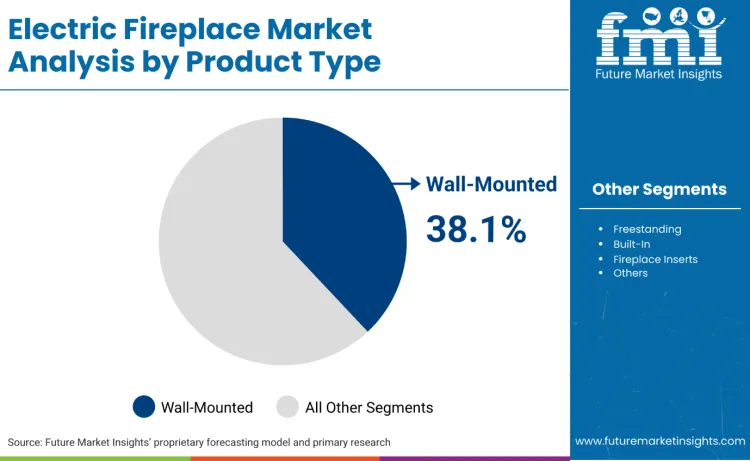
Wall-mounted electric fireplaces account for 38.1%, driven by extensive use in residential installations, apartment applications, and space-saving designs. The surging use of smart home appliances is further bolstering demand. Freestanding fireplaces hold 34.2%, supporting portable heating, temporary installations, and rental property applications. Built-in fireplaces represent 21.8%, favored for permanent installations, custom designs, and luxury residential applications. Other product types contribute 5.9%, used in specialized applications and niche market segments.
Key Points
- Wall-mounted fireplaces dominate residential and commercial applications.
- Freestanding fireplaces support portable and flexible heating markets.
- Product selection depends on installation requirements and aesthetic considerations.
How Do Application Requirements Influence Fireplace Selection?
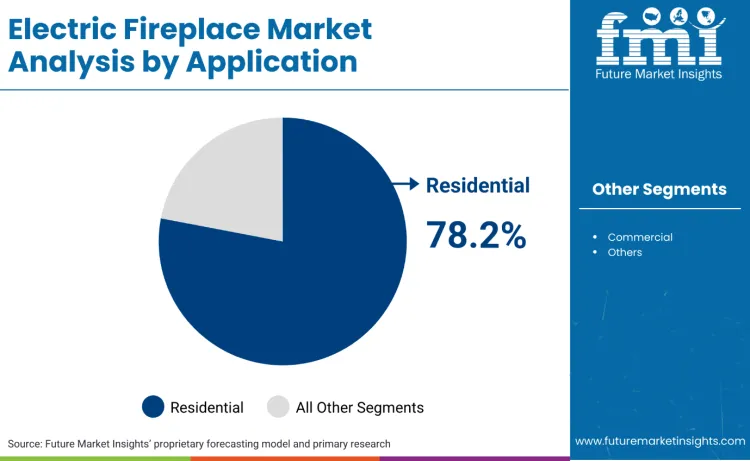
Residential applications represent 78.2%, reflecting priority on applications requiring home heating and interior design features. Commercial installations account for 21.8%, suitable for hospitality applications requiring aesthetic appeal and controlled heating environments. Residential applications emphasize energy efficiency, design flexibility, and installation convenience. Commercial applications focus on durability, aesthetic consistency, and maintenance efficiency.
Key Points
- Residential applications remain the primary market segment.
- Commercial applications serve hospitality and office heating needs.
- Application selection depends on heating requirements and installation specifications.
What are the Certification Requirements in Electric Fireplace Space?
Certification requirements for electric fireplaces focus on safety, performance, and electrical compliance to protect users and meet regulatory standards. In many countries, electric fireplaces must be tested and certified by accredited laboratories to demonstrate compliance with product safety standards such as UL 1278 in the United States and CSA C22.2 No. 46 in Canada, which evaluate electrical shock risk, fire hazards, insulation, and mechanical stability. In Europe, conformity with the Low Voltage Directive requires compliance with EN 60335-1 and EN 60335-2-30 standards covering general household electrical safety and specific heater requirements.
CE marking is required for products sold in the European Economic Area, indicating conformity with essential health and safety requirements. Electromagnetic compatibility testing ensures that electric fireplaces do not cause or suffer interference with other electrical equipment. Energy efficiency and eco-design regulations in some jurisdictions may require additional testing and labeling for power consumption. Manufacturers must also provide clear instructions, warning labels, and safety information. Compliance with these certifications is often verified through periodic factory inspections and quality management systems such as ISO 9001.
How Is the Electric Fireplace Market Evolving Globally?
Global demand for electric fireplaces is increasing as residential and commercial developers expand construction capacity while addressing consumer convenience, heating efficiency, and design application requirements. Thus, there is a growing demand for smart home products, such as residential furnaces, electric fireplaces, and others. Growth reflects rising use of smart-enabled fireplace designs, advanced heating systems, and energy-optimized product specifications across residential developments, commercial facilities, and hospitality construction systems. Product selection focuses on heating properties, installation efficiency, and cost performance under various construction scenarios. China records 4.9% CAGR, USA records 4.8% CAGR, Germany records 3.6% CAGR, Japan records 3.4% CAGR, and UK records 3.2% CAGR. Adoption remains driven by heating requirements and design efficiency rather than volume expansion alone.
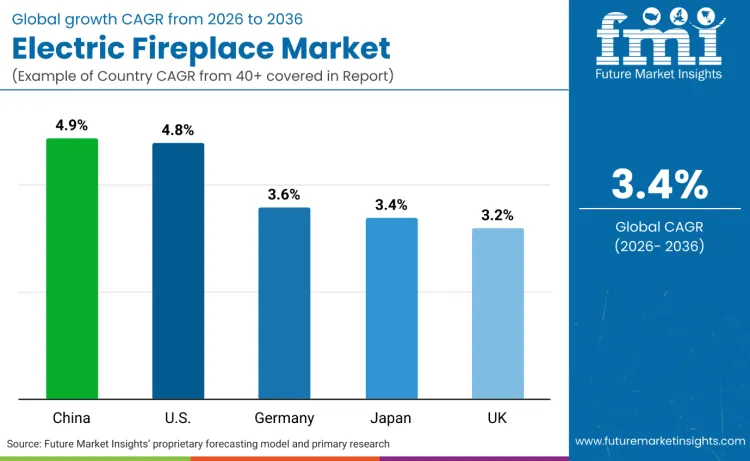
| Country | CAGR (2026-2036) |
|---|---|
| China | 4.9% |
| USA | 4.8% |
| Germany | 3.6% |
| Japan | 3.4% |
| UK | 3.2% |
Source: FMI’s proprietary forecasting model and primary research
What is Driving Growth of Electric Fireplace Demand in China?
Demand for electric fireplaces in China is expanding as residential construction facilities develop housing capabilities and comfort improvement programs. Growth at 4.9% CAGR reflects rising use of wall-mounted units, residential heating applications, and modern design systems addressing domestic market and urbanization requirements. Product quality improvement under construction conditions remains critical for heating performance and consumer acceptance. Cost considerations encourage fireplace solutions delivering heating efficiency and installation convenience at competitive price points. Residential developers prioritize units compatible with existing electrical infrastructure and building capabilities. Demand concentrates within urban construction clusters, apartment development zones, and residential facilities serving metropolitan and suburban markets.
- Expansion of residential construction production capabilities
- Need for apartment heating and modern design solutions
- Cost-effective wall-mounted and built-in fireplace systems
- Growth of urban housing market capacity
Why is USA Seeing Expansion in Electric Fireplace Adoption?
FMI is of the opinion that electric fireplace demand in USA is rising as construction systems expand residential programs and comfort enhancement initiatives. Growth at 4.8% CAGR reflects strong activity in home renovation, new construction, and commercial heating applications. Large-scale residential construction is driving demand for units delivering heating efficiency, cost effectiveness, and code compliance. Residential facilities increase utilization of wall-mounted and built-in fireplaces due to energy requirements and consumer preference specifications. Domestic manufacturing policies support advanced fireplace technologies and installation standards. Demand remains centered on major residential construction regions and integrated development complexes serving domestic and export markets.
- Expansion of residential construction and renovation programs
- Construction system support for advanced heating technologies
- Growth of energy-efficient and modern design services
- Development of cost-efficient fireplace capabilities
What Factors are Shaping Electric Fireplace Sales in Germany?
Sales of electric fireplaces in Germany are increasing as operators expand residential facilities and comfort improvement capabilities aligned with energy efficiency and heating processing needs. Growth at 3.6% CAGR reflects rising use in residential heating, apartment installations, and commercial heating applications. Product performance under seasonal conditions and installation reliability drives technology selection. Construction financing mechanisms increase access to advanced fireplace equipment for qualifying residential facilities. Residential construction programs focus on heating efficiency and design quality to demonstrate fireplace value. Demand remains strongest within residential construction centers and development facilities serving European markets.
- Expansion of residential construction facilities
- Operator access to advanced heating technologies
- Focus on heating efficiency and design quality
- Growth of residential construction and fireplace installation services
How is Japan Supporting Growth of Electric Fireplace Demand?
Electric fireplace market demand in Japan is advancing as manufacturing systems expand production capabilities across residential heating, commercial installations, and precision heating applications. Growth at 3.4% CAGR reflects strong use in apartment developments, residential construction, and commercial heating applications. Advanced manufacturing operations introduce complex heating scenarios requiring consistent product performance and quality reliability. Production strategies prioritize materials with proven heating characteristics and installation stability. Major construction facilities emphasize product specifications and quality control protocols to optimize fireplace efficiency. Demand is driven by performance evidence and cost effectiveness rather than raw material availability trends.
- Expansion of residential heating and construction programs
- Advanced manufacturing facility management
- Focus on heating characteristics and installation reliability
- Growth of precision heating centers
What is Driving Expansion of Electric Fireplace Demand in UK?
Demand for electric fireplaces in UK is rising as construction programs expand quality capabilities across residential development, commercial heating, and specialty installation applications. Growth at 3.2% CAGR reflects utilization driven by quality standards and performance-based heating protocols. Product consistency under long-term operation scenarios influences technology selection and construction management approaches. Residential operators prioritize systems supporting heating efficiency, cost effectiveness, and energy performance. Quality acceptance standards elevate focus on product reliability, heating performance, and supply consistency. Demand remains tied to residential construction program development and manufacturing capacity rather than general heating expansion.
- Quality standard-driven product utilization
- Expansion of residential construction programs
- Focus on product reliability and cost efficiency
- Performance-based heating supply protocols
Who are the Major Players Active in the Electric Fireplace Market?
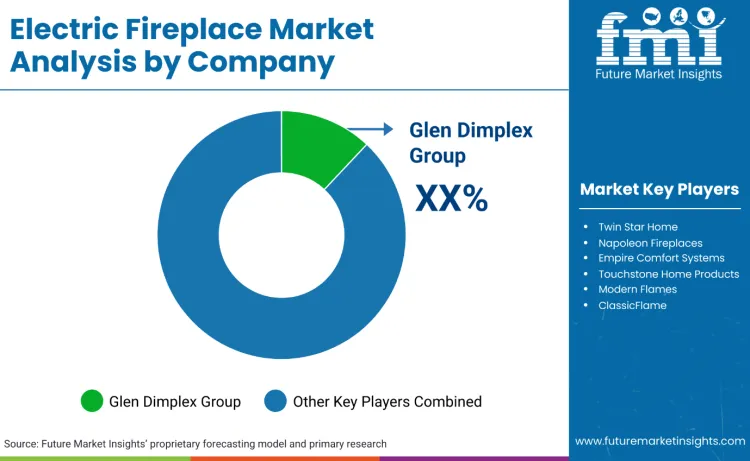
Major players active in the electric fireplace market include Glen Dimplex Group, which offers a broad portfolio of electric heating and fireplace solutions across residential markets. Twin Star Home focuses on contemporary electric fireplaces and integrated home comfort products designed for modern interiors. Napoleon Fireplaces is active with electric fireplace models alongside its wider range of heating solutions. Empire Comfort Systems supplies electric fireplaces as part of its residential heating and indoor comfort offerings. Touchstone Home Products specializes in modern electric fireplaces and media wall units aimed at design focused living spaces. These companies compete through product design, heating performance, safety features, and compatibility with evolving home interiors and smart home trends.
Key Players in the Electric Fireplace Market
- Glen Dimplex Group
- Twin Star Home
- Napoleon Fireplaces
- Empire Comfort Systems
- Touchstone Home Products
- Modern Flames
- ClassicFlame
- Real Flame
- Amantii Electric Fireplaces
- R.W. Flame
Scope of the Report
| Items | Values |
|---|---|
| Quantitative Units | USD billion |
| Product Type | Wall-Mounted Electric Fireplaces; Freestanding Electric Fireplaces; Built-In Electric Fireplaces; Fireplace Inserts; Others |
| Application | Residential; Commercial; Others |
| Installation | Indoor; Outdoor |
| Regions Covered | Asia Pacific, Europe, North America, Latin America, Middle East & Africa |
| Countries Covered | China, USA, Germany, Japan, UK, and 40+ countries |
| Key Companies Profiled | Glen Dimplex Group; Twin Star Home; Napoleon Fireplaces; Empire Comfort Systems; Touchstone Home Products; Others |
| Additional Attributes | Dollar sales by product type, application, and installation method; performance in heating efficiency and cost effectiveness across residential heating, commercial installations, and hospitality matrices; product quality improvement, installation efficiency enhancement, and energy management under construction operations; impact on heating performance, supply reliability, and cost management during installation processes; compatibility with electrical systems and design targets; procurement dynamics driven by residential construction expansion, quality improvement programs, and long-term heating supply partnerships. |
Electric Fireplace Market by Segment
Product Type:
- Wall-Mounted Electric Fireplaces
- Freestanding Electric Fireplaces
- Built-In Electric Fireplaces
- Fireplace Inserts
- Others
Application:
- Residential
- Commercial
- Others
Installation:
- Indoor
- Outdoor
Region:
- Asia Pacific
- China
- Japan
- South Korea
- India
- Australia & New Zealand
- ASEAN
- Rest of Asia Pacific
- Europe
- Germany
- United Kingdom
- France
- Italy
- Spain
- Nordic
- BENELUX
- Rest of Europe
- North America
- USA
- Canada
- Mexico
- Latin America
- Brazil
- Chile
- Rest of Latin America
- Middle East & Africa
- Kingdom of Saudi Arabia
- Other GCC Countries
- Turkey
- South Africa
- Other African Union
- Rest of Middle East & Africa
Bibliography
- Electric Fireplace Institute. (2023). Heating Standards for Electric Fireplaces: Technical Guidelines. EFI.
- International Home Comfort Association. (2023). Product Specifications for Electric Fireplaces: Efficiency and Safety Requirements. IHCA.
- Society of Heating Technology. (2024). SHT Guidelines for Fireplace Selection in Residential Construction (updated heating specifications for efficiency and design applications). SHT.
- Johnson, M. K., et al. (2023). Heating efficiency effects of advanced electric fireplaces on residential comfort optimization: A comprehensive analysis of wall-mounted and built-in fireplace applications. Journal of Home Heating Technology, 29, 156-172.
- Williams, D. R., et al. (2023). Third annual electric fireplace report: Special focus on energy performance and cost efficiency in residential heating applications. International Heating Review, 25, 34-51.
Frequently Asked Questions
How big is the electric fireplace market in 2026?
The global electric fireplace market is estimated to be valued at USD 2.8 billion in 2026.
What will be the size of the electric fireplace market in 2036?
The market size for the electric fireplace market is projected to reach USD 3.9 billion by 2036.
How much will the electric fireplace market grow between 2026 and 2036?
The electric fireplace market is expected to grow at a 3.4% CAGR between 2026 and 2036.
What are the key product types in the electric fireplace market?
The key product types in the electric fireplace market include wall-mounted electric fireplaces, freestanding electric fireplaces, built-in electric fireplaces, and fireplace inserts.
Which product segment will contribute a significant share in the electric fireplace market in 2026?
In terms of product type, the wall-mounted electric fireplaces segment is set to command a 38.1% share in the electric fireplace market in 2026.
Preview the report firsthand - request a free sample
Get SampleGet the brochure for pricing and purchase details.
Get PDFTable of Content
- Executive Summary
- Global Market Outlook
- Demand Side Trends
- Supply Side Trends
- Technology Roadmap Analysis
- Analysis and Recommendations
- Market Overview
- Market Coverage / Taxonomy
- Market Definition / Scope / Limitations
- Research Methodology
- Chapter Orientation
- Analytical Lens and Working Hypotheses
- Market Structure, Signals, and Trend Drivers
- Benchmarking and Cross-market Comparability
- Market Sizing, Forecasting, and Opportunity Mapping
- Research Design and Evidence Framework
- Desk Research Programme (Secondary Evidence)
- Expert Input and Fieldwork (Primary Evidence)
- Governance, Ethics, and Data Stewardship
- Tooling, Models, and Reference Databases
- Data Engineering and Model Build
- Quality Assurance and Audit Trail
- Market Background
- Market Dynamics
- Drivers
- Restraints
- Opportunity
- Trends
- Scenario Forecast
- Demand in Optimistic Scenario
- Demand in Likely Scenario
- Demand in Conservative Scenario
- Opportunity Map Analysis
- Product Life Cycle Analysis
- Supply Chain Analysis
- Investment Feasibility Matrix
- Value Chain Analysis
- PESTLE and Porter's Analysis
- Regulatory Landscape
- Regional Parent Market Outlook
- Production and Consumption Statistics
- Import and Export Statistics
- Market Dynamics
- Global Electric Fireplace Market Analysis 2021 to 2025 and Forecast, 2026 to 2036
- Historical Market Size Value (USD Billion) Analysis, 2021 to 2025
- Current and Future Market Size Value (USD Billion) Projections, 2026 to 2036
- Y-o-Y Growth Trend Analysis
- Absolute $ Opportunity Analysis
- Global Electric Fireplace Market Pricing Analysis 2021 to 2025 and Forecast 2026 to 2036
- Y-o-Y Growth Trend Analysis 2021 to 2025
- Absolute $ Opportunity Analysis 2026 to 2036
- Global Electric Fireplace Market Analysis 2021 to 2025 and Forecast 2026 to 2036, By Product Type
- Introduction / Key Findings
- Historical Market Size Value (USD Billion) Analysis By Product Type, 2021 to 2025
- Current and Future Market Size Value (USD Billion) Analysis and Forecast By Product Type, 2026 to 2036
- Wall-Mounted Electric Fireplaces
- Freestanding Electric Fireplaces
- Built-In Electric Fireplaces
- Fireplace Inserts
- Others
- Global Electric Fireplace Market Analysis 2021 to 2025 and Forecast 2026 to 2036, By Application
- Introduction / Key Findings
- Historical Market Size Value (USD Billion) Analysis By Application, 2021 to 2025
- Current and Future Market Size Value (USD Billion) Analysis and Forecast By Application, 2026 to 2036
- Residential
- Commercial
- Others
- Global Electric Fireplace Market Analysis 2021 to 2025 and Forecast 2026 to 2036, By Installation
- Indoor
- Outdoor
- Global Electric Fireplace Market Analysis 2021 to 2025 and Forecast 2026 to 2036, By Region
- North America
- Latin America
- Europe
- Asia Pacific
- Middle East & Africa
- Key Countries Market Analysis
- Market Structure Analysis
- Competition Analysis
- Glen Dimplex Group
- Twin Star Home
- Napoleon Fireplaces
- Empire Comfort Systems
- Touchstone Home Products
- Modern Flames
- ClassicFlame
- Real Flame
- Amantii Electric Fireplaces
- R.W. Flame
- Assumptions & Acronyms Used


