

- Industry Size (2026)
- USD 6.1 Bn
- Forecast (2036)
- USD 12.8 Bn
- CAGR (2026 to 2036)
- 7.7%
Electric Power Steering Motors Market Forecast and Outlook By FMI
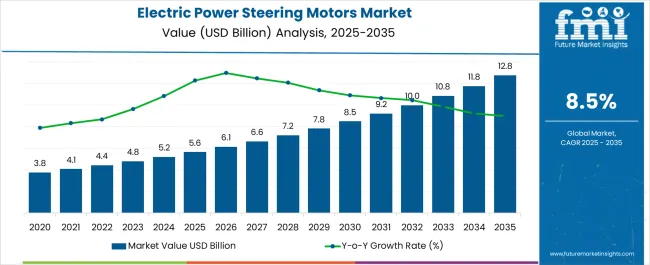
In 2025, the electric power steering motors market was valued at USD 5.6 billion. Based on Future Market Insights' analysis, demand for electric power steering motors is estimated to grow to USD 6.1 billion in 2026 and USD 12.8 billion by 2036. FMI projects a CAGR of 7.7% during the forecast period.
Absolute dollar growth of USD 7.2 billion over the decade signals steady expansion driven by global vehicle electrification rather than cyclical recovery. Despite intensifying price competition and raw material cost volatility, major electric power steering motor manufacturers sustain margin stability through long-term OEM supply contracts and platform consolidation strategies.
Summary of Electric Power Steering Motors Market
- Electric Power Steering Motors Market Definition: The industry covers electric motors integrated into vehicle steering systems to provide variable assist torque, replacing hydraulic systems and enabling ADAS functionality.
- Demand Drivers in the Market:
- Global fuel economy standards mandate hydraulic-to-electric conversion.
- ADAS and autonomous driving require electric steering redundancy.
- Electric vehicle adoption eliminates engine-driven hydraulic pumps.
- Key Segments Analyzed in the FMI Report:
- Vehicle Type: Passenger cars dominate at 45.0% share.
- Product Type: AC motors lead with 55.0% share.
- Geography: High-growth Asia-Pacific versus replacement-driven mature markets.
- Analyst Opinion at FMI: Nikhil Kaitwade, Principal Consultant for Automotive at Future Market Insights, opines, *"In the updated version of the Electric Power Steering Motors Market Report for 2026 to 2036, program directors will find insights into how ADAS integration requirements are reshaping motor torque specifications and redundancy architectures. Besides this, my findings point at rare earth magnet price volatility directly impacting motor manufacturing margins and the consolidation of steering system supply among tier-one integrators creating concentrated buyer power."*
- Strategic Implications/Executive Takeaways:
- Shift focus from standalone motor supply to integrated steering module partnerships.
- Treat functional safety (ISO 26262) compliance as market entry barrier.
- Prioritize brushless DC motor development for higher efficiency and durability.
- Methodology:
- Validated through OEM production schedules and supplier capacity announcements.
- Zero reliance on speculative third-party market research reports.
- Based on verifiable vehicle production data and steering system content analysis.
As Robin Milavec, President, Chief Technology Officer (CTO), Chief Strategy Officer (CSO), and Executive Board Director of Nexteer Automotive, noted regarding the company’s performance amid industry headwinds, “Nexteer continues to outperform the market by delivering innovation, securing strategic programs and investing in operational excellence, even amid ongoing volatility in global vehicle production.” [1]
China (10.2% CAGR) and India (9.5% CAGR) drive new opportunities through expanding vehicle production and rapid adoption of electric vehicles. Brazil (8.2% CAGR) contributes via growing automotive manufacturing base and fleet modernization. Mature automotive markets such as Germany (7.8%), the United States (7.2%), Japan (6.4%), and the United Kingdom (6.8%) generate replacement demand through advanced driver assistance system (ADAS) integration, with volume expansion constrained by market saturation and extended vehicle lifecycles.
Electric Power Steering Motors Market Definition
Electric power steering motors comprise electromechanical devices that provide steering assist by converting electrical energy into torque, replacing traditional hydraulic power steering systems. These motors, integrated with electronic control units and torque sensors, enable variable assist characteristics, reduce fuel consumption by eliminating continuous hydraulic pump operation, and serve as foundational components for advanced driver assistance and autonomous driving functionalities.
Electric Power Steering Motors Market Inclusions
The report includes a comprehensive analysis of market dynamics, featuring Global and Regional Market Sizes (Volume and Value) and a 10-year Forecast (2026 to 2036). It covers segmental breakdowns by vehicle type (Passenger Cars, Light Commercial Vehicles, Heavy Commercial Vehicles, Off-Highway Vehicles), product type (AC Motors, DC Motors), sales channel (OEM, Aftersales), and motor power categories.
Electric Power Steering Motors Market Exclusions
The scope excludes hydraulic power steering systems, steering columns without integrated motors, and aftermarket repair parts not containing electric motors. It also omits steering systems for off-highway equipment not meeting on-road vehicle classifications, focusing strictly on electric motors designed for power steering applications in certified road vehicles.
Electric Power Steering Motors Market Research Methodology
- Primary Research: Interviews were conducted with electric motor manufacturers, automotive OEM procurement heads, Tier 1 steering system integrators, and aftermarket distributors across major regions. Raw material suppliers clarified rare earth magnet supply dynamics.
- Desk Research: Vehicle production data from OICA, steering system content analysis, and corporate financial filings supported volume benchmarking.
- Market-Sizing and Forecasting: A hybrid top-down and bottom-up model was developed. Demand was reconstructed from global vehicle production forecasts, electric power steering penetration rates, and motor content per vehicle, then validated against supplier production capacities.
- Data Validation and Update Cycle: Outputs undergo anomaly screening, variance checks across production and trade datasets, and structured peer review prior to release.
Segmental Analysis
Electric Power Steering Motors Market Analysis by Vehicle Type
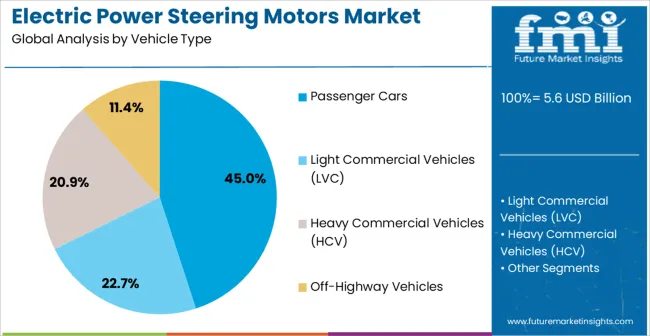
Based on FMI’s electric power steering motors market report, consumption of passenger car applications is estimated to hold 45.0% share in 2026. Growth in demand for passenger car electric power steering motors comes from the segment's volume leadership, with global passenger car production exceeding 70 million units annually and electric power steering penetration approaching 90% in new vehicles.
- Platform Consolidation: JTEKT is transforming into a "solution provider creating the future of mobility society" as outlined in the JTEKT Group 2030 Vision, leveraging its position as the world's first developer of EPS to offer systems "suitable for every vehicle segment" from compact to large-sized vehicles [2].
- Premium Vehicle Content: ZF presents state-of-the-art steering solutions such as "Steer-by-Wire" and "EasyTurn" for maximum maneuverability, where "steer-by-wire offers easier handling of even heavy vehicles through a flexible steering ratio and adjustable steering force" [3].
- Emerging Market Adoption: India's "Passenger Vehicles recorded their highest-ever sales of 4.3 million units in FY 2024-25," reinforcing volume expansion and EPS penetration in high-growth automotive markets [4].
Electric Power Steering Motors Market Analysis by Product Type
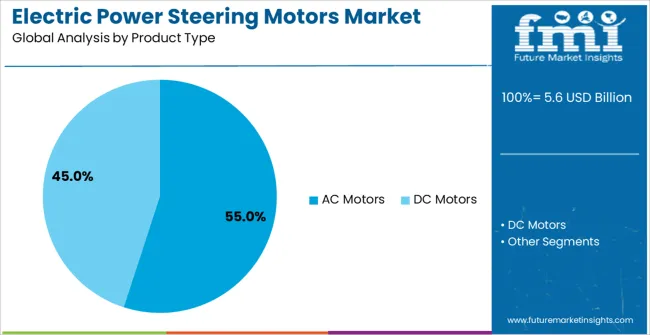
Based on FMI’s electric power steering motors market report, consumption of AC motors is estimated to hold 55.0% share in 2026. Growth in demand for AC motors comes from their superior efficiency, precise torque control, and compatibility with regenerative braking systems in hybrid and electric vehicles.
- Brushless DC Competition: Nidec succeeded in mass production of brushless DC motors earlier than competitors and has "held on to the world's No. 1 position," as these motors are "highly efficient and compact so that they can be mounted in small spaces" and are increasingly "replacing once-general hydraulic units" [5] [6].
- 48V Architecture Migration: Mitsuba Corporation regard India as one of their "most important strategic markets" and have resolved to establish "Mitsuba India R&D Pvt. Ltd." in April 2026 to respond to "development and marketing of automotive and general-purpose electrical components" and enhance development speed [7].
- Autonomous Driving Integration: LG Innotek has developed the "EPS motor, Torque Sensors, and ECU product" using differentiated "BLDC technology, which enables the motor to have high power output, low noise, small size, and fast response," while positioning itself as a "Total Solution Provider" for future mobility at CES 2025 [8].
Electric Power Steering Motors Market Drivers, Restraints, and Opportunities
Future Market Insights analysis that historical patterns point at a high-volume, platform-driven automotive industry where electric power steering (EPS) motors have become the default steering architecture across passenger vehicles and light commercial fleets. Estimated valuation in 2026 represents the immediate “software-defined steering phase” as OEMs invest in torque sensors, ECUs, and steer-by-wire readiness to align with electrification and advanced driver assistance system integration timelines.
While demand for hydraulic steering systems is structurally declining due to efficiency penalties and limited ADAS compatibility (volume loss), the price-per-unit of high-output brushless and steer-by-wire compatible EPS motors is significantly higher (value gain), resulting in sustained double-digit revenue growth. The forecast value accounts for the market reaching a “technology consolidation phase” where electrified platforms, hybrid architectures, and autonomous-ready systems standardize EPS adoption across vehicle classes.
Electrification Integration: Growth is shifting from basic steering assist toward high-voltage and 48V-compatible motor systems integrated with regenerative braking and EV platforms.
-
ADAS and Steer-by-Wire Mandates: Increasing regulatory and safety emphasis on lane-keeping, automated parking, and autonomous driving functions is forcing OEMs to migrate toward electronically controlled steering systems with redundancy and fail-safe architectures.
- Emerging Market Motorization: Rapid passenger vehicle production growth in Asia-Pacific and Latin America is accelerating EPS penetration as manufacturers bypass hydraulic systems in favor of cost-efficient electric architectures aligned with fuel efficiency and emission targets.
Regional Analysis
Based on the regional analysis, the electric power steering motors market is segmented into North America, Latin America, Europe, East Asia, South Asia, Oceania and Middle East & Africa across 40-plus countries. The full report also offers market attractiveness analysis based on regional trends.
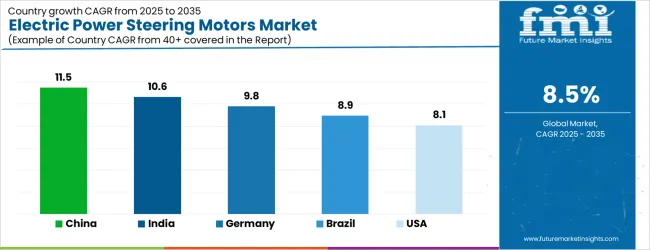
| Country | CAGR (2026 to 2036) |
|---|---|
| China | 10.2% |
| India | 9.5% |
| Brazil | 8.2% |
| Germany | 7.8% |
| United States | 7.2% |
| United Kingdom | 6.8% |
| Japan | 6.4% |
Source: Future Market Insights (FMI) analysis, based on proprietary forecasting model and primary research
North America Electric Power Steering Motors Market Analysis
North America is currently characterized by a “high-output transition,” where resurgent demand for heavy-duty trucks and SUVs is accelerating deployment of high-torque rack-assist EPS systems and early steer-by-wire integration. Key players in North America include Nexteer Automotive, which leads in rack-assist EPS platforms for full-size pickups, and ZF Friedrichshafen, which is advancing steer-by-wire architectures for premium electric vehicles.
- United States: Demand for EPS in the United States is projected to rise at 4.8% CAGR through 2036. Growth is reinforced by heavy-duty program wins and continued electrification of steering platforms. “Nexteer continues to focus on market share gain, displacing top competitors on several new EPS, DL and CIS programmes for multiple global OEMs,” including applications for GMC Sierra Heavy Duty and Chevrolet Silverado HD. [9]
FMI’s report includes a detailed analysis of the growth in the North American region, along with a country-wise assessment that includes the USA and Canada. Readers can also find regional trends, regulatory evolution, and platform migration shaping EPS adoption across vehicle segments.
Asia Pacific Electric Power Steering Motors Market Analysis
Asia Pacific remains the global epicenter of production, leveraging the world’s highest vehicle volumes and rapid New Energy Vehicle penetration to standardize EPS as a core efficiency enabler. JTEKT Corporation and Nidec maintain strong regional footprints, while Nexteer expands local engineering engagement in steer-by-wire standardization.
- China: Leading with a 5.2% CAGR, the market is shifting toward national steer-by-wire standards and advanced control system localization. “Nexteer Sponsored Automotive Chassis-by-Wire Standards Research Group Meeting Advancing Steer-by-Wire Standards in China.” [10]
- India: Domestic demand is accelerating at a 6.5% CAGR, supported by record passenger vehicle production and localization initiatives. “JTEKT India Ltd is primarily engaged in the business of manufacturing steering systems & other auto components for the passenger car and utility vehicle manufacturers.” [11]
The full report analyze the electric power steering motors market across East and South Asia from 2021 to 2036, covering localization strategies, NEV penetration, and steer-by-wire development shaping regional growth trajectories.
Latin America Electric Power Steering Motors Market Analysis
Latin America is emerging as a value-sensitive expansion market, where regional OEM assembly hubs integrate EPS to meet fuel efficiency and safety mandates while maintaining cost competitiveness.
- Brazil: A projected 4.1% CAGR through 2036 is supported by localized vehicle production recovery and increasing penetration of EPS in compact and utility vehicle segments.
The report consists of a detailed analysis for the market in Brazil, Mexico, Argentina, Colombia and Rest of Latin America. Readers can find detailed information about several factors, such as localization trends, regulatory alignment, and platform electrification, which are impacting growth in the Latin America region.
Europe Electric Power Steering Motors Market Analysis
Europe is the global “innovation laboratory,” where market value is driven by the transition toward steer-by-wire architectures and software-defined steering systems rather than incremental hydraulic replacement. Leading players in Europe EPS industry, ZF Friedrichshafen and Thyssenkrupp Automotive Technology, lead in steer-by-wire and advanced steering R&D programs.
- Germany: Demand for EPS in Germany is rising at a 4.5% CAGR through 2036, driven by early series production of steer-by-wire vehicles. “This marks the start of the first series production of a steer-by-wire vehicle in Europe in 2026,” enabling capabilities up to Level 4 and beyond. [12]
FMI’s analysis of EPS motors market in Europe consists of country-wise assessment that includes Germany, France, United Kingdom, Italy, Spain and Rest of Europe. Readers can know various regulatory developments, autonomous integration milestones, and steering electrification trends in the regional market.
Competitive Aligners for Market Players
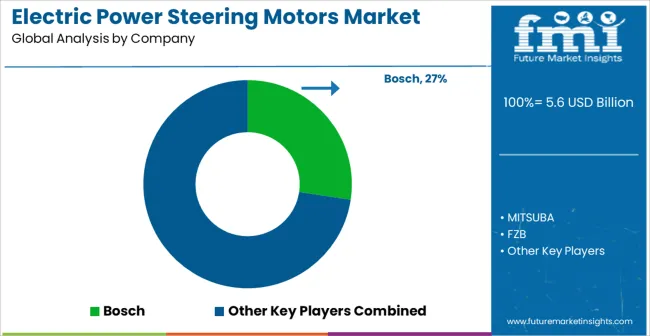
Market structure remains fragmented in general, yet practical competition is concentrated among a limited set of tier-one suppliers capable of meeting global OEM volume, functional safety compliance, and platform lifecycle expectations. A significant share of global EPS motor capacity sits with vertically integrated steering system manufacturers, while remaining participants operate with limited pricing leverage and high dependency on program awards. Primary competitive variable is cost survivability at mid-cycle vehicle production levels, not peak margin capture during volume upswings.
Producers with captive motor design, in-house ECU development, and integrated torque sensor capabilities absorb semiconductor volatility and magnet price fluctuations more effectively and sustain program continuity during supply chain disruptions. Suppliers without vertical integration depend on third-party electronics and control software partners, increasing exposure to qualification delays and margin compression during new vehicle launches. Regulatory compliance further narrows the competitive field. Ability to supply ISO 26262 functional safety-compliant systems, meet steer-by-wire redundancy standards, and pass OEM durability validation at scale requires deep validation infrastructure, embedded software expertise, and disciplined process control, creating natural attrition among undercapitalized entrants.
Customer concentration reinforces buyer leverage. Large global OEM groups multi-source EPS platforms across regions to prevent supplier dependency, limiting price pass-through and compressing margins despite rising software and electrification content.
Recent Developments:
- In January 2026, At CES 2026, Bosch showcased advanced software-driven mobility and manufacturing solutions, projected more than €6 billion in software and services sales, expanded USA partnerships with Microsoft and Kodiak AI, and highlighted progress in automated driving and digital factory technologies [13].
- In July 2025 - ZF introduced its advanced steer-by-wire system, securing a production contract with Mercedes-Benz starting in 2026 and enhancing vehicle agility, safety, and design flexibility while supporting next-generation automated driving capabilities [14].
Key Players in Electric Power Steering Motors Market
- Robert Bosch GmbH
- JTEKT Corporation
- ZF Friedrichshafen AG
- NSK Ltd.
- Nexteer Automotive
- Nidec Corporation
- Mitsuba Corporation
- LG Innotek
- Hitachi Astemo, Ltd.
- Johnson Electric Holdings Limited
- MAHLE Group
- Toshiba Corporation
- FZB Technology
- General Ricambi S.r.l.
- Denso Corporation
- Mando Corporation
- Hyundai Mobis
- Thyssenkrupp Presta AG
Scope of the Report
| Metric | Value |
|---|---|
| Quantitative Units | USD 6.1 billion (2026) to USD 12.8 billion (2036), at a CAGR of 7.7% |
| Market Definition | The electric power steering motors market comprises the global production and supply of electromechanical motors integrated into automotive steering systems, replacing hydraulic assist mechanisms to deliver variable steering torque, improve fuel efficiency, and enable ADAS and autonomous driving functionalities across certified road vehicles. |
| Vehicle Type Segmentation | Passenger Cars, Light Commercial Vehicles, Heavy Commercial Vehicles, Off-Highway Vehicles |
| Product Type Segmentation | AC Motors (Induction, Permanent Magnet Synchronous), DC Motors (Brushless DC, Brushed DC) |
| Sales Channel Segmentation | Original Equipment Manufacturers (OEM), Aftersales |
| Motor Power Segmentation | Less Than 300 Watts, 300-600 Watts, More Than 600 Watts |
| Regions Covered | North America, Latin America, Europe, East Asia, South Asia & Pacific, Middle East & Africa |
| Countries Covered | United States, Canada, Mexico, Brazil, Argentina, Chile, Germany, France, United Kingdom, Italy, Spain, Russia, China, Japan, South Korea, India, Indonesia, Malaysia, Thailand, Vietnam, Australia, New Zealand and 40 plus countries |
| Key Companies Profiled | Robert Bosch GmbH, JTEKT Corporation, ZF Friedrichshafen AG, NSK Ltd., Nexteer Automotive, Nidec Corporation, Mitsuba Corporation, LG Innotek, Hitachi Astemo Ltd., Denso Corporation, Hyundai Mobis, Mando Corporation, Thyssenkrupp Presta AG |
| Forecast Period | 2026 to 2036 |
| Approach | Hybrid top down and bottom up market modeling validated through primary interviews with Tier 1 steering system integrators, motor manufacturers, and OEM procurement teams, supported by OICA vehicle production benchmarking, steering penetration analysis, and supplier capacity verification |
Electric Power Steering Motors Market Analysis by Segments
Vehicle Type:
- Passenger Cars
- Light Commercial Vehicles (LCV)
- Heavy Commercial Vehicles (HCV)
- Off-Highway Vehicles
Product Type:
- AC Motors
- Induction Motors
- Permanent Magnet Synchronous Motors
- DC Motors
- Brushless DC Motors (BLDC)
- Brushed DC Motors
Sales Channel:
- Original Equipment Manufacturers (OEM)
- Aftersales
Motor Power:
- Less Than 300 Watts
- 300-600 Watts
- More Than 600 Watts
Region:
- North America
- United States
- Canada
- Mexico
- Latin America
- Brazil
- Argentina
- Chile
- Rest of Latin America
- Europe
- Germany
- France
- United Kingdom
- Italy
- Spain
- Russia
- Nordic
- Benelux
- Rest of Europe
- East Asia
- China
- Japan
- South Korea
- South Asia & Pacific
- India
- ASEAN (Indonesia, Malaysia, Thailand, Vietnam)
- Australia & New Zealand
- Rest of South Asia & Pacific
- Middle East & Africa
- Kingdom of Saudi Arabia
- United Arab Emirates
- Turkey
- South Africa
- Rest of Middle East & Africa
Bibliography
- [1] Nexteer Automotive. (2025). Nexteer reports strong first-half 2025 results. Nexteer Media Center.
- [2] JTEKT Corporation. (2025). JTEKT report 2025 (Annual report). JTEKT.
- [3] ZF Friedrichshafen AG. (2025). IAA Mobility technologies overview. ZF.
- [4] Society of Indian Automobile Manufacturers (SIAM). (2025). Annual report 2024-25. SIAM.
- [5] Nidec Corporation. (2025). Brushless motor technology capability. Nidec.
- [6] Nidec Corporation. (2025). EPS case study: New-generation electric power steering. Nidec.
- [7] Mitsuba Corporation. (2025). Investor relations news release (November 12, 2025). Mitsuba.
- [8] LG Innotek. (2025). Press release. LG Innotek Newsroom.
- [9] [Corporate Author Unknown]. (2025). EW01316-10 technical document (PDF).
- [10] Nexteer Automotive. (2025). Media center. Nexteer.
- [11] Screener.in. (2025). JTEKT India Ltd share price and company insights. Screener.
- [12] ZF Friedrichshafen AG. (2025). ZF steer-by-wire: Driving innovation in a new direction. ZF.
- [13] Bosch. (2026). CES 2026: Bosch is shaping the future of mobility, manufacturing and technology in everyday life. Bosch Media Service US.
- [14] ZF Friedrichshafen AG. (2025). ZF steer-by-wire: Driving innovation in a new direction. ZF.
This Report Addresses
- Market intelligence to enable structured strategic decision-making across mature and emerging automotive motor economies
- Market size estimation and 10-year revenue forecasts from 2026 to 2036, supported by validated vehicle production data and motor content analysis
- Growth opportunity mapping across vehicle types, product types, sales channels, and motor power categories with emphasis on ADAS-compliant and EV-specific applications
- Segment and regional revenue forecasts covering passenger cars, commercial vehicles, and off-highway applications
- Competition strategy assessment including vertical integration models, functional safety certification positioning, and manufacturing scale benchmarking
- Technology roadmap tracking including brushless DC adoption, 48V architecture migration, and steer-by-wire development
- Regulatory impact analysis covering fuel economy standards (CAFE, CAFC, EU CO2), functional safety requirements (ISO 26262), and regional emission regulations
- Market report delivery in PDF, Excel, PPT, and interactive dashboard formats for executive and operational use
Frequently Asked Questions
How large is the demand for electric power steering motors in the global market in 2026?What will be the market size of electric power steering motors in the global market by 2036?
Demand for electric power steering motors in the global market is estimated to be valued at USD 6.1 billion in 2026.
What will be the market size of electric power steering motors in the global market by 2036?
Market size for electric power steering motors is projected to reach USD 12.8 billion by 2036.
What is the expected demand growth for electric power steering motors in the global market between 2026 and 2036?
Demand for electric power steering motors in the global market is expected to grow at a CAGR of 7.7% between 2026 and 2036.
Which vehicle type is poised to lead global sales by 2026?
Passenger cars are expected to be the dominant vehicle type, capturing approximately 45.0% of global market share in 2026 due to production volume leadership and near-universal electric power steering adoption.
Which product type is projected to contribute significant share in the electric power steering motors market in 2026?
In terms of product type, AC motors are projected to command 55.0% share in the electric power steering motors market in 2026, driven by efficiency advantages and compatibility with EV architectures.
What is driving electric power steering motor demand in China?
China's 10.2% CAGR is driven by CAFC fuel economy standards mandating hydraulic system phase-out, domestic vehicle production exceeding 30 million units annually, and rapid electric vehicle adoption requiring EPS as standard equipment.
What compliance standards are referenced for China?
China's Corporate Average Fuel Consumption (CAFC) standards and GB motor vehicle safety regulations are referenced as key compliance benchmarks.
What is the United States growth outlook in this report?
The United States is projected to grow at a CAGR of 7.2% during 2026 to 2036, supported by light truck production volumes and ADAS integration requirements.
Why is Germany's growth rate significant in this report?
Germany's 7.8% CAGR reflects the premium vehicle focus of German manufacturers, with over 45% of domestic production featuring electric or hybrid powertrains requiring advanced EPS systems.
Why is Germany's growth rate significant in this report?
Germany's 7.8% CAGR reflects the premium vehicle focus of German manufacturers, with over 45% of domestic production featuring electric or hybrid powertrains requiring advanced EPS systems.
What type of demand dominates in mature markets?
Replacement demand through vehicle production and ADAS-driven content growth dominates mature markets, with electric power steering penetration already exceeding 95% in new vehicles.
What is Japan's growth outlook in this report?
Japan is projected to grow at a CAGR of 6.4% during 2026 to 2036, characterized by stable domestic production and global leadership in hybrid vehicle technology.
Does the report cover South Korea in its regional analysis?
South Korea is included within East Asia under the regional coverage framework.
What is the main Korea-related demand theme in East Asia coverage?
Korea's demand centers on domestic production by Hyundai Motor Group and supplier capabilities from Mando Corporation and Hyundai Mobis serving both domestic and global OEMs.
Which motor power segment is strategically important for heavy vehicles?
More Than 600 Watts motors are prioritized for heavy commercial vehicles and SUVs requiring higher assist torque, with content value exceeding entry-level passenger car motors by 40-50%.
What are electric power steering motors and what are they mainly used for?
Electric power steering motors are electromechanical devices providing steering assist by converting electrical energy to torque, primarily used to replace hydraulic systems, improve fuel efficiency, and enable ADAS functionality.
What does the electric power steering motors market mean in this report?
The electric power steering motors market refers to global production and supply of electric motors specifically designed for power steering applications in certified road vehicles.
What is included in the scope of this electric power steering motors market report?
Scope covers electric power steering motors by vehicle type (passenger cars, LCV, HCV, off-highway), product type (AC, DC), sales channel (OEM, aftersales), and motor power categories.
What is excluded from the scope of this report?
Hydraulic power steering systems, steering columns without integrated motors, aftermarket repair parts without motors, and off-highway equipment not meeting road vehicle classifications are excluded.
What does market forecast mean on this page?
Market forecast represents a model-based projection built on defined assumptions for strategic planning purposes.
How does FMI build and validate the electric power steering motors market forecast?
Forecast is developed using hybrid top-down and bottom-up modeling validated through vehicle production data, steering system content analysis, and supplier capacity benchmarks.
What does zero reliance on speculative third-party market research mean here?
Primary interviews and verifiable public datasets including OICA production statistics, corporate financial filings, and supplier announcements are used instead of unverified syndicated market estimates.
Preview the report firsthand - request a free sample
Get SampleGet the brochure for pricing and purchase details.
Get PDFTable of Content
- Executive Summary
- Global Market Outlook
- Demand-side Trends
- Supply-side Trends
- Technology Roadmap Analysis
- Analysis and Recommendations
- Market Overview
- Market Coverage / Taxonomy
- Market Definition / Scope / Limitations
- Research Methodology
- Chapter Orientation
- Analytical Lens and Working Hypotheses
- Market Structure, Signals, and Trend Drivers
- Benchmarking and Cross-market Comparability
- Market Sizing, Forecasting, and Opportunity Mapping
- Research Design and Evidence Framework
- Desk Research Programme (Secondary Evidence)
- Company Annual and Sustainability Reports
- Peer-reviewed Journals and Academic Literature
- Corporate Websites, Product Literature, and Technical Notes
- Earnings Decks and Investor Briefings
- Statutory Filings and Regulatory Disclosures
- Technical White Papers and Standards Notes
- Trade Journals, Industry Magazines, and Analyst Briefs
- Conference Proceedings, Webinars, and Seminar Materials
- Government Statistics Portals and Public Data Releases
- Press Releases and Reputable Media Coverage
- Specialist Newsletters and Curated Briefings
- Sector Databases and Reference Repositories
- FMI Internal Proprietary Databases and Historical Market Datasets
- Subscription Datasets and Paid Sources
- Social Channels, Communities, and Digital Listening Inputs
- Additional Desk Sources
- Expert Input and Fieldwork (Primary Evidence)
- Primary Modes
- Qualitative Interviews and Expert Elicitation
- Quantitative Surveys and Structured Data Capture
- Blended Approach
- Why Primary Evidence is Used
- Field Techniques
- Interviews
- Surveys
- Focus Groups
- Observational and In-context Research
- Social and Community Interactions
- Stakeholder Universe Engaged
- C-suite Leaders
- Board Members
- Presidents and Vice Presidents
- R&D and Innovation Heads
- Technical Specialists
- Domain Subject-matter Experts
- Scientists
- Physicians and Other Healthcare Professionals
- Governance, Ethics, and Data Stewardship
- Research Ethics
- Data Integrity and Handling
- Primary Modes
- Tooling, Models, and Reference Databases
- Desk Research Programme (Secondary Evidence)
- Data Engineering and Model Build
- Data Acquisition and Ingestion
- Cleaning, Normalisation, and Verification
- Synthesis, Triangulation, and Analysis
- Quality Assurance and Audit Trail
- Market Background
- Market Dynamics
- Drivers
- Restraints
- Opportunity
- Trends
- Scenario Forecast
- Demand in Optimistic Scenario
- Demand in Likely Scenario
- Demand in Conservative Scenario
- Opportunity Map Analysis
- Product Life Cycle Analysis
- Supply Chain Analysis
- Investment Feasibility Matrix
- Value Chain Analysis
- PESTLE and Porter’s Analysis
- Regulatory Landscape
- Regional Parent Market Outlook
- Production and Consumption Statistics
- Import and Export Statistics
- Market Dynamics
- Global Market Analysis 2021 to 2025 and Forecast, 2026 to 2036
- Historical Market Size Value (USD Million) Analysis, 2021 to 2025
- Current and Future Market Size Value (USD Million) Projections, 2026 to 2036
- Y-o-Y Growth Trend Analysis
- Absolute $ Opportunity Analysis
- Global Market Pricing Analysis 2021 to 2025 and Forecast 2026 to 2036
- Global Market Analysis 2021 to 2025 and Forecast 2026 to 2036, By Vehicle Type
- Introduction / Key Findings
- Historical Market Size Value (USD Million) Analysis By Vehicle Type , 2021 to 2025
- Current and Future Market Size Value (USD Million) Analysis and Forecast By Vehicle Type , 2026 to 2036
- Passenger cars
- Light Commercial Vehicles (LCV)
- Heavy Commercial Vehicles (HCV)
- Off-Highway Vehicles
- Passenger cars
- Y-o-Y Growth Trend Analysis By Vehicle Type , 2021 to 2025
- Absolute $ Opportunity Analysis By Vehicle Type , 2026 to 2036
- Global Market Analysis 2021 to 2025 and Forecast 2026 to 2036, By Product Type
- Introduction / Key Findings
- Historical Market Size Value (USD Million) Analysis By Product Type, 2021 to 2025
- Current and Future Market Size Value (USD Million) Analysis and Forecast By Product Type, 2026 to 2036
- AC motors
- DC Motors
- AC motors
- Y-o-Y Growth Trend Analysis By Product Type, 2021 to 2025
- Absolute $ Opportunity Analysis By Product Type, 2026 to 2036
- Global Market Analysis 2021 to 2025 and Forecast 2026 to 2036, By Region
- Introduction
- Historical Market Size Value (USD Million) Analysis By Region, 2021 to 2025
- Current Market Size Value (USD Million) Analysis and Forecast By Region, 2026 to 2036
- North America
- Latin America
- Western Europe
- Eastern Europe
- East Asia
- South Asia and Pacific
- Middle East & Africa
- Market Attractiveness Analysis By Region
- North America Market Analysis 2021 to 2025 and Forecast 2026 to 2036, By Country
- Historical Market Size Value (USD Million) Trend Analysis By Market Taxonomy, 2021 to 2025
- Market Size Value (USD Million) Forecast By Market Taxonomy, 2026 to 2036
- By Country
- USA
- Canada
- Mexico
- By Vehicle Type
- By Product Type
- By Country
- Market Attractiveness Analysis
- By Country
- By Vehicle Type
- By Product Type
- Key Takeaways
- Latin America Market Analysis 2021 to 2025 and Forecast 2026 to 2036, By Country
- Historical Market Size Value (USD Million) Trend Analysis By Market Taxonomy, 2021 to 2025
- Market Size Value (USD Million) Forecast By Market Taxonomy, 2026 to 2036
- By Country
- Brazil
- Chile
- Rest of Latin America
- By Vehicle Type
- By Product Type
- By Country
- Market Attractiveness Analysis
- By Country
- By Vehicle Type
- By Product Type
- Key Takeaways
- Western Europe Market Analysis 2021 to 2025 and Forecast 2026 to 2036, By Country
- Historical Market Size Value (USD Million) Trend Analysis By Market Taxonomy, 2021 to 2025
- Market Size Value (USD Million) Forecast By Market Taxonomy, 2026 to 2036
- By Country
- Germany
- UK
- Italy
- Spain
- France
- Nordic
- BENELUX
- Rest of Western Europe
- By Vehicle Type
- By Product Type
- By Country
- Market Attractiveness Analysis
- By Country
- By Vehicle Type
- By Product Type
- Key Takeaways
- Eastern Europe Market Analysis 2021 to 2025 and Forecast 2026 to 2036, By Country
- Historical Market Size Value (USD Million) Trend Analysis By Market Taxonomy, 2021 to 2025
- Market Size Value (USD Million) Forecast By Market Taxonomy, 2026 to 2036
- By Country
- Russia
- Poland
- Hungary
- Balkan & Baltic
- Rest of Eastern Europe
- By Vehicle Type
- By Product Type
- By Country
- Market Attractiveness Analysis
- By Country
- By Vehicle Type
- By Product Type
- Key Takeaways
- East Asia Market Analysis 2021 to 2025 and Forecast 2026 to 2036, By Country
- Historical Market Size Value (USD Million) Trend Analysis By Market Taxonomy, 2021 to 2025
- Market Size Value (USD Million) Forecast By Market Taxonomy, 2026 to 2036
- By Country
- China
- Japan
- South Korea
- By Vehicle Type
- By Product Type
- By Country
- Market Attractiveness Analysis
- By Country
- By Vehicle Type
- By Product Type
- Key Takeaways
- South Asia and Pacific Market Analysis 2021 to 2025 and Forecast 2026 to 2036, By Country
- Historical Market Size Value (USD Million) Trend Analysis By Market Taxonomy, 2021 to 2025
- Market Size Value (USD Million) Forecast By Market Taxonomy, 2026 to 2036
- By Country
- India
- ASEAN
- Australia & New Zealand
- Rest of South Asia and Pacific
- By Vehicle Type
- By Product Type
- By Country
- Market Attractiveness Analysis
- By Country
- By Vehicle Type
- By Product Type
- Key Takeaways
- Middle East & Africa Market Analysis 2021 to 2025 and Forecast 2026 to 2036, By Country
- Historical Market Size Value (USD Million) Trend Analysis By Market Taxonomy, 2021 to 2025
- Market Size Value (USD Million) Forecast By Market Taxonomy, 2026 to 2036
- By Country
- Kingdom of Saudi Arabia
- Other GCC Countries
- Turkiye
- South Africa
- Other African Union
- Rest of Middle East & Africa
- By Vehicle Type
- By Product Type
- By Country
- Market Attractiveness Analysis
- By Country
- By Vehicle Type
- By Product Type
- Key Takeaways
- Key Countries Market Analysis
- USA
- Pricing Analysis
- Market Share Analysis, 2025
- By Vehicle Type
- By Product Type
- Canada
- Pricing Analysis
- Market Share Analysis, 2025
- By Vehicle Type
- By Product Type
- Mexico
- Pricing Analysis
- Market Share Analysis, 2025
- By Vehicle Type
- By Product Type
- Brazil
- Pricing Analysis
- Market Share Analysis, 2025
- By Vehicle Type
- By Product Type
- Chile
- Pricing Analysis
- Market Share Analysis, 2025
- By Vehicle Type
- By Product Type
- Germany
- Pricing Analysis
- Market Share Analysis, 2025
- By Vehicle Type
- By Product Type
- UK
- Pricing Analysis
- Market Share Analysis, 2025
- By Vehicle Type
- By Product Type
- Italy
- Pricing Analysis
- Market Share Analysis, 2025
- By Vehicle Type
- By Product Type
- Spain
- Pricing Analysis
- Market Share Analysis, 2025
- By Vehicle Type
- By Product Type
- France
- Pricing Analysis
- Market Share Analysis, 2025
- By Vehicle Type
- By Product Type
- India
- Pricing Analysis
- Market Share Analysis, 2025
- By Vehicle Type
- By Product Type
- ASEAN
- Pricing Analysis
- Market Share Analysis, 2025
- By Vehicle Type
- By Product Type
- Australia & New Zealand
- Pricing Analysis
- Market Share Analysis, 2025
- By Vehicle Type
- By Product Type
- China
- Pricing Analysis
- Market Share Analysis, 2025
- By Vehicle Type
- By Product Type
- Japan
- Pricing Analysis
- Market Share Analysis, 2025
- By Vehicle Type
- By Product Type
- South Korea
- Pricing Analysis
- Market Share Analysis, 2025
- By Vehicle Type
- By Product Type
- Russia
- Pricing Analysis
- Market Share Analysis, 2025
- By Vehicle Type
- By Product Type
- Poland
- Pricing Analysis
- Market Share Analysis, 2025
- By Vehicle Type
- By Product Type
- Hungary
- Pricing Analysis
- Market Share Analysis, 2025
- By Vehicle Type
- By Product Type
- Kingdom of Saudi Arabia
- Pricing Analysis
- Market Share Analysis, 2025
- By Vehicle Type
- By Product Type
- Turkiye
- Pricing Analysis
- Market Share Analysis, 2025
- By Vehicle Type
- By Product Type
- South Africa
- Pricing Analysis
- Market Share Analysis, 2025
- By Vehicle Type
- By Product Type
- USA
- Market Structure Analysis
- Competition Dashboard
- Competition Benchmarking
- Market Share Analysis of Top Players
- By Regional
- By Vehicle Type
- By Product Type
- Competition Analysis
- Competition Deep Dive
- Robert Bosch GmbH
- Overview
- Product Portfolio
- Profitability by Market Segments (Product/Age /Sales Channel/Region)
- Sales Footprint
- Strategy Overview
- Marketing Strategy
- Product Strategy
- Channel Strategy
- JTEKT Corporation
- ZF Friedrichshafen AG
- NSK Ltd.
- Nexteer Automotive
- Nidec Corporation
- Mitsuba Corporation
- Robert Bosch GmbH
- Competition Deep Dive
- Assumptions & Acronyms Used


