

- Industry Size (2026)
- USD 876 Mn
- Forecast (2036)
- USD 3606 Mn
- CAGR (2026 to 2036)
- 15.2%
Bidirectional Charging Safety Accessories Market Forecast and Outlook 2026 to 2036
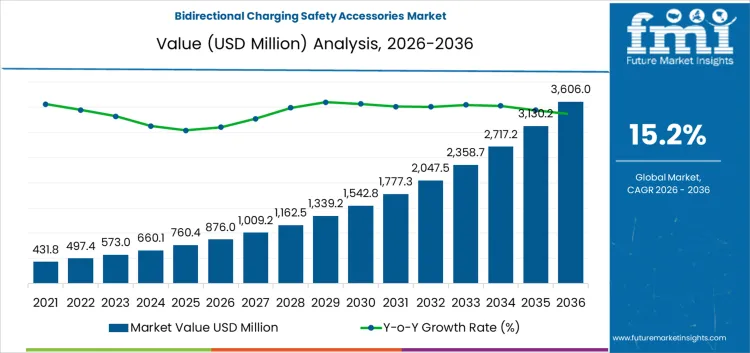
The bidirectional charging safety accessories market is projected to reach USD 3,606 million by 2036, growing at a CAGR of 15.2% from its 2026 value of USD 876 million. This market occupies a crucial position within the broader EV ecosystem, addressing the growing need for safe and efficient bidirectional charging solutions. As electric vehicles increasingly serve as energy storage systems, safety accessories become essential to ensure both vehicle and grid stability. The industry’s influence is expanding, driven by the integration of EVs into smart grids and the push toward renewable energy sources. Competitive weight is shaped by the need for highly reliable, certified safety solutions that meet evolving regulatory standards. Vendors that can provide innovative, scalable, and cost-effective safety accessories will be better positioned to secure long-term contracts with automakers and charging infrastructure providers. As the industry grows, early movers with robust testing capabilities will lead the way in defining safety standards.
Quick Stats for the Bidirectional Charging Safety Accessories Market
- Bidirectional Charging Safety Accessories Market Value (2026): USD 876 million
- Bidirectional Charging Safety Accessories Market Forecast Value (2036): USD 3,606 million
- Bidirectional Charging Safety Accessories Market Global Forecast CAGR 2026 to 2036: 15.2%
- Bidirectional Charging Safety Accessories Market Leading Segment: Vehicle-to-Home (V2H) (46%)
- Key Growth Regions in Bidirectional Charging Safety Accessories Market: India
- Top Players in Bidirectional Charging Safety Accessories Market: Schneider Electric, ABB, Siemens, Eaton, Legrand, Delta Electronics, Wallbox, Enphase, Generac, Tesla
What is the Compound Absolute Growth Analysis for the Bidirectional Charging Safety Accessories Market through 2036?
The compound absolute growth analysis for the bidirectional charging safety accessories market shows a steady and substantial increase over the forecast period. Starting from USD 876 million in 2026, the industry will grow by approximately USD 135 million annually in the initial years, reaching USD 1,165.4 million by 2028. This early phase is driven by the initial adoption of bidirectional charging technology and the increasing need for safety solutions to support energy transfer.
From 2028 to 2032, the industry will experience continued growth, with values rising from USD 1,342.8 million in 2029 to USD 2,039.9 million by 2032. This phase will see more rapid adoption as the infrastructure for bidirectional charging systems expands and the technology becomes more widely implemented in EVs and grids.
The sector is likely to experience accelerated growth, with a significant increase in the absolute value. The industry will rise from USD 2,675.4 million in 2034 to USD 3,606 million by 2036, reflecting the growing maturity of bidirectional charging technologies and the increasing importance of safety and grid integration. This compound absolute growth analysis indicates that the industry will continue to experience a strong upward trajectory, driven by technological advancements and increasing adoption of bidirectional charging solutions.
Bidirectional Charging Safety Accessories Market Key Takeaways
| Metric | Value |
|---|---|
| Industry Sales Value (2026) | USD 876 million |
| Industry Forecast Value (2036) | USD 3,606 million |
| Industry Forecast CAGR 2026 to 2036 | 15.2% |
What Is Driving the Bidirectional Charging Safety Accessories Market?
Historically, the bidirectional charging safety accessories market developed as electric vehicles (EVs) and charging infrastructure began integrating vehicle to grid (V2G), vehicle to home (V2H), and vehicle to load (V2L) functions. Early EV charging systems focused on unidirectional power flow from grid to vehicle, emphasizing basic safety interlocks, overcurrent protection, and weather sealing. When bidirectional capabilities emerged, vehicles and chargers were designed to export power back to buildings or grids during peak demand or outages, creating new electrical safety risks that conventional accessories did not address. Standard charging connectors and safety devices lacked features to manage reverse power flow, ground fault conditions under bidirectional load, and isolation requirements during dynamic mode switching.
Early pilot programs that incorporated bidirectional charging highlighted the need for accessories such as advanced interlock devices, isolating contactors, fault current detectors, and reinforced protective enclosures to ensure safe operation with bi directional energy exchange. Facility and fleet operators adopting bidirectional charging began testing supplemental hardware that could manage safety protocols distinct from traditional EV to grid interactions, demonstrating how evolving power flow patterns introduced new failure modes and compliance gaps. These initial implementations clarified accessory requirements and informed standards bodies, laying the groundwork for a safety accessory segment tailored to the complexities and electrical dynamics of bidirectional power flow.
Future demand for the bidirectional charging safety accessories market is expected to be shaped by accelerating deployment of V2G, V2H, and V2L use cases, rising electrification of residential and commercial energy systems, and regulatory emphasis on electrical safety in dynamic power environments. Growth drivers include increased adoption of smart chargers and bidirectional inverters, expanding the contexts in which vehicles serve as distributed energy resources during grid stress events and backup power scenarios. Safety accessories that incorporate real time fault detection, isolation verification, arc flash suppression, and adaptive load management will help mitigate risks associated with reverse power flow, unintended back feeding, and complex grounding scenarios.
Integration of digital communication standards will enable accessories to interact with chargers and EVs to coordinate safe operating states and prevent hazardous conditions during mode transitions. Broader electrification strategies that rely on EV batteries for grid services and building energy support will highlight the importance of certified safety hardware that maintains protective separation between systems while accommodating variable power directions. Barriers include the need to align accessory designs with evolving international safety standards, high initial costs for advanced protective hardware, and the challenge of educating installers and end users on proper configuration and maintenance. Long term market expansion will depend on demonstrable improvements in safety outcomes, inclusion of accessories in bidirectional charging code requirements, and the ability of manufacturers to deliver interoperable solutions that support diverse system architectures across residential, commercial, and utility scale implementations.
What are the Key Segments in the Bidirectional Charging Safety Accessories Market?
The Bidirectional Charging Safety Accessories market is segmented by use case and sales channel. Use case segments include vehicle-to-home (V2H), vehicle-to-load (V2L), vehicle-to-grid (V2G), and others, with vehicle-to-home (V2H) leading the market at 46%. Sales channels consist of OEM or charger bundled, electrical distributors, online direct-to-consumer (D2C), and others, with OEM or charger bundled accounting for the largest share at 44%. The market is driven by the growing adoption of bidirectional EV charging technologies that allow electric vehicles to both charge from and supply power to homes, buildings, or grids. This expansion is closely linked to the increasing demand for energy storage solutions and smart home technologies, particularly in regions like North America, Europe, and Asia Pacific, where sustainability and energy efficiency are prioritized.
What is Driving Growth in the Vehicle-to-Home (V2H) Use Case Segment?
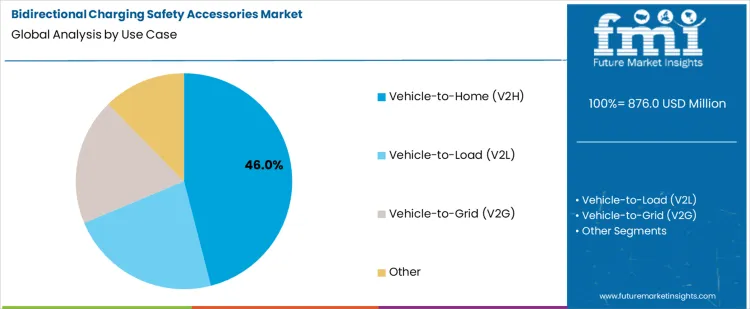
Vehicle-to-home (V2H) is the leading use case in the Bidirectional Charging Safety Accessories market, holding 46% of the market share. This segment's growth is driven by the increasing interest in using electric vehicles (EVs) as a backup power source for homes, particularly during power outages or periods of high energy demand. V2H systems allow EV owners to use the energy stored in their vehicle's battery to power household appliances, effectively transforming their EV into a mobile energy source. This technology is especially appealing in regions with frequent power disruptions or in homes that prioritize energy independence.
The rising adoption of electric vehicles, coupled with advancements in smart grid technologies and home energy management systems, is further fueling the growth of the V2H use case. As more consumers seek to reduce their reliance on the grid and take advantage of renewable energy sources, V2H systems are becoming a key solution for sustainable energy use in residential settings. With the increasing integration of solar power and home batteries, the V2H segment is expected to continue expanding, particularly in regions like North America, Europe, and Japan.
What is Driving the Demand for OEM or Charger Bundled Sales Channels?
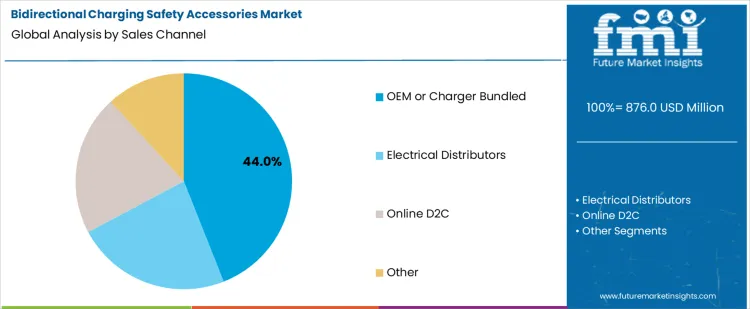
OEM or charger bundled sales channels are the dominant segment in the Bidirectional Charging Safety Accessories market, accounting for 44% of the market share. This growth is primarily driven by the preference of EV manufacturers and charger producers to offer bundled solutions that include both the vehicle's charging equipment and the necessary safety accessories for bidirectional charging systems. Bundled sales provide customers with a one-stop solution for all their charging needs, ensuring that the accessories are compatible with the charging system and meet safety standards. As bidirectional charging technology gains traction, manufacturers are increasingly offering these integrated solutions to simplify the purchasing process for consumers.
Bundled sales allow OEMs and charger manufacturers to ensure that the safety accessories, such as protection relays, surge protectors, and circuit breakers, are specifically designed to work with their products, thereby enhancing the overall user experience and system safety. As EV adoption continues to rise globally, particularly in regions like Europe and North America, the demand for bundled charging solutions is expected to continue to grow, making OEM or charger bundled sales a critical channel for the market.
What are the Key Dynamics in the Bidirectional Charging Safety Accessories Market?
The bidirectional charging safety accessories market is gaining momentum with the increasing adoption of bidirectional charging technology in electric vehicles (EVs) and renewable energy systems. Bidirectional charging allows EVs to not only charge from the grid but also supply energy back to the grid or power home appliances, contributing to energy resilience and grid stability. As this technology becomes more widespread, safety accessories designed to ensure the proper functioning and protection of bidirectional charging systems, such as surge protectors, circuit breakers, and isolation devices, are becoming critical. The industry is driven by the rise in smart grid applications, government incentives for clean energy solutions, and the growing emphasis on energy independence and storage solutions, which further accelerate the need for secure and reliable charging infrastructure.
What are the Key Drivers of Growth in the Bidirectional Charging Safety Accessories Market?
The growth of the bidirectional charging safety accessories market is driven by several factors. One major driver is the increasing adoption of bidirectional charging systems, particularly as electric vehicles become more mainstream. Bidirectional charging technology enables vehicles to act as energy storage units, allowing for energy sharing between the vehicle and the grid or home, which is becoming essential for grid stability and reducing reliance on conventional energy sources. As the adoption of EVs and renewable energy systems increases, there is a greater need for safety accessories to ensure that these systems operate efficiently and safely.
The development of smart grids and the growing demand for home energy management solutions are driving the need for secure charging equipment. Government policies and incentives that promote clean energy technologies, energy efficiency, and sustainable infrastructure are further boosting market growth. The shift towards energy independence and sustainable energy storage solutions is also driving demand for bidirectional charging safety accessories.
What are the Key Restraints in the Bidirectional Charging Safety Accessories Market?
Despite the growth potential, the bidirectional charging safety accessories market faces several challenges. One of the main restraints is the high initial cost of bidirectional charging systems and their associated safety accessories, which can deter consumers, especially in regions where EV adoption is still emerging. The cost of integrating safety accessories, such as circuit breakers, isolators, and surge protection devices, adds to the overall expense of implementing bidirectional charging infrastructure. Another challenge is the lack of standardization across bidirectional charging systems and safety accessories, which can lead to compatibility issues and make it difficult for consumers to choose the right components for their specific needs.
The complexity of installing and maintaining bidirectional charging systems, along with the need for specialized knowledge in integrating the systems safely, may limit adoption among non-expert users. Finally, regulatory uncertainty and the need for updated safety standards in the bidirectional charging sector could slow down market development in some regions.
What are the Key Trends in the Bidirectional Charging Safety Accessories Market?
Several key trends are shaping the bidirectional charging safety accessories market. One notable trend is the increasing focus on developing more affordable and efficient safety accessories to make bidirectional charging systems more accessible to a broader range of consumers and businesses. As demand grows, manufacturers are investing in innovations that improve the performance, cost-effectiveness, and ease of installation of safety accessories such as surge protectors and isolators. Another trend is the integration of IoT and smart technologies in safety accessories, which enable real-time monitoring and remote diagnostics of bidirectional charging systems, enhancing safety and user control.
There is also a growing emphasis on the development of universal, standardized safety solutions that are compatible with various bidirectional charging systems and EV models, ensuring greater convenience and wider adoption. As energy storage and grid resilience become increasingly important, there is a trend toward more advanced safety features that protect both the grid and the vehicle, ensuring safe and efficient energy transfer between them. The rise of residential and commercial energy independence solutions is also driving demand for secure, reliable bidirectional charging infrastructure, further boosting the growth.
What is the Country-Wise Analysis of the Bidirectional Charging Safety Accessories Market?
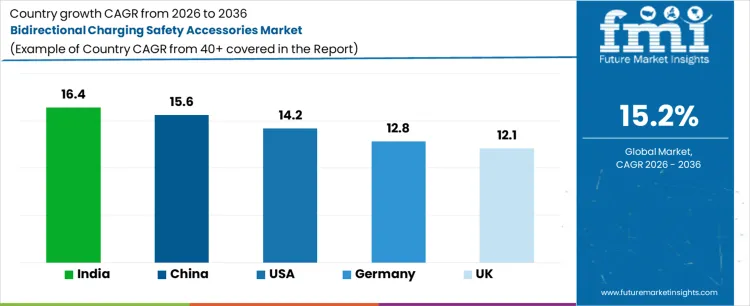
The bidirectional charging safety accessories market is experiencing strong growth as the adoption of electric vehicles (EVs) increases and new technologies such as bidirectional charging gain traction. Bidirectional charging allows energy to flow both ways-charging the vehicle and using its battery to power the home or return electricity to the grid. This technology, while offering significant benefits for energy management, requires specialized safety accessories to protect the vehicle, charging infrastructure, and users. The market is driven by the rise in EV sales, the growing emphasis on energy efficiency, and government initiatives supporting clean energy and smart grid technologies. Countries like India, China, the USA, Germany, and the UK are experiencing strong demand for safety accessories to support the safe implementation of bidirectional charging systems.
| Country | CAGR (%) |
|---|---|
| India | 16.4 |
| China | 15.6 |
| USA | 14.2 |
| Germany | 12.8 |
| UK | 12.1 |
What is Driving the Growth of the Bidirectional Charging Safety Accessories Market in India?
India’s bidirectional charging safety accessories market is growing at a CAGR of 16.4%, the highest among the countries analyzed. The growth is largely driven by the increasing adoption of electric vehicles in India, supported by government incentives and the growing focus on reducing pollution. As the adoption of EVs accelerates, there is a rising need for advanced technologies such as bidirectional charging, which allows EVs to contribute to the grid or power homes. Bidirectional charging systems require specialized safety accessories to protect users and equipment from potential electrical hazards. With India’s expanding EV market and the government's push towards clean energy, the demand for bidirectional charging safety accessories is expected to continue growing as the country builds out its EV infrastructure.
How is the Bidirectional Charging Safety Accessories Market Performing in China?
China’s bidirectional charging safety accessories market is growing at a CAGR of 15.6%. As the largest electric vehicle market in the world, China is driving significant demand for advanced EV technologies, including bidirectional charging. With the government’s strong push to electrify the transportation sector and integrate EVs into the power grid, the need for safety accessories that ensure the safe operation of bidirectional charging systems is rising. China’s expanding EV infrastructure, including home charging stations and public charging networks, is also contributing to the market’s growth. The country’s focus on energy management, sustainability, and smart grid technologies is expected to continue supporting the adoption of bidirectional charging solutions, driving the demand for related safety accessories.
What Factors are Shaping the Bidirectional Charging Safety Accessories Market in the USA?
The bidirectional charging safety accessories market in the USA is growing at a CAGR of 14.2%. The USA’s increasing adoption of electric vehicles, combined with the country’s strong focus on clean energy and smart grid integration, is driving the demand for bidirectional charging solutions. As more consumers and businesses invest in EVs and home charging stations, the need for safety accessories to protect users and infrastructure from electrical risks is rising. Bidirectional charging offers significant benefits for energy storage and management, making it an attractive option for consumers and utility companies alike. The USA’s growing investments in EV infrastructure and government incentives for clean energy technologies are expected to continue contributing to the market’s growth.
How is the Bidirectional Charging Safety Accessories Market Evolving in Germany?
Germany’s bidirectional charging safety accessories market is growing at a CAGR of 12.8%. Germany is a leader in Europe’s electric vehicle market, and the demand for advanced charging solutions, including bidirectional charging, is rising rapidly. Bidirectional charging enables EVs to contribute to energy storage and grid stability, which aligns with Germany’s renewable energy goals and smart grid initiatives. The adoption of bidirectional charging systems requires specialized safety accessories to ensure safe operations, especially in residential and commercial installations. Germany’s focus on sustainability and reducing carbon emissions, along with its strong automotive sector, is driving the growth of this market. The continued expansion of Germany’s EV infrastructure and the country’s leadership in clean energy technologies will contribute to further market growth.
What is Contributing to the Growth of the Bidirectional Charging Safety Accessories Market in the UK?
The bidirectional charging safety accessories market in the UK is growing at a CAGR of 12.1%. The UK is seeing a rise in the adoption of electric vehicles, driven by government incentives, environmental concerns, and a shift towards cleaner transportation. As the EV market grows, there is an increasing demand for advanced charging technologies, including bidirectional charging, which allows for energy flow both ways-charging the vehicle and providing power back to the grid. Bidirectional charging systems require specialized safety accessories to protect users and infrastructure, ensuring safe and reliable operation. With the UK’s commitment to sustainability and reducing carbon emissions, as well as its growing EV infrastructure, the demand for bidirectional charging safety accessories is expected to continue growing.
What is the Competitive Landscape for the Bidirectional Charging Safety Accessories Market?
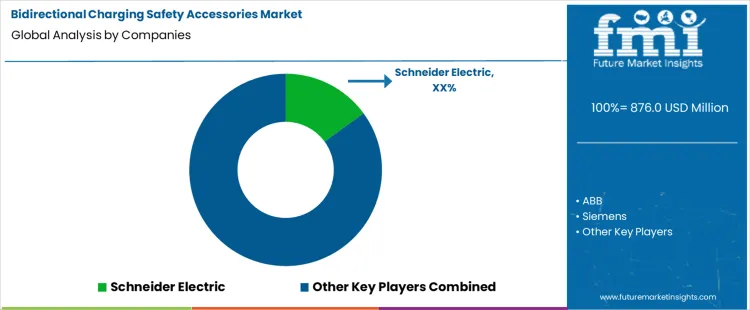
The bidirectional charging safety accessories market is growing as the adoption of electric vehicles (EVs) increases, particularly in residential and commercial applications that require advanced charging solutions. Schneider Electric leads the sector with its innovative safety accessories designed for bidirectional EV charging systems. Their focus on energy management, safety, and seamless integration into smart grids has positioned them as a leader in the sector. ABB is a significant competitor, providing safety solutions that ensure safe energy transfer in bidirectional charging systems, helping to optimize energy use and reduce grid strain. Siemens also plays a key role, offering products designed to enhance the safety and efficiency of bidirectional charging while ensuring compliance with industry standards. Eaton focuses on providing reliable safety accessories for bidirectional EV charging, offering solutions that prioritize user protection and energy efficiency.
Legrand is involved in the industry by providing robust and flexible safety solutions for bidirectional charging systems, emphasizing the integration of renewable energy sources and the use of energy-efficient technologies. Delta Electronics is contributing by offering cutting-edge safety products for bidirectional charging that integrate seamlessly with smart home systems and offer real-time energy monitoring. Wallbox focuses on providing user-friendly, energy-efficient safety accessories designed for residential and commercial bidirectional charging stations, enabling better control over energy flow. Enphase, with its expertise in energy management, provides advanced safety accessories that ensure secure energy transfer in bidirectional charging systems. Generac offers solutions that improve the safety and reliability of bidirectional EV charging, especially in areas with variable power grids. Tesla, known for its innovative EV technologies, also contributes to the industry by offering safety accessories designed to ensure secure integration with its vehicle and home energy systems.
To remain competitive in the bidirectional charging safety accessories market, companies focus on continuous innovation, energy management, and user-friendly solutions. Schneider Electric continues to enhance its product offerings with smart energy management features, ensuring the safe integration of bidirectional chargers into residential and commercial settings. ABB is expanding its portfolio by focusing on the development of reliable, high-performance safety products that cater to the growing demand for bidirectional charging infrastructure. Siemens is integrating more advanced technologies into its safety accessories, aiming to provide enhanced protection and greater efficiency in energy transfer. Eaton is investing in creating energy-efficient and user-safe solutions for bidirectional charging, focusing on scalability and adaptability to different power systems.
Legrand’s strategy includes offering customizable safety solutions that cater to both residential and commercial applications. Delta Electronics is advancing its bidirectional charging safety accessories with features that integrate seamlessly into smart home and energy management systems. Wallbox is emphasizing compact and user-friendly safety solutions, focusing on residential charging stations. Enphase continues to innovate with its energy management solutions, ensuring seamless and safe integration of bidirectional charging technology. Generac and Tesla are also enhancing their safety accessories, providing secure, efficient, and reliable charging solutions that meet the increasing demand for bidirectional charging infrastructure. These strategies ensure that these companies remain at the forefront of the rapidly evolving bidirectional charging safety accessories market.
Key Players of the Bidirectional Charging Safety Accessories Market
- Schneider Electric
- ABB
- Siemens
- Eaton
- Legrand
- Delta Electronics
- Wallbox
- Enphase
- Generac
- Tesla
Scope of the Report
| Items | Values |
|---|---|
| Quantitative Units (2026) | USD Million |
| Safety Accessory Type | Isolation or Transfer Switch Hardware, Ground Fault and RCD Modules, Connector Interlocks, Other |
| Use Case | Vehicle-to-Home (V2H), Vehicle-to-Load (V2L), Vehicle-to-Grid (V2G), Other |
| Power Rating | Up to 3.6 kW, 3.6-11 kW, Above 11 kW, Other |
| Sales Channel | OEM or Charger Bundled, Electrical Distributors, Online D2C, Other |
| Companies | Schneider Electric, ABB, Siemens, Eaton, Legrand, Delta Electronics, Wallbox, Enphase, Generac, Tesla |
| Regions Covered | North America, Latin America, Western Europe, Eastern Europe, South Asia and Pacific, East Asia, Middle East & Africa |
| Countries Covered | United States, Canada, Mexico, Brazil, Argentina, Germany, France, United Kingdom, Italy, Spain, Netherlands, China, India, Japan, South Korea, ANZ, GCC Countries, South Africa |
| Additional Attributes | Dollar by sales by safety accessory type, use case, power rating, and sales channel. Includes market trends towards safety and efficiency in bidirectional charging systems, regulatory compliance, and the role of safety accessories in ensuring secure energy flow in vehicle-to-grid and other applications. |
Bidirectional Charging Safety Accessories Market Segmentation
Safety Accessory Type
- Isolation or Transfer Switch Hardware
- Ground Fault and RCD Modules
- Connector Interlocks
- Other
Use Case
- Vehicle-to-Home (V2H)
- Vehicle-to-Load (V2L)
- Vehicle-to-Grid (V2G)
- Other
Power Rating
- Up to 3.6 kW
- 3.6-11 kW
- Above 11 kW
- Other
Sales Channel
- OEM or Charger Bundled
- Electrical Distributors
- Online D2C
- Other
Region
- Asia Pacific
- China
- Japan
- India
- Australia & New Zealand
- ASEAN
- Rest of Asia Pacific
- Europe
- Germany
- United Kingdom
- France
- Italy
- Spain
- Nordic
- BENELUX
- Rest of Europe
- North America
- United States
- Canada
- Mexico
- Latin America
- Brazil
- Argentina
- Rest of Latin America
- Middle East & Africa
- Kingdom of Saudi Arabia
- Other GCC Countries
- South Africa
- Rest of Middle East & Africa
Bibliography
- Schneider Electric. (2023). Innovative Safety Solutions for Bidirectional EV Charging Systems. Schneider Electric Energy Management.
- ABB. (2023). Ensuring Safe Energy Transfer with Bidirectional Charging Accessories. ABB Power Solutions.
- Siemens. (2023). Safety and Efficiency in Bidirectional EV Charging: Siemens’ Role in Smart Grid Integration. Siemens Smart Grid Solutions.
- Eaton. (2023). Eaton’s Advanced Safety Accessories for Bidirectional EV Charging. Eaton Electrical Solutions.
- Legrand. (2023). Legrand’s Flexible Safety Solutions for Bidirectional Charging Systems. Legrand Energy Management.
Frequently Asked Questions
How big is the bidirectional charging safety accessories market in 2026?
The global bidirectional charging safety accessories market is estimated to be valued at USD 876.0 million in 2026.
What will be the size of bidirectional charging safety accessories market in 2036?
The market size for the bidirectional charging safety accessories market is projected to reach USD 3,606.0 million by 2036.
How much will be the bidirectional charging safety accessories market growth between 2026 and 2036?
The bidirectional charging safety accessories market is expected to grow at a 15.2% CAGR between 2026 and 2036.
What are the key product types in the bidirectional charging safety accessories market?
The key product types in bidirectional charging safety accessories market are isolation or transfer switch hardware, ground fault and rcd modules, connector interlocks and other.
Which use case segment to contribute significant share in the bidirectional charging safety accessories market in 2026?
In terms of use case, vehicle-to-home (v2h) segment to command 46.0% share in the bidirectional charging safety accessories market in 2026.
Preview the report firsthand - request a free sample
Get SampleGet the brochure for pricing and purchase details.
Get PDFTable of Content
- Executive Summary
- Global Market Outlook
- Demand-side Trends
- Supply-side Trends
- Technology Roadmap Analysis
- Analysis and Recommendations
- Market Overview
- Market Coverage / Taxonomy
- Market Definition / Scope / Limitations
- Market Background
- Market Dynamics
- Drivers
- Restraints
- Opportunity
- Trends
- Scenario Forecast
- Demand in Optimistic Scenario
- Demand in Likely Scenario
- Demand in Conservative Scenario
- Opportunity Map Analysis
- Product Life Cycle Analysis
- Supply Chain Analysis
- Investment Feasibility Matrix
- Value Chain Analysis
- PESTLE and Porter’s Analysis
- Regulatory Landscape
- Regional Parent Market Outlook
- Production and Consumption Statistics
- Import and Export Statistics
- Market Dynamics
- Global Market Analysis 2021 to 2025 and Forecast, 2026 to 2036
- Historical Market Size Value (USD Million) Analysis, 2021 to 2025
- Current and Future Market Size Value (USD Million) Projections, 2026 to 2036
- Y-o-Y Growth Trend Analysis
- Absolute $ Opportunity Analysis
- Global Market Pricing Analysis 2021 to 2025 and Forecast 2026 to 2036
- Global Market Analysis 2021 to 2025 and Forecast 2026 to 2036, By Safety Accessory Type
- Introduction / Key Findings
- Historical Market Size Value (USD Million) Analysis By Safety Accessory Type , 2021 to 2025
- Current and Future Market Size Value (USD Million) Analysis and Forecast By Safety Accessory Type , 2026 to 2036
- Isolation or Transfer Switch Hardware
- Ground Fault and RCD Modules
- Connector Interlocks
- Other
- Isolation or Transfer Switch Hardware
- Y-o-Y Growth Trend Analysis By Safety Accessory Type , 2021 to 2025
- Absolute $ Opportunity Analysis By Safety Accessory Type , 2026 to 2036
- Global Market Analysis 2021 to 2025 and Forecast 2026 to 2036, By Use Case
- Introduction / Key Findings
- Historical Market Size Value (USD Million) Analysis By Use Case, 2021 to 2025
- Current and Future Market Size Value (USD Million) Analysis and Forecast By Use Case, 2026 to 2036
- Vehicle-to-Home (V2H)
- Vehicle-to-Load (V2L)
- Vehicle-to-Grid (V2G)
- Other
- Vehicle-to-Home (V2H)
- Y-o-Y Growth Trend Analysis By Use Case, 2021 to 2025
- Absolute $ Opportunity Analysis By Use Case, 2026 to 2036
- Global Market Analysis 2021 to 2025 and Forecast 2026 to 2036, By Power Rating
- Introduction / Key Findings
- Historical Market Size Value (USD Million) Analysis By Power Rating, 2021 to 2025
- Current and Future Market Size Value (USD Million) Analysis and Forecast By Power Rating, 2026 to 2036
- 3.6-11 kW
- Up to 3.6 kW
- Above 11 kW
- Other
- 3.6-11 kW
- Y-o-Y Growth Trend Analysis By Power Rating, 2021 to 2025
- Absolute $ Opportunity Analysis By Power Rating, 2026 to 2036
- Global Market Analysis 2021 to 2025 and Forecast 2026 to 2036, By Sales Channel
- Introduction / Key Findings
- Historical Market Size Value (USD Million) Analysis By Sales Channel, 2021 to 2025
- Current and Future Market Size Value (USD Million) Analysis and Forecast By Sales Channel, 2026 to 2036
- OEM or Charger Bundled
- Electrical Distributors
- Online D2C
- Other
- OEM or Charger Bundled
- Y-o-Y Growth Trend Analysis By Sales Channel, 2021 to 2025
- Absolute $ Opportunity Analysis By Sales Channel, 2026 to 2036
- Global Market Analysis 2021 to 2025 and Forecast 2026 to 2036, By Region
- Introduction
- Historical Market Size Value (USD Million) Analysis By Region, 2021 to 2025
- Current Market Size Value (USD Million) Analysis and Forecast By Region, 2026 to 2036
- North America
- Latin America
- Western Europe
- Eastern Europe
- East Asia
- South Asia and Pacific
- Middle East & Africa
- Market Attractiveness Analysis By Region
- North America Market Analysis 2021 to 2025 and Forecast 2026 to 2036, By Country
- Historical Market Size Value (USD Million) Trend Analysis By Market Taxonomy, 2021 to 2025
- Market Size Value (USD Million) Forecast By Market Taxonomy, 2026 to 2036
- By Country
- USA
- Canada
- Mexico
- By Safety Accessory Type
- By Use Case
- By Power Rating
- By Sales Channel
- By Country
- Market Attractiveness Analysis
- By Country
- By Safety Accessory Type
- By Use Case
- By Power Rating
- By Sales Channel
- Key Takeaways
- Latin America Market Analysis 2021 to 2025 and Forecast 2026 to 2036, By Country
- Historical Market Size Value (USD Million) Trend Analysis By Market Taxonomy, 2021 to 2025
- Market Size Value (USD Million) Forecast By Market Taxonomy, 2026 to 2036
- By Country
- Brazil
- Chile
- Rest of Latin America
- By Safety Accessory Type
- By Use Case
- By Power Rating
- By Sales Channel
- By Country
- Market Attractiveness Analysis
- By Country
- By Safety Accessory Type
- By Use Case
- By Power Rating
- By Sales Channel
- Key Takeaways
- Western Europe Market Analysis 2021 to 2025 and Forecast 2026 to 2036, By Country
- Historical Market Size Value (USD Million) Trend Analysis By Market Taxonomy, 2021 to 2025
- Market Size Value (USD Million) Forecast By Market Taxonomy, 2026 to 2036
- By Country
- Germany
- UK
- Italy
- Spain
- France
- Nordic
- BENELUX
- Rest of Western Europe
- By Safety Accessory Type
- By Use Case
- By Power Rating
- By Sales Channel
- By Country
- Market Attractiveness Analysis
- By Country
- By Safety Accessory Type
- By Use Case
- By Power Rating
- By Sales Channel
- Key Takeaways
- Eastern Europe Market Analysis 2021 to 2025 and Forecast 2026 to 2036, By Country
- Historical Market Size Value (USD Million) Trend Analysis By Market Taxonomy, 2021 to 2025
- Market Size Value (USD Million) Forecast By Market Taxonomy, 2026 to 2036
- By Country
- Russia
- Poland
- Hungary
- Balkan & Baltic
- Rest of Eastern Europe
- By Safety Accessory Type
- By Use Case
- By Power Rating
- By Sales Channel
- By Country
- Market Attractiveness Analysis
- By Country
- By Safety Accessory Type
- By Use Case
- By Power Rating
- By Sales Channel
- Key Takeaways
- East Asia Market Analysis 2021 to 2025 and Forecast 2026 to 2036, By Country
- Historical Market Size Value (USD Million) Trend Analysis By Market Taxonomy, 2021 to 2025
- Market Size Value (USD Million) Forecast By Market Taxonomy, 2026 to 2036
- By Country
- China
- Japan
- South Korea
- By Safety Accessory Type
- By Use Case
- By Power Rating
- By Sales Channel
- By Country
- Market Attractiveness Analysis
- By Country
- By Safety Accessory Type
- By Use Case
- By Power Rating
- By Sales Channel
- Key Takeaways
- South Asia and Pacific Market Analysis 2021 to 2025 and Forecast 2026 to 2036, By Country
- Historical Market Size Value (USD Million) Trend Analysis By Market Taxonomy, 2021 to 2025
- Market Size Value (USD Million) Forecast By Market Taxonomy, 2026 to 2036
- By Country
- India
- ASEAN
- Australia & New Zealand
- Rest of South Asia and Pacific
- By Safety Accessory Type
- By Use Case
- By Power Rating
- By Sales Channel
- By Country
- Market Attractiveness Analysis
- By Country
- By Safety Accessory Type
- By Use Case
- By Power Rating
- By Sales Channel
- Key Takeaways
- Middle East & Africa Market Analysis 2021 to 2025 and Forecast 2026 to 2036, By Country
- Historical Market Size Value (USD Million) Trend Analysis By Market Taxonomy, 2021 to 2025
- Market Size Value (USD Million) Forecast By Market Taxonomy, 2026 to 2036
- By Country
- Kingdom of Saudi Arabia
- Other GCC Countries
- Turkiye
- South Africa
- Other African Union
- Rest of Middle East & Africa
- By Safety Accessory Type
- By Use Case
- By Power Rating
- By Sales Channel
- By Country
- Market Attractiveness Analysis
- By Country
- By Safety Accessory Type
- By Use Case
- By Power Rating
- By Sales Channel
- Key Takeaways
- Key Countries Market Analysis
- USA
- Pricing Analysis
- Market Share Analysis, 2025
- By Safety Accessory Type
- By Use Case
- By Power Rating
- By Sales Channel
- Canada
- Pricing Analysis
- Market Share Analysis, 2025
- By Safety Accessory Type
- By Use Case
- By Power Rating
- By Sales Channel
- Mexico
- Pricing Analysis
- Market Share Analysis, 2025
- By Safety Accessory Type
- By Use Case
- By Power Rating
- By Sales Channel
- Brazil
- Pricing Analysis
- Market Share Analysis, 2025
- By Safety Accessory Type
- By Use Case
- By Power Rating
- By Sales Channel
- Chile
- Pricing Analysis
- Market Share Analysis, 2025
- By Safety Accessory Type
- By Use Case
- By Power Rating
- By Sales Channel
- Germany
- Pricing Analysis
- Market Share Analysis, 2025
- By Safety Accessory Type
- By Use Case
- By Power Rating
- By Sales Channel
- UK
- Pricing Analysis
- Market Share Analysis, 2025
- By Safety Accessory Type
- By Use Case
- By Power Rating
- By Sales Channel
- Italy
- Pricing Analysis
- Market Share Analysis, 2025
- By Safety Accessory Type
- By Use Case
- By Power Rating
- By Sales Channel
- Spain
- Pricing Analysis
- Market Share Analysis, 2025
- By Safety Accessory Type
- By Use Case
- By Power Rating
- By Sales Channel
- France
- Pricing Analysis
- Market Share Analysis, 2025
- By Safety Accessory Type
- By Use Case
- By Power Rating
- By Sales Channel
- India
- Pricing Analysis
- Market Share Analysis, 2025
- By Safety Accessory Type
- By Use Case
- By Power Rating
- By Sales Channel
- ASEAN
- Pricing Analysis
- Market Share Analysis, 2025
- By Safety Accessory Type
- By Use Case
- By Power Rating
- By Sales Channel
- Australia & New Zealand
- Pricing Analysis
- Market Share Analysis, 2025
- By Safety Accessory Type
- By Use Case
- By Power Rating
- By Sales Channel
- China
- Pricing Analysis
- Market Share Analysis, 2025
- By Safety Accessory Type
- By Use Case
- By Power Rating
- By Sales Channel
- Japan
- Pricing Analysis
- Market Share Analysis, 2025
- By Safety Accessory Type
- By Use Case
- By Power Rating
- By Sales Channel
- South Korea
- Pricing Analysis
- Market Share Analysis, 2025
- By Safety Accessory Type
- By Use Case
- By Power Rating
- By Sales Channel
- Russia
- Pricing Analysis
- Market Share Analysis, 2025
- By Safety Accessory Type
- By Use Case
- By Power Rating
- By Sales Channel
- Poland
- Pricing Analysis
- Market Share Analysis, 2025
- By Safety Accessory Type
- By Use Case
- By Power Rating
- By Sales Channel
- Hungary
- Pricing Analysis
- Market Share Analysis, 2025
- By Safety Accessory Type
- By Use Case
- By Power Rating
- By Sales Channel
- Kingdom of Saudi Arabia
- Pricing Analysis
- Market Share Analysis, 2025
- By Safety Accessory Type
- By Use Case
- By Power Rating
- By Sales Channel
- Turkiye
- Pricing Analysis
- Market Share Analysis, 2025
- By Safety Accessory Type
- By Use Case
- By Power Rating
- By Sales Channel
- South Africa
- Pricing Analysis
- Market Share Analysis, 2025
- By Safety Accessory Type
- By Use Case
- By Power Rating
- By Sales Channel
- USA
- Market Structure Analysis
- Competition Dashboard
- Competition Benchmarking
- Market Share Analysis of Top Players
- By Regional
- By Safety Accessory Type
- By Use Case
- By Power Rating
- By Sales Channel
- Competition Analysis
- Competition Deep Dive
- Schneider Electric
- Overview
- Product Portfolio
- Profitability by Market Segments (Product/Age /Sales Channel/Region)
- Sales Footprint
- Strategy Overview
- Marketing Strategy
- Product Strategy
- Channel Strategy
- ABB
- Siemens
- Eaton
- Legrand
- Delta Electronics
- Wallbox
- Enphase
- Generac
- Tesla
- Schneider Electric
- Competition Deep Dive
- Assumptions & Acronyms Used
- Research Methodology


