

- Industry Size (2026)
- USD 2.6 Bn
- Forecast (2036)
- USD 16.8 Bn
- CAGR (2026 to 2036)
- 20.5%
EV Charging As A Service Market Forecast and Outlook 2026 to 2036
The EV charging as a service (CaaS) market is projected to reach USD 16.8 billion by 2036, growing at a CAGR of 20.5% from its 2026 value of USD 2.6 billion. Application concentration within key sectors such as fleet management, commercial real estate, and public infrastructure will significantly shape market dynamics. As demand for EV infrastructure increases, end-use dependency becomes critical, with growth heavily influenced by the adoption of electric vehicles in urban and commercial settings. Volume stability will be a key factor, with fluctuations in regulatory incentives, infrastructure investments, and consumer adoption affecting overall demand. Providers must balance the need to scale with operational flexibility to meet varying customer requirements. Those focusing on high-volume, long-term contracts with commercial and municipal clients will likely achieve more predictable growth. As a result, strategic alignment with evolving policies and infrastructure trends will be crucial for sustaining competitive advantage in the growing market.
Quick Stats for the EV Charging As A Service Market:
- EV Charging As A Service Market Value (2026): USD 2.6 billion
- EV Charging As A Service Market Forecast Value (2036): USD 16.8 billion
- EV Charging As A Service Market Global Forecast CAGR (2026-2036): 20.5%
- EV Charging As A Service Market Leading Segment: Subscription or Pay Per Use Fees (55%)
- Key Growth Regions in EV Charging As A Service Market: USA
- Top Players in EV Charging As A Service Market: Charge Point, Inc., Tesla, Inc., Blink Charging Co., EV Connect, Inc., Shell Recharge Solutions, ENGIE EV Solutions, TGOOD Global Ltd., State Grid Corporation of China, EVgo Inc., TP Link/Hypercharge Networks
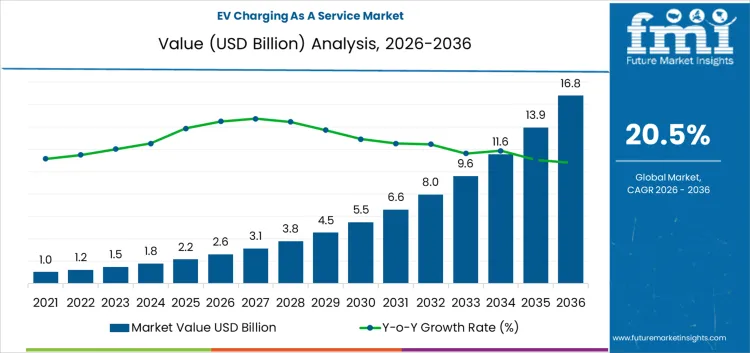
What is the Market Growth Curve Shape Analysis for the EV Charging As A Service Market through 2036?
The growth curve for the EV charging as a service market will exhibit an accelerating pattern, characterized by a sharp upward slope as the market matures. The early phase of growth, from 2026 to 2028, will be marked by steady increases, as demand for EV charging services rises with the expanding number of EVs on the road and the need for a more extensive charging infrastructure. The market will rise from USD 2.6 billion in 2026 to USD 4.2 billion in 2028, reflecting a steady but strong increase as charging networks become more established.
Between 2028 and 2032, the market will experience a period of acceleration, with the value rising from USD 5.4 billion in 2029 to USD 11.3 billion by 2032. This sharp increase will be driven by the scaling up of charging infrastructure, including the installation of fast-charging stations and the integration of more advanced features like smart charging systems and subscription-based services.
From 2032 to 2036, the market will continue its rapid expansion, reaching USD 16.8 billion by 2036. The growth curve will steepen as the adoption of EVs becomes widespread, charging services become more ubiquitous, and smart grid integration advances. This later phase will see the market benefiting from increasing governmental and corporate investments in EV infrastructure, along with the growing consumer reliance on easy-to-access and cost-effective charging solutions. The overall market trajectory indicates a highly dynamic growth pattern with acceleration during the latter stages of the forecast period.
EV Charging As A Service Market Key Takeaways
| Metric | Value |
|---|---|
| Industry Sales Value (2026) | USD 2.6 billion |
| Industry Forecast Value (2036) | USD 16.8 billion |
| Industry Forecast CAGR 2026 to 2036 | 20.5% |
What Is Driving the EV Charging As A Service Market?
Historically, the EV Charging As A Service (EV CaaS) market emerged as electric vehicle adoption outpaced consumer confidence in fixed charging infrastructure availability and convenience. Early EV charging deployments were primarily hardware-centric, with uncoordinated installations of AC and DC chargers in homes, workplaces, and public spaces. Drivers and fleet operators experienced variability in uptime, payment interoperability, and station reliability, which highlighted limitations of a purely asset-led rollout. Service providers responded by bundling charging hardware with networked management platforms, subscription access, and roaming agreements that simplified payment and station access. Fleet operators, commercial real estate owners, and municipalities adopted managed charging services to reduce upfront capital intensity, outsource maintenance, and ensure uptime through service level commitments. Initial adoption focused on urban centers and corporate fleets where predictable usage patterns justified service contracts and mobile apps enhanced user experience. This foundation clarified the value of managed charging services in reducing operational complexity and risk for hosts and end users.
Future demand for the EV Charging As A Service market will be shaped by rapid EV market expansion, diversified charging use cases, and increasing expectations for seamless, reliable charging experiences across private and public domains. Growth factors include fleet electrification in logistics, ride-hailing, and municipal services that require predictable charging availability and load management to optimize operating costs. Residential and workplace users will seek managed solutions to balance energy costs, integrate with smart grids, and access dynamic pricing through service contracts rather than individual hardware ownership. Expansion of multi-station hubs and corridor fast-charging networks will drive demand for service offerings that combine uptime guarantees, predictive maintenance, and integrated billing across networks. Advances in software platforms that support user reservations, demand response, and real-time diagnostics will further differentiate service providers and enhance utilization metrics. Barriers include the complexity of integrating legacy infrastructure into unified service frameworks, variability in regional energy tariffs, and the need to ensure data security across connected charging ecosystems. Long-term market growth will depend on demonstrated reliability, transparent service pricing, and alignment with broader electrification and grid resilience strategies.
What are the Key Segments in the EV Charging As A Service Market?
The EV Charging As A Service (CaaS) market is segmented by service type and revenue model. Service types include fleet charging services, public or home subscription charging, managed workplace or commercial CaaS, value-added software & maintenance, and others, with fleet charging services leading the market at 42%. Revenue models include subscription or pay-per-use fees, hardware & installation contracts, software & analytics services, and energy or utility partnerships, with subscription or pay-per-use fees representing the largest share at 55%. The market is driven by the increasing adoption of electric vehicles (EVs) and the growing demand for convenient, cost-effective, and accessible charging solutions. The expansion of charging infrastructure, particularly for commercial fleets, workplaces, and residential areas, is fueling the growth of the CaaS market.
What is Driving Growth in the Fleet Charging Services Segment?
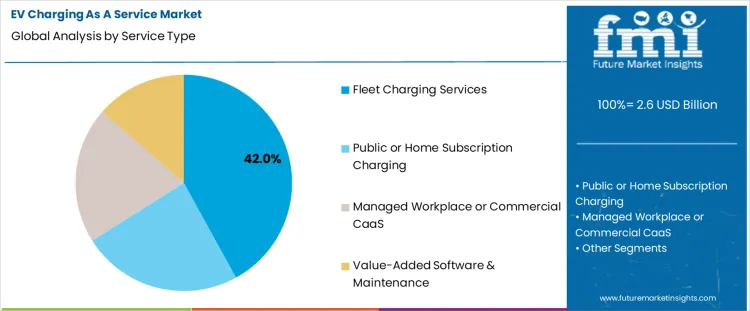
Fleet charging services are the largest service type segment in the EV Charging As A Service market, accounting for 42% of the market share. This growth is driven by the increasing number of electric commercial vehicles (EVs) used in delivery, logistics, and transportation fleets. As businesses shift toward electric fleets to reduce carbon emissions and meet sustainability goals, the demand for efficient and reliable charging solutions is rising. Fleet charging services offer tailored solutions to fleet operators, ensuring that EVs can be charged conveniently and efficiently, minimizing downtime and optimizing fleet performance. These services often include charging infrastructure installation, maintenance, and management, providing a seamless solution for businesses looking to transition to electric vehicles. The demand for fleet charging services is expected to continue growing, particularly in regions where EV adoption is accelerating and commercial fleets are expanding, such as North America and Europe. As regulatory policies incentivize the electrification of fleets and businesses strive for more sustainable operations, the fleet charging services segment is poised for continued expansion.
What is Driving the Demand for Subscription or Pay Per Use Fees Revenue Model?
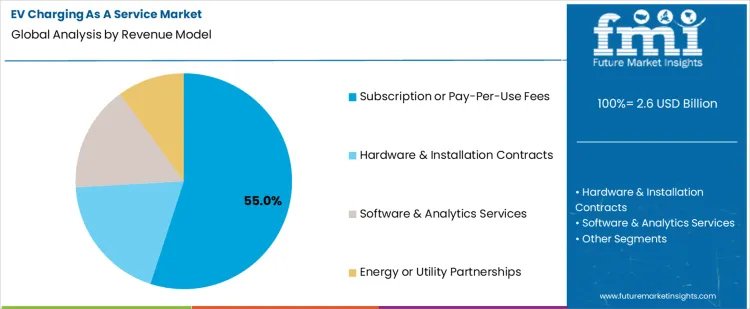
The subscription or pay-per-use fees revenue model is the dominant segment in the EV Charging As A Service market, holding 55% of the market share. This growth is driven by the increasing preference for flexible, cost-effective payment options among EV owners and businesses. The subscription or pay-per-use model allows users to pay based on their charging frequency and usage, making it an attractive option for both residential and commercial EV owners. This model provides predictable costs for consumers and businesses while promoting wider access to charging infrastructure. For fleet operators, it offers a scalable and flexible solution that aligns with their charging needs. Additionally, subscription services often include value-added features such as access to a network of charging stations, software for monitoring and managing energy usage, and maintenance services, further enhancing the value of this model. As the EV market continues to grow and charging infrastructure becomes more widespread, the subscription or pay-per-use revenue model is expected to remain the preferred choice for both service providers and consumers, driving continued growth in the market.
What are the Key Dynamics in the EV Charging As A Service Market?
The EV charging as a service (CaaS) market is expanding as electric vehicle (EV) adoption accelerates globally. CaaS refers to a business model where EV charging infrastructure, maintenance, and payment systems are provided as a service, rather than requiring consumers or businesses to own and manage their own charging stations. This market is driven by the increasing number of electric vehicles on the road, the need for accessible, reliable, and scalable charging infrastructure, and the growing trend toward urbanization. The shift toward sustainable transportation and government incentives for EV adoption are also contributing to the growth of CaaS, as it offers a flexible and cost-effective solution for EV owners, fleet operators, and businesses looking to invest in EV charging infrastructure without high upfront costs.
What are the Key Drivers of Growth in the EV Charging As A Service Market?
The growth of the EV charging as a service market is primarily driven by the increasing adoption of electric vehicles and the corresponding need for reliable and widely available charging infrastructure. As governments and businesses prioritize sustainability, the demand for EVs is rising, which in turn increases the need for convenient charging options. CaaS providers offer a more cost-effective solution compared to traditional charging station ownership by handling the installation, maintenance, and operational aspects, allowing users to focus on electric vehicle use without worrying about infrastructure. The growing demand for fast charging solutions and the rise of fleet operators seeking efficient charging systems for their EV fleets are also fueling market growth. Additionally, advancements in payment systems, mobile apps for easy access to charging stations, and the integration of renewable energy sources into charging infrastructure are contributing to the rapid expansion of CaaS offerings.
What are the Key Restraints in the EV Charging As A Service Market?
The EV charging as a service market faces several challenges. One of the main constraints is the high capital investment required to build and maintain charging stations, especially in underserved or remote locations. Although CaaS reduces the financial burden on end-users, service providers must bear the costs of infrastructure development, which can be a barrier in regions with limited demand or high installation costs. Another challenge is the fragmentation of the charging network, as different regions, EV models, and service providers often use different charging standards and payment systems, making it difficult to create a universal platform. Additionally, the lack of standardization in EV charging infrastructure and interoperability between networks can hinder the growth of CaaS, as consumers may face difficulties accessing charging stations. Finally, concerns regarding the security of data generated by users of charging services, such as payment information and location tracking, could slow the adoption of CaaS models.
What are the Key Trends in the EV Charging As A Service Market?
Several key trends are shaping the EV charging as a service market. One of the most significant trends is the growing integration of smart charging technologies. These solutions allow users to find available charging stations, schedule charging sessions, and even pay for services via mobile apps, improving convenience and accessibility. Another trend is the integration of renewable energy sources, such as solar or wind, into charging stations to create more sustainable and environmentally friendly infrastructure. The rise of ultra-fast charging stations, which significantly reduce the time required for charging, is also influencing the market, with service providers seeking to meet consumer expectations for speed and convenience. Additionally, the increasing use of data analytics and artificial intelligence (AI) to optimize charging station performance, forecast energy demand, and improve load balancing is driving the growth of CaaS solutions. As electric vehicle adoption continues to rise, more companies are looking to offer subscription-based models or pricing schemes for CaaS, making it easier for consumers to access charging services without significant upfront costs. These trends indicate that the CaaS market will continue to evolve with an emphasis on user convenience, sustainability, and advanced technologies.
What is the Country-Wise Analysis of the EV Charging As A Service Market?
The EV charging as a service (CaaS) market is experiencing rapid growth as the adoption of electric vehicles (EVs) accelerates globally. CaaS solutions provide convenient, flexible, and scalable charging infrastructure to EV owners, making it easier for consumers to access charging points. The market is driven by government incentives promoting clean energy, the expansion of EV adoption, and the increasing need for efficient and accessible charging solutions. Countries like the USA, China, Germany, the UK, and India are leading the way in this market, fueled by the growth in EV adoption, the expansion of charging networks, and the demand for innovative, user-friendly charging solutions.
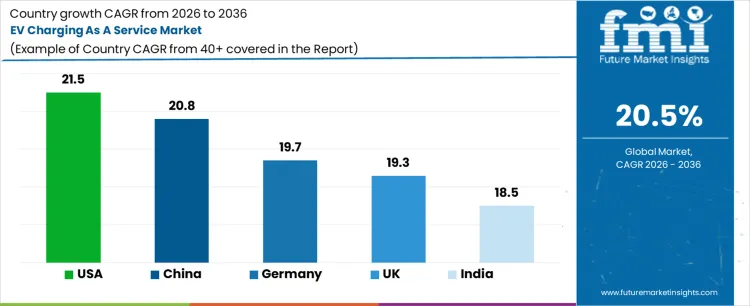
| Country | CAGR (%) |
|---|---|
| USA | 21.5 |
| China | 20.8 |
| Germany | 19.7 |
| UK | 19.3 |
| India | 18.5 |
What is Driving the Growth of the EV Charging As A Service Market in the USA?
The USA’s EV charging as a service (CaaS) market is growing at a CAGR of 21.5%, the highest among the countries analyzed. The growth is driven by the rapid adoption of electric vehicles, supported by government incentives and increasing consumer demand for clean energy solutions. As the EV market in the USA continues to expand, the need for widespread, accessible, and convenient charging infrastructure is growing. CaaS provides a flexible and scalable charging solution that meets this demand. Additionally, private and commercial sectors are increasingly adopting CaaS solutions to provide charging infrastructure for both residential and public use. With increasing investments in EV infrastructure and the ongoing transition to electric mobility, the USA’s CaaS market is expected to grow significantly.
How is the EV Charging As A Service Market Performing in China?
China’s EV charging as a service market is growing at a CAGR of 20.8%. As the largest EV market in the world, China is leading the way in the adoption of electric vehicles and the expansion of EV charging infrastructure. CaaS is becoming an increasingly popular solution in China as it provides flexible and efficient charging services to EV owners, especially as the country’s charging infrastructure continues to grow rapidly. The Chinese government’s strong push for clean energy, coupled with increasing urbanization and rising consumer demand for EVs, is fueling the adoption of CaaS. As China continues to lead in EV production and adoption, the market for CaaS is expected to grow steadily.
What Factors are Shaping the EV Charging As A Service Market in Germany?
Germany’s EV charging as a service market is growing at a CAGR of 19.7%. As one of Europe’s largest automotive markets, Germany is increasingly adopting electric vehicles, which is driving the demand for reliable and accessible charging infrastructure. The German government’s initiatives to promote clean energy and reduce carbon emissions are fueling the demand for EV charging solutions, including CaaS. CaaS offers convenience, scalability, and flexibility, making it a suitable option for both residential and commercial users. As Germany continues to invest in EV infrastructure and strives to meet its sustainability goals, the CaaS market is expected to experience significant growth.
How is the EV Charging As A Service Market Evolving in the UK?
The UK’s EV charging as a service market is growing at a CAGR of 19.3%. The UK is seeing rapid adoption of electric vehicles, supported by government incentives and policies promoting clean energy solutions. As the demand for EVs rises, the need for widespread and easily accessible charging infrastructure is also increasing. CaaS provides an ideal solution for meeting this demand, offering flexibility and scalability to users. The UK government’s commitment to achieving net-zero emissions by 2050 and its focus on increasing the availability of public and private charging points are contributing to the growth of the CaaS market. As the market continues to mature, the demand for CaaS solutions is expected to rise steadily.
What is Contributing to the Growth of the EV Charging As A Service Market in India?
India’s EV charging as a service market is growing at a CAGR of 18.5%. India is experiencing rapid growth in electric vehicle adoption, driven by government incentives, environmental concerns, and the rising demand for cleaner transportation options. The country’s EV charging infrastructure is expanding, and CaaS is emerging as an important solution to provide widespread, convenient, and cost-effective charging options. The government’s push for electric mobility and the rise in urbanization are contributing to the market’s growth. As the demand for EVs continues to rise, CaaS will play a significant role in supporting India’s transition to electric transportation, making the market for CaaS solutions a key area of growth in the country.
What is the Competitive Landscape for the EV Charging As A Service Market?
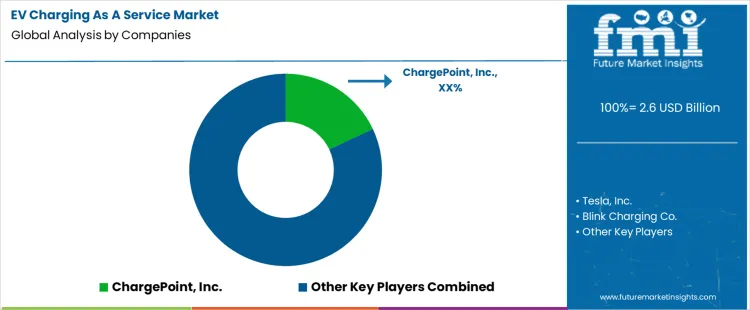
The EV charging as a service (CaaS) market is expanding rapidly as electric vehicle adoption accelerates and demand grows for reliable, scalable charging infrastructure. ChargePoint, Inc. leads the competitive landscape with a broad global network supported by software-driven platforms, flexible subscription models, and comprehensive station management services for residential, commercial, and fleet users. Tesla, Inc. remains a strong competitor through its extensive Supercharger network, offering fast, reliable charging integrated with vehicle and energy management systems, while gradually expanding access beyond its own vehicle base.
Blink Charging Co. plays an important role by combining charging hardware with networked software solutions that support public, workplace, and residential charging. EV Connect, Inc. focuses on cloud-based platforms that enable businesses and property owners to efficiently manage charging operations at scale. Shell Recharge Solutions leverages Shell’s global energy footprint to expand its charging network, integrating renewable energy and smart charging services. ENGIE EV Solutions emphasizes sustainable and intelligent charging infrastructure, offering end-to-end services focused on energy optimization.
Other notable participants include TGOOD Global Ltd., State Grid Corporation of China, EVgo Inc., and TP-Link/Hypercharge Networks, each contributing through large-scale deployments, fast-charging networks, or smart residential and commercial solutions. Overall, competition is driven by network expansion, software integration, energy management capabilities, and service flexibility, positioning leading providers to support the continued growth of electric mobility worldwide.
Key Players of the EV Charging As A Service Market
- ChargePoint, Inc.
- Tesla, Inc.
- Blink Charging Co.
- EV Connect, Inc.
- Shell Recharge Solutions
- ENGIE EV Solutions
- TGOOD Global Ltd.
- State Grid Corporation of China
- EVgo Inc.
- TP‑Link/Hypercharge Networks
Scope of the Report
| Items | Values |
|---|---|
| Quantitative Units (2026) | USD Billion |
| Service Type | Fleet Charging Services, Public or Home Subscription Charging, Managed Workplace or Commercial CaaS, Value-Added Software & Maintenance |
| Revenue Model | Subscription or Pay-Per-Use Fees, Hardware & Installation Contracts, Software & Analytics Services, Energy or Utility Partnerships |
| Customer Segment | Commercial Fleets, Retail & Hospitality, Workplace & Offices, Residential or Multifamily, Public Sector (Municipal) |
| Companies | ChargePoint, Inc., Tesla, Inc., Blink Charging Co., EV Connect, Inc., Shell Recharge Solutions, ENGIE EV Solutions, TGOOD Global Ltd., State Grid Corporation of China, EVgo Inc., TP-Link/Hypercharge Networks |
| Regions Covered | North America, Latin America, Western Europe, Eastern Europe, South Asia and Pacific, East Asia, Middle East & Africa |
| Countries Covered | United States, Canada, Mexico, Brazil, Argentina, Germany, France, United Kingdom, Italy, Spain, Netherlands, China, India, Japan, South Korea, ANZ, GCC Countries, South Africa |
| Additional Attributes | Dollar sales by service type, revenue model, customer segment, and regions. Includes market trends towards scalability, regulatory compliance, cost-effectiveness, and the role of charging as a service in enhancing the adoption of electric vehicles. |
EV Charging As A Service Market Segmentation
Service Type:
- Fleet Charging Services
- Public or Home Subscription Charging
- Managed Workplace or Commercial CaaS
- Value-Added Software & Maintenance
Revenue Model:
- Subscription or Pay-Per-Use Fees
- Hardware & Installation Contracts
- Software & Analytics Services
- Energy or Utility Partnerships
Customer Segment:
- Commercial Fleets
- Retail & Hospitality
- Workplace & Offices
- Residential or Multifamily
- Public Sector (Municipal)
Region:
- Asia Pacific
- China
- Japan
- India
- Australia & New Zealand
- ASEAN
- Rest of Asia Pacific
- Europe
- Germany
- United Kingdom
- France
- Italy
- Spain
- Nordic
- BENELUX
- Rest of Europe
- North America
- United States
- Canada
- Mexico
- Latin America
- Brazil
- Argentina
- Rest of Latin America
- Middle East & Africa
- Kingdom of Saudi Arabia
- Other GCC Countries
- South Africa
- Rest of Middle East & Africa
Bibliography
- International Energy Agency. (2025). Global EV outlook 2025: Expanding sales in diverse markets. International Energy Agency.
- European Parliament, & Council of the European Union. (2023). Regulation (EU) 2023/1804 of 13 September 2023 on the deployment of alternative fuels infrastructure. Official Journal of the European Union.
- Federal Highway Administration. (2023). National Electric Vehicle Infrastructure (NEVI) standards and requirements (Final rule). Federal Register.
Frequently Asked Questions
How big is the ev charging as a service market in 2026?
The global ev charging as a service market is estimated to be valued at USD 2.6 billion in 2026.
What will be the size of ev charging as a service market in 2036?
The market size for the ev charging as a service market is projected to reach USD 16.8 billion by 2036.
How much will be the ev charging as a service market growth between 2026 and 2036?
The ev charging as a service market is expected to grow at a 20.5% CAGR between 2026 and 2036.
What are the key product types in the ev charging as a service market?
The key product types in ev charging as a service market are fleet charging services, public or home subscription charging, managed workplace or commercial caas and value‑added software & maintenance.
Which revenue model segment to contribute significant share in the ev charging as a service market in 2026?
In terms of revenue model, subscription or pay‑per‑use fees segment to command 55.0% share in the ev charging as a service market in 2026.
Preview the report firsthand - request a free sample
Get SampleGet the brochure for pricing and purchase details.
Get PDFTable of Content
- Executive Summary
- Global Market Outlook
- Demand-side Trends
- Supply-side Trends
- Technology Roadmap Analysis
- Analysis and Recommendations
- Market Overview
- Market Coverage / Taxonomy
- Market Definition / Scope / Limitations
- Market Background
- Market Dynamics
- Drivers
- Restraints
- Opportunity
- Trends
- Scenario Forecast
- Demand in Optimistic Scenario
- Demand in Likely Scenario
- Demand in Conservative Scenario
- Opportunity Map Analysis
- Product Life Cycle Analysis
- Supply Chain Analysis
- Investment Feasibility Matrix
- Value Chain Analysis
- PESTLE and Porter’s Analysis
- Regulatory Landscape
- Regional Parent Market Outlook
- Production and Consumption Statistics
- Import and Export Statistics
- Market Dynamics
- Global Market Analysis 2021 to 2025 and Forecast, 2026 to 2036
- Historical Market Size Value (USD Million) Analysis, 2021 to 2025
- Current and Future Market Size Value (USD Million) Projections, 2026 to 2036
- Y-o-Y Growth Trend Analysis
- Absolute $ Opportunity Analysis
- Global Market Pricing Analysis 2021 to 2025 and Forecast 2026 to 2036
- Global Market Analysis 2021 to 2025 and Forecast 2026 to 2036, By Service Type
- Introduction / Key Findings
- Historical Market Size Value (USD Million) Analysis By Service Type, 2021 to 2025
- Current and Future Market Size Value (USD Million) Analysis and Forecast By Service Type, 2026 to 2036
- Fleet Charging Services
- Public or Home Subscription Charging
- Managed Workplace or Commercial CaaS
- Value‑Added Software & Maintenance
- Fleet Charging Services
- Y-o-Y Growth Trend Analysis By Service Type, 2021 to 2025
- Absolute $ Opportunity Analysis By Service Type, 2026 to 2036
- Global Market Analysis 2021 to 2025 and Forecast 2026 to 2036, By Revenue Model
- Introduction / Key Findings
- Historical Market Size Value (USD Million) Analysis By Revenue Model, 2021 to 2025
- Current and Future Market Size Value (USD Million) Analysis and Forecast By Revenue Model, 2026 to 2036
- Subscription or Pay‑Per‑Use Fees
- Hardware & Installation Contracts
- Software & Analytics Services
- Energy or Utility Partnerships
- Subscription or Pay‑Per‑Use Fees
- Y-o-Y Growth Trend Analysis By Revenue Model, 2021 to 2025
- Absolute $ Opportunity Analysis By Revenue Model, 2026 to 2036
- Global Market Analysis 2021 to 2025 and Forecast 2026 to 2036, By Customer Segment
- Introduction / Key Findings
- Historical Market Size Value (USD Million) Analysis By Customer Segment, 2021 to 2025
- Current and Future Market Size Value (USD Million) Analysis and Forecast By Customer Segment, 2026 to 2036
- Commercial Fleets
- Retail & Hospitality
- Workplace & Offices
- Residential or Multifamily
- Public Sector (Municipal)
- Commercial Fleets
- Y-o-Y Growth Trend Analysis By Customer Segment, 2021 to 2025
- Absolute $ Opportunity Analysis By Customer Segment, 2026 to 2036
- Global Market Analysis 2021 to 2025 and Forecast 2026 to 2036, By Region
- Introduction
- Historical Market Size Value (USD Million) Analysis By Region, 2021 to 2025
- Current Market Size Value (USD Million) Analysis and Forecast By Region, 2026 to 2036
- North America
- Latin America
- Western Europe
- Eastern Europe
- East Asia
- South Asia and Pacific
- Middle East & Africa
- Market Attractiveness Analysis By Region
- North America Market Analysis 2021 to 2025 and Forecast 2026 to 2036, By Country
- Historical Market Size Value (USD Million) Trend Analysis By Market Taxonomy, 2021 to 2025
- Market Size Value (USD Million) Forecast By Market Taxonomy, 2026 to 2036
- By Country
- USA
- Canada
- Mexico
- By Service Type
- By Revenue Model
- By Customer Segment
- By Country
- Market Attractiveness Analysis
- By Country
- By Service Type
- By Revenue Model
- By Customer Segment
- Key Takeaways
- Latin America Market Analysis 2021 to 2025 and Forecast 2026 to 2036, By Country
- Historical Market Size Value (USD Million) Trend Analysis By Market Taxonomy, 2021 to 2025
- Market Size Value (USD Million) Forecast By Market Taxonomy, 2026 to 2036
- By Country
- Brazil
- Chile
- Rest of Latin America
- By Service Type
- By Revenue Model
- By Customer Segment
- By Country
- Market Attractiveness Analysis
- By Country
- By Service Type
- By Revenue Model
- By Customer Segment
- Key Takeaways
- Western Europe Market Analysis 2021 to 2025 and Forecast 2026 to 2036, By Country
- Historical Market Size Value (USD Million) Trend Analysis By Market Taxonomy, 2021 to 2025
- Market Size Value (USD Million) Forecast By Market Taxonomy, 2026 to 2036
- By Country
- Germany
- UK
- Italy
- Spain
- France
- Nordic
- BENELUX
- Rest of Western Europe
- By Service Type
- By Revenue Model
- By Customer Segment
- By Country
- Market Attractiveness Analysis
- By Country
- By Service Type
- By Revenue Model
- By Customer Segment
- Key Takeaways
- Eastern Europe Market Analysis 2021 to 2025 and Forecast 2026 to 2036, By Country
- Historical Market Size Value (USD Million) Trend Analysis By Market Taxonomy, 2021 to 2025
- Market Size Value (USD Million) Forecast By Market Taxonomy, 2026 to 2036
- By Country
- Russia
- Poland
- Hungary
- Balkan & Baltic
- Rest of Eastern Europe
- By Service Type
- By Revenue Model
- By Customer Segment
- By Country
- Market Attractiveness Analysis
- By Country
- By Service Type
- By Revenue Model
- By Customer Segment
- Key Takeaways
- East Asia Market Analysis 2021 to 2025 and Forecast 2026 to 2036, By Country
- Historical Market Size Value (USD Million) Trend Analysis By Market Taxonomy, 2021 to 2025
- Market Size Value (USD Million) Forecast By Market Taxonomy, 2026 to 2036
- By Country
- China
- Japan
- South Korea
- By Service Type
- By Revenue Model
- By Customer Segment
- By Country
- Market Attractiveness Analysis
- By Country
- By Service Type
- By Revenue Model
- By Customer Segment
- Key Takeaways
- South Asia and Pacific Market Analysis 2021 to 2025 and Forecast 2026 to 2036, By Country
- Historical Market Size Value (USD Million) Trend Analysis By Market Taxonomy, 2021 to 2025
- Market Size Value (USD Million) Forecast By Market Taxonomy, 2026 to 2036
- By Country
- India
- ASEAN
- Australia & New Zealand
- Rest of South Asia and Pacific
- By Service Type
- By Revenue Model
- By Customer Segment
- By Country
- Market Attractiveness Analysis
- By Country
- By Service Type
- By Revenue Model
- By Customer Segment
- Key Takeaways
- Middle East & Africa Market Analysis 2021 to 2025 and Forecast 2026 to 2036, By Country
- Historical Market Size Value (USD Million) Trend Analysis By Market Taxonomy, 2021 to 2025
- Market Size Value (USD Million) Forecast By Market Taxonomy, 2026 to 2036
- By Country
- Kingdom of Saudi Arabia
- Other GCC Countries
- Turkiye
- South Africa
- Other African Union
- Rest of Middle East & Africa
- By Service Type
- By Revenue Model
- By Customer Segment
- By Country
- Market Attractiveness Analysis
- By Country
- By Service Type
- By Revenue Model
- By Customer Segment
- Key Takeaways
- Key Countries Market Analysis
- USA
- Pricing Analysis
- Market Share Analysis, 2025
- By Service Type
- By Revenue Model
- By Customer Segment
- Canada
- Pricing Analysis
- Market Share Analysis, 2025
- By Service Type
- By Revenue Model
- By Customer Segment
- Mexico
- Pricing Analysis
- Market Share Analysis, 2025
- By Service Type
- By Revenue Model
- By Customer Segment
- Brazil
- Pricing Analysis
- Market Share Analysis, 2025
- By Service Type
- By Revenue Model
- By Customer Segment
- Chile
- Pricing Analysis
- Market Share Analysis, 2025
- By Service Type
- By Revenue Model
- By Customer Segment
- Germany
- Pricing Analysis
- Market Share Analysis, 2025
- By Service Type
- By Revenue Model
- By Customer Segment
- UK
- Pricing Analysis
- Market Share Analysis, 2025
- By Service Type
- By Revenue Model
- By Customer Segment
- Italy
- Pricing Analysis
- Market Share Analysis, 2025
- By Service Type
- By Revenue Model
- By Customer Segment
- Spain
- Pricing Analysis
- Market Share Analysis, 2025
- By Service Type
- By Revenue Model
- By Customer Segment
- France
- Pricing Analysis
- Market Share Analysis, 2025
- By Service Type
- By Revenue Model
- By Customer Segment
- India
- Pricing Analysis
- Market Share Analysis, 2025
- By Service Type
- By Revenue Model
- By Customer Segment
- ASEAN
- Pricing Analysis
- Market Share Analysis, 2025
- By Service Type
- By Revenue Model
- By Customer Segment
- Australia & New Zealand
- Pricing Analysis
- Market Share Analysis, 2025
- By Service Type
- By Revenue Model
- By Customer Segment
- China
- Pricing Analysis
- Market Share Analysis, 2025
- By Service Type
- By Revenue Model
- By Customer Segment
- Japan
- Pricing Analysis
- Market Share Analysis, 2025
- By Service Type
- By Revenue Model
- By Customer Segment
- South Korea
- Pricing Analysis
- Market Share Analysis, 2025
- By Service Type
- By Revenue Model
- By Customer Segment
- Russia
- Pricing Analysis
- Market Share Analysis, 2025
- By Service Type
- By Revenue Model
- By Customer Segment
- Poland
- Pricing Analysis
- Market Share Analysis, 2025
- By Service Type
- By Revenue Model
- By Customer Segment
- Hungary
- Pricing Analysis
- Market Share Analysis, 2025
- By Service Type
- By Revenue Model
- By Customer Segment
- Kingdom of Saudi Arabia
- Pricing Analysis
- Market Share Analysis, 2025
- By Service Type
- By Revenue Model
- By Customer Segment
- Turkiye
- Pricing Analysis
- Market Share Analysis, 2025
- By Service Type
- By Revenue Model
- By Customer Segment
- South Africa
- Pricing Analysis
- Market Share Analysis, 2025
- By Service Type
- By Revenue Model
- By Customer Segment
- USA
- Market Structure Analysis
- Competition Dashboard
- Competition Benchmarking
- Market Share Analysis of Top Players
- By Regional
- By Service Type
- By Revenue Model
- By Customer Segment
- Competition Analysis
- Competition Deep Dive
- ChargePoint, Inc.
- Overview
- Product Portfolio
- Profitability by Market Segments (Product/Age /Sales Channel/Region)
- Sales Footprint
- Strategy Overview
- Marketing Strategy
- Product Strategy
- Channel Strategy
- Tesla, Inc.
- Blink Charging Co.
- EV Connect, Inc.
- Shell Recharge Solutions
- ENGIE EV Solutions
- TGOOD Global Ltd.
- State Grid Corporation of China
- EVgo Inc.
- TP‑Link/Hypercharge Networks
- ChargePoint, Inc.
- Competition Deep Dive
- Assumptions & Acronyms Used
- Research Methodology


