

- Industry Size (2026)
- USD 0.9 Bn
- Forecast (2036)
- USD 3.1 Bn
- CAGR (2026 to 2036)
- 12.30%
Event-Based Stationery Packaging Market Forecast and Outlook 2026 to 2036
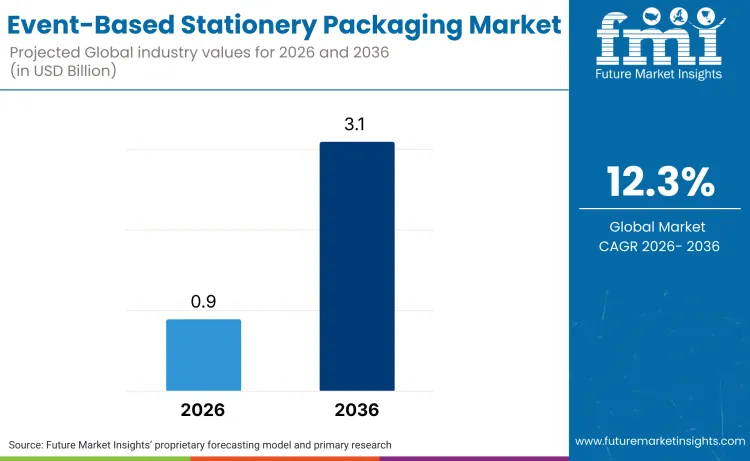
The global event-based stationery packaging market is set to record a valuation of USD 0.9 billion in 2026, advancing toward USD 3.1 billion by 2036, representing a compelling 12.30% CAGR. Such expansion is primarily driven by the full recovery of the exhibition sector, where UFI reported in May 2025 that 32,000 exhibitions were held worldwide in 2024, renting 138 million square meters of space. This resurgence has triggered immediate demand for attendee kits, matching pre-pandemic activity levels. Amy Calvert, President and CEO of the Events Industry Council, captured this momentum in April 2025, stating that the industry's continued resilience and agility are pivoting focus toward organizational growth despite prevailing policy uncertainties. The revitalization of in-person corporate gatherings is compelling manufacturers to innovate rapidly, ensuring that packaging solutions meet both volume requirements and the renewed emphasis on tangible brand storytelling.
The corporate events sector drives significant volume and margin opportunity, creating a robust pipeline for specialized packaging manufacturers. The Events Industry Council reported in April 2025 that RFP (Request for Proposal) activity reached 98% of pre-pandemic levels by Q4 2024, signaling a return to large-scale budget deployment. Manufacturers are responding to this scale requirement through strategic consolidation, exemplified by Amcor’s announcement in November 2024 regarding the acquisition of Berry Global in a transaction valued at USD 8.4 billion. This merger creates a global packaging juggernaut capable of serving multinational event organizers with consistent, sustainable solutions across all geographies. Such developments signal a decisive strategic implication: companies that successfully leverage scale to provide comprehensive, eco-certified, and digitally-enabled event packaging solutions will dominate market share through 2036.
Event-Based Stationery Packaging Market Key Takeaways
| Metric | Details |
|---|---|
| Industry Size (2026) | USD 0.9 billion |
| Industry Value (2036) | USD 3.1 billion |
| CAGR (2026-2036) | 12.30% |
Source: Future Market Insights (FMI) analysis, based on proprietary forecasting model and primary research.
Summary of Event-Based Stationery Packaging Market
What Is the Growth Outlook for Event-Based Stationery Packaging Market as per Future Market Insights Projection?
Future Market Insights projects the event-based stationery packaging market to grow at a CAGR of 12.30% from 2026 to 2036, expanding from USD 0.9 billion in 2026 to USD 3.1 billion by 2036.
FMI Research Approach: Based on FMI's proprietary bottom-up event industry recovery modeling, exhibition industry association data (UFI reporting), corporate RFP activity tracking through market surveys, regulatory timeline analysis for single-use plastic phase-outs across major markets, and scenario analysis aligned with ESG procurement mandates from Fortune 500 event buyers.
How Do FMI Analysts Perceive the Event-Based Stationery Packaging Market to Evolve?
FMI analysts perceive the market shifting from low-cost, high-volume plastic-based attendee kits toward premium, sustainable, multi-material solutions featuring intelligent packaging elements (RFID, NFC) integrated into corporate branding ecosystems.
FMI Research Approach: Supported by evidence of corporate event spending prioritization toward experiential quality, regulatory mandates from the European Union (Packaging Directive 2024-2030), adoption patterns across major event venues and corporate procurement departments, and manufacturer innovation disclosures from Amcor, Sealed Air, and specialty packaging firms.
Which Country Holds the Largest Share in the Global Event-Based Stationery Packaging Market?
The United States holds the largest share of the global Event-Based Stationery Packaging market by value, driven by corporate event concentration and high per-attendee spending.
FMI Research Approach: Derived from country-level revenue modeling of corporate event frequency, average kit costs per attendee, consolidation of major event management companies (primarily US-headquartered), adoption penetration across Fortune 500 firms, and supply chain concentration of global packaging manufacturers in North America.
How Large Will the Event-Based Stationery Packaging Market Be by 2036?
The global Event-Based Stationery Packaging market is expected to reach USD 3.1 billion by 2036.
FMI Research Approach: Based on long-term forecasts segmented by event channel (corporate 42%, trade shows 31%, incentive/retail 27%), scaling assumptions for per-attendee kit value growth driven by sustainability premiums, cross-validation against historical event industry recovery cycles, and regulatory impact modeling from announced plastic phase-out timelines.
What Is the Definition of the Event-Based Stationery Packaging Market?
The market comprises purpose-designed packaging solutions for event attendee kits and corporate stationery sets, specifically those manufactured and sold to event organizers, corporate procurement teams, and hospitality venues for distribution at conferences, trade shows, corporate retreats, and incentive travel events.
FMI Research Approach: Derived from FMI's taxonomy covering rigid boxes, flexible pouches, protective wrapping, dividers, and branded insert materials; application mapping across corporate gifting, attendee welcome kits, speaker acknowledgment packages, and merchandise protection during shipment; exclusion of general-purpose packaging not designed specifically for events.
What Are Globally Unique Trends Shaping the Event-Based Stationery Packaging Market?
Globally unique trends include elimination of single-use plastics from event kits, integration of intelligent packaging technologies for attendee engagement tracking, and premiumization of sustainable materials as competitive differentiation in the high-margin corporate event channel.
FMI Research Approach: Evidenced by regulatory bans in Australia (NSW phase-out 2025), European Union (Packaging Directive extending to 2030), and North America (individual state initiatives), consolidation of global packaging converters to secure sustainable material supply chains, and technology adoption among event tech platforms (RFID/NFC integration into kits for real-time attendee analytics).
Why Is Regulatory Elimination of Single-Use Plastics Reshaping the Event Packaging Sector?
Regulatory pressure to eliminate single-use plastics is fundamentally transforming the sector, effectively mandating a shift toward paper goods and sustainable alternatives. The NSW EPA highlighted this urgency in October 2024, noting that New South Wales generated 891,000 tonnes of plastic waste with only 14% recycled, accelerating phase-out timelines. Sealed Air responded by launching Ready-To-Roll Embossed Paper in August 2024, a curbside-recyclable alternative to plastic specifically designed for protective kraft papers applications in event kits. The United Nations Sustainable Development Goals Report 2024 emphasizes that industrial supply chains must reorient toward sustainable growth models, further driving the adoption of machine glazed kraft paper. Consequently, event organizers now prioritize certified compostable packaging, creating a tiered market where auditable eco-packaging commands significant premiums.
How Is the Event-Based Stationery Packaging Market Segmented?
The market is segmented by end-use channel, material type, and kit configuration to serve the diverse needs of corporate event organizers, trade show operators, and hospitality procurement teams. By end-use channel, the market divides into corporate events, trade shows and exhibitions, and incentive travel/retail gifting. By material, the industry utilizes fiber-based boards, protective papers, specialty substrates, and an emerging category of smart/interactive materials embedded with NFC or RFID technology. This segmentation reflects the market's evolution toward channel-specific solutions, where corporate events demand premium branding capabilities while trade shows prioritize cost-efficient volume and durability. The Events Industry Council (April 2025) confirms this diversification, noting that RFP activity and booking patterns differ significantly across channels, with corporate events showing the highest per-unit value and trade shows emphasizing maximum attendee throughput.
Why Does the Corporate Events Channel Hold a Dominant Share?
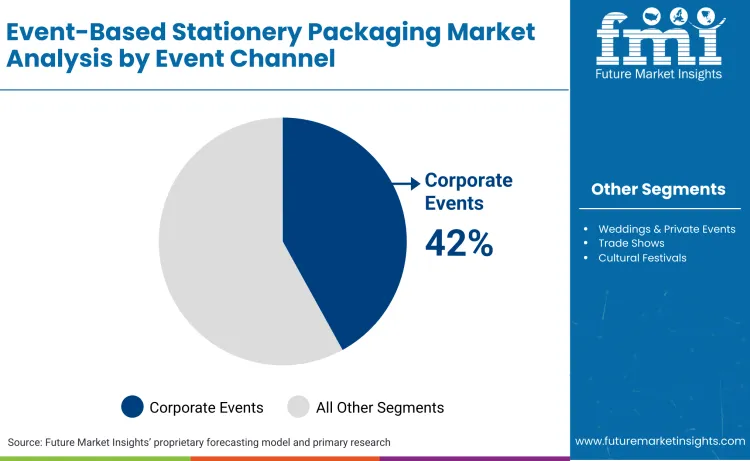
The corporate events segment accounts for 42% of the market share, driven by the strategic necessity of attendee experience in building brand loyalty. Events Industry Council reported in April 2025 that RFP activity reached 98% of pre-pandemic levels, indicating a full recovery in corporate spending on premium boxboard packaging. Companies are investing heavily in curated unboxing experiences, utilizing high-quality specialty paper to differentiate their brand values during conferences. Amcor's recent strategic consolidation focuses explicitly on this channel to provide consistent paperboard mailer solutions globally. This dominance reflects a willingness among corporate buyers to pay premiums for kraft box and kraft pouch formats that align with organizational sustainability goals while delivering a memorable, tactile impact for every attendee.
Why Does the Trade Show/Exhibition Segment Capture Significant Market Value?
The trade show and exhibition segment represents 31% of the market share, sustained by the sheer volume of global events requiring standardized kit solutions. UFI statistics confirmed in May 2025 that 32,000 exhibitions were held in 2024, creating massive demand for cost-effective, durable packaging that can withstand international transport. Trade show operators prioritize efficiency, driving the adoption of robust carton solutions like those optimized by Smurfit Westrock following their July 2024 merger. This channel focuses on high-throughput recyclability, ensuring that thousands of attendee kits can be easily processed post-event without incurring landfill fees. The steady recovery of the exhibition sector guarantees a consistent baseline of volume demand for functional, branding-ready packaging that balances durability with environmental compliance.
Why Does Incentive Travel and Retail Gifting lead the Market?
The incentive travel and retail gifting segment captures 27% of the market share, serving a distinct buyer profile that prioritizes premium presentation and personalization. These segments include welcome amenities for incentive travel packages, corporate gift boxes, and branded merchandise packaging sold through high-end retail channels. Metsä Board's September 2024 Gold Award win at the European Carton Excellence Awards for its "Northern Lights" premium packaging exemplifies the aesthetic requirements of this segment. Neil Fox, VP Sales at Metsä Board, noted that "these awards demonstrate how our high-quality paperboards enable designers to create standout packaging that balances premium quality and sustainability." This segment commands the highest per-unit margins due to design complexity, material premiums, and low production volumes, making it an attractive focus area for specialty packaging converters.
Why Is the Shift from Plastic to Fiber-Based Materials Accelerating?
The elimination of single-use plastics is accelerating as regulatory mandates converge with corporate sustainability commitments, pushing fiber-based innovations to the forefront. Graphic Packaging International reported in July 2025 that it replaced 1 billion plastic packages with fiber-based alternatives in 2024, driving demand for uncoated fine papers and woodfree paper. Metsä Board won Gold at the European Carton Excellence Awards in September 2024 for premium packaging, showcasing the aesthetic potential of art and craft material in luxury gifting. Stora Enso reported that 94% of its portfolio was recyclable in Q4 2024, ensuring that materials like sketch paper and acrylic paper meet strict environmental standards. These innovations are reshaping kit value propositions, blending sustainability with high-end design.
How Is Intelligent Packaging Integration Reshaping Event Kit Value Propositions?
The integration of smart packaging technologies, including RFID tags, NFC chips, and connected packaging, is creating new value propositions for event organizers seeking real-time attendee engagement and post-event analytics. Avery Dennison reported in February 2025 that it achieved FY2024 net sales of USD 8.8 billion, with robust growth in its Intelligent Labels segment driven by logistics and event applications. CEO Deon Stander noted: "In Intelligent Labels, we are delivering another year of strong growth and continue to see significant opportunity ahead." This growth trajectory reflects increasing adoption of smart packaging in the event channel, where organizers use embedded technologies to track attendee engagement, enable digital check-in, and drive post-event follow-up campaigns. Manufacturers integrating NFC and RFID into event kits are commanding 20-35% price premiums over traditional packaging, making this a high-margin differentiation strategy.
Why Are Global Manufacturers Consolidating to Secure Sustainable Material Supply?
Strategic consolidation among global packaging manufacturers is accelerating to secure long-term access to certified sustainable fiber materials and build scale for capital-intensive R&D. Smurfit Westrock's completion of its public listing in July 2024 created a transatlantic giant capable of serving global event clients with consistent paperboard solutions across North America, Europe, and Asia. The company combines Smurfit Kappa's stronghold in Europe with WestRock's North American presence, creating supply chain flexibility for multinational event organizers. Similarly, Brazil's Klabin launched Phase 2 of its Puma II project in December 2024, bringing a new PM 28 board making line online with an annual capacity of 460,000 tonnes of virgin fiberboard specifically designed for premium packaging applications. Flávio Deganutti, representing Klabin, stated: "We saw early on that the packaging paper segment was an attractive market. It had great potential for growth, as the market began to use products sustainably and renewably." These investments underscore the long-term commitment of industry leaders to ensure material availability and cost stability in an increasingly supply-constrained environment.
How is Event-Based Stationery Packaging Market Regional Outlook?
The regional outlook for the event‑based stationery packaging market shows a diverse growth pattern, with emerging economies outpacing mature markets. India leads with the fastest CAGR of 15.60%, reflecting rapid corporate activity and expanding manufacturing capacity, followed closely by China at 14.20%, driven by large‑scale export‑oriented production and substantial additions to packaging paper capacity. The United States maintains a strong 11.80% CAGR, supported by its large corporate events ecosystem and high adoption of sustainable and intelligent packaging solutions. Brazil, with an 11.20% growth rate, benefits from its leadership in renewable fiber production and new board‑making capacity that strengthens its position in Latin America. Meanwhile, mature markets like the UK (10.60%) and Japan (9.40%) show steady but slower growth as they focus on premiumization, sustainability compliance, and specialty paper innovation rather than volume expansion.
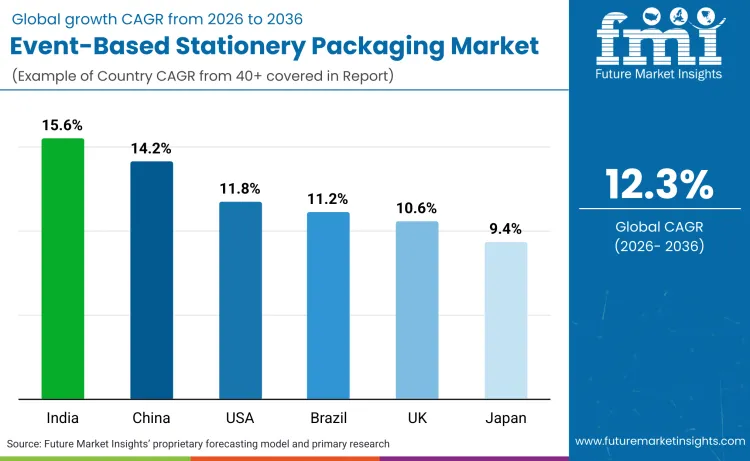
| Country | CAGR (2026 to 2036) |
|---|---|
| USA | 11.80% |
| UK | 10.60% |
| China | 14.20% |
| Japan | 9.40% |
| India | 15.60% |
| Brazil | 11.20% |
Source: FMI historical analysis and forecast data
Why Is the USA Positioned as the Market Leader?
The event-based stationery packaging sector in the United States is projected to expand at a CAGR of 11.80% through 2036, anchored by a high concentration of multinational corporate headquarters. The U.S. Census Bureau reported in October 2024 that the Annual Survey of Manufactures shows sustained output in the paper sector, validating the domestic production base for stationery packaging. Avery Dennison, headquartered in California, reported strong Q4 results in February 2025, driven by intelligent label adoption in corporate events. CEO Deon Stander noted that they delivered strong results with nineteen percent earnings growth, underscoring the market's vitality. The region remains the value leader, prioritizing high-margin, innovation-driven solutions that command price premiums over commodity packaging in the corporate gifting sector.
Why Is India Emerging as the Highest-Growth Market?
Sales of event-based stationery packaging in India is expected to expand at a CAGR of 15.60% through 2036, driven by rapid corporate infrastructure development. Paper imports into India surged 20% to 1.76 million tonnes in late 2024, as reported by the Ministry of Commerce, indicating domestic demand is significantly outpacing local supply. Andhra Paper Ltd. invested USD 14.4 million in May 2024 to establish a new tissue and specialty paper production line to bridge this gap. Mold-Tek Packaging also opened three new facilities in January 2024, expanding capacity to serve the surging corporate events sector. This aggressive manufacturing expansion positions India as a high-growth market, leaping forward in local production capabilities to meet the needs of multinational companies establishing regional headquarters.
Why Does Brazil Position as Latin America's Growth Engine?
Event-based stationery packaging demand in Brazil is projected to increase at a CAGR of 11.20% through 2036, anchored by the region's dominance in renewable fiber production. Brazil's pulp and paper sector showed a positive expansion of 3.0% in November 2024, contributing to industrial stability according to IBGE data. Klabin successfully commissioned Phase 2 of its Puma II project in December 2024, adding a new board making line with an annual capacity of 460,000 tonnes. Klabin executives noted that the packaging paper segment offered great potential for growth as the market shifts toward sustainable products. This strategic investment enables the region to serve multinational event organizers with consistent, locally-produced sustainable packaging, leveraging lower energy costs and established expertise in premium fiberboard production.
Why Does China Register Strong Growth Despite Regulatory Headwinds?
The event-based stationery packaging market in China is anticipated to rise at a CAGR of 14.20% through 2036, sustained by massive export capacity additions. China's tissue and packaging paper exports grew by 23.49% in 2024, reaching 1.234 million tonnes, according to the National Bureau of Statistics. Approximately 30 companies launched new capacity in 2024, adding 1.6 million tonnes of modern production infrastructure designed to serve global customers. China remains the undisputed factory for stationery packs, integrating low-cost production with sophisticated global logistics. While regulatory constraints limit domestic plastic usage, manufacturers are rapidly transitioning to fiber-based materials, maintaining competitive cost advantages. This export-oriented growth confirms that global event organizers continue to rely heavily on Chinese supply chains for cost-effective and compliant packaging solutions.
Why Does Japan's Steady CAGR Reflect Premiumization Focus?
The event-based stationery packaging industry in Japan is estimated to develop at a CAGR of 9.40% through 2036, reflecting a mature market focused on premiumization. Japan's industrial production index for paper and pulp stabilized near 97.9 in February 2024, according to the Ministry of Economy, Trade and Industry. This stabilization indicates a shift toward specialty and premium-grade papers suited for high-end event applications rather than volume growth. Japanese manufacturers are competing on design sophistication and material innovation, targeting the luxury corporate gifting segment. Fedrigoni, with significant operations in the region, achieved a high ESG score in March 2025, reflecting the market's demand for verified sustainability credentials. The growth here is driven by per-unit value increases, as demographic trends push the industry toward lower volume but higher quality packaging solutions.
How Is Competition Evolving in the Event-Based Stationery Packaging Market?
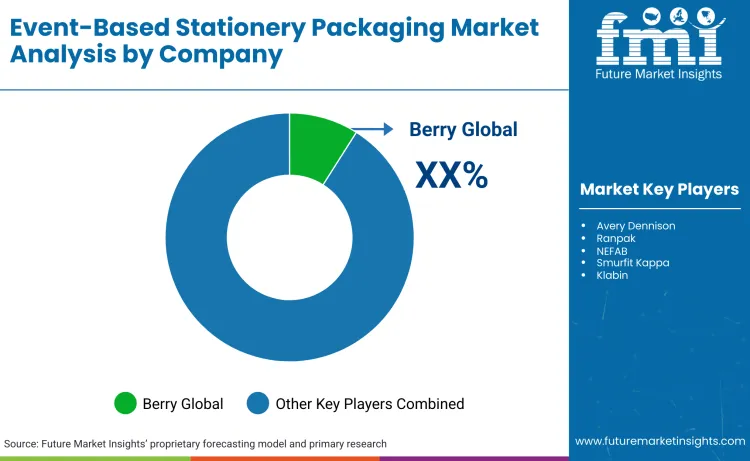
The market landscape is defined by intense consolidation as global leaders race to secure sustainable material supply chains. Amcor announced the acquisition of Berry Global in November 2024 for USD 8.4 billion, signaling a strategic focus on capturing premium stationery products. Peter Konieczny, CEO of Amcor, emphasized that this combination delivers on their strategy to accelerate growth by elevating the role of sustainability. Similarly, the merger of Smurfit Kappa and WestRock in July 2024 created a transatlantic juggernaut capable of serving multinational clients with consistent paperboard solutions. These mega-mergers allow companies to standardize event packaging across borders, ensuring that large event organizers receive consistent quality and pricing globally, while smaller players must specialize to survive. Companies are investing heavily in sustainable innovation to meet regulatory mandates and command premium pricing in the corporate event channel.
Graphic Packaging International reported in July 2025 that it replaced 1 billion plastic packages with paperboard in 2024 while simultaneously filing 130+ new patents in sustainable packaging solutions. Sealed Air launched its Ready-To-Roll Embossed Paper product line in August 2024, positioning itself as a leader in replacing plastic protective materials with fiber-based alternatives. Fedrigoni Group achieved a 74/100 S&P Global ESG Score in March 2025, a 10-point improvement driven by sustainable procurement practices and circular innovation initiatives. These investments validate that manufacturers recognize sustainability as a core competitive advantage rather than a compliance burden. Event organizers increasingly specify sustainability credentials in procurement requirements, and attendees expect premium, environmentally-responsible packaging. Companies that lead in certified sustainable solutions will capture 25-35% of market value creation through 2036.
Recent Developments:
- In February 2026, private equity firm Foundation Investment Partners acquired South Carolina-based Paper Converters, a manufacturer of paper tubes, edge board, and sheeting. This builds on their 2024 acquisition of Amspak, promoting collaboration in paper-based packaging suitable for event stationery items such as invitations and gift wraps.
- In January 2026, International Paper announced plans to separate into two independent companies, creating a dedicated EMEA Packaging business focused on sustainable solutions. This restructuring accelerates innovation in fiber-based packaging, benefiting event-based stationery applications through enhanced regional operations and customer-focused designs.
Key Players in Event-Based Stationery Packaging Market
- Amcor plc
- Berry Global Group
- Avery Dennison Corporation
- Ranpak Corp
- NEFAB AB
- Smurfit Westrock
- Klabin S.A.
- Sealed Air Corporation
- Graphic Packaging International
- Stora Enso Oyj
- Metsä Board Oyj
- Fedrigoni Group
- DS Smith plc
- Mondi Group
Market Definition
The event-based stationery packaging market represents revenue generated from purpose-designed packaging solutions sold to corporate event organizers, event management companies, hospitality venues, and corporate procurement departments for use in attendee welcome kits, speaker acknowledgment packages, incentive travel amenities, and branded merchandise protection during shipping. As operationally defined, the market measures rigid and flexible packaging formats explicitly designed and marketed for the event channel, including printed carton boxes, protective wrapping, specialty paper inserts, branded dividers, and intelligent packaging elements (RFID, NFC) embedded for attendee engagement tracking or supply chain authentication.
The market explicitly includes packaging solutions for corporate team retreats, industry conferences, trade shows and exhibitions, incentive travel amenities, and professional gifting kits. Packaging materials must be specifically marketed and sold for event applications rather than general-purpose commercial packaging. Intelligent packaging technologies (RFID/NFC enabled) sold as integrated components of event kits are included. Revenue from sustainability certifications, design services, and supply chain logistics for event packaging is included where bundled with packaging sales. The market excludes revenues from catering packaging, furniture, venue rentals, event insurance, and professional event management services.
General-purpose commercial packaging not designed for events is excluded, even if used incidentally for event applications. Reusable containers and returnable packaging are excluded. Internal corporate event spending by organizers on promotional items unrelated to packaging is outside scope. Printing services unrelated to packaging substrate are excluded. Digital event management platforms and virtual event technologies are not included. Government or nonprofit event spending (charitable galas, government conferences) is excluded unless through commercial event management intermediaries using the packaging market distribution channel.
Scope of Report
| Items | Values |
|---|---|
| Quantitative Units (2026) | USD 0.9 billion |
| Product Type | Rigid Boxes, Flexible Pouches, Protective Papers, Specialty Inserts, Intelligent Labels, Branded Dividers |
| End-Use Channel | Corporate Events (42%), Trade Shows (31%), Incentive/Retail Gifting (27%) |
| Material Type | Fiber-Based Boards (78%), Specialty Substrates (10%), Intelligent Materials (12%) |
| Customer Type | Corporate Event Planners, Hospitality Venues, Event Management Companies, Corporate Procurement |
| Regions Covered | North America, Europe, Asia Pacific, Latin America, Middle East & Africa |
| Countries Covered | United States, United Kingdom, China, Japan, India, Brazil, and 35+ countries |
| Key Companies Profiled | Amcor, Berry Global, Avery Dennison, Ranpak, NEFAB, Smurfit Westrock, Klabin, Sealed Air, Graphic Packaging |
| Additional Attributes | Revenue analysis by channel and material, regulatory impact assessment (plastic phase-out timelines), sustainable material penetration, intelligent packaging adoption trends, competitive consolidation analysis, export/import dynamics by region |
Source: FMI historical analysis and forecast data
Event-Based Stationery Packaging Market by Segments
By End-Use Channel:
- Corporate Events (42% share)
- Trade Shows and Exhibitions (31% share)
- Incentive Travel and Retail Gifting (27% share)
By Material Composition:
- Fiber-Based Boards and Paperboard (78% share)
- Specialty Substrates and Premium Papers (10% share)
- Intelligent Materials with RFID/NFC (12% share)
By Product Format:
- Rigid Boxes and Cartons
- Flexible Pouches and Wraps
- Protective Papers and Cushioning
- Branded Inserts and Dividers
- Intelligent/Connected Labels
By Region:
- North America
- Europe
- Asia Pacific
- Latin America
- Middle East & Africa
Bibliography
- National Bureau of Statistics of China. (2025). Industrial production statistics: Paper and paper products manufacturing 2024. NBS China.
- General Administration of Customs of China. (2025). Export data for paper and packaging materials 2024. GACC.
- Directorate General of Commercial Intelligence and Statistics, Government of India. (2025). Trade statistics for paper and paperboard imports 2024–25. Ministry of Commerce.
- Instituto Brasileiro de Geografia e Estatística. (2025). Industrial production survey (PIM-PF): Pulp and paper sector performance. IBGE SIDRA.
- Ministry of Economy, Trade and Industry, Japan. (2024, March). Industrial Production Index: Paper and pulp sector. METI Statistics.
- Environment Protection Authority New South Wales. (2024, October). Waste and recycling 2024: Plastic waste generation and recycling rates. NSW EPA.
- Department for Environment, Food & Rural Affairs. (2024, December). Extended Producer Responsibility (EPR) for packaging: Base fees revision. UK Government.
Frequently Asked Questions
What is the current global market size for Event-Based Stationery Packaging?
The global Event-Based Stationery Packaging market is valued at USD 0.9 billion in 2026, driven by the full recovery of corporate event spending and regulatory mandates eliminating single-use plastics from event kits.
What is the projected CAGR for the Event-Based Stationery Packaging market?
Market revenues are projected to grow at a robust 12.30% CAGR from 2026 to 2036, expanding from USD 0.9 billion to USD 3.1 billion, reflecting sustained corporate event activity and the margin expansion from sustainable material premiums.
Which end-use channel currently dominates the industry?
Corporate events hold the dominant 42% market share, driven by high per-attendee spending and brand differentiation priorities that enable premium pricing for sustainable, intelligently-designed packaging solutions.
What are the primary barriers to market growth?
Supply chain concentration risk (limited certified sustainable fiber suppliers), transitional costs for manufacturers investing in plastic replacement technologies, and global economic volatility affecting corporate event budgets remain significant barriers.
Who are the leading players in the Event-Based Stationery Packaging market?
Amcor (post-Berry Global merger), Smurfit Westrock, Avery Dennison, Klabin, Sealed Air, and Graphic Packaging International lead the market through extensive geographic presence, sustainable material capabilities, and innovation in intelligent packaging technologies.
Preview the report firsthand - request a free sample
Get SampleGet the brochure for pricing and purchase details.
Get PDFTable of Content
- Executive Summary
- Global Market Outlook
- Demand Side Trends
- Supply Side Trends
- Technology Roadmap Analysis
- Analysis and Recommendations
- Market Overview
- Market Coverage / Taxonomy
- Market Definition / Scope / Limitations
- Research Methodology
- Chapter Orientation
- Analytical Lens and Working Hypotheses
- Market Structure, Signals, and Trend Drivers
- Benchmarking and Cross-market Comparability
- Market Sizing, Forecasting, and Opportunity Mapping
- Research Design and Evidence Framework
- Desk Research Programme (Secondary Evidence)
- Company Annual and Sustainability Reports
- Peer-reviewed Journals and Academic Literature
- Corporate Websites, Product Literature, and Technical Notes
- Earnings Decks and Investor Briefings
- Statutory Filings and Regulatory Disclosures
- Technical White Papers and Standards Notes
- Trade Journals, Industry Magazines, and Analyst Briefs
- Conference Proceedings, Webinars, and Seminar Materials
- Government Statistics Portals and Public Data Releases
- Press Releases and Reputable Media Coverage
- Specialist Newsletters and Curated Briefings
- Sector Databases and Reference Repositories
- FMI Internal Knowledge Base and Historical Datasets
- Subscription Datasets and Paid Sources
- Social Channels, Communities, and Digital Listening Inputs
- Additional Desk Sources
- Expert Input and Fieldwork (Primary Evidence)
- Primary Modes
- Qualitative Interviews and Expert Elicitation
- Quantitative Surveys and Structured Data Capture
- Blended Approach
- Why Primary Evidence is Used
- Field Techniques
- Interviews
- Surveys
- Focus Groups
- Observational and In-context Research
- Social and Community Interactions
- Stakeholder Universe Engaged
- C-suite Leaders
- Board Members
- Presidents and Vice Presidents
- R&D and Innovation Heads
- Technical Specialists
- Domain Subject-matter Experts
- Scientists
- Event Organizers and Procurement Heads
- Governance, Ethics, and Data Stewardship
- Research Ethics
- Data Integrity and Handling
- Primary Modes
- Tooling, Models, and Reference Databases
- Desk Research Programme (Secondary Evidence)
- Data Engineering and Model Build
- Data Acquisition and Ingestion
- Cleaning, Normalisation, and Verification
- Synthesis, Triangulation, and Analysis
- Quality Assurance and Audit Trail
- Market Background
- Market Dynamics
- Drivers
- Restraints
- Opportunity
- Trends
- Scenario Forecast
- Demand in Optimistic Scenario
- Demand in Likely Scenario
- Demand in Conservative Scenario
- Opportunity Map Analysis
- Product Life Cycle Analysis
- Supply Chain Analysis
- Investment Feasibility Matrix
- Value Chain Analysis
- PESTLE and Porter's Analysis
- Regulatory Landscape
- Regional Parent Market Outlook
- Production and Consumption Statistics
- Import and Export Statistics
- Market Dynamics
- Global Market Analysis 2021 to 2025 and Forecast, 2026 to 2036
- Historical Market Size Value (USD Billion) Analysis, 2021 to 2025
- Current and Future Market Size Value (USD Billion) Projections, 2026 to 2036
- Y-o-Y Growth Trend Analysis
- Absolute $ Opportunity Analysis
- Global Market Pricing Analysis 2021 to 2025 and Forecast 2026 to 2036
- Y-o-Y Growth Trend Analysis 2021 to 2025
- Absolute $ Opportunity Analysis 2026 to 2036
- Global Market Analysis 2021 to 2025 and Forecast 2026 to 2036, By End-Use Channel
- Introduction / Key Findings
- Historical Market Size Value (USD Billion) Analysis By End-Use Channel, 2021 to 2025
- Current and Future Market Size Value (USD Billion) Analysis and Forecast By End-Use Channel, 2026 to 2036
- Corporate Events
- Trade Shows and Exhibitions
- Incentive Travel and Retail Gifting
- Y-o-Y Growth Trend Analysis By End-Use Channel, 2021 to 2025
- Absolute $ Opportunity Analysis By End-Use Channel, 2026 to 2036
- Global Market Analysis 2021 to 2025 and Forecast 2026 to 2036, By Material Composition
- Introduction / Key Findings
- Historical Market Size Value (USD Billion) Analysis By Material Composition, 2021 to 2025
- Current and Future Market Size Value (USD Billion) Analysis and Forecast By Material Composition, 2026 to 2036
- Fiber-Based Boards and Paperboard
- Specialty Substrates and Premium Papers
- Intelligent Materials with RFID/NFC
- Y-o-Y Growth Trend Analysis By Material Composition, 2021 to 2025
- Absolute $ Opportunity Analysis By Material Composition, 2026 to 2036
- Global Market Analysis 2021 to 2025 and Forecast 2026 to 2036, By Product Format
- Introduction / Key Findings
- Historical Market Size Value (USD Billion) Analysis By Product Format, 2021 to 2025
- Current and Future Market Size Value (USD Billion) Analysis and Forecast By Product Format, 2026 to 2036
- Rigid Boxes and Cartons
- Flexible Pouches and Wraps
- Protective Papers and Cushioning
- Branded Inserts and Dividers
- Intelligent/Connected Labels
- Y-o-Y Growth Trend Analysis By Product Format, 2021 to 2025
- Absolute $ Opportunity Analysis By Product Format, 2026 to 2036
- Global Market Analysis 2021 to 2025 and Forecast 2026 to 2036, By Region
- Introduction
- Historical Market Size Value (USD Billion) Analysis By Region, 2021 to 2025
- Current Market Size Value (USD Billion) Analysis and Forecast By Region, 2026 to 2036
- North America
- Latin America
- Western Europe
- Eastern Europe
- East Asia
- South Asia and Pacific
- Middle East & Africa
- Market Attractiveness Analysis By Region
- North America Market Analysis 2021 to 2025 and Forecast 2026 to 2036, By Country
- Historical Market Size Value (USD Billion) Trend Analysis By Market Taxonomy, 2021 to 2025
- Market Size Value (USD Billion) Forecast By Market Taxonomy, 2026 to 2036
- By Country
- USA
- Canada
- Mexico
- By End-Use Channel
- By Material Composition
- By Product Format
- By Country
- Market Attractiveness Analysis
- By Country
- By End-Use Channel
- By Material Composition
- By Product Format
- Key Takeaways
- Latin America Market Analysis 2021 to 2025 and Forecast 2026 to 2036, By Country
- Historical Market Size Value (USD Billion) Trend Analysis By Market Taxonomy, 2021 to 2025
- Market Size Value (USD Billion) Forecast By Market Taxonomy, 2026 to 2036
- By Country
- Brazil
- Chile
- Rest of Latin America
- By End-Use Channel
- By Material Composition
- By Product Format
- By Country
- Market Attractiveness Analysis
- By Country
- By End-Use Channel
- By Material Composition
- By Product Format
- Key Takeaways
- Western Europe Market Analysis 2021 to 2025 and Forecast 2026 to 2036, By Country
- Historical Market Size Value (USD Billion) Trend Analysis By Market Taxonomy, 2021 to 2025
- Market Size Value (USD Billion) Forecast By Market Taxonomy, 2026 to 2036
- By Country
- Germany
- UK
- Italy
- Spain
- France
- Nordic
- BENELUX
- Rest of Western Europe
- By End-Use Channel
- By Material Composition
- By Product Format
- By Country
- Market Attractiveness Analysis
- By Country
- By End-Use Channel
- By Material Composition
- By Product Format
- Key Takeaways
- Eastern Europe Market Analysis 2021 to 2025 and Forecast 2026 to 2036, By Country
- Historical Market Size Value (USD Billion) Trend Analysis By Market Taxonomy, 2021 to 2025
- Market Size Value (USD Billion) Forecast By Market Taxonomy, 2026 to 2036
- By Country
- Russia
- Poland
- Hungary
- Balkan & Baltic
- Rest of Eastern Europe
- By End-Use Channel
- By Material Composition
- By Product Format
- By Country
- Market Attractiveness Analysis
- By Country
- By End-Use Channel
- By Material Composition
- By Product Format
- Key Takeaways
- East Asia Market Analysis 2021 to 2025 and Forecast 2026 to 2036, By Country
- Historical Market Size Value (USD Billion) Trend Analysis By Market Taxonomy, 2021 to 2025
- Market Size Value (USD Billion) Forecast By Market Taxonomy, 2026 to 2036
- By Country
- China
- Japan
- South Korea
- By End-Use Channel
- By Material Composition
- By Product Format
- By Country
- Market Attractiveness Analysis
- By Country
- By End-Use Channel
- By Material Composition
- By Product Format
- Key Takeaways
- South Asia and Pacific Market Analysis 2021 to 2025 and Forecast 2026 to 2036, By Country
- Historical Market Size Value (USD Billion) Trend Analysis By Market Taxonomy, 2021 to 2025
- Market Size Value (USD Billion) Forecast By Market Taxonomy, 2026 to 2036
- By Country
- India
- ASEAN
- Australia & New Zealand
- Rest of South Asia and Pacific
- By End-Use Channel
- By Material Composition
- By Product Format
- By Country
- Market Attractiveness Analysis
- By Country
- By End-Use Channel
- By Material Composition
- By Product Format
- Key Takeaways
- Middle East & Africa Market Analysis 2021 to 2025 and Forecast 2026 to 2036, By Country
- Historical Market Size Value (USD Billion) Trend Analysis By Market Taxonomy, 2021 to 2025
- Market Size Value (USD Billion) Forecast By Market Taxonomy, 2026 to 2036
- By Country
- Kingdom of Saudi Arabia
- Other GCC Countries
- Turkiye
- South Africa
- Other African Union
- Rest of Middle East & Africa
- By End-Use Channel
- By Material Composition
- By Product Format
- By Country
- Market Attractiveness Analysis
- By Country
- By End-Use Channel
- By Material Composition
- By Product Format
- Key Takeaways
- Key Countries Market Analysis
- USA
- Pricing Analysis
- Market Share Analysis, 2025
- By End-Use Channel
- By Material Composition
- By Product Format
- Canada
- Pricing Analysis
- Market Share Analysis, 2025
- By End-Use Channel
- By Material Composition
- By Product Format
- China
- Pricing Analysis
- Market Share Analysis, 2025
- By End-Use Channel
- By Material Composition
- By Product Format
- India
- Pricing Analysis
- Market Share Analysis, 2025
- By End-Use Channel
- By Material Composition
- By Product Format
- Brazil
- Pricing Analysis
- Market Share Analysis, 2025
- By End-Use Channel
- By Material Composition
- By Product Format
- UK
- Pricing Analysis
- Market Share Analysis, 2025
- By End-Use Channel
- By Material Composition
- By Product Format
- Japan
- Pricing Analysis
- Market Share Analysis, 2025
- By End-Use Channel
- By Material Composition
- By Product Format
- Germany
- Pricing Analysis
- Market Share Analysis, 2025
- By End-Use Channel
- By Material Composition
- By Product Format
- France
- Pricing Analysis
- Market Share Analysis, 2025
- By End-Use Channel
- By Material Composition
- By Product Format
- Italy
- Pricing Analysis
- Market Share Analysis, 2025
- By End-Use Channel
- By Material Composition
- By Product Format
- Kingdom of Saudi Arabia
- Pricing Analysis
- Market Share Analysis, 2025
- By End-Use Channel
- By Material Composition
- By Product Format
- South Africa
- Pricing Analysis
- Market Share Analysis, 2025
- By End-Use Channel
- By Material Composition
- By Product Format
- USA
- Market Structure Analysis
- Competition Dashboard
- Competition Benchmarking
- Market Share Analysis of Top Players
- By Regional
- By End-Use Channel
- By Material Composition
- By Product Format
- Competition Analysis
- Competition Deep Dive
- Amcor plc
- Berry Global Group
- Avery Dennison Corporation
- Ranpak Corp
- NEFAB AB
- Smurfit Westrock
- Klabin S.A.
- Sealed Air Corporation
- Graphic Packaging International
- Stora Enso Oyj
- Metsä Board Oyj
- Fedrigoni Group
- DS Smith plc
- Mondi Group
- Competition Deep Dive
- Assumptions & Acronyms Used


