

- Industry Size (2026)
- USD 0.82 Bn
- Forecast (2036)
- USD 2.2 Bn
- CAGR (2026 to 2036)
- 10.40%
ADAS Level 3 Certification Impacts Market Size, Market Forecast and Outlook By FMI
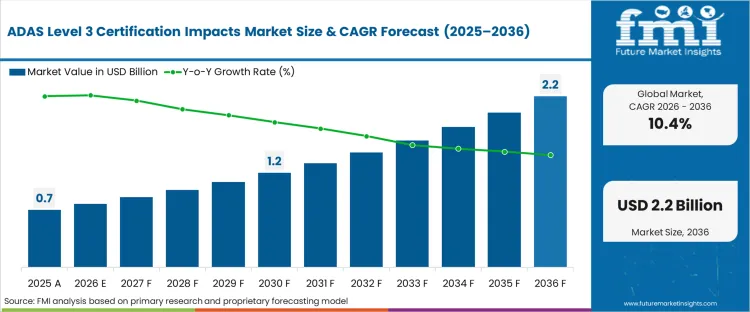
The ADAS Level 3 certification impacts market was valued at USD 0.74 billion in 2025. Revenue is expected to surpass USD 0.82 billion in 2026 at a CAGR of 10.40% during the forecast period. Ongoing capital commitments accelerate the sector’s total valuation
to USD 2.2 billion through 2036 as automakers face unprecedented Level 3 homologation cost per vehicle program requirements to satisfy transport ministries.
Homologation directors at major automakers face an immediate timeline crunch navigating Level 3 vs Level 2 certification complexity. Securing regulatory clearance for automated lane-keeping systems requires distinct regional evidence sets, forcing rapid adoption of localized advanced driver assistance systems audit partners. Failing to secure type approval before a model year launch halts regional distribution entirely. The Level 3 autonomous driving certification market operates differently from self-certified testing, carrying massive commercial risk because regulators increasingly demand independent automotive homologation services documentation.
Summary of ADAS Level 3 Certification Impacts Market
- ADAS Level 3 Certification Impacts Market Definition
- This sector captures external capital directed toward securing legal operating permits for conditionally automated vehicles, spanning physical testing audits, digital simulation approvals, and ongoing cybersecurity homologation requirements mandated by global transport authorities.
- Demand Drivers in the Market
- Stringent UNECE regulations compel homologation engineers to contract an autonomous driving approval service provider for unbiased safety case validation.
- Evolving operational design domains force regulatory affairs managers to continuously recertify updated software stacks across different jurisdictions to manage UN R157 certification cost.
- Complex cybersecurity mandates push vehicle program directors to outsource software update management system audits.
- Key Segments Analyzed in the FMI Report
- Type approval and homologation engineering is anticipated to record 31.0% share in 2026, driven by mandatory external technical service signatures.
- Physical vehicle and proving-ground validation is projected to capture 34.0% share in 2026, anchored by regulators requiring real-world evidence from Level 3 certification testing labs.
- Premium passenger cars is set to account for 58.0% share in 2026, reflecting where initial high-cost autonomy packages remain financially viable.
- OEMs is estimated to command 62.0% share in 2026, as final legal liability rests with vehicle manufacturers.
- UN R157 / motorway Level 3 approval is poised to hold 36.0% share in 2026, acting as baseline architecture for initial deployments.
- China: 13.6% compound growth, propelled by an aggressive national transition toward standardized data-recording compliance frameworks.
- Analyst Opinion at FMI
- Nikhil Kaitwade, Principal Analyst, Automotive, at FMI, notes that, "Generalist models assume simulation software will quickly replace expensive physical track testing for Level 3 compliance. Regulators actually require physical edge-case validation to ground-truth digital models before issuing type approvals. Certification bodies profit twice: first by auditing autonomous driving simulation tester toolchains, and again by executing physical witness tests."
- Strategic Implications / Executive Takeaways
- Technical service providers must expand digital audit capabilities to capture recurring software update homologation revenue.
- Automaker compliance teams face severe bottlenecks if relying on single-jurisdiction automotive tic partners for global platform launches.
- Toolchain vendors gain advantage by pre-certifying simulation environments to reduce final OEM regulatory submission friction.
| Metric | Details |
|---|---|
| Industry Size (2026) | USD 0.82 billion |
| Industry Value (2036) | USD 2.2 billion |
| CAGR (2026-2036) | 10.40% |
Source: Future Market Insights (FMI) analysis, based on proprietary forecasting model and primary research
Once national transport authorities begin linking software update management systems directly to continued road-legality permits, certification spend becomes an ongoing operational expenditure rather than a one-time launch cost. This recurring post approval software update compliance Level 3 requirement ensures continuous revenue streams for testing houses. Pre-launch approvals signal just one phase of an ongoing validation lifecycle defining the Level 3 vehicle approval services market.
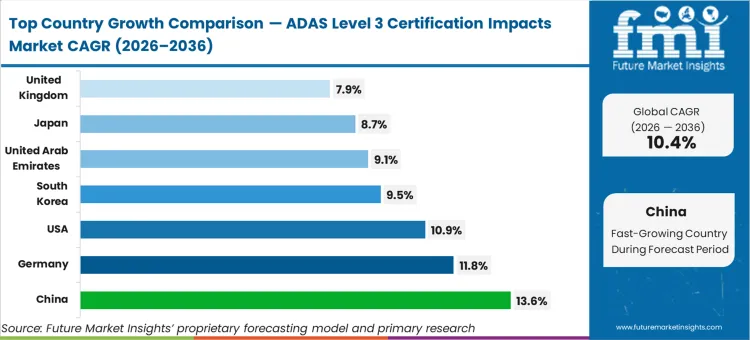
Geographic divergence shapes the overall ADAS Level 3 market size and CAGR. The China Level 3 certification market expands at 13.6% as regulators finalize mandatory data-recording standards for high-level autonomy. The Germany Level 3 homologation market tracks closely at 11.8% driven by premium automakers seeking autonomous vehicles clearances on domestic autobahns. The United States Level 3 vehicle approval services segment grows at 10.9% through varying state-level deployment rules. South Korea posts 9.5% growth following recent safety standard updates. The United Arab Emirates registers 9.1% driven by forward-leaning autonomous fleet policies. Japan expands at 8.7%, focusing on narrow operational domains. The United Kingdom progresses at 7.9% prioritizing framework-led integration.
Definition
This sector measures the automated driving type approval market, comprising third-party engineering, auditing, and validation services required to secure legal permits for conditionally automated driving systems. The entire autonomous driving approval process strictly covers external spend directed toward regulatory compliance, independent safety case generation, and continuous software homologation. Internal research and development expenditures fall outside this boundary.
Inclusions
Scope incorporates Level 3 autonomous vehicle cybersecurity homologation, scenario-based proving ground rentals tied to type approval, and external automotive cybersecurity update management audits. Third-party engineering hours dedicated specifically to translating SAE Level 3 SOTIF and functional safety evidence into compliant regulatory submissions form a core revenue stream for any autonomous driving approval service provider.
Exclusions
Hardware sensors, internal automaker testing payroll, and basic consumer crash-testing programs are excluded. Procurement of general automotive test equipment does not constitute certification spend. Standard vehicle homologation unrelated to specific Level 3 ODD validation requirements remains categorized under conventional testing markets.
ADAS Level 3 Certification Impacts Market Research Methodology
- Primary Research: Homologation directors, independent technical service auditors, and a Level 3 ADAS homologation consultant
- Desk Research: UNECE R157 type approval registries, national transport ministry deployment permits, and ISO 21448 certification logs
- Market-Sizing and Forecasting: Billed consulting hours for active Level 3 vehicle programs across top tier automakers
- Data Validation and Update Cycle: Cross-referencing technical service provider public financial disclosures with regional regulatory approval announcements
Segmental Analysis
ADAS Level 3 Certification Impacts Market Analysis by Service Type
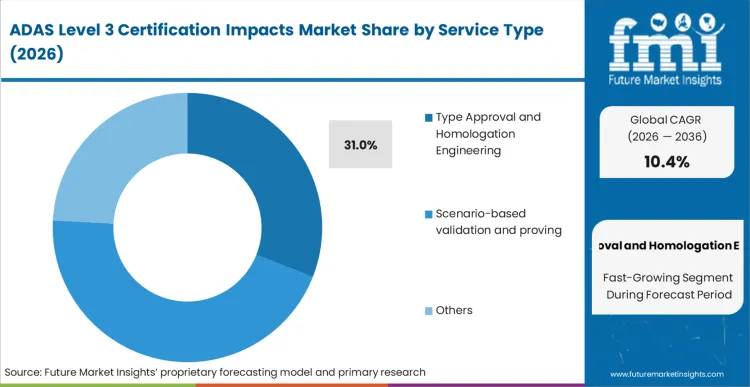
Mandatory third-party signatures explain why Type approval and homologation engineering holds 31.0% share in this sector. Functional safety managers at automakers cannot self-certify Level 3 systems for public roads; they require authorised technical services to validate safety cases. Based on FMI's assessment, securing initial operational design domain clearance demands intense engineering collaboration between automaker compliance teams and independent auditors navigating the complex autonomous driving safety case market. Integrating connected car evidence directly into regulatory dossiers forms a massive operational undertaking. Outsourcing this translation process ensures dossiers meet exact transport ministry formatting requirements. General testing data proves insufficient: transport authorities reject submissions lacking explicit correlation to UNECE parameters, forcing costly re-tests. Relying on inexperienced engineering partners delays type approval, directly impacting vehicle launch schedules across critical regions.
- Regulatory translation: Homologation engineers convert internal test data into standardized legal submissions. Compliance directors avoid submission rejections.
- Continuous compliance: Safety managers monitor ongoing rule changes impacting deployed fleets. Post-launch operational permits remain valid.
- Liability transfer: Automakers leverage independent technical service signatures. Chief engineers mitigate internal legal exposure during certification.
ADAS Level 3 Certification Impacts Market Analysis by Validation Layer
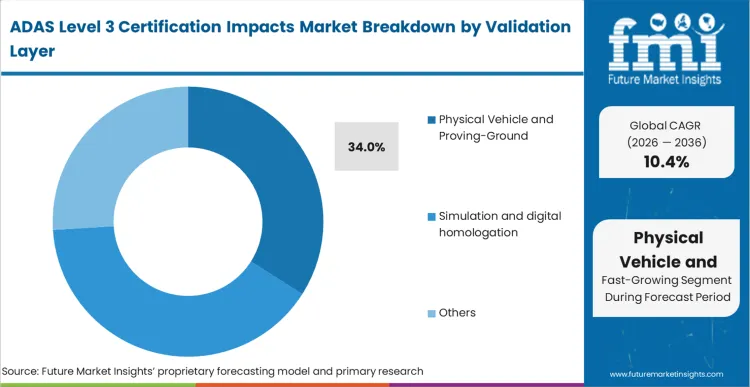
Transport authorities distrust purely digital evidence, cementing Physical vehicle and proving-ground validation at 34.0% share. Regulatory affairs managers must present real-world track data to validate theoretical safety models before authorities grant highway pilot permits. FMI's analysis indicates physical witness testing serves as an unavoidable hurdle despite automaker desires to move toward cheaper automotive ota updates compliance simulations and digital homologation for Level 3 vehicles. Booking dedicated proving grounds with certified audit teams creates significant logistical friction during final vehicle development phases. Simulation environments cannot yet legally replicate complex weather degraded sensor performance to regulator satisfaction. Attempting to bypass physical witness testing guarantees type approval denial.
- Ground truth validation: Technical service auditors witness physical edge-case scenarios on closed tracks. Automakers secure baseline performance proof.
- Sensor degradation verification: Test engineers evaluate hardware limits under adverse weather. Functional safety directors satisfy physical limitation mandates.
- Audit coordination: Proving ground managers align facility availability with technical service schedules. Vehicle program directors avoid launch-delaying bottlenecks.
ADAS Level 3 Certification Impacts Market Analysis by Vehicle Platform
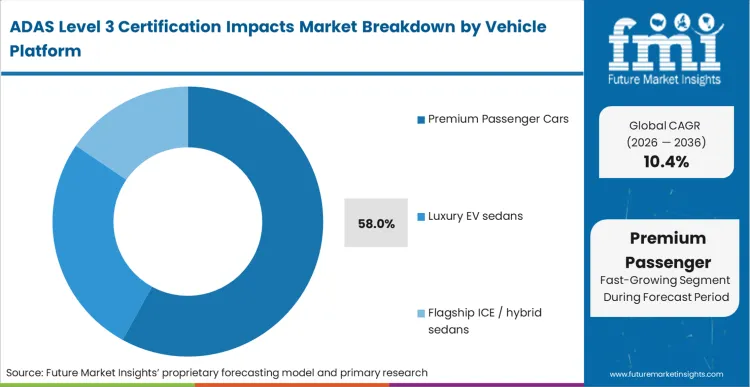
High integration costs dictate why Premium passenger cars command 58.0% share currently. Chief engineers prioritize flagship models for Level 3 deployment because massive sensor suites and redundant architectures require high-margin pricing structures to absorb development expenditures. FMI analysts note that certification costs scale poorly down to mass-market segments, confining early approvals to luxury platforms. Validating redundant vehicle software operations for a low-volume flagship sedan costs nearly as much as validating a mass-market compact. Automakers essentially treat premium sedans as regulatory icebreakers, establishing precedent before attempting broader deployment. Delaying flagship certification cedes critical technological leadership positioning to rival luxury brands.
- Margin absorption: Product planners allocate massive certification costs against high sticker prices. Automakers protect profitability during early autonomy rollouts.
- Architecture redundancy: Systems engineers validate complex dual-power and steering layouts. Homologation directors ensure fail-operational compliance.
- Precedent setting: Regulatory teams negotiate initial operational design domains using flagship data. Future mass-market platform approvals move faster.
ADAS Level 3 Certification Impacts Market Analysis by Customer Type
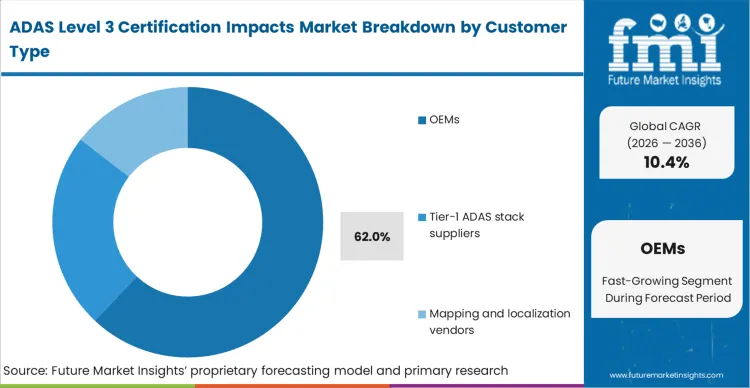
Final legal accountability forces OEMs to maintain 62.0% share of direct certification spending. While suppliers provide validated components, vehicle program directors must prove the integrated system functions safely as a complete unit. In FMI's view, transport ministries issue type approvals exclusively to vehicle manufacturers, ensuring OEMs bear ultimate responsibility for connected vehicle technology compliance. Tier-1 suppliers handle component-level validation, but system-level homologation requires OEM-funded proving ground programs and technical service audits. Component-level pre-certification reduces final integration friction but cannot replace mandatory whole-vehicle audits. Automakers who attempt to shift final certification burdens onto suppliers face immediate regulatory gridlock.
- System integration auditing: Technical services evaluate whole-vehicle safety concepts. Vehicle program directors secure unified type approval.
- Ongoing permit maintenance: Compliance officers manage continuous software update evidence. Fleet legality remains intact across active lifecycles.
- Cross-jurisdiction harmonization: Regulatory managers coordinate distinct approval requirements across borders. Global launch strategies execute seamlessly.
ADAS Level 3 Certification Impacts Market Analysis by Regulatory Scope
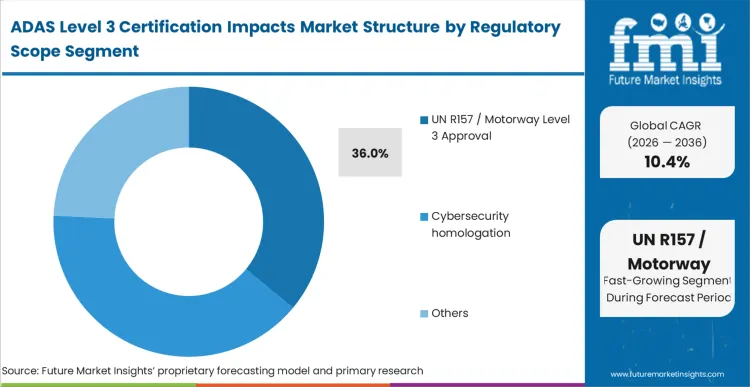
Establishing baseline highway pilot parameters drives UN R157 / motorway Level 3 approval to 36.0% share. Regulatory affairs managers utilize this framework as a standardized starting point for securing initial conditional automation permits across participating nations. As per FMI's projection, standardizing automotive network testing protocols around R157 allows automakers to streamline engineering efforts rather than building bespoke dossiers for every country. Regional transport authorities increasingly demand local data variations, complicating this unified approach. ODD restriction validation for Level 3 vehicles and driver handover validation for Level 3 require parallel certification tracks. Ignoring specific national extensions risks blocking critical regional sales channels despite holding UN-level clearance.
- Baseline dossier generation: Homologation engineers compile standardized safety cases matching R157 parameters. Automakers secure multi-nation European approvals efficiently.
- Operational limitation definition: Functional safety managers mathematically define maximum safe speeds and following distances. Regulators approve specific highway pilot constraints.
- Localization adaptation: Compliance directors modify baseline dossiers to meet specific national variations. Vehicles achieve legal status outside core UNECE zones.
ADAS Level 3 Certification Impacts Market Drivers, Restraints, and Opportunities
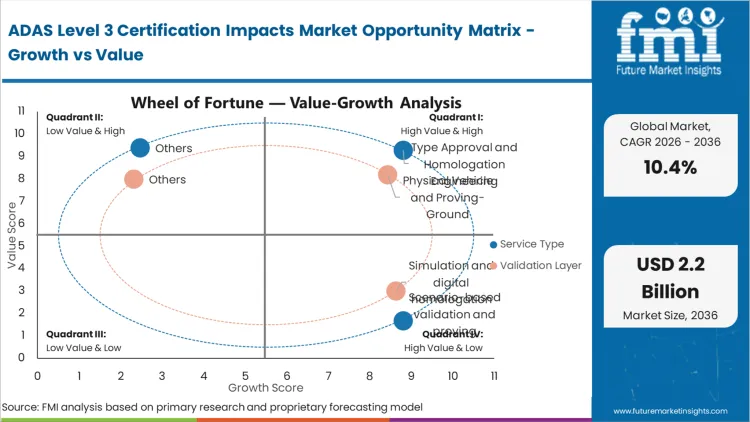
Mandatory UNECE software update regulations force regulatory affairs managers to continuously recertify vehicle platforms long after initial sale. Delaying these automotive connectivity audits risks immediate suspension of existing vehicle type approvals, paralyzing fleet operations. This transforms the Level 3 ADAS certification market from a discrete pre-launch event into a continuous operational expenditure, guaranteeing sustained demand for independent technical services capable of auditing complex over-the-air update management systems.
Fragmented national deployment frameworks slow global platform rollouts despite unified engineering efforts. Local transport authorities routinely demand jurisdiction-specific proving ground data, undermining UN-level harmonization attempts. This localization requirement forces automakers to duplicate costly witness testing programs across multiple regions. Standardized vehicle cybersecurity management audits offer partial mitigation, but true global homologation remains impeded by divergent national safety philosophies.
Opportunities in the ADAS Level 3 Certification Impacts Market
- Simulation toolchain pre-certification: Validation tool providers secure independent accreditation for digital testing environments. Automaker compliance directors accelerate overall homologation timelines using trusted virtual models.
- Cybersecurity management auditing: Technical services establish dedicated business units for ISO/SAE 21434 compliance. Software engineers gain necessary iso 24089 software update compliance management platforms certifications for continuous deployment.
- ODD expansion validation: Engineering firms specialize in validating broader operational design domains. Vehicle program directors successfully expand highway pilots into complex urban environments.
Regional Analysis
The ADAS Level 3 Certification Impacts market is geographically segmented into Europe, Asia Pacific, and North America, extending across more than 40 countries.
.webp "Top Country Growth Comparison Adas Level 3 Certification Impacts Market Cagr (2026 2036)")
| Country | CAGR (2026 to 2036) |
|---|---|
| China | 13.6% |
| Germany | 11.8% |
| United States | 10.9% |
| South Korea | 9.5% |
| United Arab Emirates | 9.1% |
| Japan | 8.7% |
| United Kingdom | 7.9% |
Source: Future Market Insights (FMI) analysis, based on proprietary forecasting model and primary research
Europe ADAS Level 3 Certification Impacts Market Analysis
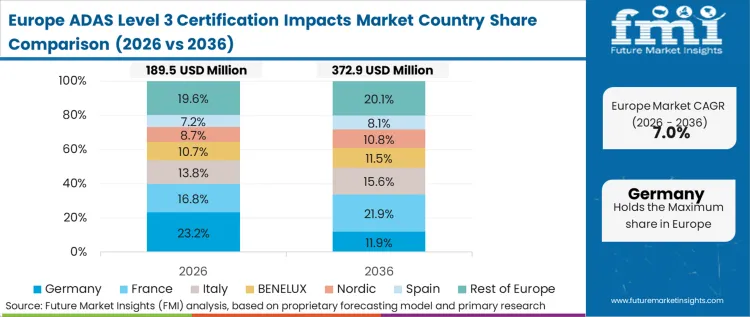
Stringent UNECE regulatory enforcement shapes how technical services operate across European jurisdictions. Regulators mandate independent verification for all conditionally automated systems before granting public road access. FMI's analysis indicates European transport ministries lead global standardization efforts, forcing automakers to adapt certification pipelines to strict R157 parameters. Automakers prioritize European automotive adas autonomy mlops and model lifecycle management audits to secure approvals applicable across multiple member states simultaneously.
- Germany: Germany’s Level 3 homologation market expands at an 11.8% CAGR through 2036. Domestic regulatory authorities actively issue highway pilot permits for premium automakers. Homologation directors leverage clear legal frameworks to execute structured physical validation programs. Early approvals grant German technical services a massive head start in defining global best practices.
- United Kingdom: Domestic deployment relies heavily on consultation-led frameworks, forcing compliance directors to submit extensive simulation evidence before physical testing begins. Revenue tied to UK ALKS approval services is estimated to advance at 7.9% yearly. Because the Vehicle Certification Agency requires prolonged digital safety audits, automakers deliberately treat this jurisdiction as a secondary, documentation-heavy deployment phase.
FMI's report includes France and Italy. Regulatory bodies in these nations closely monitor German deployments before expanding their own national permit structures.
Asia Pacific ADAS Level 3 Certification Impacts Market Analysis
Aggressive national data-recording mandates dictate certification strategies across major Asian manufacturing hubs. Transport authorities demand deep access to internal system logs during type approval processes. Based on FMI's assessment, localizing automotive communication technology validation becomes mandatory as governments restrict cross-border data flows regarding autonomous mapping.
- China: The China Level 3 certification market is projected to grow at a 13.6% CAGR. National transport ministries enforce strict domestic data handling requirements for high-level autonomy. Regulatory affairs directors must contract local technical services to handle sensitive mapping validation. Rapidly tightening safety standards pull massive certification work away from internal engineering teams into third-party audit houses.
- South Korea: Updated national safety standards force automakers to revamp homologation pipelines. Functional safety managers collaborate with domestic testing agencies to validate specific urban scenarios. Growth is set to reach 9.5% annually. Clear regulatory guidelines accelerate testing velocity compared to fragmented regional markets.
- Japan: Revenue for Japan Level 3 certification services tracks at an 8.7% CAGR. Initial pioneelocalisedhas narrowed into highly restricted operational design domains, forcing compliance teams to focus exclusively on low-speed traffic jam pilot validations. Rather than pursuing immediate highway expansion, automakers utilize these tight, localized approvals to master the continuous data-reporting mandates required by domestic transport authorities.
FMI's report includes India and Australia. Evolving infrastructure realities in these countries delay immediate Level 3 framework implementation, pushing certification spending outward.
North America ADAS Level 3 Certification Impacts Market Analysis
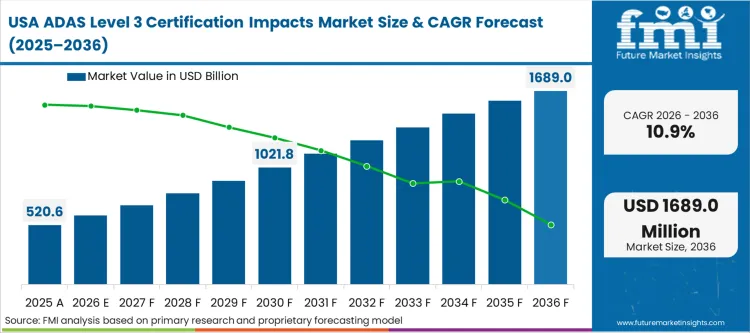
Fragmented state-level deployment rules fracture unified certification attempts across North American borders. Unlike European centralized type approvals, American deployment relies heavily on self-certification backed by transparent safety data reporting. FMI analysts note that this environment changes certification spending toward voluntary third-party automotive end point authentication audits to shield automakers from extreme liability risks.
- United States: Because federal authorities rely heavily on manufacturer self-certification, corporate legal directors force engineering teams to secure independent validation regardless. Demand for United States Level 3 vehicle approval services expands at a 10.9% CAGR. Fractured state-level motor vehicle rules require localized permits, transforming third-party safety cases into critical corporate defense mechanisms against post-launch litigation rather than simple regulatory obligations.
FMI's report includes Canada and Mexico. Harmonization efforts slowly align cross-border testing requirements, though specific provincial rules still dictate local deployment boundaries.
Competitive Aligners for Market Players
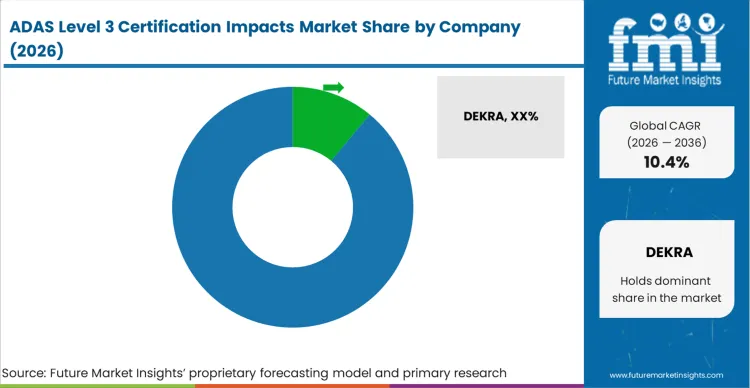
Legacy technical service providers hold significant power because transport ministries officially authorize only a limited pool of companies to sign type approval documents. DEKRA and TÜV SÜD leverage decades of established regulatory trust, making them the best homologation companies for autonomous driving for automakers seeking guaranteed compliance. Vehicle program directors choose auditing partners based strictly on their legal authority to issue specific regional certificates, not merely their technical testing capabilities.
Incumbents possess massive proprietary databases mapping exact regulatory interpretations across different national transport authorities. Challengers cannot easily replicate this institutional knowledge, as interpreting vague UNECE phrasing requires years of direct interaction with regulators. Maintaining dedicated proving grounds equipped specifically for Level 3 edge-case validation creates a massive capital barrier that protects established testing houses from software-only audit startups.
Automakers resist vendor lock-in by splitting physical testing and cybersecurity audits among different providers. Procurement directors deliberately qualify multiple technical services to maintain negotiating leverage during continuous software update recertifications. Massive changes in digital homologation workflows force traditional testing houses to acquire specialized simulation validators, completely altering how certification contracts operate moving forward.
Key Players in ADAS Level 3 Certification Impacts Market
- DEKRA
- TÜV SÜD
- SGS
- Applus+ IDIADA
- TÜV Rheinland
- UL Solutions
- dSPACE
Scope of the Report
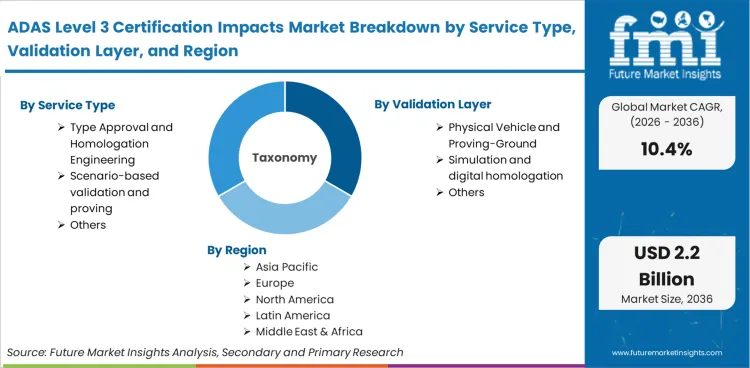
| Metric | Value |
|---|---|
| Quantitative Units | USD 0.82 billion to USD 2.2 billion, at a CAGR of 10.40% |
| Market Definition | ADAS Level 3 Certification Impacts comprises third-party engineering, auditing, and validation services required to secure legal type approvals for conditionally automated driving systems. |
| Segmentation | Service type, Validation layer, Vehicle platform, Customer type, Regulatory scope, and Region |
| Regions Covered | North America, Latin America, Western Europe, Eastern Europe, Asia Pacific excluding Japan (APEJ), Japan, and Middle East & Africa (MEA) |
| Countries Covered | China, Germany, United States, South Korea, United Arab Emirates, Japan, United Kingdom |
| Key Companies Profiled | DEKRA, TÜV SÜD, SGS, Applus+ IDIADA, TÜV Rheinland, UL Solutions, dSPACE |
| Forecast Period | 2026 to 2036 |
| Approach | Billed consulting hours for active Level 3 vehicle programs across top tier automakers |
Source: Future Market Insights (FMI) analysis, based on proprietary forecasting model and primary research
ADAS Level 3 Certification Impacts Market Analysis by Segments
Service type:
- Type approval and homologation engineering
- Scenario-based validation and proving
- Functional safety and SOTIF assurance
- Cybersecurity and SUMS evidence
- Conformity of production and change-management
Validation layer:
- Physical vehicle and proving-ground validation
- Simulation and digital homologation
- Documentation and safety case generation
- Software and OTA compliance verification
- Independent audit and witness testing
Vehicle platform:
- Premium passenger cars
- Luxury EV sedans
- Flagship ICE / hybrid sedans
- Executive SUVs
- Pilot-fleet derivatives
Customer type:
- OEMs
- Tier-1 ADAS stack suppliers
- Mapping and localization vendors
- Validation toolchain vendors
- Regulatory and technical service partners
Regulatory scope:
- UN R157 / motorway Level 3 approval
- Cybersecurity homologation
- Software update compliance
- Driver monitoring / HMI validation
- National permit extensions and post-approval updates
Region:
- North America
- United States
- Canada
- Europe
- Germany
- United Kingdom
- France
- Italy
- Spain
- Asia Pacific
- China
- Japan
- South Korea
- Taiwan
- Singapore
- Latin America
- Brazil
- Mexico
- Argentina
- Middle East & Africa
- GCC Countries
- South Africa
- Europe
Bibliography
- National Highway Traffic Safety Administration. (2024, December 19). ADS-equipped vehicle safety, transparency, and evaluation program.
- Vehicle Certification Agency. (2026, January 6). Automated Lane Keeping Systems (ALKS) and listing of self-driving vehicles.
- Mercedes-Benz Group AG. (2024, December 17). Mercedes-Benz increases top speed of its Level 3 automated driving system to 95 km/h.
- BMW Group. (2024, June 25). Road to autonomous driving: BMW is the first car manufacturer to receive approval for the combination of Level 2 and Level 3.
- Honda Motor Co., Ltd. (2025). Honda Report 2025.
- Ministry of Land, Infrastructure and Transport, Republic of Korea. (2024). Korean government announces safety standards for Level 3 automated vehicles.
This bibliography is provided for reader reference. The full FMI report contains the complete reference list with primary source documentation.
This Report Addresses
- Regulatory timeline crunch regarding operational design domain approvals facing automakers
- Mandatory third-party signatures dictating homologation engineering outsourcing
- Physical vehicle and proving-ground validation persisting despite digital simulation advancements
- Margin absorption requirements confining initial certifications to premium passenger cars
- Legal accountability forcing OEMs to command primary certification spending
- UNECE R157 framework serving as baseline architecture for global deployments
- China's aggressive national data-recording mandates changing certification dynamics
- Continuous software update recertification converting compliance into operational expenditure
Frequently Asked Questions
What is included in Level 3 certification costs?
Expenditures strictly cover external spend directed toward regulatory compliance, independent safety case generation, and continuous software homologation. Internal research and development, basic consumer crash testing, and hardware sensor procurement fall entirely outside this specific compliance budget.
Why is Level 3 homologation more expensive than Level 2?
Functional safety managers cannot self-certify Level 3 systems for public roads. Transport authorities mandate independent technical service signatures, requiring rigorous physical proving ground witness testing and complex software update audits that basic driver-assist features never legally required.
Which regulations govern Level 3 automated driving approval?
The UNECE R157 framework serves as the primary standardized baseline for highway pilot certifications across participating nations. However, fragmented national deployment frameworks force localized modifications, with countries like China and the USA enforcing strict domestic data handling and state-level rules.
How big is the market for Level 3 certification services in automotive?
Industry valuation is projected to cross USD 0.82 billion in 2026, advancing at a 10.40% CAGR to reach USD 2.2 billion by 2036. This growth directly reflects the increasing regulatory burden placed upon automakers seeking conditional automation permits.
Which companies help carmakers certify SAE Level 3 systems?
DEKRA, TÜV SÜD, SGS, Applus+ IDIADA, TÜV Rheinland, UL Solutions, and dSPACE operate as established technical service partners. Transport ministries officially authorize only a limited pool of these companies to sign critical type approval documents.
What dictates the autonomous driving approval process?
Transport authorities distrust purely digital evidence. Regulatory affairs managers must present real-world track data witnessed by certified independent auditors to ground-truth theoretical models before authorities grant final highway pilot permits.
What limits immediate certification scalability across vehicle platforms?
Premium passenger cars account for 58.0% share currently. Chief engineers allocate massive homologation testing costs exclusively to high-margin vehicles, rendering mass-market deployment financially unviable until baseline precedents reduce audit complexities.
Why does physical testing retain such high sector share?
Physical vehicle and proving-ground validation captures 34.0% share. Transport authorities mandate real-world edge-case verification to ground-truth digital models, preventing automakers from bypassing expensive track audits using simulation software alone.
Who holds primary legal responsibility during approvals?
OEMs command 62.0% share. Transport ministries issue operating permits exclusively to vehicle manufacturers, forcing vehicle program directors to fund system-level validation rather than relying purely on pre-certified supplier components.
How does UN R157 impact global testing workflows?
UN R157 holds 36.0% share. Regulatory affairs managers utilize this standard to compile baseline European dossiers, though divergent national requirements force localized modifications before vehicles legally cross specific borders.
What specific requirement drives Chinese certification expansion?
China expands at 13.6% CAGR. National authorities mandate strict localized data-handling parameters, forcing foreign automakers to contract domestic technical services for sensitive autonomous mapping validation.
Why does Germany lead near-term European deployment volumes?
Germany grows at 11.8% CAGR. Domestic regulatory authorities establish clear, functioning legal frameworks allowing technical services to execute structured validation programs for premium automaker highway pilots immediately.
How do software update regulations alter testing models?
Mandatory continuous compliance requirements transform certification from discrete pre-launch events into ongoing operational expenditures. Safety managers must secure repeated technical service audits to maintain active fleet permits.
What advantage do incumbent technical services possess?
Regulators restrict type approval authorization to a limited pool of recognized testing houses. These incumbents leverage decades of proprietary regulatory interpretation data that new entrants cannot easily replicate.
How do automakers manage independent audit bottlenecks?
Procurement directors qualify multiple technical services simultaneously. Dividing physical proving ground audits and cybersecurity evaluations prevents catastrophic launch delays caused by single-vendor capacity constraints.
What role does simulation play in final regulatory approval?
While physical testing dominates final sign-offs, validated digital models drastically reduce preliminary engineering friction. Toolchain vendors pre-certify simulation environments to streamline OEM safety case generation prior to physical witness audits.
How do localized permits impact UN-level harmonization?
Fragmented national rules frequently supersede UN baseline parameters. Compliance directors must execute parallel testing tracks to satisfy local transport authorities despite holding broad regional clearances.
What commercial risk follows delayed type approval?
Failing to secure required independent signatures blocks specific regional distribution entirely. Automakers lose early-mover market positioning and strand millions in development capital if regulatory dossiers suffer rejection.
What specific operational domain dominates current approvals?
Low-speed traffic jam pilots and restricted highway lane-keeping systems comprise the bulk of active validation programs. Broader urban environments remain largely restricted pending further physical edge-case proving.
How do cybersecurity mandates integrate into Level 3 approval?
Software update management system audits operate alongside physical vehicle proving. Technical services must verify secure over-the-air pathways before transport ministries grant functional safety operational permits.
Why do American certification dynamics differ from Europe?
American deployment relies heavily on self-certification and transparent reporting rather than centralized type approvals. USA compliance directors prioritize third-party audits primarily to mitigate post-deployment legal liabilities.
What constraint limits simulation-only approvals?
Transport authorities distrust theoretical models simulating severe weather degradation. Regulators demand physical sensor failure demonstrations, preventing fully virtual homologation pipelines.
How do technical services secure recurring revenue streams?
Post-launch software updates require ongoing validation signatures. Audit firms establish continuous monitoring contracts with automakers to ensure deployed fleets maintain legal regulatory compliance throughout their lifecycle.
What dictates technical service partner selection?
Vehicle program directors select auditors based on their legal authority to issue specific regional certificates. Technical capabilities matter less than established institutional trust with target transport ministries.
How does component-level pre-certification assist OEMs?
Tier-1 suppliers validate individual sensors, reducing final integration friction. However, system-level homologation still requires extensive OEM-funded proving ground programs to satisfy whole-vehicle regulatory mandates.
What prevents rapid mass-market Level 3 rollout?
Validating redundant steering and braking architectures requires immense capital. Engineering teams cannot amortize these specialized certification costs across lower-margin volume platforms without destroying unit profitability.
How do different national authorities view physical evidence?
While some nations slowly accept digital twin safety cases, most major transport ministries rigidly demand physical witness testing reports, preventing unified global certification strategies.
What characterizes early regulatory precedent setting?
Automakers utilize flagship sedans as regulatory icebreakers. Navigating initial approval complexities establishes standardized internal testing protocols, significantly reducing validation friction for subsequent vehicle platform launches.
Preview the report firsthand - request a free sample
Get SampleGet the brochure for pricing and purchase details.
Get PDFTable of Content
- Executive Summary
- Global Market Outlook
- Demand-side Trends
- Supply-side Trends
- Technology Roadmap Analysis
- Analysis and Recommendations
- Market Overview
- Market Coverage / Taxonomy
- Market Definition / Scope / Limitations
- Research Methodology
- Chapter Orientation
- Analytical Lens and Working Hypotheses
- Market Structure, Signals, and Trend Drivers
- Benchmarking and Cross-market Comparability
- Market Sizing, Forecasting, and Opportunity Mapping
- Research Design and Evidence Framework
- Desk Research Programme (Secondary Evidence)
- Company Annual and Sustainability Reports
- Peer-reviewed Journals and Academic Literature
- Corporate Websites, Product Literature, and Technical Notes
- Earnings Decks and Investor Briefings
- Statutory Filings and Regulatory Disclosures
- Technical White Papers and Standards Notes
- Trade Journals, Industry Magazines, and Analyst Briefs
- Conference Proceedings, Webinars, and Seminar Materials
- Government Statistics Portals and Public Data Releases
- Press Releases and Reputable Media Coverage
- Specialist Newsletters and Curated Briefings
- Sector Databases and Reference Repositories
- FMI Internal Proprietary Databases and Historical Market Datasets
- Subscription Datasets and Paid Sources
- Social Channels, Communities, and Digital Listening Inputs
- Additional Desk Sources
- Expert Input and Fieldwork (Primary Evidence)
- Primary Modes
- Qualitative Interviews and Expert Elicitation
- Quantitative Surveys and Structured Data Capture
- Blended Approach
- Why Primary Evidence is Used
- Field Techniques
- Interviews
- Surveys
- Focus Groups
- Observational and In-context Research
- Social and Community Interactions
- Stakeholder Universe Engaged
- C-suite Leaders
- Board Members
- Presidents and Vice Presidents
- R&D and Innovation Heads
- Technical Specialists
- Domain Subject-matter Experts
- Scientists
- Physicians and Other Healthcare Professionals
- Governance, Ethics, and Data Stewardship
- Research Ethics
- Data Integrity and Handling
- Primary Modes
- Tooling, Models, and Reference Databases
- Desk Research Programme (Secondary Evidence)
- Data Engineering and Model Build
- Data Acquisition and Ingestion
- Cleaning, Normalisation, and Verification
- Synthesis, Triangulation, and Analysis
- Quality Assurance and Audit Trail
- Market Background
- Market Dynamics
- Drivers
- Restraints
- Opportunity
- Trends
- Scenario Forecast
- Demand in Optimistic Scenario
- Demand in Likely Scenario
- Demand in Conservative Scenario
- Opportunity Map Analysis
- Product Life Cycle Analysis
- Supply Chain Analysis
- Investment Feasibility Matrix
- Value Chain Analysis
- PESTLE and Porter’s Analysis
- Regulatory Landscape
- Regional Parent Market Outlook
- Production and Consumption Statistics
- Import and Export Statistics
- Market Dynamics
- Global Market Analysis 2021 to 2025 and Forecast, 2026 to 2036
- Historical Market Size Value (USD Million) Analysis, 2021 to 2025
- Current and Future Market Size Value (USD Million) Projections, 2026 to 2036
- Y-o-Y Growth Trend Analysis
- Absolute $ Opportunity Analysis
- Global Market Pricing Analysis 2021 to 2025 and Forecast 2026 to 2036
- Global Market Analysis 2021 to 2025 and Forecast 2026 to 2036, By Service Type
- Introduction / Key Findings
- Historical Market Size Value (USD Million) Analysis By Service Type , 2021 to 2025
- Current and Future Market Size Value (USD Million) Analysis and Forecast By Service Type , 2026 to 2036
- Type Approval and Homologation Engineering
- Scenario-based validation and proving
- Others
- Type Approval and Homologation Engineering
- Y-o-Y Growth Trend Analysis By Service Type , 2021 to 2025
- Absolute $ Opportunity Analysis By Service Type , 2026 to 2036
- Global Market Analysis 2021 to 2025 and Forecast 2026 to 2036, By Validation Layer
- Introduction / Key Findings
- Historical Market Size Value (USD Million) Analysis By Validation Layer, 2021 to 2025
- Current and Future Market Size Value (USD Million) Analysis and Forecast By Validation Layer, 2026 to 2036
- Physical Vehicle and Proving-Ground
- Simulation and digital homologation
- Others
- Physical Vehicle and Proving-Ground
- Y-o-Y Growth Trend Analysis By Validation Layer, 2021 to 2025
- Absolute $ Opportunity Analysis By Validation Layer, 2026 to 2036
- Global Market Analysis 2021 to 2025 and Forecast 2026 to 2036, By Vehicle Platform
- Introduction / Key Findings
- Historical Market Size Value (USD Million) Analysis By Vehicle Platform, 2021 to 2025
- Current and Future Market Size Value (USD Million) Analysis and Forecast By Vehicle Platform, 2026 to 2036
- Premium Passenger Cars
- Luxury EV sedans
- Flagship ICE / hybrid sedans
- Premium Passenger Cars
- Y-o-Y Growth Trend Analysis By Vehicle Platform, 2021 to 2025
- Absolute $ Opportunity Analysis By Vehicle Platform, 2026 to 2036
- Global Market Analysis 2021 to 2025 and Forecast 2026 to 2036, By Customer Type
- Introduction / Key Findings
- Historical Market Size Value (USD Million) Analysis By Customer Type, 2021 to 2025
- Current and Future Market Size Value (USD Million) Analysis and Forecast By Customer Type, 2026 to 2036
- OEMs
- Tier-1 ADAS stack suppliers
- Mapping and localization vendors
- OEMs
- Y-o-Y Growth Trend Analysis By Customer Type, 2021 to 2025
- Absolute $ Opportunity Analysis By Customer Type, 2026 to 2036
- Global Market Analysis 2021 to 2025 and Forecast 2026 to 2036, By Regulatory Scope
- Introduction / Key Findings
- Historical Market Size Value (USD Million) Analysis By Regulatory Scope, 2021 to 2025
- Current and Future Market Size Value (USD Million) Analysis and Forecast By Regulatory Scope, 2026 to 2036
- UN R157 / Motorway Level 3 Approval
- Cybersecurity homologation
- Others
- UN R157 / Motorway Level 3 Approval
- Y-o-Y Growth Trend Analysis By Regulatory Scope, 2021 to 2025
- Absolute $ Opportunity Analysis By Regulatory Scope, 2026 to 2036
- Global Market Analysis 2021 to 2025 and Forecast 2026 to 2036, By Region
- Introduction
- Historical Market Size Value (USD Million) Analysis By Region, 2021 to 2025
- Current Market Size Value (USD Million) Analysis and Forecast By Region, 2026 to 2036
- North America
- Latin America
- Western Europe
- Eastern Europe
- East Asia
- South Asia and Pacific
- Middle East & Africa
- Market Attractiveness Analysis By Region
- North America Market Analysis 2021 to 2025 and Forecast 2026 to 2036, By Country
- Historical Market Size Value (USD Million) Trend Analysis By Market Taxonomy, 2021 to 2025
- Market Size Value (USD Million) Forecast By Market Taxonomy, 2026 to 2036
- By Country
- USA
- Canada
- Mexico
- By Service Type
- By Validation Layer
- By Vehicle Platform
- By Customer Type
- By Regulatory Scope
- By Country
- Market Attractiveness Analysis
- By Country
- By Service Type
- By Validation Layer
- By Vehicle Platform
- By Customer Type
- By Regulatory Scope
- Key Takeaways
- Latin America Market Analysis 2021 to 2025 and Forecast 2026 to 2036, By Country
- Historical Market Size Value (USD Million) Trend Analysis By Market Taxonomy, 2021 to 2025
- Market Size Value (USD Million) Forecast By Market Taxonomy, 2026 to 2036
- By Country
- Brazil
- Chile
- Rest of Latin America
- By Service Type
- By Validation Layer
- By Vehicle Platform
- By Customer Type
- By Regulatory Scope
- By Country
- Market Attractiveness Analysis
- By Country
- By Service Type
- By Validation Layer
- By Vehicle Platform
- By Customer Type
- By Regulatory Scope
- Key Takeaways
- Western Europe Market Analysis 2021 to 2025 and Forecast 2026 to 2036, By Country
- Historical Market Size Value (USD Million) Trend Analysis By Market Taxonomy, 2021 to 2025
- Market Size Value (USD Million) Forecast By Market Taxonomy, 2026 to 2036
- By Country
- Germany
- UK
- Italy
- Spain
- France
- Nordic
- BENELUX
- Rest of Western Europe
- By Service Type
- By Validation Layer
- By Vehicle Platform
- By Customer Type
- By Regulatory Scope
- By Country
- Market Attractiveness Analysis
- By Country
- By Service Type
- By Validation Layer
- By Vehicle Platform
- By Customer Type
- By Regulatory Scope
- Key Takeaways
- Eastern Europe Market Analysis 2021 to 2025 and Forecast 2026 to 2036, By Country
- Historical Market Size Value (USD Million) Trend Analysis By Market Taxonomy, 2021 to 2025
- Market Size Value (USD Million) Forecast By Market Taxonomy, 2026 to 2036
- By Country
- Russia
- Poland
- Hungary
- Balkan & Baltic
- Rest of Eastern Europe
- By Service Type
- By Validation Layer
- By Vehicle Platform
- By Customer Type
- By Regulatory Scope
- By Country
- Market Attractiveness Analysis
- By Country
- By Service Type
- By Validation Layer
- By Vehicle Platform
- By Customer Type
- By Regulatory Scope
- Key Takeaways
- East Asia Market Analysis 2021 to 2025 and Forecast 2026 to 2036, By Country
- Historical Market Size Value (USD Million) Trend Analysis By Market Taxonomy, 2021 to 2025
- Market Size Value (USD Million) Forecast By Market Taxonomy, 2026 to 2036
- By Country
- China
- Japan
- South Korea
- By Service Type
- By Validation Layer
- By Vehicle Platform
- By Customer Type
- By Regulatory Scope
- By Country
- Market Attractiveness Analysis
- By Country
- By Service Type
- By Validation Layer
- By Vehicle Platform
- By Customer Type
- By Regulatory Scope
- Key Takeaways
- South Asia and Pacific Market Analysis 2021 to 2025 and Forecast 2026 to 2036, By Country
- Historical Market Size Value (USD Million) Trend Analysis By Market Taxonomy, 2021 to 2025
- Market Size Value (USD Million) Forecast By Market Taxonomy, 2026 to 2036
- By Country
- India
- ASEAN
- Australia & New Zealand
- Rest of South Asia and Pacific
- By Service Type
- By Validation Layer
- By Vehicle Platform
- By Customer Type
- By Regulatory Scope
- By Country
- Market Attractiveness Analysis
- By Country
- By Service Type
- By Validation Layer
- By Vehicle Platform
- By Customer Type
- By Regulatory Scope
- Key Takeaways
- Middle East & Africa Market Analysis 2021 to 2025 and Forecast 2026 to 2036, By Country
- Historical Market Size Value (USD Million) Trend Analysis By Market Taxonomy, 2021 to 2025
- Market Size Value (USD Million) Forecast By Market Taxonomy, 2026 to 2036
- By Country
- Kingdom of Saudi Arabia
- Other GCC Countries
- Turkiye
- South Africa
- Other African Union
- Rest of Middle East & Africa
- By Service Type
- By Validation Layer
- By Vehicle Platform
- By Customer Type
- By Regulatory Scope
- By Country
- Market Attractiveness Analysis
- By Country
- By Service Type
- By Validation Layer
- By Vehicle Platform
- By Customer Type
- By Regulatory Scope
- Key Takeaways
- Key Countries Market Analysis
- USA
- Pricing Analysis
- Market Share Analysis, 2025
- By Service Type
- By Validation Layer
- By Vehicle Platform
- By Customer Type
- By Regulatory Scope
- Canada
- Pricing Analysis
- Market Share Analysis, 2025
- By Service Type
- By Validation Layer
- By Vehicle Platform
- By Customer Type
- By Regulatory Scope
- Mexico
- Pricing Analysis
- Market Share Analysis, 2025
- By Service Type
- By Validation Layer
- By Vehicle Platform
- By Customer Type
- By Regulatory Scope
- Brazil
- Pricing Analysis
- Market Share Analysis, 2025
- By Service Type
- By Validation Layer
- By Vehicle Platform
- By Customer Type
- By Regulatory Scope
- Chile
- Pricing Analysis
- Market Share Analysis, 2025
- By Service Type
- By Validation Layer
- By Vehicle Platform
- By Customer Type
- By Regulatory Scope
- Germany
- Pricing Analysis
- Market Share Analysis, 2025
- By Service Type
- By Validation Layer
- By Vehicle Platform
- By Customer Type
- By Regulatory Scope
- UK
- Pricing Analysis
- Market Share Analysis, 2025
- By Service Type
- By Validation Layer
- By Vehicle Platform
- By Customer Type
- By Regulatory Scope
- Italy
- Pricing Analysis
- Market Share Analysis, 2025
- By Service Type
- By Validation Layer
- By Vehicle Platform
- By Customer Type
- By Regulatory Scope
- Spain
- Pricing Analysis
- Market Share Analysis, 2025
- By Service Type
- By Validation Layer
- By Vehicle Platform
- By Customer Type
- By Regulatory Scope
- France
- Pricing Analysis
- Market Share Analysis, 2025
- By Service Type
- By Validation Layer
- By Vehicle Platform
- By Customer Type
- By Regulatory Scope
- India
- Pricing Analysis
- Market Share Analysis, 2025
- By Service Type
- By Validation Layer
- By Vehicle Platform
- By Customer Type
- By Regulatory Scope
- ASEAN
- Pricing Analysis
- Market Share Analysis, 2025
- By Service Type
- By Validation Layer
- By Vehicle Platform
- By Customer Type
- By Regulatory Scope
- Australia & New Zealand
- Pricing Analysis
- Market Share Analysis, 2025
- By Service Type
- By Validation Layer
- By Vehicle Platform
- By Customer Type
- By Regulatory Scope
- China
- Pricing Analysis
- Market Share Analysis, 2025
- By Service Type
- By Validation Layer
- By Vehicle Platform
- By Customer Type
- By Regulatory Scope
- Japan
- Pricing Analysis
- Market Share Analysis, 2025
- By Service Type
- By Validation Layer
- By Vehicle Platform
- By Customer Type
- By Regulatory Scope
- South Korea
- Pricing Analysis
- Market Share Analysis, 2025
- By Service Type
- By Validation Layer
- By Vehicle Platform
- By Customer Type
- By Regulatory Scope
- Russia
- Pricing Analysis
- Market Share Analysis, 2025
- By Service Type
- By Validation Layer
- By Vehicle Platform
- By Customer Type
- By Regulatory Scope
- Poland
- Pricing Analysis
- Market Share Analysis, 2025
- By Service Type
- By Validation Layer
- By Vehicle Platform
- By Customer Type
- By Regulatory Scope
- Hungary
- Pricing Analysis
- Market Share Analysis, 2025
- By Service Type
- By Validation Layer
- By Vehicle Platform
- By Customer Type
- By Regulatory Scope
- Kingdom of Saudi Arabia
- Pricing Analysis
- Market Share Analysis, 2025
- By Service Type
- By Validation Layer
- By Vehicle Platform
- By Customer Type
- By Regulatory Scope
- Turkiye
- Pricing Analysis
- Market Share Analysis, 2025
- By Service Type
- By Validation Layer
- By Vehicle Platform
- By Customer Type
- By Regulatory Scope
- South Africa
- Pricing Analysis
- Market Share Analysis, 2025
- By Service Type
- By Validation Layer
- By Vehicle Platform
- By Customer Type
- By Regulatory Scope
- USA
- Market Structure Analysis
- Competition Dashboard
- Competition Benchmarking
- Market Share Analysis of Top Players
- By Regional
- By Service Type
- By Validation Layer
- By Vehicle Platform
- By Customer Type
- By Regulatory Scope
- Competition Analysis
- Competition Deep Dive
- DEKRA
- Overview
- Product Portfolio
- Profitability by Market Segments (Product/Age /Sales Channel/Region)
- Sales Footprint
- Strategy Overview
- Marketing Strategy
- Product Strategy
- Channel Strategy
- TÜV SÜD
- SGS
- Applus+ IDIADA
- TÜV Rheinland
- UL Solutions
- dSPACE
- DEKRA
- Competition Deep Dive
- Assumptions & Acronyms Used


