

- Market Size (2026)
- USD 280.5 Mn
- Forecast (2036)
- USD 818.2 Mn
- CAGR (2026 to 2036)
- 11.3%
ADAS Calibration and Alignment Equipment Systems Market Size, Forecast, and Outlook By FMI
Summary of the ADAS Calibration and Alignment Equipment Systems Market
- Demand and Growth Drivers
- Safety rules support demand for ADAS calibration equipment as vehicle sensors need documented alignment after production and repair work.
- Collision repair work lifts equipment use as camera and radar positions can change after glass replacement or front-end repair.
- OEM inspection needs reinforce factory calibration as ADAS features move into passenger cars and light commercial vehicles.
- Product and Segment View
- Passenger vehicles lead vehicle type demand with 58.3% share in 2026, reflecting high sensor fitment across mass models.
- Automotive OEMs dominate end user demand with 48.0% share in 2026, supported by production-line validation needs.
- Static calibration hold high service demand as target-based setups help workshops reduce repeat calibration work.
- Geography and Competitive Outlook
- China is expected to record a CAGR of 6.4% through 2036, due to intelligent vehicle output and NEV penetration.
- India is projected to expand at 6.3% CAGR from 2026 to 2036, as vehicle production and formal service capacity increase.
- Companies combining multi-brand coverage with software-guided workflows are strengthening their position during the forecast period.
- Analyst Opinion
- Nikhil Kaitwade, Associate Vice President at FMI says, “ADAS calibration and alignment equipment systems keep expanding as vehicles need accurate camera and radar positioning after production and repair work. Cost pressure and technician training gaps can slow use among smaller workshops with limited daily calibration volumes. Demand continues through guided software factory validation and collision repair applications across sensor-equipped passenger and commercial vehicles.”
- DAS Calibration and Alignment Equipment Systems Market Value Analysis
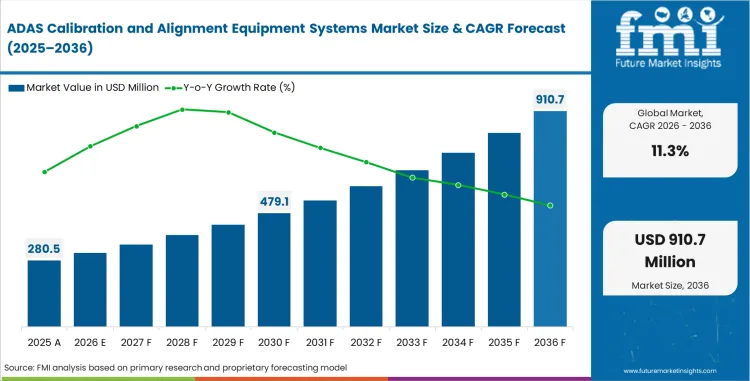
- The ADAS calibration and alignment equipment systems market is moving from specialist workshop use into routine service and production validation.
- Adoption is supported by safety evidence needs as AEB and lane support functions rely on accurate sensor aim.
- The market is benefiting from deeper use of ADAS calibration equipment across OEM and repair networks.
- Demand is supported by the need for calibration records meeting warranty and service documentation requirements.
Key Takeaways, Market Size, and Forecast
- The ADAS calibration and alignment equipment systems market is estimated at USD 252.0 million in 2025.
- By 2036, the ADAS Calibration and Alignment Equipment Systems Market is expected to be worth USD 818.2 million.
- From 2026 to 2036, the market is projected to expand at a CAGR of 11.3%.
- The market is projected to create an incremental opportunity of USD 537.7 million between 2026 and 2036.
- In 2026, passenger vehicles are expected to account for 58.3% of vehicle type demand.
- China at 6.4% and India at 6.3% are two of the faster expanding country markets.
ADAS Calibration and Alignment Equipment Systems Market Definition
The ADAS calibration and alignment equipment systems market includes equipment and software used to position, test, and verify sensors used in driver assistance functions. These systems support camera calibration, radar alignment, LiDAR positioning, and ultrasonic sensor checks. Scope includes target boards, digital rigs, alignment units, calibration software, and diagnostic support tools. Finished vehicles, standalone ADAS sensors, and general wheel balancing tools are outside the scope.
ADAS Calibration and Alignment Equipment Systems Market Inclusions
Market scope encompasses commercially traded ADAS calibration and alignment equipment categorized by calibration type, equipment type, sensor type, vehicle type, end user, and region from 2026 to 2036.
ADAS Calibration and Alignment Equipment Systems Market Exclusions
Scope does not include finished vehicles, standalone ADAS sensors, autonomous driving software, routine wheel balancing machines, or generic scan tools without calibration capability.
ADAS Calibration and Alignment Equipment Systems Market Research Methodology
- Primary Research: FMI analysts talked to automotive OEMs, Tier 1 suppliers, service stations, glass repair networks, and calibration equipment suppliers.
- Desk Research: Combined data from safety regulations, company product portfolios, vehicle production data, and service repair requirements.
- Market sizing and forecasting: Added equipment use across vehicle type and end user groups from the bottom up.
- Data validation: Cross-checked every quarter against ADAS penetration, service bay economics, company portfolios, and country vehicle output.
Why is the ADAS Calibration and Alignment Equipment Systems Market Growing?
- OEMs need calibration systems earlier in the production process to verify camera and radar performance before delivery.
- Repair networks are using calibration equipment after windshield replacement as sensor position affects safety function.
- Service stations are investing in guided systems as technician training affects job accuracy and workshop throughput.
Vehicle safety regulation is creating a measurable need for calibration accuracy. NHTSA finalized FMVSS No. 127 in May 2024 and projects the rule will save at least 360 lives and prevent at least 24,000 injuries each year. This rule supports demand for AEB-ready calibration tools as cameras and radar sensors must operate within planned limits. Equipment suppliers with documented workflows can help repair networks reduce liability exposure.
European rules add another service trigger for calibration systems. New general safety rules apply to all new motor vehicles sold in the EU from 7 July 2024 and introduce advanced driver assistance systems for all new vehicles. This supports workshop demand for automotive camera and automotive radar sensors calibration tools. Service networks need equipment able to handle several brands with traceable records.
Market Segmentation Analysis
- Static Calibration is estimated to account for 46.0% of calibration type demand in 2026 with strong use across controlled service bays.
- Target Systems are expected to account for 41.0% of equipment type demand in 2026 with broad use across camera and radar jobs.
- Camera Calibration is projected to account for 39.0% of sensor type demand in 2026 with high use after windshield replacement.
- Passenger Vehicles are expected to account for 58.3% of vehicle type demand in 2026 with direct use across high-volume model lines.
- Automotive OEMs are estimated to account for 48.0% of end user demand in 2026 with strong use across production validation.
The market for ADAS calibration and alignment equipment systems is divided into five primary segment groups based on calibration type, equipment type, sensor type, vehicle type, and end user. Calibration type includes Static Calibration, Dynamic Calibration, and Hybrid Calibration. Equipment type includes Target Systems, Digital Rigs, Alignment Units, and Calibration Software. Sensor type includes Camera Calibration, Radar Calibration, LiDAR Calibration, and Ultrasonic Calibration. Vehicle type includes Passenger Vehicles and Commercial Vehicles. End user includes Automotive OEMs, Tier 1 Suppliers, and Service Stations.
Insights into the Static Calibration Type Segment
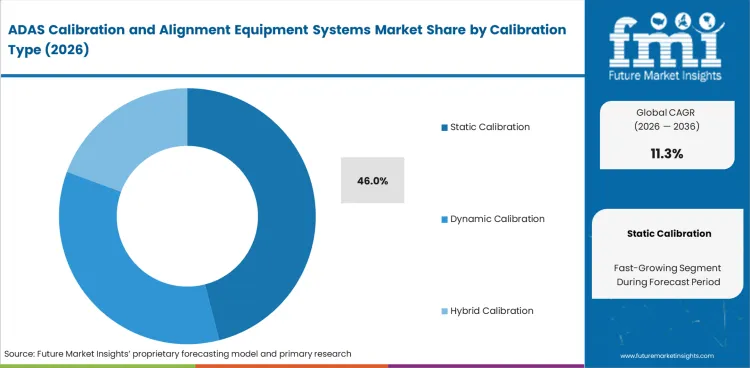
- Static calibration is expected to make up 46.0% of the calibration type segment in 2026. Target-based bay calibration is the segment with the highest share. Fixed target placement helps workshops check camera and radar alignment with repeatable measurements before repair files are closed.
- Dynamic calibration applications concentrate on road-based checks for selected vehicle models with manufacturer-specific procedures. Hybrid calibration combines bay setup with road verification for vehicles using more advanced sensor packages.
Insights into the Target Systems Equipment Type Segment
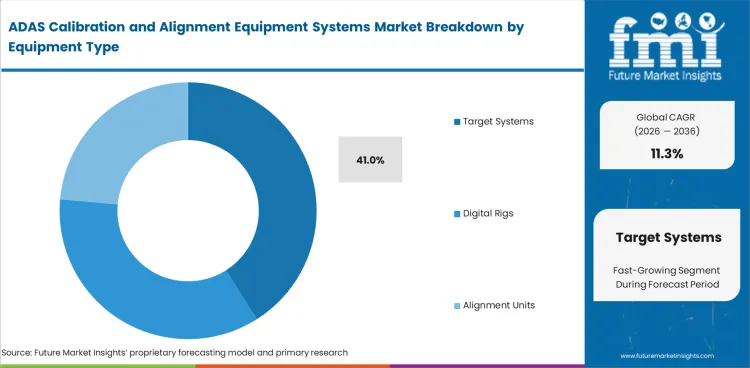
- In 2026, target systems will make up 41.0% of the equipment type segment. Printed and digital targets help technicians align front cameras and radar units after windshield replacement or body repair work.
- Radar reflector applications focus on bumper-level sensor checks after collision service and panel replacement. Digital rig applications support faster setup for workshops handling several vehicle brands in one service bay.
Insights into the Camera Calibration Sensor Type Segment
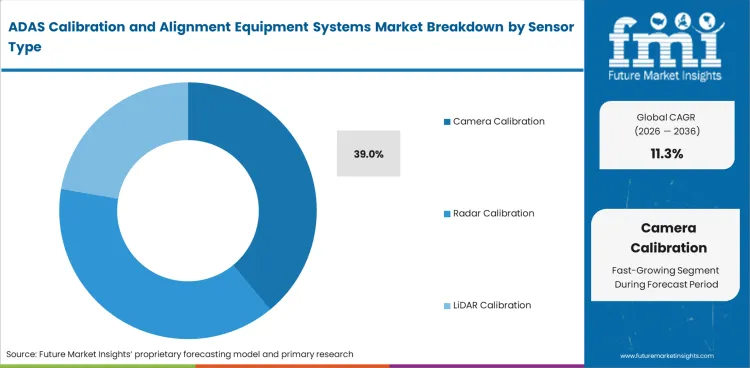
- Camera calibration is poised to contribute 39.0% of the sensor type segment in 2026. Windscreen-mounted cameras need accurate positioning after glass replacement as small angle changes can affect lane support and braking alerts.
- Radar calibration applications concentrate on front bumper and corner sensor alignment after repair work. LiDAR calibration is used in higher-value vehicle programs with more advanced driver assistance packages.
Insights into the Passenger Vehicles Segment
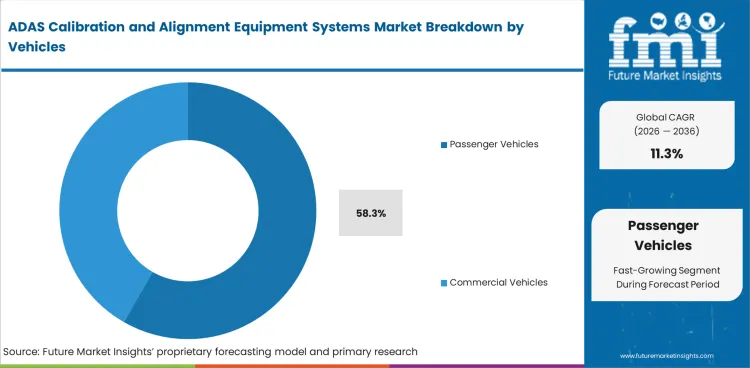
- Passenger vehicles is predicted to hold 58.3% share of the vehicle type segment. Higher model volume and broader ADAS fitment make passenger vehicles the largest demand base for calibration systems.
- Commercial vehicle applications concentrate on buses and trucks using camera-based safety and driver assistance systems. Fleet service centers use calibration equipment to support uptime and repair documentation after sensor-related service work.
Insights into the Automotive OEMs End User Segment
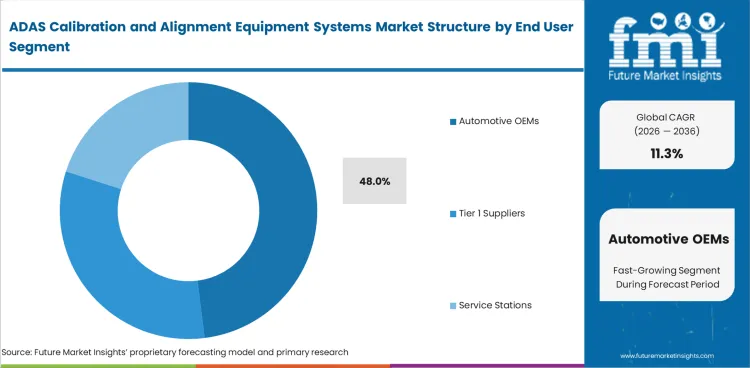
- In 2026, automotive OEMs is expected to make up 48.0% of the end user segment. OEMs use calibration equipment to verify sensor aim before vehicle delivery and reduce warranty exposure.
- Service station applications concentrate on post-repair calibration after glass work and collision service. Tier 1 supplier applications support sensor module testing before parts move into vehicle assembly programs.
ADAS Calibration and Alignment Equipment Systems Market Drivers, Restraints, and Opportunities
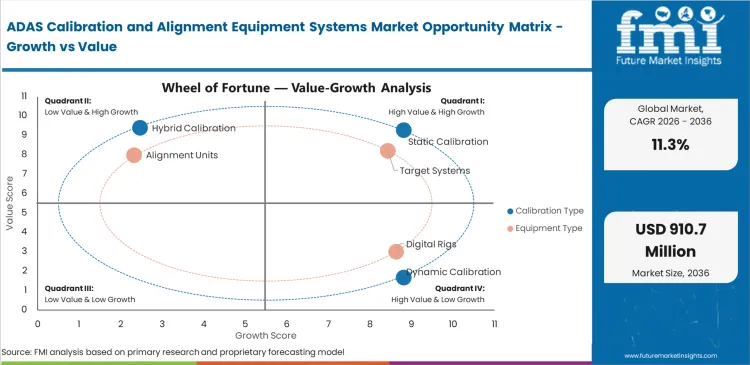
- AEB regulation is creating structured demand for calibration evidence across vehicle assembly and repair service channels.
- Higher sensor content raises equipment need as camera and radar alignment must match OEM repair procedures.
- High setup cost creates pricing pressure for smaller service stations with limited daily calibration jobs.
- Software-guided calibration creates opportunity through faster setup and easier multi-brand service coverage.
ADAS calibration and alignment equipment systems keep expanding as vehicles need accurate camera and radar positioning after production and repair work. Cost pressure and technician training gaps can slow use among smaller workshops with limited daily calibration volumes. Demand continues through guided software factory validation and collision repair applications across sensor equipped passenger and commercial vehicles.
Service-Price Inflation Is Pulling Equipment ROI Forward
In April 2026, the USA Bureau of Labor Statistics’ March CPI table indicated motor vehicle maintenance and repair up 6.1% year over year and 1.3% month over month; motor vehicle maintenance and servicing rose 6.4%, while motor vehicle repair rose 5.4%. For calibration equipment suppliers this strengthens customer ROI by improving payback economics. Repair shops can absorb higher equipment and software costs because billable services reprice faster, in comparison to general goods. It keeps leasing and financing offers relevant for independent repairers.
Analysis of ADAS Calibration and Alignment Equipment Systems Market By Key Countries
.webp "Top Country Growth Comparison Adas Calibration And Alignment Equipment Systems Market Cagr (2026 2036)")
| Country | CAGR |
|---|---|
| China | 6.4% |
| India | 6.3% |
| USA | 6.1% |
| South Korea | 6.0% |
| Germany | 5.8% |
| UK | 5.7% |
| Japan | 5.6% |
Source: Future Market Insights, 2026.
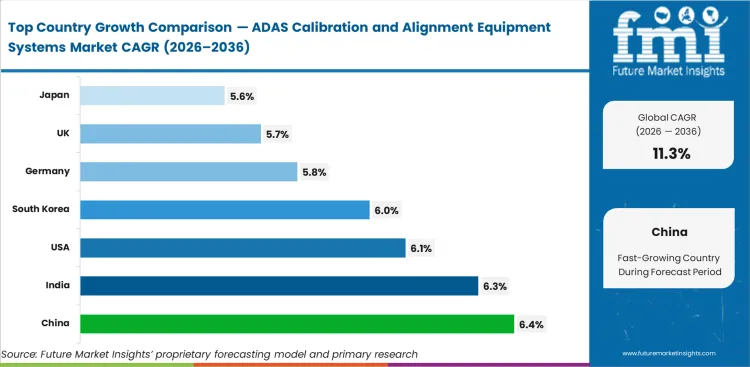
ADAS Calibration and Alignment Equipment Systems Market CAGR Analysis By Country
- China leads with a 6.4% CAGR through 2036 as NEV output and intelligent vehicle content expand.
- India at 6.3% reflects passenger vehicle output and increasing formal service capacity across major cities.
- The USA at 6.1% reflects safety regulation and repair documentation discipline across certified service centers.
- South Korea at 6.0% reflects connected vehicle production and export-oriented OEM service requirements.
- Germany at 5.8% reflects advanced vehicle production and structured service quality requirements.
- The UK at 5.7% reflects fleet-heavy vehicle registrations and higher ADAS repair documentation needs.
- Japan at 5.6% reflects established service networks with controlled equipment upgrade cycles.
Demand for ADAS calibration and alignment equipment systems is forecast to rise at 11.3% CAGR from 2026 to 2036. Country-level analysis covers the major markets contributing to this forecast, with the key markets listed below.
Demand Outlook for ADAS Calibration and Alignment Equipment Systems Market in China
China’s ADAS calibration and alignment equipment systems industry is projected to record a CAGR of 6.4% from 2026 to 2036. New energy vehicle output reached 16.524 million units in 2025 and increased 25.1% from the previous year. This production base supports demand for China ADAS calibration and alignment equipment systems. Local service chains need calibration tools suited to camera and radar-heavy vehicles.
- High NEV output supports demand for sensor alignment tools across OEM and dealer networks.
- Local vehicle platforms need calibration systems covering camera and radar procedures.
- Service providers need software updates as model launches increase calibration complexity.
Sales Analysis of ADAS Calibration and Alignment Equipment Systems Market in India
The ADAS calibration and alignment equipment systems sector in India is expected to expand at a CAGR of 6.3% during the assessment period. The manufacturers supports demand for India ADAS calibration and alignment equipment systems. Service chains can gain from tools supporting high-volume passenger vehicle repair.
- Local vehicle output supports demand for OEM line checks and service station calibration.
- PM E-DRIVE includes support for testing agencies with an outlay of INR 10,900 crore.
- Domestic workshops need guided systems to reduce repeat jobs and technician training gaps.
Demand Outlook for ADAS Calibration and Alignment Equipment Systems Market in the United States
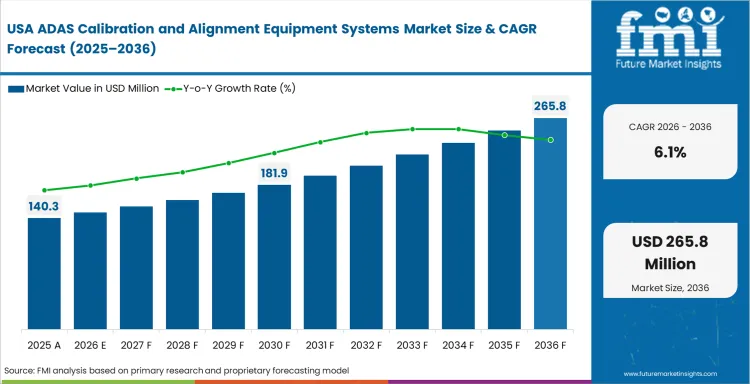
The USA ADAS calibration and alignment equipment systems industry is forecast to grow at a CAGR of 6.1% by 2036. Service centers value calibration partners with validated setup methods and repair documentation support. Equipment demand is strongest across dealerships and collision repair networks.
- AEB regulation supports demand for camera and radar calibration after collision repairs.
- Dealerships require documented procedures to protect warranty and safety claims.
- Service complexity supports use of automotive crash sensor checks across repair workflows.
Opportunity Analysis of ADAS Calibration and Alignment Equipment Systems Market in South Korea
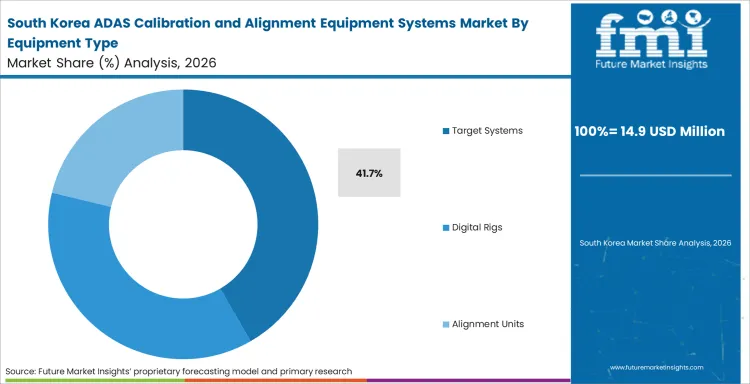
The ADAS calibration and alignment equipment systems segment in South Korea is poised to advance at 6.0% CAGR over the forecast years. Export-oriented production supports demand for South Korea ADAS calibration and alignment equipment systems. OEM service networks need tools matching global repair instructions.
- High vehicle output supports calibration demand across assembly and service networks.
- Export models require repeatable inspection systems aligned with overseas safety expectations.
- Connected vehicle content supports demand for automotive sensors calibration support.
Future Outlook for ADAS Calibration and Alignment Equipment Systems Market in Germany
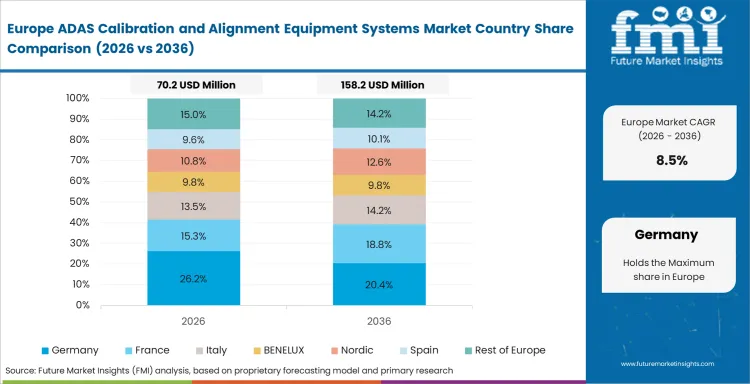
Germany’s ADAS calibration and alignment equipment systems industry is expected to post 5.8% CAGR by 2036. German car production in January 2026 reached 305,900 units according to VDA reporting. This production base supports demand for Germany ADAS calibration and alignment equipment systems. Suppliers with OEM-aligned software and workshop training can support premium service accounts.
- Advanced vehicle production supports demand for validated calibration and alignment tools.
- Premium repair networks need precise target systems for camera and radar service work.
- Equipment suppliers benefit from service chains using automotive MEMS sensors and radar platforms.
Demand Outlook for ADAS Calibration and Alignment Equipment Systems Market in the United Kingdom
The UK ADAS calibration and alignment equipment systems sector is expected to expand at 5.7% CAGR over the forecast years. The vehicle base supports demand for UK ADAS calibration and alignment equipment systems. Fleet-heavy registrations increase the need for service records after repair work.
- Fleet registrations support demand for fast calibration and documented repair completion.
- BEV penetration raises sensor service needs across dealer and glass repair networks.
- Repair shops need guided workflows linked to ADAS calibration-as-a-service models.
In-depth Analysis of ADAS Calibration and Alignment Equipment Systems Market in Japan
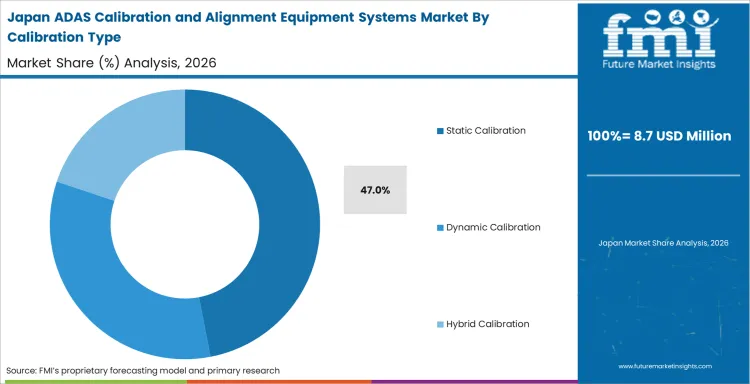
Japan’s ADAS calibration and alignment equipment systems industry is expected to record 5.6% CAGR by 2036. JAMA’s 2025 industry publication covers production and service activity across the Japanese automobile industry. Established service networks support demand for Japan ADAS calibration and alignment equipment systems. Workshops need equipment upgrades as camera and radar functions become standard across model lines.
- Established service networks support controlled adoption of multi-brand calibration tools.
- OEM repair discipline supports demand for precise alignment and service documentation.
- Advanced safety systems support calibration linked to automotive HD imaging radar use.
Competitive Landscape and Strategic Positioning
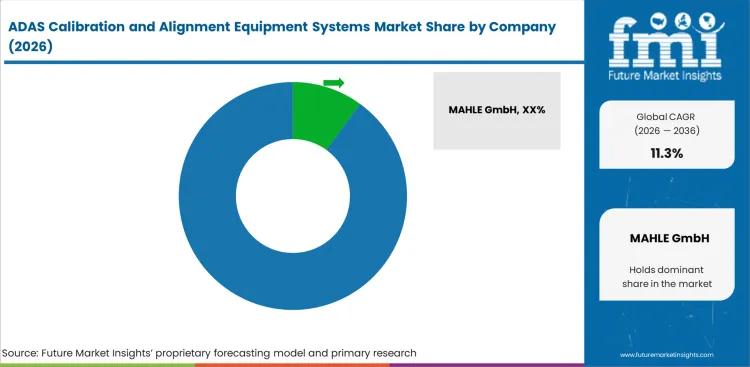
ADAS Calibration and Alignment Equipment Systems Market Analysis By Company
- MAHLE GmbH is a leading provider through digital ADAS calibration systems and workshop diagnostic support.
- Robert Bosch GmbH and HELLA GmbH & Co. differentiate based on service network reach and diagnostic platform depth.
- Specialist providers focus on target systems and software-guided workflows for independent repair centers.
MAHLE has strong positioning through digital ADAS systems and guided workshop tools. Bosch offers broad automotive diagnostic coverage through established service relationships. TEXA and Autel serve independent workshops through software-led equipment packages and multi-brand coverage. The Burke Porter Group adds strength in alignment and test systems for OEM and workshop use.
Barriers include equipment cost and the need for frequent vehicle database updates. Strategic priorities include software coverage and technician training across long vehicle service cycles. Service centers favor suppliers offering calibration evidence and diagnostic integration with reduced repeat work. Suppliers with broad vehicle coverage can lower coordination burden for manufacturers and service chains.
Key Companies in the ADAS Calibration and Alignment Equipment Systems Market
Key global companies leading the ADAS calibration and alignment equipment systems market include:
- MAHLE GmbH, Robert Bosch GmbH, and HELLA GmbH & Co. have strong workshop equipment coverage for ADAS calibration and diagnostics.
- Autel Intelligent Technology, TEXA S.p.A, and Launch Tech Co. serve independent workshops through diagnostic platforms and calibration accessories.
- COJALI S.L., The Burke Porter Group, Hofmann Megaplan GmbH, and BorgWarner Inc. hold specialist positions across alignment and service equipment.
Competitive Benchmarking: ADAS Calibration and Alignment Equipment Systems Market
| Company | Calibration Coverage | Software Depth | Workshop Support |
|---|---|---|---|
| MAHLE GmbH | High | High | Strong |
| Robert Bosch GmbH | High | High | Strong |
| HELLA GmbH & Co. | Medium | High | Strong |
| Autel Intelligent Technology | High | Medium | Strong |
| TEXA S.p.A | High | High | Strong |
| Launch Tech Co. | High | Medium | Moderate |
| COJALI S.L. | Medium | High | Moderate |
| The Burke Porter Group | Medium | Medium | Strong |
| Hofmann Megaplan GmbH | Medium | Medium | Moderate |
| BorgWarner Inc. | Medium | Medium | Moderate |
Source: Future Market Insights, 2026.
Key Developments in ADAS Calibration and Alignment Equipment Systems Market
- October 2025, MAHLE presented Digital ADAS 2.0 EXTRA at Equip Auto Paris. The system features ultrasonic sensors for vehicle positioning and a rotatable high-resolution 75-inch display.
- July 2025, TEXA signed a strategic agreement with Automotive Glass Experts. The agreement supports ADAS diagnostics and calibration systems across AGE’s international automotive glass network.
Key Players in the ADAS Calibration and Alignment Equipment Systems Market
Major Global Players:
- MAHLE GmbH
- Robert Bosch GmbH
- HELLA GmbH & Co.
- Autel Intelligent Technology
- TEXA S.p.A
- Launch Tech Co.
- The Burke Porter Group
Specialist Players:
- COJALI S.L.
- Hofmann Megaplan GmbH
- BorgWarner Inc.
Report Scope and Coverage
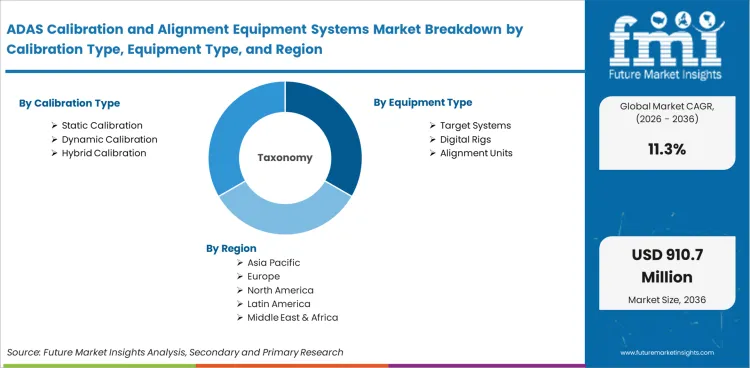
ADAS Calibration and Alignment Equipment Systems Market Breakdown By Calibration Type, Equipment Type, and Region
| Parameter | Details |
|---|---|
| Quantitative Units | USD 280.5 million to USD 818.2 million, at a CAGR of 11.3% |
| Market Definition | The ADAS calibration and alignment equipment systems market encompasses tools and software used to verify sensor alignment after vehicle production or repair. |
| Regions Covered | North America, Latin America, Europe, East Asia, South Asia and Pacific, Middle East and Africa |
| Countries Covered | USA, UK, Germany, China, India, Japan, South Korea, and 30 plus countries |
| Key Companies Profiled | MAHLE GmbH, Robert Bosch GmbH, HELLA GmbH & Co., Autel Intelligent Technology, TEXA S.p.A, Launch Tech Co., COJALI S.L., The Burke Porter Group, Hofmann Megaplan GmbH, BorgWarner Inc. |
| Forecast Period | 2026 to 2036 |
| Approach | Hybrid bottom-up and top-down methodology starting with equipment demand and verified service use patterns. |
Source: Future Market Insights, 2026.
ADAS Calibration and Alignment Equipment Systems Market by Segments
ADAS Calibration and Alignment Equipment Systems Market Segmented by Calibration Type:
- Static Calibration
- Dynamic Calibration
- Hybrid Calibration
ADAS Calibration and Alignment Equipment Systems Market Segmented by Equipment Type:
- Target Systems
- Digital Rigs
- Alignment Units
- Calibration Software
ADAS Calibration and Alignment Equipment Systems Market Segmented by Sensor Type:
- Camera Calibration
- Radar Calibration
- LiDAR Calibration
- Ultrasonic Calibration
ADAS Calibration and Alignment Equipment Systems Market Segmented by Vehicle Type:
- Passenger Vehicles
- Commercial Vehicles
ADAS Calibration and Alignment Equipment Systems Market Segmented by End User:
- Automotive OEMs
- Tier 1 Suppliers
- Service Stations
ADAS Calibration and Alignment Equipment Systems Market by Region:
- North America
- USA
- Canada
- Mexico
- Latin America
- Brazil
- Chile
- Rest of Latin America
- Europe
- Germany
- UK
- Italy
- Spain
- France
- Rest of Europe
- East Asia
- China
- Japan
- South Korea
- South Asia and Pacific
- India
- ASEAN
- Australia & New Zealand
- Rest of South Asia and Pacific
- Middle East and Africa
- Saudi Arabia
- Other GCC Countries
- South Africa
- Rest of Middle East and Africa
Research Sources and Bibliography
- MEMA. (2025, February). ADAS Aftermarket Service Ecosystem 2035.
- USA Bureau of Labor Statistics. (2026, April 10). Consumer Price Index News Release - 2026 M03 Results.
- Press Information Bureau. (2026, February 10). Status of heavy industries sector. Government of India.
- National Highway Traffic Safety Administration. (2024, April 29). NHTSA finalizes key safety rule to reduce crashes and save lives. USA Department of Transportation.
- National Bureau of Statistics of China. (2026, February 28). Statistical communiqué of the People’s Republic of China on the 2025 national economic and social development. NBS China.
- Society of Motor Manufacturers and Traders. (2026, January 6). UK new car market breaches two million as almost one in four buyers go electric. SMMT.
- Invest Korea. (2026, January 20). S. Korea’s auto exports hit record USD 72 bn in 2025. KOTRA.
- German Association of the Automotive Industry. (2026). New record: 40% electric share of passenger car production in 2025. VDA.
This Report Answers
- What is the current and future size of the ADAS calibration and alignment equipment systems market?
- How fast is the ADAS calibration and alignment equipment systems market expected to expand between 2026 and 2036?
- Which calibration type is expected to lead the market by 2026?
- Which vehicle type segment is expected to account for the highest demand by 2026?
- What factors are driving demand for ADAS calibration and alignment equipment systems globally?
- How are vehicle safety regulations influencing adoption of calibration systems?
- Why are automotive OEMs the main demand base for calibration equipment?
- How are sensor-rich vehicles creating demand for specialized calibration workflows?
- Which countries are projected to record faster expansion through 2036?
- What is driving market expansion in China and India?
- Who are the key companies active in the ADAS calibration and alignment equipment systems market?
- How does FMI estimate and validate the market forecast?
Frequently Asked Questions
What is the global market demand for ADAS Calibration and Alignment Equipment Systems in 2026?
In 2026, the global market for ADAS calibration and alignment equipment systems is expected to be worth USD 280.5 million.
How big will the market for ADAS Calibration and Alignment Equipment Systems be in 2036?
By 2036, the market for ADAS calibration and alignment equipment systems is expected to be worth USD 818.2 million.
How much is demand for ADAS Calibration and Alignment Equipment Systems expected to expand between 2026 and 2036?
Between 2026 and 2036, demand for ADAS calibration and alignment equipment systems is expected to expand at a CAGR of 11.3%.
Which vehicle type segment is likely to be the best seller globally by 2026?
Passenger vehicles will make up 58.3% of the vehicle type segment in 2026.
What is causing demand to rise in China?
The China ADAS calibration and alignment equipment systems market is projected to record 6.4% CAGR through 2036, supported by NEV output and intelligent vehicle content.
What is causing demand to rise in India?
The India ADAS calibration and alignment equipment systems market is projected to expand at 6.3% CAGR through 2036, supported by vehicle production and formal service capacity.
What does this report mean by ADAS Calibration and Alignment Equipment Systems Market definition?
The ADAS calibration and alignment equipment systems market includes tools and software used to verify camera, radar, LiDAR, and ultrasonic sensor alignment.
How does FMI make the ADAS Calibration and Alignment Equipment Systems forecast and check it?
Forecasting models use a hybrid bottom-up and top-down approach, starting with equipment demand and checking it against service use patterns.
Preview the report firsthand - request a free sample
Get SampleGet the brochure for pricing and purchase details.
Get PDFTable of Content
- Executive Summary
- Global Market Outlook
- Demand-side Trends
- Supply-side Trends
- Technology Roadmap Analysis
- Analysis and Recommendations
- Market Overview
- Market Coverage / Taxonomy
- Market Definition / Scope / Limitations
- Research Methodology
- Chapter Orientation
- Analytical Lens and Working Hypotheses
- Market Structure, Signals, and Trend Drivers
- Benchmarking and Cross-market Comparability
- Market Sizing, Forecasting, and Opportunity Mapping
- Research Design and Evidence Framework
- Desk Research Programme (Secondary Evidence)
- Company Annual and Sustainability Reports
- Peer-reviewed Journals and Academic Literature
- Corporate Websites, Product Literature, and Technical Notes
- Earnings Decks and Investor Briefings
- Statutory Filings and Regulatory Disclosures
- Technical White Papers and Standards Notes
- Trade Journals, Industry Magazines, and Analyst Briefs
- Conference Proceedings, Webinars, and Seminar Materials
- Government Statistics Portals and Public Data Releases
- Press Releases and Reputable Media Coverage
- Specialist Newsletters and Curated Briefings
- Sector Databases and Reference Repositories
- FMI Internal Proprietary Databases and Historical Market Datasets
- Subscription Datasets and Paid Sources
- Social Channels, Communities, and Digital Listening Inputs
- Additional Desk Sources
- Expert Input and Fieldwork (Primary Evidence)
- Primary Modes
- Qualitative Interviews and Expert Elicitation
- Quantitative Surveys and Structured Data Capture
- Blended Approach
- Why Primary Evidence is Used
- Field Techniques
- Interviews
- Surveys
- Focus Groups
- Observational and In-context Research
- Social and Community Interactions
- Stakeholder Universe Engaged
- C-suite Leaders
- Board Members
- Presidents and Vice Presidents
- R&D and Innovation Heads
- Technical Specialists
- Domain Subject-matter Experts
- Scientists
- Physicians and Other Healthcare Professionals
- Governance, Ethics, and Data Stewardship
- Research Ethics
- Data Integrity and Handling
- Primary Modes
- Tooling, Models, and Reference Databases
- Desk Research Programme (Secondary Evidence)
- Data Engineering and Model Build
- Data Acquisition and Ingestion
- Cleaning, Normalisation, and Verification
- Synthesis, Triangulation, and Analysis
- Quality Assurance and Audit Trail
- Market Background
- Market Dynamics
- Drivers
- Restraints
- Opportunity
- Trends
- Scenario Forecast
- Demand in Optimistic Scenario
- Demand in Likely Scenario
- Demand in Conservative Scenario
- Opportunity Map Analysis
- Product Life Cycle Analysis
- Supply Chain Analysis
- Investment Feasibility Matrix
- Value Chain Analysis
- PESTLE and Porter’s Analysis
- Regulatory Landscape
- Regional Parent Market Outlook
- Production and Consumption Statistics
- Import and Export Statistics
- Market Dynamics
- Global Market Analysis 2021 to 2025 and Forecast, 2026 to 2036
- Historical Market Size Value (USD Million) Analysis, 2021 to 2025
- Current and Future Market Size Value (USD Million) Projections, 2026 to 2036
- Y-o-Y Growth Trend Analysis
- Absolute $ Opportunity Analysis
- Global Market Pricing Analysis 2021 to 2025 and Forecast 2026 to 2036
- Global Market Analysis 2021 to 2025 and Forecast 2026 to 2036, By Calibration Type
- Introduction / Key Findings
- Historical Market Size Value (USD Million) Analysis By Calibration Type , 2021 to 2025
- Current and Future Market Size Value (USD Million) Analysis and Forecast By Calibration Type , 2026 to 2036
- Static Calibration
- Dynamic Calibration
- Hybrid Calibration
- Static Calibration
- Y-o-Y Growth Trend Analysis By Calibration Type , 2021 to 2025
- Absolute $ Opportunity Analysis By Calibration Type , 2026 to 2036
- Global Market Analysis 2021 to 2025 and Forecast 2026 to 2036, By Equipment Type
- Introduction / Key Findings
- Historical Market Size Value (USD Million) Analysis By Equipment Type, 2021 to 2025
- Current and Future Market Size Value (USD Million) Analysis and Forecast By Equipment Type, 2026 to 2036
- Target Systems
- Digital Rigs
- Alignment Value (USD Million)s
- Target Systems
- Y-o-Y Growth Trend Analysis By Equipment Type, 2021 to 2025
- Absolute $ Opportunity Analysis By Equipment Type, 2026 to 2036
- Global Market Analysis 2021 to 2025 and Forecast 2026 to 2036, By Sensor Type
- Introduction / Key Findings
- Historical Market Size Value (USD Million) Analysis By Sensor Type, 2021 to 2025
- Current and Future Market Size Value (USD Million) Analysis and Forecast By Sensor Type, 2026 to 2036
- Camera Calibration
- Radar Calibration
- LiDAR Calibration
- Camera Calibration
- Y-o-Y Growth Trend Analysis By Sensor Type, 2021 to 2025
- Absolute $ Opportunity Analysis By Sensor Type, 2026 to 2036
- Global Market Analysis 2021 to 2025 and Forecast 2026 to 2036, By Vehicles
- Introduction / Key Findings
- Historical Market Size Value (USD Million) Analysis By Vehicles, 2021 to 2025
- Current and Future Market Size Value (USD Million) Analysis and Forecast By Vehicles, 2026 to 2036
- Passenger Vehicles
- Commercial Vehicles
- Passenger Vehicles
- Y-o-Y Growth Trend Analysis By Vehicles, 2021 to 2025
- Absolute $ Opportunity Analysis By Vehicles, 2026 to 2036
- Global Market Analysis 2021 to 2025 and Forecast 2026 to 2036, By End User
- Introduction / Key Findings
- Historical Market Size Value (USD Million) Analysis By End User, 2021 to 2025
- Current and Future Market Size Value (USD Million) Analysis and Forecast By End User, 2026 to 2036
- Automotive OEMs
- Tier 1 Suppliers
- Service Stations
- Automotive OEMs
- Y-o-Y Growth Trend Analysis By End User, 2021 to 2025
- Absolute $ Opportunity Analysis By End User, 2026 to 2036
- Global Market Analysis 2021 to 2025 and Forecast 2026 to 2036, By Region
- Introduction
- Historical Market Size Value (USD Million) Analysis By Region, 2021 to 2025
- Current Market Size Value (USD Million) Analysis and Forecast By Region, 2026 to 2036
- North America
- Latin America
- Western Europe
- Eastern Europe
- East Asia
- South Asia and Pacific
- Middle East & Africa
- Market Attractiveness Analysis By Region
- North America Market Analysis 2021 to 2025 and Forecast 2026 to 2036, By Country
- Historical Market Size Value (USD Million) Trend Analysis By Market Taxonomy, 2021 to 2025
- Market Size Value (USD Million) Forecast By Market Taxonomy, 2026 to 2036
- By Country
- USA
- Canada
- Mexico
- By Calibration Type
- By Equipment Type
- By Sensor Type
- By Vehicles
- By End User
- By Country
- Market Attractiveness Analysis
- By Country
- By Calibration Type
- By Equipment Type
- By Sensor Type
- By Vehicles
- By End User
- Key Takeaways
- Latin America Market Analysis 2021 to 2025 and Forecast 2026 to 2036, By Country
- Historical Market Size Value (USD Million) Trend Analysis By Market Taxonomy, 2021 to 2025
- Market Size Value (USD Million) Forecast By Market Taxonomy, 2026 to 2036
- By Country
- Brazil
- Chile
- Rest of Latin America
- By Calibration Type
- By Equipment Type
- By Sensor Type
- By Vehicles
- By End User
- By Country
- Market Attractiveness Analysis
- By Country
- By Calibration Type
- By Equipment Type
- By Sensor Type
- By Vehicles
- By End User
- Key Takeaways
- Western Europe Market Analysis 2021 to 2025 and Forecast 2026 to 2036, By Country
- Historical Market Size Value (USD Million) Trend Analysis By Market Taxonomy, 2021 to 2025
- Market Size Value (USD Million) Forecast By Market Taxonomy, 2026 to 2036
- By Country
- Germany
- UK
- Italy
- Spain
- France
- Nordic
- BENELUX
- Rest of Western Europe
- By Calibration Type
- By Equipment Type
- By Sensor Type
- By Vehicles
- By End User
- By Country
- Market Attractiveness Analysis
- By Country
- By Calibration Type
- By Equipment Type
- By Sensor Type
- By Vehicles
- By End User
- Key Takeaways
- Eastern Europe Market Analysis 2021 to 2025 and Forecast 2026 to 2036, By Country
- Historical Market Size Value (USD Million) Trend Analysis By Market Taxonomy, 2021 to 2025
- Market Size Value (USD Million) Forecast By Market Taxonomy, 2026 to 2036
- By Country
- Russia
- Poland
- Hungary
- Balkan & Baltic
- Rest of Eastern Europe
- By Calibration Type
- By Equipment Type
- By Sensor Type
- By Vehicles
- By End User
- By Country
- Market Attractiveness Analysis
- By Country
- By Calibration Type
- By Equipment Type
- By Sensor Type
- By Vehicles
- By End User
- Key Takeaways
- East Asia Market Analysis 2021 to 2025 and Forecast 2026 to 2036, By Country
- Historical Market Size Value (USD Million) Trend Analysis By Market Taxonomy, 2021 to 2025
- Market Size Value (USD Million) Forecast By Market Taxonomy, 2026 to 2036
- By Country
- China
- Japan
- South Korea
- By Calibration Type
- By Equipment Type
- By Sensor Type
- By Vehicles
- By End User
- By Country
- Market Attractiveness Analysis
- By Country
- By Calibration Type
- By Equipment Type
- By Sensor Type
- By Vehicles
- By End User
- Key Takeaways
- South Asia and Pacific Market Analysis 2021 to 2025 and Forecast 2026 to 2036, By Country
- Historical Market Size Value (USD Million) Trend Analysis By Market Taxonomy, 2021 to 2025
- Market Size Value (USD Million) Forecast By Market Taxonomy, 2026 to 2036
- By Country
- India
- ASEAN
- Australia & New Zealand
- Rest of South Asia and Pacific
- By Calibration Type
- By Equipment Type
- By Sensor Type
- By Vehicles
- By End User
- By Country
- Market Attractiveness Analysis
- By Country
- By Calibration Type
- By Equipment Type
- By Sensor Type
- By Vehicles
- By End User
- Key Takeaways
- Middle East & Africa Market Analysis 2021 to 2025 and Forecast 2026 to 2036, By Country
- Historical Market Size Value (USD Million) Trend Analysis By Market Taxonomy, 2021 to 2025
- Market Size Value (USD Million) Forecast By Market Taxonomy, 2026 to 2036
- By Country
- Kingdom of Saudi Arabia
- Other GCC Countries
- Turkiye
- South Africa
- Other African Union
- Rest of Middle East & Africa
- By Calibration Type
- By Equipment Type
- By Sensor Type
- By Vehicles
- By End User
- By Country
- Market Attractiveness Analysis
- By Country
- By Calibration Type
- By Equipment Type
- By Sensor Type
- By Vehicles
- By End User
- Key Takeaways
- Key Countries Market Analysis
- USA
- Pricing Analysis
- Market Share Analysis, 2025
- By Calibration Type
- By Equipment Type
- By Sensor Type
- By Vehicles
- By End User
- Canada
- Pricing Analysis
- Market Share Analysis, 2025
- By Calibration Type
- By Equipment Type
- By Sensor Type
- By Vehicles
- By End User
- Mexico
- Pricing Analysis
- Market Share Analysis, 2025
- By Calibration Type
- By Equipment Type
- By Sensor Type
- By Vehicles
- By End User
- Brazil
- Pricing Analysis
- Market Share Analysis, 2025
- By Calibration Type
- By Equipment Type
- By Sensor Type
- By Vehicles
- By End User
- Chile
- Pricing Analysis
- Market Share Analysis, 2025
- By Calibration Type
- By Equipment Type
- By Sensor Type
- By Vehicles
- By End User
- Germany
- Pricing Analysis
- Market Share Analysis, 2025
- By Calibration Type
- By Equipment Type
- By Sensor Type
- By Vehicles
- By End User
- UK
- Pricing Analysis
- Market Share Analysis, 2025
- By Calibration Type
- By Equipment Type
- By Sensor Type
- By Vehicles
- By End User
- Italy
- Pricing Analysis
- Market Share Analysis, 2025
- By Calibration Type
- By Equipment Type
- By Sensor Type
- By Vehicles
- By End User
- Spain
- Pricing Analysis
- Market Share Analysis, 2025
- By Calibration Type
- By Equipment Type
- By Sensor Type
- By Vehicles
- By End User
- France
- Pricing Analysis
- Market Share Analysis, 2025
- By Calibration Type
- By Equipment Type
- By Sensor Type
- By Vehicles
- By End User
- India
- Pricing Analysis
- Market Share Analysis, 2025
- By Calibration Type
- By Equipment Type
- By Sensor Type
- By Vehicles
- By End User
- ASEAN
- Pricing Analysis
- Market Share Analysis, 2025
- By Calibration Type
- By Equipment Type
- By Sensor Type
- By Vehicles
- By End User
- Australia & New Zealand
- Pricing Analysis
- Market Share Analysis, 2025
- By Calibration Type
- By Equipment Type
- By Sensor Type
- By Vehicles
- By End User
- China
- Pricing Analysis
- Market Share Analysis, 2025
- By Calibration Type
- By Equipment Type
- By Sensor Type
- By Vehicles
- By End User
- Japan
- Pricing Analysis
- Market Share Analysis, 2025
- By Calibration Type
- By Equipment Type
- By Sensor Type
- By Vehicles
- By End User
- South Korea
- Pricing Analysis
- Market Share Analysis, 2025
- By Calibration Type
- By Equipment Type
- By Sensor Type
- By Vehicles
- By End User
- Russia
- Pricing Analysis
- Market Share Analysis, 2025
- By Calibration Type
- By Equipment Type
- By Sensor Type
- By Vehicles
- By End User
- Poland
- Pricing Analysis
- Market Share Analysis, 2025
- By Calibration Type
- By Equipment Type
- By Sensor Type
- By Vehicles
- By End User
- Hungary
- Pricing Analysis
- Market Share Analysis, 2025
- By Calibration Type
- By Equipment Type
- By Sensor Type
- By Vehicles
- By End User
- Kingdom of Saudi Arabia
- Pricing Analysis
- Market Share Analysis, 2025
- By Calibration Type
- By Equipment Type
- By Sensor Type
- By Vehicles
- By End User
- Turkiye
- Pricing Analysis
- Market Share Analysis, 2025
- By Calibration Type
- By Equipment Type
- By Sensor Type
- By Vehicles
- By End User
- South Africa
- Pricing Analysis
- Market Share Analysis, 2025
- By Calibration Type
- By Equipment Type
- By Sensor Type
- By Vehicles
- By End User
- USA
- Market Structure Analysis
- Competition Dashboard
- Competition Benchmarking
- Market Share Analysis of Top Players
- By Regional
- By Calibration Type
- By Equipment Type
- By Sensor Type
- By Vehicles
- By End User
- Competition Analysis
- Competition Deep Dive
- MAHLE GmbH
- Overview
- Product Portfolio
- Profitability by Market Segments (Product/Age /Sales Channel/Region)
- Sales Footprint
- Strategy Overview
- Marketing Strategy
- Product Strategy
- Channel Strategy
- Robert Bosch GmbH
- HELLA GmbH & Co.
- Autel Intelligent Technology
- TEXA S.p.A
- Launch Tech Co.
- The Burke Porter Group
- MAHLE GmbH
- Competition Deep Dive
- Assumptions & Acronyms Used


