

- Industry Size (2026)
- USD 223.0 Mn
- Forecast (2036)
- USD 407.0 Mn
- CAGR (2026 to 2036)
- 6.2%
Indoor Air Quality Multi-Pollutant Sensor Calibration Test Equipment Market Size, Market Forecast and Outlook By FMI
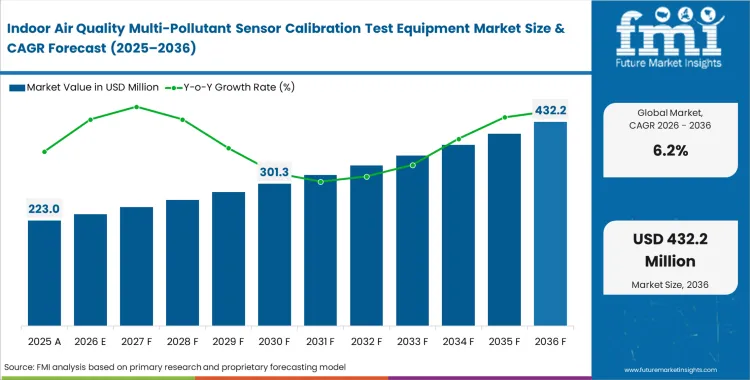
The indoor air quality multi-pollutant sensor calibration test equipment market was valued at USD 210.0 million in 2025. Sales are poised to cross USD 223.0 million in 2026 at a CAGR of 6.2% during the forecast period. Industry expansion is set to reach USD 407.0 million through 2036 as validation laboratories shift from single-gas checks to simultaneous mixed-pollutant chamber evaluations.
Summary of Indoor Air Quality Multi-Pollutant Sensor Calibration Test Equipment Market
- The market is forecast to reach USD 407.0 million by 2036.
- The market is expected to grow at a CAGR of 6.2% from 2026 to 2036.
- The market was estimated at USD 210.0 million in 2025.
- The market is projected to reach USD 223.0 million in 2026.
- The forecast period represents an incremental opportunity of USD 184.0 million.
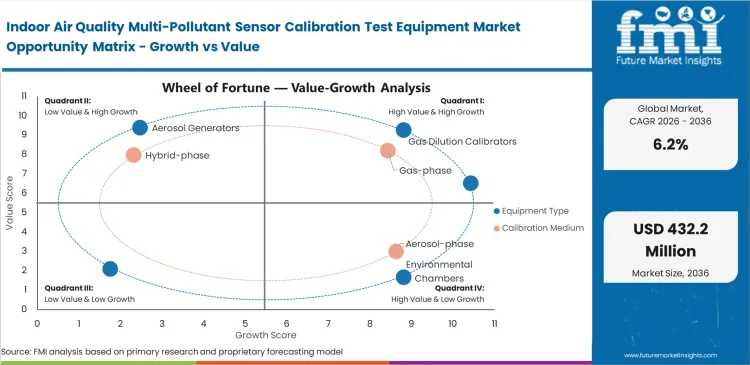
- Gas dilution calibrators lead by equipment type with a 34.0% share.
- Gas-phase calibration dominates medium type with a 42.0% share.
- Automated systems lead by automation level with a 46.0% share.
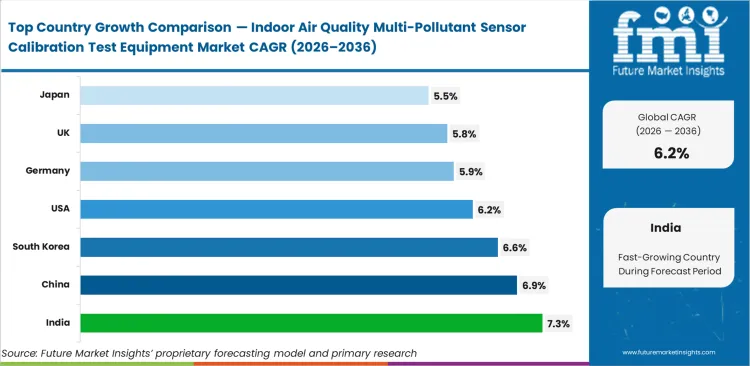
- India is the fastest-growing market at 7.3%, followed by China at 6.9% and South Korea at 6.6%.
- Key companies in the market include HORIBA, Acoem, Environics, Weiss Technik, TSI, Kanomax, and 2B Technologies.
Building certification engineers are under mounting pressure to validate consumer-grade components against laboratory-grade reference standards before approving HVAC system integration. Test facility directors can no longer depend on isolated carbon dioxide measurements, as LEED v5 and WELL certification frameworks now demand concurrent monitoring of particulate matter and volatile organic compounds. Without timely investment in multi-gas dilution systems, independent certification bodies risk significant backlogs as they struggle to process an increasing volume of low-cost sensor models. Independent laboratories increasingly evaluate environmental monitoring accuracy across shifting temperature gradients. This urgency accelerates the broader IAQ sensor calibration equipment market expansion.
Once national regulators formalize testing methodologies, validation volumes rise immediately. Sensor manufacturers are then required to invest in calibrated aerosol generators to comply with tighter conformity standards. In the absence of traceable reference measurements within internal quality assurance processes, production lines can come to a halt, driving urgent capacity expansion across the multi-pollutant sensor calibration market.
India is estimated to hold the lead with a 7.3% CAGR, as local sensor assembly and commercial building digitization expand quickly from a still-localized base. China is anticipated to capture a 6.9% CAGR, supported by its large original equipment manufacturing base, while South Korea is set to record 6.6% growth on the back of premium electronics integration. The United States is expected to hold a 6.2% CAGR, driven by its established AQ-SPEC validation ecosystem. Germany is poised to garner 5.9% growth, slightly ahead of the United Kingdom, which is estimated to hold a 5.8% CAGR, as both markets move through replacement cycles for aging calibration hardware. Japan rounds out the major test hubs and is anticipated to capture a 5.5% CAGR. Facility requirements still vary sharply across these geographies, with Asian manufacturing centers investing more heavily in production-line validation tools, while European testing authorities continue to procure more complex environmental chambers.
Segmental Analysis
Indoor Air Quality Multi-Pollutant Sensor Calibration Test Equipment Market Analysis by Equipment Type
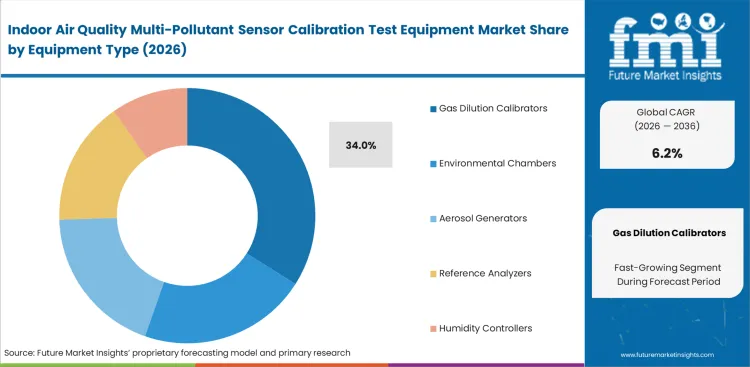
Test laboratories replace standalone mass flow controllers once basic setups stop reproducing the atmospheric mixtures required under current certification standards. Gas dilution calibrators are estimated to secure 34.0% share in 2026 because they generate the precise concentration profiles needed for baseline performance documentation and repeatable validation work. Quality assurance teams depend on these integrated systems to blend reference gases accurately across broad dynamic ranges, which keeps production lines aligned with tighter compliance expectations. A leadership position comes with an operating constraint that buyers often understate. Sourcing teams usually assess the capital cost of the calibrator itself more carefully than the recurring expense of certified specialty gas supply. Demand for more advanced air quality sensor test chamber systems rises from the same requirement, since laboratories now need controlled, repeatable gas handling rather than simple component-level assembly.
- Flow verification: Integrated sonic orifices maintain stable flow rates even when downstream pressure shifts during long exposure runs. Quality assurance managers gain confidence in stability data and reduce the risk of recalls tied to poor concentration control.
- Manifold dead-volume: Internal plumbing architecture reduces dead space and speeds up transitions between pollutant setpoints. Laboratory technicians consume less calibration gas during purge cycles and move through test phases more efficiently.
- Algorithm tracking: Onboard software calculates final dilution ratios from cylinder concentrations and target mixture settings automatically. Calibration engineers avoid manual calculation errors that can invalidate week-long certification trials.
Indoor Air Quality Multi-Pollutant Sensor Calibration Test Equipment Market Analysis by Calibration Medium
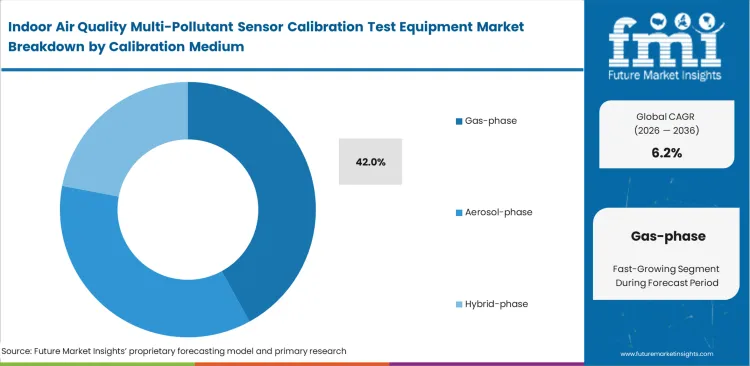
Regulatory testing begins with controlled reference protocols for hazardous gases before laboratories move into the more variable behavior of particulate matter. Gas-phase calibration systems remain central to that workflow because most installed testing infrastructure was built around carbon dioxide, formaldehyde, and trace VOC validation. Gas-phase calibration systems are anticipated to hold 42.0% share of the market in 2026, reflecting both regulatory continuity and the practical need for stable trace-gas generation in building sensor qualification. HVAC integration teams continue to prioritize these systems when verifying demand-controlled ventilation components, where low-level gas accuracy matters more than broad chamber capability. The tougher execution issue is often misunderstood. Facilities supporting WELL building certification and advanced indoor air quality programs need that precision, and older gas delivery systems increasingly struggle to meet low-ppb requirements demanded by newer sensor designs.
- Cylinder regulation: Multi-stage pressure regulators maintain steady delivery from high-pressure reference cylinders into the dilution manifold. Laboratory managers avoid startup spikes that can damage sensitive optical sensor components.
- Condensation prevention: Heated transfer lines keep heavier volatile organic compounds from condensing on tubing walls before they reach the chamber. Test engineers reduce false-negative readings caused by gas losses inside the delivery path.
- Permeation ovens: Integrated thermal chambers use calibrated permeation tubes to generate reactive gases that degrade too quickly in stored cylinders. Certification teams gain a safer and more reliable way to produce trace-level nitrogen dioxide mixtures.
Indoor Air Quality Multi-Pollutant Sensor Calibration Test Equipment Market Analysis by Automation Level
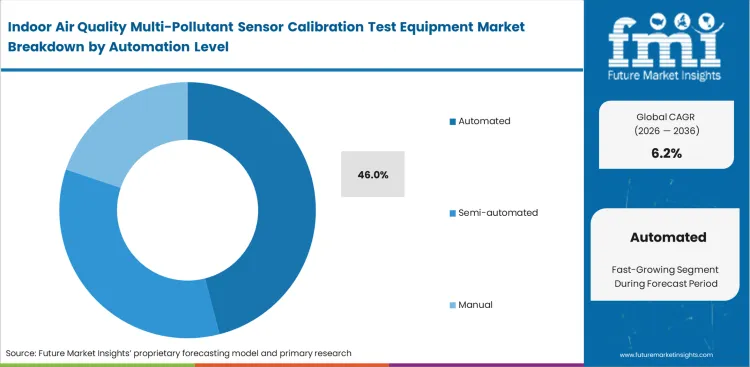
High-volume component manufacturing requires rapid, sequential exposure to multiple target concentrations without constant technician intervention. Automated systems execute complex, multi-day testing scripts with the consistency needed for continuous baseline, span, and cross-interference checks. Production engineers program these platforms to run overnight, so testing capacity extends beyond staffed shifts. Many small laboratories still buy manual systems, expecting lower capital outlay to translate into lower operating costs. That assumption usually fails once technicians must keep adjusting manual flow controllers throughout a three-day ASTM protocol to maintain test continuity. Automated systems are expected to capture a 46.0% share of the market in 2026, reflecting the throughput and labor advantage they deliver under real operating conditions. Academic researchers who continue to rely on manual setups face the same constraint, since reviewers increasingly expect long, uninterrupted datasets that manual systems struggle to generate reliably. Implementing a reliable VOC sensor gas dilution system resolves these continuity problems.
- Sequence programming: Test supervisors build multi-day execution scripts that transition seamlessly through complex pollutant gradients. Certification facilities quadruple their testing throughput by running automated evaluations continuously over weekends without staffing requirements.
- Digital handshake: Automated calibrators interface directly with environmental chambers to synchronize concentration shifts alongside temperature ramps. Systems engineers capture perfectly aligned dataset correlations, avoiding hours of manual data alignment during post-test analysis.
- Fault notification: Integrated software monitors internal flow controllers continuously, halting sequences immediately if reference gas cylinder pressures drop below operational thresholds. Quality assurance directors avoid wasting entire production batches on invalid tests running overnight with empty cylinders.
Indoor Air Quality Multi-Pollutant Sensor Calibration Test Equipment Market Analysis by End Use
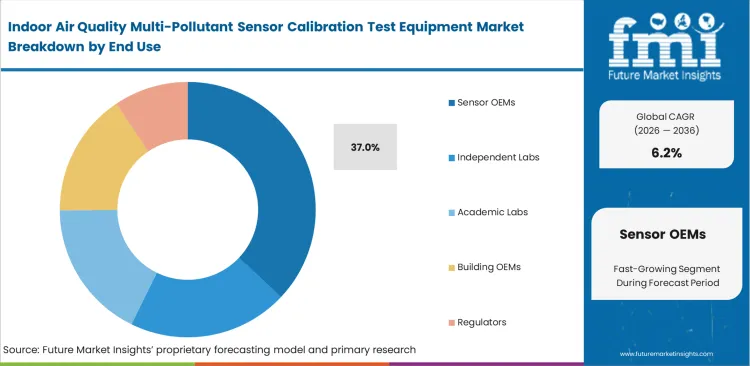
Component design phases require iterative performance checks long before final products reach independent certification bodies. Sensor original equipment manufacturers embed testing infrastructure directly into their product development pipelines. Hardware engineers utilize these systems to characterize baseline sensor responses and develop internal compensation algorithms. Industry watchers often assume independent testing labs buy the most sophisticated equipment. Top-tier sensor OEMs deploy far more advanced multi-pollutant chambers specifically to discover failure modes before independent reviewers find them. Sensor original equipment manufacturers are expected to account for 37.0% share in 2026. Companies attempting to outsource early-stage automotive cabin air quality validation face unacceptable development delays compared to competitors operating dedicated internal calibration facilities. Constructing a complete CO2 PM2.5 TVOC sensor calibration setup internally allows rapid iteration.
- Algorithm training: Development teams expose prototype sensing elements to hundreds of distinct temperature, humidity, and pollutant combinations. Firmware engineers extract massive datasets required to build robust cross-sensitivity compensation models prior to product launch.
- Burn-in validation: Production facilities run continuous low-level exposure profiles on completed sensor boards to verify long-term stability. Quality assurance managers isolate drifting components before shipping them to commercial HVAC integrators.
- Warranty defense: Manufacturers maintain precise digital records of every outgoing component's performance against reference analyzers inside controlled chambers. Legal departments utilize these calibration certificates to dismiss liability claims when building owners blame sensors for poor air quality events.
Indoor Air Quality Multi-Pollutant Sensor Calibration Test Equipment Market Analysis by Form Factor
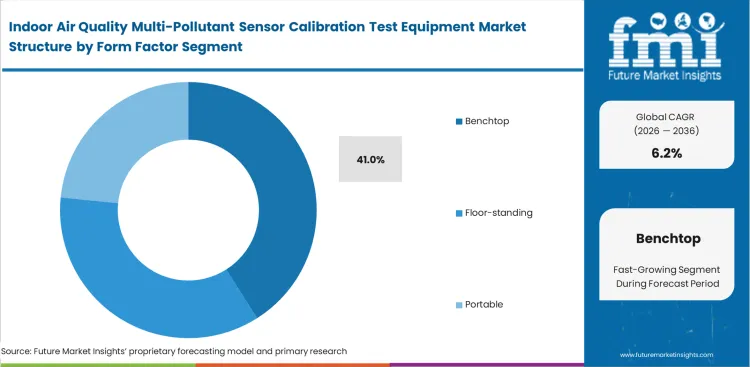
Laboratory space constraints shape equipment choice almost as much as calibration performance in electronics testing facilities. Benchtop calibrators are estimated to capture 41.0% share in 2026 because they deliver the precision needed for single-component characterization while fitting within standard workstation layouts. Test engineers favor them when the job calls for fast, controlled validation without the footprint and infrastructure burden of full-scale environmental chambers. Procurement teams often specify floor-standing systems based on technical range alone, then discover that the HVAC and exhaust upgrades required to support them can cost more than the equipment itself. Portable field calibrators create a different mismatch. Research facilities that try to use them for rigorous laboratory validation usually run into thermal instability and poor repeatability, especially in publication-grade FTIR gas analyser work. Benchtop systems sit in the practical middle, giving laboratories usable precision within the space, utility, and budget limits they actually operate under.
- Modular stacking: Compact hardware designs let technicians stack multiple dilution units vertically within limited bench space. Facility managers can raise testing capacity per square foot without expanding laboratory footprint.
- Quick-disconnect fittings: Front-facing pneumatic ports make it easier to switch between reference gas cylinders during mixed-gas studies. Laboratory teams reduce setup time when moving across client protocols or pollutant types.
- Thermal isolation: Internal layouts separate heat-generating power supplies from sensitive mass flow controllers. Design engineers maintain tighter volumetric flow accuracy during continuous 48-hour exposure runs.
Indoor Air Quality Multi-Pollutant Sensor Calibration Test Equipment Market Drivers, Restraints, and Opportunities
Stringent building certification requirements force facility operators to deploy highly accurate sensing networks, creating intense pressure on original equipment manufacturers to validate their hardware. Certification engineers cannot submit performance data derived from uncalibrated commercial sensors when pursuing LEED v5 or WELL building standards. Delaying the acquisition of multi-pollutant test equipment leaves sensor manufacturers unable to provide required traceability documentation. This failure effectively locks them out of premium commercial real estate projects. This regulatory pressure pushes testing laboratories to upgrade ad-hoc setups into formal continuous emission monitoring validation stacks capable of executing simultaneous multi-gas evaluations. Investing heavily in ASTM D8405 indoor sensor testing equipment is now mandatory for survival.
Chamber design complexity creates severe operational friction that slows adoption even for well-funded testing facilities. Procuring hardware represents only the initial barrier. Laboratories struggle continuously with reference gas instability, where highly reactive compounds like formaldehyde degrade inside delivery cylinders before reaching the testing chamber. This chemical reality requires facilities to integrate complex, high-maintenance permeation ovens alongside standard dilution calibrators. Newer dynamic gas generators partially address cylinder degradation. However, these systems demand specialized technician training that most independent laboratories currently lack.
Opportunities in the Indoor Air Quality Multi-Pollutant Sensor Calibration Test Equipment Market
- Chamber leasing models: Financial structuring options allow smaller academic laboratories to access advanced environmental testing hardware. Equipment manufacturers generate predictable recurring revenue streams while expanding their installed user base across the smart building IAQ sensor calibration market.
- Automated reporting software: Digital platforms that instantly convert raw chamber output into formatted ASTM compliance documents eliminate massive administrative bottlenecks. Independent certification facilities increase their testing throughput without hiring additional data analysts.
- Multi-phase integration: Engineering combined systems that simultaneously deliver precise aerosol distributions and trace-level volatile organic compounds opens new validation pathways. Hardware vendors capture premium pricing from natural gas analyzers laboratories executing complex cross-sensitivity studies.
Regional Analysis
Based on regional analysis, indoor air quality multi-pollutant sensor calibration test equipment is segmented into North America, Europe, and Asia Pacific across 40 plus countries.
.webp "Top Country Growth Comparison Indoor Air Quality Multi Pollutant Sensor Calibration Test Equipment Market Cagr (2026 2036)")
| Country | CAGR (2026 to 2036) |
|---|---|
| India | 7.3% |
| China | 6.9% |
| South Korea | 6.6% |
| United States | 6.2% |
| Germany | 5.9% |
| United Kingdom | 5.8% |
| Japan | 5.5% |
Source: Future Market Insights (FMI) analysis, based on proprietary forecasting model and primary research
North America Indoor Air Quality Multi-Pollutant Sensor Calibration Test Equipment Market Analysis
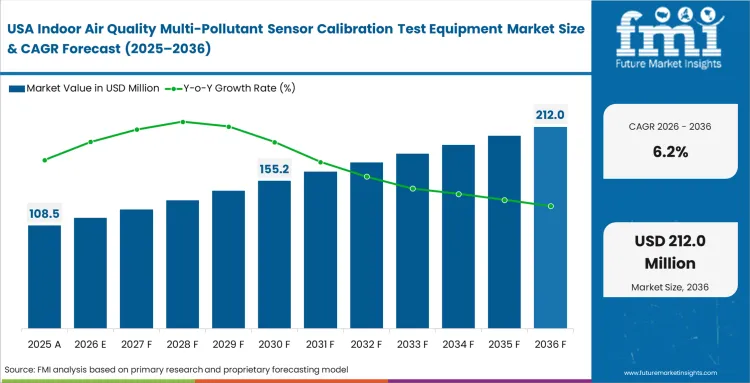
Established regulatory testing frameworks shape how independent laboratories plan capital spending across North America. Facilities align equipment purchases with protocol requirements set by major environmental agencies, and that operating structure is pushing laboratories away from manual calibration setups toward automated multi-parameter validation chambers.
- United States: Government-backed validation programs set the performance baseline for commercial sensor testing across the country. Laboratory directors need advanced aerosol and gas delivery systems to win contracts from major component manufacturers. The indoor air quality multi-pollutant sensor calibration test equipment sector in the United States is expected to capture at a 6.2% CAGR, supported by the steady replacement of legacy validation hardware inside a mature testing ecosystem. That demand continues to favor facilities equipped with automated chambers that can run long-duration multi-pollutant evaluations with minimal execution risk.
FMI's report includes Canada alongside the established United States validation environment. While domestic facilities dominate standards creation through regulatory programs, northern latitude test centers uniquely focus their capital allocations on extreme cold‑weather HVAC integration capabilities. South Korea is also identified as a growing influence, as rising investments in advanced climate control systems, automotive testing, and smart infrastructure are expanding demand for specialized validation and certification services.
Europe Indoor Air Quality Multi-Pollutant Sensor Calibration Test Equipment Market Analysis
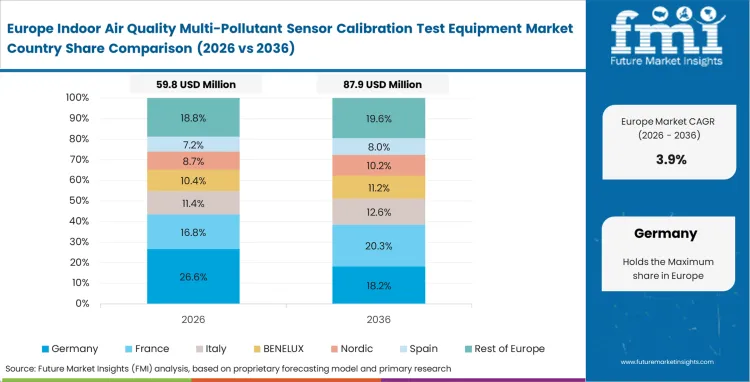
Stringent building energy performance rules are forcing European facility managers to rely on more accurate demand-controlled ventilation sensors, and that is raising the calibration standard across the region. Laboratories increasingly need reliable low-concentration measurement under tightly controlled environmental conditions, especially where temperature and humidity shifts can alter sensor response. FMI’s view is that this requirement is pushing European testing authorities away from basic dilution setups and toward higher-specification systems that can reproduce exposure conditions with far greater control.
- Germany: Automotive and industrial engineering depth gives Germany a stricter validation culture than many peer markets. Demand for indoor air quality multi-pollutant sensor calibration test equipment in Germany is estimated to expand at a 5.9% CAGR through 2036, with much of that demand tied to replacement cycles for aging calibration hardware. Quality assurance teams specify high-end reference analyzers and environmental chambers to meet demanding European compliance requirements and internal repeatability standards. Laboratories that cannot demonstrate stable, repeatable performance are less likely to retain long-term deployment contracts in major testing hubs.
- United Kingdom: Universities, research institutes, and specialized test centers create demand for benchtop gas dilution platforms that can be reconfigured quickly across changing research protocols. Principal investigators and laboratory managers value systems that minimize downtime between studies and support a wider range of validation work. indoor air quality multi-pollutant sensor calibration test equipment demand in the United Kingdom is anticipated to increase at a CAGR of 5.8% over the forecast period, as testing facilities favor modular architectures over large fixed-installation chambers. That flexibility helps independent laboratories compete for a broader mix of work across consumer product testing and industrial safety validation.
FMI's report includes France, Italy, Spain, and Russia beyond the primary testing hubs analyzed above. Southern European facility managers face entirely different operational pressures, prioritizing advanced humidity control modules over raw temperature manipulation because extreme coastal moisture variations rapidly degrade unprotected optical particle counters. The Netherlands is also highlighted as an emerging area of opportunity, where high‑density ports, semiconductor testing facilities, and climate‑sensitive logistics infrastructure are driving investment in precision environmental validation systems.
Asia Pacific Indoor Air Quality Multi-Pollutant Sensor Calibration Test Equipment Market Analysis
Mass electronics manufacturing capacity shapes purchasing behavior across Asian calibration hubs. Production environments need high-throughput validation systems that can support factory-floor testing at scale, not research-oriented equipment built for slower experimental work. FMI’s analysis indicates that local quality control managers increasingly favor automated systems capable of validating multiple sensor boards at once, because production efficiency and repeatability matter more than standalone laboratory flexibility.
- India: Accelerating commercial real estate development and worsening urban air pollution are pushing domestic manufacturers to build local sensor assembly and testing capacity more aggressively. Demand for indoor air quality multi-pollutant sensor calibration test equipment in India is expected to rise at a CAGR of 7.3% through 2036, with benchtop calibrators seeing strong uptake as manufacturers establish basic quality control for high-volume, low-cost air quality monitors. Expansion still starts from a relatively small installed base, which is why current capital allocation is moving quickly into foundational validation infrastructure. Local testing facilities also benefit as international building standards such as LEED gain wider acceptance among premium property developers.
- China: Unmatched original equipment manufacturing scale keeps equipment demand tied closely to production-line efficiency and throughput. Quality engineers rely on automated, rack-mounted calibration systems built directly into large manufacturing lines so they can run baseline and span checks on thousands of consumer-grade sensors each day. Continuous factory expansion keeps procurement volumes high, and the indoor air quality multi-pollutant sensor calibration test equipment market in China is estimated to hold at a 6.9% CAGR. Spending is closely linked to export discipline, as component manufacturers need traceable multi-gas testing capability to protect international supply relationships.
- South Korea: Advanced semiconductor and smart-home electronics programs create demand for calibration hardware with tighter precision and better environmental control than standard mass-market setups. Product development teams use complex chamber systems to refine compensation algorithms before high-end appliances move into commercial launch. Electronics manufacturers are investing heavily in internal validation capacity, and South Korea is anticipated to post a 6.6% CAGR in the indoor air quality multi-pollutant sensor calibration test equipment market through 2036. That spending pattern reflects a premium-product strategy where performance verification directly supports competitiveness in smart building and connected device markets.
- Japan: Mature precision engineering industries keep procurement focused on upgrading installed calibration infrastructure rather than building capacity from scratch. Metrology specialists place more weight on long-term stability, digital control, and repeatable reference performance than on raw testing speed alone. Sales of indoor air quality multi-pollutant sensor calibration test equipment in Japan are expected to rise at a CAGR of 5.5% through 2036. Replacement demand remains the main purchasing driver among established certification bodies and specialized laboratories. Continued investment in reference analyzers and zero-air generation systems helps these facilities maintain the measurement discipline that underpins Japan’s reputation in precision validation work.
FMI's report includes Australia and the Rest of Asia Pacific alongside the primary electronics manufacturing centers. Vietnam is also gaining prominence, as the rapid expansion of semiconductor assembly, consumer electronics production, and export‑oriented industrial parks is increasing demand for reliable environmental testing and validation infrastructure.
Competitive Aligners for Market Players
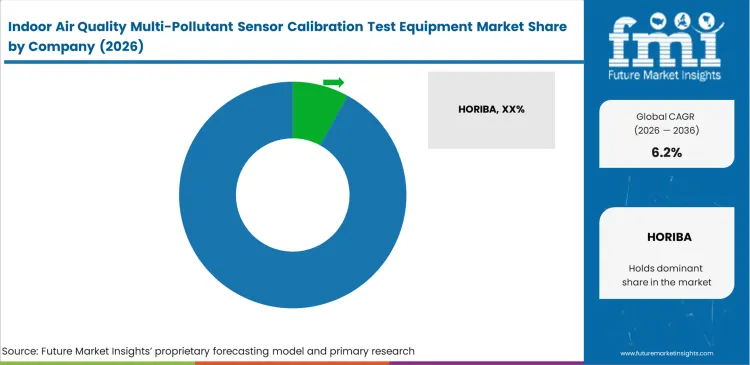
Specialized metrology requirements have created a highly structured competitive landscape where established reference equipment manufacturers effectively set the technical benchmarks. Companies such as HORIBA and Acoem draw on decades of experience in regulatory-grade continuous emissions monitoring to maintain a strong position in indoor sensor calibration. Test laboratory directors show limited appetite for unproven hardware startups, instead favoring established indoor air quality calibration system supplier with a long track record of ISO 17025 accreditation. This emphasis on validated performance acts as a barrier to rapid market entry. While constructing a gas dilution manifold is relatively straightforward from a mechanical standpoint, demonstrating consistent volumetric accuracy under varying pressure conditions requires years of documented validation.
Established players reinforce their market position by tightly coupling proprietary control software with their mass flow controllers and reference analyzers. Environics maintains a strong presence through automated sequencing platforms that reduce the need for manual intervention during extended ASTM testing procedures. New entrants cannot compete on price alone; they must recreate fully integrated digital ecosystems that align environmental sensor outputs with chamber conditions and reference gas inputs. Customer retention remains exceptionally high, as switching calibration vendors often requires laboratories to overhaul years of customized testing protocols and retrain engineering teams. Once a laboratory invests in indoor air quality sensor calibration chamber systems, it becomes embedded within a long-term supplier ecosystem.
Major sensor original equipment manufacturers increasingly flex their purchasing power by demanding customized chamber architectures tailored to their specific production line formats. Rather than accepting standard benchtop calibrators, Tier-1 component producers require vendors like Weiss Technik to design high-throughput testing manifolds that validate dozens of sensor boards simultaneously. Custom engineering capabilities determine long-term success. Suppliers who successfully adapt traditional laboratory-grade calibration precision for fast-paced electronics manufacturing environments capture highly profitable multi-year procurement contracts. Procurement teams regularly request a precise gas dilution calibrator quote for VOC sensor testing to evaluate these bespoke architectures.
Key Players in Indoor Air Quality Multi-Pollutant Sensor Calibration Test Equipment Market
- HORIBA
- Acoem
- Environics
- Weiss Technik
- TSI Incorporated
- Kanomax
- 2B Technologies
Scope of the Report
| Metric | Value |
|---|---|
| Quantitative Units | USD 223.0 million to USD 407.0 million, at a CAGR of 6.2% |
| Market Definition | Indoor Air Quality Multi-Pollutant Sensor Calibration Test Equipment provides traceable reference baselines for validating commercial sensing networks. Controlled chambers and dilution systems expose test devices to specific airborne contaminant combinations under regulated environmental conditions. |
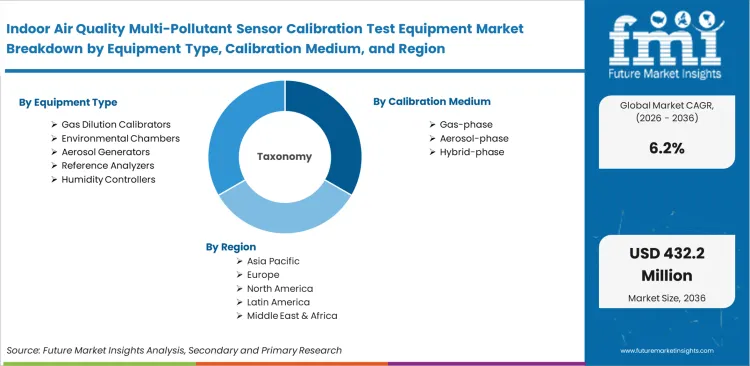
| Segmentation | Equipment Type, Calibration Medium, Automation Level, End Use, Form Factor |
| Regions Covered | North America, Latin America, Europe, Asia Pacific, Middle East and Africa |
| Countries Covered | India, China, South Korea, United States, Germany, United Kingdom, Japan |
| Key Companies Profiled | HORIBA, Acoem, Environics, Weiss Technik, TSI Incorporated, Kanomax, 2B Technologies |
| Forecast Period | 2026 to 2036 |
| Approach | Annual capital expenditure budgets for independent air quality testing laboratories anchor all baseline valuation models. |
Source: Future Market Insights (FMI) analysis, based on proprietary forecasting model and primary research
Indoor Air Quality Multi-Pollutant Sensor Calibration Test Equipment Market Analysis by Segments
Equipment Type
- Gas Dilution Calibrators
- Environmental Chambers
- Aerosol Generators
- Reference Analyzers
- Humidity Controllers
Calibration Medium
- Gas-phase
- Aerosol-phase
- Hybrid-phase
Automation Level
- Automated
- Semi-automated
- Manual
End Use
- Sensor OEMs
- Independent Labs
- Academic Labs
- Building OEMs
- Regulators
Form Factor
- Benchtop
- Floor-standing
- Portable
Region
- North America
- United States
- Canada
- Latin America
- Brazil
- Mexico
- Rest of Latin America
- Europe
- Germany
- United Kingdom
- France
- Italy
- Spain
- Russia
- Rest of Europe
- Asia Pacific
- China
- Japan
- India
- South Korea
- Australia
- Rest of Asia Pacific
- Middle East and Africa
- GCC Countries
- South Africa
- Rest of Middle East and Africa
Bibliography
- American Society of Heating, Refrigerating and Air-Conditioning Engineers. (2025, February 12). Indoor carbon dioxide.
- International WELL Building Institute. (2025, April 14). WELL performance verification guidebook.
- National Renewable Energy Laboratory. (2024). Development of laboratory test methods for low-cost indoor air quality sensors.
- USA Green Building Council. (2025, April). Summary of changes to LEED v5 USA Green Building Council.
- Fissore, V. I., Lanzone, V., Cagliero, M., Quaglio, G., Pollo, R., Ferraris, F., Rubino, S., Razzak, H., Cortese, M., & Genta, G. (2024). Multi-sensor device for traceable monitoring of indoor environments and calibration methods. Sensors, 24(10), Article 3152.
- Othman, H., Chaaban, F. B., Shurafa, S., Dmour, M. M., Chedid, R., Kays, W., Ghaddar, N., & Ghali, K. (2025). A calibration chamber framework for low-cost indoor air quality sensors evaluation in naturally ventilated office spaces: Design and implementation. Building and Environment, 283, 113219.
This bibliography is provided for reader reference. The full FMI report contains the complete reference list with primary source documentation.
This Report Addresses
- Component manufacturers struggling to validate consumer-grade optical sensors against demanding ASTM protocols.
- Independent laboratories deciding between benchtop dilution setups and fully automated environmental test chambers.
- Certification agencies managing extreme backlog pressures while attempting to execute multi-day exposure testing manually.
- Quality assurance directors seeking traceable reference methods to defend internal calibration data against field failures.
- Facility managers navigating complex WELL building performance verification rules using uncalibrated building networks.
- Academic researchers discovering that standalone field tools lack the thermal stability needed for publication-quality validation.
- Procurement officers calculating the hidden operational costs of reference gas cylinder consumption versus initial capital layouts.
- Original equipment manufacturers migrating from simple carbon dioxide baseline checks toward simultaneous multi-pollutant compensation algorithms.
Frequently Asked Questions
Exactly what equipment is used to calibrate indoor air quality sensors?
Validation workflows require precise hardware combinations including mass flow controllers, gas dilution calibrators, and specialized environmental chambers. Test facility engineers utilize these specific instruments to expose commercial sensing modules to highly controlled atmospheric mixtures mimicking real-world conditions.
Regarding methodology, how are multi-pollutant IAQ sensors calibrated?
Certification teams position the commercial components inside sealed environmental chambers alongside highly accurate laboratory reference analyzers. Technicians manipulate temperature, humidity, and trace gas concentrations simultaneously, establishing distinct performance curves that map how the sensor reacts to complex, shifting atmospheric variables.
Functionally, why do IAQ sensors need chamber testing?
Component architecture behaves unpredictably when multiple airborne variables interact simultaneously. Standalone ambient testing completely misses profound cross-sensitivity flaws, forcing laboratories to isolate the components inside controlled chambers to document true performance deviations under varied thermal and moisture stresses.
When evaluating the HORIBA vs Acoem gas calibrator capabilities, what distinguishes them?
Laboratory directors favor HORIBA when pursuing absolute extreme precision in academic research settings, whereas Acoem architectures excel in continuous, ruggedized testing environments. Both manufacturers dominate the regulatory-grade equipment sector but address slightly different continuous flow stability requirements.
In deployment workflows, how does chamber testing vs field calibration for IAQ sensors differ?
Field calibration merely verifies basic functionality by briefly exposing a deployed component to a single span gas. Laboratory chamber testing scientifically maps the sensor's entire reaction matrix across shifting temperature, humidity, and interference gradients before the component ever reaches commercial deployment.
What limits adoption of fully automated environmental chambers in independent test labs?
Facility HVAC infrastructure proves critically inadequate. Massive environmental chambers require dedicated, high-capacity exhaust routing that many commercial laboratory locations simply cannot accommodate without structurally modifying the building, capping adoption rates among smaller testing providers.
Why do automated systems hold a 46.0% share despite high capital costs?
Quality engineering teams must run continuous, week-long exposure sequences to properly evaluate sensor drift and cross-sensitivity. Manual platforms require constant technician presence to adjust mass flow controllers, making high-volume validation workflows economically impossible without automated sequencing.
What specific operational hurdle do aerosol-phase calibration systems present?
Producing a stable, repeatable distribution of particulate matter requires extreme environmental control. Minor temperature fluctuations inside the testing manifold cause agglomeration, destroying the required particle size distribution before it even reaches the optical sensor under evaluation. An aerosol generator for PM sensor calibration requires absolute thermal stability.
How does India's 7.3% CAGR compare structurally to Japan's 5.5% expansion?
Procurement directors in India build out first-generation, high-volume baseline testing stations for localized manufacturing assembly lines. Japanese metrology facilities solely execute highly specialized replacement cycles for extreme-precision reference architecture.
Why do gas dilution calibrators capture 34.0% of equipment expenditures?
Baseline reference requirements dictate that laboratories expose sensors to precise, traceable trace-gas mixtures. Integrated sonic orifices inside these calibrators maintain exact flow rates regardless of downstream pressure changes, eliminating invalid test runs caused by unstable gas delivery.
What forces Sensor OEMs to represent 37.0% of end-user demand?
Firmware engineers require massive, reliable datasets to train cross-sensitivity compensation algorithms before commercial launch. Outsourcing this iterative, multi-week characterization process to independent facilities delays product release schedules unacceptably in highly competitive electronics sectors.
What structural advantage do floor-standing chambers provide over benchtop units?
Large volumetric capacities allow testing supervisors to expose dozens of sensor boards to specific pollutant profiles simultaneously. This high-throughput capability drastically reduces per-unit validation costs for component manufacturers executing massive production runs.
Why are hybrid-phase calibration systems becoming mandatory for commercial certification?
Modern building codes require simultaneous validation of volatile organic compounds and particulate matter. Separate testing manifolds fail to accurately simulate how these pollutants interact within actual HVAC environments, forcing testing centers to procure systems capable of generating both simultaneously.
What hidden cost disrupts laboratory budgets when operating gas dilution equipment?
Procurement directors often overlook specialty calibration gas consumption. Highly reactive test compounds require specialized, low-shelf-life cylinders. Running continuous 72-hour exposure profiles drains these expensive resources rapidly, destroying operational margins for under-prepared facilities.
How do humidity controllers impact overall sensor validation accuracy?
Trace gas sensing elements react wildly differently depending on ambient moisture levels. If testing engineers cannot strictly regulate chamber humidity during volatile organic compound exposures, the resulting calibration curves fail completely when sensors encounter standard commercial building conditions.
Why do academic laboratories struggle with manual gas flow platforms?
Peer reviewers increasingly mandate massive, unbroken datasets to prove new sensing material viability. Technicians cannot manually manipulate baseline span controllers precisely enough over 48 hours to generate the statistical certainty required for modern atmospheric chemistry publications.
What operational risk do permeation ovens resolve for certification facilities?
Storing highly reactive reference gases like nitrogen dioxide in compressed cylinders leads to concentration degradation before the test even begins. Integrated permeation systems generate fresh, traceable trace-level gases on demand, eliminating invalidation caused by expired cylinder inventories.
Why does China mandate localized, high-throughput validation arrays?
Massive production hubs export thousands of consumer-grade monitors daily. Factory floor managers cannot wait weeks for independent lab results. They must integrate automated, rack-mounted calibration platforms directly into the assembly line to prevent shipping defective, drifting components.
How do quick-disconnect pneumatic ports improve laboratory efficiency?
Validation protocols require rapid switching between distinctly different chemical mixtures. Dedicated disconnect fittings allow testing technicians to swap reference gas supplies instantly without breaking chamber seals, maximizing testing capacity per workstation.
What structural issue drives the requirement for thermal isolation in calibrators?
Internal mass flow controllers lose critical accuracy if exposed to variable heat loads from adjacent system power supplies. Dedicated hardware layouts protect these sensitive valves, ensuring delivery precision remains absolute during multi-day, continuous-operation testing phases.
Why do facility managers specify multi-gas validation for demand-controlled ventilation?
Modern HVAC systems modulate airflow based on combined carbon dioxide and volatile organic compound inputs. Testing these sensors individually fails to reveal critical cross-interference flaws that cause building ventilation networks to respond erratically once integrated.
What makes benchtop systems ideal for independent test labs?
Commercial property constraints force independent testing providers to maximize revenue per square foot. Stackable, modular dilution systems allow laboratory directors to construct high-capacity validation arrays without expanding their physical footprint or requesting expensive facility upgrades.
How do digital handshakes between calibrators and chambers improve testing?
System integration guarantees that target gas concentration shifts occur exactly when chamber temperature ramps hit predefined setpoints. This automated synchronization prevents hours of tedious, manual data alignment required when processing outputs from isolated hardware systems.
Why do legal departments insist on automated calibration records?
When building owners experience poor indoor air quality, they frequently blame the installed sensing network. Traceable digital exposure logs generated by automated calibration chambers provide absolute proof that components functioned perfectly upon shipping, neutralizing immediate liability claims.
Preview the report firsthand - request a free sample
Get SampleGet the brochure for pricing and purchase details.
Get PDFTable of Content
- Executive Summary
- Global Market Outlook
- Demand-side Trends
- Supply-side Trends
- Technology Roadmap Analysis
- Analysis and Recommendations
- Market Overview
- Market Coverage / Taxonomy
- Market Definition / Scope / Limitations
- Research Methodology
- Chapter Orientation
- Analytical Lens and Working Hypotheses
- Market Structure, Signals, and Trend Drivers
- Benchmarking and Cross-market Comparability
- Market Sizing, Forecasting, and Opportunity Mapping
- Research Design and Evidence Framework
- Desk Research Programme (Secondary Evidence)
- Company Annual and Sustainability Reports
- Peer-reviewed Journals and Academic Literature
- Corporate Websites, Product Literature, and Technical Notes
- Earnings Decks and Investor Briefings
- Statutory Filings and Regulatory Disclosures
- Technical White Papers and Standards Notes
- Trade Journals, Industry Magazines, and Analyst Briefs
- Conference Proceedings, Webinars, and Seminar Materials
- Government Statistics Portals and Public Data Releases
- Press Releases and Reputable Media Coverage
- Specialist Newsletters and Curated Briefings
- Sector Databases and Reference Repositories
- FMI Internal Proprietary Databases and Historical Market Datasets
- Subscription Datasets and Paid Sources
- Social Channels, Communities, and Digital Listening Inputs
- Additional Desk Sources
- Expert Input and Fieldwork (Primary Evidence)
- Primary Modes
- Qualitative Interviews and Expert Elicitation
- Quantitative Surveys and Structured Data Capture
- Blended Approach
- Why Primary Evidence is Used
- Field Techniques
- Interviews
- Surveys
- Focus Groups
- Observational and In-context Research
- Social and Community Interactions
- Stakeholder Universe Engaged
- C-suite Leaders
- Board Members
- Presidents and Vice Presidents
- R&D and Innovation Heads
- Technical Specialists
- Domain Subject-matter Experts
- Scientists
- Physicians and Other Healthcare Professionals
- Governance, Ethics, and Data Stewardship
- Research Ethics
- Data Integrity and Handling
- Primary Modes
- Tooling, Models, and Reference Databases
- Desk Research Programme (Secondary Evidence)
- Data Engineering and Model Build
- Data Acquisition and Ingestion
- Cleaning, Normalisation, and Verification
- Synthesis, Triangulation, and Analysis
- Quality Assurance and Audit Trail
- Market Background
- Market Dynamics
- Drivers
- Restraints
- Opportunity
- Trends
- Scenario Forecast
- Demand in Optimistic Scenario
- Demand in Likely Scenario
- Demand in Conservative Scenario
- Opportunity Map Analysis
- Product Life Cycle Analysis
- Supply Chain Analysis
- Investment Feasibility Matrix
- Value Chain Analysis
- PESTLE and Porter’s Analysis
- Regulatory Landscape
- Regional Parent Market Outlook
- Production and Consumption Statistics
- Import and Export Statistics
- Market Dynamics
- Global Market Analysis 2021 to 2025 and Forecast, 2026 to 2036
- Historical Market Size Value (USD Million) Analysis, 2021 to 2025
- Current and Future Market Size Value (USD Million) Projections, 2026 to 2036
- Y-o-Y Growth Trend Analysis
- Absolute $ Opportunity Analysis
- Global Market Pricing Analysis 2021 to 2025 and Forecast 2026 to 2036
- Global Market Analysis 2021 to 2025 and Forecast 2026 to 2036, By Equipment Type
- Introduction / Key Findings
- Historical Market Size Value (USD Million) Analysis By Equipment Type , 2021 to 2025
- Current and Future Market Size Value (USD Million) Analysis and Forecast By Equipment Type , 2026 to 2036
- Gas Dilution Calibrators
- Environmental Chambers
- Aerosol Generators
- Reference Analyzers
- Humidity Controllers
- Gas Dilution Calibrators
- Y-o-Y Growth Trend Analysis By Equipment Type , 2021 to 2025
- Absolute $ Opportunity Analysis By Equipment Type , 2026 to 2036
- Global Market Analysis 2021 to 2025 and Forecast 2026 to 2036, By Calibration Medium
- Introduction / Key Findings
- Historical Market Size Value (USD Million) Analysis By Calibration Medium, 2021 to 2025
- Current and Future Market Size Value (USD Million) Analysis and Forecast By Calibration Medium, 2026 to 2036
- Gas-phase
- Aerosol-phase
- Hybrid-phase
- Gas-phase
- Y-o-Y Growth Trend Analysis By Calibration Medium, 2021 to 2025
- Absolute $ Opportunity Analysis By Calibration Medium, 2026 to 2036
- Global Market Analysis 2021 to 2025 and Forecast 2026 to 2036, By Automation Level
- Introduction / Key Findings
- Historical Market Size Value (USD Million) Analysis By Automation Level, 2021 to 2025
- Current and Future Market Size Value (USD Million) Analysis and Forecast By Automation Level, 2026 to 2036
- Automated
- Semi-automated
- Manual
- Automated
- Y-o-Y Growth Trend Analysis By Automation Level, 2021 to 2025
- Absolute $ Opportunity Analysis By Automation Level, 2026 to 2036
- Global Market Analysis 2021 to 2025 and Forecast 2026 to 2036, By End Use
- Introduction / Key Findings
- Historical Market Size Value (USD Million) Analysis By End Use, 2021 to 2025
- Current and Future Market Size Value (USD Million) Analysis and Forecast By End Use, 2026 to 2036
- Sensor OEMs
- Independent Labs
- Academic Labs
- Building OEMs
- Regulators
- Sensor OEMs
- Y-o-Y Growth Trend Analysis By End Use, 2021 to 2025
- Absolute $ Opportunity Analysis By End Use, 2026 to 2036
- Global Market Analysis 2021 to 2025 and Forecast 2026 to 2036, By Form Factor
- Introduction / Key Findings
- Historical Market Size Value (USD Million) Analysis By Form Factor, 2021 to 2025
- Current and Future Market Size Value (USD Million) Analysis and Forecast By Form Factor, 2026 to 2036
- Benchtop
- Floor-standing
- Portable
- Benchtop
- Y-o-Y Growth Trend Analysis By Form Factor, 2021 to 2025
- Absolute $ Opportunity Analysis By Form Factor, 2026 to 2036
- Global Market Analysis 2021 to 2025 and Forecast 2026 to 2036, By Region
- Introduction
- Historical Market Size Value (USD Million) Analysis By Region, 2021 to 2025
- Current Market Size Value (USD Million) Analysis and Forecast By Region, 2026 to 2036
- North America
- Latin America
- Western Europe
- Eastern Europe
- East Asia
- South Asia and Pacific
- Middle East & Africa
- Market Attractiveness Analysis By Region
- North America Market Analysis 2021 to 2025 and Forecast 2026 to 2036, By Country
- Historical Market Size Value (USD Million) Trend Analysis By Market Taxonomy, 2021 to 2025
- Market Size Value (USD Million) Forecast By Market Taxonomy, 2026 to 2036
- By Country
- USA
- Canada
- Mexico
- By Equipment Type
- By Calibration Medium
- By Automation Level
- By End Use
- By Form Factor
- By Country
- Market Attractiveness Analysis
- By Country
- By Equipment Type
- By Calibration Medium
- By Automation Level
- By End Use
- By Form Factor
- Key Takeaways
- Latin America Market Analysis 2021 to 2025 and Forecast 2026 to 2036, By Country
- Historical Market Size Value (USD Million) Trend Analysis By Market Taxonomy, 2021 to 2025
- Market Size Value (USD Million) Forecast By Market Taxonomy, 2026 to 2036
- By Country
- Brazil
- Chile
- Rest of Latin America
- By Equipment Type
- By Calibration Medium
- By Automation Level
- By End Use
- By Form Factor
- By Country
- Market Attractiveness Analysis
- By Country
- By Equipment Type
- By Calibration Medium
- By Automation Level
- By End Use
- By Form Factor
- Key Takeaways
- Western Europe Market Analysis 2021 to 2025 and Forecast 2026 to 2036, By Country
- Historical Market Size Value (USD Million) Trend Analysis By Market Taxonomy, 2021 to 2025
- Market Size Value (USD Million) Forecast By Market Taxonomy, 2026 to 2036
- By Country
- Germany
- UK
- Italy
- Spain
- France
- Nordic
- BENELUX
- Rest of Western Europe
- By Equipment Type
- By Calibration Medium
- By Automation Level
- By End Use
- By Form Factor
- By Country
- Market Attractiveness Analysis
- By Country
- By Equipment Type
- By Calibration Medium
- By Automation Level
- By End Use
- By Form Factor
- Key Takeaways
- Eastern Europe Market Analysis 2021 to 2025 and Forecast 2026 to 2036, By Country
- Historical Market Size Value (USD Million) Trend Analysis By Market Taxonomy, 2021 to 2025
- Market Size Value (USD Million) Forecast By Market Taxonomy, 2026 to 2036
- By Country
- Russia
- Poland
- Hungary
- Balkan & Baltic
- Rest of Eastern Europe
- By Equipment Type
- By Calibration Medium
- By Automation Level
- By End Use
- By Form Factor
- By Country
- Market Attractiveness Analysis
- By Country
- By Equipment Type
- By Calibration Medium
- By Automation Level
- By End Use
- By Form Factor
- Key Takeaways
- East Asia Market Analysis 2021 to 2025 and Forecast 2026 to 2036, By Country
- Historical Market Size Value (USD Million) Trend Analysis By Market Taxonomy, 2021 to 2025
- Market Size Value (USD Million) Forecast By Market Taxonomy, 2026 to 2036
- By Country
- China
- Japan
- South Korea
- By Equipment Type
- By Calibration Medium
- By Automation Level
- By End Use
- By Form Factor
- By Country
- Market Attractiveness Analysis
- By Country
- By Equipment Type
- By Calibration Medium
- By Automation Level
- By End Use
- By Form Factor
- Key Takeaways
- South Asia and Pacific Market Analysis 2021 to 2025 and Forecast 2026 to 2036, By Country
- Historical Market Size Value (USD Million) Trend Analysis By Market Taxonomy, 2021 to 2025
- Market Size Value (USD Million) Forecast By Market Taxonomy, 2026 to 2036
- By Country
- India
- ASEAN
- Australia & New Zealand
- Rest of South Asia and Pacific
- By Equipment Type
- By Calibration Medium
- By Automation Level
- By End Use
- By Form Factor
- By Country
- Market Attractiveness Analysis
- By Country
- By Equipment Type
- By Calibration Medium
- By Automation Level
- By End Use
- By Form Factor
- Key Takeaways
- Middle East & Africa Market Analysis 2021 to 2025 and Forecast 2026 to 2036, By Country
- Historical Market Size Value (USD Million) Trend Analysis By Market Taxonomy, 2021 to 2025
- Market Size Value (USD Million) Forecast By Market Taxonomy, 2026 to 2036
- By Country
- Kingdom of Saudi Arabia
- Other GCC Countries
- Turkiye
- South Africa
- Other African Union
- Rest of Middle East & Africa
- By Equipment Type
- By Calibration Medium
- By Automation Level
- By End Use
- By Form Factor
- By Country
- Market Attractiveness Analysis
- By Country
- By Equipment Type
- By Calibration Medium
- By Automation Level
- By End Use
- By Form Factor
- Key Takeaways
- Key Countries Market Analysis
- USA
- Pricing Analysis
- Market Share Analysis, 2025
- By Equipment Type
- By Calibration Medium
- By Automation Level
- By End Use
- By Form Factor
- Canada
- Pricing Analysis
- Market Share Analysis, 2025
- By Equipment Type
- By Calibration Medium
- By Automation Level
- By End Use
- By Form Factor
- Mexico
- Pricing Analysis
- Market Share Analysis, 2025
- By Equipment Type
- By Calibration Medium
- By Automation Level
- By End Use
- By Form Factor
- Brazil
- Pricing Analysis
- Market Share Analysis, 2025
- By Equipment Type
- By Calibration Medium
- By Automation Level
- By End Use
- By Form Factor
- Chile
- Pricing Analysis
- Market Share Analysis, 2025
- By Equipment Type
- By Calibration Medium
- By Automation Level
- By End Use
- By Form Factor
- Germany
- Pricing Analysis
- Market Share Analysis, 2025
- By Equipment Type
- By Calibration Medium
- By Automation Level
- By End Use
- By Form Factor
- UK
- Pricing Analysis
- Market Share Analysis, 2025
- By Equipment Type
- By Calibration Medium
- By Automation Level
- By End Use
- By Form Factor
- Italy
- Pricing Analysis
- Market Share Analysis, 2025
- By Equipment Type
- By Calibration Medium
- By Automation Level
- By End Use
- By Form Factor
- Spain
- Pricing Analysis
- Market Share Analysis, 2025
- By Equipment Type
- By Calibration Medium
- By Automation Level
- By End Use
- By Form Factor
- France
- Pricing Analysis
- Market Share Analysis, 2025
- By Equipment Type
- By Calibration Medium
- By Automation Level
- By End Use
- By Form Factor
- India
- Pricing Analysis
- Market Share Analysis, 2025
- By Equipment Type
- By Calibration Medium
- By Automation Level
- By End Use
- By Form Factor
- ASEAN
- Pricing Analysis
- Market Share Analysis, 2025
- By Equipment Type
- By Calibration Medium
- By Automation Level
- By End Use
- By Form Factor
- Australia & New Zealand
- Pricing Analysis
- Market Share Analysis, 2025
- By Equipment Type
- By Calibration Medium
- By Automation Level
- By End Use
- By Form Factor
- China
- Pricing Analysis
- Market Share Analysis, 2025
- By Equipment Type
- By Calibration Medium
- By Automation Level
- By End Use
- By Form Factor
- Japan
- Pricing Analysis
- Market Share Analysis, 2025
- By Equipment Type
- By Calibration Medium
- By Automation Level
- By End Use
- By Form Factor
- South Korea
- Pricing Analysis
- Market Share Analysis, 2025
- By Equipment Type
- By Calibration Medium
- By Automation Level
- By End Use
- By Form Factor
- Russia
- Pricing Analysis
- Market Share Analysis, 2025
- By Equipment Type
- By Calibration Medium
- By Automation Level
- By End Use
- By Form Factor
- Poland
- Pricing Analysis
- Market Share Analysis, 2025
- By Equipment Type
- By Calibration Medium
- By Automation Level
- By End Use
- By Form Factor
- Hungary
- Pricing Analysis
- Market Share Analysis, 2025
- By Equipment Type
- By Calibration Medium
- By Automation Level
- By End Use
- By Form Factor
- Kingdom of Saudi Arabia
- Pricing Analysis
- Market Share Analysis, 2025
- By Equipment Type
- By Calibration Medium
- By Automation Level
- By End Use
- By Form Factor
- Turkiye
- Pricing Analysis
- Market Share Analysis, 2025
- By Equipment Type
- By Calibration Medium
- By Automation Level
- By End Use
- By Form Factor
- South Africa
- Pricing Analysis
- Market Share Analysis, 2025
- By Equipment Type
- By Calibration Medium
- By Automation Level
- By End Use
- By Form Factor
- USA
- Market Structure Analysis
- Competition Dashboard
- Competition Benchmarking
- Market Share Analysis of Top Players
- By Regional
- By Equipment Type
- By Calibration Medium
- By Automation Level
- By End Use
- By Form Factor
- Competition Analysis
- Competition Deep Dive
- HORIBA
- Overview
- Product Portfolio
- Profitability by Market Segments (Product/Age /Sales Channel/Region)
- Sales Footprint
- Strategy Overview
- Marketing Strategy
- Product Strategy
- Channel Strategy
- Acoem
- Environics
- Weiss Technik
- TSI Incorporated
- Kanomax
- 2B Technologies
- HORIBA
- Competition Deep Dive
- Assumptions & Acronyms Used


