

- Industry Size (2026)
- USD 850.7 Mn
- Forecast (2036)
- USD 1995.5 Mn
- CAGR (2026 to 2036)
- 8.9%
Indoor Air Purification Chemicals and Coatings Market Forecast and Outlook 2026 to 2036
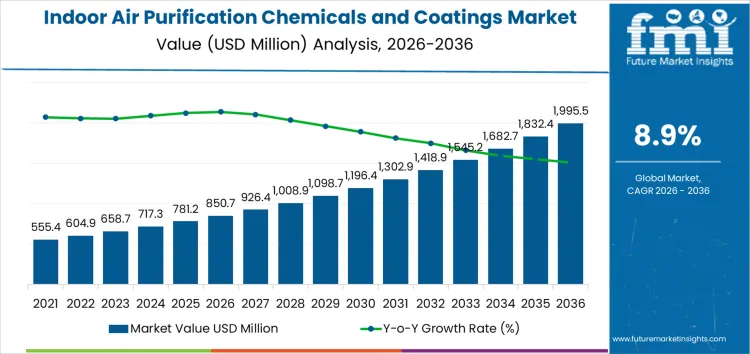
The indoor air purification chemicals and coatings market is projected to grow from USD 850.7 million in 2026 to USD 1,995.5 million by 2036, with a compound annual growth rate (CAGR) of 8.9%. While the market presents significant upside, execution risk remains a crucial factor for both suppliers and buyers. The complexity of integrating air purification chemicals and coatings into existing infrastructure can lead to adoption friction, especially in markets where cost sensitivity is high. Companies are tasked with ensuring product effectiveness while managing the upfront investments required for widespread implementation. Economic sensitivity further complicates this, as fluctuations in disposable income and operating budgets could delay adoption in both residential and commercial segments. Additionally, the market's dependence on evolving regulatory standards could create uncertainty for long-term investments. As suppliers work to scale solutions, they will need to address these constraints, balancing innovation with real-world application challenges, while mitigating risks associated with adoption and economic volatility.
Quick Stats of the Indoor Air Purification Chemicals and Coatings Market
- Indoor Air Purification Chemicals and Coatings Market Value (2026): USD 850.7 million
- Indoor Air Purification Chemicals and Coatings Market Forecast Value (2036): USD 1,995.5 million
- Indoor Air Purification Chemicals and Coatings Market Global Forecast CAGR (2026-2036): 8.9%
- Indoor Air Purification Chemicals and Coatings Market Leading Segment: Integration Type (HVAC System Integrated Coatings & Chemicals) 36%
- Key Growth Regions in Indoor Air Purification Chemicals and Coatings Market: China
- Top Players in Indoor Air Purification Chemicals and Coatings Market: BASF SE, PPG Industries, Akzo Nobel, Sherwin-Williams, RPM International
What is the Growth Forecast for the Indoor Air Purification Chemicals and Coatings Market through 2036?
The saturation point analysis for the indoor air purification chemicals and coatings market indicates that while the market will continue to grow, the rate of growth will gradually slow as the technology becomes more widely adopted and the market reaches maturity. Initially, from 2026 to 2031, the market will experience steady acceleration, with the demand for air purification solutions driven by growing awareness of air quality issues, increased regulatory pressure, and technological advancements. The market value will increase from USD 850.7 million in 2026 to USD 1,340.3 million in 2031, reflecting rapid growth as adoption expands across residential, commercial, and industrial sectors.
However, as the market becomes more established, particularly beyond 2031, the growth rate will start to decelerate as it approaches a saturation point. By 2036, the market will reach USD 1,995.5 million, with the pace of growth slowing from previous years. The slowing growth can be attributed to the widespread adoption of air purification technologies, where most potential customers have already implemented some form of air purification solution, leading to a more stable, less volatile growth rate. This saturation is typical of mature markets where growth stabilizes and demand is driven by incremental innovations rather than dramatic increases in adoption.
Indoor Air Purification Chemicals and Coatings Market Key Takeaways
| Metric | Value |
|---|---|
| Industry Sales Value (2026) | USD 850.7 million |
| Industry Forecast Value (2036) | USD 1,995.5 million |
| Industry Forecast CAGR (2026-2036) | 8.9% |
What Is Driving the Demand for the Indoor Air Purification Chemicals and Coatings Market Globally?
The global demand for indoor air purification chemicals and coatings is being driven by rising awareness of air quality and its impact on health in homes, offices, schools, hospitals, and commercial buildings. Indoor air can contain volatile organic compounds, formaldehyde, nitrogen oxides, mold spores, allergens, and particulate matter that contribute to respiratory irritation, allergies, and long term health issues. Growing concern about these risks has encouraged building owners, facility managers, and homeowners to adopt air purification technologies that reduce contaminants at the source or neutralize them within occupied spaces.
Purification chemicals formulated for air filtration systems and photocatalytic or antimicrobial coatings applied to surfaces help capture, break down, or inactivate airborne pollutants. Regulatory attention to indoor air quality standards in workplaces and public environments in Europe, North America, and Asia is also reinforcing demand. Expansion of urban populations, increased time spent indoors, and heightened expectations for healthier built environments are motivating investment in products that improve perceived comfort and wellbeing.
Future demand for indoor air purification chemicals and coatings is expected to grow as sustainability goals and performance expectations evolve across sectors worldwide. Advances in chemical formulations and surface treatment technologies are enhancing the ability to reduce odors, suppress microbial growth, and improve long term air quality without frequent maintenance. Integration of air purification coatings with building materials and HVAC systems will support holistic approaches to ventilation and environmental control.
Urbanization and densification of living and working spaces will sustain demand for solutions that mitigate pollutant accumulation in enclosed areas. Growth in smart building trends and sensor based monitoring will enable real time assessment of air quality and automated activation of purification systems, reinforcing value for facility owners. Increasing consumer and corporate focus on health and environmental quality, combined with potential tightening of indoor air quality regulations, will support broader adoption of chemicals and coatings that contribute to cleaner indoor environments. As awareness of chronic exposure risks rises, demand for products that balance performance, safety, and durability is expected to expand steadily across regions and building types.
What are the Leading Segments in the Global Indoor Air Purification Chemicals and Coatings Market?
The global indoor air purification chemicals and coatings market is segmented by integration type and application area. Among integration types, HVAC system integrated coatings & chemicals lead the market, capturing 36% of the share, followed by interior wall & surface coatings, filter-enhanced chemical media, standalone indoor air purification devices, and smart sensor-activated chemical systems. HVAC-integrated solutions are favored for their ability to improve air quality across entire building systems. On the application area side, residential buildings dominate the market, holding 32% of the share, followed by commercial buildings (offices, hotels, malls), healthcare facilities, industrial indoor environments, and educational & public infrastructure. Residential buildings drive demand as individuals seek improved air quality for health and comfort.
What Drives the Growth of HVAC System Integrated Coatings & Chemicals in the Indoor Air Purification Chemicals and Coatings Market?
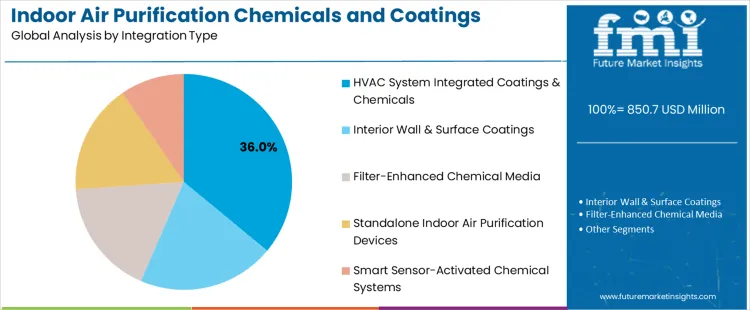
HVAC system integrated coatings & chemicals are the leading integration type in the indoor air purification chemicals and coatings market, holding 36% of the share. These solutions are increasingly popular due to their ability to purify air in large, centralized heating, ventilation, and air conditioning systems. The integration of purification chemicals and coatings into HVAC systems ensures continuous air cleaning, addressing pollutants, allergens, and odors across an entire building. The growing demand for indoor air quality (IAQ) solutions in both residential and commercial buildings, driven by increased awareness of air pollution's impact on health, is fueling the adoption of HVAC-integrated solutions. Additionally, HVAC systems are already a core part of building infrastructure, making them an efficient and cost-effective point of integration for air purification systems. As concerns over air quality continue to rise, HVAC system-integrated coatings and chemicals are expected to remain a dominant solution in the market.
What is Driving the Demand for Residential Buildings in the Indoor Air Purification Chemicals and Coatings Market?
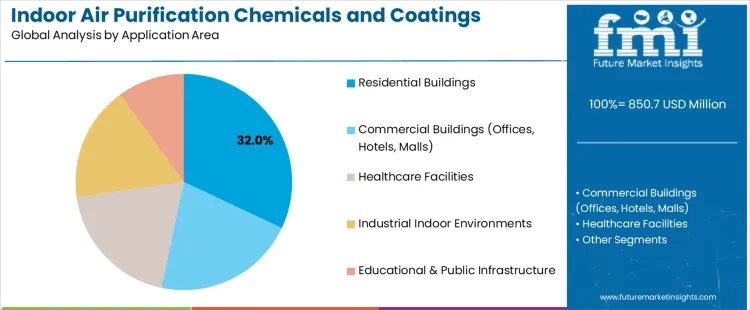
Residential buildings are the leading application area in the indoor air purification chemicals and coatings market, holding 32% of the share. This demand is driven by increasing awareness of the importance of indoor air quality, especially due to the rise in respiratory illnesses, allergies, and environmental pollution. Homeowners are becoming more conscious of the need for clean air in their living environments, prompting a growing adoption of air purification solutions, including chemicals and coatings. The widespread use of HVAC systems in homes, alongside standalone devices and surface coatings, provides effective and continuous purification of indoor air. With more people spending time indoors, particularly in urban areas with higher pollution levels, the demand for improved air quality solutions in residential buildings continues to grow. As consumers prioritize health and comfort, the residential building segment is expected to remain a key driver of growth in the indoor air purification chemicals and coatings market.
What are the Key Dynamics in the Global Indoor Air Purification Chemicals and Coatings Market?
The global indoor air purification chemicals and coatings market is growing as building owners, facility managers and consumers prioritise healthier indoor environments and tighter control of airborne pollutants such as VOCs, allergens, odors and pathogens. These products include air purifying coatings, reactive adsorbents, photocatalytic surfaces and chemical additives that neutralize contaminants on walls, ceilings and HVAC surfaces. Market expansion reflects increased awareness of indoor air quality, stricter building standards, and integration of air purification strategies into commercial, residential and institutional spaces worldwide.
What are the Key Drivers for the Indoor Air Purification Chemicals and Coatings Market?
A major driver is rising concern about the health impacts of indoor pollutants, which can contribute to respiratory issues, allergies and sick building syndrome. Regulations, green building certifications and wellness oriented design standards encourage use of materials and treatments that actively improve air quality. Growth in urbanisation and energy efficient buildings with reduced natural ventilation increases reliance on mechanical and chemical air purification approaches. Advances in chemical formulations and nanotechnology improve performance of coatings that break down VOCs, microbes and odors. Consumer interest in smart, multi functional products that combine aesthetics with air purification supports adoption across residential and commercial sectors.
What are the Restraints for the Indoor Air Purification Chemicals and Coatings Market?
One restraint is the challenge of validating and quantifying long term performance of purification chemicals and coatings under real world indoor conditions. Results in controlled laboratory settings may not always fully translate to diverse building environments, which can affect confidence among specifiers and end users. Some advanced products carry a cost premium compared with conventional paints or finishes, influencing decisions in budget sensitive projects. Regulatory scrutiny of new active chemistries requires safety testing and compliance documentation, which can extend time to market. Consumer confusion about product claims and effectiveness may reduce demand without clear standards or certification labels.
What are the Key Trends in the Indoor Air Purification Chemicals and Coatings Market?
A key trend is development of multi functional coatings that combine air purification with antimicrobial, stain resistant and aesthetic properties, offering broader appeal in interior finishes. Photocatalytic and photocurrent enhanced chemistries that activate with visible light are gaining traction for continuous VOC and odor breakdown. Integration of air purification coatings with building management systems and sensor networks supports dynamic air quality tracking and responsive control. Sustainable, low VOC and eco certified formulations align with green building and wellness standards such as WELL Building and LEED. Collaboration between chemical developers, coating manufacturers and architects accelerates specification of air purifying solutions in new construction and retrofit projects.
What is the Country-Wise Analysis of the Indoor Air Purification Chemicals and Coatings Market?
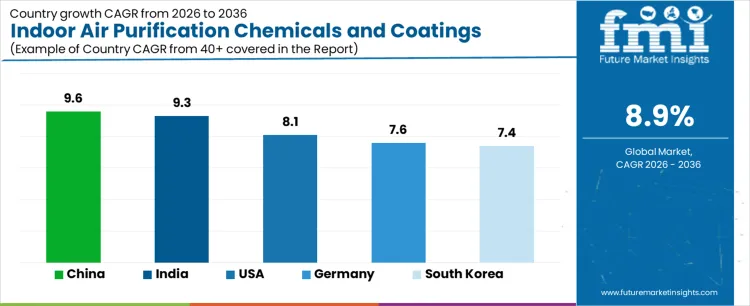
The indoor air purification chemicals and coatings market is expected to grow steadily, driven by increasing awareness about air quality, public health concerns, and the rising demand for cleaner indoor environments. These chemicals and coatings are used to neutralize pollutants such as volatile organic compounds (VOCs), dust, and other airborne contaminants in residential, commercial, and industrial spaces. High-growth markets like China and India are seeing strong demand due to rapid urbanization, growing industrial activity, and increased focus on health and well-being. Developed markets such as the United States, Germany, and South Korea are also experiencing steady growth, supported by stringent air quality regulations, technological advancements in air purification, and a growing emphasis on sustainability.
| Country | CAGR (2026-2036) |
|---|---|
| China | 9.6% |
| India | 9.3% |
| USA | 8.1% |
| Germany | 7.6% |
| South Korea | 7.4% |
What is the Growth Outlook for the Indoor Air Purification Chemicals and Coatings Market in China?
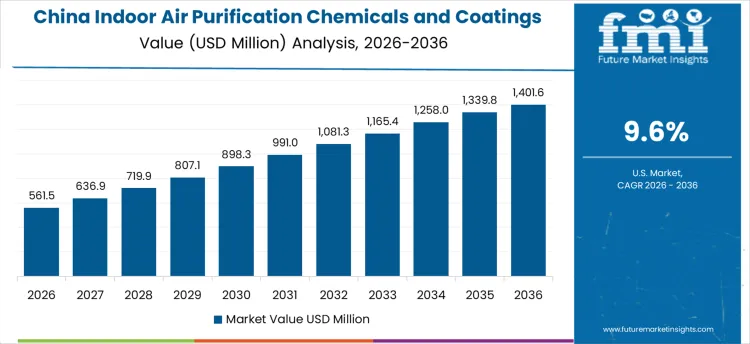
The indoor air purification chemicals and coatings market in China is expected to grow at the highest rate, with a projected CAGR of 9.6%. As China continues to urbanize, industrialize, and expand its middle class, there is a growing need for cleaner indoor environments, especially in highly polluted urban centers. The Chinese government’s increasing focus on improving air quality and public health is driving the adoption of indoor air purification solutions. With significant investments in environmental technologies, there is a rising demand for chemical solutions and coatings that can improve indoor air quality. China’s rapid urbanization and growing awareness of air pollution-related health issues are expected to continue to fuel demand for these products in the coming years.
What is the Market Outlook for the Indoor Air Purification Chemicals and Coatings Market in India?
The indoor air purification chemicals and coatings market in India is projected to grow steadily, with a projected CAGR of 9.3%. India’s rapid urbanization, rising industrialization, and increasing awareness of the health impacts of air pollution are key drivers of the market. The country faces significant air quality challenges, particularly in major cities, where industrial emissions and vehicle exhaust contribute to high levels of pollution. As the government prioritizes improving air quality and health outcomes, the demand for indoor air purification solutions, including chemicals and coatings, is expected to rise. With growing consumer awareness and regulatory support for cleaner air, the market for air purification chemicals and coatings in India is poised for steady growth.
What is the Growth Forecast for the Indoor Air Purification Chemicals and Coatings Market in the United States?
The indoor air purification chemicals and coatings market in the United States is expected to grow steadily, with a projected CAGR of 8.1%. The U.S. market is driven by increasing concerns about indoor air quality, particularly in light of the COVID-19 pandemic and heightened awareness of respiratory health. The demand for indoor air purification products is rising in both residential and commercial sectors as consumers and businesses seek to improve air quality in homes, offices, and public spaces. Additionally, the U.S. government’s commitment to reducing environmental pollutants and improving public health is contributing to market growth. As the market for green and sustainable air purification solutions continues to expand, demand for indoor air purification chemicals and coatings is expected to rise.
What is the Market Outlook for the Indoor Air Purification Chemicals and Coatings Market in Germany?
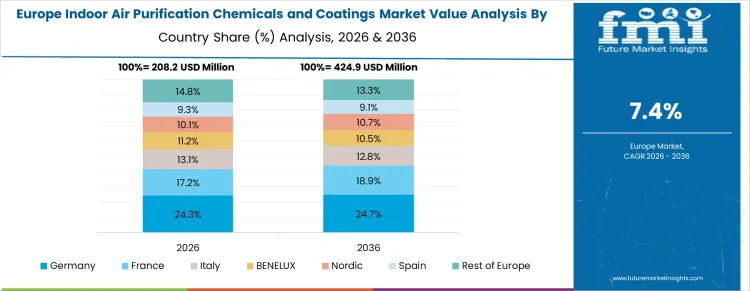
The indoor air purification chemicals and coatings market in Germany is projected to grow at a steady pace, with a projected CAGR of 7.6%. Germany’s strong environmental regulations and emphasis on public health are key drivers of the market. As awareness about the harmful effects of indoor air pollution continues to grow, demand for air purification chemicals and coatings is expected to rise, especially in commercial and residential buildings. The German government’s policies promoting energy efficiency and healthier indoor environments are also contributing to the market’s growth. As consumers and industries in Germany increasingly prioritize sustainability and cleaner air, the market for air purification solutions is expected to experience steady expansion.
What are the Growth Prospects for the Indoor Air Purification Chemicals and Coatings Market in South Korea?
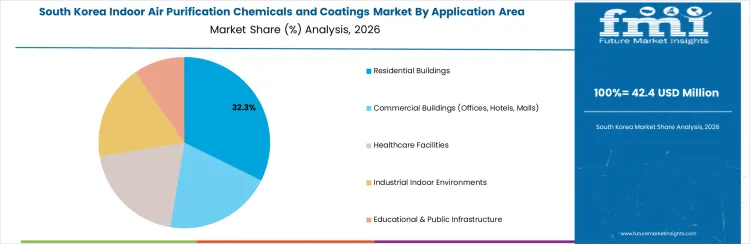
The indoor air purification chemicals and coatings market in South Korea is expected to grow steadily, with a projected CAGR of 7.4%. South Korea’s industrialization and urbanization, combined with growing concerns over air quality, are fueling the demand for indoor air purification solutions. The country faces challenges related to both indoor and outdoor air pollution, and the government is increasingly focusing on measures to improve public health through better air quality. South Korea’s strong emphasis on technology and innovation is supporting the development of advanced air purification chemicals and coatings. With increasing consumer awareness and government initiatives to address air pollution, the market for indoor air purification solutions is expected to grow steadily in South Korea.
What is the Competitive Landscape for the Indoor Air Purification Chemicals and Coatings Market?
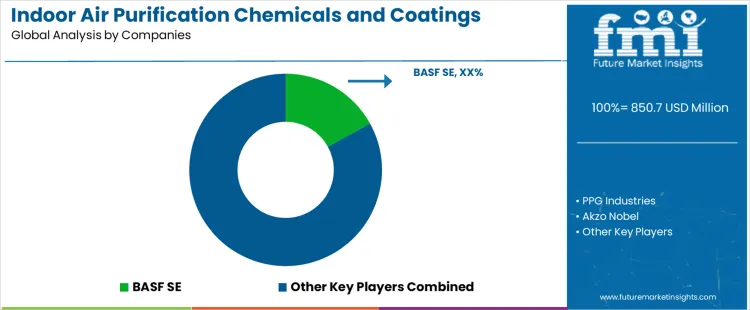
The indoor air purification chemicals and coatings market is experiencing significant growth as consumers and industries become increasingly concerned with indoor air quality and environmental health. BASF SE leads the market with its innovative air purification chemicals and coatings, offering high-performance solutions that improve indoor air quality by removing pollutants and harmful substances. Their focus on sustainability, product efficacy, and regulatory compliance has positioned them as a dominant player in this sector. PPG Industries, Akzo Nobel, and Sherwin-Williams are key competitors, each providing specialized coatings and chemicals designed to enhance air purification in indoor environments. PPG Industries focuses on developing coatings that provide long-lasting protection while improving indoor air quality, while Akzo Nobel and Sherwin-Williams offer products designed to improve air quality through advanced chemical formulations.
RPM International further strengthens the competitive landscape by offering air purification chemicals and coatings designed to meet the growing demand for healthier, safer indoor spaces. RPM International specializes in providing solutions for various industries, including commercial and residential sectors, with an emphasis on enhancing air quality. These companies compete by focusing on product innovation, environmental sustainability, and the ability to meet the increasing consumer demand for effective, safe, and eco-friendly indoor air purification solutions. As awareness of indoor air quality increases and regulatory standards tighten, the market is expected to continue growing, driven by the need for healthier living and working environments.
Key Players of the Indoor Air Purification Chemicals and Coatings Market
- BASF SE
- PPG Industries
- Akzo Nobel
- Sherwin-Williams
- RPM International
Scope of the Report
| Items | Values |
|---|---|
| Quantitative Units (2026) | USD Million |
| Coating Type | Photocatalytic (TiO₂-Based) Coatings, Antimicrobial & Antiviral Chemical Coatings, VOC & Formaldehyde Neutralizing Agents, Activated Carbon & Adsorbent Coatings, Other Specialty Indoor Air Purification Chemicals |
| Application Area | Residential Buildings, Commercial Buildings (Offices, Hotels, Malls), Healthcare Facilities, Industrial Indoor Environments, Educational & Public Infrastructure |
| Integration Type | HVAC System Integrated Coatings & Chemicals, Interior Wall & Surface Coatings, Filter-Enhanced Chemical Media, Standalone Indoor Air Purification Devices, Smart Sensor-Activated Chemical Systems |
| Companies | BASF SE, PPG Industries, Akzo Nobel, Sherwin-Williams, RPM International |
| Regions Covered | North America, Latin America, Western Europe, Eastern Europe, South Asia and Pacific, East Asia, Middle East & Africa |
| Countries Covered | United States, Canada, Mexico, Brazil, Argentina, Germany, France, United Kingdom, Italy, Spain, Netherlands, China, India, Japan, South Korea, ANZ, GCC Countries, South Africa |
| Additional Attributes | Dollar by sales by coating type, application area, integration type, and region. Includes market trends in indoor air purification chemicals and coatings, performance in various indoor environments, cost-effectiveness, sustainability practices, regulatory compliance, market share and competitive positioning of key companies, and the role of chemical coatings and agents in improving indoor air quality, reducing pollutants, and enhancing comfort and health in residential, commercial, healthcare, and industrial spaces. |
Indoor Air Purification Chemicals and Coatings Market Segmentation
Coating Type:
- Photocatalytic (TiO₂-Based) Coatings
- Antimicrobial & Antiviral Chemical Coatings
- VOC & Formaldehyde Neutralizing Agents
- Activated Carbon & Adsorbent Coatings
- Other Specialty Indoor Air Purification Chemicals
Application Area:
- Residential Buildings
- Commercial Buildings (Offices, Hotels, Malls)
- Healthcare Facilities
- Industrial Indoor Environments
- Educational & Public Infrastructure
Integration Type:
- HVAC System Integrated Coatings & Chemicals
- Interior Wall & Surface Coatings
- Filter-Enhanced Chemical Media
- Standalone Indoor Air Purification Devices
- Smart Sensor-Activated Chemical Systems
Region:
- Asia Pacific
- China
- Japan
- South Korea
- India
- Australia & New Zealand
- ASEAN
- Rest of Asia Pacific
- Europe
- Germany
- United Kingdom
- France
- Italy
- Spain
- Nordic
- BENELUX
- Rest of Europe
- North America
- United States
- Canada
- Mexico
- Latin America
- Brazil
- Chile
- Rest of Latin America
- Middle East & Africa
- Kingdom of Saudi Arabia
- Other GCC Countries
- Turkey
- South Africa
- Other African Union
- Rest of Middle East & Africa
Frequently Asked Questions
How big is the indoor air purification chemicals and coatings market in 2026?
The global indoor air purification chemicals and coatings market is estimated to be valued at USD 850.7 million in 2026.
What will be the size of indoor air purification chemicals and coatings market in 2036?
The market size for the indoor air purification chemicals and coatings market is projected to reach USD 1,995.5 million by 2036.
How much will be the indoor air purification chemicals and coatings market growth between 2026 and 2036?
The indoor air purification chemicals and coatings market is expected to grow at a 8.9% CAGR between 2026 and 2036.
What are the key product types in the indoor air purification chemicals and coatings market?
The key product types in indoor air purification chemicals and coatings market are photocatalytic (tio₂-based) coatings, antimicrobial & antiviral chemical coatings, VOC & formaldehyde neutralizing agents, activated carbon & adsorbent coatings and other specialty indoor air purification chemicals.
Which application area segment to contribute significant share in the indoor air purification chemicals and coatings market in 2026?
In terms of application area, residential buildings segment to command 32.0% share in the indoor air purification chemicals and coatings market in 2026.
Preview the report firsthand - request a free sample
Get SampleGet the brochure for pricing and purchase details.
Get PDFTable of Content
- Executive Summary
- Global Market Outlook
- Demand-side Trends
- Supply-side Trends
- Technology Roadmap Analysis
- Analysis and Recommendations
- Market Overview
- Market Coverage / Taxonomy
- Market Definition / Scope / Limitations
- Market Background
- Market Dynamics
- Drivers
- Restraints
- Opportunity
- Trends
- Scenario Forecast
- Demand in Optimistic Scenario
- Demand in Likely Scenario
- Demand in Conservative Scenario
- Opportunity Map Analysis
- Product Life Cycle Analysis
- Supply Chain Analysis
- Investment Feasibility Matrix
- Value Chain Analysis
- PESTLE and Porter’s Analysis
- Regulatory Landscape
- Regional Parent Market Outlook
- Production and Consumption Statistics
- Import and Export Statistics
- Market Dynamics
- Global Market Analysis 2021 to 2025 and Forecast, 2026 to 2036
- Historical Market Size Value (USD Million) Analysis, 2021 to 2025
- Current and Future Market Size Value (USD Million) Projections, 2026 to 2036
- Y-o-Y Growth Trend Analysis
- Absolute $ Opportunity Analysis
- Global Market Pricing Analysis 2021 to 2025 and Forecast 2026 to 2036
- Global Market Analysis 2021 to 2025 and Forecast 2026 to 2036, By Coating Type
- Introduction / Key Findings
- Historical Market Size Value (USD Million) Analysis By Coating Type , 2021 to 2025
- Current and Future Market Size Value (USD Million) Analysis and Forecast By Coating Type , 2026 to 2036
- Photocatalytic (TiO₂-Based) Coatings
- Antimicrobial & Antiviral Chemical Coatings
- VOC & Formaldehyde Neutralizing Agents
- Activated Carbon & Adsorbent Coatings
- Other Specialty Indoor Air Purification Chemicals
- Photocatalytic (TiO₂-Based) Coatings
- Y-o-Y Growth Trend Analysis By Coating Type , 2021 to 2025
- Absolute $ Opportunity Analysis By Coating Type , 2026 to 2036
- Global Market Analysis 2021 to 2025 and Forecast 2026 to 2036, By Application Area
- Introduction / Key Findings
- Historical Market Size Value (USD Million) Analysis By Application Area, 2021 to 2025
- Current and Future Market Size Value (USD Million) Analysis and Forecast By Application Area, 2026 to 2036
- Residential Buildings
- Commercial Buildings (Offices, Hotels, Malls)
- Healthcare Facilities
- Industrial Indoor Environments
- Educational & Public Infrastructure
- Residential Buildings
- Y-o-Y Growth Trend Analysis By Application Area, 2021 to 2025
- Absolute $ Opportunity Analysis By Application Area, 2026 to 2036
- Global Market Analysis 2021 to 2025 and Forecast 2026 to 2036, By Integration Type
- Introduction / Key Findings
- Historical Market Size Value (USD Million) Analysis By Integration Type, 2021 to 2025
- Current and Future Market Size Value (USD Million) Analysis and Forecast By Integration Type, 2026 to 2036
- HVAC System Integrated Coatings & Chemicals
- Interior Wall & Surface Coatings
- Filter-Enhanced Chemical Media
- Standalone Indoor Air Purification Devices
- Smart Sensor-Activated Chemical Systems
- HVAC System Integrated Coatings & Chemicals
- Y-o-Y Growth Trend Analysis By Integration Type, 2021 to 2025
- Absolute $ Opportunity Analysis By Integration Type, 2026 to 2036
- Global Market Analysis 2021 to 2025 and Forecast 2026 to 2036, By Region
- Introduction
- Historical Market Size Value (USD Million) Analysis By Region, 2021 to 2025
- Current Market Size Value (USD Million) Analysis and Forecast By Region, 2026 to 2036
- North America
- Latin America
- Western Europe
- Eastern Europe
- East Asia
- South Asia and Pacific
- Middle East & Africa
- Market Attractiveness Analysis By Region
- North America Market Analysis 2021 to 2025 and Forecast 2026 to 2036, By Country
- Historical Market Size Value (USD Million) Trend Analysis By Market Taxonomy, 2021 to 2025
- Market Size Value (USD Million) Forecast By Market Taxonomy, 2026 to 2036
- By Country
- USA
- Canada
- Mexico
- By Coating Type
- By Application Area
- By Integration Type
- By Country
- Market Attractiveness Analysis
- By Country
- By Coating Type
- By Application Area
- By Integration Type
- Key Takeaways
- Latin America Market Analysis 2021 to 2025 and Forecast 2026 to 2036, By Country
- Historical Market Size Value (USD Million) Trend Analysis By Market Taxonomy, 2021 to 2025
- Market Size Value (USD Million) Forecast By Market Taxonomy, 2026 to 2036
- By Country
- Brazil
- Chile
- Rest of Latin America
- By Coating Type
- By Application Area
- By Integration Type
- By Country
- Market Attractiveness Analysis
- By Country
- By Coating Type
- By Application Area
- By Integration Type
- Key Takeaways
- Western Europe Market Analysis 2021 to 2025 and Forecast 2026 to 2036, By Country
- Historical Market Size Value (USD Million) Trend Analysis By Market Taxonomy, 2021 to 2025
- Market Size Value (USD Million) Forecast By Market Taxonomy, 2026 to 2036
- By Country
- Germany
- UK
- Italy
- Spain
- France
- Nordic
- BENELUX
- Rest of Western Europe
- By Coating Type
- By Application Area
- By Integration Type
- By Country
- Market Attractiveness Analysis
- By Country
- By Coating Type
- By Application Area
- By Integration Type
- Key Takeaways
- Eastern Europe Market Analysis 2021 to 2025 and Forecast 2026 to 2036, By Country
- Historical Market Size Value (USD Million) Trend Analysis By Market Taxonomy, 2021 to 2025
- Market Size Value (USD Million) Forecast By Market Taxonomy, 2026 to 2036
- By Country
- Russia
- Poland
- Hungary
- Balkan & Baltic
- Rest of Eastern Europe
- By Coating Type
- By Application Area
- By Integration Type
- By Country
- Market Attractiveness Analysis
- By Country
- By Coating Type
- By Application Area
- By Integration Type
- Key Takeaways
- East Asia Market Analysis 2021 to 2025 and Forecast 2026 to 2036, By Country
- Historical Market Size Value (USD Million) Trend Analysis By Market Taxonomy, 2021 to 2025
- Market Size Value (USD Million) Forecast By Market Taxonomy, 2026 to 2036
- By Country
- China
- Japan
- South Korea
- By Coating Type
- By Application Area
- By Integration Type
- By Country
- Market Attractiveness Analysis
- By Country
- By Coating Type
- By Application Area
- By Integration Type
- Key Takeaways
- South Asia and Pacific Market Analysis 2021 to 2025 and Forecast 2026 to 2036, By Country
- Historical Market Size Value (USD Million) Trend Analysis By Market Taxonomy, 2021 to 2025
- Market Size Value (USD Million) Forecast By Market Taxonomy, 2026 to 2036
- By Country
- India
- ASEAN
- Australia & New Zealand
- Rest of South Asia and Pacific
- By Coating Type
- By Application Area
- By Integration Type
- By Country
- Market Attractiveness Analysis
- By Country
- By Coating Type
- By Application Area
- By Integration Type
- Key Takeaways
- Middle East & Africa Market Analysis 2021 to 2025 and Forecast 2026 to 2036, By Country
- Historical Market Size Value (USD Million) Trend Analysis By Market Taxonomy, 2021 to 2025
- Market Size Value (USD Million) Forecast By Market Taxonomy, 2026 to 2036
- By Country
- Kingdom of Saudi Arabia
- Other GCC Countries
- Turkiye
- South Africa
- Other African Union
- Rest of Middle East & Africa
- By Coating Type
- By Application Area
- By Integration Type
- By Country
- Market Attractiveness Analysis
- By Country
- By Coating Type
- By Application Area
- By Integration Type
- Key Takeaways
- Key Countries Market Analysis
- USA
- Pricing Analysis
- Market Share Analysis, 2025
- By Coating Type
- By Application Area
- By Integration Type
- Canada
- Pricing Analysis
- Market Share Analysis, 2025
- By Coating Type
- By Application Area
- By Integration Type
- Mexico
- Pricing Analysis
- Market Share Analysis, 2025
- By Coating Type
- By Application Area
- By Integration Type
- Brazil
- Pricing Analysis
- Market Share Analysis, 2025
- By Coating Type
- By Application Area
- By Integration Type
- Chile
- Pricing Analysis
- Market Share Analysis, 2025
- By Coating Type
- By Application Area
- By Integration Type
- Germany
- Pricing Analysis
- Market Share Analysis, 2025
- By Coating Type
- By Application Area
- By Integration Type
- UK
- Pricing Analysis
- Market Share Analysis, 2025
- By Coating Type
- By Application Area
- By Integration Type
- Italy
- Pricing Analysis
- Market Share Analysis, 2025
- By Coating Type
- By Application Area
- By Integration Type
- Spain
- Pricing Analysis
- Market Share Analysis, 2025
- By Coating Type
- By Application Area
- By Integration Type
- France
- Pricing Analysis
- Market Share Analysis, 2025
- By Coating Type
- By Application Area
- By Integration Type
- India
- Pricing Analysis
- Market Share Analysis, 2025
- By Coating Type
- By Application Area
- By Integration Type
- ASEAN
- Pricing Analysis
- Market Share Analysis, 2025
- By Coating Type
- By Application Area
- By Integration Type
- Australia & New Zealand
- Pricing Analysis
- Market Share Analysis, 2025
- By Coating Type
- By Application Area
- By Integration Type
- China
- Pricing Analysis
- Market Share Analysis, 2025
- By Coating Type
- By Application Area
- By Integration Type
- Japan
- Pricing Analysis
- Market Share Analysis, 2025
- By Coating Type
- By Application Area
- By Integration Type
- South Korea
- Pricing Analysis
- Market Share Analysis, 2025
- By Coating Type
- By Application Area
- By Integration Type
- Russia
- Pricing Analysis
- Market Share Analysis, 2025
- By Coating Type
- By Application Area
- By Integration Type
- Poland
- Pricing Analysis
- Market Share Analysis, 2025
- By Coating Type
- By Application Area
- By Integration Type
- Hungary
- Pricing Analysis
- Market Share Analysis, 2025
- By Coating Type
- By Application Area
- By Integration Type
- Kingdom of Saudi Arabia
- Pricing Analysis
- Market Share Analysis, 2025
- By Coating Type
- By Application Area
- By Integration Type
- Turkiye
- Pricing Analysis
- Market Share Analysis, 2025
- By Coating Type
- By Application Area
- By Integration Type
- South Africa
- Pricing Analysis
- Market Share Analysis, 2025
- By Coating Type
- By Application Area
- By Integration Type
- USA
- Market Structure Analysis
- Competition Dashboard
- Competition Benchmarking
- Market Share Analysis of Top Players
- By Regional
- By Coating Type
- By Application Area
- By Integration Type
- Competition Analysis
- Competition Deep Dive
- BASF SE
- Overview
- Product Portfolio
- Profitability by Market Segments (Product/Age /Sales Channel/Region)
- Sales Footprint
- Strategy Overview
- Marketing Strategy
- Product Strategy
- Channel Strategy
- PPG Industries
- Akzo Nobel
- Sherwin-Williams
- RPM International
- BASF SE
- Competition Deep Dive
- Assumptions & Acronyms Used
- Research Methodology


