

- Industry Size (2026)
- USD 997.3 Mn
- Forecast (2036)
- USD 2234.2 Mn
- CAGR (2026 to 2036)
- 8.4%
Air Scrubbing Chemicals for Industrial Emissions Market Forecast and Outlook 2026 to 2036
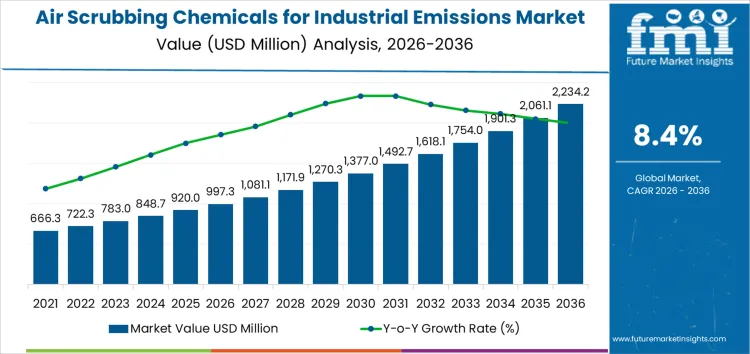
The air scrubbing chemicals for industrial emissions market is projected to grow from USD 997.3 million in 2026 to USD 2,234.2 million by 2036, reflecting a compound annual growth rate (CAGR) of 8.4%. The industry’s expansion is shaped by capital-intensive investments in industrial emissions control, where buyers face significant upfront costs. Return timelines are crucial, as companies seek technologies that balance long-term environmental benefits with immediate financial feasibility.
As regulatory frameworks tighten, industries are more selective in their investments, prioritizing proven solutions that offer robust performance and regulatory compliance. While capital allocation remains conservative, the market’s growth signals a shift toward greater adoption of air scrubbing chemicals as part of broader sustainability efforts. Investors will need to consider not just short-term gains, but also the long-term value of positioning within industries committed to reducing their carbon footprint. These dynamics create a selective investment landscape focused on efficiency, scalability, and regulatory alignment.
Quick Stats of the Air Scrubbing Chemicals for Industrial Emissions Market
- Air Scrubbing Chemicals for Industrial Emissions Market Value (2026): USD 997.3 million
- Air Scrubbing Chemicals for Industrial Emissions Market Forecast Value (2036): USD 2,234.2 million
- Air Scrubbing Chemicals for Industrial Emissions Market Global Forecast CAGR (2026-2036): 8.4%
- Air Scrubbing Chemicals for Industrial Emissions Market Leading Segment: Chemical Type (Alkaline Scrubbing Chemicals-NaOH, Ca(OH)₂) 32%
- Key Growth Regions in Air Scrubbing Chemicals for Industrial Emissions Market: China
- Top Players in Air Scrubbing Chemicals for Industrial Emissions Market: Ecolab, BASF SE, Solvay, Kemira, Cabot Corporation
What is the Growth Forecast for the Air Scrubbing Chemicals for Industrial Emissions Market through 2036?
The rolling compound annual growth rate (CAGR) analysis for the air scrubbing chemicals for industrial emissions market indicates a strong and consistent growth trajectory throughout the forecast period, with variations in growth rate during different phases of market expansion. In the initial years (2026–2031), the market will experience a higher rate of growth as industries and regulatory bodies intensify efforts to address air pollution. From USD 997.3 million in 2026 to USD 1,513.9 million in 2031, the market will grow at a faster pace, driven by stricter environmental regulations and a rising demand for efficient pollution control solutions. During this phase, the CAGR will be relatively higher as industries adopt air scrubbing chemicals more aggressively to comply with air quality standards.
In the latter half of the forecast period (2031-2036), the growth rate will stabilize as the market matures. The CAGR will moderate slightly, reflecting a more widespread adoption of air scrubbing technologies, where demand continues to grow but at a less rapid pace. By 2036, the market is expected to reach USD 2,234.2 million, with steady, incremental growth. The slower growth rate during this phase is typical of a maturing market, where early adopters have already implemented solutions, and the technology becomes more integrated into standard industrial practices. Despite this moderation, the market will still expand steadily, driven by ongoing regulatory requirements and continuous improvements in scrubbing chemical formulations.
Air Scrubbing Chemicals for Industrial Emissions Market Key Takeaways
| Metric | Value |
|---|---|
| Industry Sales Value (2026) | USD 997.3 million |
| Industry Forecast Value (2036) | USD 2,234.2 million |
| Industry Forecast CAGR (2026-2036) | 8.4% |
What Is Driving the Demand for the Air Scrubbing Chemicals for Industrial Emissions Market Globally?
The global demand for air scrubbing chemicals for industrial emissions is driven by tightening environmental regulations, growing awareness of air quality impacts, and expanding industrial activity in manufacturing, power generation, and chemical processing sectors. Air scrubbing chemicals are used in gas treatment systems to remove sulfur oxides, nitrogen oxides, volatile organic compounds, acidic gases, and particulate precursors from flue gas streams and exhaust. Governments in North America, Europe, and Asia have implemented stricter emission limits and monitoring requirements to protect public health, reduce smog formation, and control regional haze.
Industrial operators are adopting advanced scrubbing solutions to comply with these standards and avoid penalties while maintaining operational continuity. Public pressure for cleaner air, particularly in urban and industrial corridors, reinforces investment in emission control technologies. Upgrades to coal, oil, and biomass fired plants, along with petrochemical and mining operations, further increase demand for scrubbing chemicals that support efficient capture of regulated pollutants.
Future demand for air scrubbing chemicals for industrial emissions is expected to grow as facilities pursue deeper reductions in regulated and unregulated pollutants and align with broader sustainability goals. Continued technological advances in sorbent chemistry, reagent delivery systems, and catalyst formulations are improving removal efficiency at lower dosages and with reduced operational cost. Increased integration of scrubber systems with real time monitoring and data analytics helps operators optimize reagent use and track compliance more effectively. Regulatory frameworks that incorporate health based standards and cumulative impact assessments will push industries to adopt more robust emission control strategies.
Growth of renewable energy and shifts in fuel mix will influence chemical selection and system design, but legacy and transitional assets will continue to require effective scrubbing solutions. Expansion of heavy industry in emerging markets, where air quality concerns are high, will also sustain demand. As stakeholders prioritize reduced environmental impact, energy efficiency, and community health outcomes, the market for air scrubbing chemicals that deliver reliable pollutant control is poised for steady global expansion.
What are the Leading Segments in the Global Air Scrubbing Chemicals for Industrial Emissions Market?
The global air scrubbing chemicals for industrial emissions market is primarily driven by alkaline scrubbing chemicals (NaOH, Ca(OH)₂), which capture 32% of the share, and power generation & utilities, which holds 30% of the market share. Alkaline chemicals are effective in neutralizing acidic gases such as sulfur dioxide and hydrogen chloride, commonly produced by power plants. The increasing need for pollution control, stricter environmental regulations, and sustainable air quality management solutions are key factors driving the demand for air scrubbing chemicals across various industries, particularly in the power generation sector.
What Drives the Growth of Alkaline Scrubbing Chemicals (NaOH, Ca(OH)₂) in the Air Scrubbing Chemicals for Industrial Emissions Market?
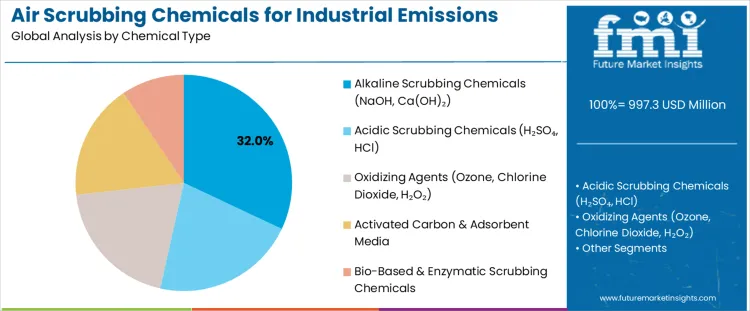
Alkaline scrubbing chemicals, particularly sodium hydroxide (NaOH) and calcium hydroxide (Ca(OH)₂), are the leading chemical type in the air scrubbing chemicals for industrial emissions market, holding 32% of the share. These chemicals are preferred for their effectiveness in neutralizing a variety of acidic gases, such as sulfur dioxide (SO₂) and hydrogen chloride (HCl), which are commonly emitted by power plants, refineries, and other industrial facilities. Alkaline scrubbing chemicals are typically used in wet scrubbing systems, where the gaseous emissions are bubbled through a solution of alkaline chemicals, which then react with the contaminants to neutralize them and produce safe byproducts. The increasing regulatory pressure to reduce industrial emissions and the need for sustainable air pollution control technologies are driving the adoption of alkaline scrubbing chemicals. As industries, particularly power generation, face growing environmental regulations, the demand for effective, cost-efficient, and eco-friendly scrubbing solutions like alkaline chemicals will continue to rise, ensuring their dominance in the market.
What is Driving the Demand for Power Generation & Utilities in the Air Scrubbing Chemicals for Industrial Emissions Market?
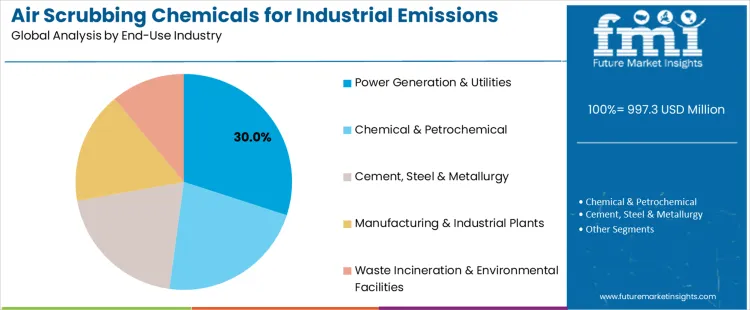
Power generation & utilities is the leading end-use industry in the air scrubbing chemicals for industrial emissions market, capturing 30% of the share. This demand is primarily driven by the significant emissions generated by power plants, particularly those fueled by coal, natural gas, and other fossil fuels. These plants produce large amounts of sulfur dioxide (SO₂), nitrogen oxides (NOx), particulate matter, and other harmful pollutants, which need to be effectively controlled to meet environmental regulations and protect air quality. Air scrubbing chemicals, especially alkaline and acidic scrubbing agents, are critical in removing these pollutants from exhaust gases before they are released into the atmosphere. The growing emphasis on environmental sustainability, combined with stricter emission regulations in the power generation sector, is driving the need for efficient and reliable air pollution control technologies. As the power generation industry seeks to comply with regulations and improve its environmental performance, the demand for air scrubbing chemicals will continue to grow, solidifying power generation & utilities as the dominant end-use sector in the market.
What are the Key Dynamics in the Global Air Scrubbing Chemicals for Industrial Emissions Market?
The global air scrubbing chemicals for industrial emissions market is expanding as regulatory agencies, manufacturers and energy producers adopt chemical solutions that remove pollutants from exhaust streams. Air scrubbing chemicals are used in wet and dry scrubbers to neutralize sulfur oxides, nitrogen oxides, particulate matter, volatile organic compounds and other contaminants from power plants, refineries, steel mills and chemical facilities. Growth is supported by tightening air quality standards, stronger enforcement of emission limits, and increasing public and corporate focus on environmental performance. Adoption spans heavy industry, waste to energy plants and large scale manufacturing where effective flue gas treatment is essential for compliance and community health.
What are the Key Drivers for the Air Scrubbing Chemicals for Industrial Emissions Market?
A primary driver is stringent global regulation of industrial air emissions that requires facilities to install and operate effective scrubbing systems. Agencies in North America, Europe and Asia maintain strict limits on sulfur dioxide, nitrogen oxides and particulate emissions, prompting investment in chemicals that enhance scrubbing efficiency and reduce pollutant release. Expanded monitoring and reporting requirements amplify the need for reliable emission control. Growth in industrial production and energy generation increases the volume of flue gases needing treatment. Advances in chemical formulations, including absorbents, neutralizing agents and catalysts, improve pollutant capture and help operators meet evolving environmental expectations.
What are the Restraints for the Air Scrubbing Chemicals for Industrial Emissions Market?
One restraint is the cost associated with advanced air scrubbing chemicals and the equipment required to deploy them. High performance reagents, catalysts and sorbents can carry significant upfront and operating expenses that affect profitability in cost sensitive sectors. Integration of scrubbing systems with legacy infrastructure may require process modifications and capital investment. Variable enforcement of emission standards across regions influences urgency of adoption and scale of investment. Some industries face challenges in balancing operational efficiency with meeting stricter emission targets, especially where energy costs and raw material volatility influence budgeting.
What are the Key Trends in the Air Scrubbing Chemicals for Industrial Emissions Market?
A key trend is development of tailored, low impact scrubbing chemistries that deliver high pollutant capture while reducing secondary waste and byproducts. Manufacturers are focusing on regenerable sorbents and recyclable chemical systems that lower lifecycle cost and waste disposal needs. Integration of digital control systems and real time monitoring enhances dosing precision, optimizes reagent use and supports compliance reporting. Collaboration among chemical suppliers, equipment OEMs and industrial end users accelerates innovation in hybrid scrubbing solutions that combine physical capture with chemical neutralization. Growing interest in decarbonization and synergistic emission control technologies influences formulation strategy and adoption in broader industrial emission management programs.
What is the Country-Wise Analysis of the Air Scrubbing Chemicals for Industrial Emissions Market?
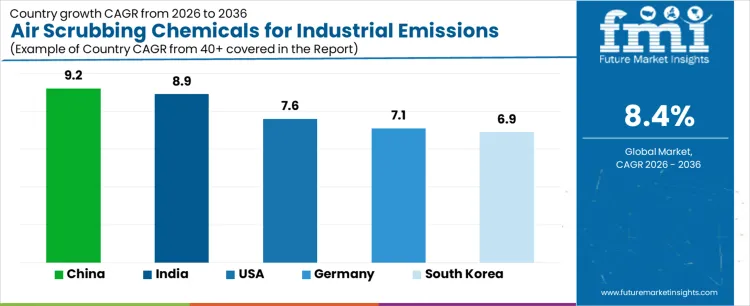
The air scrubbing chemicals for industrial emissions market is expected to grow steadily, driven by increasing regulatory pressure to reduce industrial pollution and improve air quality. These chemicals are used in air pollution control systems to remove contaminants such as sulfur dioxide, nitrogen oxides, and particulate matter from industrial emissions, helping companies comply with environmental standards. High-growth markets such as China and India are seeing strong demand due to their rapidly expanding industrial sectors and increasing focus on environmental sustainability. Developed markets such as the United States, Germany, and South Korea are also experiencing steady growth, supported by stringent environmental regulations, technological advancements in pollution control, and the need to meet stricter air quality standards.
| Country | CAGR (2026-2036) |
|---|---|
| China | 9.2% |
| India | 8.9% |
| USA | 7.6% |
| Germany | 7.1% |
| South Korea | 6.9% |
What is the Growth Outlook for the Air Scrubbing Chemicals for Industrial Emissions Market in China?
The air scrubbing chemicals for industrial emissions market in China is expected to grow at the highest rate, with a projected CAGR of 9.2%. As China continues to industrialize, the country faces significant challenges related to air pollution, particularly from its manufacturing and power sectors. The government is increasingly focused on improving air quality and reducing industrial emissions, which is driving demand for air pollution control technologies, including air scrubbing chemicals. Stricter regulations and policies aimed at reducing pollution levels, along with growing environmental awareness, are expected to support the growth of the market. As China’s industrial base continues to expand, the demand for effective air scrubbing solutions will continue to rise.
What is the Market Outlook for the Air Scrubbing Chemicals for Industrial Emissions Market in India?
The air scrubbing chemicals for industrial emissions market in India is projected to grow steadily, with a projected CAGR of 8.9%. India’s industrial sector, particularly in manufacturing, power generation, and mining, is a major contributor to air pollution. The government’s increasing focus on reducing emissions and improving air quality, along with stricter environmental regulations, is driving the adoption of air pollution control technologies. As India expands its industrial base and addresses environmental challenges, the demand for air scrubbing chemicals is expected to rise. Furthermore, India’s growing emphasis on sustainability and clean technologies will contribute to the steady growth of the air scrubbing chemicals market.
What is the Growth Forecast for the Air Scrubbing Chemicals for Industrial Emissions Market in the United States?
The air scrubbing chemicals for industrial emissions market in the United States is expected to grow steadily, with a projected CAGR of 7.6%. The U.S. market is driven by stringent regulations imposed by the Environmental Protection Agency (EPA) on industrial emissions, particularly in sectors such as manufacturing, power generation, and chemical production. As industries seek to comply with air quality standards and reduce their environmental footprint, the demand for air pollution control technologies, including air scrubbing chemicals, is increasing. Additionally, the growing focus on sustainability, environmental health, and the adoption of greener technologies is expected to support the steady expansion of the market in the U.S.
What is the Market Outlook for the Air Scrubbing Chemicals for Industrial Emissions Market in Germany?
The air scrubbing chemicals for industrial emissions market in Germany is projected to grow at a steady pace, with a projected CAGR of 7.1%. Germany’s strong commitment to environmental protection and its strict air quality standards are key drivers of the market. As industries in Germany continue to face pressure to reduce emissions, there is increasing demand for air pollution control technologies. Government initiatives aimed at improving air quality and reducing industrial pollution are further encouraging the adoption of air scrubbing chemicals. With Germany’s focus on sustainability and green technologies, the demand for effective air scrubbing solutions is expected to continue growing steadily in the coming years.
What are the Growth Prospects for the Air Scrubbing Chemicals for Industrial Emissions Market in South Korea?
The air scrubbing chemicals for industrial emissions market in South Korea is expected to grow steadily, with a projected CAGR of 6.9%. South Korea’s industrial sector, particularly in manufacturing and power generation, is a major contributor to air pollution, prompting the need for advanced pollution control technologies. The government’s efforts to improve air quality, reduce emissions, and meet stricter environmental standards are driving the demand for air scrubbing chemicals. As South Korea continues to focus on sustainability and reducing the environmental impact of its industrial activities, the market for air pollution control solutions is expected to grow steadily. Additionally, increasing investments in cleaner technologies and infrastructure will support the adoption of air scrubbing chemicals for industrial emissions in South Korea.
What is the Competitive Landscape for the Air Scrubbing Chemicals for Industrial Emissions Market?
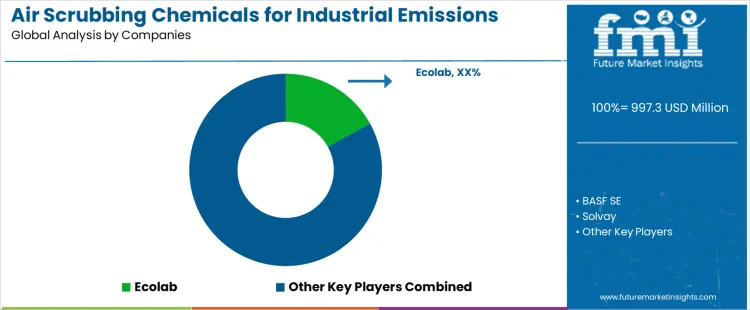
The air scrubbing chemicals for industrial emissions market is expanding as industries face increasing pressure to reduce emissions and improve air quality. Ecolab leads the market with its innovative air scrubbing chemicals, offering solutions that effectively capture and neutralize harmful gases and particulate matter from industrial emissions. Their commitment to sustainability, performance, and regulatory compliance has positioned them as a dominant player in this sector. BASF SE, Solvay, and Kemira are significant competitors, each providing specialized chemical solutions designed to improve air quality and reduce industrial pollutants. BASF SE offers a broad range of air scrubbing chemicals that focus on efficiency and environmental safety, while Solvay and Kemira provide tailored products for various industrial applications, including waste treatment and emissions control.
Cabot Corporation further strengthens the competitive landscape by offering air scrubbing chemicals designed to optimize emission control in industrial settings. Cabot Corporation specializes in high-performance, eco-friendly chemicals that enhance scrubbing processes and improve air quality. These companies compete by focusing on product innovation, sustainability, and the ability to meet the growing demand for effective air pollution control solutions. As environmental regulations become more stringent and industries strive for cleaner operations, the market for air scrubbing chemicals is expected to continue growing, with an emphasis on developing more efficient and sustainable solutions for industrial emissions.
Key Players of the Air Scrubbing Chemicals for Industrial Emissions Market
- Ecolab
- BASF SE
- Solvay
- Kemira
- Cabot Corporation
Scope of the Report
| Items | Values |
|---|---|
| Quantitative Units (2026) | USD Million |
| Chemical Type | Alkaline Scrubbing Chemicals (NaOH, Ca(OH)₂), Acidic Scrubbing Chemicals (H₂SO₄, HCl), Oxidizing Agents (Ozone, Chlorine Dioxide, H₂O₂), Activated Carbon & Adsorbent Media, Bio-Based & Enzymatic Scrubbing Chemicals |
| Emission Type | Sulfur Oxides (SOx), Nitrogen Oxides (NOx), Volatile Organic Compounds (VOCs), Acid Gases (HCl, HF, NH₃), Mercury & Hazardous Air Pollutants (HAPs), Other Industrial Emissions |
| End-Use Industry | Power Generation & Utilities, Chemical & Petrochemical, Cement, Steel & Metallurgy, Manufacturing & Industrial Plants, Waste Incineration & Environmental Facilities |
| Companies | Ecolab, BASF SE, Solvay, Kemira, Cabot Corporation |
| Regions Covered | North America, Latin America, Western Europe, Eastern Europe, South Asia and Pacific, East Asia, Middle East & Africa |
| Countries Covered | United States, Canada, Mexico, Brazil, Argentina, Germany, France, United Kingdom, Italy, Spain, Netherlands, China, India, Japan, South Korea, ANZ, GCC Countries, South Africa |
| Additional Attributes | Dollar by sales by chemical type, emission type, end-use industry, and region. Includes market trends in air scrubbing chemicals for industrial emissions, performance in various emission control applications, cost-effectiveness, sustainability practices, regulatory compliance, market share and competitive positioning of key companies, and the role of scrubbing chemicals in reducing air pollution, improving emission control efficiency, and supporting environmental compliance in industrial sectors. |
Air Scrubbing Chemicals for Industrial Emissions Market Segmentation
Chemical Type
- Alkaline Scrubbing Chemicals (NaOH, Ca(OH)₂)
- Acidic Scrubbing Chemicals (H₂SO₄, HCl)
- Oxidizing Agents (Ozone, Chlorine Dioxide, H₂O₂)
- Activated Carbon & Adsorbent Media
- Bio-Based & Enzymatic Scrubbing Chemicals
Emission Type
- Sulfur Oxides (SOx)
- Nitrogen Oxides (NOx)
- Volatile Organic Compounds (VOCs)
- Acid Gases (HCl, HF, NH₃)
- Mercury & Hazardous Air Pollutants (HAPs)
- Other Industrial Emissions
End-Use Industry
- Power Generation & Utilities
- Chemical & Petrochemical
- Cement, Steel & Metallurgy
- Manufacturing & Industrial Plants
- Waste Incineration & Environmental Facilities
Region
- Asia Pacific
- China
- Japan
- South Korea
- India
- Australia & New Zealand
- ASEAN
- Rest of Asia Pacific
- Europe
- Germany
- United Kingdom
- France
- Italy
- Spain
- Nordic
- BENELUX
- Rest of Europe
- North America
- United States
- Canada
- Mexico
- Latin America
- Brazil
- Chile
- Rest of Latin America
- Middle East & Africa
- Kingdom of Saudi Arabia
- Other GCC Countries
- Turkey
- South Africa
- Other African Union
- Rest of Middle East & Africa
Bibliography
- Ecolab. (n.d.). Air scrubbing chemicals for industrial emissions.
- BASF SE. (n.d.). Innovative solutions in air scrubbing chemicals.
Frequently Asked Questions
How big is the air scrubbing chemicals for industrial emissions market in 2026?
The global air scrubbing chemicals for industrial emissions market is estimated to be valued at USD 997.3 million in 2026.
What will be the size of air scrubbing chemicals for industrial emissions market in 2036?
The market size for the air scrubbing chemicals for industrial emissions market is projected to reach USD 2,234.2 million by 2036.
How much will be the air scrubbing chemicals for industrial emissions market growth between 2026 and 2036?
The air scrubbing chemicals for industrial emissions market is expected to grow at a 8.4% CAGR between 2026 and 2036.
What are the key product types in the air scrubbing chemicals for industrial emissions market?
The key product types in air scrubbing chemicals for industrial emissions market are alkaline scrubbing chemicals (NaOH, Ca(OH)₂), acidic scrubbing chemicals (H₂SO₄, HCl), oxidizing agents (ozone, chlorine dioxide, h₂o₂), activated carbon & adsorbent media and bio-based & enzymatic scrubbing chemicals.
Which emission type segment to contribute significant share in the air scrubbing chemicals for industrial emissions market in 2026?
In terms of emission type, sulfur oxides (SOx) segment to command 28.0% share in the air scrubbing chemicals for industrial emissions market in 2026.
Preview the report firsthand - request a free sample
Get SampleGet the brochure for pricing and purchase details.
Get PDFTable of Content
- Executive Summary
- Global Market Outlook
- Demand-side Trends
- Supply-side Trends
- Technology Roadmap Analysis
- Analysis and Recommendations
- Market Overview
- Market Coverage / Taxonomy
- Market Definition / Scope / Limitations
- Market Background
- Market Dynamics
- Drivers
- Restraints
- Opportunity
- Trends
- Scenario Forecast
- Demand in Optimistic Scenario
- Demand in Likely Scenario
- Demand in Conservative Scenario
- Opportunity Map Analysis
- Product Life Cycle Analysis
- Supply Chain Analysis
- Investment Feasibility Matrix
- Value Chain Analysis
- PESTLE and Porter’s Analysis
- Regulatory Landscape
- Regional Parent Market Outlook
- Production and Consumption Statistics
- Import and Export Statistics
- Market Dynamics
- Global Market Analysis 2021 to 2025 and Forecast, 2026 to 2036
- Historical Market Size Value (USD Million) Analysis, 2021 to 2025
- Current and Future Market Size Value (USD Million) Projections, 2026 to 2036
- Y-o-Y Growth Trend Analysis
- Absolute $ Opportunity Analysis
- Global Market Pricing Analysis 2021 to 2025 and Forecast 2026 to 2036
- Global Market Analysis 2021 to 2025 and Forecast 2026 to 2036, By Chemical Type
- Introduction / Key Findings
- Historical Market Size Value (USD Million) Analysis By Chemical Type , 2021 to 2025
- Current and Future Market Size Value (USD Million) Analysis and Forecast By Chemical Type , 2026 to 2036
- Alkaline Scrubbing Chemicals (NaOH, Ca(OH)₂)
- Acidic Scrubbing Chemicals (H₂SO₄, HCl)
- Oxidizing Agents (Ozone, Chlorine Dioxide, H₂O₂)
- Activated Carbon & Adsorbent Media
- Bio-Based & Enzymatic Scrubbing Chemicals
- Alkaline Scrubbing Chemicals (NaOH, Ca(OH)₂)
- Y-o-Y Growth Trend Analysis By Chemical Type , 2021 to 2025
- Absolute $ Opportunity Analysis By Chemical Type , 2026 to 2036
- Global Market Analysis 2021 to 2025 and Forecast 2026 to 2036, By Emission Type
- Introduction / Key Findings
- Historical Market Size Value (USD Million) Analysis By Emission Type, 2021 to 2025
- Current and Future Market Size Value (USD Million) Analysis and Forecast By Emission Type, 2026 to 2036
- Sulfur Oxides (SOx)
- Nitrogen Oxides (NOx)
- Volatile Organic Compounds (VOCs)
- Acid Gases (HCl, HF, NH₃)
- Mercury & Hazardous Air Pollutants (HAPs)
- Other Industrial Emissions
- Sulfur Oxides (SOx)
- Y-o-Y Growth Trend Analysis By Emission Type, 2021 to 2025
- Absolute $ Opportunity Analysis By Emission Type, 2026 to 2036
- Global Market Analysis 2021 to 2025 and Forecast 2026 to 2036, By End-Use Industry
- Introduction / Key Findings
- Historical Market Size Value (USD Million) Analysis By End-Use Industry, 2021 to 2025
- Current and Future Market Size Value (USD Million) Analysis and Forecast By End-Use Industry, 2026 to 2036
- Power Generation & Utilities
- Chemical & Petrochemical
- Cement, Steel & Metallurgy
- Manufacturing & Industrial Plants
- Waste Incineration & Environmental Facilities
- Power Generation & Utilities
- Y-o-Y Growth Trend Analysis By End-Use Industry, 2021 to 2025
- Absolute $ Opportunity Analysis By End-Use Industry, 2026 to 2036
- Global Market Analysis 2021 to 2025 and Forecast 2026 to 2036, By Region
- Introduction
- Historical Market Size Value (USD Million) Analysis By Region, 2021 to 2025
- Current Market Size Value (USD Million) Analysis and Forecast By Region, 2026 to 2036
- North America
- Latin America
- Western Europe
- Eastern Europe
- East Asia
- South Asia and Pacific
- Middle East & Africa
- Market Attractiveness Analysis By Region
- North America Market Analysis 2021 to 2025 and Forecast 2026 to 2036, By Country
- Historical Market Size Value (USD Million) Trend Analysis By Market Taxonomy, 2021 to 2025
- Market Size Value (USD Million) Forecast By Market Taxonomy, 2026 to 2036
- By Country
- USA
- Canada
- Mexico
- By Chemical Type
- By Emission Type
- By End-Use Industry
- By Country
- Market Attractiveness Analysis
- By Country
- By Chemical Type
- By Emission Type
- By End-Use Industry
- Key Takeaways
- Latin America Market Analysis 2021 to 2025 and Forecast 2026 to 2036, By Country
- Historical Market Size Value (USD Million) Trend Analysis By Market Taxonomy, 2021 to 2025
- Market Size Value (USD Million) Forecast By Market Taxonomy, 2026 to 2036
- By Country
- Brazil
- Chile
- Rest of Latin America
- By Chemical Type
- By Emission Type
- By End-Use Industry
- By Country
- Market Attractiveness Analysis
- By Country
- By Chemical Type
- By Emission Type
- By End-Use Industry
- Key Takeaways
- Western Europe Market Analysis 2021 to 2025 and Forecast 2026 to 2036, By Country
- Historical Market Size Value (USD Million) Trend Analysis By Market Taxonomy, 2021 to 2025
- Market Size Value (USD Million) Forecast By Market Taxonomy, 2026 to 2036
- By Country
- Germany
- UK
- Italy
- Spain
- France
- Nordic
- BENELUX
- Rest of Western Europe
- By Chemical Type
- By Emission Type
- By End-Use Industry
- By Country
- Market Attractiveness Analysis
- By Country
- By Chemical Type
- By Emission Type
- By End-Use Industry
- Key Takeaways
- Eastern Europe Market Analysis 2021 to 2025 and Forecast 2026 to 2036, By Country
- Historical Market Size Value (USD Million) Trend Analysis By Market Taxonomy, 2021 to 2025
- Market Size Value (USD Million) Forecast By Market Taxonomy, 2026 to 2036
- By Country
- Russia
- Poland
- Hungary
- Balkan & Baltic
- Rest of Eastern Europe
- By Chemical Type
- By Emission Type
- By End-Use Industry
- By Country
- Market Attractiveness Analysis
- By Country
- By Chemical Type
- By Emission Type
- By End-Use Industry
- Key Takeaways
- East Asia Market Analysis 2021 to 2025 and Forecast 2026 to 2036, By Country
- Historical Market Size Value (USD Million) Trend Analysis By Market Taxonomy, 2021 to 2025
- Market Size Value (USD Million) Forecast By Market Taxonomy, 2026 to 2036
- By Country
- China
- Japan
- South Korea
- By Chemical Type
- By Emission Type
- By End-Use Industry
- By Country
- Market Attractiveness Analysis
- By Country
- By Chemical Type
- By Emission Type
- By End-Use Industry
- Key Takeaways
- South Asia and Pacific Market Analysis 2021 to 2025 and Forecast 2026 to 2036, By Country
- Historical Market Size Value (USD Million) Trend Analysis By Market Taxonomy, 2021 to 2025
- Market Size Value (USD Million) Forecast By Market Taxonomy, 2026 to 2036
- By Country
- India
- ASEAN
- Australia & New Zealand
- Rest of South Asia and Pacific
- By Chemical Type
- By Emission Type
- By End-Use Industry
- By Country
- Market Attractiveness Analysis
- By Country
- By Chemical Type
- By Emission Type
- By End-Use Industry
- Key Takeaways
- Middle East & Africa Market Analysis 2021 to 2025 and Forecast 2026 to 2036, By Country
- Historical Market Size Value (USD Million) Trend Analysis By Market Taxonomy, 2021 to 2025
- Market Size Value (USD Million) Forecast By Market Taxonomy, 2026 to 2036
- By Country
- Kingdom of Saudi Arabia
- Other GCC Countries
- Turkiye
- South Africa
- Other African Union
- Rest of Middle East & Africa
- By Chemical Type
- By Emission Type
- By End-Use Industry
- By Country
- Market Attractiveness Analysis
- By Country
- By Chemical Type
- By Emission Type
- By End-Use Industry
- Key Takeaways
- Key Countries Market Analysis
- USA
- Pricing Analysis
- Market Share Analysis, 2025
- By Chemical Type
- By Emission Type
- By End-Use Industry
- Canada
- Pricing Analysis
- Market Share Analysis, 2025
- By Chemical Type
- By Emission Type
- By End-Use Industry
- Mexico
- Pricing Analysis
- Market Share Analysis, 2025
- By Chemical Type
- By Emission Type
- By End-Use Industry
- Brazil
- Pricing Analysis
- Market Share Analysis, 2025
- By Chemical Type
- By Emission Type
- By End-Use Industry
- Chile
- Pricing Analysis
- Market Share Analysis, 2025
- By Chemical Type
- By Emission Type
- By End-Use Industry
- Germany
- Pricing Analysis
- Market Share Analysis, 2025
- By Chemical Type
- By Emission Type
- By End-Use Industry
- UK
- Pricing Analysis
- Market Share Analysis, 2025
- By Chemical Type
- By Emission Type
- By End-Use Industry
- Italy
- Pricing Analysis
- Market Share Analysis, 2025
- By Chemical Type
- By Emission Type
- By End-Use Industry
- Spain
- Pricing Analysis
- Market Share Analysis, 2025
- By Chemical Type
- By Emission Type
- By End-Use Industry
- France
- Pricing Analysis
- Market Share Analysis, 2025
- By Chemical Type
- By Emission Type
- By End-Use Industry
- India
- Pricing Analysis
- Market Share Analysis, 2025
- By Chemical Type
- By Emission Type
- By End-Use Industry
- ASEAN
- Pricing Analysis
- Market Share Analysis, 2025
- By Chemical Type
- By Emission Type
- By End-Use Industry
- Australia & New Zealand
- Pricing Analysis
- Market Share Analysis, 2025
- By Chemical Type
- By Emission Type
- By End-Use Industry
- China
- Pricing Analysis
- Market Share Analysis, 2025
- By Chemical Type
- By Emission Type
- By End-Use Industry
- Japan
- Pricing Analysis
- Market Share Analysis, 2025
- By Chemical Type
- By Emission Type
- By End-Use Industry
- South Korea
- Pricing Analysis
- Market Share Analysis, 2025
- By Chemical Type
- By Emission Type
- By End-Use Industry
- Russia
- Pricing Analysis
- Market Share Analysis, 2025
- By Chemical Type
- By Emission Type
- By End-Use Industry
- Poland
- Pricing Analysis
- Market Share Analysis, 2025
- By Chemical Type
- By Emission Type
- By End-Use Industry
- Hungary
- Pricing Analysis
- Market Share Analysis, 2025
- By Chemical Type
- By Emission Type
- By End-Use Industry
- Kingdom of Saudi Arabia
- Pricing Analysis
- Market Share Analysis, 2025
- By Chemical Type
- By Emission Type
- By End-Use Industry
- Turkiye
- Pricing Analysis
- Market Share Analysis, 2025
- By Chemical Type
- By Emission Type
- By End-Use Industry
- South Africa
- Pricing Analysis
- Market Share Analysis, 2025
- By Chemical Type
- By Emission Type
- By End-Use Industry
- USA
- Market Structure Analysis
- Competition Dashboard
- Competition Benchmarking
- Market Share Analysis of Top Players
- By Regional
- By Chemical Type
- By Emission Type
- By End-Use Industry
- Competition Analysis
- Competition Deep Dive
- Ecolab
- Overview
- Product Portfolio
- Profitability by Market Segments (Product/Age /Sales Channel/Region)
- Sales Footprint
- Strategy Overview
- Marketing Strategy
- Product Strategy
- Channel Strategy
- BASF SE
- Solvay
- Kemira
- Cabot Corporation
- Ecolab
- Competition Deep Dive
- Assumptions & Acronyms Used
- Research Methodology


