

- Market Size (2026)
- USD 278.3 Mn
- Forecast (2036)
- USD 475.4 Mn
- CAGR (2026 to 2036)
- 5.5%
Air Duct Cleaning Chemicals Market Size, Market Forecast and Outlook By FMI
The air duct cleaning chemicals market was valued at USD 263.8 million in 2025. The market is set to reach USD 278.3 million by 2026-end and grow at a CAGR of 5.5% between 2026-2036 to reach USD 475.4 million by 2036. Fungicides And Fungi Stats will dominate with a 42.6% share, while Commercial will lead with a 47.9%% share.
Summary of Air Duct Cleaning Chemicals Market
- Demand and Growth Drivers
- Indoor air quality awareness is increasing as building occupants and facility managers recognize the health impact of contaminated HVAC systems, driving demand for antimicrobial duct treatment chemicals.
- Building health certification programs (WELL, Fitwel) include HVAC system hygiene requirements that drive scheduled duct cleaning and antimicrobial treatment protocols.
- Post-pandemic emphasis on indoor environmental quality has elevated HVAC system cleanliness from maintenance afterthought to health and safety priority across commercial and institutional buildings.
- Product and Segment View
- Fungicides And Fungi Stats holds 42.6% of the application process segment in 2026, supported by the widespread need for antifungal treatment in HVAC systems where moisture condensation creates conditions favorable for mold and fungal growth.
- Commercial accounts for 47.9% of the application segment, reflecting the concentration of duct cleaning chemical demand in commercial buildings where HVAC systems serve large occupied spaces with regulatory indoor air quality requirements.
- Residential applications represent a growing segment as homeowner awareness of indoor air quality and HVAC system hygiene increases, driven by health concerns and energy efficiency considerations related to duct contamination.
- Geography and Competitive Outlook
- China leads country-level growth at 7.4% CAGR, supported by large commercial building stock, increasing indoor air quality awareness, and growing HVAC maintenance services market.
- India follows at 6.9% CAGR, driven by rapid commercial construction growth, expanding awareness of indoor air quality, and growing professional HVAC maintenance services sector.
- Competition spans specialty chemical manufacturers focused on HVAC treatment products, general cleaning chemical companies with HVAC product lines, and HVAC service companies developing proprietary treatment formulations.
- Analyst Opinion
- The air duct cleaning chemicals market reflects the growing recognition of HVAC system hygiene as a building health determinant. Indoor air quality has moved from facility management concern to occupant health priority, creating regulatory and commercial demand for systematic duct cleaning and antimicrobial treatment. The competitive advantage shifts toward manufacturers that can demonstrate EPA-registered antimicrobial efficacy with low toxicity profiles, as building owners increasingly require documentation of treatment chemical safety alongside antimicrobial performance. Companies that combine effective formulations with applicator training programs and certified treatment protocols will capture growing market share during the forecast period.
- EPA registration requirements for antimicrobial duct treatment chemicals create regulatory barriers to entry that favor established manufacturers with approved formulations.
- Indoor air quality monitoring technology is enabling data-driven duct cleaning scheduling, optimizing chemical treatment frequency based on measured contamination levels.
- Green chemistry formulations with reduced volatile organic compounds are gaining preference as building owners seek duct treatment chemicals compatible with low-emission building environments.
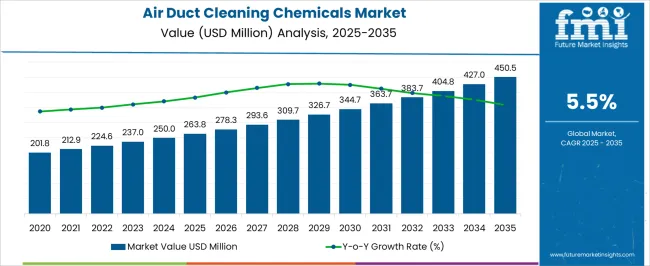
Key Takeaways, Market Size, and Forecast
- The Air Duct Cleaning Chemicals Market was valued at USD 263.80 million in 2025.
- By 2036, the Air Duct Cleaning Chemicals Market is expected to be worth USD 475.39 million.
- From 2026 to 2036, the market is projected to expand at a CAGR of 5.5%.
- The market is projected to create an incremental opportunity of USD 197.08 million between 2026 and 2036.
- In 2026, fungicides and fungi stats is expected to account for 42.6% of the application process segment, driven by the high prevalence of fungal contamination in HVAC ductwork and the health impact of mold exposure in indoor environments.
- China (7.4%) and India (6.9%) are two of the fastest growing markets in the world.
Air Duct Cleaning Chemicals Market Definition
The air duct cleaning chemicals market includes antimicrobial agents, sanitizers, deodorizers, and cleaning compounds formulated for HVAC ductwork treatment, covering fungicides, bactericides, algaecides, and odor neutralizers used in commercial, residential, and industrial air handling system maintenance.
Air Duct Cleaning Chemicals Market Inclusions
Market scope covers air duct cleaning chemicals segmented by application process (fungicides, bactericides, algaecides, deodorizers, others) and application (commercial, residential, industrial). The revenue range extends from 2026 to 2036.
Air Duct Cleaning Chemicals Market Exclusions
The scope does not include general-purpose cleaning chemicals not formulated for HVAC systems, air filtration products, duct sealing materials, and mechanical duct cleaning equipment without chemical treatment.
Air Duct Cleaning Chemicals Market Research Methodology
- Primary Research: FMI analysts conducted interviews with manufacturers, distributors, contractors, and end-use procurement specialists across key markets.
- Desk Research: Integrated data from industry publications, trade association reports, regulatory databases, and manufacturer disclosures.
- Market Sizing and Forecasting: Bottom-up aggregation across product types, application segments, and regional adoption curves with cross-validation against industry production data.
- Data Validation: Cross-checked quarterly against manufacturer revenue disclosures, trade statistics, and industry association reports.
Why is the Air Duct Cleaning Chemicals Market Growing?
- Indoor air quality health awareness is driving demand for antimicrobial duct treatment as building occupants and managers increasingly understand the connection between HVAC contamination and respiratory health.
- Building health certifications (WELL, Fitwel) include HVAC system hygiene protocols that specify regular duct cleaning and antimicrobial treatment, creating structured commercial demand.
- Post-pandemic building re-occupancy has elevated HVAC system cleanliness from routine maintenance to health and safety compliance requirement across commercial facilities.
The air duct cleaning chemicals market reflects the intersection of building health science and HVAC maintenance practice. Research linking contaminated ductwork to respiratory illness, allergic reactions, and sick building syndrome has elevated duct treatment from discretionary maintenance to health-related building management practice.
Fungicides and fungi stats at 42.6% of the application process segment reflect the prevalence of mold and fungal contamination in HVAC systems, where condensation and humidity create favorable growth conditions. Antifungal treatment addresses both active contamination and preventive protection.
Commercial buildings at 47.9% of the application segment reflect the concentration of duct cleaning chemical demand in office, healthcare, hospitality, and institutional facilities where HVAC systems serve large occupied areas with indoor air quality regulatory requirements.
Market Segmentation Analysis
- Fungicides And Fungi Stats holds 42.6% of the application process segment, supported by the widespread need for antifungal treatment in HVAC systems where moisture condensation creates conditions favorable for mold and fungal growth.
- Commercial at 47.9% leads the application segment, reflecting the concentration of duct cleaning chemical demand in commercial buildings where HVAC systems serve large occupied spaces with regulatory indoor air quality requirements.
- Industrial applications represent a specialized segment where duct cleaning chemicals must address contamination from manufacturing processes including particulate matter, chemical residues, and biological growth in process ventilation systems.
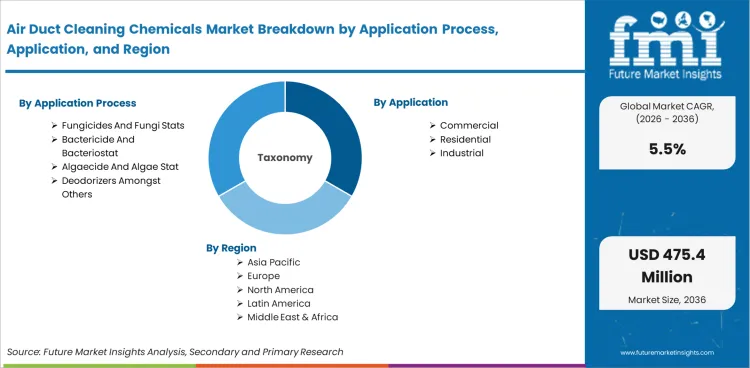
The air duct cleaning chemicals market is segmented by application process (fungicides and fungi stats, bactericide and bacteriostat, algaecide and algae stat, deodorizers amongst others) and application (commercial, residential, industrial).
Insights into the Fungicides And Fungi Stats Application Process
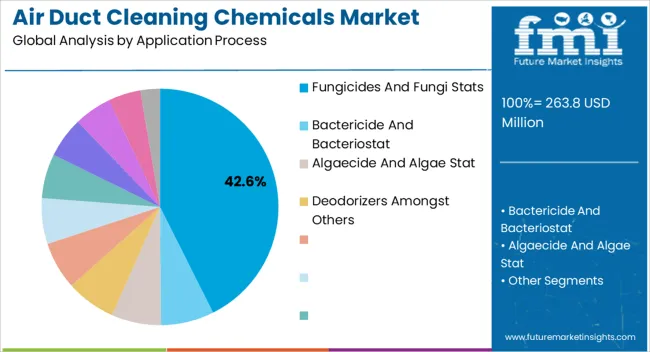
Fungicides and fungi stats hold 42.6% of the application process segment in 2026. Mold and fungal contamination is the most common microbial issue in HVAC ductwork, driven by moisture condensation on duct surfaces that creates favorable conditions for fungal colonization.
EPA-registered fungicidal formulations for HVAC application must demonstrate both antimicrobial efficacy and safety for treated surfaces that contact conditioned air delivered to occupied spaces, creating formulation challenges that favor specialized manufacturers.
Insights into the Commercial Application Segment
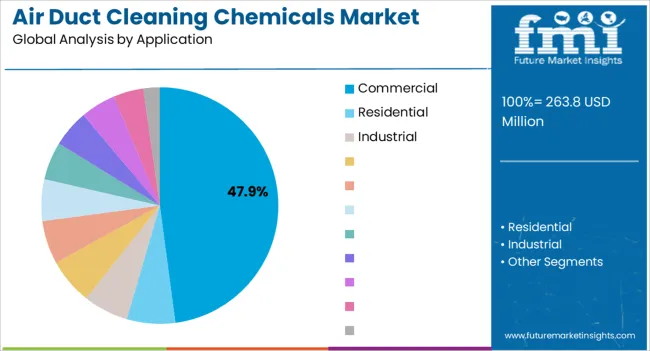
Commercial buildings account for 47.9% of the application segment in 2026. Office buildings, hospitals, hotels, and institutional facilities have the largest HVAC duct surface areas and serve the most occupants, creating the greatest exposure risk from contaminated ductwork.
Facility management companies and HVAC service contractors are the primary purchasers of commercial duct cleaning chemicals, with treatment protocols increasingly specified in building maintenance contracts and health certification programs.
Air Duct Cleaning Chemicals Market Drivers, Restraints, and Opportunities
- Indoor air quality health awareness and building health certification requirements are the primary structural drivers, converting HVAC duct treatment from optional maintenance to specified building management practice.
- Regulatory compliance for antimicrobial chemical registration and occupational exposure limits constrain market entry and formulation development timelines.
- Green chemistry and low-VOC formulations create product development opportunities as building owners require treatment chemicals compatible with healthy indoor environments.
The air duct cleaning chemicals market is shaped by the growing recognition of HVAC system hygiene as a determinant of building occupant health and the resulting regulatory and commercial demand for antimicrobial duct treatment.
Health Awareness as Structural Driver
Scientific evidence linking HVAC contamination to occupant health issues has elevated duct treatment from discretionary maintenance to health-related building management practice, creating sustained demand for antimicrobial duct cleaning chemicals.
Regulatory Registration Barriers
EPA antimicrobial registration requirements and occupational safety standards create formulation constraints and market entry barriers. Manufacturers must demonstrate efficacy and safety through testing protocols that require significant investment.
Green Chemistry Opportunities
Low-VOC, bio-based, and environmentally preferable duct treatment formulations are gaining preference as building owners seek chemicals consistent with healthy building environments and sustainability commitments.
Analysis of Air Duct Cleaning Chemicals Market by Key Countries
.webp "Top Country Growth Comparison Air Duct Cleaning Chemicals Market Cagr (2026 2036)")
| Country | CAGR |
|---|---|
| China | 7.4% |
| India | 6.9% |
| Germany | 6.3% |
| France | 5.8% |
| UK | 5.2% |
| USA | 4.7% |
| Brazil | 4.1% |
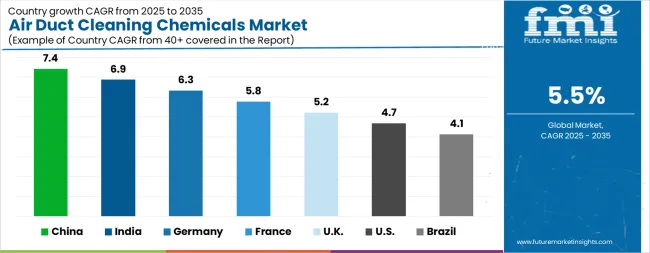
- China leads at 7.4% CAGR through 2036, supported by large commercial building stock and growing HVAC maintenance services.
- India at 6.9% CAGR driven by commercial construction growth and expanding indoor air quality awareness.
- Germany (6.3%) and France (5.8%) maintain growth through building modernization and indoor environmental quality investment.
The air duct cleaning chemicals market is projected to expand at 5.5% CAGR globally from 2026 to 2036. The analysis covers more than 30 countries, with the leading markets detailed below.
Demand Outlook for Air Duct Cleaning Chemicals Market in China
China is growing at 7.4% CAGR through 2036, leading country-level growth. Large commercial building stock, increasing indoor air quality awareness, and growing professional HVAC maintenance services are driving demand.
- Large commercial building stock creates significant duct cleaning chemical demand across office and hospitality sectors.
- Indoor air quality awareness is increasing among building owners and facility managers.
- Professional HVAC maintenance services market is growing and professionalizing.
Future Outlook for Air Duct Cleaning Chemicals Market in India
India is expanding at 6.9% CAGR through 2036, driven by commercial construction growth, expanding awareness of indoor air quality, and growing professional HVAC maintenance services.
- Commercial construction growth in urban centers creates new HVAC systems requiring maintenance chemical treatment.
- Indoor air quality awareness is growing among commercial building occupants and managers.
- Professional HVAC services sector is expanding with increasing demand for duct cleaning treatment.
Opportunity Analysis of Air Duct Cleaning Chemicals Market in Germany
Germany is growing at 6.3% CAGR through 2036, reflecting strict indoor air quality regulations, high building health standards, and mature HVAC maintenance services market.
- Strict indoor air quality regulations drive systematic HVAC duct treatment in commercial and institutional buildings.
- Building health certification adoption creates structured demand for antimicrobial duct treatment.
- Mature HVAC maintenance market provides established distribution channels for duct cleaning chemicals.
In-depth Analysis of Air Duct Cleaning Chemicals Market in France
France is growing at 5.8% CAGR through 2036, supported by EU building health regulations, growing indoor air quality awareness, and expanding commercial HVAC maintenance services.
- EU indoor air quality regulations drive HVAC system hygiene requirements across commercial buildings.
- Hospital and healthcare facility HVAC treatment requirements create specialized antimicrobial demand.
- Commercial building maintenance standards include duct cleaning chemical treatment protocols.
Sales Analysis of Air Duct Cleaning Chemicals Market in the USA
The USA is growing at 4.7% CAGR through 2036, maintaining significant revenue concentration with mature NADCA-certified duct cleaning industry and growing building health certification adoption.
- NADCA industry standards drive professional duct cleaning practices including antimicrobial chemical treatment.
- Building health certification (WELL, Fitwel) adoption creates structured demand for HVAC treatment chemicals.
- EPA antimicrobial registration provides regulatory framework ensuring treatment chemical safety and efficacy.
Competitive Landscape and Strategic Positioning
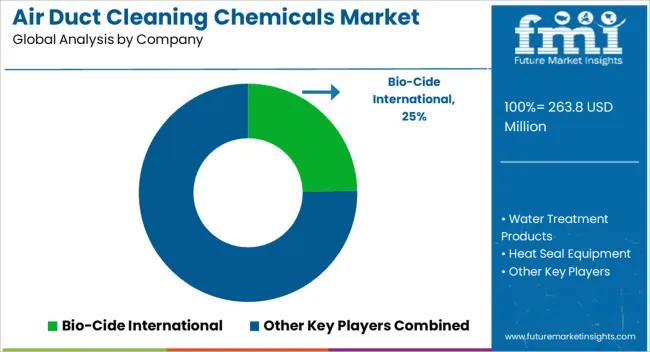
- Bio-Cide International leads through its specialized HVAC antimicrobial product line with EPA-registered formulations for duct cleaning and treatment applications.
- Water Treatment Products and Abatement Technologies compete through focused HVAC maintenance chemical portfolios serving professional duct cleaning contractors.
- HVAC service companies are developing proprietary treatment formulations, creating vertical integration competition with standalone chemical manufacturers.
Bio-Cide International maintains leadership through its EPA-registered antimicrobial formulations specifically developed for HVAC duct treatment applications. Water Treatment Products offers antimicrobial chemicals for building water and HVAC system treatment.
Abatement Technologies provides HVAC cleaning equipment and antimicrobial chemicals for professional duct cleaning contractors. Heat Seal Equipment offers duct cleaning systems with integrated chemical treatment capabilities.
ComStar International and OdorX provide specialty formulations for HVAC odor control and antimicrobial treatment in specific commercial and residential applications.
Key Companies in the Air Duct Cleaning Chemicals Market
Key global companies leading the air duct cleaning chemicals market include:
- Bio-Cide International (USA), Water Treatment Products (USA), and Abatement Technologies (USA) maintain leading positions through EPA-registered antimicrobial formulations for HVAC applications.
- Heat Seal Equipment (USA), ComStar International (USA), and OdorX (USA) compete through specialized duct cleaning chemical and equipment solutions for professional contractors.
Competitive Benchmarking: Air Duct Cleaning Chemicals Market
| Company | Product Range | EPA Registration | Contractor Access | Geographic Reach |
|---|---|---|---|---|
| Bio-Cide International | Comprehensive | Strong | Strong | N. America |
| Water Treatment Products | Moderate | Strong | Moderate | N. America |
| Abatement Technologies | Moderate | Moderate | Strong | N. America |
| Heat Seal Equipment | Specialty | Moderate | Moderate | N. America |
| ComStar International | Specialty | Moderate | Moderate | N. America |
| OdorX | Specialty | Moderate | Moderate | N. America |
Source: Future Market Insights competitive analysis, 2026.
Key Players in the Air Duct Cleaning Chemicals Market
Major Global Players
- Bio-Cide International
- Water Treatment Products
- Abatement Technologies
Emerging Players/Startups
- Heat Seal Equipment
- ComStar International
- OdorX
Report Scope and Coverage
| Parameter | Details |
|---|---|
| Quantitative Units | USD 278.31 million to USD 475.39 million, at a CAGR of 5.5% |
| Market Definition | The air duct cleaning chemicals market includes antimicrobial agents, sanitizers, deodorizers, and cleaning compounds formulated for HVAC ductwork treatment, covering fungicides, bactericides, algaecides, and odor neutralizers used in commercial, residential, and industrial air handling system maintenance. |
| Regions Covered | North America, Latin America, Europe, East Asia, South Asia and Pacific, Middle East and Africa |
| Countries Covered | China, India, Germany, France, UK, USA, Brazil, 30 plus countries |
| Key Companies Profiled | Bio-Cide International, Water Treatment Products, Abatement Technologies, Heat Seal Equipment, ComStar International, OdorX |
| Forecast Period | 2026 to 2036 |
| Approach | Hybrid bottom-up and top-down methodology starting with verified industry data, projecting adoption velocity across segments and regions. |
Market Segmentation Analysis
Air Duct Cleaning Chemicals Market Segmented by Application Process:
- Fungicides And Fungi Stats
- Bactericide And Bacteriostat
- Algaecide And Algae Stat
- Deodorizers Amongst Others
Air Duct Cleaning Chemicals Market Segmented by Application:
- Commercial
- Residential
- Industrial
Air Duct Cleaning Chemicals Market by Region:
- North America
- USA
- Canada
- Mexico
- Latin America
- Brazil
- Chile
- Rest of Latin America
- Western Europe
- Germany
- UK
- Italy
- Spain
- France
- Nordic
- BENELUX
- Rest of Western Europe
- Eastern Europe
- Russia
- Poland
- Hungary
- Balkan & Baltic
- Rest of Eastern Europe
- East Asia
- China
- Japan
- South Korea
- South Asia and Pacific
- India
- ASEAN
- Australia & New Zealand
- Rest of South Asia and Pacific
- Middle East & Africa
- Kingdom of Saudi Arabia
- Other GCC Countries
- Turkiye
- South Africa
- Other African Union
- Rest of Middle East & Africa
Research Sources and Bibliography
- National Air Duct Cleaners Association. (2025). NADCA Standards for Assessment, Cleaning, and Restoration of HVAC Systems. NADCA.
- USA Environmental Protection Agency. (2024). Antimicrobial Products for HVAC Systems: Registration and Efficacy Requirements. EPA.
- ASHRAE. (2025). ASHRAE Standard 62.1: Ventilation and Indoor Air Quality. ASHRAE.
- World Health Organization. (2024). Indoor Air Quality: HVAC System Hygiene Guidelines. WHO.
- International WELL Building Institute. (2025). WELL Building Standard: Air Quality and HVAC Treatment Requirements. IWBI.
This bibliography is provided for reader reference.
This Report Answers
- Estimating the size of the air duct cleaning chemicals market and revenue projections from 2026 to 2036.
- Segmentation by application process (fungicides and fungi stats, bactericide and bacteriostat, algaecide and algae stat.
- Insights about more than 30 markets in the region.
- Analysis of key product, application, and end-use segments.
- Assessment of the competitive landscape.
- Finding investment opportunities across key segments and regions.
- Tracking regulatory frameworks and industry standards.
Frequently Asked Questions
What is the global market demand for air duct cleaning chemicals in 2026?
In 2026, the global air duct cleaning chemicals market is expected to be worth USD 278.31 million.
How big will the air duct cleaning chemicals market be in 2036?
By 2036, the market is expected to be worth USD 475.39 million.
How much is demand expected to grow between 2026 and 2036?
Between 2026 and 2036, the market is expected to grow at a CAGR of 5.5%.
Which application process segment is likely to lead globally in 2026?
Fungicides And Fungi Stats is expected to hold 42.6% of the application process segment in 2026, supported by the widespread need for antifungal treatment in HVAC systems where moisture condensation creates conditions favorable for mold and fungal growth.
What is causing demand to rise in China?
China is growing at 7.4% CAGR through 2036, supported by large commercial building stock, increasing indoor air quality awareness, and growing HVAC maintenance services market.
What is causing demand to rise in India?
India is expanding at 6.9% CAGR through 2036, driven by rapid commercial construction growth, expanding awareness of indoor air quality, and growing professional HVAC maintenance services sector.
What does this report mean by air duct cleaning chemicals market definition?
The air duct cleaning chemicals market includes antimicrobial agents, sanitizers, deodorizers, and cleaning compounds formulated for HVAC ductwork treatment, covering fungicides, bactericides, algaecides, and odor neutralizers used in commercial, residential, and industrial air handling system maintenance.
How does FMI make this forecast and validate it?
Forecasting uses a hybrid bottom-up and top-down approach, starting with verified industry production data and cross-checking against manufacturer disclosures and trade statistics.
Preview the report firsthand - request a free sample
Get SampleGet the brochure for pricing and purchase details.
Get PDFTable of Content
- Global Market Outlook
- Demand-side Trends
- Supply-side Trends
- Technology Roadmap Analysis
- Analysis and Recommendations
- Market Overview
- Market Coverage / Taxonomy
- Market Definition / Scope / Limitations
- Research Methodology
- Chapter Orientation
- Analytical Lens and Working Hypotheses
- Market Structure, Signals, and Trend Drivers
- Benchmarking and Cross-market Comparability
- Market Sizing, Forecasting, and Opportunity Mapping
- Research Design and Evidence Framework
- Desk Research Programme (Secondary Evidence)
- Company Annual and Sustainability Reports
- Peer-reviewed Journals and Academic Literature
- Corporate Websites, Product Literature, and Technical Notes
- Earnings Decks and Investor Briefings
- Statutory Filings and Regulatory Disclosures
- Technical White Papers and Standards Notes
- Trade Journals, Industry Magazines, and Analyst Briefs
- Conference Proceedings, Webinars, and Seminar Materials
- Government Statistics Portals and Public Data Releases
- Press Releases and Reputable Media Coverage
- Specialist Newsletters and Curated Briefings
- Sector Databases and Reference Repositories
- FMI Internal Proprietary Databases and Historical Market Datasets
- Subscription Datasets and Paid Sources
- Social Channels, Communities, and Digital Listening Inputs
- Additional Desk Sources
- Expert Input and Fieldwork (Primary Evidence)
- Governance, Ethics, and Data Stewardship
- Research Ethics
- Data Integrity and Handling
- Governance, Ethics, and Data Stewardship
- Tooling, Models, and Reference Databases
- Desk Research Programme (Secondary Evidence)
- Data Engineering and Model Build
- Data Acquisition and Ingestion
- Cleaning, Normalisation, and Verification
- Synthesis, Triangulation, and Analysis
- Quality Assurance and Audit Trail
- Market Background
- Market Dynamics
- Drivers
- Restraints
- Opportunity
- Trends
- Scenario Forecast
- Demand in Optimistic Scenario
- Demand in Likely Scenario
- Demand in Conservative Scenario
- Opportunity Map Analysis
- Product Life Cycle Analysis
- Supply Chain Analysis
- Investment Feasibility Matrix
- Value Chain Analysis
- PESTLE and Porter’s Analysis
- Regulatory Landscape
- Regional Parent Market Outlook
- Production and Consumption Statistics
- Import and Export Statistics
- Market Dynamics
- Global Market Analysis 2021 to 2025 and Forecast, 2026 to 2036
- Historical Market Size Value (USD Million) Analysis, 2021 to 2025
- Current and Future Market Size Value (USD Million) Projections, 2026 to 2036
- Y-o-Y Growth Trend Analysis
- Absolute $ Opportunity Analysis
- Global Market Pricing Analysis 2021 to 2025 and Forecast 2026 to 2036
- Global Market Analysis 2021 to 2025 and Forecast 2026 to 2036, By Application Process
- Introduction / Key Findings
- Historical Market Size Value (USD Million) Analysis By Application Process , 2021 to 2025
- Current and Future Market Size Value (USD Million) Analysis and Forecast By Application Process , 2026 to 2036
- Fungicides And Fungi Stats
- Bactericide And Bacteriostat
- Algaecide And Algae Stat
- Deodorizers Amongst Others
- Fungicides And Fungi Stats
- Y-o-Y Growth Trend Analysis By Application Process , 2021 to 2025
- Absolute $ Opportunity Analysis By Application Process , 2026 to 2036
- Global Market Analysis 2021 to 2025 and Forecast 2026 to 2036, By Application
- Introduction / Key Findings
- Historical Market Size Value (USD Million) Analysis By Application, 2021 to 2025
- Current and Future Market Size Value (USD Million) Analysis and Forecast By Application, 2026 to 2036
- Commercial
- Residential
- Industrial
- Commercial
- Y-o-Y Growth Trend Analysis By Application, 2021 to 2025
- Absolute $ Opportunity Analysis By Application, 2026 to 2036
- Global Market Analysis 2021 to 2025 and Forecast 2026 to 2036, By Region
- Introduction
- Historical Market Size Value (USD Million) Analysis By Region, 2021 to 2025
- Current Market Size Value (USD Million) Analysis and Forecast By Region, 2026 to 2036
- North America
- Latin America
- Western Europe
- Eastern Europe
- East Asia
- South Asia and Pacific
- Middle East & Africa
- Market Attractiveness Analysis By Region
- North America Market Analysis 2021 to 2025 and Forecast 2026 to 2036, By Country
- Historical Market Size Value (USD Million) Trend Analysis By Market Taxonomy, 2021 to 2025
- Market Size Value (USD Million) Forecast By Market Taxonomy, 2026 to 2036
- By Country
- USA
- Canada
- Mexico
- By Application Process
- By Application
- By Country
- Market Attractiveness Analysis
- By Country
- By Application Process
- By Application
- Key Takeaways
- Latin America Market Analysis 2021 to 2025 and Forecast 2026 to 2036, By Country
- Historical Market Size Value (USD Million) Trend Analysis By Market Taxonomy, 2021 to 2025
- Market Size Value (USD Million) Forecast By Market Taxonomy, 2026 to 2036
- By Country
- Brazil
- Chile
- Rest of Latin America
- By Application Process
- By Application
- By Country
- Market Attractiveness Analysis
- By Country
- By Application Process
- By Application
- Key Takeaways
- Western Europe Market Analysis 2021 to 2025 and Forecast 2026 to 2036, By Country
- Historical Market Size Value (USD Million) Trend Analysis By Market Taxonomy, 2021 to 2025
- Market Size Value (USD Million) Forecast By Market Taxonomy, 2026 to 2036
- By Country
- Germany
- UK
- Italy
- Spain
- France
- Nordic
- BENELUX
- Rest of Western Europe
- By Application Process
- By Application
- By Country
- Market Attractiveness Analysis
- By Country
- By Application Process
- By Application
- Key Takeaways
- Eastern Europe Market Analysis 2021 to 2025 and Forecast 2026 to 2036, By Country
- Historical Market Size Value (USD Million) Trend Analysis By Market Taxonomy, 2021 to 2025
- Market Size Value (USD Million) Forecast By Market Taxonomy, 2026 to 2036
- By Country
- Russia
- Poland
- Hungary
- Balkan & Baltic
- Rest of Eastern Europe
- By Application Process
- By Application
- By Country
- Market Attractiveness Analysis
- By Country
- By Application Process
- By Application
- Key Takeaways
- East Asia Market Analysis 2021 to 2025 and Forecast 2026 to 2036, By Country
- Historical Market Size Value (USD Million) Trend Analysis By Market Taxonomy, 2021 to 2025
- Market Size Value (USD Million) Forecast By Market Taxonomy, 2026 to 2036
- By Country
- China
- Japan
- South Korea
- By Application Process
- By Application
- By Country
- Market Attractiveness Analysis
- By Country
- By Application Process
- By Application
- Key Takeaways
- South Asia and Pacific Market Analysis 2021 to 2025 and Forecast 2026 to 2036, By Country
- Historical Market Size Value (USD Million) Trend Analysis By Market Taxonomy, 2021 to 2025
- Market Size Value (USD Million) Forecast By Market Taxonomy, 2026 to 2036
- By Country
- India
- ASEAN
- Australia & New Zealand
- Rest of South Asia and Pacific
- By Application Process
- By Application
- By Country
- Market Attractiveness Analysis
- By Country
- By Application Process
- By Application
- Key Takeaways
- Middle East & Africa Market Analysis 2021 to 2025 and Forecast 2026 to 2036, By Country
- Historical Market Size Value (USD Million) Trend Analysis By Market Taxonomy, 2021 to 2025
- Market Size Value (USD Million) Forecast By Market Taxonomy, 2026 to 2036
- By Country
- Kingdom of Saudi Arabia
- Other GCC Countries
- Turkiye
- South Africa
- Other African Union
- Rest of Middle East & Africa
- By Application Process
- By Application
- By Country
- Market Attractiveness Analysis
- By Country
- By Application Process
- By Application
- Key Takeaways
- Key Countries Market Analysis
- USA
- Pricing Analysis
- Market Share Analysis, 2025
- By Application Process
- By Application
- Canada
- Pricing Analysis
- Market Share Analysis, 2025
- By Application Process
- By Application
- Mexico
- Pricing Analysis
- Market Share Analysis, 2025
- By Application Process
- By Application
- Brazil
- Pricing Analysis
- Market Share Analysis, 2025
- By Application Process
- By Application
- Chile
- Pricing Analysis
- Market Share Analysis, 2025
- By Application Process
- By Application
- Germany
- Pricing Analysis
- Market Share Analysis, 2025
- By Application Process
- By Application
- UK
- Pricing Analysis
- Market Share Analysis, 2025
- By Application Process
- By Application
- Italy
- Pricing Analysis
- Market Share Analysis, 2025
- By Application Process
- By Application
- Spain
- Pricing Analysis
- Market Share Analysis, 2025
- By Application Process
- By Application
- France
- Pricing Analysis
- Market Share Analysis, 2025
- By Application Process
- By Application
- India
- Pricing Analysis
- Market Share Analysis, 2025
- By Application Process
- By Application
- ASEAN
- Pricing Analysis
- Market Share Analysis, 2025
- By Application Process
- By Application
- Australia & New Zealand
- Pricing Analysis
- Market Share Analysis, 2025
- By Application Process
- By Application
- China
- Pricing Analysis
- Market Share Analysis, 2025
- By Application Process
- By Application
- Japan
- Pricing Analysis
- Market Share Analysis, 2025
- By Application Process
- By Application
- South Korea
- Pricing Analysis
- Market Share Analysis, 2025
- By Application Process
- By Application
- Russia
- Pricing Analysis
- Market Share Analysis, 2025
- By Application Process
- By Application
- Poland
- Pricing Analysis
- Market Share Analysis, 2025
- By Application Process
- By Application
- Hungary
- Pricing Analysis
- Market Share Analysis, 2025
- By Application Process
- By Application
- Kingdom of Saudi Arabia
- Pricing Analysis
- Market Share Analysis, 2025
- By Application Process
- By Application
- Turkiye
- Pricing Analysis
- Market Share Analysis, 2025
- By Application Process
- By Application
- South Africa
- Pricing Analysis
- Market Share Analysis, 2025
- By Application Process
- By Application
- USA
- Market Structure Analysis
- Competition Dashboard
- Competition Benchmarking
- Market Share Analysis of Top Players
- By Regional
- By Application Process
- By Application
- Competition Analysis
- Competition Deep Dive
- Bio-Cide International
- Overview
- Product Portfolio
- Profitability by Market Segments (Product/Age /Sales Channel/Region)
- Sales Footprint
- Strategy Overview
- Marketing Strategy
- Product Strategy
- Channel Strategy
- Water Treatment Products
- Heat Seal Equipment
- Abatement Technologies
- ComStar International
- OdorX
- Bio-Cide International
- Competition Deep Dive
- Assumptions & Acronyms Used


