

- Industry Size (2026)
- USD 1940.0 Mn
- Forecast (2036)
- USD 5865.9 Mn
- CAGR (2026 to 2036)
- 11.7%
High-Performance PCR for Industrial Chemicals Packaging Market Forecast and Outlook 2026 to 2036
The high-performance PCR for industrial chemicals packaging market is expected to be valued at USD 1,940.0 million in 2026, and is forecasted to reach USD 5,865.9 million by 2036, at a CAGR of 11.7% over the forecast period. Growth reflects a shift in industrial packaging strategies where sustainability objectives are being integrated into safety-critical chemical containment rather than limited to secondary packaging applications.
Quick Stats for High-Performance PCR for Industrial Chemicals Packaging Market
- High-Performance PCR for Industrial Chemicals Packaging Market Value (2026): USD 1,940.0 million
- High-Performance PCR for Industrial Chemicals Packaging Market Forecast Value (2036): USD 5,865.9 million
- High-Performance PCR for Industrial Chemicals Packaging Market Forecast CAGR 2026 to 2036: 11.7%
- Leading Packaging Format by Demand Share: Drums, jerrycans & IBCs
- Fastest-Growing Countries: India, China, USA, Germany, Japan
- Top Players in Global Demand: Mauser Packaging Solutions, Schütz, Greif, Berry Global, Time Technoplast
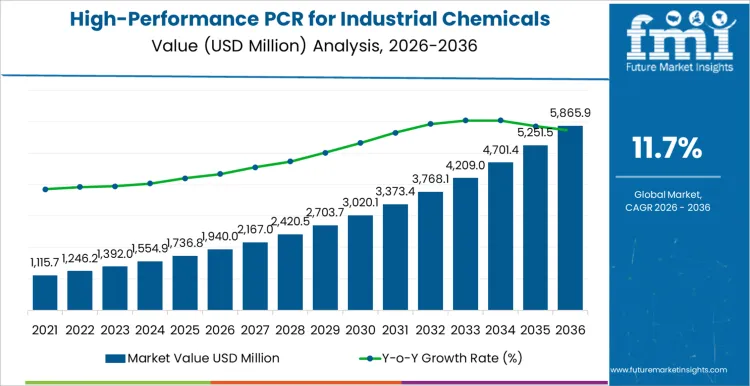
Industrial chemical producers packaging solvents, agrochemicals, lubricants, and specialty fluids increasingly adopt high-performance post-consumer recycled resins that deliver strength, chemical resistance, and dimensional stability comparable to virgin polymers. Drums, jerrycans, and intermediate bulk containers remain primary adoption formats, as thicker wall sections and standardized designs support controlled PCR integration without compromising leak resistance or transport safety.
Advancements in feedstock purification, additive stabilization, and molecular weight control have improved impact resistance and stress crack performance of engineered PCR materials. Regulatory scrutiny around recycled content, combined with corporate decarbonization targets, is accelerating qualification of PCR packaging across chemical supply chains. Material selection is guided by chemical compatibility testing, permeation analysis, and documented compliance with hazardous goods standards. Demand growth is therefore driven by performance validation and regulatory acceptance rather than volume substitution alone.
High-Performance PCR for Industrial Chemicals Packaging Market Key Takeaways
| Metric | Value |
|---|---|
| Market Value (2026) | USD 1,940.0 million |
| Market Forecast Value (2036) | USD 5,865.9 million |
| Forecast CAGR 2026 to 2036 | 11.7% |
Why is the Demand for High Performance PCR for Industrial Chemicals Packaging Growing?
Procurement teams in industrial chemicals sectors are increasingly sourcing high performance post consumer recycled (PCR) resins for packaging because these materials now meet stringent requirements for strength and chemical compatibility. Industrial chemicals such as solvents, additives, and specialty lubricants are packaged in jerrycans, drums, and intermediate bulk containers that must resist stress cracking and maintain integrity during transport and storage. Traditional PCR grades often fell short in mechanical performance, prompting converters to adopt advanced PCR engineered with reinforcement additives and controlled molecular weight distributions. These engineered PCR materials deliver consistent impact resistance and dimensional stability in demanding applications where leakage, deformation, or loss of barrier properties could have operational or safety consequences. Packaging engineers specify high performance PCR to balance sustainability commitments with functional benchmarks required in hazardous goods handling systems.
Market growth is influenced by regulatory and buyer expectations that emphasize recycled content without compromising safety in industrial supply chains. Regions implementing recycled content mandates for packaging have extended focus into industrial end uses, encouraging procurement of high performance PCR grades that satisfy performance specifications and compliance criteria. Chemical producers working with corrosive or reactive substances conduct compatibility testing to ensure PCR packaging maintains chemical resistance over defined shelf life and distribution conditions. Material scientists refine processing techniques to manage contaminant removal and maintain rheological consistency, yielding PCR resin suitable for injection molding and blow molding operations common in drums and pail production. Industrial buyers prioritize suppliers with robust quality control systems that verify mechanical and barrier performance against documented standards.
How Is High-Performance PCR Reshaping Packaging for Industrial Chemicals?
Use of high-performance post-consumer recycled (PCR) plastics in industrial chemical packaging is moving beyond sustainability pilots into technically demanding, compliance-driven applications. Unlike consumer packaging, this segment prioritizes containment integrity, chemical resistance, and logistics durability. Adoption is therefore concentrated where PCR can demonstrably match or closely approach virgin resin performance under aggressive chemical exposure and handling conditions.
Which Packaging Formats Are Most Suitable for High-Performance PCR Integration?
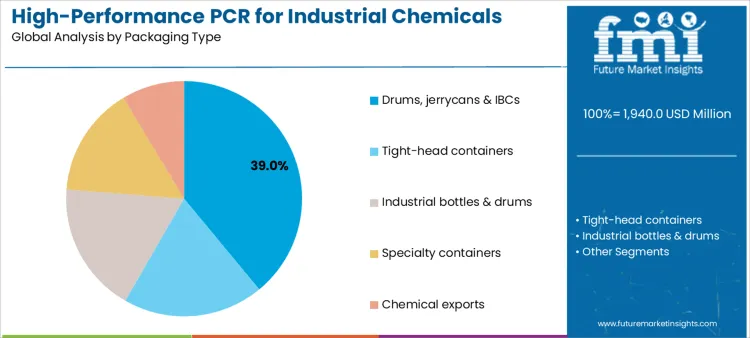
Drums, jerrycans, and intermediate bulk containers (IBCs) account for the largest share at 39.0%, reflecting their standardized designs and predictable stress profiles. These formats benefit from thicker walls and conservative safety margins, allowing easier substitution of engineered PCR without compromising regulatory compliance. Industrial bottles, tight-head containers, and specialty export packaging show selective uptake, often limited to non-hazardous or controlled-risk chemicals. Export-oriented packaging remains cautious due to cross-border compliance and liability considerations.
Key Points
- Rigid bulk formats enable faster PCR substitution
- Thick-wall designs mitigate PCR variability risks
- Export packaging faces stricter qualification barriers
What Performance Technologies Enable PCR Use in Chemical Packaging?
Performance optimization technologies dominate adoption decisions, with ESCR, permeation resistance, and impact optimization representing 51.0% of implemented solutions. These enhancements address the primary failure modes associated with recycled polymers in chemical environments. Barrier-enhanced blow moulding and high-wall-thickness moulding are used where solvent resistance and long storage durations are critical. Chemical resistance tuning through additives and multilayer structures supports niche applications requiring compatibility with aggressive formulations.
Key Points
- Stress crack and permeation control are non-negotiable
- Wall thickness compensates for recycled material variability
- Additive engineering replaces simple resin substitution
Which End-Use Segments Are Driving Demand for High-Performance PCR?
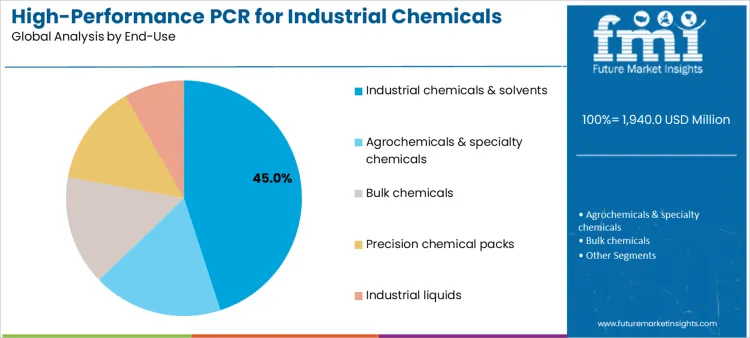
Industrial chemicals and solvents represent 45.0% of end-use demand, driven by large container volumes and increasing pressure to decarbonize supply chains. Agrochemicals and specialty chemicals follow, particularly where brand owners face sustainability disclosure requirements but can limit PCR use to secondary or tertiary packaging. Bulk chemicals and precision chemical packs adopt PCR selectively, often after extended validation cycles. Industrial liquids with lower regulatory risk profiles act as early adopters.
Key Points
- High-volume industrial chemicals lead adoption
- Specialty chemicals require longer validation timelines
- Risk tolerance varies significantly by chemical class
What are the Key Dynamics in the high performance PCR for industrial chemicals packaging market?
Demand in the high performance PCR (post consumer recycled) market for industrial chemicals packaging is shaped by stringent safety requirements and sustainability commitments in sectors such as agrochemicals, coatings, lubricants, and industrial cleaners. End users require packaging that withstands aggressive chemical formulations, maintains mechanical integrity under transport stress, and delivers consistent performance in drums, jerrycans, and intermediate bulk containers (IBCs). Brands with environmental targets seek high PCR content materials that do not compromise barrier strength or compliance with chemical compatibility standards.
How do chemical compatibility and mechanical performance expectations influence material selection?
Industrial chemical packagers prioritize high performance PCR resins that can sustain exposure to solvents, acids, and bases without softening, stress cracking, or permeability failures. In agrochemical jerrycans carrying concentrated herbicides, PCR materials must exhibit consistent impact resistance and tight seal capability to prevent leaks during storage and field use. Coatings and paint manufacturers seek PCR drums that tolerate extended fill periods without swelling or odor migration. Rheology of PCR resins is evaluated to ensure predictable extrusion and injection molding behavior that supports uniform wall thickness and robust thread engagement in closures. Resistance to environmental stress cracking and high temperature stability under fill and storage conditions are key performance criteria, especially when packaging frictional or heat sensitive chemistries.
What do supply quality and regulatory documentation requirements mean for market growth?
Market growth is influenced by the need for high quality, contaminant free PCR feedstock and by regulatory documentation obligations tied to industrial chemical contact. Sorting and preprocessing operations must isolate polymer streams with controlled properties to match performance requirements of industrial resins used in demanding applications. Variability in PCR feedstock can lead to inconsistent mechanical properties, raising rejection risk during conversion or field use. Regulatory frameworks regarding chemical compatibility testing, traceability, and safety data affect qualification timelines for new PCR grades, with some jurisdictions requiring extensive testing before adoption in regulated segments. Price pressures arise where high performance PCR grades must compete with cost efficient virgin materials, especially in markets without recycled content mandates. Consistency of supply across geographic regions influences procurement strategies for multinational manufacturers that require standardized performance and documentation across plants serving global customers.
How Is Demand for the High-Performance PCR for Industrial Chemicals Packaging Market Evolving Globally?
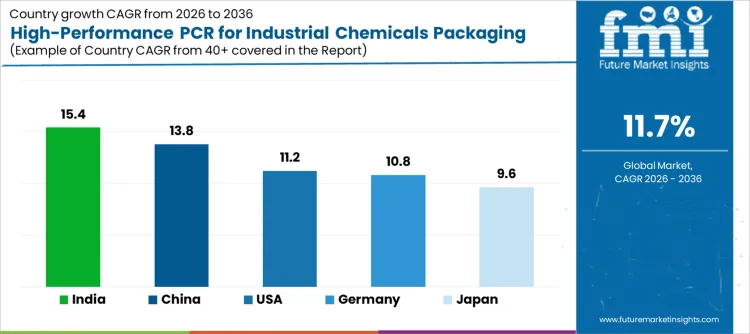
Global demand for high-performance PCR (Post-Consumer Recycled) packaging for industrial chemicals is rising as industries across sectors seek more sustainable packaging solutions to meet environmental targets. Growth reflects increasing adoption of recycled content in packaging for chemicals used in industrial, agricultural, and manufacturing processes, driven by both regulatory requirements and consumer demand for eco-friendly products. High-performance PCR materials provide the necessary durability, safety, and chemical resistance for industrial chemicals packaging. India records 15.4% CAGR, China records 13.8% CAGR, USA records 11.2% CAGR, Germany records 10.8% CAGR, and Japan records 9.6% CAGR. Adoption is driven by sustainability targets, regulatory support, and the growing availability of high-quality PCR materials.
| Country | CAGR (%) |
|---|---|
| India | 15.4% |
| China | 13.8% |
| USA | 11.2% |
| Germany | 10.8% |
| Japan | 9.6% |
What is driving growth of high-performance PCR for industrial chemicals packaging demand in India?
Demand for high-performance PCR packaging for industrial chemicals in India is expanding as industries focus on reducing plastic waste and adopting more sustainable packaging solutions. Growth at 15.4% CAGR reflects the growing use of recycled content in packaging for chemicals used in various industries such as agriculture, automotive, and construction. As government regulations and sustainability efforts increase, more manufacturers are opting for high-performance PCR materials that meet durability and safety standards for industrial chemical packaging. The demand is further supported by increasing consumer preference for products with eco-friendly packaging and rising awareness of circular economy practices.
- Government regulations pushing for plastic waste reduction
- Increased adoption of recycled content in industrial packaging
- Focus on sustainability and circular economy models
- Demand for durable and safe packaging solutions
Why is China seeing expansion in high-performance PCR for industrial chemicals packaging adoption?
High-performance PCR packaging for industrial chemicals is experiencing significant growth in China due to strong government initiatives and increasing demand for sustainable solutions. Growth at 13.8% CAGR reflects the country's adoption of recycled materials in packaging for various industrial chemicals, including those used in agriculture, manufacturing, and automotive applications. China’s focus on reducing plastic waste and improving recycling rates is pushing industries to seek alternatives to virgin plastic. As local supply chains for high-quality PCR materials strengthen, the demand for high-performance PCR packaging solutions is increasing across key sectors.
- Government-led sustainability and recycling initiatives
- Need to comply with plastic waste reduction regulations
- Rising demand for sustainable and eco-friendly packaging
- Expansion of high-quality PCR material production capacity
What factors are shaping high-performance PCR for industrial chemicals packaging sales in the USA?
Sales of high-performance PCR packaging for industrial chemicals in the USA are growing as manufacturers align with sustainability goals and regulatory frameworks that encourage recycling and reduced plastic waste. Growth at 11.2% CAGR reflects the increasing use of PCR materials for packaging chemicals, particularly in industries such as agriculture, industrial manufacturing, and automotive. The need for durable, chemically resistant, and safe packaging solutions for industrial chemicals is driving the demand for high-performance PCR materials. Additionally, the USA’s strong regulatory environment surrounding recycling and waste management plays a key role in accelerating the adoption of PCR packaging.
- Regulatory requirements for plastic waste reduction
- Rising consumer demand for eco-friendly industrial packaging
- Expansion of recycling programs and infrastructure
- Focus on packaging durability and chemical resistance
How is Germany supporting growth of high-performance PCR for industrial chemicals packaging demand?
Germany is leading in the adoption of high-performance PCR packaging for industrial chemicals, driven by strong sustainability policies and a circular economy focus. Growth at 10.8% CAGR reflects Germany's efforts to enhance its recycling infrastructure and improve the quality of recycled materials. The country’s stringent regulations on plastic waste and recycling, combined with the growing demand for eco-friendly products, are pushing industries in sectors such as agriculture, automotive, and chemicals to adopt high-performance PCR packaging. Manufacturers are increasingly looking for packaging solutions that not only meet environmental standards but also ensure the safety and quality of industrial chemicals.
- Circular economy policies and regulations
- Strong emphasis on sustainability and recycling practices
- Rising demand for recycled materials in industrial sectors
- Focus on packaging durability and compliance with standards
What is driving expansion of high-performance PCR for industrial chemicals packaging demand in Japan?
Demand for high-performance PCR packaging for industrial chemicals in Japan is increasing as the country focuses on sustainability and reducing plastic waste across industries. Growth at 9.6% CAGR reflects the use of recycled materials in packaging for industrial chemicals, especially in sectors such as manufacturing, agriculture, and chemicals. Japan’s strong waste management policies and consumer demand for eco-friendly products are driving the shift towards high-performance PCR packaging solutions. The Japanese government’s focus on recycling and reducing plastic waste is further incentivizing industries to invest in sustainable packaging materials.
- Government focus on recycling and plastic waste reduction
- Strong demand for sustainable packaging in industrial sectors
- Expansion of high-quality PCR material availability
- Adoption of eco-friendly packaging to meet consumer expectations
What is the competitive landscape of demand for the high-performance PCR for industrial chemicals packaging market globally?
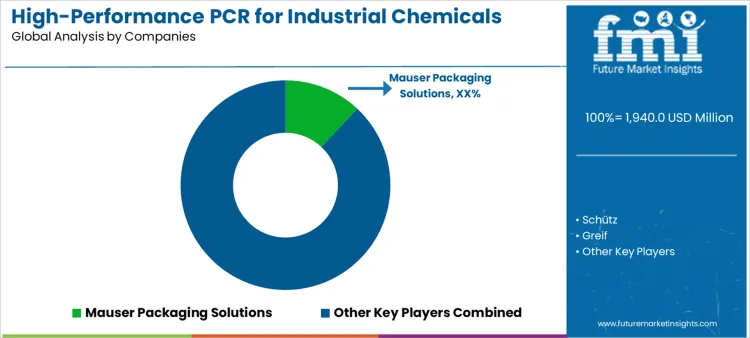
The high-performance PCR for industrial chemicals packaging market is driven by the growing need for sustainable packaging solutions in the chemicals sector, where performance and safety are paramount. Manufacturers are increasingly looking for packaging that not only meets regulatory standards but also reduces environmental impact by incorporating post-consumer recycled (PCR) materials. Companies in the market focus on barrier properties, structural integrity, and chemical compatibility, ensuring that PCR materials maintain the high standards required for hazardous or bulk chemical storage and transportation. Procurement behavior emphasizes long-term supply agreements, cost efficiency, and the ability to scale production while adhering to sustainability goals. The market trend is shifting towards using higher percentages of PCR in packaging, particularly as industry regulations for recycling and waste management become stricter.
Mauser Packaging Solutions leads competitive positioning with its extensive portfolio of industrial packaging products, offering durable, high-performance containers that integrate high levels of PCR material for bulk chemicals. Schütz competes by offering a wide range of rigid packaging solutions that maintain performance while incorporating sustainable, recycled materials. Greif supports demand with its sustainable, industrial packaging solutions tailored to the needs of chemical manufacturers, focusing on both recyclability and material strength. Berry Global provides high-performance packaging systems with a focus on innovation in integrating PCR materials into industrial chemical packaging. Time Technoplast participates with cost-effective, robust packaging solutions that incorporate PCR materials, particularly for the industrial chemicals market. Zijiang, Rengo, and Toyo Seikan cater to regional markets with tailored packaging solutions that combine high-performance features with increasing PCR content. Competitive differentiation is driven by packaging durability, chemical resistance, supply chain efficiency, and the ability to scale PCR material use without compromising safety or regulatory compliance.
Key Players in the High-Performance PCR for Industrial Chemicals Packaging Market
- Mauser Packaging Solutions
- Schütz
- Greif
- Berry Global
- Time Technoplast
- Zijiang
- Rengo
- Toyo Seikan
- Others
Scope of the Report
| Items | Values |
|---|---|
| Quantitative Units | USD million |
| Packaging Type | Drums, jerrycans & IBCs; Tight-head containers; Industrial bottles & drums; Specialty containers; Chemical exports |
| Performance Technology | ESCR, permeation & impact optimisation; Barrier-enhanced blow moulding; High-wall-thickness moulding; Chemical resistance tuning; Others |
| End-Use | Industrial chemicals & solvents; Agrochemicals & specialty chemicals; Bulk chemicals; Precision chemical packs; Industrial liquids |
| Regions Covered | Asia Pacific, Europe, North America, Latin America, Middle East & Africa |
| Countries Covered | India, China, USA, Germany, Japan, and 40+ countries |
| Key Companies Profiled | Mauser Packaging Solutions; Schütz; Greif; Berry Global; Time Technoplast; Zijiang; Rengo; Toyo Seikan; Others |
| Additional Attributes | Dollar sales by packaging type, performance technology, and end-use; performance of barrier-enhanced blow moulding and high-wall-thickness moulding in ensuring chemical resistance and durability; effectiveness in industrial chemicals, agrochemicals, and bulk chemicals packaging; impact of chemical resistance tuning on product safety and packaging integrity; procurement dynamics driven by regulatory compliance and demand for high-performance industrial packaging solutions. |
High-Performance PCR for Industrial Chemicals Packaging Market by Segment
Packaging Type:
- Drums, jerrycans & IBCs
- Tight-head containers
- Industrial bottles & drums
- Specialty containers
- Chemical exports
Performance Technology:
- ESCR, permeation & impact optimisation
- Barrier-enhanced blow moulding
- High-wall-thickness moulding
- Chemical resistance tuning
- Others
End-Use:
- Industrial chemicals & solvents
- Agrochemicals & specialty chemicals
- Bulk chemicals
- Precision chemical packs
- Industrial liquids
Region:
- Asia Pacific
- China
- Japan
- South Korea
- India
- Australia & New Zealand
- ASEAN
- Rest of Asia Pacific
- Europe
- Germany
- United Kingdom
- France
- Italy
- Spain
- Nordic
- BENELUX
- Rest of Europe
- North America
- United States
- Canada
- Mexico
- Latin America
- Brazil
- Chile
- Rest of Latin America
- Middle East & Africa
- Kingdom of Saudi Arabia
- Other GCC Countries
- Turkey
- South Africa
- Other African Union
- Rest of Middle East & Africa
Bibliography
- European Chemicals Agency. (2024). Safe use of recycled plastics in chemical packaging: Compatibility, containment integrity, and regulatory considerations. Publications Office of the European Union.
- European Commission, Joint Research Centre. (2023). Performance assessment of recycled polyolefins for rigid industrial packaging applications. Publications Office of the European Union.
- International Organization for Standardization. (2023). ISO/TR 22005: Packaging-Chemical resistance, stress cracking, and performance evaluation of recycled plastic containers. ISO.
- Organisation for Economic Co operation and Development. (2024). Recycled plastics in industrial supply chains: Safety, performance, and circular economy integration. OECD Publishing.
- Wang, T., Keller, A., & Schmidt, H. (2024). Environmental stress cracking resistance and permeation behavior of post consumer recycled polyethylene for chemical containers. Polymer Degradation and Stability, 223, 110505.
Frequently Asked Questions
How big is the high-performance pcr for industrial chemicals packaging market in 2026?
The global high-performance pcr for industrial chemicals packaging market is estimated to be valued at USD 1,940.0 million in 2026.
What will be the size of high-performance pcr for industrial chemicals packaging market in 2036?
The market size for the high-performance pcr for industrial chemicals packaging market is projected to reach USD 5,865.9 million by 2036.
How much will be the high-performance pcr for industrial chemicals packaging market growth between 2026 and 2036?
The high-performance pcr for industrial chemicals packaging market is expected to grow at a 11.7% CAGR between 2026 and 2036.
What are the key product types in the high-performance pcr for industrial chemicals packaging market?
The key product types in high-performance pcr for industrial chemicals packaging market are drums, jerrycans & ibcs, tight-head containers, industrial bottles & drums, specialty containers and chemical exports.
Which performance technology segment to contribute significant share in the high-performance pcr for industrial chemicals packaging market in 2026?
In terms of performance technology, escr, permeation & impact optimisation segment to command 51.0% share in the high-performance pcr for industrial chemicals packaging market in 2026.
Preview the report firsthand - request a free sample
Get SampleGet the brochure for pricing and purchase details.
Get PDFTable of Content
- Executive Summary
- Global Market Outlook
- Demand-side Trends
- Supply-side Trends
- Technology Roadmap Analysis
- Analysis and Recommendations
- Market Overview
- Market Coverage / Taxonomy
- Market Definition / Scope / Limitations
- Market Background
- Market Dynamics
- Drivers
- Restraints
- Opportunity
- Trends
- Scenario Forecast
- Demand in Optimistic Scenario
- Demand in Likely Scenario
- Demand in Conservative Scenario
- Opportunity Map Analysis
- Product Life Cycle Analysis
- Supply Chain Analysis
- Investment Feasibility Matrix
- Value Chain Analysis
- PESTLE and Porter’s Analysis
- Regulatory Landscape
- Regional Parent Market Outlook
- Production and Consumption Statistics
- Import and Export Statistics
- Market Dynamics
- Global Market Analysis 2021 to 2025 and Forecast, 2026 to 2036
- Historical Market Size Value (USD Million) Analysis, 2021 to 2025
- Current and Future Market Size Value (USD Million) Projections, 2026 to 2036
- Y-o-Y Growth Trend Analysis
- Absolute $ Opportunity Analysis
- Global Market Pricing Analysis 2021 to 2025 and Forecast 2026 to 2036
- Global Market Analysis 2021 to 2025 and Forecast 2026 to 2036, By Packaging Type
- Introduction / Key Findings
- Historical Market Size Value (USD Million) Analysis By Packaging Type , 2021 to 2025
- Current and Future Market Size Value (USD Million) Analysis and Forecast By Packaging Type , 2026 to 2036
- Drums, jerrycans & IBCs
- Tight-head containers
- Industrial bottles & drums
- Specialty containers
- Chemical exports
- Drums, jerrycans & IBCs
- Y-o-Y Growth Trend Analysis By Packaging Type , 2021 to 2025
- Absolute $ Opportunity Analysis By Packaging Type , 2026 to 2036
- Global Market Analysis 2021 to 2025 and Forecast 2026 to 2036, By Performance Technology
- Introduction / Key Findings
- Historical Market Size Value (USD Million) Analysis By Performance Technology, 2021 to 2025
- Current and Future Market Size Value (USD Million) Analysis and Forecast By Performance Technology, 2026 to 2036
- ESCR, permeation & impact optimisation
- Barrier-enhanced blow moulding
- High-wall-thickness moulding
- Chemical resistance tuning
- Others
- ESCR, permeation & impact optimisation
- Y-o-Y Growth Trend Analysis By Performance Technology, 2021 to 2025
- Absolute $ Opportunity Analysis By Performance Technology, 2026 to 2036
- Global Market Analysis 2021 to 2025 and Forecast 2026 to 2036, By End-Use
- Introduction / Key Findings
- Historical Market Size Value (USD Million) Analysis By End-Use, 2021 to 2025
- Current and Future Market Size Value (USD Million) Analysis and Forecast By End-Use, 2026 to 2036
- Industrial chemicals & solvents
- Agrochemicals & specialty chemicals
- Bulk chemicals
- Precision chemical packs
- Industrial liquids
- Industrial chemicals & solvents
- Y-o-Y Growth Trend Analysis By End-Use, 2021 to 2025
- Absolute $ Opportunity Analysis By End-Use, 2026 to 2036
- Global Market Analysis 2021 to 2025 and Forecast 2026 to 2036, By Region
- Introduction
- Historical Market Size Value (USD Million) Analysis By Region, 2021 to 2025
- Current Market Size Value (USD Million) Analysis and Forecast By Region, 2026 to 2036
- North America
- Latin America
- Western Europe
- Eastern Europe
- East Asia
- South Asia and Pacific
- Middle East & Africa
- Market Attractiveness Analysis By Region
- North America Market Analysis 2021 to 2025 and Forecast 2026 to 2036, By Country
- Historical Market Size Value (USD Million) Trend Analysis By Market Taxonomy, 2021 to 2025
- Market Size Value (USD Million) Forecast By Market Taxonomy, 2026 to 2036
- By Country
- USA
- Canada
- Mexico
- By Packaging Type
- By Performance Technology
- By End-Use
- By Country
- Market Attractiveness Analysis
- By Country
- By Packaging Type
- By Performance Technology
- By End-Use
- Key Takeaways
- Latin America Market Analysis 2021 to 2025 and Forecast 2026 to 2036, By Country
- Historical Market Size Value (USD Million) Trend Analysis By Market Taxonomy, 2021 to 2025
- Market Size Value (USD Million) Forecast By Market Taxonomy, 2026 to 2036
- By Country
- Brazil
- Chile
- Rest of Latin America
- By Packaging Type
- By Performance Technology
- By End-Use
- By Country
- Market Attractiveness Analysis
- By Country
- By Packaging Type
- By Performance Technology
- By End-Use
- Key Takeaways
- Western Europe Market Analysis 2021 to 2025 and Forecast 2026 to 2036, By Country
- Historical Market Size Value (USD Million) Trend Analysis By Market Taxonomy, 2021 to 2025
- Market Size Value (USD Million) Forecast By Market Taxonomy, 2026 to 2036
- By Country
- Germany
- UK
- Italy
- Spain
- France
- Nordic
- BENELUX
- Rest of Western Europe
- By Packaging Type
- By Performance Technology
- By End-Use
- By Country
- Market Attractiveness Analysis
- By Country
- By Packaging Type
- By Performance Technology
- By End-Use
- Key Takeaways
- Eastern Europe Market Analysis 2021 to 2025 and Forecast 2026 to 2036, By Country
- Historical Market Size Value (USD Million) Trend Analysis By Market Taxonomy, 2021 to 2025
- Market Size Value (USD Million) Forecast By Market Taxonomy, 2026 to 2036
- By Country
- Russia
- Poland
- Hungary
- Balkan & Baltic
- Rest of Eastern Europe
- By Packaging Type
- By Performance Technology
- By End-Use
- By Country
- Market Attractiveness Analysis
- By Country
- By Packaging Type
- By Performance Technology
- By End-Use
- Key Takeaways
- East Asia Market Analysis 2021 to 2025 and Forecast 2026 to 2036, By Country
- Historical Market Size Value (USD Million) Trend Analysis By Market Taxonomy, 2021 to 2025
- Market Size Value (USD Million) Forecast By Market Taxonomy, 2026 to 2036
- By Country
- China
- Japan
- South Korea
- By Packaging Type
- By Performance Technology
- By End-Use
- By Country
- Market Attractiveness Analysis
- By Country
- By Packaging Type
- By Performance Technology
- By End-Use
- Key Takeaways
- South Asia and Pacific Market Analysis 2021 to 2025 and Forecast 2026 to 2036, By Country
- Historical Market Size Value (USD Million) Trend Analysis By Market Taxonomy, 2021 to 2025
- Market Size Value (USD Million) Forecast By Market Taxonomy, 2026 to 2036
- By Country
- India
- ASEAN
- Australia & New Zealand
- Rest of South Asia and Pacific
- By Packaging Type
- By Performance Technology
- By End-Use
- By Country
- Market Attractiveness Analysis
- By Country
- By Packaging Type
- By Performance Technology
- By End-Use
- Key Takeaways
- Middle East & Africa Market Analysis 2021 to 2025 and Forecast 2026 to 2036, By Country
- Historical Market Size Value (USD Million) Trend Analysis By Market Taxonomy, 2021 to 2025
- Market Size Value (USD Million) Forecast By Market Taxonomy, 2026 to 2036
- By Country
- Kingdom of Saudi Arabia
- Other GCC Countries
- Turkiye
- South Africa
- Other African Union
- Rest of Middle East & Africa
- By Packaging Type
- By Performance Technology
- By End-Use
- By Country
- Market Attractiveness Analysis
- By Country
- By Packaging Type
- By Performance Technology
- By End-Use
- Key Takeaways
- Key Countries Market Analysis
- USA
- Pricing Analysis
- Market Share Analysis, 2025
- By Packaging Type
- By Performance Technology
- By End-Use
- Canada
- Pricing Analysis
- Market Share Analysis, 2025
- By Packaging Type
- By Performance Technology
- By End-Use
- Mexico
- Pricing Analysis
- Market Share Analysis, 2025
- By Packaging Type
- By Performance Technology
- By End-Use
- Brazil
- Pricing Analysis
- Market Share Analysis, 2025
- By Packaging Type
- By Performance Technology
- By End-Use
- Chile
- Pricing Analysis
- Market Share Analysis, 2025
- By Packaging Type
- By Performance Technology
- By End-Use
- Germany
- Pricing Analysis
- Market Share Analysis, 2025
- By Packaging Type
- By Performance Technology
- By End-Use
- UK
- Pricing Analysis
- Market Share Analysis, 2025
- By Packaging Type
- By Performance Technology
- By End-Use
- Italy
- Pricing Analysis
- Market Share Analysis, 2025
- By Packaging Type
- By Performance Technology
- By End-Use
- Spain
- Pricing Analysis
- Market Share Analysis, 2025
- By Packaging Type
- By Performance Technology
- By End-Use
- France
- Pricing Analysis
- Market Share Analysis, 2025
- By Packaging Type
- By Performance Technology
- By End-Use
- India
- Pricing Analysis
- Market Share Analysis, 2025
- By Packaging Type
- By Performance Technology
- By End-Use
- ASEAN
- Pricing Analysis
- Market Share Analysis, 2025
- By Packaging Type
- By Performance Technology
- By End-Use
- Australia & New Zealand
- Pricing Analysis
- Market Share Analysis, 2025
- By Packaging Type
- By Performance Technology
- By End-Use
- China
- Pricing Analysis
- Market Share Analysis, 2025
- By Packaging Type
- By Performance Technology
- By End-Use
- Japan
- Pricing Analysis
- Market Share Analysis, 2025
- By Packaging Type
- By Performance Technology
- By End-Use
- South Korea
- Pricing Analysis
- Market Share Analysis, 2025
- By Packaging Type
- By Performance Technology
- By End-Use
- Russia
- Pricing Analysis
- Market Share Analysis, 2025
- By Packaging Type
- By Performance Technology
- By End-Use
- Poland
- Pricing Analysis
- Market Share Analysis, 2025
- By Packaging Type
- By Performance Technology
- By End-Use
- Hungary
- Pricing Analysis
- Market Share Analysis, 2025
- By Packaging Type
- By Performance Technology
- By End-Use
- Kingdom of Saudi Arabia
- Pricing Analysis
- Market Share Analysis, 2025
- By Packaging Type
- By Performance Technology
- By End-Use
- Turkiye
- Pricing Analysis
- Market Share Analysis, 2025
- By Packaging Type
- By Performance Technology
- By End-Use
- South Africa
- Pricing Analysis
- Market Share Analysis, 2025
- By Packaging Type
- By Performance Technology
- By End-Use
- USA
- Market Structure Analysis
- Competition Dashboard
- Competition Benchmarking
- Market Share Analysis of Top Players
- By Regional
- By Packaging Type
- By Performance Technology
- By End-Use
- Competition Analysis
- Competition Deep Dive
- Mauser Packaging Solutions
- Overview
- Product Portfolio
- Profitability by Market Segments (Product/Age /Sales Channel/Region)
- Sales Footprint
- Strategy Overview
- Marketing Strategy
- Product Strategy
- Channel Strategy
- Schütz
- Greif
- Berry Global
- Time Technoplast
- Zijiang
- Rengo
- Toyo Seikan
- Others
- Mauser Packaging Solutions
- Competition Deep Dive
- Assumptions & Acronyms Used
- Research Methodology


