

- Industry Size (2026)
- USD 417.1 Mn
- Forecast (2036)
- USD 836 Mn
- CAGR (2026 to 2036)
- 7.20%
Vehicle Cabin Air Quality & Filtration Test Systems Market Forecast and Outlook 2026 to 2036
The global vehicle cabin air quality & filtration test systems market, projected to grow from USD 417.1 million in 2026 to USD 836 million by 2036, is experiencing a steady CAGR of 7.20%. This growth is fueled by rising health consciousness among consumers, increasing vehicle electrification, and stricter regulatory standards for air quality. As electric vehicles (EVs) become more prevalent, ensuring cleaner and healthier air within cabins is gaining prominence, driving the demand for advanced filtration and testing systems. The rising focus on passenger comfort, especially in urban areas with poor air quality, is pushing automotive manufacturers to invest in state-of-the-art air quality testing systems.
Quick Stats for Vehicle Cabin Air Quality & Filtration Test Systems Market
- Vehicle Cabin Air Quality & Filtration Test Systems Market Value (2026): USD 417.1 Million
- Vehicle Cabin Air Quality & Filtration Test Systems Market Forecast Value (2036): USD 836 Million
- Vehicle Cabin Air Quality & Filtration Test Systems Market Forecast CAGR (2026–2036): 7.20%
- Leading Vehicle Segment in Vehicle Cabin Air Quality & Filtration Test Systems Market: Passenger Cars
- Key Growth Regions in Vehicle Cabin Air Quality & Filtration Test Systems Market: Asia Pacific, North America, Europe
- Top Key Players in Vehicle Cabin Air Quality & Filtration Test Systems Market: TSI Incorporated, HORIBA, AVL, Testo, Palas, Honeywell, Parker Hannifin, UL Solutions, Intertek, Siemens
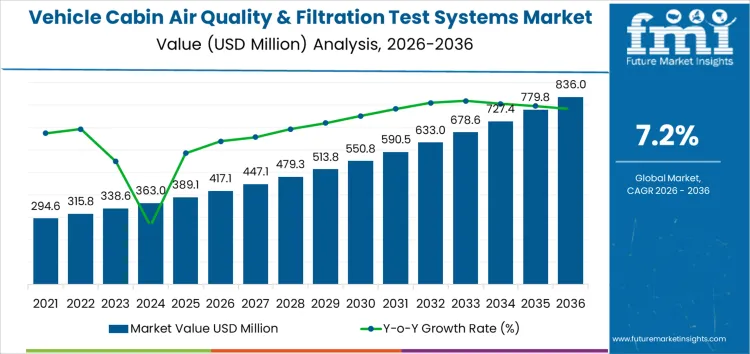
The market is witnessing increased competition, as OEMs, HVAC and filter suppliers, and testing labs adopt sophisticated measurement technologies such as particle counters and gas analyzers to assess and improve air quality. In addition, innovations in testing platforms that simulate real-world conditions and allow for real-time data analysis are gaining traction. As stricter regulations on in-vehicle air quality and increasing consumer demand for safer, more comfortable cabin environments continue to influence the market, growth is expected across key regions, particularly China, Brazil, and the USA. Market participants are also focusing on modular, scalable solutions to meet the growing demand for vehicle-specific cabin air quality systems.
Vehicle Cabin Air Quality & Filtration Test Systems Market Key Takeaways
| Metric | Value |
|---|---|
| Industry Value (2026) | USD 417.1 Million |
| Forecast Value (2036) | USD 836 Million |
| Forecast CAGR (2026–2036) | 7.20% |
How is the Global Vehicle Cabin Air Quality & Filtration Test Systems Market Advancing?
The global vehicle cabin air quality and filtration test systems market is experiencing growth due to rising concerns about air quality, both inside and outside vehicles, and increasing regulatory standards for cabin air filtration. These test systems are designed to measure and analyze the effectiveness of cabin air filtration systems in removing pollutants, allergens, and other harmful particles from the air inside vehicles. With growing awareness of health and safety, especially in the context of vehicle interiors, automakers are investing in advanced filtration systems to provide cleaner, safer air for passengers.
Growth is driven by the increasing demand for electric vehicles (EVs) and the growing focus on reducing the environmental impact of automotive operations. As EVs typically lack the exhaust emissions found in traditional internal combustion engine (ICE) vehicles, the cabin air quality is becoming an even more critical focus. This has led to a stronger emphasis on improving air quality through advanced filtration systems. Regulatory bodies across various regions are tightening the requirements for air quality within vehicles, pushing automakers to integrate better filtration and air purification technologies. The ongoing advancements in filtration technology and testing solutions will continue to drive demand for these systems in the years ahead.
What is the Segment-Wise Analysis for the Vehicle Cabin Air Quality & Filtration Test Systems Market?
The vehicle cabin air quality & filtration test systems market is segmented by vehicle segment and measurement technology. Passenger cars lead the market with a 46% share, followed by premium or luxury vehicles, commercial vehicles, and other vehicle types. These vehicle segments are crucial for ensuring the quality of cabin air through effective filtration and monitoring systems. In terms of measurement technology, particle counters or photometers dominate with a 56% share, followed by gas analyzers, aerosol generators & tracers, and multi-sensor suites.
Why Do Passenger Cars Lead the Vehicle Cabin Air Quality & Filtration Test Systems Market?
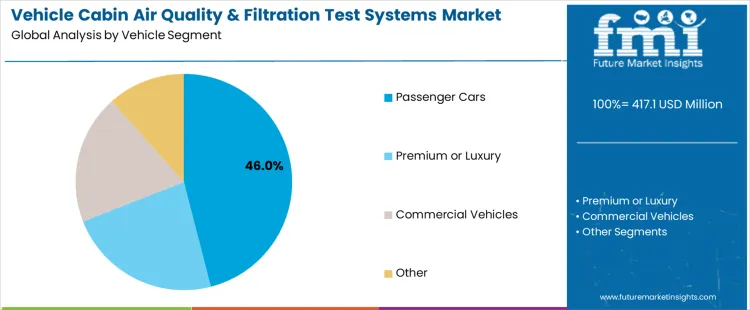
Passenger cars account for 46% of the vehicle cabin air quality & filtration test systems market share, reflecting their widespread adoption of advanced cabin air filtration and quality systems. As consumers demand higher comfort and better air quality in their vehicles, particularly in urban areas with high pollution, passenger cars require robust testing solutions to ensure optimal air quality. These systems are tested for their ability to filter pollutants, allergens, and harmful gases effectively. As the focus on environmental sustainability and health-conscious driving experiences increases, the demand for air quality and filtration test systems in passenger vehicles continues to rise, securing their dominance in the market.
How Do Particle Counters or Photometers Contribute to the Vehicle Cabin Air Quality & Filtration Test Systems Market?
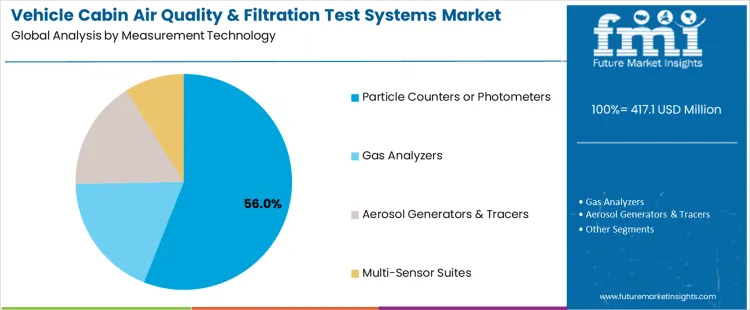
Particle counters or photometers lead the measurement technology segment with a 56% share, as they are essential for accurately measuring the number and size of particles present in the cabin air. These devices help ensure that the cabin air quality meets the required standards by detecting particulate matter that can affect health and comfort. Particle counters and photometers are used extensively in automotive testing to validate the efficiency of air filtration systems in removing dust, soot, and other fine particles from the cabin environment. With growing consumer concerns about air quality and health, these technologies continue to be critical in the development of effective vehicle cabin air systems.
What Are the Key Dynamics for the Vehicle Cabin Air Quality & Filtration Test Systems Market?
The vehicle cabin air quality and filtration test systems market is driven by increasing awareness of in‑vehicle air pollution and its impact on occupant health, especially in urban environments. Automakers are focusing on ensuring cleaner cabin environments by validating filtration efficiency against particulate matter, allergens, odors, and other pollutants. Tests assess HVAC performance, filter media effectiveness, and air quality sensors under varied environmental conditions. Stricter emissions and air quality regulations, plus consumer demand for healthier cabins, shape market growth.
How Are the Key Drivers Shaping the Vehicle Cabin Air Quality & Filtration Test Systems Market?
Key drivers include rising consumer demand for healthier vehicle cabins and stringent regulations on air quality and particulate emissions. Urban pollution, allergens, and harmful gases prompt automakers to adopt advanced cabin filtration systems. Test platforms are used to validate performance under real‑world conditions and ensure compliance with regulatory standards. Technological improvements in air quality sensors, filter materials, and HVAC integration push automakers to invest in sophisticated test systems, making them essential for product development and quality assurance.
What Are the Key Trends Shaping the Vehicle Cabin Air Quality & Filtration Test Systems Market?
Emerging trends include the integration of real‑time air quality sensors and automated test routines to capture dynamic pollutant behavior. There’s a shift toward smart and connected test systems that link HVAC performance with in‑vehicle telematics and user feedback data. Advanced analytics and AI are being used to interpret complex air quality patterns and predict filter performance over time. Modular test platforms that allow customizable configurations for different vehicle types and filtration technologies are gaining popularity, supporting faster product iterations and improved passenger comfort.
What is the Growth Outlook on the Vehicle Cabin Air Quality & Filtration Test Systems Market by Country?
| Country | CAGR (%) |
|---|---|
| China | 8.4% |
| Brazil | 7.9% |
| USA | 7% |
| South Korea | 6.8% |
| Germany | 6.8% |
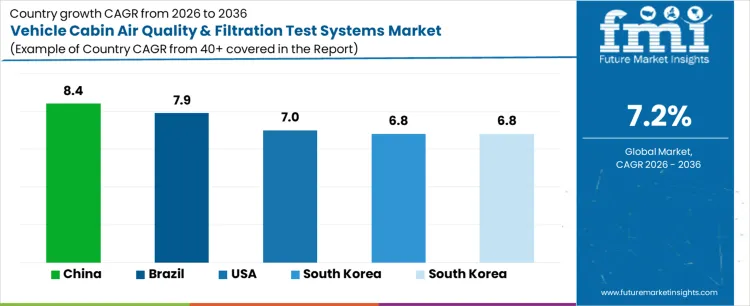
The vehicle cabin air quality & filtration test systems market is growing steadily, with China leading at an 8.4% CAGR, driven by rapid advancements in the electric vehicle (EV) market and rising concerns over air quality and environmental sustainability. Brazil follows with 7.9%, fueled by increasing adoption of EVs and growing consumer demand for healthier, cleaner cabin environments. The USA’s market grows at 7%, supported by innovations in electric and connected vehicles, as well as government regulations for vehicle emissions. South Korea and Germany both grow at 6.8%, driven by their automotive industries' focus on consumer comfort, alongside increasing demand for high-quality air filtration systems.
What is Driving the Growth of the Vehicle Cabin Air Quality & Filtration Test Systems Market in China?
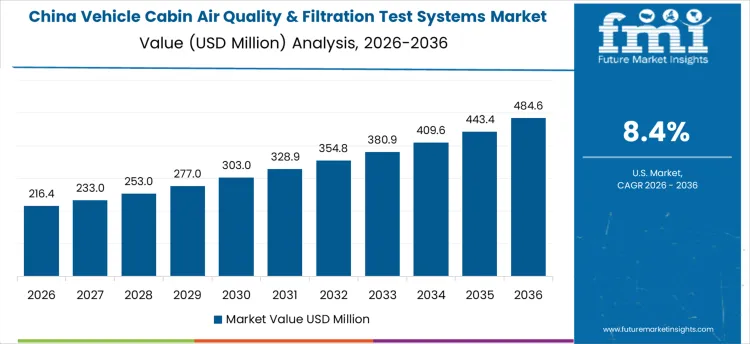
China’s vehicle cabin air quality & filtration test systems market is growing at 8.4%, driven by the country’s booming automotive industry, increasing demand for electric vehicles (EVs), and the growing concern over air quality and environmental sustainability. As China’s government continues to emphasize green transportation and environmental regulations, the need for high-quality cabin air filtration systems and testing solutions becomes critical. The rapid adoption of electric and hybrid vehicles, coupled with rising consumer expectations for cleaner, healthier in-vehicle air, further fuels the demand for advanced filtration test systems. With ongoing advancements in automotive technology and smart cabin systems, China is set to remain a key market for vehicle cabin air quality solutions.
What is Contributing to the Growth of the Vehicle Cabin Air Quality & Filtration Test Systems Market in Brazil?
Brazil’s vehicle cabin air quality & filtration test systems market is growing at 7.9%, supported by the increasing focus on air quality and consumer health within the automotive sector. As Brazil modernizes its automotive industry and sees a rise in electric vehicle adoption, the demand for advanced air filtration systems and their associated testing solutions grows. Government initiatives to reduce pollution and improve environmental standards also contribute to the market’s growth. With rising awareness of air quality in both urban and rural areas, along with the growing consumer preference for healthier, cleaner cabin environments, Brazil is poised for continued demand for vehicle cabin air quality and filtration testing systems.
How is the Vehicle Cabin Air Quality & Filtration Test Systems Market Expanding in the USA?
The USA’s vehicle cabin air quality & filtration test systems market is growing at 7%, driven by the increasing importance of air quality, particularly in electric vehicles (EVs) and smart cabins. As the automotive industry embraces electric and connected vehicles, the need for high-performance air filtration systems to ensure clean and healthy cabin environments rises. Consumer demand for enhanced comfort, including improved cabin air quality, is also contributing to the market’s growth. The growing emphasis on environmental sustainability and government regulations for automotive emissions and interior air standards further accelerates the adoption of advanced filtration technologies. The USA remains a key market for innovation in air quality testing solutions.
Why is the Vehicle Cabin Air Quality & Filtration Test Systems Market Growing in South Korea?
South Korea’s vehicle cabin air quality & filtration test systems market is growing at 6.8%, supported by the country’s leadership in automotive manufacturing, particularly with the rise of electric vehicles. As South Korea’s automotive industry focuses on smart mobility and green technologies, consumers are increasingly demanding cleaner, healthier cabin environments. The country’s emphasis on ecological urban mobility solutions, including eco-friendly electric vehicles, further drives the need for advanced cabin air filtration and testing systems. As automakers continue to innovate in vehicle comfort and air quality, the market for vehicle cabin air quality solutions in South Korea is expected to continue expanding.
What is Driving the Growth of the Vehicle Cabin Air Quality & Filtration Test Systems Market in Germany?
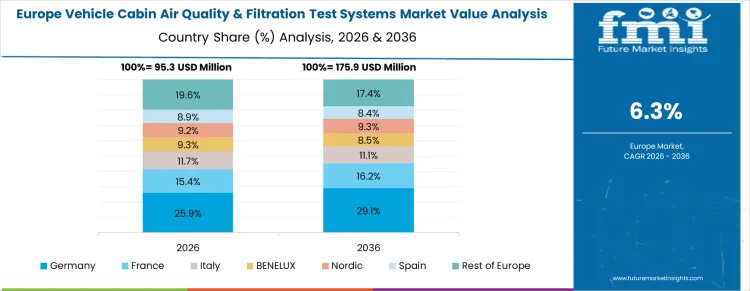
Germany’s vehicle cabin air quality & filtration test systems market is growing at 6.8%, supported by the country’s strong automotive industry, particularly with its shift towards electric mobility and connected vehicles. As German automakers increasingly focus on sustainability and consumer comfort, the demand for advanced cabin air quality testing solutions rises. With increasing concerns over indoor air pollution and growing health consciousness among consumers, high-quality air filtration systems in vehicles are becoming a necessity. Germany’s regulatory push for cleaner automotive technologies and the integration of advanced cabin systems in electric vehicles further accelerate the adoption of air filtration test systems. Germany remains a significant market for innovation in vehicle cabin air quality solutions.
How Are Companies Competing in the Vehicle Cabin Air Quality & Filtration Test Systems Market?
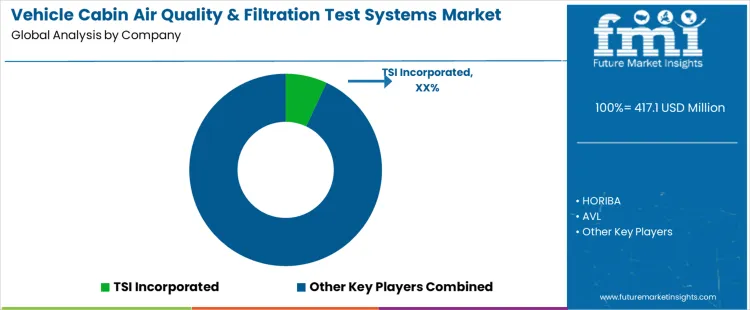
Competition in the vehicle cabin air quality and filtration test systems market is driven by measurement accuracy, multi‑pollutant detection, real‑time analysis, and integration with HVAC and environmental simulation. TSI Incorporated leads with high‑precision aerosol and particle measurement systems that quantify pollutants such as PM2.5, PM10, and ultrafine particulates. Its product materials emphasize fast response and traceability, enabling engineers to evaluate filter efficiency under varied conditions. HORIBA competes with versatile gas and particle analyzers designed for automotive environments, highlighting broad dynamic range and robust data logging in brochures.
AVL brings integrated test rigs that combine air quality measurement with HVAC performance, marketed as solutions that simulate real driving and environmental cycles. Testo and Palas focus on portable and laboratory‑based instruments that offer detailed insight into airborne contaminants, with collateral stressing user‑friendly interfaces and comprehensive pollutant profiles. Honeywell and Parker Hannifin differentiate through filtration system validation equipment that pairs flow dynamics testing with contaminant capture assessment, helping OEMs optimize filter media and cabin circulation strategies.
Certification bodies such as UL Solutions and Intertek add value with independent testing services and compliance verification, aligning test outcomes with global air quality and safety standards. Siemens rounds out the field with software‑enhanced test platforms that support synchronized data capture and analysis, enabling deeper insight into HVAC performance and filter longevity. Across vendors, product literature is crafted to showcase accuracy, repeatability, and actionable insights that help manufacturers improve cabin comfort and occupant health.
Key Players in Vehicle Cabin Air Quality & Filtration Test Systems Market
- TSI Incorporated
- HORIBA
- AVL
- Testo
- Palas
- Honeywell
- Parker Hannifin
- UL Solutions
- Intertek
- Siemens
Scope of Report
| Items | Values |
|---|---|
| Quantitative Unit (2026) | USD million |
| Customer Type | OEMs, HVAC & Filter Suppliers, Test Labs, Research or Academia |
| Vehicle Segment | Passenger Cars, Premium or Luxury, Commercial Vehicles, Other |
| Measurement Technology | Particle Counters or Photometers, Gas Analyzers, Aerosol Generators & Tracers, Multi-Sensor Suites |
| Regions Covered | Asia Pacific, Europe, North America, Latin America, Middle East & Africa |
| Countries Covered | USA, China, Japan, South Korea, India, Australia & New Zealand, ASEAN, Germany, UK, France, Italy, Spain, Nordic, BENELUX, Brazil, Chile, Mexico, Saudi Arabia, Other GCC Countries, Turkey, South Africa, Other African Union |
| Key Companies Profiled | TSI Incorporated, HORIBA, AVL, Testo, Palas, Honeywell, Parker Hannifin, UL Solutions, Intertek, Siemens |
| Additional Attributes | Dollar sales segmented by customer type, vehicle segment, and measurement technology, with regional CAGR and growth outlook. This report offers a detailed market forecast, providing insights into segment-specific trends and growth projections across key regions. |
Vehicle Cabin Air Quality & Filtration Test Systems Market by Segments
Customer Type:
- OEMs
- HVAC & Filter Suppliers
- Test Labs
- Research or Academia
Vehicle Segment:
- Passenger Cars
- Premium or Luxury
- Commercial Vehicles
- Other
Measurement Technology:
- Particle Counters or Photometers
- Gas Analyzers
- Aerosol Generators & Tracers
- Multi-Sensor Suites
Region:
- Asia Pacific
- China
- Japan
- South Korea
- India
- Australia & New Zealand
- ASEAN
- Rest of Asia Pacific
- Europe
- Germany
- United Kingdom
- France
- Italy
- Spain
- Nordic
- BENELUX
- Rest of Europe
- North America
- United States
- Canada
- Mexico
- Latin America
- Brazil
- Chile
- Rest of Latin America
- Middle East & Africa
- Kingdom of Saudi Arabia
- Other GCC Countries
- Turkey
- South Africa
- Other African Union
- Rest of Middle East & Africa
Frequently Asked Questions
How big is the vehicle cabin air quality & filtration test systems market in 2026?
The global vehicle cabin air quality & filtration test systems market is estimated to be valued at USD 417.1 million in 2026.
What will be the size of vehicle cabin air quality & filtration test systems market in 2036?
The market size for the vehicle cabin air quality & filtration test systems market is projected to reach USD 836.0 million by 2036.
How much will be the vehicle cabin air quality & filtration test systems market growth between 2026 and 2036?
The vehicle cabin air quality & filtration test systems market is expected to grow at a 7.2% CAGR between 2026 and 2036.
What are the key product types in the vehicle cabin air quality & filtration test systems market?
The key product types in vehicle cabin air quality & filtration test systems market are oems, hvac & filter suppliers, test labs and research or academia.
Which vehicle segment segment to contribute significant share in the vehicle cabin air quality & filtration test systems market in 2026?
In terms of vehicle segment, passenger cars segment to command 46.0% share in the vehicle cabin air quality & filtration test systems market in 2026.
Preview the report firsthand - request a free sample
Get SampleGet the brochure for pricing and purchase details.
Get PDFTable of Content
- Executive Summary
- Global Market Outlook
- Demand-side Trends
- Supply-side Trends
- Technology Roadmap Analysis
- Analysis and Recommendations
- Market Overview
- Market Coverage / Taxonomy
- Market Definition / Scope / Limitations
- Market Background
- Market Dynamics
- Drivers
- Restraints
- Opportunity
- Trends
- Scenario Forecast
- Demand in Optimistic Scenario
- Demand in Likely Scenario
- Demand in Conservative Scenario
- Opportunity Map Analysis
- Product Life Cycle Analysis
- Supply Chain Analysis
- Investment Feasibility Matrix
- Value Chain Analysis
- PESTLE and Porter’s Analysis
- Regulatory Landscape
- Regional Parent Market Outlook
- Production and Consumption Statistics
- Import and Export Statistics
- Market Dynamics
- Global Market Analysis 2021 to 2025 and Forecast, 2026 to 2036
- Historical Market Size Value (USD Million) Analysis, 2021 to 2025
- Current and Future Market Size Value (USD Million) Projections, 2026 to 2036
- Y-o-Y Growth Trend Analysis
- Absolute $ Opportunity Analysis
- Global Market Pricing Analysis 2021 to 2025 and Forecast 2026 to 2036
- Global Market Analysis 2021 to 2025 and Forecast 2026 to 2036, By Customer Type
- Introduction / Key Findings
- Historical Market Size Value (USD Million) Analysis By Customer Type , 2021 to 2025
- Current and Future Market Size Value (USD Million) Analysis and Forecast By Customer Type , 2026 to 2036
- OEMs
- HVAC & Filter Suppliers
- Test Labs
- Research or Academia
- OEMs
- Y-o-Y Growth Trend Analysis By Customer Type , 2021 to 2025
- Absolute $ Opportunity Analysis By Customer Type , 2026 to 2036
- Global Market Analysis 2021 to 2025 and Forecast 2026 to 2036, By Vehicle Segment
- Introduction / Key Findings
- Historical Market Size Value (USD Million) Analysis By Vehicle Segment, 2021 to 2025
- Current and Future Market Size Value (USD Million) Analysis and Forecast By Vehicle Segment, 2026 to 2036
- Passenger Cars
- Premium or Luxury
- Commercial Vehicles
- Other
- Passenger Cars
- Y-o-Y Growth Trend Analysis By Vehicle Segment, 2021 to 2025
- Absolute $ Opportunity Analysis By Vehicle Segment, 2026 to 2036
- Global Market Analysis 2021 to 2025 and Forecast 2026 to 2036, By Measurement Technology
- Introduction / Key Findings
- Historical Market Size Value (USD Million) Analysis By Measurement Technology, 2021 to 2025
- Current and Future Market Size Value (USD Million) Analysis and Forecast By Measurement Technology, 2026 to 2036
- Particle Counters or Photometers
- Gas Analyzers
- Aerosol Generators & Tracers
- Multi-Sensor Suites
- Particle Counters or Photometers
- Y-o-Y Growth Trend Analysis By Measurement Technology, 2021 to 2025
- Absolute $ Opportunity Analysis By Measurement Technology, 2026 to 2036
- Global Market Analysis 2021 to 2025 and Forecast 2026 to 2036, By Region
- Introduction
- Historical Market Size Value (USD Million) Analysis By Region, 2021 to 2025
- Current Market Size Value (USD Million) Analysis and Forecast By Region, 2026 to 2036
- North America
- Latin America
- Western Europe
- Eastern Europe
- East Asia
- South Asia and Pacific
- Middle East & Africa
- Market Attractiveness Analysis By Region
- North America Market Analysis 2021 to 2025 and Forecast 2026 to 2036, By Country
- Historical Market Size Value (USD Million) Trend Analysis By Market Taxonomy, 2021 to 2025
- Market Size Value (USD Million) Forecast By Market Taxonomy, 2026 to 2036
- By Country
- USA
- Canada
- Mexico
- By Customer Type
- By Vehicle Segment
- By Measurement Technology
- By Country
- Market Attractiveness Analysis
- By Country
- By Customer Type
- By Vehicle Segment
- By Measurement Technology
- Key Takeaways
- Latin America Market Analysis 2021 to 2025 and Forecast 2026 to 2036, By Country
- Historical Market Size Value (USD Million) Trend Analysis By Market Taxonomy, 2021 to 2025
- Market Size Value (USD Million) Forecast By Market Taxonomy, 2026 to 2036
- By Country
- Brazil
- Chile
- Rest of Latin America
- By Customer Type
- By Vehicle Segment
- By Measurement Technology
- By Country
- Market Attractiveness Analysis
- By Country
- By Customer Type
- By Vehicle Segment
- By Measurement Technology
- Key Takeaways
- Western Europe Market Analysis 2021 to 2025 and Forecast 2026 to 2036, By Country
- Historical Market Size Value (USD Million) Trend Analysis By Market Taxonomy, 2021 to 2025
- Market Size Value (USD Million) Forecast By Market Taxonomy, 2026 to 2036
- By Country
- Germany
- UK
- Italy
- Spain
- France
- Nordic
- BENELUX
- Rest of Western Europe
- By Customer Type
- By Vehicle Segment
- By Measurement Technology
- By Country
- Market Attractiveness Analysis
- By Country
- By Customer Type
- By Vehicle Segment
- By Measurement Technology
- Key Takeaways
- Eastern Europe Market Analysis 2021 to 2025 and Forecast 2026 to 2036, By Country
- Historical Market Size Value (USD Million) Trend Analysis By Market Taxonomy, 2021 to 2025
- Market Size Value (USD Million) Forecast By Market Taxonomy, 2026 to 2036
- By Country
- Russia
- Poland
- Hungary
- Balkan & Baltic
- Rest of Eastern Europe
- By Customer Type
- By Vehicle Segment
- By Measurement Technology
- By Country
- Market Attractiveness Analysis
- By Country
- By Customer Type
- By Vehicle Segment
- By Measurement Technology
- Key Takeaways
- East Asia Market Analysis 2021 to 2025 and Forecast 2026 to 2036, By Country
- Historical Market Size Value (USD Million) Trend Analysis By Market Taxonomy, 2021 to 2025
- Market Size Value (USD Million) Forecast By Market Taxonomy, 2026 to 2036
- By Country
- China
- Japan
- South Korea
- By Customer Type
- By Vehicle Segment
- By Measurement Technology
- By Country
- Market Attractiveness Analysis
- By Country
- By Customer Type
- By Vehicle Segment
- By Measurement Technology
- Key Takeaways
- South Asia and Pacific Market Analysis 2021 to 2025 and Forecast 2026 to 2036, By Country
- Historical Market Size Value (USD Million) Trend Analysis By Market Taxonomy, 2021 to 2025
- Market Size Value (USD Million) Forecast By Market Taxonomy, 2026 to 2036
- By Country
- India
- ASEAN
- Australia & New Zealand
- Rest of South Asia and Pacific
- By Customer Type
- By Vehicle Segment
- By Measurement Technology
- By Country
- Market Attractiveness Analysis
- By Country
- By Customer Type
- By Vehicle Segment
- By Measurement Technology
- Key Takeaways
- Middle East & Africa Market Analysis 2021 to 2025 and Forecast 2026 to 2036, By Country
- Historical Market Size Value (USD Million) Trend Analysis By Market Taxonomy, 2021 to 2025
- Market Size Value (USD Million) Forecast By Market Taxonomy, 2026 to 2036
- By Country
- Kingdom of Saudi Arabia
- Other GCC Countries
- Turkiye
- South Africa
- Other African Union
- Rest of Middle East & Africa
- By Customer Type
- By Vehicle Segment
- By Measurement Technology
- By Country
- Market Attractiveness Analysis
- By Country
- By Customer Type
- By Vehicle Segment
- By Measurement Technology
- Key Takeaways
- Key Countries Market Analysis
- USA
- Pricing Analysis
- Market Share Analysis, 2025
- By Customer Type
- By Vehicle Segment
- By Measurement Technology
- Canada
- Pricing Analysis
- Market Share Analysis, 2025
- By Customer Type
- By Vehicle Segment
- By Measurement Technology
- Mexico
- Pricing Analysis
- Market Share Analysis, 2025
- By Customer Type
- By Vehicle Segment
- By Measurement Technology
- Brazil
- Pricing Analysis
- Market Share Analysis, 2025
- By Customer Type
- By Vehicle Segment
- By Measurement Technology
- Chile
- Pricing Analysis
- Market Share Analysis, 2025
- By Customer Type
- By Vehicle Segment
- By Measurement Technology
- Germany
- Pricing Analysis
- Market Share Analysis, 2025
- By Customer Type
- By Vehicle Segment
- By Measurement Technology
- UK
- Pricing Analysis
- Market Share Analysis, 2025
- By Customer Type
- By Vehicle Segment
- By Measurement Technology
- Italy
- Pricing Analysis
- Market Share Analysis, 2025
- By Customer Type
- By Vehicle Segment
- By Measurement Technology
- Spain
- Pricing Analysis
- Market Share Analysis, 2025
- By Customer Type
- By Vehicle Segment
- By Measurement Technology
- France
- Pricing Analysis
- Market Share Analysis, 2025
- By Customer Type
- By Vehicle Segment
- By Measurement Technology
- India
- Pricing Analysis
- Market Share Analysis, 2025
- By Customer Type
- By Vehicle Segment
- By Measurement Technology
- ASEAN
- Pricing Analysis
- Market Share Analysis, 2025
- By Customer Type
- By Vehicle Segment
- By Measurement Technology
- Australia & New Zealand
- Pricing Analysis
- Market Share Analysis, 2025
- By Customer Type
- By Vehicle Segment
- By Measurement Technology
- China
- Pricing Analysis
- Market Share Analysis, 2025
- By Customer Type
- By Vehicle Segment
- By Measurement Technology
- Japan
- Pricing Analysis
- Market Share Analysis, 2025
- By Customer Type
- By Vehicle Segment
- By Measurement Technology
- South Korea
- Pricing Analysis
- Market Share Analysis, 2025
- By Customer Type
- By Vehicle Segment
- By Measurement Technology
- Russia
- Pricing Analysis
- Market Share Analysis, 2025
- By Customer Type
- By Vehicle Segment
- By Measurement Technology
- Poland
- Pricing Analysis
- Market Share Analysis, 2025
- By Customer Type
- By Vehicle Segment
- By Measurement Technology
- Hungary
- Pricing Analysis
- Market Share Analysis, 2025
- By Customer Type
- By Vehicle Segment
- By Measurement Technology
- Kingdom of Saudi Arabia
- Pricing Analysis
- Market Share Analysis, 2025
- By Customer Type
- By Vehicle Segment
- By Measurement Technology
- Turkiye
- Pricing Analysis
- Market Share Analysis, 2025
- By Customer Type
- By Vehicle Segment
- By Measurement Technology
- South Africa
- Pricing Analysis
- Market Share Analysis, 2025
- By Customer Type
- By Vehicle Segment
- By Measurement Technology
- USA
- Market Structure Analysis
- Competition Dashboard
- Competition Benchmarking
- Market Share Analysis of Top Players
- By Regional
- By Customer Type
- By Vehicle Segment
- By Measurement Technology
- Competition Analysis
- Competition Deep Dive
- TSI Incorporated
- Overview
- Product Portfolio
- Profitability by Market Segments (Product/Age /Sales Channel/Region)
- Sales Footprint
- Strategy Overview
- Marketing Strategy
- Product Strategy
- Channel Strategy
- HORIBA
- AVL
- Testo
- Palas
- Honeywell
- Parker Hannifin
- UL Solutions
- Intertek
- Siemens
- TSI Incorporated
- Competition Deep Dive
- Assumptions & Acronyms Used
- Research Methodology


