

- Industry Size (2026)
- USD 572.0 Mn
- Forecast (2036)
- USD 1483.6 Mn
- CAGR (2026 to 2036)
- 10.0%
Cabin Air Sterilization Systems Market Forecast and Outlook 2026 to 2036
The cabin air sterilization systems market is valued at USD 572.0 million in 2026 and is projected to reach USD 1,483.6 million by 2036, expanding at a CAGR of 10.0%. Value growth reflects structural integration of active sterilization technologies within cabin HVAC systems rather than discretionary add-on adoption. Spending concentrates on HVAC-integrated UV-C and photocatalytic modules that deliver continuous air treatment without materially increasing airflow resistance or power consumption. Passenger vehicles account for the largest share of value formation due to daily occupancy frequency, heightened health awareness, and OEM-led standardization of air hygiene features. Public transport and shared mobility contribute incremental demand where high passenger turnover elevates sterilization relevance.
Outlook over the forecast period is shaped by validation requirements, operating safety, and cost-performance tradeoffs. Scalability remains moderated by regulatory scrutiny related to ozone generation, UV exposure safeguards, and verification of real-world sterilization efficacy. System effectiveness depends on airflow velocity, exposure duration, and placement within HVAC pathways, constraining uniform performance across platforms. Maintenance obligations, including lamp replacement or catalyst degradation, influence lifecycle cost considerations. Adoption favors factory-integrated solutions aligned with standardized HVAC architectures rather than retrofit installations. Demand expansion remains robust but controlled, anchored to health-focused vehicle design, shared mobility hygiene requirements, and gradual normalization of active air sterilization as a core cabin air quality function.
Quick Stats for Cabin Air Sterilization Systems Market
- Cabin Air Sterilization Systems Market Value (2026): USD 572.0 million
- Cabin Air Sterilization Systems Market Forecast Value (2036): USD 1,483.6 million
- Cabin Air Sterilization Systems Market Forecast CAGR 2026 to 2036: 10.0%
- Leading Sterilization Technology in Global Demand: UV-C Systems
- Fastest-Growing Countries: China, Brazil, USA, Germany, South Korea
- Top Players in Global Demand: Panasonic, Honeywell, Philips, Denso, Bosch, LG Electronics, Sharp, MANN+HUMMEL, MAHLE, 3M
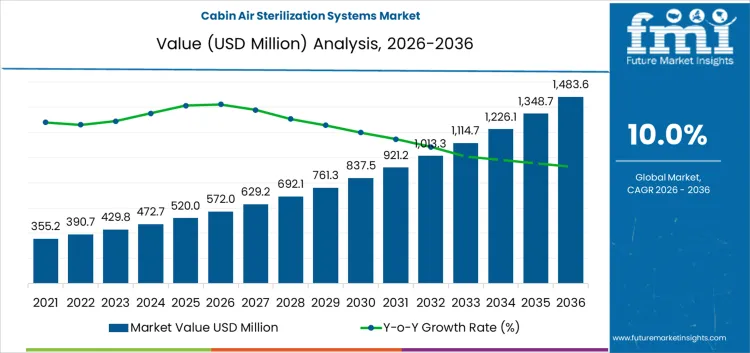
Cabin Air Sterilization Systems Market Key Takeaways
| Metric | Value |
|---|---|
| Market Value (2026) | USD 572.0 million |
| Market Forecast Value (2036) | USD 1,483.6 million |
| Forecast CAGR 2026 to 2036 | 10.0% |
Why is the Demand for Cabin Air Sterilization Systems Growing?
Demand for cabin air sterilization systems is rising as vehicle manufacturers and fleet operators specify technologies that reduce airborne biological contaminants in enclosed environments. Rising awareness of respiratory health risks from pathogens and allergens has influenced specification of cabin sterilization solutions that integrate with HVAC systems to support occupant safety. Engineers design ultraviolet and photocatalytic modules that deactivate microbial agents while maintaining airflow performance and energy efficiency. Procurement teams evaluate sterilization effectiveness, ease of integration with existing HVAC architectures, and maintenance requirements when selecting systems for passenger cars, commercial fleets, and public transport vehicles.
Transport authorities and safety regulators emphasize occupant protection standards that influence selection of advanced air quality technologies in new vehicle programs. Growth in consumer concern about indoor air quality is reinforcing uptake of cabin air sterilization systems that align with comfort and health criteria in daily travel. System integrators coordinate module performance with climate control strategies that adjust to ambient conditions and occupancy patterns. Advancements in sensor feedback and control algorithms support responsive operation and diagnostics throughout vehicle life. These factors support sustained adoption of cabin air sterilization solutions across personal mobility and mass transit applications.
How Are the Segments Classified in the Cabin Air Sterilization Systems Market?
Demand for cabin air sterilization systems is shaped by infection control priorities, occupant health awareness, and in-vehicle air hygiene requirements. Adoption increases across urban and high-usage driving environments where enclosed cabin exposure remains prolonged. Vehicle manufacturers focus on technologies capable of neutralizing airborne pathogens without disrupting airflow or thermal comfort. Integration choices emphasize safety, reliability, and compatibility with existing climate control systems. Segment classification reflects differentiation by sterilization technology, integration method, and vehicle category. Structure highlights how disinfection approach, system placement, and vehicle positioning influence adoption intensity, system complexity, and operational consistency across automotive cabin environments.
Which Technology Represents the Largest Share of Demand?
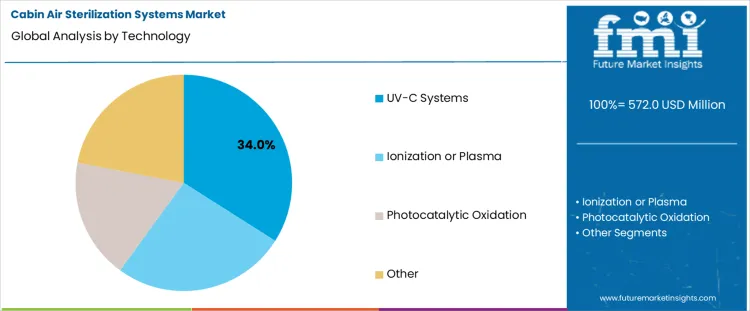
UV-C systems hold 34.0%, representing the largest share among sterilization technologies due to established germicidal effectiveness. UV-C irradiation inactivates bacteria and viruses through nucleic acid disruption. Integration within air pathways enables continuous sterilization during cabin air circulation. Controlled exposure design ensures occupant safety while maintaining disinfection performance. Ionization or plasma and photocatalytic oxidation systems address pathogen reduction through different reaction mechanisms. Other technologies support experimental or hybrid approaches. Technology segmentation reflects preference for solutions with validated sterilization efficacy, predictable performance, and compatibility with enclosed cabin airflow environments.
Key Points
-
UV-C technology delivers validated pathogen inactivation capability.
- Continuous airflow exposure supports consistent sterilization.
- Other technologies address alternative disinfection mechanisms.
Which Integration Method Accounts for the Highest Share of Demand?
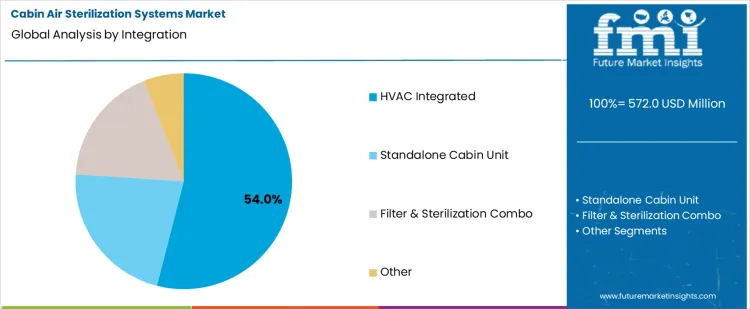
HVAC integrated systems hold 54.0%, representing the largest share among integration methods due to seamless airflow access. Placement within HVAC ducts enables sterilization during both heating and cooling operation. Integrated designs reduce need for additional cabin hardware and simplify maintenance. System coordination supports consistent treatment of recirculated and fresh air streams. Standalone cabin units and filter combinations serve targeted or retrofit applications with added packaging considerations. Other integration methods support niche layouts. Integration segmentation reflects emphasis on embedded solutions delivering uniform air treatment aligned with vehicle climate control architectures.
Key Points
- HVAC integration enables continuous air sterilization.
- Embedded placement reduces additional component requirements.
- Other methods support targeted or retrofit configurations.
Which Vehicle Segment Drives the Largest Share of Demand?
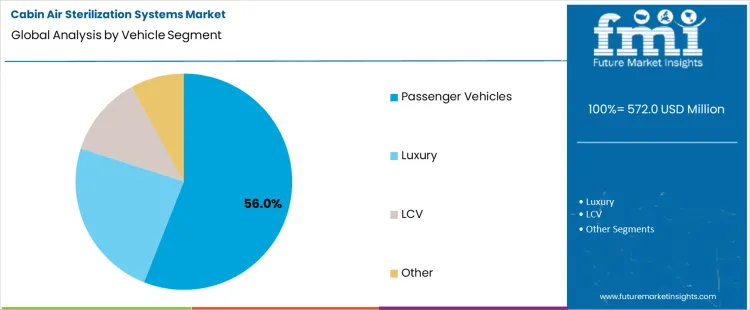
Passenger vehicles hold 56.0%, representing the largest share among vehicle segments adopting cabin air sterilization. High occupancy frequency and daily usage increase focus on air hygiene within this segment. Manufacturers integrate sterilization features to address health expectations and comfort differentiation. Broad deployment supports standardization across mass-market platforms. Luxury vehicles adopt enhanced sterilization as part of premium interior offerings. Light commercial vehicles apply systems based on exposure duration and operational context. Vehicle segment segmentation reflects concentration of adoption within passenger-focused platforms prioritizing occupant health and cabin air quality.
Key Points
- Passenger vehicles emphasize daily-use air hygiene.
- Standardization supports wide-scale system deployment.
- Other segments integrate based on exposure and positioning.
What are the Key Dynamics in the Cabin Air Sterilization Systems Market?
Demand for cabin air sterilization systems reflects requirement to reduce airborne pathogens within enclosed mobility and transport environments. Adoption spans passenger vehicles, public transport, ambulances, and specialty cabins. Global scope aligns with heightened hygiene awareness and infection control expectations. Usage centers on UV-C, ionization, plasma, and filtration-assisted sterilization technologies integrated into cabin HVAC systems.
How do hygiene expectations and shared mobility usage shape adoption?
Enclosed cabins enable accumulation of airborne microorganisms during repeated occupancy cycles. Demand increases in shared mobility, public transport, and medical transport settings where passenger turnover remains high. Air sterilization systems operate continuously or cyclically to reduce microbial load. Integration within HVAC ducts enables treatment without direct occupant interaction. UV-C and ionization technologies provide non-chemical sterilization methods. Adoption strengthens where operators seek visible hygiene assurance measures. Regulatory guidance on indoor air quality supports consideration of sterilization systems within transport cabins.
How do safety validation and system effectiveness constraints influence market scalability?
Sterilization technologies require strict safety validation to prevent ozone generation or UV exposure risk. Demand sensitivity rises where regulatory approval remains unclear or inconsistent. Effectiveness depends on airflow rate, exposure time, and system placement. Added components increase HVAC complexity and cost. Power consumption considerations affect electric mobility applications. Maintenance requirements include lamp replacement or electrode cleaning. Public skepticism regarding efficacy affects perceived value. Standardization challenges limit uniform deployment across diverse cabin architectures.
How Is Demand for Cabin Air Sterilization Systems Evolving Globally?
Demand for cabin air sterilization systems is expanding globally due to heightened focus on airborne pathogen control, enclosed space hygiene, and integrated air quality management. Adoption reflects transition from passive filtration toward active sterilization using UV-C, ionization, and plasma-based technologies. Applications extend across passenger vehicles, public transport, and shared mobility platforms operating in high-occupancy environments. OEMs increasingly embed sterilization within HVAC architectures rather than optional add-ons. Growth rates in China at 12.1%, Brazil at 11.9%, USA at 9.4%, Germany at 9.2%, and South Korea at 9.0% indicate sustained expansion driven by public health awareness, regulatory scrutiny, and platform-level cabin system redesign.
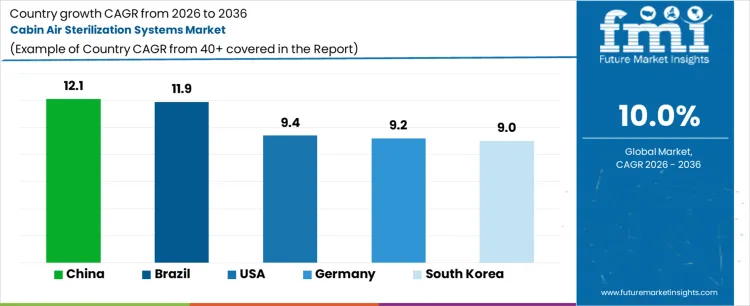
| Country | CAGR (%) |
|---|---|
| China | 12.1% |
| Brazil | 11.9% |
| USA | 9.4% |
| Germany | 9.2% |
| South Korea | 9.0% |
What Is Driving Rapid Growth of Cabin Air Sterilization Demand in China?
Large-scale deployment across transport platforms is accelerating cabin air sterilization system demand in China, expanding at a CAGR of 12.1%. High passenger density in urban mobility increases concern around airborne transmission within enclosed cabins. Public transport electrification programs integrate sterilization systems to improve hygiene standards. OEMs standardize active air treatment within HVAC modules for mass-market vehicles. Shared mobility and ride-hailing fleets reinforce adoption due to continuous vehicle utilization. Strong domestic capability in UV-C and electronic components supports rapid scaling and cost-effective integration across multiple vehicle categories.
- High passenger density across urban transport systems
- Integration within public transit and shared mobility fleets
- OEM standardization of active air treatment systems
- Strong domestic manufacturing of sterilization components
Why Is Brazil Experiencing Accelerated Adoption of Cabin Air Sterilization Systems?
Public health sensitivity and climate conditions are driving cabin air sterilization system demand growth in Brazil at a CAGR of 11.9%. Warm and humid environments increase microbial persistence within vehicle cabins. Urban transit systems prioritize sterilization to improve passenger confidence. Electric buses and commercial fleets adopt active air treatment to support continuous operations. Retrofit activity remains significant across existing vehicle fleets. Adoption reflects hygiene assurance and risk mitigation priorities rather than premium comfort positioning.
- Warm and humid climate supporting microbial growth
- Public transport focus on passenger hygiene confidence
- Fleet electrification supporting system integration
- Significant retrofit demand across existing vehicles
How Is the USA Supporting Steady Expansion of Cabin Air Sterilization Systems?
Health-conscious vehicle design trends support cabin air sterilization system demand growth in the USA, expanding at a CAGR of 9.4%. Increased awareness of airborne transmission influences consumer expectations for cabin hygiene. OEMs integrate sterilization technologies to differentiate safety features. Adoption remains strong in shared mobility, commercial fleets, and public transport vehicles. Electric and hybrid platforms support tighter cabin sealing, improving sterilization effectiveness. Demand growth is steady, shaped by institutional procurement and fleet adoption rather than universal passenger vehicle penetration.
- Heightened awareness of airborne health risks
- Adoption across shared mobility and fleet vehicles
- Integration within sealed EV and hybrid cabins
- Institutional procurement supporting steady volumes
What Factors Are Sustaining Cabin Air Sterilization Demand in Germany?
Engineering-led hygiene standards sustain cabin air sterilization system demand in Germany, growing at a CAGR of 9.2%. Public transport operators emphasize air hygiene compliance and passenger safety. OEMs integrate sterilization as part of advanced cabin air management systems. Regulatory focus on indoor air quality supports adoption across commercial and municipal fleets. High expectations for system reliability influence technology selection. Growth remains consistent, driven by compliance-oriented integration rather than rapid feature proliferation.
- Public transport hygiene and safety requirements
- Integration within advanced HVAC architectures
- Regulatory attention to indoor air quality
- High reliability and performance expectations
Why Is South Korea Showing Consistent Growth in Cabin Air Sterilization Systems?
Technology-driven health protection priorities support cabin air sterilization system demand growth in South Korea at a CAGR of 9.0%. Dense urban commuting increases exposure duration within enclosed vehicles. Seasonal respiratory health concerns elevate demand for active sterilization. OEMs leverage advanced electronics and sensor integration to deploy responsive air treatment systems. Export-oriented vehicle platforms incorporate sterilization to meet diverse market expectations. Growth reflects system-level standardization across new vehicle programs rather than discretionary feature adoption.
- Dense urban commuting increasing exposure duration
- Seasonal respiratory health sensitivity
- Advanced electronics enabling responsive sterilization
- Export platform standardization across markets
What is the competitive landscape of demand for cabin air sterilization systems globally?
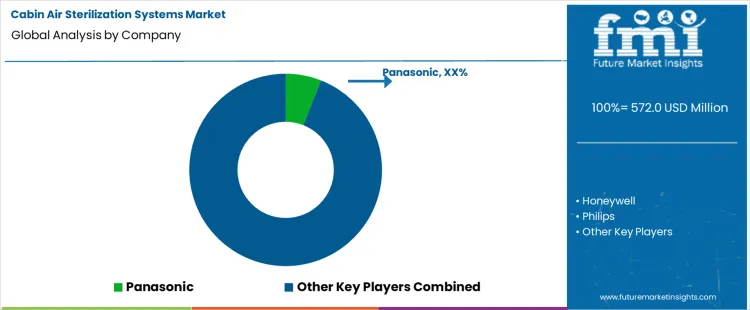
Demand for cabin air sterilization systems is driven by heightened focus on in-vehicle air hygiene, airborne pathogen mitigation, and improved passenger well-being in personal and shared mobility environments. These systems employ UV-C, photocatalytic oxidation, ionization, and HEPA-assisted sterilization to reduce microbial load, allergens, and volatile organic compounds within enclosed cabins. Buyers evaluate sterilization efficacy, energy consumption, integration with HVAC modules, maintenance requirements, and compliance with automotive safety and electromagnetic interference standards. Procurement teams prioritize suppliers with validated performance data, global technical support, and scalable solutions suitable for diverse vehicle architectures. Trend in the global market reflects post-pandemic awareness of air quality, emphasis on health-oriented features, and adoption of connected control and monitoring interfaces.
Panasonic holds leading positioning through advanced air sterilization technologies and integrated HVAC components adopted by automotive OEMs seeking enhanced air hygiene. Honeywell supports demand with UV-C and photocatalytic sterilization modules designed for automotive and mobility applications with complementary sensor integration. Philips contributes air treatment solutions and UV-C sterilization technologies validated for pathogen reduction and air quality enhancement. Denso participates with climate system modules incorporating sterilization and air purification functions aligned with OEM comfort standards. Bosch supplies sensor-assisted air disinfection systems and cabin air quality controls integrated into broader vehicle thermal management. Competitive differentiation depends on sterilization efficacy, installation compatibility, energy efficiency, regulatory readiness, and ability to provide measurable in-cabin air quality benefits.
Key Players in the Cabin Air Sterilization Systems Market
- Panasonic
- Honeywell
- Philips
- Denso
- Bosch
- LG Electronics
- Sharp
- MANN+HUMMEL
- MAHLE
- 3M
Scope of the Report
| Items | Values |
|---|---|
| Quantitative Units | USD million |
| Technology | UV-C Systems; Ionization or Plasma; Photocatalytic Oxidation; Other |
| Integration | HVAC Integrated; Standalone Cabin Unit; Filter & Sterilization Combo; Other |
| Vehicle Segment | Passenger Vehicles; Luxury; LCV; Other |
| Use Case | Allergen or Pathogen Reduction; Odor or VOC Control; Shared Mobility Hygiene; Other |
| Regions Covered | Asia Pacific, Europe, North America, Latin America, Middle East & Africa |
| Countries Covered | China, Brazil, USA, Germany, South Korea, and 40+ countries |
| Key Companies Profiled | Panasonic; Honeywell; Philips; Denso; Bosch; LG Electronics; Sharp; MANN+HUMMEL; MAHLE; 3M |
| Additional Attributes | Dollar sales by technology and integration; adoption trends for in-cabin sterilization addressing airborne pathogens and allergens; microbial inactivation rate, airflow resistance, and exposure-time performance metrics; compatibility with HVAC airflow, filter media, and ionization safeguards; maintenance cycles, lamp or catalyst life, and energy draw considerations; compliance with automotive safety standards, ozone emission limits, and OEM interior air quality specifications influencing system selection. |
Cabin Air Sterilization Systems Market by Segment
Technology:
- UV-C Systems
- Ionization or Plasma
- Photocatalytic Oxidation
- Other
Integration:
- HVAC Integrated
- Standalone Cabin Unit
- Filter & Sterilization Combo
- Other
Vehicle Segment:
- Passenger Vehicles
- Luxury
- LCV
- Other
Use Case:
- Allergen or Pathogen Reduction
- Odor or VOC Control
- Shared Mobility Hygiene
- Other
Region:
- Asia Pacific
- China
- Japan
- South Korea
- India
- Australia & New Zealand
- ASEAN
- Rest of Asia Pacific
- Europe
- Germany
- United Kingdom
- France
- Italy
- Spain
- Nordic
- BENELUX
- Rest of Europe
- North America
- United States
- Canada
- Mexico
- Latin America
- Brazil
- Chile
- Rest of Latin America
- Middle East & Africa
- Kingdom of Saudi Arabia
- Other GCC Countries
- Turkey
- South Africa
- Other African Union
- Rest of Middle East & Africa
Bibliography
- World Health Organization. (2023).Roadmap to improve and ensure good indoor ventilation in the context of COVID-19 and other airborne diseases. WHO Indoor Air Quality Publications.
- International Energy Agency. (2024).Air quality, ventilation, and health considerations in transport and mobility systems. IEA Energy and Environment Reports.
- Society of Automotive Engineers International. (2023).In-cabin air sterilization, UV-C integration, and pathogen mitigation in vehicle HVAC systems. SAE Technical Papers.
- European Commission Joint Research Centre. (2024).Airborne pathogen control and indoor air hygiene technologies in transport environments. JRC Science for Policy Reports.
Frequently Asked Questions
How big is the cabin air sterilization systems market in 2026?
The global cabin air sterilization systems market is estimated to be valued at USD 572.0 million in 2026.
What will be the size of cabin air sterilization systems market in 2036?
The market size for the cabin air sterilization systems market is projected to reach USD 1,483.6 million by 2036.
How much will be the cabin air sterilization systems market growth between 2026 and 2036?
The cabin air sterilization systems market is expected to grow at a 10.0% CAGR between 2026 and 2036.
What are the key product types in the cabin air sterilization systems market?
The key product types in cabin air sterilization systems market are uv-c systems, ionization or plasma, photocatalytic oxidation and other.
Which integration segment to contribute significant share in the cabin air sterilization systems market in 2026?
In terms of integration, hvac integrated segment to command 54.0% share in the cabin air sterilization systems market in 2026.
Preview the report firsthand - request a free sample
Get SampleGet the brochure for pricing and purchase details.
Get PDFTable of Content
- Executive Summary
- Global Market Outlook
- Demand-side Trends
- Supply-side Trends
- Technology Roadmap Analysis
- Analysis and Recommendations
- Market Overview
- Market Coverage / Taxonomy
- Market Definition / Scope / Limitations
- Market Background
- Market Dynamics
- Drivers
- Restraints
- Opportunity
- Trends
- Scenario Forecast
- Demand in Optimistic Scenario
- Demand in Likely Scenario
- Demand in Conservative Scenario
- Opportunity Map Analysis
- Product Life Cycle Analysis
- Supply Chain Analysis
- Investment Feasibility Matrix
- Value Chain Analysis
- PESTLE and Porter’s Analysis
- Regulatory Landscape
- Regional Parent Market Outlook
- Production and Consumption Statistics
- Import and Export Statistics
- Market Dynamics
- Global Market Analysis 2021 to 2025 and Forecast, 2026 to 2036
- Historical Market Size Value (USD Million) Analysis, 2021 to 2025
- Current and Future Market Size Value (USD Million) Projections, 2026 to 2036
- Y-o-Y Growth Trend Analysis
- Absolute $ Opportunity Analysis
- Global Market Pricing Analysis 2021 to 2025 and Forecast 2026 to 2036
- Global Market Analysis 2021 to 2025 and Forecast 2026 to 2036, By Technology
- Introduction / Key Findings
- Historical Market Size Value (USD Million) Analysis By Technology , 2021 to 2025
- Current and Future Market Size Value (USD Million) Analysis and Forecast By Technology , 2026 to 2036
- UV-C Systems
- Ionization or Plasma
- Photocatalytic Oxidation
- Other
- UV-C Systems
- Y-o-Y Growth Trend Analysis By Technology , 2021 to 2025
- Absolute $ Opportunity Analysis By Technology , 2026 to 2036
- Global Market Analysis 2021 to 2025 and Forecast 2026 to 2036, By Integration
- Introduction / Key Findings
- Historical Market Size Value (USD Million) Analysis By Integration, 2021 to 2025
- Current and Future Market Size Value (USD Million) Analysis and Forecast By Integration, 2026 to 2036
- HVAC Integrated
- Standalone Cabin Value (USD Million)
- Filter & Sterilization Combo
- Other
- HVAC Integrated
- Y-o-Y Growth Trend Analysis By Integration, 2021 to 2025
- Absolute $ Opportunity Analysis By Integration, 2026 to 2036
- Global Market Analysis 2021 to 2025 and Forecast 2026 to 2036, By Vehicle Segment
- Introduction / Key Findings
- Historical Market Size Value (USD Million) Analysis By Vehicle Segment, 2021 to 2025
- Current and Future Market Size Value (USD Million) Analysis and Forecast By Vehicle Segment, 2026 to 2036
- Passenger Vehicles
- Luxury
- LCV
- Other
- Passenger Vehicles
- Y-o-Y Growth Trend Analysis By Vehicle Segment, 2021 to 2025
- Absolute $ Opportunity Analysis By Vehicle Segment, 2026 to 2036
- Global Market Analysis 2021 to 2025 and Forecast 2026 to 2036, By Use Case
- Introduction / Key Findings
- Historical Market Size Value (USD Million) Analysis By Use Case, 2021 to 2025
- Current and Future Market Size Value (USD Million) Analysis and Forecast By Use Case, 2026 to 2036
- Allergen or Pathogen Reduction
- Odor or VOC Control
- Shared Mobility Hygiene
- Other
- Allergen or Pathogen Reduction
- Y-o-Y Growth Trend Analysis By Use Case, 2021 to 2025
- Absolute $ Opportunity Analysis By Use Case, 2026 to 2036
- Global Market Analysis 2021 to 2025 and Forecast 2026 to 2036, By Region
- Introduction
- Historical Market Size Value (USD Million) Analysis By Region, 2021 to 2025
- Current Market Size Value (USD Million) Analysis and Forecast By Region, 2026 to 2036
- North America
- Latin America
- Western Europe
- Eastern Europe
- East Asia
- South Asia and Pacific
- Middle East & Africa
- Market Attractiveness Analysis By Region
- North America Market Analysis 2021 to 2025 and Forecast 2026 to 2036, By Country
- Historical Market Size Value (USD Million) Trend Analysis By Market Taxonomy, 2021 to 2025
- Market Size Value (USD Million) Forecast By Market Taxonomy, 2026 to 2036
- By Country
- USA
- Canada
- Mexico
- By Technology
- By Integration
- By Vehicle Segment
- By Use Case
- By Country
- Market Attractiveness Analysis
- By Country
- By Technology
- By Integration
- By Vehicle Segment
- By Use Case
- Key Takeaways
- Latin America Market Analysis 2021 to 2025 and Forecast 2026 to 2036, By Country
- Historical Market Size Value (USD Million) Trend Analysis By Market Taxonomy, 2021 to 2025
- Market Size Value (USD Million) Forecast By Market Taxonomy, 2026 to 2036
- By Country
- Brazil
- Chile
- Rest of Latin America
- By Technology
- By Integration
- By Vehicle Segment
- By Use Case
- By Country
- Market Attractiveness Analysis
- By Country
- By Technology
- By Integration
- By Vehicle Segment
- By Use Case
- Key Takeaways
- Western Europe Market Analysis 2021 to 2025 and Forecast 2026 to 2036, By Country
- Historical Market Size Value (USD Million) Trend Analysis By Market Taxonomy, 2021 to 2025
- Market Size Value (USD Million) Forecast By Market Taxonomy, 2026 to 2036
- By Country
- Germany
- UK
- Italy
- Spain
- France
- Nordic
- BENELUX
- Rest of Western Europe
- By Technology
- By Integration
- By Vehicle Segment
- By Use Case
- By Country
- Market Attractiveness Analysis
- By Country
- By Technology
- By Integration
- By Vehicle Segment
- By Use Case
- Key Takeaways
- Eastern Europe Market Analysis 2021 to 2025 and Forecast 2026 to 2036, By Country
- Historical Market Size Value (USD Million) Trend Analysis By Market Taxonomy, 2021 to 2025
- Market Size Value (USD Million) Forecast By Market Taxonomy, 2026 to 2036
- By Country
- Russia
- Poland
- Hungary
- Balkan & Baltic
- Rest of Eastern Europe
- By Technology
- By Integration
- By Vehicle Segment
- By Use Case
- By Country
- Market Attractiveness Analysis
- By Country
- By Technology
- By Integration
- By Vehicle Segment
- By Use Case
- Key Takeaways
- East Asia Market Analysis 2021 to 2025 and Forecast 2026 to 2036, By Country
- Historical Market Size Value (USD Million) Trend Analysis By Market Taxonomy, 2021 to 2025
- Market Size Value (USD Million) Forecast By Market Taxonomy, 2026 to 2036
- By Country
- China
- Japan
- South Korea
- By Technology
- By Integration
- By Vehicle Segment
- By Use Case
- By Country
- Market Attractiveness Analysis
- By Country
- By Technology
- By Integration
- By Vehicle Segment
- By Use Case
- Key Takeaways
- South Asia and Pacific Market Analysis 2021 to 2025 and Forecast 2026 to 2036, By Country
- Historical Market Size Value (USD Million) Trend Analysis By Market Taxonomy, 2021 to 2025
- Market Size Value (USD Million) Forecast By Market Taxonomy, 2026 to 2036
- By Country
- India
- ASEAN
- Australia & New Zealand
- Rest of South Asia and Pacific
- By Technology
- By Integration
- By Vehicle Segment
- By Use Case
- By Country
- Market Attractiveness Analysis
- By Country
- By Technology
- By Integration
- By Vehicle Segment
- By Use Case
- Key Takeaways
- Middle East & Africa Market Analysis 2021 to 2025 and Forecast 2026 to 2036, By Country
- Historical Market Size Value (USD Million) Trend Analysis By Market Taxonomy, 2021 to 2025
- Market Size Value (USD Million) Forecast By Market Taxonomy, 2026 to 2036
- By Country
- Kingdom of Saudi Arabia
- Other GCC Countries
- Turkiye
- South Africa
- Other African Union
- Rest of Middle East & Africa
- By Technology
- By Integration
- By Vehicle Segment
- By Use Case
- By Country
- Market Attractiveness Analysis
- By Country
- By Technology
- By Integration
- By Vehicle Segment
- By Use Case
- Key Takeaways
- Key Countries Market Analysis
- USA
- Pricing Analysis
- Market Share Analysis, 2025
- By Technology
- By Integration
- By Vehicle Segment
- By Use Case
- Canada
- Pricing Analysis
- Market Share Analysis, 2025
- By Technology
- By Integration
- By Vehicle Segment
- By Use Case
- Mexico
- Pricing Analysis
- Market Share Analysis, 2025
- By Technology
- By Integration
- By Vehicle Segment
- By Use Case
- Brazil
- Pricing Analysis
- Market Share Analysis, 2025
- By Technology
- By Integration
- By Vehicle Segment
- By Use Case
- Chile
- Pricing Analysis
- Market Share Analysis, 2025
- By Technology
- By Integration
- By Vehicle Segment
- By Use Case
- Germany
- Pricing Analysis
- Market Share Analysis, 2025
- By Technology
- By Integration
- By Vehicle Segment
- By Use Case
- UK
- Pricing Analysis
- Market Share Analysis, 2025
- By Technology
- By Integration
- By Vehicle Segment
- By Use Case
- Italy
- Pricing Analysis
- Market Share Analysis, 2025
- By Technology
- By Integration
- By Vehicle Segment
- By Use Case
- Spain
- Pricing Analysis
- Market Share Analysis, 2025
- By Technology
- By Integration
- By Vehicle Segment
- By Use Case
- France
- Pricing Analysis
- Market Share Analysis, 2025
- By Technology
- By Integration
- By Vehicle Segment
- By Use Case
- India
- Pricing Analysis
- Market Share Analysis, 2025
- By Technology
- By Integration
- By Vehicle Segment
- By Use Case
- ASEAN
- Pricing Analysis
- Market Share Analysis, 2025
- By Technology
- By Integration
- By Vehicle Segment
- By Use Case
- Australia & New Zealand
- Pricing Analysis
- Market Share Analysis, 2025
- By Technology
- By Integration
- By Vehicle Segment
- By Use Case
- China
- Pricing Analysis
- Market Share Analysis, 2025
- By Technology
- By Integration
- By Vehicle Segment
- By Use Case
- Japan
- Pricing Analysis
- Market Share Analysis, 2025
- By Technology
- By Integration
- By Vehicle Segment
- By Use Case
- South Korea
- Pricing Analysis
- Market Share Analysis, 2025
- By Technology
- By Integration
- By Vehicle Segment
- By Use Case
- Russia
- Pricing Analysis
- Market Share Analysis, 2025
- By Technology
- By Integration
- By Vehicle Segment
- By Use Case
- Poland
- Pricing Analysis
- Market Share Analysis, 2025
- By Technology
- By Integration
- By Vehicle Segment
- By Use Case
- Hungary
- Pricing Analysis
- Market Share Analysis, 2025
- By Technology
- By Integration
- By Vehicle Segment
- By Use Case
- Kingdom of Saudi Arabia
- Pricing Analysis
- Market Share Analysis, 2025
- By Technology
- By Integration
- By Vehicle Segment
- By Use Case
- Turkiye
- Pricing Analysis
- Market Share Analysis, 2025
- By Technology
- By Integration
- By Vehicle Segment
- By Use Case
- South Africa
- Pricing Analysis
- Market Share Analysis, 2025
- By Technology
- By Integration
- By Vehicle Segment
- By Use Case
- USA
- Market Structure Analysis
- Competition Dashboard
- Competition Benchmarking
- Market Share Analysis of Top Players
- By Regional
- By Technology
- By Integration
- By Vehicle Segment
- By Use Case
- Competition Analysis
- Competition Deep Dive
- Panasonic
- Overview
- Product Portfolio
- Profitability by Market Segments (Product/Age /Sales Channel/Region)
- Sales Footprint
- Strategy Overview
- Marketing Strategy
- Product Strategy
- Channel Strategy
- Honeywell
- Philips
- Denso
- Bosch
- LG
- Sharp
- MANN+HUMMEL
- Mahle
- 3M
- Panasonic
- Competition Deep Dive
- Assumptions & Acronyms Used
- Research Methodology


