

- Industry Size (2026)
- USD 1912.0 Mn
- Forecast (2036)
- USD 3489.3 Mn
- CAGR (2026 to 2036)
- 6.2%
In-Cabin PM2.5 Filtration Systems Market Forecast and Outlook 2026 to 2036
The in-cabin PM2.5 filtration systems market is valued at USD 1,912.0 million in 2026 and is projected to reach USD 3,489.3 million by 2036, expanding at a CAGR of 6.2%. Value growth reflects structural integration of particulate filtration within vehicle HVAC architectures rather than accessory-level adoption. Allocation of spend concentrates on HVAC-integrated, high-efficiency media solutions that deliver consistent PM2.5 capture without materially increasing airflow resistance or energy draw. Passenger vehicles account for the largest share of value formation due to production scale, daily urban exposure, and growing consumer sensitivity to in-cabin air quality metrics. Electrification trends reinforce this trajectory, as sealed cabin designs increase reliance on active filtration to maintain acceptable interior air conditions under congested driving patterns.
Quick Stats for In-Cabin PM2.5 Filtration Systems Market
- In-Cabin PM2.5 Filtration Systems Market Value (2026): USD 1,912.0 million
- In-Cabin PM2.5 Filtration Systems Market Forecast Value (2036): USD 3,489.3 million
- In-Cabin PM2.5 Filtration Systems Market Forecast CAGR 2026 to 2036: 6.2%
- Leading Filter Type in Global Demand: HEPA or High-Efficiency Media
- Fastest-Growing Countries: China, Brazil, USA, Germany, South Korea
- Top Players in Global Demand: MANN+HUMMEL, MAHLE, Denso, Bosch, Hanon Systems, Donaldson, Honeywell, 3M, Philips, Panasonic
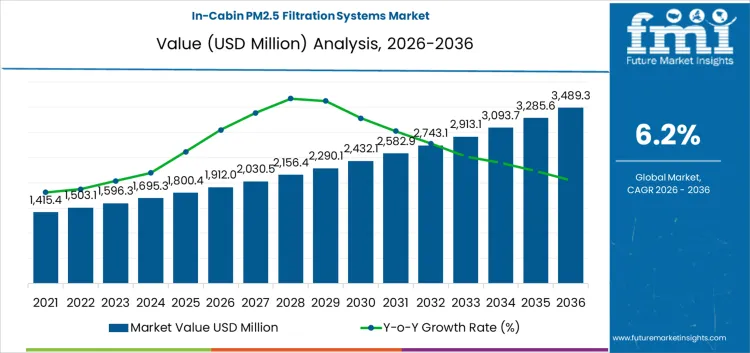
Outlook over the forecast period is defined by standardization, maintenance economics, and performance tradeoffs. Scalability remains moderated by pressure drop management, filter replacement intervals, and cost sensitivity in mid-range vehicle segments. High-efficiency media improve capture performance yet introduce airflow and service considerations that influence OEM specification decisions. Retrofit penetration remains limited due to packaging constraints and HVAC compatibility issues in legacy platforms. Regulatory attention to cabin air quality remains indirect, supporting OEM-led adoption rather than mandate-driven acceleration. Supply dependence on specialized filter media and validation requirements shapes pricing stability and development timelines. Demand expansion remains steady rather than accelerated, anchored to health awareness, urban exposure mitigation, and gradual feature normalization across passenger and fleet vehicle platforms.
In-Cabin PM2.5 Filtration Systems Market Key Takeaways
| Metric | Value |
|---|---|
| Market Value (2026) | USD 1,912.0 million |
| Market Forecast Value (2036) | USD 3,489.3 million |
| Forecast CAGR 2026 to 2036 | 6.2% |
Why is the Demand for In-Cabin PM2.5 Filtration Systems Growing?
Demand for in-cabin PM2.5 filtration systems is rising as vehicle manufacturers and public transport operators specify advanced filtration to protect occupants from fine particulate pollution during travel. Urbanization and traffic density elevate exposure to airborne particles linked with respiratory and cardiovascular issues, prompting specification of filtration modules that capture PM2.5 and support air quality standards. Engineers design multi-stage filters with media capable of trapping ultrafine particles while maintaining acceptable airflow and reduced energy impact on HVAC systems. Procurement teams assess filter efficiency ratings, compatibility with cabin HVAC architectures, and replacement serviceability when selecting solutions for light and heavy duty vehicles and mass transit fleets.
Transport planners and safety regulators emphasize occupant health protection and compliance with emissions and air quality guidelines that influence specification of effective filtration technologies in new vehicle programs. Growth in awareness among consumers and fleet managers about indoor air quality metrics is reinforcing uptake of in-cabin PM2.5 filtration systems that align with comfort and health criteria. System integrators align module performance with vehicle control strategies that optimize filtration operation under varied environmental conditions. Advancements in filter media science and housing design support longer service life and predictable maintenance intervals. These factors support sustained adoption of cabin air quality solutions across personal and commercial mobility segments.
How Are the Segments Classified in the In-Cabin PM2.5 Filtration Systems Market?
Demand for in-cabin PM2.5 filtration systems is shaped by rising air quality concerns, regulatory exposure limits, and occupant health awareness. Adoption increases across urban driving environments with persistent particulate pollution exposure. Vehicle manufacturers prioritize filtration efficiency, airflow compatibility, and pressure drop control within HVAC systems. Integration supports reduction of fine particulate ingress without compromising thermal comfort. Segment classification reflects differentiation by filter media type, vehicle positioning, and system integration approach. Structure highlights how filtration mechanism, vehicle category, and installation strategy influence performance expectations, adoption intensity, and deployment consistency across passenger and commercial vehicle platforms.
Which Filter Type Represents the Largest Share of Demand?
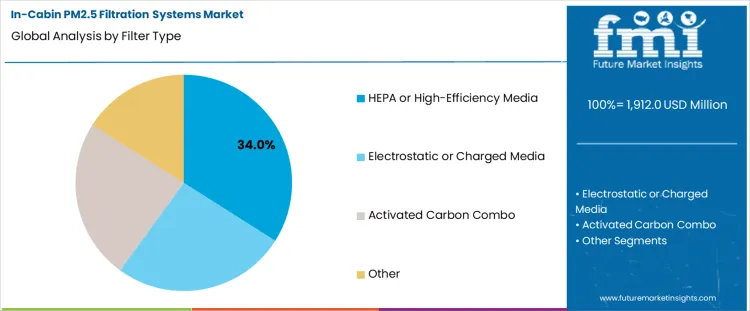
HEPA or high-efficiency media hold 34.0%, representing the largest share among filter types due to effective fine particulate capture capability. These filters provide high removal efficiency for PM2.5 particles under standardized airflow conditions. Integration within vehicle HVAC systems supports continuous filtration during cabin air circulation. Performance consistency and predictable pressure characteristics reinforce selection across multiple vehicle platforms. Electrostatic and activated carbon combinations address odor control and charged particle capture with varied efficiency profiles. Other filter types support specialized or cost-sensitive applications. Filter type segmentation reflects preference for proven mechanical filtration delivering reliable particulate reduction under diverse operating conditions.
Key Points
- High-efficiency media provide consistent PM2.5 removal performance.
- Mechanical filtration supports predictable airflow behavior.
- Other filter types address odor or electrostatic capture needs.
Which Vehicle Segment Drives the Largest Share of Demand?
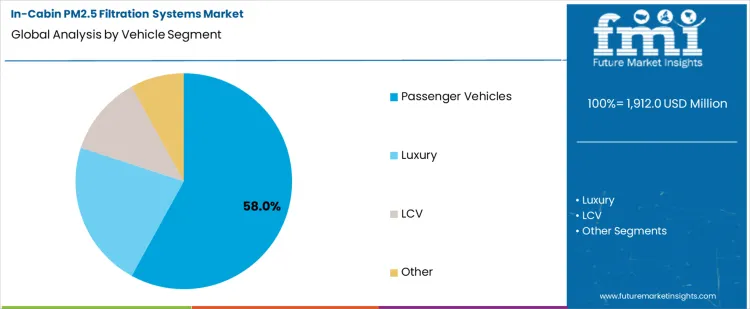
Passenger vehicles hold 58.0%, representing the largest share among vehicle segments adopting in-cabin PM2.5 filtration systems. High production volumes and widespread urban usage increase exposure mitigation requirements. Consumer focus on in-vehicle air quality reinforces integration across mainstream vehicle models. Manufacturers prioritize scalable filtration solutions supporting broad deployment. Luxury vehicles adopt enhanced filtration as part of comfort differentiation strategies. Light commercial vehicles apply systems based on driver exposure duration and operating environment. Vehicle segment segmentation reflects concentration of filtration deployment within passenger-focused platforms emphasizing health protection and daily usability.
Key Points
- Passenger vehicles face higher aggregate exposure conditions.
- Health awareness drives filtration integration across models.
- Other segments adopt based on usage intensity.
Which Integration Approach Accounts for the Highest Share of Demand?
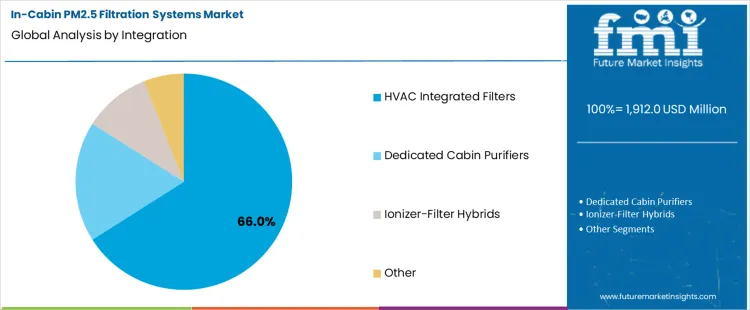
HVAC integrated filters hold 66.0%, representing the largest share among integration approaches due to seamless system compatibility. Placement within HVAC pathways enables continuous filtration during heating and cooling operation. Integrated designs simplify packaging and maintenance while minimizing additional components. Airflow optimization ensures filtration without excessive pressure loss. Dedicated cabin purifiers and ionizer-filter hybrids support targeted purification with added system complexity. Other integration approaches address niche configurations. Integration segmentation reflects preference for embedded solutions delivering consistent particulate control aligned with existing vehicle climate control architectures.
Key Points
- HVAC integration supports continuous air filtration.
- Embedded designs reduce component and packaging complexity.
- Other approaches provide supplemental or targeted purification.
What are the Key Dynamics in the In-Cabin PM2.5 Filtration Systems Market?
Demand for in-cabin PM2.5 filtration systems reflects need to reduce occupant exposure to fine particulate pollution. Adoption spans passenger vehicles, commercial fleets, rail coaches, and specialty transport operating in high-pollution environments. Global scope aligns with air quality awareness and health protection priorities. Usage centers on high-efficiency particulate filters integrated within cabin air intake and recirculation systems.
How do air quality concerns and health protection priorities shape adoption?
Fine particulate matter poses respiratory and cardiovascular health risks within enclosed cabins. Demand increases in urban regions with persistent air pollution exposure. Automotive platforms integrate PM2.5 filtration to improve perceived cabin safety and comfort. Real-time air quality monitoring enhances system responsiveness and user trust. Electric vehicles adopt advanced filtration to differentiate interior environment quality. Fleet operators value filtration to protect drivers with prolonged exposure durations. Regulatory attention to in-cabin air quality supports OEM inclusion. Adoption reflects prioritization of occupant health alongside thermal comfort.
How do filter maintenance and cost constraints influence market scalability?
High-efficiency filters increase airflow resistance, affecting HVAC energy consumption. Demand sensitivity rises where frequent filter replacement elevates ownership cost. Performance depends on sealing quality and installation accuracy. Maintenance compliance varies across users, affecting real-world effectiveness. Space constraints limit filter size in compact cabins. Certification requirements for filtration efficiency add testing cost. Supply chain dependence on specialized filter media affects pricing stability. Integration challenges persist when retrofitting older cabin HVAC architectures.
How Is Demand for In-Cabin PM2.5 Filtration Systems Evolving Globally?
Demand for in-cabin PM2.5 filtration systems is expanding globally due to rising air pollution exposure, heightened health awareness, and integration of cabin air quality management within vehicle platforms. Adoption reflects focus on fine particulate removal to protect occupants during urban driving and congestion. OEMs increasingly embed PM2.5 filtration within HVAC architectures rather than optional accessories. Growth is influenced by urban air quality conditions, regulatory attention, and consumer health sensitivity. Growth rates in China at 7.9%, Brazil at 7.7%, USA at 5.8%, Germany at 5.6%, and South Korea at 5.5% indicate sustained expansion aligned with urbanization, pollution mitigation priorities, and cabin comfort standardization.
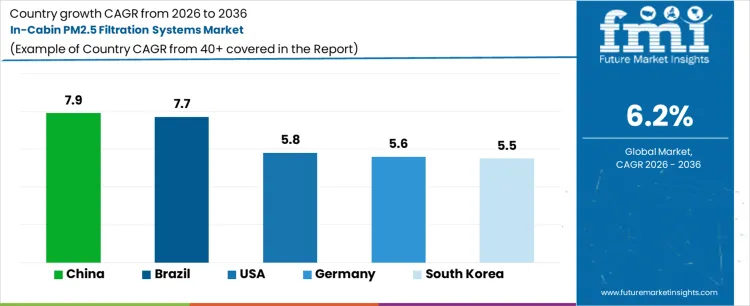
| Country | CAGR (%) |
|---|---|
| China | 7.9% |
| Brazil | 7.7% |
| USA | 5.8% |
| Germany | 5.6% |
| South Korea | 5.5% |
What Is Driving Strong In-Cabin PM2.5 Filtration Demand Growth in China?
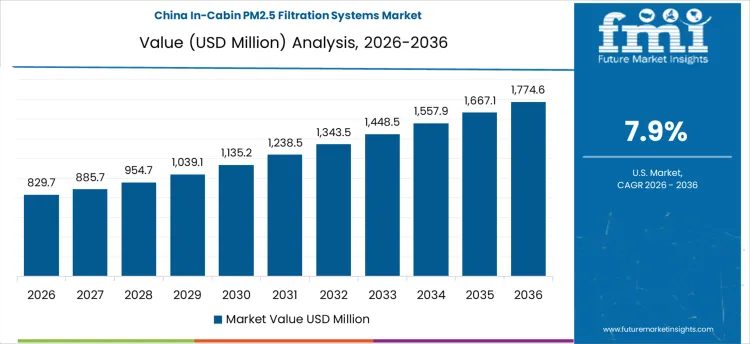
Urban air quality conditions are shaping in-cabin PM2.5 filtration system demand in China, expanding at a CAGR of 7.9%. High particulate exposure in major metropolitan regions increases perceived health risk during daily commuting. OEMs integrate high-efficiency filtration as standard in mid-range and premium vehicles. Electric vehicle adoption reinforces sealed cabin designs, increasing reliance on active filtration. Public awareness campaigns and real-time air quality data heighten consumer sensitivity. Adoption also extends to buses and shared mobility vehicles operating continuously in polluted corridors.
- High urban PM2.5 exposures across major cities
- Standardization of filtration in new vehicle platforms
- Sealed EV cabin architectures increasing filtration reliance
- Public awareness of air quality health impacts
Why Is Brazil Experiencing Rising Demand for In-Cabin PM2.5 Filtration Systems?
Traffic-related pollution and climate conditions are driving in-cabin PM2.5 filtration demand growth in Brazil at a CAGR of 7.7%. Dense traffic corridors in urban centers elevate occupant exposure to fine particulates. High temperatures encourage closed-window driving with air conditioning, increasing filtration dependence. OEMs position filtration systems as functional health features rather than premium add-ons. Ride-hailing and fleet vehicles contribute steady demand due to extended operating hours. Growth reflects urban exposure mitigation needs rather than regulatory mandates.
- Traffic congestion increasing particulate exposure
- High air-conditioning usage supporting closed-cabin operation
- Fleet and ride-hailing vehicle utilization
- Functional health positioning by OEMs
How Is the USA Supporting Steady Expansion of In-Cabin PM2.5 Filtration Systems?
Health-oriented vehicle design trends support in-cabin PM2.5 filtration system demand growth in the USA, expanding at a CAGR of 5.8%. Wildfire smoke events increase consumer awareness of airborne particulates. OEMs integrate filtration to enhance cabin comfort and perceived safety. Adoption remains strongest in urban and suburban regions affected by seasonal air quality events. Electric and hybrid vehicles support tighter cabin sealing, improving filtration effectiveness. Demand growth is steady, shaped by episodic pollution awareness rather than chronic exposure.
- Wildfire-related air quality concerns
- Consumer focus on health and cabin safety
- Integration within sealed EV and hybrid cabins
- Seasonal pollution-driven demand patterns
What Factors Are Sustaining In-Cabin PM2.5 Filtration Demand in Germany?
Environmental awareness and engineering standards sustain in-cabin PM2.5 filtration system demand in Germany, growing at a CAGR of 5.6%. Urban low-emission zones heighten attention to particulate exposure during driving. OEMs integrate filtration to complement broader air quality and sustainability strategies. High expectations for cabin comfort and filtration efficiency influence system specification. Adoption extends across passenger vehicles and commercial fleets operating in city centers. Growth remains measured, reflecting mature vehicle markets and gradual feature standardization.
- Urban low-emission zone exposure considerations
- High cabin comfort and engineering expectations
- Integration with sustainability-focused vehicle design
- Adoption across passenger and commercial vehicles
Why Is South Korea Showing Moderate Growth in In-Cabin PM2.5 Filtration Systems?
Public sensitivity to air pollution drives in-cabin PM2.5 filtration system demand in South Korea, expanding at a CAGR of 5.5%. Seasonal fine dust events increase health concerns during commuting. OEMs integrate advanced filtration to address consumer expectations for clean cabin air. High vehicle technology adoption supports rapid feature acceptance. Urban density and frequent congestion increase exposure duration. Growth reflects health-driven consumer preference supported by strong domestic automotive technology capabilities.
- Seasonal fine dust events affecting air quality
- High consumer awareness of particulate health risks
- Advanced vehicle technology adoption rates
- Dense urban traffic increasing exposure duration
What is the competitive landscape of demand for in-cabin PM2.5 filtration systems globally?
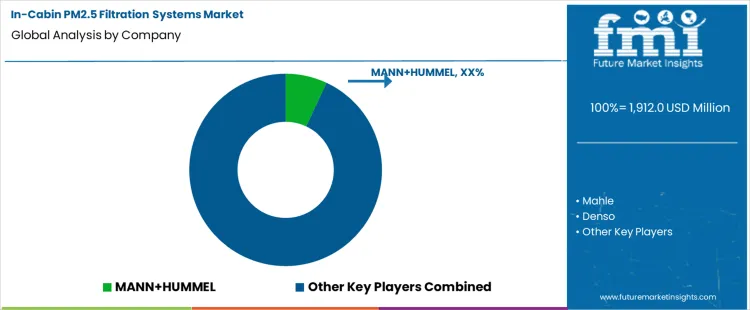
Demand for in-cabin PM2.5 filtration systems is driven by rising urban air pollution, increased awareness of health impacts from fine particulate matter, and regulatory and OEM requirements for improved cabin air quality. These systems are integrated with HVAC modules to efficiently capture particles smaller than 2.5 microns while maintaining airflow and minimal pressure drop. Buyers evaluate filtration efficiency, filter media quality, integration compatibility with vehicle HVAC architectures, and durability across service intervals. Procurement teams prioritize suppliers with proven media technology, OEM certification, global technical support, and compliance with regional air quality standards. Trend in the global market reflects increased adoption of advanced cabin air filters, growth of electrified HVAC systems, and consumer demand for healthier in-vehicle environments.
MANN+HUMMEL holds leading positioning through high-performance filtration media and in-cabin air quality solutions used by automotive OEMs worldwide. MAHLE supports demand with integrated cabin air filters and HVAC components designed for high PM2.5 capture and low resistance. Denso contributes advanced filter systems and climate control modules aligned with OEM comfort and air quality standards. Bosch supplies cabin air filtration technologies and sensors that enhance monitoring and control of particulate ingress. Donaldson participates with specialty filter media and design expertise supporting durability and high capture efficiency. Competitive differentiation depends on filtration efficiency, flow performance, integration support, serviceability, and alignment with evolving health and air quality benchmarks.
Key Players in the In-Cabin PM2.5 Filtration Systems Market
- MANN+HUMMEL
- MAHLE
- Denso
- Bosch
- Hanon Systems
- Donaldson
- Honeywell
- 3M
- Philips
- Panasonic
Scope of the Report
| Items | Values |
|---|---|
| Quantitative Units | USD million |
| Filter Type | HEPA or High-Efficiency Media; Electrostatic or Charged Media; Activated Carbon Combo; Other |
| Vehicle Segment | Passenger Vehicles; Luxury; LCV; Other |
| Integration | HVAC Integrated Filters; Dedicated Cabin Purifiers; Ionizer-Filter Hybrids; Other |
| Regions Covered | Asia Pacific, Europe, North America, Latin America, Middle East & Africa |
| Countries Covered | China, Brazil, USA, Germany, South Korea, and 40+ countries |
| Key Companies Profiled | MANN+HUMMEL; MAHLE; Denso; Bosch; Hanon Systems; Donaldson; Honeywell; 3M; Philips; Panasonic |
| Additional Attributes | Dollar sales by filter type and integration; adoption trends for PM2.5 mitigation in urban driving environments and premium vehicle cabins; filtration efficiency at 0.3 microns, pressure drop, and service life performance metrics; compatibility with HVAC airflow rates, ionization modules, and odor control media; maintenance intervals, replacement cost, and packaging constraints; compliance with cabin air quality standards and OEM specifications influencing in-cabin PM2.5 filtration system selection. |
In-Cabin PM2.5 Filtration Systems Market by Segment
Filter Type:
- HEPA or High-Efficiency Media
- Electrostatic or Charged Media
- Activated Carbon Combo
- Other
Vehicle Segment:
- Passenger Vehicles
- Luxury
- LCV
- Other
Integration:
- HVAC Integrated Filters
- Dedicated Cabin Purifiers
- Ionizer-Filter Hybrids
- Other
Region:
- Asia Pacific
- China
- Japan
- South Korea
- India
- Australia & New Zealand
- ASEAN
- Rest of Asia Pacific
- Europe
- Germany
- United Kingdom
- France
- Italy
- Spain
- Nordic
- BENELUX
- Rest of Europe
- North America
- United States
- Canada
- Mexico
- Latin America
- Brazil
- Chile
- Rest of Latin America
- Middle East & Africa
- Kingdom of Saudi Arabia
- Other GCC Countries
- Turkey
- South Africa
- Other African Union
- Rest of Middle East & Africa
Bibliography
-
World Health Organization. (2024). Ambient (outdoor) air pollution (Fact sheet). World Health Organization.
-
Marinello, S., et al. (2023). Exposure to Air Pollution in Transport Microenvironments. Sustainability.
-
Wei, D., et al. (2023). Vehicle cabin air quality: influence of air recirculation on cabin particle concentrations and CO2 (study article).
-
European Commission, Joint Research Centre. (2014). Report of laboratory and in-situ validation of micro-sensors… when sensors are transported… in different micro-environments (JRC technical report; older but real).
Frequently Asked Questions
How big is the in-cabin pm2.5 filtration systems market in 2026?
The global in-cabin pm2.5 filtration systems market is estimated to be valued at USD 1,912.0 million in 2026.
What will be the size of in-cabin pm2.5 filtration systems market in 2036?
The market size for the in-cabin pm2.5 filtration systems market is projected to reach USD 3,489.3 million by 2036.
How much will be the in-cabin pm2.5 filtration systems market growth between 2026 and 2036?
The in-cabin pm2.5 filtration systems market is expected to grow at a 6.2% CAGR between 2026 and 2036.
What are the key product types in the in-cabin pm2.5 filtration systems market?
The key product types in in-cabin pm2.5 filtration systems market are hepa or high-efficiency media, electrostatic or charged media, activated carbon combo and other.
Which vehicle segment segment to contribute significant share in the in-cabin pm2.5 filtration systems market in 2026?
In terms of vehicle segment, passenger vehicles segment to command 58.0% share in the in-cabin pm2.5 filtration systems market in 2026.
Preview the report firsthand - request a free sample
Get SampleGet the brochure for pricing and purchase details.
Get PDFTable of Content
- Executive Summary
- Global Market Outlook
- Demand-side Trends
- Supply-side Trends
- Technology Roadmap Analysis
- Analysis and Recommendations
- Market Overview
- Market Coverage / Taxonomy
- Market Definition / Scope / Limitations
- Market Background
- Market Dynamics
- Drivers
- Restraints
- Opportunity
- Trends
- Scenario Forecast
- Demand in Optimistic Scenario
- Demand in Likely Scenario
- Demand in Conservative Scenario
- Opportunity Map Analysis
- Product Life Cycle Analysis
- Supply Chain Analysis
- Investment Feasibility Matrix
- Value Chain Analysis
- PESTLE and Porter’s Analysis
- Regulatory Landscape
- Regional Parent Market Outlook
- Production and Consumption Statistics
- Import and Export Statistics
- Market Dynamics
- Global Market Analysis 2021 to 2025 and Forecast, 2026 to 2036
- Historical Market Size Value (USD Million) Analysis, 2021 to 2025
- Current and Future Market Size Value (USD Million) Projections, 2026 to 2036
- Y-o-Y Growth Trend Analysis
- Absolute $ Opportunity Analysis
- Global Market Pricing Analysis 2021 to 2025 and Forecast 2026 to 2036
- Global Market Analysis 2021 to 2025 and Forecast 2026 to 2036, By Filter Type
- Introduction / Key Findings
- Historical Market Size Value (USD Million) Analysis By Filter Type , 2021 to 2025
- Current and Future Market Size Value (USD Million) Analysis and Forecast By Filter Type , 2026 to 2036
- HEPA or High-Efficiency Media
- Electrostatic or Charged Media
- Activated Carbon Combo
- Other
- HEPA or High-Efficiency Media
- Y-o-Y Growth Trend Analysis By Filter Type , 2021 to 2025
- Absolute $ Opportunity Analysis By Filter Type , 2026 to 2036
- Global Market Analysis 2021 to 2025 and Forecast 2026 to 2036, By Vehicle Segment
- Introduction / Key Findings
- Historical Market Size Value (USD Million) Analysis By Vehicle Segment, 2021 to 2025
- Current and Future Market Size Value (USD Million) Analysis and Forecast By Vehicle Segment, 2026 to 2036
- Passenger Vehicles
- Luxury
- LCV
- Other
- Passenger Vehicles
- Y-o-Y Growth Trend Analysis By Vehicle Segment, 2021 to 2025
- Absolute $ Opportunity Analysis By Vehicle Segment, 2026 to 2036
- Global Market Analysis 2021 to 2025 and Forecast 2026 to 2036, By Integration
- Introduction / Key Findings
- Historical Market Size Value (USD Million) Analysis By Integration, 2021 to 2025
- Current and Future Market Size Value (USD Million) Analysis and Forecast By Integration, 2026 to 2036
- HVAC Integrated Filters
- Dedicated Cabin Purifiers
- Ionizer-Filter Hybrids
- Other
- HVAC Integrated Filters
- Y-o-Y Growth Trend Analysis By Integration, 2021 to 2025
- Absolute $ Opportunity Analysis By Integration, 2026 to 2036
- Global Market Analysis 2021 to 2025 and Forecast 2026 to 2036, By Region
- Introduction
- Historical Market Size Value (USD Million) Analysis By Region, 2021 to 2025
- Current Market Size Value (USD Million) Analysis and Forecast By Region, 2026 to 2036
- North America
- Latin America
- Western Europe
- Eastern Europe
- East Asia
- South Asia and Pacific
- Middle East & Africa
- Market Attractiveness Analysis By Region
- North America Market Analysis 2021 to 2025 and Forecast 2026 to 2036, By Country
- Historical Market Size Value (USD Million) Trend Analysis By Market Taxonomy, 2021 to 2025
- Market Size Value (USD Million) Forecast By Market Taxonomy, 2026 to 2036
- By Country
- USA
- Canada
- Mexico
- By Filter Type
- By Vehicle Segment
- By Integration
- By Country
- Market Attractiveness Analysis
- By Country
- By Filter Type
- By Vehicle Segment
- By Integration
- Key Takeaways
- Latin America Market Analysis 2021 to 2025 and Forecast 2026 to 2036, By Country
- Historical Market Size Value (USD Million) Trend Analysis By Market Taxonomy, 2021 to 2025
- Market Size Value (USD Million) Forecast By Market Taxonomy, 2026 to 2036
- By Country
- Brazil
- Chile
- Rest of Latin America
- By Filter Type
- By Vehicle Segment
- By Integration
- By Country
- Market Attractiveness Analysis
- By Country
- By Filter Type
- By Vehicle Segment
- By Integration
- Key Takeaways
- Western Europe Market Analysis 2021 to 2025 and Forecast 2026 to 2036, By Country
- Historical Market Size Value (USD Million) Trend Analysis By Market Taxonomy, 2021 to 2025
- Market Size Value (USD Million) Forecast By Market Taxonomy, 2026 to 2036
- By Country
- Germany
- UK
- Italy
- Spain
- France
- Nordic
- BENELUX
- Rest of Western Europe
- By Filter Type
- By Vehicle Segment
- By Integration
- By Country
- Market Attractiveness Analysis
- By Country
- By Filter Type
- By Vehicle Segment
- By Integration
- Key Takeaways
- Eastern Europe Market Analysis 2021 to 2025 and Forecast 2026 to 2036, By Country
- Historical Market Size Value (USD Million) Trend Analysis By Market Taxonomy, 2021 to 2025
- Market Size Value (USD Million) Forecast By Market Taxonomy, 2026 to 2036
- By Country
- Russia
- Poland
- Hungary
- Balkan & Baltic
- Rest of Eastern Europe
- By Filter Type
- By Vehicle Segment
- By Integration
- By Country
- Market Attractiveness Analysis
- By Country
- By Filter Type
- By Vehicle Segment
- By Integration
- Key Takeaways
- East Asia Market Analysis 2021 to 2025 and Forecast 2026 to 2036, By Country
- Historical Market Size Value (USD Million) Trend Analysis By Market Taxonomy, 2021 to 2025
- Market Size Value (USD Million) Forecast By Market Taxonomy, 2026 to 2036
- By Country
- China
- Japan
- South Korea
- By Filter Type
- By Vehicle Segment
- By Integration
- By Country
- Market Attractiveness Analysis
- By Country
- By Filter Type
- By Vehicle Segment
- By Integration
- Key Takeaways
- South Asia and Pacific Market Analysis 2021 to 2025 and Forecast 2026 to 2036, By Country
- Historical Market Size Value (USD Million) Trend Analysis By Market Taxonomy, 2021 to 2025
- Market Size Value (USD Million) Forecast By Market Taxonomy, 2026 to 2036
- By Country
- India
- ASEAN
- Australia & New Zealand
- Rest of South Asia and Pacific
- By Filter Type
- By Vehicle Segment
- By Integration
- By Country
- Market Attractiveness Analysis
- By Country
- By Filter Type
- By Vehicle Segment
- By Integration
- Key Takeaways
- Middle East & Africa Market Analysis 2021 to 2025 and Forecast 2026 to 2036, By Country
- Historical Market Size Value (USD Million) Trend Analysis By Market Taxonomy, 2021 to 2025
- Market Size Value (USD Million) Forecast By Market Taxonomy, 2026 to 2036
- By Country
- Kingdom of Saudi Arabia
- Other GCC Countries
- Turkiye
- South Africa
- Other African Union
- Rest of Middle East & Africa
- By Filter Type
- By Vehicle Segment
- By Integration
- By Country
- Market Attractiveness Analysis
- By Country
- By Filter Type
- By Vehicle Segment
- By Integration
- Key Takeaways
- Key Countries Market Analysis
- USA
- Pricing Analysis
- Market Share Analysis, 2025
- By Filter Type
- By Vehicle Segment
- By Integration
- Canada
- Pricing Analysis
- Market Share Analysis, 2025
- By Filter Type
- By Vehicle Segment
- By Integration
- Mexico
- Pricing Analysis
- Market Share Analysis, 2025
- By Filter Type
- By Vehicle Segment
- By Integration
- Brazil
- Pricing Analysis
- Market Share Analysis, 2025
- By Filter Type
- By Vehicle Segment
- By Integration
- Chile
- Pricing Analysis
- Market Share Analysis, 2025
- By Filter Type
- By Vehicle Segment
- By Integration
- Germany
- Pricing Analysis
- Market Share Analysis, 2025
- By Filter Type
- By Vehicle Segment
- By Integration
- UK
- Pricing Analysis
- Market Share Analysis, 2025
- By Filter Type
- By Vehicle Segment
- By Integration
- Italy
- Pricing Analysis
- Market Share Analysis, 2025
- By Filter Type
- By Vehicle Segment
- By Integration
- Spain
- Pricing Analysis
- Market Share Analysis, 2025
- By Filter Type
- By Vehicle Segment
- By Integration
- France
- Pricing Analysis
- Market Share Analysis, 2025
- By Filter Type
- By Vehicle Segment
- By Integration
- India
- Pricing Analysis
- Market Share Analysis, 2025
- By Filter Type
- By Vehicle Segment
- By Integration
- ASEAN
- Pricing Analysis
- Market Share Analysis, 2025
- By Filter Type
- By Vehicle Segment
- By Integration
- Australia & New Zealand
- Pricing Analysis
- Market Share Analysis, 2025
- By Filter Type
- By Vehicle Segment
- By Integration
- China
- Pricing Analysis
- Market Share Analysis, 2025
- By Filter Type
- By Vehicle Segment
- By Integration
- Japan
- Pricing Analysis
- Market Share Analysis, 2025
- By Filter Type
- By Vehicle Segment
- By Integration
- South Korea
- Pricing Analysis
- Market Share Analysis, 2025
- By Filter Type
- By Vehicle Segment
- By Integration
- Russia
- Pricing Analysis
- Market Share Analysis, 2025
- By Filter Type
- By Vehicle Segment
- By Integration
- Poland
- Pricing Analysis
- Market Share Analysis, 2025
- By Filter Type
- By Vehicle Segment
- By Integration
- Hungary
- Pricing Analysis
- Market Share Analysis, 2025
- By Filter Type
- By Vehicle Segment
- By Integration
- Kingdom of Saudi Arabia
- Pricing Analysis
- Market Share Analysis, 2025
- By Filter Type
- By Vehicle Segment
- By Integration
- Turkiye
- Pricing Analysis
- Market Share Analysis, 2025
- By Filter Type
- By Vehicle Segment
- By Integration
- South Africa
- Pricing Analysis
- Market Share Analysis, 2025
- By Filter Type
- By Vehicle Segment
- By Integration
- USA
- Market Structure Analysis
- Competition Dashboard
- Competition Benchmarking
- Market Share Analysis of Top Players
- By Regional
- By Filter Type
- By Vehicle Segment
- By Integration
- Competition Analysis
- Competition Deep Dive
- MANN+HUMMEL
- Overview
- Product Portfolio
- Profitability by Market Segments (Product/Age /Sales Channel/Region)
- Sales Footprint
- Strategy Overview
- Marketing Strategy
- Product Strategy
- Channel Strategy
- Mahle
- Denso
- Bosch
- Hanon Systems
- Donaldson
- Honeywell
- 3M
- Philips
- Panasonic
- MANN+HUMMEL
- Competition Deep Dive
- Assumptions & Acronyms Used
- Research Methodology


