

- Market Size (2026)
- USD 1.7 Bn
- Forecast (2036)
- USD 3.1 Bn
- CAGR (2026 to 2036)
- 6.2%
Low-Emission Engine Coolant Hose Systems Market Size, Market Forecast and Outlook By FMI
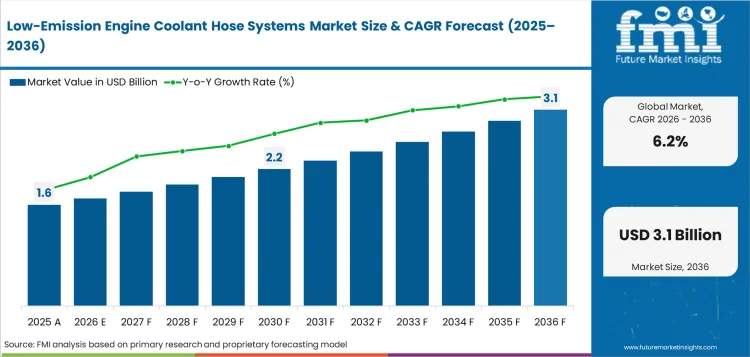
Low-emission engine coolant hose systems market was valued at USD 1.6 billion in 2025 and is estimated at USD 1.7 billion in 2026. Demand is projected to reach USD 3.1 billion by 2036 at 6.2% CAGR during the forecast period. OEM fitment is expected to represent 62.0% of sales channel demand in 2026. Passenger cars are forecast to account for 57.0% of vehicle type demand in 2026.
Summary of the Low-Emission Engine Coolant Hose Systems Market
- Demand and Growth Drivers
- Automakers need coolant hoses that can handle hotter engine spaces. Better hose performance helps engines work at the right temperature for longer.
- Hybrid vehicles are making coolant routing more complex. Hose systems now need to support both engine cooling and electric component cooling.
- Lower coolant loss is becoming more important in vehicle design. Hose suppliers with tested materials can support cleaner and safer thermal control.
- Product and Segment View
- Molded coolant hoses lead demand because they fit tight engine spaces better. Their shaped design reduces bends and lowers leak risk.
- EPDM rubber is widely used because it balances cost and heat resistance. Automakers prefer it for high-volume vehicle programs.
- OEM fitment stays important because hose shape must match the vehicle design before production starts. Early approval helps avoid later fitment issues.
- Geography and Competitive Outlook
- China and India support faster demand because vehicle output and hybrid production are rising. Local suppliers can benefit when they meet OEM testing needs.
- Germany and Japan are important for material quality and hose engineering. Their vehicle makers need coolant systems with proven durability.
- Competition depends on material testing and routing design. Suppliers with strong heat aging data and leak-control experience can win more vehicle platform work.
- Analyst Opinion
- Nikhil Kaitwade, Principal Consultant for Automotive at FMI, says, “Coolant hoses are becoming part of the emission and efficiency discussion. Automakers want hose systems able to handle heat and reduce fluid losses. Suppliers able to prove material stability and assembly savings will have better access to new engine and hybrid platforms.”
- Low-Emission Engine Coolant Hose Systems Market Value Analysis
- The low-emission engine coolant hose systems market is moving from a standard replacement parts space into a more design-focused thermal management market.
- Adoption is being supported by the need for coolant hoses that reduce fluid loss and perform well in hotter engine bays.
- The market is benefiting from hybrid vehicle layouts that need compact hose routing between engine parts and electric components.
- Demand is supported by OEMs looking for lighter hose assemblies that improve durability and reduce assembly risk during vehicle production.
Key Takeaways, Market Size, and Forecast
- Low-emission engine coolant hose systems market stood at USD 1.6 billion in 2025.
- The industry is projected to reach USD 3.1 billion by 2036.
- Market value is projected to expand at 6.2% CAGR during the forecast period.
- The market is projected to add USD 1.4 billion in incremental opportunity from 2026 to 2036.
- Molded coolant hoses are expected to lead hose type demand with 41.0% share in 2026.
- OEM fitment is anticipated to represent 62.0% of sales channel demand in 2026.
- India at 7.4% CAGR and China at 7.1% CAGR are expected to grow faster than the global market.
Coolant hose sourcing is becoming a compliance issue because thermal circuits now affect emissions control and battery durability. In April 2024, Regulation (EU) 2024/1257 covered vehicles and components for emissions and battery durability with application from 29 November 2026 for new M1 and N1 vehicle types. OEMs will ask hose suppliers for stronger validation files across engine coolant and hybrid battery loops because approval risk moves into connected thermal parts. Cooper Standard’s PlastiCool portfolio points to a second shift. The company says its glycol coolant tubes support ICE, hybrid and BEV cooling and offer a 60% lighter alternative to traditional EPDM hoses. Its line covers cooling needs up to 150°C. That gives suppliers a route to lower mass without changing every connection point. In November 2024, Teknor Apex presented Sarlink TPV coolant hose constructions for acoustic control, low electrical conductivity coolant compatibility and recycled-content use. Validated TPV hoses give manufacturers a clearer way to serve EV thermal systems without relying only on conventional rubber hoses.
Low-Emission Engine Coolant Hose Systems Market Definition
Low-emission engine coolant hose systems are hose assemblies used to move coolant through engines and hybrid vehicle thermal circuits. These systems help control engine temperature by carrying coolant between the radiator, engine block, heater unit and related cooling parts. The market focuses on hose systems designed to reduce coolant loss and handle higher heat inside modern engine bays. Automakers use these hoses to improve thermal stability, reduce leak risk and support better vehicle efficiency.
Low-Emission Engine Coolant Hose Systems Market Inclusions
Market scope covers low-emission engine coolant hose systems categorized by hose type, including molded coolant hoses, straight hoses, thermoplastic lines and connector assemblies. Material type includes EPDM rubber, silicone rubber, thermoplastic elastomer and reinforced nylon. Vehicle type includes passenger cars, light commercial vehicles, heavy trucks and hybrid vehicles. Application includes engine cooling circuits, heater circuits, turbocharger cooling and hybrid thermal loops. Sales channel includes OEM fitment, aftermarket replacement and service kits. The scope also includes hose assemblies used within engine and hybrid thermal systems where coolant movement, leak control and heat management work as part of one vehicle cooling process. Revenue scope covers 2026 to 2036. The key stakeholders include coolant hose manufacturers, automotive OEMs, Tier 1 fluid routing suppliers, material compounders, connector suppliers, aftermarket distributors, service kit providers and vehicle repair workshops.
Low-Emission Engine Coolant Hose Systems Market Exclusions
Scope excludes brake hoses and fuel hoses. Standalone air conditioning refrigerant lines are outside the scope. Battery-only coolant plates and cabin HVAC modules are excluded unless bundled with engine coolant routing. EV coolants and chemical coolant sales are excluded unless sold with hose system replacement.
Low-Emission Engine Coolant Hose Systems Market Research Methodology
- Primary Research: FMI analysts reviewed hose supplier portfolios and OEM cooling system needs across major automotive countries.
- Desk Research: Official vehicle production data and emission rule updates were checked to connect platform activity with hose demand.
- Market Sizing and Forecasting: Market size was built by comparing vehicle output with typical hose content per powertrain type.
- Data Validation: Forecast checks compared ICE and hybrid platform mix with supplier releases on coolant routing technology.
Why is the Low-Emission Engine Coolant Hose Systems Market Growing?
- Emission rules are pushing automakers to manage engine heat better. Cleaner coolant movement helps engines work at the right temperature.
- Hybrid vehicles need shorter and cleaner hose routes. Engine parts and electric parts now share tight vehicle space.
- Lightweight hose materials can reduce vehicle weight. They can support better efficiency across electric power steering cooling hose systems.
Emission rules are making coolant systems more important in vehicle design. Automakers need engines and hybrid systems to stay close to the right temperature. Coolant hoses do not control emissions on their own. Good coolant movement helps the engine work better and reduces avoidable heat stress. Low-emission hose systems are useful because they support cleaner engine performance without major design changes.
Vehicle cooling systems are getting more complex as more electric parts enter the vehicle. IEA reported battery electric cars represented 65.0% of total electric car sales in 2025. Hybrid and plug-in hybrid models still need engine coolant hoses. Hose suppliers can add value by making parts work with automotive electric coolant valve packages and pump modules.
Market Segmentation Analysis
- Shaped routing lowers leak risk, so molded coolant hoses are expected to lead with 41.0% share in 2026.
- Stable cost and proven heat aging performance support EPDM rubber at 48.0% share in 2026.
- High-volume vehicle platforms need standard hose sets, which supports passenger cars at 57.0% share in 2026.
- Turbocharged engines need steady coolant flow, so engine cooling circuits are expected to hold 45.0% share in 2026.
- Hose geometry needs approval before production, which supports OEM fitment at 62.0% share in 2026.
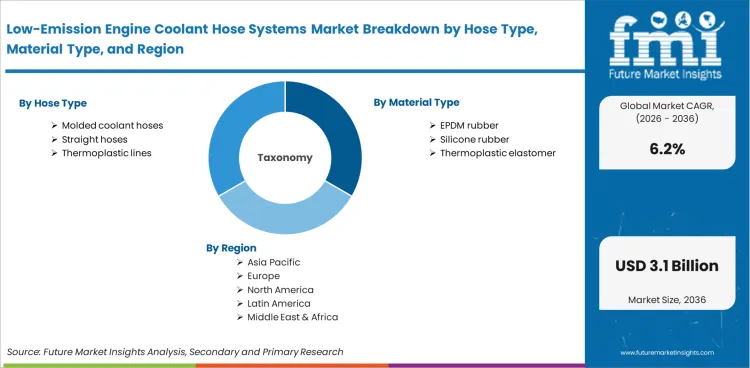
- The market is divided into five primary segment groups based on hose type and material type. Vehicle type, application and sales channel complete the structure. Hose type covers molded coolant hoses and straight hoses. Thermoplastic lines and connector assemblies complete the group. Material type covers EPDM rubber and silicone rubber. Thermoplastic elastomer and reinforced nylon are included. Vehicle type covers passenger cars and light commercial vehicles. Heavy trucks and hybrid vehicles complete the vehicle scope. Application covers engine cooling circuits and heater circuits. Turbocharger cooling and hybrid thermal loops complete the application scope. Sales channel covers OEM fitment and aftermarket replacement. Service kits complete the channel scope.
Insights into Low-Emission Engine Coolant Hose Systems Market by Hose Type
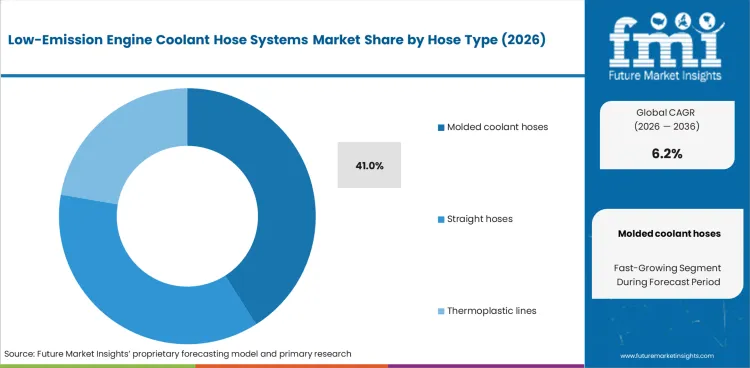
- Molded coolant hoses are expected to hold 41.0% share in 2026. Their shaped design reduces bends and helps coolant move through tight engine spaces with lower leak risk.
- Straight hoses support older vehicle service needs. Thermoplastic lines and engine coolant line quick couplings are useful in newer assemblies that need lighter connection points.
Insights into Low-Emission Engine Coolant Hose Systems Market by Material Type
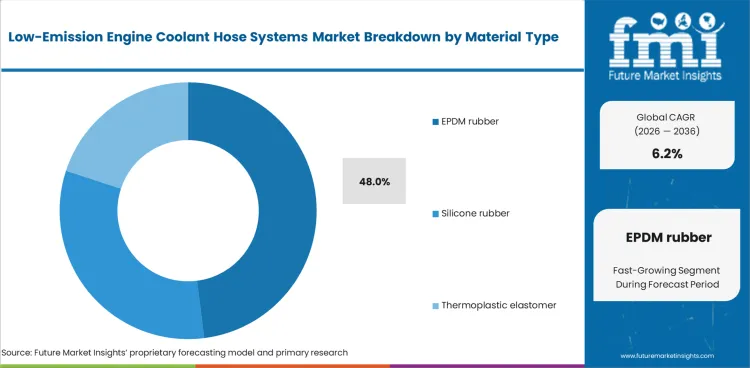
- EPDM rubber is expected to account for 48.0% share in 2026. It works well with coolant and gives automakers a cost-friendly material for high-volume engine programs.
- Silicone rubber is used near hotter engine areas. Thermoplastic elastomer is getting more attention as suppliers work on lighter hose systems.
Insights into Low-Emission Engine Coolant Hose Systems Market by Vehicle Type
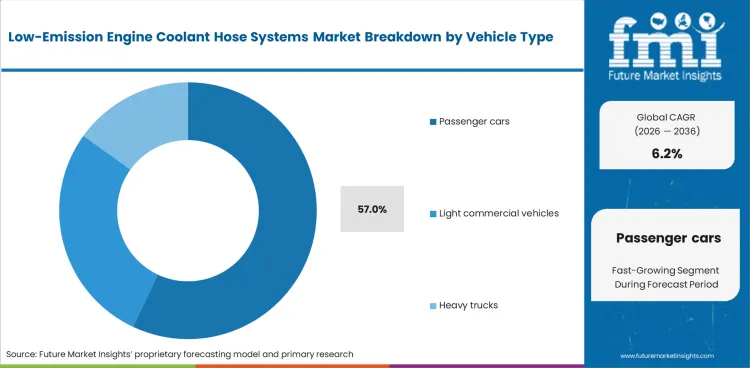
- Passenger cars are expected to account for 57.0% share in 2026. High production volume makes passenger cars the main demand source for standard coolant hose sets.
- Hybrid vehicles need compact coolant hose assemblies because engine parts and electric parts share limited space. Related designs connect with battery pack cooling valve actuator systems and e-axle cooling and lubrication system components.
Insights into Low-Emission Engine Coolant Hose Systems Market by Application
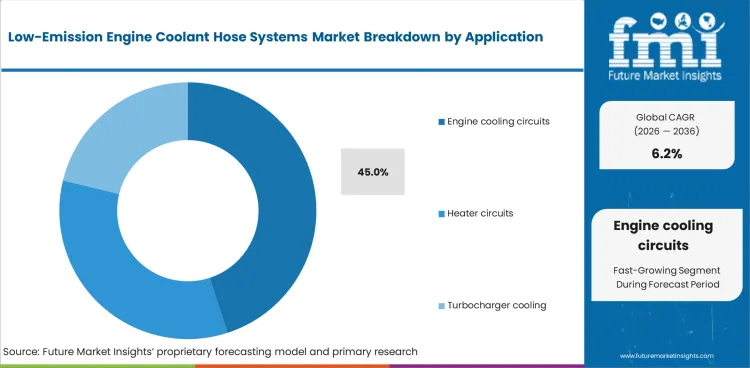
- Engine cooling circuits are expected to represent 45.0% of application demand in 2026. They protect the engine from excess heat and keep vehicle performance more stable.
- Heater circuits support cabin comfort and defrost performance. Turbocharger cooling needs stronger hose materials because smaller engines work under higher heat.
Insights into Low-Emission Engine Coolant Hose Systems Market by Sales Channel
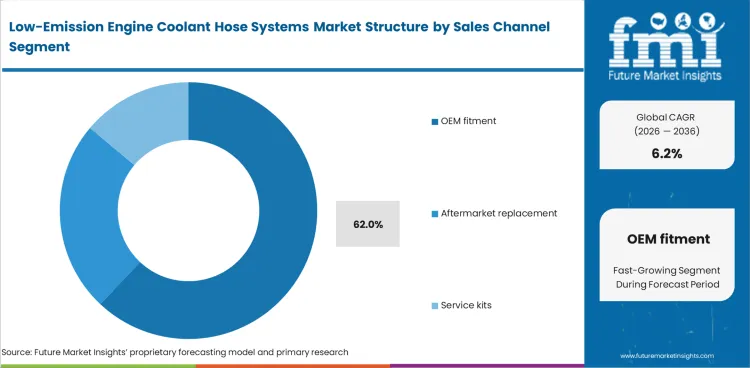
- OEM fitment is expected to capture 62.0% of sales channel demand in 2026. Vehicle makers approve hose shape and connector position before production starts.
- Aftermarket replacement supports demand from older vehicles that need hose repairs. Service kits create demand for hoses and vehicle fluid line clamps in the same repair job.
Low-Emission Engine Coolant Hose Systems Market Drivers, Restraints, and Opportunities
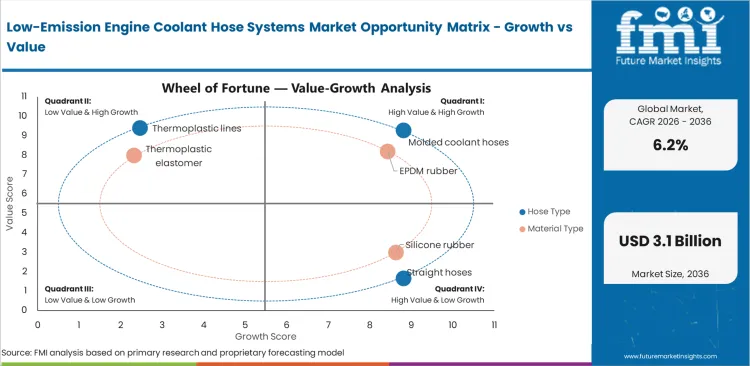
- Lower coolant loss is pushing automakers to check hose materials more carefully.
- Testing cost can slow new suppliers because hoses must pass heat and coolant exposure checks.
- Hybrid vehicles create better demand for compact hose assemblies.
Coolant Permeability Control Raises Material Scrutiny
Automakers want coolant hoses that lose less fluid over time. Low-permeation materials reduce coolant loss during long vehicle use. Hybrid engines need the same kind of stable hose performance. Materials with better glycol resistance can help suppliers enter vehicle design work earlier. Automotive coolant distribution manifold designs support cleaner coolant movement in newer platforms.
Validation Cost Slows New Suppliers
Coolant hose approval needs proof before an OEM can use the part. Suppliers must prove heat aging and coolant compatibility before approval. SAE technical content in 2024 discussed electrochemical degradation as a failure risk for EPDM coolant hoses. Testing cost favors suppliers with compound labs and past project records. Smaller suppliers may struggle if they cannot provide clear test data.
Hybrid Routing Opens Premium Assemblies
Hybrid vehicles need engine cooling and electric cooling in the same layout. Compact hose routing reduces assembly work and saves space. EV thermal system design is affecting hose assemblies used near hybrid powertrains. Molded hoses with tested connectors can earn better pricing because they solve space and leak risks together.
Analysis of Low-Emission Engine Coolant Hose Systems Market by Key Countries
.webp "Top Country Growth Comparison Low Emission Engine Coolant Hose Systems Market Cagr (2026 2036)")
| Country | CAGR |
|---|---|
| United States | 5.5% |
| China | 7.1% |
| India | 7.4% |
| Germany | 5.9% |
| France | 5.7% |
| Japan | 5.1% |
| United Kingdom | 5.4% |
Source: Future Market Insights, 2026.
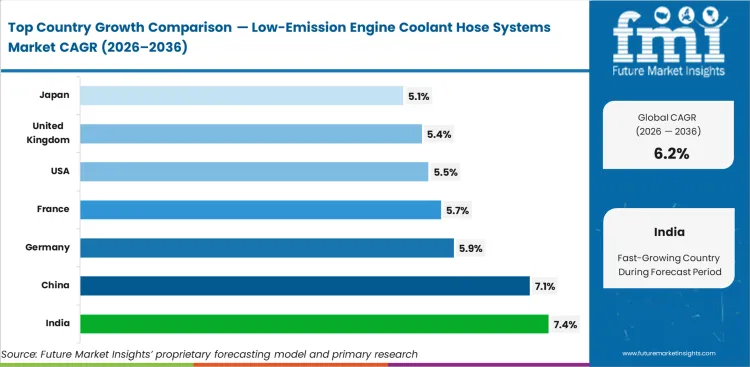
Low-Emission Engine Coolant Hose Systems Market CAGR Analysis by Country
- India is expected to record 7.4% CAGR in the market during the forecast period. Domestic vehicle output and hybrid content are raising coolant hose needs.
- China is projected to post 7.1% CAGR in the sector by 2036. Electrified vehicle scale is increasing the need for cleaner thermal routing.
- Germany is forecast to register 5.9% CAGR in this market over the forecast period. Automotive hose engineering and OEM testing depth support steady adoption.
- France points to 5.7% CAGR through 2036. Local suppliers are supporting lighter fluid systems for hybrid and combustion vehicles.
- The market in the United States is expected to expand at 5.5% CAGR through 2036. Emission standards keep OEM demand active for durable coolant hoses.
- Adoption in the United Kingdom is anticipated to move ahead at 5.4% CAGR during the forecast period. Hybrid service demand supports replacement hose and coolant routing needs.
- Global demand for low-emission engine coolant hose systems is forecast to rise at 6.2% CAGR during the forecast period. Cleaner thermal control stays central to engine and hybrid vehicle design.
Demand Outlook for Low-Emission Engine Coolant Hose Systems Market in the United States
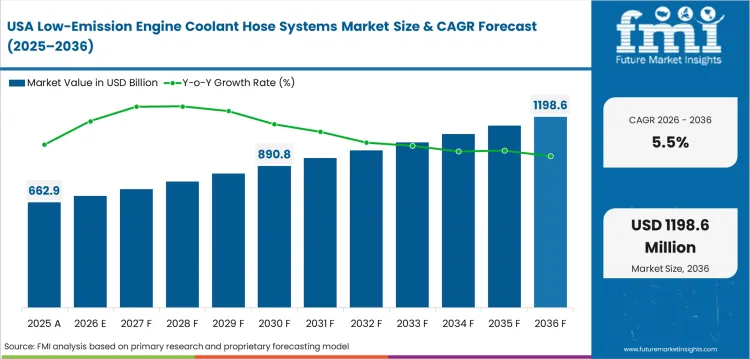
The market in the United States is expected to expand at 5.5% CAGR through 2036. EPA’s March 2024 standards cover model years 2027 to 2032 for light-duty and medium-duty vehicles. Rule pressure is pushing automakers to improve full vehicle efficiency. Coolant hose suppliers benefit when parts reduce fluid loss and handle hotter engine spaces.
- OEM platform work supports low-emission hose approval before vehicle launch.
- Aftermarket demand benefits from a large vehicle parc that needs molded hose and clamp replacement.
- Hybrid light trucks need stronger coolant routing because engines and electric parts share tighter space.
Sales Analysis of Low-Emission Engine Coolant Hose Systems Market in China
China sold over 13.0 million electric cars in 2025 according to IEA. Electric cars accounted for almost 55.0% of new car sales in the country. China is likely to post 7.1% CAGR in the sector by 2036. Hybrid and range extender models keep engine coolant hoses important as vehicle electrification expands.
- Local sourcing supports faster hose testing near vehicle assembly plants.
- High NEV output increases demand for coolant routing across mixed powertrain platforms.
- Cost pressure favors suppliers that reduce material use without losing heat resistance.
Demand Outlook for Low-Emission Engine Coolant Hose Systems Market in India
India’s vehicle output and emission upgrades are raising hose use in gasoline and hybrid platforms. The market is expected to record 7.4% CAGR during the forecast period. IEA recorded 165,000.0 electric car sales in India in 2025. Electric car sales expanded by 75.0% year over year. Local production improves access for hose makers with proven durability.
- Passenger vehicle programs create repeat demand for molded coolant hoses.
- Heat and dust exposure make material aging tests important for local suppliers.
- Service channels need affordable hose kits as vehicle use spreads beyond large cities.
Opportunity Analysis of Low-Emission Engine Coolant Hose Systems Market in Germany
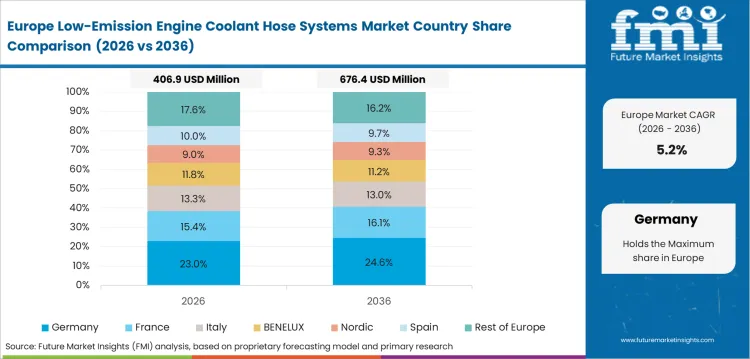
Germany’s premium vehicles and hybrid models need compact thermal systems. IEA reported German electric car sales at 850,000.0 units in 2025. Electric vehicles accounted for around 30.0% of car sales. Local suppliers can combine hose routing with e-axle integrated cooling hose module design work. Germany is expected to advance at 5.9% CAGR through 2036. Supplier testing depth is important for OEM approval.
- Material engineering supports thermoplastic and EPDM options for tight engine spaces.
- OEM approval favors suppliers with strong test records and local project support.
- Hybrid model lines need hose assemblies for engine cooling and electric drive cooling.
Sales Analysis of Low-Emission Engine Coolant Hose Systems Market in France
France benefits from local suppliers working on lighter fluid handling systems. The market is forecast at 5.7% CAGR through 2036. Hybrid vehicles and combustion engines keep coolant hoses in vehicle designs. IEA reported France’s electric sales share around 25.0% of total car sales in 2025. Engineering centers in France support battery thermal plates and engine coolant routing work.
- French vehicle programs need hose assemblies that reduce mass across luxury car hoses.
- Thermal module work supports planning between coolant hose suppliers and EV coolant filters and strainers suppliers.
- Fleet emission targets support parts that improve efficiency without major vehicle redesign.
Future Outlook for Low-Emission Engine Coolant Hose Systems Market in Japan
Japan’s market is supported by hybrid platforms and careful supplier quality control. The industry outlook in Japan points to 5.1% CAGR through 2036. JAMA reported Japan motor vehicle production at 8.2 million units in 2024. Passenger car production was 7.1 million units in the same year. Production depth supports validated hoses from suppliers with tight quality checks.
- Hybrid platforms keep engine coolant hose demand active as Japanese OEMs use electric coolant pump replacement parts.
- Material discipline favors suppliers that prove heat aging and chemical resistance.
- Export programs need consistent hose quality across different climates and vehicle duties.
Future Outlook for Low-Emission Engine Coolant Hose Systems Market in the United Kingdom
United Kingdom policy is shaping thermal component demand for low-emission vehicles. IEA reported almost 500,000.0 battery electric car sales in 2025. Adoption in the United Kingdom is anticipated to move ahead at 5.4% CAGR during the forecast period. Battery electric vehicles represented 23.0% of all new cars sold. Hybrid models keep automotive coolant aftermarket demand active through service work.
- Aftermarket channels need accurate hose kits as older vehicles stay in service longer.
- Low-emission zones and fleet targets support demand for efficient engines and hybrid platforms.
- OEM suppliers can use UK engineering programs to support compact hose routing.
Competitive Landscape and Strategic Positioning
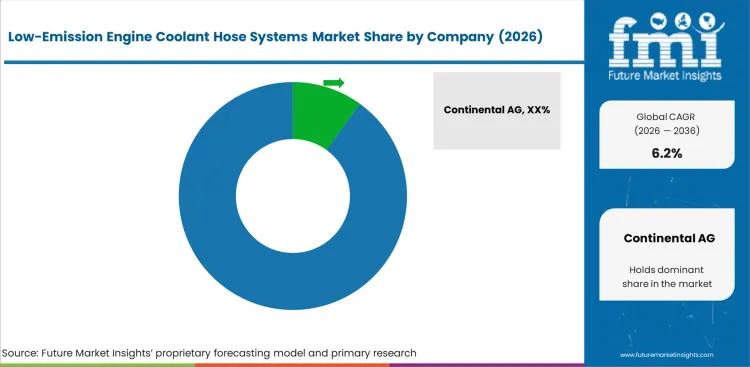
- Competition is shifting toward hose materials that reduce coolant loss and perform well under heat.
- Suppliers with proven heat aging data have a better chance of winning OEM approvals for new vehicle platforms.
- Fluid routing specialists can stand out when their hose assemblies reduce leak points and make installation easier.
- New suppliers face entry pressure because OEMs need material testing records before approving coolant hose systems.
Competitive positioning depends on material proof and integration support. Cooper Standard states that PlastiCool glycol coolant tubes support ICE and hybrid cooling systems. The company’s 2024 annual report described up to 60.0% weight reduction versus traditional EPDM hoses. Lower weight helps automakers simplify routing and improve efficiency. Closed-loop recycling programs for automotive hoses may receive more attention as rubber recovery targets increase.
Continental and Gates bring hose engineering depth across thermal and fluid transfer systems. Continental describes thermoplastic coolant hoses for electric vehicle thermal management as compact and easier to recycle. Gates is expanding liquid cooling hose materials for demanding thermal systems. Supplier examples indicate hose competition is moving toward material science and cleaner system design. Commercial vehicle transmission oil hose systems face similar pressure around heat control and durability.
Key Companies in the Low-Emission Engine Coolant Hose Systems Market
- Global Hose Specialists: Continental AG and Gates Corporation hold clear positions through coolant hose design and EPDM material depth.
- Fluid Routing Integrators: Cooper Standard Holdings Inc. and TI Automotive serve coolant tubes and thermal delivery systems.
- Japanese Material Specialists: Toyoda Gosei Co., Ltd. and Sumitomo Riko Co., Ltd. support OEM programs through rubber engineering.
Competitive Benchmarking: Low-Emission Engine Coolant Hose Systems Market
| Company | Low-Permeation Material Depth | Coolant Routing Integration | OEM Validation Support | Geographic Footprint |
|---|---|---|---|---|
| Continental AG | High | High | High | Global with European depth |
| Gates Corporation | High | Medium | Medium | Global aftermarket and OEM reach |
| Cooper Standard Holdings Inc. | High | High | High | North America and global OEM programs |
| TI Automotive | Medium | High | High | Global Tier 1 footprint |
| Toyoda Gosei Co., Ltd. | Medium | Medium | High | Japan and Asian OEM depth |
| Sumitomo Riko Co., Ltd. | Medium | Medium | Medium | Japan centered global supply |
| Nichirin Co., Ltd. | Medium | Medium | Medium | Japan and Asia focused hose supply |
Source: Future Market Insights competitive analysis, 2026.
Key Developments in Low-Emission Engine Coolant Hose Systems Market
- In April 2025, Cooper Standard’s eCoFlow™ Switch Pump technology won a 2025 Automotive News PACE Pilot Award. The company stated that the technology combines an electric water pump and an electrically driven valve into one coolant control module.
- In July 2025, TI Automotive announced its European debut at IAA Mobility 2025 with coolant delivery solutions for thermal management. Product highlights included pressurized coolant tanks and cooling delivery solutions for ICE and BEV platforms.
Key Players in the Low-Emission Engine Coolant Hose Systems Market
Major Global Players
- Continental AG
- Gates Corporation
- Cooper Standard Holdings Inc.
- TI Automotive
- Toyoda Gosei Co., Ltd.
Specialist and Regional Players
- Sumitomo Riko Co., Ltd.
- Nichirin Co., Ltd.
- Dayco Products LLC
- Hwaseung Corporation
- CODAN Rubber A/S
Report Scope and Coverage
| Parameter | Details |
|---|---|
| Quantitative Units | USD 1.7 billion to USD 3.1 billion at 6.2% CAGR |
| Market Definition | Low-emission coolant hose systems used for engine cooling and hybrid thermal circuits in vehicles |
| Segments Covered | Hose type, material type, vehicle type, application, sales channel, and region |
| Hose Type | Molded coolant hoses, straight hoses, thermoplastic lines, and connector assemblies |
| Material Type | EPDM rubber, silicone rubber, thermoplastic elastomer, and reinforced nylon |
| Vehicle Type | Passenger cars, light commercial vehicles, heavy trucks, and hybrid vehicles |
| Application | Engine cooling circuits, heater circuits, turbocharger cooling, and hybrid thermal loops |
| Sales Channel | OEM fitment, aftermarket replacement, and service kits |
| Regions Covered | North America, Latin America, Western Europe, Eastern Europe, East Asia, South Asia and Pacific, Middle East and Africa |
| Countries Covered | United States, China, India, Germany, France, Japan, United Kingdom, and more than 30.0 countries |
| Key Companies Profiled | Continental AG, Gates Corporation, Cooper Standard Holdings Inc., TI Automotive, Toyoda Gosei Co., Ltd., Sumitomo Riko Co., Ltd., and Nichirin Co., Ltd. |
| Forecast Period | 2026 to 2036 |
| Approach | Hybrid bottom-up and top-down method using vehicle output, hose content, coolant routing needs, material mix, and supplier activity |
Source: Future Market Insights, 2026.
Low-Emission Engine Coolant Hose Systems Market Breakdown by Core Segments and Region
Low-Emission Engine Coolant Hose Systems Market Segmented by Hose Type:
- Molded coolant hoses
- Straight hoses
- Thermoplastic lines
- Connector assemblies
Low-Emission Engine Coolant Hose Systems Market Segmented by Material Type:
- EPDM rubber
- Silicone rubber
- Thermoplastic elastomer
- Reinforced nylon
Low-Emission Engine Coolant Hose Systems Market Segmented by Vehicle Type:
- Passenger cars
- Light commercial vehicles
- Heavy trucks
- Hybrid vehicles
Low-Emission Engine Coolant Hose Systems Market Segmented by Application:
- Engine cooling circuits
- Heater circuits
- Turbocharger cooling
- Hybrid thermal loops
Low-Emission Engine Coolant Hose Systems Market Segmented by Sales Channel:
- OEM fitment
- Aftermarket replacement
- Service kits
Low-Emission Engine Coolant Hose Systems Market Segmented by Region:
- North America
- Latin America
- Western Europe
- Eastern Europe
- East Asia
- South Asia and Pacific
- Middle East and Africa
Research Sources and Bibliography
- European Parliament and Council of the European Union. (2024, April 24). Regulation (EU) 2024/1257 on type-approval of motor vehicles and engines and of systems, components and separate technical units intended for such vehicles, with respect to their emissions and battery durability. Official Journal of the European Union.
- USA Environmental Protection Agency. (2024, March 20). Final rule: Multi-pollutant emissions standards for model years 2027 and later light-duty and medium-duty vehicles.
- Cooper-Standard Holdings Inc. (2025). 2024 annual report. Cooper Standard.
- Cooper Standard. (n.d.). PlastiCool® glycol coolant tubes. Use this only for the 150°C claim. The page is official but does not show a publication date. Remove the 150°C line if a dated source is mandatory.
- Teknor Apex. (2024, November 20). Teknor Apex, along with key partners, showcase advancements in thermal management for electric vehicles at TPV coolant hose customer seminars held at Maillefer in Switzerland.
- SAE International. (2024, November 6). Test method for evaluating the electrochemical resistance of coolant system hoses and materials (SAE J1684_202411).
- International Energy Agency. (2026, May). Trends in electric cars. In Global EV Outlook 2026.
- Japan Automobile Manufacturers Association. (2025, September). The motor industry of Japan 2025.
- Cooper Standard. (2025, April 25). Cooper Standard receives 2025 Automotive News PACE Pilot recognition.
- TI Automotive. (2025, July 17). TI Automotive to make European debut at IAA Mobility.
This Report Answers
- What is the expected size of the low-emission engine coolant hose systems market in 2026?
- What value is the market forecast to reach by 2036?
- What CAGR is expected for the market from 2026 to 2036?
- Which hose type is expected to lead demand in 2026?
- Which material type is expected to hold the leading position in 2026?
- Which countries are expected to grow faster than the global market?
- How does OEM fitment influence coolant hose system demand?
- Which companies are active in low-emission engine coolant hose systems?
- How does FMI size and validate the low-emission engine coolant hose systems market?
Frequently Asked Questions
What is the global market demand for low-emission engine coolant hose systems in 2026?
In 2026, the global market for low-emission engine coolant hose systems is estimated at USD 1.7 billion.
How big will the market for low-emission engine coolant hose systems be in 2036?
By 2036, the market for low-emission engine coolant hose systems is projected to reach USD 3.1 billion.
How much is demand expected to expand between 2026 and 2036?
Between 2026 and 2036, demand for low-emission engine coolant hose systems is projected to expand at 6.2% CAGR.
Which hose type is expected to lead the market in 2026?
Molded coolant hoses are expected to lead hose type demand with 41.0% share in 2026.
Which sales channel is expected to account for the leading share in 2026?
OEM fitment is forecast to account for 62.0% of sales channel demand in 2026.
What is causing demand to rise in India?
India is expected to advance faster as vehicle production and hybrid content raise coolant hose use.
Which companies are included in the competitive scope?
Continental AG and Gates Corporation are included among the major companies. Cooper Standard Holdings Inc., TI Automotive and Toyoda Gosei Co., Ltd. are included in the same competitive scope.
Preview the report firsthand - request a free sample
Get SampleGet the brochure for pricing and purchase details.
Get PDFTable of Content
- Executive Summary
- Global Market Outlook
- Demand-side Trends
- Supply-side Trends
- Technology Roadmap Analysis
- Analysis and Recommendations
- Market Overview
- Market Coverage / Taxonomy
- Market Definition / Scope / Limitations
- Research Methodology
- Chapter Orientation
- Analytical Lens and Working Hypotheses
- Market Structure, Signals, and Trend Drivers
- Benchmarking and Cross-market Comparability
- Market Sizing, Forecasting, and Opportunity Mapping
- Research Design and Evidence Framework
- Desk Research Programme (Secondary Evidence)
- Company Annual and Sustainability Reports
- Peer-reviewed Journals and Academic Literature
- Corporate Websites, Product Literature, and Technical Notes
- Earnings Decks and Investor Briefings
- Statutory Filings and Regulatory Disclosures
- Technical White Papers and Standards Notes
- Trade Journals, Industry Magazines, and Analyst Briefs
- Conference Proceedings, Webinars, and Seminar Materials
- Government Statistics Portals and Public Data Releases
- Press Releases and Reputable Media Coverage
- Specialist Newsletters and Curated Briefings
- Sector Databases and Reference Repositories
- FMI Internal Proprietary Databases and Historical Market Datasets
- Subscription Datasets and Paid Sources
- Social Channels, Communities, and Digital Listening Inputs
- Additional Desk Sources
- Expert Input and Fieldwork (Primary Evidence)
- Primary Modes
- Qualitative Interviews and Expert Elicitation
- Quantitative Surveys and Structured Data Capture
- Blended Approach
- Why Primary Evidence is Used
- Field Techniques
- Interviews
- Surveys
- Focus Groups
- Observational and In-context Research
- Social and Community Interactions
- Stakeholder Universe Engaged
- C-suite Leaders
- Board Members
- Presidents and Vice Presidents
- R&D and Innovation Heads
- Technical Specialists
- Domain Subject-matter Experts
- Scientists
- Physicians and Other Healthcare Professionals
- Governance, Ethics, and Data Stewardship
- Research Ethics
- Data Integrity and Handling
- Primary Modes
- Tooling, Models, and Reference Databases
- Desk Research Programme (Secondary Evidence)
- Data Engineering and Model Build
- Data Acquisition and Ingestion
- Cleaning, Normalisation, and Verification
- Synthesis, Triangulation, and Analysis
- Quality Assurance and Audit Trail
- Market Background
- Market Dynamics
- Drivers
- Restraints
- Opportunity
- Trends
- Scenario Forecast
- Demand in Optimistic Scenario
- Demand in Likely Scenario
- Demand in Conservative Scenario
- Opportunity Map Analysis
- Product Life Cycle Analysis
- Supply Chain Analysis
- Investment Feasibility Matrix
- Value Chain Analysis
- PESTLE and Porter’s Analysis
- Regulatory Landscape
- Regional Parent Market Outlook
- Production and Consumption Statistics
- Import and Export Statistics
- Market Dynamics
- Global Market Analysis 2021 to 2025 and Forecast, 2026 to 2036
- Historical Market Size Value (USD Million) Analysis, 2021 to 2025
- Current and Future Market Size Value (USD Million) Projections, 2026 to 2036
- Y-o-Y Growth Trend Analysis
- Absolute $ Opportunity Analysis
- Global Market Pricing Analysis 2021 to 2025 and Forecast 2026 to 2036
- Global Market Analysis 2021 to 2025 and Forecast 2026 to 2036, By Hose Type
- Introduction / Key Findings
- Historical Market Size Value (USD Million) Analysis By Hose Type , 2021 to 2025
- Current and Future Market Size Value (USD Million) Analysis and Forecast By Hose Type , 2026 to 2036
- Molded coolant hoses
- Straight hoses
- Thermoplastic lines
- Molded coolant hoses
- Y-o-Y Growth Trend Analysis By Hose Type , 2021 to 2025
- Absolute $ Opportunity Analysis By Hose Type , 2026 to 2036
- Global Market Analysis 2021 to 2025 and Forecast 2026 to 2036, By Material Type
- Introduction / Key Findings
- Historical Market Size Value (USD Million) Analysis By Material Type, 2021 to 2025
- Current and Future Market Size Value (USD Million) Analysis and Forecast By Material Type, 2026 to 2036
- EPDM rubber
- Silicone rubber
- Thermoplastic elastomer
- EPDM rubber
- Y-o-Y Growth Trend Analysis By Material Type, 2021 to 2025
- Absolute $ Opportunity Analysis By Material Type, 2026 to 2036
- Global Market Analysis 2021 to 2025 and Forecast 2026 to 2036, By Vehicle Type
- Introduction / Key Findings
- Historical Market Size Value (USD Million) Analysis By Vehicle Type, 2021 to 2025
- Current and Future Market Size Value (USD Million) Analysis and Forecast By Vehicle Type, 2026 to 2036
- Passenger cars
- Light commercial vehicles
- Heavy trucks
- Passenger cars
- Y-o-Y Growth Trend Analysis By Vehicle Type, 2021 to 2025
- Absolute $ Opportunity Analysis By Vehicle Type, 2026 to 2036
- Global Market Analysis 2021 to 2025 and Forecast 2026 to 2036, By Application
- Introduction / Key Findings
- Historical Market Size Value (USD Million) Analysis By Application, 2021 to 2025
- Current and Future Market Size Value (USD Million) Analysis and Forecast By Application, 2026 to 2036
- Engine cooling circuits
- Heater circuits
- Turbocharger cooling
- Engine cooling circuits
- Y-o-Y Growth Trend Analysis By Application, 2021 to 2025
- Absolute $ Opportunity Analysis By Application, 2026 to 2036
- Global Market Analysis 2021 to 2025 and Forecast 2026 to 2036, By Sales Channel
- Introduction / Key Findings
- Historical Market Size Value (USD Million) Analysis By Sales Channel, 2021 to 2025
- Current and Future Market Size Value (USD Million) Analysis and Forecast By Sales Channel, 2026 to 2036
- OEM fitment
- Aftermarket replacement
- Service kits
- OEM fitment
- Y-o-Y Growth Trend Analysis By Sales Channel, 2021 to 2025
- Absolute $ Opportunity Analysis By Sales Channel, 2026 to 2036
- Global Market Analysis 2021 to 2025 and Forecast 2026 to 2036, By Region
- Introduction
- Historical Market Size Value (USD Million) Analysis By Region, 2021 to 2025
- Current Market Size Value (USD Million) Analysis and Forecast By Region, 2026 to 2036
- North America
- Latin America
- Western Europe
- Eastern Europe
- East Asia
- South Asia and Pacific
- Middle East & Africa
- Market Attractiveness Analysis By Region
- North America Market Analysis 2021 to 2025 and Forecast 2026 to 2036, By Country
- Historical Market Size Value (USD Million) Trend Analysis By Market Taxonomy, 2021 to 2025
- Market Size Value (USD Million) Forecast By Market Taxonomy, 2026 to 2036
- By Country
- USA
- Canada
- Mexico
- By Hose Type
- By Material Type
- By Vehicle Type
- By Application
- By Sales Channel
- By Country
- Market Attractiveness Analysis
- By Country
- By Hose Type
- By Material Type
- By Vehicle Type
- By Application
- By Sales Channel
- Key Takeaways
- Latin America Market Analysis 2021 to 2025 and Forecast 2026 to 2036, By Country
- Historical Market Size Value (USD Million) Trend Analysis By Market Taxonomy, 2021 to 2025
- Market Size Value (USD Million) Forecast By Market Taxonomy, 2026 to 2036
- By Country
- Brazil
- Chile
- Rest of Latin America
- By Hose Type
- By Material Type
- By Vehicle Type
- By Application
- By Sales Channel
- By Country
- Market Attractiveness Analysis
- By Country
- By Hose Type
- By Material Type
- By Vehicle Type
- By Application
- By Sales Channel
- Key Takeaways
- Western Europe Market Analysis 2021 to 2025 and Forecast 2026 to 2036, By Country
- Historical Market Size Value (USD Million) Trend Analysis By Market Taxonomy, 2021 to 2025
- Market Size Value (USD Million) Forecast By Market Taxonomy, 2026 to 2036
- By Country
- Germany
- UK
- Italy
- Spain
- France
- Nordic
- BENELUX
- Rest of Western Europe
- By Hose Type
- By Material Type
- By Vehicle Type
- By Application
- By Sales Channel
- By Country
- Market Attractiveness Analysis
- By Country
- By Hose Type
- By Material Type
- By Vehicle Type
- By Application
- By Sales Channel
- Key Takeaways
- Eastern Europe Market Analysis 2021 to 2025 and Forecast 2026 to 2036, By Country
- Historical Market Size Value (USD Million) Trend Analysis By Market Taxonomy, 2021 to 2025
- Market Size Value (USD Million) Forecast By Market Taxonomy, 2026 to 2036
- By Country
- Russia
- Poland
- Hungary
- Balkan & Baltic
- Rest of Eastern Europe
- By Hose Type
- By Material Type
- By Vehicle Type
- By Application
- By Sales Channel
- By Country
- Market Attractiveness Analysis
- By Country
- By Hose Type
- By Material Type
- By Vehicle Type
- By Application
- By Sales Channel
- Key Takeaways
- East Asia Market Analysis 2021 to 2025 and Forecast 2026 to 2036, By Country
- Historical Market Size Value (USD Million) Trend Analysis By Market Taxonomy, 2021 to 2025
- Market Size Value (USD Million) Forecast By Market Taxonomy, 2026 to 2036
- By Country
- China
- Japan
- South Korea
- By Hose Type
- By Material Type
- By Vehicle Type
- By Application
- By Sales Channel
- By Country
- Market Attractiveness Analysis
- By Country
- By Hose Type
- By Material Type
- By Vehicle Type
- By Application
- By Sales Channel
- Key Takeaways
- South Asia and Pacific Market Analysis 2021 to 2025 and Forecast 2026 to 2036, By Country
- Historical Market Size Value (USD Million) Trend Analysis By Market Taxonomy, 2021 to 2025
- Market Size Value (USD Million) Forecast By Market Taxonomy, 2026 to 2036
- By Country
- India
- ASEAN
- Australia & New Zealand
- Rest of South Asia and Pacific
- By Hose Type
- By Material Type
- By Vehicle Type
- By Application
- By Sales Channel
- By Country
- Market Attractiveness Analysis
- By Country
- By Hose Type
- By Material Type
- By Vehicle Type
- By Application
- By Sales Channel
- Key Takeaways
- Middle East & Africa Market Analysis 2021 to 2025 and Forecast 2026 to 2036, By Country
- Historical Market Size Value (USD Million) Trend Analysis By Market Taxonomy, 2021 to 2025
- Market Size Value (USD Million) Forecast By Market Taxonomy, 2026 to 2036
- By Country
- Kingdom of Saudi Arabia
- Other GCC Countries
- Turkiye
- South Africa
- Other African Union
- Rest of Middle East & Africa
- By Hose Type
- By Material Type
- By Vehicle Type
- By Application
- By Sales Channel
- By Country
- Market Attractiveness Analysis
- By Country
- By Hose Type
- By Material Type
- By Vehicle Type
- By Application
- By Sales Channel
- Key Takeaways
- Key Countries Market Analysis
- USA
- Pricing Analysis
- Market Share Analysis, 2025
- By Hose Type
- By Material Type
- By Vehicle Type
- By Application
- By Sales Channel
- Canada
- Pricing Analysis
- Market Share Analysis, 2025
- By Hose Type
- By Material Type
- By Vehicle Type
- By Application
- By Sales Channel
- Mexico
- Pricing Analysis
- Market Share Analysis, 2025
- By Hose Type
- By Material Type
- By Vehicle Type
- By Application
- By Sales Channel
- Brazil
- Pricing Analysis
- Market Share Analysis, 2025
- By Hose Type
- By Material Type
- By Vehicle Type
- By Application
- By Sales Channel
- Chile
- Pricing Analysis
- Market Share Analysis, 2025
- By Hose Type
- By Material Type
- By Vehicle Type
- By Application
- By Sales Channel
- Germany
- Pricing Analysis
- Market Share Analysis, 2025
- By Hose Type
- By Material Type
- By Vehicle Type
- By Application
- By Sales Channel
- UK
- Pricing Analysis
- Market Share Analysis, 2025
- By Hose Type
- By Material Type
- By Vehicle Type
- By Application
- By Sales Channel
- Italy
- Pricing Analysis
- Market Share Analysis, 2025
- By Hose Type
- By Material Type
- By Vehicle Type
- By Application
- By Sales Channel
- Spain
- Pricing Analysis
- Market Share Analysis, 2025
- By Hose Type
- By Material Type
- By Vehicle Type
- By Application
- By Sales Channel
- France
- Pricing Analysis
- Market Share Analysis, 2025
- By Hose Type
- By Material Type
- By Vehicle Type
- By Application
- By Sales Channel
- India
- Pricing Analysis
- Market Share Analysis, 2025
- By Hose Type
- By Material Type
- By Vehicle Type
- By Application
- By Sales Channel
- ASEAN
- Pricing Analysis
- Market Share Analysis, 2025
- By Hose Type
- By Material Type
- By Vehicle Type
- By Application
- By Sales Channel
- Australia & New Zealand
- Pricing Analysis
- Market Share Analysis, 2025
- By Hose Type
- By Material Type
- By Vehicle Type
- By Application
- By Sales Channel
- China
- Pricing Analysis
- Market Share Analysis, 2025
- By Hose Type
- By Material Type
- By Vehicle Type
- By Application
- By Sales Channel
- Japan
- Pricing Analysis
- Market Share Analysis, 2025
- By Hose Type
- By Material Type
- By Vehicle Type
- By Application
- By Sales Channel
- South Korea
- Pricing Analysis
- Market Share Analysis, 2025
- By Hose Type
- By Material Type
- By Vehicle Type
- By Application
- By Sales Channel
- Russia
- Pricing Analysis
- Market Share Analysis, 2025
- By Hose Type
- By Material Type
- By Vehicle Type
- By Application
- By Sales Channel
- Poland
- Pricing Analysis
- Market Share Analysis, 2025
- By Hose Type
- By Material Type
- By Vehicle Type
- By Application
- By Sales Channel
- Hungary
- Pricing Analysis
- Market Share Analysis, 2025
- By Hose Type
- By Material Type
- By Vehicle Type
- By Application
- By Sales Channel
- Kingdom of Saudi Arabia
- Pricing Analysis
- Market Share Analysis, 2025
- By Hose Type
- By Material Type
- By Vehicle Type
- By Application
- By Sales Channel
- Turkiye
- Pricing Analysis
- Market Share Analysis, 2025
- By Hose Type
- By Material Type
- By Vehicle Type
- By Application
- By Sales Channel
- South Africa
- Pricing Analysis
- Market Share Analysis, 2025
- By Hose Type
- By Material Type
- By Vehicle Type
- By Application
- By Sales Channel
- USA
- Market Structure Analysis
- Competition Dashboard
- Competition Benchmarking
- Market Share Analysis of Top Players
- By Regional
- By Hose Type
- By Material Type
- By Vehicle Type
- By Application
- By Sales Channel
- Competition Analysis
- Competition Deep Dive
- Continental AG
- Overview
- Product Portfolio
- Profitability by Market Segments (Product/Age /Sales Channel/Region)
- Sales Footprint
- Strategy Overview
- Marketing Strategy
- Product Strategy
- Channel Strategy
- Gates Corporation
- Cooper Standard Holdings Inc.
- TI Automotive
- Toyoda Gosei Co., Ltd.
- Continental AG
- Competition Deep Dive
- Assumptions & Acronyms Used


