

- Market Size (2026)
- USD 2.1 Bn
- Forecast (2036)
- USD 7.5 Bn
- CAGR (2026 to 2036)
- 13.6%
E-Axle Cooling and Lubrication System Components Market Size, Forecast, and Outlook By FMI
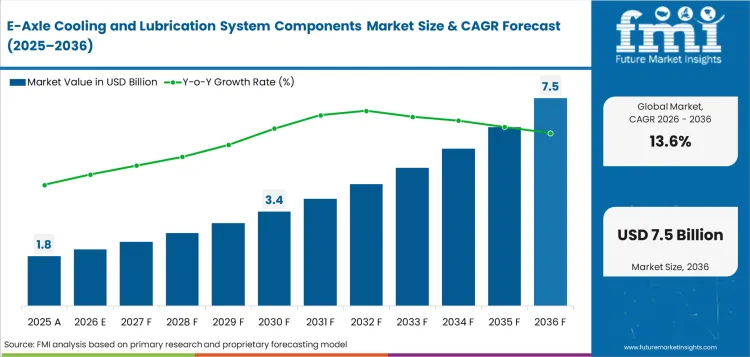
The e-axle cooling and lubrication system components market was valued at USD 1.8 billion in 2025 and is estimated to reach USD 2.1 billion in 2026. Sector is expected to rise to USD 7.5 billion by 2036 at 13.6% CAGR.
Summary of the E-Axle Cooling and Lubrication System Components Market
- Demand and Growth Drivers
- Compact e-axle housings create higher heat pressure because motors and gears work close to each other inside one drive unit.
- Oil-based cooling is gaining use since it can remove heat near rotating parts and protect gear movement during vehicle operation.
- Commercial EV duty cycles increase the need for stable cooling and lubrication as motors face longer load periods.
- Product and Segment View
- Oil pumps are expected to lead the component type segment due to directed flow needs around gears and bearings.
- Oil circuits are expected to dominate the cooling medium segment through better access to rotating motor parts.
- Integrated e-axles are anticipated to lead the drive layout segment as automakers prefer compact drivetrain packaging.
- Geography and Competitive Outlook
- China and India show stronger readiness through EV assembly scale and local component sourcing.
- United States demand is shaped by electric pickups and SUVs that create higher drive-unit heat loads.
- BorgWarner and ZF hold early advantage through thermal system depth and electrified propulsion experience.
- Analyst Opinion
- Nikhil Kaitwade, Principal Consultant at FMI, says, “E-axle cooling and lubrication is becoming a key part of EV drivetrain design. Motors and gears now work inside tighter spaces, so heat control must be planned early. Oil pumps and fluid paths need to work together before an EV platform moves toward launch. Suppliers with proven pump life and fluid compatibility will have better access to OEM programs.”
- E-Axle Cooling and Lubrication System Components Market Value Analysis
- The e-axle cooling and lubrication system components market is moving from a support-part space into a more defined EV drivetrain component area.
- Suppliers gain pricing power through validated pump maps and seal packages that reduce rework during EV platform trials.
- Compact e-axle designs are placing motors and gears closer together, which raises the need for better heat control.
- Oil-based cooling is gaining relevance as it removes heat near rotating parts and protects gear movement inside the axle housing.
- Supplier value is rising through proven pump life and fluid compatibility during OEM platform approval.
Key Takeaways, Market Size, and Forecast
- E-axle cooling and lubrication system components market value stood at USD 1.8 billion in 2025.
- By 2036, market value is anticipated to reach USD 7.5 billion.
- Industry value is likely to expand at 13.6% CAGR from 2026 to 2036.
- Market expansion is forecast to create USD 5.4 billion in incremental opportunity between 2026 and 2036.
- OEM integration is anticipated to represent 71.0% share in 2026.
- In 2026, integrated e-axles are expected to account for 62.0% share.
- China and India are forecast to lead country demand at 15.8% CAGR and 14.6% CAGR, respectively, through 2036.
E-axle makers need better heat control as drive units become smaller and more powerful. MAHLE’s 2024 kit showed an e-axle with 520 kW peak power and built-in oil management. MAHLE’s kit makes oil flow and sealing parts a larger part of heavy-duty EV design. Wet e-axles need one fluid to cool the motor and protect the gears. FUCHS states that BluEV EDF 7727 is made for wet electric axles under MB 237.12. ZF’s 2025 TherMaS system offers at least 10 kW cooling and heating from -25°C to +35°C. OEMs will prefer suppliers that can manage e-axle heat with the overall EV thermal system.
E-Axle Cooling and Lubrication System Components Market Definition
E-axle cooling and lubrication system components market covers the parts used to control heat and fluid flow inside electric vehicle e-axle units. Cooling and lubrication parts protect the motor and gear system by moving oil or coolant through the drive unit during operation.
E-Axle Cooling and Lubrication System Components Market Inclusions
Scope includes oil pumps and coolant plates used around e-axle motor and gear sets. Heat exchangers and pressure sensors are included when sold all within the drive-unit fluid system. Revenue scope covers hardware and integrated assemblies used from 2026 to 2036. Key stakeholders include EV OEMs and drive-unit suppliers. Thermal module makers and lubricant formulators shape material testing needs.
E-Axle Cooling and Lubrication System Components Market Exclusions
Scope excludes battery-only cooling plates and cabin HVAC modules. Battery cells and standalone electric motors are excluded. Full vehicle service contracts are not counted. Routine coolant replacement is excluded unless bundled with e-axle component replacement.
E-Axle Cooling and Lubrication System Components Market Research Methodology
- Primary Research: Supplier portfolios and EV e-axle component information were reviewed to understand how cooling and lubrication parts are used in drive units.
- Desk Research: IEA data and official company releases were checked to connect EV production trends with e-axle thermal component use.
- Market Sizing and Forecasting: Market value was built by comparing EV platform volumes with the typical component content used in each drive-unit design.
- Data Validation: Final checks compared EV production trends with active supplier participation to confirm that the forecast stays practical and market-specific.
Why is the E-Axle Cooling and Lubrication System Components Market Expanding?
- Higher motor speeds raise oil flow needs around gears and bearings inside compact drive units.
- Direct oil cooling supports high-load e-axles as heat can be removed closer to rotating parts.
- Closed-loop coolant paths need filters and sensors to protect narrow passages from particles.
- Platform-level sourcing gives suppliers value once pumps and seals are validated before start of production.
EV drive-unit content is rising as production scale shifts toward compact electric platforms. IEA reported in May 2025 that global electric car production reached 17.3 million units in 2024. That volume raises demand for repeatable cooling and lubrication hardware across passenger EV programs. E-axles need oil flow around gears and bearings so heat does not damage seals. Suppliers with pump maps and cleanliness controls can move from trial orders into serial supply agreements.
Battery and motor heat now shape more drivetrain design choices than many vehicle users see. IEA reported EV battery demand of about 1.0 TWh in 2024. Higher EV battery demand signals rising electric vehicle production scale, which increases the need for validated thermal hardware across vehicle platforms. EV Coolant Filters and Strainers demand shows how particle control has become part of thermal design. Component makers that test fluid compatibility early can reduce validation delays for OEMs.
Market Segmentation Analysis
- In 2026, oil pumps are forecast to account for 34.0% share.
- Oil circuits are likely to hold 46.0% share in 2026.
- Passenger BEVs are anticipated to represent 58.0% share in 2026.
- Integrated e-axles are forecast to hold 62.0% share in 2026.
- OEM integration is expected to lead with 71.0% share in 2026.
E-Axle cooling and lubrication system components market is divided into five primary segment groups based on fluid function and vehicle platform use. Component type includes oil pumps and coolant plates. Heat exchangers and seals complete one part of the component scope. Filters and sensors complete the rest. Cooling medium includes oil circuits and water-glycol. Hybrid circuits and dielectric fluids cover newer designs. Vehicle type includes passenger BEVs and commercial EVs. Hybrid EVs and performance EVs add specific thermal needs. Drive layout includes integrated e-axles and modular e-drives. Axle add-ons are counted for targeted thermal upgrades. Sales channel includes OEM integration and service parts. Prototype programs cover early test demand.
Insights into E-Axle Cooling and Lubrication System Components Market by Component Type
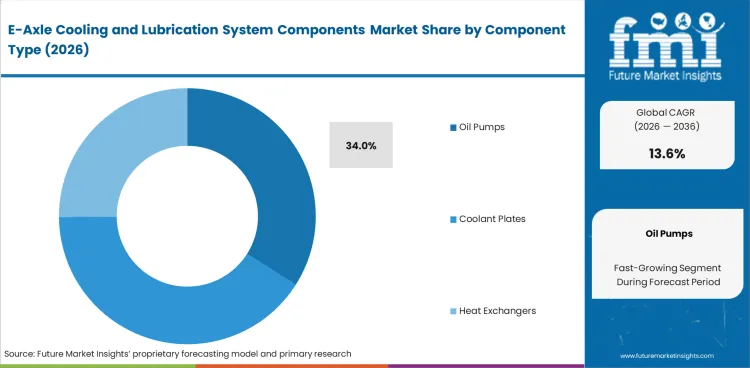
- In 2026, oil pumps are forecast to hold 34.0% as high-speed gears need directed oil flow before heat builds inside the housing.
- Automotive coolant distribution manifold for EV battery demand shows a similar shift toward managed flow paths. E-axles add foam control needs from rotating parts.
Insights into E-Axle Cooling and Lubrication System Components Market by Cooling Medium
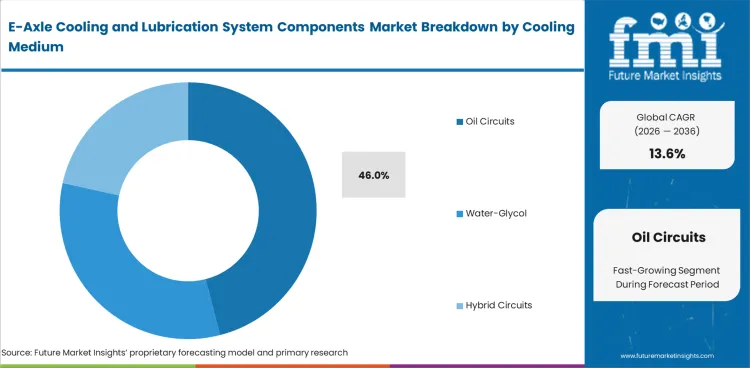
- Oil circuits are estimated to represent 46.0% in 2026 since one fluid can cool motor parts and protect the reduction gear set.
- Water-glycol loops will support external jackets and plates. Direct oil circuits are being used more inside compact e-axles because they can reach rotating parts more closely.
Insights into E-Axle Cooling and Lubrication System Components Market by Vehicle Type
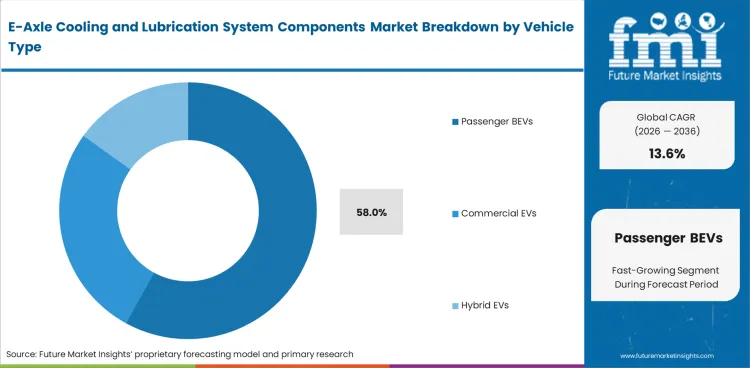
- Passenger BEVs are forecast to account for 58.0% in 2026 due to higher platform volumes and repeated use of similar drive-unit designs.
- Commercial EVs add smaller volume and create tougher operating needs. Longer duty cycles raise the need for durable seals and filters that protect the axle system under load.
Insights into E-Axle Cooling and Lubrication System Components Market by Drive Layout
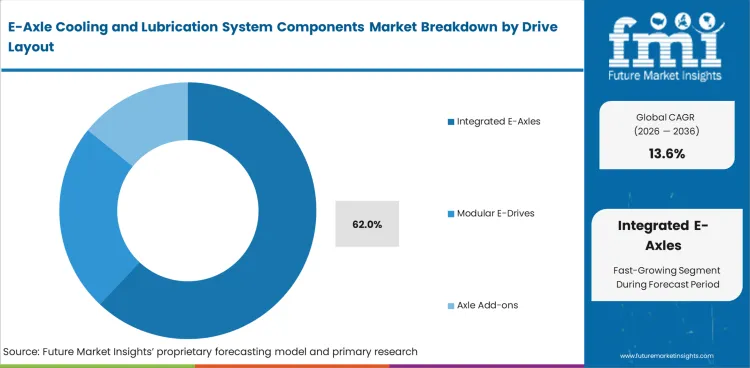
- In 2026, integrated e-axles are anticipated to account for 62.0% because compact packaging reduces hose length and limits external connection points.
- Modular e-drives will keep value for platforms that need flexible sourcing. Axle add-ons support early EV trials that need targeted cooling upgrades.
Insights into E-Axle Cooling and Lubrication System Components Market by Sales Channel
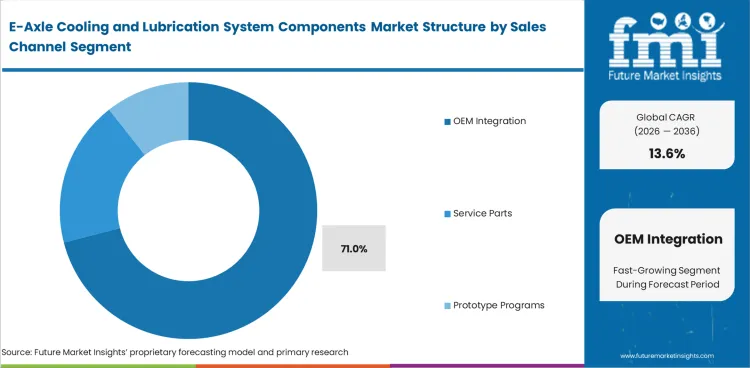
- OEM integration is forecast to capture 71.0% in 2026 as cooling plates and seals must pass durability checks before vehicle launch approval.
- Service parts will gain more attention after warranty cycles begin. Pump wear and filter loading will depend on vehicle duty cycle and operating climate.
E-Axle Cooling and Lubrication System Components Market Drivers, Restraints, and Opportunities
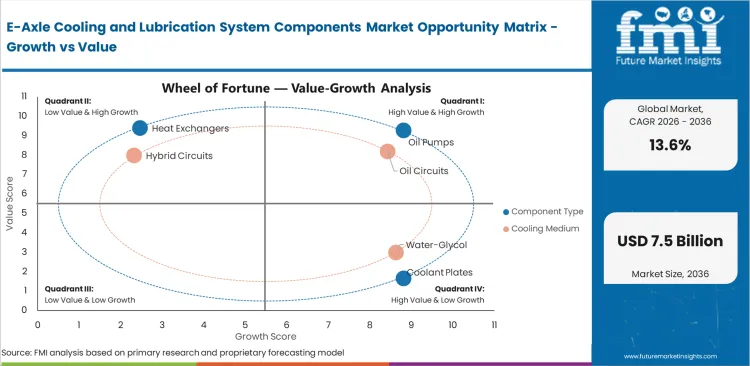
- Oil-jet cooling creates a need for precision pumps that keep oil flow steady at changing motor speeds.
- Material compatibility can slow sourcing if seals swell or harden in new EV drive fluids.
- Controlled pumps and valves improve heat sensing and fluid movement inside compact e-axles.
- Automotive electric coolant valve demand reflects the shift toward active fluid routing in EV thermal loops.
Oil Jet Heat Removal
Direct oil cooling is drawing more design attention as e-axles move toward higher speed and tighter packaging. IEA reported that over 4.0 million electric cars were sold worldwide in the first quarter of 2025. First-quarter vehicle scale gives suppliers a stronger reason to qualify oil jets and electric pumps for repeat EV programs. Flow control must stay stable at higher motor speeds so oil does not foam inside the housing. Battery thermal plates demand shows the same focus on planned heat paths. E-axle suppliers are now applying that approach inside the drive unit.
Fluid Compatibility Barrier
Fluid selection can slow approval because e-axle oil must cool parts and protect gear movement near electronic systems. ZF stated in June 2025 that TherMaS offers at least 10.0 kW cooling and heating capacity across outside temperatures from minus 25 C to plus 35 C. Wide temperature changes explain why seals and plastic parts need longer testing. Thermal management materials for EV batteries demand shows the same need for stable materials under heat. Suppliers that prove swelling and aging performance can shorten the approval path.
Controlled Coolant Routing
Valve and sensor content is rising as e-axle loops need better control across motors and gears. BorgWarner highlighted integrated thermal modules and eCoolers at IAA Mobility in September 2025. This points to a component mix in which pumps and sensors work as one managed package. Suppliers that combine hardware with calibration support can protect more value per EV platform.
Analysis of E-Axle Cooling and Lubrication System Components Market by Key Countries
.webp "Top Country Growth Comparison E Axle Cooling And Lubrication System Components Market Cagr (2026 2036)")
| Country | CAGR |
|---|---|
| China | 15.8% |
| India | 14.6% |
| United States | 13.9% |
| Germany | 13.5% |
| South Korea | 13.2% |
| Japan | 12.9% |
| France | 12.6% |
Source: Future Market Insights, 2026.
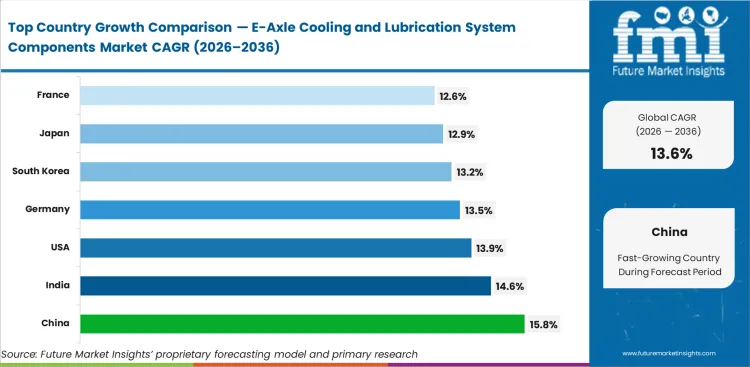
E-Axle Cooling and Lubrication System Components Market CAGR Analysis by Country
- China is forecast to advance at 15.8% CAGR through 2036 as local EV production supports e-axle cooling and lubrication component sourcing.
- India is expected to expand at 14.6% CAGR during the forecast period as EV assembly creates more need for compact drive-unit thermal parts.
- United States demand is forecast to rise at 13.9% CAGR by 2036 with electric pickups and SUVs raising heat loads inside e-axles.
- Germany is anticipated to move at 13.5% CAGR over the study period through premium EV engineering and strong driveline supplier depth.
- Across the assessment period, South Korea is forecast to register 13.2% CAGR as EV exports support compact cooling and lubrication hardware.
- Japan is expected to post 12.9% CAGR in this market by 2036 through hybrid and BEV platform work.
- France is likely to rise at 12.6% CAGR from 2026 to 2036 as European EV programs support localized e-axle component use.
Demand Outlook for E-Axle Cooling and Lubrication System Components Market in China
The market in China is forecast to expand at 15.8% CAGR through 2036 as local EV production creates steady need for e-axle cooling and lubrication parts. IEA reported that China produced 12.4 million electric cars in 2024 and held over 70.0% of global output. Large production volume gives pump and seal suppliers more opportunities to test cost-efficient designs. Local sourcing helps suppliers work closer to EV assembly plants.
- EV assembly scale supports local pump and heat exchanger sourcing.
- Battery-electric programs need compact e-axles with cleaner oil flow.
- Supplier parks can reduce testing time for seals and sensors.
Sales Analysis of E-Axle Cooling and Lubrication System Components Market in India
IEA reported nearly 35,000.0 electric car sales in India during the first quarter of 2025 after 45.0% year-over-year expansion. India is expected to advance at 14.6% CAGR by 2036 led by local EV assembly creating openings for compact drive-unit thermal parts. Early EV scale can support prototype orders for pumps and coolant plates. Local testing can help suppliers enter higher-power EV programs with lower approval risk.
- Supplier clusters support e-drive machining and sealing trials.
- Charging funding improves confidence in longer-range EV platforms.
- Local EV assembly increases use of coolant and lubrication subassemblies.
Demand Analysis of E-Axle Cooling and Lubrication System Components Market in the United States
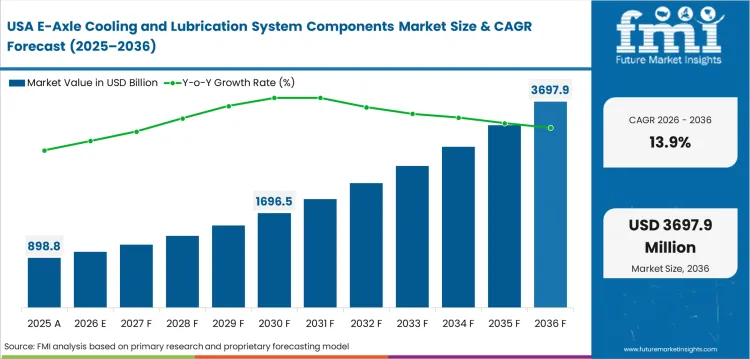
United States demand follows heavier EVs that place more pressure on gear cooling and bearing life. Over 360,000.0 electric cars were sold in the country during the first quarter of 2025. IEA placed the figure about 10.0% above the same period in 2024. Heavier EVs need stronger oil flow inside drive units. The market in the United States is forecast to rise at 13.9% CAGR during the forecast period. Suppliers with truck and SUV validation experience can enter platform planning earlier.
- Powertrain engineering supports early testing of pumps and seals for EV trucks.
- Zero-emission vehicle rules push OEMs to improve drive-unit efficiency.
- EV assembly investments create sourcing routes for heat exchangers and fluid modules.
Future Outlook for E-Axle Cooling and Lubrication System Components Market in Germany
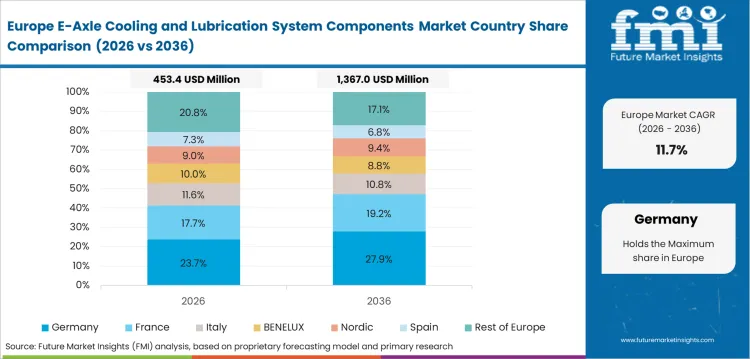
Germany is expected to move ahead at 13.5% CAGR over the study period. Germany has a strong driveline engineering base, which supports e-axle cooling and lubrication component work. IEA reported that German OEMs marked a 5.0% year-over-year increase in their EU electric car output in 2024. Higher EV output creates more need for quiet pumps and durable seals. Supplier value will depend on proven performance in high-speed drive units.
- Powertrain suppliers support oil pump and bearing package development.
- Premium EV programs need low-noise thermal hardware.
- Strict quality checks raise testing needs for fluid aging and seal materials.
Demand Analysis for E-Axle Cooling and Lubrication System Components Market in South Korea
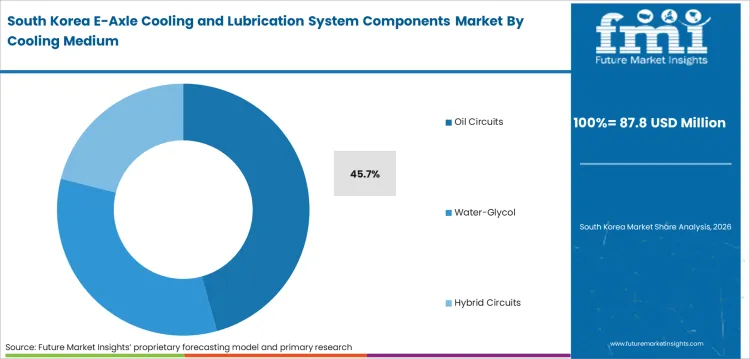
South Korea benefits from EV export programs and battery supply depth. Local thermal testing can help suppliers protect their place in export-focused platforms. Japan and South Korea accounted for most of the nearly 640,000.0 electric cars exported from Asia Pacific outside China in 2024. During 2026 to 2036, South Korea is expected to record 13.2% CAGR. Export activity supports compact e-drive hardware that can be used across global EV programs.
- Vehicle output supports e-axle seal and filter demand.
- Electronics suppliers strengthen sensor supply for active cooling loops.
- Battery clusters improve know-how in heat exchangers and coolant path testing.
Sales Outlook for E-Axle Cooling and Lubrication System Components Market in Japan
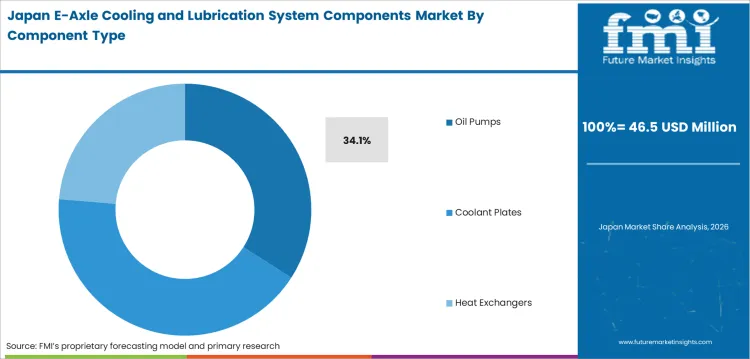
Japan is expected to post 12.9% CAGR in this market by 2036. Compact pumps with quiet lubrication can support smaller EV platforms and local quality needs. The country’s demand outlook is tied to careful hybrid and BEV platform planning. Asia Pacific electric car production outside China reached about 1.0 million units in 2024, with Japan and Korea accounting for most of the region’s nearly 640,000.0 exports.
- Powertrain engineering supports precision seals and quiet drive-unit assemblies.
- Vehicle production gives suppliers a route into compact BEV platforms.
- Mobility planning supports electrified component work across domestic manufacturers.
Opportunity Analysis for E-Axle Cooling and Lubrication System Components Market in France
France follows the European EV supply path through local vehicle assembly and emissions rules. IEA reported that European electric car sales reached over 900,000.0 units in the first quarter of 2025. Higher EV sales support local component supply for drive units and thermal packages. The market in France is forecast to advance at 12.6% CAGR between 2026 and 2036. Proven fluid compatibility can help suppliers enter compact EV platform programs.
- EV battery projects support local interest in thermal plates and coolant modules.
- Renault’s EV hub can support more localized drive-unit component supply.
- European CO2 standards push French OEMs to improve e-drive efficiency.
Competitive Landscape and Strategic Positioning
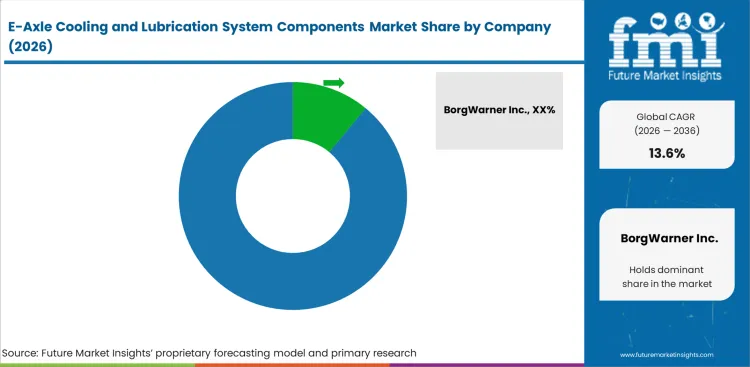
- Competition depends on validated thermal modules and oil pumps built for compact e-drive housings.
- BorgWarner and ZF hold leading positions through electrified propulsion and thermal portfolios.
- Specialist suppliers can gain more orders by proving that fluids and seals can work safely for long periods.
- Entry barriers are high because OEMs take time to approve parts and drive-unit failure can create warranty costs.
Established suppliers have an advantage because e-axle cooling and lubrication choices are made during platform design. BorgWarner highlighted integrated thermal modules and eCoolers at IAA Mobility 2025. These products give OEMs one supplier route for thermal hardware placed near electric motors and power electronics. ZF’s TherMaS launch in June 2025 shows that full-vehicle heat control now affects drive-unit planning. Suppliers that connect hardware performance with test data can reduce design risk for automakers.
Specialist component makers can win by solving one high-risk problem better than a full-system supplier. Seal makers focus on swelling and heat aging under EV fluid exposure. Filter suppliers focus on particle control in narrow coolant passages. EV powertrain programs need these parts to work safely near high-voltage systems under repeated load. Smaller suppliers need proof from durability tests and production samples.
Program selection favors companies with manufacturing depth near EV assembly locations. Magna announced a new facility in Wuhu in November 2025 to make eDrive systems for battery-electric vehicles in China. Hanon Systems showcased coolant modules and heat exchangers at AAPEX 2025. Thermal and driveline hardware are moving closer to EV production sites. Vehicle electrification programs are also driving the need for proven components near assembly plants.
Key Companies in the E-Axle Cooling and Lubrication System Components Market
- Global Leaders: BorgWarner and ZF Friedrichshafen AG compete through electrified propulsion and validated thermal supply. MAHLE GmbH adds thermal module strength and component manufacturing depth.
- Driveline Specialists: Dana Incorporated and Schaeffler AG compete through e-drive assembly depth and established OEM access. Magna International Inc. adds China eDrive manufacturing depth through the Wuhu facility.
- Thermal Specialists: Hanon Systems and GKN Automotive add competitive depth through thermal modules and eDrive experience.
Competitive Benchmarking: E-Axle Cooling and Lubrication System Components Market
| Company | E-Axle Thermal Depth | Oil Flow Validation | OEM Program Access | Geographic Footprint |
|---|---|---|---|---|
| BorgWarner | High | High | High | Global supply with North America depth |
| ZF Friedrichshafen AG | High | Medium | High | Global supply with European engineering depth |
| MAHLE GmbH | High | Medium | Medium | Global thermal component footprint |
| Schaeffler AG | Medium | High | High | Europe and Asia powertrain presence |
| Dana Incorporated | Medium | High | Medium | North America and off-highway depth |
| Magna International Inc. | Medium | Medium | High | Global supply with China expansion |
| Hanon Systems | High | Medium | Medium | Korea-centered thermal presence |
| GKN Automotive | Medium | Medium | Medium | Europe and Asia driveline footprint |
Source: Future Market Insights competitive analysis, 2026. Ratings reflect relative positioning based on e-axle thermal depth, oil flow validation and OEM program access.
Recent Developments in the E-Axle Cooling and Lubrication System Components Market
- In February 2026, ZF secured a multi-year India order for several thousand AxTrax 2 LF electric portal axles. The axle uses advanced oil cooling and supports higher e-axle thermal control in electric city buses.
- In December 2025, Schaeffler presented a compact range extender module with a cooling system and oil filter. The module shows that oil flow and compact thermal parts are drawing more design attention inside electrified drivetrain modules.
Key Companies in the E-Axle Cooling and Lubrication System Components Market
- BorgWarner Inc.
- ZF Friedrichshafen AG
- MAHLE GmbH
- Schaeffler AG
- Dana Incorporated
- Magna International Inc.
- Hanon Systems
- GKN Automotive
Report Scope and Coverage
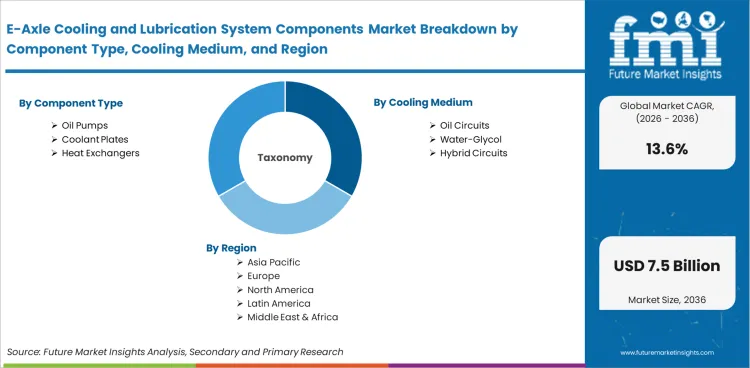
| Parameter | Details |
|---|---|
| Quantitative Units | USD 2.1 billion to USD 7.5 billion at 13.6% CAGR |
| Market Definition | Cooling and lubrication hardware used inside or around EV e-axle assemblies |
| Component Type | Oil Pumps and Coolant Plates, Heat Exchangers and Seals, Filters and Sensors |
| Cooling Medium | Oil Circuits and Water-Glycol, Hybrid Circuits and Dielectric Fluids |
| Vehicle Type | Passenger BEVs and Commercial EVs, Hybrid EVs and Performance EVs |
| Drive Layout | Integrated E-Axles and Modular E-Drives, Axle Add-ons |
| Sales Channel | OEM Integration and Service Parts, Prototype Programs |
| Countries Covered | China, India, United States, Germany, South Korea, Japan, France |
| Key Companies Profiled | BorgWarner Inc., ZF Friedrichshafen AG, MAHLE GmbH, Schaeffler AG, Dana Incorporated, Magna International Inc., Hanon Systems, GKN Automotive |
| Forecast Period | 2026 to 2036 |
| Approach | Hybrid bottom-up and top-down model using EV platform count and component value checks |
E-Axle Cooling and Lubrication System Components Market Taxonomy
By Component Type
- Oil Pumps
- Coolant Plates
- Heat Exchangers
- Seals
- Filters
- Sensors
By Cooling Medium
- Oil Circuits
- Water-Glycol
- Hybrid Circuits
- Dielectric Fluids
By Vehicle Type
- Passenger BEVs
- Commercial EVs
- Hybrid EVs
- Performance EVs
By Drive Layout
- Integrated E-Axles
- Modular E-Drives
- Axle Add-ons
By Sales Channel
- OEM Integration
- Service Parts
- Prototype Programs
Research Sources and Bibliography
- ZF Friedrichshafen AG. (2026, February 16). AxTrax 2 LF: ZF secures major India city bus order. ZF Press Center.
- Schaeffler AG. (2025, December 2). Schaeffler presents new products from its electrification range at the CTI in Berlin. Schaeffler.
- International Energy Agency. (2025, May 14). Trends in the electric car industry. In Global EV Outlook 2025. IEA.
- International Energy Agency. (2025, May 14). Trends in electric car markets. In Global EV Outlook 2025. IEA.
- International Energy Agency. (2025, May 14). Electric vehicle batteries. In Global EV Outlook 2025. IEA.
- ZF Friedrichshafen AG. (2025, June 3). Comfortable temperature for electric cars: New ZF thermal management system increases range by up to 10 percent. ZF Press Center.
- BorgWarner Inc. (2025, September 8). BorgWarner showcases products for propulsion system diversity at IAA Mobility 2025. BorgWarner.
- Magna International Inc. (2025, November 19). Magna deepens China footprint to meet growing EV demand. Magna.
- Hanon Systems. (2025, November 4). Hanon Systems joins Hankook & Company Group to showcase thermal management technologies at AAPEX 2025. Hanon Systems.
- European Commission. (2025). Cars and vans. European Commission.
This Report Answers
- What is the expected value of E-Axle Cooling and Lubrication System Components in 2026 and 2036?
- What CAGR is expected for the market during the 2026 to 2036 forecast period?
- Which component type is likely to lead demand and what explains its share?
- How do oil circuits compare with water-glycol loops in e-axle cooling design?
- Which countries are forecast above the global market average?
- Which companies are active in e-axle cooling and lubrication component supply?
- How are EV production trends changing pump and seal demand?
Frequently Asked Questions
What is the global market value for E-Axle Cooling and Lubrication System Components in 2026?
Global demand is set to be worth USD 2.1 billion in 2026 as EV platforms add higher thermal content.
What is the forecast value of the market by 2036?
Market value is set to reach USD 7.5 billion by 2036 as integrated e-axles need validated fluid hardware.
What CAGR is anticipated for the forecast period?
Demand is forecast to expand at 13.6% CAGR from 2026 to 2036 due to higher drive-unit content.
Which component type is likely to lead the market?
Oil pumps are likely to lead component type with 34.0% share in 2026 as directed flow protects gears.
Which sales channel has the leading share?
OEM integration is estimated to hold 71.0% share in 2026 since fluid paths are qualified before launch.
Which country has the faster country outlook?
China is forecast to record 15.8% CAGR through 2036 as EV production scale supports local e-axle component sourcing.
What does the market include?
Market scope includes pumps and coolant plates. Heat exchangers and seals used around EV e-axle assemblies are included. Filters and sensors used in the same assembly are also counted.
How was the forecast prepared?
FMI used EV platform counts, component values and supplier evidence to build the forecast.
Which cooling medium is best for compact e-axles?
Oil circuits suit compact e-axles since one fluid can lubricate gears and remove heat.
What is the difference between oil circuits and water-glycol loops?
Oil circuits flow around gears directly. Water-glycol loops remove heat through plates or jackets outside rotating parts.
Which vehicles use these components most?
Passenger BEVs use the highest component volume as shared platforms create volume. Commercial EVs add demand through heavier duty cycles.
Preview the report firsthand - request a free sample
Get SampleGet the brochure for pricing and purchase details.
Get PDFTable of Content
- Executive Summary
- Global Market Outlook
- Demand-side Trends
- Supply-side Trends
- Technology Roadmap Analysis
- Analysis and Recommendations
- Market Overview
- Market Coverage / Taxonomy
- Market Definition / Scope / Limitations
- Research Methodology
- Chapter Orientation
- Analytical Lens and Working Hypotheses
- Market Structure, Signals, and Trend Drivers
- Benchmarking and Cross-market Comparability
- Market Sizing, Forecasting, and Opportunity Mapping
- Research Design and Evidence Framework
- Desk Research Programme (Secondary Evidence)
- Company Annual and Sustainability Reports
- Peer-reviewed Journals and Academic Literature
- Corporate Websites, Product Literature, and Technical Notes
- Earnings Decks and Investor Briefings
- Statutory Filings and Regulatory Disclosures
- Technical White Papers and Standards Notes
- Trade Journals, Industry Magazines, and Analyst Briefs
- Conference Proceedings, Webinars, and Seminar Materials
- Government Statistics Portals and Public Data Releases
- Press Releases and Reputable Media Coverage
- Specialist Newsletters and Curated Briefings
- Sector Databases and Reference Repositories
- FMI Internal Proprietary Databases and Historical Market Datasets
- Subscription Datasets and Paid Sources
- Social Channels, Communities, and Digital Listening Inputs
- Additional Desk Sources
- Expert Input and Fieldwork (Primary Evidence)
- Primary Modes
- Qualitative Interviews and Expert Elicitation
- Quantitative Surveys and Structured Data Capture
- Blended Approach
- Why Primary Evidence is Used
- Field Techniques
- Interviews
- Surveys
- Focus Groups
- Observational and In-context Research
- Social and Community Interactions
- Stakeholder Universe Engaged
- C-suite Leaders
- Board Members
- Presidents and Vice Presidents
- R&D and Innovation Heads
- Technical Specialists
- Domain Subject-matter Experts
- Scientists
- Physicians and Other Healthcare Professionals
- Governance, Ethics, and Data Stewardship
- Research Ethics
- Data Integrity and Handling
- Primary Modes
- Tooling, Models, and Reference Databases
- Desk Research Programme (Secondary Evidence)
- Data Engineering and Model Build
- Data Acquisition and Ingestion
- Cleaning, Normalisation, and Verification
- Synthesis, Triangulation, and Analysis
- Quality Assurance and Audit Trail
- Market Background
- Market Dynamics
- Drivers
- Restraints
- Opportunity
- Trends
- Scenario Forecast
- Demand in Optimistic Scenario
- Demand in Likely Scenario
- Demand in Conservative Scenario
- Opportunity Map Analysis
- Product Life Cycle Analysis
- Supply Chain Analysis
- Investment Feasibility Matrix
- Value Chain Analysis
- PESTLE and Porter’s Analysis
- Regulatory Landscape
- Regional Parent Market Outlook
- Production and Consumption Statistics
- Import and Export Statistics
- Market Dynamics
- Global Market Analysis 2021 to 2025 and Forecast, 2026 to 2036
- Historical Market Size Value (USD Million) Analysis, 2021 to 2025
- Current and Future Market Size Value (USD Million) Projections, 2026 to 2036
- Y-o-Y Growth Trend Analysis
- Absolute $ Opportunity Analysis
- Global Market Pricing Analysis 2021 to 2025 and Forecast 2026 to 2036
- Global Market Analysis 2021 to 2025 and Forecast 2026 to 2036, By Component Type
- Introduction / Key Findings
- Historical Market Size Value (USD Million) Analysis By Component Type , 2021 to 2025
- Current and Future Market Size Value (USD Million) Analysis and Forecast By Component Type , 2026 to 2036
- Oil Pumps
- Coolant Plates
- Heat Exchangers
- Oil Pumps
- Y-o-Y Growth Trend Analysis By Component Type , 2021 to 2025
- Absolute $ Opportunity Analysis By Component Type , 2026 to 2036
- Global Market Analysis 2021 to 2025 and Forecast 2026 to 2036, By Cooling Medium
- Introduction / Key Findings
- Historical Market Size Value (USD Million) Analysis By Cooling Medium, 2021 to 2025
- Current and Future Market Size Value (USD Million) Analysis and Forecast By Cooling Medium, 2026 to 2036
- Oil Circuits
- Water-Glycol
- Hybrid Circuits
- Oil Circuits
- Y-o-Y Growth Trend Analysis By Cooling Medium, 2021 to 2025
- Absolute $ Opportunity Analysis By Cooling Medium, 2026 to 2036
- Global Market Analysis 2021 to 2025 and Forecast 2026 to 2036, By Vehicle Type
- Introduction / Key Findings
- Historical Market Size Value (USD Million) Analysis By Vehicle Type, 2021 to 2025
- Current and Future Market Size Value (USD Million) Analysis and Forecast By Vehicle Type, 2026 to 2036
- Passenger BEVs
- Commercial EVs
- Hybrid EVs
- Passenger BEVs
- Y-o-Y Growth Trend Analysis By Vehicle Type, 2021 to 2025
- Absolute $ Opportunity Analysis By Vehicle Type, 2026 to 2036
- Global Market Analysis 2021 to 2025 and Forecast 2026 to 2036, By Drive Layout
- Introduction / Key Findings
- Historical Market Size Value (USD Million) Analysis By Drive Layout, 2021 to 2025
- Current and Future Market Size Value (USD Million) Analysis and Forecast By Drive Layout, 2026 to 2036
- Integrated E-Axles
- Modular E-Drives
- Axle Add-ons
- Integrated E-Axles
- Y-o-Y Growth Trend Analysis By Drive Layout, 2021 to 2025
- Absolute $ Opportunity Analysis By Drive Layout, 2026 to 2036
- Global Market Analysis 2021 to 2025 and Forecast 2026 to 2036, By Sales Channel
- Introduction / Key Findings
- Historical Market Size Value (USD Million) Analysis By Sales Channel, 2021 to 2025
- Current and Future Market Size Value (USD Million) Analysis and Forecast By Sales Channel, 2026 to 2036
- OEM Integration
- Service Parts
- Prototype Programs
- OEM Integration
- Y-o-Y Growth Trend Analysis By Sales Channel, 2021 to 2025
- Absolute $ Opportunity Analysis By Sales Channel, 2026 to 2036
- Global Market Analysis 2021 to 2025 and Forecast 2026 to 2036, By Region
- Introduction
- Historical Market Size Value (USD Million) Analysis By Region, 2021 to 2025
- Current Market Size Value (USD Million) Analysis and Forecast By Region, 2026 to 2036
- North America
- Latin America
- Western Europe
- Eastern Europe
- East Asia
- South Asia and Pacific
- Middle East & Africa
- Market Attractiveness Analysis By Region
- North America Market Analysis 2021 to 2025 and Forecast 2026 to 2036, By Country
- Historical Market Size Value (USD Million) Trend Analysis By Market Taxonomy, 2021 to 2025
- Market Size Value (USD Million) Forecast By Market Taxonomy, 2026 to 2036
- By Country
- USA
- Canada
- Mexico
- By Component Type
- By Cooling Medium
- By Vehicle Type
- By Drive Layout
- By Sales Channel
- By Country
- Market Attractiveness Analysis
- By Country
- By Component Type
- By Cooling Medium
- By Vehicle Type
- By Drive Layout
- By Sales Channel
- Key Takeaways
- Latin America Market Analysis 2021 to 2025 and Forecast 2026 to 2036, By Country
- Historical Market Size Value (USD Million) Trend Analysis By Market Taxonomy, 2021 to 2025
- Market Size Value (USD Million) Forecast By Market Taxonomy, 2026 to 2036
- By Country
- Brazil
- Chile
- Rest of Latin America
- By Component Type
- By Cooling Medium
- By Vehicle Type
- By Drive Layout
- By Sales Channel
- By Country
- Market Attractiveness Analysis
- By Country
- By Component Type
- By Cooling Medium
- By Vehicle Type
- By Drive Layout
- By Sales Channel
- Key Takeaways
- Western Europe Market Analysis 2021 to 2025 and Forecast 2026 to 2036, By Country
- Historical Market Size Value (USD Million) Trend Analysis By Market Taxonomy, 2021 to 2025
- Market Size Value (USD Million) Forecast By Market Taxonomy, 2026 to 2036
- By Country
- Germany
- UK
- Italy
- Spain
- France
- Nordic
- BENELUX
- Rest of Western Europe
- By Component Type
- By Cooling Medium
- By Vehicle Type
- By Drive Layout
- By Sales Channel
- By Country
- Market Attractiveness Analysis
- By Country
- By Component Type
- By Cooling Medium
- By Vehicle Type
- By Drive Layout
- By Sales Channel
- Key Takeaways
- Eastern Europe Market Analysis 2021 to 2025 and Forecast 2026 to 2036, By Country
- Historical Market Size Value (USD Million) Trend Analysis By Market Taxonomy, 2021 to 2025
- Market Size Value (USD Million) Forecast By Market Taxonomy, 2026 to 2036
- By Country
- Russia
- Poland
- Hungary
- Balkan & Baltic
- Rest of Eastern Europe
- By Component Type
- By Cooling Medium
- By Vehicle Type
- By Drive Layout
- By Sales Channel
- By Country
- Market Attractiveness Analysis
- By Country
- By Component Type
- By Cooling Medium
- By Vehicle Type
- By Drive Layout
- By Sales Channel
- Key Takeaways
- East Asia Market Analysis 2021 to 2025 and Forecast 2026 to 2036, By Country
- Historical Market Size Value (USD Million) Trend Analysis By Market Taxonomy, 2021 to 2025
- Market Size Value (USD Million) Forecast By Market Taxonomy, 2026 to 2036
- By Country
- China
- Japan
- South Korea
- By Component Type
- By Cooling Medium
- By Vehicle Type
- By Drive Layout
- By Sales Channel
- By Country
- Market Attractiveness Analysis
- By Country
- By Component Type
- By Cooling Medium
- By Vehicle Type
- By Drive Layout
- By Sales Channel
- Key Takeaways
- South Asia and Pacific Market Analysis 2021 to 2025 and Forecast 2026 to 2036, By Country
- Historical Market Size Value (USD Million) Trend Analysis By Market Taxonomy, 2021 to 2025
- Market Size Value (USD Million) Forecast By Market Taxonomy, 2026 to 2036
- By Country
- India
- ASEAN
- Australia & New Zealand
- Rest of South Asia and Pacific
- By Component Type
- By Cooling Medium
- By Vehicle Type
- By Drive Layout
- By Sales Channel
- By Country
- Market Attractiveness Analysis
- By Country
- By Component Type
- By Cooling Medium
- By Vehicle Type
- By Drive Layout
- By Sales Channel
- Key Takeaways
- Middle East & Africa Market Analysis 2021 to 2025 and Forecast 2026 to 2036, By Country
- Historical Market Size Value (USD Million) Trend Analysis By Market Taxonomy, 2021 to 2025
- Market Size Value (USD Million) Forecast By Market Taxonomy, 2026 to 2036
- By Country
- Kingdom of Saudi Arabia
- Other GCC Countries
- Turkiye
- South Africa
- Other African Union
- Rest of Middle East & Africa
- By Component Type
- By Cooling Medium
- By Vehicle Type
- By Drive Layout
- By Sales Channel
- By Country
- Market Attractiveness Analysis
- By Country
- By Component Type
- By Cooling Medium
- By Vehicle Type
- By Drive Layout
- By Sales Channel
- Key Takeaways
- Key Countries Market Analysis
- USA
- Pricing Analysis
- Market Share Analysis, 2025
- By Component Type
- By Cooling Medium
- By Vehicle Type
- By Drive Layout
- By Sales Channel
- Canada
- Pricing Analysis
- Market Share Analysis, 2025
- By Component Type
- By Cooling Medium
- By Vehicle Type
- By Drive Layout
- By Sales Channel
- Mexico
- Pricing Analysis
- Market Share Analysis, 2025
- By Component Type
- By Cooling Medium
- By Vehicle Type
- By Drive Layout
- By Sales Channel
- Brazil
- Pricing Analysis
- Market Share Analysis, 2025
- By Component Type
- By Cooling Medium
- By Vehicle Type
- By Drive Layout
- By Sales Channel
- Chile
- Pricing Analysis
- Market Share Analysis, 2025
- By Component Type
- By Cooling Medium
- By Vehicle Type
- By Drive Layout
- By Sales Channel
- Germany
- Pricing Analysis
- Market Share Analysis, 2025
- By Component Type
- By Cooling Medium
- By Vehicle Type
- By Drive Layout
- By Sales Channel
- UK
- Pricing Analysis
- Market Share Analysis, 2025
- By Component Type
- By Cooling Medium
- By Vehicle Type
- By Drive Layout
- By Sales Channel
- Italy
- Pricing Analysis
- Market Share Analysis, 2025
- By Component Type
- By Cooling Medium
- By Vehicle Type
- By Drive Layout
- By Sales Channel
- Spain
- Pricing Analysis
- Market Share Analysis, 2025
- By Component Type
- By Cooling Medium
- By Vehicle Type
- By Drive Layout
- By Sales Channel
- France
- Pricing Analysis
- Market Share Analysis, 2025
- By Component Type
- By Cooling Medium
- By Vehicle Type
- By Drive Layout
- By Sales Channel
- India
- Pricing Analysis
- Market Share Analysis, 2025
- By Component Type
- By Cooling Medium
- By Vehicle Type
- By Drive Layout
- By Sales Channel
- ASEAN
- Pricing Analysis
- Market Share Analysis, 2025
- By Component Type
- By Cooling Medium
- By Vehicle Type
- By Drive Layout
- By Sales Channel
- Australia & New Zealand
- Pricing Analysis
- Market Share Analysis, 2025
- By Component Type
- By Cooling Medium
- By Vehicle Type
- By Drive Layout
- By Sales Channel
- China
- Pricing Analysis
- Market Share Analysis, 2025
- By Component Type
- By Cooling Medium
- By Vehicle Type
- By Drive Layout
- By Sales Channel
- Japan
- Pricing Analysis
- Market Share Analysis, 2025
- By Component Type
- By Cooling Medium
- By Vehicle Type
- By Drive Layout
- By Sales Channel
- South Korea
- Pricing Analysis
- Market Share Analysis, 2025
- By Component Type
- By Cooling Medium
- By Vehicle Type
- By Drive Layout
- By Sales Channel
- Russia
- Pricing Analysis
- Market Share Analysis, 2025
- By Component Type
- By Cooling Medium
- By Vehicle Type
- By Drive Layout
- By Sales Channel
- Poland
- Pricing Analysis
- Market Share Analysis, 2025
- By Component Type
- By Cooling Medium
- By Vehicle Type
- By Drive Layout
- By Sales Channel
- Hungary
- Pricing Analysis
- Market Share Analysis, 2025
- By Component Type
- By Cooling Medium
- By Vehicle Type
- By Drive Layout
- By Sales Channel
- Kingdom of Saudi Arabia
- Pricing Analysis
- Market Share Analysis, 2025
- By Component Type
- By Cooling Medium
- By Vehicle Type
- By Drive Layout
- By Sales Channel
- Turkiye
- Pricing Analysis
- Market Share Analysis, 2025
- By Component Type
- By Cooling Medium
- By Vehicle Type
- By Drive Layout
- By Sales Channel
- South Africa
- Pricing Analysis
- Market Share Analysis, 2025
- By Component Type
- By Cooling Medium
- By Vehicle Type
- By Drive Layout
- By Sales Channel
- USA
- Market Structure Analysis
- Competition Dashboard
- Competition Benchmarking
- Market Share Analysis of Top Players
- By Regional
- By Component Type
- By Cooling Medium
- By Vehicle Type
- By Drive Layout
- By Sales Channel
- Competition Analysis
- Competition Deep Dive
- BorgWarner Inc.
- Overview
- Product Portfolio
- Profitability by Market Segments (Product/Age /Sales Channel/Region)
- Sales Footprint
- Strategy Overview
- Marketing Strategy
- Product Strategy
- Channel Strategy
- ZF Friedrichshafen AG
- MAHLE GmbH
- Schaeffler AG
- Dana Incorporated
- Magna International Inc.
- BorgWarner Inc.
- Competition Deep Dive
- Assumptions & Acronyms Used


