

- Industry Size (2026)
- USD 1.4 Bn
- Forecast (2036)
- USD 2.2 Bn
- CAGR (2026 to 2036)
- 4.5%
Roll Cooling and Lubrication Systems Market Size, Market Forecast and Outlook By FMI
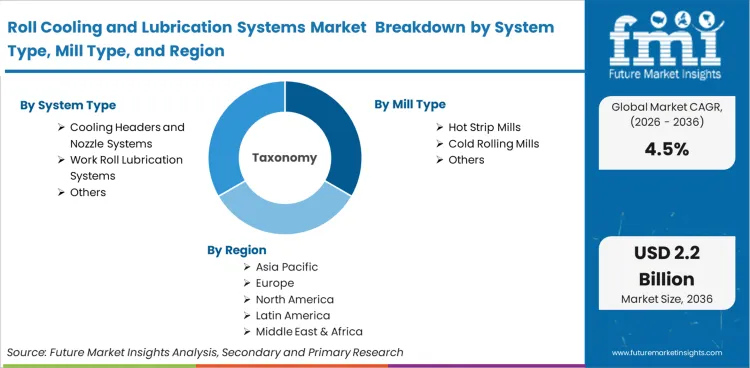
The roll cooling and lubrication systems market is estimated at USD 1.34 billion in 2025; it is set to reach USD 1.4 billion in 2026, and USD 2.2 billion by 2036 at a CAGR of 4.5%. Cooling headers and nozzle systems remain the leading system type in 2026 because thermal management sits at the center of roll life, strip quality, and mill productivity. Hot strip mills account for the largest workflow demand, while integrated steel plants remain the leading end-use class by revenue. Market growth is supported by the need to reduce roll wear, manage thermal crown, sustain surface quality, and lower rolling force in modern mills.
Summary of Roll Cooling and Lubrication Systems Market
- Key Drivers
- Process stability remains a major demand driver. Poor roll cooling shows up quickly in strip quality, roll wear, and unplanned maintenance, which keeps mills focused on targeted spray systems, nozzle optimization, and recirculation packages.
- Energy and cost pressure remain the second driver. Work roll lubrication can reduce friction and rolling force, which directly improves mill economics and makes lubrication an operating-leverage tool rather than a simple maintenance add-on.
- The third driver is automation and condition monitoring. Buyers increasingly want integrated systems that go beyond spraying coolant and instead offer recirculation control, filtration, diagnostics, and repeatable performance under changing mill conditions.
- Key Segments Analyzed in the Report
- System type: cooling headers and nozzle systems, work roll lubrication systems, emulsion preparation and recirculation units, filtration and condition monitoring systems, others
- Mill type: hot strip mills, cold rolling mills, plate mills, aluminum rolling mills, others
- End use: integrated steel plants, mini mills, aluminum producers, metal service centers
- Region: North America, Latin America, Western Europe, Eastern Europe, East Asia, South Asia & Pacific, and Middle East & Africa
- Analyst Opinion
- Nikhil Kaitwade, Principal Consultant at Future Market Insights, opines that this market rewards suppliers that can prove metallurgical and mechanical outcomes, not just fluid delivery. Cooling and lubrication become strategic when they improve roll life, strip shape, and throughput at the same time.
- Roll Cooling and Lubrication Systems Market Definition
- The roll cooling and lubrication systems market includes engineered systems used to cool and lubricate rolls in metal rolling operations. It covers spray headers, nozzles, work roll lubrication units, emulsion preparation systems, recirculation skids, filtration equipment, controls, and related services used in hot and cold rolling.
- Roll Cooling and Lubrication Systems Market Inclusions
- Revenue from dedicated cooling, lubrication, recirculation, and filtration systems for rolling mills
- Engineering, retrofit, and service revenue tied to mill cooling and lubrication upgrades
- Control and monitoring layers that directly support roll cooling or work roll lubrication
- Roll Cooling and Lubrication Systems Market Exclusions
- General plant water systems not dedicated to rolling operations
- Standalone industrial lubricants sold without system scope
- Rolling mill equipment with no direct cooling or lubrication function
- Roll Cooling and Lubrication Systems Market Research Methodology
- This study evaluates the market across key segments and regions for the base year 2025 and the forecast period 2026 to 2036. All market values are presented in USD billion. The analysis is built on a review of regulatory references, company disclosures, product and technology developments, trade literature, and industry documentation relevant to the value chain. Market estimates are derived through triangulation of demand-side trends, supply-side positioning, pricing dynamics, application intensity, and regional adoption patterns to establish current market size and forecast potential.
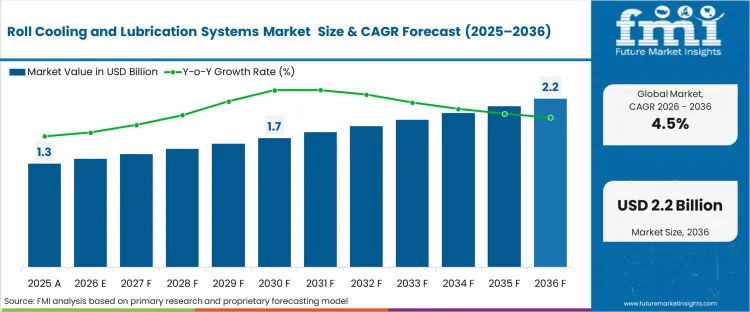
Key Drivers, Restraints, and Trends in Roll Cooling and Lubrication Systems Market
Drivers
Demand is underpinned by strip-quality requirements, roll-life economics, and ongoing modernization in steel and aluminum rolling. Mills continue to invest in cooling and lubrication because inconsistent thermal control can damage surface quality, accelerate wear, and reduce throughput. Lubrication also remains important where friction reduction can improve force control and operating efficiency.
Restraints
The main restraints are capital cost, shutdown complexity, and the fact that performance depends on mill-specific tuning rather than on hardware alone. Even strong systems may underperform if spray geometry, recirculation quality, nozzle condition, and lubrication settings are not aligned with the specific mill environment. This makes adoption slower in plants with short shutdown windows or older rolling infrastructure.
Trends
The clearest trend is the move from basic spray infrastructure toward more integrated cooling, lubrication, filtration, and digital monitoring packages. Buyers increasingly want systems that can support diagnostics, recirculation quality, and repeatable application performance rather than treating cooling and lubrication as isolated utility functions.
Segmental Analysis
Roll Cooling and Lubrication Systems Market Analysis by System Type
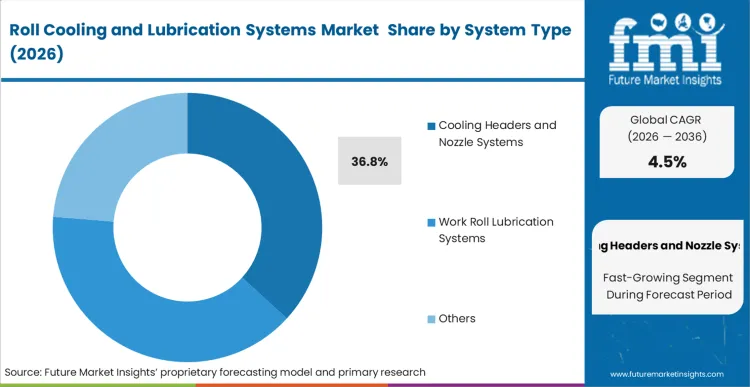
Cooling headers and nozzle systems are expected to hold the leading share of 36.8% in 2026. They remain the operational core of thermal management because mills cannot avoid the need to control heat at the roll gap and along the roll barrel. Their commercial importance is reinforced by the fact that cooling performance directly affects strip quality, roll life, and mill uptime.
Roll Cooling and Lubrication Systems Market Analysis by Mill Type
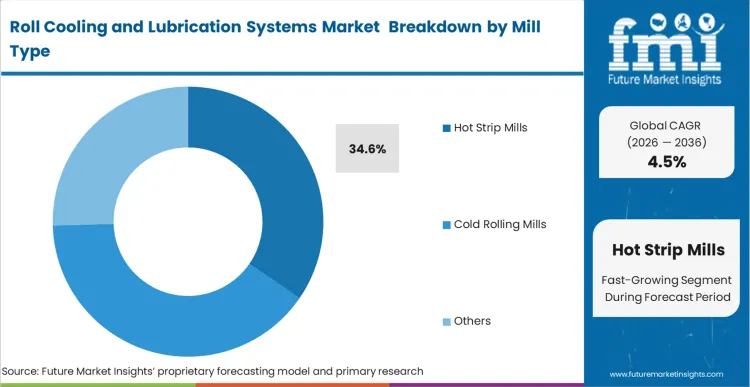
Hot strip mills are expected to remain the leading mill type with a 34.6% share in 2026. Thermal loads are high, quality sensitivity is immediate, and the economic penalty from inconsistent cooling or lubrication becomes visible quickly at production scale. This makes hot strip mills one of the most commercially important environments for engineered cooling and lubrication systems.
Competitive Aligners for Market Players
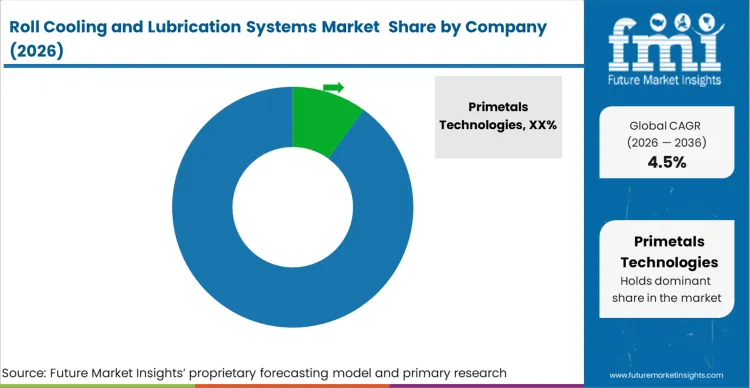
Competition in this market is shaped less by catalog breadth and more by process credibility inside live mill environments. Buyers do not evaluate roll cooling and lubrication systems as standalone utility packages. They evaluate them in terms of what they do to roll life, strip profile, thermal stability, and day-to-day operating consistency. That raises the bar for suppliers. Application engineering matters because spray placement, nozzle geometry, lubricant dosing, and recirculation quality all need to be matched to the exact mill layout and product mix. A system that performs well in one rolling environment may not deliver the same outcome in another without significant tuning.
Retrofit capability is another major competitive factor. Many mills are not building from scratch. They are upgrading existing assets under tight shutdown windows, which means suppliers need to integrate new cooling or lubrication hardware without disrupting mill balance, maintenance planning, or production schedules. That favors companies with strong commissioning support and a clear understanding of brownfield constraints. It also favors suppliers that can demonstrate measurable results after installation. Buyers respond more strongly to evidence of lower roll consumption, better surface consistency, reduced friction, or more stable thermal control than to general claims about system sophistication.
The strongest players also differentiate through fluid-management depth. Cooling and lubrication performance depends on more than sprays and headers alone. Filtration quality, emulsion stability, recirculation control, contamination management, and monitoring capability all affect results over time. Suppliers that can bring these elements together in a coordinated system are usually better positioned than vendors selling isolated hardware. In practice, market leadership tends to go to companies that can translate mechanical design into operating improvement and can prove that improvement in production conditions.
Key Players in Roll Cooling and Lubrication Systems Market
- Primetals Technologies
- Lechler GmbH
- SMS group GmbH
- Danieli & C. Officine Meccaniche S.p.A.
- ANDRITZ AG
- Butech Bliss
- Spraying Systems Co.
- TMEIC
- Nippon Steel Engineering
- Fives Group
Strategic Outlook by FMI on Roll Cooling and Lubrication Systems Market
The market is expected to expand steadily through 2036 as mills continue to balance capital spending against uptime, quality, and consumables performance. Stronger demand is likely to come from brownfield upgrades and from mills seeking better friction management without compromising strip surface integrity.
Scope of the Report
| Metric | Value |
|---|---|
| Market Value | USD 1.34 billion in 2025 to USD 2.2 billion by 2036 |
| CAGR | 4.5% from 2026 to 2036 |
| Base Year | 2025 |
| Forecast Period | 2026 to 2036 |
| System Type Segmentation | Cooling Headers and Nozzle Systems, Work Roll Lubrication Systems, Emulsion Preparation and Recirculation Units, Filtration and Condition Monitoring Systems, Others |
| Mill Type Segmentation | Hot Strip Mills, Cold Rolling Mills, Plate Mills, Aluminum Rolling Mills, Others |
| End Use Segmentation | Integrated Steel Plants, Mini Mills, Aluminum Producers, Metal Service Centers |
| Regions Covered | North America, Latin America, Western Europe, Eastern Europe, East Asia, South Asia & Pacific, and Middle East & Africa |
Bibliography
- Primetals Technologies. n.d. Work Roll Lubrication System for Hot Strip Mills.
- Lechler GmbH. n.d. General Aspects of Roll Cooling for Hot & Cold Rolling Mills.
- Tata Steel Digeca. n.d. The Importance of Lubrication and Cooling Systems in Steel Rolling.
- Spraying Systems Co. n.d. Cold Rolling Spray Solutions.
- SMS group GmbH. n.d. Hot Strip Mill for Steel.
Frequently Asked Questions
What is the current size of the roll cooling and lubrication systems market?
The roll cooling and lubrication systems market is estimated at USD 1.34 billion in 2025.
What is the expected market value of the roll cooling and lubrication systems market in 2026?
The market is projected to reach USD 1.4 billion in 2026.
What will be the roll cooling and lubrication systems market value by 2036?
The market is forecast to reach USD 2.2 billion by 2036.
What is the projected CAGR of the roll cooling and lubrication systems market?
The market is projected to grow at a CAGR of 4.5% from 2026 to 2036.
Which system type leads the roll cooling and lubrication systems market in 2026?
Cooling headers and nozzle systems are expected to remain the leading system type in 2026.
Which mill type leads the roll cooling and lubrication systems market in 2026?
Hot strip mills remain the leading mill type in 2026.
Which end-use segment leads the roll cooling and lubrication systems market in 2026?
Integrated steel plants remain the leading end-use class by revenue in 2026.
What is supporting growth in the roll cooling and lubrication systems market?
Growth is being supported by the need to reduce roll wear, manage thermal crown, sustain surface quality, and lower rolling force in modern mills.
Which regions are covered in the roll cooling and lubrication systems market report?
The report covers North America, Latin America, Western Europe, Eastern Europe, East Asia, South Asia & Pacific, and the Middle East & Africa.
What is the outlook for the roll cooling and lubrication systems market through 2036?
The outlook remains steady through 2036, supported by brownfield upgrades, efficiency projects, and the move toward integrated cooling, lubrication, filtration, and monitoring systems.
Preview the report firsthand - request a free sample
Get SampleGet the brochure for pricing and purchase details.
Get PDFTable of Content
- Executive Summary
- Global Market Outlook
- Demand-side Trends
- Supply-side Trends
- Technology Roadmap Analysis
- Analysis and Recommendations
- Market Overview
- Market Coverage / Taxonomy
- Market Definition / Scope / Limitations
- Research Methodology
- Chapter Orientation
- Analytical Lens and Working Hypotheses
- Market Structure, Signals, and Trend Drivers
- Benchmarking and Cross-market Comparability
- Market Sizing, Forecasting, and Opportunity Mapping
- Research Design and Evidence Framework
- Desk Research Programme (Secondary Evidence)
- Company Annual and Sustainability Reports
- Peer-reviewed Journals and Academic Literature
- Corporate Websites, Product Literature, and Technical Notes
- Earnings Decks and Investor Briefings
- Statutory Filings and Regulatory Disclosures
- Technical White Papers and Standards Notes
- Trade Journals, Industry Magazines, and Analyst Briefs
- Conference Proceedings, Webinars, and Seminar Materials
- Government Statistics Portals and Public Data Releases
- Press Releases and Reputable Media Coverage
- Specialist Newsletters and Curated Briefings
- Sector Databases and Reference Repositories
- FMI Internal Proprietary Databases and Historical Market Datasets
- Subscription Datasets and Paid Sources
- Social Channels, Communities, and Digital Listening Inputs
- Additional Desk Sources
- Expert Input and Fieldwork (Primary Evidence)
- Primary Modes
- Qualitative Interviews and Expert Elicitation
- Quantitative Surveys and Structured Data Capture
- Blended Approach
- Why Primary Evidence is Used
- Field Techniques
- Interviews
- Surveys
- Focus Groups
- Observational and In-context Research
- Social and Community Interactions
- Stakeholder Universe Engaged
- C-suite Leaders
- Board Members
- Presidents and Vice Presidents
- R&D and Innovation Heads
- Technical Specialists
- Domain Subject-matter Experts
- Scientists
- Physicians and Other Healthcare Professionals
- Governance, Ethics, and Data Stewardship
- Research Ethics
- Data Integrity and Handling
- Primary Modes
- Tooling, Models, and Reference Databases
- Desk Research Programme (Secondary Evidence)
- Data Engineering and Model Build
- Data Acquisition and Ingestion
- Cleaning, Normalisation, and Verification
- Synthesis, Triangulation, and Analysis
- Quality Assurance and Audit Trail
- Market Background
- Market Dynamics
- Drivers
- Restraints
- Opportunity
- Trends
- Scenario Forecast
- Demand in Optimistic Scenario
- Demand in Likely Scenario
- Demand in Conservative Scenario
- Opportunity Map Analysis
- Product Life Cycle Analysis
- Supply Chain Analysis
- Investment Feasibility Matrix
- Value Chain Analysis
- PESTLE and Porter’s Analysis
- Regulatory Landscape
- Regional Parent Market Outlook
- Production and Consumption Statistics
- Import and Export Statistics
- Market Dynamics
- Global Market Analysis 2021 to 2025 and Forecast, 2026 to 2036
- Historical Market Size Value (USD Million) Analysis, 2021 to 2025
- Current and Future Market Size Value (USD Million) Projections, 2026 to 2036
- Y-o-Y Growth Trend Analysis
- Absolute $ Opportunity Analysis
- Global Market Pricing Analysis 2021 to 2025 and Forecast 2026 to 2036
- Global Market Analysis 2021 to 2025 and Forecast 2026 to 2036, By System Type
- Introduction / Key Findings
- Historical Market Size Value (USD Million) Analysis By System Type , 2021 to 2025
- Current and Future Market Size Value (USD Million) Analysis and Forecast By System Type , 2026 to 2036
- Cooling Headers and Nozzle Systems
- Work Roll Lubrication Systems
- Others
- Cooling Headers and Nozzle Systems
- Y-o-Y Growth Trend Analysis By System Type , 2021 to 2025
- Absolute $ Opportunity Analysis By System Type , 2026 to 2036
- Global Market Analysis 2021 to 2025 and Forecast 2026 to 2036, By Mill Type
- Introduction / Key Findings
- Historical Market Size Value (USD Million) Analysis By Mill Type, 2021 to 2025
- Current and Future Market Size Value (USD Million) Analysis and Forecast By Mill Type, 2026 to 2036
- Hot Strip Mills
- Cold Rolling Mills
- Others
- Hot Strip Mills
- Y-o-Y Growth Trend Analysis By Mill Type, 2021 to 2025
- Absolute $ Opportunity Analysis By Mill Type, 2026 to 2036
- Global Market Analysis 2021 to 2025 and Forecast 2026 to 2036, By Region
- Introduction
- Historical Market Size Value (USD Million) Analysis By Region, 2021 to 2025
- Current Market Size Value (USD Million) Analysis and Forecast By Region, 2026 to 2036
- North America
- Latin America
- Western Europe
- Eastern Europe
- East Asia
- South Asia and Pacific
- Middle East & Africa
- Market Attractiveness Analysis By Region
- North America Market Analysis 2021 to 2025 and Forecast 2026 to 2036, By Country
- Historical Market Size Value (USD Million) Trend Analysis By Market Taxonomy, 2021 to 2025
- Market Size Value (USD Million) Forecast By Market Taxonomy, 2026 to 2036
- By Country
- USA
- Canada
- Mexico
- By System Type
- By Mill Type
- By Country
- Market Attractiveness Analysis
- By Country
- By System Type
- By Mill Type
- Key Takeaways
- Latin America Market Analysis 2021 to 2025 and Forecast 2026 to 2036, By Country
- Historical Market Size Value (USD Million) Trend Analysis By Market Taxonomy, 2021 to 2025
- Market Size Value (USD Million) Forecast By Market Taxonomy, 2026 to 2036
- By Country
- Brazil
- Chile
- Rest of Latin America
- By System Type
- By Mill Type
- By Country
- Market Attractiveness Analysis
- By Country
- By System Type
- By Mill Type
- Key Takeaways
- Western Europe Market Analysis 2021 to 2025 and Forecast 2026 to 2036, By Country
- Historical Market Size Value (USD Million) Trend Analysis By Market Taxonomy, 2021 to 2025
- Market Size Value (USD Million) Forecast By Market Taxonomy, 2026 to 2036
- By Country
- Germany
- UK
- Italy
- Spain
- France
- Nordic
- BENELUX
- Rest of Western Europe
- By System Type
- By Mill Type
- By Country
- Market Attractiveness Analysis
- By Country
- By System Type
- By Mill Type
- Key Takeaways
- Eastern Europe Market Analysis 2021 to 2025 and Forecast 2026 to 2036, By Country
- Historical Market Size Value (USD Million) Trend Analysis By Market Taxonomy, 2021 to 2025
- Market Size Value (USD Million) Forecast By Market Taxonomy, 2026 to 2036
- By Country
- Russia
- Poland
- Hungary
- Balkan & Baltic
- Rest of Eastern Europe
- By System Type
- By Mill Type
- By Country
- Market Attractiveness Analysis
- By Country
- By System Type
- By Mill Type
- Key Takeaways
- East Asia Market Analysis 2021 to 2025 and Forecast 2026 to 2036, By Country
- Historical Market Size Value (USD Million) Trend Analysis By Market Taxonomy, 2021 to 2025
- Market Size Value (USD Million) Forecast By Market Taxonomy, 2026 to 2036
- By Country
- China
- Japan
- South Korea
- By System Type
- By Mill Type
- By Country
- Market Attractiveness Analysis
- By Country
- By System Type
- By Mill Type
- Key Takeaways
- South Asia and Pacific Market Analysis 2021 to 2025 and Forecast 2026 to 2036, By Country
- Historical Market Size Value (USD Million) Trend Analysis By Market Taxonomy, 2021 to 2025
- Market Size Value (USD Million) Forecast By Market Taxonomy, 2026 to 2036
- By Country
- India
- ASEAN
- Australia & New Zealand
- Rest of South Asia and Pacific
- By System Type
- By Mill Type
- By Country
- Market Attractiveness Analysis
- By Country
- By System Type
- By Mill Type
- Key Takeaways
- Middle East & Africa Market Analysis 2021 to 2025 and Forecast 2026 to 2036, By Country
- Historical Market Size Value (USD Million) Trend Analysis By Market Taxonomy, 2021 to 2025
- Market Size Value (USD Million) Forecast By Market Taxonomy, 2026 to 2036
- By Country
- Kingdom of Saudi Arabia
- Other GCC Countries
- Turkiye
- South Africa
- Other African Union
- Rest of Middle East & Africa
- By System Type
- By Mill Type
- By Country
- Market Attractiveness Analysis
- By Country
- By System Type
- By Mill Type
- Key Takeaways
- Key Countries Market Analysis
- USA
- Pricing Analysis
- Market Share Analysis, 2025
- By System Type
- By Mill Type
- Canada
- Pricing Analysis
- Market Share Analysis, 2025
- By System Type
- By Mill Type
- Mexico
- Pricing Analysis
- Market Share Analysis, 2025
- By System Type
- By Mill Type
- Brazil
- Pricing Analysis
- Market Share Analysis, 2025
- By System Type
- By Mill Type
- Chile
- Pricing Analysis
- Market Share Analysis, 2025
- By System Type
- By Mill Type
- Germany
- Pricing Analysis
- Market Share Analysis, 2025
- By System Type
- By Mill Type
- UK
- Pricing Analysis
- Market Share Analysis, 2025
- By System Type
- By Mill Type
- Italy
- Pricing Analysis
- Market Share Analysis, 2025
- By System Type
- By Mill Type
- Spain
- Pricing Analysis
- Market Share Analysis, 2025
- By System Type
- By Mill Type
- France
- Pricing Analysis
- Market Share Analysis, 2025
- By System Type
- By Mill Type
- India
- Pricing Analysis
- Market Share Analysis, 2025
- By System Type
- By Mill Type
- ASEAN
- Pricing Analysis
- Market Share Analysis, 2025
- By System Type
- By Mill Type
- Australia & New Zealand
- Pricing Analysis
- Market Share Analysis, 2025
- By System Type
- By Mill Type
- China
- Pricing Analysis
- Market Share Analysis, 2025
- By System Type
- By Mill Type
- Japan
- Pricing Analysis
- Market Share Analysis, 2025
- By System Type
- By Mill Type
- South Korea
- Pricing Analysis
- Market Share Analysis, 2025
- By System Type
- By Mill Type
- Russia
- Pricing Analysis
- Market Share Analysis, 2025
- By System Type
- By Mill Type
- Poland
- Pricing Analysis
- Market Share Analysis, 2025
- By System Type
- By Mill Type
- Hungary
- Pricing Analysis
- Market Share Analysis, 2025
- By System Type
- By Mill Type
- Kingdom of Saudi Arabia
- Pricing Analysis
- Market Share Analysis, 2025
- By System Type
- By Mill Type
- Turkiye
- Pricing Analysis
- Market Share Analysis, 2025
- By System Type
- By Mill Type
- South Africa
- Pricing Analysis
- Market Share Analysis, 2025
- By System Type
- By Mill Type
- USA
- Market Structure Analysis
- Competition Dashboard
- Competition Benchmarking
- Market Share Analysis of Top Players
- By Regional
- By System Type
- By Mill Type
- Competition Analysis
- Competition Deep Dive
- Primetals Technologies
- Overview
- Product Portfolio
- Profitability by Market Segments (Product/Age /Sales Channel/Region)
- Sales Footprint
- Strategy Overview
- Marketing Strategy
- Product Strategy
- Channel Strategy
- Lechler GmbH
- SMS group GmbH
- Danieli & C. Officine Meccaniche S.p.A.
- ANDRITZ AG
- Butech Bliss
- Spraying Systems Co.
- Primetals Technologies
- Competition Deep Dive
- Assumptions & Acronyms Used


